Gastro-Intestinal Fistula

         Hashmi
• Fistulas are abnormal communications between
  two epithelial-lined surfaces

• Gastrointestinal (GI) fistulas represent abnormal
  ductlike communications between the gut and
  another epithelial-lined surface
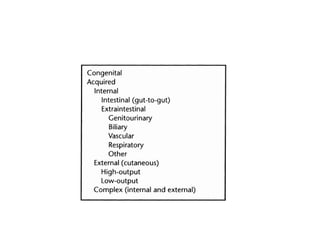
  – organ system
  – skin surface
  – GI tract itself
• The majority of external (cutaneous)
  fistulas represent a complication of recent
  abdominal surgery

• The leading causes of internal fistulas
  – Crohn disease
  – Diverticulitis
  – Malignancy
  – Complication of treatment
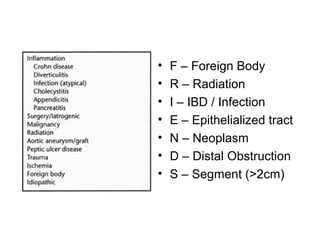
•   F – Foreign Body
•   R – Radiation
•   I – IBD / Infection
•   E – Epithelialized tract
•   N – Neoplasm
•   D – Distal Obstruction
•   S – Segment (>2cm)
• High output fistula are from upper GI tract

• High-output GI fistula discharge more than
  500ml/day

• High-output pancreatic fistula is one which
  produces more than 200 ml/day

• High output fistula
   – more serious metabolic disturbances
   – higher mortality rates
• Spontaneous closure
   –   bowel continuity is maintained
   –   no abscess
   –   adjacent bowel is healthy
   –   no distal obstruction
   –   fistula tract is not epithelialized
   –   not more than 2 cm in length
   –   bowel defect is less than 1 cm in diameter

• Least likely to close with non-operative therapy
   –   gastric
   –   lateral duodenal
   –   ligament of Treitz
   –   ileal fistula
• Nutritional Support
  – Minerals, vitamins, electrolytes
  – Caloric intake (35-45 cal/kg/day)
  – Protein (1.5-1.75 gm/kg/day)
  – TPN
• Recognition and Stabilization
  – fluid resuscitation, electrolytes, acid/base balance,
    control of sepsis, local wound care, nutritional support

• Investigation and Assessment
  – radiological
  – source, nature of tract, bowel continuity, obstruction,
    adjacent bowel, abscess

• Definitive Treatment
  – somatostatin and nutritional support, surgical
    resection +/- diversion

Gastro intestinal fistula

  • 1.
  • 2.
    • Fistulas areabnormal communications between two epithelial-lined surfaces • Gastrointestinal (GI) fistulas represent abnormal ductlike communications between the gut and another epithelial-lined surface – organ system – skin surface – GI tract itself
  • 4.
    • The majorityof external (cutaneous) fistulas represent a complication of recent abdominal surgery • The leading causes of internal fistulas – Crohn disease – Diverticulitis – Malignancy – Complication of treatment
  • 5.
    • F – Foreign Body • R – Radiation • I – IBD / Infection • E – Epithelialized tract • N – Neoplasm • D – Distal Obstruction • S – Segment (>2cm)
  • 6.
    • High outputfistula are from upper GI tract • High-output GI fistula discharge more than 500ml/day • High-output pancreatic fistula is one which produces more than 200 ml/day • High output fistula – more serious metabolic disturbances – higher mortality rates
  • 7.
    • Spontaneous closure – bowel continuity is maintained – no abscess – adjacent bowel is healthy – no distal obstruction – fistula tract is not epithelialized – not more than 2 cm in length – bowel defect is less than 1 cm in diameter • Least likely to close with non-operative therapy – gastric – lateral duodenal – ligament of Treitz – ileal fistula
  • 8.
    • Nutritional Support – Minerals, vitamins, electrolytes – Caloric intake (35-45 cal/kg/day) – Protein (1.5-1.75 gm/kg/day) – TPN
  • 9.
    • Recognition andStabilization – fluid resuscitation, electrolytes, acid/base balance, control of sepsis, local wound care, nutritional support • Investigation and Assessment – radiological – source, nature of tract, bowel continuity, obstruction, adjacent bowel, abscess • Definitive Treatment – somatostatin and nutritional support, surgical resection +/- diversion