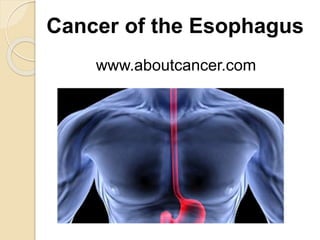
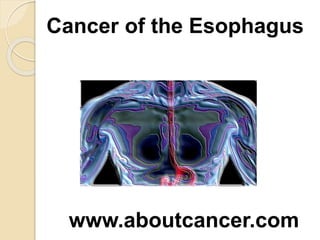
Cancer of the Esophagus 
www.aboutcancer.com
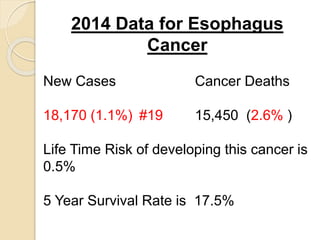
2014 Data for Esophagus 
Cancer 
New Cases Cancer Deaths 
18,170 (1.1%) #19 15,450 (2.6% ) 
Life Time Risk of developing this cancer is 
0.5% 
5 Year Survival Rate is 17.5%
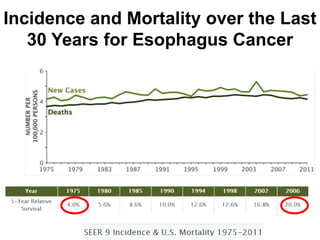
Incidence and Mortality over the Last 
30 Years for Esophagus Cancer
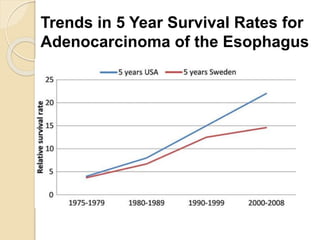
Trends in 5 Year Survival Rates for 
Adenocarcinoma of the Esophagus
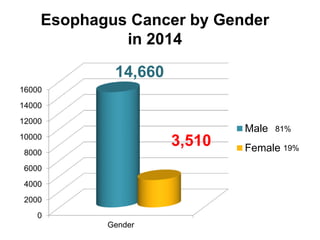
Esophagus Cancer by Gender 
in 2014 
16000 
14000 
12000 
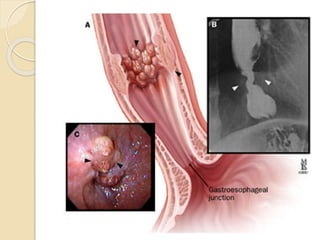
10000 
8000 
6000 
4000 
2000 
0 
Gender 
Male 
Female 
14,660 
3,510 
81% 
19%
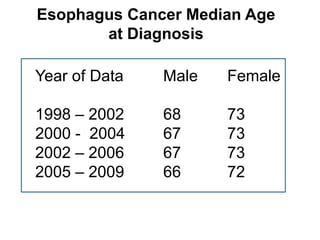
Esophagus Cancer Median Age 
at Diagnosis 
Year of Data Male Female 
1998 – 2002 68 73 
2000 - 2004 67 73 
2002 – 2006 67 73 
2005 – 2009 66 72
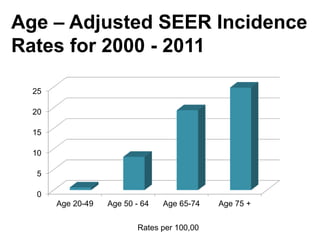
Age – Adjusted SEER Incidence 
Rates for 2000 - 2011 
25 
20 
15 
10 
5 
0 
Age 20-49 Age 50 - 64 Age 65-74 Age 75 + 
Rates per 100,00
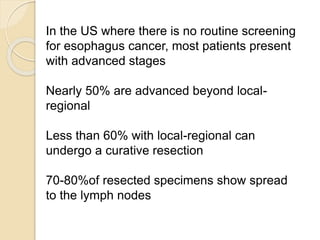
In the US where there is no routine screening 
for esophagus cancer, most patients present 
with advanced stages 
Nearly 50% are advanced beyond local-regional 
Less than 60% with local-regional can 
undergo a curative resection 
70-80%of resected specimens show spread 
to the lymph nodes
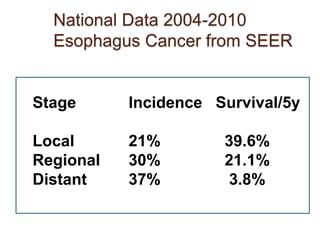
National Data 2004-2010 
Esophagus Cancer from SEER 
Stage Incidence Survival/5y 
Local 21% 39.6% 
Regional 30% 21.1% 
Distant 37% 3.8%
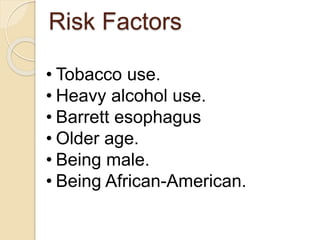
Risk Factors 
• Tobacco use. 
• Heavy alcohol use. 
• Barrett esophagus 
• Older age. 
• Being male. 
• Being African-American.
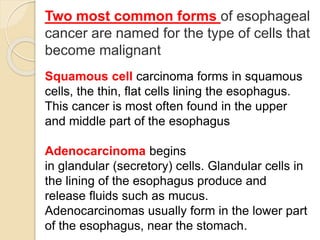
Two most common forms of esophageal 
cancer are named for the type of cells that 
become malignant 
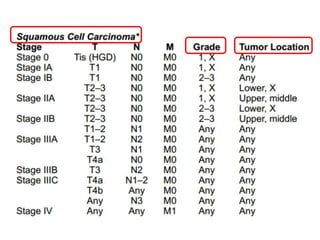
Squamous cell carcinoma forms in squamous 
cells, the thin, flat cells lining the esophagus. 
This cancer is most often found in the upper 
and middle part of the esophagus 
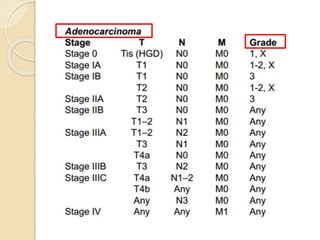
Adenocarcinoma begins 
in glandular (secretory) cells. Glandular cells in 
the lining of the esophagus produce and 
release fluids such as mucus. 
Adenocarcinomas usually form in the lower part 
of the esophagus, near the stomach.
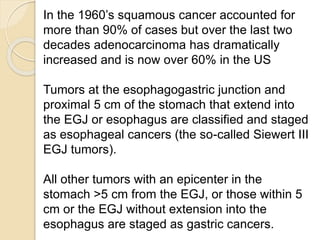
In the 1960’s squamous cancer accounted for 
more than 90% of cases but over the last two 
decades adenocarcinoma has dramatically 
increased and is now over 60% in the US 
Tumors at the esophagogastric junction and 
proximal 5 cm of the stomach that extend into 
the EGJ or esophagus are classified and staged 
as esophageal cancers (the so-called Siewert III 
EGJ tumors). 
All other tumors with an epicenter in the 
stomach >5 cm from the EGJ, or those within 5 
cm or the EGJ without extension into the 
esophagus are staged as gastric cancers.
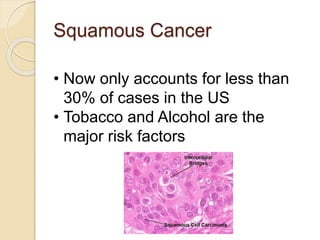
Squamous Cancer 
• Now only accounts for less than 
30% of cases in the US 
• Tobacco and Alcohol are the 
major risk factors
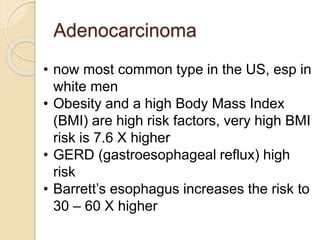
Adenocarcinoma 
• now most common type in the US, esp in 
white men 
• Obesity and a high Body Mass Index 
(BMI) are high risk factors, very high BMI 
risk is 7.6 X higher 
• GERD (gastroesophageal reflux) high 
risk 
• Barrett’s esophagus increases the risk to 
30 – 60 X higher
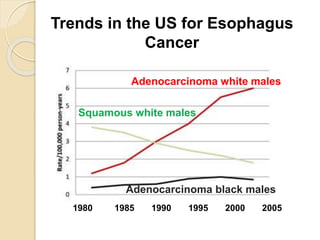
Trends in the US for Esophagus 
Cancer 
Adenocarcinoma white males 
Squamous white males 
Adenocarcinoma black males 
1980 1985 1990 1995 2000 2005
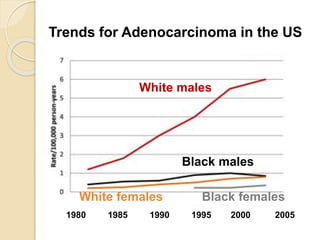
Trends for Adenocarcinoma in the US 
White males 
Black males 
White females Black females 
1980 1985 1990 1995 2000 2005
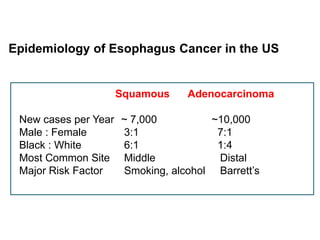
Epidemiology of Esophagus Cancer in the US 
Squamous Adenocarcinoma 
New cases per Year ~ 7,000 ~10,000 
Male : Female 3:1 7:1 
Black : White 6:1 1:4 
Most Common Site Middle Distal 
Major Risk Factor Smoking, alcohol Barrett’s
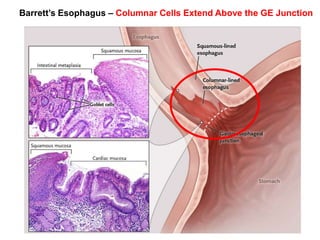
Barrett’s Esophagus – Columnar Cells Extend Above the GE Junction
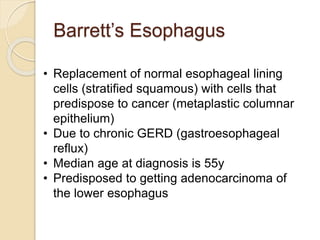
Barrett’s Esophagus 
• Replacement of normal esophageal lining 
cells (stratified squamous) with cells that 
predispose to cancer (metaplastic columnar 
epithelium) 
• Due to chronic GERD (gastroesophageal 
reflux) 
• Median age at diagnosis is 55y 
• Predisposed to getting adenocarcinoma of 
the lower esophagus
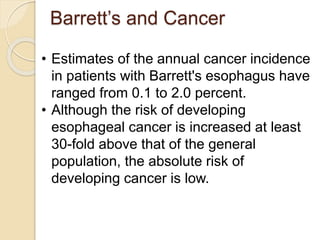
Barrett’s and Cancer 
• Estimates of the annual cancer incidence 
in patients with Barrett's esophagus have 
ranged from 0.1 to 2.0 percent. 
• Although the risk of developing 
esophageal cancer is increased at least 
30-fold above that of the general 
population, the absolute risk of 
developing cancer is low.
Barrett’s and Cancer 
• Cancer incidence was 6.3 per 1000 person-years. 
When only studies with well defined 
criteria for the diagnosis of Barrett's esophagus 
were included, the rate was 5.0 per 1000 
person-years. 
• For high-grade dysplasia the corresponding 
pooled estimate for cancer incidence was 10.2 
per 1000 person-years. 
• The incidence of mortality was 3.0 per 1000 
person-years due to esophageal 
adenocarcinoma and 37.1 per 1000 person-years 
due to other causes.
Screening for Barrett’s from the AGA 
(American Gastroenterological Association) 
Age 50 years or older 
Male sex 
White race 
Chronic GERD 
Hiatal hernia 
Elevated body mass index 
Intra-abdominal distribution of body fat
Screening for Barrett’s from the ACP 
(American College of Physicians) 
In men older than 50y with GERD symptoms 
for more than 5 years plus: 
Nocturnal reflux symptoms 
Hiatus hernia 
Elevated body mass index 
Tobacco use 
Intra-abdominal distribution of fat
Signs and Symptoms of 
Esophagus Cancer 
• Difficulty and pain with swallowing 
• Pressure or burning in the chest 
• Indigestion or heartburn 
• Vomiting 
• Frequent choking on food 
• Unexplained weight loss 
• Coughing or hoarseness 
• Pain behind the breastbone or in the 
throat
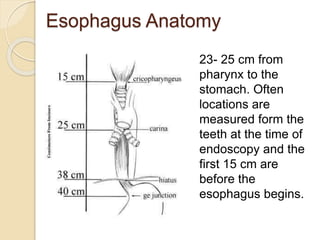
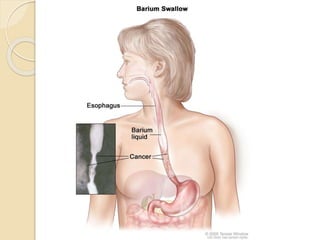
Esophagus Anatomy 
23- 25 cm from 
pharynx to the 
stomach. Often 
locations are 
measured form the 
teeth at the time of 
endoscopy and the 
first 15 cm are 
before the 
esophagus begins.
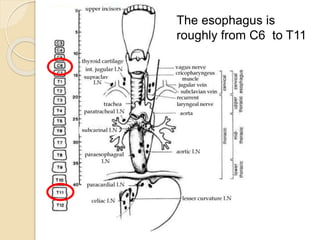
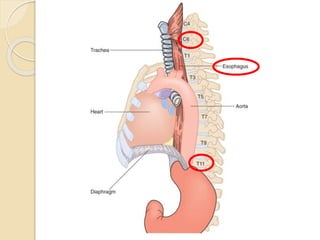
The esophagus is 
roughly from C6 to T11
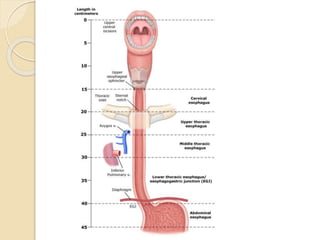
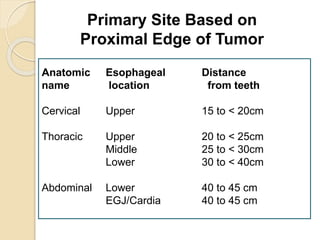
Primary Site Based on 
Proximal Edge of Tumor 
Anatomic Esophageal Distance 
name location from teeth 
Cervical Upper 15 to < 20cm 
Thoracic Upper 20 to < 25cm 
Middle 25 to < 30cm 
Lower 30 to < 40cm 
Abdominal Lower 40 to 45 cm 
EGJ/Cardia 40 to 45 cm
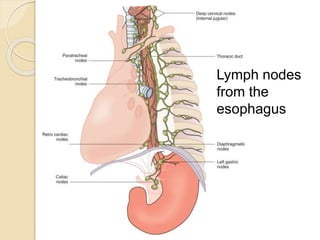
Lymph nodes 
from the 
esophagus
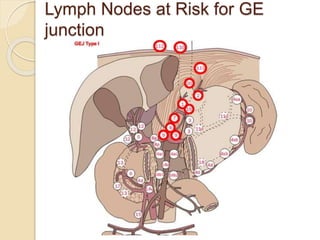
Lymph Nodes at Risk for GE 
junction
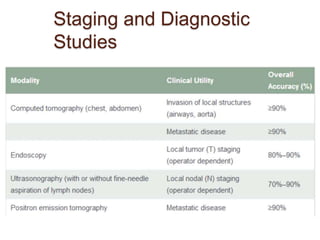
Staging and Diagnostic 
Studies
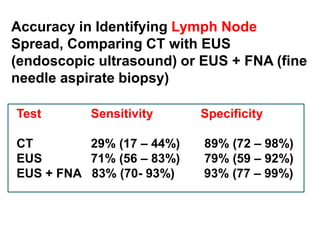
Accuracy in Identifying Lymph Node 
Spread, Comparing CT with EUS 
(endoscopic ultrasound) or EUS + FNA (fine 
needle aspirate biopsy) 
Test Sensitivity Specificity 
CT 29% (17 – 44%) 89% (72 – 98%) 
EUS 71% (56 – 83%) 79% (59 – 92%) 
EUS + FNA 83% (70- 93%) 93% (77 – 99%)
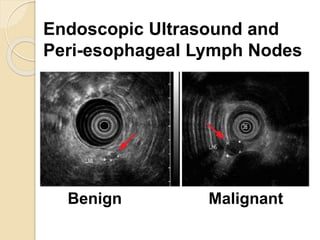
Endoscopic Ultrasound and 
Peri-esophageal Lymph Nodes 
Benign Malignant
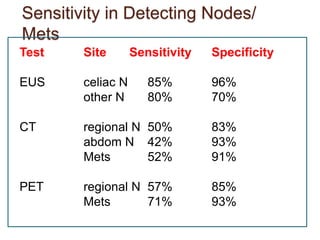
Sensitivity in Detecting Nodes/ 
Mets 
Test Site Sensitivity Specificity 
EUS celiac N 85% 96% 
other N 80% 70% 
CT regional N 50% 83% 
abdom N 42% 93% 
Mets 52% 91% 
PET regional N 57% 85% 
Mets 71% 93%
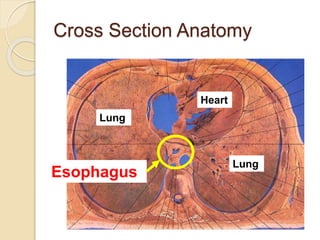
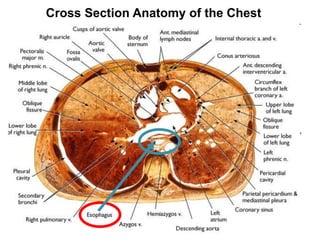
Cross Section Anatomy 
Heart 
Esophagus 
Lung 
Lung
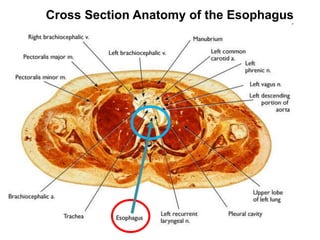
Cross Section Anatomy of the Esophagus
Cross Section Anatomy of the Chest
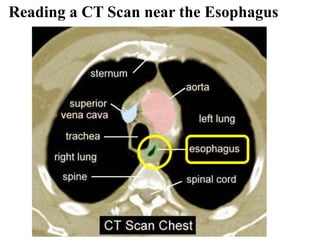
Reading a CT Scan near the Esophagus
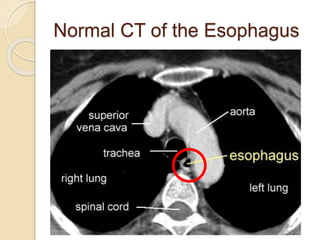
Normal CT of the Esophagus
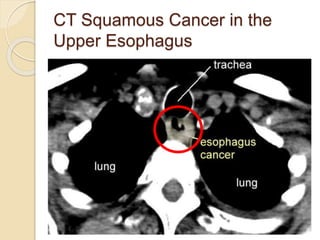
CT Squamous Cancer in the 
Upper Esophagus
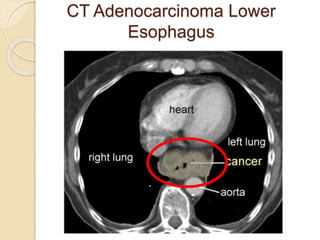
CT Adenocarcinoma Lower 
Esophagus
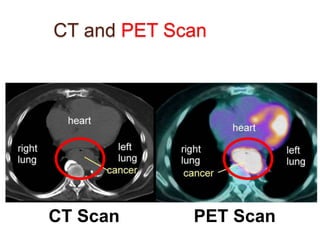
CT and PET Scan 
CT Scan PET Scan
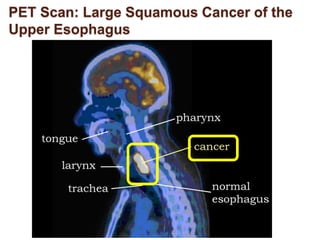
PET Scan: Large Squamous Cancer of the 
Upper Esophagus
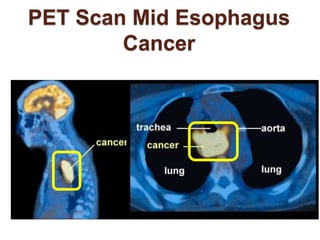
PET Scan Mid Esophagus 
Cancer
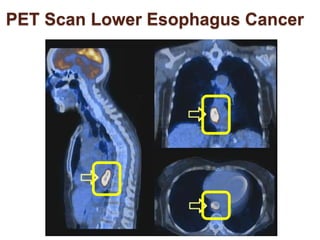
PET Scan Lower Esophagus Cancer
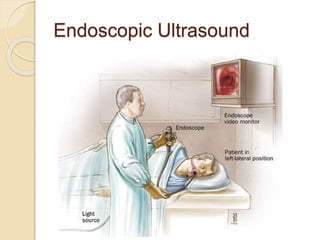
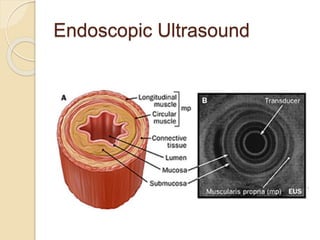
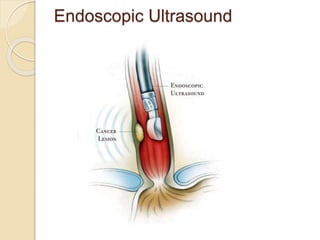
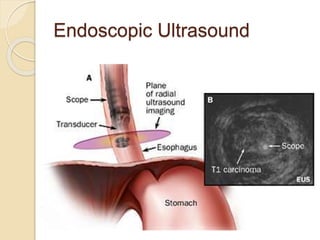
Endoscopic Ultrasound
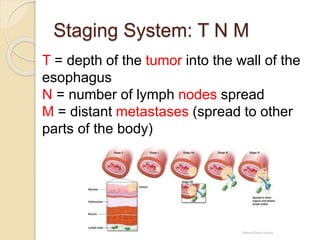
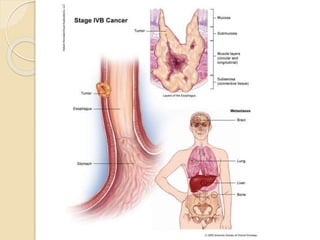
Staging System: T N M 
T = depth of the tumor into the wall of the 
esophagus 
N = number of lymph nodes spread 
M = distant metastases (spread to other 
parts of the body)
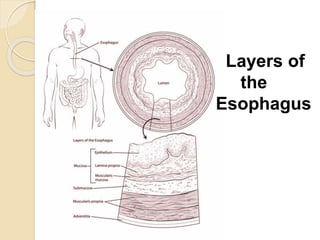
Layers of 
the 
Esophagus
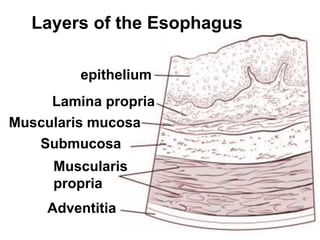
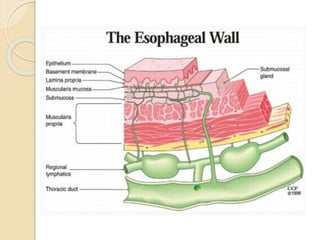
Layers of the Esophagus 
epithelium 
Lamina propria 
Muscularis mucosa 
Submucosa 
Muscularis 
propria 
Adventitia
Layers of the Esophagus 
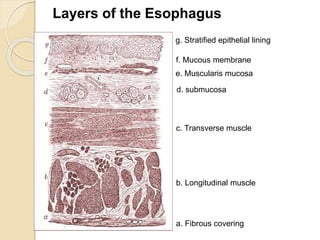
g. Stratified epithelial lining 
f. Mucous membrane 
e. Muscularis mucosa 
d. submucosa 
c. Transverse muscle 
b. Longitudinal muscle 
a. Fibrous covering
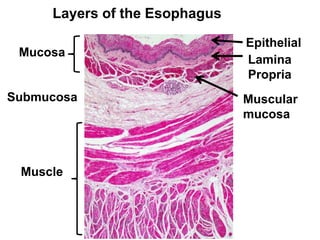
Layers of the Esophagus 
Mucosa 
Submucosa 
Muscle 
Epithelial 
Lamina 
Propria 
Muscular 
mucosa
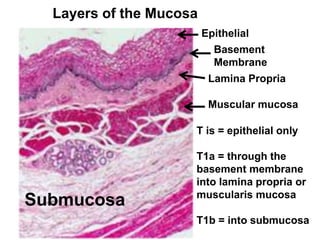
Epithelial 
Basement 
Membrane 
Lamina Propria 
Muscular mucosa 
Layers of the Mucosa 
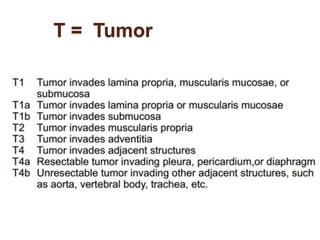
T is = epithelial only 
T1a = through the 
basement membrane 
into lamina propria or 
muscularis mucosa 
T1b = into submucosa 
Submucosa
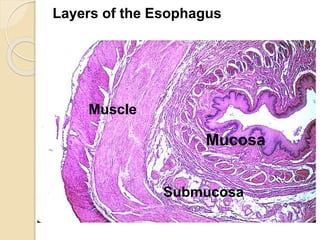
Layers of the Esophagus 
Muscle 
Mucosa 
Submucosa
T = Tumor
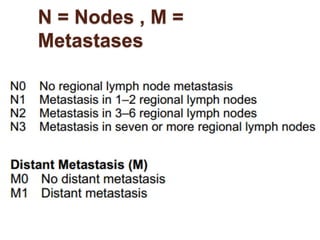
N = Nodes , M = 
Metastases
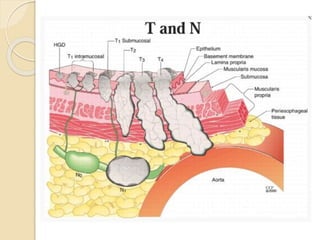
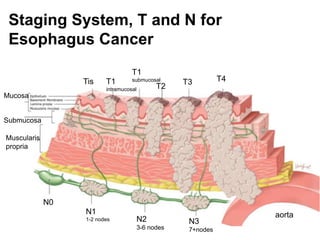
Staging System, T and N for 
Esophagus Cancer 
Tis T1 
T1 
submucosal 
intramucosal 
aorta 
T3 T4 
T2 
N0 
N1 
1-2 nodes 
Mucosa 
N2 
3-6 nodes 
N3 
7+nodes 
Submucosa 
Muscularis 
propria
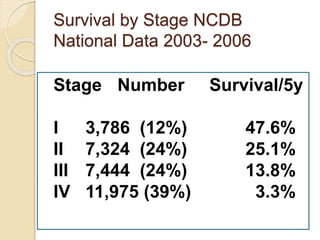
Survival by Stage NCDB 
National Data 2003- 2006 
Stage Number Survival/5y 
I 3,786 (12%) 47.6% 
II 7,324 (24%) 25.1% 
III 7,444 (24%) 13.8% 
IV 11,975 (39%) 3.3%
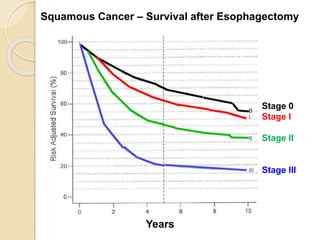
Squamous Cancer – Survival after Esophagectomy 
Years 
Stage 0 
Stage I 
Stage II 
Stage III
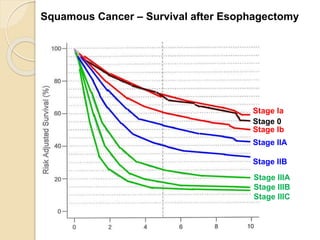
Squamous Cancer – Survival after Esophagectomy 
Stage Ia 
Stage 0 
Stage Ib 
Stage IIA 
Stage IIB 
Stage IIIA 
Stage IIIB 
Stage IIIC
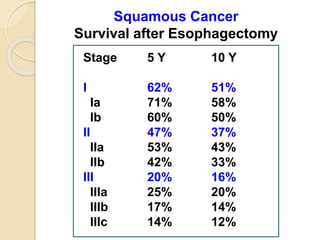
Squamous Cancer 
Survival after Esophagectomy 
Stage 5 Y 10 Y 
I 62% 51% 
Ia 71% 58% 
Ib 60% 50% 
II 47% 37% 
IIa 53% 43% 
IIb 42% 33% 
III 20% 16% 
IIIa 25% 20% 
IIIb 17% 14% 
IIIc 14% 12%
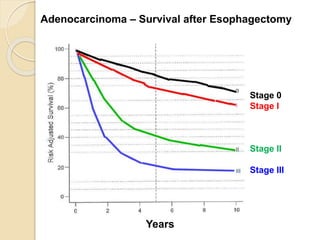
Adenocarcinoma – Survival after Esophagectomy 
Years 
Stage 0 
Stage I 
Stage II 
Stage III
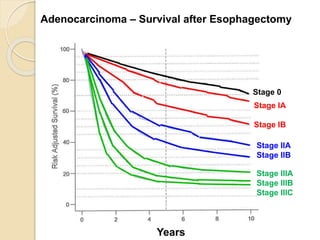
Adenocarcinoma – Survival after Esophagectomy 
Years 
Stage 0 
Stage IA 
Stage IB 
Stage IIA 
Stage IIB 
Stage IIIA 
Stage IIIB 
Stage IIIC
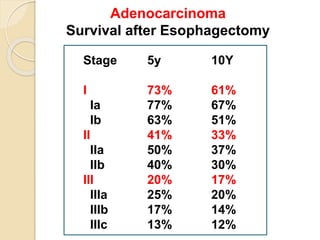
Adenocarcinoma 
Survival after Esophagectomy 
Stage 5y 10Y 
I 73% 61% 
Ia 77% 67% 
Ib 63% 51% 
II 41% 33% 
IIa 50% 37% 
IIb 40% 30% 
III 20% 17% 
IIIa 25% 20% 
IIIb 17% 14% 
IIIc 13% 12%
Cancer of the Esophagus 
www.aboutcancer.com

Esophagus cancer

  • 1.
    Cancer of theEsophagus www.aboutcancer.com
  • 2.
    2014 Data forEsophagus Cancer New Cases Cancer Deaths 18,170 (1.1%) #19 15,450 (2.6% ) Life Time Risk of developing this cancer is 0.5% 5 Year Survival Rate is 17.5%
  • 3.
    Incidence and Mortalityover the Last 30 Years for Esophagus Cancer
  • 4.
    Trends in 5Year Survival Rates for Adenocarcinoma of the Esophagus
  • 5.
    Esophagus Cancer byGender in 2014 16000 14000 12000 10000 8000 6000 4000 2000 0 Gender Male Female 14,660 3,510 81% 19%
  • 6.
    Esophagus Cancer MedianAge at Diagnosis Year of Data Male Female 1998 – 2002 68 73 2000 - 2004 67 73 2002 – 2006 67 73 2005 – 2009 66 72
  • 7.
    Age – AdjustedSEER Incidence Rates for 2000 - 2011 25 20 15 10 5 0 Age 20-49 Age 50 - 64 Age 65-74 Age 75 + Rates per 100,00
  • 8.
    In the USwhere there is no routine screening for esophagus cancer, most patients present with advanced stages Nearly 50% are advanced beyond local-regional Less than 60% with local-regional can undergo a curative resection 70-80%of resected specimens show spread to the lymph nodes
  • 9.
    National Data 2004-2010 Esophagus Cancer from SEER Stage Incidence Survival/5y Local 21% 39.6% Regional 30% 21.1% Distant 37% 3.8%
  • 10.
    Risk Factors •Tobacco use. • Heavy alcohol use. • Barrett esophagus • Older age. • Being male. • Being African-American.
  • 11.
    Two most commonforms of esophageal cancer are named for the type of cells that become malignant Squamous cell carcinoma forms in squamous cells, the thin, flat cells lining the esophagus. This cancer is most often found in the upper and middle part of the esophagus Adenocarcinoma begins in glandular (secretory) cells. Glandular cells in the lining of the esophagus produce and release fluids such as mucus. Adenocarcinomas usually form in the lower part of the esophagus, near the stomach.
  • 12.
    In the 1960’ssquamous cancer accounted for more than 90% of cases but over the last two decades adenocarcinoma has dramatically increased and is now over 60% in the US Tumors at the esophagogastric junction and proximal 5 cm of the stomach that extend into the EGJ or esophagus are classified and staged as esophageal cancers (the so-called Siewert III EGJ tumors). All other tumors with an epicenter in the stomach >5 cm from the EGJ, or those within 5 cm or the EGJ without extension into the esophagus are staged as gastric cancers.
  • 13.
    Squamous Cancer •Now only accounts for less than 30% of cases in the US • Tobacco and Alcohol are the major risk factors
  • 14.
    Adenocarcinoma • nowmost common type in the US, esp in white men • Obesity and a high Body Mass Index (BMI) are high risk factors, very high BMI risk is 7.6 X higher • GERD (gastroesophageal reflux) high risk • Barrett’s esophagus increases the risk to 30 – 60 X higher
  • 15.
    Trends in theUS for Esophagus Cancer Adenocarcinoma white males Squamous white males Adenocarcinoma black males 1980 1985 1990 1995 2000 2005
  • 16.
    Trends for Adenocarcinomain the US White males Black males White females Black females 1980 1985 1990 1995 2000 2005
  • 17.
    Epidemiology of EsophagusCancer in the US Squamous Adenocarcinoma New cases per Year ~ 7,000 ~10,000 Male : Female 3:1 7:1 Black : White 6:1 1:4 Most Common Site Middle Distal Major Risk Factor Smoking, alcohol Barrett’s
  • 18.
    Barrett’s Esophagus –Columnar Cells Extend Above the GE Junction
  • 19.
    Barrett’s Esophagus •Replacement of normal esophageal lining cells (stratified squamous) with cells that predispose to cancer (metaplastic columnar epithelium) • Due to chronic GERD (gastroesophageal reflux) • Median age at diagnosis is 55y • Predisposed to getting adenocarcinoma of the lower esophagus
  • 20.
    Barrett’s and Cancer • Estimates of the annual cancer incidence in patients with Barrett's esophagus have ranged from 0.1 to 2.0 percent. • Although the risk of developing esophageal cancer is increased at least 30-fold above that of the general population, the absolute risk of developing cancer is low.
  • 21.
    Barrett’s and Cancer • Cancer incidence was 6.3 per 1000 person-years. When only studies with well defined criteria for the diagnosis of Barrett's esophagus were included, the rate was 5.0 per 1000 person-years. • For high-grade dysplasia the corresponding pooled estimate for cancer incidence was 10.2 per 1000 person-years. • The incidence of mortality was 3.0 per 1000 person-years due to esophageal adenocarcinoma and 37.1 per 1000 person-years due to other causes.
  • 22.
    Screening for Barrett’sfrom the AGA (American Gastroenterological Association) Age 50 years or older Male sex White race Chronic GERD Hiatal hernia Elevated body mass index Intra-abdominal distribution of body fat
  • 23.
    Screening for Barrett’sfrom the ACP (American College of Physicians) In men older than 50y with GERD symptoms for more than 5 years plus: Nocturnal reflux symptoms Hiatus hernia Elevated body mass index Tobacco use Intra-abdominal distribution of fat
  • 24.
    Signs and Symptomsof Esophagus Cancer • Difficulty and pain with swallowing • Pressure or burning in the chest • Indigestion or heartburn • Vomiting • Frequent choking on food • Unexplained weight loss • Coughing or hoarseness • Pain behind the breastbone or in the throat
  • 25.
    Esophagus Anatomy 23-25 cm from pharynx to the stomach. Often locations are measured form the teeth at the time of endoscopy and the first 15 cm are before the esophagus begins.
  • 26.
    The esophagus is roughly from C6 to T11
  • 29.
    Primary Site Basedon Proximal Edge of Tumor Anatomic Esophageal Distance name location from teeth Cervical Upper 15 to < 20cm Thoracic Upper 20 to < 25cm Middle 25 to < 30cm Lower 30 to < 40cm Abdominal Lower 40 to 45 cm EGJ/Cardia 40 to 45 cm
  • 30.
    Lymph nodes fromthe esophagus
  • 31.
    Lymph Nodes atRisk for GE junction
  • 33.
  • 34.
    Accuracy in IdentifyingLymph Node Spread, Comparing CT with EUS (endoscopic ultrasound) or EUS + FNA (fine needle aspirate biopsy) Test Sensitivity Specificity CT 29% (17 – 44%) 89% (72 – 98%) EUS 71% (56 – 83%) 79% (59 – 92%) EUS + FNA 83% (70- 93%) 93% (77 – 99%)
  • 35.
    Endoscopic Ultrasound and Peri-esophageal Lymph Nodes Benign Malignant
  • 36.
    Sensitivity in DetectingNodes/ Mets Test Site Sensitivity Specificity EUS celiac N 85% 96% other N 80% 70% CT regional N 50% 83% abdom N 42% 93% Mets 52% 91% PET regional N 57% 85% Mets 71% 93%
  • 41.
    Cross Section Anatomy Heart Esophagus Lung Lung
  • 42.
    Cross Section Anatomyof the Esophagus
  • 43.
  • 44.
    Reading a CTScan near the Esophagus
  • 45.
    Normal CT ofthe Esophagus
  • 46.
    CT Squamous Cancerin the Upper Esophagus
  • 47.
  • 48.
    CT and PETScan CT Scan PET Scan
  • 49.
    PET Scan: LargeSquamous Cancer of the Upper Esophagus
  • 50.
    PET Scan MidEsophagus Cancer
  • 51.
    PET Scan LowerEsophagus Cancer
  • 52.
  • 53.
  • 54.
  • 55.
  • 56.
    Staging System: TN M T = depth of the tumor into the wall of the esophagus N = number of lymph nodes spread M = distant metastases (spread to other parts of the body)
  • 57.
    Layers of the Esophagus
  • 58.
    Layers of theEsophagus epithelium Lamina propria Muscularis mucosa Submucosa Muscularis propria Adventitia
  • 59.
    Layers of theEsophagus g. Stratified epithelial lining f. Mucous membrane e. Muscularis mucosa d. submucosa c. Transverse muscle b. Longitudinal muscle a. Fibrous covering
  • 60.
    Layers of theEsophagus Mucosa Submucosa Muscle Epithelial Lamina Propria Muscular mucosa
  • 61.
    Epithelial Basement Membrane Lamina Propria Muscular mucosa Layers of the Mucosa T is = epithelial only T1a = through the basement membrane into lamina propria or muscularis mucosa T1b = into submucosa Submucosa
  • 62.
    Layers of theEsophagus Muscle Mucosa Submucosa
  • 64.
  • 65.
    N = Nodes, M = Metastases
  • 67.
    Staging System, Tand N for Esophagus Cancer Tis T1 T1 submucosal intramucosal aorta T3 T4 T2 N0 N1 1-2 nodes Mucosa N2 3-6 nodes N3 7+nodes Submucosa Muscularis propria
  • 76.
    Survival by StageNCDB National Data 2003- 2006 Stage Number Survival/5y I 3,786 (12%) 47.6% II 7,324 (24%) 25.1% III 7,444 (24%) 13.8% IV 11,975 (39%) 3.3%
  • 77.
    Squamous Cancer –Survival after Esophagectomy Years Stage 0 Stage I Stage II Stage III
  • 78.
    Squamous Cancer –Survival after Esophagectomy Stage Ia Stage 0 Stage Ib Stage IIA Stage IIB Stage IIIA Stage IIIB Stage IIIC
  • 79.
    Squamous Cancer Survivalafter Esophagectomy Stage 5 Y 10 Y I 62% 51% Ia 71% 58% Ib 60% 50% II 47% 37% IIa 53% 43% IIb 42% 33% III 20% 16% IIIa 25% 20% IIIb 17% 14% IIIc 14% 12%
  • 80.
    Adenocarcinoma – Survivalafter Esophagectomy Years Stage 0 Stage I Stage II Stage III
  • 81.
    Adenocarcinoma – Survivalafter Esophagectomy Years Stage 0 Stage IA Stage IB Stage IIA Stage IIB Stage IIIA Stage IIIB Stage IIIC
  • 82.
    Adenocarcinoma Survival afterEsophagectomy Stage 5y 10Y I 73% 61% Ia 77% 67% Ib 63% 51% II 41% 33% IIa 50% 37% IIb 40% 30% III 20% 17% IIIa 25% 20% IIIb 17% 14% IIIc 13% 12%
  • 83.
    Cancer of theEsophagus www.aboutcancer.com