
Gastric outlet obstruction
Sunil Kumar Daha
• May be pre-pyloric, pyloric or duodenal
• Most commonly associated with
Long standing peptic ulcer disease (Pyloric stenosis)
Gastric cancer
• Nowadays, Crohn’s disease , external compression from a pancreatic
carcinoma are being common causes
Introduction
Causes
Children
• Idiopathic hypertrophic Pyloric
stenosis (IHPS)
• Gastric volvolus
• Hiatal hernia
• Antral web
• Gastric duplication
• Polyps
• Neoplasm
• Malrotation
Adult
• Gastric carcinoma
• Pyloric stenosis secondary to
Peptic ulcer disease
• Crohn’s disease
• Pancreatitis
• Large gastric polyps
• Gastric tuberculosis
• Gastric volvolus
• Pyloric mucosal diaphragm
• Trichobezoar/phytobezoar
Pyloric stenosis
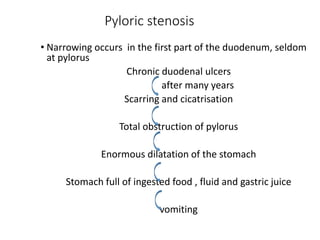
• Narrowing occurs in the first part of the duodenum, seldom
at pylorus
Chronic duodenal ulcers
after many years
Scarring and cicatrisation
Total obstruction of pylorus
Enormous dilatation of the stomach
Stomach full of ingested food , fluid and gastric juice
vomiting
Clinical features
History
• Long h/o peptic ulcer disease
• Pain
persistent in epigastric region , radiates from above and left of umbilicus to the
LIF
often with feeling of fullness ,
within1/2 hr of food intake
loss of periodicity
Contd…
• Vomiting – large quantity, foul smelling and frothy vomitus
 partially digested or non-digested food ,non-bilious
• Hematemesis or malaena may occur
• Loss of appetite and weight
Clinical features
On examination
• Patient appear unwell and dehydrated
• Confused status d/t alkalosis and electrolyte changes
• Visible gastric peristalsis- from left  right , elicited by
asking the pt. to drink a cup of water pathognnomonic
• Positive succussion splash – on shaking pt’s abdomen
• On auscultation and persussion – dilated stomach ( the
greater curvature lies below the level of umbilicus here)
Metabolic Effects
• Vomiting of HCl → Hypochloraemic alkalosis→
Progression of dehydration→ Metabolic abnormalities
related to the renal function
• HCO3 excreted along with Na+ → Hyponatremia and
profound dehydration → Na+ retention with K+ and H+
excretion → Urine acidic → Metabolic Alkalosis and
Hypokalaemia → Hypocalcaemia → Tetany
Investigation
• Laboratory:
Sodium, Potassium, Urea, Creatinine
CBC (TC, DC, Hematocrit)
• Abdominal X-ray
• USG/ CT scan
• Endoscopy and biopsy – to rule out gastric Ca and view
stenosed area
• Barium meal study
• Endoscopic ultrasound
• ECG – for hypokalemia
Management
• Involves
Correcting the metabolic abnormality
Dealing with the mechanical problem
• Addressing the electrolyte abnormality
Rehydration with IV isotonic saline with K
supplementation
NaCl and water replacement  to allow kidney to correct
acid-base abnormality
Ca ,K and Mg supplementation
Blood transfusion if pt is anemic
Management contd…..
• Stomach should be emptied using wide bore gastric tube
and lavage the stomach till completely emptied
This allows investigation of patient with endoscopy and
contrast radiology
Biopsy around the pylorus to exclude malignancy.
• IV Proton pump inhibitor  decreases gastric secretion
and improves inflammatory response and ensures
absorption
Management contd….
Endoscopic treatment with balloon dilatation
May be useful in early cases
Has complications of perforation and dilatation may have
to be performed several times
may not be successful in long term
Surgery
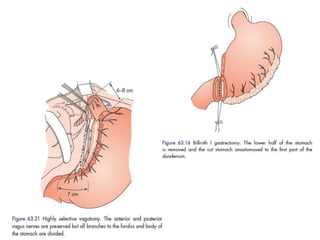
• Highly Selective Vagotomy (HSV) with gastrojejunostomy
technically difficult but better than truncal vagotomy
Maintains the nerve supply of chronically obstructed
antrum
May reduce the chronic emptying problems
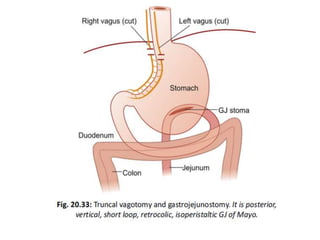
• Truncal vagotomy with gastrojejunostomy of Mayo 
commonly advocated
• Vagotomy ,antrectomy with Billroth I anastomosis with
feeeding jejunostomy for nutrition
Gastric Carcinoma
• It is the most common cause of Gastric Outlet Obstruction in recent
years
• Less metabolic abnormalities due to less acid–base disturbance
16
Risk Factors for Stomach Cancer
• H. pylori infection – Ca. distal stomach or body of stomach
• Pt. with peptic ulcer surgery
• Reflux gastritis
• Smoking or dust ingestion
• Obesity Proximal gastric cancer (Higher socio-economic groups)
17
Distribution of Gastric Cancer
18
Clinical Features
• In early stage no specific sign and symptoms
• Late features include:
• Dyspepsia
• Vomiting
• Early satiety
• Bloating
• Distension
• Iron deficiency anemia
• Obstruction leads to dysphagia or Epigastric fullness
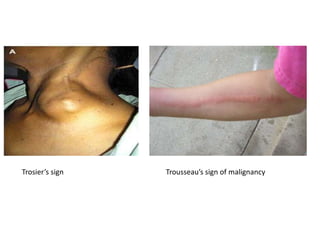
• Virchow’s node enlarged
• Thrombophlebitis: Trousseau’s sign positive
• Deep Vein Thrombosis
Trosier’s sign Trousseau’s sign of malignancy
Comparing….
Pathology
• Early Gastric Cancer
• Cancer limited to mucosa and submucosa
• With or without lymph node involvement
• Can be either protruding, superficial or excavated
• Late Gastric Cancer
• Involves muscularis externa
Spread of carcinoma of stomach
• Distant spread
• Unusual before disease spreads locally
• Uncommon in the absence of lymph node metastasis
• Routes of spread
• Direct spread: penetrates muscularis, serosa and untimately adjacent organs
like pancreas, colon, liver
• Lymphatic Spread:
• Antrum
• right gastric lymph nodes superiorly
• gastroepiploic and subpyloric lymph nodes inferiorly
• Pylorus-
• right gastric suprapyloric lymph nodes superiorly
• subpyloric lymph nodes inferiorly
• Suprapyloric→paraaortic
• Subpyloric → superior mesenteric lymph nodes
• Tumor can appear in supraclavicular lymph node (Troisier’s sign)
• Nodal involvement does not imply systemic dissemination
Contd…
• Blood- borne metastasis
• First to liver than to other organs like lungs and bone
• Uncommon without nodal involvement
• Trans peritoneal Spread
• Common mode of spread once tumor reached serosa of stomach and
indicates incurability
• Ovaries may also be involved sometimes (Krukenberg’s tumors)
Management
• Total gastrectomy (Esophagojejunostomy)
• Proximal Tumor and Mid-body Tumor
• Subtotal
• Distally placed tumor
• Proximal stomach preserved
• Post-operative Complications
• Immediate : Bleeding
• Early : Leakage, Secondary Hemorrhage
• Late :Fistula, Septic collection, nutritional deficiency
Management: Others
• Radiotherapy
• Radiosensitive tissue in gastric bed which limits the dose, so
not much effective
• Role in palliative treatment
• Chemotherapy
• Respond well to combined cytotoxic chemotherapy and neo-
adjuvant chemotherapy
• Palliative surgery
• In patient with significant symptoms of either obstruction or bleeding
• Remove the tumor and reconstruct the gastrointestinal tract
Palliative Surgery
• High gastroenterostomy
• Roux loop with a wide anastomosis between the stomach and
jejunum
• Gastric exclusion and Oesophagojejunostomy.
• Inoperable tumors situated in the cardia : palliative intubation, stenting or another
form of recanalisation
The end
References
• Bailey and Love’s Short Practice of Surgery; 26th Edition
• SRB’s manual of surgery; 5th edition

Gastrci outlet obstruction

  • 1.
  • 2.
    • May bepre-pyloric, pyloric or duodenal • Most commonly associated with Long standing peptic ulcer disease (Pyloric stenosis) Gastric cancer • Nowadays, Crohn’s disease , external compression from a pancreatic carcinoma are being common causes Introduction
  • 3.
    Causes Children • Idiopathic hypertrophicPyloric stenosis (IHPS) • Gastric volvolus • Hiatal hernia • Antral web • Gastric duplication • Polyps • Neoplasm • Malrotation Adult • Gastric carcinoma • Pyloric stenosis secondary to Peptic ulcer disease • Crohn’s disease • Pancreatitis • Large gastric polyps • Gastric tuberculosis • Gastric volvolus • Pyloric mucosal diaphragm • Trichobezoar/phytobezoar
  • 4.
    Pyloric stenosis • Narrowingoccurs in the first part of the duodenum, seldom at pylorus Chronic duodenal ulcers after many years Scarring and cicatrisation Total obstruction of pylorus Enormous dilatation of the stomach Stomach full of ingested food , fluid and gastric juice vomiting
  • 5.
    Clinical features History • Longh/o peptic ulcer disease • Pain persistent in epigastric region , radiates from above and left of umbilicus to the LIF often with feeling of fullness , within1/2 hr of food intake loss of periodicity
  • 6.
    Contd… • Vomiting –large quantity, foul smelling and frothy vomitus  partially digested or non-digested food ,non-bilious • Hematemesis or malaena may occur • Loss of appetite and weight
  • 7.
    Clinical features On examination •Patient appear unwell and dehydrated • Confused status d/t alkalosis and electrolyte changes • Visible gastric peristalsis- from left  right , elicited by asking the pt. to drink a cup of water pathognnomonic • Positive succussion splash – on shaking pt’s abdomen • On auscultation and persussion – dilated stomach ( the greater curvature lies below the level of umbilicus here)
  • 8.
    Metabolic Effects • Vomitingof HCl → Hypochloraemic alkalosis→ Progression of dehydration→ Metabolic abnormalities related to the renal function • HCO3 excreted along with Na+ → Hyponatremia and profound dehydration → Na+ retention with K+ and H+ excretion → Urine acidic → Metabolic Alkalosis and Hypokalaemia → Hypocalcaemia → Tetany
  • 9.
    Investigation • Laboratory: Sodium, Potassium,Urea, Creatinine CBC (TC, DC, Hematocrit) • Abdominal X-ray • USG/ CT scan • Endoscopy and biopsy – to rule out gastric Ca and view stenosed area • Barium meal study • Endoscopic ultrasound • ECG – for hypokalemia
  • 10.
    Management • Involves Correcting themetabolic abnormality Dealing with the mechanical problem • Addressing the electrolyte abnormality Rehydration with IV isotonic saline with K supplementation NaCl and water replacement  to allow kidney to correct acid-base abnormality Ca ,K and Mg supplementation Blood transfusion if pt is anemic
  • 11.
    Management contd….. • Stomachshould be emptied using wide bore gastric tube and lavage the stomach till completely emptied This allows investigation of patient with endoscopy and contrast radiology Biopsy around the pylorus to exclude malignancy. • IV Proton pump inhibitor  decreases gastric secretion and improves inflammatory response and ensures absorption
  • 12.
    Management contd…. Endoscopic treatmentwith balloon dilatation May be useful in early cases Has complications of perforation and dilatation may have to be performed several times may not be successful in long term
  • 13.
    Surgery • Highly SelectiveVagotomy (HSV) with gastrojejunostomy technically difficult but better than truncal vagotomy Maintains the nerve supply of chronically obstructed antrum May reduce the chronic emptying problems • Truncal vagotomy with gastrojejunostomy of Mayo  commonly advocated • Vagotomy ,antrectomy with Billroth I anastomosis with feeeding jejunostomy for nutrition
  • 16.
    Gastric Carcinoma • Itis the most common cause of Gastric Outlet Obstruction in recent years • Less metabolic abnormalities due to less acid–base disturbance 16
  • 17.
    Risk Factors forStomach Cancer • H. pylori infection – Ca. distal stomach or body of stomach • Pt. with peptic ulcer surgery • Reflux gastritis • Smoking or dust ingestion • Obesity Proximal gastric cancer (Higher socio-economic groups) 17
  • 18.
  • 19.
    Clinical Features • Inearly stage no specific sign and symptoms • Late features include: • Dyspepsia • Vomiting • Early satiety • Bloating • Distension • Iron deficiency anemia • Obstruction leads to dysphagia or Epigastric fullness • Virchow’s node enlarged • Thrombophlebitis: Trousseau’s sign positive • Deep Vein Thrombosis
  • 20.
  • 21.
  • 22.
    Pathology • Early GastricCancer • Cancer limited to mucosa and submucosa • With or without lymph node involvement • Can be either protruding, superficial or excavated • Late Gastric Cancer • Involves muscularis externa
  • 23.
    Spread of carcinomaof stomach • Distant spread • Unusual before disease spreads locally • Uncommon in the absence of lymph node metastasis • Routes of spread • Direct spread: penetrates muscularis, serosa and untimately adjacent organs like pancreas, colon, liver
  • 24.
    • Lymphatic Spread: •Antrum • right gastric lymph nodes superiorly • gastroepiploic and subpyloric lymph nodes inferiorly • Pylorus- • right gastric suprapyloric lymph nodes superiorly • subpyloric lymph nodes inferiorly • Suprapyloric→paraaortic • Subpyloric → superior mesenteric lymph nodes • Tumor can appear in supraclavicular lymph node (Troisier’s sign) • Nodal involvement does not imply systemic dissemination
  • 25.
    Contd… • Blood- bornemetastasis • First to liver than to other organs like lungs and bone • Uncommon without nodal involvement • Trans peritoneal Spread • Common mode of spread once tumor reached serosa of stomach and indicates incurability • Ovaries may also be involved sometimes (Krukenberg’s tumors)
  • 26.
    Management • Total gastrectomy(Esophagojejunostomy) • Proximal Tumor and Mid-body Tumor • Subtotal • Distally placed tumor • Proximal stomach preserved • Post-operative Complications • Immediate : Bleeding • Early : Leakage, Secondary Hemorrhage • Late :Fistula, Septic collection, nutritional deficiency
  • 27.
    Management: Others • Radiotherapy •Radiosensitive tissue in gastric bed which limits the dose, so not much effective • Role in palliative treatment • Chemotherapy • Respond well to combined cytotoxic chemotherapy and neo- adjuvant chemotherapy • Palliative surgery • In patient with significant symptoms of either obstruction or bleeding • Remove the tumor and reconstruct the gastrointestinal tract
  • 28.
    Palliative Surgery • Highgastroenterostomy • Roux loop with a wide anastomosis between the stomach and jejunum • Gastric exclusion and Oesophagojejunostomy. • Inoperable tumors situated in the cardia : palliative intubation, stenting or another form of recanalisation The end
  • 29.
    References • Bailey andLove’s Short Practice of Surgery; 26th Edition • SRB’s manual of surgery; 5th edition