SURGERY
GASTRIC CARCINOMA
DR. CHONGO SHAPI (BSc. HB, MBChB)
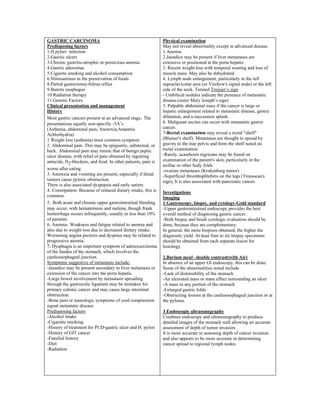
GASTRIC CARCINOMA
Predisposing factors
1.H.pylori infection
2.Gasctic ulcers
3.Chronic gastritis-atrophic or pernicious anemia
4.Gastric adenomas
5.Cigarete smoking and alcohol consumption
6.Nitrosamines in the preservation of foods
8.Partial gastrectomy-bilous reflux
9.Barrets esophagus
10.Radiation therapy
11.Genetic Factors
Clinical presentation and management
History
Most gastric cancers present at an advanced stage. The
presentations equally non-specific -5A’s
(Asthenia, abdominal pain, Anorexia,Anaemia
Achlorhydria)
1.Weight loss (asthenia) most common symptom
2. Abdominal pain .This may be epigastric, substernal, or
back. Abdominal pain may mimic that of benign peptic
ulcer disease, with relief of pain obtained by ingesting
antacids, H2-blockers, and food. In other patients, pain is
worse after eating
3. Anorexia and vomiting are present, especially if distal
tumors cause pyloric obstruction.
There is also associated dyspepsia and early satiety.
4. Constipation- Because of reduced dietary intake, this is
common.
5. Both acute and chronic upper gastrointestinal bleeding
may occur, with hematemesis and melena, though frank
hemorrhage occurs infrequently, usually in less than 10%
of patients.
6. Anemia- Weakness and fatigue related to anemia and
also due to weight loss due to decreased dietary intake.
Worsening angina pectoris and dyspnea may be related to
progressive anemia.
7. Dysphagia is an important symptom of adenocarcinoma
of the fundus of the stomach, which involves the
cardioesophageal junction.
Symptoms suggestive of metastasis include:
-Jaundice may be present secondary to liver metastasis or
extension of the cancer into the porta hepatis.
-Large bowel involvement by metastasis spreading
through the gastrocolic ligament may be mistaken for
primary colonic cancer and may cause large intestinal
obstruction.
-Bone pain or neurologic symptoms of cord compression
signal metastatic disease.
Predisposing factors
-Alcohol intake
-Cigarette smoking
-History of treatment for PUD-gastric ulcer and H. pylori
-History of GIT cancer
-Familial history
-Diet
-Radiation
Physical examination
May not reveal abnormality except in advanced disease.
1.Anemia
2.Jaundice may be present if liver metastases are
extensive or positioned at the porta hepatis
3. Recent weight loss with temporal wasting and loss of
muscle mass. May also be dehydrated
4. Lymph node enlargement, particularly in the left
supraclavicular area (or Virchow's signal node) or the left
side of the neck. Termed Troisier’s sign
- Umbilical nodules indicate the presence of metastatic
disease.(sister Mary Joseph’s sign)
5. Palpable abdominal mass if the cancer is large or
hepatic enlargement related to metastatic disease, gastric
dilatation, and a succussion splash.
6. Malignant ascites can occur with metastatic gastric
cancer.
7-Rectal examination may reveal a rectal "shelf"
(Blumer's shelf). Metastases are thought to spread by
gravity to the true pelvis and form the shelf noted on
rectal examination.
-Rarely, acanthosis nigricans may be found on
examination of the patient's skin, particularly in the
axillae or other body folds.
-ovarian metastases (Krukenberg tumor)
-Superficial thrombophlebitis on the legs (Trousseau's
sign), It is also associated with pancreatic cancer.
Investigations
Imaging
1.Gastroscopy, biopsy, and cytology-Gold standard
-Upper gastrointestinal endoscopy provides the best
overall method of diagnosing gastric cancer.
-Both biopsy and brush cytologic evaluation should be
done, because they are complementary.
In general, the more biopsies obtained, the higher the
diagnostic yield. At least four to six biopsy specimens
should be obtained from each separate lesion for
histology.
2.Barium meal –double contrast(with Air)
In absence of an upper GI endoscopy, this can be done.
Some of the abnormalities noted include
-Lack of distensibility of the stomach
-An ulcerated mass or mass effect surrounding an ulcer
-A mass in any portion of the stomach
-Enlarged gastric folds
-Obstructing lesions at the cardioesophageal junction or at
the pylorus.
3.Endoscopic ultrasonography
Combnes endoscopy and ultrasonography to produce
detailed images of the stomach wall allowing an accurate
assessment of depth of tumor invasion.
It is more accurate in assessing depth of cancer invasion
and also appears to be more accurate in determining
cancer spread to regional lymph nodes.
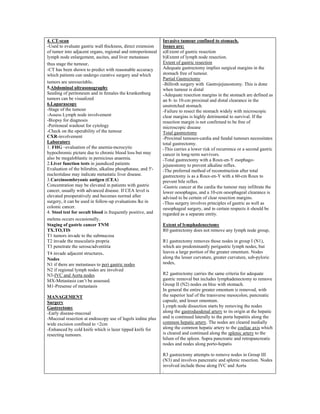
4. CT-scan
-Used to evaluate gastric wall thickness, direct extension
of tumor into adjacent organs, regional and retroperitoneal
lymph node enlargement, ascites, and liver metastases
thus stage the tumour.
-CT has been shown to predict with reasonable accuracy
which patients can undergo curative surgery and which
tumors are unresectable.
5.Abdominal ultrasonography
Seeding of peritoneum and in females the krunkenburg
tumors can be visualized
6.Laparascopy
-Stage of the tumour
-Assess Lymph node involvement
-Biopsy for diagnosis
-Peritoneal washout for cytology
-Check on the operability of the tumour
CXR-involvement
Laboratory
1. FHG –evaluation of the anemia-mcrocytic
hypochromic picture due to chronic blood loss but may
also be megaloblastic in pernicious anaemia.
2.Liver function tests in jaundiced patients
Evaluation of the bilirubin, alkaline phosphatase, and 5'-
nucleotidase may indicate metastatic liver disease.
3.Carcinoembryonic antigen (CEA)
Concentration may be elevated in patients with gastric
cancer, usually with advanced disease. If CEA level is
elevated preoperatively and becomes normal after
surgery, it can be used in follow-up evaluations lke in
colonic cancer.
4. Stool test for occult blood is frequently positive, and
melena occurs occasionally.
Staging of gastric cancer TNM
TX.TO,TIS
T1 tumors invade to the submucosa
T2 invade the muscularis propria
T3 penetrate the serosa/adventitia
T4 invade adjacent structures.
Nodes
N1 if there are metastases to peri gastric nodes
N2 if regional lymph nodes are involved
N3-IVC and Aorta nodes
MX-Metastasis can’t be assessed.
M1-Presense of metastasis
MANAGEMENT
Surgery
Gastrectomy
-Early disease-mucosal
-Mucosal resection at endoscopy use of lugols iodine plus
wide excision confined to <2cm
-Enhanced by cold knife which is lazer tipped knife for
resecting tumours.
Invasive tumour confined to stomach.
Issues are:
a)Extent of gastric resection
b)Extent of lymph node resection.
Extent of gastric resection
Adequate gastrectomy implies surgical margins in the
stomach free of tumour.
Partial Gastrectomy
-Billroth surgery with Gastrojejunostomy. This is done
when tumour is distal
-Adequate resection margins in the stomach are defined as
an 8- to 10-cm proximal and distal clearance in the
unstretched stomach.
-Failure to resect the stomach widely with microscopic
clear margins is highly detrimental to survival. If the
resection margin is not confirmed to be free of
microscopic disease
Total gastrectomy
-Proximal tumours-cardia and fundal tumours necessitates
total gastrectomy.
-This carries a lower risk of recurrence or a second gastric
cancer in long-term survivors.
-Total gastrectomy with a Roux-en-Y esophago-
jejunostomy to prevent alkaline reflux.
-The preferred method of reconstruction after total
gastrectomy is as a Roux-en-Y with a 60-cm Roux to
prevent bile reflux.
-Gastric cancer at the cardia the tumour may infiltrate the
lower oesophagus, and a 10-cm oesophageal clearance is
advised to be certain of clear resection margins.
-Thus surgery involves principles of gastric as well as
oesophageal surgery, and in certain respects it should be
regarded as a separate entity.
Extent of lymphadenectomy
R0 gastrectomy does not remove any lymph node group,
R1 gastrectomy removes those nodes in group I (N1),
which are predominantly perigastric lymph nodes, but
leaves a large portion of the greater omentum. Nodes
along the lesser curvature, greater curvature, sub-pyloric
nodes,
R2 gastrectomy carries the same criteria for adequate
gastric removal but includes lymphadenectomy to remove
Group II (N2) nodes en bloc with stomach.
In general the entire greater omentum is removed, with
the superior leaf of the transverse mesocolon, pancreatic
capsule, and lesser omentum.
Lymph node dissection starts by removing the nodes
along the gastroduodenal artery to its origin at the hepatic
and is continued laterally to the porta hepatitis along the
common hepatic artery. The nodes are cleared medially
along the common hepatic artery to the coeliac axis which
is cleared and continued along the splenic artery to the
hilum of the spleen. Supra pancreatic and retropancreatic
nodes and nodes along porto-hepatis
R3 gastrectomy attempts to remove nodes in Group III
(N3) and involves pancreatic and splenic resection. Nodes
involved include those along IVC and Aorta
.
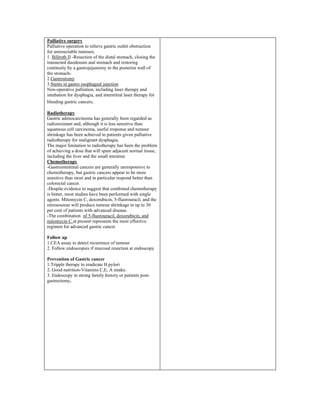
Palliative surgery
Palliative operation to relieve gastric outlet obstruction
for unresectable tumours.
1. Billroth II -Resection of the distal stomach, closing the
transected duodenum and stomach and restoring
continuity by a gastrojejustomy to the posterior wall of
the stomach-
2.Gastrostomy
3.Stents in gastro esophageal junction
Non-operative palliation, including laser therapy and
intubation for dysphagia, and interstitial laser therapy for
bleeding gastric cancers.
Radiotherapy
Gastric adenocarcinoma has generally been regarded as
radioresistant and, although it is less sensitive than
squamous cell carcinoma, useful response and tumour
shrinkage has been achieved in patients given palliative
radiotherapy for malignant dysphagia.
The major limitation to radiotherapy has been the problem
of achieving a dose that will spare adjacent normal tissue,
including the liver and the small intestine
Chemotherapy
-Gastrointestinal cancers are generally unresponsive to
chemotherapy, but gastric cancers appear to be more
sensitive than most and in particular respond better than
colorectal cancer.
-Despite evidence to suggest that combined chemotherapy
is better, most studies have been performed with single
agents. Mitomycin C, doxorubicin, 5-fluorouracil, and the
nitrosoureas will produce tumour shrinkage in up to 30
per cent of patients with advanced disease.
-The combination of 5-fluorouracil, doxorubicin, and
mitomycin C at present represents the most effective
regimen for advanced gastric cancer
Follow up
1.CEA assay to detect recurrence of tumour
2. Follow endoscopies if mucosal resection at endoscopy.
Prevention of Gastric cancer
1.Tripple therapy to eradicate H.pylori
2. Good nutrition-Vitamins C,E, A intake.
3. Endoscopy in strong family history or patients post-
gastrectomy.
GASTRIC CARCINOMA.pdf

GASTRIC CARCINOMA.pdf

  • 1.
  • 2.
    GASTRIC CARCINOMA Predisposing factors 1.H.pyloriinfection 2.Gasctic ulcers 3.Chronic gastritis-atrophic or pernicious anemia 4.Gastric adenomas 5.Cigarete smoking and alcohol consumption 6.Nitrosamines in the preservation of foods 8.Partial gastrectomy-bilous reflux 9.Barrets esophagus 10.Radiation therapy 11.Genetic Factors Clinical presentation and management History Most gastric cancers present at an advanced stage. The presentations equally non-specific -5A’s (Asthenia, abdominal pain, Anorexia,Anaemia Achlorhydria) 1.Weight loss (asthenia) most common symptom 2. Abdominal pain .This may be epigastric, substernal, or back. Abdominal pain may mimic that of benign peptic ulcer disease, with relief of pain obtained by ingesting antacids, H2-blockers, and food. In other patients, pain is worse after eating 3. Anorexia and vomiting are present, especially if distal tumors cause pyloric obstruction. There is also associated dyspepsia and early satiety. 4. Constipation- Because of reduced dietary intake, this is common. 5. Both acute and chronic upper gastrointestinal bleeding may occur, with hematemesis and melena, though frank hemorrhage occurs infrequently, usually in less than 10% of patients. 6. Anemia- Weakness and fatigue related to anemia and also due to weight loss due to decreased dietary intake. Worsening angina pectoris and dyspnea may be related to progressive anemia. 7. Dysphagia is an important symptom of adenocarcinoma of the fundus of the stomach, which involves the cardioesophageal junction. Symptoms suggestive of metastasis include: -Jaundice may be present secondary to liver metastasis or extension of the cancer into the porta hepatis. -Large bowel involvement by metastasis spreading through the gastrocolic ligament may be mistaken for primary colonic cancer and may cause large intestinal obstruction. -Bone pain or neurologic symptoms of cord compression signal metastatic disease. Predisposing factors -Alcohol intake -Cigarette smoking -History of treatment for PUD-gastric ulcer and H. pylori -History of GIT cancer -Familial history -Diet -Radiation Physical examination May not reveal abnormality except in advanced disease. 1.Anemia 2.Jaundice may be present if liver metastases are extensive or positioned at the porta hepatis 3. Recent weight loss with temporal wasting and loss of muscle mass. May also be dehydrated 4. Lymph node enlargement, particularly in the left supraclavicular area (or Virchow's signal node) or the left side of the neck. Termed Troisier’s sign - Umbilical nodules indicate the presence of metastatic disease.(sister Mary Joseph’s sign) 5. Palpable abdominal mass if the cancer is large or hepatic enlargement related to metastatic disease, gastric dilatation, and a succussion splash. 6. Malignant ascites can occur with metastatic gastric cancer. 7-Rectal examination may reveal a rectal "shelf" (Blumer's shelf). Metastases are thought to spread by gravity to the true pelvis and form the shelf noted on rectal examination. -Rarely, acanthosis nigricans may be found on examination of the patient's skin, particularly in the axillae or other body folds. -ovarian metastases (Krukenberg tumor) -Superficial thrombophlebitis on the legs (Trousseau's sign), It is also associated with pancreatic cancer. Investigations Imaging 1.Gastroscopy, biopsy, and cytology-Gold standard -Upper gastrointestinal endoscopy provides the best overall method of diagnosing gastric cancer. -Both biopsy and brush cytologic evaluation should be done, because they are complementary. In general, the more biopsies obtained, the higher the diagnostic yield. At least four to six biopsy specimens should be obtained from each separate lesion for histology. 2.Barium meal –double contrast(with Air) In absence of an upper GI endoscopy, this can be done. Some of the abnormalities noted include -Lack of distensibility of the stomach -An ulcerated mass or mass effect surrounding an ulcer -A mass in any portion of the stomach -Enlarged gastric folds -Obstructing lesions at the cardioesophageal junction or at the pylorus. 3.Endoscopic ultrasonography Combnes endoscopy and ultrasonography to produce detailed images of the stomach wall allowing an accurate assessment of depth of tumor invasion. It is more accurate in assessing depth of cancer invasion and also appears to be more accurate in determining cancer spread to regional lymph nodes.
  • 3.
    4. CT-scan -Used toevaluate gastric wall thickness, direct extension of tumor into adjacent organs, regional and retroperitoneal lymph node enlargement, ascites, and liver metastases thus stage the tumour. -CT has been shown to predict with reasonable accuracy which patients can undergo curative surgery and which tumors are unresectable. 5.Abdominal ultrasonography Seeding of peritoneum and in females the krunkenburg tumors can be visualized 6.Laparascopy -Stage of the tumour -Assess Lymph node involvement -Biopsy for diagnosis -Peritoneal washout for cytology -Check on the operability of the tumour CXR-involvement Laboratory 1. FHG –evaluation of the anemia-mcrocytic hypochromic picture due to chronic blood loss but may also be megaloblastic in pernicious anaemia. 2.Liver function tests in jaundiced patients Evaluation of the bilirubin, alkaline phosphatase, and 5'- nucleotidase may indicate metastatic liver disease. 3.Carcinoembryonic antigen (CEA) Concentration may be elevated in patients with gastric cancer, usually with advanced disease. If CEA level is elevated preoperatively and becomes normal after surgery, it can be used in follow-up evaluations lke in colonic cancer. 4. Stool test for occult blood is frequently positive, and melena occurs occasionally. Staging of gastric cancer TNM TX.TO,TIS T1 tumors invade to the submucosa T2 invade the muscularis propria T3 penetrate the serosa/adventitia T4 invade adjacent structures. Nodes N1 if there are metastases to peri gastric nodes N2 if regional lymph nodes are involved N3-IVC and Aorta nodes MX-Metastasis can’t be assessed. M1-Presense of metastasis MANAGEMENT Surgery Gastrectomy -Early disease-mucosal -Mucosal resection at endoscopy use of lugols iodine plus wide excision confined to <2cm -Enhanced by cold knife which is lazer tipped knife for resecting tumours. Invasive tumour confined to stomach. Issues are: a)Extent of gastric resection b)Extent of lymph node resection. Extent of gastric resection Adequate gastrectomy implies surgical margins in the stomach free of tumour. Partial Gastrectomy -Billroth surgery with Gastrojejunostomy. This is done when tumour is distal -Adequate resection margins in the stomach are defined as an 8- to 10-cm proximal and distal clearance in the unstretched stomach. -Failure to resect the stomach widely with microscopic clear margins is highly detrimental to survival. If the resection margin is not confirmed to be free of microscopic disease Total gastrectomy -Proximal tumours-cardia and fundal tumours necessitates total gastrectomy. -This carries a lower risk of recurrence or a second gastric cancer in long-term survivors. -Total gastrectomy with a Roux-en-Y esophago- jejunostomy to prevent alkaline reflux. -The preferred method of reconstruction after total gastrectomy is as a Roux-en-Y with a 60-cm Roux to prevent bile reflux. -Gastric cancer at the cardia the tumour may infiltrate the lower oesophagus, and a 10-cm oesophageal clearance is advised to be certain of clear resection margins. -Thus surgery involves principles of gastric as well as oesophageal surgery, and in certain respects it should be regarded as a separate entity. Extent of lymphadenectomy R0 gastrectomy does not remove any lymph node group, R1 gastrectomy removes those nodes in group I (N1), which are predominantly perigastric lymph nodes, but leaves a large portion of the greater omentum. Nodes along the lesser curvature, greater curvature, sub-pyloric nodes, R2 gastrectomy carries the same criteria for adequate gastric removal but includes lymphadenectomy to remove Group II (N2) nodes en bloc with stomach. In general the entire greater omentum is removed, with the superior leaf of the transverse mesocolon, pancreatic capsule, and lesser omentum. Lymph node dissection starts by removing the nodes along the gastroduodenal artery to its origin at the hepatic and is continued laterally to the porta hepatitis along the common hepatic artery. The nodes are cleared medially along the common hepatic artery to the coeliac axis which is cleared and continued along the splenic artery to the hilum of the spleen. Supra pancreatic and retropancreatic nodes and nodes along porto-hepatis R3 gastrectomy attempts to remove nodes in Group III (N3) and involves pancreatic and splenic resection. Nodes involved include those along IVC and Aorta .
  • 4.
    Palliative surgery Palliative operationto relieve gastric outlet obstruction for unresectable tumours. 1. Billroth II -Resection of the distal stomach, closing the transected duodenum and stomach and restoring continuity by a gastrojejustomy to the posterior wall of the stomach- 2.Gastrostomy 3.Stents in gastro esophageal junction Non-operative palliation, including laser therapy and intubation for dysphagia, and interstitial laser therapy for bleeding gastric cancers. Radiotherapy Gastric adenocarcinoma has generally been regarded as radioresistant and, although it is less sensitive than squamous cell carcinoma, useful response and tumour shrinkage has been achieved in patients given palliative radiotherapy for malignant dysphagia. The major limitation to radiotherapy has been the problem of achieving a dose that will spare adjacent normal tissue, including the liver and the small intestine Chemotherapy -Gastrointestinal cancers are generally unresponsive to chemotherapy, but gastric cancers appear to be more sensitive than most and in particular respond better than colorectal cancer. -Despite evidence to suggest that combined chemotherapy is better, most studies have been performed with single agents. Mitomycin C, doxorubicin, 5-fluorouracil, and the nitrosoureas will produce tumour shrinkage in up to 30 per cent of patients with advanced disease. -The combination of 5-fluorouracil, doxorubicin, and mitomycin C at present represents the most effective regimen for advanced gastric cancer Follow up 1.CEA assay to detect recurrence of tumour 2. Follow endoscopies if mucosal resection at endoscopy. Prevention of Gastric cancer 1.Tripple therapy to eradicate H.pylori 2. Good nutrition-Vitamins C,E, A intake. 3. Endoscopy in strong family history or patients post- gastrectomy.