GASTRIC OUTLET
OBSTRUCTION
DZVUKE TREVOR T
MBChB V – UNIVERSITY OF ZIMBABWE
10/17/2019
1
OBJECTIVES
 Case
 Definition
 Aetiology
 Pathophysiology
 Clinical presentation
 Metabolic derangements
 Investigations
 Management
10/17/2019
2
DEFINITION
 Gastric outlet obstruction is a spectrum of
diseases that produces mechanical impedance to
gastric emptying.
10/17/2019
3
CASE PRESANTATION
Name: CN
Age: 59
Address: stoneridge
Occupation: soldier
10/17/2019
4
PRESENTING COMPLAINT
 Generalised body weakness X 3months
 Post prandial vomiting X 1 month
 Loss of appetite X 1 month
10/17/2019
5
HISTORY OF PRESENTING COMPLAINT
 Chronically unwell patient
 Presented with post-prandial vomiting for a month.
 He would vomit undigested food about 2 to 4 hours
after a meal
 The vomiting was projectile, non bilious and non
blood stained
 Amounted to 1 cupful
 It was associated with early satiety and loss off
appetite
10/17/2019
6
HPC CONT...
 He reported episodes of passing melena stool but
no diarrhoea and on presentation he had not
been passing stool for the past 6 days
 All this was on a background of generalised body
weakness and significant loss of weight( 59kg to
52 kg)
 Of note is that the patient had a 20 pack year
history of smoking cigarettes and a 25 year
history of drinking alcohol (8u/day)
10/17/2019
7
HPC CONT...
 He did not know his blood group
 No family history of malignancy
 No history of peptic ulcer disease or chronic use
of NSAIDs
10/17/2019
8
SYSTEMS REVIEW
 General: no night sweats. Loss of weight
 CVS : palpitations, no oedema, shortness of breath or
dyspnoea
 Respiratory: no cough, chest pain, haemoptysis,
 GUS: No hematuria, frequency, urgency, dysuria.
 MSS: no muscle or joint pain
 CNS: no loss of consciousness, headaches, dizziness
10/17/2019
9
PAST MEDICAL AND SURGICAL HISTORY
 Index admission was at Mvurwi hospital February 2018 for
generalised body weakness and headache which were
managed and he was transfused 2 units of blood
 3months ago he presented to the physicians at PGH with
the same symptoms
 Transferred to us from the physicians
 No history of other chronic illness
 No history of any surgeries
10/17/2019
10
PAST DRUG HISTORY
 No history of chronic NSAID use
 No known drug allergies
 No history of consumption of caustic chemicals
10/17/2019
11
FAMILY HISTORY
 No family history of malignancy
 No family history of other chronic illnesses
10/17/2019
12
SOCIAL HISTORY
 25 year history of drinking alcohol
 20 pack year history of smoking cigarettes
 Works as a soldier
 Married
 Modern methods of sanitation
10/17/2019
13
SUMMARY
 59 years old male patient who presented
generalised body weakness, profuse postprandial
non bilious vomiting and weight loss. He has no
history of peptic ulcer disease and no personal of
family history of malignancy.
10/17/2019
14
EXAMINATION
 Ill looking and wasted with zygomatic
prominence
 Palmar pallor
 No jaundice, cyanosis or oedema
 No generalised lymphadenopathy
 Negative trossure sign and no Sr Mary Joseph
nodes
10/17/2019
15
ABDOMEN
 I : scaphoid, symmetrical, no masses, no vissible
peristalsis, umbilicus inverted
 P: soft non tender, no palpable masses , no guarding
 P: flank dullness
 A: secussion splash negative, bowel sounds present
 DRE: rectum empty, no bloomer’s shelves
10/17/2019
16
 For this patient an endoscopic biopsy was done
which showed gastric carcinoma – linitis plastica
 Diagnosis was GOO secondary to gastric
malignancy
10/17/2019
17
AETIOLOGY OF GOO
 Causes of gastric outlet obstruction may be divided
into Benign or malignant causes.
 The aetiology has shifted from mostly benign causes
to mostly malignant causes.
 This is due to better medical management of peptic
ulcer disease(PUD)
 And the use of H. pylori erradication therapy.
10/17/2019
18
BENIGN CAUSES
 Peptic ulcer disease (5% of goo pts)
 Pyloric stenosis
 Inflammatory diseases
- pancreatitis
- crohn’s disease
- cholecystitis
 Caustic ingestion
 Strictures
 Tumors
- lipomas
- adenomas
 Post suregical obstruction
 Pancreatic pseudocysts
 bezoars
10/17/2019
19
MALIGNANT CAUSES
 Pancreatic Cancer (commonest – 10 – 20%)
 Duodenal cancer
 Peri-ampulary cancer
 Cholangiocarcinoma
 Gastric cancer
 Metastasis to the gastric outlet
10/17/2019
20
PATHOPHYSIOLOGY
 There is obstruction of the pyloric channel or of the
duodenum
 This may be intrinsic or extrinsic
 As a result, post prandial vomiting is the cardinal
feature
- vomiting is non bilious, projectile with
identifiable undigested food.
 Initially , liquids are better tolerated than solids
 Patients then get significant weight loss due to poor
caloric intake
 Malnutrion is a late feature and is more pronounced in
patients with concomittant malignancy
10/17/2019
21
PATHOPHYSIOLOGY CONT...
 The profound continuous vomiting then leads to
dehydration and eletrolyte imbalances
 When the obstruction persists, patients develop
significant gastric dilatation
- loss of tone of gastric masculature
- gross dilatation
- loss of peristalsis
10/17/2019
22
METABOLIC EFFECTS
 Classically, GOO causes a – hypokalemic,
hypochloraemic metabolic alkalosis with
paradoxical aciduria and hypocalcaemia
 Prolonged vomiting causes loss of hydrochloric acid
and create a hypochloremic metabolic alkalosis
 Dehydration activates the RAAS and this leads to
more Na retention with increases K and H excretion
in the distal tubule – hypokalemic alkalosis
10/17/2019
23
METABOLIC EFFECTS CONT...
 Paradoxical aciduria:
-Initially urine has low Cl and high bicarbonate content (reflecting the
primary metabolic abnnormality)
- the bicarbonate is excreted with Sodium and with time the patient
becomes progressively hyponatremic and more dehydrated
-dehydration leads to sodium retention and K and H are excreted
intead
-this leads to acidic urine
10/17/2019
24
CLINICAL PRESENTATION
 Nausea and vomiting are the cardinal features
 Vomiting is non bilious projectile post-prandial
and contains undigested food materials
 In the early stages vomiting may be intermittent
occurring within the first hour of feeding.
10/17/2019
25
PRESENTATION CONT...
 If the obstruction is incomplete, the patient gets
retentive symptoms:
-early satiety
-bloating
-epigastric fullness
-indigestion
 Malnutrition
 Loss of weight
10/17/2019
26
CLINICAL PRESANTATION
 On examination
 Stomach felt as a dilated tympanitic mass in the epigastric
area
 Visible gastric peristalsis
- ‘the stomach that you see’
- ‘the stomach that you feel’
 a wave of peristalsis that runs from the left hypochondrium
across the umbilicus to end in the right hypochondrium.
 If absent , give patient 500 – 1000 ml of water to drink
 Secussion splush – ‘the stomach that u hear’
10/17/2019
27
INVESTIGATIONS
 Imaging
 Blood work
10/17/2019
28
IMAGING
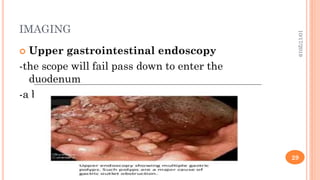
 Upper gastrointestinal endoscopy
-the scope will fail pass down to enter the
duodenum
-a biopsy may be taken during the procedure
10/17/2019
29
INVESTIGATIONS
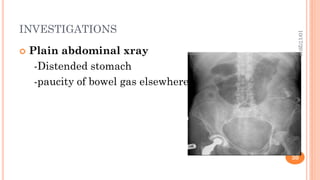
 Plain abdominal xray
-Distended stomach
-paucity of bowel gas elsewhere
10/17/2019
30
INVESTIGATIONS
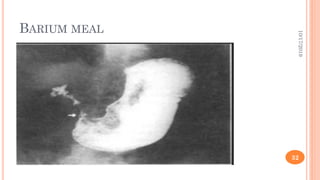
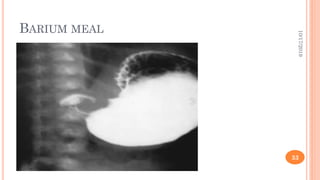
 Barium Meal Xray
-hugely distended stomach
-no or little barium in the esophagus
-mosaic appearance( ba + food)
-delayed evacuation of Ba into duodenum( repeat)
10/17/2019
31
BARIUM MEAL
10/17/2019
32
BARIUM MEAL
10/17/2019
33
INVESTIGATIONS
 CXR – exclude mets, aspiration
 USS – exclude ascites
 CT scan Chest , Abdomen and Pelvis – r/o mets
and to stage
10/17/2019
34
INVESTIGATIONS CONT..
 Blood work
 FBC – anemia, reduced Hb and MCV
 U&E – hypokalemia, hypochloremia,
 ABG – metabolic alkalosis, elavated bicarbonate
 LFT – Elavated liver enzymes show metastasis
10/17/2019
35
MANAGEMENT
 Aims are:
-correcting hydration and metabolic abnormality
-dealing with obstruction
10/17/2019
36
INITIAL WORKUP
 Admit
 Insert wide bore i.v cannulae to obtain blood for
(u&e, fbc, crossmatch)
 Wide bore NG tube for stomach decompression
 Rehydrate with
-Normal saline + KCl supplement (IDEAL)
-Ringer’s lactate
 Urinary catheter for output
 Chats to monitor fluid input and output
 Monitor nutrition
10/17/2019
37

Gastric outlet obstruction

  • 1.
    GASTRIC OUTLET OBSTRUCTION DZVUKE TREVORT MBChB V – UNIVERSITY OF ZIMBABWE 10/17/2019 1
  • 2.
    OBJECTIVES  Case  Definition Aetiology  Pathophysiology  Clinical presentation  Metabolic derangements  Investigations  Management 10/17/2019 2
  • 3.
    DEFINITION  Gastric outletobstruction is a spectrum of diseases that produces mechanical impedance to gastric emptying. 10/17/2019 3
  • 4.
    CASE PRESANTATION Name: CN Age:59 Address: stoneridge Occupation: soldier 10/17/2019 4
  • 5.
    PRESENTING COMPLAINT  Generalisedbody weakness X 3months  Post prandial vomiting X 1 month  Loss of appetite X 1 month 10/17/2019 5
  • 6.
    HISTORY OF PRESENTINGCOMPLAINT  Chronically unwell patient  Presented with post-prandial vomiting for a month.  He would vomit undigested food about 2 to 4 hours after a meal  The vomiting was projectile, non bilious and non blood stained  Amounted to 1 cupful  It was associated with early satiety and loss off appetite 10/17/2019 6
  • 7.
    HPC CONT...  Hereported episodes of passing melena stool but no diarrhoea and on presentation he had not been passing stool for the past 6 days  All this was on a background of generalised body weakness and significant loss of weight( 59kg to 52 kg)  Of note is that the patient had a 20 pack year history of smoking cigarettes and a 25 year history of drinking alcohol (8u/day) 10/17/2019 7
  • 8.
    HPC CONT...  Hedid not know his blood group  No family history of malignancy  No history of peptic ulcer disease or chronic use of NSAIDs 10/17/2019 8
  • 9.
    SYSTEMS REVIEW  General:no night sweats. Loss of weight  CVS : palpitations, no oedema, shortness of breath or dyspnoea  Respiratory: no cough, chest pain, haemoptysis,  GUS: No hematuria, frequency, urgency, dysuria.  MSS: no muscle or joint pain  CNS: no loss of consciousness, headaches, dizziness 10/17/2019 9
  • 10.
    PAST MEDICAL ANDSURGICAL HISTORY  Index admission was at Mvurwi hospital February 2018 for generalised body weakness and headache which were managed and he was transfused 2 units of blood  3months ago he presented to the physicians at PGH with the same symptoms  Transferred to us from the physicians  No history of other chronic illness  No history of any surgeries 10/17/2019 10
  • 11.
    PAST DRUG HISTORY No history of chronic NSAID use  No known drug allergies  No history of consumption of caustic chemicals 10/17/2019 11
  • 12.
    FAMILY HISTORY  Nofamily history of malignancy  No family history of other chronic illnesses 10/17/2019 12
  • 13.
    SOCIAL HISTORY  25year history of drinking alcohol  20 pack year history of smoking cigarettes  Works as a soldier  Married  Modern methods of sanitation 10/17/2019 13
  • 14.
    SUMMARY  59 yearsold male patient who presented generalised body weakness, profuse postprandial non bilious vomiting and weight loss. He has no history of peptic ulcer disease and no personal of family history of malignancy. 10/17/2019 14
  • 15.
    EXAMINATION  Ill lookingand wasted with zygomatic prominence  Palmar pallor  No jaundice, cyanosis or oedema  No generalised lymphadenopathy  Negative trossure sign and no Sr Mary Joseph nodes 10/17/2019 15
  • 16.
    ABDOMEN  I :scaphoid, symmetrical, no masses, no vissible peristalsis, umbilicus inverted  P: soft non tender, no palpable masses , no guarding  P: flank dullness  A: secussion splash negative, bowel sounds present  DRE: rectum empty, no bloomer’s shelves 10/17/2019 16
  • 17.
     For thispatient an endoscopic biopsy was done which showed gastric carcinoma – linitis plastica  Diagnosis was GOO secondary to gastric malignancy 10/17/2019 17
  • 18.
    AETIOLOGY OF GOO Causes of gastric outlet obstruction may be divided into Benign or malignant causes.  The aetiology has shifted from mostly benign causes to mostly malignant causes.  This is due to better medical management of peptic ulcer disease(PUD)  And the use of H. pylori erradication therapy. 10/17/2019 18
  • 19.
    BENIGN CAUSES  Pepticulcer disease (5% of goo pts)  Pyloric stenosis  Inflammatory diseases - pancreatitis - crohn’s disease - cholecystitis  Caustic ingestion  Strictures  Tumors - lipomas - adenomas  Post suregical obstruction  Pancreatic pseudocysts  bezoars 10/17/2019 19
  • 20.
    MALIGNANT CAUSES  PancreaticCancer (commonest – 10 – 20%)  Duodenal cancer  Peri-ampulary cancer  Cholangiocarcinoma  Gastric cancer  Metastasis to the gastric outlet 10/17/2019 20
  • 21.
    PATHOPHYSIOLOGY  There isobstruction of the pyloric channel or of the duodenum  This may be intrinsic or extrinsic  As a result, post prandial vomiting is the cardinal feature - vomiting is non bilious, projectile with identifiable undigested food.  Initially , liquids are better tolerated than solids  Patients then get significant weight loss due to poor caloric intake  Malnutrion is a late feature and is more pronounced in patients with concomittant malignancy 10/17/2019 21
  • 22.
    PATHOPHYSIOLOGY CONT...  Theprofound continuous vomiting then leads to dehydration and eletrolyte imbalances  When the obstruction persists, patients develop significant gastric dilatation - loss of tone of gastric masculature - gross dilatation - loss of peristalsis 10/17/2019 22
  • 23.
    METABOLIC EFFECTS  Classically,GOO causes a – hypokalemic, hypochloraemic metabolic alkalosis with paradoxical aciduria and hypocalcaemia  Prolonged vomiting causes loss of hydrochloric acid and create a hypochloremic metabolic alkalosis  Dehydration activates the RAAS and this leads to more Na retention with increases K and H excretion in the distal tubule – hypokalemic alkalosis 10/17/2019 23
  • 24.
    METABOLIC EFFECTS CONT... Paradoxical aciduria: -Initially urine has low Cl and high bicarbonate content (reflecting the primary metabolic abnnormality) - the bicarbonate is excreted with Sodium and with time the patient becomes progressively hyponatremic and more dehydrated -dehydration leads to sodium retention and K and H are excreted intead -this leads to acidic urine 10/17/2019 24
  • 25.
    CLINICAL PRESENTATION  Nauseaand vomiting are the cardinal features  Vomiting is non bilious projectile post-prandial and contains undigested food materials  In the early stages vomiting may be intermittent occurring within the first hour of feeding. 10/17/2019 25
  • 26.
    PRESENTATION CONT...  Ifthe obstruction is incomplete, the patient gets retentive symptoms: -early satiety -bloating -epigastric fullness -indigestion  Malnutrition  Loss of weight 10/17/2019 26
  • 27.
    CLINICAL PRESANTATION  Onexamination  Stomach felt as a dilated tympanitic mass in the epigastric area  Visible gastric peristalsis - ‘the stomach that you see’ - ‘the stomach that you feel’  a wave of peristalsis that runs from the left hypochondrium across the umbilicus to end in the right hypochondrium.  If absent , give patient 500 – 1000 ml of water to drink  Secussion splush – ‘the stomach that u hear’ 10/17/2019 27
  • 28.
  • 29.
    IMAGING  Upper gastrointestinalendoscopy -the scope will fail pass down to enter the duodenum -a biopsy may be taken during the procedure 10/17/2019 29
  • 30.
    INVESTIGATIONS  Plain abdominalxray -Distended stomach -paucity of bowel gas elsewhere 10/17/2019 30
  • 31.
    INVESTIGATIONS  Barium MealXray -hugely distended stomach -no or little barium in the esophagus -mosaic appearance( ba + food) -delayed evacuation of Ba into duodenum( repeat) 10/17/2019 31
  • 32.
  • 33.
  • 34.
    INVESTIGATIONS  CXR –exclude mets, aspiration  USS – exclude ascites  CT scan Chest , Abdomen and Pelvis – r/o mets and to stage 10/17/2019 34
  • 35.
    INVESTIGATIONS CONT..  Bloodwork  FBC – anemia, reduced Hb and MCV  U&E – hypokalemia, hypochloremia,  ABG – metabolic alkalosis, elavated bicarbonate  LFT – Elavated liver enzymes show metastasis 10/17/2019 35
  • 36.
    MANAGEMENT  Aims are: -correctinghydration and metabolic abnormality -dealing with obstruction 10/17/2019 36
  • 37.
    INITIAL WORKUP  Admit Insert wide bore i.v cannulae to obtain blood for (u&e, fbc, crossmatch)  Wide bore NG tube for stomach decompression  Rehydrate with -Normal saline + KCl supplement (IDEAL) -Ringer’s lactate  Urinary catheter for output  Chats to monitor fluid input and output  Monitor nutrition 10/17/2019 37