By: TM, MG, JM, JV, and ER
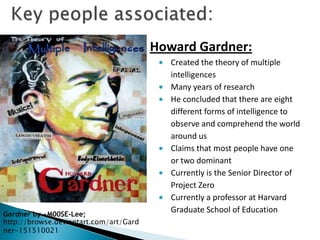
Howard Gardner:
                                           Created the theory of multiple
                                           intelligences
                                           Many years of research
                                           He concluded that there are eight
                                           different forms of intelligence to
                                           observe and comprehend the world
                                           around us
                                           Claims that most people have one
                                           or two dominant
                                           Currently is the Senior Director of
                                           Project Zero
                                           Currently a professor at Harvard
Gardner by ~M00SE-Lee;
                                           Graduate School of Education
http://browse.deviantart.com/art/Gard
ner-151510021
Mindy L. Kornhaber:
 • Researcher who is also involved with Project Zero.
 • Identified a number of reasons why teachers and policymakers in
   North America have responded positively to Howard Gardner's
   multiple intelligences, it is because of everyday experience.
David Riesman, Erik Erikson, and Jerome Bruner:
 • Created knowledge on human beings which created a spark for
   Howard Gardner and led him to his own research methods on
   human nature

John Dewey:
 • Much Gardner’s research and information come from the work of
   this man
   Researched by Howard Gardner
   Looked at gifted and typical students and adults w/
    brain damage
   Eight main intelligences used to perceive and
    understand the world
   Use all 8 but some are more dominant


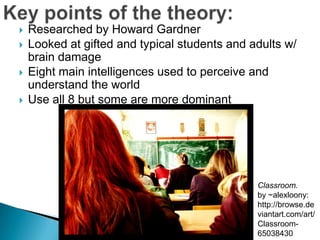
                                               Classroom.
                                               by ~alexloony:
                                               http://browse.de
                                               viantart.com/art/
                                               Classroom-
                                               65038430
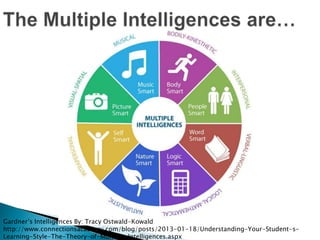
Gardner’s Intelligences By: Tracy Ostwald-Kowald
http://www.connectionsacademy.com/blog/posts/2013-01-18/Understanding-Your-Student-s-
Learning-Style-The-Theory-of-Multiple-Intelligences.aspx
Verbal: Word processing programs, word games, and
different programs that require the students to read and answer
questions.
Mathematical: Uses database, spreadsheet, and problem-
solving software programs that allow students to experiment w/
problems and observe results, as well as strategy game
formats.
Visual: Directs students to drawing and painting programs;
graphic production software, reading programs that use visual
clues like color coding, multimedia, etc.
Kinesthetic: Include keyboard/word
                                processing programs, graphic programs
                                that produce blueprints for 3D models,
                                and software that includes animated
                                graphics and requires physical
                                engagement during lesson.
                                Musical : Combine stories with songs,
                                reading programs that associate sounds
                                and letters with music, and programs that
                                allow students to create their own songs
                                and multimedia.
                                Interpersonal: Use telecommunications
                                programs that address social issues and
                                include group participation or decision
math 2 by ~cadrre;              making, programs that turn learning into
http://browse.deviantart.com/   a social activity, and games that require
art/math-2-37632848
                                two or more students to work together.
Verbal: Use language, have students think in words,
produce sensitivity to rhythm and order, writing, reading,
telling stories, and doing crossword puzzles
Mathematical: Have students engage in inductive and
deductive reasoning; use numbers effectively and categorize,
infer, and test hypotheses
Visual: Have students visualize objects and spatial
dimensions, think in images and pictures, draw, design, and
create puzzles
Kinesthetic: Engage students ability to move the body with
skill and control, expertise in using the body to express ideas
and feelings
Musical: Engage students ability to recognize patterns and
sounds; sensitivity to pitch and rhythm; think in tones and
learn through rhythm and melody
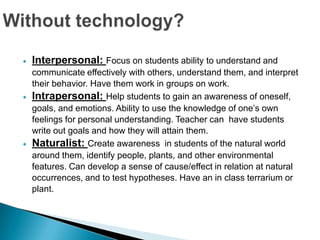
Interpersonal: Focus on students ability to understand and
communicate effectively with others, understand them, and interpret
their behavior. Have them work in groups on work.
Intrapersonal: Help students to gain an awareness of oneself,
goals, and emotions. Ability to use the knowledge of one’s own
feelings for personal understanding. Teacher can have students
write out goals and how they will attain them.
Naturalist: Create awareness in students of the natural world
around them, identify people, plants, and other environmental
features. Can develop a sense of cause/effect in relation at natural
occurrences, and to test hypotheses. Have an in class terrarium or
plant.
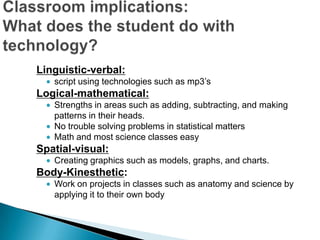
Linguistic-verbal:
   script using technologies such as mp3’s
Logical-mathematical:
   Strengths in areas such as adding, subtracting, and making
   patterns in their heads.
   No trouble solving problems in statistical matters
   Math and most science classes easy
Spatial-visual:
   Creating graphics such as models, graphs, and charts.
Body-Kinesthetic:
   Work on projects in classes such as anatomy and science by
   applying it to their own body
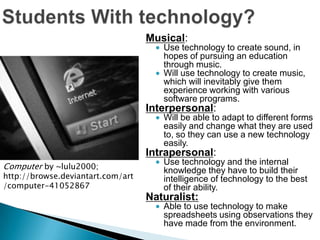
Musical:
                                      Use technology to create sound, in
                                      hopes of pursuing an education
                                      through music.
                                      Will use technology to create music,
                                      which will inevitably give them
                                      experience working with various
                                      software programs.
                                   Interpersonal:
                                      Will be able to adapt to different forms
                                      easily and change what they are used
                                      to, so they can use a new technology
                                      easily.
                                   Intrapersonal:
Computer by ~lulu2000;
                                      Use technology and the internal
                                      knowledge they have to build their
http://browse.deviantart.com/art      intelligence of technology to the best
/computer-41052867                    of their ability.
                                   Naturalist:
                                      Able to use technology to make
                                      spreadsheets using observations they
                                      have made from the environment.
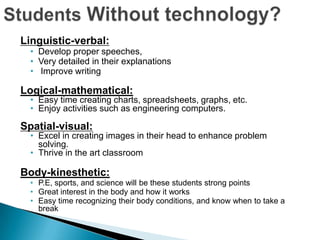
Linguistic-verbal:
  • Develop proper speeches,
  • Very detailed in their explanations
  • Improve writing

Logical-mathematical:
  • Easy time creating charts, spreadsheets, graphs, etc.
  • Enjoy activities such as engineering computers.

Spatial-visual:
  • Excel in creating images in their head to enhance problem
    solving.
  • Thrive in the art classroom

Body-kinesthetic:
  • P.E, sports, and science will be these students strong points
  • Great interest in the body and how it works
  • Easy time recognizing their body conditions, and know when to take a
    break
Musical:
    No difficulty interpreting words and remembering them
    Absolutely auditory learners and will thrive in the music classroom

Interpersonal:
    Easy time relating to classmates
    Speech-making will be an ease as they are able to connect with
    their audience.

Intrapersonal:
  ◦ Very aware of themselves. Because of this they are able to further
    their education.

Naturalist:
    This kind of learner is very aware of the nature.
Gardner’s theory of
multiple intelligences can help
teachers reach out to each
student so that the student is able
to do his or her best. Although we
may not be able to use all eight
intelligences in every single
lesson we plan, we can attempt
to include as many as possible.
Once students complete a
multiple intelligence test then we
can choose which activities will
reach out to the majority of our
classroom.

                         Multiple Inelligences by ~MrBlueSky225;
                         http://browse.deviantart.com/art/Multiple-Inelligences-68833416
Some examples include:
 Linguistic-Verbal: writing a traditional book report

 Logical-Mathematical: creating a chart that keeps
    track of the suspense of the book
   Spatial-Visual: creating a comic of a chapter of the book
   Body-Kinesthetic: making a diorama of a scene
   Musical: creating a song, or making a cd and explaining
    why these songs were chosen to explain the book
   Interpersonal: working in a small group to present a
    scene or a round table discussion about the book
   Intrapersonal: keeping a journal about his/her personal
    reactions to the book
   Ostwald-Kowald, T. (2013, January 18). Understanding your
    student's learning style: The theory of multiple intelligences.
    Retrieved from
    http://www.connectionsacademy.com/blog/posts/2013-01-
    18/Understanding-Your-Student-s-Learning-Style-The-Theory-of-
    Multiple-Intelligences.aspx

   Shelly, G. B., Gunter, G. A., & Gunter, R. E. (2012).Teachers
    discovering computers: Integrating technology in a connected world.
    (7th ed., pp. 263-265). Boston, MA: Course Technology: CENGAGE
    Learning. DOI: www.cengagebrain.com

   Lamb, A., & Johnson, L. (2000). Technology and multiple
    intelligences. Retrieved from http://eduscapes.com/tap/topic68h.htm

Gardner's Theory of Multiple Intelligences

  • 1.
    By: TM, MG,JM, JV, and ER
  • 2.
    Howard Gardner: Created the theory of multiple intelligences Many years of research He concluded that there are eight different forms of intelligence to observe and comprehend the world around us Claims that most people have one or two dominant Currently is the Senior Director of Project Zero Currently a professor at Harvard Gardner by ~M00SE-Lee; Graduate School of Education http://browse.deviantart.com/art/Gard ner-151510021
  • 3.
    Mindy L. Kornhaber: • Researcher who is also involved with Project Zero. • Identified a number of reasons why teachers and policymakers in North America have responded positively to Howard Gardner's multiple intelligences, it is because of everyday experience. David Riesman, Erik Erikson, and Jerome Bruner: • Created knowledge on human beings which created a spark for Howard Gardner and led him to his own research methods on human nature John Dewey: • Much Gardner’s research and information come from the work of this man
  • 4.
    Researched by Howard Gardner  Looked at gifted and typical students and adults w/ brain damage  Eight main intelligences used to perceive and understand the world  Use all 8 but some are more dominant Classroom. by ~alexloony: http://browse.de viantart.com/art/ Classroom- 65038430
  • 5.
    Gardner’s Intelligences By:Tracy Ostwald-Kowald http://www.connectionsacademy.com/blog/posts/2013-01-18/Understanding-Your-Student-s- Learning-Style-The-Theory-of-Multiple-Intelligences.aspx
  • 6.
    Verbal: Word processingprograms, word games, and different programs that require the students to read and answer questions. Mathematical: Uses database, spreadsheet, and problem- solving software programs that allow students to experiment w/ problems and observe results, as well as strategy game formats. Visual: Directs students to drawing and painting programs; graphic production software, reading programs that use visual clues like color coding, multimedia, etc.
  • 7.
    Kinesthetic: Include keyboard/word processing programs, graphic programs that produce blueprints for 3D models, and software that includes animated graphics and requires physical engagement during lesson. Musical : Combine stories with songs, reading programs that associate sounds and letters with music, and programs that allow students to create their own songs and multimedia. Interpersonal: Use telecommunications programs that address social issues and include group participation or decision math 2 by ~cadrre; making, programs that turn learning into http://browse.deviantart.com/ a social activity, and games that require art/math-2-37632848 two or more students to work together.
  • 8.
    Verbal: Use language,have students think in words, produce sensitivity to rhythm and order, writing, reading, telling stories, and doing crossword puzzles Mathematical: Have students engage in inductive and deductive reasoning; use numbers effectively and categorize, infer, and test hypotheses Visual: Have students visualize objects and spatial dimensions, think in images and pictures, draw, design, and create puzzles Kinesthetic: Engage students ability to move the body with skill and control, expertise in using the body to express ideas and feelings Musical: Engage students ability to recognize patterns and sounds; sensitivity to pitch and rhythm; think in tones and learn through rhythm and melody
  • 9.
    Interpersonal: Focus onstudents ability to understand and communicate effectively with others, understand them, and interpret their behavior. Have them work in groups on work. Intrapersonal: Help students to gain an awareness of oneself, goals, and emotions. Ability to use the knowledge of one’s own feelings for personal understanding. Teacher can have students write out goals and how they will attain them. Naturalist: Create awareness in students of the natural world around them, identify people, plants, and other environmental features. Can develop a sense of cause/effect in relation at natural occurrences, and to test hypotheses. Have an in class terrarium or plant.
  • 10.
    Linguistic-verbal: script using technologies such as mp3’s Logical-mathematical: Strengths in areas such as adding, subtracting, and making patterns in their heads. No trouble solving problems in statistical matters Math and most science classes easy Spatial-visual: Creating graphics such as models, graphs, and charts. Body-Kinesthetic: Work on projects in classes such as anatomy and science by applying it to their own body
  • 11.
    Musical: Use technology to create sound, in hopes of pursuing an education through music. Will use technology to create music, which will inevitably give them experience working with various software programs. Interpersonal: Will be able to adapt to different forms easily and change what they are used to, so they can use a new technology easily. Intrapersonal: Computer by ~lulu2000; Use technology and the internal knowledge they have to build their http://browse.deviantart.com/art intelligence of technology to the best /computer-41052867 of their ability. Naturalist: Able to use technology to make spreadsheets using observations they have made from the environment.
  • 12.
    Linguistic-verbal: •Develop proper speeches, • Very detailed in their explanations • Improve writing Logical-mathematical: • Easy time creating charts, spreadsheets, graphs, etc. • Enjoy activities such as engineering computers. Spatial-visual: • Excel in creating images in their head to enhance problem solving. • Thrive in the art classroom Body-kinesthetic: • P.E, sports, and science will be these students strong points • Great interest in the body and how it works • Easy time recognizing their body conditions, and know when to take a break
  • 13.
    Musical: No difficulty interpreting words and remembering them Absolutely auditory learners and will thrive in the music classroom Interpersonal: Easy time relating to classmates Speech-making will be an ease as they are able to connect with their audience. Intrapersonal: ◦ Very aware of themselves. Because of this they are able to further their education. Naturalist: This kind of learner is very aware of the nature.
  • 14.
    Gardner’s theory of multipleintelligences can help teachers reach out to each student so that the student is able to do his or her best. Although we may not be able to use all eight intelligences in every single lesson we plan, we can attempt to include as many as possible. Once students complete a multiple intelligence test then we can choose which activities will reach out to the majority of our classroom. Multiple Inelligences by ~MrBlueSky225; http://browse.deviantart.com/art/Multiple-Inelligences-68833416
  • 15.
    Some examples include: Linguistic-Verbal: writing a traditional book report  Logical-Mathematical: creating a chart that keeps track of the suspense of the book  Spatial-Visual: creating a comic of a chapter of the book  Body-Kinesthetic: making a diorama of a scene  Musical: creating a song, or making a cd and explaining why these songs were chosen to explain the book  Interpersonal: working in a small group to present a scene or a round table discussion about the book  Intrapersonal: keeping a journal about his/her personal reactions to the book
  • 16.
    Ostwald-Kowald, T. (2013, January 18). Understanding your student's learning style: The theory of multiple intelligences. Retrieved from http://www.connectionsacademy.com/blog/posts/2013-01- 18/Understanding-Your-Student-s-Learning-Style-The-Theory-of- Multiple-Intelligences.aspx  Shelly, G. B., Gunter, G. A., & Gunter, R. E. (2012).Teachers discovering computers: Integrating technology in a connected world. (7th ed., pp. 263-265). Boston, MA: Course Technology: CENGAGE Learning. DOI: www.cengagebrain.com  Lamb, A., & Johnson, L. (2000). Technology and multiple intelligences. Retrieved from http://eduscapes.com/tap/topic68h.htm