GARDEN
Legacy of the Past
Landscape design and Agriculture
◦ Organisation of fields and villages is an expression of community use and impact.
◦ Landscape – Is it an artistic expression or a functional endeavour.
◦ The best examples frequently exhibit a sense of logic
◦ inevitability
◦ relation ship to context
◦ Equates to the well organised and productive farm.
Origins Of The Garden Concept
◦ Word Garden .. Traces to Hebrew origin… gan is to protect or defend
◦ oden/eden is pleasure or delight
◦ i.e enclousure of land for pleasure and delight.
◦ Pleasure gardens … mythological roots … garden of eden or a Brindavan
◦ Symbolism attached to Garden… special meaning to certain trees
◦ Ex. Bodhi tree .. Enlightenment
◦ Peepal tree.. Life
◦ Trees, The longest living things are always revered for Fertility, life, nourishment
Babylon Gardens
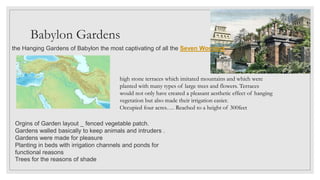
the Hanging Gardens of Babylon the most captivating of all the Seven Wonders.
high stone terraces which imitated mountains and which were
planted with many types of large trees and flowers. Terraces
would not only have created a pleasant aesthetic effect of hanging
vegetation but also made their irrigation easier.
Occupied four acres…. Reached to a height of 300feet
Orgins of Garden layout _ fenced vegetable patch.
Gardens walled basically to keep animals and intruders .
Gardens were made for pleasure
Planting in beds with irrigation channels and ponds for
functional reasons
Trees for the reasons of shade
Egyptian Gardens
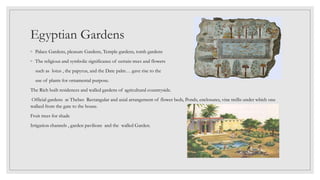
◦ Palace Gardens, pleasure Gardens, Temple gardens, tomb gardens
◦ The religious and symbolic significance of certain trees and flowers
such as lotus , the papyrus, and the Date palm… gave rise to the
use of plants for ornamental purpose.
The Rich built residences and walled gardens of agricultural countryside.
Official gardens at Thebes Rectangular and axial arrangement of flower beds, Ponds, enclosures, vine trellis under which one
walked from the gate to the house.
Fruit trees for shade
Irrigation channels , garden pavilions and the walled Garden.
Persian gardens
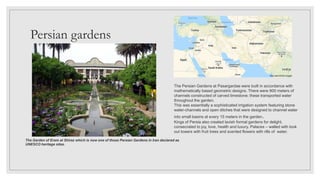
The Garden of Eram at Shiraz which is now one of those Persian Gardens in Iran declared as
UNESCO heritage sites.
The Persian Gardens at Pasargardae were built in accordance with
mathematically based geometric designs. There were 900 meters of
channels constructed of carved limestone; these transported water
throughout the garden.
This was essentially a sophisticated irrigation system featuring stone
water-channels and open ditches that were designed to channel water
into small basins at every 15 meters in the garden.
Kings of Persia also created lavish formal gardens for delight,
consecrated to joy, love, health and luxury. Palaces – walled with look
out towers with fruit trees and scented flowers with rills of water.
China
@600 bc … Roadside planting dates back
◦ Large estates….. Mountains,forests, streams, lakes
and islands…. Stocked with exotic plants and
animals with bright pavilions and bridges …for
amusement, parties both political and social.
◦ Pavillions .. For viewing moon, stars lotus etc
◦ Small or big forces of nature were arraged
harmoniouslyin contemplation and conformity of
social life.
◦ Shan shui… mountain and water
◦ Yin and Yang a harmony between contrasting
forces and forms (rivers and mountains or man
and woman)
◦ The underlying concept of the designed garden.
◦ Imperial gardens and private gardens
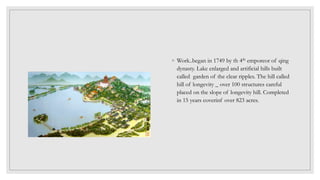
◦ Work..began in 1749 by th 4th emporeor of qing
dynasty. Lake enlarged and artificial hills built
called garden of the clear ripples. The hill called
hill of longevity _ over 100 structures careful
placed on the slope of longevity hill. Completed
in 15 years coverinf over 823 acres.
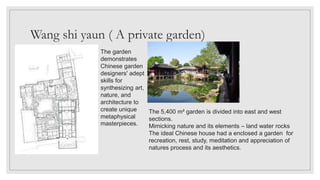
Wang shi yaun ( A private garden)
The garden
demonstrates
Chinese garden
designers' adept
skills for
synthesizing art,
nature, and
architecture to
create unique
metaphysical
masterpieces.
The 5,400 m² garden is divided into east and west
sections.
Mimicking nature and its elements – land water rocks
The ideal Chinese house had a enclosed a garden for
recreation, rest, study, meditation and appreciation of
natures process and its aesthetics.

Garden

  • 1.
  • 3.
  • 4.
    Landscape design andAgriculture ◦ Organisation of fields and villages is an expression of community use and impact. ◦ Landscape – Is it an artistic expression or a functional endeavour. ◦ The best examples frequently exhibit a sense of logic ◦ inevitability ◦ relation ship to context ◦ Equates to the well organised and productive farm.
  • 5.
    Origins Of TheGarden Concept ◦ Word Garden .. Traces to Hebrew origin… gan is to protect or defend ◦ oden/eden is pleasure or delight ◦ i.e enclousure of land for pleasure and delight. ◦ Pleasure gardens … mythological roots … garden of eden or a Brindavan ◦ Symbolism attached to Garden… special meaning to certain trees ◦ Ex. Bodhi tree .. Enlightenment ◦ Peepal tree.. Life ◦ Trees, The longest living things are always revered for Fertility, life, nourishment
  • 6.
    Babylon Gardens the HangingGardens of Babylon the most captivating of all the Seven Wonders. high stone terraces which imitated mountains and which were planted with many types of large trees and flowers. Terraces would not only have created a pleasant aesthetic effect of hanging vegetation but also made their irrigation easier. Occupied four acres…. Reached to a height of 300feet Orgins of Garden layout _ fenced vegetable patch. Gardens walled basically to keep animals and intruders . Gardens were made for pleasure Planting in beds with irrigation channels and ponds for functional reasons Trees for the reasons of shade
  • 7.
    Egyptian Gardens ◦ PalaceGardens, pleasure Gardens, Temple gardens, tomb gardens ◦ The religious and symbolic significance of certain trees and flowers such as lotus , the papyrus, and the Date palm… gave rise to the use of plants for ornamental purpose. The Rich built residences and walled gardens of agricultural countryside. Official gardens at Thebes Rectangular and axial arrangement of flower beds, Ponds, enclosures, vine trellis under which one walked from the gate to the house. Fruit trees for shade Irrigation channels , garden pavilions and the walled Garden.
  • 8.
    Persian gardens The Gardenof Eram at Shiraz which is now one of those Persian Gardens in Iran declared as UNESCO heritage sites. The Persian Gardens at Pasargardae were built in accordance with mathematically based geometric designs. There were 900 meters of channels constructed of carved limestone; these transported water throughout the garden. This was essentially a sophisticated irrigation system featuring stone water-channels and open ditches that were designed to channel water into small basins at every 15 meters in the garden. Kings of Persia also created lavish formal gardens for delight, consecrated to joy, love, health and luxury. Palaces – walled with look out towers with fruit trees and scented flowers with rills of water.
  • 9.
    China @600 bc …Roadside planting dates back ◦ Large estates….. Mountains,forests, streams, lakes and islands…. Stocked with exotic plants and animals with bright pavilions and bridges …for amusement, parties both political and social. ◦ Pavillions .. For viewing moon, stars lotus etc ◦ Small or big forces of nature were arraged harmoniouslyin contemplation and conformity of social life. ◦ Shan shui… mountain and water ◦ Yin and Yang a harmony between contrasting forces and forms (rivers and mountains or man and woman) ◦ The underlying concept of the designed garden. ◦ Imperial gardens and private gardens
  • 10.
    ◦ Work..began in1749 by th 4th emporeor of qing dynasty. Lake enlarged and artificial hills built called garden of the clear ripples. The hill called hill of longevity _ over 100 structures careful placed on the slope of longevity hill. Completed in 15 years coverinf over 823 acres.
  • 11.
    Wang shi yaun( A private garden) The garden demonstrates Chinese garden designers' adept skills for synthesizing art, nature, and architecture to create unique metaphysical masterpieces. The 5,400 m² garden is divided into east and west sections. Mimicking nature and its elements – land water rocks The ideal Chinese house had a enclosed a garden for recreation, rest, study, meditation and appreciation of natures process and its aesthetics.