SUBMITTED TO :
AR. GUNJAN TYAGI AR. BATUL ZAINAB
SUBMITTED BY:
ANUSHKA SINGH DIVYANSHU SINGH CHINKI SHARMA
ARPITA AGGARWAL KRITIKA MISHRA JYOTI KUMARI
Introduction
• At the beginning of eastern civilization, a form of religion based on animist beliefs
developed.
• The mountains, sky, seas, rivers and rocks were materialized spirits to be
honoured.
• From this background a Chinese philosopher, Lao Tzu, began to teach Taoism
which taught people to integrate themselves with the rhythms of life.
• This resulted in the importance of good manners towards nature
and human beings.
Concept
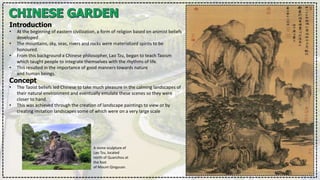
• The Taoist beliefs led Chinese to take much pleasure in the calming landscapes of
their natural environment and eventually emulate these scenes so they were
closer to hand.
• This was achieved through the creation of landscape paintings to view or by
creating imitation landscapes some of which were on a very large scale
A stone sculpture of
Lao Tzu, located
north of Quanzhou at
the foot
of Mount Qingyuan.
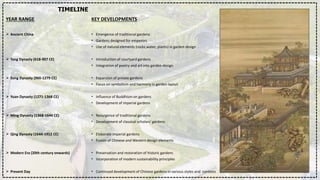
YEAR RANGE KEY DEVELOPMENTS
 Ancient China • Emergence of traditional gardens
• Gardens designed for emperors
• Use of natural elements (rocks,water, plants) in garden design
 Tang Dynasty (618-907 CE) • Introduction of courtyard gardens
• Integration of poetry and art into garden design
 Song Dynasty (960-1279 CE) • Expansion of private gardens
• Focus on symbolism and harmony in garden layout
 Yuan Dynasty (1271-1368 CE) • Influence of Buddhism on gardens
• Development of imperial gardens
 Ming Dynasty (1368-1644 CE) • Resurgence of traditional gardens
• Development of classical scholars' gardens
 Qing Dynasty (1644-1912 CE) • Elaborate imperial gardens
• Fusion of Chinese and Western design elements
 Modern Era (20th century onwards) • Preservation and restoration of historic gardens
• Incorporation of modern sustainability principles
 Present Day • Continued development of Chinese gardens in various styles and contexts
TIMELINE
Design Philosophy
• Chinese garden may be viewed as a miniature of the Chinese landscape.
• Nature is loved and held in highest honour in Chinese art, but this does
not mean that the nature must be simply "duplicated" in its original form.
• The main principle of Chinese garden art is to recreate nature, to present
its essence without an artificial effect.
• The recreation must be based on profound observation and a deep
understanding of the nature.
• The design of Chinese garden is a process of abstraction and stylization of
the existing landscape.
• The aim of creating a natural form in Chinese garden is to celebrate
the human spirit.
Characteristics of Design
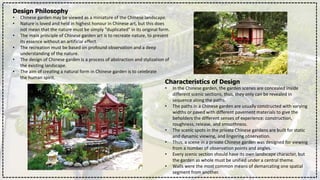
• In the Chinese garden, the garden scenes are concealed inside
different scenic sections, thus, they only can be revealed in
sequence along the paths.
• The paths in a Chinese garden are usually constructed with varying
widths or paved with different pavement materials to give the
beholders the different senses of experience: construction,
roughness, release, and smoothness.
• The scenic spots in the private Chinese gardens are built for static
and dynamic viewing, and lingering observation.
• Thus, a scene in a private Chinese garden was designed for viewing
from a number of observation points and angles.
• Every scenic section should have its own landscape character, but
the garden as whole must be unified under a central theme.
• Walls were the most common means of demarcating one spatial
segment from another.
Elements of Chinese Garden
There 6 main elements of a Chinese Garden:
 Rocks
 Water
 Vegetation
 Pathways
 Bridges
 Garden
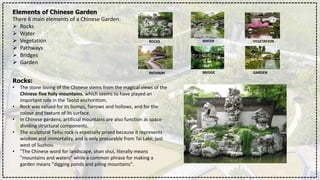
Rocks:
• The stone loving of the Chinese stems from the magical views of the
Chinese five holy mountains, which seems to have played an
important role in the Taoist anchoritism.
• Rock was valued for its bumps, furrows and hollows, and for the
colour and texture of its surface.
• In Chinese gardens, artificial mountains are also function as space-
dividing structural components.
• The sculptural Taihu rock is especially prized because it represents
wisdom and immortality, and is only procurable from Tai Lake, just
west of Suzhou.
• "The Chinese word for landscape, shan shui, literally means
"mountains and waters" while a common phrase for making a
garden means "digging ponds and piling mountains".
ROCKS WATER VEGETATION
PATHWAY BRIDGE GARDEN
Elements of Chinese Garden
There 6 main elements of a Chinese Garden:
 Rocks
 Water
 Vegetation
 Pathways
 Bridges
 Garden
ROCKS WATER VEGETATION
PATHWAY BRIDGE GARDEN
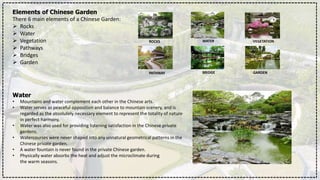
Water
• Mountains and water complement each other in the Chinese arts.
• Water serves as peaceful opposition and balance to mountain scenery, and is
regarded as the absolutely necessary element to represent the totality of nature
in perfect harmony.
• Water was also used for providing listening satisfaction in the Chinese private
gardens.
• Watercourses were never shaped into any unnatural geometrical patterns in the
Chinese private garden.
• A water fountain is never found in the private Chinese garden.
• Physically water absorbs the heat and adjust the microclimate during
the warm seasons.
Elements of Chinese Garden
There 6 main elements of a Chinese Garden:
 Rocks
 Water
 Vegetation
 Pathways
 Bridges
 Garden
ROCKS WATER VEGETATION
PATHWAY BRIDGE GARDEN
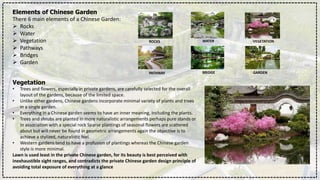
Vegetation
• Trees and flowers, especially in private gardens, are carefully selected for the overall
layout of the gardens, because of the limited space.
• Unlike other gardens, Chinese gardens incorporate minimal variety of plants and trees
in a single garden.
• Everything in a Chinese garden seems to have an inner meaning, Including the plants.
• Trees and shrubs are planted in more naturalistic arrangements perhaps pure stands or
In association with a special rock Sparse plantings of seasonal flowers are scattered
about but will never be found in geometric arrangements again the objective is to
achieve a stylized, naturalistic feel.
• Western gardens tend to have a profusion of plantings whereas the Chinese garden
style is more minimal.
Lawn is used least in the private Chinese garden, for its beauty is best perceived with
inexhaustible sight ranges, and contradicts the private Chinese garden design principle of
avoiding total exposure of everything at a glance
Elements of Chinese Garden
There 6 main elements of a Chinese Garden:
 Rocks
 Water
 Vegetation
 Pathways
 Bridges
 Garden
ROCKS WATER VEGETATION
PATHWAY BRIDGE GARDEN
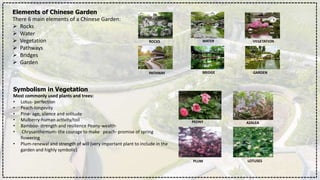
Symbolism in Vegetation
Most commonly used plants and trees:
• Lotus- perfection
• Peach-longevity
• Pine- age, silence and solitude
• Mulberry-human activity/toil
• Bamboo- strength and resilience Peony-wealth·
• Chrysanthemum- the courage to make peach- promise of spring
flowering
• Plum-renewal and strength of will (very important plant to include in the
garden and highly symbolic)
PEONY AZALEA
PLUM LOTUSES
Elements of Chinese Garden
There 6 main elements of a Chinese Garden:
 Rocks
 Water
 Vegetation
 Pathways
 Bridges
 Garden
ROCKS WATER VEGETATION
PATHWAY BRIDGE GARDEN
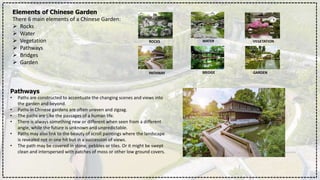
Pathways
• Paths are constructed to accentuate the changing scenes and views into
the garden and beyond.
• Paths in Chinese gardens are often uneven and zigzag.
• The paths are Like the passages of a human life.
• There is always something new or different when seen from a different
angle, while the future is unknown and unpredictable.
• Paths may also link to the beauty of scroll paintings where the landscape
is revealed not in one hit but in a succession of views.
• The path may be covered in stone, pebbles or tiles. Or it might be swept
clean and interspersed with patches of moss or other low ground covers.
Elements of Chinese Garden
There 6 main elements of a Chinese Garden:
 Rocks
 Water
 Vegetation
 Pathways
 Bridges
 Garden
ROCKS WATER VEGETATION
PATHWAY BRIDGE GARDEN
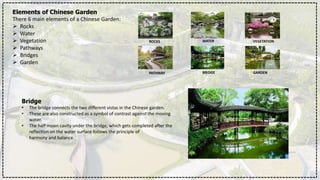
Bridge
• The bridge connects the two different vistas in the Chinese garden.
• These are also constructed as a symbol of contrast against the moving
water.
• The half moon cavity under the bridge, which gets completed after the
reflection on the water surface follows the principle of
harmony and balance.
Elements of Chinese Garden
There 6 main elements of a Chinese Garden:
 Rocks
 Water
 Vegetation
 Pathways
 Bridges
 Garden
ROCKS WATER VEGETATION
PATHWAY BRIDGE GARDEN
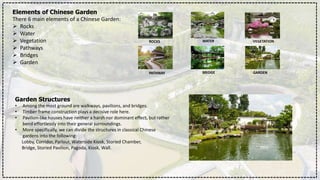
Garden Structures
• Among the most ground are walkways, pavilions, and bridges.
• Timber frame construction plays a decisive role here.
• Pavilion-like houses have neither a harsh nor dominant effect, but rather
bend effortlessly into their general surroundings.
• More specifically, we can divide the structures in classical Chinese
gardens into the following:
Lobby, Corridor, Parlour, Waterside Kiosk, Storied Chamber,
Bridge, Storied Pavilion, Pagoda, Kiosk, Wall.
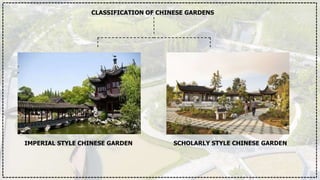
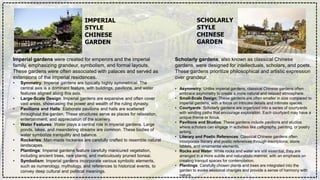
CLASSIFICATION OF CHINESE GARDENS
IMPERIAL STYLE CHINESE GARDEN SCHOLARLY STYLE CHINESE GARDEN
IMPERIAL
STYLE
CHINESE
GARDEN
SCHOLARLY
STYLE
CHINESE
GARDEN
Imperial gardens were created for emperors and the imperial
family, emphasizing grandeur, symbolism, and formal layouts.
These gardens were often associated with palaces and served as
extensions of the imperial residences.
• Symmetry: Imperial gardens are typically highly symmetrical. The
central axis is a dominant feature, with buildings, pavilions, and water
features aligned along this axis.
• Large-Scale Design: Imperial gardens are expansive and often cover
vast areas, showcasing the power and wealth of the ruling dynasty.
• Pavilions and Halls: Elaborate pavilions and halls are scattered
throughout the garden. These structures serve as places for relaxation,
entertainment, and appreciation of the scenery.
• Water Features: Water plays a central role in imperial gardens. Large
ponds, lakes, and meandering streams are common. These bodies of
water symbolize tranquility and balance.
• Rockeries: Man-made rockeries are carefully crafted to resemble natural
landscapes.
• Plantings: Imperial gardens feature carefully manicured vegetation,
including ancient trees, rare plants, and meticulously pruned bonsai.
• Symbolism: Imperial gardens incorporate various symbolic elements,
such as numerology, mythology, and references to historical events, to
convey deep cultural and political meanings.
Scholarly gardens, also known as classical Chinese
gardens, were designed for intellectuals, scholars, and poets.
These gardens prioritize philosophical and artistic expression
over grandeur.
• Asymmetry: Unlike imperial gardens, classical Chinese gardens often
embrace asymmetry to create a more natural and relaxed atmosphere.
• Small-Scale Design: These gardens are often smaller in size compared to
imperial gardens, with a focus on intricate details and intimate spaces.
• Courtyards: Scholarly gardens are organized into a series of courtyards
with winding paths that encourage exploration. Each courtyard may have a
unique theme or focus.
• Pavilions and Studios: These gardens include pavilions and studios
where scholars can engage in activities like calligraphy, painting, or poetry
writing.
• Literary and Poetic References: Classical Chinese gardens often
incorporate literary and poetic references through inscriptions, stone
tablets, and ornamental elements.
• Rocks and Water: While rocks and water are still essential, they are
arranged in a more subtle and naturalistic manner, with an emphasis on
creating tranquil spaces for contemplation.
• Plantings: Carefully chosen plants and trees are integrated into the
garden to evoke seasonal changes and provide a sense of harmony with
nature.
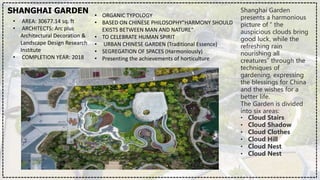
SHANGHAI GARDEN
• AREA: 30677.14 sq. ft
• ARCHITECTS: Arc plus
Architectural Decoration &
Landscape Design Research
Institute
• COMPLETION YEAR: 2018
• ORGANIC TYPOLOGY
• BASED ON CHINESE PHILOSOPHY"HARMONY SHOULD
EXISTS BETWEEN MAN AND NATURE“
• TO CELEBRATE HUMAN SPIRIT
• URBAN CHINESE GARDEN (Traditional Essence)
• SEGREGATION OF SPACES (Harmoniously)
• Presenting the achievements of horticulture
Shanghai Garden
presents a harmonious
picture of “ the
auspicious clouds bring
good luck, while the
refreshing rain
nourishing all
creatures” through the
techniques of
gardening, expressing
the blessings for China
and the wishes for a
better life.
The Garden is divided
into six areas:
• Cloud Stairs
• Cloud Shadow
• Cloud Clothes
• Cloud Hill
• Cloud Nest
• Cloud Nest
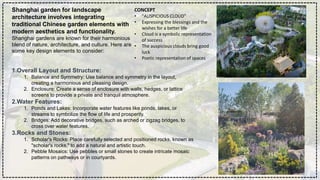
CONCEPT
• "AUSPICIOUS CLOUD”
• Expressing the blessings and the
wishes for a better life
• Cloud is a symbolic representation
of success
• The auspicious clouds bring good
luck
• Poetic representation of spaces
Shanghai garden for landscape
architecture involves integrating
traditional Chinese garden elements with
modern aesthetics and functionality.
Shanghai gardens are known for their harmonious
blend of nature, architecture, and culture. Here are
some key design elements to consider:
1.Overall Layout and Structure:
1. Balance and Symmetry: Use balance and symmetry in the layout,
creating a harmonious and pleasing design.
2. Enclosure: Create a sense of enclosure with walls, hedges, or lattice
screens to provide a private and tranquil atmosphere.
2.Water Features:
1. Ponds and Lakes: Incorporate water features like ponds, lakes, or
streams to symbolize the flow of life and prosperity.
2. Bridges: Add decorative bridges, such as arched or zigzag bridges, to
cross over water features.
3.Rocks and Stones:
1. Scholar's Rocks: Place carefully selected and positioned rocks, known as
"scholar's rocks," to add a natural and artistic touch.
2. Pebble Mosaics: Use pebbles or small stones to create intricate mosaic
patterns on pathways or in courtyards.
Shanghai garden for landscape
architecture involves integrating
traditional Chinese garden elements with
modern aesthetics and functionality.
Shanghai gardens are known for their harmonious
blend of nature, architecture, and culture. Here are
some key design elements to consider:
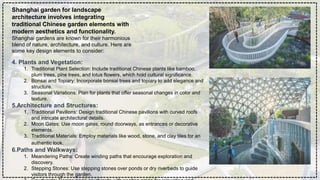
4. Plants and Vegetation:
1. Traditional Plant Selection: Include traditional Chinese plants like bamboo,
plum trees, pine trees, and lotus flowers, which hold cultural significance.
2. Bonsai and Topiary: Incorporate bonsai trees and topiary to add elegance and
structure.
3. Seasonal Variations: Plan for plants that offer seasonal changes in color and
texture.
5.Architecture and Structures:
1. Traditional Pavilions: Design traditional Chinese pavilions with curved roofs
and intricate architectural details.
2. Moon Gates: Use moon gates, round doorways, as entrances or decorative
elements.
3. Traditional Materials: Employ materials like wood, stone, and clay tiles for an
authentic look.
6.Paths and Walkways:
1. Meandering Paths: Create winding paths that encourage exploration and
discovery.
2. Stepping Stones: Use stepping stones over ponds or dry riverbeds to guide
visitors through the garden.

CHINESE GARDEN.pptx

  • 1.
    SUBMITTED TO : AR.GUNJAN TYAGI AR. BATUL ZAINAB SUBMITTED BY: ANUSHKA SINGH DIVYANSHU SINGH CHINKI SHARMA ARPITA AGGARWAL KRITIKA MISHRA JYOTI KUMARI
  • 2.
    Introduction • At thebeginning of eastern civilization, a form of religion based on animist beliefs developed. • The mountains, sky, seas, rivers and rocks were materialized spirits to be honoured. • From this background a Chinese philosopher, Lao Tzu, began to teach Taoism which taught people to integrate themselves with the rhythms of life. • This resulted in the importance of good manners towards nature and human beings. Concept • The Taoist beliefs led Chinese to take much pleasure in the calming landscapes of their natural environment and eventually emulate these scenes so they were closer to hand. • This was achieved through the creation of landscape paintings to view or by creating imitation landscapes some of which were on a very large scale A stone sculpture of Lao Tzu, located north of Quanzhou at the foot of Mount Qingyuan.
  • 3.
    YEAR RANGE KEYDEVELOPMENTS  Ancient China • Emergence of traditional gardens • Gardens designed for emperors • Use of natural elements (rocks,water, plants) in garden design  Tang Dynasty (618-907 CE) • Introduction of courtyard gardens • Integration of poetry and art into garden design  Song Dynasty (960-1279 CE) • Expansion of private gardens • Focus on symbolism and harmony in garden layout  Yuan Dynasty (1271-1368 CE) • Influence of Buddhism on gardens • Development of imperial gardens  Ming Dynasty (1368-1644 CE) • Resurgence of traditional gardens • Development of classical scholars' gardens  Qing Dynasty (1644-1912 CE) • Elaborate imperial gardens • Fusion of Chinese and Western design elements  Modern Era (20th century onwards) • Preservation and restoration of historic gardens • Incorporation of modern sustainability principles  Present Day • Continued development of Chinese gardens in various styles and contexts TIMELINE
  • 4.
    Design Philosophy • Chinesegarden may be viewed as a miniature of the Chinese landscape. • Nature is loved and held in highest honour in Chinese art, but this does not mean that the nature must be simply "duplicated" in its original form. • The main principle of Chinese garden art is to recreate nature, to present its essence without an artificial effect. • The recreation must be based on profound observation and a deep understanding of the nature. • The design of Chinese garden is a process of abstraction and stylization of the existing landscape. • The aim of creating a natural form in Chinese garden is to celebrate the human spirit. Characteristics of Design • In the Chinese garden, the garden scenes are concealed inside different scenic sections, thus, they only can be revealed in sequence along the paths. • The paths in a Chinese garden are usually constructed with varying widths or paved with different pavement materials to give the beholders the different senses of experience: construction, roughness, release, and smoothness. • The scenic spots in the private Chinese gardens are built for static and dynamic viewing, and lingering observation. • Thus, a scene in a private Chinese garden was designed for viewing from a number of observation points and angles. • Every scenic section should have its own landscape character, but the garden as whole must be unified under a central theme. • Walls were the most common means of demarcating one spatial segment from another.
  • 5.
    Elements of ChineseGarden There 6 main elements of a Chinese Garden:  Rocks  Water  Vegetation  Pathways  Bridges  Garden Rocks: • The stone loving of the Chinese stems from the magical views of the Chinese five holy mountains, which seems to have played an important role in the Taoist anchoritism. • Rock was valued for its bumps, furrows and hollows, and for the colour and texture of its surface. • In Chinese gardens, artificial mountains are also function as space- dividing structural components. • The sculptural Taihu rock is especially prized because it represents wisdom and immortality, and is only procurable from Tai Lake, just west of Suzhou. • "The Chinese word for landscape, shan shui, literally means "mountains and waters" while a common phrase for making a garden means "digging ponds and piling mountains". ROCKS WATER VEGETATION PATHWAY BRIDGE GARDEN
  • 6.
    Elements of ChineseGarden There 6 main elements of a Chinese Garden:  Rocks  Water  Vegetation  Pathways  Bridges  Garden ROCKS WATER VEGETATION PATHWAY BRIDGE GARDEN Water • Mountains and water complement each other in the Chinese arts. • Water serves as peaceful opposition and balance to mountain scenery, and is regarded as the absolutely necessary element to represent the totality of nature in perfect harmony. • Water was also used for providing listening satisfaction in the Chinese private gardens. • Watercourses were never shaped into any unnatural geometrical patterns in the Chinese private garden. • A water fountain is never found in the private Chinese garden. • Physically water absorbs the heat and adjust the microclimate during the warm seasons.
  • 7.
    Elements of ChineseGarden There 6 main elements of a Chinese Garden:  Rocks  Water  Vegetation  Pathways  Bridges  Garden ROCKS WATER VEGETATION PATHWAY BRIDGE GARDEN Vegetation • Trees and flowers, especially in private gardens, are carefully selected for the overall layout of the gardens, because of the limited space. • Unlike other gardens, Chinese gardens incorporate minimal variety of plants and trees in a single garden. • Everything in a Chinese garden seems to have an inner meaning, Including the plants. • Trees and shrubs are planted in more naturalistic arrangements perhaps pure stands or In association with a special rock Sparse plantings of seasonal flowers are scattered about but will never be found in geometric arrangements again the objective is to achieve a stylized, naturalistic feel. • Western gardens tend to have a profusion of plantings whereas the Chinese garden style is more minimal. Lawn is used least in the private Chinese garden, for its beauty is best perceived with inexhaustible sight ranges, and contradicts the private Chinese garden design principle of avoiding total exposure of everything at a glance
  • 8.
    Elements of ChineseGarden There 6 main elements of a Chinese Garden:  Rocks  Water  Vegetation  Pathways  Bridges  Garden ROCKS WATER VEGETATION PATHWAY BRIDGE GARDEN Symbolism in Vegetation Most commonly used plants and trees: • Lotus- perfection • Peach-longevity • Pine- age, silence and solitude • Mulberry-human activity/toil • Bamboo- strength and resilience Peony-wealth· • Chrysanthemum- the courage to make peach- promise of spring flowering • Plum-renewal and strength of will (very important plant to include in the garden and highly symbolic) PEONY AZALEA PLUM LOTUSES
  • 9.
    Elements of ChineseGarden There 6 main elements of a Chinese Garden:  Rocks  Water  Vegetation  Pathways  Bridges  Garden ROCKS WATER VEGETATION PATHWAY BRIDGE GARDEN Pathways • Paths are constructed to accentuate the changing scenes and views into the garden and beyond. • Paths in Chinese gardens are often uneven and zigzag. • The paths are Like the passages of a human life. • There is always something new or different when seen from a different angle, while the future is unknown and unpredictable. • Paths may also link to the beauty of scroll paintings where the landscape is revealed not in one hit but in a succession of views. • The path may be covered in stone, pebbles or tiles. Or it might be swept clean and interspersed with patches of moss or other low ground covers.
  • 10.
    Elements of ChineseGarden There 6 main elements of a Chinese Garden:  Rocks  Water  Vegetation  Pathways  Bridges  Garden ROCKS WATER VEGETATION PATHWAY BRIDGE GARDEN Bridge • The bridge connects the two different vistas in the Chinese garden. • These are also constructed as a symbol of contrast against the moving water. • The half moon cavity under the bridge, which gets completed after the reflection on the water surface follows the principle of harmony and balance.
  • 11.
    Elements of ChineseGarden There 6 main elements of a Chinese Garden:  Rocks  Water  Vegetation  Pathways  Bridges  Garden ROCKS WATER VEGETATION PATHWAY BRIDGE GARDEN Garden Structures • Among the most ground are walkways, pavilions, and bridges. • Timber frame construction plays a decisive role here. • Pavilion-like houses have neither a harsh nor dominant effect, but rather bend effortlessly into their general surroundings. • More specifically, we can divide the structures in classical Chinese gardens into the following: Lobby, Corridor, Parlour, Waterside Kiosk, Storied Chamber, Bridge, Storied Pavilion, Pagoda, Kiosk, Wall.
  • 12.
    CLASSIFICATION OF CHINESEGARDENS IMPERIAL STYLE CHINESE GARDEN SCHOLARLY STYLE CHINESE GARDEN
  • 13.
    IMPERIAL STYLE CHINESE GARDEN SCHOLARLY STYLE CHINESE GARDEN Imperial gardens werecreated for emperors and the imperial family, emphasizing grandeur, symbolism, and formal layouts. These gardens were often associated with palaces and served as extensions of the imperial residences. • Symmetry: Imperial gardens are typically highly symmetrical. The central axis is a dominant feature, with buildings, pavilions, and water features aligned along this axis. • Large-Scale Design: Imperial gardens are expansive and often cover vast areas, showcasing the power and wealth of the ruling dynasty. • Pavilions and Halls: Elaborate pavilions and halls are scattered throughout the garden. These structures serve as places for relaxation, entertainment, and appreciation of the scenery. • Water Features: Water plays a central role in imperial gardens. Large ponds, lakes, and meandering streams are common. These bodies of water symbolize tranquility and balance. • Rockeries: Man-made rockeries are carefully crafted to resemble natural landscapes. • Plantings: Imperial gardens feature carefully manicured vegetation, including ancient trees, rare plants, and meticulously pruned bonsai. • Symbolism: Imperial gardens incorporate various symbolic elements, such as numerology, mythology, and references to historical events, to convey deep cultural and political meanings. Scholarly gardens, also known as classical Chinese gardens, were designed for intellectuals, scholars, and poets. These gardens prioritize philosophical and artistic expression over grandeur. • Asymmetry: Unlike imperial gardens, classical Chinese gardens often embrace asymmetry to create a more natural and relaxed atmosphere. • Small-Scale Design: These gardens are often smaller in size compared to imperial gardens, with a focus on intricate details and intimate spaces. • Courtyards: Scholarly gardens are organized into a series of courtyards with winding paths that encourage exploration. Each courtyard may have a unique theme or focus. • Pavilions and Studios: These gardens include pavilions and studios where scholars can engage in activities like calligraphy, painting, or poetry writing. • Literary and Poetic References: Classical Chinese gardens often incorporate literary and poetic references through inscriptions, stone tablets, and ornamental elements. • Rocks and Water: While rocks and water are still essential, they are arranged in a more subtle and naturalistic manner, with an emphasis on creating tranquil spaces for contemplation. • Plantings: Carefully chosen plants and trees are integrated into the garden to evoke seasonal changes and provide a sense of harmony with nature.
  • 14.
    SHANGHAI GARDEN • AREA:30677.14 sq. ft • ARCHITECTS: Arc plus Architectural Decoration & Landscape Design Research Institute • COMPLETION YEAR: 2018 • ORGANIC TYPOLOGY • BASED ON CHINESE PHILOSOPHY"HARMONY SHOULD EXISTS BETWEEN MAN AND NATURE“ • TO CELEBRATE HUMAN SPIRIT • URBAN CHINESE GARDEN (Traditional Essence) • SEGREGATION OF SPACES (Harmoniously) • Presenting the achievements of horticulture Shanghai Garden presents a harmonious picture of “ the auspicious clouds bring good luck, while the refreshing rain nourishing all creatures” through the techniques of gardening, expressing the blessings for China and the wishes for a better life. The Garden is divided into six areas: • Cloud Stairs • Cloud Shadow • Cloud Clothes • Cloud Hill • Cloud Nest • Cloud Nest
  • 15.
    CONCEPT • "AUSPICIOUS CLOUD” •Expressing the blessings and the wishes for a better life • Cloud is a symbolic representation of success • The auspicious clouds bring good luck • Poetic representation of spaces Shanghai garden for landscape architecture involves integrating traditional Chinese garden elements with modern aesthetics and functionality. Shanghai gardens are known for their harmonious blend of nature, architecture, and culture. Here are some key design elements to consider: 1.Overall Layout and Structure: 1. Balance and Symmetry: Use balance and symmetry in the layout, creating a harmonious and pleasing design. 2. Enclosure: Create a sense of enclosure with walls, hedges, or lattice screens to provide a private and tranquil atmosphere. 2.Water Features: 1. Ponds and Lakes: Incorporate water features like ponds, lakes, or streams to symbolize the flow of life and prosperity. 2. Bridges: Add decorative bridges, such as arched or zigzag bridges, to cross over water features. 3.Rocks and Stones: 1. Scholar's Rocks: Place carefully selected and positioned rocks, known as "scholar's rocks," to add a natural and artistic touch. 2. Pebble Mosaics: Use pebbles or small stones to create intricate mosaic patterns on pathways or in courtyards.
  • 16.
    Shanghai garden forlandscape architecture involves integrating traditional Chinese garden elements with modern aesthetics and functionality. Shanghai gardens are known for their harmonious blend of nature, architecture, and culture. Here are some key design elements to consider: 4. Plants and Vegetation: 1. Traditional Plant Selection: Include traditional Chinese plants like bamboo, plum trees, pine trees, and lotus flowers, which hold cultural significance. 2. Bonsai and Topiary: Incorporate bonsai trees and topiary to add elegance and structure. 3. Seasonal Variations: Plan for plants that offer seasonal changes in color and texture. 5.Architecture and Structures: 1. Traditional Pavilions: Design traditional Chinese pavilions with curved roofs and intricate architectural details. 2. Moon Gates: Use moon gates, round doorways, as entrances or decorative elements. 3. Traditional Materials: Employ materials like wood, stone, and clay tiles for an authentic look. 6.Paths and Walkways: 1. Meandering Paths: Create winding paths that encourage exploration and discovery. 2. Stepping Stones: Use stepping stones over ponds or dry riverbeds to guide visitors through the garden.