ΕΛΛΗΝΙΚΗ ΚΗΠΟΣ
GREEK GARDENS
by Orbiso, Krisha Marie
BACKGROUND
LOCATION AND
GEOGRAPHICAL
CONTEXT
 Located in southern Europe, Greece
forms an irregular-shaped peninsula in
the Mediterranean with two additional
large peninsulas projecting from it: the
Chalcidice and the Peloponnese.
 The country has the largest coastline in
Europe (13,676km) due to its
numerous islands. Greece has a total of
2,000 Greek islands but only 168 are
inhabited.
 The country is washed to the east by
the Aegean Sea, to the west by the
Ionian and to the south by the
Mediterranean Sea.
LOCATION AND
GEOGRAPHICAL
CONTEXT
 The mountains of Greece divide the
agricultural lands into discrete
geographical units, limited at all sides by
sea and mountains.
 Rugged rocky terrain, variable rainfall
amounts – unpredictable growing
conditions. Only 10% of land is arable,
and it must be fallowed often. Poor,
chalky, acidic soil.
 Heavy reliance on the “Mediterranean
Triad” – grains, olives, wine – specifically,
beans, barley, and wheat.
 Greece has a rich diversity in flora and
fauna and many species are original in
this country, which means that they are
found only there in the world.
SOIL NATURE
 The Greeks' life was closely related to
landscape as a large part of the
population lived in the urban centre
and commuted daily in the outskirts of
the city, in order to work in the
farmlands.
 Much of the soils in Greece are made
up of silty, sandy soil. Limestone is a
characteristic type of soil found in this
country. The soil is not very fertile.
Only about 30 percent of the total land
area in Greece can support crops. Most
farms are small because there are no
major valleys in Greece. Wheat is
Greece’s main crop.
CLIMATIC
CONDITIONS
Weather in Greece is fairly uniform
throughout the mainland and the Greek
islands. Due to its geographical position,
Greece has mild winters and warm
summers, cooled by different kind of
seasonal winds. The summers are
characterized by sunshine and very little
rainfall.
In the winter, temperatures again were
influenced by the surrounding water.
Typically temperatures did not go below
4.4° C (40° F ) with the exceptions in the
high mountains. In the mountains, snow
was typical during the wet winter months.
Athens, Greece
DID YOU KNOW?
In Greek Mythology, during the
winter and fall Demeter makes
the earth cold and infertile to
match her sad feelings for her
missing daughter, and why, in
the summer and spring, the
earth is once again fertile
because Persephone is back
with her mother.
CULTURE AND
SOCIETY
 Life of women in ancient Greece were
closely tied to domestic work spinning,
weaving and other duties. Greece was
male dominating society
 Greek people made their living from
farming. Citizen had land outskirts of
urban area which provided farmlands.
Greek landscape and climate difficult
for farms.
 There were grape gardens, olive trees
majorly since it was criminal offense to
cut olive trees.
 Honey was probably was the only
sweetening that exited at the time so
beehives were kept in terracotta pots.
Painting depicting the
ancient
Greek ladies spending
their
leisure time in garden.
HISTORY
 Landscape design of ancient Greece (VI
B.C. - IV A.D.) was in essence garden
design. The presence of a good
combination of utilitarian, religious
and aesthetical features was typical to
the gardens of that time.
 The aggressive conquests of Alexander
of Macedon played a basic role in the
forming of the landscape design of this
state and a substantial part of it
underwent strong Asian influence -
culture and the traditions of Egypt,
India and Persia.
HISTORY
 Greeks learned to harmoniously
combine the construction of cities with
the natural landscape, mutually
supplementing each other.
 Gardens and parks became similar to
living organisms, which have a close
connection with the natural
environment and man.
 Acropolises, theatres, forums, squares,
seemingly grow from nature,
harmonizing and merging with the
surrounding landscape.
Built structures like gazebo
and fountains in ancient
garden
HISTORY
 Ancient Greek gardens were far less
ostentatious and more closely bound
up with religion.
 They had their origins in sacred groves,
springs and rivers believed to be
inhabited by gods and spirits, the
haunt of nymphs and satyrs.
 The trees and plants in them were
associated with particular deities.
 The goddess of love was a special
protector of gardens, and her son Eros
was sometimes represented as a
gardener. The Graces had their gardens
on the slopes of Mount Helicon.
OAK TREE - ZEUS
MYRTLE TREE - APHRODITE
LAUREL - APOLLO
HISTORY
 Such groves were also where the
celebrated schools of philosophy grew
up and flourished, the most famous
being Plato's Academy and Aristotle's
Lyceum, on the outskirts of Athens.
They gradually acquired buildings for
teaching and gymnasiums for physical
exercise.
 The gardens of the modest house that
Epicurus bought just outside the walls
of Athens in 306 B.C., where he taught
his followers (including, to the scandal
of some, women and slaves), became
so closely identified with his teachings
that his school of philosophy became
known as the Garden.
CHARACTERISTICS
PRINCIPLES AND
CHARACTERESTIC
S
 In the landscaping construction of
ancient Greece a strict symmetry
predominated.
 Stepped gardens were also built, on
which fountains were arranged and
flowers and trees were planted.
 The Hellenic garden had many
components: massive amounts of
plants, spiral staircases and many
decorations
 Greek landscape dictated a pre-defined
course through the built and unbuilt
environment, which was perceived as
an inseparable unity.
Components like water
feature and
vases in gardens.
PRINCIPLES AND
CHARACTERESTIC
S
 Hardy plants, protective walls, and
shaded patios are ubiquitous
 In smaller villages, there was no
tradition for a home to have a
backyard, there was no soil even, The
place that people had when they went
outside was the street. “They had to
put pots with plants in the street.
That's a typical garden."
 A neutral backdrop. If you have hot
summers, whitewashed walls and
lightcolored stone facades function as
effective scrims to reflect the sun's
heat and create a serene structure for a
garden.
 An accent of bright color.
Neutral background
with colorful accents of
flowers.
COMMON ELEMENTS
SOFTSCAPES
Mediterranean cypress
(Cupressus sempervirens)
Greek fir
(Abies cephalonica)
Olive tree
Olea europaea
TREES
COMMON ELEMENTS
SOFTSCAPES
Poppy anemone
(Anemone coronaria)
Cyclamen
(Cyclamineae)
Narcissus
(Narcissus pseudonarcissus)
FLOWERS
COMMON ELEMENTS
HARDSCAPES
Fountain Gazeb
o
Greek
vases
Statues
SPECIAL
FEATURES
 colorful dashes on white or earthen
background, pergolas with vines and
other climbing trees creating deep
shades.
 columns and sculptures ,vases
,fountains.
Drought-tolerant nativesPotted plantsOlive trees & Citrus trees
EXAMPLES OF GREEK
GARDEN
SACRED GROVES
The religious gardens were of two
varieties:
 CULTIVABLE TYPE
which could be rented out while also
being a pleasant gathering place
 RUSTIC SHRINE
where statuary and trees coexisted; a
subspecies of this latter type
consisted of natural grottoes
embellished by rock-cut sculpture,
votive offerings and at times.
HERRON
 the memorial garden - grove, planted
on the spot of the burial of a hero.
 Gardens had a racetrack, a
hippodrome, an area for gymnastic
games and competition in the memory
of heroes.
 With time Herrons began to be
decorated with statues and colonnades
which became the accents of parks.
 Herrons had a memorial nature, they
were made with the process of the
creation of different architectural
structures and forests.
 Over time these sacred groves ceased
to bear a memorial nature and became
sports parks.
Alexander of Macedonia’s Tomb
PHILOSOPHICAL
GARDENS
 were created specially so that
philosophical conversations could be
conducted in them.
 On the terraces were created straight,
wide alleys with space for sports,
statues, vases and fountains. In such
gardens school and gymnasium
lessons were conducted by the famous
philosophers Plato, Aristotle, etc.
Academy Garden on the Ilisos river in
the outskirts of Athens (460 B.C.).
 Philosophical gardens were isolated
from the public parks. The largest
squares of all of the cities belonging to
the state were surrounded with plants
which were also placed along the
roads.
PUBLIC GARDEN
The public garden was located in the main
area of the city near temples and
fountains.
PRIVATE GARDEN
The private gardens of prosperous
owners most frequently bore an
exceptionally utilitarian nature. SAMPLE OF CLASSICAL GREEK
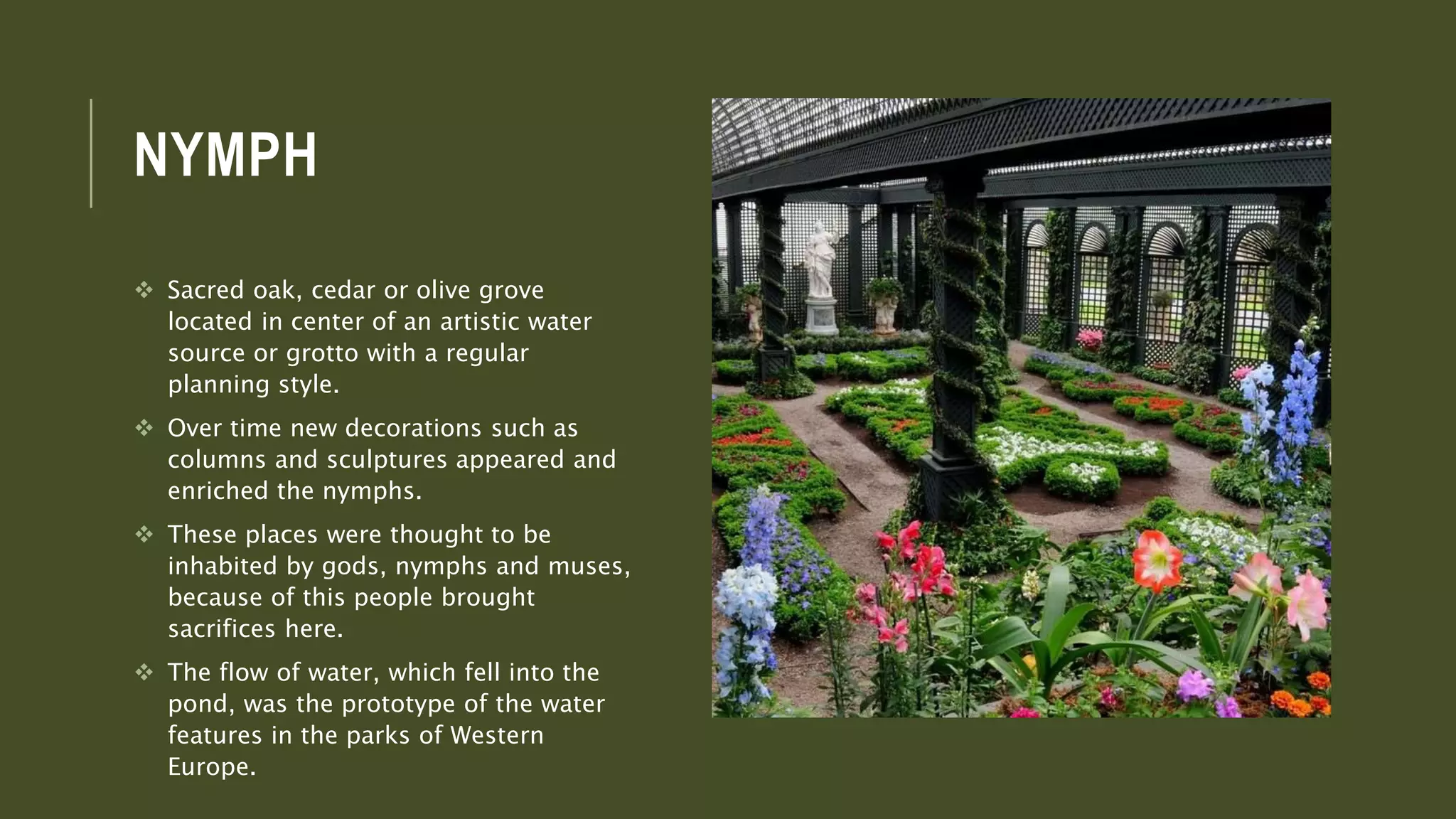
NYMPH
 Sacred oak, cedar or olive grove
located in center of an artistic water
source or grotto with a regular
planning style.
 Over time new decorations such as
columns and sculptures appeared and
enriched the nymphs.
 These places were thought to be
inhabited by gods, nymphs and muses,
because of this people brought
sacrifices here.
 The flow of water, which fell into the
pond, was the prototype of the water
features in the parks of Western
Europe.
PLEASURE
GARDENS
 The pleasure gardens like those of the
Persian's - appeared after Alexander of
Macedon victoriously marched into
Persia (336-323 B.C.). Such gardens
were created for the aristocracy -
"nobles".
 In Alexandria, for example, they
occupied ¼ of the city.
Pleasure gardens of
ancient Greece
APPLICATION
Small gazebo
Aquarius fountain
Bougainvillea in Greek vase
Laurel tree
This Grecian garden is
designed in a utilitarian
style like the ancient
times,
The design is simple and
direct, it serves its
purpose as somewhere
you can relax.
Bermuda Buttercups
(Oxalis pes-caprae)
4-20mm Graded Gravel
REFERENCES
https://www.slideshare.net/annmagiosi/fauna-and-flora-of-greece-
38511492
https://www.slideshare.net/ShanuMa/landcscape-design-in-greece
https://www.gardenvisit.com/history_theory/library_online_ebooks/
ml_gothein_history_garden_art_design/ancient_greek_greece_crete
https://www.tandfonline.com/doi/abs/10.1080/1460117090340326
4?src=recsys&journalCode=tgah20
http://www.landscapedesign-online.com/blog/ancient-greece
https://www.nytimes.com/2007/07/12/arts/12iht-
conway.1.6629841.html

Greek garden in Landscape design

  • 1.
  • 2.
  • 3.
    LOCATION AND GEOGRAPHICAL CONTEXT  Locatedin southern Europe, Greece forms an irregular-shaped peninsula in the Mediterranean with two additional large peninsulas projecting from it: the Chalcidice and the Peloponnese.  The country has the largest coastline in Europe (13,676km) due to its numerous islands. Greece has a total of 2,000 Greek islands but only 168 are inhabited.  The country is washed to the east by the Aegean Sea, to the west by the Ionian and to the south by the Mediterranean Sea.
  • 4.
    LOCATION AND GEOGRAPHICAL CONTEXT  Themountains of Greece divide the agricultural lands into discrete geographical units, limited at all sides by sea and mountains.  Rugged rocky terrain, variable rainfall amounts – unpredictable growing conditions. Only 10% of land is arable, and it must be fallowed often. Poor, chalky, acidic soil.  Heavy reliance on the “Mediterranean Triad” – grains, olives, wine – specifically, beans, barley, and wheat.  Greece has a rich diversity in flora and fauna and many species are original in this country, which means that they are found only there in the world.
  • 5.
    SOIL NATURE  TheGreeks' life was closely related to landscape as a large part of the population lived in the urban centre and commuted daily in the outskirts of the city, in order to work in the farmlands.  Much of the soils in Greece are made up of silty, sandy soil. Limestone is a characteristic type of soil found in this country. The soil is not very fertile. Only about 30 percent of the total land area in Greece can support crops. Most farms are small because there are no major valleys in Greece. Wheat is Greece’s main crop.
  • 6.
    CLIMATIC CONDITIONS Weather in Greeceis fairly uniform throughout the mainland and the Greek islands. Due to its geographical position, Greece has mild winters and warm summers, cooled by different kind of seasonal winds. The summers are characterized by sunshine and very little rainfall. In the winter, temperatures again were influenced by the surrounding water. Typically temperatures did not go below 4.4° C (40° F ) with the exceptions in the high mountains. In the mountains, snow was typical during the wet winter months. Athens, Greece
  • 7.
    DID YOU KNOW? InGreek Mythology, during the winter and fall Demeter makes the earth cold and infertile to match her sad feelings for her missing daughter, and why, in the summer and spring, the earth is once again fertile because Persephone is back with her mother.
  • 8.
    CULTURE AND SOCIETY  Lifeof women in ancient Greece were closely tied to domestic work spinning, weaving and other duties. Greece was male dominating society  Greek people made their living from farming. Citizen had land outskirts of urban area which provided farmlands. Greek landscape and climate difficult for farms.  There were grape gardens, olive trees majorly since it was criminal offense to cut olive trees.  Honey was probably was the only sweetening that exited at the time so beehives were kept in terracotta pots. Painting depicting the ancient Greek ladies spending their leisure time in garden.
  • 9.
    HISTORY  Landscape designof ancient Greece (VI B.C. - IV A.D.) was in essence garden design. The presence of a good combination of utilitarian, religious and aesthetical features was typical to the gardens of that time.  The aggressive conquests of Alexander of Macedon played a basic role in the forming of the landscape design of this state and a substantial part of it underwent strong Asian influence - culture and the traditions of Egypt, India and Persia.
  • 10.
    HISTORY  Greeks learnedto harmoniously combine the construction of cities with the natural landscape, mutually supplementing each other.  Gardens and parks became similar to living organisms, which have a close connection with the natural environment and man.  Acropolises, theatres, forums, squares, seemingly grow from nature, harmonizing and merging with the surrounding landscape. Built structures like gazebo and fountains in ancient garden
  • 11.
    HISTORY  Ancient Greekgardens were far less ostentatious and more closely bound up with religion.  They had their origins in sacred groves, springs and rivers believed to be inhabited by gods and spirits, the haunt of nymphs and satyrs.  The trees and plants in them were associated with particular deities.  The goddess of love was a special protector of gardens, and her son Eros was sometimes represented as a gardener. The Graces had their gardens on the slopes of Mount Helicon. OAK TREE - ZEUS MYRTLE TREE - APHRODITE LAUREL - APOLLO
  • 12.
    HISTORY  Such groveswere also where the celebrated schools of philosophy grew up and flourished, the most famous being Plato's Academy and Aristotle's Lyceum, on the outskirts of Athens. They gradually acquired buildings for teaching and gymnasiums for physical exercise.  The gardens of the modest house that Epicurus bought just outside the walls of Athens in 306 B.C., where he taught his followers (including, to the scandal of some, women and slaves), became so closely identified with his teachings that his school of philosophy became known as the Garden.
  • 13.
  • 14.
    PRINCIPLES AND CHARACTERESTIC S  Inthe landscaping construction of ancient Greece a strict symmetry predominated.  Stepped gardens were also built, on which fountains were arranged and flowers and trees were planted.  The Hellenic garden had many components: massive amounts of plants, spiral staircases and many decorations  Greek landscape dictated a pre-defined course through the built and unbuilt environment, which was perceived as an inseparable unity. Components like water feature and vases in gardens.
  • 15.
    PRINCIPLES AND CHARACTERESTIC S  Hardyplants, protective walls, and shaded patios are ubiquitous  In smaller villages, there was no tradition for a home to have a backyard, there was no soil even, The place that people had when they went outside was the street. “They had to put pots with plants in the street. That's a typical garden."  A neutral backdrop. If you have hot summers, whitewashed walls and lightcolored stone facades function as effective scrims to reflect the sun's heat and create a serene structure for a garden.  An accent of bright color. Neutral background with colorful accents of flowers.
  • 16.
    COMMON ELEMENTS SOFTSCAPES Mediterranean cypress (Cupressussempervirens) Greek fir (Abies cephalonica) Olive tree Olea europaea TREES
  • 17.
    COMMON ELEMENTS SOFTSCAPES Poppy anemone (Anemonecoronaria) Cyclamen (Cyclamineae) Narcissus (Narcissus pseudonarcissus) FLOWERS
  • 18.
  • 19.
  • 21.
    SPECIAL FEATURES  colorful dasheson white or earthen background, pergolas with vines and other climbing trees creating deep shades.  columns and sculptures ,vases ,fountains.
  • 22.
  • 23.
  • 24.
    SACRED GROVES The religiousgardens were of two varieties:  CULTIVABLE TYPE which could be rented out while also being a pleasant gathering place  RUSTIC SHRINE where statuary and trees coexisted; a subspecies of this latter type consisted of natural grottoes embellished by rock-cut sculpture, votive offerings and at times.
  • 25.
    HERRON  the memorialgarden - grove, planted on the spot of the burial of a hero.  Gardens had a racetrack, a hippodrome, an area for gymnastic games and competition in the memory of heroes.  With time Herrons began to be decorated with statues and colonnades which became the accents of parks.  Herrons had a memorial nature, they were made with the process of the creation of different architectural structures and forests.  Over time these sacred groves ceased to bear a memorial nature and became sports parks. Alexander of Macedonia’s Tomb
  • 26.
    PHILOSOPHICAL GARDENS  were createdspecially so that philosophical conversations could be conducted in them.  On the terraces were created straight, wide alleys with space for sports, statues, vases and fountains. In such gardens school and gymnasium lessons were conducted by the famous philosophers Plato, Aristotle, etc. Academy Garden on the Ilisos river in the outskirts of Athens (460 B.C.).  Philosophical gardens were isolated from the public parks. The largest squares of all of the cities belonging to the state were surrounded with plants which were also placed along the roads.
  • 27.
    PUBLIC GARDEN The publicgarden was located in the main area of the city near temples and fountains. PRIVATE GARDEN The private gardens of prosperous owners most frequently bore an exceptionally utilitarian nature. SAMPLE OF CLASSICAL GREEK
  • 28.
    NYMPH  Sacred oak,cedar or olive grove located in center of an artistic water source or grotto with a regular planning style.  Over time new decorations such as columns and sculptures appeared and enriched the nymphs.  These places were thought to be inhabited by gods, nymphs and muses, because of this people brought sacrifices here.  The flow of water, which fell into the pond, was the prototype of the water features in the parks of Western Europe.
  • 29.
    PLEASURE GARDENS  The pleasuregardens like those of the Persian's - appeared after Alexander of Macedon victoriously marched into Persia (336-323 B.C.). Such gardens were created for the aristocracy - "nobles".  In Alexandria, for example, they occupied ¼ of the city. Pleasure gardens of ancient Greece
  • 31.
  • 32.
    Small gazebo Aquarius fountain Bougainvilleain Greek vase Laurel tree This Grecian garden is designed in a utilitarian style like the ancient times, The design is simple and direct, it serves its purpose as somewhere you can relax. Bermuda Buttercups (Oxalis pes-caprae) 4-20mm Graded Gravel
  • 33.