Game Theory and Learning for
Wireless Network
Author : Pooya Sagharchi Ha
• What is The Game Theory ?
• Nash Equilibrium
• Game Theory and Wireless Network
• Examples on Game Theory in Wireless Network
Agenda
• Developed in 1950 by mathematicians John von
Neumann and economist Oskar Morgenstern.
• Game theory is concerned with situations in which
decision-makers interact with one another.
• and in which the happiness of each participant with the
outcome depends not just on his or her own decisions
but on the decision made by everyone.
• A mathematical tool used to describe and solve games
depending on 3 basic elements:
What is Game Theory?
Nash Equilibrium
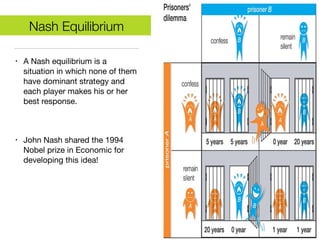
• A Nash equilibrium is a
situation in which none of them
have dominant strategy and
each player makes his or her
best response. 

• John Nash shared the 1994
Nobel prize in Economic for
developing this idea!
• Players :
• Players are the decision takers in the game
• Strategies:
• Define a plan of action for every contingency
• Payoffs :
• a utility function decides the all possible outcomes for
each player
Continue…
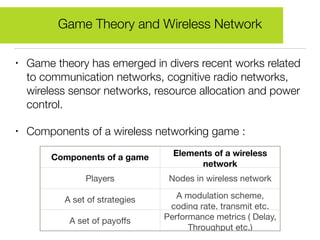
• Game theory has emerged in divers recent works related
to communication networks, cognitive radio networks,
wireless sensor networks, resource allocation and power
control.
• Components of a wireless networking game :
Game Theory and Wireless Network
Components of a game Elements of a wireless
network
Players Nodes in wireless network
A set of strategies A modulation scheme,

coding rate, transmit etc.
A set of payoffs Performance metrics ( Delay,
Throughput etc.)
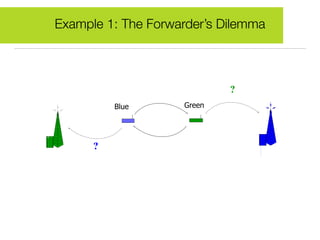
Example 1: The Forwarder’s Dilemma
?
?
Blue Green
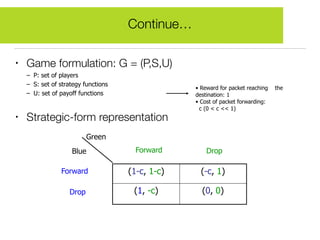
• Game formulation: G = (P,S,U)
– P: set of players
– S: set of strategy functions
– U: set of payoff functions
• Strategic-form representation
Continue…
• Reward for packet reaching the
destination: 1
• Cost of packet forwarding:
c (0 < c << 1)
(1-c, 1-c) (-c, 1)
(1, -c) (0, 0)
Blue
Green
Forward
Drop
Forward Drop
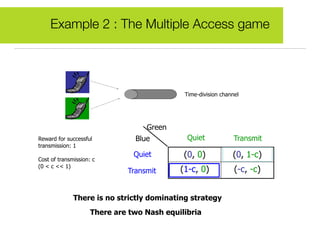
Example 2 : The Multiple Access game
Time-division channel
Reward for successful

transmission: 1
Cost of transmission: c
(0 < c << 1)
There is no strictly dominating strategy
(0, 0) (0, 1-c)
(1-c, 0) (-c, -c)
Blue
Green
Quiet
Transmit
Quiet Transmit
There are two Nash equilibria
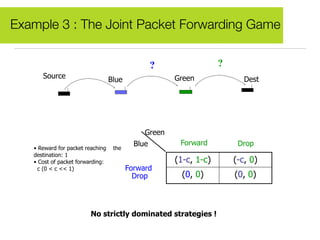
Example 3 : The Joint Packet Forwarding Game
?
Blue GreenSource Dest
?
No strictly dominated strategies !
• Reward for packet reaching the
destination: 1
• Cost of packet forwarding:
c (0 < c << 1)
(1-c, 1-c) (-c, 0)
(0, 0) (0, 0)
Blue
Green
Forward
Drop
Forward Drop
“Any Questions ?! .”

Game theory

  • 1.
    Game Theory andLearning for Wireless Network Author : Pooya Sagharchi Ha
  • 2.
    • What isThe Game Theory ? • Nash Equilibrium • Game Theory and Wireless Network • Examples on Game Theory in Wireless Network Agenda
  • 3.
    • Developed in1950 by mathematicians John von Neumann and economist Oskar Morgenstern. • Game theory is concerned with situations in which decision-makers interact with one another. • and in which the happiness of each participant with the outcome depends not just on his or her own decisions but on the decision made by everyone. • A mathematical tool used to describe and solve games depending on 3 basic elements: What is Game Theory?
  • 4.
    Nash Equilibrium • ANash equilibrium is a situation in which none of them have dominant strategy and each player makes his or her best response. • John Nash shared the 1994 Nobel prize in Economic for developing this idea!
  • 5.
    • Players : •Players are the decision takers in the game • Strategies: • Define a plan of action for every contingency • Payoffs : • a utility function decides the all possible outcomes for each player Continue…
  • 6.
    • Game theoryhas emerged in divers recent works related to communication networks, cognitive radio networks, wireless sensor networks, resource allocation and power control. • Components of a wireless networking game : Game Theory and Wireless Network Components of a game Elements of a wireless network Players Nodes in wireless network A set of strategies A modulation scheme, coding rate, transmit etc. A set of payoffs Performance metrics ( Delay, Throughput etc.)
  • 8.
    Example 1: TheForwarder’s Dilemma ? ? Blue Green
  • 9.
    • Game formulation:G = (P,S,U) – P: set of players – S: set of strategy functions – U: set of payoff functions • Strategic-form representation Continue… • Reward for packet reaching the destination: 1 • Cost of packet forwarding: c (0 < c << 1) (1-c, 1-c) (-c, 1) (1, -c) (0, 0) Blue Green Forward Drop Forward Drop
  • 10.
    Example 2 :The Multiple Access game Time-division channel Reward for successful
 transmission: 1 Cost of transmission: c (0 < c << 1) There is no strictly dominating strategy (0, 0) (0, 1-c) (1-c, 0) (-c, -c) Blue Green Quiet Transmit Quiet Transmit There are two Nash equilibria
  • 11.
    Example 3 :The Joint Packet Forwarding Game ? Blue GreenSource Dest ? No strictly dominated strategies ! • Reward for packet reaching the destination: 1 • Cost of packet forwarding: c (0 < c << 1) (1-c, 1-c) (-c, 0) (0, 0) (0, 0) Blue Green Forward Drop Forward Drop
  • 12.