Hydrological modeling of coupled surface-subsurface
flow and transport phenomena: the
CATchment-HYdrology Flow-Transport (CATHY_FT)
model
Workshop on coupled hydrological modeling
Carlotta Scudeler, Claudio Paniconi, Mario Putti
Padua, 23-09-2015
£
¢
 
¡INTRODUCTION CATHY_FT MODEL PERFORMANCE
Many challenges in improving and testing current state-of-the-art
models for integrated hydrological simulation
Not so many models address both flow and transport interactions
between the subsurface and surface
I am presenting the CATchment-HYdrology Flow-Transport
model and I am showing its performance under hillslope
drainage, seepage face, and runoff generation
C Scudeler Padua Workshop, Padua, 23-09-2015 2/17
II. CATchment HYdrology Flow
and Transport model
INTRODUCTION
£
¢
 
¡CATHY_FT MODEL PERFORMANCE
CATchment HYdrology (CATHY) model



Sw Ss
∂ψ
∂t
+ φ∂Sw
∂t
= − · q + qss
∂Q
∂t
+ ck
∂Q
∂s
= Dh
∂2
Q
∂s2 + ck qs



∂θc
∂t
= · [−qc + D c] + qtss
∂Qm
∂t
+ ct
∂Qm
∂s
= Dc
∂2
Qm
∂s2 + ct qts
C Scudeler Padua Workshop, Padua, 23-09-2015 4/17
INTRODUCTION
£
¢
 
¡CATHY_FT MODEL PERFORMANCE
CATHY Flow-Transport (CATHY_FT) model



Sw Ss
∂ψ
∂t
+ φ∂Sw
∂t
= − · q + qss
∂Q
∂t
+ ck
∂Q
∂s
= Dh
∂2
Q
∂s2 + ck qs



∂θc
∂t
= · [−qc + D c] + qtss
∂Qm
∂t
+ ct
∂Qm
∂s
= Dc
∂2
Qm
∂s2 + ct qts
C Scudeler Padua Workshop, Padua, 23-09-2015 5/17
INTRODUCTION
£
¢
 
¡CATHY_FT MODEL PERFORMANCE
Numerical model
Richards’ equation (subsurface flow)



Sw Ss
∂ψ
∂t
+ φ∂Sw
∂t
= − · q + qss
∂Q
∂t
+ ck
∂Q
∂s
= Dh
∂2
Q
∂s2 + ck qs



∂θc
∂t
= · [−qc + D c] + qtss
∂Qm
∂t
+ ct
∂Qm
∂s
= Dc
∂2
Qm
∂s2 + ct qts
Numerics: P1 Galerkin finite element (FE) model in space and implicit finite difference
model in time
C Scudeler Padua Workshop, Padua, 23-09-2015 6/17
INTRODUCTION
£
¢
 
¡CATHY_FT MODEL PERFORMANCE
Numerical model
Richards’ equation (subsurface flow)



Sw Ss
∂ψ
∂t
+ φ∂Sw
∂t
= − · q + qss
∂Q
∂t
+ ck
∂Q
∂s
= Dh
∂2
Q
∂s2 + ck qs



∂θc
∂t
= · [−qc + D c] + qtss
∂Qm
∂t
+ ct
∂Qm
∂s
= Dc
∂2
Qm
∂s2 + ct qts
Numerics: P1 Galerkin finite element (FE) model in space and implicit finite difference
model in time
1. Nodal solution for ψ → continuous and piecewise linear
C Scudeler Padua Workshop, Padua, 23-09-2015 6/17
INTRODUCTION
£
¢
 
¡CATHY_FT MODEL PERFORMANCE
Numerical model
Richards’ equation (subsurface flow)



Sw Ss
∂ψ
∂t
+ φ∂Sw
∂t
= − · q + qss
∂Q
∂t
+ ck
∂Q
∂s
= Dh
∂2
Q
∂s2 + ck qs



∂θc
∂t
= · [−qc + D c] + qtss
∂Qm
∂t
+ ct
∂Qm
∂s
= Dc
∂2
Qm
∂s2 + ct qts
Numerics: P1 Galerkin finite element (FE) model in space and implicit finite difference
model in time
1. Nodal solution for ψ → continuous and piecewise linear
2. Elementwise post-computation of the velocity field q from direct application of
Darcy’s law → elementwise constant, normal flux discontinous and not
mass-conservative across every face
C Scudeler Padua Workshop, Padua, 23-09-2015 6/17
INTRODUCTION
£
¢
 
¡CATHY_FT MODEL PERFORMANCE
Numerical model
Richards’ equation (subsurface flow)



Sw Ss
∂ψ
∂t
+ φ∂Sw
∂t
= − · q + qss
∂Q
∂t
+ ck
∂Q
∂s
= Dh
∂2
Q
∂s2 + ck qs



∂θc
∂t
= · [−qc + D c] + qtss
∂Qm
∂t
+ ct
∂Qm
∂s
= Dc
∂2
Qm
∂s2 + ct qts
Numerics: P1 Galerkin finite element (FE) model in space and implicit finite difference
model in time
1. Nodal solution for ψ → continuous and piecewise linear
2. Elementwise post-computation of the velocity field q from direct application of
Darcy’s law → elementwise constant, normal flux discontinous and not
mass-conservative across every face
3. Larson-Niklasson (LN) velocity field q reconstruction
C Scudeler Padua Workshop, Padua, 23-09-2015 6/17
INTRODUCTION
£
¢
 
¡CATHY_FT MODEL PERFORMANCE
Numerical model
ADE equation (subsurface transport)



Sw Ss
∂ψ
∂t
+ φ∂Sw
∂t
= − · q + qss
∂Q
∂t
+ ck
∂Q
∂s
= Dh
∂2
Q
∂s2 + ck qs



∂θc
∂t
= · [−qc + D c] + qtss
∂Qm
∂t
+ ct
∂Qm
∂s
= Dc
∂2
Qm
∂s2 + ct qts
Numerics: High resolution finite volume (for - · qc advective step) and FE (for
· (D c) dispersive step) combined with a time-splitting technique
C Scudeler Padua Workshop, Padua, 23-09-2015 6/17
INTRODUCTION
£
¢
 
¡CATHY_FT MODEL PERFORMANCE
Numerical model
ADE equation (subsurface transport)



Sw Ss
∂ψ
∂t
+ φ∂Sw
∂t
= − · q + qss
∂Q
∂t
+ ck
∂Q
∂s
= Dh
∂2
Q
∂s2 + ck qs



∂θc
∂t
= · [−qc + D c] + qtss
∂Qm
∂t
+ ct
∂Qm
∂s
= Dc
∂2
Qm
∂s2 + ct qts
Numerics: High resolution finite volume (for - · qc advective step) and FE (for
· (D c) dispersive step) combined with a time-splitting technique
1. Advective time-explicit step for the elementwise c
C Scudeler Padua Workshop, Padua, 23-09-2015 6/17
INTRODUCTION
£
¢
 
¡CATHY_FT MODEL PERFORMANCE
Numerical model
ADE equation (subsurface transport)



Sw Ss
∂ψ
∂t
+ φ∂Sw
∂t
= − · q + qss
∂Q
∂t
+ ck
∂Q
∂s
= Dh
∂2
Q
∂s2 + ck qs



∂θc
∂t
= · [−qc + D c] + qtss
∂Qm
∂t
+ ct
∂Qm
∂s
= Dc
∂2
Qm
∂s2 + ct qts
Numerics: High resolution finite volume (for - · qc advective step) and FE (for
· (D c) dispersive step) combined with a time-splitting technique
1. Advective time-explicit step for the elementwise c
2. Mass-conservative element→node c reconstruction
C Scudeler Padua Workshop, Padua, 23-09-2015 6/17
INTRODUCTION
£
¢
 
¡CATHY_FT MODEL PERFORMANCE
Numerical model
ADE equation (subsurface transport)



Sw Ss
∂ψ
∂t
+ φ∂Sw
∂t
= − · q + qss
∂Q
∂t
+ ck
∂Q
∂s
= Dh
∂2
Q
∂s2 + ck qs



∂θc
∂t
= · [−qc + D c] + qtss
∂Qm
∂t
+ ct
∂Qm
∂s
= Dc
∂2
Qm
∂s2 + ct qts
Numerics: High resolution finite volume (for - · qc advective step) and FE (for
· (D c) dispersive step) combined with a time-splitting technique
1. Advective time-explicit step for the elementwise c
2. Mass-conservative element→node c reconstruction
3. Dispersive time-implicit step for the nodal c
C Scudeler Padua Workshop, Padua, 23-09-2015 6/17
INTRODUCTION
£
¢
 
¡CATHY_FT MODEL PERFORMANCE
Numerical model
ADE equation (subsurface transport)



Sw Ss
∂ψ
∂t
+ φ∂Sw
∂t
= − · q + qss
∂Q
∂t
+ ck
∂Q
∂s
= Dh
∂2
Q
∂s2 + ck qs



∂θc
∂t
= · [−qc + D c] + qtss
∂Qm
∂t
+ ct
∂Qm
∂s
= Dc
∂2
Qm
∂s2 + ct qts
Numerics: High resolution finite volume (for - · qc advective step) and FE (for
· (D c) dispersive step) combined with a time-splitting technique
1. Advective time-explicit step for the elementwise c
2. Mass-conservative element→node c reconstruction
3. Dispersive time-implicit step for the nodal c
4. Mass-conservative node→element c reconstruction
C Scudeler Padua Workshop, Padua, 23-09-2015 6/17
INTRODUCTION
£
¢
 
¡CATHY_FT MODEL PERFORMANCE
Numerical model
Surface flow and transport equations



Sw Ss
∂ψ
∂t
+ φ∂Sw
∂t
= − · q + qss
∂Q
∂t
+ ck
∂Q
∂s
= Dh
∂2
Q
∂s2 + ck qs



∂θc
∂t
= · [−qc + D c] + qtss
∂Qm
∂t
+ ct
∂Qm
∂s
= Dc
∂2
Qm
∂s2 + ct qts
Numerics: Explicit finite difference scheme in space and time for both surface flow and
transport solution
C Scudeler Padua Workshop, Padua, 23-09-2015 6/17
INTRODUCTION
£
¢
 
¡CATHY_FT MODEL PERFORMANCE
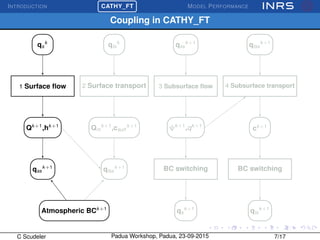
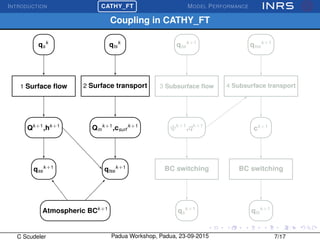
Coupling in CATHY_FT
1 Surface flow 2 Surface transport 3 Subsurface flow 4 Subsurface transport
qs
k
qts
k
Qk+1
,hk+1
Qm
k+1
,csurf
k+1
ψk+1
,qk+1
BC switching
ck+1
BC switchingqss
k+1
Atmospheric BCk+1
qss
k+1
qtss
k+1
qtss
k+1
qs
k+1
qts
k+1
C Scudeler Padua Workshop, Padua, 23-09-2015 7/17
INTRODUCTION
£
¢
 
¡CATHY_FT MODEL PERFORMANCE
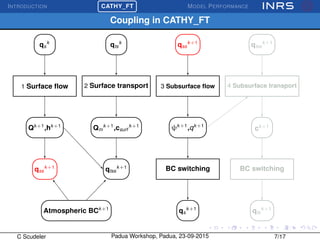
Coupling in CATHY_FT
1 Surface flow 2 Surface transport 3 Subsurface flow 4 Subsurface transport
qs
k
qts
k
Qk+1
,hk+1
Qm
k+1
,csurf
k+1
ψk+1
,qk+1
BC switching
Atmospheric BCk+1
ck+1
BC switchingqss
k+1
qss
k+1
qtss
k+1
qtss
k+1
qs
k+1
qts
k+1
C Scudeler Padua Workshop, Padua, 23-09-2015 7/17
INTRODUCTION
£
¢
 
¡CATHY_FT MODEL PERFORMANCE
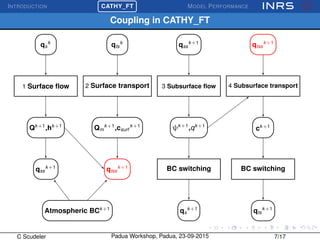
Coupling in CATHY_FT
1 Surface flow 2 Surface transport 3 Subsurface flow 4 Subsurface transport
qs
k
qts
k
Qk+1
,hk+1
Qm
k+1
,csurf
k+1
Atmospheric BCk+1
ψk+1
,qk+1
BC switching
ck+1
BC switchingqss
k+1
qss
k+1
qtss
k+1
qtss
k+1
qs
k+1
qts
k+1
C Scudeler Padua Workshop, Padua, 23-09-2015 7/17
INTRODUCTION
£
¢
 
¡CATHY_FT MODEL PERFORMANCE
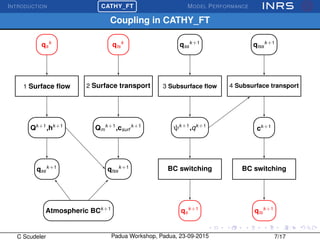
Coupling in CATHY_FT
1 Surface flow 2 Surface transport 3 Subsurface flow 4 Subsurface transport
qs
k
qts
k
Qk+1
,hk+1
Atmospheric BCk+1
Qm
k+1
,csurf
k+1
ψk+1
,qk+1
BC switching
ck+1
BC switchingqss
k+1
qss
k+1
qtss
k+1
qtss
k+1
qs
k+1
qts
k+1
C Scudeler Padua Workshop, Padua, 23-09-2015 7/17
INTRODUCTION
£
¢
 
¡CATHY_FT MODEL PERFORMANCE
Coupling in CATHY_FT
1 Surface flow 2 Surface transport 3 Subsurface flow
Atmospheric BCk+1
4 Subsurface transport
qs
k
qts
k
Qk+1
,hk+1
Qm
k+1
,csurf
k+1
ψk+1
,qk+1
BC switching
ck+1
BC switchingqss
k+1
qss
k+1
qtss
k+1
qtss
k+1
qs
k+1
qts
k+1
C Scudeler Padua Workshop, Padua, 23-09-2015 7/17
INTRODUCTION
£
¢
 
¡CATHY_FT MODEL PERFORMANCE
Model accuracy
Ability of the model to conserve mass
C Scudeler Padua Workshop, Padua, 23-09-2015 8/17
INTRODUCTION
£
¢
 
¡CATHY_FT MODEL PERFORMANCE
Model accuracy
Ability of the model to conserve mass
Sw Ss
∂ψ
∂t
+ φ
∂Sw
∂t
= − · q + qss
→
Mass-conservative solution
achieved solving the equation in
its ψ − Sw mixed form [Celia et al.,
1990]
C Scudeler Padua Workshop, Padua, 23-09-2015 8/17
INTRODUCTION
£
¢
 
¡CATHY_FT MODEL PERFORMANCE
Model accuracy
Ability of the model to conserve mass
∂θc
∂t
= · [−qc + D c] + qtss
→
HRFV mass-conservative solution
if q is mass-conservative.
C Scudeler Padua Workshop, Padua, 23-09-2015 8/17
INTRODUCTION
£
¢
 
¡CATHY_FT MODEL PERFORMANCE
Model accuracy
Ability of the model to conserve mass
∂θc
∂t
= · [−qc + D c] + qtss
→
HRFV mass-conservative solution
if q is mass-conservative.
P1 Galerkin q is not
mass-conservative
C Scudeler Padua Workshop, Padua, 23-09-2015 8/17
INTRODUCTION
£
¢
 
¡CATHY_FT MODEL PERFORMANCE
Model accuracy
Ability of the model to conserve mass
∂θc
∂t
= · [−qc + D c] + qtss
→
HRFV mass-conservative solution
if q is mass-conservative.
P1 Galerkin q is not
mass-conservative
To make q mass-conservative:
change the numerical scheme from FE =⇒ High computational cost
to Mixed Hybrid Finite Element (MHFE)
or
add mass-conservative velocity field =⇒ Low computational cost
reconstruction
C Scudeler Padua Workshop, Padua, 23-09-2015 8/17
INTRODUCTION
£
¢
 
¡CATHY_FT MODEL PERFORMANCE
Model accuracy
Ability of the model to conserve mass
∂θc
∂t
= · [−qc + D c] + qtss
→
HRFV mass-conservative solution
if q is mass-conservative.
P1 Galerkin q is not
mass-conservative
To make q mass-conservative:
change the numerical scheme from FE =⇒ High computational cost
to Mixed Hybrid Finite Element (MHFE)
or
add mass-conservative velocity field =⇒ Low computational cost
reconstruction
In CATHY_FT: FE =⇒ FE+Larson-Niklasson (LN) post-processing technique
C Scudeler Padua Workshop, Padua, 23-09-2015 8/17
INTRODUCTION
£
¢
 
¡CATHY_FT MODEL PERFORMANCE
Larson-Niklasson technique
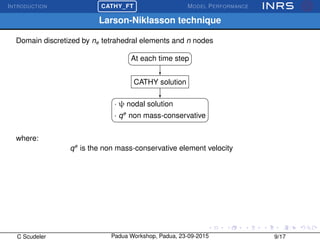
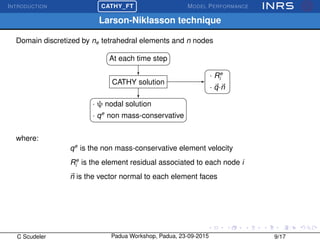
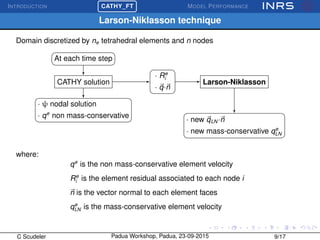
Domain discretized by ne tetrahedral elements and n nodes
At each time step
C Scudeler Padua Workshop, Padua, 23-09-2015 9/17
INTRODUCTION
£
¢
 
¡CATHY_FT MODEL PERFORMANCE
Larson-Niklasson technique
Domain discretized by ne tetrahedral elements and n nodes
At each time step
CATHY solution
· ψ nodal solution
· qe
non mass-conservative
where:
qe
is the non mass-conservative element velocity
C Scudeler Padua Workshop, Padua, 23-09-2015 9/17
INTRODUCTION
£
¢
 
¡CATHY_FT MODEL PERFORMANCE
Larson-Niklasson technique
Domain discretized by ne tetrahedral elements and n nodes
At each time step
CATHY solution
· ψ nodal solution
· qe
non mass-conservative
· Re
i
· q·n
where:
qe
is the non mass-conservative element velocity
Re
i is the element residual associated to each node i
n is the vector normal to each element faces
C Scudeler Padua Workshop, Padua, 23-09-2015 9/17
INTRODUCTION
£
¢
 
¡CATHY_FT MODEL PERFORMANCE
Larson-Niklasson technique
Domain discretized by ne tetrahedral elements and n nodes
At each time step
CATHY solution
· ψ nodal solution
· qe
non mass-conservative
· Re
i
· q·n
Larson-Niklasson
· new qLN ·n
· new mass-conservative qe
LN
where:
qe
is the non mass-conservative element velocity
Re
i is the element residual associated to each node i
n is the vector normal to each element faces
qe
LN is the mass-conservative element velocity
C Scudeler Padua Workshop, Padua, 23-09-2015 9/17
INTRODUCTION
£
¢
 
¡CATHY_FT MODEL PERFORMANCE
LN velocity reconstruction results
1. Convergent streamlines towards an outlet
2. High streamline curvatures due to heterogeneity
C Scudeler Padua Workshop, Padua, 23-09-2015 10/17
INTRODUCTION
£
¢
 
¡CATHY_FT MODEL PERFORMANCE
LN velocity reconstruction results
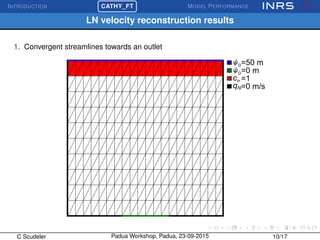
1. Convergent streamlines towards an outlet
D=50 m
D=0 m
qN=0 m/s
cin =1
C Scudeler Padua Workshop, Padua, 23-09-2015 10/17
INTRODUCTION
£
¢
 
¡CATHY_FT MODEL PERFORMANCE
LN velocity reconstruction results
1. Convergent streamlines towards an outlet
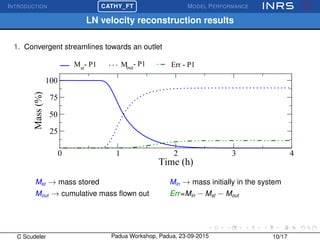
0 1 2 3 4
Time (h)
25
50
75
100
Mass(%)
Mst
- P1 Mout
- P1 Err - P1
Mst → mass stored
Mout → cumulative mass flown out
Min → mass initially in the system
Err=Min − Mst − Mout
C Scudeler Padua Workshop, Padua, 23-09-2015 10/17
INTRODUCTION
£
¢
 
¡CATHY_FT MODEL PERFORMANCE
LN velocity reconstruction results
1. Convergent streamlines towards an outlet
0 1 2 3 4
Time (h)
25
50
75
100
Mass(%)
Mst
- P1 Mout
- P1 Err - P1
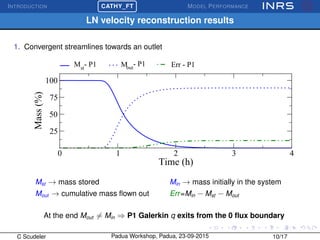
Mst → mass stored
Mout → cumulative mass flown out
Min → mass initially in the system
Err=Min − Mst − Mout
At the end Mout = Min ⇒ P1 Galerkin q exits from the 0 flux boundary
C Scudeler Padua Workshop, Padua, 23-09-2015 10/17
INTRODUCTION
£
¢
 
¡CATHY_FT MODEL PERFORMANCE
LN velocity reconstruction results
1. Convergent streamlines towards an outlet
0 1 2 3 4
Time (h)
25
50
75
100
Mass(%)
Mst
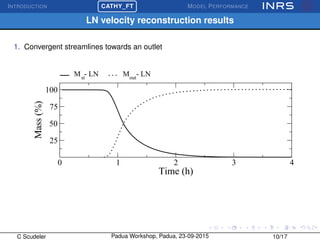
- LN Mout
- LN
C Scudeler Padua Workshop, Padua, 23-09-2015 10/17
INTRODUCTION
£
¢
 
¡CATHY_FT MODEL PERFORMANCE
LN velocity reconstruction results
1. Convergent streamlines towards an outlet
0 1 2 3 4
Time (h)
25
50
75
100
Mass(%)
Mst
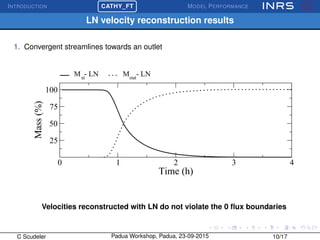
- LN Mout
- LN
Velocities reconstructed with LN do not violate the 0 flux boundaries
C Scudeler Padua Workshop, Padua, 23-09-2015 10/17
INTRODUCTION
£
¢
 
¡CATHY_FT MODEL PERFORMANCE
LN velocity reconstruction results
1. Convergent streamlines towards an outlet
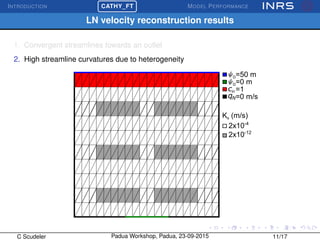
2. High streamline curvatures due to heterogeneity
D=50 m
D=0 m
qN=0 m/s
cin =1
Ks (m/s)
2x10⁻⁴
2x10-12
C Scudeler Padua Workshop, Padua, 23-09-2015 11/17
INTRODUCTION
£
¢
 
¡CATHY_FT MODEL PERFORMANCE
LN velocity reconstruction results
1. Convergent streamlines towards an outlet
2. High streamline curvatures due to heterogeneity
0 2 4 6 8 10
Time (h)
Mst
- LN Mstf
- LN
0 2 4 6 8
Time (h)
25
50
75
100
Mass(%)
Mst
- P1 Mstf
- P1
Mstf
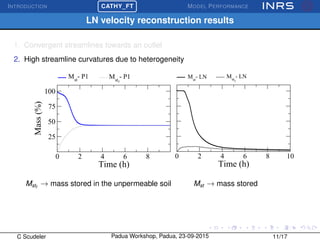
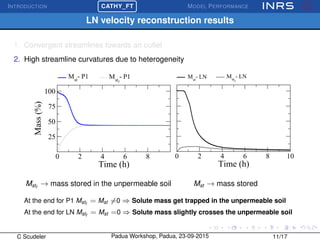
→ mass stored in the unpermeable soil Mst → mass stored
C Scudeler Padua Workshop, Padua, 23-09-2015 11/17
INTRODUCTION
£
¢
 
¡CATHY_FT MODEL PERFORMANCE
LN velocity reconstruction results
1. Convergent streamlines towards an outlet
2. High streamline curvatures due to heterogeneity
0 2 4 6 8 10
Time (h)
Mst
- LN Mstf
- LN
0 2 4 6 8
Time (h)
25
50
75
100
Mass(%)
Mst
- P1 Mstf
- P1
Mstf
→ mass stored in the unpermeable soil Mst → mass stored
At the end for P1 Mstf
= Mst =0 ⇒ Solute mass get trapped in the unpermeable soil
At the end for LN Mstf
= Mst =0 ⇒ Solute mass slightly crosses the unpermeable soil
C Scudeler Padua Workshop, Padua, 23-09-2015 11/17
III. Testing CATHY_FT at the
Landscape Evolution
Observatory (LEO)
INTRODUCTION CATHY_FT
£
¢
 
¡MODEL PERFORMANCE
The Landscape Evolution Observatory (LEO)
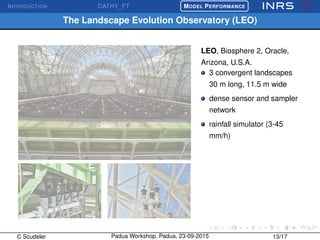
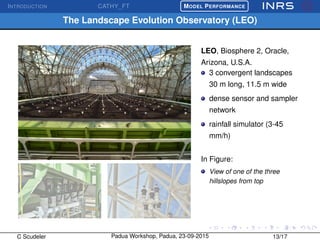
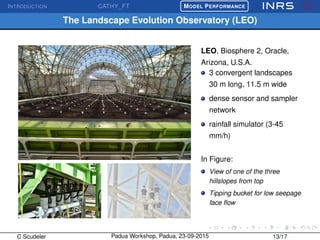
LEO, Biosphere 2, Oracle,
Arizona, U.S.A.
3 convergent landscapes
30 m long, 11.5 m wide
dense sensor and sampler
network
rainfall simulator (3-45
mm/h)
C Scudeler Padua Workshop, Padua, 23-09-2015 13/17
INTRODUCTION CATHY_FT
£
¢
 
¡MODEL PERFORMANCE
The Landscape Evolution Observatory (LEO)
LEO, Biosphere 2, Oracle,
Arizona, U.S.A.
3 convergent landscapes
30 m long, 11.5 m wide
dense sensor and sampler
network
rainfall simulator (3-45
mm/h)
In Figure:
View of one of the three
hillslopes from top
C Scudeler Padua Workshop, Padua, 23-09-2015 13/17
INTRODUCTION CATHY_FT
£
¢
 
¡MODEL PERFORMANCE
The Landscape Evolution Observatory (LEO)
LEO, Biosphere 2, Oracle,
Arizona, U.S.A.
3 convergent landscapes
30 m long, 11.5 m wide
dense sensor and sampler
network
rainfall simulator (3-45
mm/h)
In Figure:
View of one of the three
hillslopes from top
Tipping bucket for low seepage
face flow
C Scudeler Padua Workshop, Padua, 23-09-2015 13/17
INTRODUCTION CATHY_FT
£
¢
 
¡MODEL PERFORMANCE
The Landscape Evolution Observatory (LEO)
LEO, Biosphere 2, Oracle,
Arizona, U.S.A.
3 convergent landscapes
30 m long, 11.5 m wide
dense sensor and sampler
network
rainfall simulator (3-45
mm/h)
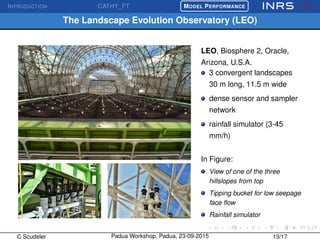
In Figure:
View of one of the three
hillslopes from top
Tipping bucket for low seepage
face flow
Rainfall simulator
C Scudeler Padua Workshop, Padua, 23-09-2015 13/17
INTRODUCTION CATHY_FT
£
¢
 
¡MODEL PERFORMANCE
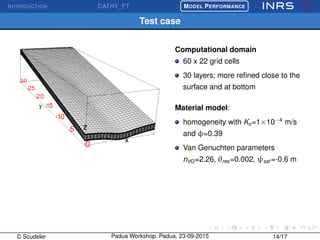
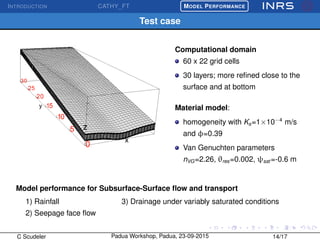
Test case
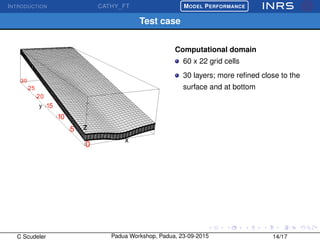
Computational domain
60 x 22 grid cells
30 layers; more refined close to the
surface and at bottom
C Scudeler Padua Workshop, Padua, 23-09-2015 14/17
INTRODUCTION CATHY_FT
£
¢
 
¡MODEL PERFORMANCE
Test case
Computational domain
60 x 22 grid cells
30 layers; more refined close to the
surface and at bottom
Material model:
homogeneity with Ks=1×10⁻⁴
m/s
and φ=0.39
Van Genuchten parameters
nVG=2.26, θres=0.002, ψsat =-0.6 m
C Scudeler Padua Workshop, Padua, 23-09-2015 14/17
INTRODUCTION CATHY_FT
£
¢
 
¡MODEL PERFORMANCE
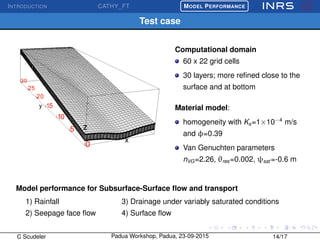
Test case
Computational domain
60 x 22 grid cells
30 layers; more refined close to the
surface and at bottom
Material model:
homogeneity with Ks=1×10⁻⁴
m/s
and φ=0.39
Van Genuchten parameters
nVG=2.26, θres=0.002, ψsat =-0.6 m
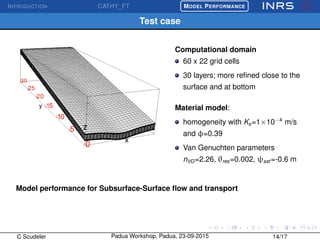
Model performance for Subsurface-Surface flow and transport
C Scudeler Padua Workshop, Padua, 23-09-2015 14/17
INTRODUCTION CATHY_FT
£
¢
 
¡MODEL PERFORMANCE
Test case
Computational domain
60 x 22 grid cells
30 layers; more refined close to the
surface and at bottom
Material model:
homogeneity with Ks=1×10⁻⁴
m/s
and φ=0.39
Van Genuchten parameters
nVG=2.26, θres=0.002, ψsat =-0.6 m
Model performance for Subsurface-Surface flow and transport
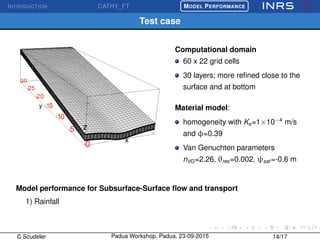
1) Rainfall
C Scudeler Padua Workshop, Padua, 23-09-2015 14/17
INTRODUCTION CATHY_FT
£
¢
 
¡MODEL PERFORMANCE
Test case
Computational domain
60 x 22 grid cells
30 layers; more refined close to the
surface and at bottom
Material model:
homogeneity with Ks=1×10⁻⁴
m/s
and φ=0.39
Van Genuchten parameters
nVG=2.26, θres=0.002, ψsat =-0.6 m
Model performance for Subsurface-Surface flow and transport
1) Rainfall
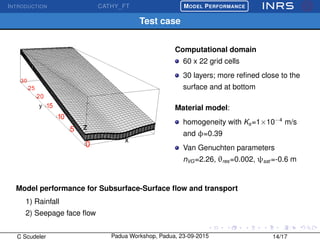
2) Seepage face flow
C Scudeler Padua Workshop, Padua, 23-09-2015 14/17
INTRODUCTION CATHY_FT
£
¢
 
¡MODEL PERFORMANCE
Test case
Computational domain
60 x 22 grid cells
30 layers; more refined close to the
surface and at bottom
Material model:
homogeneity with Ks=1×10⁻⁴
m/s
and φ=0.39
Van Genuchten parameters
nVG=2.26, θres=0.002, ψsat =-0.6 m
Model performance for Subsurface-Surface flow and transport
1) Rainfall
2) Seepage face flow
3) Drainage under variably saturated conditions
C Scudeler Padua Workshop, Padua, 23-09-2015 14/17
INTRODUCTION CATHY_FT
£
¢
 
¡MODEL PERFORMANCE
Test case
Computational domain
60 x 22 grid cells
30 layers; more refined close to the
surface and at bottom
Material model:
homogeneity with Ks=1×10⁻⁴
m/s
and φ=0.39
Van Genuchten parameters
nVG=2.26, θres=0.002, ψsat =-0.6 m
Model performance for Subsurface-Surface flow and transport
1) Rainfall
2) Seepage face flow
3) Drainage under variably saturated conditions
4) Surface flow
C Scudeler Padua Workshop, Padua, 23-09-2015 14/17
INTRODUCTION CATHY_FT
£
¢
 
¡MODEL PERFORMANCE
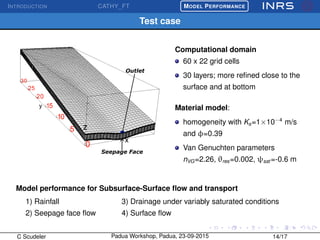
Test case
Seepage Face
Outlet
Computational domain
60 x 22 grid cells
30 layers; more refined close to the
surface and at bottom
Material model:
homogeneity with Ks=1×10⁻⁴
m/s
and φ=0.39
Van Genuchten parameters
nVG=2.26, θres=0.002, ψsat =-0.6 m
Model performance for Subsurface-Surface flow and transport
1) Rainfall
2) Seepage face flow
3) Drainage under variably saturated conditions
4) Surface flow
C Scudeler Padua Workshop, Padua, 23-09-2015 14/17
INTRODUCTION CATHY_FT
£
¢
 
¡MODEL PERFORMANCE
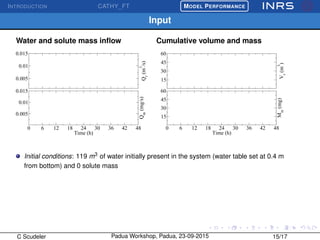
Input
Water and solute mass inflow Cumulative volume and mass
0.005
0.01
0.015
Qr
(m
3
/s)
0 6 12 18 24 30 36 42 48
Time (h)
0.005
0.01
0.015
Qm
(mg/s)
15
30
45
60
Vr
(m
3
)
0 6 12 18 24 30 36 42 48
Time (h)
15
30
45
60
Min
(mg)
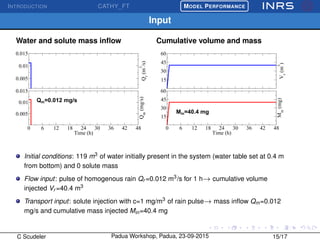
Initial conditions: 119 m3
of water initially present in the system (water table set at 0.4 m
from bottom) and 0 solute mass
C Scudeler Padua Workshop, Padua, 23-09-2015 15/17
INTRODUCTION CATHY_FT
£
¢
 
¡MODEL PERFORMANCE
Input
Water and solute mass inflow Cumulative volume and mass
0.005
0.01
0.015
Qr
(m
3
/s)
0 6 12 18 24 30 36 42 48
Time (h)
0.005
0.01
0.015
Qm
(mg/s)
Qr=0.012 m3
/s
15
30
45
60
Vr
(m
3
)
0 6 12 18 24 30 36 42 48
Time (h)
15
30
45
60
Min
(mg)
Vr=40.4 m3
Initial conditions: 119 m3
of water initially present in the system (water table set at 0.4 m
from bottom) and 0 solute mass
Flow input: pulse of homogenous rain Qr =0.012 m3
/s for 1 h→ cumulative volume
injected Vr =40.4 m3
C Scudeler Padua Workshop, Padua, 23-09-2015 15/17
INTRODUCTION CATHY_FT
£
¢
 
¡MODEL PERFORMANCE
Input
Water and solute mass inflow Cumulative volume and mass
0.005
0.01
0.015
Qr
(m
3
/s)
0 6 12 18 24 30 36 42 48
Time (h)
0.005
0.01
0.015
Qm
(mg/s)
Qm=0.012 mg/s
15
30
45
60
Vr
(m
3
)
0 6 12 18 24 30 36 42 48
Time (h)
15
30
45
60
Min
(mg)
Min=40.4 mg
Initial conditions: 119 m3
of water initially present in the system (water table set at 0.4 m
from bottom) and 0 solute mass
Flow input: pulse of homogenous rain Qr =0.012 m3
/s for 1 h→ cumulative volume
injected Vr =40.4 m3
Transport input: solute injection with c=1 mg/m3
of rain pulse→ mass inflow Qm=0.012
mg/s and cumulative mass injected Min=40.4 mg
C Scudeler Padua Workshop, Padua, 23-09-2015 15/17
INTRODUCTION CATHY_FT
£
¢
 
¡MODEL PERFORMANCE
Results
Water balance
40
80
Vr
(%)
-40
0
40
80
∆Vst
(%)
40
80
Vsf
(%)
0 6 12 18 24 30 36 42 48
Time (h)
40
80
Vout
(%)
40
80
Min
(%)
10
20
30
40
∆Mst
(%)
5
10
Msf
(%)
0 6 12 18 24 30 36 42 48
Time (h)
30
60
90
Mout
(%)
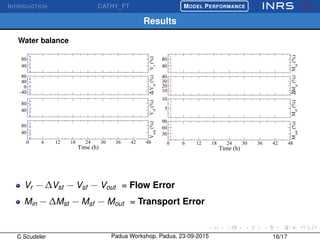
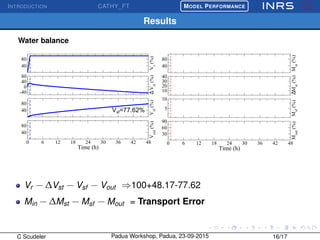
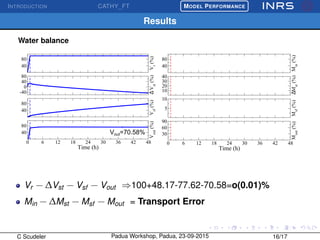
Vr − ∆Vst − Vsf − Vout = Flow Error
Min − ∆Mst − Msf − Mout = Transport Error
C Scudeler Padua Workshop, Padua, 23-09-2015 16/17
INTRODUCTION CATHY_FT
£
¢
 
¡MODEL PERFORMANCE
Results
Water balance
40
80
Vr
(%)
-40
0
40
80
∆Vst
(%)
40
80
Vsf
(%)
0 6 12 18 24 30 36 42 48
Time (h)
40
80
Vout
(%)
Vr=100%
40
80
Min
(%)
10
20
30
40
∆Mst
(%)
5
10
Msf
(%)
0 6 12 18 24 30 36 42 48
Time (h)
30
60
90
Mout
(%)
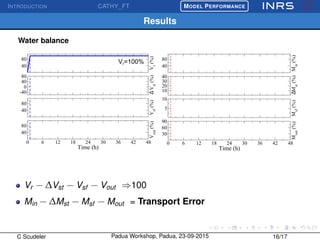
Vr − ∆Vst − Vsf − Vout ⇒100
Min − ∆Mst − Msf − Mout = Transport Error
C Scudeler Padua Workshop, Padua, 23-09-2015 16/17
INTRODUCTION CATHY_FT
£
¢
 
¡MODEL PERFORMANCE
Results
Water balance
40
80
Vr
(%)
-40
0
40
80
∆Vst
(%)
40
80
Vsf
(%)
0 6 12 18 24 30 36 42 48
Time (h)
40
80
Vout
(%)
-48.17%∆Vst=
40
80
Min
(%)
10
20
30
40
∆Mst
(%)
5
10
Msf
(%)
0 6 12 18 24 30 36 42 48
Time (h)
30
60
90
Mout
(%)
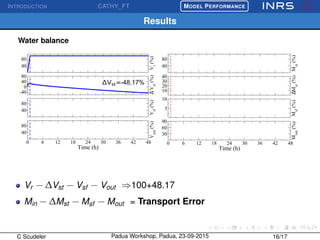
Vr − ∆Vst − Vsf − Vout ⇒100+48.17
Min − ∆Mst − Msf − Mout = Transport Error
C Scudeler Padua Workshop, Padua, 23-09-2015 16/17
INTRODUCTION CATHY_FT
£
¢
 
¡MODEL PERFORMANCE
Results
Water balance
40
80
Vr
(%)
-40
0
40
80
∆Vst
(%)
40
80
Vsf
(%)
0 6 12 18 24 30 36 42 48
Time (h)
40
80
Vout
(%)
Vsf=77.62%
40
80
Min
(%)
10
20
30
40
∆Mst
(%)
5
10
Msf
(%)
0 6 12 18 24 30 36 42 48
Time (h)
30
60
90
Mout
(%)
Vr − ∆Vst − Vsf − Vout ⇒100+48.17-77.62
Min − ∆Mst − Msf − Mout = Transport Error
C Scudeler Padua Workshop, Padua, 23-09-2015 16/17
INTRODUCTION CATHY_FT
£
¢
 
¡MODEL PERFORMANCE
Results
Water balance
40
80
Vr
(%)
-40
0
40
80
∆Vst
(%)
40
80
Vsf
(%)
0 6 12 18 24 30 36 42 48
Time (h)
40
80
Vout
(%)
Vout=70.58%
40
80
Min
(%)
10
20
30
40
∆Mst
(%)
5
10
Msf
(%)
0 6 12 18 24 30 36 42 48
Time (h)
30
60
90
Mout
(%)
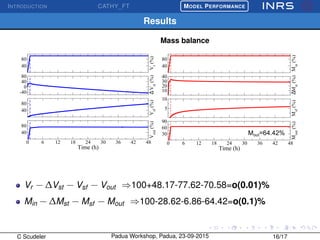
Vr − ∆Vst − Vsf − Vout ⇒100+48.17-77.62-70.58=o(0.01)%
Min − ∆Mst − Msf − Mout = Transport Error
C Scudeler Padua Workshop, Padua, 23-09-2015 16/17
INTRODUCTION CATHY_FT
£
¢
 
¡MODEL PERFORMANCE
Results
Mass balance
40
80
Vr
(%)
-40
0
40
80
∆Vst
(%)
40
80
Vsf
(%)
0 6 12 18 24 30 36 42 48
Time (h)
40
80
Vout
(%)
40
80
Min
(%)
10
20
30
40
∆Mst
(%)
5
10
Msf
(%)
0 6 12 18 24 30 36 42 48
Time (h)
30
60
90
Mout
(%)
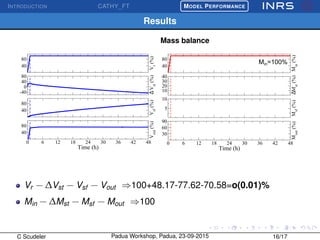
Min=100%
Vr − ∆Vst − Vsf − Vout ⇒100+48.17-77.62-70.58=o(0.01)%
Min − ∆Mst − Msf − Mout ⇒100
C Scudeler Padua Workshop, Padua, 23-09-2015 16/17
INTRODUCTION CATHY_FT
£
¢
 
¡MODEL PERFORMANCE
Results
Mass balance
40
80
Vr
(%)
-40
0
40
80
∆Vst
(%)
40
80
Vsf
(%)
0 6 12 18 24 30 36 42 48
Time (h)
40
80
Vout
(%)
40
80
Min
(%)
10
20
30
40
∆Mst
(%)
5
10
Msf
(%)
0 6 12 18 24 30 36 42 48
Time (h)
30
60
90
Mout
(%)
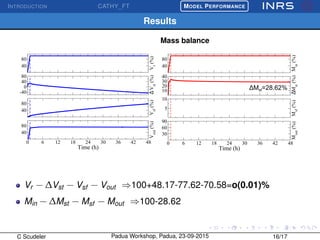
∆Mst=28.62%
Vr − ∆Vst − Vsf − Vout ⇒100+48.17-77.62-70.58=o(0.01)%
Min − ∆Mst − Msf − Mout ⇒100-28.62
C Scudeler Padua Workshop, Padua, 23-09-2015 16/17
INTRODUCTION CATHY_FT
£
¢
 
¡MODEL PERFORMANCE
Results
Mass balance
40
80
Vr
(%)
-40
0
40
80
∆Vst
(%)
40
80
Vsf
(%)
0 6 12 18 24 30 36 42 48
Time (h)
40
80
Vout
(%)
40
80
Min
(%)
10
20
30
40
∆Mst
(%)
5
10
Msf
(%)
0 6 12 18 24 30 36 42 48
Time (h)
30
60
90
Mout
(%)
Msf=6.86%
Vr − ∆Vst − Vsf − Vout ⇒100+48.17-77.62-70.58=o(0.01)%
Min − ∆Mst − Msf − Mout ⇒100-28.62-6.86
C Scudeler Padua Workshop, Padua, 23-09-2015 16/17
INTRODUCTION CATHY_FT
£
¢
 
¡MODEL PERFORMANCE
Results
Mass balance
40
80
Vr
(%)
-40
0
40
80
∆Vst
(%)
40
80
Vsf
(%)
0 6 12 18 24 30 36 42 48
Time (h)
40
80
Vout
(%)
40
80
Min
(%)
10
20
30
40
∆Mst
(%)
5
10
Msf
(%)
0 6 12 18 24 30 36 42 48
Time (h)
30
60
90
Mout
(%)
Mout=64.42%
Vr − ∆Vst − Vsf − Vout ⇒100+48.17-77.62-70.58=o(0.01)%
Min − ∆Mst − Msf − Mout ⇒100-28.62-6.86-64.42=o(0.1)%
C Scudeler Padua Workshop, Padua, 23-09-2015 16/17
INTRODUCTION CATHY_FT MODEL PERFORMANCE
Conclusions
1. P1 Galerkin solution is mass-conservative while the velocities are
not; this causes problems for transport simulations. This requires a
post-processing technique to ensure mass-conservation
C Scudeler Padua Workshop, Padua, 23-09-2015 17/17
INTRODUCTION CATHY_FT MODEL PERFORMANCE
Conclusions
1. P1 Galerkin solution is mass-conservative while the velocities are
not; this causes problems for transport simulations. This requires a
post-processing technique to ensure mass-conservation
2. Results so far indicate that LN reconstructed velocities are as
accurate as MHFE velocities and achieve much better computational
efficiency
C Scudeler Padua Workshop, Padua, 23-09-2015 17/17
INTRODUCTION CATHY_FT MODEL PERFORMANCE
Conclusions
1. P1 Galerkin solution is mass-conservative while the velocities are
not; this causes problems for transport simulations. This requires a
post-processing technique to ensure mass-conservation
2. Results so far indicate that LN reconstructed velocities are as
accurate as MHFE velocities and achieve much better computational
efficiency
3. Exchange processes in integrated surface-subsurface models are
highly complex and need to be carefully formulated and resolved
C Scudeler Padua Workshop, Padua, 23-09-2015 17/17
Thanks for your attention

Carlotta Scudeler

  • 1.
    Hydrological modeling ofcoupled surface-subsurface flow and transport phenomena: the CATchment-HYdrology Flow-Transport (CATHY_FT) model Workshop on coupled hydrological modeling Carlotta Scudeler, Claudio Paniconi, Mario Putti Padua, 23-09-2015
  • 2.
    £ ¢   ¡INTRODUCTION CATHY_FT MODELPERFORMANCE Many challenges in improving and testing current state-of-the-art models for integrated hydrological simulation Not so many models address both flow and transport interactions between the subsurface and surface I am presenting the CATchment-HYdrology Flow-Transport model and I am showing its performance under hillslope drainage, seepage face, and runoff generation C Scudeler Padua Workshop, Padua, 23-09-2015 2/17
  • 3.
    II. CATchment HYdrologyFlow and Transport model
  • 4.
    INTRODUCTION £ ¢   ¡CATHY_FT MODEL PERFORMANCE CATchmentHYdrology (CATHY) model    Sw Ss ∂ψ ∂t + φ∂Sw ∂t = − · q + qss ∂Q ∂t + ck ∂Q ∂s = Dh ∂2 Q ∂s2 + ck qs    ∂θc ∂t = · [−qc + D c] + qtss ∂Qm ∂t + ct ∂Qm ∂s = Dc ∂2 Qm ∂s2 + ct qts C Scudeler Padua Workshop, Padua, 23-09-2015 4/17
  • 5.
    INTRODUCTION £ ¢   ¡CATHY_FT MODEL PERFORMANCE CATHYFlow-Transport (CATHY_FT) model    Sw Ss ∂ψ ∂t + φ∂Sw ∂t = − · q + qss ∂Q ∂t + ck ∂Q ∂s = Dh ∂2 Q ∂s2 + ck qs    ∂θc ∂t = · [−qc + D c] + qtss ∂Qm ∂t + ct ∂Qm ∂s = Dc ∂2 Qm ∂s2 + ct qts C Scudeler Padua Workshop, Padua, 23-09-2015 5/17
  • 6.
    INTRODUCTION £ ¢   ¡CATHY_FT MODEL PERFORMANCE Numericalmodel Richards’ equation (subsurface flow)    Sw Ss ∂ψ ∂t + φ∂Sw ∂t = − · q + qss ∂Q ∂t + ck ∂Q ∂s = Dh ∂2 Q ∂s2 + ck qs    ∂θc ∂t = · [−qc + D c] + qtss ∂Qm ∂t + ct ∂Qm ∂s = Dc ∂2 Qm ∂s2 + ct qts Numerics: P1 Galerkin finite element (FE) model in space and implicit finite difference model in time C Scudeler Padua Workshop, Padua, 23-09-2015 6/17
  • 7.
    INTRODUCTION £ ¢   ¡CATHY_FT MODEL PERFORMANCE Numericalmodel Richards’ equation (subsurface flow)    Sw Ss ∂ψ ∂t + φ∂Sw ∂t = − · q + qss ∂Q ∂t + ck ∂Q ∂s = Dh ∂2 Q ∂s2 + ck qs    ∂θc ∂t = · [−qc + D c] + qtss ∂Qm ∂t + ct ∂Qm ∂s = Dc ∂2 Qm ∂s2 + ct qts Numerics: P1 Galerkin finite element (FE) model in space and implicit finite difference model in time 1. Nodal solution for ψ → continuous and piecewise linear C Scudeler Padua Workshop, Padua, 23-09-2015 6/17
  • 8.
    INTRODUCTION £ ¢   ¡CATHY_FT MODEL PERFORMANCE Numericalmodel Richards’ equation (subsurface flow)    Sw Ss ∂ψ ∂t + φ∂Sw ∂t = − · q + qss ∂Q ∂t + ck ∂Q ∂s = Dh ∂2 Q ∂s2 + ck qs    ∂θc ∂t = · [−qc + D c] + qtss ∂Qm ∂t + ct ∂Qm ∂s = Dc ∂2 Qm ∂s2 + ct qts Numerics: P1 Galerkin finite element (FE) model in space and implicit finite difference model in time 1. Nodal solution for ψ → continuous and piecewise linear 2. Elementwise post-computation of the velocity field q from direct application of Darcy’s law → elementwise constant, normal flux discontinous and not mass-conservative across every face C Scudeler Padua Workshop, Padua, 23-09-2015 6/17
  • 9.
    INTRODUCTION £ ¢   ¡CATHY_FT MODEL PERFORMANCE Numericalmodel Richards’ equation (subsurface flow)    Sw Ss ∂ψ ∂t + φ∂Sw ∂t = − · q + qss ∂Q ∂t + ck ∂Q ∂s = Dh ∂2 Q ∂s2 + ck qs    ∂θc ∂t = · [−qc + D c] + qtss ∂Qm ∂t + ct ∂Qm ∂s = Dc ∂2 Qm ∂s2 + ct qts Numerics: P1 Galerkin finite element (FE) model in space and implicit finite difference model in time 1. Nodal solution for ψ → continuous and piecewise linear 2. Elementwise post-computation of the velocity field q from direct application of Darcy’s law → elementwise constant, normal flux discontinous and not mass-conservative across every face 3. Larson-Niklasson (LN) velocity field q reconstruction C Scudeler Padua Workshop, Padua, 23-09-2015 6/17
  • 10.
    INTRODUCTION £ ¢   ¡CATHY_FT MODEL PERFORMANCE Numericalmodel ADE equation (subsurface transport)    Sw Ss ∂ψ ∂t + φ∂Sw ∂t = − · q + qss ∂Q ∂t + ck ∂Q ∂s = Dh ∂2 Q ∂s2 + ck qs    ∂θc ∂t = · [−qc + D c] + qtss ∂Qm ∂t + ct ∂Qm ∂s = Dc ∂2 Qm ∂s2 + ct qts Numerics: High resolution finite volume (for - · qc advective step) and FE (for · (D c) dispersive step) combined with a time-splitting technique C Scudeler Padua Workshop, Padua, 23-09-2015 6/17
  • 11.
    INTRODUCTION £ ¢   ¡CATHY_FT MODEL PERFORMANCE Numericalmodel ADE equation (subsurface transport)    Sw Ss ∂ψ ∂t + φ∂Sw ∂t = − · q + qss ∂Q ∂t + ck ∂Q ∂s = Dh ∂2 Q ∂s2 + ck qs    ∂θc ∂t = · [−qc + D c] + qtss ∂Qm ∂t + ct ∂Qm ∂s = Dc ∂2 Qm ∂s2 + ct qts Numerics: High resolution finite volume (for - · qc advective step) and FE (for · (D c) dispersive step) combined with a time-splitting technique 1. Advective time-explicit step for the elementwise c C Scudeler Padua Workshop, Padua, 23-09-2015 6/17
  • 12.
    INTRODUCTION £ ¢   ¡CATHY_FT MODEL PERFORMANCE Numericalmodel ADE equation (subsurface transport)    Sw Ss ∂ψ ∂t + φ∂Sw ∂t = − · q + qss ∂Q ∂t + ck ∂Q ∂s = Dh ∂2 Q ∂s2 + ck qs    ∂θc ∂t = · [−qc + D c] + qtss ∂Qm ∂t + ct ∂Qm ∂s = Dc ∂2 Qm ∂s2 + ct qts Numerics: High resolution finite volume (for - · qc advective step) and FE (for · (D c) dispersive step) combined with a time-splitting technique 1. Advective time-explicit step for the elementwise c 2. Mass-conservative element→node c reconstruction C Scudeler Padua Workshop, Padua, 23-09-2015 6/17
  • 13.
    INTRODUCTION £ ¢   ¡CATHY_FT MODEL PERFORMANCE Numericalmodel ADE equation (subsurface transport)    Sw Ss ∂ψ ∂t + φ∂Sw ∂t = − · q + qss ∂Q ∂t + ck ∂Q ∂s = Dh ∂2 Q ∂s2 + ck qs    ∂θc ∂t = · [−qc + D c] + qtss ∂Qm ∂t + ct ∂Qm ∂s = Dc ∂2 Qm ∂s2 + ct qts Numerics: High resolution finite volume (for - · qc advective step) and FE (for · (D c) dispersive step) combined with a time-splitting technique 1. Advective time-explicit step for the elementwise c 2. Mass-conservative element→node c reconstruction 3. Dispersive time-implicit step for the nodal c C Scudeler Padua Workshop, Padua, 23-09-2015 6/17
  • 14.
    INTRODUCTION £ ¢   ¡CATHY_FT MODEL PERFORMANCE Numericalmodel ADE equation (subsurface transport)    Sw Ss ∂ψ ∂t + φ∂Sw ∂t = − · q + qss ∂Q ∂t + ck ∂Q ∂s = Dh ∂2 Q ∂s2 + ck qs    ∂θc ∂t = · [−qc + D c] + qtss ∂Qm ∂t + ct ∂Qm ∂s = Dc ∂2 Qm ∂s2 + ct qts Numerics: High resolution finite volume (for - · qc advective step) and FE (for · (D c) dispersive step) combined with a time-splitting technique 1. Advective time-explicit step for the elementwise c 2. Mass-conservative element→node c reconstruction 3. Dispersive time-implicit step for the nodal c 4. Mass-conservative node→element c reconstruction C Scudeler Padua Workshop, Padua, 23-09-2015 6/17
  • 15.
    INTRODUCTION £ ¢   ¡CATHY_FT MODEL PERFORMANCE Numericalmodel Surface flow and transport equations    Sw Ss ∂ψ ∂t + φ∂Sw ∂t = − · q + qss ∂Q ∂t + ck ∂Q ∂s = Dh ∂2 Q ∂s2 + ck qs    ∂θc ∂t = · [−qc + D c] + qtss ∂Qm ∂t + ct ∂Qm ∂s = Dc ∂2 Qm ∂s2 + ct qts Numerics: Explicit finite difference scheme in space and time for both surface flow and transport solution C Scudeler Padua Workshop, Padua, 23-09-2015 6/17
  • 16.
    INTRODUCTION £ ¢   ¡CATHY_FT MODEL PERFORMANCE Couplingin CATHY_FT 1 Surface flow 2 Surface transport 3 Subsurface flow 4 Subsurface transport qs k qts k Qk+1 ,hk+1 Qm k+1 ,csurf k+1 ψk+1 ,qk+1 BC switching ck+1 BC switchingqss k+1 Atmospheric BCk+1 qss k+1 qtss k+1 qtss k+1 qs k+1 qts k+1 C Scudeler Padua Workshop, Padua, 23-09-2015 7/17
  • 17.
    INTRODUCTION £ ¢   ¡CATHY_FT MODEL PERFORMANCE Couplingin CATHY_FT 1 Surface flow 2 Surface transport 3 Subsurface flow 4 Subsurface transport qs k qts k Qk+1 ,hk+1 Qm k+1 ,csurf k+1 ψk+1 ,qk+1 BC switching Atmospheric BCk+1 ck+1 BC switchingqss k+1 qss k+1 qtss k+1 qtss k+1 qs k+1 qts k+1 C Scudeler Padua Workshop, Padua, 23-09-2015 7/17
  • 18.
    INTRODUCTION £ ¢   ¡CATHY_FT MODEL PERFORMANCE Couplingin CATHY_FT 1 Surface flow 2 Surface transport 3 Subsurface flow 4 Subsurface transport qs k qts k Qk+1 ,hk+1 Qm k+1 ,csurf k+1 Atmospheric BCk+1 ψk+1 ,qk+1 BC switching ck+1 BC switchingqss k+1 qss k+1 qtss k+1 qtss k+1 qs k+1 qts k+1 C Scudeler Padua Workshop, Padua, 23-09-2015 7/17
  • 19.
    INTRODUCTION £ ¢   ¡CATHY_FT MODEL PERFORMANCE Couplingin CATHY_FT 1 Surface flow 2 Surface transport 3 Subsurface flow 4 Subsurface transport qs k qts k Qk+1 ,hk+1 Atmospheric BCk+1 Qm k+1 ,csurf k+1 ψk+1 ,qk+1 BC switching ck+1 BC switchingqss k+1 qss k+1 qtss k+1 qtss k+1 qs k+1 qts k+1 C Scudeler Padua Workshop, Padua, 23-09-2015 7/17
  • 20.
    INTRODUCTION £ ¢   ¡CATHY_FT MODEL PERFORMANCE Couplingin CATHY_FT 1 Surface flow 2 Surface transport 3 Subsurface flow Atmospheric BCk+1 4 Subsurface transport qs k qts k Qk+1 ,hk+1 Qm k+1 ,csurf k+1 ψk+1 ,qk+1 BC switching ck+1 BC switchingqss k+1 qss k+1 qtss k+1 qtss k+1 qs k+1 qts k+1 C Scudeler Padua Workshop, Padua, 23-09-2015 7/17
  • 21.
    INTRODUCTION £ ¢   ¡CATHY_FT MODEL PERFORMANCE Modelaccuracy Ability of the model to conserve mass C Scudeler Padua Workshop, Padua, 23-09-2015 8/17
  • 22.
    INTRODUCTION £ ¢   ¡CATHY_FT MODEL PERFORMANCE Modelaccuracy Ability of the model to conserve mass Sw Ss ∂ψ ∂t + φ ∂Sw ∂t = − · q + qss → Mass-conservative solution achieved solving the equation in its ψ − Sw mixed form [Celia et al., 1990] C Scudeler Padua Workshop, Padua, 23-09-2015 8/17
  • 23.
    INTRODUCTION £ ¢   ¡CATHY_FT MODEL PERFORMANCE Modelaccuracy Ability of the model to conserve mass ∂θc ∂t = · [−qc + D c] + qtss → HRFV mass-conservative solution if q is mass-conservative. C Scudeler Padua Workshop, Padua, 23-09-2015 8/17
  • 24.
    INTRODUCTION £ ¢   ¡CATHY_FT MODEL PERFORMANCE Modelaccuracy Ability of the model to conserve mass ∂θc ∂t = · [−qc + D c] + qtss → HRFV mass-conservative solution if q is mass-conservative. P1 Galerkin q is not mass-conservative C Scudeler Padua Workshop, Padua, 23-09-2015 8/17
  • 25.
    INTRODUCTION £ ¢   ¡CATHY_FT MODEL PERFORMANCE Modelaccuracy Ability of the model to conserve mass ∂θc ∂t = · [−qc + D c] + qtss → HRFV mass-conservative solution if q is mass-conservative. P1 Galerkin q is not mass-conservative To make q mass-conservative: change the numerical scheme from FE =⇒ High computational cost to Mixed Hybrid Finite Element (MHFE) or add mass-conservative velocity field =⇒ Low computational cost reconstruction C Scudeler Padua Workshop, Padua, 23-09-2015 8/17
  • 26.
    INTRODUCTION £ ¢   ¡CATHY_FT MODEL PERFORMANCE Modelaccuracy Ability of the model to conserve mass ∂θc ∂t = · [−qc + D c] + qtss → HRFV mass-conservative solution if q is mass-conservative. P1 Galerkin q is not mass-conservative To make q mass-conservative: change the numerical scheme from FE =⇒ High computational cost to Mixed Hybrid Finite Element (MHFE) or add mass-conservative velocity field =⇒ Low computational cost reconstruction In CATHY_FT: FE =⇒ FE+Larson-Niklasson (LN) post-processing technique C Scudeler Padua Workshop, Padua, 23-09-2015 8/17
  • 27.
    INTRODUCTION £ ¢   ¡CATHY_FT MODEL PERFORMANCE Larson-Niklassontechnique Domain discretized by ne tetrahedral elements and n nodes At each time step C Scudeler Padua Workshop, Padua, 23-09-2015 9/17
  • 28.
    INTRODUCTION £ ¢   ¡CATHY_FT MODEL PERFORMANCE Larson-Niklassontechnique Domain discretized by ne tetrahedral elements and n nodes At each time step CATHY solution · ψ nodal solution · qe non mass-conservative where: qe is the non mass-conservative element velocity C Scudeler Padua Workshop, Padua, 23-09-2015 9/17
  • 29.
    INTRODUCTION £ ¢   ¡CATHY_FT MODEL PERFORMANCE Larson-Niklassontechnique Domain discretized by ne tetrahedral elements and n nodes At each time step CATHY solution · ψ nodal solution · qe non mass-conservative · Re i · q·n where: qe is the non mass-conservative element velocity Re i is the element residual associated to each node i n is the vector normal to each element faces C Scudeler Padua Workshop, Padua, 23-09-2015 9/17
  • 30.
    INTRODUCTION £ ¢   ¡CATHY_FT MODEL PERFORMANCE Larson-Niklassontechnique Domain discretized by ne tetrahedral elements and n nodes At each time step CATHY solution · ψ nodal solution · qe non mass-conservative · Re i · q·n Larson-Niklasson · new qLN ·n · new mass-conservative qe LN where: qe is the non mass-conservative element velocity Re i is the element residual associated to each node i n is the vector normal to each element faces qe LN is the mass-conservative element velocity C Scudeler Padua Workshop, Padua, 23-09-2015 9/17
  • 31.
    INTRODUCTION £ ¢   ¡CATHY_FT MODEL PERFORMANCE LNvelocity reconstruction results 1. Convergent streamlines towards an outlet 2. High streamline curvatures due to heterogeneity C Scudeler Padua Workshop, Padua, 23-09-2015 10/17
  • 32.
    INTRODUCTION £ ¢   ¡CATHY_FT MODEL PERFORMANCE LNvelocity reconstruction results 1. Convergent streamlines towards an outlet D=50 m D=0 m qN=0 m/s cin =1 C Scudeler Padua Workshop, Padua, 23-09-2015 10/17
  • 33.
    INTRODUCTION £ ¢   ¡CATHY_FT MODEL PERFORMANCE LNvelocity reconstruction results 1. Convergent streamlines towards an outlet 0 1 2 3 4 Time (h) 25 50 75 100 Mass(%) Mst - P1 Mout - P1 Err - P1 Mst → mass stored Mout → cumulative mass flown out Min → mass initially in the system Err=Min − Mst − Mout C Scudeler Padua Workshop, Padua, 23-09-2015 10/17
  • 34.
    INTRODUCTION £ ¢   ¡CATHY_FT MODEL PERFORMANCE LNvelocity reconstruction results 1. Convergent streamlines towards an outlet 0 1 2 3 4 Time (h) 25 50 75 100 Mass(%) Mst - P1 Mout - P1 Err - P1 Mst → mass stored Mout → cumulative mass flown out Min → mass initially in the system Err=Min − Mst − Mout At the end Mout = Min ⇒ P1 Galerkin q exits from the 0 flux boundary C Scudeler Padua Workshop, Padua, 23-09-2015 10/17
  • 35.
    INTRODUCTION £ ¢   ¡CATHY_FT MODEL PERFORMANCE LNvelocity reconstruction results 1. Convergent streamlines towards an outlet 0 1 2 3 4 Time (h) 25 50 75 100 Mass(%) Mst - LN Mout - LN C Scudeler Padua Workshop, Padua, 23-09-2015 10/17
  • 36.
    INTRODUCTION £ ¢   ¡CATHY_FT MODEL PERFORMANCE LNvelocity reconstruction results 1. Convergent streamlines towards an outlet 0 1 2 3 4 Time (h) 25 50 75 100 Mass(%) Mst - LN Mout - LN Velocities reconstructed with LN do not violate the 0 flux boundaries C Scudeler Padua Workshop, Padua, 23-09-2015 10/17
  • 37.
    INTRODUCTION £ ¢   ¡CATHY_FT MODEL PERFORMANCE LNvelocity reconstruction results 1. Convergent streamlines towards an outlet 2. High streamline curvatures due to heterogeneity D=50 m D=0 m qN=0 m/s cin =1 Ks (m/s) 2x10⁻⁴ 2x10-12 C Scudeler Padua Workshop, Padua, 23-09-2015 11/17
  • 38.
    INTRODUCTION £ ¢   ¡CATHY_FT MODEL PERFORMANCE LNvelocity reconstruction results 1. Convergent streamlines towards an outlet 2. High streamline curvatures due to heterogeneity 0 2 4 6 8 10 Time (h) Mst - LN Mstf - LN 0 2 4 6 8 Time (h) 25 50 75 100 Mass(%) Mst - P1 Mstf - P1 Mstf → mass stored in the unpermeable soil Mst → mass stored C Scudeler Padua Workshop, Padua, 23-09-2015 11/17
  • 39.
    INTRODUCTION £ ¢   ¡CATHY_FT MODEL PERFORMANCE LNvelocity reconstruction results 1. Convergent streamlines towards an outlet 2. High streamline curvatures due to heterogeneity 0 2 4 6 8 10 Time (h) Mst - LN Mstf - LN 0 2 4 6 8 Time (h) 25 50 75 100 Mass(%) Mst - P1 Mstf - P1 Mstf → mass stored in the unpermeable soil Mst → mass stored At the end for P1 Mstf = Mst =0 ⇒ Solute mass get trapped in the unpermeable soil At the end for LN Mstf = Mst =0 ⇒ Solute mass slightly crosses the unpermeable soil C Scudeler Padua Workshop, Padua, 23-09-2015 11/17
  • 40.
    III. Testing CATHY_FTat the Landscape Evolution Observatory (LEO)
  • 41.
    INTRODUCTION CATHY_FT £ ¢   ¡MODEL PERFORMANCE TheLandscape Evolution Observatory (LEO) LEO, Biosphere 2, Oracle, Arizona, U.S.A. 3 convergent landscapes 30 m long, 11.5 m wide dense sensor and sampler network rainfall simulator (3-45 mm/h) C Scudeler Padua Workshop, Padua, 23-09-2015 13/17
  • 42.
    INTRODUCTION CATHY_FT £ ¢   ¡MODEL PERFORMANCE TheLandscape Evolution Observatory (LEO) LEO, Biosphere 2, Oracle, Arizona, U.S.A. 3 convergent landscapes 30 m long, 11.5 m wide dense sensor and sampler network rainfall simulator (3-45 mm/h) In Figure: View of one of the three hillslopes from top C Scudeler Padua Workshop, Padua, 23-09-2015 13/17
  • 43.
    INTRODUCTION CATHY_FT £ ¢   ¡MODEL PERFORMANCE TheLandscape Evolution Observatory (LEO) LEO, Biosphere 2, Oracle, Arizona, U.S.A. 3 convergent landscapes 30 m long, 11.5 m wide dense sensor and sampler network rainfall simulator (3-45 mm/h) In Figure: View of one of the three hillslopes from top Tipping bucket for low seepage face flow C Scudeler Padua Workshop, Padua, 23-09-2015 13/17
  • 44.
    INTRODUCTION CATHY_FT £ ¢   ¡MODEL PERFORMANCE TheLandscape Evolution Observatory (LEO) LEO, Biosphere 2, Oracle, Arizona, U.S.A. 3 convergent landscapes 30 m long, 11.5 m wide dense sensor and sampler network rainfall simulator (3-45 mm/h) In Figure: View of one of the three hillslopes from top Tipping bucket for low seepage face flow Rainfall simulator C Scudeler Padua Workshop, Padua, 23-09-2015 13/17
  • 45.
    INTRODUCTION CATHY_FT £ ¢   ¡MODEL PERFORMANCE Testcase Computational domain 60 x 22 grid cells 30 layers; more refined close to the surface and at bottom C Scudeler Padua Workshop, Padua, 23-09-2015 14/17
  • 46.
    INTRODUCTION CATHY_FT £ ¢   ¡MODEL PERFORMANCE Testcase Computational domain 60 x 22 grid cells 30 layers; more refined close to the surface and at bottom Material model: homogeneity with Ks=1×10⁻⁴ m/s and φ=0.39 Van Genuchten parameters nVG=2.26, θres=0.002, ψsat =-0.6 m C Scudeler Padua Workshop, Padua, 23-09-2015 14/17
  • 47.
    INTRODUCTION CATHY_FT £ ¢   ¡MODEL PERFORMANCE Testcase Computational domain 60 x 22 grid cells 30 layers; more refined close to the surface and at bottom Material model: homogeneity with Ks=1×10⁻⁴ m/s and φ=0.39 Van Genuchten parameters nVG=2.26, θres=0.002, ψsat =-0.6 m Model performance for Subsurface-Surface flow and transport C Scudeler Padua Workshop, Padua, 23-09-2015 14/17
  • 48.
    INTRODUCTION CATHY_FT £ ¢   ¡MODEL PERFORMANCE Testcase Computational domain 60 x 22 grid cells 30 layers; more refined close to the surface and at bottom Material model: homogeneity with Ks=1×10⁻⁴ m/s and φ=0.39 Van Genuchten parameters nVG=2.26, θres=0.002, ψsat =-0.6 m Model performance for Subsurface-Surface flow and transport 1) Rainfall C Scudeler Padua Workshop, Padua, 23-09-2015 14/17
  • 49.
    INTRODUCTION CATHY_FT £ ¢   ¡MODEL PERFORMANCE Testcase Computational domain 60 x 22 grid cells 30 layers; more refined close to the surface and at bottom Material model: homogeneity with Ks=1×10⁻⁴ m/s and φ=0.39 Van Genuchten parameters nVG=2.26, θres=0.002, ψsat =-0.6 m Model performance for Subsurface-Surface flow and transport 1) Rainfall 2) Seepage face flow C Scudeler Padua Workshop, Padua, 23-09-2015 14/17
  • 50.
    INTRODUCTION CATHY_FT £ ¢   ¡MODEL PERFORMANCE Testcase Computational domain 60 x 22 grid cells 30 layers; more refined close to the surface and at bottom Material model: homogeneity with Ks=1×10⁻⁴ m/s and φ=0.39 Van Genuchten parameters nVG=2.26, θres=0.002, ψsat =-0.6 m Model performance for Subsurface-Surface flow and transport 1) Rainfall 2) Seepage face flow 3) Drainage under variably saturated conditions C Scudeler Padua Workshop, Padua, 23-09-2015 14/17
  • 51.
    INTRODUCTION CATHY_FT £ ¢   ¡MODEL PERFORMANCE Testcase Computational domain 60 x 22 grid cells 30 layers; more refined close to the surface and at bottom Material model: homogeneity with Ks=1×10⁻⁴ m/s and φ=0.39 Van Genuchten parameters nVG=2.26, θres=0.002, ψsat =-0.6 m Model performance for Subsurface-Surface flow and transport 1) Rainfall 2) Seepage face flow 3) Drainage under variably saturated conditions 4) Surface flow C Scudeler Padua Workshop, Padua, 23-09-2015 14/17
  • 52.
    INTRODUCTION CATHY_FT £ ¢   ¡MODEL PERFORMANCE Testcase Seepage Face Outlet Computational domain 60 x 22 grid cells 30 layers; more refined close to the surface and at bottom Material model: homogeneity with Ks=1×10⁻⁴ m/s and φ=0.39 Van Genuchten parameters nVG=2.26, θres=0.002, ψsat =-0.6 m Model performance for Subsurface-Surface flow and transport 1) Rainfall 2) Seepage face flow 3) Drainage under variably saturated conditions 4) Surface flow C Scudeler Padua Workshop, Padua, 23-09-2015 14/17
  • 53.
    INTRODUCTION CATHY_FT £ ¢   ¡MODEL PERFORMANCE Input Waterand solute mass inflow Cumulative volume and mass 0.005 0.01 0.015 Qr (m 3 /s) 0 6 12 18 24 30 36 42 48 Time (h) 0.005 0.01 0.015 Qm (mg/s) 15 30 45 60 Vr (m 3 ) 0 6 12 18 24 30 36 42 48 Time (h) 15 30 45 60 Min (mg) Initial conditions: 119 m3 of water initially present in the system (water table set at 0.4 m from bottom) and 0 solute mass C Scudeler Padua Workshop, Padua, 23-09-2015 15/17
  • 54.
    INTRODUCTION CATHY_FT £ ¢   ¡MODEL PERFORMANCE Input Waterand solute mass inflow Cumulative volume and mass 0.005 0.01 0.015 Qr (m 3 /s) 0 6 12 18 24 30 36 42 48 Time (h) 0.005 0.01 0.015 Qm (mg/s) Qr=0.012 m3 /s 15 30 45 60 Vr (m 3 ) 0 6 12 18 24 30 36 42 48 Time (h) 15 30 45 60 Min (mg) Vr=40.4 m3 Initial conditions: 119 m3 of water initially present in the system (water table set at 0.4 m from bottom) and 0 solute mass Flow input: pulse of homogenous rain Qr =0.012 m3 /s for 1 h→ cumulative volume injected Vr =40.4 m3 C Scudeler Padua Workshop, Padua, 23-09-2015 15/17
  • 55.
    INTRODUCTION CATHY_FT £ ¢   ¡MODEL PERFORMANCE Input Waterand solute mass inflow Cumulative volume and mass 0.005 0.01 0.015 Qr (m 3 /s) 0 6 12 18 24 30 36 42 48 Time (h) 0.005 0.01 0.015 Qm (mg/s) Qm=0.012 mg/s 15 30 45 60 Vr (m 3 ) 0 6 12 18 24 30 36 42 48 Time (h) 15 30 45 60 Min (mg) Min=40.4 mg Initial conditions: 119 m3 of water initially present in the system (water table set at 0.4 m from bottom) and 0 solute mass Flow input: pulse of homogenous rain Qr =0.012 m3 /s for 1 h→ cumulative volume injected Vr =40.4 m3 Transport input: solute injection with c=1 mg/m3 of rain pulse→ mass inflow Qm=0.012 mg/s and cumulative mass injected Min=40.4 mg C Scudeler Padua Workshop, Padua, 23-09-2015 15/17
  • 56.
    INTRODUCTION CATHY_FT £ ¢   ¡MODEL PERFORMANCE Results Waterbalance 40 80 Vr (%) -40 0 40 80 ∆Vst (%) 40 80 Vsf (%) 0 6 12 18 24 30 36 42 48 Time (h) 40 80 Vout (%) 40 80 Min (%) 10 20 30 40 ∆Mst (%) 5 10 Msf (%) 0 6 12 18 24 30 36 42 48 Time (h) 30 60 90 Mout (%) Vr − ∆Vst − Vsf − Vout = Flow Error Min − ∆Mst − Msf − Mout = Transport Error C Scudeler Padua Workshop, Padua, 23-09-2015 16/17
  • 57.
    INTRODUCTION CATHY_FT £ ¢   ¡MODEL PERFORMANCE Results Waterbalance 40 80 Vr (%) -40 0 40 80 ∆Vst (%) 40 80 Vsf (%) 0 6 12 18 24 30 36 42 48 Time (h) 40 80 Vout (%) Vr=100% 40 80 Min (%) 10 20 30 40 ∆Mst (%) 5 10 Msf (%) 0 6 12 18 24 30 36 42 48 Time (h) 30 60 90 Mout (%) Vr − ∆Vst − Vsf − Vout ⇒100 Min − ∆Mst − Msf − Mout = Transport Error C Scudeler Padua Workshop, Padua, 23-09-2015 16/17
  • 58.
    INTRODUCTION CATHY_FT £ ¢   ¡MODEL PERFORMANCE Results Waterbalance 40 80 Vr (%) -40 0 40 80 ∆Vst (%) 40 80 Vsf (%) 0 6 12 18 24 30 36 42 48 Time (h) 40 80 Vout (%) -48.17%∆Vst= 40 80 Min (%) 10 20 30 40 ∆Mst (%) 5 10 Msf (%) 0 6 12 18 24 30 36 42 48 Time (h) 30 60 90 Mout (%) Vr − ∆Vst − Vsf − Vout ⇒100+48.17 Min − ∆Mst − Msf − Mout = Transport Error C Scudeler Padua Workshop, Padua, 23-09-2015 16/17
  • 59.
    INTRODUCTION CATHY_FT £ ¢   ¡MODEL PERFORMANCE Results Waterbalance 40 80 Vr (%) -40 0 40 80 ∆Vst (%) 40 80 Vsf (%) 0 6 12 18 24 30 36 42 48 Time (h) 40 80 Vout (%) Vsf=77.62% 40 80 Min (%) 10 20 30 40 ∆Mst (%) 5 10 Msf (%) 0 6 12 18 24 30 36 42 48 Time (h) 30 60 90 Mout (%) Vr − ∆Vst − Vsf − Vout ⇒100+48.17-77.62 Min − ∆Mst − Msf − Mout = Transport Error C Scudeler Padua Workshop, Padua, 23-09-2015 16/17
  • 60.
    INTRODUCTION CATHY_FT £ ¢   ¡MODEL PERFORMANCE Results Waterbalance 40 80 Vr (%) -40 0 40 80 ∆Vst (%) 40 80 Vsf (%) 0 6 12 18 24 30 36 42 48 Time (h) 40 80 Vout (%) Vout=70.58% 40 80 Min (%) 10 20 30 40 ∆Mst (%) 5 10 Msf (%) 0 6 12 18 24 30 36 42 48 Time (h) 30 60 90 Mout (%) Vr − ∆Vst − Vsf − Vout ⇒100+48.17-77.62-70.58=o(0.01)% Min − ∆Mst − Msf − Mout = Transport Error C Scudeler Padua Workshop, Padua, 23-09-2015 16/17
  • 61.
    INTRODUCTION CATHY_FT £ ¢   ¡MODEL PERFORMANCE Results Massbalance 40 80 Vr (%) -40 0 40 80 ∆Vst (%) 40 80 Vsf (%) 0 6 12 18 24 30 36 42 48 Time (h) 40 80 Vout (%) 40 80 Min (%) 10 20 30 40 ∆Mst (%) 5 10 Msf (%) 0 6 12 18 24 30 36 42 48 Time (h) 30 60 90 Mout (%) Min=100% Vr − ∆Vst − Vsf − Vout ⇒100+48.17-77.62-70.58=o(0.01)% Min − ∆Mst − Msf − Mout ⇒100 C Scudeler Padua Workshop, Padua, 23-09-2015 16/17
  • 62.
    INTRODUCTION CATHY_FT £ ¢   ¡MODEL PERFORMANCE Results Massbalance 40 80 Vr (%) -40 0 40 80 ∆Vst (%) 40 80 Vsf (%) 0 6 12 18 24 30 36 42 48 Time (h) 40 80 Vout (%) 40 80 Min (%) 10 20 30 40 ∆Mst (%) 5 10 Msf (%) 0 6 12 18 24 30 36 42 48 Time (h) 30 60 90 Mout (%) ∆Mst=28.62% Vr − ∆Vst − Vsf − Vout ⇒100+48.17-77.62-70.58=o(0.01)% Min − ∆Mst − Msf − Mout ⇒100-28.62 C Scudeler Padua Workshop, Padua, 23-09-2015 16/17
  • 63.
    INTRODUCTION CATHY_FT £ ¢   ¡MODEL PERFORMANCE Results Massbalance 40 80 Vr (%) -40 0 40 80 ∆Vst (%) 40 80 Vsf (%) 0 6 12 18 24 30 36 42 48 Time (h) 40 80 Vout (%) 40 80 Min (%) 10 20 30 40 ∆Mst (%) 5 10 Msf (%) 0 6 12 18 24 30 36 42 48 Time (h) 30 60 90 Mout (%) Msf=6.86% Vr − ∆Vst − Vsf − Vout ⇒100+48.17-77.62-70.58=o(0.01)% Min − ∆Mst − Msf − Mout ⇒100-28.62-6.86 C Scudeler Padua Workshop, Padua, 23-09-2015 16/17
  • 64.
    INTRODUCTION CATHY_FT £ ¢   ¡MODEL PERFORMANCE Results Massbalance 40 80 Vr (%) -40 0 40 80 ∆Vst (%) 40 80 Vsf (%) 0 6 12 18 24 30 36 42 48 Time (h) 40 80 Vout (%) 40 80 Min (%) 10 20 30 40 ∆Mst (%) 5 10 Msf (%) 0 6 12 18 24 30 36 42 48 Time (h) 30 60 90 Mout (%) Mout=64.42% Vr − ∆Vst − Vsf − Vout ⇒100+48.17-77.62-70.58=o(0.01)% Min − ∆Mst − Msf − Mout ⇒100-28.62-6.86-64.42=o(0.1)% C Scudeler Padua Workshop, Padua, 23-09-2015 16/17
  • 65.
    INTRODUCTION CATHY_FT MODELPERFORMANCE Conclusions 1. P1 Galerkin solution is mass-conservative while the velocities are not; this causes problems for transport simulations. This requires a post-processing technique to ensure mass-conservation C Scudeler Padua Workshop, Padua, 23-09-2015 17/17
  • 66.
    INTRODUCTION CATHY_FT MODELPERFORMANCE Conclusions 1. P1 Galerkin solution is mass-conservative while the velocities are not; this causes problems for transport simulations. This requires a post-processing technique to ensure mass-conservation 2. Results so far indicate that LN reconstructed velocities are as accurate as MHFE velocities and achieve much better computational efficiency C Scudeler Padua Workshop, Padua, 23-09-2015 17/17
  • 67.
    INTRODUCTION CATHY_FT MODELPERFORMANCE Conclusions 1. P1 Galerkin solution is mass-conservative while the velocities are not; this causes problems for transport simulations. This requires a post-processing technique to ensure mass-conservation 2. Results so far indicate that LN reconstructed velocities are as accurate as MHFE velocities and achieve much better computational efficiency 3. Exchange processes in integrated surface-subsurface models are highly complex and need to be carefully formulated and resolved C Scudeler Padua Workshop, Padua, 23-09-2015 17/17
  • 68.
    Thanks for yourattention