Soil moisture spatio-temporal variability:
insights from mechanistic ecohydrological
modeling
Simone Fatichi
Institute of Environmental Engineering, ETH Zurich, Zurich, Switzerland
simone.fatichi@ifu.baug.ethz.ch
24 September 2015
Padova, Italy
Introduction Methods Results Conclusions
MOTIVATION
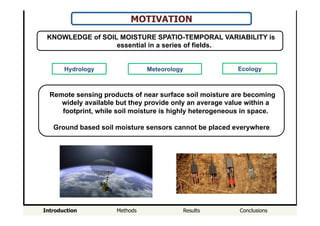
KNOWLEDGE of SOIL MOISTURE SPATIO-TEMPORAL VARIABILITY is
essential in a series of fields.
Remote sensing products of near surface soil moisture are becoming
widely available but they provide only an average value within a
footprint, while soil moisture is highly heterogeneous in space.
Ground based soil moisture sensors cannot be placed everywhere
EcologyMeteorologyHydrology
Introduction Methods Results Conclusions
ADDRESSING SOIL MOISTURE SPATIO-TEMPORAL
VARIABILITY
Tague et al., 2010 WRR
Vachaud et al. 1985 SSSAJ
Jacobs et al. 2004 Rem. Sens. Env.
Brocca et al., 2010 WRR
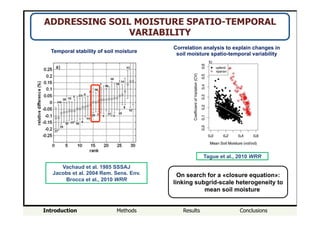
Temporal stability of soil moisture
Correlation analysis to explain changes in
soil moisture spatio-temporal variability
On search for a «closure equation»:
linking subgrid-scale heterogeneity to
mean soil moisture
Introduction Methods Results Conclusions
SOIL MOISTURE SPATIO-TEMPORAL VARIABILITY
10
15
20
10
15
20
25
30
35
11
12
13
14
15
Effective Saturation
0.6
0.7
0.8
10
15
20
10
15
20
25
30
35
11
12
13
14
15
Effective Saturation
0.6
0.7
0.8
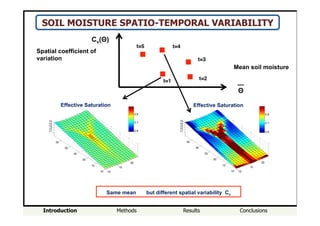
Same mean ​"  but different spatial variability Cv
Θ
Cv(Θ)
Effective Saturation Effective Saturation
t=1 t=2
t=3
Spatial coefficient of
variation!
t=4t=5
Mean soil moisture!
Introduction Methods Results Conclusions
Ivanov et al. 2010 WRR
SOIL MOISTURE SPATIO-TEMPORAL VARIABILITY
•  Precipitation decreases
variability.
•  Lateral re-distribution of
water increases variability
•  ET drying decrease
variability
Lateral redistribution is
function of precipitation
intensity and pre-event soil
moisture (dependent on ET
history)
Mean domain soil moisture content [-]
Coefficientofvariation
tRIBS-VEGGIE
Introduction Methods Results Conclusions
SOIL MOISTURE SPATIO-TEMPORAL VARIABILITY
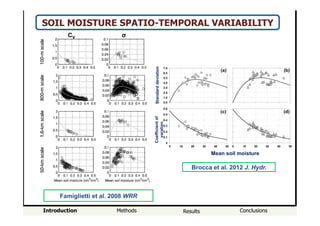
Famiglietti et al. 2008 WRR
Brocca et al. 2012 J. Hydr.
CV! σ!
Mean soil moisture
Coefficientof
varation
Standarddeviation
Introduction Methods Results Conclusions
SOIL MOISTURE SPATIO-TEMPORAL VARIABILITY
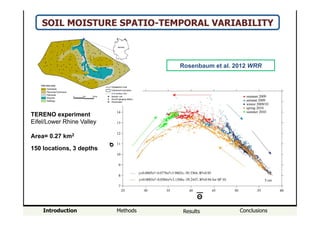
Rosenbaum et al. 2012 WRR
σ!
Θ
TERENO experiment
Eifel/Lower Rhine Valley
Area= 0.27 km2
150 locations, 3 depths
Introduction Methods Results Conclusions
SOIL MOISTURE SPATIO-TEMPORAL VARIABILITY
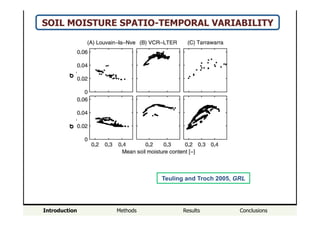
Teuling and Troch 2005, GRL
σ!σ!
Introduction Methods Results Conclusions
RESEARCH QUESTIONS
! (i) What is the relative importance of biotic and abiotic controls on
soil moisture spatio-temporal variability at the hillslope scale and
across different environmental conditions?
! (ii) Under what conditions is the relation between Cv and Θ
hysteretic or unique?
Introduction Methods Results Conclusions
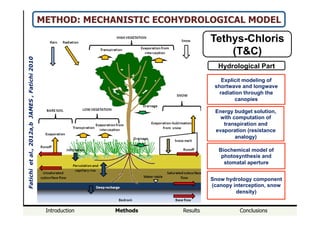
METHOD: MECHANISTIC ECOHYDROLOGICAL MODEL
Tethys-Chloris
(T&C)
Explicit modeling of
shortwave and longwave
radiation through the
canopies
Energy budget solution,
with computation of
transpiration and
evaporation (resistance
analogy)
Hydrological Part
Biochemical model of
photosynthesis and
stomatal aperture
Fatichietal.,2012a,bJAMES,Fatichi2010
Snow hydrology component
(canopy interception, snow
density)
Introduction Methods Results Conclusions
Domain spatial connectivity
RESOLUTION
5 to 100 [m]
• LATERAL CONNECTIONS BETWEEN
ELEMENTS (above surface and subsurface);
1D-quasi 3D approach
• SUBGRID PARAMETERIZATION FOR
CHANNELS
• KINEMATIC ROUTING (channel, subsurface,
overland)
TETHYS-CHLORIS (T&C)
Parallel version
Using distributed
computing resources
Introduction Methods Results Conclusions
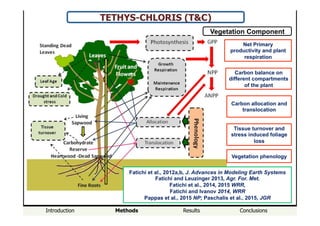
Net Primary
productivity and plant
respiration
Carbon allocation and
translocation
Tissue turnover and
stress induced foliage
loss
Carbon balance on
different compartments
of the plant
Vegetation Component
Vegetation phenology
TETHYS-CHLORIS (T&C)
Fatichi et al., 2012a,b, J. Advances in Modeling Earth Systems
Fatichi and Leuzinger 2013, Agr. For. Met.
Fatichi et al., 2014, 2015 WRR,
Fatichi and Ivanov 2014, WRR
Pappas et al., 2015 NP; Paschalis et al., 2015, JGR
Introduction Methods Results Conclusions
MODEL BENCHMARK
0 60 120 180
0
60
120
180
240
300
Time (min)
OutflowRate(m3
/min)
CATHY (sheet flow)
CATHY (comb. flow)
CATHY (rill flow)
Parflow
T&C
tRIBS
0 500 1000 1500 2000 0
500
1000
0
50
100
Y [m]
X [m]
Z[m]
Flow routing
(V-catchment domain)
Di Giammarco et al. 1996 J HYDR
Kollet and Maxwell, 2006, AWR
Panday and Huyakom 2004, AWR
Sulis et al. 2010, WRR
CATHY
(Camporese et al.
2010 WRR; Sulis et
al. 2010, WRR)
PARFLOW
(Kollet and Maxwell
2006, AWR; Maxwell
and Kollet 2008 Nat.
Geo.)
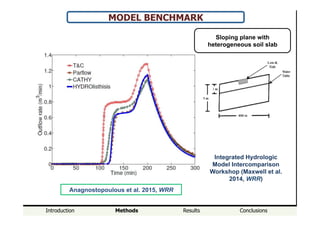
Integrated Hydrologic
Model Intercomparison
Workshop (Maxwell et
al. 2014, WRR)
Introduction Methods Results Conclusions
MODEL BENCHMARK
Integrated Hydrologic
Model Intercomparison
Workshop (Maxwell et al.
2014, WRR)
Anagnostopoulous et al. 2015, WRR
Sloping plane with
heterogeneous soil slab
Introduction Methods Results Conclusions
MODEL BENCHMARK
Generating runoff and trench flow in
an elementary hillslope (Biosphere-2
domain, Hopp et al., 2009 HESS).
HYDRUS-3D (Simunek et al., 2006; 2008)
tRIBS-VEGGIE (Ivanov et al., 2004; 2008 WRR)
0 100 200 300 400
0.1
0.15
0.2
0.25
0.3
0.35
WaterContentθ[-]
Hours
T&C
tRIBS-VEGGIE
HYDRUS-3D
0 100 200 300 400
0
0.5
1
1.5
2
TotalOutflow[m3
h-1
]
Hours
T&C
tRIBS-VEGGIE
HYDRUS-3D
Hopp et al. 2015, Hydr. Res. Sub.
Introduction Methods Results Conclusions
SELECTED DOMAIN
10
15
20
10
15
20
25
30
35
11
12
13
14
15
11
12
13
14
15
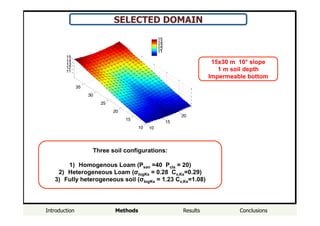
15x30 m 10° slope
1 m soil depth
Impermeable bottom
Three soil configurations:
1)  Homogenous Loam (Psan =40 Pcla = 20)
2)  Heterogeneous Loam (σlogKs = 0.28 Cv,Ks=0.29)
3)  Fully heterogeneous soil (σlogKs = 1.23 Cv,Ks=1.08)
Introduction Methods Results Conclusions
-150 -100 -50 0 50 100 150
-80
-60
-40
-20
0
20
40
60
80
500
1000
1500
2000
2500
3000
3500
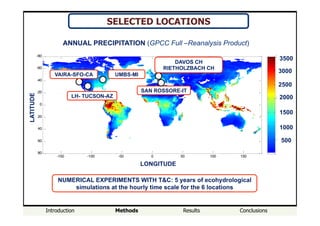
SELECTED LOCATIONS
ANNUAL PRECIPITATION (GPCC Full –Reanalysis Product)
3500
2000
1500
1000
500
VAIRA-SFO-CA UMBS-MI
LH- TUCSON-AZ
DAVOS CH
RIETHOLZBACH CH
LONGITUDE
LATITUDE
3000
2500
SAN ROSSORE-IT
NUMERICAL EXPERIMENTS WITH T&C: 5 years of ecohydrological
simulations at the hourly time scale for the 6 locations
Introduction Methods Results Conclusions
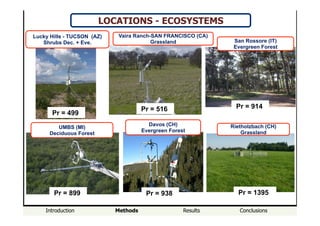
LOCATIONS - ECOSYSTEMS
Pr = 499!
Vaira Ranch-SAN FRANCISCO (CA)
Grassland
UMBS (MI)
Deciduous Forest
Lucky Hills - TUCSON (AZ)
Shrubs Dec. + Eve.
Rietholzbach (CH)
Grassland
Davos (CH)
Evergreen Forest
San Rossore (IT)
Evergreen Forest
Pr = 516! Pr = 914!
Pr = 899! Pr = 938! Pr = 1395!
Introduction Methods Results Conclusions
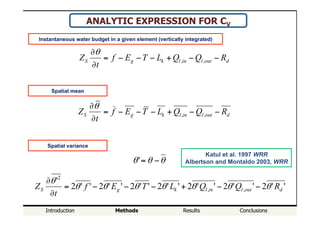
"me!evolu"on!of!the!spa"al!mean!
ANALYTIC EXPRESSION FOR CV
doutlinlkgS RQQLTEf
t
Z −−+−−−=
∂
∂
,,
θ
doutlinlkgS RQQLTEf
t
Z −−+−−−=
∂
∂
,,
θ
Instantaneous water budget in a given element (vertically integrated)
Spatial mean
Spatial variance
''2''2''2''2''2''2''2
'
,,
2
doutlinlkgS RQQLTEf
t
Z θθθθθθθ
θ
−−+−−−=
∂
∂
θθθ −='
Katul et al. 1997 WRR
Albertson and Montaldo 2003, WRR
Introduction Methods Results Conclusions
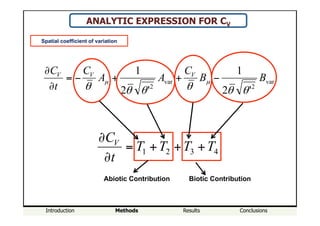
"me!evolu"on!of!the!spa"al!mean!
Spatial coefficient of variation
var
2
var
2
'2
1
'2
1
BB
C
AA
C
t
C VVV
θθθθθθ µµ −++−=
∂
∂
4321 TTTT
t
CV
+++=
∂
∂
Abiotic Contribution! Biotic Contribution!
ANALYTIC EXPRESSION FOR CV
Introduction Methods Results Conclusions
Contributions to ∂Cv/ ∂t
500 1000 1500
0
0.2
0.4
0.6
0.8
1
time [day]
[-]
T1
abiotic-var
500 1000 1500
0
0.2
0.4
0.6
0.8
1
time [day]
[-]
T2
abiotic-µ
500 1000 1500
0
0.2
0.4
0.6
0.8
1
time [day]
[-]
T3
biotic-µ
500 1000 1500
0
0.2
0.4
0.6
0.8
1
time [day]
[-]
T4
biotic-var
T2 – Abiotic Variance T1 – Abiotic Mean
T3 – Biotic Mean T4 – Biotic Variance
[-]
[-][-]
[-]
Introduction Methods Results Conclusions
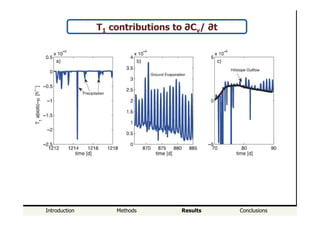
T1 contributions to ∂Cv/ ∂t
Introduction Methods Results Conclusions
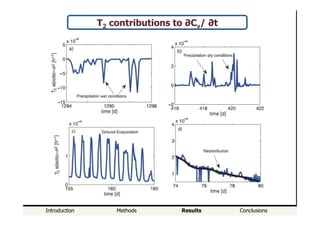
T2 contributions to ∂Cv/ ∂t
Introduction Methods Results Conclusions
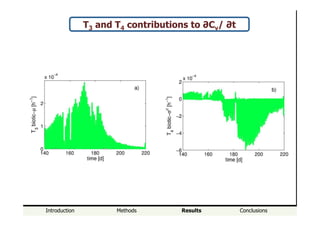
T3 and T4 contributions to ∂Cv/ ∂t
Introduction Methods Results Conclusions
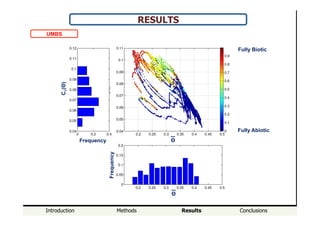
RESULTS
UMBS
Θ
Cv(Θ)
Frequency
Frequency
Θ
Fully Biotic
Fully Abiotic
Results
Cv(Θ)
Θ
Cv(Θ)Cv(Θ)
UMBS (MI)
DAVOS (CH)
RIETHOLZBACH (CH) SAN ROSSORE (IT)
VAIRA RANCH (CA)
LUCKY HILLS (AZ)
Θ
Cv(Θ)Cv(Θ)Cv(Θ)
HOMOGENOUS SOIL
Results
Cv(Θ)
Θ
Cv(Θ)Cv(Θ)
UMBS (MI)
DAVOS (CH)
RIETHOLZBACH (CH)
SAN ROSSORE (IT)
VAIRA RANCH (CA)
LUCKY HILLS (AZ)
Θ
Cv(Θ)Cv(Θ)
Cv(Θ)
HETEROG. LOAM
Results
Cv(Θ)
Θ
Cv(Θ)
Cv(Θ)
UMBS (MI)
DAVOS (CH)
RIETHOLZBACH (CH) SAN ROSSORE (IT)
VAIRA RANCH (CA)
LUCKY HILLS (AZ)
Θ
Cv(Θ)Cv(Θ)
Cv(Θ)
FULLY HETEROG.
Introduction Methods Results Conclusions
ABIOTIC VS. BIOTIC CONTROLS
43
21
TTB
TTA
+=
+=
WETNESS INDEX WETNESS INDEX
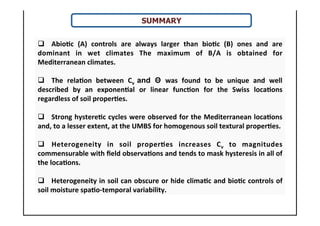
SUMMARY
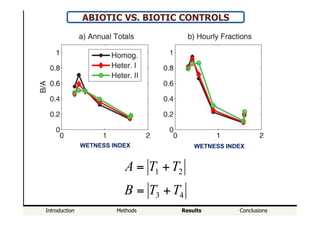
!  Abio%c' (A)' controls' are' always' larger' than' bio%c' (B)' ones' and' are'
dominant' in' wet' climates' The' maximum' of' B/A' is' obtained' for'
Mediterranean'climates.'
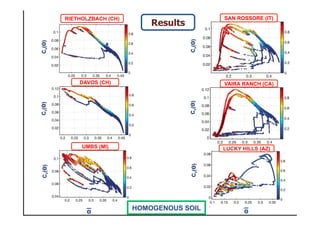
!  The' rela%on' between' Cv' and Θ was' found' to' be' unique' and' well'
described' by' an' exponen%al' or' linear' func%on' for' the' Swiss' loca%ons'
regardless'of'soil'proper%es.''
!  Strong'hystere%c'cycles'were'observed'for'the'Mediterranean'loca%ons'
and,'to'a'lesser'extent,'at'the'UMBS'for'homogenous'soil'textural'proper%es.''
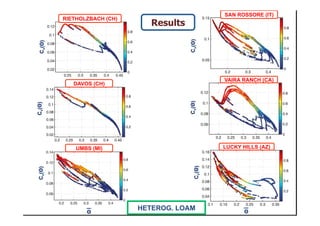
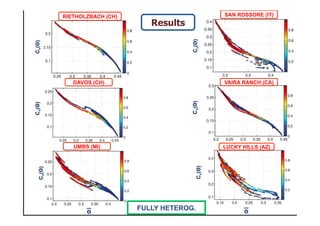
!  Heterogeneity' in' soil' proper%es' increases' Cv' to' magnitudes'
commensurable'with'field'observa%ons'and'tends'to'mask'hysteresis'in'all'of'
the'loca%ons.'
!  Heterogeneity'in'soil'can'obscure'or'hide'clima%c'and'bio%c'controls'of'
soil'moisture'spa%oItemporal'variability.''
Thanks for your
attention !
Fatichi et al., 2015, WRR

Simone Fatichi

  • 1.
    Soil moisture spatio-temporalvariability: insights from mechanistic ecohydrological modeling Simone Fatichi Institute of Environmental Engineering, ETH Zurich, Zurich, Switzerland simone.fatichi@ifu.baug.ethz.ch 24 September 2015 Padova, Italy
  • 2.
    Introduction Methods ResultsConclusions MOTIVATION KNOWLEDGE of SOIL MOISTURE SPATIO-TEMPORAL VARIABILITY is essential in a series of fields. Remote sensing products of near surface soil moisture are becoming widely available but they provide only an average value within a footprint, while soil moisture is highly heterogeneous in space. Ground based soil moisture sensors cannot be placed everywhere EcologyMeteorologyHydrology
  • 3.
    Introduction Methods ResultsConclusions ADDRESSING SOIL MOISTURE SPATIO-TEMPORAL VARIABILITY Tague et al., 2010 WRR Vachaud et al. 1985 SSSAJ Jacobs et al. 2004 Rem. Sens. Env. Brocca et al., 2010 WRR Temporal stability of soil moisture Correlation analysis to explain changes in soil moisture spatio-temporal variability On search for a «closure equation»: linking subgrid-scale heterogeneity to mean soil moisture
  • 4.
    Introduction Methods ResultsConclusions SOIL MOISTURE SPATIO-TEMPORAL VARIABILITY 10 15 20 10 15 20 25 30 35 11 12 13 14 15 Effective Saturation 0.6 0.7 0.8 10 15 20 10 15 20 25 30 35 11 12 13 14 15 Effective Saturation 0.6 0.7 0.8 Same mean ​"  but different spatial variability Cv Θ Cv(Θ) Effective Saturation Effective Saturation t=1 t=2 t=3 Spatial coefficient of variation! t=4t=5 Mean soil moisture!
  • 5.
    Introduction Methods ResultsConclusions Ivanov et al. 2010 WRR SOIL MOISTURE SPATIO-TEMPORAL VARIABILITY •  Precipitation decreases variability. •  Lateral re-distribution of water increases variability •  ET drying decrease variability Lateral redistribution is function of precipitation intensity and pre-event soil moisture (dependent on ET history) Mean domain soil moisture content [-] Coefficientofvariation tRIBS-VEGGIE
  • 6.
    Introduction Methods ResultsConclusions SOIL MOISTURE SPATIO-TEMPORAL VARIABILITY Famiglietti et al. 2008 WRR Brocca et al. 2012 J. Hydr. CV! σ! Mean soil moisture Coefficientof varation Standarddeviation
  • 7.
    Introduction Methods ResultsConclusions SOIL MOISTURE SPATIO-TEMPORAL VARIABILITY Rosenbaum et al. 2012 WRR σ! Θ TERENO experiment Eifel/Lower Rhine Valley Area= 0.27 km2 150 locations, 3 depths
  • 8.
    Introduction Methods ResultsConclusions SOIL MOISTURE SPATIO-TEMPORAL VARIABILITY Teuling and Troch 2005, GRL σ!σ!
  • 9.
    Introduction Methods ResultsConclusions RESEARCH QUESTIONS ! (i) What is the relative importance of biotic and abiotic controls on soil moisture spatio-temporal variability at the hillslope scale and across different environmental conditions? ! (ii) Under what conditions is the relation between Cv and Θ hysteretic or unique?
  • 10.
    Introduction Methods ResultsConclusions METHOD: MECHANISTIC ECOHYDROLOGICAL MODEL Tethys-Chloris (T&C) Explicit modeling of shortwave and longwave radiation through the canopies Energy budget solution, with computation of transpiration and evaporation (resistance analogy) Hydrological Part Biochemical model of photosynthesis and stomatal aperture Fatichietal.,2012a,bJAMES,Fatichi2010 Snow hydrology component (canopy interception, snow density)
  • 11.
    Introduction Methods ResultsConclusions Domain spatial connectivity RESOLUTION 5 to 100 [m] • LATERAL CONNECTIONS BETWEEN ELEMENTS (above surface and subsurface); 1D-quasi 3D approach • SUBGRID PARAMETERIZATION FOR CHANNELS • KINEMATIC ROUTING (channel, subsurface, overland) TETHYS-CHLORIS (T&C) Parallel version Using distributed computing resources
  • 12.
    Introduction Methods ResultsConclusions Net Primary productivity and plant respiration Carbon allocation and translocation Tissue turnover and stress induced foliage loss Carbon balance on different compartments of the plant Vegetation Component Vegetation phenology TETHYS-CHLORIS (T&C) Fatichi et al., 2012a,b, J. Advances in Modeling Earth Systems Fatichi and Leuzinger 2013, Agr. For. Met. Fatichi et al., 2014, 2015 WRR, Fatichi and Ivanov 2014, WRR Pappas et al., 2015 NP; Paschalis et al., 2015, JGR
  • 13.
    Introduction Methods ResultsConclusions MODEL BENCHMARK 0 60 120 180 0 60 120 180 240 300 Time (min) OutflowRate(m3 /min) CATHY (sheet flow) CATHY (comb. flow) CATHY (rill flow) Parflow T&C tRIBS 0 500 1000 1500 2000 0 500 1000 0 50 100 Y [m] X [m] Z[m] Flow routing (V-catchment domain) Di Giammarco et al. 1996 J HYDR Kollet and Maxwell, 2006, AWR Panday and Huyakom 2004, AWR Sulis et al. 2010, WRR CATHY (Camporese et al. 2010 WRR; Sulis et al. 2010, WRR) PARFLOW (Kollet and Maxwell 2006, AWR; Maxwell and Kollet 2008 Nat. Geo.) Integrated Hydrologic Model Intercomparison Workshop (Maxwell et al. 2014, WRR)
  • 14.
    Introduction Methods ResultsConclusions MODEL BENCHMARK Integrated Hydrologic Model Intercomparison Workshop (Maxwell et al. 2014, WRR) Anagnostopoulous et al. 2015, WRR Sloping plane with heterogeneous soil slab
  • 15.
    Introduction Methods ResultsConclusions MODEL BENCHMARK Generating runoff and trench flow in an elementary hillslope (Biosphere-2 domain, Hopp et al., 2009 HESS). HYDRUS-3D (Simunek et al., 2006; 2008) tRIBS-VEGGIE (Ivanov et al., 2004; 2008 WRR) 0 100 200 300 400 0.1 0.15 0.2 0.25 0.3 0.35 WaterContentθ[-] Hours T&C tRIBS-VEGGIE HYDRUS-3D 0 100 200 300 400 0 0.5 1 1.5 2 TotalOutflow[m3 h-1 ] Hours T&C tRIBS-VEGGIE HYDRUS-3D Hopp et al. 2015, Hydr. Res. Sub.
  • 16.
    Introduction Methods ResultsConclusions SELECTED DOMAIN 10 15 20 10 15 20 25 30 35 11 12 13 14 15 11 12 13 14 15 15x30 m 10° slope 1 m soil depth Impermeable bottom Three soil configurations: 1)  Homogenous Loam (Psan =40 Pcla = 20) 2)  Heterogeneous Loam (σlogKs = 0.28 Cv,Ks=0.29) 3)  Fully heterogeneous soil (σlogKs = 1.23 Cv,Ks=1.08)
  • 17.
    Introduction Methods ResultsConclusions -150 -100 -50 0 50 100 150 -80 -60 -40 -20 0 20 40 60 80 500 1000 1500 2000 2500 3000 3500 SELECTED LOCATIONS ANNUAL PRECIPITATION (GPCC Full –Reanalysis Product) 3500 2000 1500 1000 500 VAIRA-SFO-CA UMBS-MI LH- TUCSON-AZ DAVOS CH RIETHOLZBACH CH LONGITUDE LATITUDE 3000 2500 SAN ROSSORE-IT NUMERICAL EXPERIMENTS WITH T&C: 5 years of ecohydrological simulations at the hourly time scale for the 6 locations
  • 18.
    Introduction Methods ResultsConclusions LOCATIONS - ECOSYSTEMS Pr = 499! Vaira Ranch-SAN FRANCISCO (CA) Grassland UMBS (MI) Deciduous Forest Lucky Hills - TUCSON (AZ) Shrubs Dec. + Eve. Rietholzbach (CH) Grassland Davos (CH) Evergreen Forest San Rossore (IT) Evergreen Forest Pr = 516! Pr = 914! Pr = 899! Pr = 938! Pr = 1395!
  • 19.
    Introduction Methods ResultsConclusions "me!evolu"on!of!the!spa"al!mean! ANALYTIC EXPRESSION FOR CV doutlinlkgS RQQLTEf t Z −−+−−−= ∂ ∂ ,, θ doutlinlkgS RQQLTEf t Z −−+−−−= ∂ ∂ ,, θ Instantaneous water budget in a given element (vertically integrated) Spatial mean Spatial variance ''2''2''2''2''2''2''2 ' ,, 2 doutlinlkgS RQQLTEf t Z θθθθθθθ θ −−+−−−= ∂ ∂ θθθ −=' Katul et al. 1997 WRR Albertson and Montaldo 2003, WRR
  • 20.
    Introduction Methods ResultsConclusions "me!evolu"on!of!the!spa"al!mean! Spatial coefficient of variation var 2 var 2 '2 1 '2 1 BB C AA C t C VVV θθθθθθ µµ −++−= ∂ ∂ 4321 TTTT t CV +++= ∂ ∂ Abiotic Contribution! Biotic Contribution! ANALYTIC EXPRESSION FOR CV
  • 21.
    Introduction Methods ResultsConclusions Contributions to ∂Cv/ ∂t 500 1000 1500 0 0.2 0.4 0.6 0.8 1 time [day] [-] T1 abiotic-var 500 1000 1500 0 0.2 0.4 0.6 0.8 1 time [day] [-] T2 abiotic-µ 500 1000 1500 0 0.2 0.4 0.6 0.8 1 time [day] [-] T3 biotic-µ 500 1000 1500 0 0.2 0.4 0.6 0.8 1 time [day] [-] T4 biotic-var T2 – Abiotic Variance T1 – Abiotic Mean T3 – Biotic Mean T4 – Biotic Variance [-] [-][-] [-]
  • 22.
    Introduction Methods ResultsConclusions T1 contributions to ∂Cv/ ∂t
  • 23.
    Introduction Methods ResultsConclusions T2 contributions to ∂Cv/ ∂t
  • 24.
    Introduction Methods ResultsConclusions T3 and T4 contributions to ∂Cv/ ∂t
  • 25.
    Introduction Methods ResultsConclusions RESULTS UMBS Θ Cv(Θ) Frequency Frequency Θ Fully Biotic Fully Abiotic
  • 26.
    Results Cv(Θ) Θ Cv(Θ)Cv(Θ) UMBS (MI) DAVOS (CH) RIETHOLZBACH(CH) SAN ROSSORE (IT) VAIRA RANCH (CA) LUCKY HILLS (AZ) Θ Cv(Θ)Cv(Θ)Cv(Θ) HOMOGENOUS SOIL
  • 27.
    Results Cv(Θ) Θ Cv(Θ)Cv(Θ) UMBS (MI) DAVOS (CH) RIETHOLZBACH(CH) SAN ROSSORE (IT) VAIRA RANCH (CA) LUCKY HILLS (AZ) Θ Cv(Θ)Cv(Θ) Cv(Θ) HETEROG. LOAM
  • 28.
    Results Cv(Θ) Θ Cv(Θ) Cv(Θ) UMBS (MI) DAVOS (CH) RIETHOLZBACH(CH) SAN ROSSORE (IT) VAIRA RANCH (CA) LUCKY HILLS (AZ) Θ Cv(Θ)Cv(Θ) Cv(Θ) FULLY HETEROG.
  • 29.
    Introduction Methods ResultsConclusions ABIOTIC VS. BIOTIC CONTROLS 43 21 TTB TTA += += WETNESS INDEX WETNESS INDEX
  • 30.
    SUMMARY !  Abio%c' (A)'controls' are' always' larger' than' bio%c' (B)' ones' and' are' dominant' in' wet' climates' The' maximum' of' B/A' is' obtained' for' Mediterranean'climates.' !  The' rela%on' between' Cv' and Θ was' found' to' be' unique' and' well' described' by' an' exponen%al' or' linear' func%on' for' the' Swiss' loca%ons' regardless'of'soil'proper%es.'' !  Strong'hystere%c'cycles'were'observed'for'the'Mediterranean'loca%ons' and,'to'a'lesser'extent,'at'the'UMBS'for'homogenous'soil'textural'proper%es.'' !  Heterogeneity' in' soil' proper%es' increases' Cv' to' magnitudes' commensurable'with'field'observa%ons'and'tends'to'mask'hysteresis'in'all'of' the'loca%ons.' !  Heterogeneity'in'soil'can'obscure'or'hide'clima%c'and'bio%c'controls'of' soil'moisture'spa%oItemporal'variability.''
  • 31.
    Thanks for your attention! Fatichi et al., 2015, WRR