I. OBJECTIVES
A. Content Standards The learners demonstrate an understanding of: How the different structures of the circulatory
and respiratory systems work together to transport oxygen-rich blood and nutrients to the
different parts of the body
B. Performance Standard The learners should be able to: conduct an information dissemination activity on effective
ways of taking care of the respiratory and circulatory systems based on data gathered from
the school or local health workers
C. Learning Competencies The learners should be able to explain how the respiratory and
circulatory systems work together to transport nutrients, gases, and
other molecules to and from the different parts of the body
Specific Objective:
Explain the mechanism of how the respiratory and circulatory work
together
Code: S9LT-la-b26
1.8
II. CONTENT
III. LEARNING RESOURCES
A. References
1. Teacher’s Guide Pages 14-15
2. Learner’s Material Page
3. Textbook Pages
4. Additional Materials from LR https://drive.google.com/drive/folders/0B9fMGpTQ1bjwcjEyQ2ZPekJERjg
B. Other Learning Resources
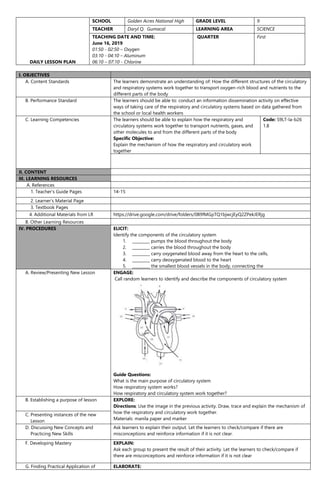
IV. PROCEDURES ELICIT:
Identify the components of the circulatory system
1. _________ pumps the blood throughout the body
2. _________ carries the blood throughout the body
3. _________ carry oxygenated blood away from the heart to the cells,
4. _________ carry deoxygenated blood to the heart
5. _________ the smallest blood vessels in the body, connecting the
A. Review/Presenting New Lesson ENGAGE:
Call random learners to identify and describe the components of circulatory system
Guide Questions:
What is the main purpose of circulatory system
How respiratory system works?
How respiratory and circulatory system work together?
B. Establishing a purpose of lesson EXPLORE:
Directions: Use the image in the previous activity. Draw, trace and explain the mechanism of
how the respiratory and circulatory work together.
Materials: manila paper and marker
C. Presenting instances of the new
Lesson
D. Discussing New Concepts and
Practicing New Skills
Ask learners to explain their output. Let the learners to check/compare if there are
misconceptions and reinforce information if it is not clear.
F. Developing Mastery EXPLAIN:
Ask each group to present the result of their activity. Let the learners to check/compare if
there are misconceptions and reinforce information if it is not clear
G. Finding Practical Application of ELABORATE:
DAILY LESSON PLAN
SCHOOL Golden Acres National High GRADE LEVEL 9
TEACHER Daryl Q. Gumacal LEARNING AREA SCIENCE
TEACHING DATE AND TIME:
June 16, 2019
01:50 - 02:50 – Oxygen
03:10 - 04:10 – Aluminum
06:10 – 07:10 - Chlorine
QUARTER First
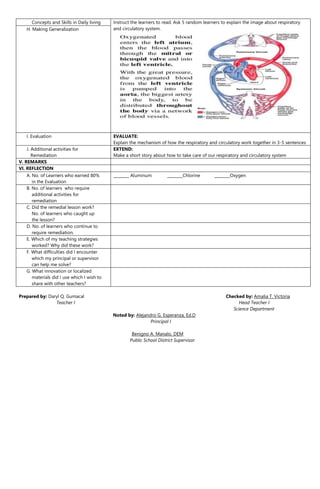
Concepts and Skills in Daily living Instruct the learners to read. Ask 5 random learners to explain the image about respiratory
and circulatory system.
H. Making Generalization
I. Evaluation EVALUATE:
Explain the mechanism of how the respiratory and circulatory work together in 3-5 sentences
J. Additional activities for
Remediation
EXTEND:
Make a short story about how to take care of our respiratory and circulatory system
V. REMARKS
VI. REFLECTION
A. No. of Learners who earned 80%
in the Evaluation
________ Aluminum ________Chlorine ________Oxygen
B. No. of learners who require
additional activities for
remediation
C. Did the remedial lesson work?
No. of learners who caught up
the lesson?
D. No. of learners who continue to
require remediation.
E. Which of my teaching strategies
worked? Why did these work?
F. What difficulties did I encounter
which my principal or supervisor
can help me solve?
G. What innovation or localized
materials did I use which I wish to
share with other teachers?
Prepared by: Daryl Q. Gumacal Checked by: Amalia T. Victoria
Teacher I Head Teacher I
Science Department
Noted by: Alejandro G. Esperanza, Ed.D
Principal I
Benigno A. Manalo, DEM
Public School District Supervisor
I. OBJECTIVES
A. Content Standards The learners demonstrate an understanding of: How the different structures of the circulatory
and respiratory systems work together to transport oxygen-rich blood and nutrients to the
different parts of the body
B. Performance Standard The learners should be able to: conduct an information dissemination activity on effective
ways of taking care of the respiratory and circulatory systems based on data gathered from
the school or local health workers
C. Learning Competencies The learners should be able to explain how the respiratory and
circulatory systems work together to transport nutrients, gases, and
other molecules to and from the different parts of the body
Specific Objective:
Explain the negative effects of cigarette smoking in the circulatory
and respiratory system.
Code: S9LT-la-b27
II. CONTENT
III. LEARNING RESOURCES
A. References
1. Teacher’s Guide Pages 14-15
2. Learner’s Material Page
3. Textbook Pages
4. Additional Materials from LR https://drive.google.com/drive/folders/0B9fMGpTQ1bjwcjEyQ2ZPekJERjg
B. Other Learning Resources Manila paper, marker, worksheets
IV. PROCEDURES
A. Review/Presenting New Lesson ELICIT:
Fill in the blanks
The circulatory and respiratory systems work together to circulate blood and ________
throughout the body. ______ moves in and out of the _______ through the trachea, bronchi,
and bronchioles. Blood moves in and out of the lungs through the __________ arteries and
______ that connect to the heart.
Identify the components of the circulatory system
1. _________ pumps the blood throughout the body
2. _________ carries the blood throughout the body
3. _________ carry mostly oxygenated blood away from the heart to the cells except
pulmonary artery,
4. _______ carry mostly deoxygenated blood to the heart except pulmonary veins
_________ the smallest blood vessels in the body, connecting the
B. Establishing a purpose of lesson ENGAGE:
Enumerate activities that affect our circulatory and respiratory system.
Positive lifestyle Negative lifestyle
1. 1.
2. 2.
3. 3.
4. 4.
5. 5.
Guide question:
How cigarette smokings affect our respiratory and circulatory system?
C. Presenting instances of the new
Lesson
D. Discussing New Concepts and
Practicing New Skills
EXPLORE:
Activity: Cigarette Smoking Is Dangerous to Your Health
Objective:
Explain the negative effects of cigarette smoking on the circulatory and
respiratory systems
Materials:
Manila paper, learners manual, and marker
Procedure: (on learners manual pages 20-21)
F. Developing Mastery EXPLAIN:
Ask each group to present the result of their activity. Let the learners to check/compare if
there are misconceptions and reinforce information if it is not clear
G. Finding Practical Application of
Concepts and Skills in Daily living
ELABORATE:
Ask 5 random learners to explain why Cigarette Smoking Is Dangerous to our Health
DAILY LESSON PLAN
SCHOOL Golden Acres National High GRADE LEVEL 9
TEACHER Daryl Q. Gumacal LEARNING AREA SCIENCE
TEACHING DATE AND TIME:
June 19, 2019
01:50 - 02:50 – Oxygen
03:10 - 04:10 – Aluminum
06:10 – 07:10 - Chlorine
QUARTER First
H. Making Generalization Present the following concept
I. Evaluation EVALUATE:
Explain the negative effects of cigarette smoking in the circulatory and respiratory system in 3
to 5 sentences.
J. Additional activities for
Remediation
EXTEND:
Enumerate and describe 5 lungs and heart diseases caused by smoking cigarette.
Explain how we can prevent heart and lung diseases in 3-5 sentences.
V. REMARKS
VI. REFLECTION
A. No. of Learners who earned 80%
in the Evaluation
________ Aluminum ________Chlorine ________Oxygen
B. No. of learners who require
additional activities for
remediation
C. Did the remedial lesson work?
No. of learners who caught up
the lesson?
D. No. of learners who continue to
require remediation.
E. Which of my teaching strategies
worked? Why did these work?
F. What difficulties did I encounter
which my principal or supervisor
can help me solve?
G. What innovation or localized
materials did I use which I wish to
share with other teachers?
Prepared by: Daryl Q. Gumacal Checked by: Amalia T. Victoria
Teacher I Head Teacher I
Science Department
Noted by: Alejandro G. Esperanza, Ed.D
Principal I
Benigno A. Manalo, DEM
Public School District Supervisor
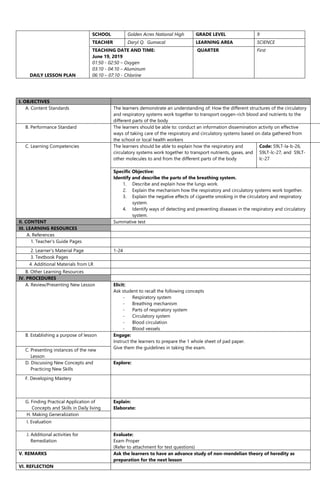
I. OBJECTIVES
A. Content Standards The learners demonstrate an understanding of: How the different structures of the circulatory
and respiratory systems work together to transport oxygen-rich blood and nutrients to the
different parts of the body
B. Performance Standard The learners should be able to: conduct an information dissemination activity on effective
ways of taking care of the respiratory and circulatory systems based on data gathered from
the school or local health workers
C. Learning Competencies The learners should be able to explain how the respiratory and
circulatory systems work together to transport nutrients, gases, and
other molecules to and from the different parts of the body
Code: S9LT-la-b-26,
S9LT-lc-27, and S9LT-
lc-27
Specific Objective:
Identify and describe the parts of the breathing system.
1. Describe and explain how the lungs work.
2. Explain the mechanism how the respiratory and circulatory systems work together.
3. Explain the negative effects of cigarette smoking in the circulatory and respiratory
system.
4. Identify ways of detecting and preventing diseases in the respiratory and circulatory
system.
II. CONTENT Summative test
III. LEARNING RESOURCES
A. References
1. Teacher’s Guide Pages
2. Learner’s Material Page 1-24
3. Textbook Pages
4. Additional Materials from LR
B. Other Learning Resources
IV. PROCEDURES
A. Review/Presenting New Lesson Elicit:
Ask student to recall the following concepts
- Respiratory system
- Breathing mechanism
- Parts of respiratory system
- Circulatory system
- Blood circulation
- Blood vessels
B. Establishing a purpose of lesson Engage:
Instruct the learners to prepare the 1 whole sheet of pad paper.
Give them the guidelines in taking the exam.
C. Presenting instances of the new
Lesson
D. Discussing New Concepts and
Practicing New Skills
Explore:
F. Developing Mastery
G. Finding Practical Application of
Concepts and Skills in Daily living
Explain:
Elaborate:
H. Making Generalization
I. Evaluation
J. Additional activities for
Remediation
Evaluate:
Exam Proper
(Refer to attachment for test questions)
V. REMARKS Ask the learners to have an advance study of non-mendelian theory of heredity as
preparation for the next lesson
VI. REFLECTION
DAILY LESSON PLAN
SCHOOL Golden Acres National High GRADE LEVEL 9
TEACHER Daryl Q. Gumacal LEARNING AREA SCIENCE
TEACHING DATE AND TIME:
June 19, 2019
01:50 - 02:50 – Oxygen
03:10 - 04:10 – Aluminum
06:10 – 07:10 - Chlorine
QUARTER First
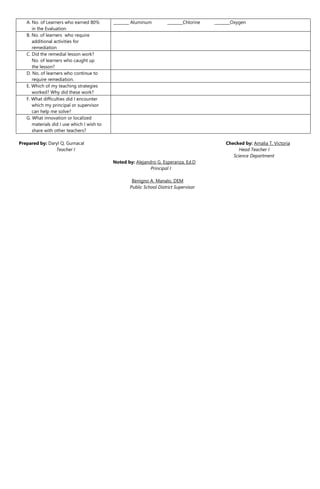
A. No. of Learners who earned 80%
in the Evaluation
________ Aluminum ________Chlorine ________Oxygen
B. No. of learners who require
additional activities for
remediation
C. Did the remedial lesson work?
No. of learners who caught up
the lesson?
D. No. of learners who continue to
require remediation.
E. Which of my teaching strategies
worked? Why did these work?
F. What difficulties did I encounter
which my principal or supervisor
can help me solve?
G. What innovation or localized
materials did I use which I wish to
share with other teachers?
Prepared by: Daryl Q. Gumacal Checked by: Amalia T. Victoria
Teacher I Head Teacher I
Science Department
Noted by: Alejandro G. Esperanza, Ed.D
Principal I
Benigno A. Manalo, DEM
Public School District Supervisor

G9 Q1 DLL HEART.docx

  • 1.
    I. OBJECTIVES A. ContentStandards The learners demonstrate an understanding of: How the different structures of the circulatory and respiratory systems work together to transport oxygen-rich blood and nutrients to the different parts of the body B. Performance Standard The learners should be able to: conduct an information dissemination activity on effective ways of taking care of the respiratory and circulatory systems based on data gathered from the school or local health workers C. Learning Competencies The learners should be able to explain how the respiratory and circulatory systems work together to transport nutrients, gases, and other molecules to and from the different parts of the body Specific Objective: Explain the mechanism of how the respiratory and circulatory work together Code: S9LT-la-b26 1.8 II. CONTENT III. LEARNING RESOURCES A. References 1. Teacher’s Guide Pages 14-15 2. Learner’s Material Page 3. Textbook Pages 4. Additional Materials from LR https://drive.google.com/drive/folders/0B9fMGpTQ1bjwcjEyQ2ZPekJERjg B. Other Learning Resources IV. PROCEDURES ELICIT: Identify the components of the circulatory system 1. _________ pumps the blood throughout the body 2. _________ carries the blood throughout the body 3. _________ carry oxygenated blood away from the heart to the cells, 4. _________ carry deoxygenated blood to the heart 5. _________ the smallest blood vessels in the body, connecting the A. Review/Presenting New Lesson ENGAGE: Call random learners to identify and describe the components of circulatory system Guide Questions: What is the main purpose of circulatory system How respiratory system works? How respiratory and circulatory system work together? B. Establishing a purpose of lesson EXPLORE: Directions: Use the image in the previous activity. Draw, trace and explain the mechanism of how the respiratory and circulatory work together. Materials: manila paper and marker C. Presenting instances of the new Lesson D. Discussing New Concepts and Practicing New Skills Ask learners to explain their output. Let the learners to check/compare if there are misconceptions and reinforce information if it is not clear. F. Developing Mastery EXPLAIN: Ask each group to present the result of their activity. Let the learners to check/compare if there are misconceptions and reinforce information if it is not clear G. Finding Practical Application of ELABORATE: DAILY LESSON PLAN SCHOOL Golden Acres National High GRADE LEVEL 9 TEACHER Daryl Q. Gumacal LEARNING AREA SCIENCE TEACHING DATE AND TIME: June 16, 2019 01:50 - 02:50 – Oxygen 03:10 - 04:10 – Aluminum 06:10 – 07:10 - Chlorine QUARTER First
  • 2.
    Concepts and Skillsin Daily living Instruct the learners to read. Ask 5 random learners to explain the image about respiratory and circulatory system. H. Making Generalization I. Evaluation EVALUATE: Explain the mechanism of how the respiratory and circulatory work together in 3-5 sentences J. Additional activities for Remediation EXTEND: Make a short story about how to take care of our respiratory and circulatory system V. REMARKS VI. REFLECTION A. No. of Learners who earned 80% in the Evaluation ________ Aluminum ________Chlorine ________Oxygen B. No. of learners who require additional activities for remediation C. Did the remedial lesson work? No. of learners who caught up the lesson? D. No. of learners who continue to require remediation. E. Which of my teaching strategies worked? Why did these work? F. What difficulties did I encounter which my principal or supervisor can help me solve? G. What innovation or localized materials did I use which I wish to share with other teachers? Prepared by: Daryl Q. Gumacal Checked by: Amalia T. Victoria Teacher I Head Teacher I Science Department Noted by: Alejandro G. Esperanza, Ed.D Principal I Benigno A. Manalo, DEM Public School District Supervisor
  • 3.
    I. OBJECTIVES A. ContentStandards The learners demonstrate an understanding of: How the different structures of the circulatory and respiratory systems work together to transport oxygen-rich blood and nutrients to the different parts of the body B. Performance Standard The learners should be able to: conduct an information dissemination activity on effective ways of taking care of the respiratory and circulatory systems based on data gathered from the school or local health workers C. Learning Competencies The learners should be able to explain how the respiratory and circulatory systems work together to transport nutrients, gases, and other molecules to and from the different parts of the body Specific Objective: Explain the negative effects of cigarette smoking in the circulatory and respiratory system. Code: S9LT-la-b27 II. CONTENT III. LEARNING RESOURCES A. References 1. Teacher’s Guide Pages 14-15 2. Learner’s Material Page 3. Textbook Pages 4. Additional Materials from LR https://drive.google.com/drive/folders/0B9fMGpTQ1bjwcjEyQ2ZPekJERjg B. Other Learning Resources Manila paper, marker, worksheets IV. PROCEDURES A. Review/Presenting New Lesson ELICIT: Fill in the blanks The circulatory and respiratory systems work together to circulate blood and ________ throughout the body. ______ moves in and out of the _______ through the trachea, bronchi, and bronchioles. Blood moves in and out of the lungs through the __________ arteries and ______ that connect to the heart. Identify the components of the circulatory system 1. _________ pumps the blood throughout the body 2. _________ carries the blood throughout the body 3. _________ carry mostly oxygenated blood away from the heart to the cells except pulmonary artery, 4. _______ carry mostly deoxygenated blood to the heart except pulmonary veins _________ the smallest blood vessels in the body, connecting the B. Establishing a purpose of lesson ENGAGE: Enumerate activities that affect our circulatory and respiratory system. Positive lifestyle Negative lifestyle 1. 1. 2. 2. 3. 3. 4. 4. 5. 5. Guide question: How cigarette smokings affect our respiratory and circulatory system? C. Presenting instances of the new Lesson D. Discussing New Concepts and Practicing New Skills EXPLORE: Activity: Cigarette Smoking Is Dangerous to Your Health Objective: Explain the negative effects of cigarette smoking on the circulatory and respiratory systems Materials: Manila paper, learners manual, and marker Procedure: (on learners manual pages 20-21) F. Developing Mastery EXPLAIN: Ask each group to present the result of their activity. Let the learners to check/compare if there are misconceptions and reinforce information if it is not clear G. Finding Practical Application of Concepts and Skills in Daily living ELABORATE: Ask 5 random learners to explain why Cigarette Smoking Is Dangerous to our Health DAILY LESSON PLAN SCHOOL Golden Acres National High GRADE LEVEL 9 TEACHER Daryl Q. Gumacal LEARNING AREA SCIENCE TEACHING DATE AND TIME: June 19, 2019 01:50 - 02:50 – Oxygen 03:10 - 04:10 – Aluminum 06:10 – 07:10 - Chlorine QUARTER First
  • 4.
    H. Making GeneralizationPresent the following concept I. Evaluation EVALUATE: Explain the negative effects of cigarette smoking in the circulatory and respiratory system in 3 to 5 sentences. J. Additional activities for Remediation EXTEND: Enumerate and describe 5 lungs and heart diseases caused by smoking cigarette. Explain how we can prevent heart and lung diseases in 3-5 sentences. V. REMARKS VI. REFLECTION A. No. of Learners who earned 80% in the Evaluation ________ Aluminum ________Chlorine ________Oxygen B. No. of learners who require additional activities for remediation C. Did the remedial lesson work? No. of learners who caught up the lesson? D. No. of learners who continue to require remediation. E. Which of my teaching strategies worked? Why did these work? F. What difficulties did I encounter which my principal or supervisor can help me solve? G. What innovation or localized materials did I use which I wish to share with other teachers? Prepared by: Daryl Q. Gumacal Checked by: Amalia T. Victoria Teacher I Head Teacher I Science Department Noted by: Alejandro G. Esperanza, Ed.D Principal I Benigno A. Manalo, DEM Public School District Supervisor
  • 5.
    I. OBJECTIVES A. ContentStandards The learners demonstrate an understanding of: How the different structures of the circulatory and respiratory systems work together to transport oxygen-rich blood and nutrients to the different parts of the body B. Performance Standard The learners should be able to: conduct an information dissemination activity on effective ways of taking care of the respiratory and circulatory systems based on data gathered from the school or local health workers C. Learning Competencies The learners should be able to explain how the respiratory and circulatory systems work together to transport nutrients, gases, and other molecules to and from the different parts of the body Code: S9LT-la-b-26, S9LT-lc-27, and S9LT- lc-27 Specific Objective: Identify and describe the parts of the breathing system. 1. Describe and explain how the lungs work. 2. Explain the mechanism how the respiratory and circulatory systems work together. 3. Explain the negative effects of cigarette smoking in the circulatory and respiratory system. 4. Identify ways of detecting and preventing diseases in the respiratory and circulatory system. II. CONTENT Summative test III. LEARNING RESOURCES A. References 1. Teacher’s Guide Pages 2. Learner’s Material Page 1-24 3. Textbook Pages 4. Additional Materials from LR B. Other Learning Resources IV. PROCEDURES A. Review/Presenting New Lesson Elicit: Ask student to recall the following concepts - Respiratory system - Breathing mechanism - Parts of respiratory system - Circulatory system - Blood circulation - Blood vessels B. Establishing a purpose of lesson Engage: Instruct the learners to prepare the 1 whole sheet of pad paper. Give them the guidelines in taking the exam. C. Presenting instances of the new Lesson D. Discussing New Concepts and Practicing New Skills Explore: F. Developing Mastery G. Finding Practical Application of Concepts and Skills in Daily living Explain: Elaborate: H. Making Generalization I. Evaluation J. Additional activities for Remediation Evaluate: Exam Proper (Refer to attachment for test questions) V. REMARKS Ask the learners to have an advance study of non-mendelian theory of heredity as preparation for the next lesson VI. REFLECTION DAILY LESSON PLAN SCHOOL Golden Acres National High GRADE LEVEL 9 TEACHER Daryl Q. Gumacal LEARNING AREA SCIENCE TEACHING DATE AND TIME: June 19, 2019 01:50 - 02:50 – Oxygen 03:10 - 04:10 – Aluminum 06:10 – 07:10 - Chlorine QUARTER First
  • 6.
    A. No. ofLearners who earned 80% in the Evaluation ________ Aluminum ________Chlorine ________Oxygen B. No. of learners who require additional activities for remediation C. Did the remedial lesson work? No. of learners who caught up the lesson? D. No. of learners who continue to require remediation. E. Which of my teaching strategies worked? Why did these work? F. What difficulties did I encounter which my principal or supervisor can help me solve? G. What innovation or localized materials did I use which I wish to share with other teachers? Prepared by: Daryl Q. Gumacal Checked by: Amalia T. Victoria Teacher I Head Teacher I Science Department Noted by: Alejandro G. Esperanza, Ed.D Principal I Benigno A. Manalo, DEM Public School District Supervisor