Address: Taguitic, Kapatagan, Lanao del Norte
Republic of the Philippines
Department of Education
____________________________________________________________________________
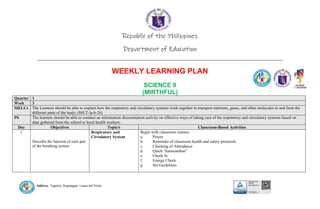
WEEKLY LEARNING PLAN
SCIENCE 9
(MIRTHFUL)
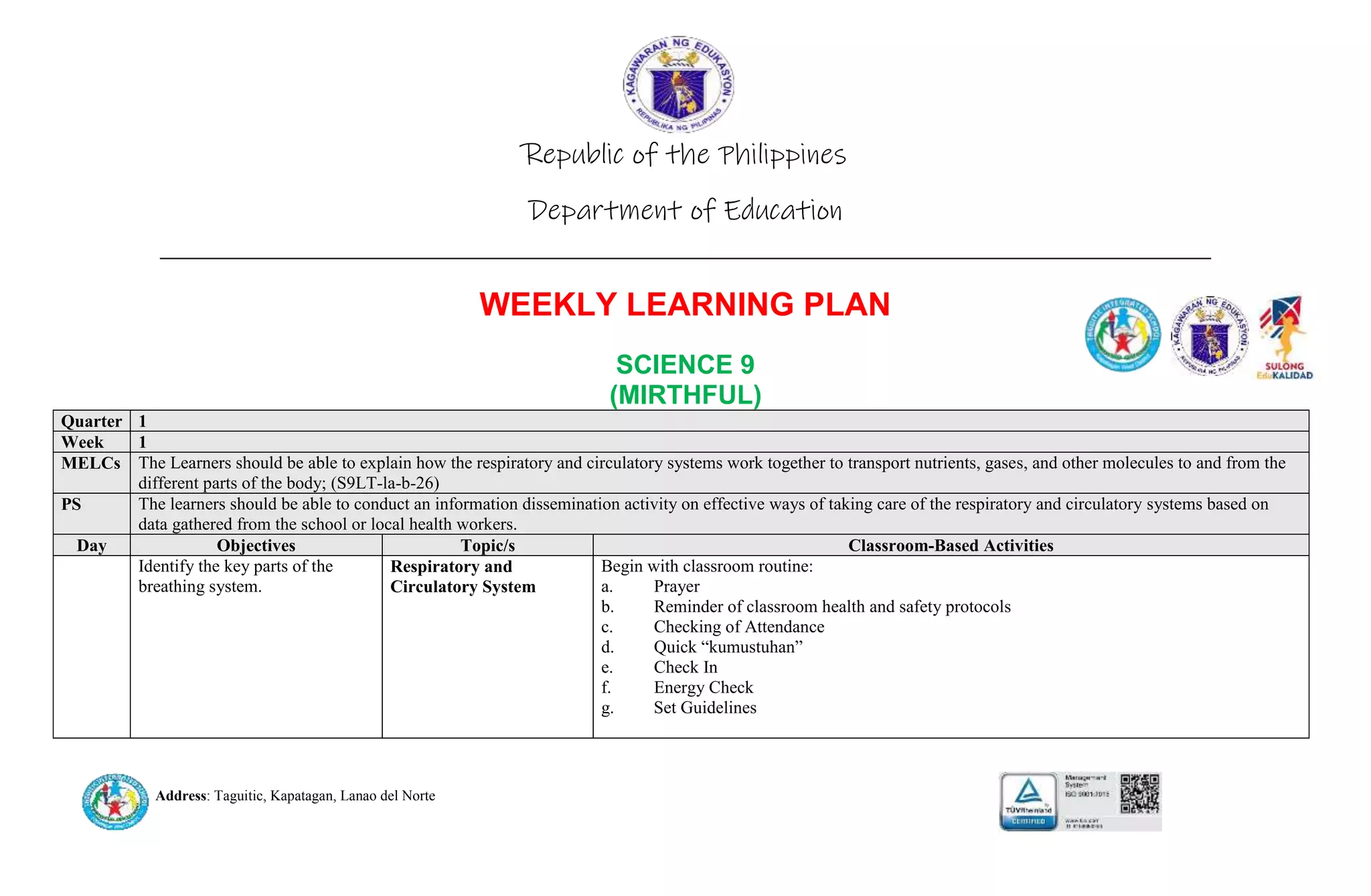
Quarter 1
Week 1
MELCs The Learners should be able to explain how the respiratory and circulatory systems work together to transport nutrients, gases, and other molecules to and from the
different parts of the body; (S9LT-la-b-26)
PS The learners should be able to conduct an information dissemination activity on effective ways of taking care of the respiratory and circulatory systems based on
data gathered from the school or local health workers.
Day Objectives Topic/s Classroom-Based Activities
Identify the key parts of the
breathing system.
Respiratory and
Circulatory System
Begin with classroom routine:
a. Prayer
b. Reminder of classroom health and safety protocols
c. Checking of Attendance
d. Quick “kumustuhan”
e. Check In
f. Energy Check
g. Set Guidelines
Address: Taguitic, Kapatagan, Lanao del Norte
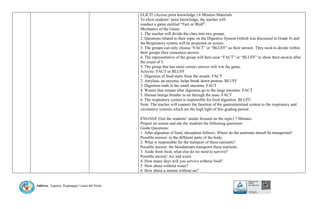
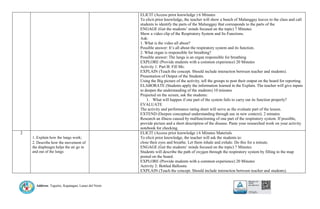
ELICIT (Access prior knowledge ) 6 Minutes Materials
To elicit students’ prior knowledge, the teacher will:
conduct a game entitled “Fact or Bluff”.
Mechanics of the Game:
1. The teacher will divide the class into two groups.
2. Questions related to their topic on the Digestive System (which was discussed in Grade 8) and
the Respiratory system will be projected on screen.
3. The groups can only choose “FACT” or “BLUFF” as their answer. They need to decide within
their groups their consensus answer.
4. The representative of the group will then raise “FACT” or “BLUFF” to show their answer after
the count of 5.
5. The group that has more correct answer will win the game.
Activity: FACT or BLUFF
1. Digestion of food starts from the mouth. FACT
2. Amylase, an enzyme, helps break down protein. BLUFF
3. Digestion ends in the small intestine. FACT
4. Wastes that remain after digestion go to the large intestine. FACT
5. Human beings breathe in air through the nose. FACT
6. The respiratory system is responsible for food digestion. BLUFF.
Note: The teacher will connect the function of the gastrointestinal system to the respiratory and
circulatory systems which are the high light of this grading period.
ENGAGE (Get the students’ minds focused on the topic) 7 Minutes
Project on screen and ask the students the following questions:
Guide Questions:
1. After digestion of food, absorption follows. Where do the nutrients absorb be transported?
Possible answer: to the different parts of the body.
2. What is responsible for the transport of these nutrients?
Possible answer: the bloodstream transports these nutrients
3. Aside from food, what else do we need to survive?
Possible answer: Air and water
4. How many days will you survive without food?
5. How about without water?
6. How about a minute without air?
Address: Taguitic, Kapatagan, Lanao del Norte
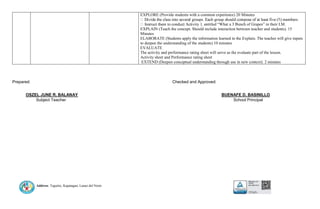
EXPLORE (Provide students with a common experience) 20 Minutes
ntitled “What a 3 Bunch of Grapes” in their LM.
EXPLAIN (Teach the concept. Should include interaction between teacher and students). 15
Minutes
ELABORATE (Students apply the information learned in the Explain. The teacher will give inputs
to deepen the understanding of the students) 10 minutes
EVALUATE
The activity and performance rating sheet will serve as the evaluate part of the lesson.
Activity sheet and Performance rating sheet
EXTEND (Deepen conceptual understanding through use in new context). 2 minutes
Prepared: Checked and Approved:
OSZEL JUNE R. BALANAY BUENAFE D. BASINILLO
Subject Teacher School Principal
Address: Taguitic, Kapatagan, Lanao del Norte
Republic of the Philippines
Department of Education
____________________________________________________________________________
WEEKLY LEARNING PLAN
SCIENCE 9
(MIRTHFUL)
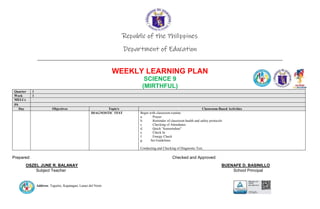
Quarter 1
Week 1
MELCs
PS
Day Objectives Topic/s Classroom-Based Activities
DIAGNOSTIC TEST Begin with classroom routine:
a. Prayer
b. Reminder of classroom health and safety protocols
c. Checking of Attendance
d. Quick “kumustuhan”
e. Check In
f. Energy Check
g. Set Guidelines
Conducting and Checking of Diagnostic Test.
Prepared: Checked and Approved:
OSZEL JUNE R. BALANAY BUENAFE D. BASINILLO
Subject Teacher School Principal
Address: Taguitic, Kapatagan, Lanao del Norte
Republic of the Philippines
Department of Education
____________________________________________________________________________
WEEKLY LEARNING PLAN
SCIENCE 9
(MIRTHFUL)
Quarter 1
Week 3
MELCs The Learners should be able to explain how the respiratory and circulatory systems work together to transport nutrients, gases, and other molecules to and from the
different parts of the body; (S9LT-la-b-26)
PS The learners should be able to conduct an information dissemination activity on effective ways of taking care of the respiratory and circulatory systems based on
data gathered from the school or local health workers.
Day Objectives Topic/s Classroom-Based Activities
1
Describe the function of each part
of the breathing system.
Respiratory and
Circulatory System
Begin with classroom routine:
a. Prayer
b. Reminder of classroom health and safety protocols
c. Checking of Attendance
d. Quick “kumustuhan”
e. Check In
f. Energy Check
g. Set Guidelines
Address: Taguitic, Kapatagan, Lanao del Norte
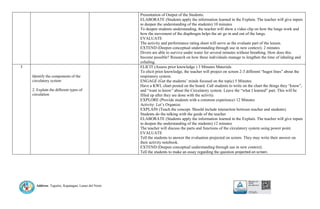
ELICIT (Access prior knowledge ) 6 Minutes
To elicit prior knowledge, the teacher will show a bunch of Malunggay leaves to the class and call
students to identify the parts of the Malunggay that corresponds to the parts of the
ENGAGE (Get the students’ minds focused on the topic) 7 Minutes
Show a video clip of the Respiratory System and Its Functions.
Ask:
1. What is the video all about?
Possible answer: It’s all about the respiratory system and its function.
2. What organ is responsible for breathing?
Possible answer: The lungs is an organ responsible for breathing
EXPLORE (Provide students with a common experience) 20 Minutes
Activity 1: Part B: Fill Me.
EXPLAIN (Teach the concept. Should include interaction between teacher and students).
Presentation of Output of the Students.
Using the Big picture of the activity, tell the groups to post their output on the board for reporting.
ELABORATE (Students apply the information learned in the Explain. The teacher will give inputs
to deepen the understanding of the students) 10 minutes
Projected on the screen, ask the students:
1. What will happen if one part of the system fails to carry out its function properly?
EVALUATE
The activity and performance rating sheet will serve as the evaluate part of the lesson.
EXTEND (Deepen conceptual understanding through use in new context). 2 minutes
Research an illness caused by malfunctioning of one part of the respiratory system. If possible,
provide picture and a short description of the disease. Paste your researched work on your activity
notebook for checking.
2
1. Explain how the lungs work;
2. Describe how the movement of
the diaphragm helps the air go in
and out of the lungs
ELICIT (Access prior knowledge ) 6 Minutes Materials
To elicit prior knowledge, the teacher will ask the students to:
close their eyes and breathe. Let them inhale and exhale. Do this for a minute.
ENGAGE (Get the students’ minds focused on the topic) 7 Minutes
Students will describe the path of oxygen through the respiratory system by filling in the map
posted on the board.
EXPLORE (Provide students with a common experience) 20 Minutes
Activity 2: Bottled Balloons
EXPLAIN (Teach the concept. Should include interaction between teacher and students).
Address: Taguitic, Kapatagan, Lanao del Norte
Presentation of Output of the Students.
ELABORATE (Students apply the information learned in the Explain. The teacher will give inputs
to deepen the understanding of the students) 10 minutes
To deepen students understanding, the teacher will show a video clip on how the lungs work and
how the movement of the diaphragm helps the air go in and out of the lungs.
EVALUATE
The activity and performance rating sheet will serve as the evaluate part of the lesson.
EXTEND (Deepen conceptual understanding through use in new context). 2 minutes
Divers are able to survive under water for several minutes without breathing. How does this
become possible? Research on how these individuals manage to lengthen the time of inhaling and
exhaling.
3
Identify the components of the
circulatory system
2. Explain the different types of
circulation
ELICIT (Assess prior knowledge ) 3 Minutes Materials
To elicit prior knowledge, the teacher will project on screen 2-3 different “hugot lines” about the
respiratory system.
ENGAGE (Get the students’ minds focused on the topic) 5 Minutes
Have a KWL chart posted on the board. Call students to write on the chart the things they “know”,
and “want to know” about the Circulatory system. Leave the “what I learned” part. This will be
filled up after they are done with the activity.
EXPLORE (Provide students with a common experience) 12 Minutes
Activity: Let’s Organize
EXPLAIN (Teach the concept. Should include interaction between teacher and students).
Students do the talking with the guide of the teacher
ELABORATE (Students apply the information learned in the Explain. The teacher will give inputs
to deepen the understanding of the students) 12 minutes
The teacher will discuss the parts and functions of the circulatory system using power point.
EVALUATE
Tell the students to answer the evaluation projected on screen. They may write their answer on
their activity notebook.
EXTEND (Deepen conceptual understanding through use in new context).
Tell the students to make an essay regarding the question projected on screen.
Address: Taguitic, Kapatagan, Lanao del Norte
4
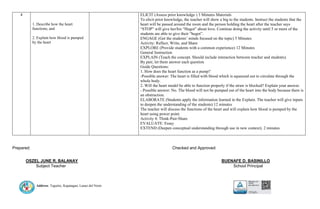
1. Describe how the heart
functions; and
2. Explain how blood is pumped
by the heart
ELICIT (Assess prior knowledge ) 3 Minutes Materials
To elicit prior knowledge, the teacher will show a big to the students. Instruct the students that the
heart will be passed around the room and the person holding the heart after the teacher says
“STOP” will give her/his “Hugot” about love. Continue doing the activity until 5 or more of the
students are able to give their “hugot”.
ENGAGE (Get the students’ minds focused on the topic) 5 Minutes
Activity: Reflect, Write, and Share
EXPLORE (Provide students with a common experience) 12 Minutes
General Instruction
EXPLAIN (Teach the concept. Should include interaction between teacher and students).
By pair, let them answer each question
Guide Questions:
1. How does the heart function as a pump?
-Possible answer: The heart is filled with blood which is squeezed out to circulate through the
whole body.
2. Will the heart model be able to function properly if the straw is blocked? Explain your answer.
- Possible answer: No. The blood will not be pumped out of the heart into the body because there is
an obstruction.
ELABORATE (Students apply the information learned in the Explain. The teacher will give inputs
to deepen the understanding of the students) 12 minutes
The teacher will discuss the functions of the heart and will explain how blood is pumped by the
heart using power point.
Activity 4: Think-Pair-Share
EVALUATE: Essay
EXTEND (Deepen conceptual understanding through use in new context). 2 minutes
Prepared: Checked and Approved:
OSZEL JUNE R. BALANAY BUENAFE D. BASINILLO
Subject Teacher School Principal

sci9.docx

  • 1.
    Address: Taguitic, Kapatagan,Lanao del Norte Republic of the Philippines Department of Education ____________________________________________________________________________ WEEKLY LEARNING PLAN SCIENCE 9 (MIRTHFUL) Quarter 1 Week 1 MELCs The Learners should be able to explain how the respiratory and circulatory systems work together to transport nutrients, gases, and other molecules to and from the different parts of the body; (S9LT-la-b-26) PS The learners should be able to conduct an information dissemination activity on effective ways of taking care of the respiratory and circulatory systems based on data gathered from the school or local health workers. Day Objectives Topic/s Classroom-Based Activities Identify the key parts of the breathing system. Respiratory and Circulatory System Begin with classroom routine: a. Prayer b. Reminder of classroom health and safety protocols c. Checking of Attendance d. Quick “kumustuhan” e. Check In f. Energy Check g. Set Guidelines
  • 2.
    Address: Taguitic, Kapatagan,Lanao del Norte ELICIT (Access prior knowledge ) 6 Minutes Materials To elicit students’ prior knowledge, the teacher will: conduct a game entitled “Fact or Bluff”. Mechanics of the Game: 1. The teacher will divide the class into two groups. 2. Questions related to their topic on the Digestive System (which was discussed in Grade 8) and the Respiratory system will be projected on screen. 3. The groups can only choose “FACT” or “BLUFF” as their answer. They need to decide within their groups their consensus answer. 4. The representative of the group will then raise “FACT” or “BLUFF” to show their answer after the count of 5. 5. The group that has more correct answer will win the game. Activity: FACT or BLUFF 1. Digestion of food starts from the mouth. FACT 2. Amylase, an enzyme, helps break down protein. BLUFF 3. Digestion ends in the small intestine. FACT 4. Wastes that remain after digestion go to the large intestine. FACT 5. Human beings breathe in air through the nose. FACT 6. The respiratory system is responsible for food digestion. BLUFF. Note: The teacher will connect the function of the gastrointestinal system to the respiratory and circulatory systems which are the high light of this grading period. ENGAGE (Get the students’ minds focused on the topic) 7 Minutes Project on screen and ask the students the following questions: Guide Questions: 1. After digestion of food, absorption follows. Where do the nutrients absorb be transported? Possible answer: to the different parts of the body. 2. What is responsible for the transport of these nutrients? Possible answer: the bloodstream transports these nutrients 3. Aside from food, what else do we need to survive? Possible answer: Air and water 4. How many days will you survive without food? 5. How about without water? 6. How about a minute without air?
  • 3.
    Address: Taguitic, Kapatagan,Lanao del Norte EXPLORE (Provide students with a common experience) 20 Minutes ntitled “What a 3 Bunch of Grapes” in their LM. EXPLAIN (Teach the concept. Should include interaction between teacher and students). 15 Minutes ELABORATE (Students apply the information learned in the Explain. The teacher will give inputs to deepen the understanding of the students) 10 minutes EVALUATE The activity and performance rating sheet will serve as the evaluate part of the lesson. Activity sheet and Performance rating sheet EXTEND (Deepen conceptual understanding through use in new context). 2 minutes Prepared: Checked and Approved: OSZEL JUNE R. BALANAY BUENAFE D. BASINILLO Subject Teacher School Principal
  • 4.
    Address: Taguitic, Kapatagan,Lanao del Norte Republic of the Philippines Department of Education ____________________________________________________________________________ WEEKLY LEARNING PLAN SCIENCE 9 (MIRTHFUL) Quarter 1 Week 1 MELCs PS Day Objectives Topic/s Classroom-Based Activities DIAGNOSTIC TEST Begin with classroom routine: a. Prayer b. Reminder of classroom health and safety protocols c. Checking of Attendance d. Quick “kumustuhan” e. Check In f. Energy Check g. Set Guidelines Conducting and Checking of Diagnostic Test. Prepared: Checked and Approved: OSZEL JUNE R. BALANAY BUENAFE D. BASINILLO Subject Teacher School Principal
  • 5.
    Address: Taguitic, Kapatagan,Lanao del Norte Republic of the Philippines Department of Education ____________________________________________________________________________ WEEKLY LEARNING PLAN SCIENCE 9 (MIRTHFUL) Quarter 1 Week 3 MELCs The Learners should be able to explain how the respiratory and circulatory systems work together to transport nutrients, gases, and other molecules to and from the different parts of the body; (S9LT-la-b-26) PS The learners should be able to conduct an information dissemination activity on effective ways of taking care of the respiratory and circulatory systems based on data gathered from the school or local health workers. Day Objectives Topic/s Classroom-Based Activities 1 Describe the function of each part of the breathing system. Respiratory and Circulatory System Begin with classroom routine: a. Prayer b. Reminder of classroom health and safety protocols c. Checking of Attendance d. Quick “kumustuhan” e. Check In f. Energy Check g. Set Guidelines
  • 6.
    Address: Taguitic, Kapatagan,Lanao del Norte ELICIT (Access prior knowledge ) 6 Minutes To elicit prior knowledge, the teacher will show a bunch of Malunggay leaves to the class and call students to identify the parts of the Malunggay that corresponds to the parts of the ENGAGE (Get the students’ minds focused on the topic) 7 Minutes Show a video clip of the Respiratory System and Its Functions. Ask: 1. What is the video all about? Possible answer: It’s all about the respiratory system and its function. 2. What organ is responsible for breathing? Possible answer: The lungs is an organ responsible for breathing EXPLORE (Provide students with a common experience) 20 Minutes Activity 1: Part B: Fill Me. EXPLAIN (Teach the concept. Should include interaction between teacher and students). Presentation of Output of the Students. Using the Big picture of the activity, tell the groups to post their output on the board for reporting. ELABORATE (Students apply the information learned in the Explain. The teacher will give inputs to deepen the understanding of the students) 10 minutes Projected on the screen, ask the students: 1. What will happen if one part of the system fails to carry out its function properly? EVALUATE The activity and performance rating sheet will serve as the evaluate part of the lesson. EXTEND (Deepen conceptual understanding through use in new context). 2 minutes Research an illness caused by malfunctioning of one part of the respiratory system. If possible, provide picture and a short description of the disease. Paste your researched work on your activity notebook for checking. 2 1. Explain how the lungs work; 2. Describe how the movement of the diaphragm helps the air go in and out of the lungs ELICIT (Access prior knowledge ) 6 Minutes Materials To elicit prior knowledge, the teacher will ask the students to: close their eyes and breathe. Let them inhale and exhale. Do this for a minute. ENGAGE (Get the students’ minds focused on the topic) 7 Minutes Students will describe the path of oxygen through the respiratory system by filling in the map posted on the board. EXPLORE (Provide students with a common experience) 20 Minutes Activity 2: Bottled Balloons EXPLAIN (Teach the concept. Should include interaction between teacher and students).
  • 7.
    Address: Taguitic, Kapatagan,Lanao del Norte Presentation of Output of the Students. ELABORATE (Students apply the information learned in the Explain. The teacher will give inputs to deepen the understanding of the students) 10 minutes To deepen students understanding, the teacher will show a video clip on how the lungs work and how the movement of the diaphragm helps the air go in and out of the lungs. EVALUATE The activity and performance rating sheet will serve as the evaluate part of the lesson. EXTEND (Deepen conceptual understanding through use in new context). 2 minutes Divers are able to survive under water for several minutes without breathing. How does this become possible? Research on how these individuals manage to lengthen the time of inhaling and exhaling. 3 Identify the components of the circulatory system 2. Explain the different types of circulation ELICIT (Assess prior knowledge ) 3 Minutes Materials To elicit prior knowledge, the teacher will project on screen 2-3 different “hugot lines” about the respiratory system. ENGAGE (Get the students’ minds focused on the topic) 5 Minutes Have a KWL chart posted on the board. Call students to write on the chart the things they “know”, and “want to know” about the Circulatory system. Leave the “what I learned” part. This will be filled up after they are done with the activity. EXPLORE (Provide students with a common experience) 12 Minutes Activity: Let’s Organize EXPLAIN (Teach the concept. Should include interaction between teacher and students). Students do the talking with the guide of the teacher ELABORATE (Students apply the information learned in the Explain. The teacher will give inputs to deepen the understanding of the students) 12 minutes The teacher will discuss the parts and functions of the circulatory system using power point. EVALUATE Tell the students to answer the evaluation projected on screen. They may write their answer on their activity notebook. EXTEND (Deepen conceptual understanding through use in new context). Tell the students to make an essay regarding the question projected on screen.
  • 8.
    Address: Taguitic, Kapatagan,Lanao del Norte 4 1. Describe how the heart functions; and 2. Explain how blood is pumped by the heart ELICIT (Assess prior knowledge ) 3 Minutes Materials To elicit prior knowledge, the teacher will show a big to the students. Instruct the students that the heart will be passed around the room and the person holding the heart after the teacher says “STOP” will give her/his “Hugot” about love. Continue doing the activity until 5 or more of the students are able to give their “hugot”. ENGAGE (Get the students’ minds focused on the topic) 5 Minutes Activity: Reflect, Write, and Share EXPLORE (Provide students with a common experience) 12 Minutes General Instruction EXPLAIN (Teach the concept. Should include interaction between teacher and students). By pair, let them answer each question Guide Questions: 1. How does the heart function as a pump? -Possible answer: The heart is filled with blood which is squeezed out to circulate through the whole body. 2. Will the heart model be able to function properly if the straw is blocked? Explain your answer. - Possible answer: No. The blood will not be pumped out of the heart into the body because there is an obstruction. ELABORATE (Students apply the information learned in the Explain. The teacher will give inputs to deepen the understanding of the students) 12 minutes The teacher will discuss the functions of the heart and will explain how blood is pumped by the heart using power point. Activity 4: Think-Pair-Share EVALUATE: Essay EXTEND (Deepen conceptual understanding through use in new context). 2 minutes Prepared: Checked and Approved: OSZEL JUNE R. BALANAY BUENAFE D. BASINILLO Subject Teacher School Principal