G20 Labour Markets in 2015:
Strengthening the Link between
Employment and Growth
G20 Labour and Employment
Ministerial Meeting
Ankara, Turkey
3 September 2015
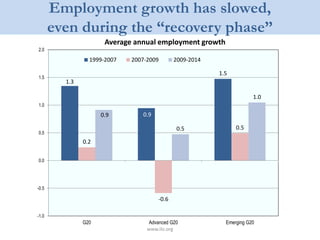
Employment growth has slowed,
even during the “recovery phase”
www.ilo.org
1.3
0.9
1.5
0.2
-0.6
0.5
0.9
0.5
1.0
-1.0
-0.5
0.0
0.5
1.0
1.5
2.0
G20 Advanced G20 Emerging G20
1999-2007 2007-2009 2009-2014
Average annual employment growth
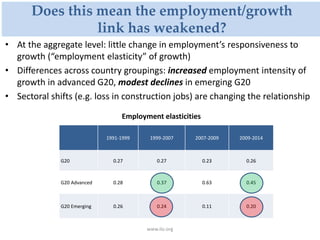
Does this mean the employment/growth
link has weakened?
www.ilo.org
Employment elasticities
1991-1999 1999-2007 2007-2009 2009-2014
G20 0.27 0.27 0.23 0.26
G20 Advanced 0.28 0.37 0.63 0.45
G20 Emerging 0.26 0.24 0.11 0.20
• At the aggregate level: little change in employment’s responsiveness to
growth (“employment elasticity” of growth)
• Differences across country groupings: increased employment intensity of
growth in advanced G20, modest declines in emerging G20
• Sectoral shifts (e.g. loss in construction jobs) are changing the relationship
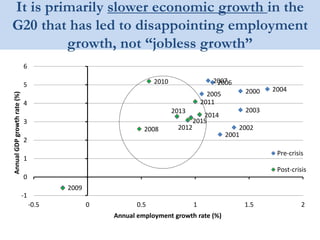
It is primarily slower economic growth in the
G20 that has led to disappointing employment
growth, not “jobless growth”
2000
2001
2002
2003
2004
2005
20062007
2008
2009
2010
2011
2012
2013
2014
2015
-1
0
1
2
3
4
5
6
-0.5 0 0.5 1 1.5 2
AnnualGDPgrowthrate(%)
Annual employment growth rate (%)
Pre-crisis
Post-crisis
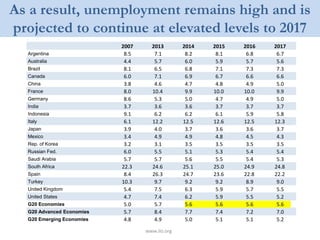
As a result, unemployment remains high and is
projected to continue at elevated levels to 2017
www.ilo.org
2007 2013 2014 2015 2016 2017
Argentina 8.5 7.1 8.2 8.1 6.8 6.7
Australia 4.4 5.7 6.0 5.9 5.7 5.6
Brazil 8.1 6.5 6.8 7.1 7.3 7.3
Canada 6.0 7.1 6.9 6.7 6.6 6.6
China 3.8 4.6 4.7 4.8 4.9 5.0
France 8.0 10.4 9.9 10.0 10.0 9.9
Germany 8.6 5.3 5.0 4.7 4.9 5.0
India 3.7 3.6 3.6 3.7 3.7 3.7
Indonesia 9.1 6.2 6.2 6.1 5.9 5.8
Italy 6.1 12.2 12.5 12.6 12.5 12.3
Japan 3.9 4.0 3.7 3.6 3.6 3.7
Mexico 3.4 4.9 4.9 4.8 4.5 4.3
Rep. of Korea 3.2 3.1 3.5 3.5 3.5 3.5
Russian Fed. 6.0 5.5 5.1 5.3 5.4 5.4
Saudi Arabia 5.7 5.7 5.6 5.5 5.4 5.3
South Africa 22.3 24.6 25.1 25.0 24.9 24.8
Spain 8.4 26.3 24.7 23.6 22.8 22.2
Turkey 10.3 9.7 9.2 9.2 8.9 9.0
United Kingdom 5.4 7.5 6.3 5.9 5.7 5.5
United States 4.7 7.4 6.2 5.9 5.5 5.2
G20 Economies 5.0 5.7 5.6 5.6 5.6 5.6
G20 Advanced Economies 5.7 8.4 7.7 7.4 7.2 7.0
G20 Emerging Economies 4.8 4.9 5.0 5.1 5.1 5.2
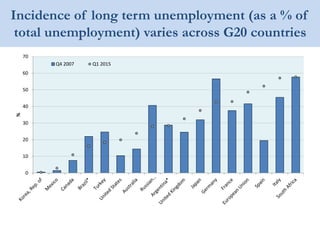
Incidence of long term unemployment (as a % of
total unemployment) varies across G20 countries
0
10
20
30
40
50
60
70
%
Q4 2007 Q1 2015
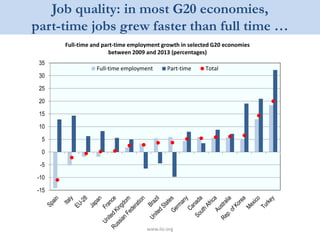
Job quality: in most G20 economies,
part-time jobs grew faster than full time …
www.ilo.org
Full-time and part-time employment growth in selected G20 economies
between 2009 and 2013 (percentages)
-15
-10
-5
0
5
10
15
20
25
30
35
Full-time employment Part-time Total
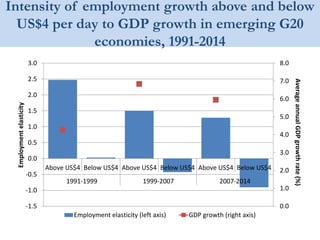
Intensity of employment growth above and below
US$4 per day to GDP growth in emerging G20
economies, 1991-2014
0.0
1.0
2.0
3.0
4.0
5.0
6.0
7.0
8.0
-1.5
-1.0
-0.5
0.0
0.5
1.0
1.5
2.0
2.5
3.0
Above US$4 Below US$4 Above US$4 Below US$4 Above US$4 Below US$4
1991-1999 1999-2007 2007-2014
AverageannualGDPgrowthrate(%)
Employmentelasticity
Employment elasticity (left axis) GDP growth (right axis)
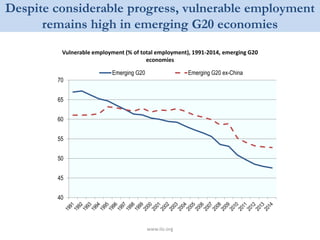
Despite considerable progress, vulnerable employment
remains high in emerging G20 economies
www.ilo.org
Vulnerable employment (% of total employment), 1991-2014, emerging G20
economies
40
45
50
55
60
65
70
Emerging G20 Emerging G20 ex-China
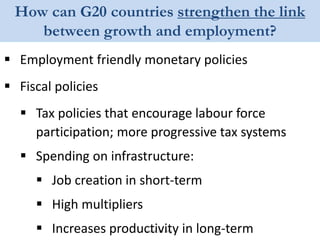
How can G20 countries strengthen the link
between growth and employment?
www.ilo.org
 Employment friendly monetary policies
 Fiscal policies
 Tax policies that encourage labour force
participation; more progressive tax systems
 Spending on infrastructure:
 Job creation in short-term
 High multipliers
 Increases productivity in long-term
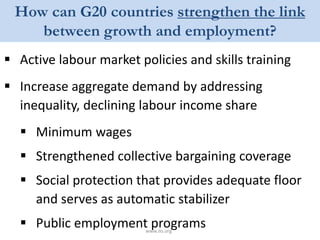
How can G20 countries strengthen the link
between growth and employment?
www.ilo.org
 Active labour market policies and skills training
 Increase aggregate demand by addressing
inequality, declining labour income share
 Minimum wages
 Strengthened collective bargaining coverage
 Social protection that provides adequate floor
and serves as automatic stabilizer
 Public employment programs
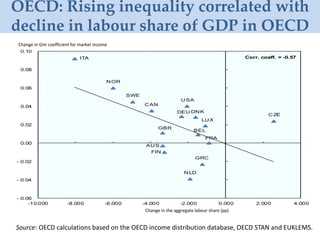
OECD: Rising inequality correlated with
decline in labour share of GDP in OECD
Source: OECD calculations based on the OECD income distribution database, OECD STAN and EUKLEMS.
Source: OECD calculations based on the OECD income distribution
database, OECD STAN and EUKLEMS.
AUS
BEL
CAN
CZE
DEU DNK
FIN
FRA
GBR
GRC
ITA
LUX
NLD
NOR
SWE
USA
- 0.06
- 0.04
- 0.02
0.00
0.02
0.04
0.06
0.08
0.10
-10.000 -8.000 -6.000 -4.000 -2.000 0.000 2.000 4.000
Change in the aggregate labour share, percentage points
Change in the Gini coefficient for market income
Corr. coeff. = -0.57
Change in Gini coefficient for market income
Change in the aggregate labour share (pp)
Inequality and declining labour income share
are among the causes of slow growth
www.ilo.org
 Recent work by ILO, OECD, IMF: An increasing body of
evidence shows that inequality slows and interrupts
economic growth. Different methodologies and
different data sets all yield the same conclusion.
 Inequality has risen in most G20, reducing current and
potential growth and working against Leaders’ goal of
strong, sustainable and balanced growth and
additional 2% growth.
 Social cohesion, political stability, further global
integration all negatively affected by inequality.

G20 Labour Markets in 2015: Strengthening the Link between Employment and Growth

  • 1.
    G20 Labour Marketsin 2015: Strengthening the Link between Employment and Growth G20 Labour and Employment Ministerial Meeting Ankara, Turkey 3 September 2015
  • 2.
    Employment growth hasslowed, even during the “recovery phase” www.ilo.org 1.3 0.9 1.5 0.2 -0.6 0.5 0.9 0.5 1.0 -1.0 -0.5 0.0 0.5 1.0 1.5 2.0 G20 Advanced G20 Emerging G20 1999-2007 2007-2009 2009-2014 Average annual employment growth
  • 3.
    Does this meanthe employment/growth link has weakened? www.ilo.org Employment elasticities 1991-1999 1999-2007 2007-2009 2009-2014 G20 0.27 0.27 0.23 0.26 G20 Advanced 0.28 0.37 0.63 0.45 G20 Emerging 0.26 0.24 0.11 0.20 • At the aggregate level: little change in employment’s responsiveness to growth (“employment elasticity” of growth) • Differences across country groupings: increased employment intensity of growth in advanced G20, modest declines in emerging G20 • Sectoral shifts (e.g. loss in construction jobs) are changing the relationship
  • 4.
    It is primarilyslower economic growth in the G20 that has led to disappointing employment growth, not “jobless growth” 2000 2001 2002 2003 2004 2005 20062007 2008 2009 2010 2011 2012 2013 2014 2015 -1 0 1 2 3 4 5 6 -0.5 0 0.5 1 1.5 2 AnnualGDPgrowthrate(%) Annual employment growth rate (%) Pre-crisis Post-crisis
  • 5.
    As a result,unemployment remains high and is projected to continue at elevated levels to 2017 www.ilo.org 2007 2013 2014 2015 2016 2017 Argentina 8.5 7.1 8.2 8.1 6.8 6.7 Australia 4.4 5.7 6.0 5.9 5.7 5.6 Brazil 8.1 6.5 6.8 7.1 7.3 7.3 Canada 6.0 7.1 6.9 6.7 6.6 6.6 China 3.8 4.6 4.7 4.8 4.9 5.0 France 8.0 10.4 9.9 10.0 10.0 9.9 Germany 8.6 5.3 5.0 4.7 4.9 5.0 India 3.7 3.6 3.6 3.7 3.7 3.7 Indonesia 9.1 6.2 6.2 6.1 5.9 5.8 Italy 6.1 12.2 12.5 12.6 12.5 12.3 Japan 3.9 4.0 3.7 3.6 3.6 3.7 Mexico 3.4 4.9 4.9 4.8 4.5 4.3 Rep. of Korea 3.2 3.1 3.5 3.5 3.5 3.5 Russian Fed. 6.0 5.5 5.1 5.3 5.4 5.4 Saudi Arabia 5.7 5.7 5.6 5.5 5.4 5.3 South Africa 22.3 24.6 25.1 25.0 24.9 24.8 Spain 8.4 26.3 24.7 23.6 22.8 22.2 Turkey 10.3 9.7 9.2 9.2 8.9 9.0 United Kingdom 5.4 7.5 6.3 5.9 5.7 5.5 United States 4.7 7.4 6.2 5.9 5.5 5.2 G20 Economies 5.0 5.7 5.6 5.6 5.6 5.6 G20 Advanced Economies 5.7 8.4 7.7 7.4 7.2 7.0 G20 Emerging Economies 4.8 4.9 5.0 5.1 5.1 5.2
  • 6.
    Incidence of longterm unemployment (as a % of total unemployment) varies across G20 countries 0 10 20 30 40 50 60 70 % Q4 2007 Q1 2015
  • 7.
    Job quality: inmost G20 economies, part-time jobs grew faster than full time … www.ilo.org Full-time and part-time employment growth in selected G20 economies between 2009 and 2013 (percentages) -15 -10 -5 0 5 10 15 20 25 30 35 Full-time employment Part-time Total
  • 8.
    Intensity of employmentgrowth above and below US$4 per day to GDP growth in emerging G20 economies, 1991-2014 0.0 1.0 2.0 3.0 4.0 5.0 6.0 7.0 8.0 -1.5 -1.0 -0.5 0.0 0.5 1.0 1.5 2.0 2.5 3.0 Above US$4 Below US$4 Above US$4 Below US$4 Above US$4 Below US$4 1991-1999 1999-2007 2007-2014 AverageannualGDPgrowthrate(%) Employmentelasticity Employment elasticity (left axis) GDP growth (right axis)
  • 9.
    Despite considerable progress,vulnerable employment remains high in emerging G20 economies www.ilo.org Vulnerable employment (% of total employment), 1991-2014, emerging G20 economies 40 45 50 55 60 65 70 Emerging G20 Emerging G20 ex-China
  • 10.
    How can G20countries strengthen the link between growth and employment? www.ilo.org  Employment friendly monetary policies  Fiscal policies  Tax policies that encourage labour force participation; more progressive tax systems  Spending on infrastructure:  Job creation in short-term  High multipliers  Increases productivity in long-term
  • 11.
    How can G20countries strengthen the link between growth and employment? www.ilo.org  Active labour market policies and skills training  Increase aggregate demand by addressing inequality, declining labour income share  Minimum wages  Strengthened collective bargaining coverage  Social protection that provides adequate floor and serves as automatic stabilizer  Public employment programs
  • 12.
    OECD: Rising inequalitycorrelated with decline in labour share of GDP in OECD Source: OECD calculations based on the OECD income distribution database, OECD STAN and EUKLEMS. Source: OECD calculations based on the OECD income distribution database, OECD STAN and EUKLEMS. AUS BEL CAN CZE DEU DNK FIN FRA GBR GRC ITA LUX NLD NOR SWE USA - 0.06 - 0.04 - 0.02 0.00 0.02 0.04 0.06 0.08 0.10 -10.000 -8.000 -6.000 -4.000 -2.000 0.000 2.000 4.000 Change in the aggregate labour share, percentage points Change in the Gini coefficient for market income Corr. coeff. = -0.57 Change in Gini coefficient for market income Change in the aggregate labour share (pp)
  • 13.
    Inequality and declininglabour income share are among the causes of slow growth www.ilo.org  Recent work by ILO, OECD, IMF: An increasing body of evidence shows that inequality slows and interrupts economic growth. Different methodologies and different data sets all yield the same conclusion.  Inequality has risen in most G20, reducing current and potential growth and working against Leaders’ goal of strong, sustainable and balanced growth and additional 2% growth.  Social cohesion, political stability, further global integration all negatively affected by inequality.