G20 in Retrospect and Prospect
Mahmoud Mohieldin*
Managing Director
The World Bank
Presentation to the
School of International Public Affairs
Columbia University
January 25, 2012
*Disclaimer: The findings, interpretations, and conclusions expressed in this paper do not necessarily reflect the views of the Executive Directors
of The World Bank or the governments they represent. The World Bank does not guarantee the accuracy of the data included in this work.
Key questions
 What is the G20 and who are its members?
 What is the role of the G20?
 What is the G20 focusing on?
 What is the contribution of the World Bank?
Introduction
2

 Follows in the footsteps of the G6, G7, G8 (a leaders’
forum established in 1975).
 The G20 was setup in the wake of the Asian financial crisis
as a global forum for Finance Ministers and Central Bank
Governors to discuss measures to promote financial
stability and sustainable development.
 Representatives account for about 85 percent of the world
economy.
 First meeting took place in Berlin in December 1999
(chaired by Paul Martin, former Finance Minister of
Canada).
Origins of the G20
3

Additional invitees:
•France invited Ethiopia, Singapore, Spain, UAE (Chair of the GCC), and Equatorial
Guinea (Chair of the African Union).
•Mexico invited Colombia, Cambodia, Chile, Equatorial Guinea (Chair of the African
Union), and Spain.
1. Argentina
2. Australia
3. Brazil
4. Canada
5. China
6. France
7. Germany
8. India
9. Indonesia
10. Italy
Who are the G20
4
11. Japan
12. Mexico
13. Russia
14. Saudi Arabia
15. South Africa
16. Republic of Korea
17. Turkey
18. United Kingdom
19. United States of America
20. European Union/ECB
• International Monetary
Fund
• World Bank
• Financial Stability Board
• Organization for
Economic Cooperation
and Development
• United Nations
• International Labor
Organization
• World Trade Organization

1999-2001 Canada
2002 India
2003 Mexico
2004 Germany
2005 China
2006 Australia
2007 South Africa
2008 Brazil
2009 United Kingdom
2010 Korea
2011 France
2012 Mexico
The G20 Chairs
5

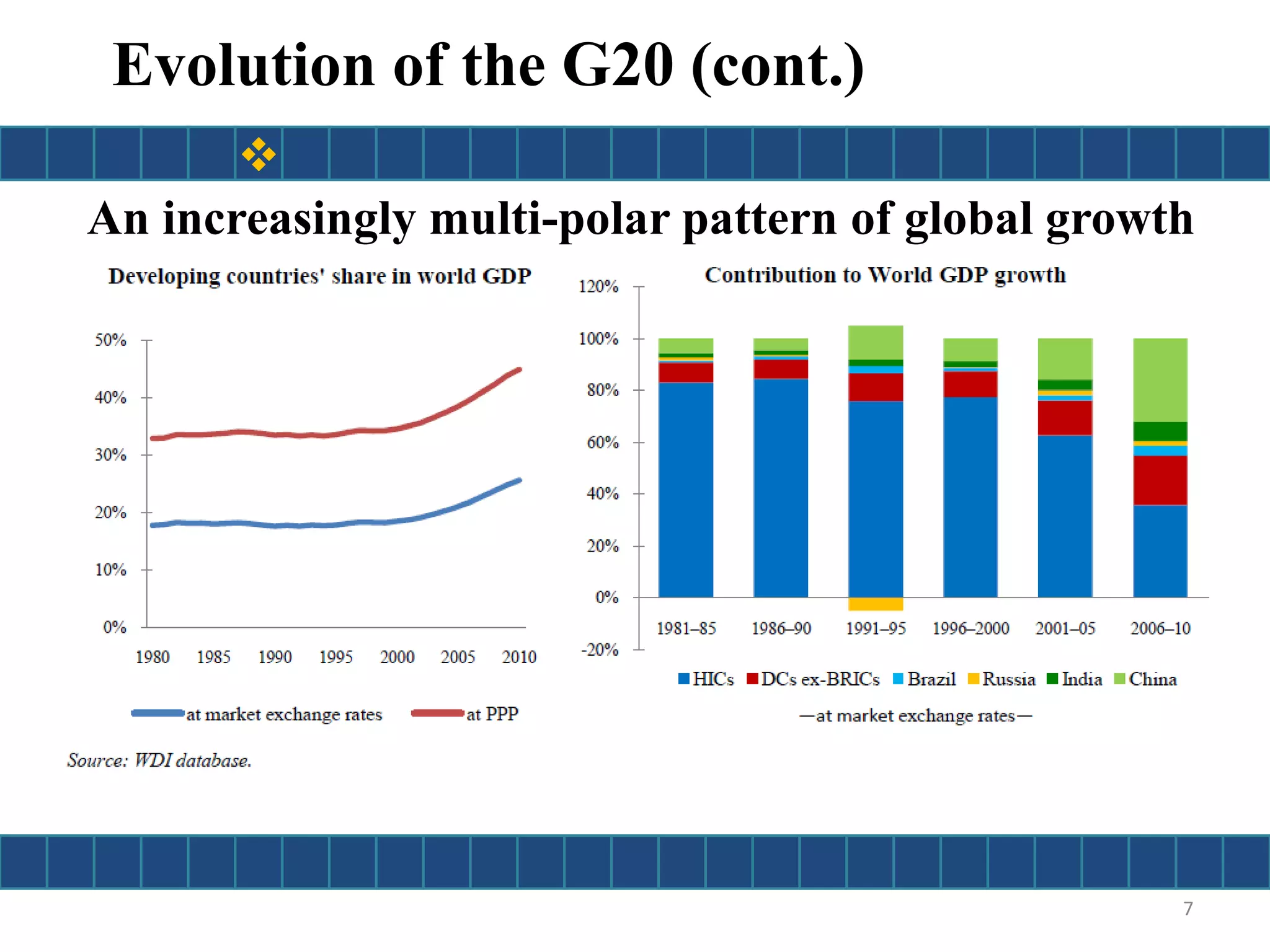
A. Multi-polar world
 EMEs accounting for rapidly increasing shares of
output, growth, trade and investment.
 Trend accentuated in the outlook, where 2012 Global
Economic Prospects highlights weakening in advanced
economies, while growth slows but remains strong in
EMEs.
Evolution of the G20
6
Two key factors driving the importance of the G20
in international policy making:

Evolution of the G20 (cont.)
7
An increasingly multi-polar pattern of global growth

8
An increasingly multi-polar pattern of global trade
Evolution of the G20 (cont.)

9
Source: World Bank, Global Economic Prospects, 2012
In weakening outlook, EMEs sustain global growth
Evolution of the G20 (cont.)

B. Global financial crisis starting in 2008
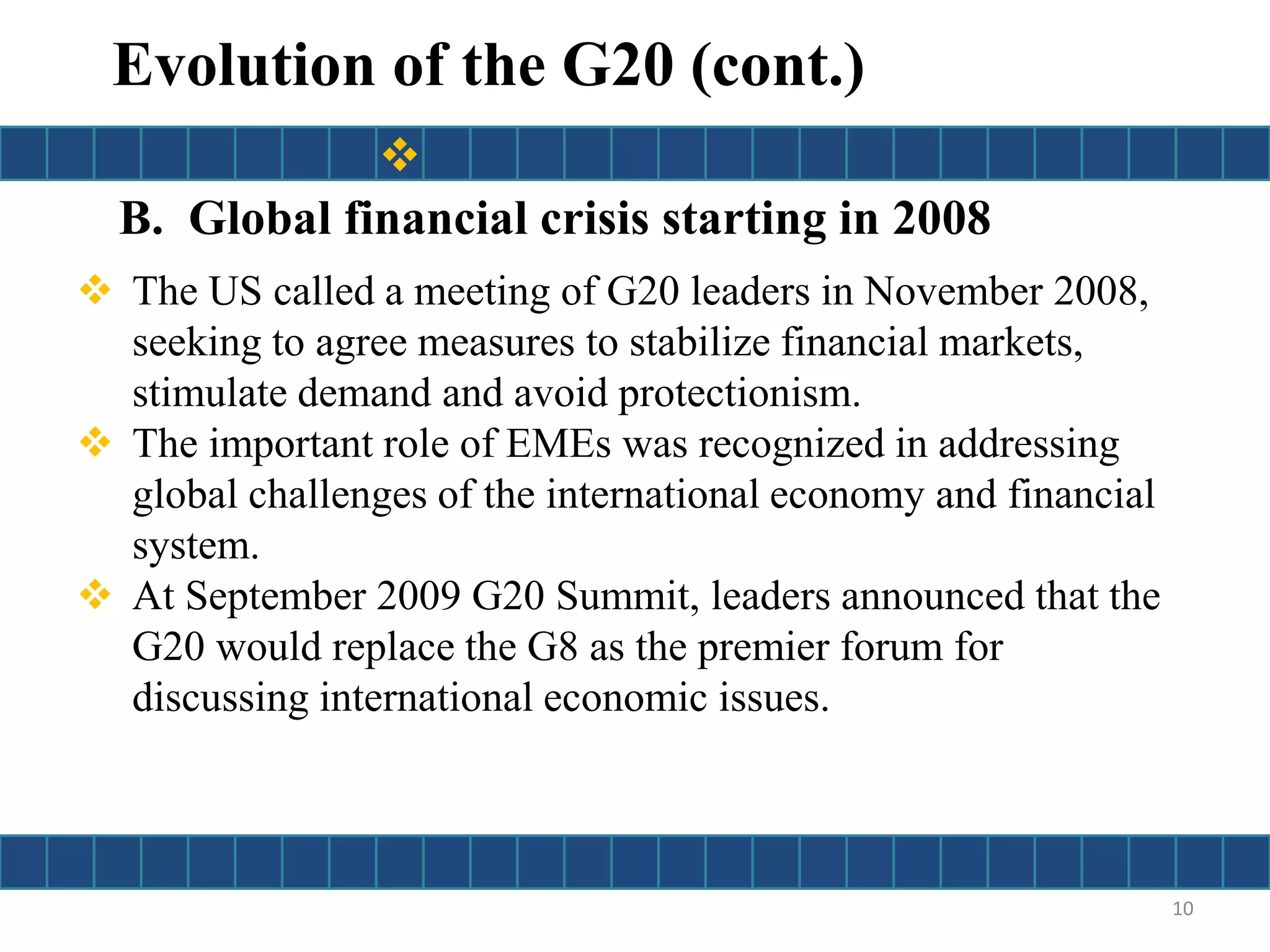
 The US called a meeting of G20 leaders in November 2008,
seeking to agree measures to stabilize financial markets,
stimulate demand and avoid protectionism.
 The important role of EMEs was recognized in addressing
global challenges of the international economy and financial
system.
 At September 2009 G20 Summit, leaders announced that the
G20 would replace the G8 as the premier forum for
discussing international economic issues.
10
Evolution of the G20 (cont.)

Governance and Role
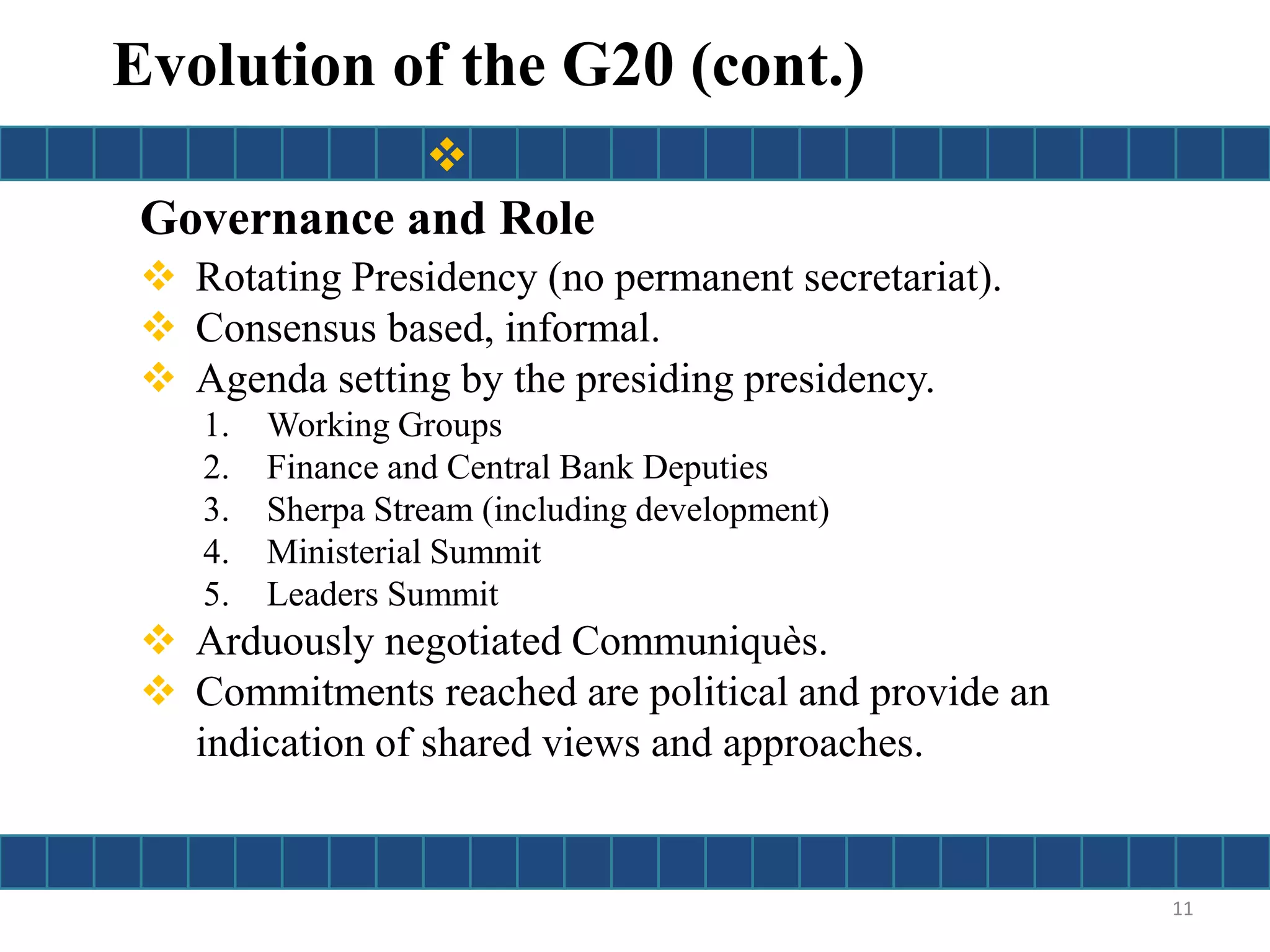
 Rotating Presidency (no permanent secretariat).
 Consensus based, informal.
 Agenda setting by the presiding presidency.
1. Working Groups
2. Finance and Central Bank Deputies
3. Sherpa Stream (including development)
4. Ministerial Summit
5. Leaders Summit
 Arduously negotiated Communiquès.
 Commitments reached are political and provide an
indication of shared views and approaches.
11
Evolution of the G20 (cont.)

Highlights of the growing agendas at the G20 Summits
 Washington (2008) – Stabilize financial markets and restore
growth (Washington Action Plan).
 London (2009) – Implementation of the Washington Action
Plan, strengthening the financial system.
 Pittsburgh (2009) – From crisis to recovery.
 Toronto (2010) – Framework for strong, sustainable and
balanced growth.
 Seoul (2010) – Seoul Development Consensus (9 pillars)
 Cannes (2011) – Expanded list, overtaken by euro crisis.
Key Focus Areas of the G20
12

Korea Presidency 2010
 Ensuring global economic recovery
 Framework for strong, sustainable, and balanced global
growth (Seoul Action Plan).
 International financial institution reform
 Financial sector reforms
 Fighting protectionism and promoting trade and investment
 Financial inclusion
 Energy
 Seoul Development Consensus for Shared Growth
Key Focus Areas of the G20 (cont.)
13

Seoul Consensus
 Focus on economic growth needed to reach MDGs.
 Global development partnership – development assistance, transparent
and accountable.
 Prioritize global or regional systemic issues.
 Private sector participation essential.
 G20 to complement, not duplicate other global actors.
 Outcome orientation - focus on tangible measures.
 The nine key pillars most in need of attention within developing
countries: 1) infrastructure, 2) private investment and job creation, 3)
human resource development, 4) trade, 5) financial inclusion, 6)
resilient growth , 7) food security, 8) domestic resource mobilization
9) knowledge sharing.
Key Focus Areas of the G20 (cont.)
14

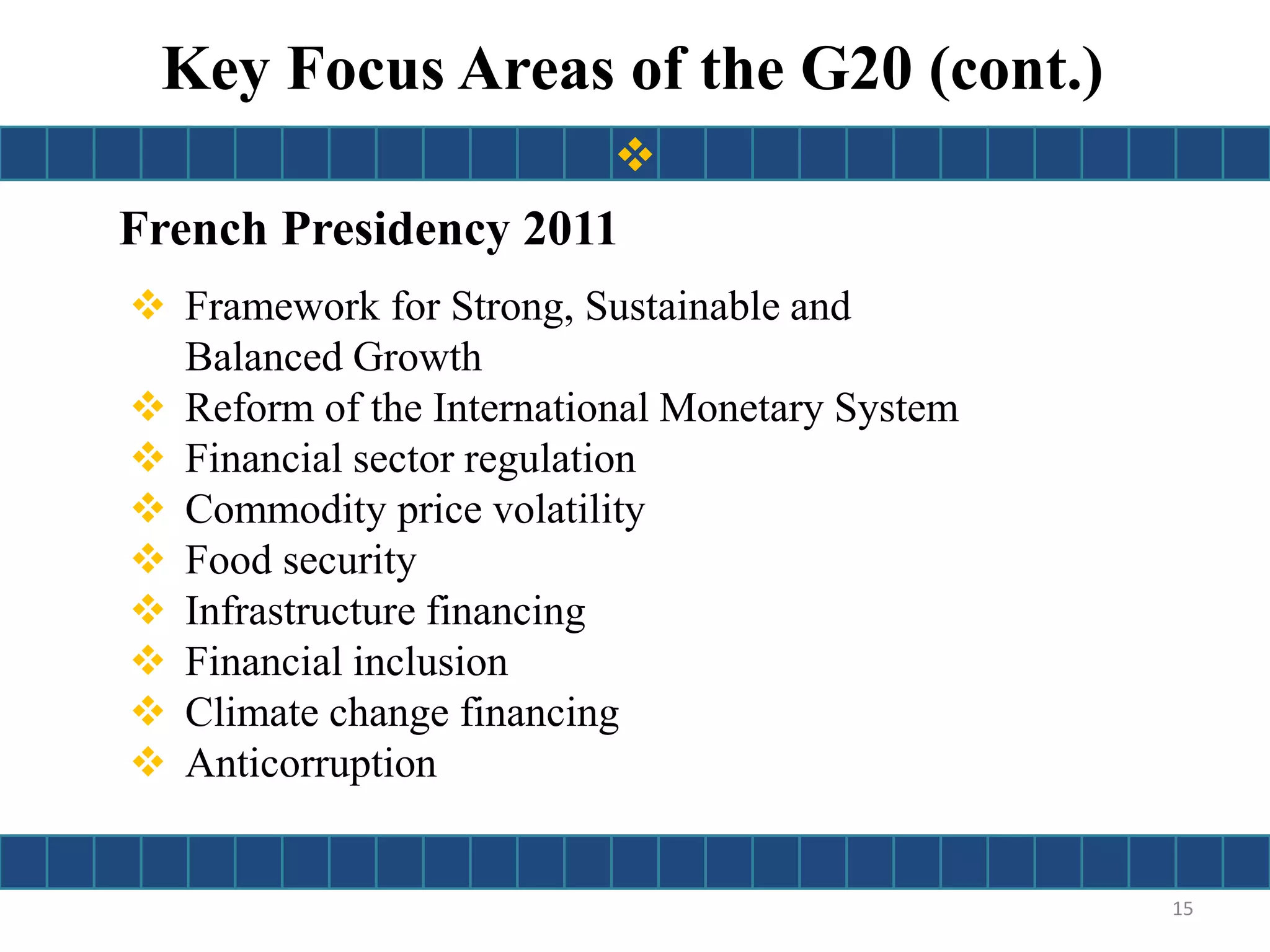
French Presidency 2011
 Framework for Strong, Sustainable and
Balanced Growth
 Reform of the International Monetary System
 Financial sector regulation
 Commodity price volatility
 Food security
 Infrastructure financing
 Financial inclusion
 Climate change financing
 Anticorruption
Key Focus Areas of the G20 (cont.)
15

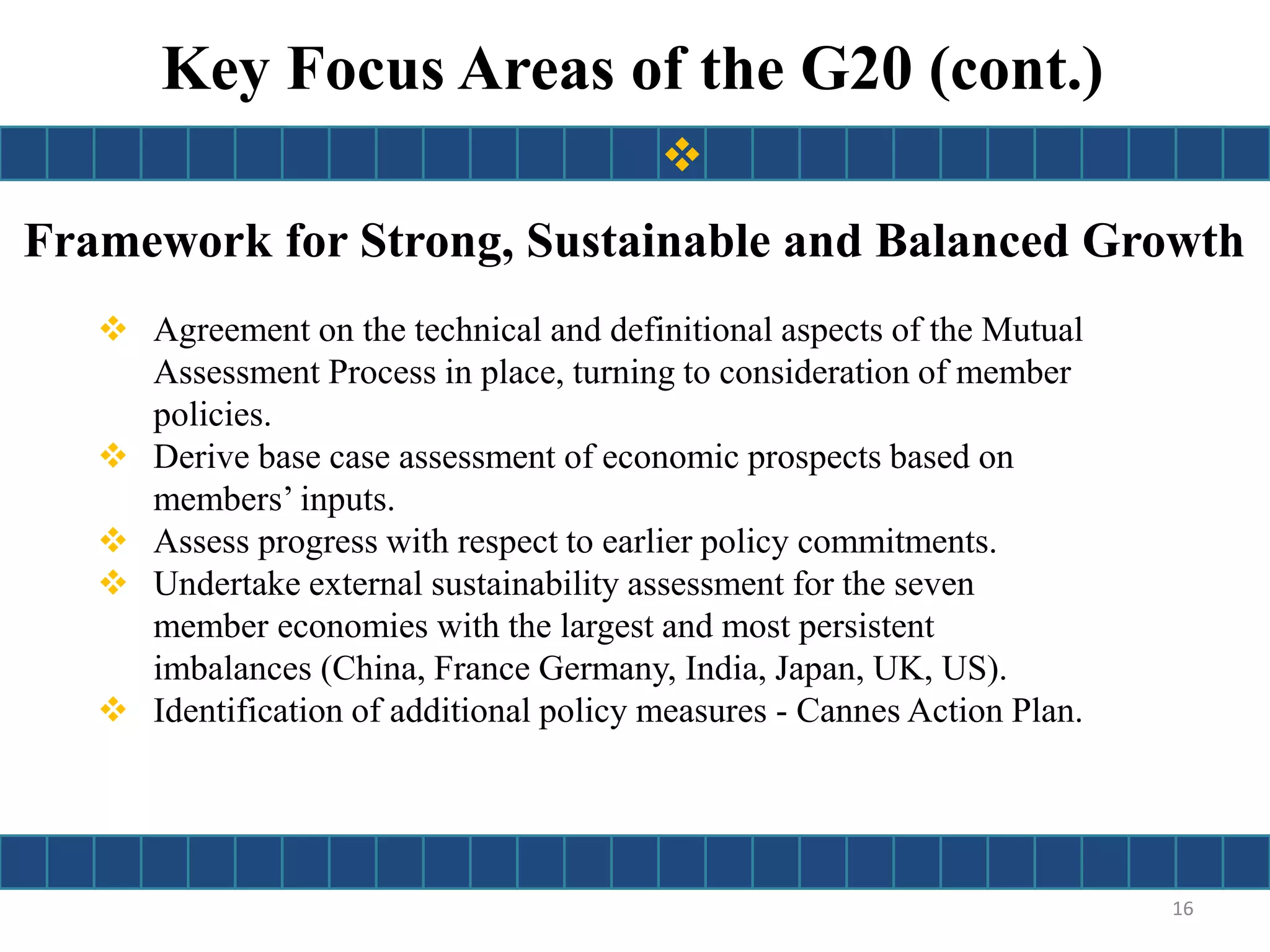
Framework for Strong, Sustainable and Balanced Growth
 Agreement on the technical and definitional aspects of the Mutual
Assessment Process in place, turning to consideration of member
policies.
 Derive base case assessment of economic prospects based on
members’ inputs.
 Assess progress with respect to earlier policy commitments.
 Undertake external sustainability assessment for the seven
member economies with the largest and most persistent
imbalances (China, France Germany, India, Japan, UK, US).
 Identification of additional policy measures - Cannes Action Plan.
16
Key Focus Areas of the G20 (cont.)

Cannes Action Plan for Growth and Jobs
 All G20 members commit to keep global markets open
and resist trade protectionism.
 All will take whatever measures necessary to preserve
the stability of banking systems and financial markets,
and to ensure that banks are adequately capitalized.
 All will ensure that the IMF has adequate resources.
17
Key Focus Areas of the G20 (cont.)

Country commitments under the Cannes Action Plan
 United States will implement tax reforms for jobs and
investment.
 Japan will quickly implement reconstruction measures.
 Australia, Brazil, Canada, China, Germany, Korea, and
Indonesia, where public finance are relatively strong, will let
automatic stabilizers work and will take additional
discretionary fiscal measures as deemed necessary.
 Emerging market economies with external surpluses commit
to boosting domestic demand and move more rapidly toward
market-determined exchange rates.
18
Key Focus Areas of the G20 (cont.)

A growing concern about jobs
 “If you were to ask me, from all the world polling Gallup has
done for more than 75 years, what would fix the world -- what
would suddenly create worldwide peace, global wellbeing,
and the next extraordinary advancements in human
development, I would say the immediate appearance of 1.8
billion jobs -- formal jobs. […] We can’t see that quest for
good jobs as an internal skirmish between warring political
ideologies. It’s an international war” (Jim Clifton, Chairman
and CEO of Gallup, author of The Coming Jobs War.
19
Focus on Jobs

 In times of rapid technological progress, entire sectors may
be affected.
 The global financial crisis resulted in massive job losses in
both emerging and industrial countries.
 Recent political events highlight the discontent of educated
youth whose job opportunities fall short of their
expectations.
 Around the world, there is anxiety about the pace of job
creation and the prospect of a global fight for jobs.
20
Focus on Jobs (cont.)

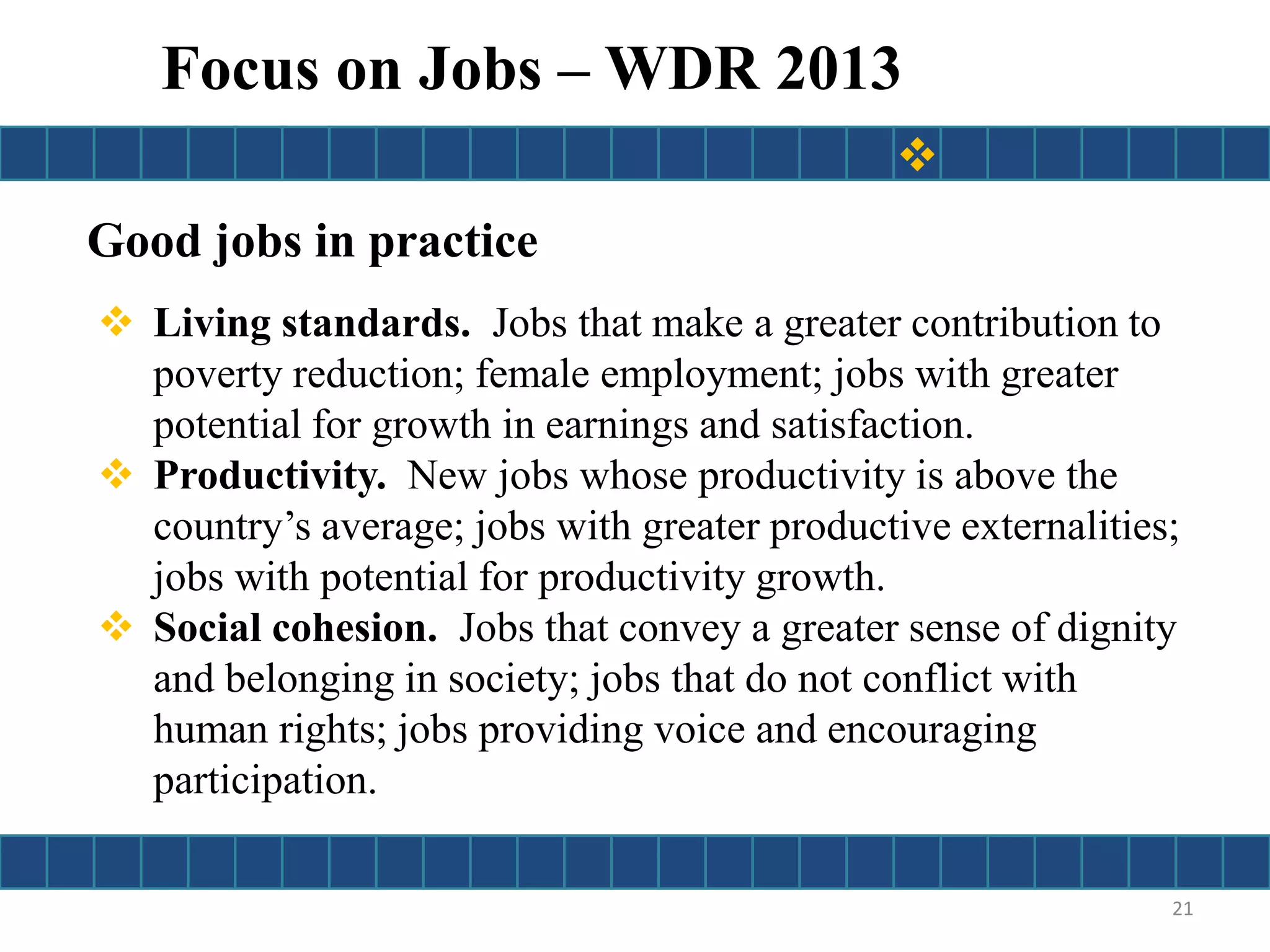
Good jobs in practice
 Living standards. Jobs that make a greater contribution to
poverty reduction; female employment; jobs with greater
potential for growth in earnings and satisfaction.
 Productivity. New jobs whose productivity is above the
country’s average; jobs with greater productive externalities;
jobs with potential for productivity growth.
 Social cohesion. Jobs that convey a greater sense of dignity
and belonging in society; jobs that do not conflict with
human rights; jobs providing voice and encouraging
participation.
21
Focus on Jobs – WDR 2013

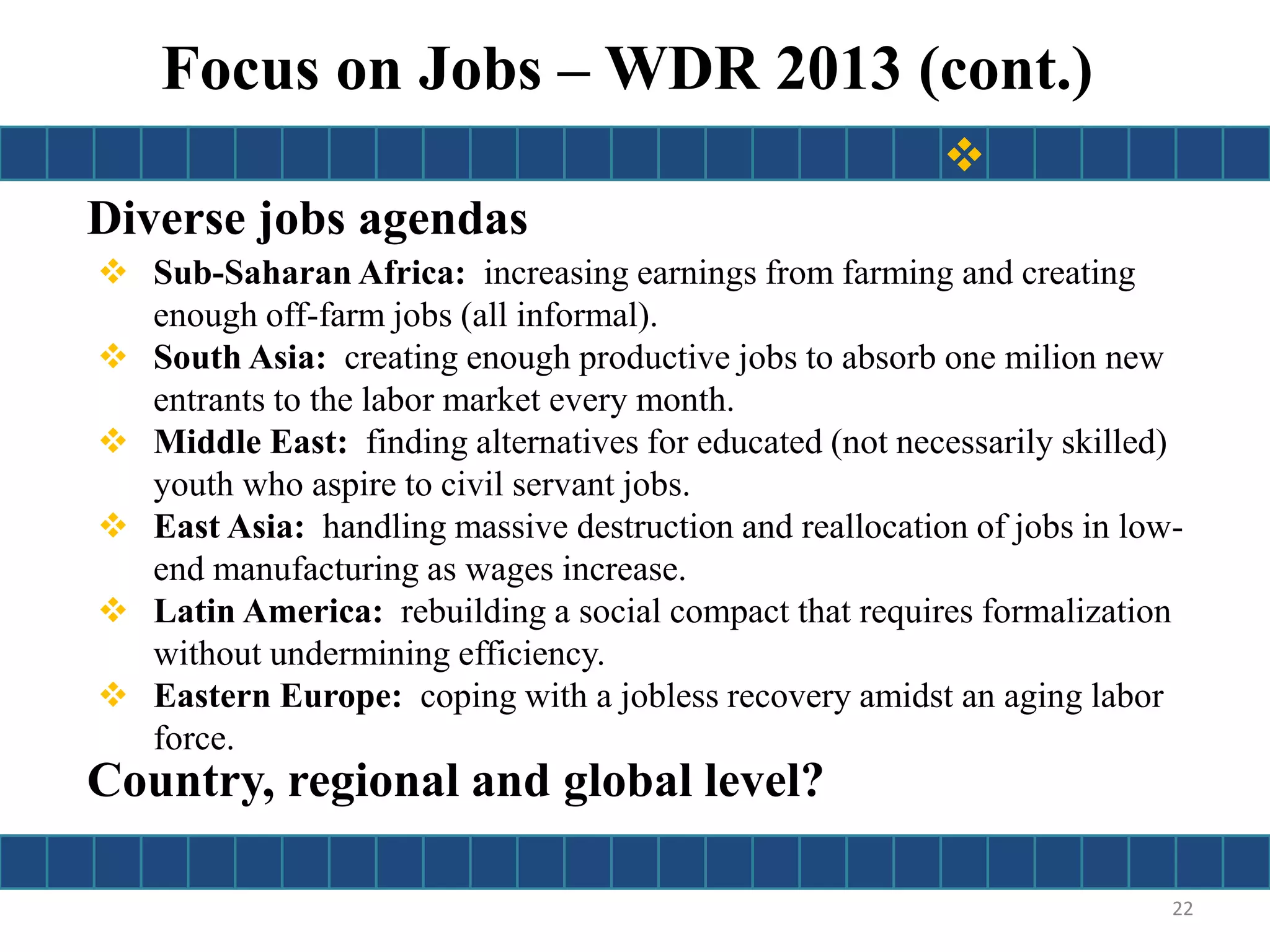
Diverse jobs agendas
 Sub-Saharan Africa: increasing earnings from farming and creating
enough off-farm jobs (all informal).
 South Asia: creating enough productive jobs to absorb one milion new
entrants to the labor market every month.
 Middle East: finding alternatives for educated (not necessarily skilled)
youth who aspire to civil servant jobs.
 East Asia: handling massive destruction and reallocation of jobs in low-
end manufacturing as wages increase.
 Latin America: rebuilding a social compact that requires formalization
without undermining efficiency.
 Eastern Europe: coping with a jobless recovery amidst an aging labor
force.
22
Focus on Jobs – WDR 2013 (cont.)

Country, regional and global level?
Priorities under the Mexican Presidency –
streamlining and prioritization
 Economic stabilization and structural reforms as foundations for
growth and employment.
 Strengthening the financial system and fostering financial
inclusion to promote economic growth.
 Improving the international financial architecture in an
interconnected world (Finance Track).
 Enhancing food security and addressing commodity price
volatility.
 Promoting sustainable development, green growth and the fight
against climate change.
The G20 going forward
23

The G20 going forward (cont.)
24

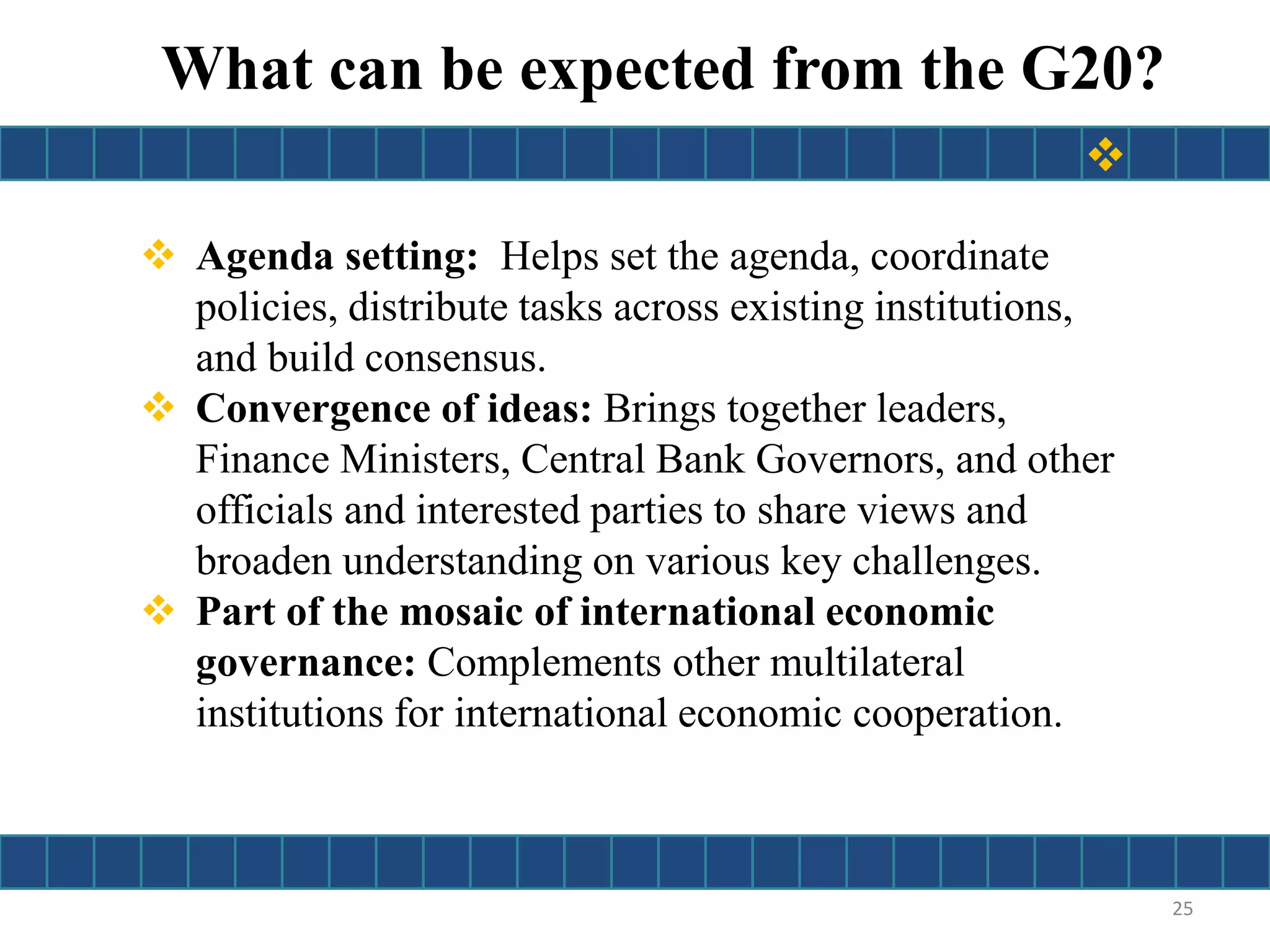
 Agenda setting: Helps set the agenda, coordinate
policies, distribute tasks across existing institutions,
and build consensus.
 Convergence of ideas: Brings together leaders,
Finance Ministers, Central Bank Governors, and other
officials and interested parties to share views and
broaden understanding on various key challenges.
 Part of the mosaic of international economic
governance: Complements other multilateral
institutions for international economic cooperation.
What can be expected from the G20?
25

Bridge from G20 to G187
 Represent the interests of the non-G20 developing
countries in the forum (G187).
 Highlight development perspectives, and impacts on
the poor.
 Substantive contributions on the development stream.
 Capacity building – Collaboration with the Korean
Development School
The Role of the World Bank
26

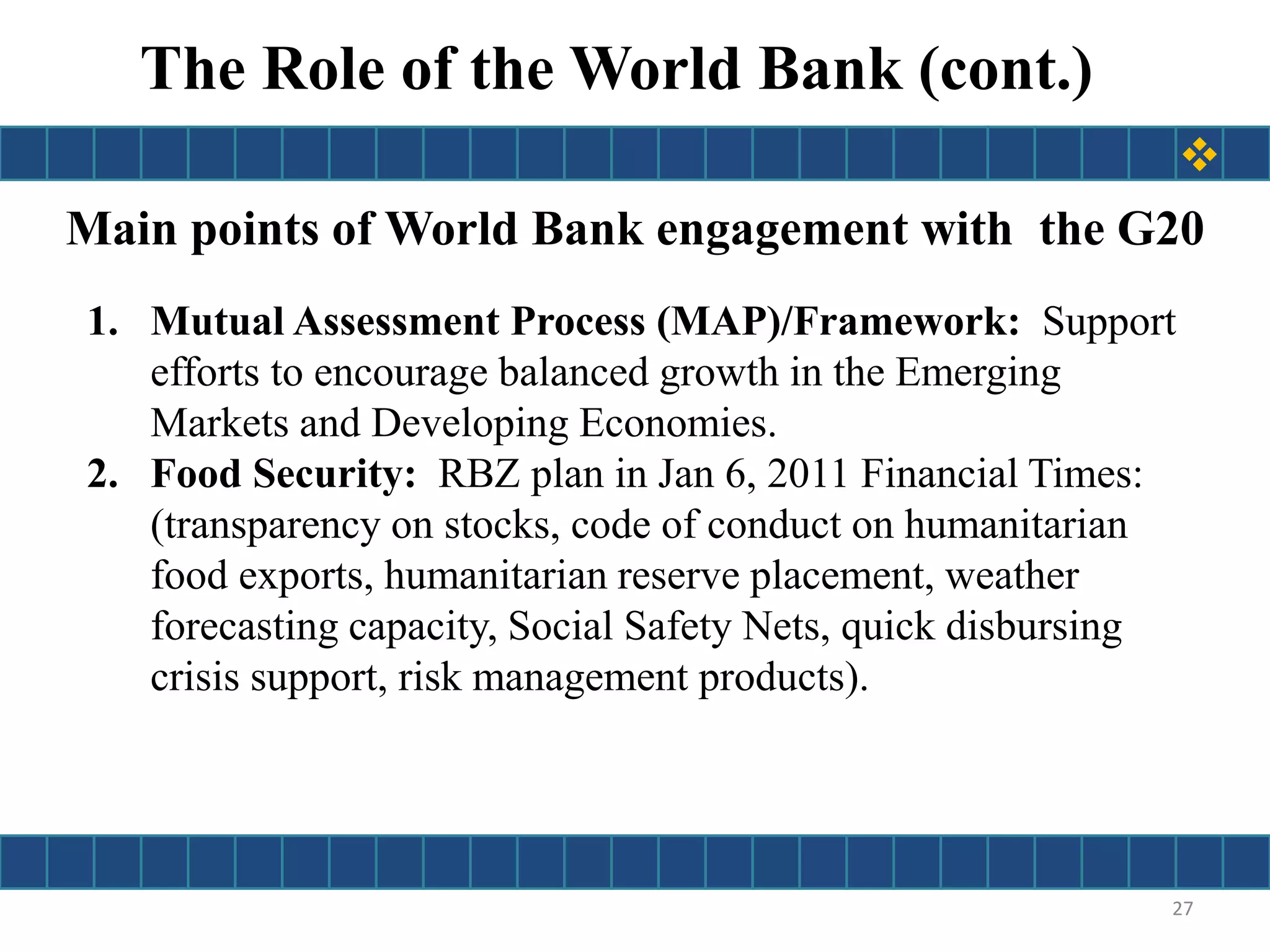
Main points of World Bank engagement with the G20
1. Mutual Assessment Process (MAP)/Framework: Support
efforts to encourage balanced growth in the Emerging
Markets and Developing Economies.
2. Food Security: RBZ plan in Jan 6, 2011 Financial Times:
(transparency on stocks, code of conduct on humanitarian
food exports, humanitarian reserve placement, weather
forecasting capacity, Social Safety Nets, quick disbursing
crisis support, risk management products).
The Role of the World Bank (cont.)
27

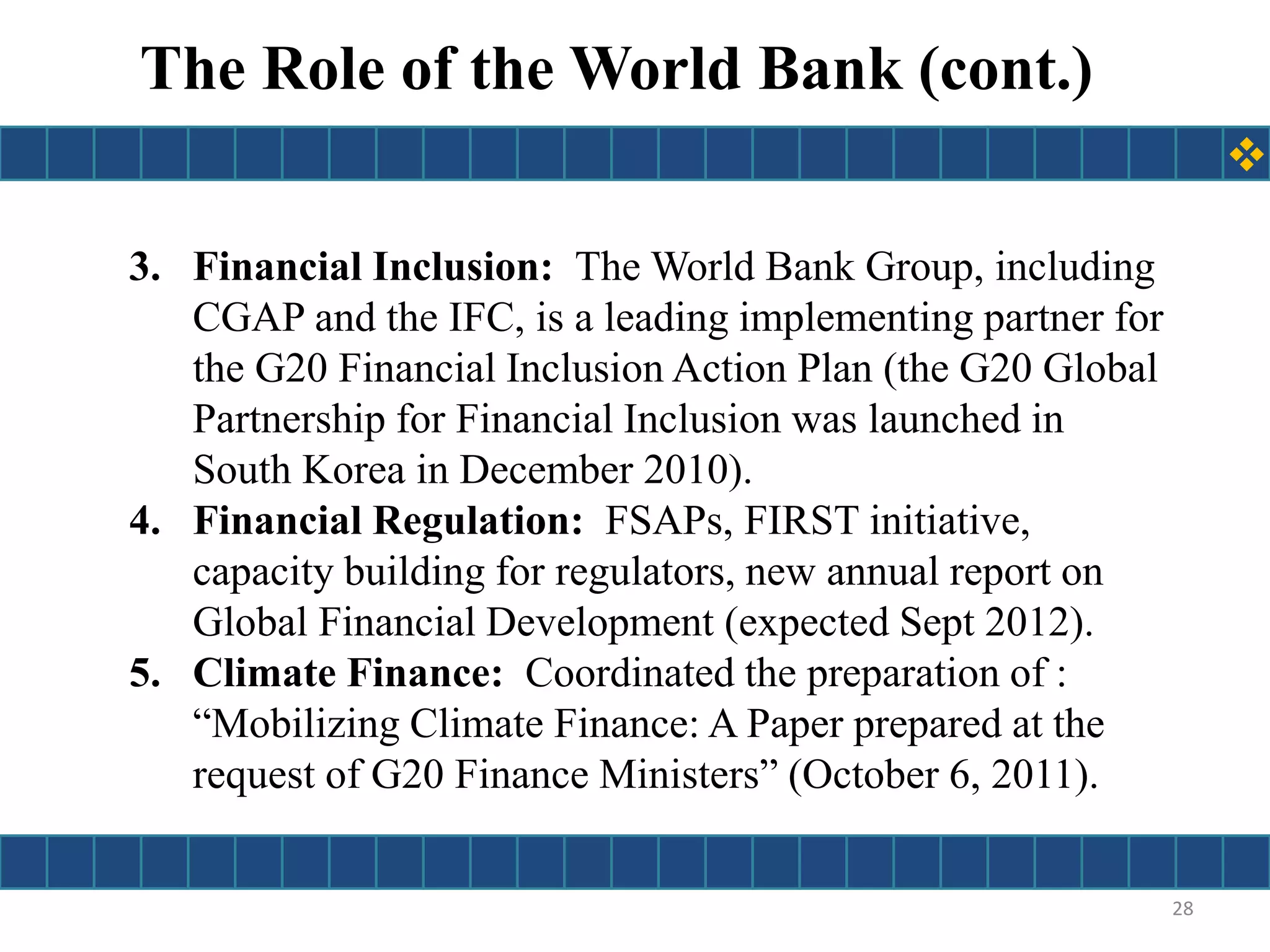
3. Financial Inclusion: The World Bank Group, including
CGAP and the IFC, is a leading implementing partner for
the G20 Financial Inclusion Action Plan (the G20 Global
Partnership for Financial Inclusion was launched in
South Korea in December 2010).
4. Financial Regulation: FSAPs, FIRST initiative,
capacity building for regulators, new annual report on
Global Financial Development (expected Sept 2012).
5. Climate Finance: Coordinated the preparation of :
“Mobilizing Climate Finance: A Paper prepared at the
request of G20 Finance Ministers” (October 6, 2011).
The Role of the World Bank (cont.)
28

6. Local currency bond markets: Helped articulate
action plan through the “Local Currency Bond Markets
in Emerging Markets: A Contribution to the Stability
of the International Monetary System” (April 2011)
7. Infrastructure: Working with regional development
banks, identified infrastructure gaps and recommended
options to mobilize financing (scale up Africa regional
integration).
The Role of the World Bank (cont.)
29

Thank You
30

G20 in retrospect and in prospect

  • 1.
    G20 in Retrospectand Prospect Mahmoud Mohieldin* Managing Director The World Bank Presentation to the School of International Public Affairs Columbia University January 25, 2012 *Disclaimer: The findings, interpretations, and conclusions expressed in this paper do not necessarily reflect the views of the Executive Directors of The World Bank or the governments they represent. The World Bank does not guarantee the accuracy of the data included in this work.
  • 2.
    Key questions  Whatis the G20 and who are its members?  What is the role of the G20?  What is the G20 focusing on?  What is the contribution of the World Bank? Introduction 2 
  • 3.
     Follows inthe footsteps of the G6, G7, G8 (a leaders’ forum established in 1975).  The G20 was setup in the wake of the Asian financial crisis as a global forum for Finance Ministers and Central Bank Governors to discuss measures to promote financial stability and sustainable development.  Representatives account for about 85 percent of the world economy.  First meeting took place in Berlin in December 1999 (chaired by Paul Martin, former Finance Minister of Canada). Origins of the G20 3 
  • 4.
    Additional invitees: •France invitedEthiopia, Singapore, Spain, UAE (Chair of the GCC), and Equatorial Guinea (Chair of the African Union). •Mexico invited Colombia, Cambodia, Chile, Equatorial Guinea (Chair of the African Union), and Spain. 1. Argentina 2. Australia 3. Brazil 4. Canada 5. China 6. France 7. Germany 8. India 9. Indonesia 10. Italy Who are the G20 4 11. Japan 12. Mexico 13. Russia 14. Saudi Arabia 15. South Africa 16. Republic of Korea 17. Turkey 18. United Kingdom 19. United States of America 20. European Union/ECB • International Monetary Fund • World Bank • Financial Stability Board • Organization for Economic Cooperation and Development • United Nations • International Labor Organization • World Trade Organization 
  • 5.
    1999-2001 Canada 2002 India 2003Mexico 2004 Germany 2005 China 2006 Australia 2007 South Africa 2008 Brazil 2009 United Kingdom 2010 Korea 2011 France 2012 Mexico The G20 Chairs 5 
  • 6.
    A. Multi-polar world EMEs accounting for rapidly increasing shares of output, growth, trade and investment.  Trend accentuated in the outlook, where 2012 Global Economic Prospects highlights weakening in advanced economies, while growth slows but remains strong in EMEs. Evolution of the G20 6 Two key factors driving the importance of the G20 in international policy making: 
  • 7.
    Evolution of theG20 (cont.) 7 An increasingly multi-polar pattern of global growth 
  • 8.
    8 An increasingly multi-polarpattern of global trade Evolution of the G20 (cont.) 
  • 9.
    9 Source: World Bank,Global Economic Prospects, 2012 In weakening outlook, EMEs sustain global growth Evolution of the G20 (cont.) 
  • 10.
    B. Global financialcrisis starting in 2008  The US called a meeting of G20 leaders in November 2008, seeking to agree measures to stabilize financial markets, stimulate demand and avoid protectionism.  The important role of EMEs was recognized in addressing global challenges of the international economy and financial system.  At September 2009 G20 Summit, leaders announced that the G20 would replace the G8 as the premier forum for discussing international economic issues. 10 Evolution of the G20 (cont.) 
  • 11.
    Governance and Role Rotating Presidency (no permanent secretariat).  Consensus based, informal.  Agenda setting by the presiding presidency. 1. Working Groups 2. Finance and Central Bank Deputies 3. Sherpa Stream (including development) 4. Ministerial Summit 5. Leaders Summit  Arduously negotiated Communiquès.  Commitments reached are political and provide an indication of shared views and approaches. 11 Evolution of the G20 (cont.) 
  • 12.
    Highlights of thegrowing agendas at the G20 Summits  Washington (2008) – Stabilize financial markets and restore growth (Washington Action Plan).  London (2009) – Implementation of the Washington Action Plan, strengthening the financial system.  Pittsburgh (2009) – From crisis to recovery.  Toronto (2010) – Framework for strong, sustainable and balanced growth.  Seoul (2010) – Seoul Development Consensus (9 pillars)  Cannes (2011) – Expanded list, overtaken by euro crisis. Key Focus Areas of the G20 12 
  • 13.
    Korea Presidency 2010 Ensuring global economic recovery  Framework for strong, sustainable, and balanced global growth (Seoul Action Plan).  International financial institution reform  Financial sector reforms  Fighting protectionism and promoting trade and investment  Financial inclusion  Energy  Seoul Development Consensus for Shared Growth Key Focus Areas of the G20 (cont.) 13 
  • 14.
    Seoul Consensus  Focuson economic growth needed to reach MDGs.  Global development partnership – development assistance, transparent and accountable.  Prioritize global or regional systemic issues.  Private sector participation essential.  G20 to complement, not duplicate other global actors.  Outcome orientation - focus on tangible measures.  The nine key pillars most in need of attention within developing countries: 1) infrastructure, 2) private investment and job creation, 3) human resource development, 4) trade, 5) financial inclusion, 6) resilient growth , 7) food security, 8) domestic resource mobilization 9) knowledge sharing. Key Focus Areas of the G20 (cont.) 14 
  • 15.
    French Presidency 2011 Framework for Strong, Sustainable and Balanced Growth  Reform of the International Monetary System  Financial sector regulation  Commodity price volatility  Food security  Infrastructure financing  Financial inclusion  Climate change financing  Anticorruption Key Focus Areas of the G20 (cont.) 15 
  • 16.
    Framework for Strong,Sustainable and Balanced Growth  Agreement on the technical and definitional aspects of the Mutual Assessment Process in place, turning to consideration of member policies.  Derive base case assessment of economic prospects based on members’ inputs.  Assess progress with respect to earlier policy commitments.  Undertake external sustainability assessment for the seven member economies with the largest and most persistent imbalances (China, France Germany, India, Japan, UK, US).  Identification of additional policy measures - Cannes Action Plan. 16 Key Focus Areas of the G20 (cont.) 
  • 17.
    Cannes Action Planfor Growth and Jobs  All G20 members commit to keep global markets open and resist trade protectionism.  All will take whatever measures necessary to preserve the stability of banking systems and financial markets, and to ensure that banks are adequately capitalized.  All will ensure that the IMF has adequate resources. 17 Key Focus Areas of the G20 (cont.) 
  • 18.
    Country commitments underthe Cannes Action Plan  United States will implement tax reforms for jobs and investment.  Japan will quickly implement reconstruction measures.  Australia, Brazil, Canada, China, Germany, Korea, and Indonesia, where public finance are relatively strong, will let automatic stabilizers work and will take additional discretionary fiscal measures as deemed necessary.  Emerging market economies with external surpluses commit to boosting domestic demand and move more rapidly toward market-determined exchange rates. 18 Key Focus Areas of the G20 (cont.) 
  • 19.
    A growing concernabout jobs  “If you were to ask me, from all the world polling Gallup has done for more than 75 years, what would fix the world -- what would suddenly create worldwide peace, global wellbeing, and the next extraordinary advancements in human development, I would say the immediate appearance of 1.8 billion jobs -- formal jobs. […] We can’t see that quest for good jobs as an internal skirmish between warring political ideologies. It’s an international war” (Jim Clifton, Chairman and CEO of Gallup, author of The Coming Jobs War. 19 Focus on Jobs 
  • 20.
     In timesof rapid technological progress, entire sectors may be affected.  The global financial crisis resulted in massive job losses in both emerging and industrial countries.  Recent political events highlight the discontent of educated youth whose job opportunities fall short of their expectations.  Around the world, there is anxiety about the pace of job creation and the prospect of a global fight for jobs. 20 Focus on Jobs (cont.) 
  • 21.
    Good jobs inpractice  Living standards. Jobs that make a greater contribution to poverty reduction; female employment; jobs with greater potential for growth in earnings and satisfaction.  Productivity. New jobs whose productivity is above the country’s average; jobs with greater productive externalities; jobs with potential for productivity growth.  Social cohesion. Jobs that convey a greater sense of dignity and belonging in society; jobs that do not conflict with human rights; jobs providing voice and encouraging participation. 21 Focus on Jobs – WDR 2013 
  • 22.
    Diverse jobs agendas Sub-Saharan Africa: increasing earnings from farming and creating enough off-farm jobs (all informal).  South Asia: creating enough productive jobs to absorb one milion new entrants to the labor market every month.  Middle East: finding alternatives for educated (not necessarily skilled) youth who aspire to civil servant jobs.  East Asia: handling massive destruction and reallocation of jobs in low- end manufacturing as wages increase.  Latin America: rebuilding a social compact that requires formalization without undermining efficiency.  Eastern Europe: coping with a jobless recovery amidst an aging labor force. 22 Focus on Jobs – WDR 2013 (cont.)  Country, regional and global level?
  • 23.
    Priorities under theMexican Presidency – streamlining and prioritization  Economic stabilization and structural reforms as foundations for growth and employment.  Strengthening the financial system and fostering financial inclusion to promote economic growth.  Improving the international financial architecture in an interconnected world (Finance Track).  Enhancing food security and addressing commodity price volatility.  Promoting sustainable development, green growth and the fight against climate change. The G20 going forward 23 
  • 24.
    The G20 goingforward (cont.) 24 
  • 25.
     Agenda setting:Helps set the agenda, coordinate policies, distribute tasks across existing institutions, and build consensus.  Convergence of ideas: Brings together leaders, Finance Ministers, Central Bank Governors, and other officials and interested parties to share views and broaden understanding on various key challenges.  Part of the mosaic of international economic governance: Complements other multilateral institutions for international economic cooperation. What can be expected from the G20? 25 
  • 26.
    Bridge from G20to G187  Represent the interests of the non-G20 developing countries in the forum (G187).  Highlight development perspectives, and impacts on the poor.  Substantive contributions on the development stream.  Capacity building – Collaboration with the Korean Development School The Role of the World Bank 26 
  • 27.
    Main points ofWorld Bank engagement with the G20 1. Mutual Assessment Process (MAP)/Framework: Support efforts to encourage balanced growth in the Emerging Markets and Developing Economies. 2. Food Security: RBZ plan in Jan 6, 2011 Financial Times: (transparency on stocks, code of conduct on humanitarian food exports, humanitarian reserve placement, weather forecasting capacity, Social Safety Nets, quick disbursing crisis support, risk management products). The Role of the World Bank (cont.) 27 
  • 28.
    3. Financial Inclusion:The World Bank Group, including CGAP and the IFC, is a leading implementing partner for the G20 Financial Inclusion Action Plan (the G20 Global Partnership for Financial Inclusion was launched in South Korea in December 2010). 4. Financial Regulation: FSAPs, FIRST initiative, capacity building for regulators, new annual report on Global Financial Development (expected Sept 2012). 5. Climate Finance: Coordinated the preparation of : “Mobilizing Climate Finance: A Paper prepared at the request of G20 Finance Ministers” (October 6, 2011). The Role of the World Bank (cont.) 28 
  • 29.
    6. Local currencybond markets: Helped articulate action plan through the “Local Currency Bond Markets in Emerging Markets: A Contribution to the Stability of the International Monetary System” (April 2011) 7. Infrastructure: Working with regional development banks, identified infrastructure gaps and recommended options to mobilize financing (scale up Africa regional integration). The Role of the World Bank (cont.) 29 
  • 30.

Editor's Notes

  • #5 The host governments usually invite additional countries, whether to represent particular regions or assuage complaining neighbors. So there are usually about 25 nations present, plus the heads of international organizations such as the World Bank, the International Monetary Fund and the United Nations. (The European Union has the most seats, usually with six or seven countries as well as representatives of the president of the European Council, the presidency country and the European Commission.) The countries around the table account for about 85 percent of global GDP.
  • #12 Troika
  • #18 Specific commitments include: - China committed to rebalance demand toward domestic consumption, promote market-based interest rate reform, and move further toward capital account convertibility. The G-20 welcomes China's determination to increase exchange rate flexibility consistent with underlying market fundamentals. - Saudi Arabia commits to helping stabilize oil markets in support of the global economy. - All G-20 members commit to keep global markets open and resist trade protectionism. Relevant Links U.S., Canada and Africa Business International Organisations - Many G-20 members committed to implement structural reforms to boost long-term growth potential and enhance job growth prospects. - Countries with large current account surpluses commit to boost domestic sources of growth by implementing measures to increase growth of consumption and investment as a share of GDP. - All G-20 members committed to full and timely implementation of financial sector reforms, including Basel II, II.5, and III along the agreed timelines.
  • #19 Specific commitments include: - China committed to rebalance demand toward domestic consumption, promote market-based interest rate reform, and move further toward capital account convertibility. The G-20 welcomes China's determination to increase exchange rate flexibility consistent with underlying market fundamentals. - Saudi Arabia commits to helping stabilize oil markets in support of the global economy. - All G-20 members commit to keep global markets open and resist trade protectionism. Relevant Links U.S., Canada and Africa Business International Organisations - Many G-20 members committed to implement structural reforms to boost long-term growth potential and enhance job growth prospects. - Countries with large current account surpluses commit to boost domestic sources of growth by implementing measures to increase growth of consumption and investment as a share of GDP. - All G-20 members committed to full and timely implementation of financial sector reforms, including Basel II, II.5, and III along the agreed timelines.
  • #20 Specific commitments include: - China committed to rebalance demand toward domestic consumption, promote market-based interest rate reform, and move further toward capital account convertibility. The G-20 welcomes China's determination to increase exchange rate flexibility consistent with underlying market fundamentals. - Saudi Arabia commits to helping stabilize oil markets in support of the global economy. - All G-20 members commit to keep global markets open and resist trade protectionism. Relevant Links U.S., Canada and Africa Business International Organisations - Many G-20 members committed to implement structural reforms to boost long-term growth potential and enhance job growth prospects. - Countries with large current account surpluses commit to boost domestic sources of growth by implementing measures to increase growth of consumption and investment as a share of GDP. - All G-20 members committed to full and timely implementation of financial sector reforms, including Basel II, II.5, and III along the agreed timelines.
  • #21 Specific commitments include: - China committed to rebalance demand toward domestic consumption, promote market-based interest rate reform, and move further toward capital account convertibility. The G-20 welcomes China's determination to increase exchange rate flexibility consistent with underlying market fundamentals. - Saudi Arabia commits to helping stabilize oil markets in support of the global economy. - All G-20 members commit to keep global markets open and resist trade protectionism. Relevant Links U.S., Canada and Africa Business International Organisations - Many G-20 members committed to implement structural reforms to boost long-term growth potential and enhance job growth prospects. - Countries with large current account surpluses commit to boost domestic sources of growth by implementing measures to increase growth of consumption and investment as a share of GDP. - All G-20 members committed to full and timely implementation of financial sector reforms, including Basel II, II.5, and III along the agreed timelines.
  • #22 Specific commitments include: - China committed to rebalance demand toward domestic consumption, promote market-based interest rate reform, and move further toward capital account convertibility. The G-20 welcomes China's determination to increase exchange rate flexibility consistent with underlying market fundamentals. - Saudi Arabia commits to helping stabilize oil markets in support of the global economy. - All G-20 members commit to keep global markets open and resist trade protectionism. Relevant Links U.S., Canada and Africa Business International Organisations - Many G-20 members committed to implement structural reforms to boost long-term growth potential and enhance job growth prospects. - Countries with large current account surpluses commit to boost domestic sources of growth by implementing measures to increase growth of consumption and investment as a share of GDP. - All G-20 members committed to full and timely implementation of financial sector reforms, including Basel II, II.5, and III along the agreed timelines.
  • #23 Specific commitments include: - China committed to rebalance demand toward domestic consumption, promote market-based interest rate reform, and move further toward capital account convertibility. The G-20 welcomes China's determination to increase exchange rate flexibility consistent with underlying market fundamentals. - Saudi Arabia commits to helping stabilize oil markets in support of the global economy. - All G-20 members commit to keep global markets open and resist trade protectionism. Relevant Links U.S., Canada and Africa Business International Organisations - Many G-20 members committed to implement structural reforms to boost long-term growth potential and enhance job growth prospects. - Countries with large current account surpluses commit to boost domestic sources of growth by implementing measures to increase growth of consumption and investment as a share of GDP. - All G-20 members committed to full and timely implementation of financial sector reforms, including Basel II, II.5, and III along the agreed timelines.