What is a summit?
 A summit is a meeting of heads of
state or government, usually with considerable media
exposure, tight security, and a prearranged agenda.
 First Notable summit meetings was during War II.
EVOLUTION
• Term summit was not commonly used .
• It was coined in 1955 during the Cold war.
• The post-Cold War era has produced an increase in the
number of "summit" events.
• On March 25, 1973, the Finance Ministers of Britain,
France, Germany and the US met and formed the
―Library Group
• In September, they were joined by the Japanese Finance
Minister, and this group (subsequently known as the
Group of Five) met periodically for more than a decade.
What happens at the Summit?
• The Summit is a rare chance for the democratically
elected Leaders of the member countries to meet,
discuss common challenges, and decide on some
common responses.
G6…….
• The forum originated with a 1975 summit hosted
by France that brought together representatives of six
governments: France, West Germany, Italy, Japan,
the United Kingdom, and the United States, thus
leading to the name Group of Six or G6
• Was formed due to several international crises in the
early 1970s – the collapse of the Bretton Woods
financial system in 1971; the 1973 Yom Kippur War,
Oil shocks and the breakdown of the gold standard.
G7…..
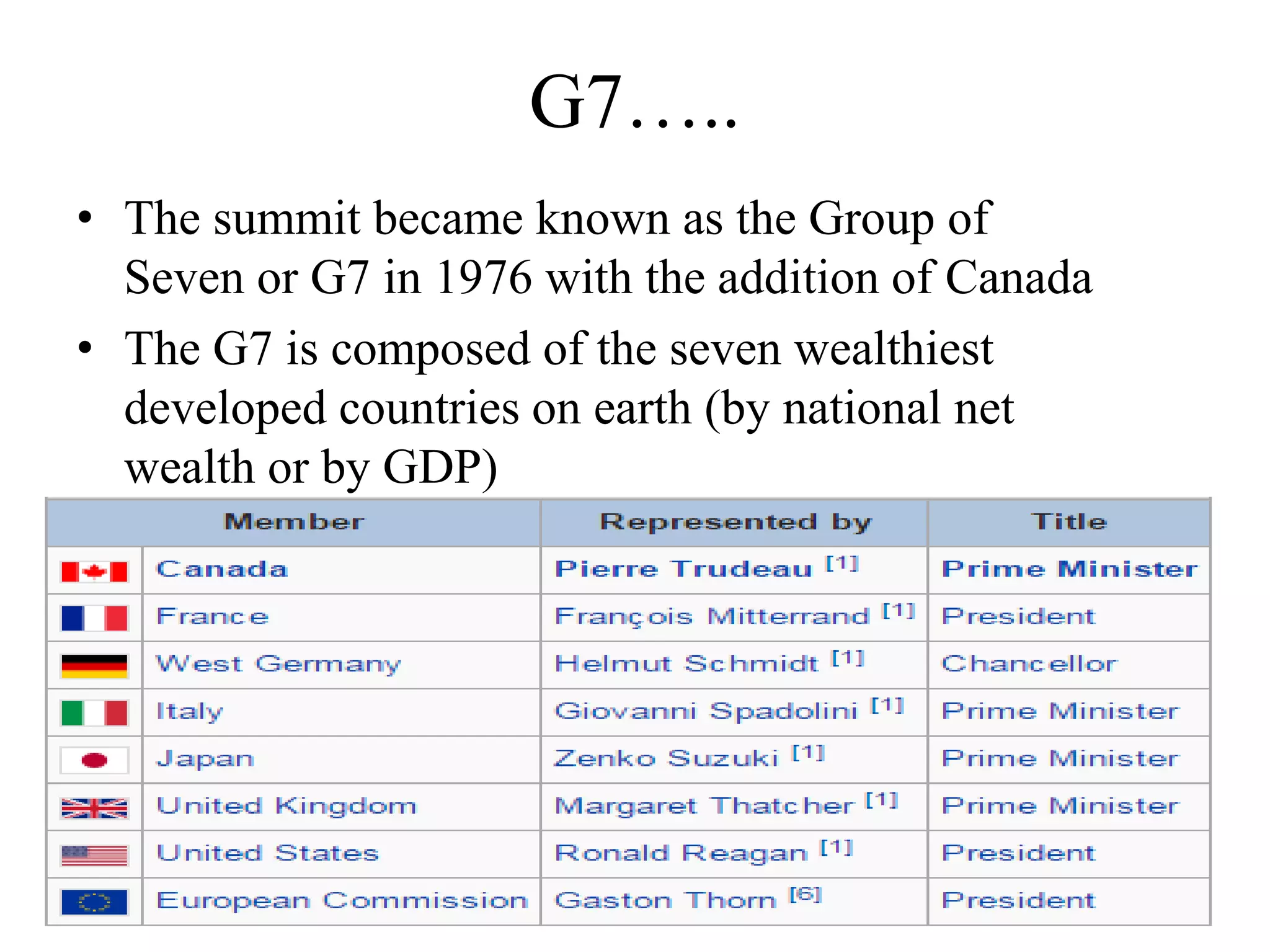
• The summit became known as the Group of
Seven or G7 in 1976 with the addition of Canada
• The G7 is composed of the seven wealthiest
developed countries on earth (by national net
wealth or by GDP)
G8….
• Russia was added to the group from 1998, which then
became known as the G8.
• the G8 in effect comprises seven nations and
the European Union as the eighth member.
• The European Union was represented within the G8
since the 1980s but could not host or chair summits.
The 40th summit was the first time the European
Union was able to host and chair a summit.
Video : Learn G8
• https://www.youtube.com/watch?v=DhSLCR2
QqWc
G8+5
• Both France and the United Kingdom have expressed a desire to expand
the group to include five developing countries, referred to as the Outreach
Five (O5)
• The G8+5 group was formed in 2005 when Tony Blair, then Prime Minister
of the United Kingdom, in his role as host of the 31st G8
summit at Gleneagles, Scotland, invited the leading emerging countries to
join the talks
• Brazil (7th country in the world by nominal GDP) People's Republic of
China (2nd country in the world by GDP) India (10th country in the world
by GDP) Mexico, and South Africa. These countries have participated as
guests in meetings that are sometimes called G8+5.
Issues discussed in1ST G8 summit
• Searching and productive exchange of views on world
economy
• Political and economic responsibilities of democracies
• Growth of interdependence and fostering international
cooperation
• Inflation and energy crises
• Unemployment and economic recovery
• Fostering growth of world trade
• Monetary stability
• Multilateral trade negotiations
• Economic relations with the Soviet Union and
the Eastern Bloc
• Cooperative relationship and improved understanding
of developing countries
• Conference on International Economic Co-operation
• Cooperation via international organizations
NOTE: In 2014, Russia’s violation of Ukraine’s sovereignty and territorial integrity led
to suspension of participation in the G8, and a return to G7 format.
The 2015 G-7 Summit
Germany
• Germany took over the G7 Presidency at the end of
the summit in Brussels in June 2014.
• It hosted the annual meeting of heads of state and
government on 7 and 8 June 2015.
• The President met with the other Leaders of the G-7
at Schloss Elmau, Germany on June 7-8 to make
tangible progress on a wide range of economic,
security, and development priorities.
ISSUES ADDRESED
• Promoting Peace and International Security
• Russia and Ukraine
• Women’s Entrepreneurship
• Women’s Technical and Vocational Training
• Libya
• Counter Terrorism
• Sustainability and balanced global economic growth
• Promoting High Standard and Investment
• Concluding the Doha Round
• Promoting High Standard in Global Supply
Chain
• Addressing Climate Change
• Achieving Zero Ebola Cases
• Post 2015 Development Agenda
• Advancing Women’s Economic Empowerment
THE GROUP OF 20: The premier forum for
international economic cooperation
• The Group of 20 (G20) was first established in the wake of the
Asian financial crisis of the late 1990s as a meeting of finance
ministers and central bank governors.
• Its goals were to bring stability to financial markets and to
promote economic cooperation.
• With the onset of the global financial crisis in 2008, the G20
was seen as the most effective forum to lead global efforts to
stem the crisis and mitigate its effects.
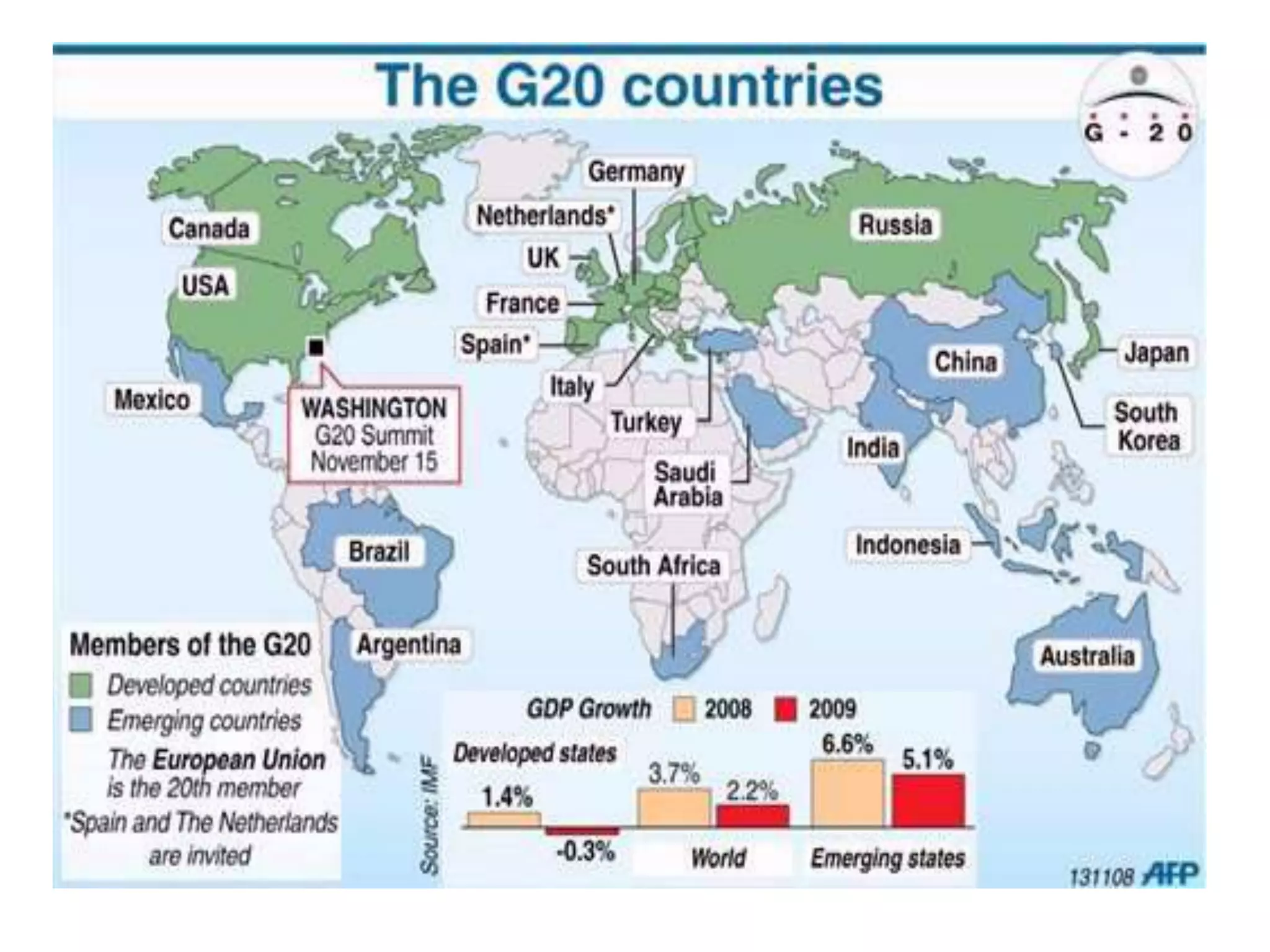
G20 COUNTRIES
• Argentina India United Kingdom
Australia Indonesia USA
Brazil Italy The European Union
Canada Japan
China the Republic of Korea
France Mexico
Germany Russia
Saudi Arabia South Africa
Turkey
2008 G-20 Washington summit
• The 2008 G-20 Washington Summit on Financial Markets and the
World Economy took place on November 14–15, 2008, in Washington,
D.C., United States.
• G20 leaders underscored the critical importance of rejecting protectionism
and introduced coordinated stimulus packages.
• These actions constituted the largest fiscal and monetary stimulus and the
most comprehensive support program for the financial sector in modern
times.
• Leaders met a second time in London on April 1-2, 2009. At
the London Summit, leaders continued the work that had
begun in Washington and announced a historic pledge of
US$1.1 trillion to restore credit, growth and jobs in the world
economy.
• This included $750 billion in new resources for the
International Monetary Fund, as well as $100 billion in new
lending by the Multilateral Development Banks and $250
billion to support trade financing.
• The 2014 G20 Brisbane summit was the ninth meeting of
the G20 heads of government. It was held in Brisbane, the capital
city of Queensland, Australia, on 15–16 November 2014.
Agenda
• European leaders expressed their desire to support the recovery
as the global economy moves beyond the global financial crisis.
• European Commission President Barroso and European
Council President Van Rompuy stressed the importance of
coordinated growth strategies as well as finalising agreements on
core financial reforms, and actions on tax and anti-corruption.
2014 G20 Brisbane summit
Previous G20 Summit
• 2014 - Brisbane, Australia
• 2013 - St Petersburg, Russia
• 2012 - Los Cabos, Mexico
• 2011 - Cannes, France
• 2010 - Seoul, South Korea and Toronto, Canada
• 2009 - Pittsburgh, (USA and London, England
• 2008 - Washington, USA
2015 G-20 Antalya summit
• The 2015 G-20 Antalya summit will be the tenth annual
meeting of the G-20 heads of government. It will be held
in Antalya, Turkey.
• Turkey officially took over the presidency of the G-20
from Australia in December 1, 2014 and China will preside
over the organization in 2016.
Agenda :
• Investment
• Employment
• Trade
• Financial regulation
• International Financial Architecture
• International Tax
• Anti-Corruption
• Development
• Energy Sustainability
THANK YOU

Global summit. g8 and g20

  • 2.
    What is asummit?  A summit is a meeting of heads of state or government, usually with considerable media exposure, tight security, and a prearranged agenda.  First Notable summit meetings was during War II.
  • 3.
    EVOLUTION • Term summitwas not commonly used . • It was coined in 1955 during the Cold war. • The post-Cold War era has produced an increase in the number of "summit" events. • On March 25, 1973, the Finance Ministers of Britain, France, Germany and the US met and formed the ―Library Group • In September, they were joined by the Japanese Finance Minister, and this group (subsequently known as the Group of Five) met periodically for more than a decade.
  • 4.
    What happens atthe Summit? • The Summit is a rare chance for the democratically elected Leaders of the member countries to meet, discuss common challenges, and decide on some common responses.
  • 5.
    G6……. • The forumoriginated with a 1975 summit hosted by France that brought together representatives of six governments: France, West Germany, Italy, Japan, the United Kingdom, and the United States, thus leading to the name Group of Six or G6 • Was formed due to several international crises in the early 1970s – the collapse of the Bretton Woods financial system in 1971; the 1973 Yom Kippur War, Oil shocks and the breakdown of the gold standard.
  • 6.
    G7….. • The summitbecame known as the Group of Seven or G7 in 1976 with the addition of Canada • The G7 is composed of the seven wealthiest developed countries on earth (by national net wealth or by GDP)
  • 7.
    G8…. • Russia wasadded to the group from 1998, which then became known as the G8. • the G8 in effect comprises seven nations and the European Union as the eighth member. • The European Union was represented within the G8 since the 1980s but could not host or chair summits. The 40th summit was the first time the European Union was able to host and chair a summit.
  • 8.
    Video : LearnG8 • https://www.youtube.com/watch?v=DhSLCR2 QqWc
  • 9.
    G8+5 • Both Franceand the United Kingdom have expressed a desire to expand the group to include five developing countries, referred to as the Outreach Five (O5) • The G8+5 group was formed in 2005 when Tony Blair, then Prime Minister of the United Kingdom, in his role as host of the 31st G8 summit at Gleneagles, Scotland, invited the leading emerging countries to join the talks • Brazil (7th country in the world by nominal GDP) People's Republic of China (2nd country in the world by GDP) India (10th country in the world by GDP) Mexico, and South Africa. These countries have participated as guests in meetings that are sometimes called G8+5.
  • 10.
    Issues discussed in1STG8 summit • Searching and productive exchange of views on world economy • Political and economic responsibilities of democracies • Growth of interdependence and fostering international cooperation • Inflation and energy crises • Unemployment and economic recovery • Fostering growth of world trade • Monetary stability
  • 11.
    • Multilateral tradenegotiations • Economic relations with the Soviet Union and the Eastern Bloc • Cooperative relationship and improved understanding of developing countries • Conference on International Economic Co-operation • Cooperation via international organizations NOTE: In 2014, Russia’s violation of Ukraine’s sovereignty and territorial integrity led to suspension of participation in the G8, and a return to G7 format.
  • 12.
    The 2015 G-7Summit Germany • Germany took over the G7 Presidency at the end of the summit in Brussels in June 2014. • It hosted the annual meeting of heads of state and government on 7 and 8 June 2015. • The President met with the other Leaders of the G-7 at Schloss Elmau, Germany on June 7-8 to make tangible progress on a wide range of economic, security, and development priorities.
  • 13.
    ISSUES ADDRESED • PromotingPeace and International Security • Russia and Ukraine • Women’s Entrepreneurship • Women’s Technical and Vocational Training • Libya • Counter Terrorism • Sustainability and balanced global economic growth • Promoting High Standard and Investment
  • 14.
    • Concluding theDoha Round • Promoting High Standard in Global Supply Chain • Addressing Climate Change • Achieving Zero Ebola Cases • Post 2015 Development Agenda • Advancing Women’s Economic Empowerment
  • 15.
    THE GROUP OF20: The premier forum for international economic cooperation • The Group of 20 (G20) was first established in the wake of the Asian financial crisis of the late 1990s as a meeting of finance ministers and central bank governors. • Its goals were to bring stability to financial markets and to promote economic cooperation. • With the onset of the global financial crisis in 2008, the G20 was seen as the most effective forum to lead global efforts to stem the crisis and mitigate its effects.
  • 16.
    G20 COUNTRIES • ArgentinaIndia United Kingdom Australia Indonesia USA Brazil Italy The European Union Canada Japan China the Republic of Korea France Mexico Germany Russia Saudi Arabia South Africa Turkey
  • 18.
    2008 G-20 Washingtonsummit • The 2008 G-20 Washington Summit on Financial Markets and the World Economy took place on November 14–15, 2008, in Washington, D.C., United States. • G20 leaders underscored the critical importance of rejecting protectionism and introduced coordinated stimulus packages. • These actions constituted the largest fiscal and monetary stimulus and the most comprehensive support program for the financial sector in modern times.
  • 19.
    • Leaders meta second time in London on April 1-2, 2009. At the London Summit, leaders continued the work that had begun in Washington and announced a historic pledge of US$1.1 trillion to restore credit, growth and jobs in the world economy. • This included $750 billion in new resources for the International Monetary Fund, as well as $100 billion in new lending by the Multilateral Development Banks and $250 billion to support trade financing.
  • 20.
    • The 2014G20 Brisbane summit was the ninth meeting of the G20 heads of government. It was held in Brisbane, the capital city of Queensland, Australia, on 15–16 November 2014. Agenda • European leaders expressed their desire to support the recovery as the global economy moves beyond the global financial crisis. • European Commission President Barroso and European Council President Van Rompuy stressed the importance of coordinated growth strategies as well as finalising agreements on core financial reforms, and actions on tax and anti-corruption. 2014 G20 Brisbane summit
  • 21.
    Previous G20 Summit •2014 - Brisbane, Australia • 2013 - St Petersburg, Russia • 2012 - Los Cabos, Mexico • 2011 - Cannes, France • 2010 - Seoul, South Korea and Toronto, Canada • 2009 - Pittsburgh, (USA and London, England • 2008 - Washington, USA
  • 22.
    2015 G-20 Antalyasummit • The 2015 G-20 Antalya summit will be the tenth annual meeting of the G-20 heads of government. It will be held in Antalya, Turkey. • Turkey officially took over the presidency of the G-20 from Australia in December 1, 2014 and China will preside over the organization in 2016.
  • 23.
    Agenda : • Investment •Employment • Trade • Financial regulation • International Financial Architecture • International Tax • Anti-Corruption • Development • Energy Sustainability
  • 24.