1
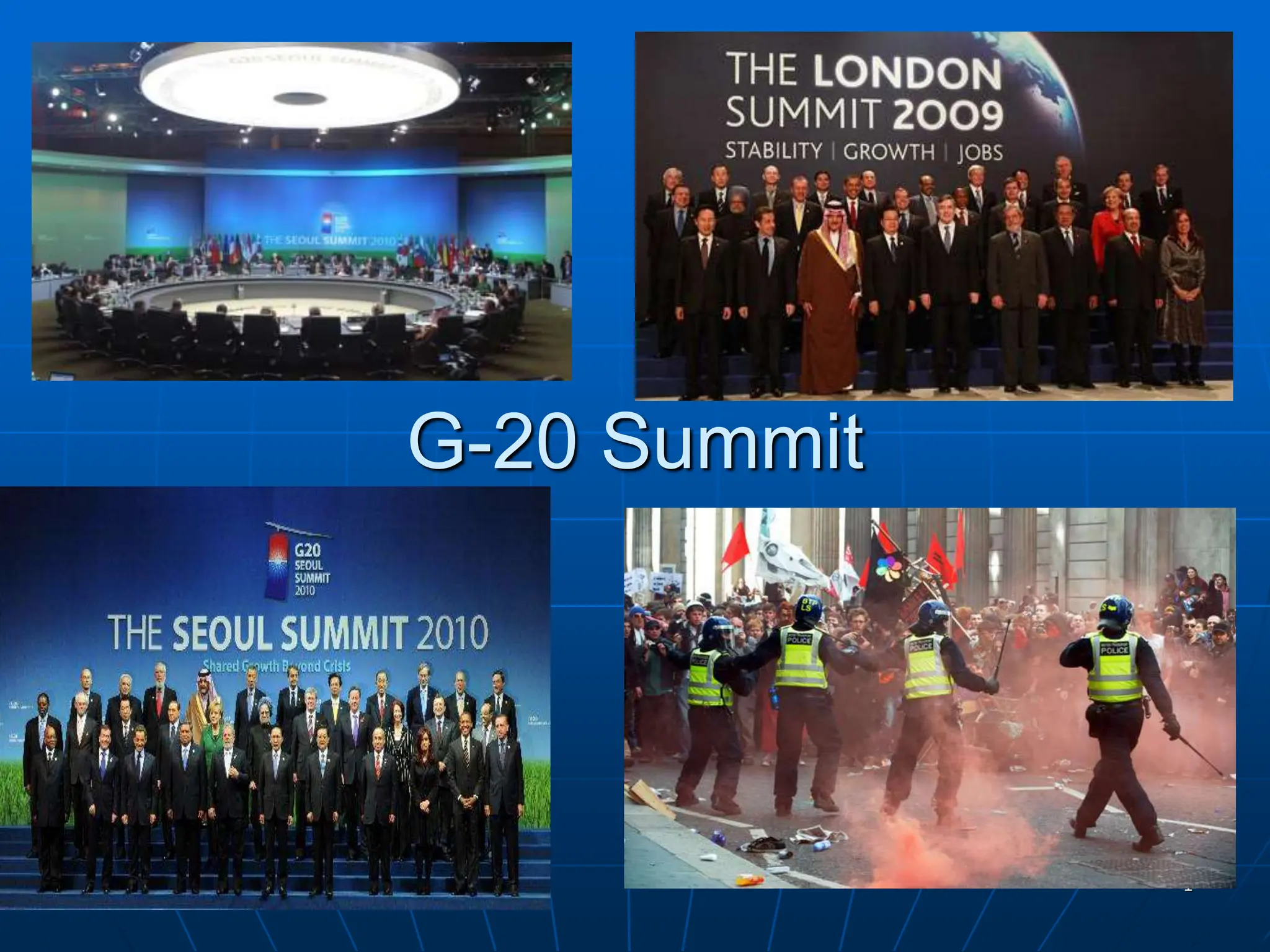
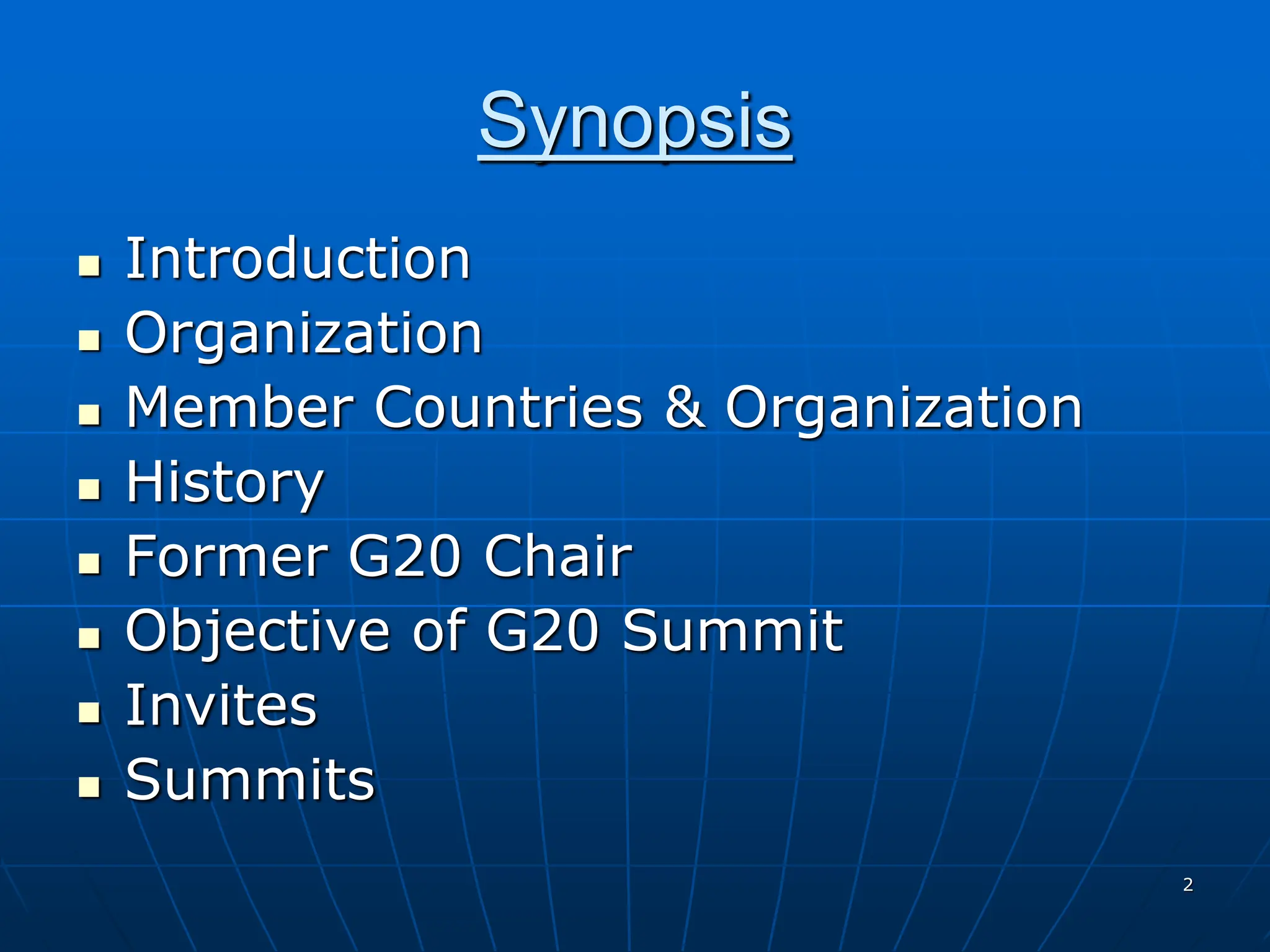
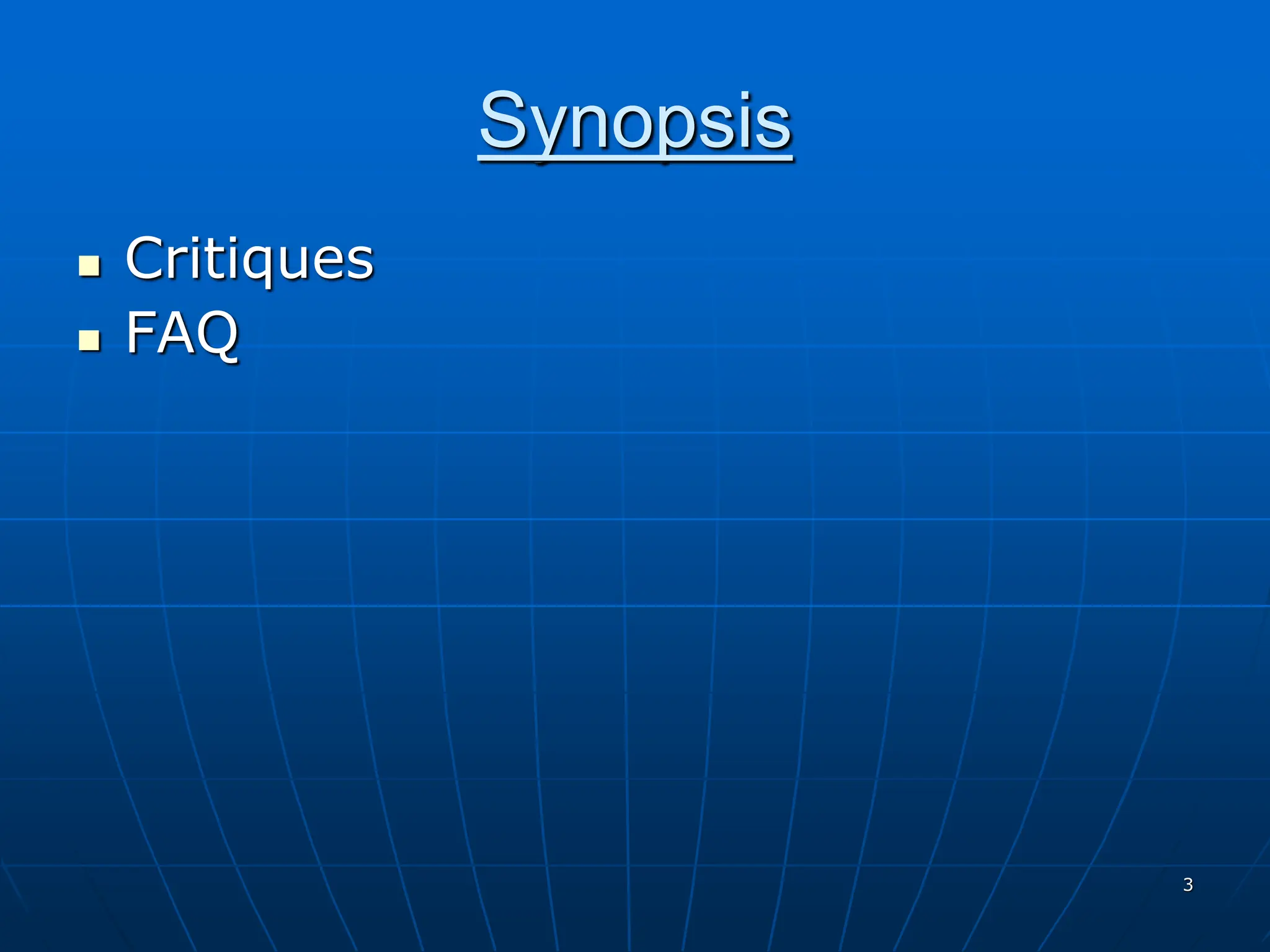
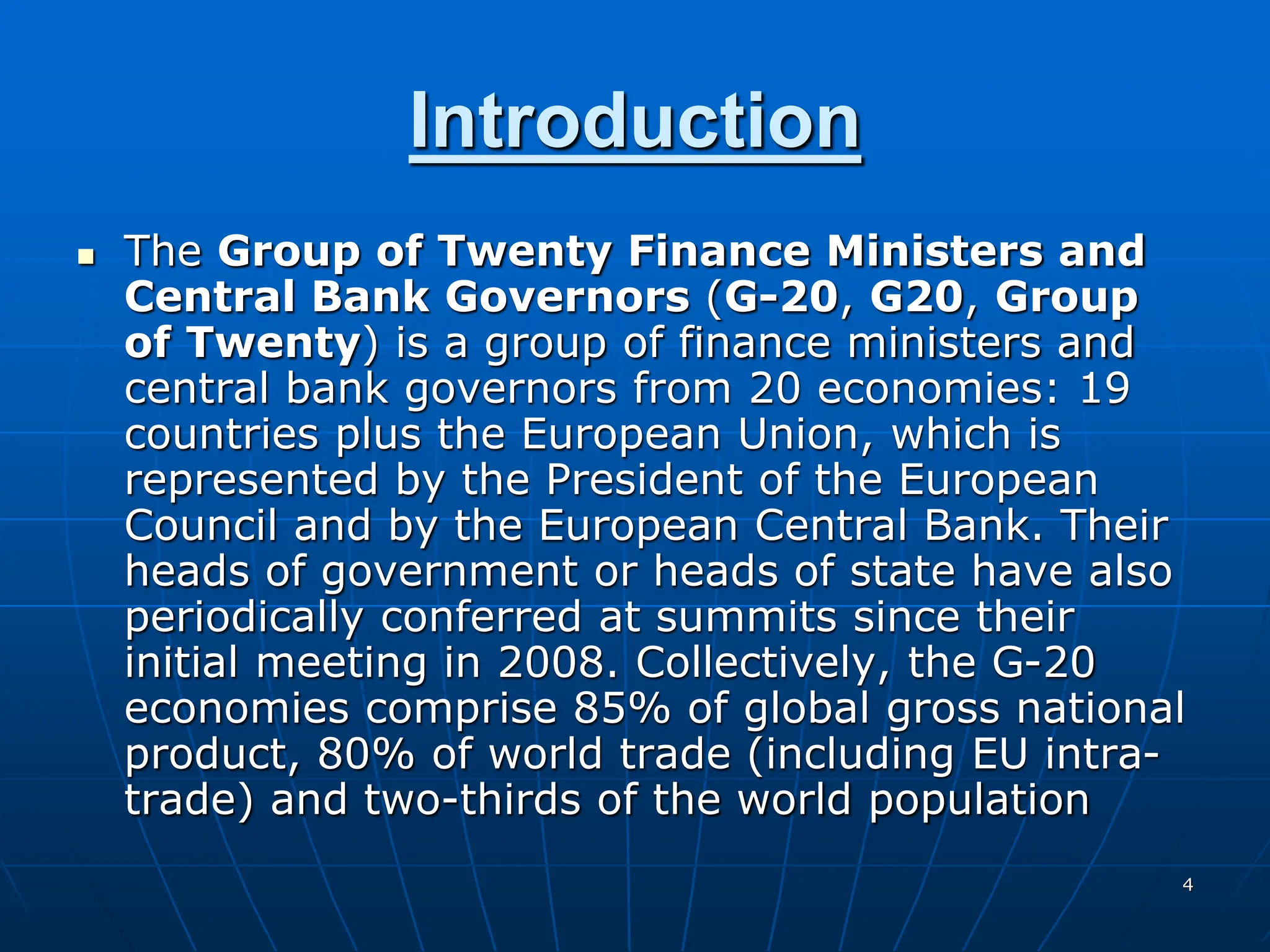
G-20 Summit
2
Synopsis
 Introduction
 Organization
 Member Countries & Organization
 History
 Former G20 Chair
 Objective of G20 Summit
 Invites
 Summits
3
Synopsis
 Critiques
 FAQ
4
Introduction
 The Group of Twenty Finance Ministers and
Central Bank Governors (G-20, G20, Group
of Twenty) is a group of finance ministers and
central bank governors from 20 economies: 19
countries plus the European Union, which is
represented by the President of the European
Council and by the European Central Bank. Their
heads of government or heads of state have also
periodically conferred at summits since their
initial meeting in 2008. Collectively, the G-20
economies comprise 85% of global gross national
product, 80% of world trade (including EU intra-
trade) and two-thirds of the world population
Why was the G-20 established?
 The G-20 was established as a response to the Asian financial
crisis of the late 1990s and to a “growing recognition that key
emerging-market countries were not adequately included in the
core of global economic discussion and governance,” according
to the G-20’s public materials.
 A smaller group of industrialized nations has been meeting
since the 1970s (the G-7 and G-8, which convene finance
ministers and heads of government, respectively). In the
1990s, given the extent of the Asian financial crisis,
government leaders decided to involve a broader group of
countries, including emerging market countries, to deal with
the turmoil. A group of 22 countries (“G-22”) and then a group
of 33 countries (“G-33”) met on an ad hoc basis.
 The G-20 was created in 1999 as a more permanent
international economic body that includes representation from
emerging countries.
6
Organization
 The G-20 operates without a permanent
secretariat or staff.
 The chair rotates annually among the members
and is selected from a different regional grouping
of countries.
 The chair is part of a revolving three-member
management group of past, present and future
chairs referred to as the Troika.
 The role of the Troika is to ensure continuity in
the G-20's work and management across host
years. The current chair of G20 is South Korea;
after the G20 Summit during November 11-12, it
will be handed over to France.
7
Member Countries & Organization
 In 2010, there are 20 members of the G-
20. These include, at the leaders summits,
the leaders of 19 countries and of the
European Union, and, at the ministerial-
level meetings, the finance ministers and
central bank governors of 19 countries
and of the European Union. In addition,
Spain and the Netherlands took part in the
last 35 meetings despite not being
recognized members.
8
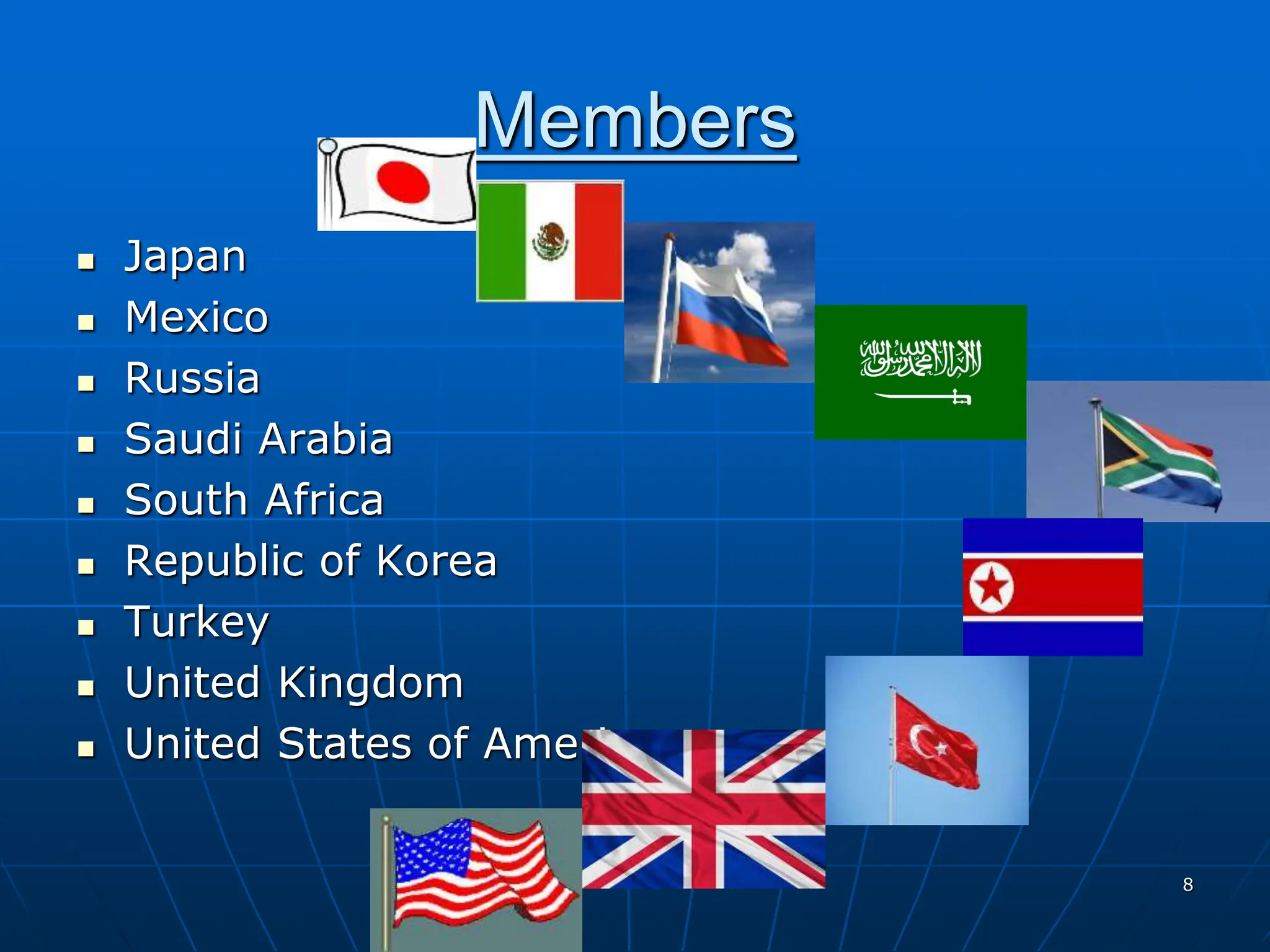
Members
 Japan
 Mexico
 Russia
 Saudi Arabia
 South Africa
 Republic of Korea
 Turkey
 United Kingdom
 United States of America
9
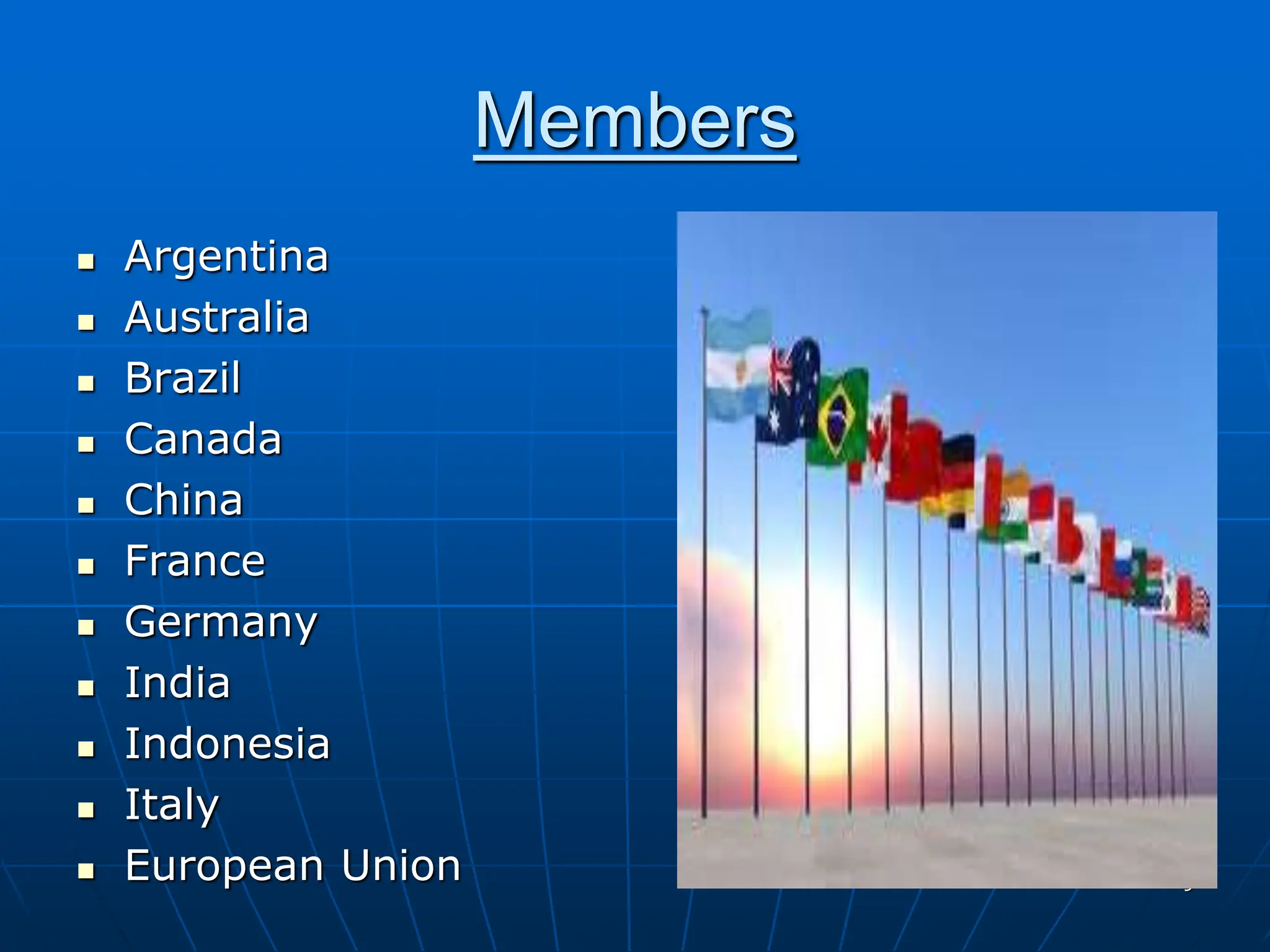
Members
 Argentina
 Australia
 Brazil
 Canada
 China
 France
 Germany
 India
 Indonesia
 Italy
 European Union
10
In addition to these 20 members, the
following forums and institutions, as
represented by their respective chief
executive officers, participate in
meetings of the G-20
 the Managing Director of the International Monetary
Fund
 the Chairman of the International Monetary Fund
 the President of the World Bank
 International Monetary and Financial Committee
 the Chairman of the Development Committee
11
History
Why was the G-20 established?
 The G-20 was established as a response to the Asian financial
crisis of the late 1990s and to a “growing recognition that key
emerging-market countries were not adequately included in the
core of global economic discussion and governance,” according
to the G-20’s public materials.
 A smaller group of industrialized nations has been meeting
since the 1970s (the G-7 and G-8, which convene finance
ministers and heads of government, respectively). In the
1990s, given the extent of the Asian financial crisis,
government leaders decided to involve a broader group of
countries, including emerging market countries, to deal with
the turmoil. A group of 22 countries (“G-22”) and then a group
of 33 countries (“G-33”) met on an ad hoc basis.
 The G-20 was created in 1999 as a more permanent
international economic body that includes representation from
emerging countries.
13
History
The proposals made by the G-22 and the
G-33 to reduce the world economy's
susceptibility to crises showed the
potential benefits of a regular international
consultative forum embracing the
emerging-market countries. Such a
regular dialogue with a constant set of
partners was institutionalized by the
creation of the G-20 in 1999.
14
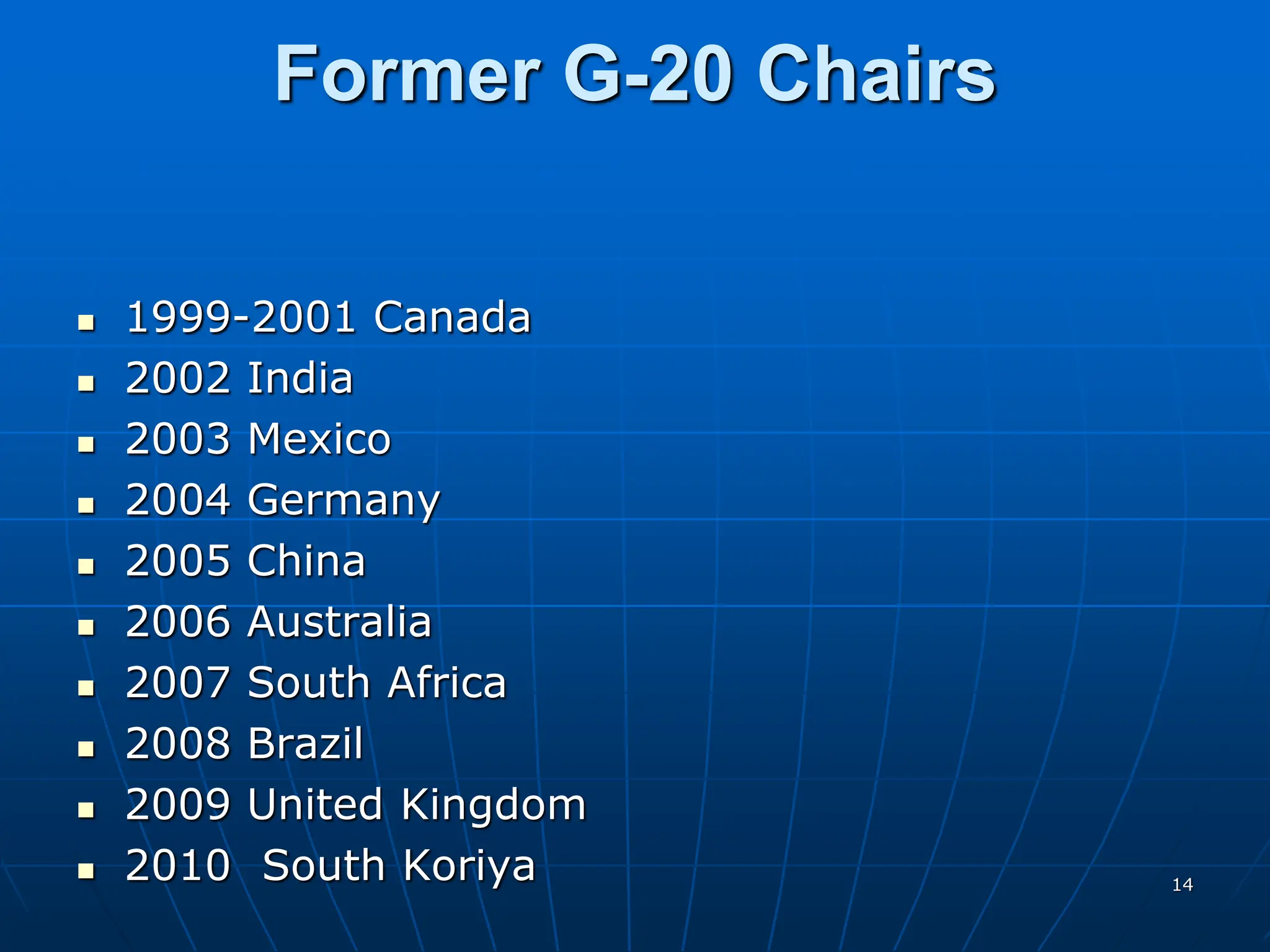
Former G-20 Chairs
 1999-2001 Canada
 2002 India
 2003 Mexico
 2004 Germany
 2005 China
 2006 Australia
 2007 South Africa
 2008 Brazil
 2009 United Kingdom
 2010 South Koriya
15
Objective of G-20 Summit
 It studies, reviews, and promotes
discussion (among key industrial and
emerging market countries) of policy
issues pertaining to the promotion of
international financial stability, and
seeks to address issues that go
beyond the responsibilities of any
one organization.
16
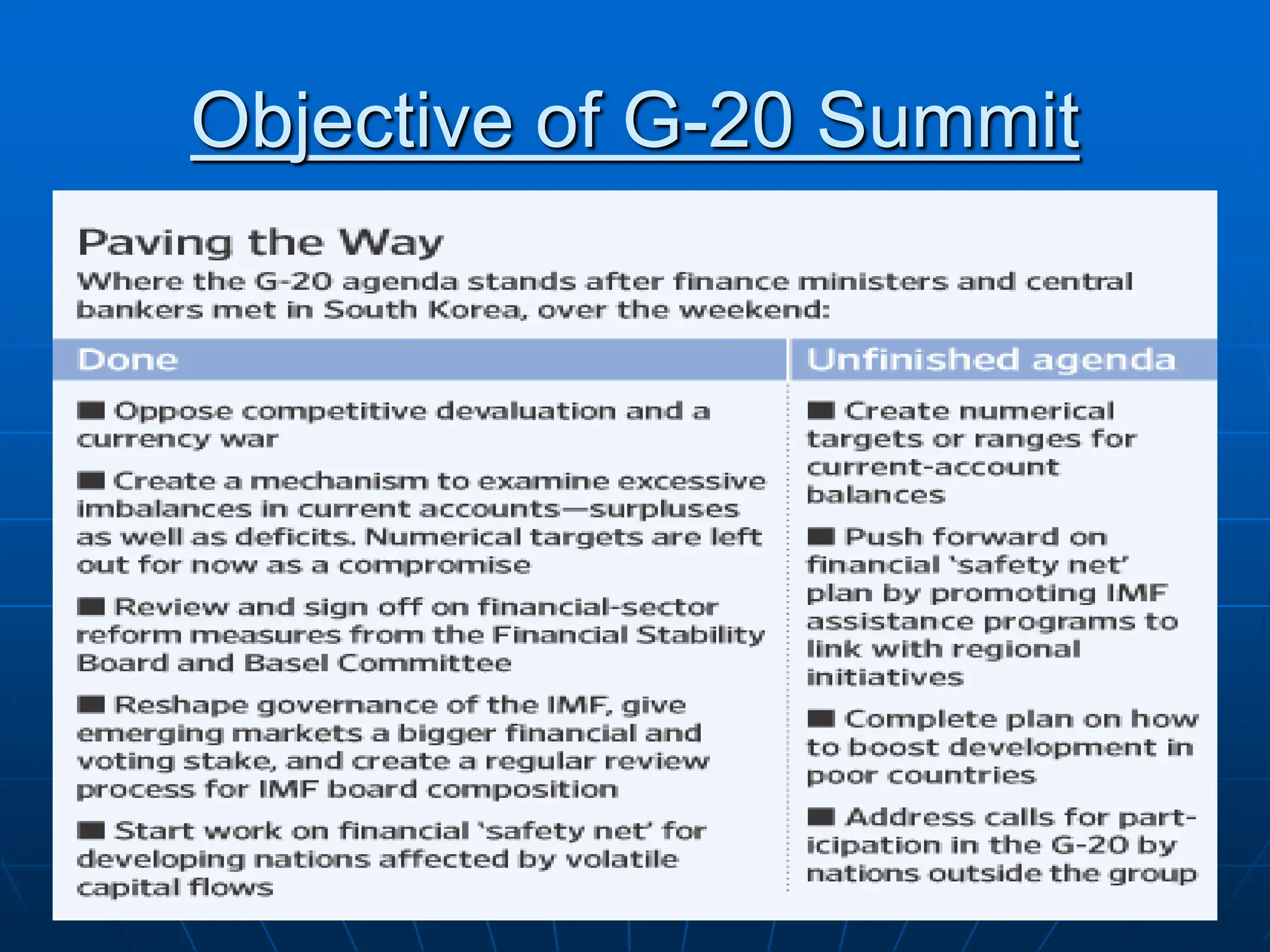
Objective of G-20 Summit
17
Invites
 The invitees are chosen by the host country.
 For the 2010 summits, for example, both Canada
and South Korea invited Ethiopia (chair of
NEPAD), Malawi (chair of the African Union),
Vietnam (chair of ASEAN), and Spain.
 Canada also invited the Netherlands (world's 16th
largest economy) while Korea invited Singapore.
 Canada and South Korea invited seven
international organizations: the United Nations,
the International Labor Organization, the World
Bank, the International Monetary Fund, the
Organization for Economic Cooperation and
Development, the World Trade Organization, and
the Financial Stability Board.
18
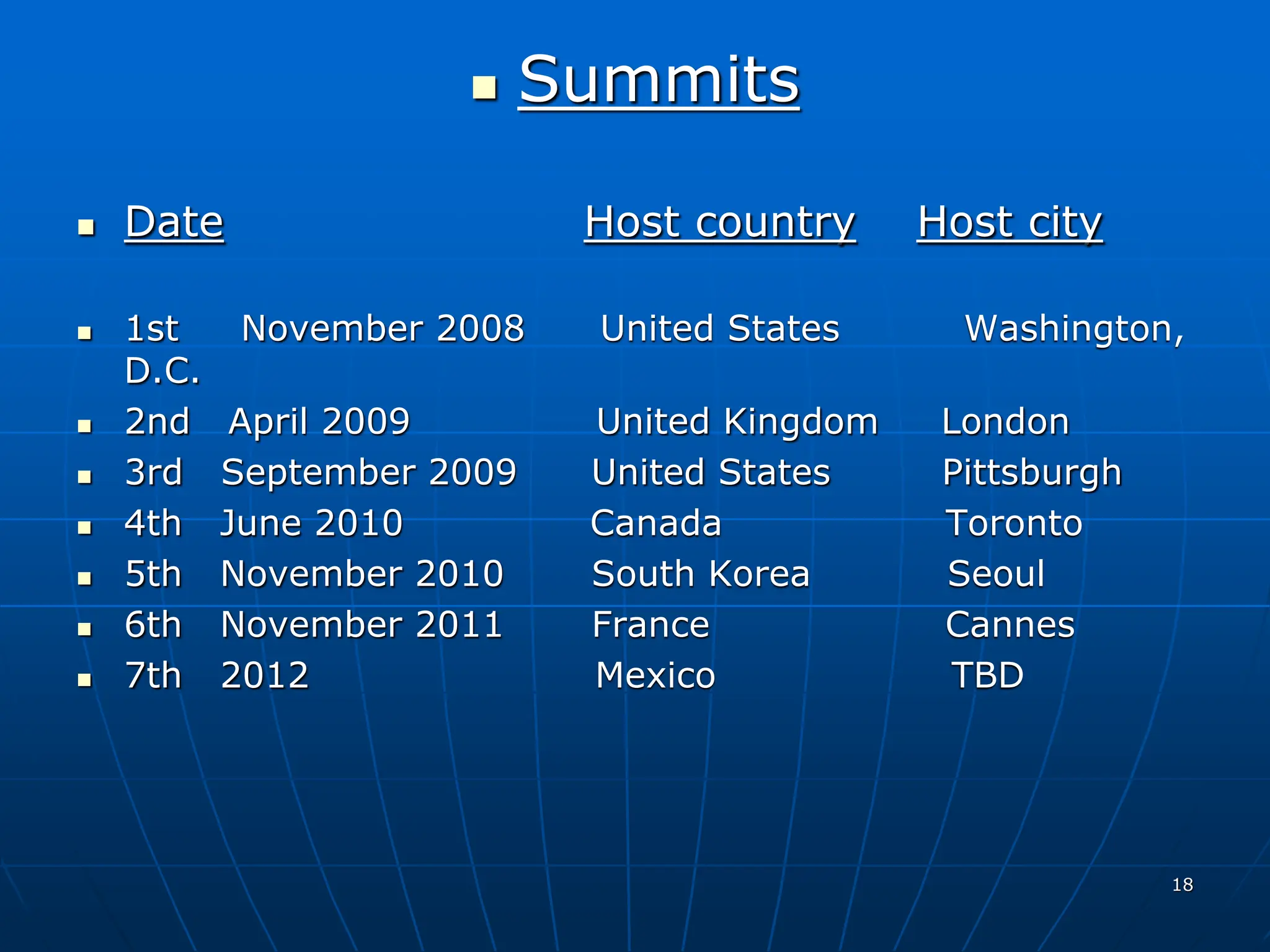
 Summits
 Date Host country Host city
 1st November 2008 United States Washington,
D.C.
 2nd April 2009 United Kingdom London
 3rd September 2009 United States Pittsburgh
 4th June 2010 Canada Toronto
 5th November 2010 South Korea Seoul
 6th November 2011 France Cannes
 7th 2012 Mexico TBD
19
Critiques
 Global Governance Group (3G) response
 everybody wants 21st largest nation in the world, they
want the G-21, and think it's highly unfair if they have been
cut out.
 Norway is the largest contributor to development programs
in the World Bank and United Nations, it is not a member of
the E.U. and thus not represented in the G-20 even
indirectly.
 Norway, like the other 180 nations not among the G-20,
has little or no voice within the group. Store characterized
the G-20 as a "self-appointment group“.
 Expanse of large amount of money.
20
FAQ
 What are the criteria for G-20 membership ?
In a forum such as the G-20, it is particularly
important for the number of countries involved to
be restricted and fixed to ensure the
effectiveness and continuity of its activity. There
are no formal criteria for G-20 membership and
the composition of the group has remained
unchanged since it was established.
21
FAQ
 Can all member countries exert equal
influence?
Achieving consensus is the underlying principle of
G-20 activity with regard to comments,
recommendations and measures to be adopted.
There are no formal votes or resolutions on the
basis of fixed voting shares or economic criteria.
Every G-20 member has one 'voice' with which it
can take an active part in G-20 activity. To this
extent the influence a country can exert is
shaped decisively by its commitment.
22
 THANK YOU

G20-PPT.ppt.............................

  • 1.
  • 2.
    2 Synopsis  Introduction  Organization Member Countries & Organization  History  Former G20 Chair  Objective of G20 Summit  Invites  Summits
  • 3.
  • 4.
    4 Introduction  The Groupof Twenty Finance Ministers and Central Bank Governors (G-20, G20, Group of Twenty) is a group of finance ministers and central bank governors from 20 economies: 19 countries plus the European Union, which is represented by the President of the European Council and by the European Central Bank. Their heads of government or heads of state have also periodically conferred at summits since their initial meeting in 2008. Collectively, the G-20 economies comprise 85% of global gross national product, 80% of world trade (including EU intra- trade) and two-thirds of the world population
  • 5.
    Why was theG-20 established?  The G-20 was established as a response to the Asian financial crisis of the late 1990s and to a “growing recognition that key emerging-market countries were not adequately included in the core of global economic discussion and governance,” according to the G-20’s public materials.  A smaller group of industrialized nations has been meeting since the 1970s (the G-7 and G-8, which convene finance ministers and heads of government, respectively). In the 1990s, given the extent of the Asian financial crisis, government leaders decided to involve a broader group of countries, including emerging market countries, to deal with the turmoil. A group of 22 countries (“G-22”) and then a group of 33 countries (“G-33”) met on an ad hoc basis.  The G-20 was created in 1999 as a more permanent international economic body that includes representation from emerging countries.
  • 6.
    6 Organization  The G-20operates without a permanent secretariat or staff.  The chair rotates annually among the members and is selected from a different regional grouping of countries.  The chair is part of a revolving three-member management group of past, present and future chairs referred to as the Troika.  The role of the Troika is to ensure continuity in the G-20's work and management across host years. The current chair of G20 is South Korea; after the G20 Summit during November 11-12, it will be handed over to France.
  • 7.
    7 Member Countries &Organization  In 2010, there are 20 members of the G- 20. These include, at the leaders summits, the leaders of 19 countries and of the European Union, and, at the ministerial- level meetings, the finance ministers and central bank governors of 19 countries and of the European Union. In addition, Spain and the Netherlands took part in the last 35 meetings despite not being recognized members.
  • 8.
    8 Members  Japan  Mexico Russia  Saudi Arabia  South Africa  Republic of Korea  Turkey  United Kingdom  United States of America
  • 9.
    9 Members  Argentina  Australia Brazil  Canada  China  France  Germany  India  Indonesia  Italy  European Union
  • 10.
    10 In addition tothese 20 members, the following forums and institutions, as represented by their respective chief executive officers, participate in meetings of the G-20  the Managing Director of the International Monetary Fund  the Chairman of the International Monetary Fund  the President of the World Bank  International Monetary and Financial Committee  the Chairman of the Development Committee
  • 11.
  • 12.
    Why was theG-20 established?  The G-20 was established as a response to the Asian financial crisis of the late 1990s and to a “growing recognition that key emerging-market countries were not adequately included in the core of global economic discussion and governance,” according to the G-20’s public materials.  A smaller group of industrialized nations has been meeting since the 1970s (the G-7 and G-8, which convene finance ministers and heads of government, respectively). In the 1990s, given the extent of the Asian financial crisis, government leaders decided to involve a broader group of countries, including emerging market countries, to deal with the turmoil. A group of 22 countries (“G-22”) and then a group of 33 countries (“G-33”) met on an ad hoc basis.  The G-20 was created in 1999 as a more permanent international economic body that includes representation from emerging countries.
  • 13.
    13 History The proposals madeby the G-22 and the G-33 to reduce the world economy's susceptibility to crises showed the potential benefits of a regular international consultative forum embracing the emerging-market countries. Such a regular dialogue with a constant set of partners was institutionalized by the creation of the G-20 in 1999.
  • 14.
    14 Former G-20 Chairs 1999-2001 Canada  2002 India  2003 Mexico  2004 Germany  2005 China  2006 Australia  2007 South Africa  2008 Brazil  2009 United Kingdom  2010 South Koriya
  • 15.
    15 Objective of G-20Summit  It studies, reviews, and promotes discussion (among key industrial and emerging market countries) of policy issues pertaining to the promotion of international financial stability, and seeks to address issues that go beyond the responsibilities of any one organization.
  • 16.
  • 17.
    17 Invites  The inviteesare chosen by the host country.  For the 2010 summits, for example, both Canada and South Korea invited Ethiopia (chair of NEPAD), Malawi (chair of the African Union), Vietnam (chair of ASEAN), and Spain.  Canada also invited the Netherlands (world's 16th largest economy) while Korea invited Singapore.  Canada and South Korea invited seven international organizations: the United Nations, the International Labor Organization, the World Bank, the International Monetary Fund, the Organization for Economic Cooperation and Development, the World Trade Organization, and the Financial Stability Board.
  • 18.
    18  Summits  DateHost country Host city  1st November 2008 United States Washington, D.C.  2nd April 2009 United Kingdom London  3rd September 2009 United States Pittsburgh  4th June 2010 Canada Toronto  5th November 2010 South Korea Seoul  6th November 2011 France Cannes  7th 2012 Mexico TBD
  • 19.
    19 Critiques  Global GovernanceGroup (3G) response  everybody wants 21st largest nation in the world, they want the G-21, and think it's highly unfair if they have been cut out.  Norway is the largest contributor to development programs in the World Bank and United Nations, it is not a member of the E.U. and thus not represented in the G-20 even indirectly.  Norway, like the other 180 nations not among the G-20, has little or no voice within the group. Store characterized the G-20 as a "self-appointment group“.  Expanse of large amount of money.
  • 20.
    20 FAQ  What arethe criteria for G-20 membership ? In a forum such as the G-20, it is particularly important for the number of countries involved to be restricted and fixed to ensure the effectiveness and continuity of its activity. There are no formal criteria for G-20 membership and the composition of the group has remained unchanged since it was established.
  • 21.
    21 FAQ  Can allmember countries exert equal influence? Achieving consensus is the underlying principle of G-20 activity with regard to comments, recommendations and measures to be adopted. There are no formal votes or resolutions on the basis of fixed voting shares or economic criteria. Every G-20 member has one 'voice' with which it can take an active part in G-20 activity. To this extent the influence a country can exert is shaped decisively by its commitment.
  • 22.