UNIT 17
PSYCHOLOGY FOR SPORTS PERFORMANCE
TYPE A
A type A Sports performer has…
Low level
of
patience
Has the urge
for
competition
Wants to achieve
high goals.
Will multi task
under time
pressure.
Has a lack of
tolerance
Has a high anxiety
TYPE B
A Type B performer has …
Tolerant towards people
more relaxed
more reflective
low level of anxiety
higher level of
imagination and
creativity.
INTERACTIONAL APPROACH
The interactional approach looks at both
an individuals personality traits as well as
a situation. A performer with an interaction
approach is a strong performer. An
example of this who is usually quite shy in
everyday life, seems to be more likely to
celebrate with the crowd when they score
a goal. Here is an example:
https://www.youtube.com/watch?v=Y-
iufuqUFsc
MARTEN’S SCHEMATIC VIEW
In Marten’s schematic view there is seen to be three levels personality:
Psychological core
Typical response
Role-related behaviour
The psychological core includes your attitudes and values. It also includes your
interests, motivation and beliefs about you and yourself worth. The psychological core
is about the real you. Not what other people think of you.
Typical response are the way you adapt to the environment, as well as how we respond
to the world around us.
Role related behaviour is the behaviour changeable aspects of personality. Your
personality changes in the different situation you are in. For example you could be a
student at one moment, coaching a team the next or being a friend.
The triangle above is an interpretation of Marten’s schematic view made by Weinburg
and Gould 2007.
PSYCHODYNAMIC THEORY
The psychodynamic theory is broken into two parts.
Conscious and unconscious. The first part is the ID,
interactive drive. It Is part of your personality which is
unconscious. This makes you do certain things without
thinking about them. For example if a footballer is about to
take a penalty kick. The expectation put on them to score
may put pressure on them. This could bring large levels of
anxiety upon them.
The second part is your ego, super ego. This is your moral
conscience. An example of this is in football. For example if
a player refuses to take the penalty for fear of letting the
team down.
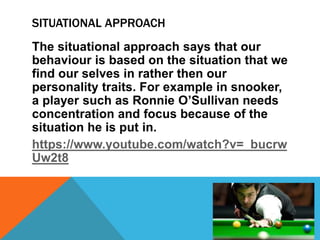
SITUATIONAL APPROACH
The situational approach says that our
behaviour is based on the situation that we
find our selves in rather then our
personality traits. For example in snooker,
a player such as Ronnie O’Sullivan needs
concentration and focus because of the
situation he is put in.
https://www.youtube.com/watch?v=_bucrw
Uw2t8
TRAIT THEORY
There are 4 different trait theories:
Introversion
Extroversion
Stable
Neurotic
Introverts are people who don’t seek excitement and would prefer to be in a
environment. They prefer activities that need concentration.
Extroverts become bored quickly. They are poor when it comes to task that need
concentration. They look for change and excitement. They are less responsive to
pain then what introverts are. Extroverts are also seen to be more successful in
sporting situations as they can cope with competition and distractive situations.
Stable individuals are very easy-going. Where as Neurotic people, (unstable
people) tent to be very anxious and restless. They are also highly excitable.
ELITE VERSUS NON-ELITE
The more successful athletes usually shows lower
level of depression, fatigue and confusion.
However they have more higher levels of vigour.
The less successful athletes are the opposite.
They have higher levels of depression, confusion
and anger.
Usually the more successful athletes are more
content when performing. They are also are a lot
more varied with how they perform.
INTRINSIC
Intrinsic motivation is when someone is participating in a sport just for
enjoyment, rather than for an overall achievement. People can be
intrinsic motivated in three ways:
• The first was is to be motivated by accomplishment. This happens when
athletes want to increase their level of skill so they can get a sense of
accomplishment.
• The second is to be motivated by stimulation. This means people play
sport to get excited or get an adrenalin rush.
• The third way is motivation by knowledge. This means being interested
in your own performance.
EXTRINSIC
Extrinsic motivation is someone who behaves in a way because external
mechanism. A very common form of extrinsic motivation comes from
tangible and intangible rewards:
• Tangible rewards are things that can physically be given to you. For
example money, medals and trophies.
• Intangible rewards are things such as praise, encouragement and
motivation. These are all example of non-physical rewards.
Extrinsic motivation can go wrong if used all the time. If a player got
praised all the time about the same thing, after a while the value would be
lost. Also extrinsic motivation can also decrease intrinsic motivation. The
reason for this is because an individual can interpret motivation in a
different way meaning it can either benefit or knock their confidence.
ACHIEVEMENT MOTIVATION
Achievement motivation was suggested by Atkinson in 1964, who argued
that achievement motivation comes from an individuals personality and
is there motivation for success. It is the motivation that makes an
athlete carry on trying even if they are failing at the time. There are two
categories:
• Need to achieve (NACH)
• Need to avoid failure (NAF)
ATTRIBUTION MOTIVATION
Attribution theory looks at how people explain success or failure. It shows
you and helps you understand the athletes actions and motivations.
There are two different kinds of attributions:
• Internal attribution- a person behaves in a certain way because of
character, personality or attitude.
• External attribution- a person behaves in a certain way because the
situation they are in.
EFFECTS ON SPORT PERFORMANCE
Motivation is a key component to successful sports performance. There is
two different types of motivation positive and negative:
• POSOTIVE- An individual who is motivated to perform play and train at
a high level will increase In their performance. Coaches, athletes and
managers make sure that the athletes are working at their highest level
without seeing negative side affects.
• NEGATIVE- Sometimes being over motivated can cause a problem for
athletes. Athletes usually feel under pressure to perform at a high
standard. This means they train more and more. Sometimes over
motivation can cause staleness and burnout and overtraining. Signs of
this is if an athlete is unable to maintain a good level of skill and fitness.
Burnouts can happen when the athlete finds they can no longer want to
take part in a certain activity they used to join. You can also recognise
when an athlete is staleness as they may suffer from mood swings and
can become depressed.
MOTIVATIONAL CLIMATE
Motivational climate is the environment where athletes finds themselves and how this
affects their motivation positively and negatively. A motivational climate is
focused on mastery tasks., (Athletes receive positive reinforcement and talk about
the extreme team work and co-operation.) Will help develop motivation through
improving the athletes overall learning and effort. Athletes focus on the outcome,
(where they fill punished due to their mistakes , competition is encouraged and
people with the highest level will receive attention.) This can lead to less effort and
persistence from athletes.
There is a suggested technique to develop motivational climate:
• Tasks-Having a range of tasks that need athletes to participate in learning and
decision making
• Authority-Giving athletes over monitoring and evaluating their own learning and
decision making.
• Reward-Using rewards that can improve an individuals performance.
• Grouping-Giving athletes an opportunity to work in groups so that they develop
skills in a group.
• Evaluation- Focusing on an individual s effort and improvement]
• Timing- Timing activities effectively
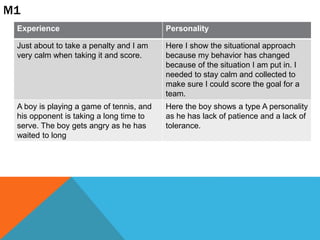
M1
Experience Personality
Just about to take a penalty and I am
very calm when taking it and score.
Here I show the situational approach
because my behavior has changed
because of the situation I am put in. I
needed to stay calm and collected to
make sure I could score the goal for a
team.
A boy is playing a game of tennis, and
his opponent is taking a long time to
serve. The boy gets angry as he has
waited to long
Here the boy shows a type A personality
as he has lack of patience and a lack of
tolerance.
M1
Experience Personality
A girl is at a training session and she
doesn't’t understand a drill. She gets
angry and very confused. She walks off.
This girl shows the non-elite personality.
As she gets angry and confused. She
also show a tad of type A personality.
A boy is starting a new team, he is
usually quite a shy person but because
he is in knew environment he is very
chatty.
This boys shows the personality of the
Marten schematic view, role related
behavior. They also show the
personality of the situational theory.
D1
https://www.youtube.com/watch?v=OB6Gr-AB_1s
In this clip it shows Andy Murray getting angry about the
people shutting the roof and stopping the game. Andy
Murray shows many characteristics of a type A
personality. For example in this video he is very un-
patient and not tolerant at all. These are both Type A
characteristics.
However in the clip below Beckham is taking an important
penalty. Beckham here shows many characteristics of a
Type B personality. For example he is relaxed, but he also
has a low level of anxiety.
https://www.youtube.com/watch?v=XuIczWO9T9I
D1
In the clip o f Andy Murray it shows that he is a
angry person with low levels of tolerance. He
has a type A personality. Andy Murray did not
end up wining this match because. Where as
David Beckham was calm and relaxed when
taking his penalties. Beckham has a type B
personality. David Beckham scored this
penalty. This shows overall Type B personalities
are more likely to succeed in sport.
D1
https://www.youtube.com/watch?v=Y-iufuqUFsc
In this link Mo Farah and Usaine Bolt are both celebrating
after the wins of their races. Here they both show
interactional personality. This is because they are both
strong performers, and Mo Farah celebrates and doesn't’t
act so shy when celebrating a win.
https://www.youtube.com/watch?v=w_EkRYmyYdk
In this first clip it shows a man coaching his team. This man
shows the characteristic of the Marten’s Schematic
theory personality. This is because the coach is adapting
to his environment, knowing he needs to talk in a serious
way, this is known as role related behavior. However that
manager can soon become a friend to a player. He acts
like this because of the environment he is in. Again role-
related behavior.
D1
In the first clip it shows Mo Farah and Usain Bolt are celebrating after their
wins at the Olympics. Mo Farah Is a strong performer. He shows the
interactional personality.
However the second clip shows a coach adapting to his environment and
coaching his team. This man shows the characteristic of the Marten’s
Schematic theory personality.
This coach and this athlete have too totally different personalities types.
So you can not compare which personality type is better.
D1
https://www.youtube.com/watch?v=fdOYVf1E8O4
In this clip above it shows a little girl playing tennis. You can see this girl is
playing for enjoyment of the sport rather then for achievement and
competition. These characteristics show she is intrinsic motivated. It also
shows she plays tennis for excitement. This is one factor of intrinsic
motivation.
https://www.youtube.com/watch?v=5paosdKAkbw
In this clip above it shows Usain Bolt excepting his gold medal. Here Bolt
shows he has tangible extrinsic motivation. This is evident because bolt
wants to win the race to receive a Medal to show his achievements.
D1
In the first clip it shows a little girl playing sport for fun rather then
achievement. She is intrinsic motivated.
However in the second clip it shows Usain Bolt excepting his medal. Here
Bolt shows he has tangible extrinsic motivation.
The two athletes show too completely different types of motivation. The girl
is motivated by the fun and excitement of the sport. Where as Bolt is
motivated by the achievement that he is given a the end,

Unit 17 Psychology In Sport

  • 1.
    UNIT 17 PSYCHOLOGY FORSPORTS PERFORMANCE
  • 2.
    TYPE A A typeA Sports performer has… Low level of patience Has the urge for competition Wants to achieve high goals. Will multi task under time pressure. Has a lack of tolerance Has a high anxiety
  • 3.
    TYPE B A TypeB performer has … Tolerant towards people more relaxed more reflective low level of anxiety higher level of imagination and creativity.
  • 4.
    INTERACTIONAL APPROACH The interactionalapproach looks at both an individuals personality traits as well as a situation. A performer with an interaction approach is a strong performer. An example of this who is usually quite shy in everyday life, seems to be more likely to celebrate with the crowd when they score a goal. Here is an example: https://www.youtube.com/watch?v=Y- iufuqUFsc
  • 5.
    MARTEN’S SCHEMATIC VIEW InMarten’s schematic view there is seen to be three levels personality: Psychological core Typical response Role-related behaviour The psychological core includes your attitudes and values. It also includes your interests, motivation and beliefs about you and yourself worth. The psychological core is about the real you. Not what other people think of you. Typical response are the way you adapt to the environment, as well as how we respond to the world around us. Role related behaviour is the behaviour changeable aspects of personality. Your personality changes in the different situation you are in. For example you could be a student at one moment, coaching a team the next or being a friend. The triangle above is an interpretation of Marten’s schematic view made by Weinburg and Gould 2007.
  • 6.
    PSYCHODYNAMIC THEORY The psychodynamictheory is broken into two parts. Conscious and unconscious. The first part is the ID, interactive drive. It Is part of your personality which is unconscious. This makes you do certain things without thinking about them. For example if a footballer is about to take a penalty kick. The expectation put on them to score may put pressure on them. This could bring large levels of anxiety upon them. The second part is your ego, super ego. This is your moral conscience. An example of this is in football. For example if a player refuses to take the penalty for fear of letting the team down.
  • 7.
    SITUATIONAL APPROACH The situationalapproach says that our behaviour is based on the situation that we find our selves in rather then our personality traits. For example in snooker, a player such as Ronnie O’Sullivan needs concentration and focus because of the situation he is put in. https://www.youtube.com/watch?v=_bucrw Uw2t8
  • 8.
    TRAIT THEORY There are4 different trait theories: Introversion Extroversion Stable Neurotic Introverts are people who don’t seek excitement and would prefer to be in a environment. They prefer activities that need concentration. Extroverts become bored quickly. They are poor when it comes to task that need concentration. They look for change and excitement. They are less responsive to pain then what introverts are. Extroverts are also seen to be more successful in sporting situations as they can cope with competition and distractive situations. Stable individuals are very easy-going. Where as Neurotic people, (unstable people) tent to be very anxious and restless. They are also highly excitable.
  • 9.
    ELITE VERSUS NON-ELITE Themore successful athletes usually shows lower level of depression, fatigue and confusion. However they have more higher levels of vigour. The less successful athletes are the opposite. They have higher levels of depression, confusion and anger. Usually the more successful athletes are more content when performing. They are also are a lot more varied with how they perform.
  • 11.
    INTRINSIC Intrinsic motivation iswhen someone is participating in a sport just for enjoyment, rather than for an overall achievement. People can be intrinsic motivated in three ways: • The first was is to be motivated by accomplishment. This happens when athletes want to increase their level of skill so they can get a sense of accomplishment. • The second is to be motivated by stimulation. This means people play sport to get excited or get an adrenalin rush. • The third way is motivation by knowledge. This means being interested in your own performance.
  • 12.
    EXTRINSIC Extrinsic motivation issomeone who behaves in a way because external mechanism. A very common form of extrinsic motivation comes from tangible and intangible rewards: • Tangible rewards are things that can physically be given to you. For example money, medals and trophies. • Intangible rewards are things such as praise, encouragement and motivation. These are all example of non-physical rewards. Extrinsic motivation can go wrong if used all the time. If a player got praised all the time about the same thing, after a while the value would be lost. Also extrinsic motivation can also decrease intrinsic motivation. The reason for this is because an individual can interpret motivation in a different way meaning it can either benefit or knock their confidence.
  • 13.
    ACHIEVEMENT MOTIVATION Achievement motivationwas suggested by Atkinson in 1964, who argued that achievement motivation comes from an individuals personality and is there motivation for success. It is the motivation that makes an athlete carry on trying even if they are failing at the time. There are two categories: • Need to achieve (NACH) • Need to avoid failure (NAF)
  • 14.
    ATTRIBUTION MOTIVATION Attribution theorylooks at how people explain success or failure. It shows you and helps you understand the athletes actions and motivations. There are two different kinds of attributions: • Internal attribution- a person behaves in a certain way because of character, personality or attitude. • External attribution- a person behaves in a certain way because the situation they are in.
  • 15.
    EFFECTS ON SPORTPERFORMANCE Motivation is a key component to successful sports performance. There is two different types of motivation positive and negative: • POSOTIVE- An individual who is motivated to perform play and train at a high level will increase In their performance. Coaches, athletes and managers make sure that the athletes are working at their highest level without seeing negative side affects. • NEGATIVE- Sometimes being over motivated can cause a problem for athletes. Athletes usually feel under pressure to perform at a high standard. This means they train more and more. Sometimes over motivation can cause staleness and burnout and overtraining. Signs of this is if an athlete is unable to maintain a good level of skill and fitness. Burnouts can happen when the athlete finds they can no longer want to take part in a certain activity they used to join. You can also recognise when an athlete is staleness as they may suffer from mood swings and can become depressed.
  • 16.
    MOTIVATIONAL CLIMATE Motivational climateis the environment where athletes finds themselves and how this affects their motivation positively and negatively. A motivational climate is focused on mastery tasks., (Athletes receive positive reinforcement and talk about the extreme team work and co-operation.) Will help develop motivation through improving the athletes overall learning and effort. Athletes focus on the outcome, (where they fill punished due to their mistakes , competition is encouraged and people with the highest level will receive attention.) This can lead to less effort and persistence from athletes. There is a suggested technique to develop motivational climate: • Tasks-Having a range of tasks that need athletes to participate in learning and decision making • Authority-Giving athletes over monitoring and evaluating their own learning and decision making. • Reward-Using rewards that can improve an individuals performance. • Grouping-Giving athletes an opportunity to work in groups so that they develop skills in a group. • Evaluation- Focusing on an individual s effort and improvement] • Timing- Timing activities effectively
  • 17.
    M1 Experience Personality Just aboutto take a penalty and I am very calm when taking it and score. Here I show the situational approach because my behavior has changed because of the situation I am put in. I needed to stay calm and collected to make sure I could score the goal for a team. A boy is playing a game of tennis, and his opponent is taking a long time to serve. The boy gets angry as he has waited to long Here the boy shows a type A personality as he has lack of patience and a lack of tolerance.
  • 18.
    M1 Experience Personality A girlis at a training session and she doesn't’t understand a drill. She gets angry and very confused. She walks off. This girl shows the non-elite personality. As she gets angry and confused. She also show a tad of type A personality. A boy is starting a new team, he is usually quite a shy person but because he is in knew environment he is very chatty. This boys shows the personality of the Marten schematic view, role related behavior. They also show the personality of the situational theory.
  • 19.
    D1 https://www.youtube.com/watch?v=OB6Gr-AB_1s In this clipit shows Andy Murray getting angry about the people shutting the roof and stopping the game. Andy Murray shows many characteristics of a type A personality. For example in this video he is very un- patient and not tolerant at all. These are both Type A characteristics. However in the clip below Beckham is taking an important penalty. Beckham here shows many characteristics of a Type B personality. For example he is relaxed, but he also has a low level of anxiety. https://www.youtube.com/watch?v=XuIczWO9T9I
  • 20.
    D1 In the clipo f Andy Murray it shows that he is a angry person with low levels of tolerance. He has a type A personality. Andy Murray did not end up wining this match because. Where as David Beckham was calm and relaxed when taking his penalties. Beckham has a type B personality. David Beckham scored this penalty. This shows overall Type B personalities are more likely to succeed in sport.
  • 21.
    D1 https://www.youtube.com/watch?v=Y-iufuqUFsc In this linkMo Farah and Usaine Bolt are both celebrating after the wins of their races. Here they both show interactional personality. This is because they are both strong performers, and Mo Farah celebrates and doesn't’t act so shy when celebrating a win. https://www.youtube.com/watch?v=w_EkRYmyYdk In this first clip it shows a man coaching his team. This man shows the characteristic of the Marten’s Schematic theory personality. This is because the coach is adapting to his environment, knowing he needs to talk in a serious way, this is known as role related behavior. However that manager can soon become a friend to a player. He acts like this because of the environment he is in. Again role- related behavior.
  • 22.
    D1 In the firstclip it shows Mo Farah and Usain Bolt are celebrating after their wins at the Olympics. Mo Farah Is a strong performer. He shows the interactional personality. However the second clip shows a coach adapting to his environment and coaching his team. This man shows the characteristic of the Marten’s Schematic theory personality. This coach and this athlete have too totally different personalities types. So you can not compare which personality type is better.
  • 23.
    D1 https://www.youtube.com/watch?v=fdOYVf1E8O4 In this clipabove it shows a little girl playing tennis. You can see this girl is playing for enjoyment of the sport rather then for achievement and competition. These characteristics show she is intrinsic motivated. It also shows she plays tennis for excitement. This is one factor of intrinsic motivation. https://www.youtube.com/watch?v=5paosdKAkbw In this clip above it shows Usain Bolt excepting his gold medal. Here Bolt shows he has tangible extrinsic motivation. This is evident because bolt wants to win the race to receive a Medal to show his achievements.
  • 24.
    D1 In the firstclip it shows a little girl playing sport for fun rather then achievement. She is intrinsic motivated. However in the second clip it shows Usain Bolt excepting his medal. Here Bolt shows he has tangible extrinsic motivation. The two athletes show too completely different types of motivation. The girl is motivated by the fun and excitement of the sport. Where as Bolt is motivated by the achievement that he is given a the end,