1
K-means clustering
CSE 4621 | Machine Learning| BScTE | Summer 22-23
Sabbir Ahmed
Assistant Professor, Dept of CSE, IUT
sabbirahmed@iut-dhaka.edu
2
K-Means Clustering
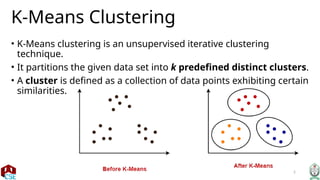
• K-Means clustering is an unsupervised iterative clustering
technique.
• It partitions the given data set into k predefined distinct clusters.
• A cluster is defined as a collection of data points exhibiting certain
similarities.
3
It partitions the data set such that-
• Each data point belongs to a cluster with the nearest mean.
• Data points belonging to one cluster have high degree of
similarity.
• Data points belonging to different clusters have high degree of
dissimilarity.
4
K-Means Clustering Algorithm involves the
following steps-
Step-01:
• Choose the number of clusters K.
Step-02:
• Randomly select any K data points as cluster centers.
• Select cluster centers in such a way that they are as farther as
possible from each other.
Step-03:
• Calculate the distance between each data point and each cluster
center.
• The distance may be calculated either by using given distance
function or by using Euclidean distance formula.
5
Step-04:
• Assign each data point to some cluster.
• A data point is assigned to that cluster whose center is nearest to
that data point.
Step-05:
• Re-compute the center of newly formed clusters.
• The center of a cluster is computed by taking mean of all the data
points contained in that cluster.
6
Step-06:
• Keep repeating the procedure from Step-03 to Step-05 until any of
the following stopping criteria is met-
• Center of newly formed clusters do not change
• Data points remain present in the same cluster
• Maximum number of iterations are reached
7
Advantages
• K-Means Clustering Algorithm offers the following advantages-
• It is relatively efficient with time complexity O(nkt) where-
• n = number of instances
• k = number of clusters
• t = number of iterations
• It often terminates at local optimum.
8
Disadvantages
• K-Means Clustering Algorithm has the following disadvantages-
• It requires to specify the number of clusters (k) in advance.
• It can not handle noisy data and outliers.
• It is not suitable to identify clusters with non-convex shapes.
9
PRACTICE PROBLEMS BASED ON K-MEANS
CLUSTERING ALGORITHM-
• Problem-01:
• Cluster the following eight points (with (x, y) representing
locations) into three clusters:
• A1(2, 10), A2(2, 5), A3(8, 4), A4(5, 8), A5(7, 5), A6(6, 4), A7(1, 2), A8(4, 9)
• Initial cluster centers are: A1(2, 10), A4(5, 8) and A7(1, 2).
• The distance function between two points a = (x1, y1) and b = (x2,
y2) is defined as-
• Ρ(a, b) = |x2 – x1| + |y2 – y1|
• Use K-Means Algorithm to find the three cluster centers after the
second iteration.
10
Solution-
• We follow the above discussed K-Means Clustering Algorithm-
Iteration-01:
• We calculate the distance of each point from each of the center of
the three clusters.
• The distance is calculated by using the given distance function.
11
• The following illustration shows the calculation of distance
between point A1(2, 10) and each of the center of the three
clusters-
• Calculating Distance Between A1(2, 10) and C1(2, 10)-
• Ρ(A1, C1)
= |x2 – x1| + |y2 – y1|
= |2 – 2| + |10 – 10|
= 0
12
• Calculating Distance Between A1(2, 10) and C2(5, 8)-
• Ρ(A1, C2)
= |x2 – x1| + |y2 – y1|
= |5 – 2| + |8 – 10|
= 3 + 2
= 5
• Calculating Distance Between A1(2, 10) and C3(1, 2)-
• Ρ(A1, C3)
= |x2 – x1| + |y2 – y1|
= |1 – 2| + |2 – 10|
= 1 + 8
= 9
• In the similar manner, we calculate the distance of other points from each of
the center of the three clusters.
13
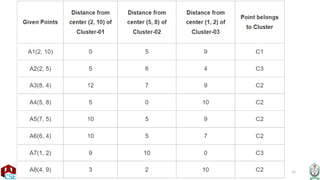
• Next,
• We draw a table showing all the results.
• Using the table, we decide which point belongs to which cluster.
• The given point belongs to that cluster whose center is nearest to it.
14
15
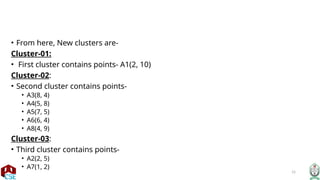
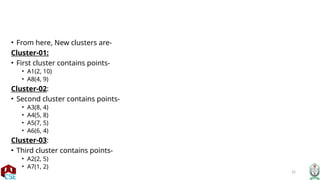
• From here, New clusters are-
Cluster-01:
• First cluster contains points- A1(2, 10)
Cluster-02:
• Second cluster contains points-
• A3(8, 4)
• A4(5, 8)
• A5(7, 5)
• A6(6, 4)
• A8(4, 9)
Cluster-03:
• Third cluster contains points-
• A2(2, 5)
• A7(1, 2)
16
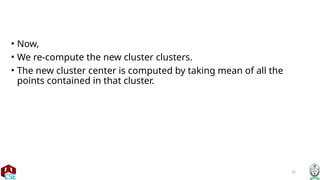
• Now,
• We re-compute the new cluster clusters.
• The new cluster center is computed by taking mean of all the
points contained in that cluster.
17
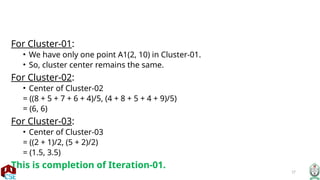
For Cluster-01:
• We have only one point A1(2, 10) in Cluster-01.
• So, cluster center remains the same.
For Cluster-02:
• Center of Cluster-02
= ((8 + 5 + 7 + 6 + 4)/5, (4 + 8 + 5 + 4 + 9)/5)
= (6, 6)
For Cluster-03:
• Center of Cluster-03
= ((2 + 1)/2, (5 + 2)/2)
= (1.5, 3.5)
This is completion of Iteration-01.
18
Iteration-02:
• We calculate the distance of each point from each of the center of
the three clusters.
• The distance is calculated by using the given distance function.
19
• The following illustration shows the calculation of distance between point
A1(2, 10) and each of the center of the three clusters-
• Calculating Distance Between A1(2, 10) and C1(2, 10)-
• Ρ(A1, C1)
= |x2 – x1| + |y2 – y1|
=|2 – 2| + |10 – 10|= 0
• Calculating Distance Between A1(2, 10) and C2(6, 6)-
• Ρ(A1, C2)
= |x2 – x1| + |y2 – y1|
= |6 – 2| + |6 – 10|= 4 + 4 = 8
• Calculating Distance Between A1(2, 10) and C3(1.5, 3.5)-
• Ρ(A1, C3)
= |x2 – x1| + |y2 – y1|
= |1.5 – 2| + |3.5 – 10|= 0.5 + 6.5 = 7
20
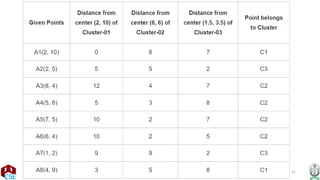
• In the similar manner, we calculate the distance of other points
from each of the center of the three clusters.
• Next,
• We draw a table showing all the results.
• Using the table, we decide which point belongs to which cluster.
• The given point belongs to that cluster whose center is nearest to it.
21
22
• From here, New clusters are-
Cluster-01:
• First cluster contains points-
• A1(2, 10)
• A8(4, 9)
Cluster-02:
• Second cluster contains points-
• A3(8, 4)
• A4(5, 8)
• A5(7, 5)
• A6(6, 4)
Cluster-03:
• Third cluster contains points-
• A2(2, 5)
• A7(1, 2)
23
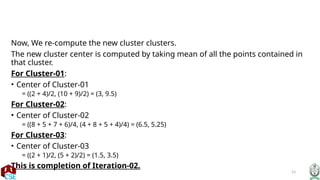
Now, We re-compute the new cluster clusters.
The new cluster center is computed by taking mean of all the points contained in
that cluster.
For Cluster-01:
• Center of Cluster-01
= ((2 + 4)/2, (10 + 9)/2) = (3, 9.5)
For Cluster-02:
• Center of Cluster-02
= ((8 + 5 + 7 + 6)/4, (4 + 8 + 5 + 4)/4) = (6.5, 5.25)
For Cluster-03:
• Center of Cluster-03
= ((2 + 1)/2, (5 + 2)/2) = (1.5, 3.5)
This is completion of Iteration-02.
24
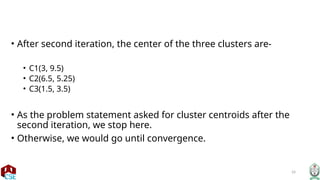
• After second iteration, the center of the three clusters are-
• C1(3, 9.5)
• C2(6.5, 5.25)
• C3(1.5, 3.5)
• As the problem statement asked for cluster centroids after the
second iteration, we stop here.
• Otherwise, we would go until convergence.
25
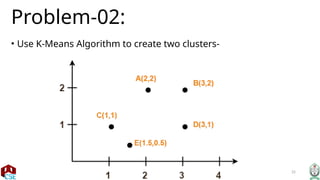
Problem-02:
• Use K-Means Algorithm to create two clusters-
26
• Solution-
• We follow the above discussed K-Means Clustering Algorithm.
• Assume A(2, 2) and C(1, 1) are centers of the two clusters.
27
Iteration-01:
• We calculate the distance of each point from each of the center of
the two clusters.
• The distance is calculated by using the Euclidean distance formula.
• The following illustration shows the calculation of distance
between point A(2, 2) and each of the center of the two clusters-
28
• Calculating Distance Between A(2, 2) and C1(2, 2)-
• Ρ(A, C1)
= sqrt [ (x2 – x1)^2 + (y2 – y1)^2 ]
= sqrt [ (2 – 2)^2 + (2 – 2)^2 ]
= sqrt [ 0 + 0 ]
= 0
• Calculating Distance Between A(2, 2) and C2(1, 1)-
• Ρ(A, C2)
= sqrt [ (x2 – x1)^2 + (y2 – y1)^2 ]
= sqrt [ (1 – 2)^2 + (1 – 2)^2 ]
= sqrt [ 1 + 1 ]
= sqrt [ 2 ]
= 1.41
• In the similar manner, we calculate the distance of other points from each of the
center of the two clusters.
29
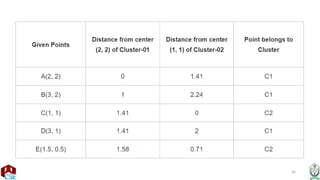
• Next,
• We draw a table showing all the results.
• Using the table, we decide which point belongs to which cluster.
• The given point belongs to that cluster whose center is nearest to
it.
30
31
• From here, New clusters are-
Cluster-01:
• First cluster contains points-
• A(2, 2)
• B(3, 2)
• D(3, 1)
Cluster-02:
• Second cluster contains points-
• C(1, 1)
• E(1.5, 0.5)
• Now, We re-compute the new cluster clusters.
• The new cluster center is computed by taking mean of all the points
contained in that cluster.
32
For Cluster-01:
Center of Cluster-01
= ((2 + 3 + 3)/3, (2 + 2 + 1)/3)
= (2.67, 1.67)
For Cluster-02:
Center of Cluster-02
= ((1 + 1.5)/2, (1 + 0.5)/2)
= (1.25, 0.75)
• This is completion of Iteration-01.
• Next, we go to iteration-02, iteration-03 and so on until the centers do not
change anymore.
33
Reference
• https://www.gatevidyalay.com/k-means-clustering-algorithm-exam
ple/

k-means clustering machine learning.pptx

  • 1.
    1 K-means clustering CSE 4621| Machine Learning| BScTE | Summer 22-23 Sabbir Ahmed Assistant Professor, Dept of CSE, IUT sabbirahmed@iut-dhaka.edu
  • 2.
    2 K-Means Clustering • K-Meansclustering is an unsupervised iterative clustering technique. • It partitions the given data set into k predefined distinct clusters. • A cluster is defined as a collection of data points exhibiting certain similarities.
  • 3.
    3 It partitions thedata set such that- • Each data point belongs to a cluster with the nearest mean. • Data points belonging to one cluster have high degree of similarity. • Data points belonging to different clusters have high degree of dissimilarity.
  • 4.
    4 K-Means Clustering Algorithminvolves the following steps- Step-01: • Choose the number of clusters K. Step-02: • Randomly select any K data points as cluster centers. • Select cluster centers in such a way that they are as farther as possible from each other. Step-03: • Calculate the distance between each data point and each cluster center. • The distance may be calculated either by using given distance function or by using Euclidean distance formula.
  • 5.
    5 Step-04: • Assign eachdata point to some cluster. • A data point is assigned to that cluster whose center is nearest to that data point. Step-05: • Re-compute the center of newly formed clusters. • The center of a cluster is computed by taking mean of all the data points contained in that cluster.
  • 6.
    6 Step-06: • Keep repeatingthe procedure from Step-03 to Step-05 until any of the following stopping criteria is met- • Center of newly formed clusters do not change • Data points remain present in the same cluster • Maximum number of iterations are reached
  • 7.
    7 Advantages • K-Means ClusteringAlgorithm offers the following advantages- • It is relatively efficient with time complexity O(nkt) where- • n = number of instances • k = number of clusters • t = number of iterations • It often terminates at local optimum.
  • 8.
    8 Disadvantages • K-Means ClusteringAlgorithm has the following disadvantages- • It requires to specify the number of clusters (k) in advance. • It can not handle noisy data and outliers. • It is not suitable to identify clusters with non-convex shapes.
  • 9.
    9 PRACTICE PROBLEMS BASEDON K-MEANS CLUSTERING ALGORITHM- • Problem-01: • Cluster the following eight points (with (x, y) representing locations) into three clusters: • A1(2, 10), A2(2, 5), A3(8, 4), A4(5, 8), A5(7, 5), A6(6, 4), A7(1, 2), A8(4, 9) • Initial cluster centers are: A1(2, 10), A4(5, 8) and A7(1, 2). • The distance function between two points a = (x1, y1) and b = (x2, y2) is defined as- • Ρ(a, b) = |x2 – x1| + |y2 – y1| • Use K-Means Algorithm to find the three cluster centers after the second iteration.
  • 10.
    10 Solution- • We followthe above discussed K-Means Clustering Algorithm- Iteration-01: • We calculate the distance of each point from each of the center of the three clusters. • The distance is calculated by using the given distance function.
  • 11.
    11 • The followingillustration shows the calculation of distance between point A1(2, 10) and each of the center of the three clusters- • Calculating Distance Between A1(2, 10) and C1(2, 10)- • Ρ(A1, C1) = |x2 – x1| + |y2 – y1| = |2 – 2| + |10 – 10| = 0
  • 12.
    12 • Calculating DistanceBetween A1(2, 10) and C2(5, 8)- • Ρ(A1, C2) = |x2 – x1| + |y2 – y1| = |5 – 2| + |8 – 10| = 3 + 2 = 5 • Calculating Distance Between A1(2, 10) and C3(1, 2)- • Ρ(A1, C3) = |x2 – x1| + |y2 – y1| = |1 – 2| + |2 – 10| = 1 + 8 = 9 • In the similar manner, we calculate the distance of other points from each of the center of the three clusters.
  • 13.
    13 • Next, • Wedraw a table showing all the results. • Using the table, we decide which point belongs to which cluster. • The given point belongs to that cluster whose center is nearest to it.
  • 14.
  • 15.
    15 • From here,New clusters are- Cluster-01: • First cluster contains points- A1(2, 10) Cluster-02: • Second cluster contains points- • A3(8, 4) • A4(5, 8) • A5(7, 5) • A6(6, 4) • A8(4, 9) Cluster-03: • Third cluster contains points- • A2(2, 5) • A7(1, 2)
  • 16.
    16 • Now, • Were-compute the new cluster clusters. • The new cluster center is computed by taking mean of all the points contained in that cluster.
  • 17.
    17 For Cluster-01: • Wehave only one point A1(2, 10) in Cluster-01. • So, cluster center remains the same. For Cluster-02: • Center of Cluster-02 = ((8 + 5 + 7 + 6 + 4)/5, (4 + 8 + 5 + 4 + 9)/5) = (6, 6) For Cluster-03: • Center of Cluster-03 = ((2 + 1)/2, (5 + 2)/2) = (1.5, 3.5) This is completion of Iteration-01.
  • 18.
    18 Iteration-02: • We calculatethe distance of each point from each of the center of the three clusters. • The distance is calculated by using the given distance function.
  • 19.
    19 • The followingillustration shows the calculation of distance between point A1(2, 10) and each of the center of the three clusters- • Calculating Distance Between A1(2, 10) and C1(2, 10)- • Ρ(A1, C1) = |x2 – x1| + |y2 – y1| =|2 – 2| + |10 – 10|= 0 • Calculating Distance Between A1(2, 10) and C2(6, 6)- • Ρ(A1, C2) = |x2 – x1| + |y2 – y1| = |6 – 2| + |6 – 10|= 4 + 4 = 8 • Calculating Distance Between A1(2, 10) and C3(1.5, 3.5)- • Ρ(A1, C3) = |x2 – x1| + |y2 – y1| = |1.5 – 2| + |3.5 – 10|= 0.5 + 6.5 = 7
  • 20.
    20 • In thesimilar manner, we calculate the distance of other points from each of the center of the three clusters. • Next, • We draw a table showing all the results. • Using the table, we decide which point belongs to which cluster. • The given point belongs to that cluster whose center is nearest to it.
  • 21.
  • 22.
    22 • From here,New clusters are- Cluster-01: • First cluster contains points- • A1(2, 10) • A8(4, 9) Cluster-02: • Second cluster contains points- • A3(8, 4) • A4(5, 8) • A5(7, 5) • A6(6, 4) Cluster-03: • Third cluster contains points- • A2(2, 5) • A7(1, 2)
  • 23.
    23 Now, We re-computethe new cluster clusters. The new cluster center is computed by taking mean of all the points contained in that cluster. For Cluster-01: • Center of Cluster-01 = ((2 + 4)/2, (10 + 9)/2) = (3, 9.5) For Cluster-02: • Center of Cluster-02 = ((8 + 5 + 7 + 6)/4, (4 + 8 + 5 + 4)/4) = (6.5, 5.25) For Cluster-03: • Center of Cluster-03 = ((2 + 1)/2, (5 + 2)/2) = (1.5, 3.5) This is completion of Iteration-02.
  • 24.
    24 • After seconditeration, the center of the three clusters are- • C1(3, 9.5) • C2(6.5, 5.25) • C3(1.5, 3.5) • As the problem statement asked for cluster centroids after the second iteration, we stop here. • Otherwise, we would go until convergence.
  • 25.
    25 Problem-02: • Use K-MeansAlgorithm to create two clusters-
  • 26.
    26 • Solution- • Wefollow the above discussed K-Means Clustering Algorithm. • Assume A(2, 2) and C(1, 1) are centers of the two clusters.
  • 27.
    27 Iteration-01: • We calculatethe distance of each point from each of the center of the two clusters. • The distance is calculated by using the Euclidean distance formula. • The following illustration shows the calculation of distance between point A(2, 2) and each of the center of the two clusters-
  • 28.
    28 • Calculating DistanceBetween A(2, 2) and C1(2, 2)- • Ρ(A, C1) = sqrt [ (x2 – x1)^2 + (y2 – y1)^2 ] = sqrt [ (2 – 2)^2 + (2 – 2)^2 ] = sqrt [ 0 + 0 ] = 0 • Calculating Distance Between A(2, 2) and C2(1, 1)- • Ρ(A, C2) = sqrt [ (x2 – x1)^2 + (y2 – y1)^2 ] = sqrt [ (1 – 2)^2 + (1 – 2)^2 ] = sqrt [ 1 + 1 ] = sqrt [ 2 ] = 1.41 • In the similar manner, we calculate the distance of other points from each of the center of the two clusters.
  • 29.
    29 • Next, • Wedraw a table showing all the results. • Using the table, we decide which point belongs to which cluster. • The given point belongs to that cluster whose center is nearest to it.
  • 30.
  • 31.
    31 • From here,New clusters are- Cluster-01: • First cluster contains points- • A(2, 2) • B(3, 2) • D(3, 1) Cluster-02: • Second cluster contains points- • C(1, 1) • E(1.5, 0.5) • Now, We re-compute the new cluster clusters. • The new cluster center is computed by taking mean of all the points contained in that cluster.
  • 32.
    32 For Cluster-01: Center ofCluster-01 = ((2 + 3 + 3)/3, (2 + 2 + 1)/3) = (2.67, 1.67) For Cluster-02: Center of Cluster-02 = ((1 + 1.5)/2, (1 + 0.5)/2) = (1.25, 0.75) • This is completion of Iteration-01. • Next, we go to iteration-02, iteration-03 and so on until the centers do not change anymore.
  • 33.

Editor's Notes

  • #2 <number><number><number>
  • #3 <number><number><number>
  • #4 <number><number><number>
  • #5 <number><number><number>
  • #6 <number><number><number>
  • #7 <number><number><number>
  • #8 <number><number><number>
  • #9 <number><number><number>
  • #10 <number><number><number>
  • #11 <number><number><number>
  • #12 <number><number><number>
  • #13 <number><number><number>
  • #14 <number><number><number>
  • #15 <number><number><number>
  • #16 <number><number><number>
  • #17 <number><number><number>
  • #18 <number><number><number>
  • #19 <number><number><number>
  • #20 <number><number><number>
  • #21 <number><number><number>
  • #22 <number><number><number>
  • #23 <number><number><number>
  • #24 <number><number><number>
  • #25 <number><number><number>
  • #26 <number><number><number>
  • #27 <number><number><number>
  • #28 <number><number><number>
  • #29 <number><number><number>
  • #30 <number><number><number>
  • #31 <number><number><number>
  • #32 <number><number><number>
  • #33 <number><number><number>