1
Department of electrical and electronics engineering
Gandhiji institute of science and technology Approved by AICTE,NEW DELHI,
Affiliated to JNTU KAKINADA , Gattu Bhimavaram ( p. o)-
521178,VATSAVAI(M),
JAGGAYYAPET , Krishna District www.gistech.co.in
2
PRESENTED BY:
SK.SHABEER(14JF5A0201)
HARIKESH CHAUHAN(13JF1A0209)
A.ASHOK(13JF1A0201)
SUMBUL SABA(13JF1A0228)
RAJESH KUMAR(13JF1A0225)
UNDER GUIDE BY:-
U. NARESH M.Tech
asst professor
.
HEAD OF THE DEPARTMENT:-
M.SUNDAR RAO M.Tech
Associative professor
Contents.......
3
 Abstract.
 Different Types Of converters
 Buck Converter
 Boost Converter
 Buck- Boost Converter
 Different Types Of Controller( p, pi , pid And Fuzzy)
 Fuzzy Controller
 Advantages, Disadvantages And Application Of Our
Projects
 Conclusion
 Queries
Abstract ......
4
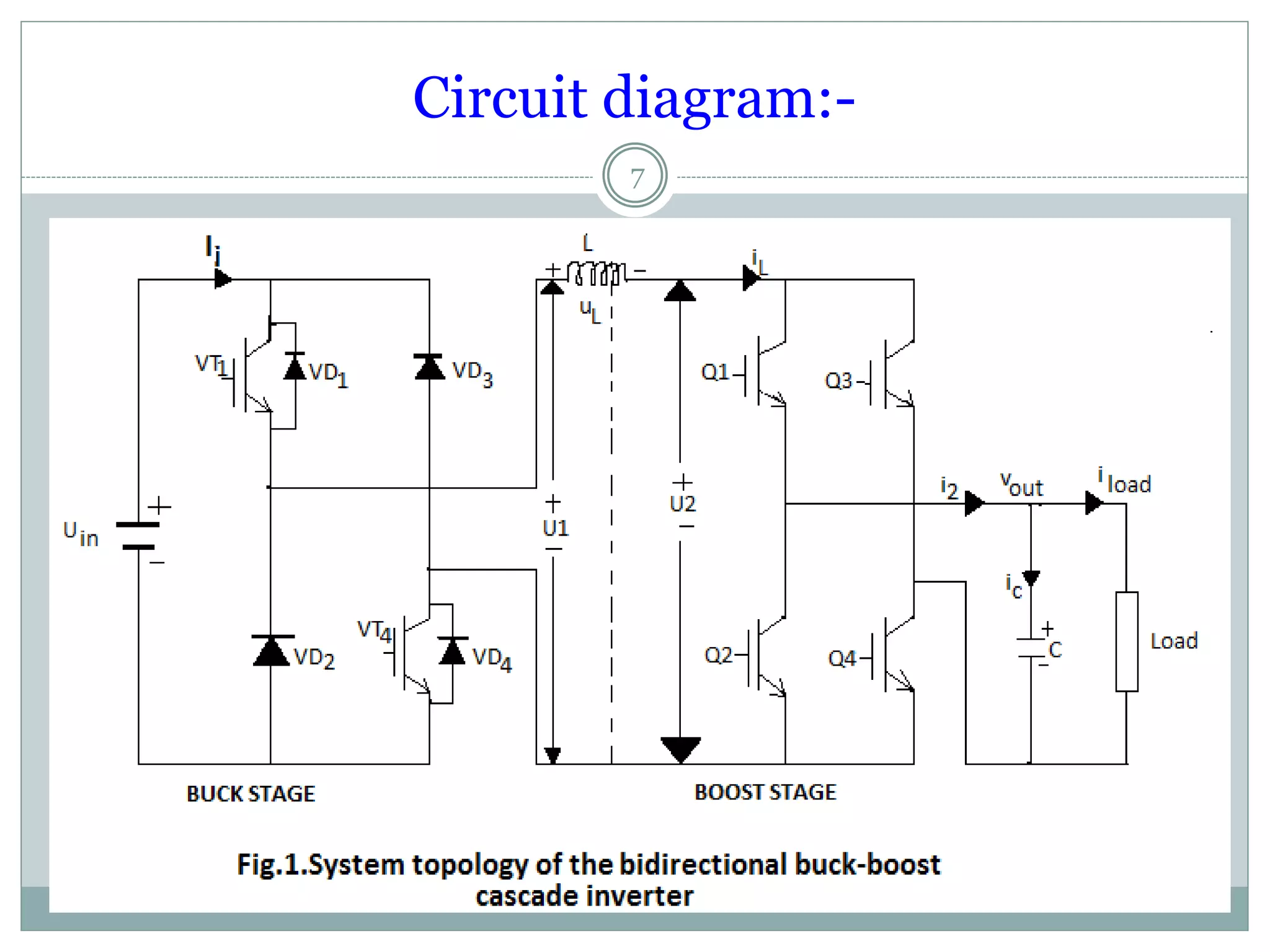
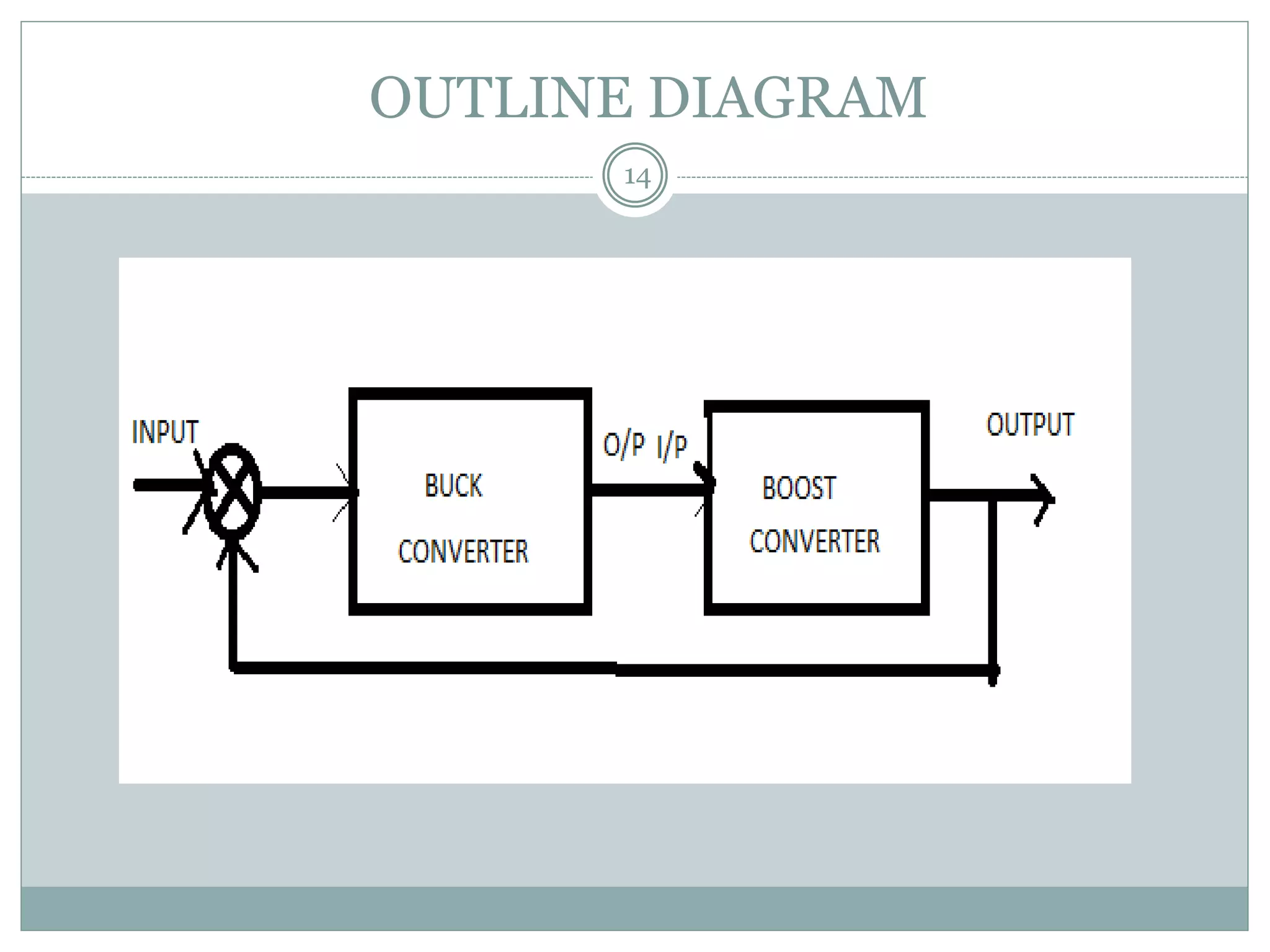
 This paper proposes a bidirectional buck boost cascade inverter
and presents its modelling and control methods
 Here the inverter can be seen as the cascade of a buck converter
and boost converter main inductor current is maintained by
buck stage and out voltage controlled by boost stage
 It provides bidirectional operational with bipolar outputs.
It reduces the dead time effect and reduced output distortion
OPERATION OF BUCK STAGE
 Buck converter is a dc- dc power converter
 it is a class of switched mode power supply(SMPS)
 It containing two semiconductors (Diode & IGBT)
 To reduce voltage ripple , filters made of capacitor & inductor
 Buck converter provide much greater power efficiency
APPLICATIONS:-
It is used in many industrial application such as cars trolley buses
battery operated vehicles and battery charging etc....
To provide smooth control on output high efficiency , fast response and
regeneration.
To provide long and less maintenance due to absence of moving parts.
5
 Operation of boost stage:-
Output voltage always higher than input voltage
Boost converter is dc-dc power converter
It is a class of switch mode power supply (SMPS)
When switch is “on” : diode is reverse biased output circuit is thus isolated
inductor is charged.
When switch is “off “: output stage received energy from the inductor as
well as input.
Filter capacitor is very large to ensure constant output voltage .
In this diode and transistor is used as switching device .
It is voltage control device and it required small amount of current
Switching speed is very high.
It operates in nano second.
6
Circuit diagram:-
7
What is a fuzzy controller
8
 Fuzzy logic controller developed by Zadesh in 1965.
 Fuzzy logic control is rule based technique.
 The rules are “IF THEN” rules
 Fuzzy logic control can be well suited to control a system
with uncertain, complex , inaccurate or non linear
dynamics..
 In fuzzy logic controller we used membership functions
Why should we use fuzzy controller
9
 Very robust
 It can be easily modified.
 Can used multiple inputs and outputs sources.
 Very quick and cheaper to implement.
 Much similar than its predecessors.
Types of controllers
10
 P-controllers (proportional controllers)
 I-controller (integral controller)
 PI-controller(proportional+ integral controller )
 PD- controller(proportional +derivative controller )
 PID- controller (proportional + integral +derivative
controller )
PID-controller:-
11 A controller in which the output are control signal
is a sum of three signals one being proportional to
error signal one being proportional to integral of
the error signal and third being proportional to
derivative of error signal is known as PID
controller.
Advantages:-
o It improves the system performance in all aspects
due to combined operation of three.
o “P” of PID controller increase the gain of system.
o “I” of PID controllers decreases the steady state
error.
o “D” of PID controller decreases the rate of change
of error.
Compare PID and fuzzy logic controllers
12
 Reduced output distortions.
 High performance achieved
 Which can be utilized to eliminate the systems non
linearity.
 Quick speed.
ADVANTAGES:-
 GREATER POWER EFFICIENCY
 SIMPLE CIRCUITS
 HEAT DISSIPATION IS LESS
 LESS SEMI CONDUCTOR DIVICES ARE REQUIRED
DISADVANTAGES:-
 IT DOES NOT STEP - UP THE OUTPUT CURRENT
 IT IS COSTLY AVAILABLE IN THE MARKET
13
OUTLINE DIAGRAM
14
CONCLUSION:-
Which can be utilized to eliminate the system nonlinearity , and thus high
performance acheived
Consequently , a decoupled control strategy with feed forward compensation
technique is proposed .
15
16
17

fuzzy based bidirectional buck-boost cascade inverter

  • 1.
    1 Department of electricaland electronics engineering Gandhiji institute of science and technology Approved by AICTE,NEW DELHI, Affiliated to JNTU KAKINADA , Gattu Bhimavaram ( p. o)- 521178,VATSAVAI(M), JAGGAYYAPET , Krishna District www.gistech.co.in
  • 2.
    2 PRESENTED BY: SK.SHABEER(14JF5A0201) HARIKESH CHAUHAN(13JF1A0209) A.ASHOK(13JF1A0201) SUMBULSABA(13JF1A0228) RAJESH KUMAR(13JF1A0225) UNDER GUIDE BY:- U. NARESH M.Tech asst professor . HEAD OF THE DEPARTMENT:- M.SUNDAR RAO M.Tech Associative professor
  • 3.
    Contents....... 3  Abstract.  DifferentTypes Of converters  Buck Converter  Boost Converter  Buck- Boost Converter  Different Types Of Controller( p, pi , pid And Fuzzy)  Fuzzy Controller  Advantages, Disadvantages And Application Of Our Projects  Conclusion  Queries
  • 4.
    Abstract ...... 4  Thispaper proposes a bidirectional buck boost cascade inverter and presents its modelling and control methods  Here the inverter can be seen as the cascade of a buck converter and boost converter main inductor current is maintained by buck stage and out voltage controlled by boost stage  It provides bidirectional operational with bipolar outputs. It reduces the dead time effect and reduced output distortion
  • 5.
    OPERATION OF BUCKSTAGE  Buck converter is a dc- dc power converter  it is a class of switched mode power supply(SMPS)  It containing two semiconductors (Diode & IGBT)  To reduce voltage ripple , filters made of capacitor & inductor  Buck converter provide much greater power efficiency APPLICATIONS:- It is used in many industrial application such as cars trolley buses battery operated vehicles and battery charging etc.... To provide smooth control on output high efficiency , fast response and regeneration. To provide long and less maintenance due to absence of moving parts. 5
  • 6.
     Operation ofboost stage:- Output voltage always higher than input voltage Boost converter is dc-dc power converter It is a class of switch mode power supply (SMPS) When switch is “on” : diode is reverse biased output circuit is thus isolated inductor is charged. When switch is “off “: output stage received energy from the inductor as well as input. Filter capacitor is very large to ensure constant output voltage . In this diode and transistor is used as switching device . It is voltage control device and it required small amount of current Switching speed is very high. It operates in nano second. 6
  • 7.
  • 8.
    What is afuzzy controller 8  Fuzzy logic controller developed by Zadesh in 1965.  Fuzzy logic control is rule based technique.  The rules are “IF THEN” rules  Fuzzy logic control can be well suited to control a system with uncertain, complex , inaccurate or non linear dynamics..  In fuzzy logic controller we used membership functions
  • 9.
    Why should weuse fuzzy controller 9  Very robust  It can be easily modified.  Can used multiple inputs and outputs sources.  Very quick and cheaper to implement.  Much similar than its predecessors.
  • 10.
    Types of controllers 10 P-controllers (proportional controllers)  I-controller (integral controller)  PI-controller(proportional+ integral controller )  PD- controller(proportional +derivative controller )  PID- controller (proportional + integral +derivative controller )
  • 11.
    PID-controller:- 11 A controllerin which the output are control signal is a sum of three signals one being proportional to error signal one being proportional to integral of the error signal and third being proportional to derivative of error signal is known as PID controller. Advantages:- o It improves the system performance in all aspects due to combined operation of three. o “P” of PID controller increase the gain of system. o “I” of PID controllers decreases the steady state error. o “D” of PID controller decreases the rate of change of error.
  • 12.
    Compare PID andfuzzy logic controllers 12  Reduced output distortions.  High performance achieved  Which can be utilized to eliminate the systems non linearity.  Quick speed.
  • 13.
    ADVANTAGES:-  GREATER POWEREFFICIENCY  SIMPLE CIRCUITS  HEAT DISSIPATION IS LESS  LESS SEMI CONDUCTOR DIVICES ARE REQUIRED DISADVANTAGES:-  IT DOES NOT STEP - UP THE OUTPUT CURRENT  IT IS COSTLY AVAILABLE IN THE MARKET 13
  • 14.
  • 15.
    CONCLUSION:- Which can beutilized to eliminate the system nonlinearity , and thus high performance acheived Consequently , a decoupled control strategy with feed forward compensation technique is proposed . 15
  • 16.
  • 17.