Strategic Education
Directions & Getting There
Through Foresight
Joe Murphy
University of Houston
MS in Foresight program.
SFSU Exec. MBA
Christa McAuliffe technology Conference. Manchester, NH.
Dec, 2015
@libraryfuture Joe Murphy
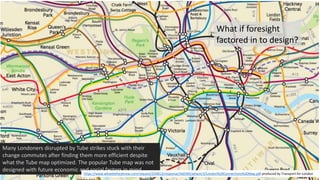
What if foresight
factored in to design?
Many Londoners disrupted by Tube strikes stuck with their
change commutes after finding them more efficient despite
what the Tube map optimized. The popular Tube map was not
designed with future economic and social factors in mind.
https://www.whatdotheyknow.com/request/224813/response/560395/attach/3/London%20Connections%20Map.pdf produced by Transport for London
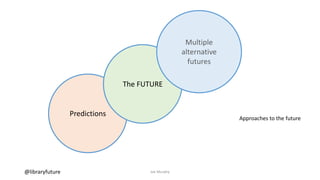
Predictions
@libraryfuture Joe Murphy
The FUTURE
Multiple
alternative
futures
Approaches to the future
Multiple
alternative
futures
Multiple
alternative
futures
There are no rules about the future
but are there laws?
@libraryfuture Joe Murphy
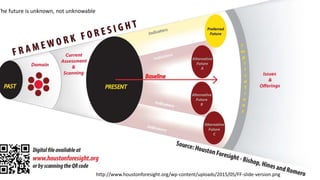
http://www.houstonforesight.org/wp-content/uploads/2015/05/FF-slide-version.png
The future is unknown, not unknowable
@libraryfuture
Joe Murphy
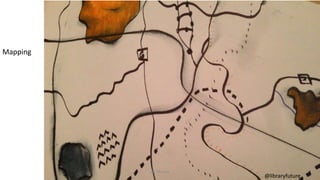
Mapping
Art by Eileen Jerrett
@libraryfuture Joe Murphy
unwrapping the present, the current era Art by
Eileen Jerrett
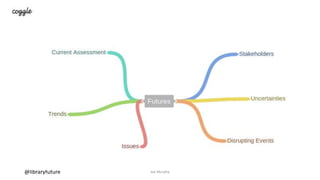
@libraryfuture Joe Murphy https://coggle.it/
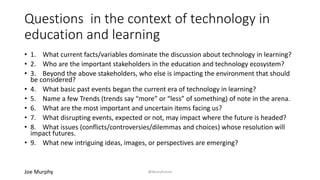
Questions in the context of technology in
education and learning
• 1. What current facts/variables dominate the discussion about technology in learning?
• 2. Who are the important stakeholders in the education and technology ecosystem?
• 3. Beyond the above stakeholders, who else is impacting the environment that should
be considered?
• 4. What basic past events began the current era of technology in learning?
• 5. Name a few Trends (trends say “more” or “less” of something) of note in the arena.
• 6. What are the most important and uncertain items facing us?
• 7. What disrupting events, expected or not, may impact where the future is headed?
• 8. What issues (conflicts/controversies/dilemmas and choices) whose resolution will
impact futures.
• 9. What new intriguing ideas, images, or perspectives are emerging?
Joe Murphy @libraryfuture
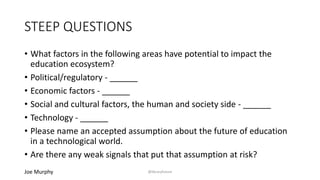
STEEP QUESTIONS
Joe Murphy @libraryfuture
• What factors in the following areas have potential to impact the
education ecosystem?
• Political/regulatory - ______
• Economic factors - ______
• Social and cultural factors, the human and society side - ______
• Technology - ______
• Please name an accepted assumption about the future of education
in a technological world.
• Are there any weak signals that put that assumption at risk?
@libraryfuture Joe Murphy
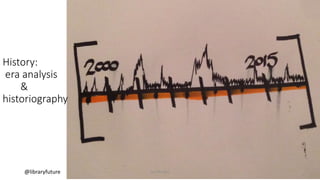
History:
era analysis
&
historiography
@libraryfuture Joe Murphy
Expected
Normative
Baseline
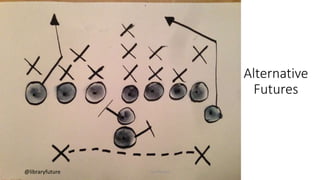
Alternative
Futures
@libraryfuture Joe Murphy
The prototypical futurist tool
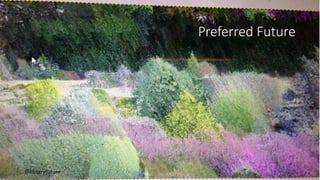
Preferred Future
@libraryfuture Joe Murphy
Implications
@libraryfuture Joe Murphy
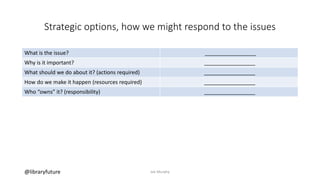
Strategic options, how we might respond to the issues
What is the issue? _________________
Why is it important? _________________
What should we do about it? (actions required) _________________
How do we make it happen (resources required) _________________
Who “owns” it? (responsibility) _________________
@libraryfuture Joe Murphy
Design Thinking
@libraryfuture Joe Murphy Art by Eileen Jerrett
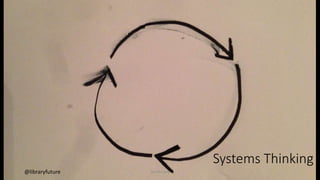
Systems Thinking
@libraryfuture Joe Murphy
Scenario
planning
@libraryfuture Joe Murphy
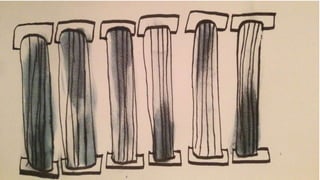
Six Pillars as another foresight method
Joe Murphy
Spiral dynamics
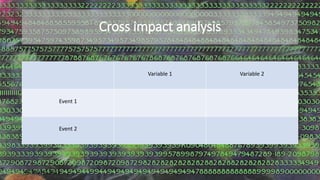
Cross impact analysis
Variable 1 Variable 2
Event 1
Event 2
@libraryfuture Joe Murphy
Art by Eileen Jerrett
@libraryfuture Joe Murphy
Big questions
If we are now in the knowledge age, what is next?
Joe Murphy @libraryfuture
What to ask/give futurists?
Listen for implications when presented with “the future of X is Y”
ask for: what you can provide as the industry insider (trends,
scanning hits, ) to help guide a foresight framework?
share assumptions, facts on recent historical era
Joe Murphy @libraryfuture
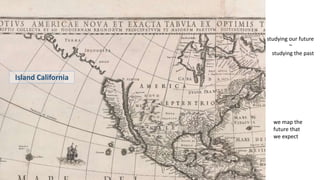
studying our future
~
studying the past
Island California
we map the
future that
we expect
https://searchworks.stanford.edu/view/rs814r
m1327 Copyright Š Stanford
University. Creative Commons
License. Image from the Glen
McLaughlin Map Collection
courtesy Stanford University
Libraries.
https://purl.stanford.edu/rs814rm1327
A simple goal
For us to walk away with an additional question or two
to ask when considering our futures
Joe Murphy @libraryfuture
Takeaways
The future does
not have to be a
surprise
The future does not
have to be solely
pushed externally
When the future is a
surprise - you have what it
takes to deal with it (and
guide it)
Joe Murphy @libraryfuture
@libraryfuture Joe Murphy
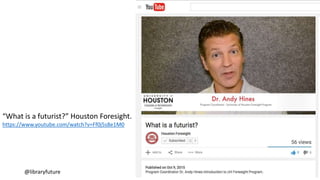
“What is a futurist?” Houston Foresight.
https://www.youtube.com/watch?v=Ff0j5s8e1M0
Joe Murphy
My Story:
Physics Degree -> MLISc – Uni Hawaii
-> Yale Science Librarian
-> Director Library Futures
-> MBA -> M.S. Foresight
My Habitat:
http://libraryfuture.com
Libraryfuture@gmail.com
Twitter @libraryfuture
www.linkedin.com/in/joemurphylibraryfuture

Futures strategies spotlight presentation CMTC by Joe Murphy librarian futurist

Editor's Notes

  • #3 This geographically accurate London Tube map took a freedom of info act to release. This story reveals how design impacts futures, explores now vs long term costs, helps us understand the value of peripheral vision and blind spots revealed through disruption (if most of our forecasts include X, in what situations might X be tossed aside?). The lesson I take away is about incorporating multiple approaches to futures (design thinking), considering multiple stakeholders (today’s and tomorrow’s workers and their ec0nomic web), the question of how to measure impacts for metrics that have not emerged, soft and hard soft impacts and foresight solutions (the people and their economic impact).
  • #4 Ways of looking at the future. Discrete events, a singular future, alternative futures via foresight
  • #5 The future is knowable. As knowable as the past.
  • #6 We have a process - a set of strategies, dominated by the Framework Foresight model. Framework Foresight Graphic - http://www.houstonforesight.org/?p=4289
  • #7 We first map the domain
  • #8 Current Assessment, understand the cohesive current era
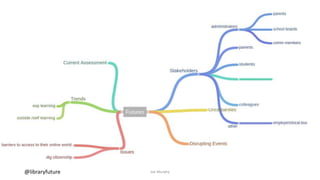
  • #9 Basic example of a domain mind map
  • #12 We created this mind map live using https://coggle.it/ filing in the key stakeholders, trends (more or less, a vector with direction and magnitude), and Issues. Great live audience input.
  • #13 Mapping recent history. What defined the previous time period?
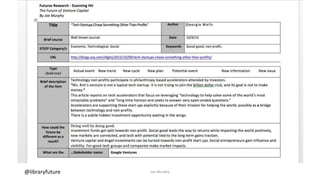
  • #14 Scanning as a Structure to horizon scanning. This scanning hit form is used in the University of Houston Framework foresight model.
  • #15 The Baseline future is an extension of what we see now. Current plans & projections will continue, defined by macro trends and indicators. Baseline futures are interesting because they explore the current conditions and their consequences extrapolated out tens of years. It is thus the least likely. If we stop at the baseline we are making a prediction and not a forecast.
  • #16 Alternative Futures are the ‘prototypical futurist tool.’ Because all futures contain built in uncertainties and there are multiple plausible futures, we think in uncertainties within a range of plausible futures. A cone of possibility. Beyond the baseline, alternative futures are driven by weak signals, by asking what disrupting events, expected or not, may impact where the future is headed? What are the most important and uncertain items facing us?
  • #17 Amongst the alternative futures is our Preferred Future. An aspirational vision, an image of the future. Where we want to aim. The guiding star we work towards even if we fall short.
  • #18 What do we do now? Implications of the futures, of these scenarios for the stakeholders leveraged for insight into issues and policies. We ask what issues are looming, conflicts or choices, whose resolution will impact and guide futures. These may be a “raw material for generating ideas.”
  • #19 It is a cycle, a feedback loop, iteration
  • #21 Foresight is multidisciplinary. It includes (and overlaps with) fields and practices such as Design Thinking. Craft responses to strategically respond to issues or opportunities suggested by scenarios.
  • #22 Systems feedback is another approach. The ecosystem has inputs and outputs. Foresighters are problem solvers. We operate in an ecosystem and can put leverage onto keystone species (stakeholders) to impact change.
  • #23 Scenarios are another foresight method. They leverage diverse perspectives. Not designed to be predictions, meant to expand thinking beyond business as usual. See the new Koppel book, and Kahane’s South Africa example. Sci-fi (creative scenarios about the future freed from demonstrable boundaries),
  • #24 Six Pillars is another foresight method. Brief overview. Similarities.
  • #25 Spiral dynamics is a model for exploring human development
  • #26 Cross Impact Analysis
  • #27 Creativity methods, strengths, structure, empowerment, as tool
  • #28 Big Questions. Analyze questions in depth from one method (Integral is great for this) then have each team member share and compare the topic from that method’s perspective.
  • #29 And applying measurements to alternative futures
  • #32 The story of “Island California.” When our maps were built upon and recapitulated an assumption. https://searchworks.stanford.edu/view/rs814rm1327 Copyright Š Stanford University. This work is licensed under a Creative Commons Attribution-NonCommercial 3.0 Unported License. Image from the Glen McLaughlin Map Collection courtesy Stanford University Libraries. https://purl.stanford.edu/rs814rm1327
  • #35 “What is a futurist?” Houston Foresight. https://www.youtube.com/watch?v=Ff0j5s8e1M0