Teaching About The Future Peter C Bishop Andy Hines Auth
Teaching About The Future Peter C Bishop Andy Hines Auth
Teaching About The Future Peter C Bishop Andy Hines Auth
Teaching About The Future Peter C Bishop Andy Hines Auth
Teaching About The Future Peter C Bishop Andy Hines Auth
1.
Teaching About TheFuture Peter C Bishop Andy
Hines Auth download
https://ebookbell.com/product/teaching-about-the-future-peter-c-
bishop-andy-hines-auth-5373618
Explore and download more ebooks at ebookbell.com
2.
Here are somerecommended products that we believe you will be
interested in. You can click the link to download.
Interdisciplinary Teaching About Earth And The Environment For A
Sustainable Future 1st Ed David C Gosselin
https://ebookbell.com/product/interdisciplinary-teaching-about-earth-
and-the-environment-for-a-sustainable-future-1st-ed-david-c-
gosselin-7321212
Geography As Inquiry Teaching About And Exploring The Earth As Our
Home Mark Newman Jack Zevin
https://ebookbell.com/product/geography-as-inquiry-teaching-about-and-
exploring-the-earth-as-our-home-mark-newman-jack-zevin-51991496
Developing Writing For Different Purposes Teaching About Genre In The
Early Years 1st Edition Jeni Riley David Reedy
https://ebookbell.com/product/developing-writing-for-different-
purposes-teaching-about-genre-in-the-early-years-1st-edition-jeni-
riley-david-reedy-51280616
From Hiphop To Hyperlinks Teaching About Culture In The Composition
Classroom Editor Joanna N Paull
https://ebookbell.com/product/from-hiphop-to-hyperlinks-teaching-
about-culture-in-the-composition-classroom-editor-joanna-n-
paull-42802066
3.
Teaching About RaceAnd Racism In The College Classroom Notes From A
White Professor Cyndi Kernahan
https://ebookbell.com/product/teaching-about-race-and-racism-in-the-
college-classroom-notes-from-a-white-professor-cyndi-kernahan-21965572
Teaching About Scientific Origins Studies In The Postmodern Theory Of
Education Leslie Sandra Jones
https://ebookbell.com/product/teaching-about-scientific-origins-
studies-in-the-postmodern-theory-of-education-leslie-sandra-
jones-2392822
Teaching About Technology An Introduction To The Philosophy Of
Technology For Nonphilosophers 1st Edition Marc J De Vries Auth
https://ebookbell.com/product/teaching-about-technology-an-
introduction-to-the-philosophy-of-technology-for-nonphilosophers-1st-
edition-marc-j-de-vries-auth-4385736
Teaching About Technology An Introduction To The Philosophy Of
Technology For Nonphilosophers 2nd Edition Marc J De Vries Auth
https://ebookbell.com/product/teaching-about-technology-an-
introduction-to-the-philosophy-of-technology-for-nonphilosophers-2nd-
edition-marc-j-de-vries-auth-5605906
Teaching About Technology An Introduction To The Philosophy Of
Technology For Nonphilosophers 1st Edition Marc J De Vries
https://ebookbell.com/product/teaching-about-technology-an-
introduction-to-the-philosophy-of-technology-for-nonphilosophers-1st-
edition-marc-j-de-vries-1630276
Other books byPeter C. Bishop and Andy Hines:
ConsumerShift: How Changing Values Are Reshaping the Consumer Landscape,
A. Hines
Managing Your Future as an Association, A. Hines, J. Coates, J. Jarratt &
J. Mahaffie
Thinking about the Future: Guidelines for Strategic Foresight, A. Hines & P. Bishop
2025: Scenarios of US and Global Society as Reshaped by Science and Technology,
A. Hines, J. Coates & J. Mahaffie
8.
Teaching about theFuture
Peter C. Bishop
University of Houston, USA
and
Andy Hines
University of Houston, USA
To the faculty,students, graduates, and administrators in the
University of Houston System who have contributed to this
new discipline of Strategic Foresight over the last 35-plus years.
vii
Contents
List of Tablesxii
List of Figures xiii
Preface xv
Purpose xviii
Acknowledgements xix
Introduction 1
Introducing the Future 1
Why teach the future? 2
The problem of prediction 3
The future(s) 5
Be prepared 7
Imagine the future 9
Create the future 11
The Tricks of Foresight 11
Telling stories 11
Pursuing visions 12
The benefits of foresight 12
Structure of the Book 14
Part I Understanding 17
1 Models of Change 19
Introduction 19
Understanding Change 20
What is change? 21
How much change is there? 21
The four dimensions of change 22
A model of change: Punctuated equilibrium 34
Alternative Futures 39
“What can we know about the future?” 39
(Not) predicting the future 40
Certainty 45
Assumptions 47
Types of futures: The cone of plausibility 49
13.
Futures Methods 52
Somedefinitions around methods 53
Thinking about the Future framework 54
Conclusion 60
Resources 60
2 Systems Thinking 63
Introduction 63
History 64
Generalization 66
System behaviors 70
Approach 73
Cybernetic systems 74
Complex adaptive systems 81
Conclusion 90
Resources 91
3 Perspectives on the Future 97
Introduction 97
History 98
Empirical and cultural 98
Critical 100
Integral 100
Generalization 101
Approach 102
Causal Layered Analysis 102
Integral Futures 105
Conclusion 108
Resources 109
4 Social Change 112
Introduction 112
History 112
Generalization 114
Explaining social change 114
Critical assumptions 117
Approach 119
Conclusion 148
Resources 151
Part II Mapping 157
5 Research 159
Introduction 159
viii Contents
14.
History 160
Generalization 161
Choosinga domain 161
Primary research 162
Secondary research 164
Approach 165
Research supports framework forecasting 165
Conclusion 173
Resources 173
6 Scanning 176
Introduction 176
History 178
Generalization 180
Why scanning is difficult 180
Approach 181
Identify scanning hits 182
Operate at different levels of the domain 184
Keep an eye on wildcards 186
Keep track of your hits 187
Distinguish types of scanning hits 188
Establish criteria for evaluating scanning hits 189
Conclusion 190
Resources 191
7 Forecasting 194
Introduction 194
History 195
Generalization 196
Forecasting theory 198
Approach: Framework Forecasting 201
2. Summary 202
4. Era analysis 203
5. Baseline forecasting 203
Critical thinking 207
6. Baseline analysis 210
Creativity 211
7. Alternative futures forecasting 214
8. Scenario kernels 219
Conclusion 220
Resources 221
Contents ix
15.
Part III Influencing223
8 Leadership 225
Introduction 225
History 225
Era 1. Traits 226
Era 2. Situation 226
Era 3. Effectiveness 226
Era 4. Contingency 227
Era 5. Shared leadership 227
Era 6. Managers and Leaders 227
Generalization 228
Leadership distinctions 230
Approach 231
Leading people into new territory 232
Exploring boundaries of the possible 232
Committing to goals they do not know how to achieve 232
Building bridges when they know only one side of
the river 233
Motivating people to do what they don’t want to do 233
Conclusion 233
Resources 234
9 Visioning 236
Introduction 236
History 237
Generalization 239
Attributes of a vision 239
Vision statements 241
Approach 242
Values 242
Background 243
Conclusion 248
Resources 250
10 Planning 252
Introduction 252
History 253
Generalization 254
Approach 255
1. Planning to plan 257
2. Understanding the future 258
3. Setting the direction 261
4. Developing the plan 263
x Contents
16.
Conclusion 266
Resources 266
11Change Management 269
Introduction 269
History 269
Generalization 271
Approach 274
1. Have a good reason 274
2. Be honest about the process 275
3. Articulate a vision 277
4. Commit to achieve the vision 277
5. Communicate! 277
6. Generate trust 278
Conclusion 280
Resources 280
Appendices 282
Appendix 1. Framework forecasting specification 282
Appendix 2. World Futures 286
Appendix 3. Scanning form and explanation 288
Appendix 4. Strategic Planning and Change Managemant 291
Bibliography 294
Index 299
Contents xi
17.
xii
List of Tables
P.1History of the Houston Futures program xvi
I.1 Benefits of foresight 13
1.1 Types of futures 51
1.2 Thinking about the Future approach and methods 56
2.1 Systems definitions 66
2.2 Cybernetic and complex systems 88
3.1 Using CLA to analyze boomer retirement 104
3.2 Phases of Integral Futures 108
4.1 Critical assumptions supporting theories of social change 148
5.1 Taxonomy of judgmental data-gathering techniques 163
5.2 Sample interview plan 164
5.3 Clark’s research strategy 166
5.4 Research aspects of framework forecasting 167
5.5 PC era vs. Internet era 171
6.1 Diffusion of ideas 183
6.2 Three levels of scanning 184
6.3 Types of scanning hits 188
6.4 Criteria for evaluating scanning hits 189
7.1 IDEA framework for creative problem-solving 213
7.2 Scenario (alternative futures) techniques 215
9.1 Four types of values 243
9.2 Five stages of developing visions 245
10.1 Steps in strategic planning 256
10.2 Dimensions of an initiative 265
11.1 Eight reasons for organizational change 276
A.1 Framework forecasting specification 282
A.2 Goal hierarchy 293
18.
xiii
I.1 Plausible optionsincrease in the future 6
I.2 Shifting the cone 9
1.1 Sources of change...as covered in text 23
1.2 Levels of change 26
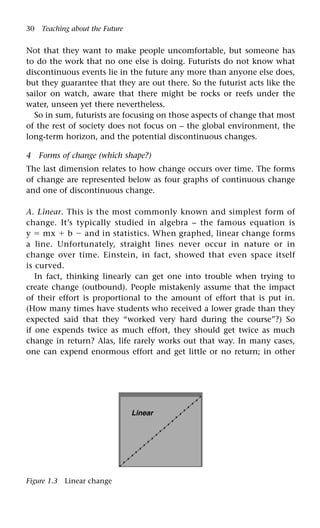
1.3 Linear change 30
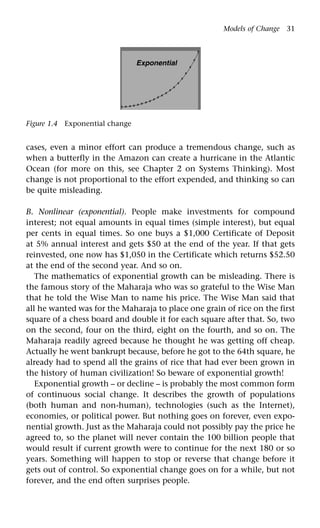
1.4 Exponential change 31
1.5 Asymptotic change 32
1.6 Cyclic change 32
1.7 S-curve 33
1.8 Punctuated equilibrium 34
1.9 Transitions between eras 35
1.10 Successive eras 37
1.11 Four types of futures 42
1.12 Language of plausibility 43
1.13 Cone of plausibility 50
1.14 Thinking about the Future framework 55
2.1 Understanding system behavior 68
2.2 Attacking the deficit 72
2.3 Reinforcing (positive feedback) loop 78
2.4 Balancing (negative feedback) loop 78
2.5 Stock-flow model 79
2.6 Modeling population increase 80
2.7 Three types of systems 85
2.8 Four types of systems 87
3.1 Five levels of the curriculum 98
3.2 The layers of Causal Layered Analysis 102
3.3 Wilber’s four quadrant model 106
4.1 Critical assumptions 149
List of Figures
19.
6.1 Scanning hitform 182
6.2 Porter’s five forces 185
6.3 STEEP 186
6.4 Molitor’s emerging issue curve 187
7.1 Framework forecasting 203
7.2 Futures wheel 207
9.1 Vision statements 237
9.2 Presence: Human Purpose and the Field of the Future 249
10.1 Steps in strategic planning 257
10.2 Levels of change 259
10.3 The organization model 260
10.4 Greater impact? 262
10.5 Goal hierarchy 263
11.1 Roger’s innovation diffusion curve 270
A.1 Scanning form 288
xiv List of Figures
20.
xv
Preface
This book isthe product of more than 35 years of accumulated experi-
ence of the faculty teaching foresight on the Graduate Program in
Futures Studies, first at the University of Houston-Clear Lake (UHCL)
and now at the University of Houston (UH). The program was estab-
lished by Dean Calvin Cannon and Chancellor Alfred Neumann in
1975. Dean Cannon’s rationale for establishing this program in that
new university was simple, “We study the past, don’t we? Why can’t we
study the future?” And from that simple thought came the first official
degree in foresight.
Dean Cannon hired two academic futurists to staff the program:
Jib Fowles, a sociologist and communications professor from the New
School for Social Research, where he studied with Alvin Toffler for a
time, and Chris Dede, a futurist of educational technology who drafted
his own futures degree at the University of Massachusetts. These faculty
then hired Oliver Markley from Stanford Research Institute to turn the
program into a more applied and professional direction. Peter Bishop
started teaching in the program in 1983, coming from Michigan State
University with degrees in sociology and social change. Andy Hines
took his degree from the program in 1990 and has now returned to UH
to teach and prepare students as professional futurists.
The curriculum for the futures program has evolved over that time,
but it has remained remarkably stable over the last ten years. Dr Bishop
started putting courses online in 2001, requiring a new level of speci-
ficity in what students had to learn and do in each course and each
class. It is now time to share that curriculum with the rest of the futures
community and with educators in general.
Foresight appeared in public first in France in the 1950s and then
in the US and elsewhere in the 1960s. Since then, hundreds of futures
courses have been taught around the world. But that number pales in
comparison with the number of courses taught about the past, that
is, history. There are still only a dozen or so graduate degrees in the
world and no doctoral program yet. So it is unfortunate that in times of
intense change, where creativity and innovation are required for com-
petitive success, little knowledge of how to anticipate and influence the
future is provided for students. It’s not the teachers’ fault. They were not
taught about the future either.
21.
This is wherethis book comes in. The University of Houston has been
teaching and preparing professional futurists for decades. Now it is time
to expand that mission to educators everywhere. The authors believe
that it is possible to include futures thinking into every discipline at
every level of education, particularly high schools, colleges, and profes-
sional schools. In fact, it is our vision that, in the long run, teaching
about the future is as common as teaching about the past. The past is
where the record of human achievement and failure appear; the future
is where people will live as time goes on. Should they not get equal
time? Should not every high school and college student who takes a
course in world history also take a course in world futures? Should they
not learn to envision, plan, and execute plans to create change toward
a more preferable future? Of course they should.
So this book contains the UH foresight curriculum from start to
finish. It contains approximately one chapter for every course in the
xvi Preface
Table P.1 History of the Houston Futures program
Year Event
1975 University of Houston-Clear Lake (UHCL) establishes the Futures
program
Jib Fowles and Chris Dede join as charter faculty
1978 Oliver Markley joins faculty from the Stanford Research Institute
1983 Peter Bishop starts teaching in Futures program
1996 Wendy Schultz joins faculty as Visiting Professor
2000 World Future Society holds annual conference in Houston, and annual
“Best of Houston” session featuring student work begins
2001 Alumni Retreat proves instrumental in founding of Association of
Professional Futurists the following year
2001 Chris Jones joins faculty and World Futures Studies Federation
Secretariat is hosted by the program
2001 Program begins putting courses online (one per semester until entire
curriculum online)
2005 Andy Hines joins as Lecturer, as program moves to UH main campus
2007 UH Main campus re-approves the program
2007 Hines & Bishop publish Thinking about the Future
2008 Students earn first of three APF Student Papers Awards: Charles
Kennedy (2008), Darko Lovric (2009), Elizabeth Chapman (2010)
2009 35th Anniversary Celebration
2009 Certificate program in Strategic Foresight begins
22.
curriculum. It isalso the basis of a week-long Certificate in Strategic
Foresight course, a day-long Introduction to Foresight course and other
training programs offered in organizations every year. Our students,
clients, and professional colleagues suggest that this approach brings
it all together. It integrates the best of what futurists around the world
have been teaching in a common-sense and practical approach.
Teachers may not be able to teach everything in this book. It could
be a textbook for an introductory course in foresight, which would be
fine. But more importantly, it contains ideas and approaches that could
be incorporated in history, social science, science, and even mathemat-
ics courses. Teaching about the future is not a big mystery. People use
foresight every day. Why not explicitly teach students to use their natu-
ral human instinct to anticipate, plan, and influence their own future
and the future of their organizations and communities. What greater
mission could we as teachers have than to really prepare students for
the future!
Preface xvii
23.
xviii
Purpose
This work isa conceptual description of the field as developed and
taught by the University of Houston’s Graduate Program in Futures
Studies. It is the basis of our curriculum, which has adapted and evolved
over the last 37 years in response to new developments in the field and
changes in the marketplace for foresight. A consistent theme over this
time, among the foresight community in general and foresight educa-
tors in particular, has been the need for a consistent and comprehensive
description of the field – for someone to bring it all together. This is our
attempt at doing so. And our hope is that others will adopt this descrip-
tion as a basis for a standard curriculum. We have shared it with several
other programs over the years in that hope. This publication will help
us to reach a much wider audience. We will be happy even if we are just
able to nudge the field in a common direction.
A secondary purpose of the book is to support the training that the
program has been doing in addition to the Master’s Degree program.
We have supplemented the Master’s program with a range of other
offerings: extension courses, a week-long Certificate course, a day-long
Introduction to Foresight course, a Futurizing Your Teaching Practice
course for teachers, and a Futures Summer Camp for students. Our
participants will benefit from a big-picture yet detailed overview of the
field.
A third purpose is to give secondary and college teachers an approach
to futures that they can use in their classes. The book will be more
conceptual, but they should be able to read it through, or at least select
chapters so they might use some of the ideas in their classes.
Finally, the book could, in the future, be adopted as a text in a col-
lege introductory course. It will certainly be used in our Introduction
to Foresight course.
24.
xix
Acknowledgements
No great thingis created by one person alone or in any short period of
time. And the Graduate Program in Futures Studies at the University
of Houston is no exception. Today’s curriculum has been inspired by
and drawn upon the collective wisdom of its superb faculty over the
years: Jib Fowles, Chris Dede, Jim Bowman, Fred Kierstead, Jim Coomer,
Wendy Schultz and Chris Jones, and the current faculty including Terry
Grim, Draper Kaufman, and Cindy-Frewen-Wellner.
We are grateful to Shirley Ezell for bringing the program to the atten-
tion of Dean William Fitzgibbon, of the College of Technology at the
University of Houston, who invited the authors to re-establish the pro-
gram there in 2007 under the leadership of Ezell and Department Chair
Carole Goodson.
Thanks to the program’s Advisory Board members for providing valu-
able “real world” feedback: Joel Barker, Clem Bezold, Napier Collyns,
Tom Conger, Christian Crews, Ted Gordo, Dominique Jaroula, Jennifer
Jarratt, Oliver Markley, Pero Micic, Amy Oberg, Dave Rejeski, Paul Saffo,
Wendy Schultz, and Lee Shupp.
Also, thanks to our many professional colleagues who have helped
the program over the years in many different ways, whether visiting for
a lecture, offering an internship or job to a student, and the like.
Finally, and perhaps most important, thanks to the students and
alumni who have each left their mark on the program in some
important way – without you, none of this happens.
25.
1
Introduction
INTRODUCING THE FUTURE
Foresightis fundamentally about the study of change. Of course, futur-
ists are not the only ones who study change. Scientists study change
in physics (the motion of bodies), astronomy (the formation of stars
and planets), chemistry (chemical reactions), biology (the evolution of
species), and in a whole host of other disciplines. The social sciences
also study change at the personal level (psychology), at the group,
organizational and societal levels (sociology), and at the cultural level
(anthropology). In fact, two disciplines are particularly concerned
with change: history studies change in the past; journalism chronicles
change in the present. And that is where foresight fits in. Most people
think of time as flowing from the past (history), through the present
(journalism), and into the future. Therefore, just as historians study
the past and journalists the present, so futurists study the future. It is
interesting that history is an ancient discipline and journalism has been
around a long time. Why don’t we have an academic discipline that
studies the future?
Oh yeah! The future hasn’t happened yet. Can futurists study some-
thing that doesn’t exist? On the face of it, that’s a big problem. Of
course, historians study something that doesn’t exist either – the past.
It did at one time, but it doesn’t exist anymore.
The big difference between history/journalism and foresight, how-
ever, is that history and journalism have direct evidence of the changes
they are describing. Historians have artifacts (tools, books, buildings)
from which they can infer what life was like in the past; journalists
have statements, statistics, and their observation of events to describe
change in the present. How can a futurist infer what is going to happen
26.
2 Teaching aboutthe Future
in the future when the people there have not yet created the artifacts
and statistics to use as evidence?
Why teach the future?
It is disappointing that so few people teach about the future when, in fact,
people will live the rest of their lives there. Almost everything people do is
intended to understand or to influence the future. But where is the future
in our educational systems? A fair amount is studied about the past – as it
should be – but why not study an equal amount about the future?
We should teach as much about the future as
we do about the past
There are two answers to that question – one professional and the
other epistemological. The professional answer is that teachers do not
teach what they do not know. Since they were never taught about
the future, how can they be expected to teach their students about the
future? The more important and deeper answer, for most people, is that
the future is unknowable. You cannot teach things you cannot know.
But that is a fallacy. The future is knowable in exactly the same way that
next week’s weather is knowable or next week’s stock market or next
week’s ball scores. They can be known as a set of possibilities, as plaus-
ible alternative futures, any one of which has a significant chance of
occurring. Granted, knowing a set of possibilities is not as satisfying as
really knowing what will happen. But when really knowing is impossible,
is it not better to know something about the future (its possibilities)
than to ignore it and know little or nothing?
People and organizations change when the world changes and when
they aspire to do something significant, if not great. The world is chang-
ing and at an accelerating pace. And with this change comes the need
to learn new skills. The current model of public education was created
to prepare students for the industrial age. Be on time, stay in formation,
do the work, accept supervision and, most of all, know the right answer.
These skills made the workers of yesterday’s factories and bureaucracies
successful.
But now, gone is the majority of factory employment and going are
offices wedded to rigid procedures and command-and-control processes.
The pace of the world has quickened, driven by fast-paced information
flows. Flattened organization, networked workers and collaborative tech-
nologies facilitate flexibility and quick response to the information age.
27.
Introduction 3
As theworld environment changes so do the skills for success. The
successful will be those who have mastered the basics of change, how to
anticipate it, how to manage uncertainty and ambiguity, and ultimately
how to proactively create the changes necessary to bend the future to
more preferable outcomes. And the time to teach these skills is now
(Bishop & Strong, 2010, 105).
The problem of prediction
The problem of making statements about the future is, of course, the
problem of prediction. People learn to make predictions when they
observe the consequences of change. The baby that repeatedly throws
Teaching the future to gifted and talented students
Mary Tallent-Runnels (2005) makes the case for teaching the future
to gifted and talented students
Gifted learners have said they love to think about the future, and
this love increases as they become older (Torrance, 1978).
They are more interested in global issues than other students
and sometimes feel helpless to do anything about these issues
(Galbraith, 1985; Tallent-Runnels & Mullen, 2004).
They have the potential for intense social, moral, and ethical
concerns (Passow, 1988).
Gifted learners worry about the future, because they are sensitive
to world problems (Passow, 1988).
They also can be more morally sensitive than others – a trait that
is essential to the welfare of our society (Silverman, 1994).
When supported and guided in positive directions, these qualities
can empower them to successfully manage change (Carroll, 1991)
and to cope with problems in general and change the future
(Torrance, 1974).
Finally, many believe that gifted youth will become our world
leaders and ultimately solve our global problems. Therefore, we
must help them develop their leadership abilities and learn to
think ahead to the world they will lead (Passow, 1988; Roeper,
1988) … They can become change agents and set realistic goals as
they lead others (Carroll, 1991).
•
•
•
•
•
•
•
28.
4 Teaching aboutthe Future
the cup to the floor is engaged in a primitive form of prediction. What
will happen? Will Mommy keep picking it up? How many times? Dan
Barry, former astronaut and Head of Faculty at Singularity University,
famously described watching his two-month-old son discover his foot –
wiggle, wiggle, laugh; wiggle, wiggle, laugh. The capacity to make
predictions is formalized in science class with swinging pendulums,
rolling balls down inclined planes, melting ice cubes and predicting
the outcomes. Each prediction is a statement about what is expected
to happen in the future, and then one checks to see whether or not it
happens as expected. One is right if one measured the initial variables
accurately, put them in the right equations and did the math correctly.
If the prediction does not compute, one has to go back and do it again.
Professional scientists do the same thing. They keep repeating the
experiment until they can predict the outcome.
People also need to predict the future in the world at large so they use
the same process. They believe that all they need to do is understand
the laws that govern human behavior and predict what will happen.
But that the process does not seem to work as well in the world as it did
in the lab. Most predictions about human behavior are almost always
wrong. What good is this prediction thing if it didn’t tell what was
going to happen? Bummer!
Prediction does not work very well in the world of human affairs
because there is not a good, scientific theory of human behavior. In
fact, there are many theories in psychology, anthropology, sociology
and the like. All work to some extent, but they fail just as often. So
there is uncertainty when predicting the outcome of a process involving
human beings. Uncertainty is the reason that the predictive process
developed in the lab does not work in the world. Uncertainty is not
bad in itself. It’s just very inconvenient when it comes to predicting
behavior. In fact it might even be good because it makes people cau-
tious as they approach something new, whether it is an unfamiliar dog
or a new stock tip. What is not generally appreciated is outcomes in the
world involving people are and should be less certain than outcomes in
“hard” sciences.
One can reduce the uncertainty in the lab to very small quantities
over time – first by developing and using more precise measurements
and secondly by developing and using better theories. Uncertainty
is still there, but it is quite small. It can be reduced to very small
quantities with lots of time and money, but it cannot be eliminated.
For example, the official mass of the electron is 9.109381881031
kg.
That’s just over nine-billionths of a billionth of a billionth of a gram!
29.
Introduction 5
But itis still uncertain to about a millionth of a per cent. Plus or minus
0.000001% is good enough for most people! In that case, one can ignore
the uncertainty and go ahead with predictions of the future using that
number.
Technically, one makes an assumption when doing so. One assumes
that the mass of the electron is exactly that number. That is a pretty
good assumption because it almost is. One doesn’t have to worry about
the millionth of a per cent uncertainty in most calculations. So one pre-
dicts the future with confidence and usually gets pretty good results.
What happens when the same reasoning is used in making predictions
in the human world? Is the uncertainty in the human world equivalent
to millionths of a per cent? Hardly! Compared to the physics lab, the
human world is awash in uncertainty. Just look at today’s newspaper. It
contains lots of facts about what happened yesterday, but only random
speculation about what will happen tomorrow. People are so far from
predicting the future state of the world – even by one day – that it is
ridiculous to even try.
And that is why most people do not like to think about the future. It
is why there are no courses or departments on foresight in our schools.
It is why cultures are blind to the future. Ironically and tragically, how-
ever, the future is where people are headed and where they will spend
the rest of their lives. That is why they come to work or to school every
day – to understand and change the future – yet they are ill-equipped
for the task. They have never had any explicit training in change or
the future, and they are trying to use an inappropriate mechanism of
prediction that they learned in science. It doesn’t work. People must
come to understand and influence the future better than they have.
Indeed their very lives depend on it.
The future(s)
Since one cannot predict, does that mean giving up on thinking about
the future? Certainly not, but the approach has to be modified. One
must first give up the possibility of predicting the future on any consist-
ent basis. Sometimes predictions do turn out to be true either because of
a lucky guess or because the world operated according to known rules
during some brief period. But one is not lucky very often, and one does
not know when these periods will be so most of the time cannot count
on being lucky.
However, rather than not thinking about and preparing for the
future altogether, futurists reject the basic assumption that the future
of human affairs is predictable. Instead, they modify it by saying that
30.
6 Teaching aboutthe Future
while it is true that people cannot know the future – the one that will
ultimately become the present – they may be able to know the futures,
the set of plausible futures that one future is drawn from. In this con-
ception, the future is multiple not singular. One is not looking for the
real future amidst a bunch of imposters, but describing all the plausible
futures as a set. The future is understood by mapping the range of plaus-
ible futures and preparing for the whole range.
Admittedly, that solution is not entirely satisfactory. People want to
know the one future, they want to be certain, and they want to be right.
If they are, they can prepare more precisely for that one future. But that
knowledge is impossible for all the reasons given above. Given that, would
it not be better to know something about the future rather than to know
nothing? When the weather turns bad and one has to keep driving, one does
not close one’s eyes and refuse to look down the road because one cannot
see very far anyway? Of course not. In fact, a driver looks harder, straining
to pick up any clue of what lies ahead. They think of the possibilities –
a curve, a pothole, a car stalled in the middle of the road – and prepare for
all of them. Is one angry or sad that none of those possibilities occurred?
That the forecast of possibilities was wrong? Of course not! One is happy
to have gotten through that stormy drive without incident. By the same
token, one should not try to be “right” about the future. Being prepared
for whatever does occur is a lot more important.
So, in the same way, futurists look more carefully at the signs leading
to the future, because they can’t predict accurately. It’s a harder job to
deal with multiple possibilities, and the result is less satisfactory, but it
is better than closing one’s eyes and hurling oneself blindly into the
future.
Most people’s image of the future is a line, or a road, or a river, or even
a rollercoaster (depending on how thrilling they think the ride will be!).
Figure I.1 Plausible options increase in the future
Source: Based on Charles Taylor, Army War College.
Limit of Plausibility
Lim
it of Plausibility
Long
Medium
Short
31.
Introduction 7
It isa continuous strip of time leading from now to then. A better
image, given our inability to see the road ahead, is a cone, an expanding
set of plausible futures. The cone is relatively narrow in the short-run.
One is pretty sure of what will happen next because the number of
plausible alternatives is low. But as one moves into the medium and
long term, the range expands revealing some interesting, challenging,
even exciting futures.
Futurists are those who survey and explore the full range of plausible
futures and share what they find. They help people expand their narrow
focus on one future to a broader range of other possibilities. The key
underlying principle is that the future is actually a set of futures from
which a subsequent present will be drawn.
Be prepared
The purpose of forecasting, and even of prediction, is not just to know
the future as an abstract description but rather to prepare for it. The
objective is not just to know what will happen but to be ready whatever
does happen. Almost none of the plausible futures will actually occur.
But when one does, one is happy to have made adequate preparations.
That’s success from a futures point of view. The objective is not to be too
right (which is impossible), but rather not to be wrong – not to be
surprised. Surprise means inadequate preparation, late response, risk
of failure, even chaos or panic. Preparing for the full range of plausible
futures is the objective of foresight, reducing the element of surprise.
Foresight is not even that unusual in daily life. Most people buy insur-
ance against catastrophic loss – such as of life, health, or home. They
consider a range of plausible futures, albeit negative ones, and prepare
for their occurrence. They are not expected to predict which year their
house will burn down or which month they will go to the hospital.
They realize that predicting those things is impossible. So they carry
insurance the whole time. They don’t get to the end of the year and
kick themselves because they didn’t use their medical or auto insurance
that year. In fact, they are happy that those bad things did not happen.
And they don’t try to guess whether they will need the insurance the
next year; they pay up and feel comfortable that they are covered no
matter what happens.
People in dangerous occupations think this way all the time. It’s their
way of staying alive. The police officer on the street or the soldier in
combat is continuously thinking about what could go wrong, how they
might be surprised, because they know they are in danger when they
are surprised.
32.
8 Teaching aboutthe Future
People would be much better prepared for their organizational or
work futures if they applied that same logic. They don’t have to predict
what is going to happen as long as they are covered for all the things
that could happen. But is it possible to prepare for everything? Actually,
not. The full range of possible futures is infinite. People can’t consider
them all, much less prepare for them. Therefore, futurists narrow the
range to that of plausible futures, ones that have more than a negligible
chance of occurring.
If one could assign a minimum probability to a plausible future, they
would know for sure which were plausible and which were not, but
probabilities here are quite subjective. Rather, futurists say that a plaus-
ible future is one that has a story that makes sense. One can see how it
might actually occur. An alien landing on the lawn of the White House,
though great for Hollywood, lacks plausibility. But a coming economic
crisis or a serious terrorist attack on the Internet or a breakthrough in
cancer research – those all have stories that people can accept. They can
see them appearing on the front page of the newspaper. They might
even have information that makes those futures more likely.
The line between possible and plausible is subjective, for sure. It
comes down to whether reasonable people with open minds will accept
the story as plausible, whether they have a foundation for believing
that the story could come true. Foundations of stories are used in court-
rooms and fiction all the time. Lawyers and writers have to prepare their
listeners for the appearance of a character or an event. When they don’t,
one’s natural reaction is “Where did that come from?” They do not have
to believe the story is probable, but only that it could actually happen.
The sum of all such stories is the range of plausible futures.
Treating the future as a set of plausible outcomes rather than one
future to be discovered is one of the two major assumptions on which
futurists differ from other forecasters. The other is that people do have
some influence over parts of the future that actually occurs. Most fore-
casters describe the future independent of their actions or the actions
of their clients. That is a fine, even necessary, analytical device to be
able to construct the
forecast in the first
place. Otherwise one
might find oneself in
an infinite recursion
of “what if … and
then what if they …
and then what if
Key assumptions of foresight
1. The future is a set of plausible outcomes
rather than one future to be discovered
2. People do have some influence over which
future actually occurs.
33.
Introduction 9
we …”and on and on. One has to start somewhere, and a world chang-
ing without people’s intervention is as good a place as any.
But one ought not to stop there because the world, or parts of it, is
sensitive to people’s actions. Even though people may not be able to
control the future, as in selecting the exact future they want, they do
have the ability to influence what happens. Influence is like power; it
bends the trajectory of the future toward the future one prefers. The
more influence one has, the more one gets what one wants. Or to put
it in forecasting terms, influence bends the development of the future
into areas that are more preferable and away from areas that are less
preferable.
Imagine the future
People’s degree of influence over the future is the product of two
quantities: their inherent ability to influence the future and the effort
they choose to expend. The ability to influence the future varies by
the domain or topic area. One might have a lot of influence over the
future in some domains, like family or workplace, and relatively little
in others, such as national or world affairs. Secondly, one can choose to
make an effort to influence the future in a particular domain or not. Of
course, those who do not make an effort will have no influence over the
future at all. They must accept the future that other forces create.
Our years of experience teaching and consulting about the future
have persuaded us that most people do not believe they have much
influence over the future. They feel powerless, at the mercy of unseen
and impersonal forces over which they have no control. Such feelings
Figure I.2 Shifting the cone
Source: Based on Charles Taylor, Army War College.
Limit of Plausibility
L
i
m
i
t
o
f
P
l
a
u
s
i
b
i
l
i
t
y
Alternative
Futures
Alternative
Futures
Preferred
Future
34.
10 Teaching aboutthe Future
are understandable. The world is large and complicated. People are
bathed in media that show other people and events that have little
relation to their world or their needs. The future seems to be something
that will be handed to them, whether they like it or not.
On the other hand, a focus on national and world events obscures the
fact that everyone does have a sphere of influence, a part of the world
in which they have some influence. While that influence is never abso-
lute, even over one’s own behavior sometimes, at least one has some
power to create a future that is better than if no effort were expended
at all. And that is the reason that people work, save money, take time
with their kids, even get up in the morning – to exert their influence
on the world.
And that is where futurists come in, as do many other people who
work toward a better world. The message from every motivational
speaker in the world is that people have more influence over the future
than they think. Some will even go so far as to say that one can have
whatever future one wants. They may believe that, but futurists don’t.
There are constraints; no one’s influence – even leaders of nations or
the world’s richest people – is absolute. Everyone must deal with part
of the world that is beyond their control. Nevertheless, most people
have more influence over the future than they are exercising at the
moment.
The power for people to influence their future is related to the quality
of their vision. A vision is a concrete image of a preferred future state.
It is a picture of how one wants things to be. The more attractive and
more concrete the vision, the more it motivates one to expend effort to
work toward it.
Visions work the same for groups (organizations, communities and
societies) as they do for individuals. They portray an attractive, even com-
pelling future that motivates the members to work together to achieve
it. The great visionaries of history (Moses, Jesus Christ, Mohammed,
Buddha, Lincoln, Gandhi, King) were able to inspire people with their
vision of a better world. Many people, of lesser stature perhaps but no
less noble purpose, are trying to do the same thing today.
But one does not have be a grand historical leader to have a vision,
to be a visionary, or to change the part of the world over which they
have some influence. Truck drivers can pursue their craft with the same
zeal for safety, dependability and customer service that Moses had lead-
ing the Hebrews from Egypt. Each is pursuing their vision of a better
world; each is creating change in themselves and in the people who
know them.
35.
Introduction 11
Create thefuture
The follow-on to vision is the effort it takes to organize and mobilize
resources to achieve that vision. In some cases, those actions seem to
leap into existence. More ordinary mortals must plan, persuade and
scavenge to get the resources to achieve their vision. Preparing to work
to achieve a vision is called strategic planning. Unfortunately, most
strategic planning isn’t strategic; it is incremental, such as some per cent
increase over time. True strategic planning is transformational. It identi-
fies the long-term goals and strategies that will move the individual or
the organization toward their vision. It also kicks off near-term initiat-
ives that start to implement those strategies. The purpose is to create
a long-term transformation that creates a better future.
The final step in creating that future is implementation, often
called change management because it is fundamentally the creation
of change. The objective is to change the world. In order to do that
effectively, most individuals and organizations usually have to begin
by changing themselves. Their strategic goals and the implementa-
tion of their long-term strategies usually require them to be different
than they were in the past. Change management is first of all building
the capacity to change and to bring about change – first in oneself, then
in others and finally in the world. It is a wrenching process because it
involves uprooting old beliefs and habits in order to make way for new
attitudes and abilities. But without it, the individual and the organiza-
tion will simply be unable to move forward toward the vision. As the
famous philosopher once said, “If you keep doin’ what you been doin’,
you’ll keep gettin’ what you been gettin’.”
THE TRICKS OF FORESIGHT
Every field – accounting, law, medicine, engineering, and so on – has
its tricks. Experienced practitioners learn the tricks and produce better
results than those without their experience. Foresight has two tricks
that stand out as most useful. The extent to which one practices those
tricks and encourages others to do the same, the better prepared one
will be and the more the future will match one’s aspirations.
Telling stories
Storiesareanancientformofcommunication.Story-tellingmightevenbe
hard-wiredintopeople’sevolutionarymechanism.Thestoryhasmeaning
and carries a message using details that may not be true. Novels, movies,
36.
12 Teaching aboutthe Future
even some music contain stories about fictional characters. The events
are not true, but the message is. A scenario is a story about the future.
The details of the
scenario may not
be true; in fact,
they probably
are not. But the
message may be
true – the essence
of a plausible
futurethatshould
be considered
and perhaps
prepared for. The
extent to which
one tells stories every day, the more prepared one will be for a surprising
future.
Pursuing visions
A vision is the story of an ideal state which, if one works hard and is lucky,
one just might achieve. It’s this side of a dream or wish; it’s not magic. But
it is bold and ambitious. “Could we?” “Might we?” Those are the initial
reactions to visions. When the answer is “Yes we can,” that’s when the race
begins. Pursuing a vision is what a full life is about – it motivates, energizes
and empowers one to do extraordinary things. Even though the vision
itself may be elusive, chasing it sets one off strongly in the right direction.
People and organizations not afraid to consider the future in all its
uncertainty and complexity and not afraid to pursue a vision that is almost
beyond expectation are the people and organizations that are not only
prepared for the future but also those who will be a major force in shaping
it. Management guru Peter Drucker once said, “The best way to predict the
future is to create it.” While that is not entirely true, the more influence
one exerts on the future, the better the odds of having a better future.
THE BENEFITS OF FORESIGHT
An analysis of our last book, Thinking about the Future (2007), which
culled the collective wisdom of three dozen professional futurists glo-
bally, identified 316 benefit statements from applying foresight. Table I.1
shows how these are sorted into the Thinking about the Future frame-
work, which comprises six categories: framing, scanning, forecasting,
Elements of a good story [scenario]
Storybook more than just a description
Specific facts, events, names, dates
Plausible it could happen
Relevant it would change the future
Dramatic conflict, suspense, unresolved issues
Balanced bad things have good consequences
good things have bad consequences
Personal putting individual in the future
Integrated cohesive; plot hangs together
37.
Introduction 13
visioning, planningand acting (covered in greater detail in Chapter 1).
(Note: The number in parenthesis shows each item as a percentage of
overall benefits. Thus, 22% of the benefits statements related to framing,
9% of which related to “Thinking more diverse …” and so on.)
What stands out in Table I.1 is the high percentage of benefits attrib-
uted to the “bookends” of the foresight framework: framing and acting.
Futurists have recognized the importance of being as clear as possible
about what the problem to be studied really is, and that the problem as
presented is not always the “real” problem. Also, futurists have recog-
nized the importance of being more action-oriented, of not studying for
the sake of studying but being oriented to spurring action.
The table suggests less emphasis on visioning and planning than
might have been expected. But, on reflection, these activities were
reengineered, or drastically reduced, in the 1980s and early 1990s. So
foresight repositioned itself accordingly to meet the needs of today’s
Table I.1 Benefits of foresight
Activity Benefits
Framing (22%)
Scoping the project.
1. Thinking more diverse, open, balanced and
non-biased (9%)
2. Focusing on the right questions and problems
more clearly (7%)
3. Being aware of, and influencing, assumptions
and mental models (6%)
Scanning (16%)
Collecting information.
4. Understanding the context, in all its complexity,
through establishing frameworks (5%)
5. Anticipating change and avoiding surprise (11%)
Forecasting (22%)
Considering a range of
future possibilities.
6. Producing more creative, broader, and deeper
insights (17%)
7. Identifying a wider range of opportunities and
options (5%)
Visioning (10%)
Choosing a preferred
future.
8. Prioritizing and making better and more robust
decisions (10%)
Planning (7%)
Organizing to achieve the
vision.
9. Constructing pathways from the present to the
future that enable rehearsing for the future (7%)
Acting (23%)
Implementing the plan.
10. Catalyzing action and change (7%)
11. Building alignment, commitment and
confidence (14%)
12. Building a learning organization (2%)
Source: Hines, A. (2007).
38.
14 Teaching aboutthe Future
organizations. This “repositioning” is amply demonstrated by the
single highest scored benefit: “more creative, broader, deeper insights.”
Organizations today see foresight as a useful means to stretch their
thinking about consumer behavior, new product and service devel-
opment, or where technology is headed – in short, helping them to
identify what they need to do today to thrive tomorrow.
STRUCTURE OF THE BOOK
So, how do you teach people about the futures? At the highest level, one
needs to understand how to think about the future conceptually, then
one needs to be able to map the future, or craft descriptions of what the
future might look like, and finally, one needs to know how to influence
the future. These three over-arching categories – understanding, map-
ping and influencing – are used as organizing principles in forming the
three parts in this book.
Part I, Understanding, contains the conceptual backdrop to thinking
about the future. In our curriculum, three courses deal primarily with
this topic: Introduction to Foresight, Systems Thinking, and Social
Change (syllabi appended). The four chapters in this section lay out
the theoretical underpinnings and mindset of future studies. They
explore how futurists think about the future. “Models,” “Systems,” and
“Perspectives” provide frameworks through which to view the future.
“Social Change” provides a framework for how change happens on
a large scale. It is impossible to cleanly separate theory, method and
application in most fields and that is no different in foresight. So there
will be some overlap.
Chapter 1. Models of Change
Chapter 2. Systems Thinking
Chapter 3. Perspectives on the Future
Chapter 4. Social Change
Part II, Mapping, describes how to construct forecasts of potential
future outcomes or alternative futures. In our curriculum, two courses
deal directly with this topic: Futures Research and World Futures (syllabi
appended). The three chapters cover how to forecast baseline and futures:
the baseline is the most likely future that emerges if present trends con-
tinue (they rarely do) and then there are the alternatives to that. The raw
material for these alternative futures comes from research and scanning.
•
•
•
•
39.
Introduction 15
Futurists oftenrefer to this as inbound change – the change that happens
to people. It comes at people from the “outside” world.
Chapter 5. Research
Chapter 6. Scanning
Chapter 7. Forecasting
Part III, Influencing, explores how to take action to shape the future.
In our curriculum two courses cover this topic: Advanced Strategies and
Professional Seminar in Foresight (syllabi appended). The four chapters
in this section address the “so what” question of foresight. We study the
future in order to influence it – to help create a better future. Futurists
often refer to the changes here as outbound change: the change that
people bring about and effect on the world.
Chapter 8. Leadership
Chapter 9. Visioning
Chapter 10. Planning
Chapter 11. Change Management
Each chapter has a common structure for reading and reference:
Introduction
History: background of the topic
Generalization: chapters are based on courses, or parts of courses,
with descriptions that highlight the key ideas and learnings to be
covered
Approach: describes how the topic is taught and applied in practice
Conclusion
Resources: briefly annotated items for digging deeper into the topic.
History
Futurists recognize the value of history in illuminating the present and
thus providing important guidance to understanding the future. The
relevant background history of each topic is thus highlighted.
Generalization
Each course begins with a course generalization, a single statement
that embodies the essential learning in that course. It guides the selec-
tion and development of the modules in the course, with each module
elaborating and reinforcing the generalization.
•
•
•
•
•
•
•
•
•
•
•
•
•
40.
16 Teaching aboutthe Future
Approach
The chapters cover a mix of how the topic is taught and how it is
applied in practice, with the emphasis on the latter. The approach to
teaching is consistent across topics and thus need not be fully repeated
in each chapter. Our basic approach to learning consists of the follow-
ing elements:
Instruction: reading, lecture, discussion
Demonstration: exercises, simulation
Activity: practice, feedback
Assessment: tests, products.
These elements are part of every good instructional design.
The emphasis on applications in practice reflects the curriculum’s
intent to prepare students to become professional practitioners in fore-
sight. The applied emphasis does not mean that theory is neglected;
simply that practice is primary with theory providing the supporting
role. Not every student has this aim, but they do appreciate the practical
orientation of the curriculum as they typically seek to apply their
futures learning in their original career or setting or as new professional
futurists.
•
•
•
•
41.
Part I
Understanding
The chaptersin this part lay out the conceptual underpinnings of
the curriculum. They emphasize the mindset of future studies. They
explore how futurists think about the future. The first three chapters
provide frameworks through which to view and think about the future.
Chapter 4, Social Change, gathers together and describes leading theories
on how large-scale change actually happens. It is impossible to cleanly
separate theory, method, and application in most fields and that is no
different in foresight; as a consequence there will be some overlap.
Chapter 1. Models of Change: explores the key concern of foresight,
the study of change, in its various dimensions, as well as other key
concepts such as eras, assumptions and alternative futures, and pro-
vides an overview of methods.
Chapter 2. Systems Thinking: covers the fundamental skill of
seeing how different aspects of the world relate and connect to one
another.
Chapter 3. Perspectives on the Future: introduces additional aspects
of thinking about the future, including creativity and the role of
values and newer aspects of futures thinking, including Causal
Layered Analysis and Integral Futures.
Chapter 4. Social Change: describes the various theories about how
large-scale change takes place in and across societies and highlights
the critical assumptions of each theory.
•
•
•
•
42.
19
1
Models of Change
INTRODUCTION
Thischapter introduces some of the key concepts underlying foresight,
and provides a brief overview on methods. These concepts and methods
permeate the curriculum and will reappear throughout the text. They
are important enough to merit a separate treatment.
The prime foundational concept of foresight is that the discipline is
about change. As a result, a good deal of attention is paid to exploring
change in its various dimensions. The discipline starts with a basic
description of change and how much change there is. From there, the
various dimensions of change are explored: What types? Where does
it come from? How broad does it spread? What speed? In other words,
a synthesis of how change works.
A second key concept is that of alternative futures, which is used to
understand how change could play out in the future. Futurists seek to
identify a plausible range of potential future outcomes, rather than
trying to predict the future. For reasons that are explained, it is viewed
as impossible to get the future right on any sort of regular basis, but
that a series of possibilities can be laid out in a way that enables plan-
ning and preparation.
Several related concepts are introduced as well. The role of uncertainty –
as well as certainty – is explored and explained. Assumptions are central
to dealing with uncertainty as it relates to the future. It is widely
accepted that most forecasts of the future go awry based on faulty or
hidden assumptions, thus the curriculum devotes significant time to
identifying them.
Finally, a third major concept describes the two major divisions
of foresight: (1) mapping the changes in the world; (2) influencing
43.
20 Teaching aboutthe Future
those changes toward a more preferable future. Futurists often refer to
mapping as inbound change, the change happens to people. Forecasting
is the approach used to anticipate and describe this form of change.
Futurists often refer to influencing as outbound change, the change people
produce themselves. Outbound change is the change people bring
about through planning and subsequent action.
The two forms are interrelated. Forecasting helps one understand
the future and discover options about how to best navigate it, and
planning helps one identify one’s preferred future option, develop
plans for realizing it, and bringing it about through action. People’s
future and the future of organizations and societies is always a combi-
nation of what the world does and what people do about it. It is never
just one or the other. People are not pure victims of the world; they
always have some discretion. At the same time, people cannot have
any future they want; the world limits their influence by what it does
or does not allow.
The methods module shows the link between methods and con-
cepts. The conceptual framework used to categorize methods builds
upon the concept of inbound and outbound change. The framework
sorts methods into six categories. The first three – framing, scanning
and forecasting – relate to identifying and describing inbound change
with the outcome of describing that change in the form of alternative
futures. The second three – visioning, planning, and action – relate to
outbound change by working toward creating one’s preferred future,
with context provided by the alternative futures produced by the first
three steps.
UNDERSTANDING CHANGE
The world is changing at an apparently dizzying pace. The 20th Century
produced upheavals that changed lives through changes in popula-
tion, technology, the economy, the environment, governance, values,
and so on – all on a global scale. These changes tore down traditions
and shifted world views and structures by promoting a truly global
economy, creating new forms of communication and changing fashion,
lifestyles, parenting, politics, crime, climate, and an untold number of
other things. And that was just the 20th Century! The 21st Century has
already brought more astounding changes – the attacks on the World
Trade Center, ubiquitous hand-held wireless devices, the greatest reces-
sion in 80 years, unprecedented political change in the Middle-East, and
novel biological forms and treatments.
44.
Models of Change21
Each of these changes comes with weighty practical and ethical
implications. For instance, British scientists have just created artificial
sperm from human embryonic stem cells. Will babies now be born arti-
ficially? Will long-deceased fathers fertilize their widows? Will science
make men unnecessary? Faced with this level of change, it is no wonder
people are asking themselves how they should deal with change. How
will it impact their life, their business, their relationships, and their
future?
So understanding change is crucial for navigating the world. Several
questions relating to change are explored below:
What is change?
How much change is there?
What are the dimensions of change? (Where does it come from? How
broad does it spread? How long does it take? And how fast does it
occur?)
In other words, how does change work?
What is change?
The Merriam-Webster online dictionary says that change means to make
different in some particular way; to make radically different; to trans-
form; to give a different position, course, or direction to. The very fact
that the word can be found in seconds without even opening a book or
going to the library is an example of change in our time. The printed
dictionary (1604), the printing press (1450 in Europe), or even writing
in the first place (4th millennium BC) represent profound changes over
longer periods of time. Each of these events is a change according to the
dictionary, but they differ in timing and scope.
How much change is there?
The expression “X has changed everything” is tossed about rather freely,
but is it ever really true? Probably not. Big changes do bring noticeable
change: Losing a job or a loved one, a serious injury, being promoted,
moving to another country, winning the lottery – these are all signifi-
cant changes in a person’s life, but not everything changes as a result.
The people affected are still who they are. Though they are different,
much remains the same.
And the same can be said about organizations and even whole so-
cieties.Newpresidents,forinstance,canproduceprofoundchangeintheir
governments and countries, but even they cannot change everything.
•
•
•
•
45.
22 Teaching aboutthe Future
The people in the government or the country are still the same, and
many of the characteristics of the organization or country will outlast
even the most powerful rulers.
Of course, an individual’s death or a group’s dissolution is the ultimate
change, but only for that individual or group. Others may be affected by
the change; but they go on, remaining the same in many ways.
So the first principle of understanding change is to recognize how
much is actually changing, that some things remain the same even in
the course of the most profound change. Change occurs in the midst of
constants – what is changing and what is staying the same? The point
is not to become so preoccupied with change that what is staying the
same gets neglected.
However, people seem bound to focus on change more than on con-
stants, perhaps for very good reason. The mind and even the primary
senses automatically respond to change – the movement out of the cor-
ner of the eye, the bump in the night, the touch of a loved one. People
are wired to pay attention to change.
On a social level, the media uses that tendency to bombard people
with what is changing (the “news”) hour by hour or even minute by
minute. Most of these changes are unimportant or even trivial, but
people pay attention to them anyway. By the same token, the media
rarely reports the constants, even when they are important – the good,
like the millions of people who are born, graduate from school, get
married, go to work, do a good job each day, or the deplorable, like
persistent malnutrition, disease, poverty and oppression around the
world. Once in a while, perhaps, but it has to be news, and constants
are not news.
The tendencies to overemphasize change can be countered by asking
the question – what is changing and what is staying the same? That
way, neither the change nor the constants are ignored.
The four dimensions of change
The next step in understanding change is cataloguing the various types
of change. Early naturalists catalogued the various plants and animals
in the meadow and thereby established the disciplines of biology and
ecology, as did early astronomers, chemists, anatomists, and even
sociologists in their own fields. Making distinctions is the beginning
of making theory, so explaining a phenomenon begins with seeing its
different manifestations.
Change occurs along four dimensions that combine to create
many different types and varieties of change. The first dimension is
46.
Models of Change23
categorical, meaning that the change is either of one type or another. It
is where change comes from – its source. The other three are continual,
meaning that they can take on any value between two extremes. The
four dimensions of change are:
1. Sources and levels (from where?)
2. Time horizons (how long?)
3. Rates of change (how fast?)
4. Forms of change (which shape?)
1 Sources and levels (from where?)
Change comes from two sources: the world and ourselves. As discussed,
change from the world is called inbound because it comes at individu-
als. Change that individuals produce themselves is called outbound
because it influences what happens in the world.
These two sources of change (along with the constants) combine to
create our future. Every difference in the future (change) is a combina-
tion of what the world does and what individuals do, or do not do,
over time. So individuals cannot control the future because the world
has a role, but they are not completely powerless either because they
can influence the future. It is encouraging to realize that individuals can
actually influence the future, but this knowledge also makes one care-
ful because the world is changing at the same time. Just as it is prudent
to look both ways before crossing the street, so one should watch how
the world is changing (inbound) before acting to influence the future
(outbound). Together the world’s and the individual’s actions create the
future.
Part 1. Understanding
Why change happens
Part 3. Infuencing
The outcome
Part 2. Mapping
The landscape
OUTBOUND
Change we create ourselves
INBOUND
Change that happens to us
Figure 1.1 Sources of change....as covered in text
47.
24 Teaching aboutthe Future
Long before the futures movement became mainstream, the famous
sociologist C. Wright Mills described the relation between the immediate
and the global environment in his book The Sociological Imagination.
Nowadays people often feel that their private lives are a series of
traps. They sense that within their everyday worlds, they cannot
overcome their troubles, and in this feeling, they are often quite cor-
rect. What ordinary people are directly aware of and what they try to
do are bounded by the private orbits in which they live; their visions
and their powers are limited to the close-up scenes of job, family,
neighborhood; in other milieu, they move vicariously and remain
spectators. And the more aware they become, however vaguely, of
ambitions and of threats which transcend their immediate locales,
the more trapped they seem to feel….
The well-being they enjoy, they do not usually impute to the big
ups and downs of the societies in which they live. Seldom aware
of the intricate connection between the patterns of their own lives
and the course of world history, ordinary people do not usually
know what this connection means for the kinds of people they are
becoming and for the kinds of history-making in which they might
take part.
As Mills says, understanding change in the immediate environment
requires understanding change in the global environment. Individuals
are each a part of history, their own history and the history of their
times. And just as people in past times were part of a larger tapestry of
change, so we are part of that historical tapestry as well. The significant
difference is that today we have a perspective on the world that few had
in the past.
In the study of history, one can abstract from the daily details of
the world at the time and see what was going on in a larger sense.
People today are no longer condemned to remain ignorant of that larger
sense in their own time. Even though they cannot have the benefit of
the long-term perspective that future generations will have, they do
not have to focus only on their immediate environment either. They
can connect their world and its future with the larger world. They can
see their world as a microcosm of the larger world. And, most impor-
tantly, they can see change coming over the horizon, even before it
affects them directly. That is the futures perspective, and it comes by
paying attention to what is going on in the global environment and
imagining how it might affect their immediate environment.
48.
Models of Change25
Mills continues:
What [people] need, and what they feel they need, is a quality of
mind that will help them to use information and to develop rea-
son in order to achieve lucid summations of what is going on in
the world and of what may be happening within themselves. It is
this quality, I am going to contend, that journalists and scholars,
artists and publics, scientists and editors are coming to expect of
what may be called the sociological imagination…. The first fruit
of this imagination – and the first lesson of the social science
that embodies it – is the idea that the individual can understand
her own experience and gauge her own fate only by locating
herself within her period, that she can know her own chances
in life only by becoming aware of those of all individuals in her
circumstances. In many ways it is a terrible lesson; in many ways
a magnificent one.
This book is not teaching sociology; it is teaching about the future.
But the sociological imagination, as described here by Mills, is also
the futures perspective. For people to comprehend what might
happen to them in the future, a broad understanding of what is
going on in the world is necessary. So futurists focus on the global
environment, not because it is more important but because it is
often invisible, to most people at least. Futurists pay attention to the
global environment just as everyone else is paying attention to their
immediate environment.
Once in a while, however, every individual and group should look
past the immediate environment and see what is coming in the global
environment. They do not have to be futurists, but they should listen
to them and to others who are monitoring change at that level. And,
fortunately, people are not powerless in the face of those forces either.
They cannot control the future, but they can influence it, most easily
in their immediate environment but, in some cases, in the global
environment as well.
The future changes at three levels: the organization, the organi-
zation’s immediate environment, and the global environment. The
global environment is often categorized into large sectors to help make
sense of the massive amount of change going on there. One popular
framework among futurists is called STEEP, which is an acronym for
Social, Technological, Economic, Environmental, and Political aspects
of society. Many include other sub-categories, such as demographic,
49.
26 Teaching aboutthe Future
legal, military, informational and cultural, though few of those produce
pronounceable acronyms! Each of the subdivisions of the STEEP
environment is itself changing, and each one is affecting the others,
too. So technology affects economy which affects the demography
which affects the culture and on and on. It is impossible to know all
of these changes, but knowing some of the more important ones is
absolutely essential for anticipating the long-term future.
Organizations and individuals tend to be most interested in them-
selves! They live in an environment consisting of two levels – the
immediate environment and the global environment. The immediate
environment consists of those individuals, groups or parts of the physi-
cal environment that the individual or group interacts with on a regular
basis. So for individuals, the immediate environment consists of family
and friends, business or school acquaintances, the neighborhood, one’s
job or school.
The different levels in the ocean are a good illustration of the levels
of change in society. The surface wind whips up the waves but only on
the surface. When the wind stops, the waves stop. These are the daily
changes that count as news. Beneath the waves, the tide moves the
water in and out against the shore, but the surface wind does not affect
the tide much at all. Those are the changes in the immediate environ-
ment. And then the deep ocean currents move huge amounts of water,
but they move slowly and silently around the world. The surface winds
and the tides have no impact on the deep currents. These are the deep
changes going on in the global environment.
Industry
Political
Social
Technological
Economic
Environmental
Organization
“Outside”
Figure 1.2 Levels of change
50.
Models of Change27
The distinction between the immediate and global environment is not
very precise, nor does it have to be. Is the mayor of the town or the police
officer in the neighborhood part of the immediate or the global environ-
ment? It depends. If the individual or group is involved in city politics,
then the mayor would be part of that individual’s immediate environment.
Otherwise, probably not. By the same token, a flood in one’s neighborhood
is an event in one’s immediate environment, but sea level rise is part of the
global environment, unless one’s neighborhood is on the coast.
The important thing about the levels of change is that inbound
change comes to organizations and individuals from both environ-
ments. One’s immediate environment affects the organization, for sure.
But changes in the immediate environment rarely start there. More
often, they are themselves affected by changes in the global environ-
ment. So people get and lose jobs (immediate environment) on the basis
of the overall economy (global environment). They get sick from the
air pollution in the city (immediate environment), or they lose a loved
one in war or in traffic accidents (immediate environment) ultimately
because of changes elsewhere (global environment).
Understanding long-term change requires a broad vision of what is
going on in the world so people can understand what may happen
to them in the future. Futurists focus on that global environment,
not because it is more important, but because it is often ignored by most
people. Futurists pay attention to the global environment while most
everyone else is paying attention to their immediate environments.
2 Time horizons (how long?)
The physical horizon is the farthest one can see. In a valley, it is quite
short; in a meadow or a desert much farther, and on top of a mountain
or in an airplane, farther still. In the same way, the time horizon is that
part of the future one chooses to focus on. Unlike the physical horizon,
which is fixed, the time horizon is variable. One can focus on short-,
medium- or long-term change.
The time horizon is usually expressed as a number of years, like next
year or the next five years, or as an exact year, like 2020 or 2050. That
sounds very precise and scientific, but the numbers should not be taken
too seriously. No one really knows exactly what life will be like in 2020
or 2050 as opposed to 2019 or 2051. Rather those years simply indicate
roughly how much change is expected to occur.
The time horizon also varies with the domain, which is the area of the
future being focused on. Climate change, for instance, has a long time-
horizon; it will take a long time for significant effects to occur. Political
51.
28 Teaching aboutthe Future
change, on the other hand, has a very short time-horizon, often equal to
election cycles. Even though significant change can occur in a short time
in any domain, like the fall of the Berlin Wall or the attacks of 9–11, they
usually do not. So constants generally dominate the short term, and
change and difference become more visible at longer time horizons.
Futurists focus on longer time horizons than most other professionals.
They focus on long term because change in the global environment takes
longer to affect people than change in their immediate environment
does. The global environment will not affect most people for a while, but
will impact eventually. It is common therefore for futurists to be talking
about 2020 or 2030 these days, ten to twenty years into the future.
Some would argue that ten to twenty years is too long, that it is a
waste of time to think that far into the future. Most strategic plans, for
instance, only focus on three to five years, even though that is still a
stretch for many people. The futurist response is that it is important to
anticipate the future that far out because many of the decisions being
made today have consequences for that time. Choosing a mate or a
major, building a facility or a company, making an investment or buy-
ing a home – many of these will be successful or not depending on how
the future turns out ten to twenty years from now.
Even more importantly, it takes that long for most people to influence
the future in any significant way. Most individuals have little power to
change the global environment; it’s not in their sphere of influence. But
exerting the power they do have, over long periods of time, toward a
consistent goal, can produce marvelous results. Think of those histori-
cal figures who accomplished great things in government, or science, or
art. In most cases, their greatest achievements came only after decades
of work, exerting themselves toward the same goals over all that time. If
one aspires to do great things – and who doesn’t at some point in life? –
then one must also be patient about how long it will take.
Futurists often refer to the 200-year present, a concept coined by soci-
ologist Elise Boulding (1996). It suggests an appropriate timeframe for
consideration of an issue that includes the lifespan of the oldest and the
youngest individual alive at any given time. It provides a past, a present,
and a future perspective. The purpose is to encourage a long-term think-
ing that also acknowledges the important role of the past in shaping the
present and the future.
3 Rates of change (how fast?)
The rate of change, how fast things change, varies across a continuum
from continuous, long periods of gradual change, to discontinuous,
52.
Models of Change29
short periods of intense change. Most change is continuous, such as
getting older, growing the economy, or warming the planet. As a result,
people are pretty good at anticipating continuous change since they
have experience with it and they have time to adapt. They can even
predict the future of continuous change if it goes on long enough, some-
times using very sophisticated mathematical models and simulations.
The opposite is true of discontinuous change. It happens rarely so
that people have little experience dealing with it. It happens so sud-
denly that there is little time to adapt. And it is generally unpredictable
so one never knows when or how it will occur. It is the discontinuity,
the sudden event that makes the future problematic. If the future were
all a continuous path into the future, like a road or a river, it would not
be nearly as difficult to deal with.
The past is full of discontinuous changes:
In technology, the invention of the printing press, the steam engine,
the electric light, the transistor, the birth control pill
In the economy, the invention of currency, the establishment of the
joint stock company, repeated crashes of the stock markets, and more
recently the appearance of financial derivatives that contributed to
the recent recession
In governance (politics), various wars and revolutions, including
the American Revolution, the assassination of political leaders,
the passage of important legislation, like the Civil Rights Act or
Medicare.
In fact, most of the study of history involves discontinuities. Historians
are just as fascinated with sudden change as the news media is. It is curi-
ous therefore that people’s overall image of the future, rather than being
filled with events, is fundamentally “more of the same” – more people,
more computers, more money, more problems. People do not see a future
that is populated by discontinuous events, only by continuous changes.
The reason is that the future of continuous change can be predicted,
but discontinuous change cannot. Since discontinuous events cannot
be predicted, people fail to recognize that these events will be just as
or even more important than the continuous changes that can be pre-
dicted. So the paradox remains: people see the past as full of interesting
and important events, but they see the future as one long, continuous
stretch, generally uninterrupted by events.
Futurists focus on potential future events and generally surprising
developments since everyone else is focusing on continuous changes.
•
•
•
53.
30 Teaching aboutthe Future
Not that they want to make people uncomfortable, but someone has
to do the work that no one else is doing. Futurists do not know what
discontinuous events lie in the future any more than anyone else does,
but they guarantee that they are out there. So the futurist acts like the
sailor on watch, aware that there might be rocks or reefs under the
water, unseen yet there nevertheless.
So in sum, futurists are focusing on those aspects of change that most
of the rest of society does not focus on – the global environment, the
long-term horizon, and the potential discontinuous changes.
4 Forms of change (which shape?)
The last dimension relates to how change occurs over time. The forms
of change are represented below as four graphs of continuous change
and one of discontinuous change.
A. Linear. This is the most commonly known and simplest form of
change. It’s typically studied in algebra – the famous equation is
y mx b and in statistics. When graphed, linear change forms
a line. Unfortunately, straight lines never occur in nature or in
change over time. Einstein, in fact, showed that even space itself
is curved.
In fact, thinking linearly can get one into trouble when trying to
create change (outbound). People mistakenly assume that the impact
of their effort is proportional to the amount of effort that is put in.
(How many times have students who received a lower grade than they
expected said that they “worked very hard during the course”?) So
if one expends twice as much effort, they should get twice as much
change in return? Alas, life rarely works out that way. In many cases,
one can expend enormous effort and get little or no return; in other
Linear
Figure 1.3 Linear change
54.
Models of Change31
Exponential
Figure 1.4 Exponential change
cases, even a minor effort can produce a tremendous change, such as
when a butterfly in the Amazon can create a hurricane in the Atlantic
Ocean (for more on this, see Chapter 2 on Systems Thinking). Most
change is not proportional to the effort expended, and thinking so can
be quite misleading.
B. Nonlinear (exponential). People make investments for compound
interest; not equal amounts in equal times (simple interest), but equal
per cents in equal times. So one buys a $1,000 Certificate of Deposit
at 5% annual interest and gets $50 at the end of the year. If that gets
reinvested, one now has $1,050 in the Certificate which returns $52.50
at the end of the second year. And so on.
The mathematics of exponential growth can be misleading. There is
the famous story of the Maharaja who was so grateful to the Wise Man
that he told the Wise Man to name his price. The Wise Man said that
all he wanted was for the Maharaja to place one grain of rice on the first
square of a chess board and double it for each square after that. So, two
on the second, four on the third, eight on the fourth, and so on. The
Maharaja readily agreed because he thought he was getting off cheap.
Actually he went bankrupt because, before he got to the 64th square, he
already had to spend all the grains of rice that had ever been grown in
the history of human civilization! So beware of exponential growth!
Exponential growth – or decline – is probably the most common form
of continuous social change. It describes the growth of populations
(both human and non-human), technologies (such as the Internet),
economies, or political power. But nothing goes on forever, even expo-
nential growth. Just as the Maharaja could not possibly pay the price he
agreed to, so the planet will never contain the 100 billion people that
would result if current growth were to continue for the next 180 or so
years. Something will happen to stop or reverse that change before it
gets out of control. So exponential change goes on for a while, but not
forever, and the end often surprises people.
du mary etde tous aultres, fors d'une chambrière secretaire de leurs
affaires.
57.
LA LXXIIIe NOUVELLE.
PARMAISTRE JEHAN LAUVIN.
n la bonne et doulce conté de saint Pol, naguères, en
ung gros village assez prochain de la ville de saint Pol,
avoit ung bon simple laboureur marié avec une femme
belle et en grand point, de laquelle le curé du dit village
estoit tant amoureux que l'on ne pourroit plus. Et pour
ce qu'il se sentoit si esprins du feu d'amours et que difficile luy estoit
de servir sa dame sans estre sceu ou à tout le mains suspicionné, se
pensa qu'il ne povoit bonnement parvenir à la joissance d'elle sans
premier avoir celle du mary, mesmement que necessaire luy estoit
ainsi faire. Cest advis descouvrit à sa dame pour en avoir son
oppinion, qui luy conseilla souverainement estre propice et très
bonne pour mener à fin leurs amoureuses intencions. Nostre curé
donc, en ensuyvant le conseil tant de sa dame comme le sien
propre, se fist par gracieux et subtilz moyens accoincte de celuy
dont il vouloit estre compaignon ou lieutenant, et tant bien se
conduisit avec le bon homme qu'il ne buvoit ne mangoit quelque
jour, meismement quand aultre euvre faisoit, que tousjours ne
parlast de son bon curé; chacun jour de la sepmaine le vouloit avoir
à disner, ou à souper; bref riens n'estoit bien fait à l'ostel du bon
homme si le curé n'estoit present. Et à ce moien, toutesfoiz qu'il
vouloit, il venoit à l'ostel et à telle heure que bon luy sembloit. Mais
quand les voisins de ce simple laboureur, voyant par adventure ce
qu'il ne povoit veoir, obstant la credence et faebleté qui luy avoient
bandé et caché les yeulx, luy dirent qu'il ne luy estoit honeste d'avoir
ainsi journellement le repaire du curé, et que ce ne se povoit ainsi
continuer sans le grand deshonneur de sa femme, mesmement que
les aultres voisins et ses amis l'en notoient et parloient en son
absence. Quand le bon homme se sentit ainsi aigrement reprins de
58.
ses voisins, etqu'ilz luy blasmoient le repaire de son curé en son
hostel, force luy fut de dire au curé qu'il se deportast de hanter en
sa maison; et de fait, luy defendit par motz exprès et menasses que
jamais ne s'i trouvast s'il ne luy mandoit, affermant par grands
sermens que s'il l'y trouvoit, il compteroit avecques luy et le feroit
receveur oultre son plaisir, et sans luy en savoir gré. La defense
despleut au curé plus que ne vous saroie dire; mais nonobstant
qu'elle fust aigre, pourtant ne furent les amourettes rompues, car
elles estoient si parfond enracinées ès cueurs des autres deux
parties par les exploiz qui s'en estoient ensuyz, que impossible estoit
les desrompre ne desjoindre, quelque menace qui sourdre prist. Or,
oez comment nostre curé se gouverna après que la defence luy fut
faicte. Par l'ordonnance de sa dame, il print règle et coustume de la
venir visiter toutes les foiz qu'il sentoit le mary estre absent. Mais
assez lourdement s'i conduisit, car il ne sceut faire sa visitacion sans
le sceu des voisins qui avoient esté cause que la defense avoit esté
faicte, ausquelx le fait autant desplaisoit que s'il leur eust touché
singulièrement. Le bon homme fut de rechef adverty par eulx, qui
luy dirent que le curé avoit prins accoustumance d'aller estaindre le
feu en son hostel comme paravant la defense. Nostre simple mary,
oyant ces nouvelles, fut bien esbahy et encores plus courroucé la
moitié, lequel, pour y trouver expedient et convenable remède,
pensa tel moyen que je vous diray. Il dist à sa femme, sans monstrer
aultre semblant que tel qu'il avoit accoustumé, qu'il vouloit aller, ung
jour tel qu'il nomma, mener à saint Omer une charrettée de blé, et
que pour mieulx besoigner, il y vouloit mesmes aler. Quand le jour
nommé qu'il vouloit partir fut venu, il fist, ainsi qu'on a de coustume
en Picardie, et specialement entour saint Omer, charger son chariot
de blé à mynuyt, et à celle mesme heure voulut partir, et quand tout
fut appareillé et prest, print congé à sa femme, et vuida avecques
son chariot. Et si tost qu'il fut hors de sa porte, elle la ferma et tous
les huys de sa maison. Or vous devez entendre que nostre marchant
de blé fist son saint Omer de l'ostel d'un de ses amys qui demouroit
au bout de la ville, où il alla arriver, et mist son chariot en la cour du
dit amy, qui savoit toute la traynnée, et lequel il envoya pour faire le
guet et escouter à l'entour de sa maison pour veoir si quelque larron
59.
y viendroit. Cebon voisin et amy, quand il fut à l'endroit où il devoit
asseoir son guet, il se tapit au coing d'une forte haye espesse,
duquel lieu luy apparoient toutes les entrées de la maison au dit
marchant, dont il estoit serviteur et grand amy en ceste partie.
Guères n'eut escouté que veezcy maistre curé qui vient pour alumer
sa chandelle, ou pour mieulx dire pour l'estaindre, et tout coyement
et doulcement hurte à l'huys de la court; lequel fut tantost oy de
celle qui n'avoit pas talent de dormir en celle attente: c'estoit sa
dame, laquelle sortit habilement en chemise, et vint mettre ens son
confesseur, et puis ferme l'huys, le menant au lieu où son mary
deust avoir esté. Or revenons à nostre guet, qui, quand il parceut
tout ce qui fut fait, se leva de son guet, et s'en alla sonner sa
trompette et declara tout au bon mary. Sur quoy incontinent conseil
fut prins et ordonné en ceste manière: le marchand de blé faindit
retourner de son voyaige avecques son chariot de blé, pour certaines
adventures qu'il doubtoit luy advenir ou estre advenues; si vint
hurter à sa porte et hucher sa femme, qui se trouva bien esbahie
quand elle oyt sa voix; et tant ne le fut qu'elle ne print bien le loisir
de mucer son amoureux le curé en ung casier qui estoit en la
chambre. Et pour vous donner à entendre quelle chose c'est ung
casier, c'est ung garde-mangier en la façon d'une huche, long et
estroict par raison et assez profund. Après que le curé fut mussé où
l'on musse les œufz, le beurre, le fourmage et aultres telles vitailles,
la vaillante mesnagière, comme moitié dormant, moitié veillant, se
presenta devant son mary, et luy dist: «Helas! mon bon mary, quelle
adventure pouvez vous avoir, que si hastivement retournez?
certainement il y a aucune chose et meschef qui ne vous laisse faire
vostre voyage? Helas! pour Dieu, dictes le moy tost.» Le bon
homme, qui ne povoit plus s'il n'enrageoit, combien que semblant ne
fist, voulut aller en sa chambre, et illec dire les causes de son hastif
retour. Quand il fut où il cuidoit trouver son curé, c'est assavoir en sa
chambre, commença à compter les raisons de la rompture de son
voyaige. Premier dit que pour la suspicion qu'il avoit de la
desloyaulté d'elle, craindoit trèsfort estre du reng de bleuz vestuz,
qu'on appelle communement noz amis, et que au moien de ceste
suspicion estoit il ainsi tost retourné. Item, que ceste suspicion avoit
60.
si trèsfort frappéet hurté à son ymaginacion, que, quand il s'estoit
trouvé hors de sa maison, aultre chose ne luy venoit au devant, que
le curé estoit son lieutenant tantdiz qu'il alloit marchander. Item,
pour experimenter son ymaginacion, dit qu'il estoit ainsi retourné, et
à celle heure voulut avoir la chandelle et regarder si sa femme osoit
bien couscher sans compaignie en son absence. Quand il eut achevé
les causes de son retour, la bonne dame s'escrya, disant: «Ha! mon
bon mary, dont vous vient maintenant ceste vaine jalousie? Avez
vous perceu en moy aultre chose qu'on ne doit veoir ne juger d'une
bonne, loyale et preude femme? Helas! que maudicte soit l'heure
qu'oncques je vous cogneu, et que l'alyance fut de moy avec vous,
pour ainsi à tort estre suspicionnée de ce que mon cueur ne sceut
oncques penser. Ha! vous me cognoissez encores mal, et ne savez
combien net et entier mon cueur veult estre et demourer.» Le bon
marchant eust peu estre contraint de croire ses bourdes, s'il n'eust
rompu sa parolle; si dist qu'il vouloit averer son ymaginacion.
Incontinent, et sans plus la laisser sermonner, vint sercher et visiter
les angletz de sa chambre à tous lez au mieulx qu'il luy fut possible;
esquelx lieux, quand il les eut visitez et qu'il n'y trouvoit point ce
qu'il queroit, il se donna garde du casier, et jugea qu'il convenoit que
son compaignon y fust, et sans en monstrer semblant, hucha sa
femme et luy dist: «M'amye, combien que sans cause et à grand tort
je vous suspicionne d'estre vers moy desloyale, et que telle ne soiez
que ma faulse ymaginacion m'apporte, toutesfoiz je suis si ahurté et
enclin à croire et m'arrester en mon opinion, que impossible m'est
d'estre jamais plaisamment avecques vous. Et pour ce je vous prie
que soiez contente que la divorce et separacion soit faicte de nous
deux, et que amoureusement partissons noz biens communs par
egale porcion.» La gouge, qui desiroit assez ce marché, affin que
plus aiséement se trouvast avec son curé, accorda sans guères
dissimuler à la requeste de son mary, par telle condicion toutesfoiz
qu'elle faisant la part des meubles, elle commenceroit et feroit le
premier choix. «Et pour quelle raison, dit le mary, voulez vous choisir
la première? c'est contre tout droit et justice.» Ilz furent longtemps
en different pour choisir premier; mais en la fin le mary vaincquit,
qui print le premier et print le casier, où il n'y avoit que flans, tartes
61.
et fourmages, etaultres menues vitailles, entre lesquelx nostre curé
estoit ensevely, et lequel oyoit ces bons devis qui à sa cause se
faisoient. Quand le mary eut choisy le casier, la dame choisit la
chaudière, puis le mary ung aultre meuble, puis elle ung aultre, et
ainsi consequemment jusques ad ce que tout fut party et porcionné.
Après laquelle parchon faicte le bon mary dist: «Je suis content que
vous demourez en ma maison jusques ad ce que aurez trouvé logis
pour vous; mais de ceste heure je veil emporter ma part, et la
mectre à l'ostel d'un de mes voisins.—Faictes en, dist elle, vostre bon
plaisir.» Et il demanda une bonne longue corde, et en lya et adouba
son casier, puis fist venir son charreton, à qui fist atteler son casier
d'un cheval, et luy chargea qu'il le menast à l'ostel d'un tel son
voisin. La bonne dame, oyant ceste deliberacion, laissoit tout
convenir, car de donner conseil au contraire ne s'osoit avancer,
doubtant que le casier ne fust ouvert; ainsi abandonna tout à telle
adventure que advenir povoit. Le casier, ainsi que dit est, fut attelé
au cheval, et mené par la rue, pour aller où le bon homme l'avoit
ordonné. Mais guères n'ala loing que le maistre curé, à qui les œufz
et le beurre crevoient les yeulx, cria pour Dieu mercy. Le charreton,
oyant ceste voix piteuse resonnant de ce casier, descendit tout
esbahy, et hucha les gens et son maistre, qui ouvrirent le casier, où
ilz trouvèrent le pouvre prisonnier, doré et empapiné d'œufz, de
fromaige, de laict et aultres choses plus de cent. Ce pouvre
amoureux estoit tant piteusement appoincté qu'on ne savoit du quel
il avoit le plus. Et quand le bon mary le vit en ce point, il ne se peut
tenir de rire, combien que courroussé deust estre. Si le laissa courre,
et vint à sa femme monstrer comment il n'avoit eu trop grand tort
d'estre suspicionneux de sa faulse desloyauté. Elle, qui se vit par
exemple vaincue, cria mercy, et il luy fut pardonné par telle
condicion que si jamais le cas luy advenoit, elle fust mieulx advisée
de mettre son homme aultre part que ou casier, car le curé en avoit
eu sa robe en peril d'estre à tousjours gastée. Et après ce, ilz
demourèrent ensemble long temps, et rapporta l'omme son casier, et
ne sçay point que son curé s'i trouvast depuis, lequel, au moien de
ceste adventure, fut, comme encores est, appellé sire Baudin casier.
63.
LA LXXIVe NOUVELLE.
PARPHILIPPE DE LOAN.
insi que naguères monseigneur le seneschal de
Boulennois chevauchoit parmy le pays d'une ville à
l'aultre, en passant par ung hamelet l'on y sonnoit au
sacrement, et pource qu'il avoit doubté de non povoir
venir à la vile où il contendoit en temps pour oyr messe,
car l'heure estoit près de midy, il s'advisa qu'il descendroit audit
hamelet pour veoir Dieu en passant. Il descendit à l'huis de l'eglise,
et puis s'en alla rendre assez près de l'aultier où l'on chantoit la
grand messe, et si prochain se mist du prestre qui celebroit, qu'il le
povoit en celebrant de costé percevoir. Quand il eut levé Dieu et
calice, et fait ainsi comme il appartient, pensant à part luy, après
qu'il eut veu monseigneur le seneschal estre derrière luy, et non
sachant si à bonne heure estoit venu pour veoir Dieu lever; ayant
toutesfoiz opinion qu'il estoit venu tard, il appella son clerc et luy fist
alumer arrière la torche, puis en gardant les cerimonies qu'il fault
faire et garder, leva encores une foiz Dieu, disant que c'estoit pour
monseigneur le seneschal. Et puis ce fait, proceda oultre jusques ad
ce qu'il fust parvenu à son agnus Dei; lequel quant il l'eut dit trois
foiz, et que son clerc luy bailla la paix pour baiser, la refusa, et, en
rabrouant trèsbien son clerc, disant qu'il ne savoit ne bien ne
honneur, la fist bailler à monseigneur le seneschal, qui la refusa de
tous poins deux ou trois foiz. Et quand le prestre vit que
monseigneur le seneschal ne vouloit prendre la paix devant luy, il
laissa Dieu qu'il tenoit en ses mains, et print la paix et la porta à
monseigneur le seneschal, et luy dist que s'il ne la prenoit devant luy
il ne la prendroit jà luy mesmes: «Ce n'est raison, dist le prestre, que
j'aye la paix devant vous.» Adonc, monseigneur le seneschal, voyant
que sagesse n'avoit illec lieu, s'accorda au curé et print la paix, puis
64.
le curé après;et ce fait, s'en retourna parfaire sa messe de ce qui
restoit à parfaire.
65.
LA LXXVe NOUVELLE.
PARMONSEIGNEUR DE THALEMAS.
u temps de la guerre des deux partiz, les ungs nommez
Bourgoignons, les aultres Ermignacz, advint à Troyes, en
Champaigne, une assez gracieuse adventure, qui
trèsbien vault la racompter et mectre en compte, qui fut
telle. Ceulx de Troies, pour lors que par avant ilz eussent
esté Bourgoignons, s'estoient tournez Ermignacz, et entre eulx avoit
conversé ung compaignon à demy fol, non pas qu'il eust perdue
l'entière cognoissance de raison, mais à la verité il tenoit plus du
costé de dame folie que de raison, quoy que aucunesfoiz il
executast, et de la main et de la bouche, pluseurs besoingnes que
plus sage de luy n'eust sceu achever. Pour venir doncques au propos
encommencé, le galant sus dit estant en garnison avec les
Bourgoignons à sainte Manehot, mist une journée en termes avec
ses compaignons, et dist que s'ilz le vouloient croire, il leur bailleroit
bonne doctrine pour attrapper ung grand ost des loudiers de Troyes,
lesquelx, à la verité, il haioit mortellement, et ilz ne l'amoient guères,
mais le menassoient tousjours de pendre s'ilz le povoient tenir.
Veezcy qu'il dist: «Je m'en yrai vers Troyes et m'approucheray des
fauxbourgs, et feray semblant d'espier la ville, et de tenter de ma
lance les fossez, et si près de la ville m'approucheray que je seray
prins. Je suis seur que si tost que le bon bailly me tiendra, il me
condemnera à pendre, et nul de la ville ne s'i opposera pour moy,
car ilz me hayent trestous. Ainsi seray-je bien matin mené au gibet,
et vous serez embuschez au bosquet qui est au plus près. Et tantost
que vous orrez venir moy et ma compaignie, vous sauldrez sur
l'assemblée, et en prendrez et tiendrez à vostre volunté, et me
delivrerez de leurs mains.» Tous les compaignons de la garnison s'i
accordèrent, et dirent, puis qu'il osoit bien entreprendre ceste
66.
adventure, ilz luyaideroient à la fournir. Et pour abreger, le gentil
folastre s'approucha de Troyes, comme il avoit devant dit, et, comme
il desiroit, fut prins, dont le bruyt s'espandit tost parmy toute la ville;
et n'y eut celuy qui ne le condemnast à pendre; mesme le bailly, si
tost qu'il le vist, dist et jura par ses bons dieux qu'il seroit pendu par
la gorge. «Hélas! monseigneur, disoit-il, je vous requier mercy, je ne
vous ay rien meffait.—Vous mentez, ribauld, dist le bailly, vous avez
guydé les Bourgoignons en ceste marche, et avez encusé les bon
bourgois et marchans de ceste ville; vous en aurez vostre payement,
car vous en serez au gibet pendu.—Ha! pour Dieu, monseigneur, dit
nostre bon compaignon, puis qu'il fault que je meure, au moins qu'il
vous plaise que ce soit bien matin, et que en la ville où j'ay eu tant
de cognoissance et d'accointance, je ne reçoyve trop publicque
punicion.—Bien, bien, dist le bailly, on y pensera.» Le lendemain, dès
le point du jour, le bourreau avec sa charette fut devant la prison, où
il n'eust guères esté que veezcy venir le bailly à cheval et ses
sergens et grand nombre de gens pour l'acompaigner, et fut nostre
homme mis, troussé et lyé sur la charette, et, tenant sa musette,
dont il jouoit continuellement, on le maine devers la Justice, où il fut
plus acompaigné, quoy qu'il fust matin, que beaucoup d'aultres
n'eussent esté, tant estoit hay en la ville. Or devez vous savoir que
les compaignons de la garnison de saincte Manehot n'oblièrent pas
de eulx embuscher au bois auprès de la dicte Justice, dès la mynuyt,
tant pour sauver leur homme, quoy qu'il ne fust pas des plus sages,
tant aussi pour gaigner prisonniers et aultres choses s'ilz povoient.
Eulz là doncques venuz et arrivez, disposèrent de leur fait comme de
guerre et ordonnèrent une gaitte sur un arbre, qui leur devoit dire
quand ceulx de Troyes seroient à la Justice. Celle gaitte ainsi mise et
logée dist qu'elle feroit bon devoir. Or sont venuz et descenduz ceulx
de la Justice devant le gibet, et le plus abregement que faire se
peut, le bailly commende qu'on despesche nostre povre coquard, qui
estoit bien esbahy où ses compaignons estoient, qu'ilz ne venoient
ferir dedans ces ribaulx Erminacz. Il n'estoit pas bien à son aise,
mais regardoit devant et derrière, et le plus le boys; mais il n'oyoit
ne veoit rien. Il se confessa le plus longuement qu'il peut, toutesfoiz
il fut osté du prestre, et, pour abreger, monte sur l'eschelle, et luy là
67.
venu fut bienesbahy, Dieu le scet, et regarde et veye tousjours vers
ce bois; mais c'estoit pour neant, car la gaitte ordonnée pour faire
saillir ceulx qui rescourre le devoient étoit sur cest arbre endormye;
si ne savoit que dire ne que faire ce pouvre homme, sinon qu'il
pensoit estre à son derrain jour. Le bourreau, à chef de pièce, fist
ses preparacions pour luy bouter la hart au col pour le despescher.
Et quand il vit ce, il s'advisa d'un tour qui luy fut bien proufitable, et
dist: «Monseigneur le bailly, je vous prie pour Dieu que avant que on
mette plus avant la main en moy, que je puisse jouer une chanson
de ma musette, et je ne vous demande plus; je suis après content
de morir, et vous pardonne ma mort et à tout le monde.» Ceste
requeste luy fut passée, et sa musette luy fut en hault portée. Et
quand il la tint, le plus à loysir qu'il peut, il la commence à sonner, et
joua une chanson que les compaignons de l'embusche dessus dicte
cognoissoient trèsbien, et y avoit: «Tu demeures trop, Robinet, tu
demeures trop.» Et au son de la musette la gaitte s'esveilla, et de
paour qu'elle eut se laissa cheoir du hault en bas de l'arbre où elle
estoit, et dist: «On pend nostre homme! Avant, avant, hastez vous
tost.» Et les compaignons estoient tous prestz; et au son d'une
trompette saillirent du bois, et se vindrent fourrer sur le bailly et sur
tout le mesnage qui devant le gibet estoit. Et à cest effroy, le
bourreau fut tant esperdu et esbahy qu'il ne savoit et n'eut oncques
l'advis de luy bouter la hart au col, et le bouter jus, mais luy pria
qu'il luy sauvast la vie, ce qu'il eust fait trèsvoluntiers; mais il ne fut
pas en sa puissance; trop bien fist il aultre chose et meilleur, car luy,
qui sur l'eschelle estoit, cryoit à ses compaignons: «Prenez chula cà,
prenez cestuy; ung tel est riche, ung tel est mauvais garnement.»
Bref, les Bourgoignons tuèrent un grand tas en venue de ceulx de
Troyes, et prindrent des prisonniers ung grand nombre, et sauvèrent
leur homme en la façon que vous oés, qui bien leur dist que jour de
sa vie n'eut si belles affres qu'il avoit à ceste heure eu.
68.
LA LXXVIe NOUVELLE.
PARPHILIPE DE LOAN.
'on m'a pluseurs foiz dit et compté par gens dignes de
foy ung bien gracieux cas dont je fourniray une petite
nouvelle, sans y descroistre ne adjouster aultre chose
que servant au propos. Entre les aultres chevaliers de
Bourgoigne ung en y avoit naguères, lequel, contre la
coustume et usage du pais, tenoit à pain et à pot une donzelle belle
et gente, en son chasteau que point ne veil nommer. Son chapellain,
qui estoit jeune et frez, voyant ceste belle fille, n'estoit pas si
constant que ne fust par elle souvent tenté, et en devint trop bien
amoureux. Et quand il vit mieulx son point, compta sa rastelée à
madamoiselle, qui estoit plus fine que moustarde; car la mercy Dieu
elle avoit rendy et couru pais tant que du monde ne savoit que trop.
Elle pensoit bien en soy mesmes que si elle accordoit au prestre sa
requeste, son maistre, qui veoit cler, quelque moien qu'elle trouvast,
s'en donneroit bien garde, et ainsi perdroit le plus pour le mains. Si
delibera de descouvrir l'embusche à son maistre, qui n'en fist que
rire, car assez s'en doubtoit, attendu les regards, devises et
esbatemens qu'il avoit veu entre eulx deux; ordonna neantmains à
sa gouge qu'elle entretenist le prestre, voire sans faire la courtoisie,
et si fist elle si bien que nostre sire en avoit tout au long du braz. Et
nostre bon chevalier souvent luy disoit: «Par dieu! par dieu! nostre
sire, vous estes trop privé de ma chambrière; je ne sçay qu'il y a
entre vous deux, mais si je savoye que vous y pourchassissiez rien à
mon desavantage, nostre Dame! je vous punyroie bien.—En verité,
monseigneur, respondit maistre domine, je n'y calenge ne demande
rien; je me devise à elle, et passe temps, comme les aultres de
ceans; jour de ma vie ne luy requis d'amours ne d'aultre chose.—
Pour tant le vous dy je, dist le seigneur; si aultrement en estoit, je
69.
n'en seroie pascontent.» Si nostre domine avoit bien poursuy au
paravant de ces parolles, plus aigrement et à toute force continua sa
poursuite, car où qu'il rencontrast la gouge, de tant près la tenoit
que contraincte estoit, voulsist ou non, donner l'oreille à sa doulce
requeste; et elle duicte et faicte à l'esperon et à la lance, endormoit
nostre prestre et l'assommoit, et en son amour tant fort le boutoit
qu'il eust pour elle ung Ogier combatu. Si tost que de luy s'estoit
sauvée, tout le plaidoyé d'entre eulx deux estoit au maistre par elle
racompté, qui grand plaisir en avoit. Et pour faire la farse au vif, et
bien tromper son chapellain, il commenda à sa gouge qu'elle luy
assignast journée d'estre en la ruelle du lit où ilz couchoient, et luy
dist: «Si tost que monseigneur sera endormy, je feray tout ce que
vous vouldrez; rendez vous donc en la ruelle tout doulcement.» Et
fault, dit il, que tu le laisses faire, et moy aussi: je suis seur que
quand il cuidera que je dorme, qu'il ne demourra guères à t'enferrer,
et j'aray appresté à l'environ de ton devant le las jolis où il sera
attrappé.» La gouge en fut contente, et fist son rapport à nostre
sire, qui jour de sa vie ne fut plus joieux, et sans penser ne
ymaginer peril ne danger où il se boutoit, comme en la chambre de
son maistre, ou lit et à la gouge de son maistre, toute raison estoit
de luy à cest cop arrière mise; seullement luy chailloit d'accomplir sa
folle volunté, combien que naturelle et de pluseurs accoustumée.
Pour faire fin à long procès, maistre prestre vint à l'heure assignée
bien doulcement en la ruelle, Dieu le scet; et sa maistresse luy dist
tout bas: «Ne sonnez mot; quand monseigneur dormira, je vous
toucheray de la main et venez emprès moy.—En la bonne heure», ce
dit il. Le bon chevalier, qui à ceste heure ne dormoit mie, se tenoit à
grand peine de rire; toutesfoiz, pour faire la farse, il s'en garda, et,
comme il avoit proposé et dit, il tendit son filé ou son las, lequel
qu'on veult, tout à l'endroit de la partie où maistre prestre avoit plus
grand desir de hurter. Or est tout prest, et nostre sire appellé, et au
plus doulcement qu'il peut entre dedans le lit, et sans guères
barguigner il monte dessus le tas pour veoir plus loing. Si tost qu'il
fut logé, bon chevalier tire bien fort son las, et dit tout hault: «Ha!
ribauld prestre, estes vous tel?» Et bon prestre de soy retirer. Mais il
n'ala guères loing, car l'instrument qu'il vouloit accorder au bedon de
70.
la gouge estoitsi bien du las encepé, qu'il n'avoit garde de
deslonger, dont si trèsesbahy se trouva qu'il ne savoit sa contenance
ne que advenu il luy estoit. Et de plus fort en plus fort tiroit son
maistre le las, qui grand douleur luy eust esté, si paour et
esbahissement ne luy eussent tollu tout sentement. A chef de pièce
il revint à luy, et sentit trèsbien ces douleurs, et bien piteusement
pria mercy à son maistre, qui tant grand faim avoit de rire que à
peine il savoit parler. Si luy dist il neantmains après qu'il eust
trèsbien aval la chambre parbondy: «Allez vous en, nostre sire, et ne
vous advienne plus; ceste foiz vous sera pardonnée, mais la seconde
seroit irremissible.—Hélas! monseigneur, ce respond il, jamais ne
m'aviendra; elle fut cause de ce que j'ay fait.» A ce coup, il s'en alla,
et monseigneur se recoucha, qui espoir acheva ce que l'autre
encommença. Mais sachez bien qu'oncques puis ne s'i trouva le
prestre au sceu du maistre. Bien peut estre qu'en recompense de
ses maulx la gouge en eut depuis pitié, et, pour sa conscience
acquitter, luy presta son bedon, et tellement s'accordèrent que le
maistre en valut pis tant en biens comme en honneurs. Et du surplus
je me tais et à tant.
71.
LA LXXVIIe NOUVELLE.
PARALARDIN.
ng gentilhomme des marches de Flandres, ayant sa
mère bien ancienne et trèsfort debilitée de maladie, plus
languissant et vivant à malaise que nulle aultre femme
de son eage, esperant d'elle mieulx valoir et amender,
combien que ès marches de France il feist sa residence,
la visitoit souvent; et à chacune foiz que vers elle venoit, tousjours
estoit tant de mal oppressée, qu'on cuidast bien que l'ame en deust
partir. Et une foiz entre les aultres, comme il l'estoit venu veoir, elle
au partir luy dist: «Adieu, mon filz, je suis seure et me semble que
jamais vous ne me verrez; car je m'en vois morir.—Ha dya, ma mère,
respondit il, vous m'avez tant ceste leczon recordée que j'en suis
saoul et ennuyé; deux ans, trois ans sont jà passés et expirez que
tousjours ainsi m'avez dit, mais vous n'en avez rien fait; prenez bon
jour, je vous en prie, si n'y faillez point.» La bonne damoiselle, oyant
de son filz la response, quoyque malade et vieille fust, en soubriant
luy dist adieu. Or se passèrent puis ung an, deux ans, tousjours en
languissant. Ceste femme si fut arrière de son filz visitée, et ung soir,
comme en son lit en l'ostel d'elle estoit couchée, tant fort oppressée
de mal qu'on cuidoit bien qu'elle allast à Mortaigne, si fut ce bon filz
appelé de ceulx qui gardoient sa mère, et luy dirent que bien à haste
à sa mère venist, car seurement elle s'en alloit. «Dictes vous donc,
dit il, qu'elle s'en va? Par ma foy, je ne l'ose croire; tousjours dit elle
ainsi, mais rien n'en fait.—Nenny, nenny, dirent ses gardes, c'est à
bon escient; venez vous en, car on voit bien qu'elle s'en va.—Je vous
diray, dist il: allez devant et je vous suyz; et dictes bien à ma mère,
puis qu'elle s'en veult aller, que par Douay point ne s'en aille, car le
chemin est trop mauvais; à peu que davant hier moy et mes
chevaulx n'y demourasmes.» Il se leva neantmains, et housse sa
72.
robe longue etse mect en train pour aller veoir si sa mère feroit la
derrenière et finable grimace. Luy là venu, la trouva fort malade et
que passé avoit une subite faulte qui la cuidoit bien emporter; mais,
Dieu mercy, elle avoit ung petit mieulx. «N'est ce pas ce que je vous
dy? commence à dire ce bon filz; l'on dit tousjours ceens, et si fait
elle mesme, qu'elle s'en va et qu'elle se meurt, et rien n'en fait.
Prengne bon terme, de pardieu, comme tant de foiz luy ay dit, et si
ne faille point. Je m'en retourne dont je vien; et si vous advise pour
toutesfoiz que vous ne m'appellez plus, s'elle s'en devoit aller toute
seulle, si ne lui feray je pas à ceste heure compaignie.» Or
appartient que je vous compte la fin de mon emprinse. Ceste
damoiselle ainsi malade que dit est revint de ceste extreme maladie,
et comme auparavant depuis vesquit en languissant l'espace de trois
ans, pendant lesquelx ce bon filz une foiz d'adventure la vint veoir, et
à ce coup qu'elle rendit l'esperit. Mais le bon fut quant on le vint
querir pour estre au trespas d'elle, qu'il vestoit une robe neuve, et
n'y vouloit aller. Message sur aultre venoit vers luy, car sa bonne
mère, qui tiroit à la fin, le vouloit veoir et recommender aussi son
ame. Mais tousjours aux messagiers respondoit: «Je sçay bien
qu'elle n'a point de haste, qu'elle attendra bien que ma robe soit
mise à point. En la parfin tant luy fut dit et remonstré qu'il s'en alla
devers sa mère, sa robe neuve vestue sans les manches, lequel
quand en ce point fut d'elle regardé, luy demanda où estoient les
manches de sa robe, et il dist: «Elles sont là dedens, qui n'attendent
estre parfaictes sinon que vous nous descombrez la place.—Si seront
donc tantost achevéez, ce dist la bonne damoiselle: car je m'en vois
à Dieu, au quel humblement mon ame recommende, et à toy, mon
filz.» Et lors cy prins cy mis, la croix entre ses braz bien serréement
reposant, rendit l'ame à Dieu, sans plus mot dire; laquelle chose
voyant son bon fils, commença tant fort à plorer et soy desconforter
que jamais ne fut veu le pareil, et n'estoit nul qui conforter le sceust;
tant fort mesmes le print il au cueur que devant n'en tenoit compte
par semblant, que au bout de quinze jours de dueil il mourut.
73.
LA LXXVIIIe NOUVELLE.
PARJEHAN MARTIN.
u pais de Brabant, qui est bonne marche et plaisante,
fournye à droit et bien garnye de belles filles, et bien
sages coustumièrement, et le plus et des hommes on
soult dire, et se trouve assez veritable, que tant plus
vivent et plus sont sotz, naguères advint que ung
gentilhomme en ce point né et destené s'avolenta d'aller voyager
oultre mer en divers lieux, comme en Cypre, en Rhodes, et ès
marches d'environ; et au derrenier fut en Hierusalem, où il receut
l'ordre de chevalerie. Pendant lequel temps de son voyage, sa bonne
femme ne fut pas si oiseuse qu'elle ne presta son quoniam à trois
compaignons ses voisins, lesquelx, comme à court plusieurs servent
par temps et termes, eurent leur audience. Et tout premier ung
gentil escuier frisque, frez et friant en bon point, qui tant rembourra
son bas à son chier coust, tant en substance de son corps que en
despence de pecune, car à la verité elle tant bien le pluma qu'il n'y
failloit point renvoier, qu'il s'ennuya et retira, et de tous poins
l'abandonna. L'aultre après vint, qui chevalier estoit et homme de
grand bruyt, qui bien joyeux fut d'avoir gaigné la place, et besoigna
au mieulx qu'il peut en la façon comme dessus, moyennant de
quibus, que la gouge tant bien savoit avoir que nul aultre ne l'en
passoit. Et bref, se l'escuier qui paravant avoit la place avoit esté
rongé et plumé, damp chevalier n'en eut pas mains. Si tourne bride
et print garin, et aux aultres la queste abandonna. Pour faire bonne
bouche, la damoiselle d'un maistre prestre s'accointa, et, quoy qu'il
fust subtil et ingenieux et sur argent bien fort luxurieux, si fut il
rançonné de robes, de vaisselles, et d'aultres bagues largement. Or
advint, Dieu mercy, que le vaillant mary de ceste gouge fist savoir sa
venue, et comment en Hierusalem avoit esté fait chevalier; si fist sa
74.
bonne femme l'ostelapprester, tendre, parer, nectoyer et orner au
mieulx qu'il fut possible. Bref, tout estoit bien net et plaisant, fors
elle seulement, qui en l'ostel estoit, car du pluc et butin qu'elle avoit
à la force de ses reins conquesté avoit acquis vaisselle et tapisserie,
linge et aultres meubles en bonne quantité. A l'arriver que fist le
doulx mary, Dieu scet la joye et grand feste qu'on luy fist, celle en
especial qui mains en tenoit de compte, c'est asavoir sa vaillant
femme. Je passe tous ses bienviengnans, et vien ad ce que
monseigneur son mary, quoy que coquard fust et estoit, se donna
garde de foison de meubles, courant aval son hostel, qui avant son
voyage n'estoit léens. Vint aux coffres, aux buffetz, et en assez
d'aultres lieux, et trouve tout multiplié, dont l'avertin luy monta en la
teste, et de prinsault devyna ce qui estoit; si s'en vint tost bien
eschaufé et trèsmal meu devers sa bonne femme, et demanda dont
sourdoient tant de biens comme ceulx que j'ay dessus nommez.
«Saint Jehan, ce dist ma dame, monseigneur, ce n'est pas mal
demandé; vous avez bien cause d'en tenir telle manière, et il semble
que vous soiés courroussé, qui vous voit.—Je ne suis pas trop à mon
aise, dit il, car je ne vous laissay pas tant d'argent à mon partir, et si
n'en povez tant avoir espergné que pour avoir acquis tant de
vaisselle, tant de tapisserie, et le surplus des bagues que je trouve
céens; il fault, et je n'en doubte, car j'ay cause, que quelqu'ung se
soit de vous accointé qui nostre mesnage ait ainsi renforcé?—Et
pardieu, monseigneur, respond la simple femme, vous avez tort, qui
pour bien faire me mettez sus telle vilannie; je veil bien que vous le
sachez que je ne suis pas telle, mais meilleur en tous endroiz que à
vous n'appartient; et n'est-ce pas bien raison qu'avec tout le mal que
j'ay eu d'amasser et espergner, pour accroistre et embellir vostre
hostel et le mien, j'en soye reprochée, lesdengée et tencée? C'est
bien loing de recognoistre ma peine comme ung bon mary doit faire
à sa bonne preude femme. Telle l'avez-vous, meschant maleureux,
dont c'est dommage.» Ce procès, quoy qu'il fust plus long, pour ung
temps se cessa, et s'avisa maistre mary, pour estre de l'estat de sa
femme asseuré, qu'il feroit tant avec son curé, qui son trèsgrand
amy estoit, que d'elle orroit la devote confession, ce qu'il fist au
moien du curé, qui son fait conduisit; car ung bien matin, en la
75.
bonne sepmaine quede son curé pour soy confesser s'approucha,
en une chapelle secrète devant il l'envoya, et à son mary vint, qu'il
adouba de son habit, et pour estre son lieutenant l'envoya devers sa
femme. Si nostre mary fut joyeux, il ne le fault jà demander. Quand
en ce point il se trouva, il vint en la chappelle, et ou siége du prestre
sans mot dire entra; et sa femme d'approcher, qui à genoux se mist
devant ses piez, cuidant pour vray estre son curé, et sans tarder
commença sa confession et dist Benedicite. Et nostre sire son mary
respondit Dominus, et au mieulx qu'il sceut, comme le curé l'avoit
aprins, assovit de dire ce qui affiert. Après que la bonne femme eut
dit la confession generale, descendit au particulier, et vint parler
comment, durant le temps que son mary avoit esté dehors, ung
escuier avoit esté son lieutenant, dont elle avoit en or, en argent et
en bagues beaucop amendé. Et Dieu scet que en oyant ceste
confession, le mary estoit bien à son aise; s'il eust osé, voluntiers
l'eust tuée à ceste heure; toutesfoiz, affin d'oyr encores le surplus,
s'il y est, aura il pacience. Quand elle eut dit tout au long de cest
escuier, du chevalier s'est accusée, qui comme l'autre l'avoit bien
baguée. Et bon mary, qui de dueil se crève et fend, ne scet que faire
de soy descouvrir et bailler l'absolution sans plus attendre; il n'en fist
rien néantmains, et print loysir et pacience d'escouter ce qu'il orra.
Après le tour du chevalier, le prestre vint en jeu, dont elle s'accusa
bien humblement; mais, par nostre dame, à cest coup, bon mary
perdit pacience et n'en peut plus oyr, si jecta jus chape et surplis, et
se monstrant, luy dist: «Faulse et desloyale, or voiz je et cognois
bien vostre grand trahison! et ne vous suffisoit-il de l'escuier et puis
du chevalier, sans à ung prestre vous donner, qui par Dieu plus me
desplaist et courrousse que tout ce que fait avez.» Vous devez savoir
que de prinsault ceste vaillant femme fut esbahie et soupprinse;
mais le loysir qu'elle eut de respondre si trèsbien l'asseura et sa
contenance de manière si bien ordonna, que, à l'oyr, sa response
estoit plus asseurée que la plus juste de ce monde; faisoit à Dieu
son oroison; si respondit à chef de pièce comme le saint esperit
l'inspira, et dist bien froidement: «Pouvre coquard, qui ainsi vous
tourmentez, savez-vous bien au mains pour quoy? Or, oyez-moy, s'il
vous plaist; et pensez-vous que je ne sceusse trèsbien que c'estiez
76.
vous à quime confessoie? Si vous ay servy comme le cas le requiert,
et sans mentir de mot vous ay confessé tout mon cas; véezcy
comment: De l'escuier me suis accusée, et c'estes vous, mon doulx
amy; quand vous m'eustes en mariage, vous estiez escuier, et lors
feistes de moy ce qu'il vous pleut, et me fournistes, vous le savez,
Dieu scet comment. Le chevalier aussi dont j'ay touché et m'en suis
encoulpit, par ma foy, vous estes celuy, car à vostre retour vous
m'avez fait dame. Et vous estes aussi le prestre, car nul, si prestre
n'est, ne peut oyr confession.—Par ma foy, m'amye, dist lors le
chevalier, or m'avez vous vaincu et bien monstré que sage et
trèsbonne vous estes, et que sans cause et à tort et trèsmal adverty
vous ay chargée et dit du mal assez, dont il me desplaist, et m'en
repens, et vous en crye mercy, vous promettant de l'amender à
vostre dit.—Legièrement il vous est pardonné, ce dit la vaillant
femme, puis que le cas vous cognoissez.» Ainsi qu'avez oy fut le bon
chevalier deceu par le subtil et percevant engin de sa desloyalle
femme.
77.
LA LXXIXe NOUVELLE.
PARMESSIRE MICHAULT DE CHANGY.
u bon pays de Bourbonnoys, où voluntiers les bonnes
besoignes se font, avoit l'aultre hier ung medicin, Dieu
scet quel; oncques Ypocras ne Gallien ne practicquèrent
ainsi la science comme il faisoit: car en lieu de cyrops,
de buvraiges, de doses, d'electuaires et de cent mille
aultres besoignes que medicins solent ordonner tant à conserver la
santé de l'homme que pour la recouvrer s'elle est perdue, il ne usoit
seullement que d'une manière de faire, c'est assavoir, de bailler
clistères. Quelque maladie qu'on luy apportast ou denunçast,
tousjours faisoit bailler clistères, et toutesfoiz si bien luy venoit en
ses besoignes et affères que chacun estoit content de luy, et garisoit
chacun, dont son bruyt creut et augmenta qu'on l'appeloit par tout,
tant ès maisons des princes et seigneurs comme en grosses abbayes
et bonnes villes. Et ne fut oncques Aristote ne Gallien ainsi autorisé,
par especial du commun peuple, que ce bon maistre dessus dit. Et
tant monta sa renommée que pour toute chose l'on demandoit son
conseil; et estoit tant entonné incessamment qu'il ne savoit au quel
entendre. Se une femme avoit rude mary, fel et mauvais, elle venoit
au remède à ce bon maistre. Bref, de tout ce dont on peust
demander conseil d'homme, nostre bon maistre avoit la huée. Advint
ung jour que ung bon simple homme champestre avoit perdu son
asne; et après la longue queste d'icelluy, s'advisa de tirer vers ce
maistre qui si trèssage estoit; et à la coup de sa venue il estoit tant
avironné de peuple qu'il ne savoit au quel entendre. Ce bon homme
néantmains rompit la presse, et, quoy que le maistre parlast et
respondist à pluseurs, luy compta son cas, c'est asavoir de son asne
qu'il avoit perdu, priant pour Dieu qu'il luy voulsist radressier et
bailler chose dont il le peust recouvrer. Ce maistre, qui plus aux
78.
aultres que àluy entendoit, quand le bruyt et son de son langage,
dont rien il n'avoit entendu, fut finy, se vira devers luy, cuidant qu'il
eust aucune enfermeté; et affin d'en estre despesché, dist à ses
gens: «Baillez luy clistère.» Et ce dit, devers les aultres se tourna. Et
le bon simple homme qui l'asne avoit perdu, non sachant que le
maistre avoit dit, fut prins des gens du maistre, qui tantost, comme
il leur estoit chargé, luy baillèrent ung clistère, dont il fut bien
esbahy, car il ne savoit que c'estoit. Quand il eut ce clistère, dès qu'il
fut dedans son ventre, il picque et s'en va, sans plus demander de
son asne, cuidant certainement par ce le retrouver. Il n'eut guères
esté avant que le ventre luy brouilla et grouilla tellement qu'il fut
contraint de soy bouter en une vieille masure inhabitable, pour faire
ouverture au clistère, qui demandoit la clef des champs. Et au partir
qu'il fist, il mena si grant bruyt que l'asne du pouvre homme, qui
passoit assez près, comme esgaré et venu d'adventure, commence à
racaner et cryer; et bon homme de s'avancer et lever sus et chanter
Te Deum, et venir à son asne, qu'il cuidoit avoir recouvert ou trouvé
par le clistère que luy fist bailler le maistre, qui eut encores plus de
renommée sans comparaison que paravant. Car des choses perdues
on le tenoit vray enseigneur, et de toute science aussi le trèsparfait
docteur, quoy que d'un seul clistère toute ceste renommée venist.
Ainsi avez oy comment l'asne fut trouvé par ung clistère, qui est
chose bien apparente et qui souvent advient.
79.
Welcome to ourwebsite – the perfect destination for book lovers and
knowledge seekers. We believe that every book holds a new world,
offering opportunities for learning, discovery, and personal growth.
That’s why we are dedicated to bringing you a diverse collection of
books, ranging from classic literature and specialized publications to
self-development guides and children's books.
More than just a book-buying platform, we strive to be a bridge
connecting you with timeless cultural and intellectual values. With an
elegant, user-friendly interface and a smart search system, you can
quickly find the books that best suit your interests. Additionally,
our special promotions and home delivery services help you save time
and fully enjoy the joy of reading.
Join us on a journey of knowledge exploration, passion nurturing, and
personal growth every day!
ebookbell.com








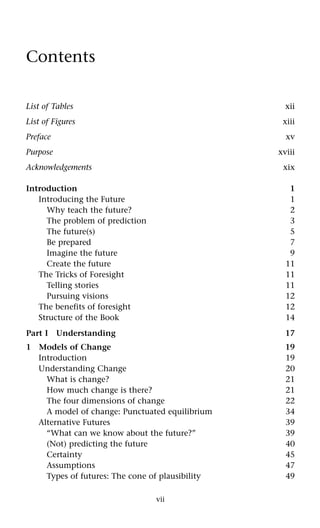
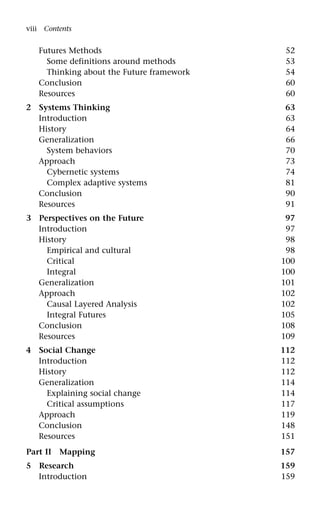
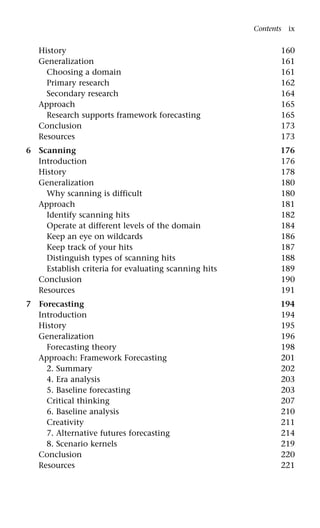
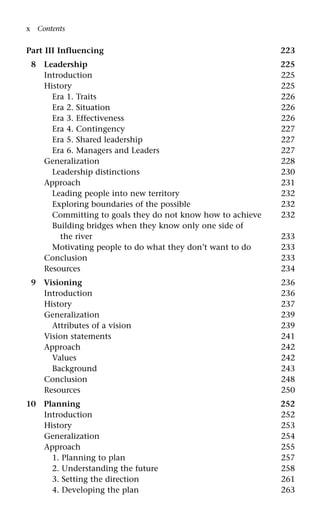
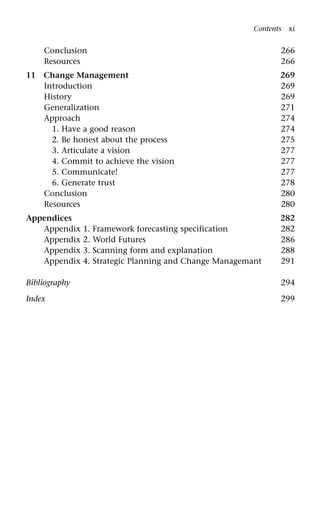
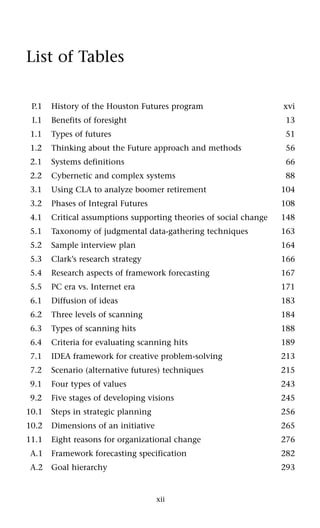
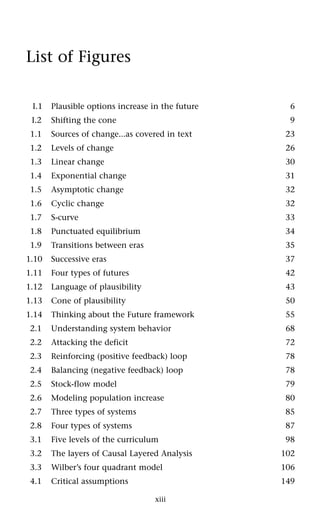
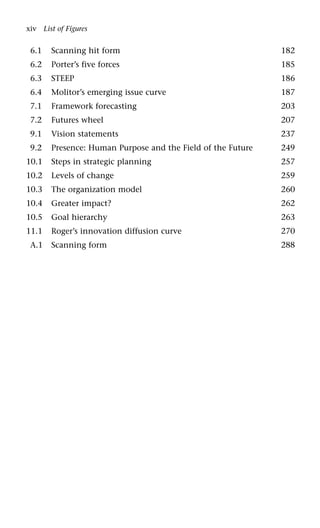
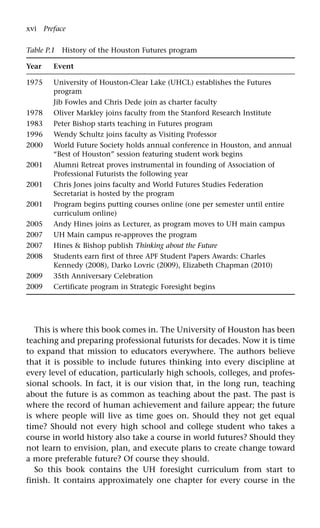
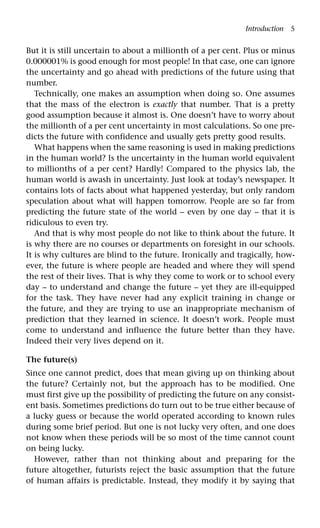
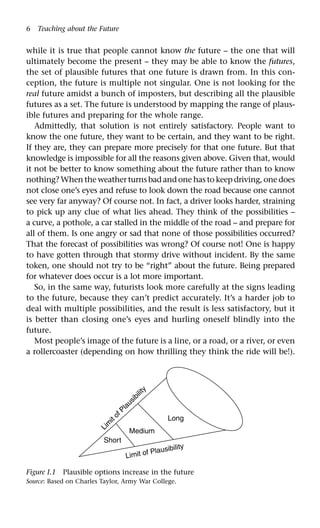
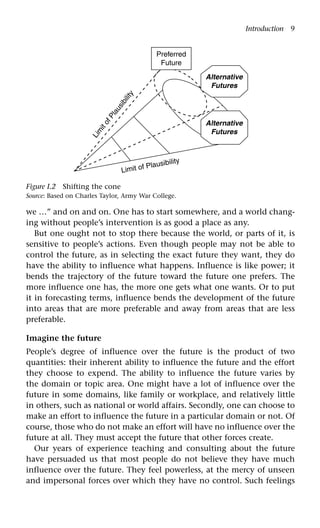
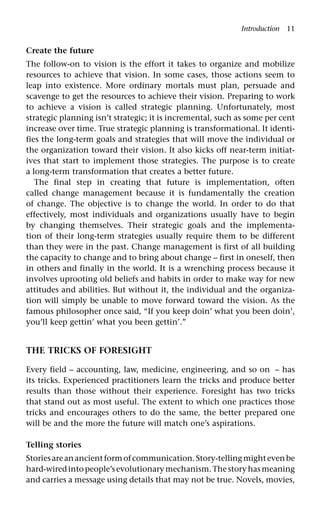
![12 Teaching about the Future
even some music contain stories about fictional characters. The events
are not true, but the message is. A scenario is a story about the future.
The details of the
scenario may not
be true; in fact,
they probably
are not. But the
message may be
true – the essence
of a plausible
futurethatshould
be considered
and perhaps
prepared for. The
extent to which
one tells stories every day, the more prepared one will be for a surprising
future.
Pursuing visions
A vision is the story of an ideal state which, if one works hard and is lucky,
one just might achieve. It’s this side of a dream or wish; it’s not magic. But
it is bold and ambitious. “Could we?” “Might we?” Those are the initial
reactions to visions. When the answer is “Yes we can,” that’s when the race
begins. Pursuing a vision is what a full life is about – it motivates, energizes
and empowers one to do extraordinary things. Even though the vision
itself may be elusive, chasing it sets one off strongly in the right direction.
People and organizations not afraid to consider the future in all its
uncertainty and complexity and not afraid to pursue a vision that is almost
beyond expectation are the people and organizations that are not only
prepared for the future but also those who will be a major force in shaping
it. Management guru Peter Drucker once said, “The best way to predict the
future is to create it.” While that is not entirely true, the more influence
one exerts on the future, the better the odds of having a better future.
THE BENEFITS OF FORESIGHT
An analysis of our last book, Thinking about the Future (2007), which
culled the collective wisdom of three dozen professional futurists glo-
bally, identified 316 benefit statements from applying foresight. Table I.1
shows how these are sorted into the Thinking about the Future frame-
work, which comprises six categories: framing, scanning, forecasting,
Elements of a good story [scenario]
Storybook more than just a description
Specific facts, events, names, dates
Plausible it could happen
Relevant it would change the future
Dramatic conflict, suspense, unresolved issues
Balanced bad things have good consequences
good things have bad consequences
Personal putting individual in the future
Integrated cohesive; plot hangs together](https://image.slidesharecdn.com/2686809-250602225548-a04f912f/85/Teaching-About-The-Future-Peter-C-Bishop-Andy-Hines-Auth-36-320.jpg)
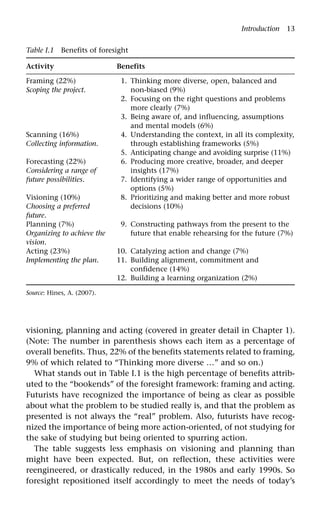
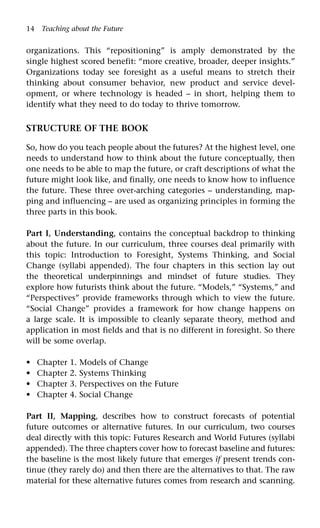

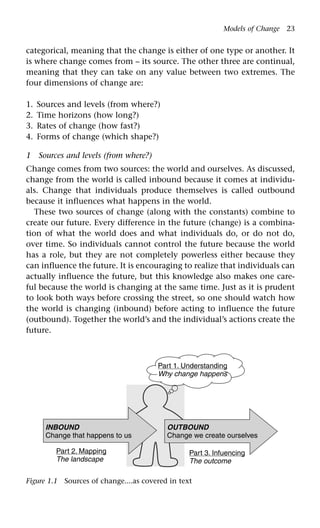
![Models of Change 25
Mills continues:
What [people] need, and what they feel they need, is a quality of
mind that will help them to use information and to develop rea-
son in order to achieve lucid summations of what is going on in
the world and of what may be happening within themselves. It is
this quality, I am going to contend, that journalists and scholars,
artists and publics, scientists and editors are coming to expect of
what may be called the sociological imagination…. The first fruit
of this imagination – and the first lesson of the social science
that embodies it – is the idea that the individual can understand
her own experience and gauge her own fate only by locating
herself within her period, that she can know her own chances
in life only by becoming aware of those of all individuals in her
circumstances. In many ways it is a terrible lesson; in many ways
a magnificent one.
This book is not teaching sociology; it is teaching about the future.
But the sociological imagination, as described here by Mills, is also
the futures perspective. For people to comprehend what might
happen to them in the future, a broad understanding of what is
going on in the world is necessary. So futurists focus on the global
environment, not because it is more important but because it is
often invisible, to most people at least. Futurists pay attention to the
global environment just as everyone else is paying attention to their
immediate environment.
Once in a while, however, every individual and group should look
past the immediate environment and see what is coming in the global
environment. They do not have to be futurists, but they should listen
to them and to others who are monitoring change at that level. And,
fortunately, people are not powerless in the face of those forces either.
They cannot control the future, but they can influence it, most easily
in their immediate environment but, in some cases, in the global
environment as well.
The future changes at three levels: the organization, the organi-
zation’s immediate environment, and the global environment. The
global environment is often categorized into large sectors to help make
sense of the massive amount of change going on there. One popular
framework among futurists is called STEEP, which is an acronym for
Social, Technological, Economic, Environmental, and Political aspects
of society. Many include other sub-categories, such as demographic,](https://image.slidesharecdn.com/2686809-250602225548-a04f912f/85/Teaching-About-The-Future-Peter-C-Bishop-Andy-Hines-Auth-48-320.jpg)