 We use the future perfect continuous to
express something that will continue
happening until a specific moment or
time in the future.
 The use of future perfect continuous is a
way to show “cause and effect”
 The future perfect continuous uses two
different auxiliaries: “will have been” and
“going to have been”
 Affirmative:
- Subject +“will have been”+ principal verb
- Subject + auxiliary verb (to be) + “going
to have been” + gerund
Examples:
- I will have been living in the same house
for 2 years tomorrow.
- I am going to have been cleaning the
house for 3 hours by the time she arrives.
 Negative:
-Subject + “will” + “not” + “have been” +
principal verb
-Subject + auxiliary verb (to be) + “not” +
“going to have been” + gerund
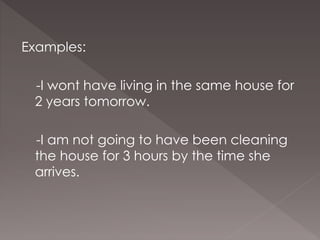
Examples:
-I wont have living in the same house for
2 years tomorrow.
-I am not going to have been cleaning
the house for 3 hours by the time she
arrives.
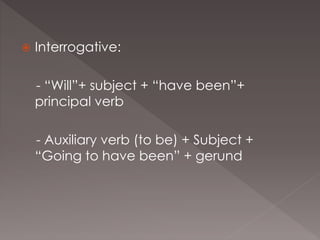
 Interrogative:
- “Will”+ subject + “have been”+
principal verb
- Auxiliary verb (to be) + Subject +
“Going to have been” + gerund
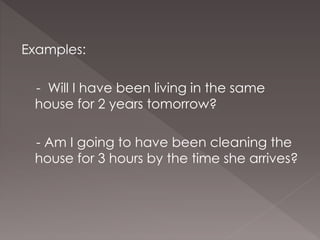
Examples:
- Will I have been living in the same
house for 2 years tomorrow?
- Am I going to have been cleaning the
house for 3 hours by the time she arrives?
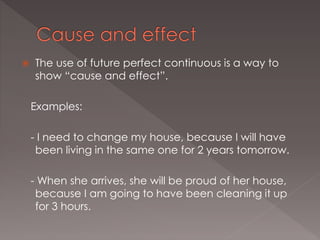
 The use of future perfect continuous is a way to
show “cause and effect”.
Examples:
- I need to change my house, because I will have
been living in the same one for 2 years tomorrow.
- When she arrives, she will be proud of her house,
because I am going to have been cleaning it up
for 3 hours.
Future perfect continuous

Future perfect continuous

  • 2.
     We usethe future perfect continuous to express something that will continue happening until a specific moment or time in the future.  The use of future perfect continuous is a way to show “cause and effect”  The future perfect continuous uses two different auxiliaries: “will have been” and “going to have been”
  • 3.
     Affirmative: - Subject+“will have been”+ principal verb - Subject + auxiliary verb (to be) + “going to have been” + gerund
  • 4.
    Examples: - I willhave been living in the same house for 2 years tomorrow. - I am going to have been cleaning the house for 3 hours by the time she arrives.
  • 5.
     Negative: -Subject +“will” + “not” + “have been” + principal verb -Subject + auxiliary verb (to be) + “not” + “going to have been” + gerund
  • 6.
    Examples: -I wont haveliving in the same house for 2 years tomorrow. -I am not going to have been cleaning the house for 3 hours by the time she arrives.
  • 7.
     Interrogative: - “Will”+subject + “have been”+ principal verb - Auxiliary verb (to be) + Subject + “Going to have been” + gerund
  • 8.
    Examples: - Will Ihave been living in the same house for 2 years tomorrow? - Am I going to have been cleaning the house for 3 hours by the time she arrives?
  • 9.
     The useof future perfect continuous is a way to show “cause and effect”. Examples: - I need to change my house, because I will have been living in the same one for 2 years tomorrow. - When she arrives, she will be proud of her house, because I am going to have been cleaning it up for 3 hours.