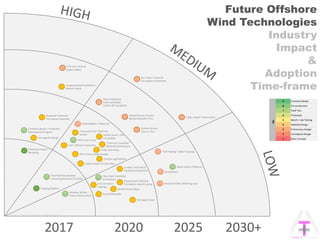
2017 2020 2025 2030+
Future Offshore
Wind Technologies
Industry
Impact
&
Adoption
Time-frame
©2017 Totaro & Associates, All Rights Reserved
HTS Inter-Array &
Export Cables
“Common Converter”
Electrical Architecture
Floating Platform
Flow Field Visualization
combining Airborne & fLIDAR
Quayside Turbine &
Foundation Assembly
Tension Leg Platform
Hybrid Blades / Materials
Vessel-deployed,
Fully Assembled
Turbine & Foundation
UAV / Remote Inspection
Sky Crane Turbine &
Foundation Installation
Site-specific Design
“Self Healing” Cable Encasing
Hybrid Service Vessels –
Mothership with CTVs
Cable-stayed Turbine Rotor
Co-generating Foundations –
Wind & Hydro
Condition Based / Predictive
Maintenance Program “Converter-less” Electrical
System
Inter-array Energy Storage
Turbine / Wind Park
Situational Awareness
Predictive Output
Modeling
Desalination
HVDC Inter-array
Guyed Monopile
Hybrid Jacket / Gravity Base
Multi-turbine Platforms
Bio-based Grout
Closed-loop Turbine &
Foundation Liquid Cooling Structural Fabric Mooring Lines
Hybrid Jacket / Pile
Foundation
Wireless SCADA /
Power Plant Control
Fibre Optic Controller
Architecture
Anti-corrosion
coatings
Turbine Service
Tow-in / Out
Skirted Gravity Base
HVAC Inter-array
Future Offshore Wind Technologies
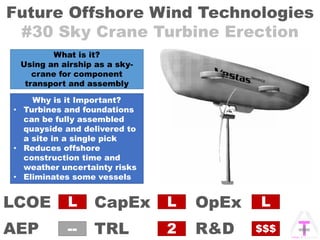
#30 Sky Crane Turbine Erection
OpExCapEx
AEP
LCOE
TRL R&D
L
2
L
--
L
$$$
What is it?
Using an airship as a sky-
crane for component
transport and assembly
Why is it Important?
• Turbines and foundations
can be fully assembled
quayside and delivered to
a site in a single pick
• Reduces offshore
construction time and
weather uncertainty risks
• Eliminates some vessels
Future Offshore Wind Technologies
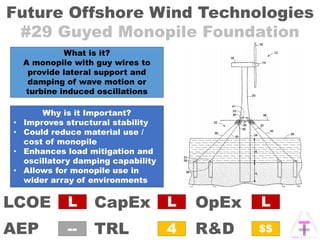
#29 Guyed Monopile Foundation
OpExCapEx
AEP
LCOE
TRL R&D
L
4
L
--
L
$$
What is it?
A monopile with guy wires to
provide lateral support and
damping of wave motion or
turbine induced oscillations
Why is it Important?
• Improves structural stability
• Could reduce material use /
cost of monopile
• Enhances load mitigation and
oscillatory damping capability
• Allows for monopile use in
wider array of environments
Future Offshore Wind Technologies
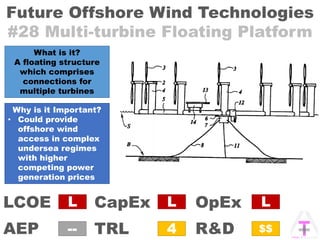
#28 Multi-turbine Floating Platform
OpExCapEx
AEP
LCOE
TRL R&D
L
4
L
--
L
$$
What is it?
A floating structure
which comprises
connections for
multiple turbines
Why is it Important?
• Could provide
offshore wind
access in complex
undersea regimes
with higher
competing power
generation prices
Future Offshore Wind Technologies
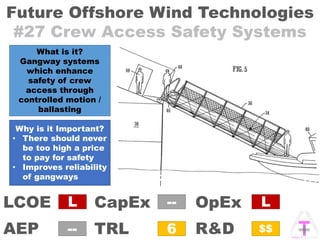
#27 Crew Access Safety Systems
OpExCapEx
AEP
LCOE
TRL R&D
L
6
--
--
L
$$
What is it?
Gangway systems
which enhance
safety of crew
access through
controlled motion /
ballasting
Why is it Important?
• There should never
be too high a price
to pay for safety
• Improves reliability
of gangways
Future Offshore Wind Technologies
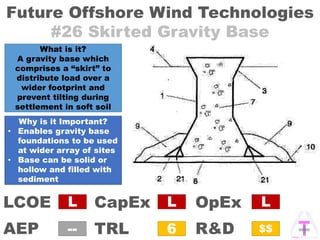
#26 Skirted Gravity Base
OpExCapEx
AEP
LCOE
TRL R&D
L
6
L
--
L
$$
What is it?
A gravity base which
comprises a “skirt” to
distribute load over a
wider footprint and
prevent tilting during
settlement in soft soil
Why is it Important?
• Enables gravity base
foundations to be used
at wider array of sites
• Base can be solid or
hollow and filled with
sediment
Future Offshore Wind Technologies
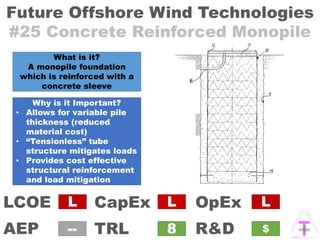
#25 Concrete Reinforced Monopile
OpExCapEx
AEP
LCOE
TRL R&D
L
8
L
--
L
$
What is it?
A monopile foundation
which is reinforced with a
concrete sleeve
Why is it Important?
• Allows for variable pile
thickness (reduced
material cost)
• “Tensionless” tube
structure mitigates loads
• Provides cost effective
structural reinforcement
and load mitigation
Future Offshore Wind Technologies
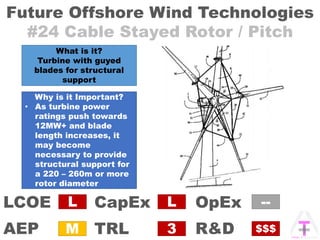
#24 Cable Stayed Rotor / Pitch
OpExCapEx
AEP
LCOE
TRL R&D
L
3
L
M
--
$$$
What is it?
Turbine with guyed
blades for structural
support
Why is it Important?
• As turbine power
ratings push towards
12MW+ and blade
length increases, it
may become
necessary to provide
structural support for
a 220 – 260m or more
rotor diameter
Future Offshore Wind Technologies
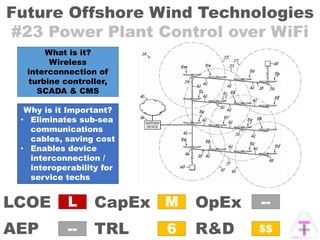
#23 Power Plant Control over WiFi
OpExCapEx
AEP
LCOE
TRL R&D
L
6
M
--
--
$$
What is it?
Wireless
interconnection of
turbine controller,
SCADA & CMS
Why is it Important?
• Eliminates sub-sea
communications
cables, saving cost
• Enables device
interconnection /
interoperability for
service techs
Future Offshore Wind Technologies
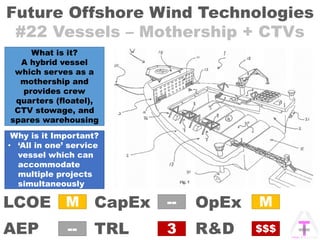
#22 Vessels – Mothership + CTVs
OpExCapEx
AEP
LCOE
TRL R&D
M
3
--
--
M
$$$
What is it?
A hybrid vessel
which serves as a
mothership and
provides crew
quarters (floatel),
CTV stowage, and
spares warehousing
Why is it Important?
• ‘All in one’ service
vessel which can
accommodate
multiple projects
simultaneously
Future Offshore Wind Technologies
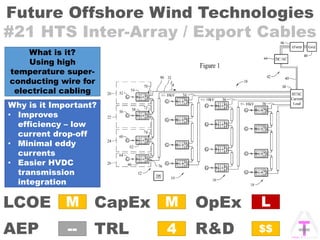
#21 HTS Inter-Array / Export Cables
OpExCapEx
AEP
LCOE
TRL R&D
M
4
M
--
L
$$
What is it?
Using high
temperature super-
conducting wire for
electrical cabling
Why is it Important?
• Improves
efficiency – low
current drop-off
• Minimal eddy
currents
• Easier HVDC
transmission
integration
Future Offshore Wind Technologies
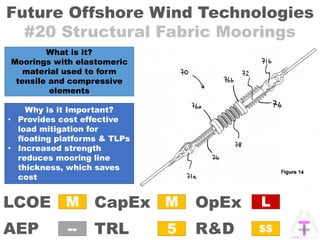
#20 Structural Fabric Moorings
OpExCapEx
AEP
LCOE
TRL R&D
M
5
M
--
L
$$
What is it?
Moorings with elastomeric
material used to form
tensile and compressive
elements
Why is it Important?
• Provides cost effective
load mitigation for
floating platforms & TLPs
• Increased strength
reduces mooring line
thickness, which saves
cost
Future Offshore Wind Technologies
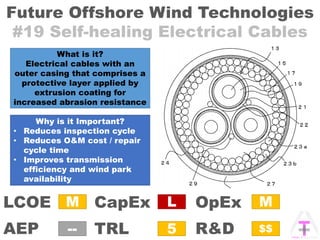
#19 Self-healing Electrical Cables
OpExCapEx
AEP
LCOE
TRL R&D
M
5
L
--
M
$$
What is it?
Electrical cables with an
outer casing that comprises a
protective layer applied by
extrusion coating for
increased abrasion resistance
Why is it Important?
• Reduces inspection cycle
• Reduces O&M cost / repair
cycle time
• Improves transmission
efficiency and wind park
availability
Future Offshore Wind Technologies
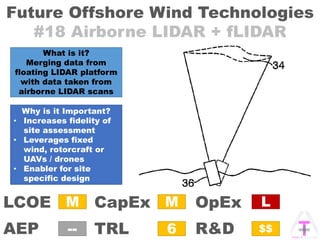
#18 Airborne LIDAR + fLIDAR
OpExCapEx
AEP
LCOE
TRL R&D
M
6
M
--
L
$$
What is it?
Merging data from
floating LIDAR platform
with data taken from
airborne LIDAR scans
Why is it Important?
• Increases fidelity of
site assessment
• Leverages fixed
wind, rotorcraft or
UAVs / drones
• Enabler for site
specific design
Future Offshore Wind Technologies
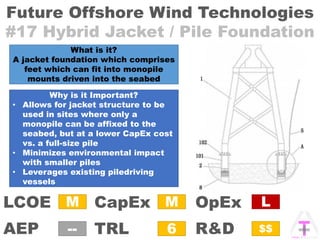
#17 Hybrid Jacket / Pile Foundation
OpExCapEx
AEP
LCOE
TRL R&D
M
6
M
--
L
$$
What is it?
A jacket foundation which comprises
feet which can fit into monopile
mounts driven into the seabed
Why is it Important?
• Allows for jacket structure to be
used in sites where only a
monopile can be affixed to the
seabed, but at a lower CapEx cost
vs. a full-size pile
• Minimizes environmental impact
with smaller piles
• Leverages existing piledriving
vessels
Future Offshore Wind Technologies
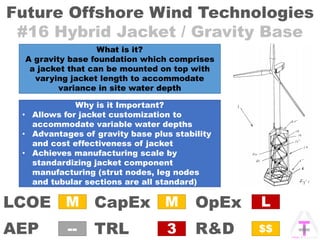
#16 Hybrid Jacket / Gravity Base
OpExCapEx
AEP
LCOE
TRL R&D
M
3
M
--
L
$$
What is it?
A gravity base foundation which comprises
a jacket that can be mounted on top with
varying jacket length to accommodate
variance in site water depth
Why is it Important?
• Allows for jacket customization to
accommodate variable water depths
• Advantages of gravity base plus stability
and cost effectiveness of jacket
• Achieves manufacturing scale by
standardizing jacket component
manufacturing (strut nodes, leg nodes
and tubular sections are all standard)
Future Offshore Wind Technologies
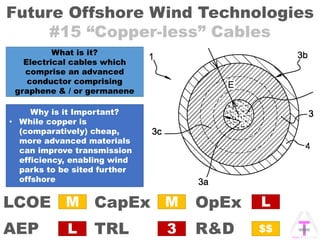
#15 “Copper-less” Cables
OpExCapEx
AEP
LCOE
TRL R&D
M
3
M
L
L
$$
What is it?
Electrical cables which
comprise an advanced
conductor comprising
graphene & / or germanene
Why is it Important?
• While copper is
(comparatively) cheap,
more advanced materials
can improve transmission
efficiency, enabling wind
parks to be sited further
offshore
Future Offshore Wind Technologies
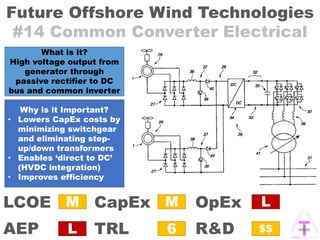
#14 Common Converter Electrical
OpExCapEx
AEP
LCOE
TRL R&D
M
6
M
L
L
$$
What is it?
High voltage output from
generator through
passive rectifier to DC
bus and common inverter
Why is it Important?
• Lowers CapEx costs by
minimizing switchgear
and eliminating step-
up/down transformers
• Enables ‘direct to DC’
(HVDC integration)
• Improves efficiency
Future Offshore Wind Technologies
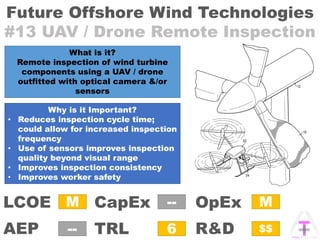
#13 UAV / Drone Remote Inspection
OpExCapEx
AEP
LCOE
TRL R&D
M
6
--
--
M
$$
What is it?
Remote inspection of wind turbine
components using a UAV / drone
outfitted with optical camera &/or
sensors
Why is it Important?
• Reduces inspection cycle time;
could allow for increased inspection
frequency
• Use of sensors improves inspection
quality beyond visual range
• Improves inspection consistency
• Improves worker safety
Future Offshore Wind Technologies
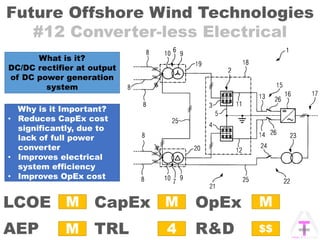
#12 Converter-less Electrical
OpExCapEx
AEP
LCOE
TRL R&D
M
4
M
M
M
$$
What is it?
DC/DC rectifier at output
of DC power generation
system
Why is it Important?
• Reduces CapEx cost
significantly, due to
lack of full power
converter
• Improves electrical
system efficiency
• Improves OpEx cost
Future Offshore Wind Technologies
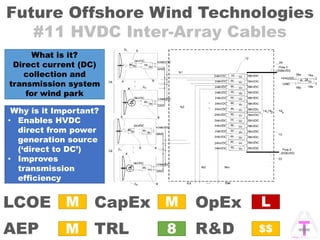
#11 HVDC Inter-Array Cables
OpExCapEx
AEP
LCOE
TRL R&D
M
8
M
M
L
$$
What is it?
Direct current (DC)
collection and
transmission system
for wind park
Why is it Important?
• Enables HVDC
direct from power
generation source
(‘direct to DC’)
• Improves
transmission
efficiency
Future Offshore Wind Technologies
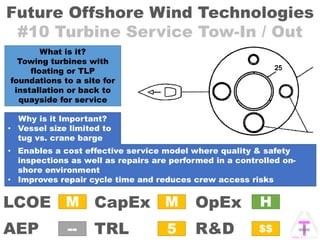
#10 Turbine Service Tow-In / Out
OpExCapEx
AEP
LCOE
TRL R&D
M
5
M
--
H
$$
What is it?
Towing turbines with
floating or TLP
foundations to a site for
installation or back to
quayside for service
Why is it Important?
• Vessel size limited to
tug vs. crane barge
• Enables a cost effective service model where quality & safety
inspections as well as repairs are performed in a controlled on-
shore environment
• Improves repair cycle time and reduces crew access risks
Future Offshore Wind Technologies
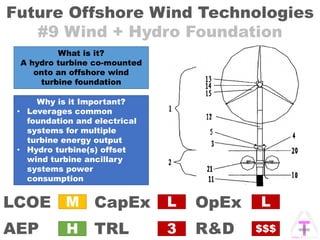
#9 Wind + Hydro Foundation
OpExCapEx
AEP
LCOE
TRL R&D
M
3
L
H
L
$$$
What is it?
A hydro turbine co-mounted
onto an offshore wind
turbine foundation
Why is it Important?
• Leverages common
foundation and electrical
systems for multiple
turbine energy output
• Hydro turbine(s) offset
wind turbine ancillary
systems power
consumption
Future Offshore Wind Technologies
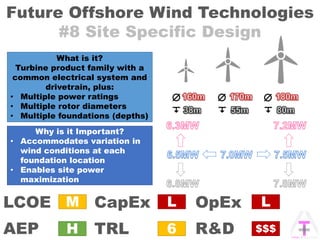
#8 Site Specific Design
OpExCapEx
AEP
LCOE
TRL R&D
M
6
L
H
L
$$$
What is it?
Turbine product family with a
common electrical system and
drivetrain, plus:
• Multiple power ratings
• Multiple rotor diameters
• Multiple foundations (depths)
Why is it Important?
• Accommodates variation in
wind conditions at each
foundation location
• Enables site power
maximization
Future Offshore Wind Technologies
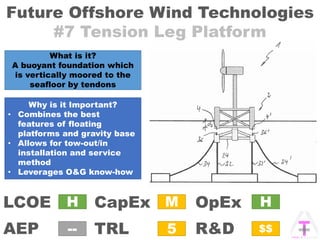
#7 Tension Leg Platform
OpExCapEx
AEP
LCOE
TRL R&D
H
5
M
--
H
$$
What is it?
A buoyant foundation which
is vertically moored to the
seafloor by tendons
Why is it Important?
• Combines the best
features of floating
platforms and gravity base
• Allows for tow-out/in
installation and service
method
• Leverages O&G know-how
Future Offshore Wind Technologies
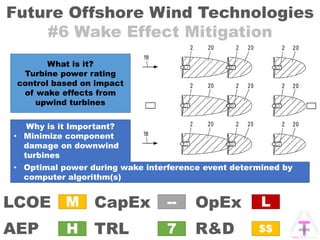
#6 Wake Effect Mitigation
OpExCapEx
AEP
LCOE
TRL R&D
M
7
--
H
L
$$
What is it?
Turbine power rating
control based on impact
of wake effects from
upwind turbines
Why is it Important?
• Minimize component
damage on downwind
turbines
• Optimal power during wake interference event determined by
computer algorithm(s)
Future Offshore Wind Technologies
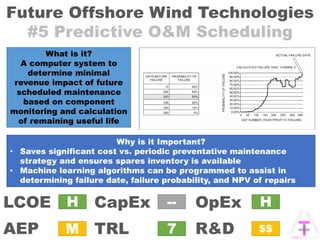
#5 Predictive O&M Scheduling
OpExCapEx
AEP
LCOE
TRL R&D
H
7
--
M
H
$$
What is it?
A computer system to
determine minimal
revenue impact of future
scheduled maintenance
based on component
monitoring and calculation
of remaining useful life
Why is it Important?
• Saves significant cost vs. periodic preventative maintenance
strategy and ensures spares inventory is available
• Machine learning algorithms can be programmed to assist in
determining failure date, failure probability, and NPV of repairs
Future Offshore Wind Technologies
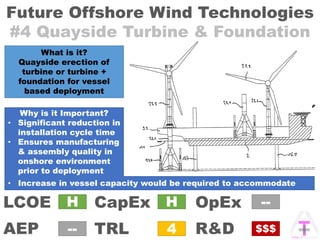
#4 Quayside Turbine & Foundation
OpExCapEx
AEP
LCOE
TRL R&D
H
4
H
--
--
$$$
What is it?
Quayside erection of
turbine or turbine +
foundation for vessel
based deployment
Why is it Important?
• Significant reduction in
installation cycle time
• Ensures manufacturing
& assembly quality in
onshore environment
prior to deployment
• Increase in vessel capacity would be required to accommodate
Future Offshore Wind Technologies
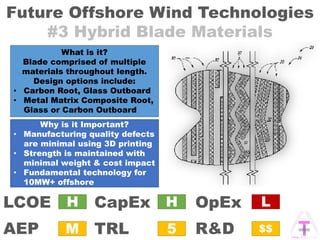
#3 Hybrid Blade Materials
OpExCapEx
AEP
LCOE
TRL R&D
H
5
H
M
L
$$
What is it?
Blade comprised of multiple
materials throughout length.
Design options include:
• Carbon Root, Glass Outboard
• Metal Matrix Composite Root,
Glass or Carbon Outboard
Why is it Important?
• Manufacturing quality defects
are minimal using 3D printing
• Strength is maintained with
minimal weight & cost impact
• Fundamental technology for
10MW+ offshore
Future Offshore Wind Technologies
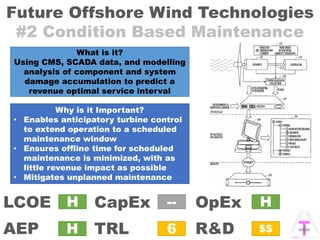
#2 Condition Based Maintenance
OpExCapEx
AEP
LCOE
TRL R&D
H
6
--
H
H
$$
What is it?
Using CMS, SCADA data, and modelling
analysis of component and system
damage accumulation to predict a
revenue optimal service interval
Why is it Important?
• Enables anticipatory turbine control
to extend operation to a scheduled
maintenance window
• Ensures offline time for scheduled
maintenance is minimized, with as
little revenue impact as possible
• Mitigates unplanned maintenance
Future Offshore Wind Technologies
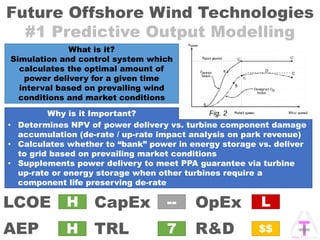
#1 Predictive Output Modelling
OpExCapEx
AEP
LCOE
TRL R&D
H
7
--
H
L
$$
• Determines NPV of power delivery vs. turbine component damage
accumulation (de-rate / up-rate impact analysis on park revenue)
• Calculates whether to “bank” power in energy storage vs. deliver
to grid based on prevailing market conditions
• Supplements power delivery to meet PPA guarantee via turbine
up-rate or energy storage when other turbines require a
component life preserving de-rate
What is it?
Simulation and control system which
calculates the optimal amount of
power delivery for a given time
interval based on prevailing wind
conditions and market conditions
Why is it Important?

Future Offshore Wind Energy Technology

  • 1.
    2017 2020 20252030+ Future Offshore Wind Technologies Industry Impact & Adoption Time-frame ©2017 Totaro & Associates, All Rights Reserved HTS Inter-Array & Export Cables “Common Converter” Electrical Architecture Floating Platform Flow Field Visualization combining Airborne & fLIDAR Quayside Turbine & Foundation Assembly Tension Leg Platform Hybrid Blades / Materials Vessel-deployed, Fully Assembled Turbine & Foundation UAV / Remote Inspection Sky Crane Turbine & Foundation Installation Site-specific Design “Self Healing” Cable Encasing Hybrid Service Vessels – Mothership with CTVs Cable-stayed Turbine Rotor Co-generating Foundations – Wind & Hydro Condition Based / Predictive Maintenance Program “Converter-less” Electrical System Inter-array Energy Storage Turbine / Wind Park Situational Awareness Predictive Output Modeling Desalination HVDC Inter-array Guyed Monopile Hybrid Jacket / Gravity Base Multi-turbine Platforms Bio-based Grout Closed-loop Turbine & Foundation Liquid Cooling Structural Fabric Mooring Lines Hybrid Jacket / Pile Foundation Wireless SCADA / Power Plant Control Fibre Optic Controller Architecture Anti-corrosion coatings Turbine Service Tow-in / Out Skirted Gravity Base HVAC Inter-array
  • 2.
    Future Offshore WindTechnologies #30 Sky Crane Turbine Erection OpExCapEx AEP LCOE TRL R&D L 2 L -- L $$$ What is it? Using an airship as a sky- crane for component transport and assembly Why is it Important? • Turbines and foundations can be fully assembled quayside and delivered to a site in a single pick • Reduces offshore construction time and weather uncertainty risks • Eliminates some vessels
  • 3.
    Future Offshore WindTechnologies #29 Guyed Monopile Foundation OpExCapEx AEP LCOE TRL R&D L 4 L -- L $$ What is it? A monopile with guy wires to provide lateral support and damping of wave motion or turbine induced oscillations Why is it Important? • Improves structural stability • Could reduce material use / cost of monopile • Enhances load mitigation and oscillatory damping capability • Allows for monopile use in wider array of environments
  • 4.
    Future Offshore WindTechnologies #28 Multi-turbine Floating Platform OpExCapEx AEP LCOE TRL R&D L 4 L -- L $$ What is it? A floating structure which comprises connections for multiple turbines Why is it Important? • Could provide offshore wind access in complex undersea regimes with higher competing power generation prices
  • 5.
    Future Offshore WindTechnologies #27 Crew Access Safety Systems OpExCapEx AEP LCOE TRL R&D L 6 -- -- L $$ What is it? Gangway systems which enhance safety of crew access through controlled motion / ballasting Why is it Important? • There should never be too high a price to pay for safety • Improves reliability of gangways
  • 6.
    Future Offshore WindTechnologies #26 Skirted Gravity Base OpExCapEx AEP LCOE TRL R&D L 6 L -- L $$ What is it? A gravity base which comprises a “skirt” to distribute load over a wider footprint and prevent tilting during settlement in soft soil Why is it Important? • Enables gravity base foundations to be used at wider array of sites • Base can be solid or hollow and filled with sediment
  • 7.
    Future Offshore WindTechnologies #25 Concrete Reinforced Monopile OpExCapEx AEP LCOE TRL R&D L 8 L -- L $ What is it? A monopile foundation which is reinforced with a concrete sleeve Why is it Important? • Allows for variable pile thickness (reduced material cost) • “Tensionless” tube structure mitigates loads • Provides cost effective structural reinforcement and load mitigation
  • 8.
    Future Offshore WindTechnologies #24 Cable Stayed Rotor / Pitch OpExCapEx AEP LCOE TRL R&D L 3 L M -- $$$ What is it? Turbine with guyed blades for structural support Why is it Important? • As turbine power ratings push towards 12MW+ and blade length increases, it may become necessary to provide structural support for a 220 – 260m or more rotor diameter
  • 9.
    Future Offshore WindTechnologies #23 Power Plant Control over WiFi OpExCapEx AEP LCOE TRL R&D L 6 M -- -- $$ What is it? Wireless interconnection of turbine controller, SCADA & CMS Why is it Important? • Eliminates sub-sea communications cables, saving cost • Enables device interconnection / interoperability for service techs
  • 10.
    Future Offshore WindTechnologies #22 Vessels – Mothership + CTVs OpExCapEx AEP LCOE TRL R&D M 3 -- -- M $$$ What is it? A hybrid vessel which serves as a mothership and provides crew quarters (floatel), CTV stowage, and spares warehousing Why is it Important? • ‘All in one’ service vessel which can accommodate multiple projects simultaneously
  • 11.
    Future Offshore WindTechnologies #21 HTS Inter-Array / Export Cables OpExCapEx AEP LCOE TRL R&D M 4 M -- L $$ What is it? Using high temperature super- conducting wire for electrical cabling Why is it Important? • Improves efficiency – low current drop-off • Minimal eddy currents • Easier HVDC transmission integration
  • 12.
    Future Offshore WindTechnologies #20 Structural Fabric Moorings OpExCapEx AEP LCOE TRL R&D M 5 M -- L $$ What is it? Moorings with elastomeric material used to form tensile and compressive elements Why is it Important? • Provides cost effective load mitigation for floating platforms & TLPs • Increased strength reduces mooring line thickness, which saves cost
  • 13.
    Future Offshore WindTechnologies #19 Self-healing Electrical Cables OpExCapEx AEP LCOE TRL R&D M 5 L -- M $$ What is it? Electrical cables with an outer casing that comprises a protective layer applied by extrusion coating for increased abrasion resistance Why is it Important? • Reduces inspection cycle • Reduces O&M cost / repair cycle time • Improves transmission efficiency and wind park availability
  • 14.
    Future Offshore WindTechnologies #18 Airborne LIDAR + fLIDAR OpExCapEx AEP LCOE TRL R&D M 6 M -- L $$ What is it? Merging data from floating LIDAR platform with data taken from airborne LIDAR scans Why is it Important? • Increases fidelity of site assessment • Leverages fixed wind, rotorcraft or UAVs / drones • Enabler for site specific design
  • 15.
    Future Offshore WindTechnologies #17 Hybrid Jacket / Pile Foundation OpExCapEx AEP LCOE TRL R&D M 6 M -- L $$ What is it? A jacket foundation which comprises feet which can fit into monopile mounts driven into the seabed Why is it Important? • Allows for jacket structure to be used in sites where only a monopile can be affixed to the seabed, but at a lower CapEx cost vs. a full-size pile • Minimizes environmental impact with smaller piles • Leverages existing piledriving vessels
  • 16.
    Future Offshore WindTechnologies #16 Hybrid Jacket / Gravity Base OpExCapEx AEP LCOE TRL R&D M 3 M -- L $$ What is it? A gravity base foundation which comprises a jacket that can be mounted on top with varying jacket length to accommodate variance in site water depth Why is it Important? • Allows for jacket customization to accommodate variable water depths • Advantages of gravity base plus stability and cost effectiveness of jacket • Achieves manufacturing scale by standardizing jacket component manufacturing (strut nodes, leg nodes and tubular sections are all standard)
  • 17.
    Future Offshore WindTechnologies #15 “Copper-less” Cables OpExCapEx AEP LCOE TRL R&D M 3 M L L $$ What is it? Electrical cables which comprise an advanced conductor comprising graphene & / or germanene Why is it Important? • While copper is (comparatively) cheap, more advanced materials can improve transmission efficiency, enabling wind parks to be sited further offshore
  • 18.
    Future Offshore WindTechnologies #14 Common Converter Electrical OpExCapEx AEP LCOE TRL R&D M 6 M L L $$ What is it? High voltage output from generator through passive rectifier to DC bus and common inverter Why is it Important? • Lowers CapEx costs by minimizing switchgear and eliminating step- up/down transformers • Enables ‘direct to DC’ (HVDC integration) • Improves efficiency
  • 19.
    Future Offshore WindTechnologies #13 UAV / Drone Remote Inspection OpExCapEx AEP LCOE TRL R&D M 6 -- -- M $$ What is it? Remote inspection of wind turbine components using a UAV / drone outfitted with optical camera &/or sensors Why is it Important? • Reduces inspection cycle time; could allow for increased inspection frequency • Use of sensors improves inspection quality beyond visual range • Improves inspection consistency • Improves worker safety
  • 20.
    Future Offshore WindTechnologies #12 Converter-less Electrical OpExCapEx AEP LCOE TRL R&D M 4 M M M $$ What is it? DC/DC rectifier at output of DC power generation system Why is it Important? • Reduces CapEx cost significantly, due to lack of full power converter • Improves electrical system efficiency • Improves OpEx cost
  • 21.
    Future Offshore WindTechnologies #11 HVDC Inter-Array Cables OpExCapEx AEP LCOE TRL R&D M 8 M M L $$ What is it? Direct current (DC) collection and transmission system for wind park Why is it Important? • Enables HVDC direct from power generation source (‘direct to DC’) • Improves transmission efficiency
  • 22.
    Future Offshore WindTechnologies #10 Turbine Service Tow-In / Out OpExCapEx AEP LCOE TRL R&D M 5 M -- H $$ What is it? Towing turbines with floating or TLP foundations to a site for installation or back to quayside for service Why is it Important? • Vessel size limited to tug vs. crane barge • Enables a cost effective service model where quality & safety inspections as well as repairs are performed in a controlled on- shore environment • Improves repair cycle time and reduces crew access risks
  • 23.
    Future Offshore WindTechnologies #9 Wind + Hydro Foundation OpExCapEx AEP LCOE TRL R&D M 3 L H L $$$ What is it? A hydro turbine co-mounted onto an offshore wind turbine foundation Why is it Important? • Leverages common foundation and electrical systems for multiple turbine energy output • Hydro turbine(s) offset wind turbine ancillary systems power consumption
  • 24.
    Future Offshore WindTechnologies #8 Site Specific Design OpExCapEx AEP LCOE TRL R&D M 6 L H L $$$ What is it? Turbine product family with a common electrical system and drivetrain, plus: • Multiple power ratings • Multiple rotor diameters • Multiple foundations (depths) Why is it Important? • Accommodates variation in wind conditions at each foundation location • Enables site power maximization
  • 25.
    Future Offshore WindTechnologies #7 Tension Leg Platform OpExCapEx AEP LCOE TRL R&D H 5 M -- H $$ What is it? A buoyant foundation which is vertically moored to the seafloor by tendons Why is it Important? • Combines the best features of floating platforms and gravity base • Allows for tow-out/in installation and service method • Leverages O&G know-how
  • 26.
    Future Offshore WindTechnologies #6 Wake Effect Mitigation OpExCapEx AEP LCOE TRL R&D M 7 -- H L $$ What is it? Turbine power rating control based on impact of wake effects from upwind turbines Why is it Important? • Minimize component damage on downwind turbines • Optimal power during wake interference event determined by computer algorithm(s)
  • 27.
    Future Offshore WindTechnologies #5 Predictive O&M Scheduling OpExCapEx AEP LCOE TRL R&D H 7 -- M H $$ What is it? A computer system to determine minimal revenue impact of future scheduled maintenance based on component monitoring and calculation of remaining useful life Why is it Important? • Saves significant cost vs. periodic preventative maintenance strategy and ensures spares inventory is available • Machine learning algorithms can be programmed to assist in determining failure date, failure probability, and NPV of repairs
  • 28.
    Future Offshore WindTechnologies #4 Quayside Turbine & Foundation OpExCapEx AEP LCOE TRL R&D H 4 H -- -- $$$ What is it? Quayside erection of turbine or turbine + foundation for vessel based deployment Why is it Important? • Significant reduction in installation cycle time • Ensures manufacturing & assembly quality in onshore environment prior to deployment • Increase in vessel capacity would be required to accommodate
  • 29.
    Future Offshore WindTechnologies #3 Hybrid Blade Materials OpExCapEx AEP LCOE TRL R&D H 5 H M L $$ What is it? Blade comprised of multiple materials throughout length. Design options include: • Carbon Root, Glass Outboard • Metal Matrix Composite Root, Glass or Carbon Outboard Why is it Important? • Manufacturing quality defects are minimal using 3D printing • Strength is maintained with minimal weight & cost impact • Fundamental technology for 10MW+ offshore
  • 30.
    Future Offshore WindTechnologies #2 Condition Based Maintenance OpExCapEx AEP LCOE TRL R&D H 6 -- H H $$ What is it? Using CMS, SCADA data, and modelling analysis of component and system damage accumulation to predict a revenue optimal service interval Why is it Important? • Enables anticipatory turbine control to extend operation to a scheduled maintenance window • Ensures offline time for scheduled maintenance is minimized, with as little revenue impact as possible • Mitigates unplanned maintenance
  • 31.
    Future Offshore WindTechnologies #1 Predictive Output Modelling OpExCapEx AEP LCOE TRL R&D H 7 -- H L $$ • Determines NPV of power delivery vs. turbine component damage accumulation (de-rate / up-rate impact analysis on park revenue) • Calculates whether to “bank” power in energy storage vs. deliver to grid based on prevailing market conditions • Supplements power delivery to meet PPA guarantee via turbine up-rate or energy storage when other turbines require a component life preserving de-rate What is it? Simulation and control system which calculates the optimal amount of power delivery for a given time interval based on prevailing wind conditions and market conditions Why is it Important?