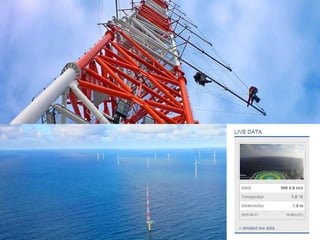
OFFSHORE WIND RESOURCE
ASSESSMENT
Dileep V Raj
Mtech Renewable Energy Technologies
Amrita Vishwa Vidyapeetham,Coimbatore
Why Offshore ?
• Higher wind speeds -> higher yield
• Larger wind farms possible – fewer space/land availability
constraints
• No complex terrain or visual impact issues
• No displacement of people
But
• A lot more expensive than onshore windfarms….
• Vessel costs + turbine foundation/installation + electrical cabling
to land
INTRODUCTION
• The wind power community has a long record on onshore design and construction
of wind turbine foundations.
• But the offshore wind power is still in the embryonic stage but with aggressive and
ambitious plans for developments.
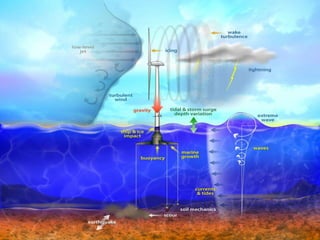
• Metocean data-
• Meterological data( Wind, Atmospheric data, Air Temperature, etc ) and
Oceanographic data ( Waves, Current, water level, Salinity, Water temperature ,
Ice etc ) are the important design basis parameters.
Traditional offshore structures vs. wind turbine foundations
• Any structure used in offshore oil and gas exploration and production constitutes a
vital part of a successful energy production, vital both in terms of construction
costs, of safety, of human lives and the environment, and in terms of revenues from
the production.
• An offshore wind turbine foundation is typically simpler and much cheaper to build
than an oil platform.
• Furthermore, the wind turbine will be un-manned except for maintenance and
repair, the environmental impact from a damaged structure is limited, and the value
of the energy production per foundation unit is far less than the value from oil
production from a platform.
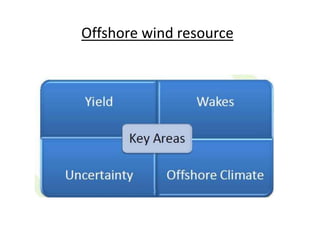
Offshore wind resource
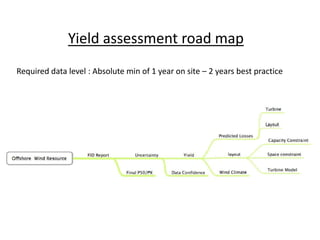
Yield assessment road map
Required data level : Absolute min of 1 year on site – 2 years best practice
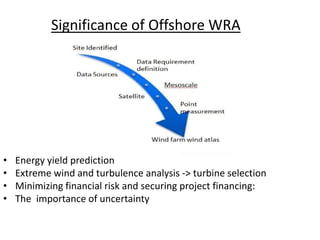
Significance of Offshore WRA
• Energy yield prediction
• Extreme wind and turbulence analysis -> turbine selection
• Minimizing financial risk and securing project financing:
• The importance of uncertainty
Challenges to resource assessment offshore
• Rough weather and sea conditions -> higher risk
• High met mast costs: 6-12 mi dollors offshore as opposed to
115-175k dollors onshore
• Very few existing data points to provide reference data ->
account for temporal variability of wind?
• Account for atmospheric stability and sea surface roughness?
Hub-Height Wind Speed
• Turbines in offshore wind plants must be designed to withstand extreme wind events
in the case of mechanical yaw error.
Hub-Height Shear and Natural Turbulence
• For turbine selection and load estimation, it is also important to know the expected
distribution of shear and natural (non-wake) turbulence.
• There is no accurate method for scaling surface measurements to make accurate hub-
height turbulence measurements.
• The situation is not much more encouraging with numerical models.
• Such models generate estimates both of wind shear and turbulence, but there is little
evidence that validates their performance for hub-height shear and turbulence.
Air Temperature and Atmospheric Surface Pressure
• Air temperature is needed in conjunction with atmospheric pressure primarily to
calculate the distribution of air density at prospective wind plant sites.
• Unlike dynamic variables, this information is well known both from surface
measurements and from numerical models.
Lightning
• Lightning is a common feature of offshore environments, and lightning
protection systems should be routinely included in the design of renewable
energy plants.
• Lightning detection networks extend well offshore; thus, frequencies of
lightning events can be mapped for offshore waters.
• This information may have some utility in assessing lightning risk to a facility.
Ice Loading
• Sea ice loading on structures is a significant design consideration in cold regions.
• Ice accretion affects blade aerodynamics for wind turbines and, in severe cases, could
affect structural integrity of turbine components.
• Icing can result both from freezing precipitation and fog and from sea spray in subfreezing
temperatures.
Tidal Elevations
• Tidal elevations for wind turbine structures are important primarily for designing
access and for identifying the parts of structures that will need to be specially
protected from sea water corrosion.
• Coverage and accuracy of tidal data is sufficient for wind development purposes.
Salinity
• Salinity information is important to inform design consideration for corrosion.
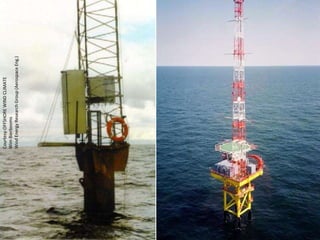
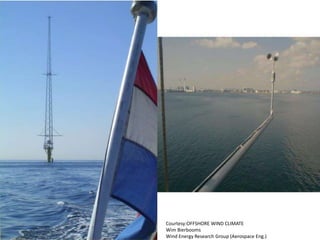
Measurement Campaign: Offshore Met Mast
• Cup anemometers and wind vanes; along with meteorological
sensors.
• Only IEC compliant option available for WRA
• Limited access at sea : site visits minimum; safety requirements
higher
• Allows monitoring of birds and marine mammals as well as acts as
platform for measuring wave height, scour movement etc.
• Data monitoring required: sector filtering, cup degradation etc.
• Issue : Flow distortion
Courtesy:OFFSHOREWINDCLIMATE
WimBierbooms
WindEnergyResearchGroup(AerospaceEng.)
Courtesy:OFFSHORE WIND CLIMATE
Wim Bierbooms
Wind Energy Research Group (Aerospace Eng.)
Offshore – Met mast vs. RS instruments
• Met mast – accepted worldwide and bankable data provided, with
international standards (MEASNET, IEC 61400-12) available
• LiDARs and SoDARs – few validation studies offshore
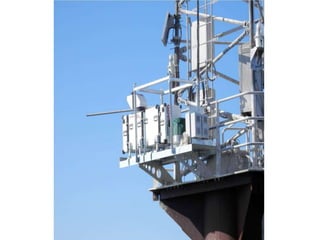
• RS (Remote Sensing) equipment such as LiDARs and SoDARs:
 ease of transportation and installation on existing platforms
 cost effective compared to tall masts
 easier maintenance compared to tall masts
 multiple height measurements
• Commercially used offshore along with a met mast till now
Exception: Beatrice project, UK – LiDAR only
Metadata location fields and categories include the following:
• Physical location (latitude, longitude, and elevation)
• Site name and number
• Political region (county and state)
• Local environment description and photographs (topography, vegetation, and
buildings or obstructions)
Instrumentation and equipment metadata and categories include the following:
• Data logger model and serial number
• Sensors (model, serial number, height, orientation or boom direction, and calibration
information)
• Tower description (size, height, face width, and so on, lattice or tubular, guyed or
non-guyed, face orientation, and tower commissioning report)
• Remote sensing data (type of instrument, model, and serial number)
• Data collection history (data outages, sensor changes, and unusual conditions such
as severe weather)
Data set description metadata include the following:
• Starting and ending dates and times
• Data sampling interval
• Total number of records collected
• Data collection rate (0%–100%)
• Data format (ASCII text, database files, binary, and so on)
• Channel number for each sensor
• Name and contact of responsible person
• Quality control and data screening procedures that have been applied
Remote Sensing instruments
How do they work?
Principle of Doppler effect : change in frequency of a signal related
to the line-of-sight velocity
• LiDARs – Light Detection and Ranging; electromagnetic radiation
reflected from aerosols
• SoDARs- Sound Detection and Ranging; acoustic pulse reflected
from the varying temperature structure of the atmosphere
LiDAR types: Continuous Wave
Pulsed
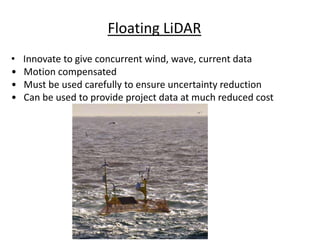
Floating LiDAR
Floating LiDAR
• Innovate to give concurrent wind, wave, current data
• Motion compensated
• Must be used carefully to ensure uncertainty reduction
• Can be used to provide project data at much reduced cost
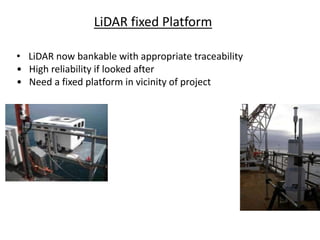
LiDAR fixed Platform
• LiDAR now bankable with appropriate traceability
• High reliability if looked after
• Need a fixed platform in vicinity of project
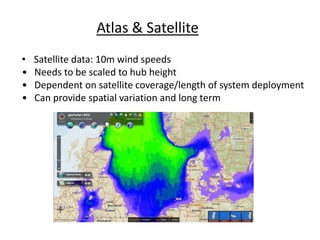
Atlas & Satellite
• Satellite data: 10m wind speeds
• Needs to be scaled to hub height
• Dependent on satellite coverage/length of system deployment
• Can provide spatial variation and long term
Uncertainty
• Concerned with Uncertainty in Wind:
a. Measurement
b. Long term
c. Coverage
• Uncertainty in Yield
a. Modeling
b. Wakes
Uncertainity
 Europe is the global leader in offshore wind energy
installation.
Globally installations have reached over 5,000 MW (Europe :
4995 MW followed by China: 390 MW and Japan: 25 MW).
India has significant off shore wind power potential - Offshore
wind potential of Tamil Nadu estimated as 127 GW at 80 m
height in a WISE study (needs further validation).
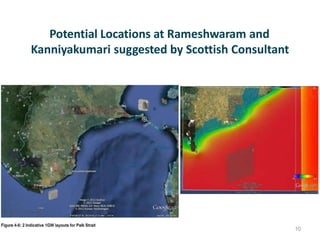
Preliminary assessment conducted by Scottish Development
International - Tamil Nadu has potential of about 1 GW in
north of Rameswaram and 1 GW in south of Kanyakumari.

•
•
3
CASE STUDY
1.INDIA
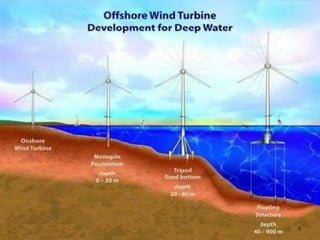
Offshore Wind Energy – Technology
Technology for offshore turbines same as that of onshore
turbines and their operational life also same (~ 20 years).

 The rated capacity of turbines higher than that of
onshore - in range of 3 MW-5 MW.
Off shore wind farms in water depths from 0.8 to 220 m
with monopile, jacket, tripod and floating technologies.

 At different depths, turbine installations require
different type of bases for stability .
 Monopile base is used for water upto 30 m depth,
whereas turbines installed on tripod or steel jacket base
for 20-80 m depths.
4
5
Offshore Wind Energy- India Status
•
•
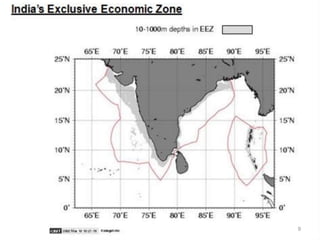
India is blessed with coastline of about 7600 Km.
United Nations Convention on Law of the Sea gives
India exclusive rights over its Exclusive Economic
Zone (200 nautical miles from baseline) to develop
offshore wind energy.
• Efforts so far limited to preliminary resource
assessment.
• C-WET has measured near shore wind data at 54
locations along the coast.
7
Preliminary studies by C-WET and Indian National Centre•
for Ocean Information Services (INCOIS), Hyderabad
suggest potential along Tamil Nadu, Gujarat and
Maharashtra coasts.
Scottish Development• International’s study done in
atJanuary, 2012 has indicated potential of 1 GW each
Kanniyakumari and North of Rameshwaram.
• These results required validation by setting
data.
up of
offshore masts to measure 2-3 years wind
• C-WET to carry out 100 m anemometry at Dhanuskodi,
Rameshwaram (near the sea).
8
9
Potential Locations at Rameshwaram and
Kanniyakumari suggested by Scottish Consultant
10
Offshore Wind Energy Development in India-
Relevant Issues
• High Cost-
times than
The cost of offshore wind farms almost 1.5 –
that of onshore wind farms.
2
• Offshore resource characterization required for firming up
potential.
• Development of a policy framework including the
regulatory process.
• Capability creation for understanding the nuances of
turbine and array design consideration and grid integration.
11
Nodal Ministry
MNRE to act as nodal ministry for development
wind energy in the country.
of offshore
Functions:
• Overall monitoring of the offshore wind development in the
country.
Co-ordination with other Ministries/Departments.
Issuing guidelines/directives for development of offshore wind
energy.
Oversee working and to provide necessary support to National
Offshore Wind Energy Authority (NOWA) for smooth
functioning.
Promoting indigenous research for technology development.
•
•
•
•
19
National Offshore Wind Energy Authority
(NOWA)
National Offshore Wind Energy Authority (NOWA) to be
established under the aegis of MNRE - to be responsible for
the following:
 Carry out Resource Assessment and Surveys in the EEZ of
the country.
 Enter into contract with the project developers for
thedevelopment of offshore wind energy project in
territorial water (12 nm).
Single Window Agency to facilitate clearances.
20
2.DENMARK
• In 1991, Denmark began operating the world’s first offshore wind farm.
• Denmark has the industry’s simplest permitting framework.
• The Danish Energy Agency acts a “one-stop-shop” for offshore wind farm
permitting, coordinating with other agencies to issue all three required
licenses: a license to carry out preliminary investigations, a license to establish
the offshore wind turbines, and a license to exploit wind power for a
given number of years including, for projects greater than 25 MW, an
approval for electricity production. All offshore wind projects are subject to an
environmental impact assessment
3.United kingdom
• The UK has a mandate to reach 15 percent renewable energy sources
for electricity by 2020.
• Since the UK’s first offshore wind farm was commissioned in December
2000, the UK has moved aggressively to continue developing this renewable
resource.
• In 2008, the UK overtook Denmark as a leader in MW capacity of offshore
wind power.
• In September 2010, the 300 MW Thanet wind farm came online,bringing the
UK total to operational offshore wind farms with a cumulative capacity of 1,341
MW.
• Another four offshore wind farms are under construction, and seven more
have been approved, which would add another 3,772 MW of capacity upon
completion.
• Germany’s first offshore wind farm was installed in 2008.
• The German wind industry expects 300 MW of new offshore wind capacity to be
installed in 2010.
• A new Power Line Expansion Law makes it easier to use underground cables and
• allows the costs of connecting the offshore wind farm to the grid to be spread
nationwide.
• Offshore wind is projected to reach a capacity of 10,000 MW in Germany by 2020.
4.Germany
REFERENCES
• Barthelmie, R.J., 1993, Prospects for Offshore Wind Energy, Wind Engineering, 17, 2, 86-89.
• Ladenburg, J., Dubgaard, A., Preferences of coastal zone users regarding the siting of
offshore wind farms, Ocean & Coastal Management, 52 (2009) 233-242.
• Offshore Wind Resource Assessment of the Gulf of Thailand J. Waewsak1, M. Landry2 and
Y. Gagnon2
• Nikolaos, N., 2004. Deep water offshore wind technologies. A thesis submitted for the
degree of Master in Science In Energy Systems and the Environment. University of
Strathclyde. Department of Mechanical Engineering September 2004. Available at:
www.esru.strath.ac.uk/Documents/ MSc_2004/nikolaos.pdf [Accessed 26 March 2009].
• IEA, 2005. Offshore Wind Experiences. International Energy Agency, Brussels.

Offshore wind resource assessment

  • 1.
    OFFSHORE WIND RESOURCE ASSESSMENT DileepV Raj Mtech Renewable Energy Technologies Amrita Vishwa Vidyapeetham,Coimbatore
  • 2.
    Why Offshore ? •Higher wind speeds -> higher yield • Larger wind farms possible – fewer space/land availability constraints • No complex terrain or visual impact issues • No displacement of people But • A lot more expensive than onshore windfarms…. • Vessel costs + turbine foundation/installation + electrical cabling to land
  • 3.
    INTRODUCTION • The windpower community has a long record on onshore design and construction of wind turbine foundations. • But the offshore wind power is still in the embryonic stage but with aggressive and ambitious plans for developments. • Metocean data- • Meterological data( Wind, Atmospheric data, Air Temperature, etc ) and Oceanographic data ( Waves, Current, water level, Salinity, Water temperature , Ice etc ) are the important design basis parameters.
  • 4.
    Traditional offshore structuresvs. wind turbine foundations • Any structure used in offshore oil and gas exploration and production constitutes a vital part of a successful energy production, vital both in terms of construction costs, of safety, of human lives and the environment, and in terms of revenues from the production. • An offshore wind turbine foundation is typically simpler and much cheaper to build than an oil platform. • Furthermore, the wind turbine will be un-manned except for maintenance and repair, the environmental impact from a damaged structure is limited, and the value of the energy production per foundation unit is far less than the value from oil production from a platform.
  • 5.
  • 6.
    Yield assessment roadmap Required data level : Absolute min of 1 year on site – 2 years best practice
  • 7.
    Significance of OffshoreWRA • Energy yield prediction • Extreme wind and turbulence analysis -> turbine selection • Minimizing financial risk and securing project financing: • The importance of uncertainty
  • 8.
    Challenges to resourceassessment offshore • Rough weather and sea conditions -> higher risk • High met mast costs: 6-12 mi dollors offshore as opposed to 115-175k dollors onshore • Very few existing data points to provide reference data -> account for temporal variability of wind? • Account for atmospheric stability and sea surface roughness?
  • 10.
    Hub-Height Wind Speed •Turbines in offshore wind plants must be designed to withstand extreme wind events in the case of mechanical yaw error. Hub-Height Shear and Natural Turbulence • For turbine selection and load estimation, it is also important to know the expected distribution of shear and natural (non-wake) turbulence. • There is no accurate method for scaling surface measurements to make accurate hub- height turbulence measurements. • The situation is not much more encouraging with numerical models. • Such models generate estimates both of wind shear and turbulence, but there is little evidence that validates their performance for hub-height shear and turbulence.
  • 11.
    Air Temperature andAtmospheric Surface Pressure • Air temperature is needed in conjunction with atmospheric pressure primarily to calculate the distribution of air density at prospective wind plant sites. • Unlike dynamic variables, this information is well known both from surface measurements and from numerical models. Lightning • Lightning is a common feature of offshore environments, and lightning protection systems should be routinely included in the design of renewable energy plants. • Lightning detection networks extend well offshore; thus, frequencies of lightning events can be mapped for offshore waters. • This information may have some utility in assessing lightning risk to a facility.
  • 12.
    Ice Loading • Seaice loading on structures is a significant design consideration in cold regions. • Ice accretion affects blade aerodynamics for wind turbines and, in severe cases, could affect structural integrity of turbine components. • Icing can result both from freezing precipitation and fog and from sea spray in subfreezing temperatures. Tidal Elevations • Tidal elevations for wind turbine structures are important primarily for designing access and for identifying the parts of structures that will need to be specially protected from sea water corrosion. • Coverage and accuracy of tidal data is sufficient for wind development purposes. Salinity • Salinity information is important to inform design consideration for corrosion.
  • 13.
    Measurement Campaign: OffshoreMet Mast • Cup anemometers and wind vanes; along with meteorological sensors. • Only IEC compliant option available for WRA • Limited access at sea : site visits minimum; safety requirements higher • Allows monitoring of birds and marine mammals as well as acts as platform for measuring wave height, scour movement etc. • Data monitoring required: sector filtering, cup degradation etc. • Issue : Flow distortion
  • 14.
  • 15.
    Courtesy:OFFSHORE WIND CLIMATE WimBierbooms Wind Energy Research Group (Aerospace Eng.)
  • 16.
    Offshore – Metmast vs. RS instruments • Met mast – accepted worldwide and bankable data provided, with international standards (MEASNET, IEC 61400-12) available • LiDARs and SoDARs – few validation studies offshore • RS (Remote Sensing) equipment such as LiDARs and SoDARs:  ease of transportation and installation on existing platforms  cost effective compared to tall masts  easier maintenance compared to tall masts  multiple height measurements • Commercially used offshore along with a met mast till now Exception: Beatrice project, UK – LiDAR only
  • 18.
    Metadata location fieldsand categories include the following: • Physical location (latitude, longitude, and elevation) • Site name and number • Political region (county and state) • Local environment description and photographs (topography, vegetation, and buildings or obstructions) Instrumentation and equipment metadata and categories include the following: • Data logger model and serial number • Sensors (model, serial number, height, orientation or boom direction, and calibration information) • Tower description (size, height, face width, and so on, lattice or tubular, guyed or non-guyed, face orientation, and tower commissioning report) • Remote sensing data (type of instrument, model, and serial number) • Data collection history (data outages, sensor changes, and unusual conditions such as severe weather)
  • 19.
    Data set descriptionmetadata include the following: • Starting and ending dates and times • Data sampling interval • Total number of records collected • Data collection rate (0%–100%) • Data format (ASCII text, database files, binary, and so on) • Channel number for each sensor • Name and contact of responsible person • Quality control and data screening procedures that have been applied
  • 20.
    Remote Sensing instruments Howdo they work? Principle of Doppler effect : change in frequency of a signal related to the line-of-sight velocity • LiDARs – Light Detection and Ranging; electromagnetic radiation reflected from aerosols • SoDARs- Sound Detection and Ranging; acoustic pulse reflected from the varying temperature structure of the atmosphere LiDAR types: Continuous Wave Pulsed Floating LiDAR
  • 21.
    Floating LiDAR • Innovateto give concurrent wind, wave, current data • Motion compensated • Must be used carefully to ensure uncertainty reduction • Can be used to provide project data at much reduced cost
  • 22.
    LiDAR fixed Platform •LiDAR now bankable with appropriate traceability • High reliability if looked after • Need a fixed platform in vicinity of project
  • 23.
    Atlas & Satellite •Satellite data: 10m wind speeds • Needs to be scaled to hub height • Dependent on satellite coverage/length of system deployment • Can provide spatial variation and long term
  • 26.
    Uncertainty • Concerned withUncertainty in Wind: a. Measurement b. Long term c. Coverage • Uncertainty in Yield a. Modeling b. Wakes Uncertainity
  • 27.
     Europe isthe global leader in offshore wind energy installation. Globally installations have reached over 5,000 MW (Europe : 4995 MW followed by China: 390 MW and Japan: 25 MW). India has significant off shore wind power potential - Offshore wind potential of Tamil Nadu estimated as 127 GW at 80 m height in a WISE study (needs further validation). Preliminary assessment conducted by Scottish Development International - Tamil Nadu has potential of about 1 GW in north of Rameswaram and 1 GW in south of Kanyakumari.  • • 3 CASE STUDY 1.INDIA
  • 28.
    Offshore Wind Energy– Technology Technology for offshore turbines same as that of onshore turbines and their operational life also same (~ 20 years).   The rated capacity of turbines higher than that of onshore - in range of 3 MW-5 MW. Off shore wind farms in water depths from 0.8 to 220 m with monopile, jacket, tripod and floating technologies.   At different depths, turbine installations require different type of bases for stability .  Monopile base is used for water upto 30 m depth, whereas turbines installed on tripod or steel jacket base for 20-80 m depths. 4
  • 29.
  • 30.
    Offshore Wind Energy-India Status • • India is blessed with coastline of about 7600 Km. United Nations Convention on Law of the Sea gives India exclusive rights over its Exclusive Economic Zone (200 nautical miles from baseline) to develop offshore wind energy. • Efforts so far limited to preliminary resource assessment. • C-WET has measured near shore wind data at 54 locations along the coast. 7
  • 31.
    Preliminary studies byC-WET and Indian National Centre• for Ocean Information Services (INCOIS), Hyderabad suggest potential along Tamil Nadu, Gujarat and Maharashtra coasts. Scottish Development• International’s study done in atJanuary, 2012 has indicated potential of 1 GW each Kanniyakumari and North of Rameshwaram. • These results required validation by setting data. up of offshore masts to measure 2-3 years wind • C-WET to carry out 100 m anemometry at Dhanuskodi, Rameshwaram (near the sea). 8
  • 32.
  • 33.
    Potential Locations atRameshwaram and Kanniyakumari suggested by Scottish Consultant 10
  • 34.
    Offshore Wind EnergyDevelopment in India- Relevant Issues • High Cost- times than The cost of offshore wind farms almost 1.5 – that of onshore wind farms. 2 • Offshore resource characterization required for firming up potential. • Development of a policy framework including the regulatory process. • Capability creation for understanding the nuances of turbine and array design consideration and grid integration. 11
  • 35.
    Nodal Ministry MNRE toact as nodal ministry for development wind energy in the country. of offshore Functions: • Overall monitoring of the offshore wind development in the country. Co-ordination with other Ministries/Departments. Issuing guidelines/directives for development of offshore wind energy. Oversee working and to provide necessary support to National Offshore Wind Energy Authority (NOWA) for smooth functioning. Promoting indigenous research for technology development. • • • • 19
  • 36.
    National Offshore WindEnergy Authority (NOWA) National Offshore Wind Energy Authority (NOWA) to be established under the aegis of MNRE - to be responsible for the following:  Carry out Resource Assessment and Surveys in the EEZ of the country.  Enter into contract with the project developers for thedevelopment of offshore wind energy project in territorial water (12 nm). Single Window Agency to facilitate clearances. 20
  • 37.
    2.DENMARK • In 1991,Denmark began operating the world’s first offshore wind farm. • Denmark has the industry’s simplest permitting framework. • The Danish Energy Agency acts a “one-stop-shop” for offshore wind farm permitting, coordinating with other agencies to issue all three required licenses: a license to carry out preliminary investigations, a license to establish the offshore wind turbines, and a license to exploit wind power for a given number of years including, for projects greater than 25 MW, an approval for electricity production. All offshore wind projects are subject to an environmental impact assessment
  • 38.
    3.United kingdom • TheUK has a mandate to reach 15 percent renewable energy sources for electricity by 2020. • Since the UK’s first offshore wind farm was commissioned in December 2000, the UK has moved aggressively to continue developing this renewable resource. • In 2008, the UK overtook Denmark as a leader in MW capacity of offshore wind power. • In September 2010, the 300 MW Thanet wind farm came online,bringing the UK total to operational offshore wind farms with a cumulative capacity of 1,341 MW. • Another four offshore wind farms are under construction, and seven more have been approved, which would add another 3,772 MW of capacity upon completion.
  • 39.
    • Germany’s firstoffshore wind farm was installed in 2008. • The German wind industry expects 300 MW of new offshore wind capacity to be installed in 2010. • A new Power Line Expansion Law makes it easier to use underground cables and • allows the costs of connecting the offshore wind farm to the grid to be spread nationwide. • Offshore wind is projected to reach a capacity of 10,000 MW in Germany by 2020. 4.Germany
  • 40.
    REFERENCES • Barthelmie, R.J.,1993, Prospects for Offshore Wind Energy, Wind Engineering, 17, 2, 86-89. • Ladenburg, J., Dubgaard, A., Preferences of coastal zone users regarding the siting of offshore wind farms, Ocean & Coastal Management, 52 (2009) 233-242. • Offshore Wind Resource Assessment of the Gulf of Thailand J. Waewsak1, M. Landry2 and Y. Gagnon2 • Nikolaos, N., 2004. Deep water offshore wind technologies. A thesis submitted for the degree of Master in Science In Energy Systems and the Environment. University of Strathclyde. Department of Mechanical Engineering September 2004. Available at: www.esru.strath.ac.uk/Documents/ MSc_2004/nikolaos.pdf [Accessed 26 March 2009]. • IEA, 2005. Offshore Wind Experiences. International Energy Agency, Brussels.