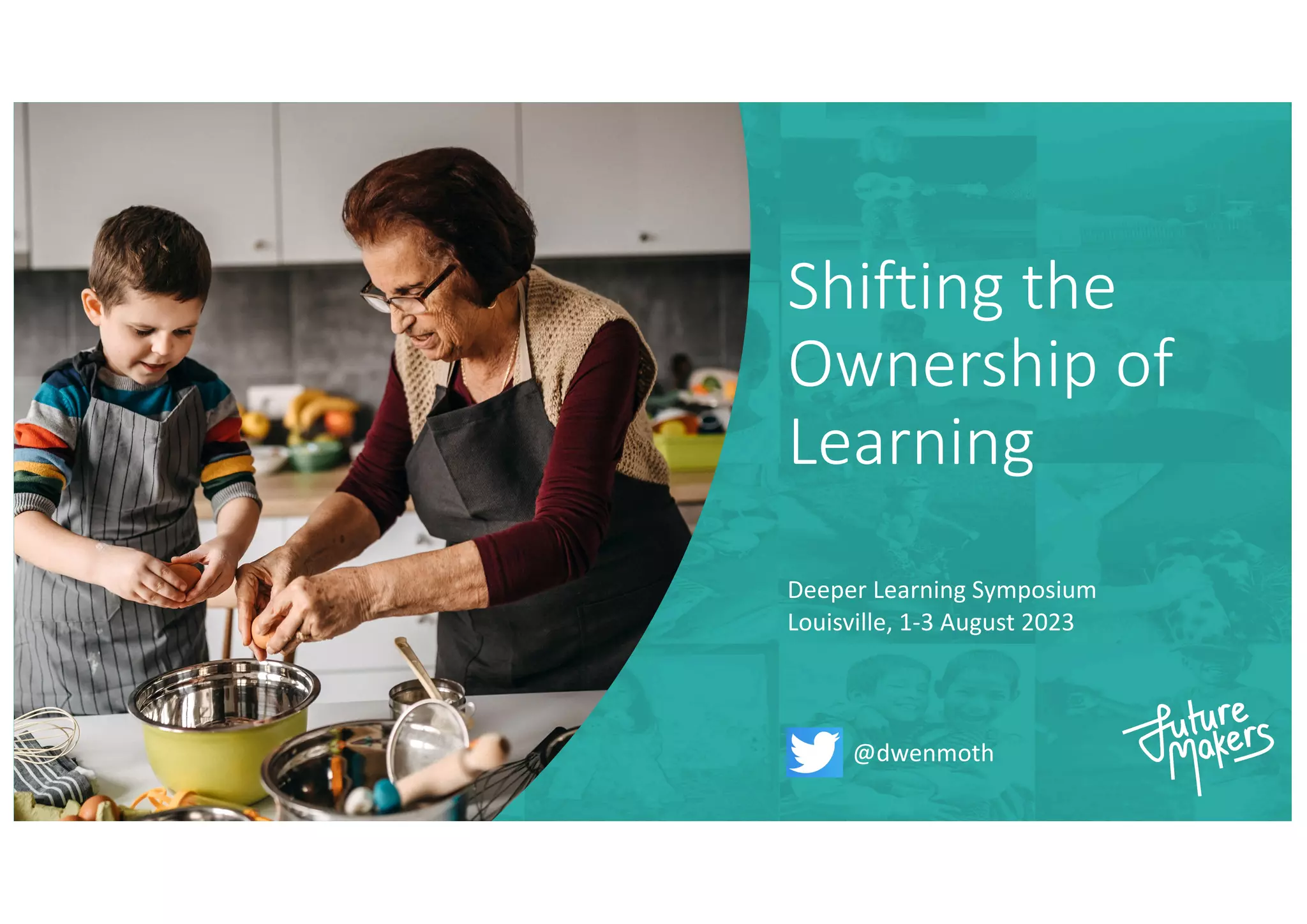
Shifting the
Ownership of
Learning
Deeper Learning Symposium
Louisville, 1-3 August 2023
@dwenmoth
How would you
describe the no2on of
being ‘learner centred’
in the work you do?
People illustrations by Storysetv
Let’s ask the students…
Washor, E and Mohkowski, C (2013) Leaving to learn
Do my teachers really know about
me and my interests and talents?
Do I find what the school
is teaching relevant to my
culture and interests?
Do I have opportuni;es to apply what I am
learning in real world se<ngs and contexts?
Do I feel appropriately
challenged in my learning?
Can I pursue my learning out of
the standard sequence?
Do I have sufficient time
to learn at my own pace?
Do I have real choice about
what, where and how I learn?
Do I have opportunities to
explore and make mistakes?
Do I have opportunities to engage deeply in my
learning and to practice the skills I need to learn?
People illustrations by Storyset
What does the term ‘agency’ mean for you?
• “The power to act”
• “Sense of ownership”
• “Executing and controlling one’s own actions”
• “Self-efficacy”
• “Personalisation”
• “Self management”, “Self-direction”
“The capacity to behave as purposeful,
reflective, responsible social beings, actively
seeking to achieve goals that have been
understood and endorsed” (OECD)
People illustra8ons by Storyset
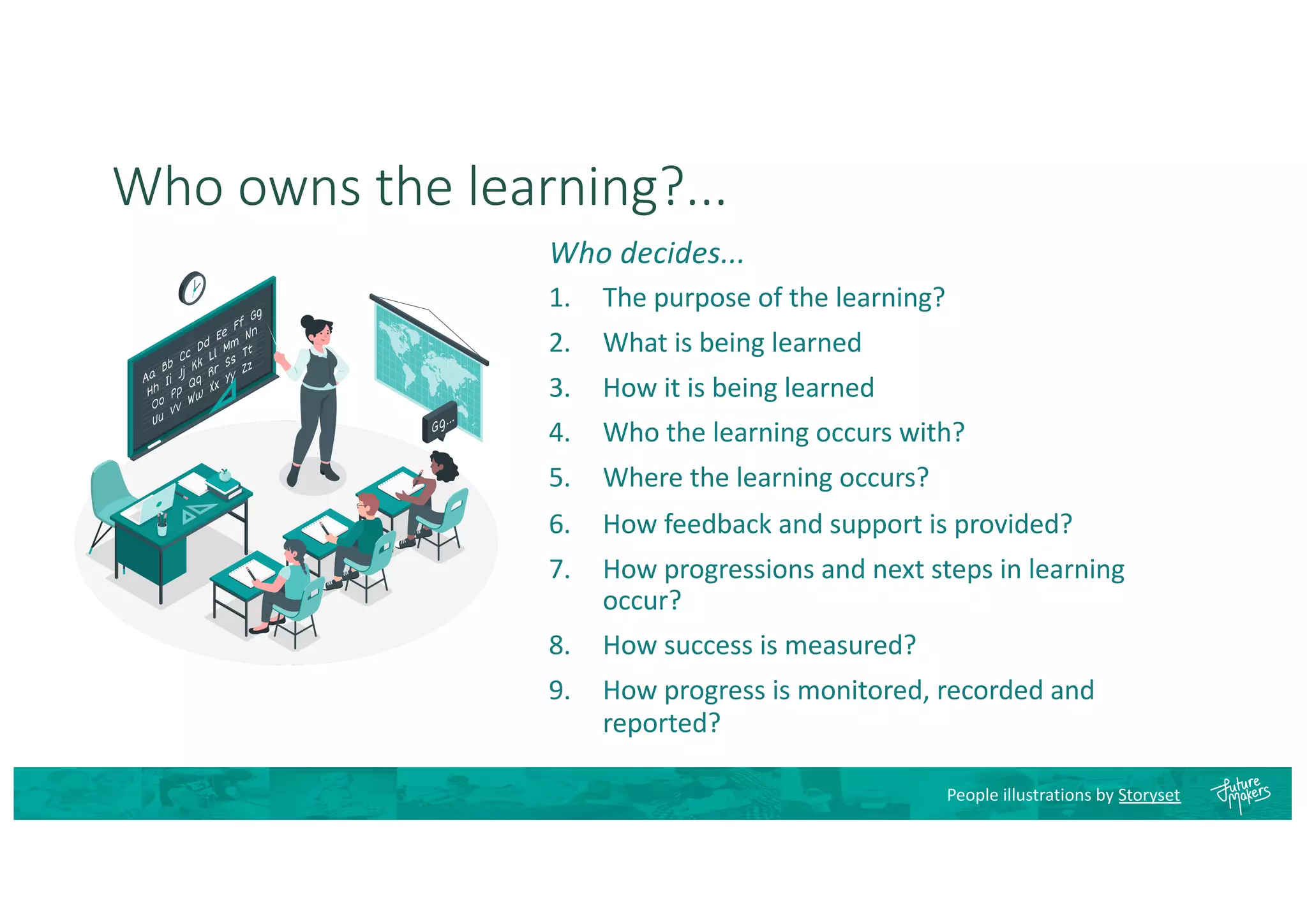
Who owns the learning?...
Who decides...
1. The purpose of the learning?
2. What is being learned
3. How it is being learned
4. Who the learning occurs with?
5. Where the learning occurs?
6. How feedback and support is provided?
7. How progressions and next steps in learning
occur?
8. How success is measured?
9. How progress is monitored, recorded and
reported?
People illustrations by Storyset
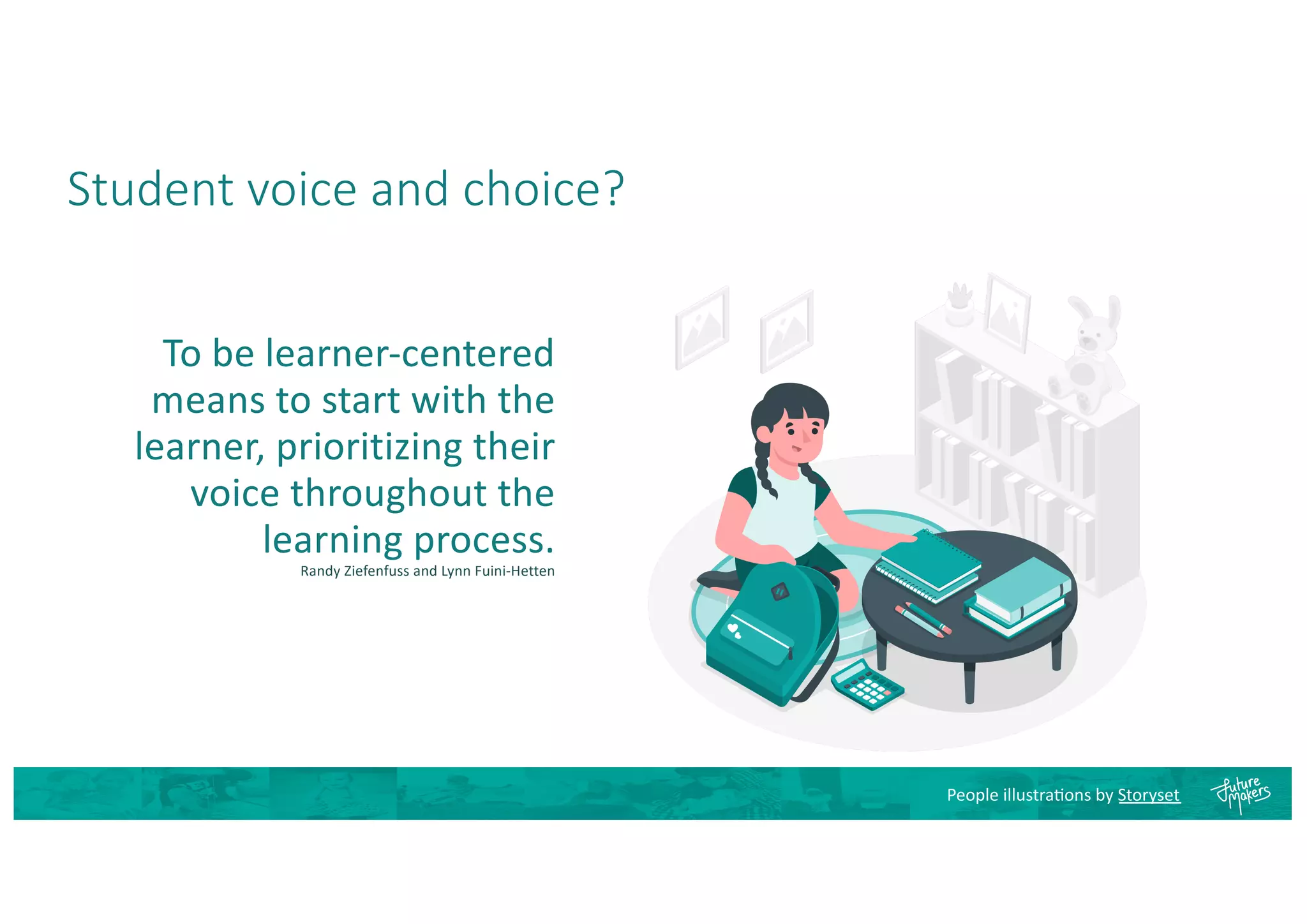
Student voice and choice?
To be learner-centered
means to start with the
learner, prioritizing their
voice throughout the
learning process.
Randy Ziefenfuss and Lynn Fuini-Hetten
People illustra8ons by Storyset
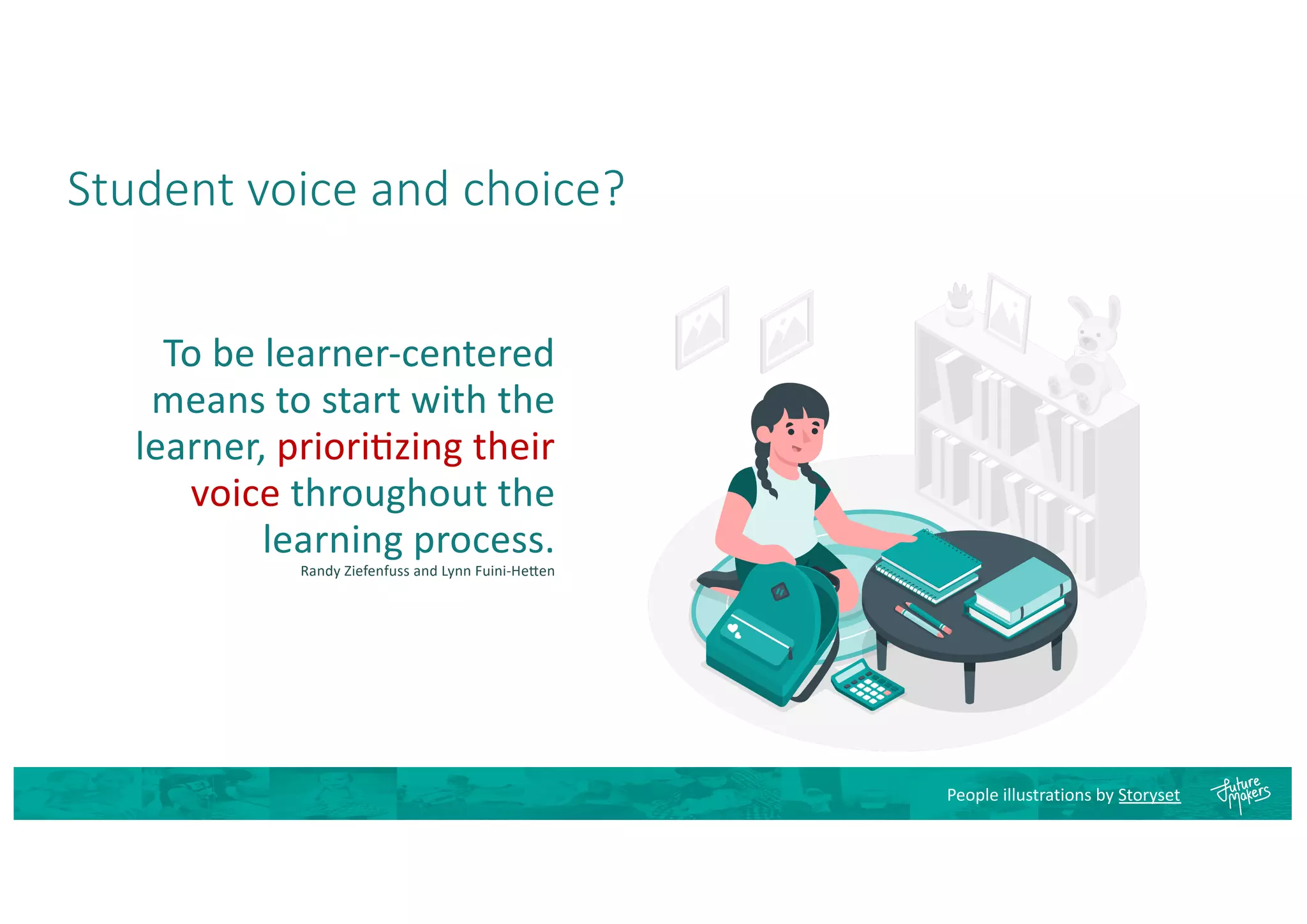
Student voice and choice?
To be learner-centered
means to start with the
learner, priori2zing their
voice throughout the
learning process.
Randy Ziefenfuss and Lynn Fuini-He2en
People illustrations by Storyset
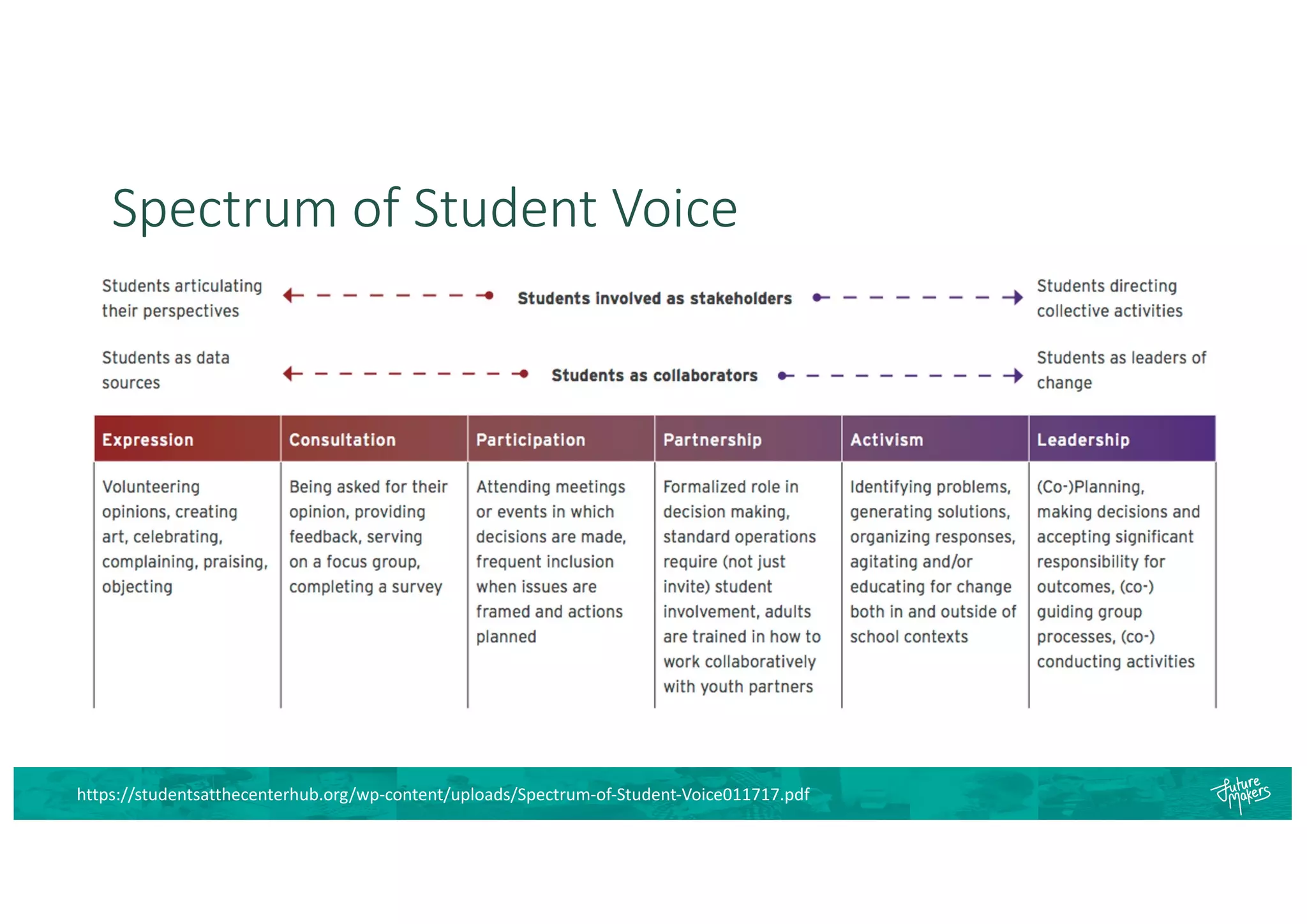
Spectrum of Student Voice
https://studentsatthecenterhub.org/wp-content/uploads/Spectrum-of-Student-Voice011717.pdf
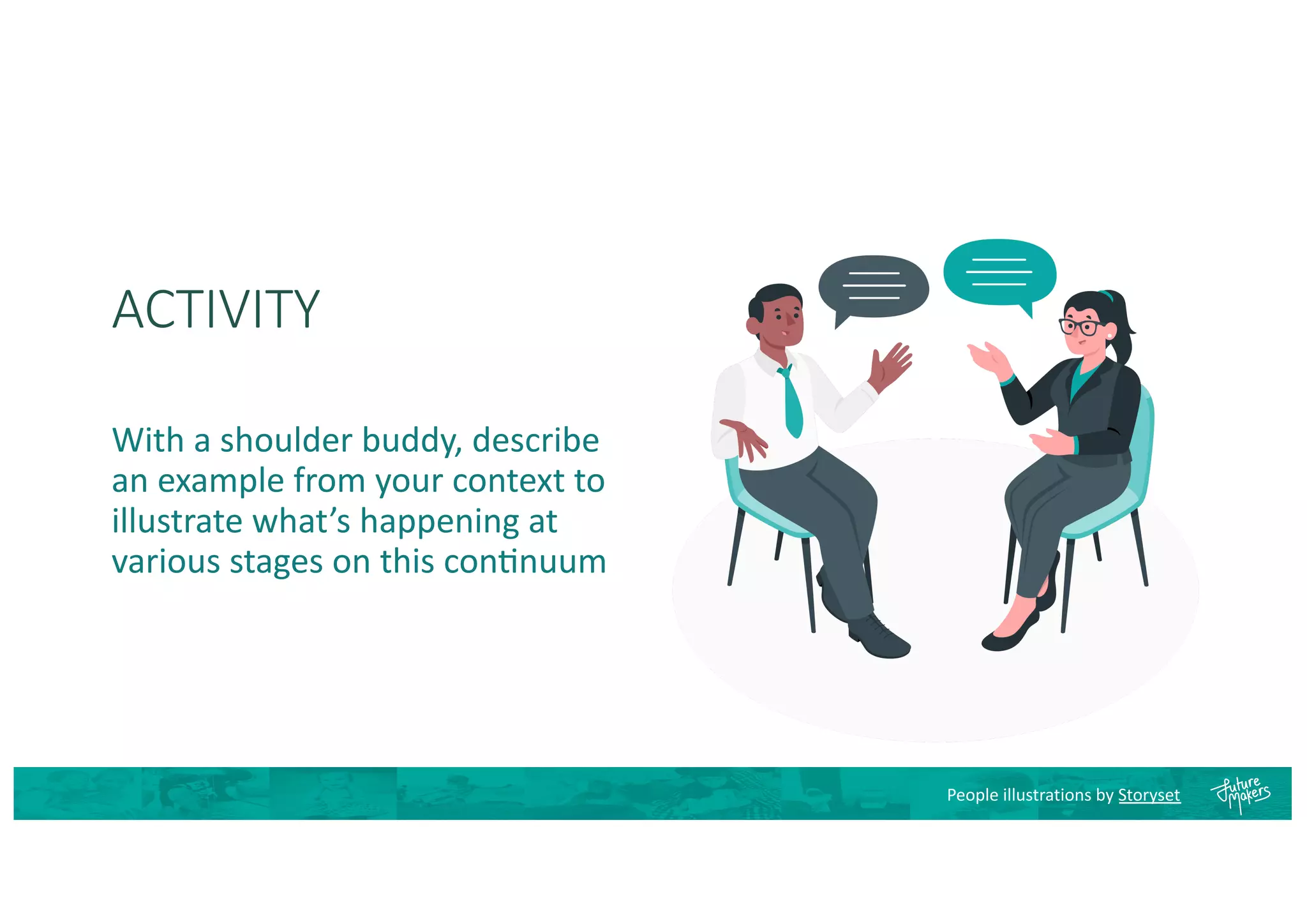
ACTIVITY
People illustrations by Storyset
With a shoulder buddy, describe
an example from your context to
illustrate what’s happening at
various stages on this con;nuum
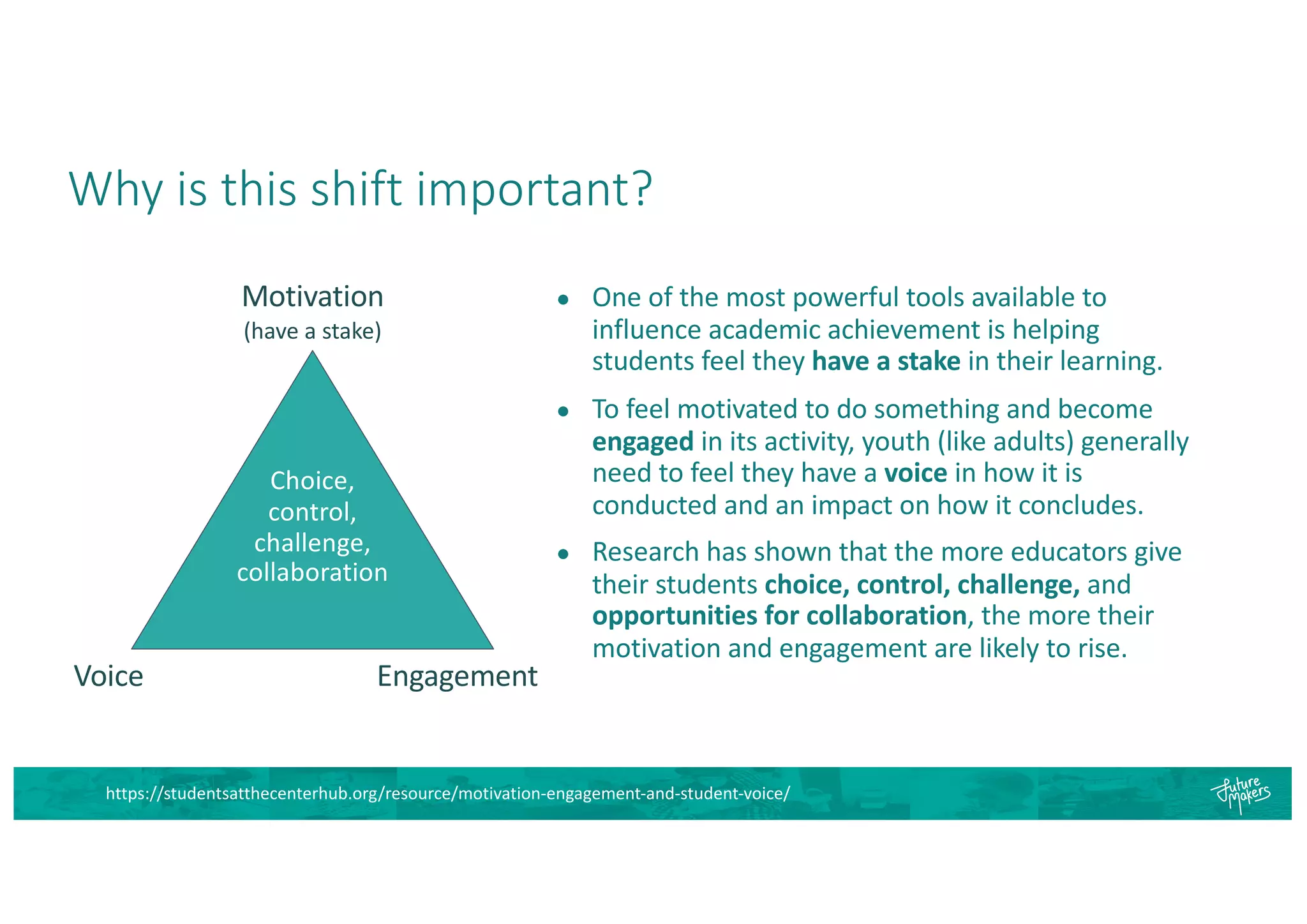
Why is this shift important?
Engagement
Motivation
(have a stake)
Voice
Choice,
control,
challenge,
collaboration
● One of the most powerful tools available to
influence academic achievement is helping
students feel they have a stake in their learning.
● To feel motivated to do something and become
engaged in its activity, youth (like adults) generally
need to feel they have a voice in how it is
conducted and an impact on how it concludes.
● Research has shown that the more educators give
their students choice, control, challenge, and
opportunities for collaboration, the more their
motivation and engagement are likely to rise.
https://studentsatthecenterhub.org/resource/motivation-engagement-and-student-voice/
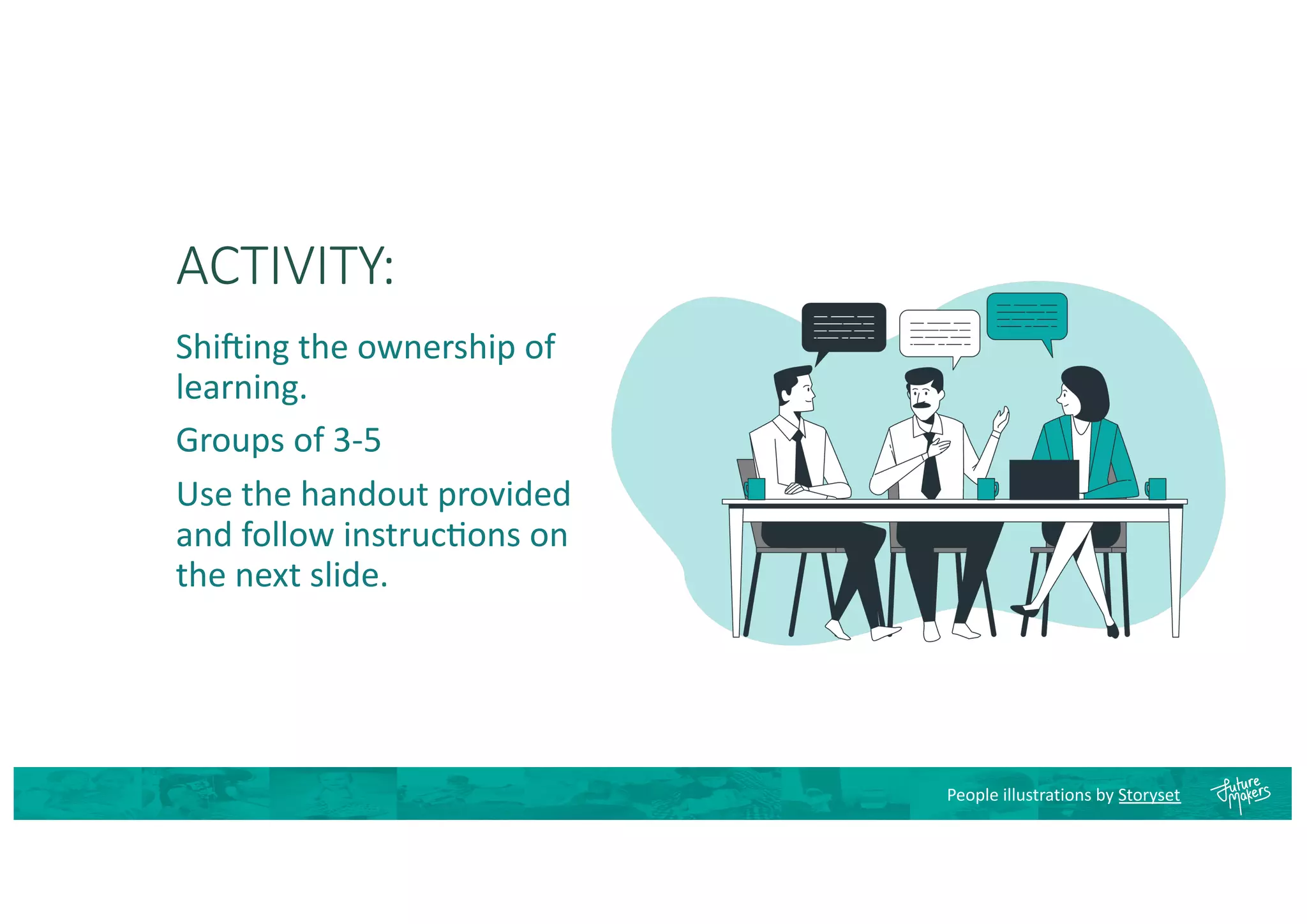
ACTIVITY:
People illustrations by Storyset
Shi=ing the ownership of
learning.
Groups of 3-5
Use the handout provided
and follow instruc;ons on
the next slide.
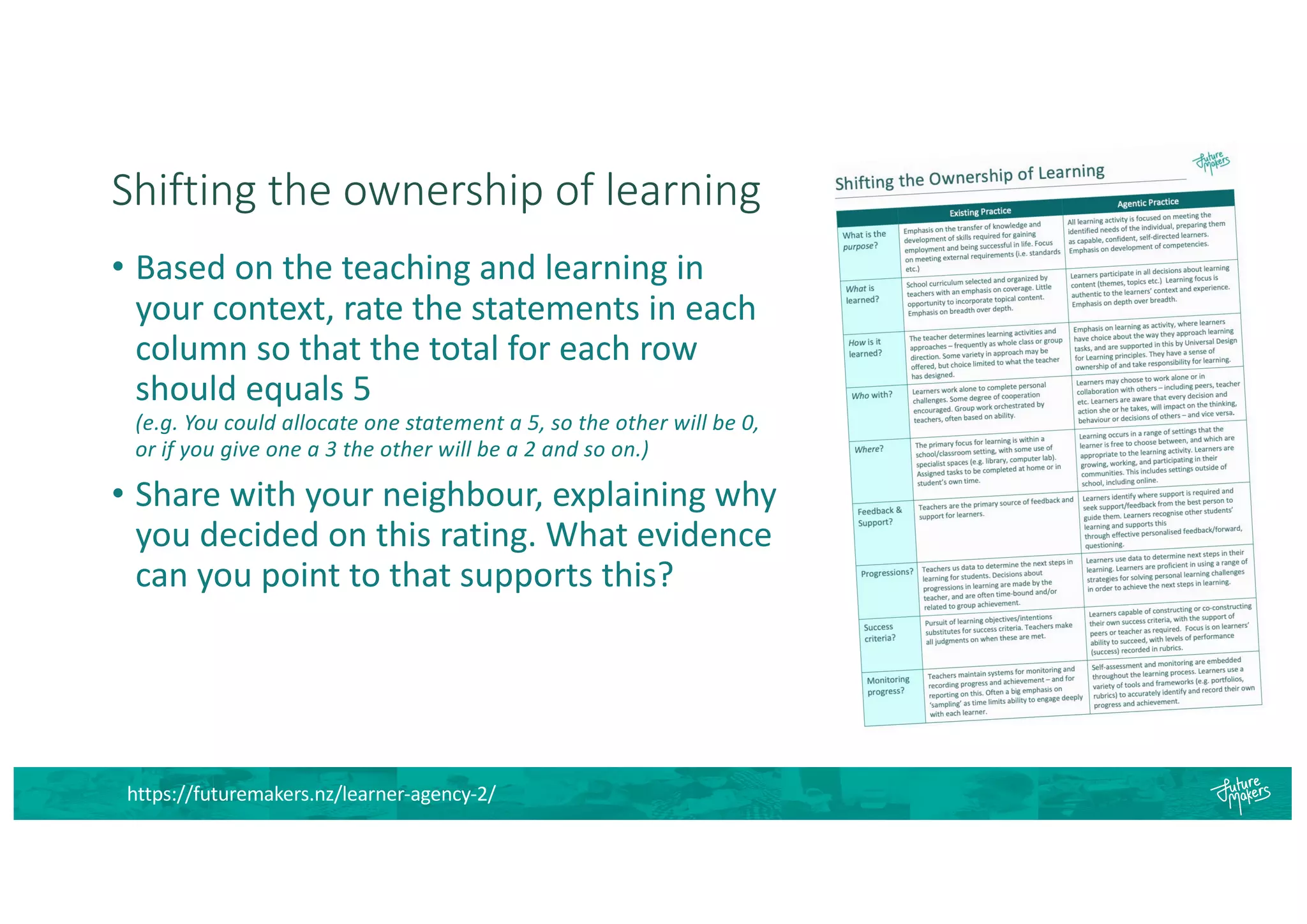
Shifting the ownership of learning
• Based on the teaching and learning in
your context, rate the statements in each
column so that the total for each row
should equals 5
(e.g. You could allocate one statement a 5, so the other will be 0,
or if you give one a 3 the other will be a 2 and so on.)
• Share with your neighbour, explaining why
you decided on this rating. What evidence
can you point to that supports this?
https://futuremakers.nz/learner-agency-2/
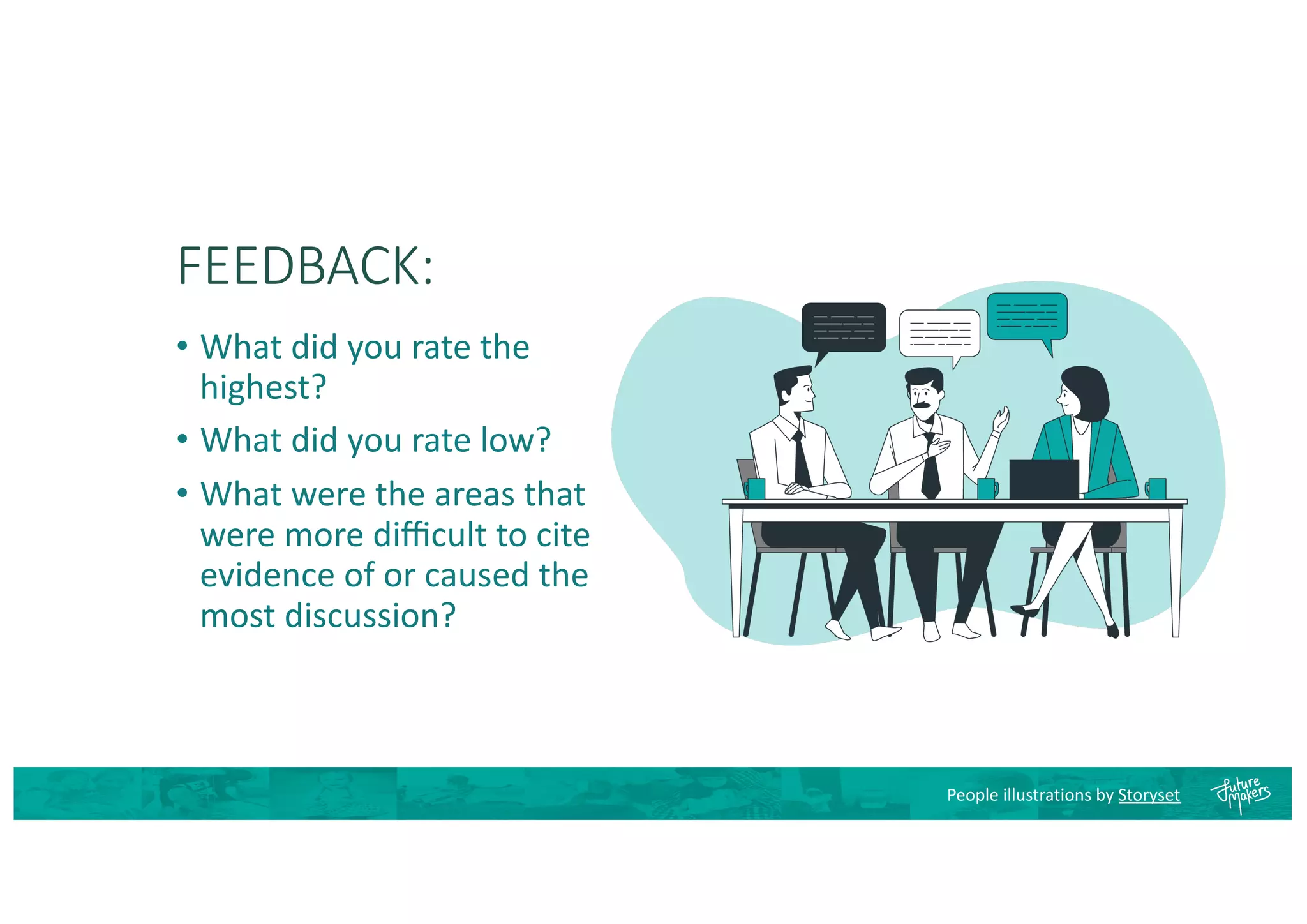
FEEDBACK:
People illustrations by Storyset
• What did you rate the
highest?
• What did you rate low?
• What were the areas that
were more difficult to cite
evidence of or caused the
most discussion?
Coming soon...
• Agency By Design Playbook
• Will be released at the Aurora Ins;tute
Symposium in October, and published
on the Aurora Website
• Followup to the earlier paper Agency
By Design: Making Learning Engaging
that can be found here:
hPps://aurora-
ins;tute.org/resource/agency-by-
design-making-learning-engaging/
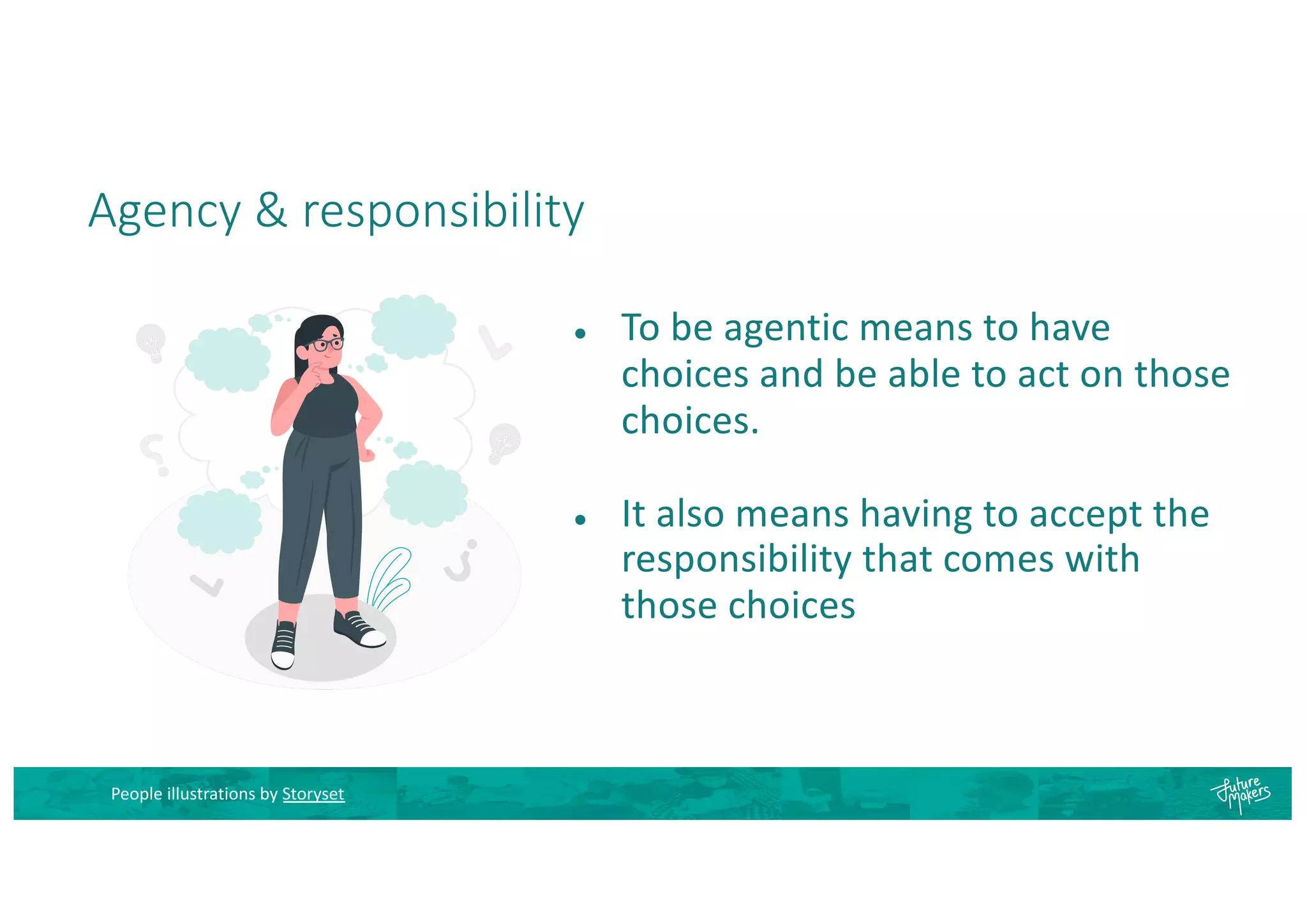
Agency & responsibility
● To be agentic means to have
choices and be able to act on those
choices.
● It also means having to accept the
responsibility that comes with
those choices
People illustrations by Storyset
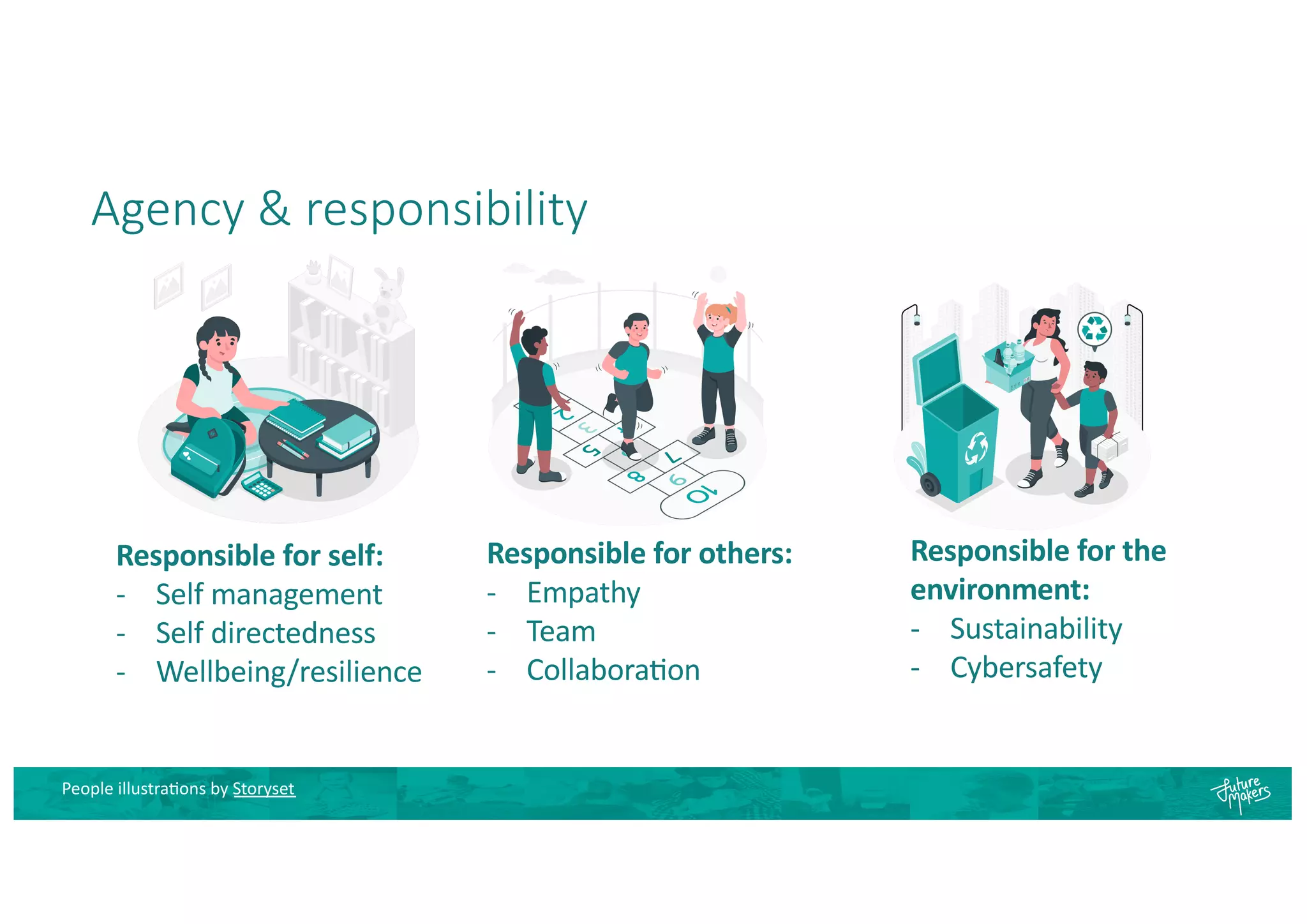
Agency & responsibility
Responsible for self:
- Self management
- Self directedness
- Wellbeing/resilience
Responsible for others:
- Empathy
- Team
- Collabora;on
Responsible for the
environment:
- Sustainability
- Cybersafety
People illustra8ons by Storyset
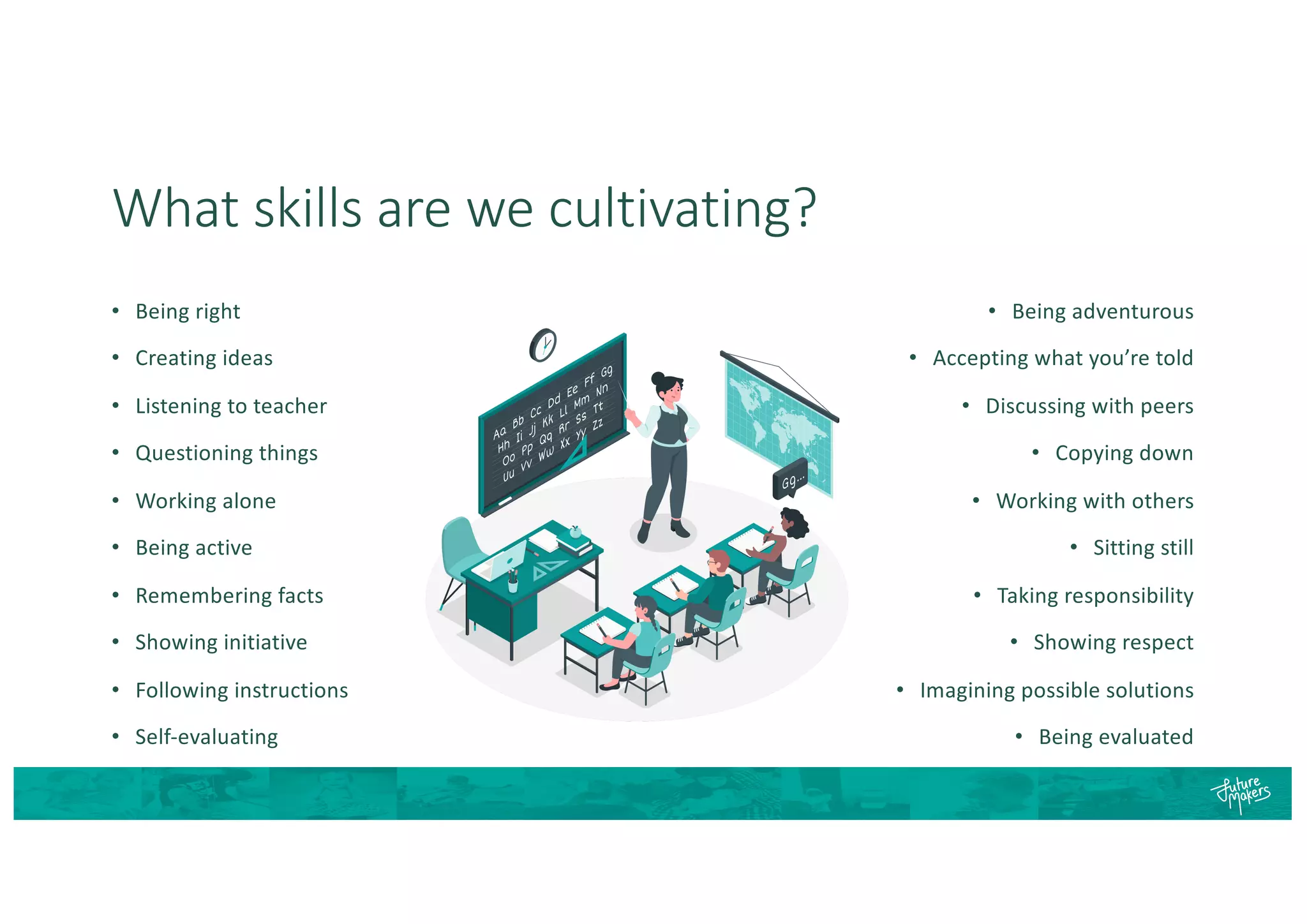
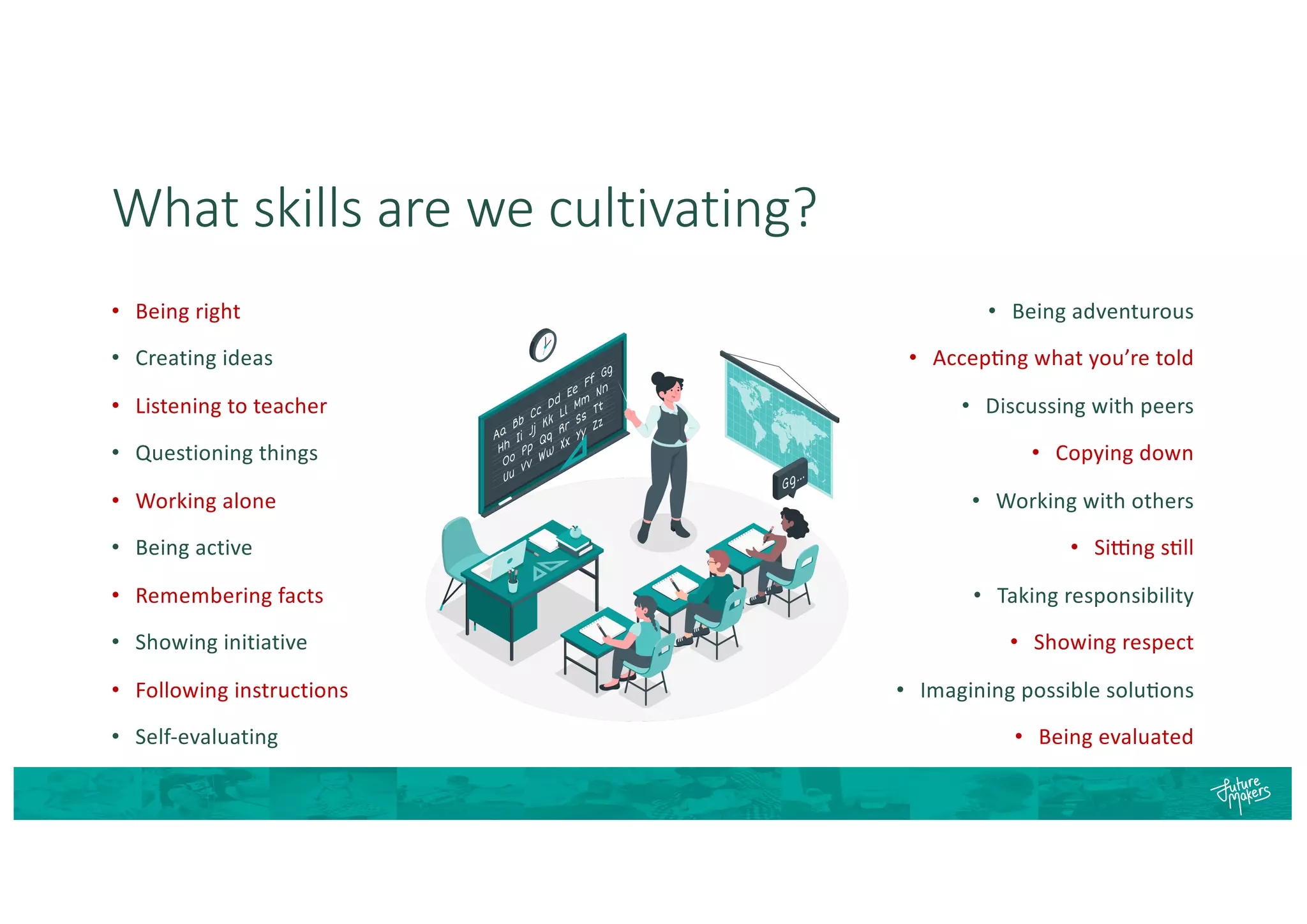
What skills are we cultivating?
• Being right
• Creating ideas
• Listening to teacher
• Questioning things
• Working alone
• Being active
• Remembering facts
• Showing initiative
• Following instructions
• Self-evaluating
• Being adventurous
• Accepting what you’re told
• Discussing with peers
• Copying down
• Working with others
• Sitting still
• Taking responsibility
• Showing respect
• Imagining possible solutions
• Being evaluated
What skills are we cultivating?
• Being right
• Creating ideas
• Listening to teacher
• Questioning things
• Working alone
• Being active
• Remembering facts
• Showing initiative
• Following instructions
• Self-evaluating
• Being adventurous
• AccepFng what you’re told
• Discussing with peers
• Copying down
• Working with others
• SiGng sFll
• Taking responsibility
• Showing respect
• Imagining possible soluFons
• Being evaluated
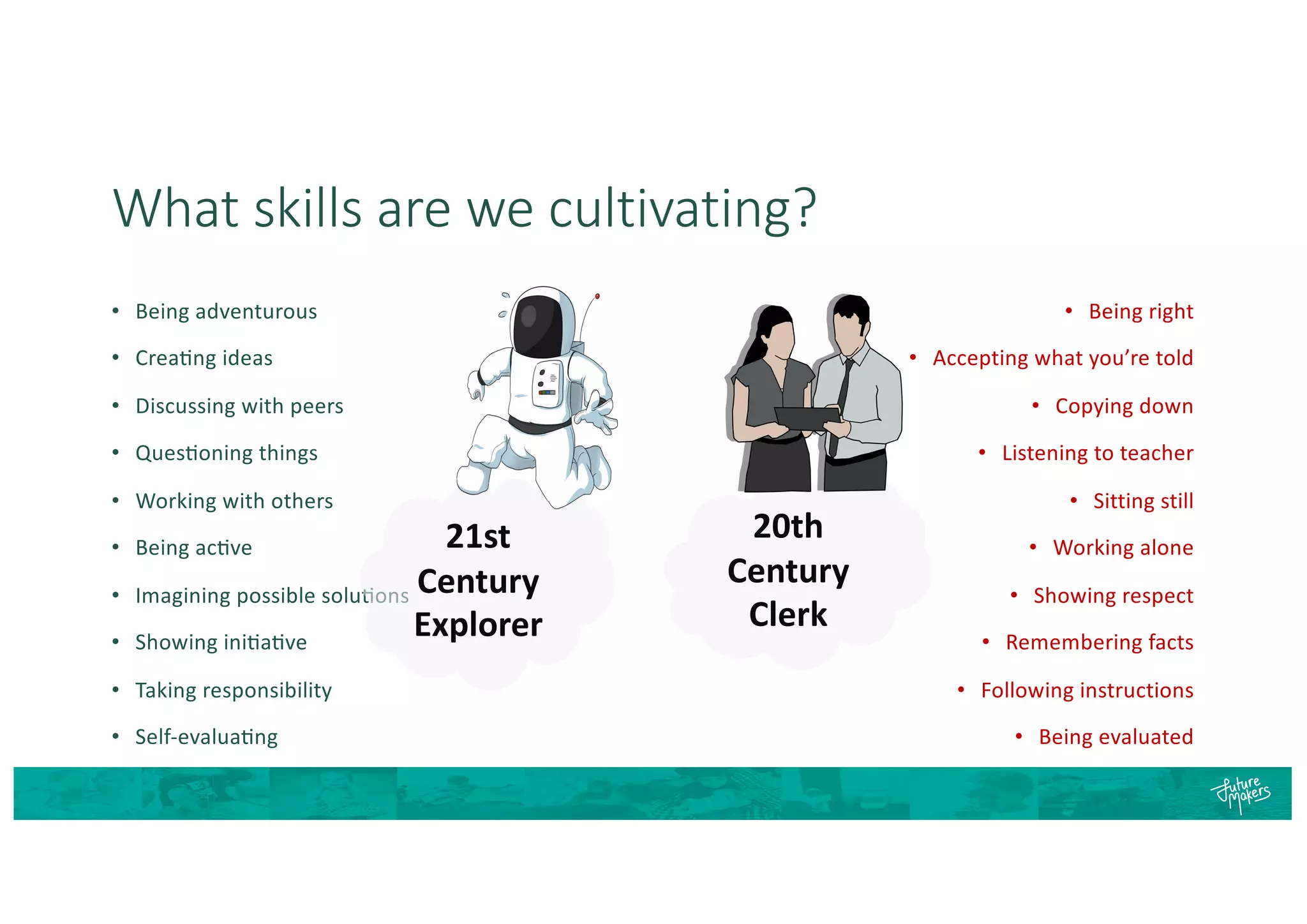
What skills are we cultivating?
• Being adventurous
• CreaFng ideas
• Discussing with peers
• QuesFoning things
• Working with others
• Being acFve
• Imagining possible soluFons
• Showing iniFaFve
• Taking responsibility
• Self-evaluaFng
• Being right
• Accepting what you’re told
• Copying down
• Listening to teacher
• Sitting still
• Working alone
• Showing respect
• Remembering facts
• Following instructions
• Being evaluated
21st
Century
Explorer
20th
Century
Clerk
ACTIVITY
People illustrations by Storyset
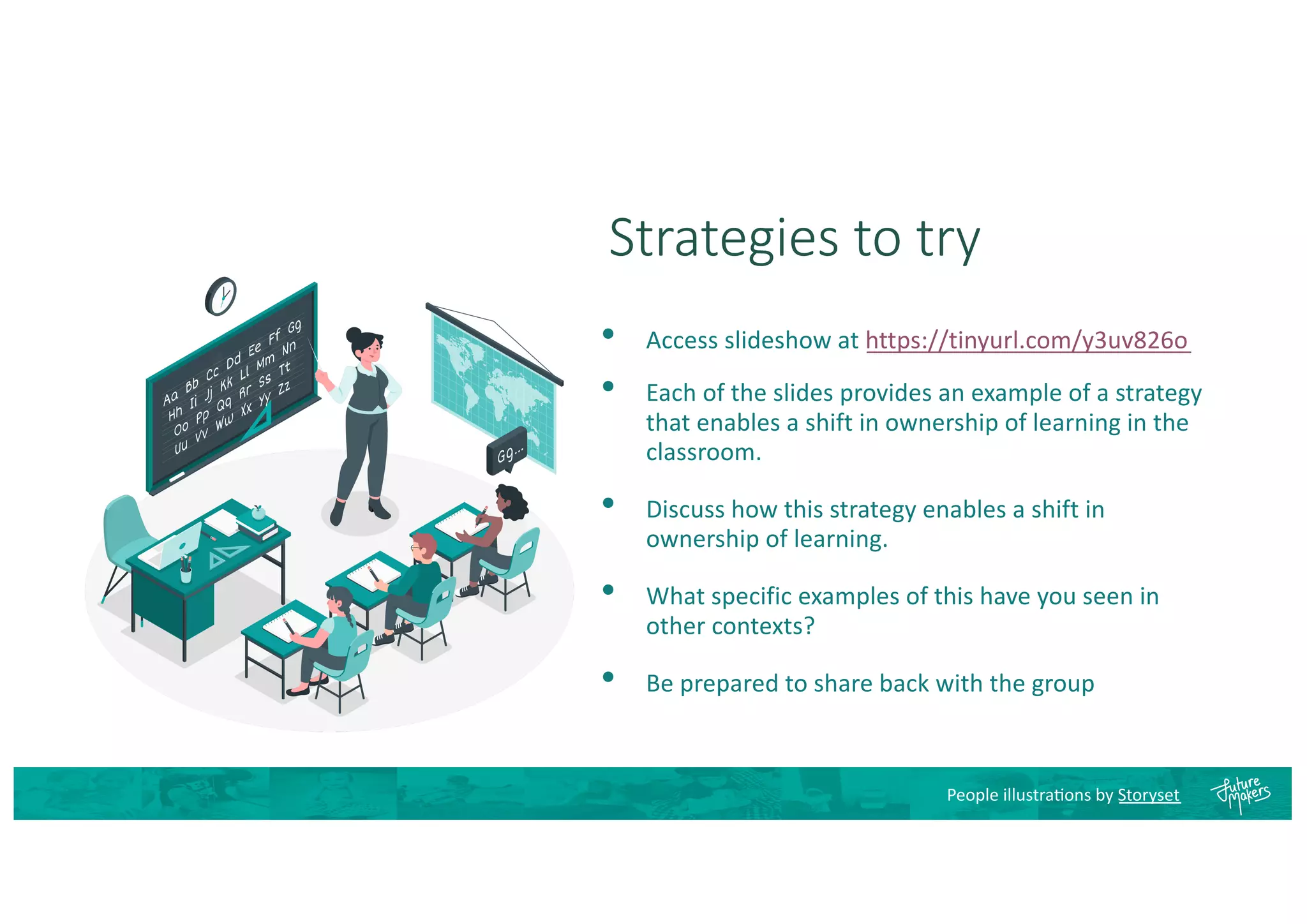
Strategies to try
• Access slideshow at https://tinyurl.com/y3uv826o
• Each of the slides provides an example of a strategy
that enables a shift in ownership of learning in the
classroom.
• Discuss how this strategy enables a shift in
ownership of learning.
• What specific examples of this have you seen in
other contexts?
• Be prepared to share back with the group
People illustra8ons by Storyset
Reflection
● What has resonated most with you
from this workshop?
● What is something you’d like to
explore further?
● What is something you’re planning on
doing when you return to your
school/class?
● What questions do you still have?
How are you going to find an answer?
People illustrations by Storyset
Thank You
derek@futuremakers.nz
@dwenmoth
www.futuremakers.nz
hKp://futuremakers.nz/blog

WORKSHOP: Shifting the Ownership of Learning

  • 1.
    Shifting the Ownership of Learning DeeperLearning Symposium Louisville, 1-3 August 2023 @dwenmoth
  • 2.
    How would you describethe no2on of being ‘learner centred’ in the work you do? People illustrations by Storysetv
  • 3.
    Let’s ask thestudents… Washor, E and Mohkowski, C (2013) Leaving to learn Do my teachers really know about me and my interests and talents? Do I find what the school is teaching relevant to my culture and interests? Do I have opportuni;es to apply what I am learning in real world se<ngs and contexts? Do I feel appropriately challenged in my learning? Can I pursue my learning out of the standard sequence? Do I have sufficient time to learn at my own pace? Do I have real choice about what, where and how I learn? Do I have opportunities to explore and make mistakes? Do I have opportunities to engage deeply in my learning and to practice the skills I need to learn? People illustrations by Storyset
  • 4.
    What does theterm ‘agency’ mean for you? • “The power to act” • “Sense of ownership” • “Executing and controlling one’s own actions” • “Self-efficacy” • “Personalisation” • “Self management”, “Self-direction” “The capacity to behave as purposeful, reflective, responsible social beings, actively seeking to achieve goals that have been understood and endorsed” (OECD) People illustra8ons by Storyset
  • 5.
    Who owns thelearning?... Who decides... 1. The purpose of the learning? 2. What is being learned 3. How it is being learned 4. Who the learning occurs with? 5. Where the learning occurs? 6. How feedback and support is provided? 7. How progressions and next steps in learning occur? 8. How success is measured? 9. How progress is monitored, recorded and reported? People illustrations by Storyset
  • 6.
    Student voice andchoice? To be learner-centered means to start with the learner, prioritizing their voice throughout the learning process. Randy Ziefenfuss and Lynn Fuini-Hetten People illustra8ons by Storyset
  • 7.
    Student voice andchoice? To be learner-centered means to start with the learner, priori2zing their voice throughout the learning process. Randy Ziefenfuss and Lynn Fuini-He2en People illustrations by Storyset
  • 8.
    Spectrum of StudentVoice https://studentsatthecenterhub.org/wp-content/uploads/Spectrum-of-Student-Voice011717.pdf
  • 9.
    ACTIVITY People illustrations byStoryset With a shoulder buddy, describe an example from your context to illustrate what’s happening at various stages on this con;nuum
  • 10.
    Why is thisshift important? Engagement Motivation (have a stake) Voice Choice, control, challenge, collaboration ● One of the most powerful tools available to influence academic achievement is helping students feel they have a stake in their learning. ● To feel motivated to do something and become engaged in its activity, youth (like adults) generally need to feel they have a voice in how it is conducted and an impact on how it concludes. ● Research has shown that the more educators give their students choice, control, challenge, and opportunities for collaboration, the more their motivation and engagement are likely to rise. https://studentsatthecenterhub.org/resource/motivation-engagement-and-student-voice/
  • 11.
    ACTIVITY: People illustrations byStoryset Shi=ing the ownership of learning. Groups of 3-5 Use the handout provided and follow instruc;ons on the next slide.
  • 12.
    Shifting the ownershipof learning • Based on the teaching and learning in your context, rate the statements in each column so that the total for each row should equals 5 (e.g. You could allocate one statement a 5, so the other will be 0, or if you give one a 3 the other will be a 2 and so on.) • Share with your neighbour, explaining why you decided on this rating. What evidence can you point to that supports this? https://futuremakers.nz/learner-agency-2/
  • 13.
    FEEDBACK: People illustrations byStoryset • What did you rate the highest? • What did you rate low? • What were the areas that were more difficult to cite evidence of or caused the most discussion?
  • 14.
    Coming soon... • AgencyBy Design Playbook • Will be released at the Aurora Ins;tute Symposium in October, and published on the Aurora Website • Followup to the earlier paper Agency By Design: Making Learning Engaging that can be found here: hPps://aurora- ins;tute.org/resource/agency-by- design-making-learning-engaging/
  • 15.
    Agency & responsibility ●To be agentic means to have choices and be able to act on those choices. ● It also means having to accept the responsibility that comes with those choices People illustrations by Storyset
  • 16.
    Agency & responsibility Responsiblefor self: - Self management - Self directedness - Wellbeing/resilience Responsible for others: - Empathy - Team - Collabora;on Responsible for the environment: - Sustainability - Cybersafety People illustra8ons by Storyset
  • 17.
    What skills arewe cultivating? • Being right • Creating ideas • Listening to teacher • Questioning things • Working alone • Being active • Remembering facts • Showing initiative • Following instructions • Self-evaluating • Being adventurous • Accepting what you’re told • Discussing with peers • Copying down • Working with others • Sitting still • Taking responsibility • Showing respect • Imagining possible solutions • Being evaluated
  • 18.
    What skills arewe cultivating? • Being right • Creating ideas • Listening to teacher • Questioning things • Working alone • Being active • Remembering facts • Showing initiative • Following instructions • Self-evaluating • Being adventurous • AccepFng what you’re told • Discussing with peers • Copying down • Working with others • SiGng sFll • Taking responsibility • Showing respect • Imagining possible soluFons • Being evaluated
  • 19.
    What skills arewe cultivating? • Being adventurous • CreaFng ideas • Discussing with peers • QuesFoning things • Working with others • Being acFve • Imagining possible soluFons • Showing iniFaFve • Taking responsibility • Self-evaluaFng • Being right • Accepting what you’re told • Copying down • Listening to teacher • Sitting still • Working alone • Showing respect • Remembering facts • Following instructions • Being evaluated 21st Century Explorer 20th Century Clerk
  • 20.
  • 21.
    Strategies to try •Access slideshow at https://tinyurl.com/y3uv826o • Each of the slides provides an example of a strategy that enables a shift in ownership of learning in the classroom. • Discuss how this strategy enables a shift in ownership of learning. • What specific examples of this have you seen in other contexts? • Be prepared to share back with the group People illustra8ons by Storyset
  • 22.
    Reflection ● What hasresonated most with you from this workshop? ● What is something you’d like to explore further? ● What is something you’re planning on doing when you return to your school/class? ● What questions do you still have? How are you going to find an answer? People illustrations by Storyset
  • 23.