Future Ready
Workshop
derek.wenmoth@core-ed.org
@dwenmoth
http://www.wenmoth.net
Outline
● Dig deeper into the ten trends
○ What are the compelling issues?
○ How might they affect us?
● What is a a future-ready learner?
● What should we be focusing on…
○ in our curriculum and in the way we teach?
○ In our learning environments and our learning activities?
● Next steps – some practical start points to leave with
ACTIVITY 1 – Digging deeper
● Review the trends and main categories
● Select one and settle with a partner/group to explore it a little
further – prepare a synopsis of what you have read:
○ What is it about? Why is it important? What are the drivers?
○ Implications for educators? Examples?
● Present back to the group
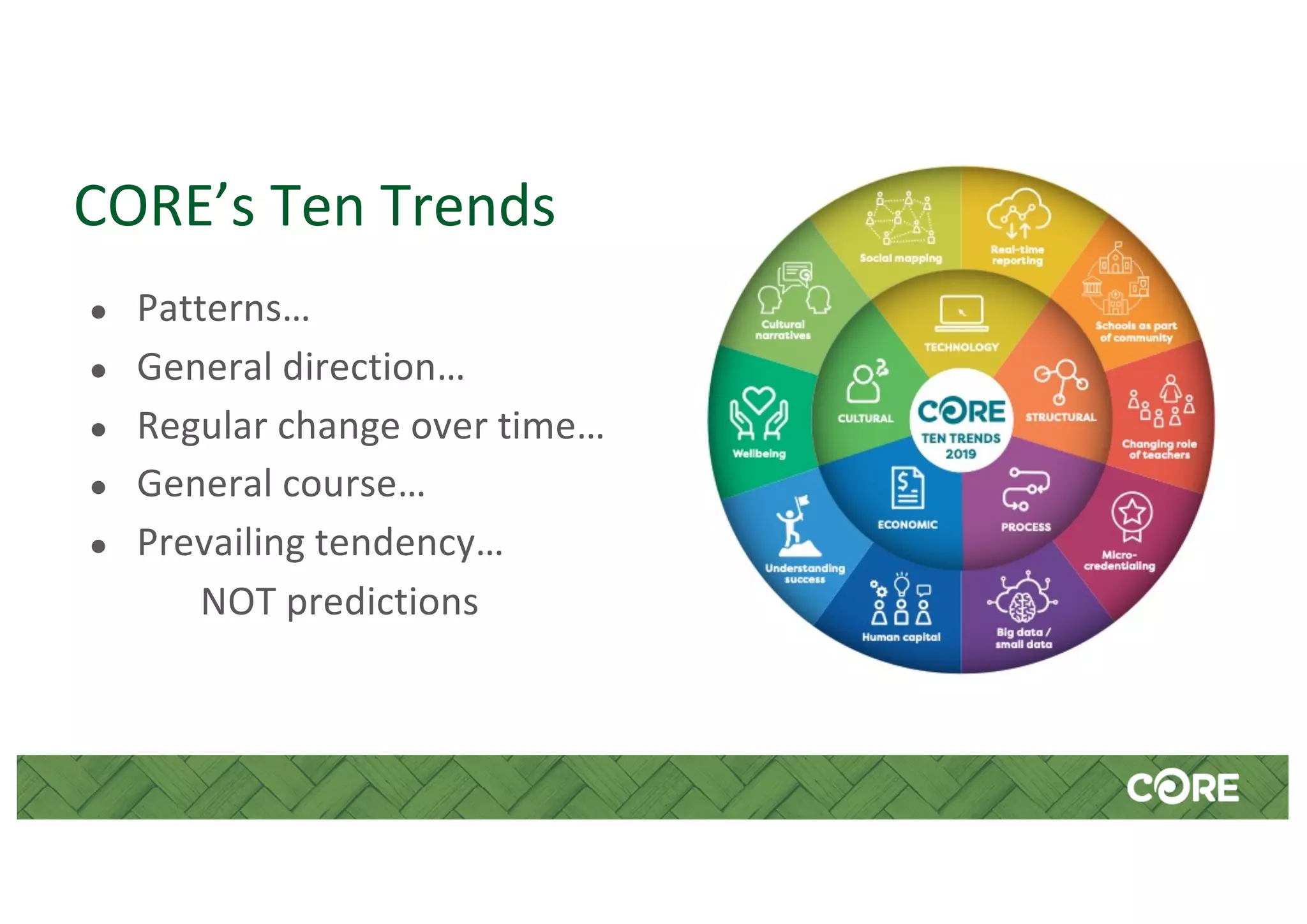
CORE’s Ten Trends
● Patterns…
● General direction…
● Regular change over time…
● General course…
● Prevailing tendency…
NOT predictions
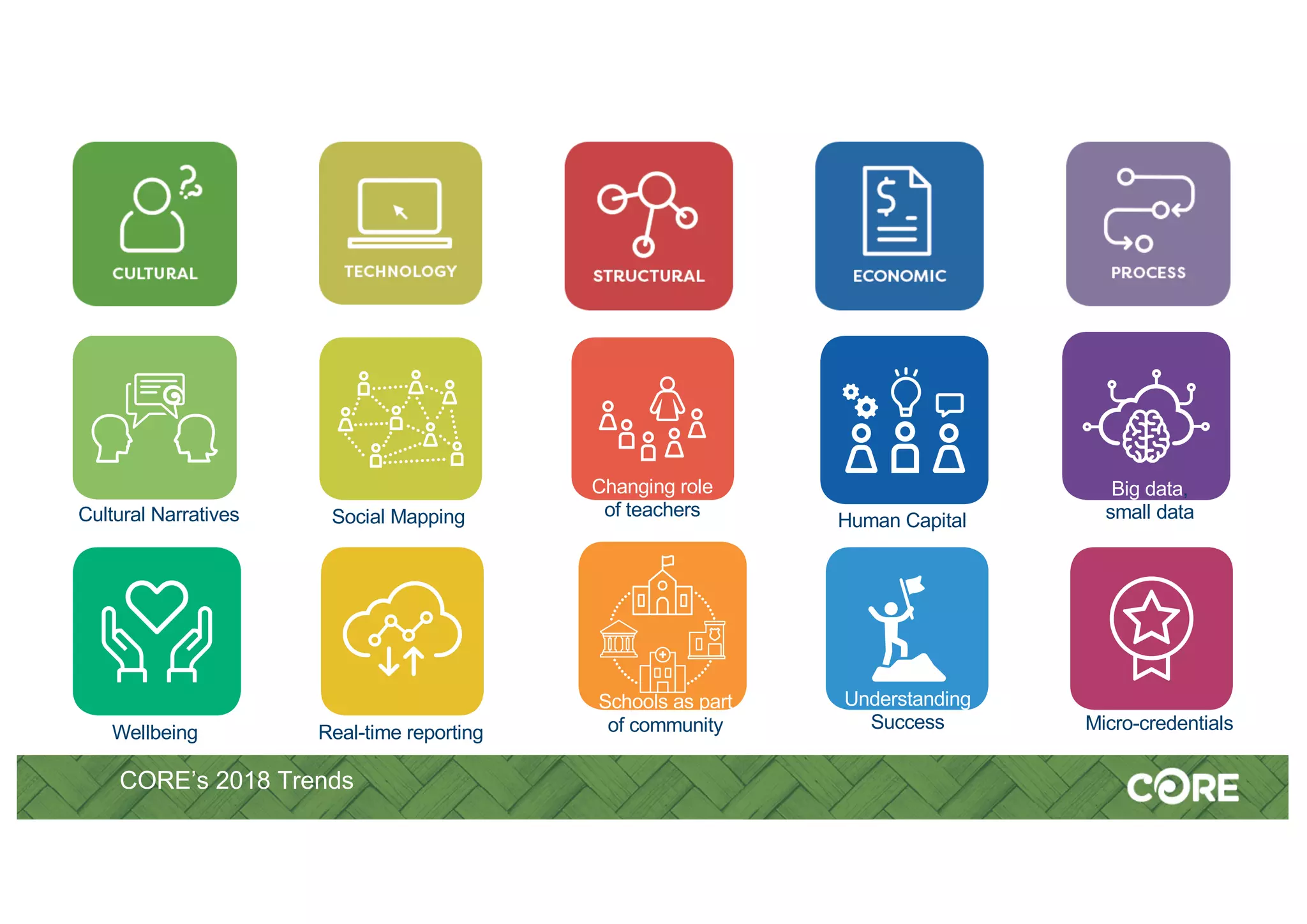
CORE’s 2018 Trends
Social Mapping
Big data,
small data
Changing role
of teachersCultural Narratives Human Capital
Micro-credentials
Understanding
Success
Wellbeing
Schools as part
of communityReal-time reporting
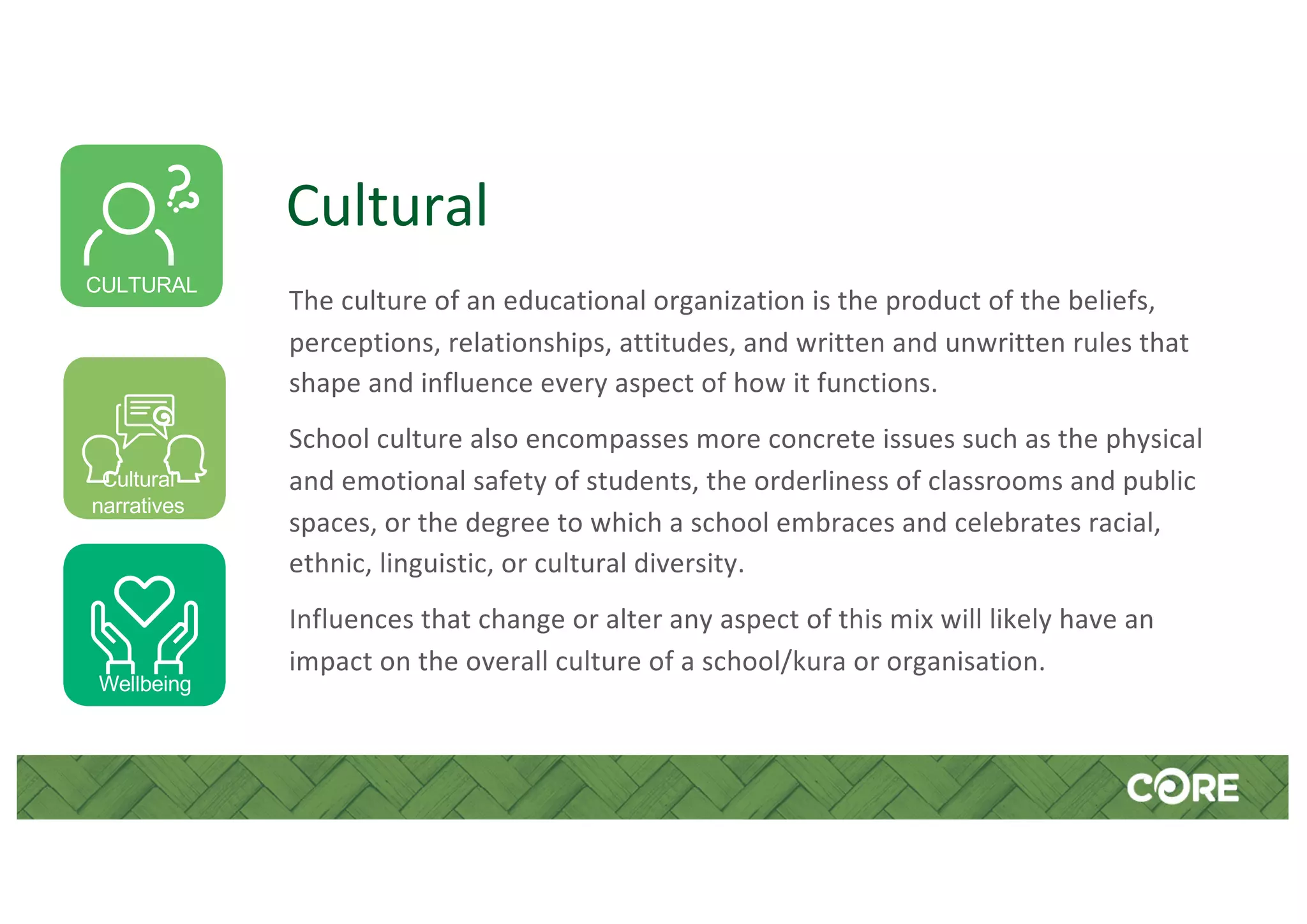
Cultural
The culture of an educational organization is the product of the beliefs,
perceptions, relationships, attitudes, and written and unwritten rules that
shape and influence every aspect of how it functions.
School culture also encompasses more concrete issues such as the physical
and emotional safety of students, the orderliness of classrooms and public
spaces, or the degree to which a school embraces and celebrates racial,
ethnic, linguistic, or cultural diversity.
Influences that change or alter any aspect of this mix will likely have an
impact on the overall culture of a school/kura or organisation.
CULTURAL
Wellbeing
Cultural
narratives
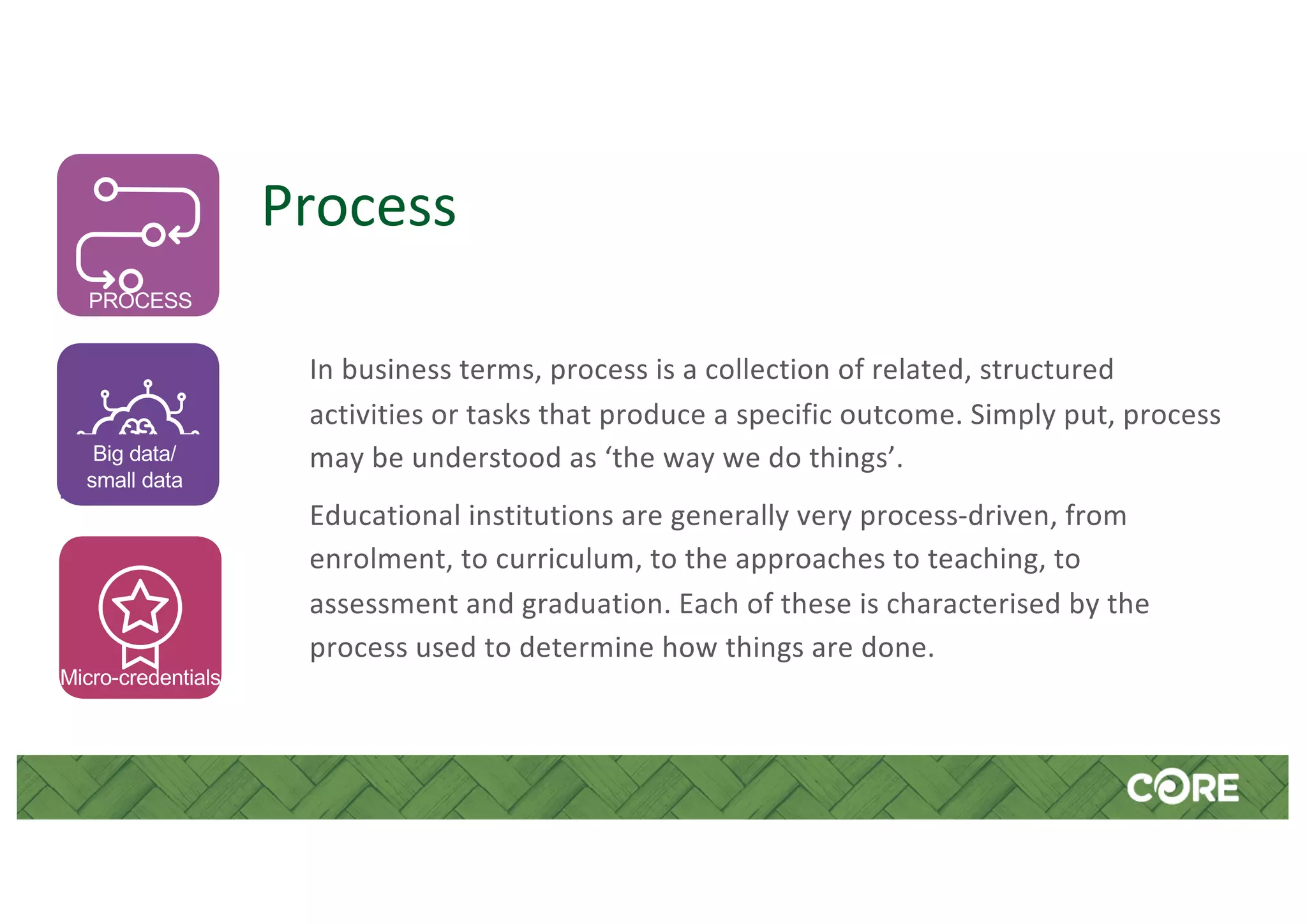
Process
In business terms, process is a collection of related, structured
activities or tasks that produce a specific outcome. Simply put, process
may be understood as ‘the way we do things’.
Educational institutions are generally very process-driven, from
enrolment, to curriculum, to the approaches to teaching, to
assessment and graduation. Each of these is characterised by the
process used to determine how things are done.
PROCESS
Micro-credentials
Big data/
small data
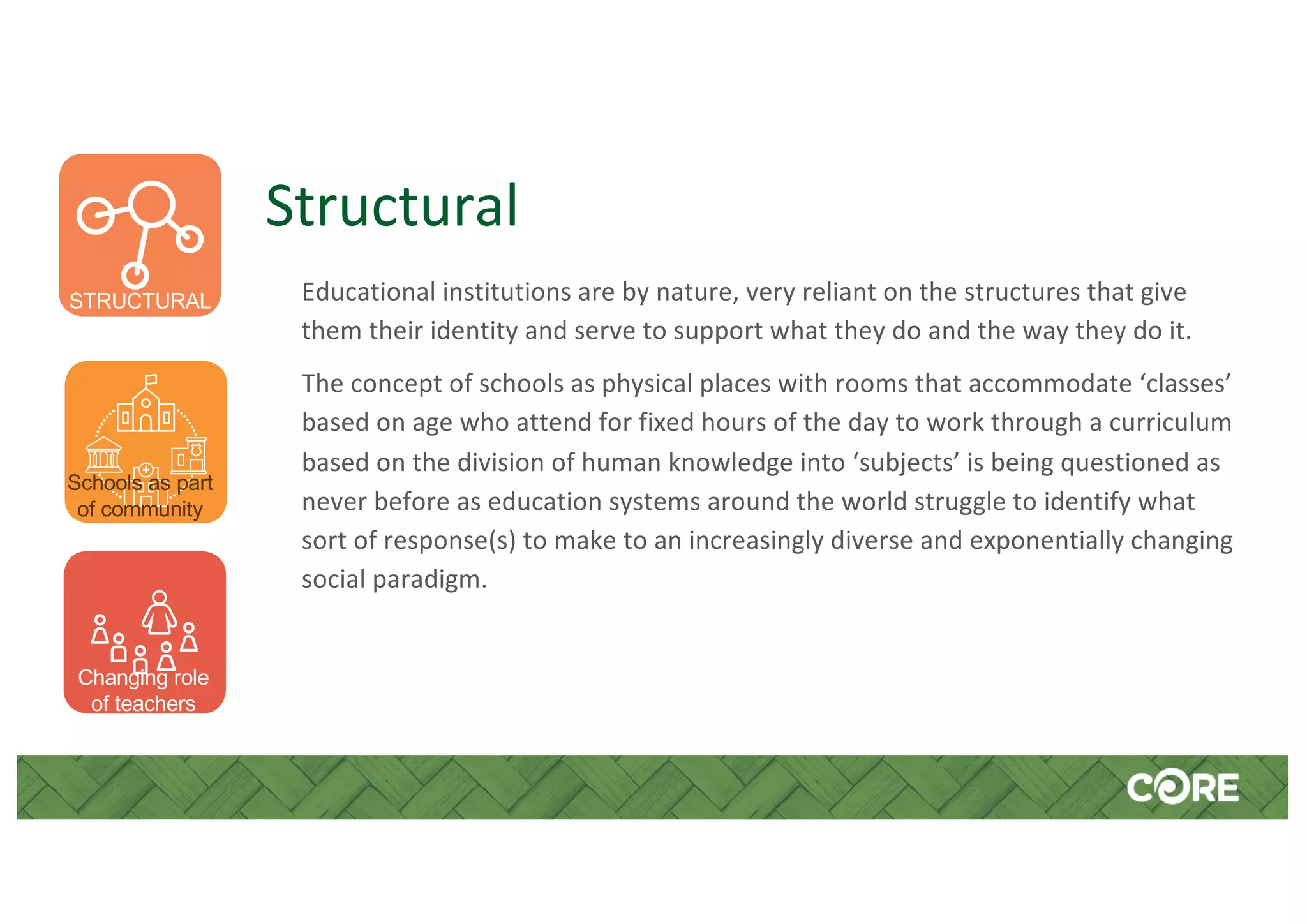
Structural
Educational institutions are by nature, very reliant on the structures that give
them their identity and serve to support what they do and the way they do it.
The concept of schools as physical places with rooms that accommodate ‘classes’
based on age who attend for fixed hours of the day to work through a curriculum
based on the division of human knowledge into ‘subjects’ is being questioned as
never before as education systems around the world struggle to identify what
sort of response(s) to make to an increasingly diverse and exponentially changing
social paradigm.
STRUCTURAL
Schools as part
of community
Changing role
of teachers
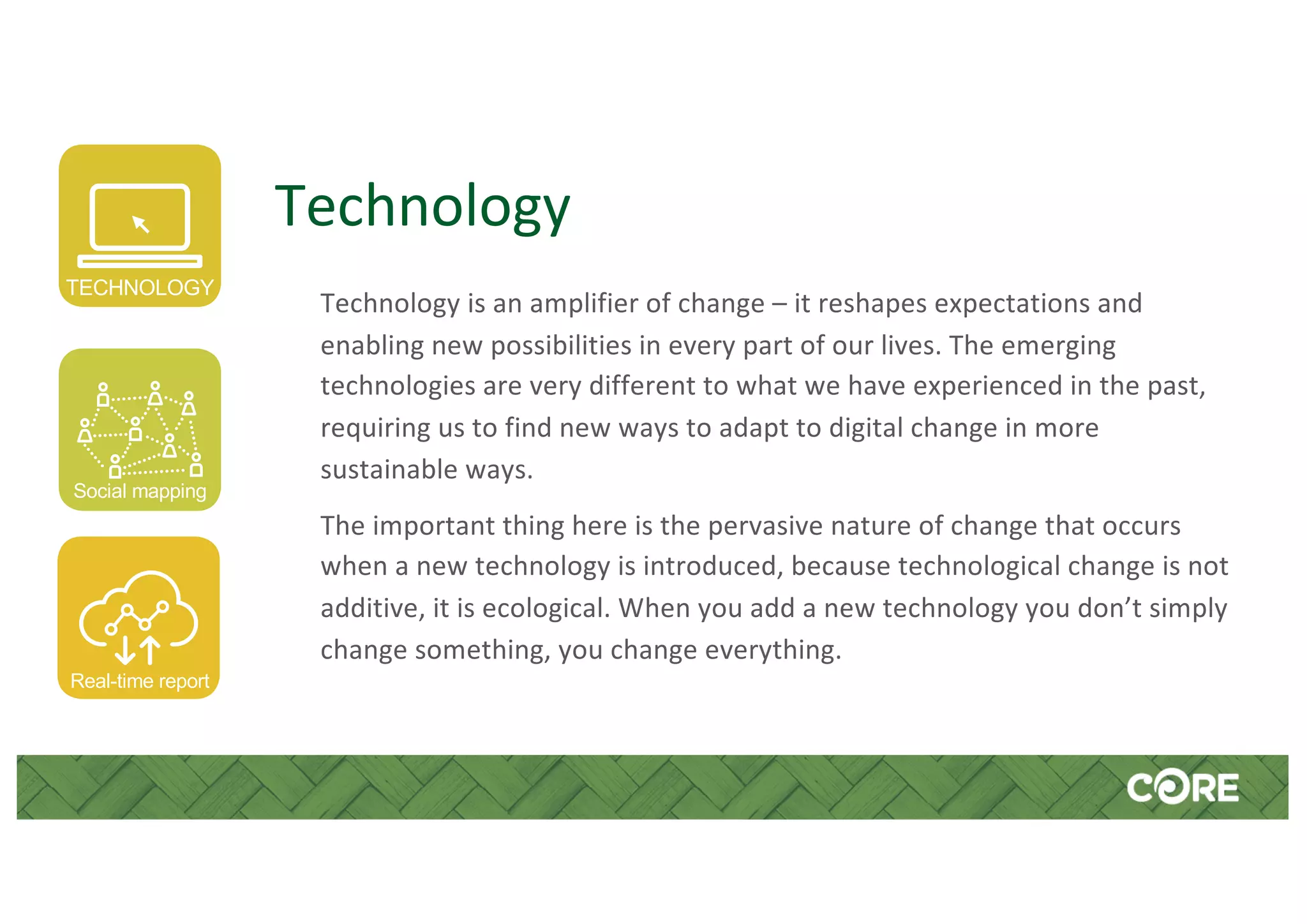
Technology
Technology is an amplifier of change – it reshapes expectations and
enabling new possibilities in every part of our lives. The emerging
technologies are very different to what we have experienced in the past,
requiring us to find new ways to adapt to digital change in more
sustainable ways.
The important thing here is the pervasive nature of change that occurs
when a new technology is introduced, because technological change is not
additive, it is ecological. When you add a new technology you don’t simply
change something, you change everything.
TECHNOLOGY
Social mapping
Real-time report
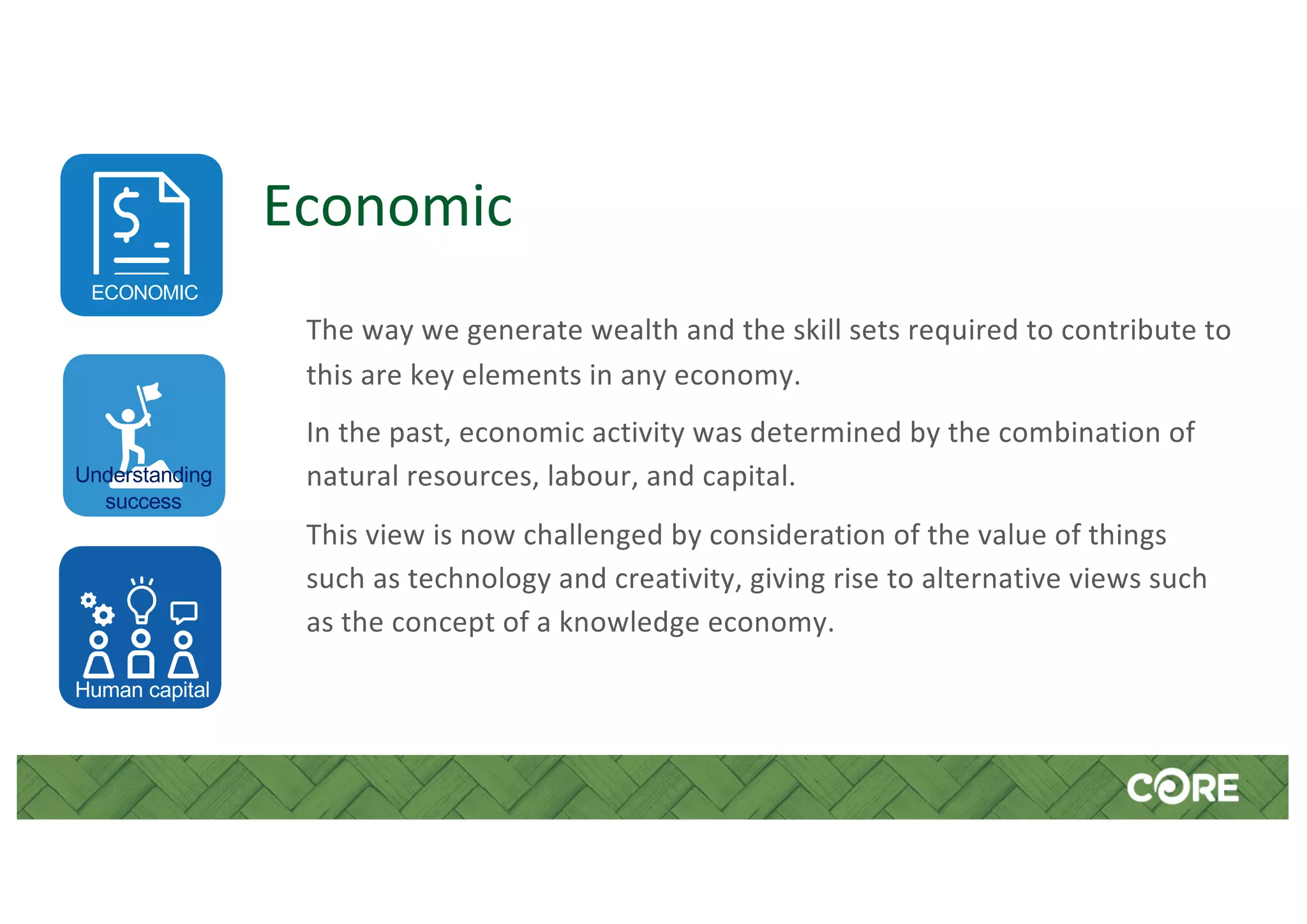
Economic
The way we generate wealth and the skill sets required to contribute to
this are key elements in any economy.
In the past, economic activity was determined by the combination of
natural resources, labour, and capital.
This view is now challenged by consideration of the value of things
such as technology and creativity, giving rise to alternative views such
as the concept of a knowledge economy.
ECONOMIC
Understanding
success
Human capital
ACTIVITY 2 – Future Ready Learners
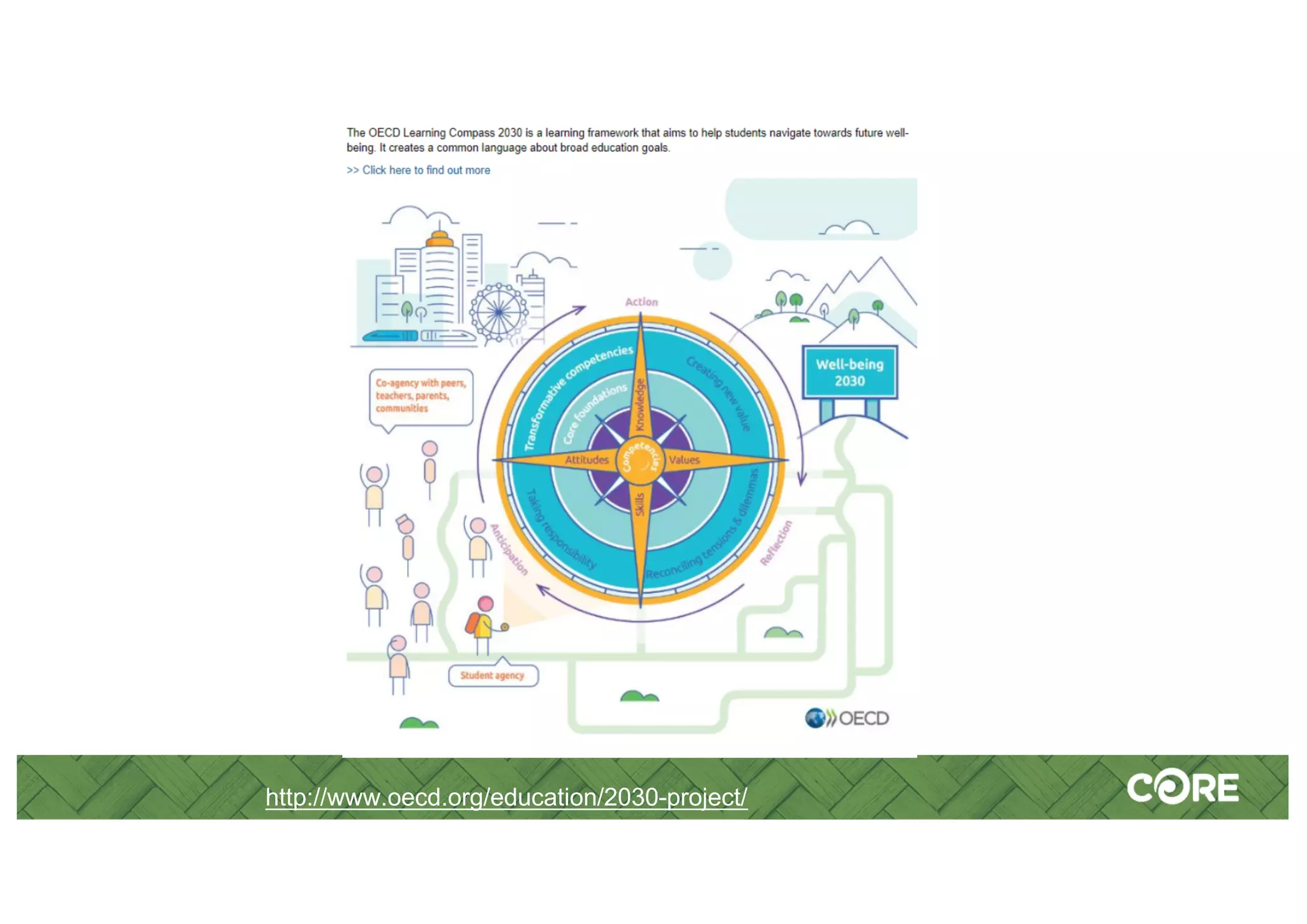
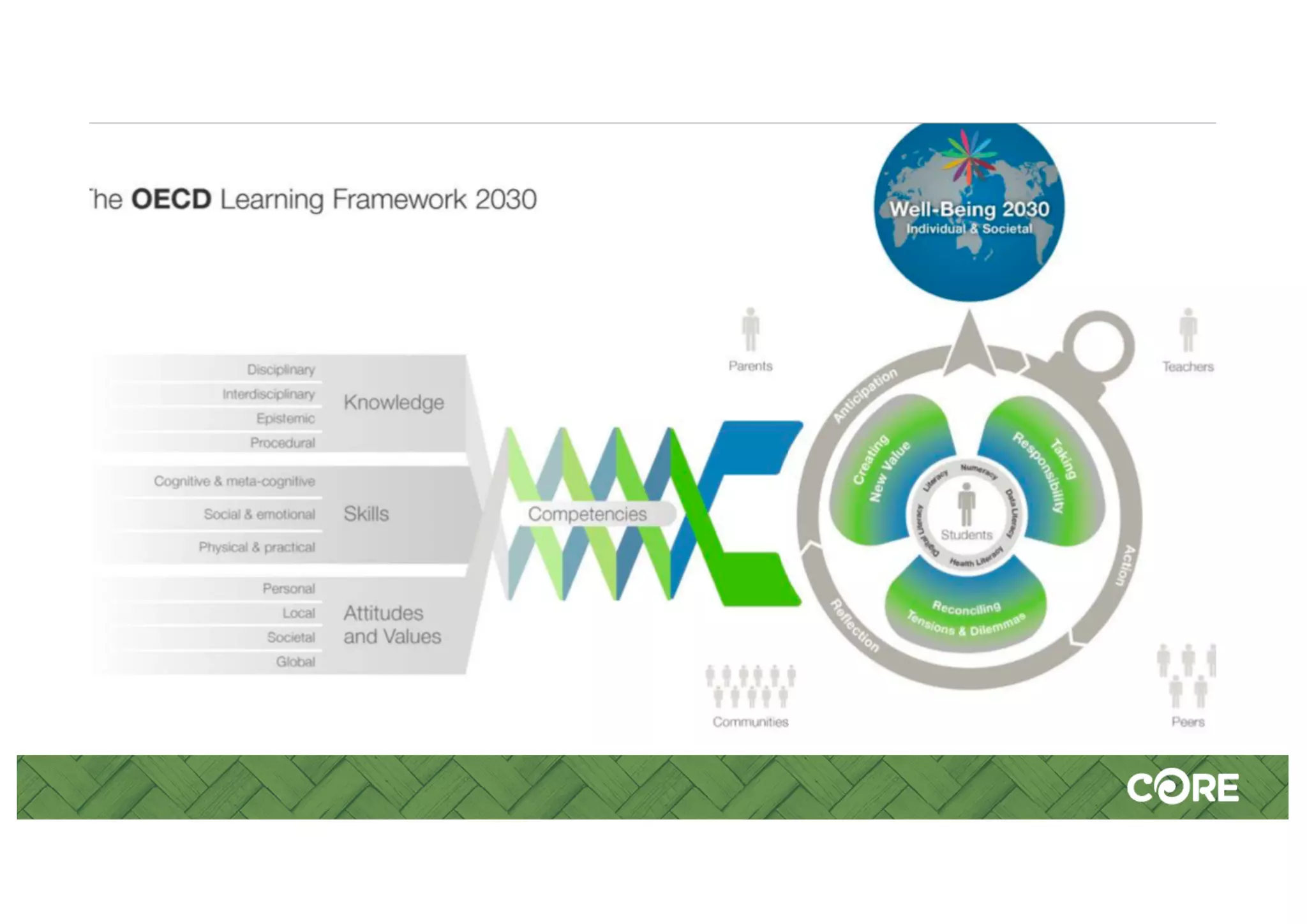
● Review work of OECD and NZC re capabilities and skills
● Work together to come up with a statement that reflects your
personal and/or school view of the characteristics of a Future
Ready Learner
● What needs to change in order to achieve this?
● Share with the group
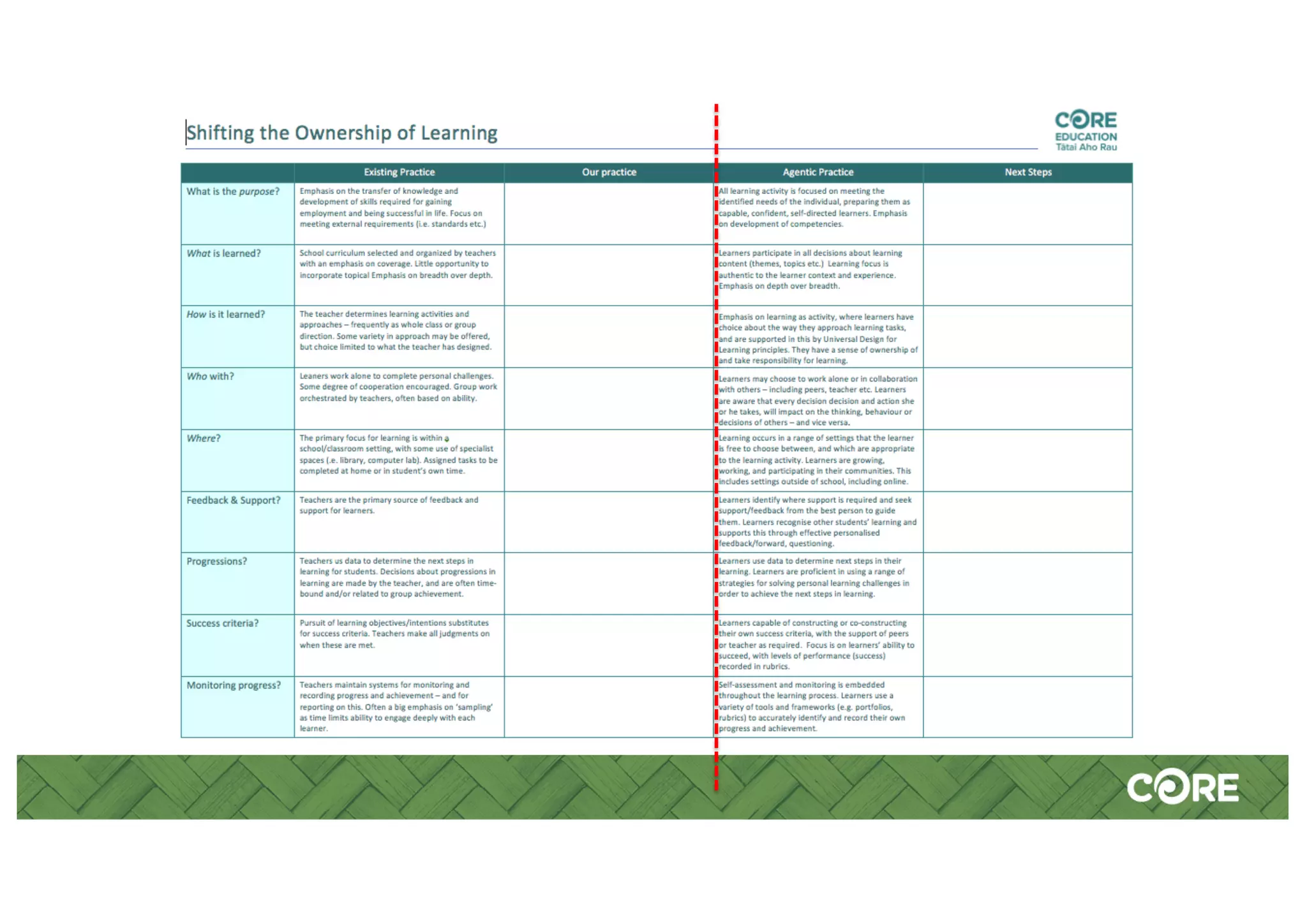
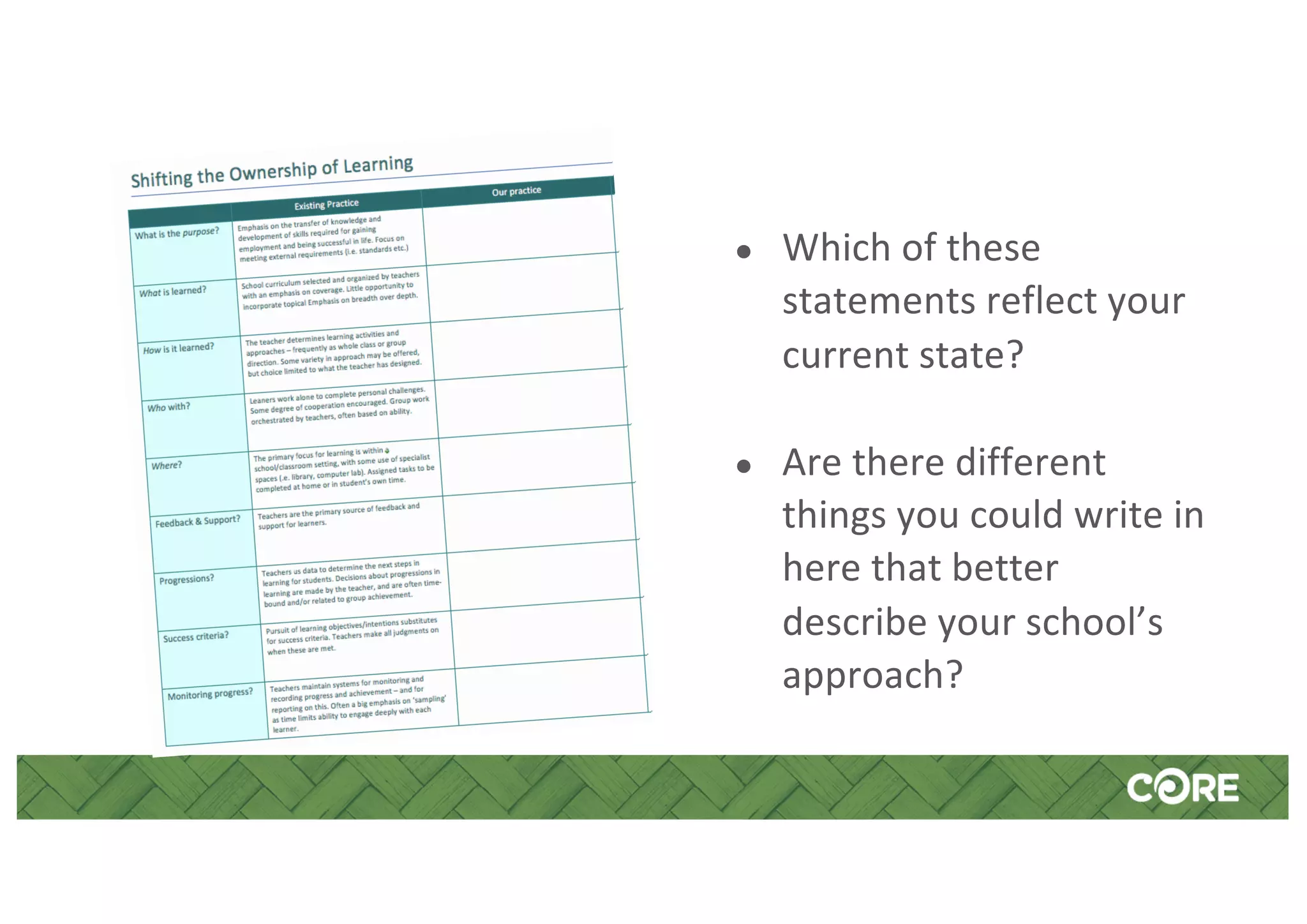
● Which of these
statements reflect your
current state?
● Are there different
things you could write in
here that better
describe your school’s
approach?
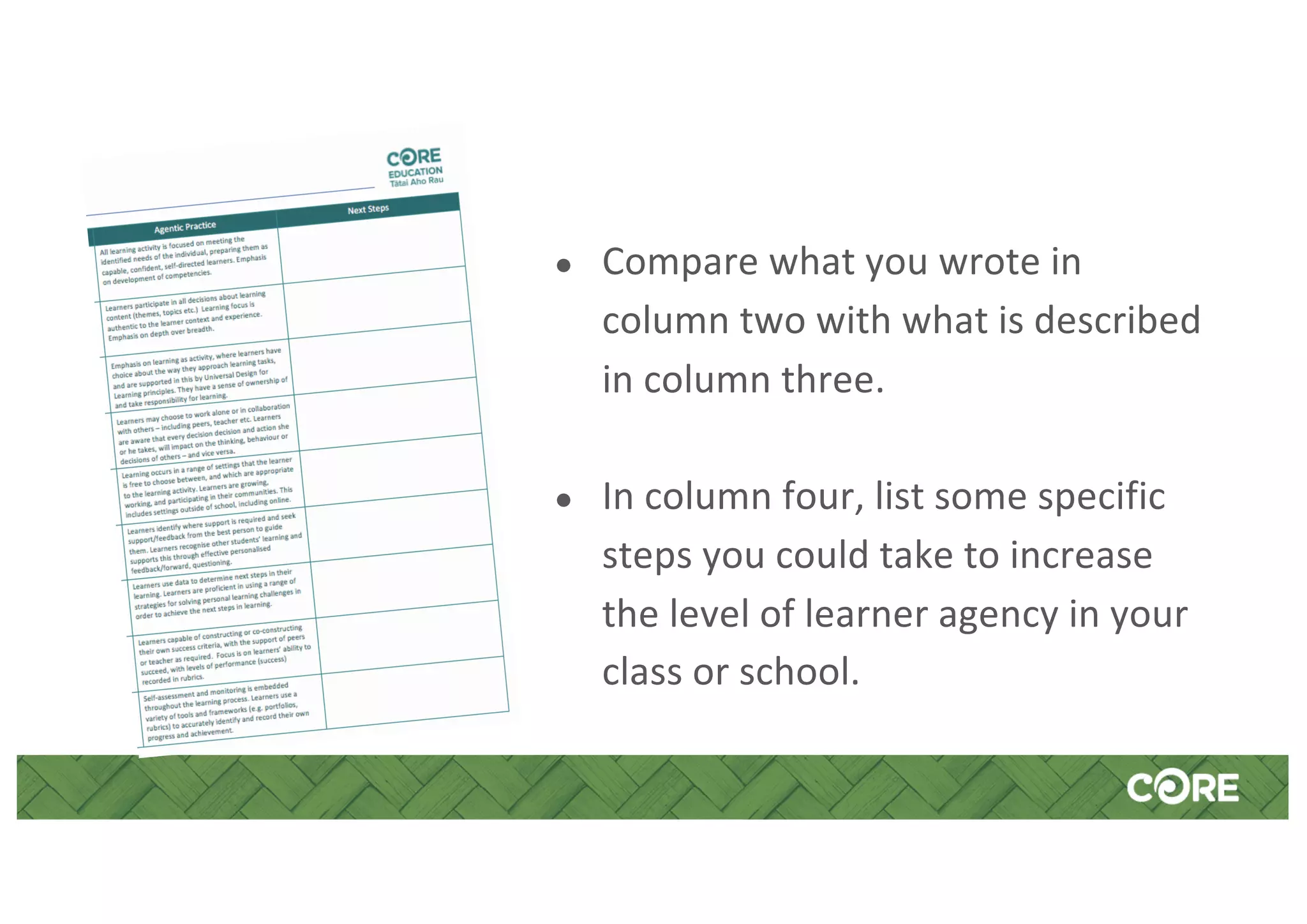
● Compare what you wrote in
column two with what is described
in column three.
● In column four, list some specific
steps you could take to increase
the level of learner agency in your
class or school.
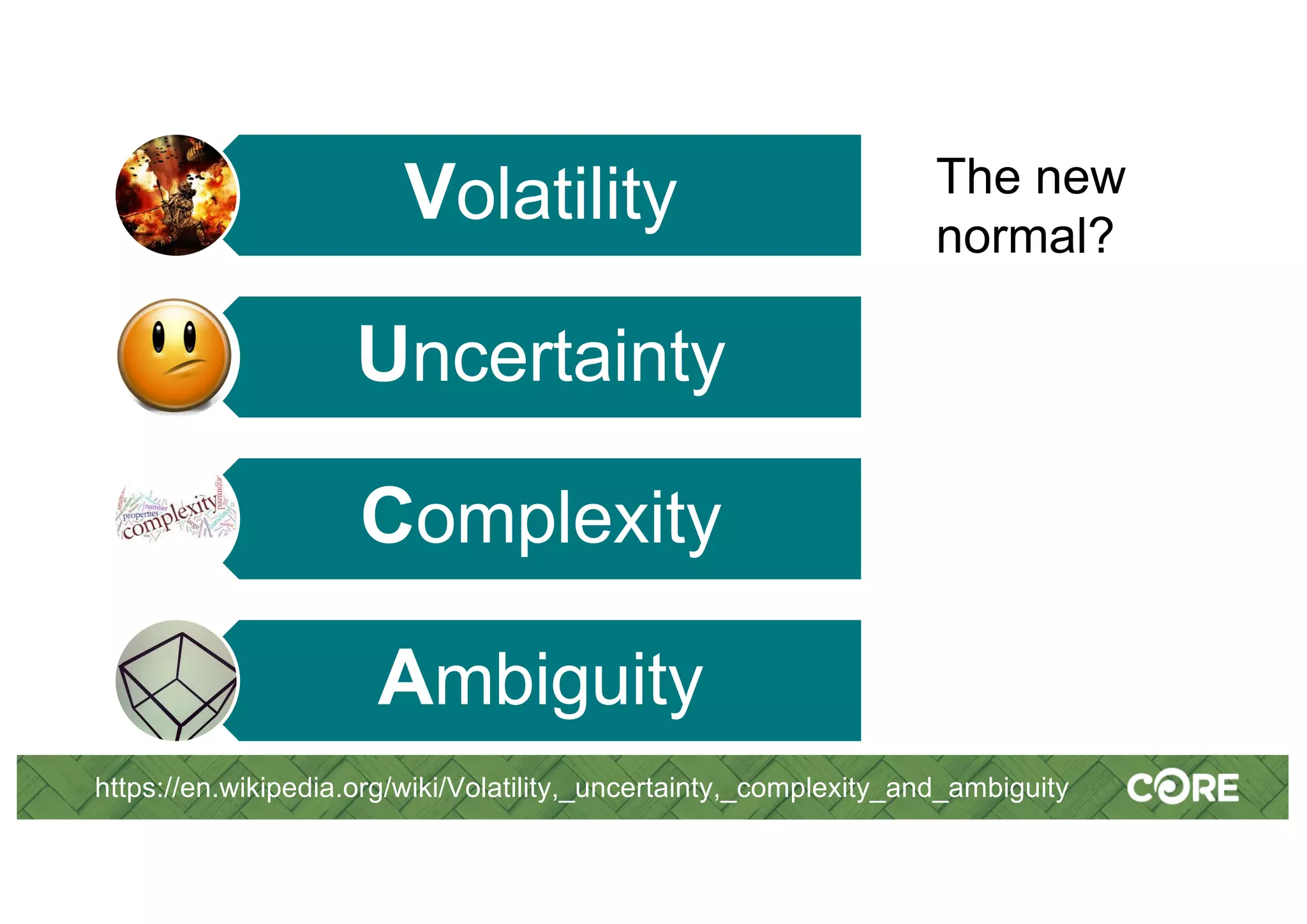
The new
normal?
Volatility
Uncertainty
Complexity
Ambiguity
https://en.wikipedia.org/wiki/Volatility,_uncertainty,_complexity_and_ambiguity
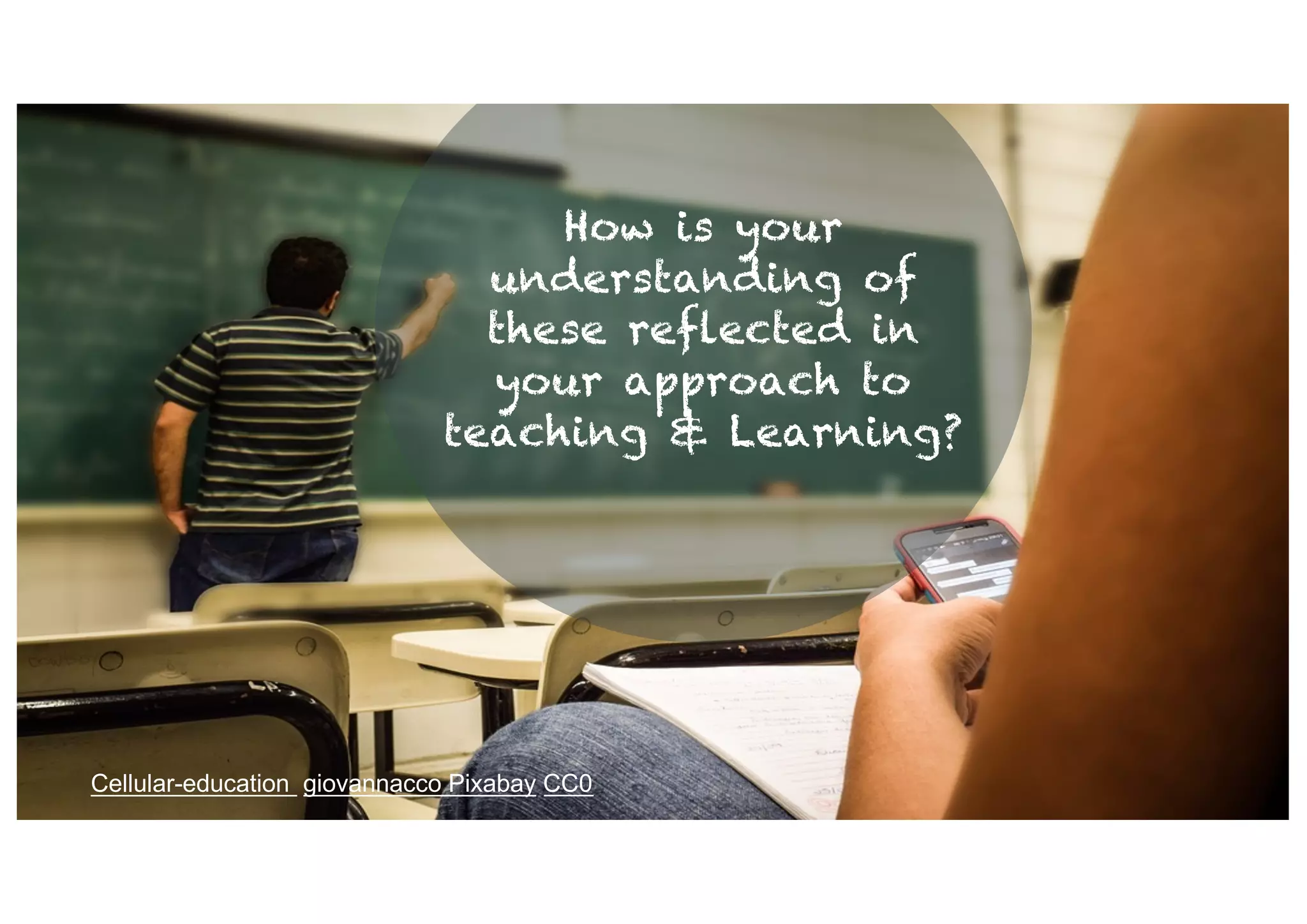
Cellular-education giovannacco Pixabay CC0
How is your
understanding of
these reflected in
your approach to
teaching & Learning?
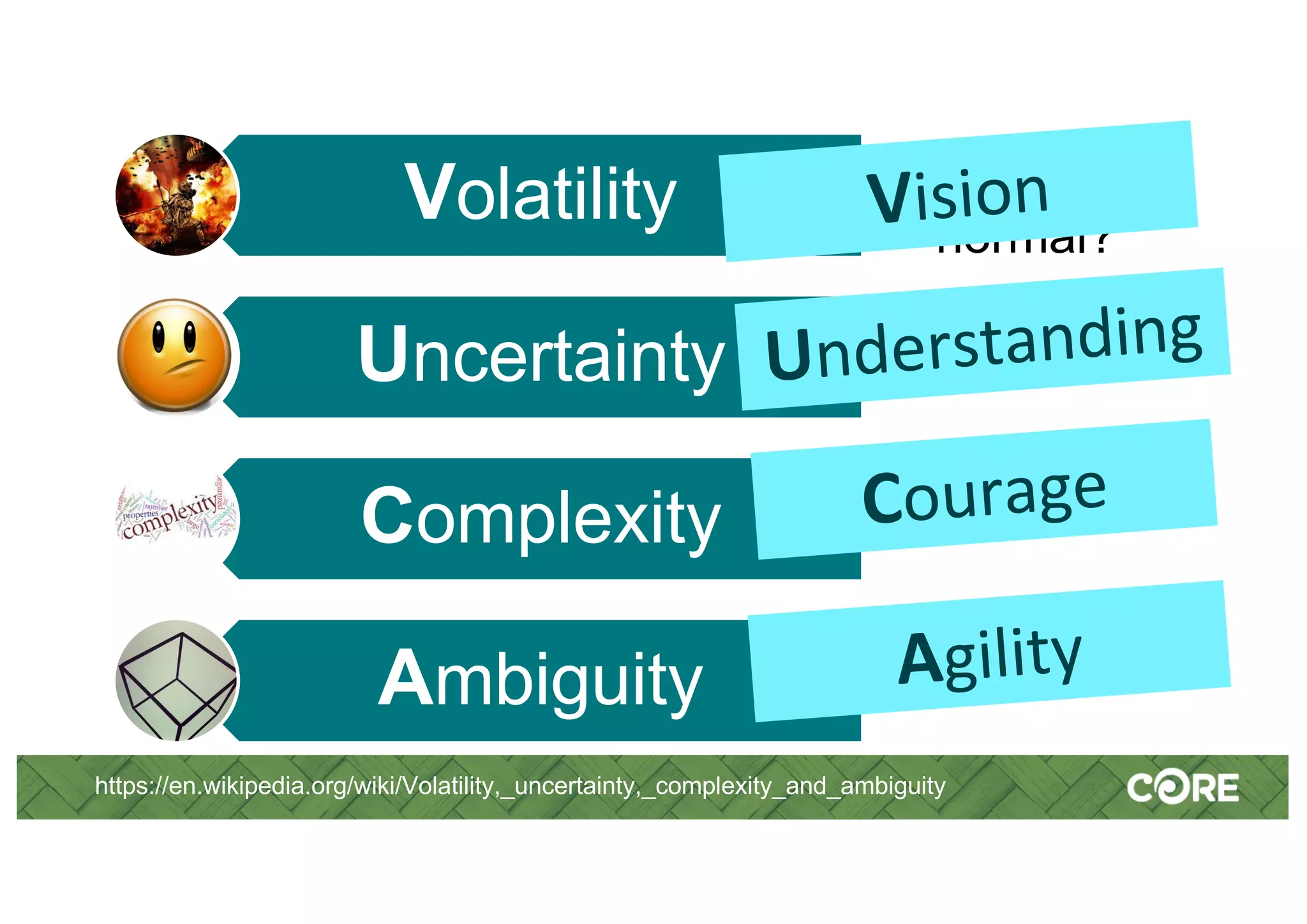
The new
normal?
Volatility
Uncertainty
Complexity
Ambiguity
https://en.wikipedia.org/wiki/Volatility,_uncertainty,_complexity_and_ambiguity
Vision
Understanding
Courage
Agility
http://www.oecd.org/education/2030-project/
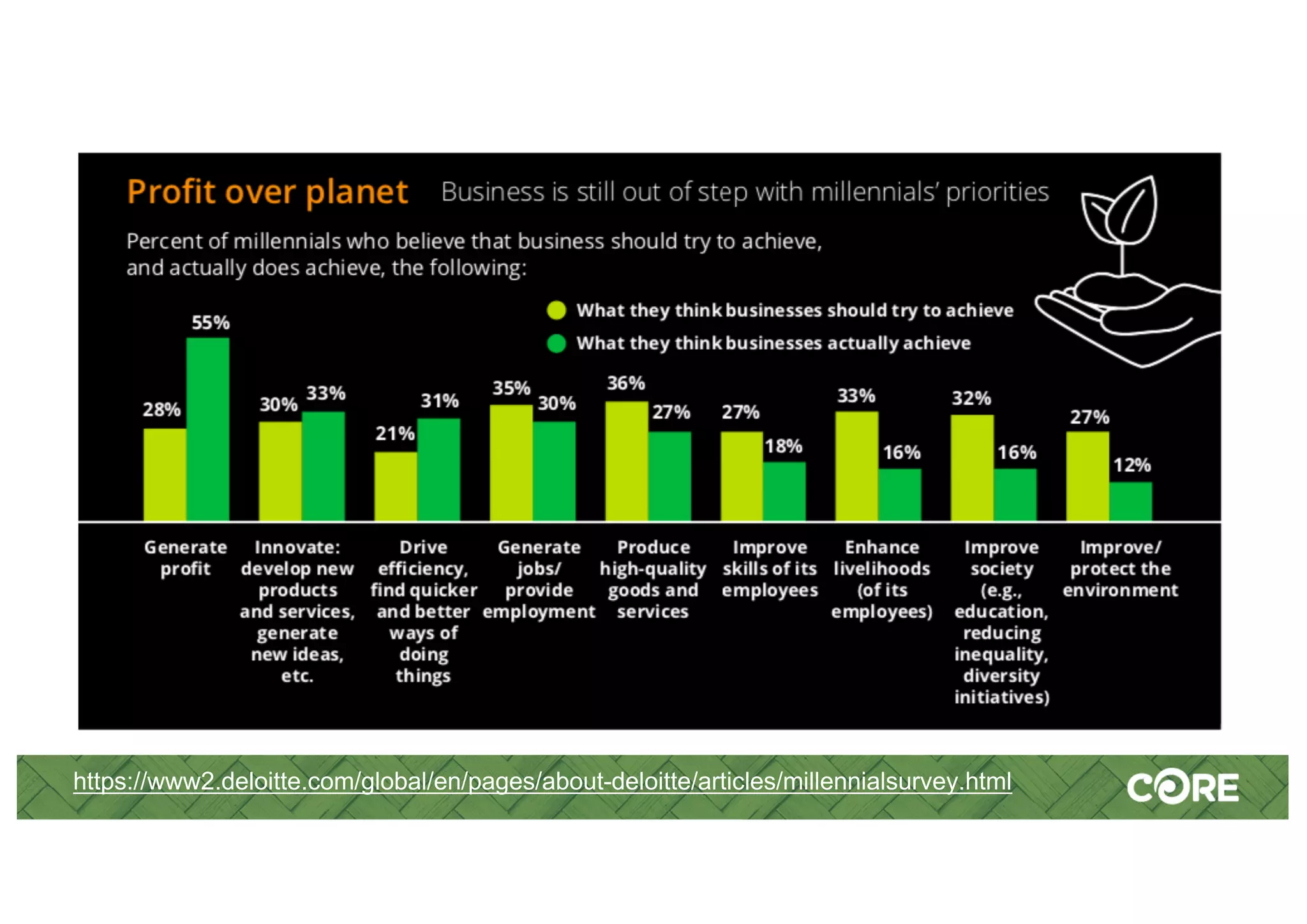
https://www2.deloitte.com/global/en/pages/about-deloitte/articles/millennialsurvey.html
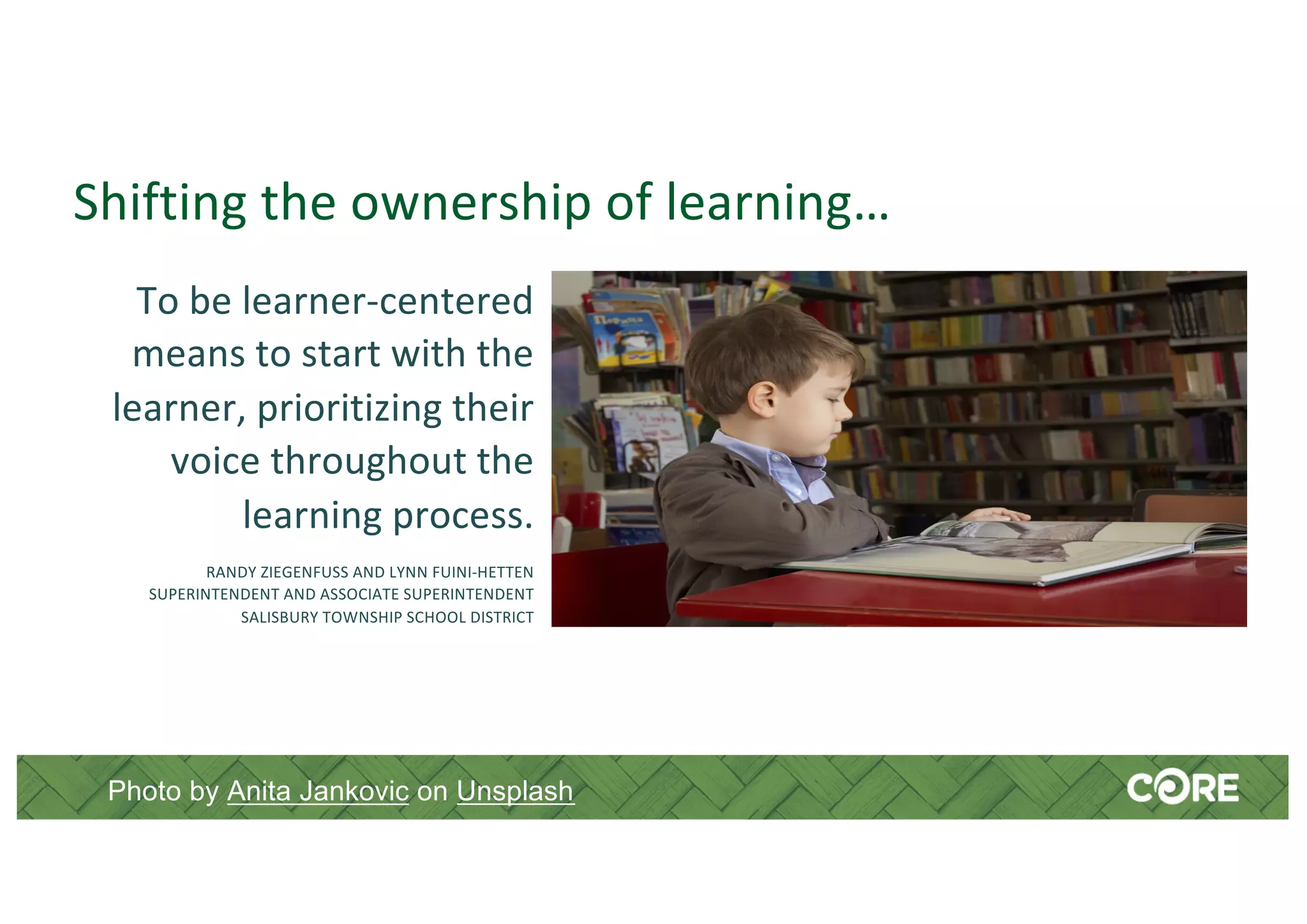
Shifting the ownership of learning…
To be learner-centered
means to start with the
learner, prioritizing their
voice throughout the
learning process.
RANDY ZIEGENFUSS AND LYNN FUINI-HETTEN
SUPERINTENDENT AND ASSOCIATE SUPERINTENDENT
SALISBURY TOWNSHIP SCHOOL DISTRICT
Photo by Anita Jankovic on Unsplash
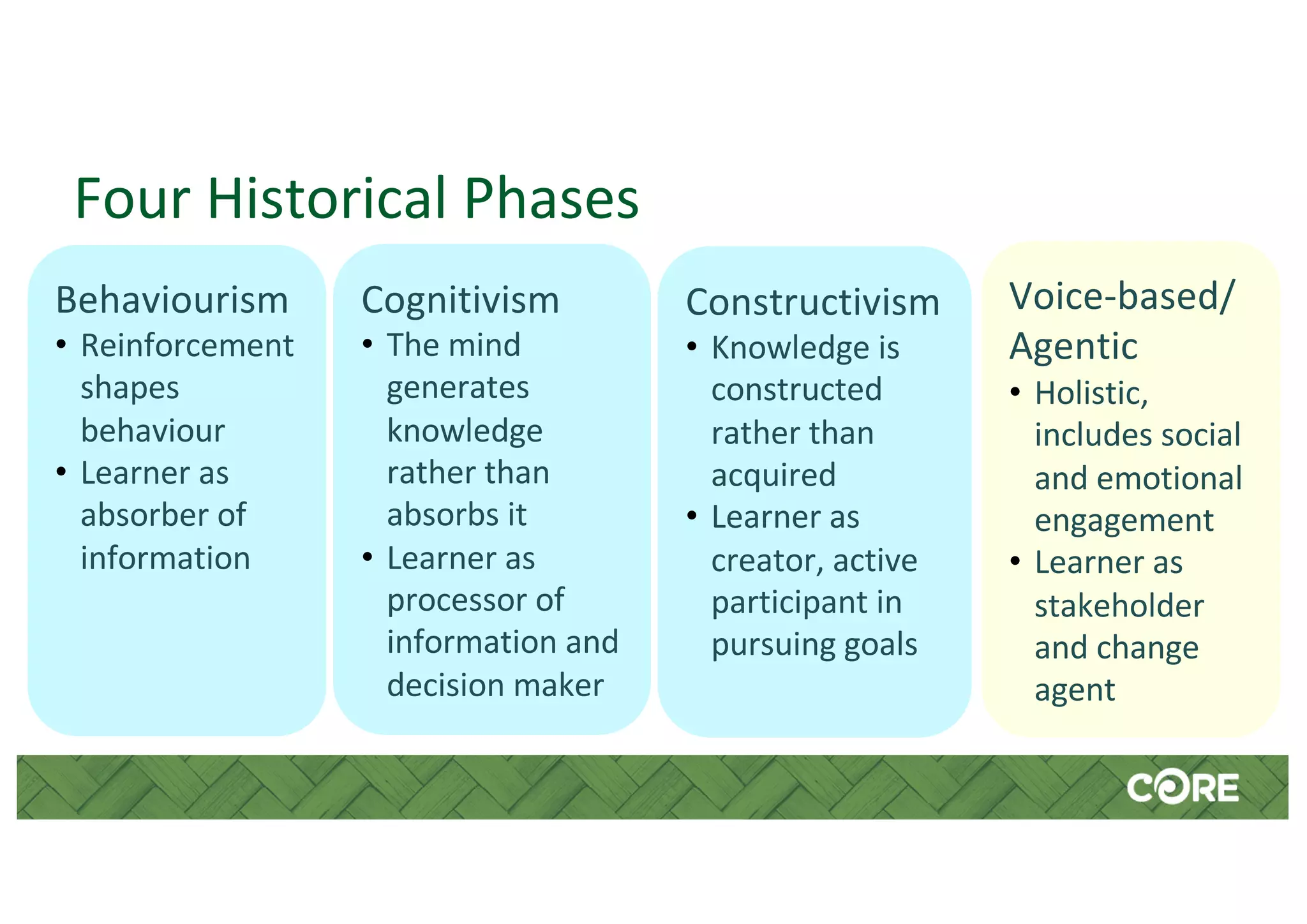
Four Historical Phases
Behaviourism
• Reinforcement
shapes
behaviour
• Learner as
absorber of
information
Cognitivism
• The mind
generates
knowledge
rather than
absorbs it
• Learner as
processor of
information and
decision maker
Constructivism
• Knowledge is
constructed
rather than
acquired
• Learner as
creator, active
participant in
pursuing goals
Voice-based/
Agentic
• Holistic,
includes social
and emotional
engagement
• Learner as
stakeholder
and change
agent
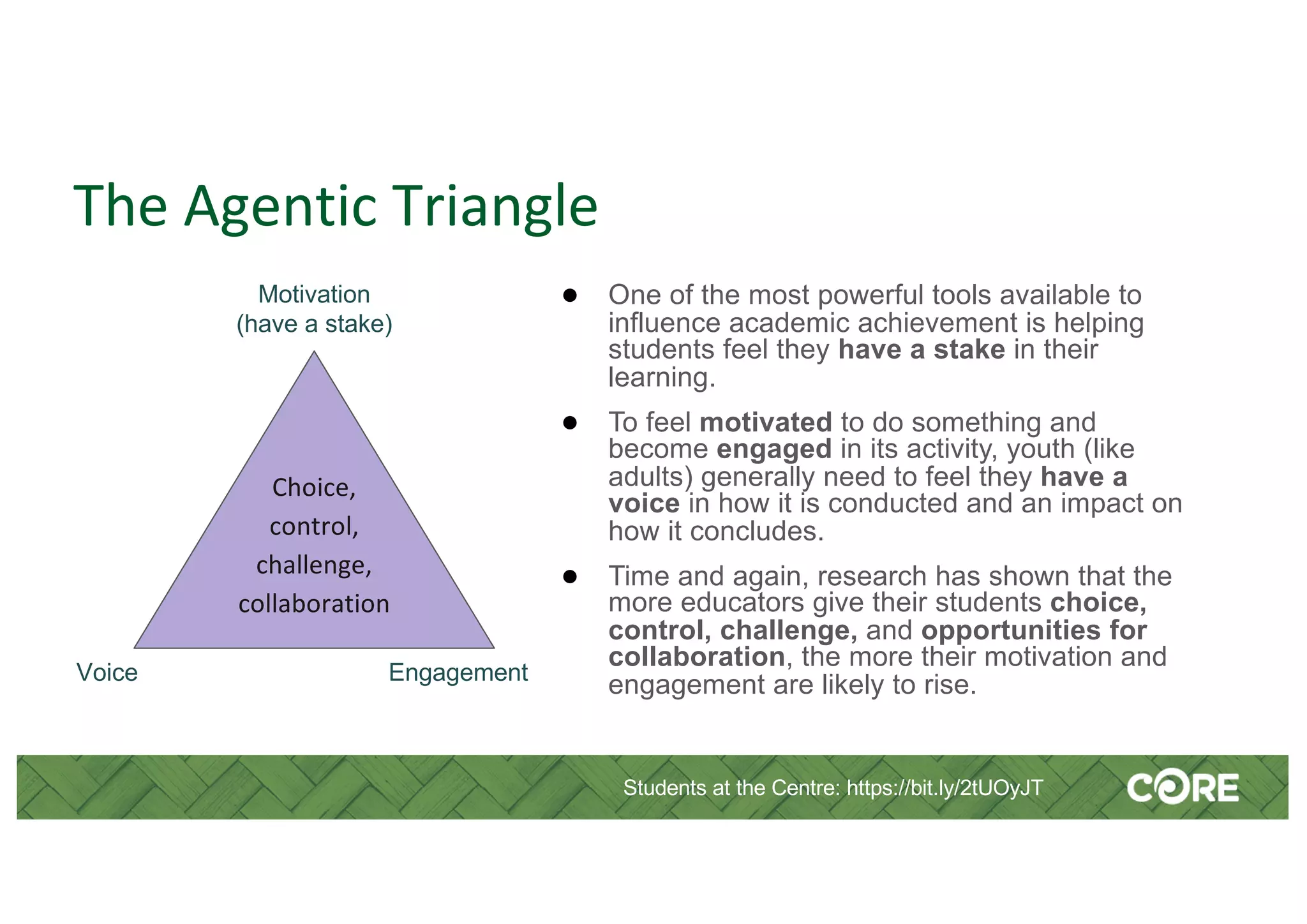
The Agentic Triangle
Engagement
Motivation
(have a stake)
Voice
Choice,
control,
challenge,
collaboration
● One of the most powerful tools available to
influence academic achievement is helping
students feel they have a stake in their
learning.
● To feel motivated to do something and
become engaged in its activity, youth (like
adults) generally need to feel they have a
voice in how it is conducted and an impact on
how it concludes.
● Time and again, research has shown that the
more educators give their students choice,
control, challenge, and opportunities for
collaboration, the more their motivation and
engagement are likely to rise.
Students at the Centre: https://bit.ly/2tUOyJT
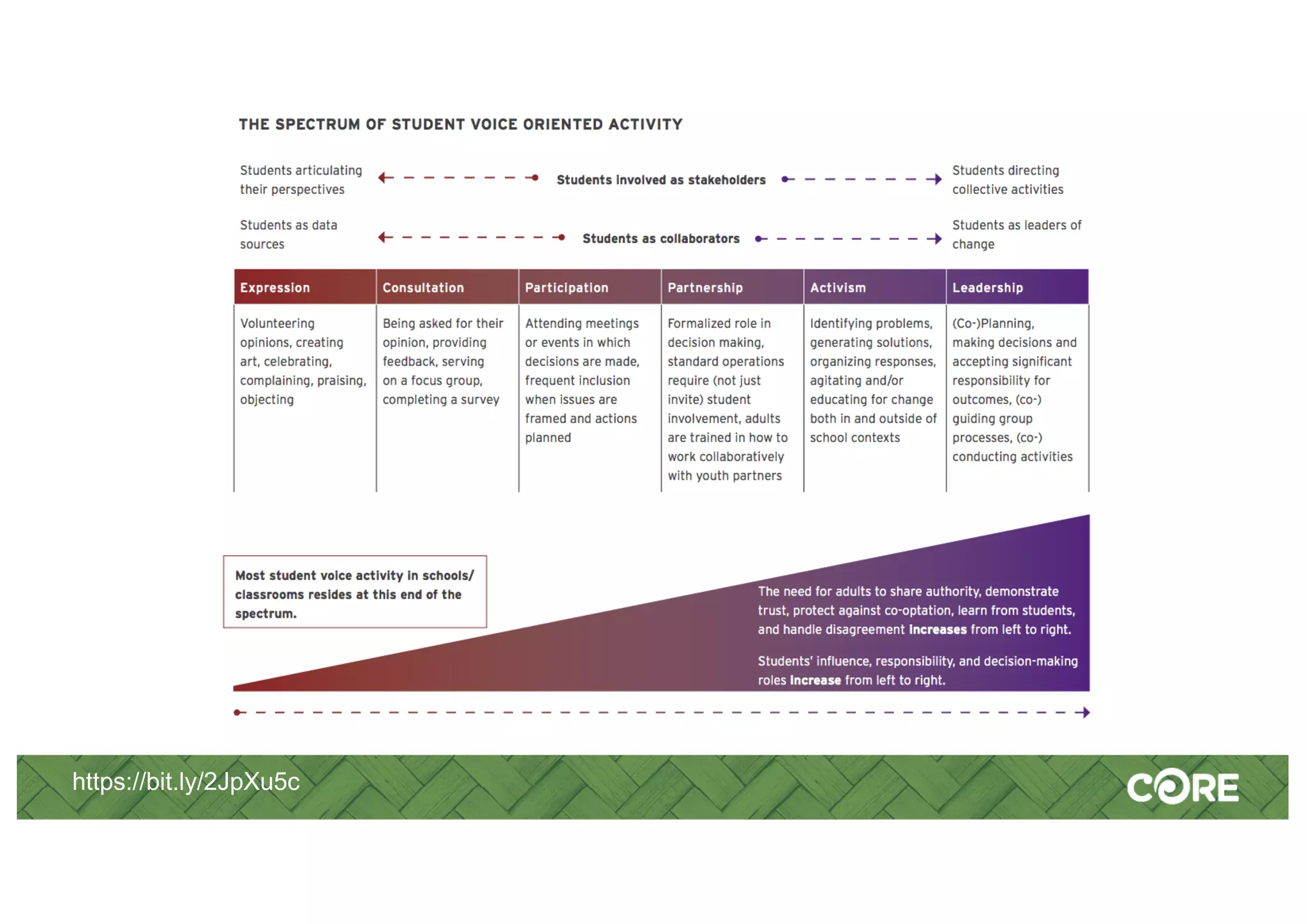
https://bit.ly/2JpXu5c
The Big Questions:
● What do you do in your design for learning to ensure your learners have the
motivation to be learners? That they feel they have a stake in their
learning.
● To feel motivated to do something and become engaged in its activity,
youth (like adults) generally need to feel they have a voice in how it is
conducted and an impact on how it concludes.
● Time and again, research has shown that the more educators give their
students choice, control, challenge, and opportunities for collaboration,
the more their motivation and engagement are likely to rise.
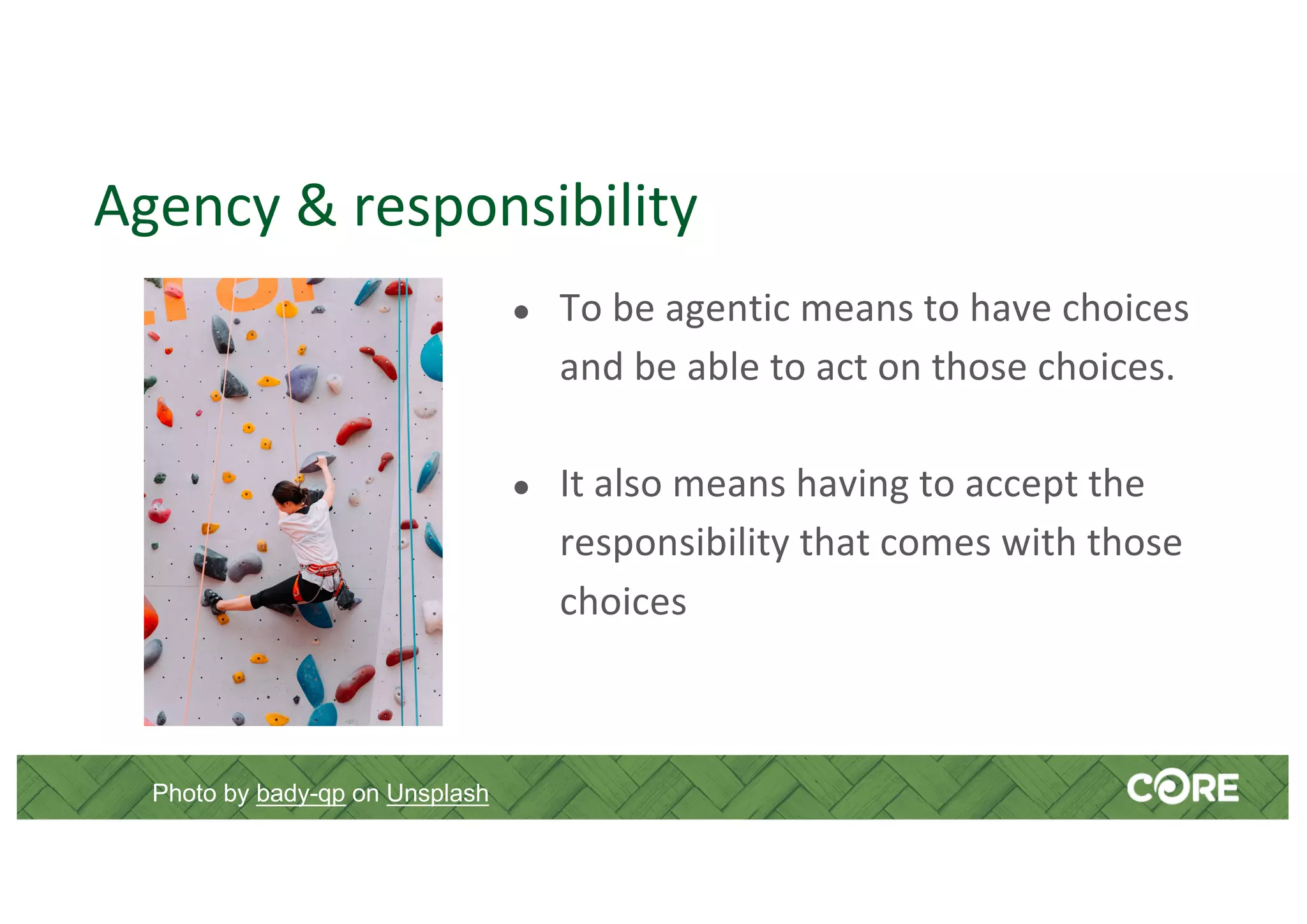
Agency & responsibility
● To be agentic means to have choices
and be able to act on those choices.
● It also means having to accept the
responsibility that comes with those
choices
Photo by bady-qp on Unsplash
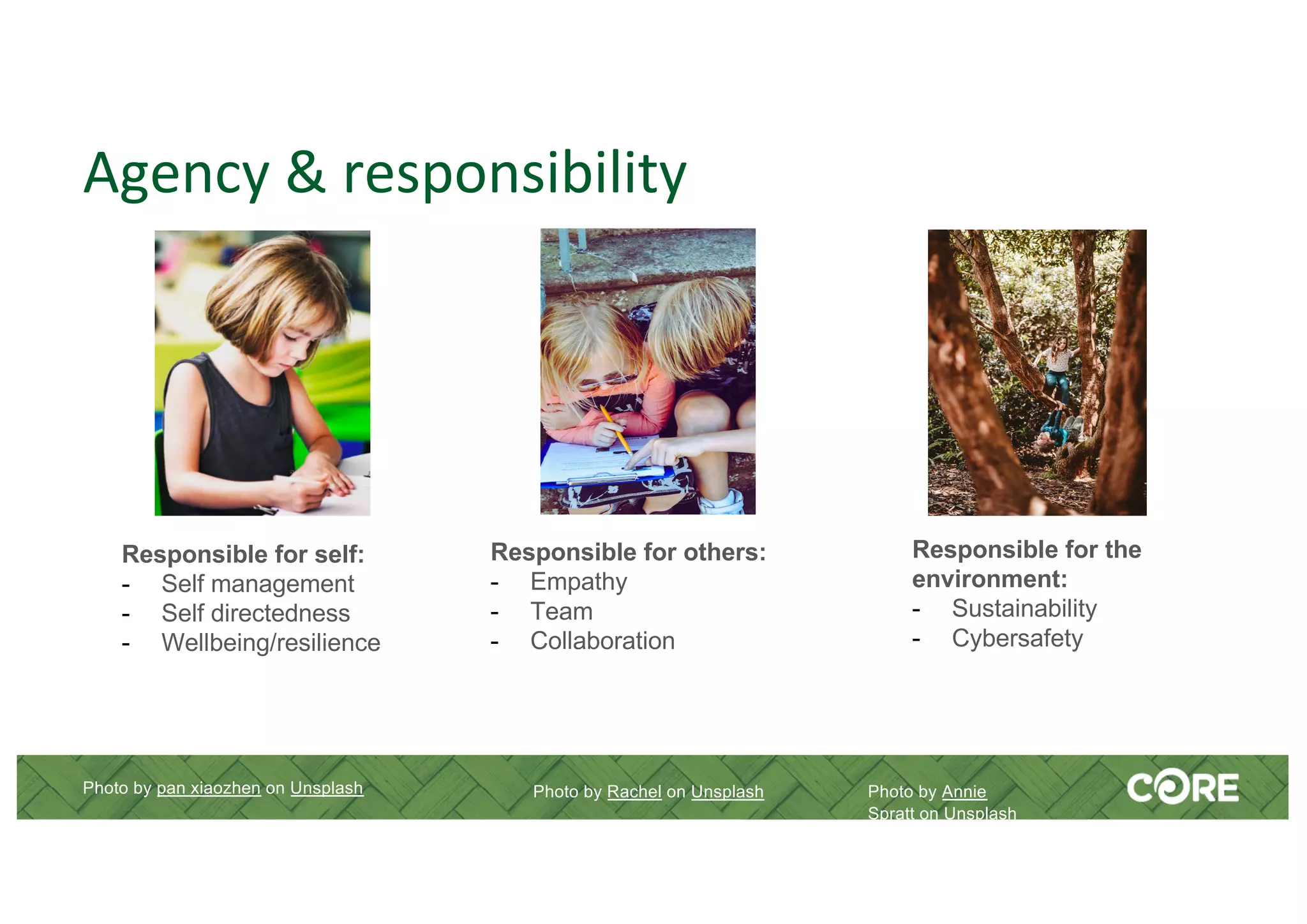
Agency & responsibility
Photo by pan xiaozhen on Unsplash Photo by Rachel on Unsplash Photo by Annie
Spratt on Unsplash
Responsible for self:
- Self management
- Self directedness
- Wellbeing/resilience
Responsible for the
environment:
- Sustainability
- Cybersafety
Responsible for others:
- Empathy
- Team
- Collaboration
ACTIVITY 3 – Where should our focus be?
● Review the context for change and the curriculum expectations
● In pairs/groups consider the question: “what can’t we leave to
chance?”
● Present back to the group
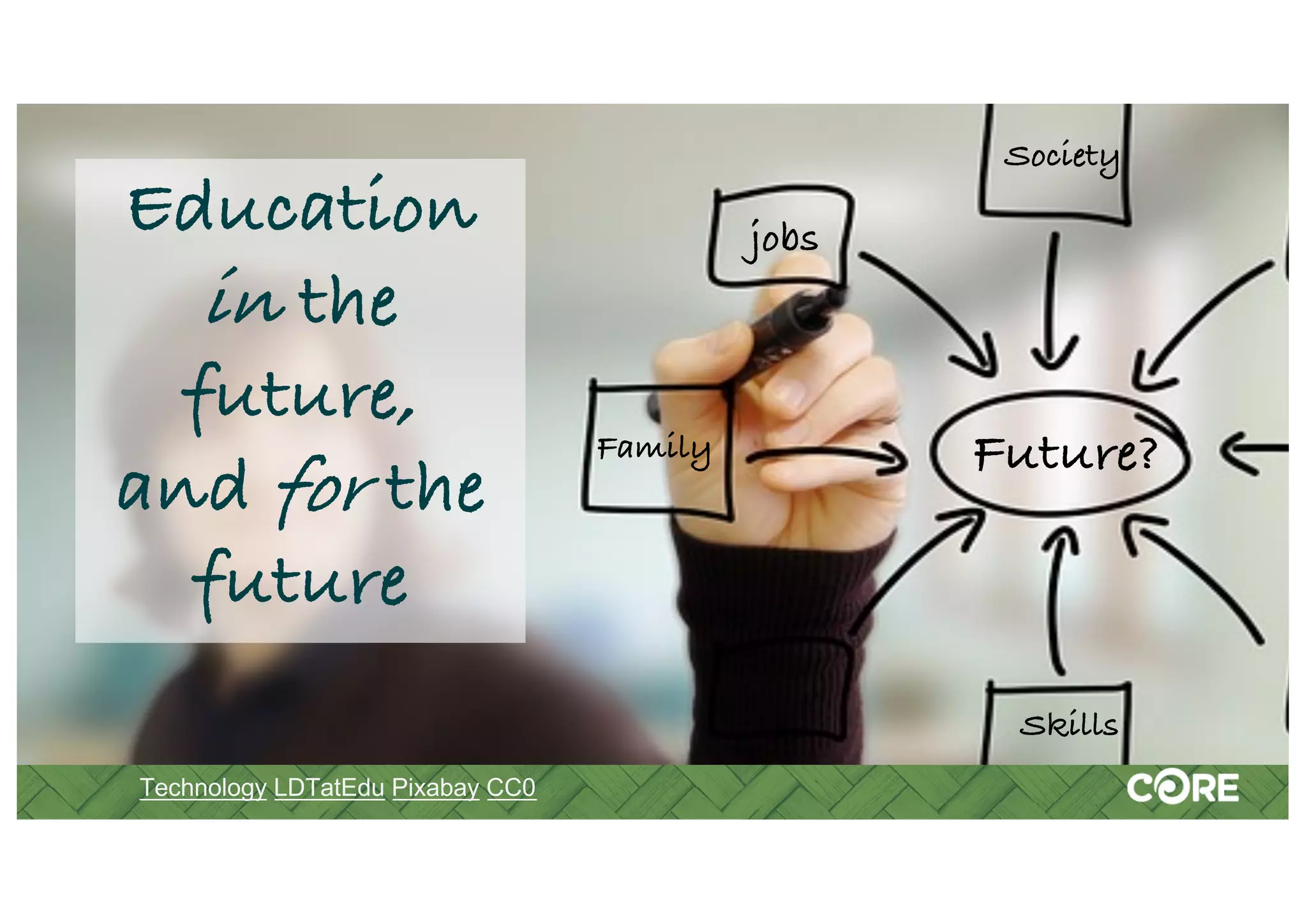
Future?
Society
jobs
Family
Skills
Education
in the
future,
and for the
future
Technology LDTatEdu Pixabay CC0
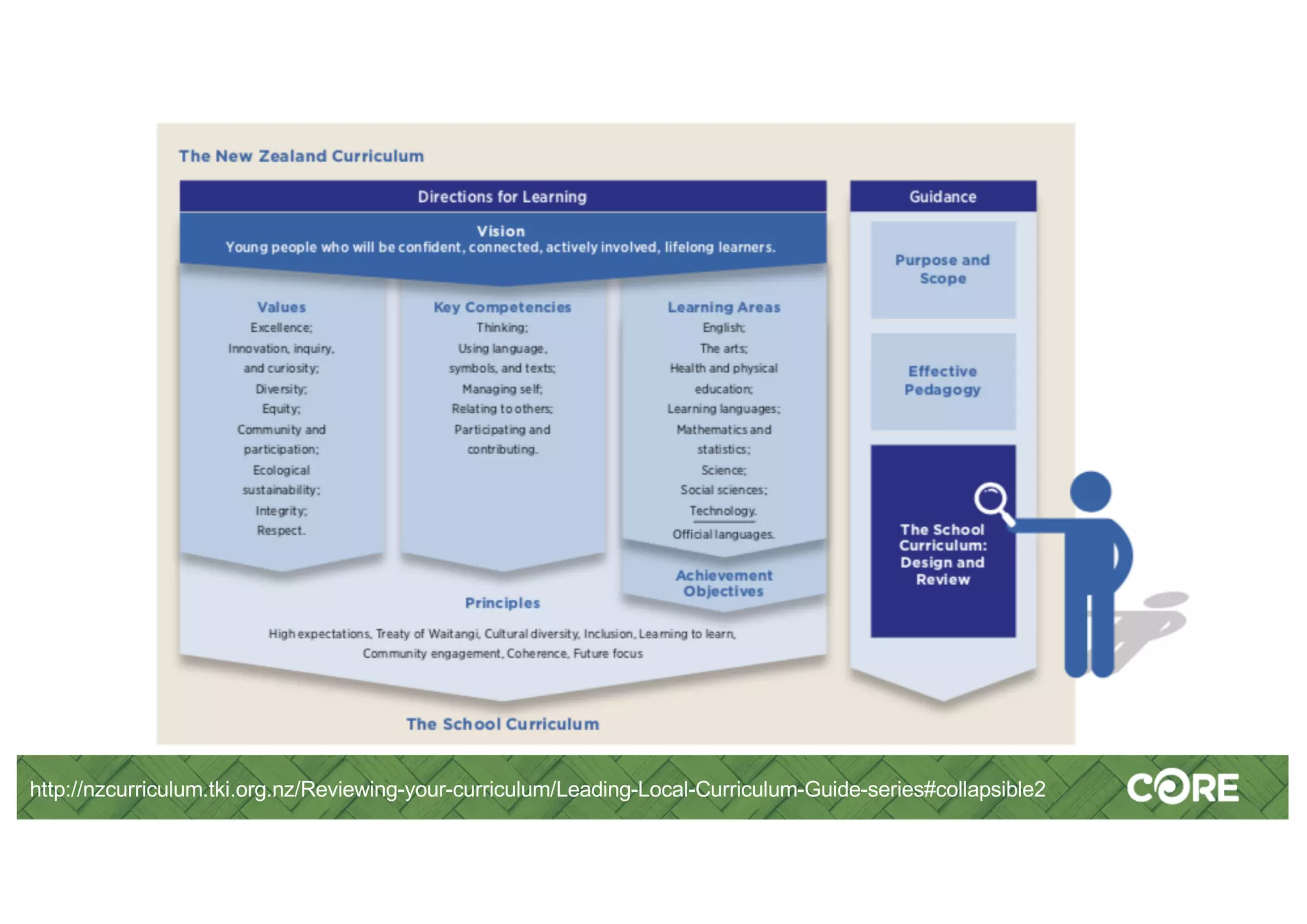
http://nzcurriculum.tki.org.nz/Reviewing-your-curriculum/Leading-Local-Curriculum-Guide-series#collapsible2
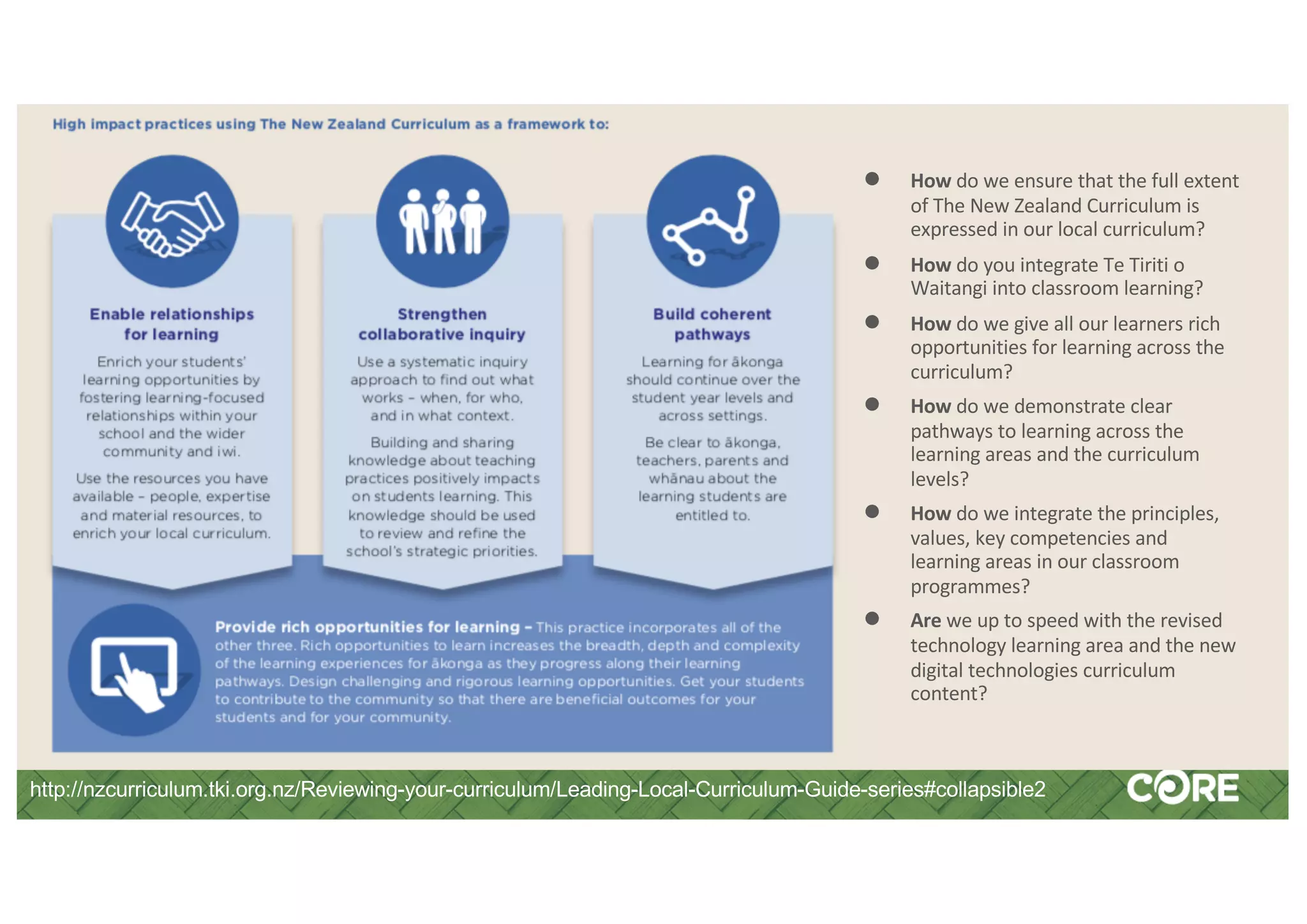
● How do we ensure that the full extent
of The New Zealand Curriculum is
expressed in our local curriculum?
● How do you integrate Te Tiriti o
Waitangi into classroom learning?
● How do we give all our learners rich
opportunities for learning across the
curriculum?
● How do we demonstrate clear
pathways to learning across the
learning areas and the curriculum
levels?
● How do we integrate the principles,
values, key competencies and
learning areas in our classroom
programmes?
● Are we up to speed with the revised
technology learning area and the new
digital technologies curriculum
content?
http://nzcurriculum.tki.org.nz/Reviewing-your-curriculum/Leading-Local-Curriculum-Guide-series#collapsible2
A school’s curriculum is likely to be well designed when:
http://nzcurriculum.tki.org.nz/Reviewing-your-curriculum/Leading-Local-Curriculum-Guide-
series#collapsible2
• principals and teachers, with the community, can show what it is
that they want their students to learn and how their curriculum is
designed to achieve this
• learning is personalised and inclusive to take into account the
students' aspirations, interests, identity, language, and culture
• the long view is taken: each student’s ultimate learning success
is more important than the covering of particular achievement
objectives
• it is manageable and realistic.
ACTIVITY 4 – Next Steps
● Consider the 2-3 things that have impressed themselves on you
in this workshop and spend some time listing the specific
actions you plan to take when you return to your place of work
● Share these with a colleague and offer support and suggestions
on how to make this happen
Those responses again…
• Focus on capabilities
• Celebrate cultural diversity
• Educate for understanding and critical engagement
• Develop learner agency and voice
• Embrace risk and failure
• Emphasize character and citizenship
• Localise your curriculum
• Engage in social good projects
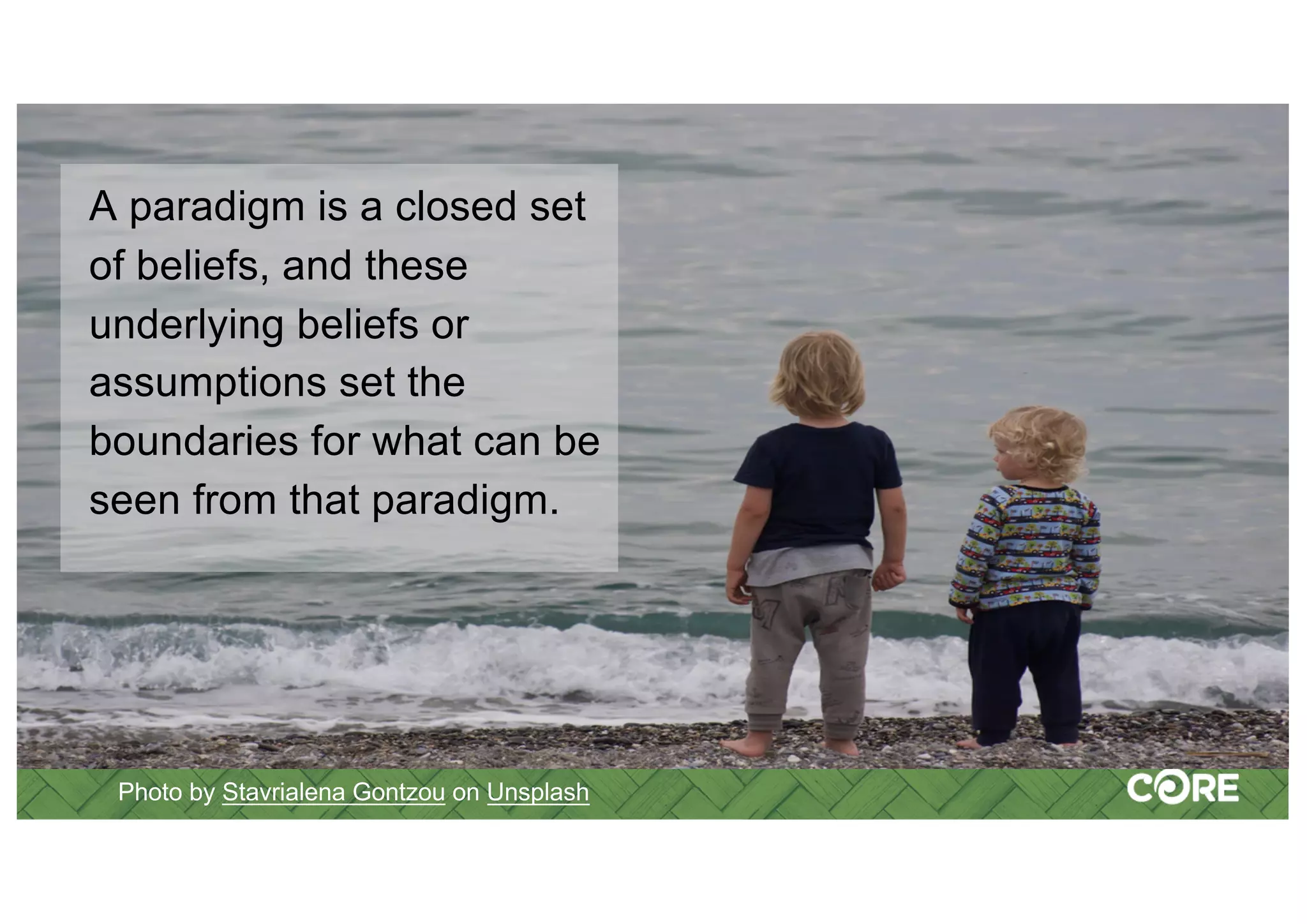
Photo by Stavrialena Gontzou on Unsplash
A paradigm is a closed set
of beliefs, and these
underlying beliefs or
assumptions set the
boundaries for what can be
seen from that paradigm.
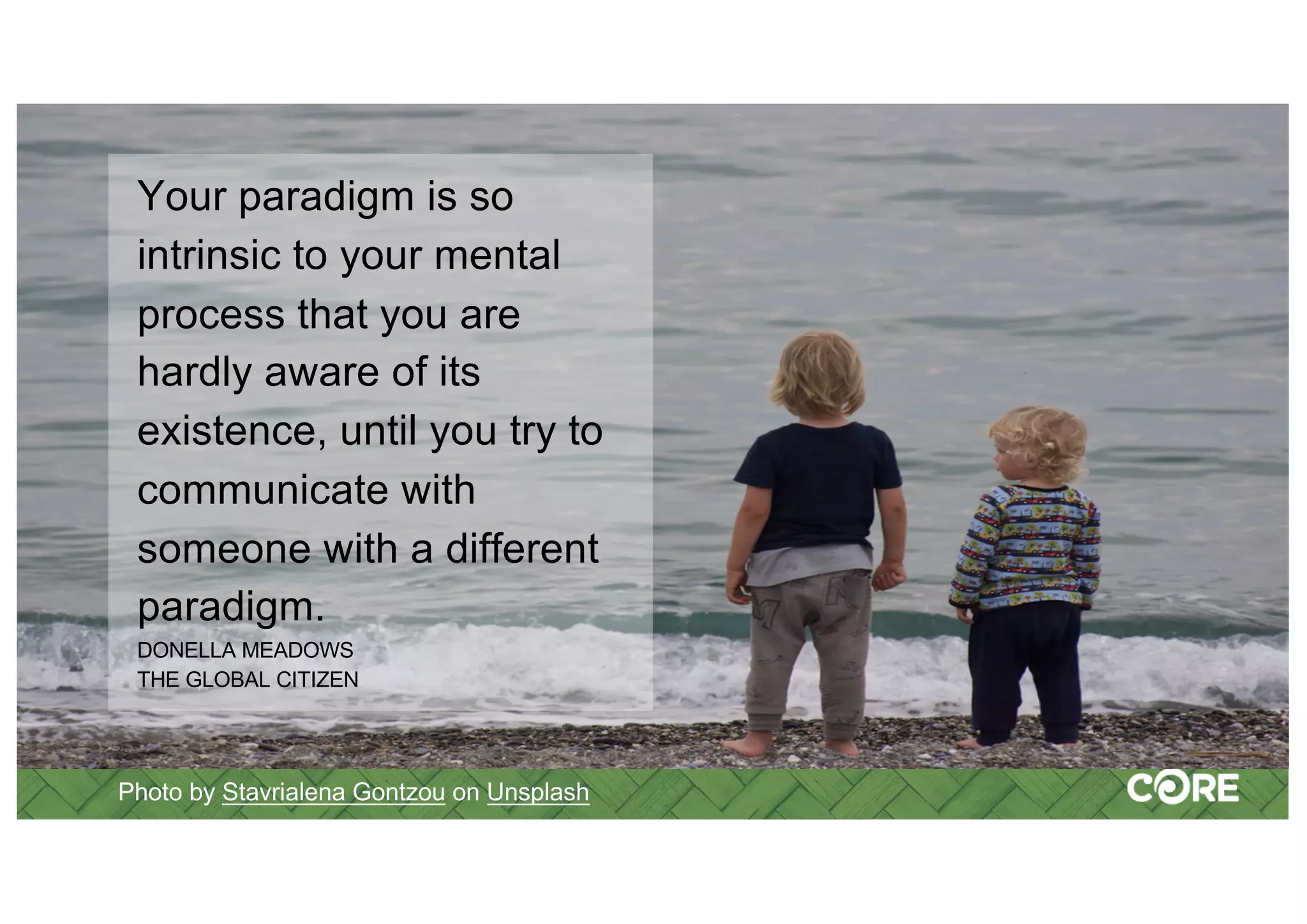
Photo by Stavrialena Gontzou on Unsplash
Your paradigm is so
intrinsic to your mental
process that you are
hardly aware of its
existence, until you try to
communicate with
someone with a different
paradigm.
DONELLA MEADOWS
THE GLOBAL CITIZEN
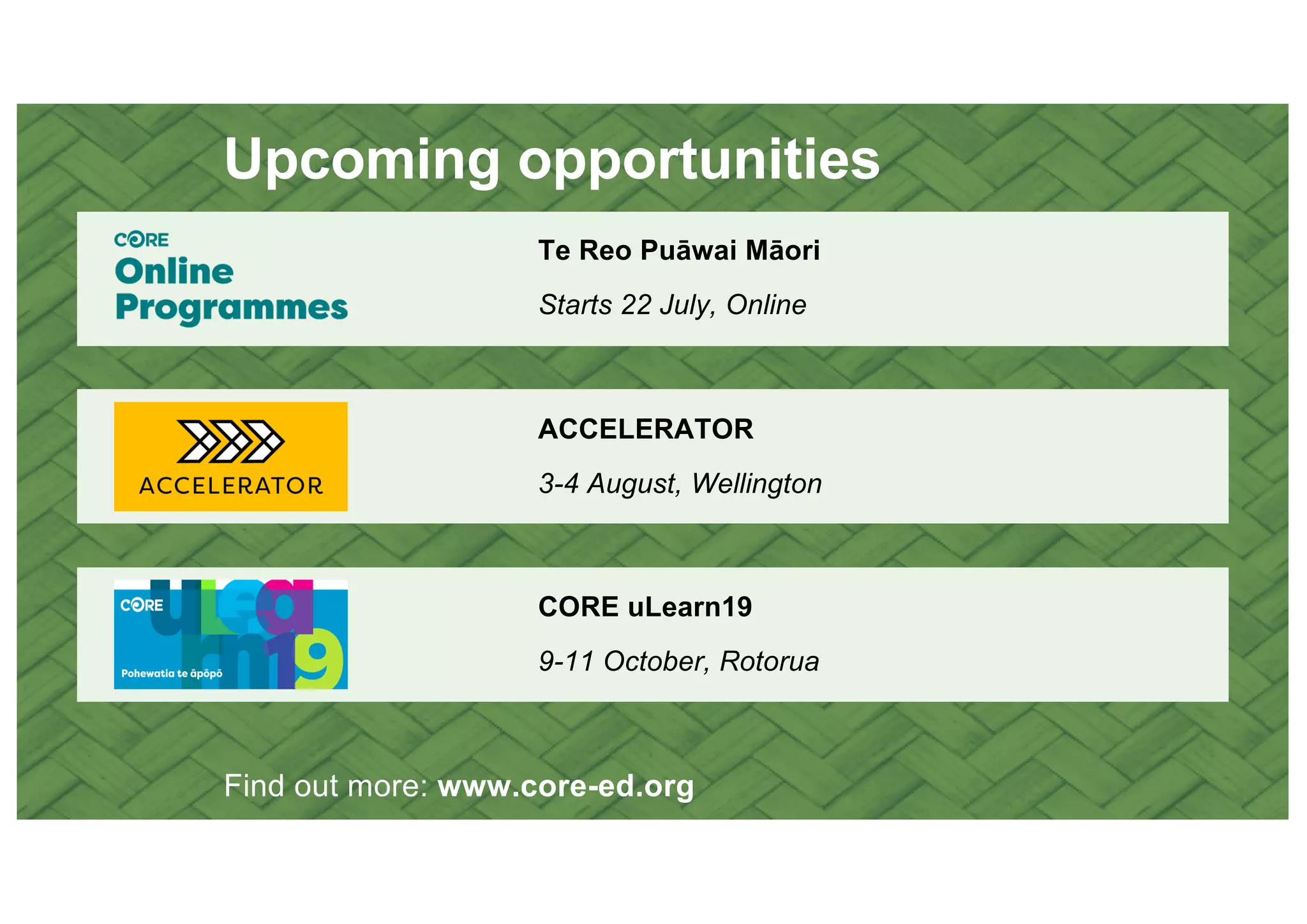
Find out more: www.core-ed.org
ACCELERATOR
3-4 August, Wellington
CORE uLearn19
9-11 October, Rotorua
Te Reo Puāwai Māori
Starts 22 July, Online
Upcoming opportunities
Breakfast future ready workshop

Breakfast future ready workshop

  • 1.
  • 2.
    Outline ● Dig deeperinto the ten trends ○ What are the compelling issues? ○ How might they affect us? ● What is a a future-ready learner? ● What should we be focusing on… ○ in our curriculum and in the way we teach? ○ In our learning environments and our learning activities? ● Next steps – some practical start points to leave with
  • 3.
    ACTIVITY 1 –Digging deeper ● Review the trends and main categories ● Select one and settle with a partner/group to explore it a little further – prepare a synopsis of what you have read: ○ What is it about? Why is it important? What are the drivers? ○ Implications for educators? Examples? ● Present back to the group
  • 4.
    CORE’s Ten Trends ●Patterns… ● General direction… ● Regular change over time… ● General course… ● Prevailing tendency… NOT predictions
  • 5.
    CORE’s 2018 Trends SocialMapping Big data, small data Changing role of teachersCultural Narratives Human Capital Micro-credentials Understanding Success Wellbeing Schools as part of communityReal-time reporting
  • 6.
    Cultural The culture ofan educational organization is the product of the beliefs, perceptions, relationships, attitudes, and written and unwritten rules that shape and influence every aspect of how it functions. School culture also encompasses more concrete issues such as the physical and emotional safety of students, the orderliness of classrooms and public spaces, or the degree to which a school embraces and celebrates racial, ethnic, linguistic, or cultural diversity. Influences that change or alter any aspect of this mix will likely have an impact on the overall culture of a school/kura or organisation. CULTURAL Wellbeing Cultural narratives
  • 7.
    Process In business terms,process is a collection of related, structured activities or tasks that produce a specific outcome. Simply put, process may be understood as ‘the way we do things’. Educational institutions are generally very process-driven, from enrolment, to curriculum, to the approaches to teaching, to assessment and graduation. Each of these is characterised by the process used to determine how things are done. PROCESS Micro-credentials Big data/ small data
  • 8.
    Structural Educational institutions areby nature, very reliant on the structures that give them their identity and serve to support what they do and the way they do it. The concept of schools as physical places with rooms that accommodate ‘classes’ based on age who attend for fixed hours of the day to work through a curriculum based on the division of human knowledge into ‘subjects’ is being questioned as never before as education systems around the world struggle to identify what sort of response(s) to make to an increasingly diverse and exponentially changing social paradigm. STRUCTURAL Schools as part of community Changing role of teachers
  • 9.
    Technology Technology is anamplifier of change – it reshapes expectations and enabling new possibilities in every part of our lives. The emerging technologies are very different to what we have experienced in the past, requiring us to find new ways to adapt to digital change in more sustainable ways. The important thing here is the pervasive nature of change that occurs when a new technology is introduced, because technological change is not additive, it is ecological. When you add a new technology you don’t simply change something, you change everything. TECHNOLOGY Social mapping Real-time report
  • 10.
    Economic The way wegenerate wealth and the skill sets required to contribute to this are key elements in any economy. In the past, economic activity was determined by the combination of natural resources, labour, and capital. This view is now challenged by consideration of the value of things such as technology and creativity, giving rise to alternative views such as the concept of a knowledge economy. ECONOMIC Understanding success Human capital
  • 11.
    ACTIVITY 2 –Future Ready Learners ● Review work of OECD and NZC re capabilities and skills ● Work together to come up with a statement that reflects your personal and/or school view of the characteristics of a Future Ready Learner ● What needs to change in order to achieve this? ● Share with the group
  • 13.
    ● Which ofthese statements reflect your current state? ● Are there different things you could write in here that better describe your school’s approach?
  • 14.
    ● Compare whatyou wrote in column two with what is described in column three. ● In column four, list some specific steps you could take to increase the level of learner agency in your class or school.
  • 15.
  • 16.
    Cellular-education giovannacco PixabayCC0 How is your understanding of these reflected in your approach to teaching & Learning?
  • 17.
  • 18.
  • 20.
  • 21.
    Shifting the ownershipof learning… To be learner-centered means to start with the learner, prioritizing their voice throughout the learning process. RANDY ZIEGENFUSS AND LYNN FUINI-HETTEN SUPERINTENDENT AND ASSOCIATE SUPERINTENDENT SALISBURY TOWNSHIP SCHOOL DISTRICT Photo by Anita Jankovic on Unsplash
  • 22.
    Four Historical Phases Behaviourism •Reinforcement shapes behaviour • Learner as absorber of information Cognitivism • The mind generates knowledge rather than absorbs it • Learner as processor of information and decision maker Constructivism • Knowledge is constructed rather than acquired • Learner as creator, active participant in pursuing goals Voice-based/ Agentic • Holistic, includes social and emotional engagement • Learner as stakeholder and change agent
  • 23.
    The Agentic Triangle Engagement Motivation (havea stake) Voice Choice, control, challenge, collaboration ● One of the most powerful tools available to influence academic achievement is helping students feel they have a stake in their learning. ● To feel motivated to do something and become engaged in its activity, youth (like adults) generally need to feel they have a voice in how it is conducted and an impact on how it concludes. ● Time and again, research has shown that the more educators give their students choice, control, challenge, and opportunities for collaboration, the more their motivation and engagement are likely to rise. Students at the Centre: https://bit.ly/2tUOyJT
  • 24.
  • 25.
    The Big Questions: ●What do you do in your design for learning to ensure your learners have the motivation to be learners? That they feel they have a stake in their learning. ● To feel motivated to do something and become engaged in its activity, youth (like adults) generally need to feel they have a voice in how it is conducted and an impact on how it concludes. ● Time and again, research has shown that the more educators give their students choice, control, challenge, and opportunities for collaboration, the more their motivation and engagement are likely to rise.
  • 26.
    Agency & responsibility ●To be agentic means to have choices and be able to act on those choices. ● It also means having to accept the responsibility that comes with those choices Photo by bady-qp on Unsplash
  • 27.
    Agency & responsibility Photoby pan xiaozhen on Unsplash Photo by Rachel on Unsplash Photo by Annie Spratt on Unsplash Responsible for self: - Self management - Self directedness - Wellbeing/resilience Responsible for the environment: - Sustainability - Cybersafety Responsible for others: - Empathy - Team - Collaboration
  • 28.
    ACTIVITY 3 –Where should our focus be? ● Review the context for change and the curriculum expectations ● In pairs/groups consider the question: “what can’t we leave to chance?” ● Present back to the group
  • 29.
  • 30.
  • 31.
    ● How dowe ensure that the full extent of The New Zealand Curriculum is expressed in our local curriculum? ● How do you integrate Te Tiriti o Waitangi into classroom learning? ● How do we give all our learners rich opportunities for learning across the curriculum? ● How do we demonstrate clear pathways to learning across the learning areas and the curriculum levels? ● How do we integrate the principles, values, key competencies and learning areas in our classroom programmes? ● Are we up to speed with the revised technology learning area and the new digital technologies curriculum content? http://nzcurriculum.tki.org.nz/Reviewing-your-curriculum/Leading-Local-Curriculum-Guide-series#collapsible2
  • 32.
    A school’s curriculumis likely to be well designed when: http://nzcurriculum.tki.org.nz/Reviewing-your-curriculum/Leading-Local-Curriculum-Guide- series#collapsible2 • principals and teachers, with the community, can show what it is that they want their students to learn and how their curriculum is designed to achieve this • learning is personalised and inclusive to take into account the students' aspirations, interests, identity, language, and culture • the long view is taken: each student’s ultimate learning success is more important than the covering of particular achievement objectives • it is manageable and realistic.
  • 33.
    ACTIVITY 4 –Next Steps ● Consider the 2-3 things that have impressed themselves on you in this workshop and spend some time listing the specific actions you plan to take when you return to your place of work ● Share these with a colleague and offer support and suggestions on how to make this happen
  • 34.
    Those responses again… •Focus on capabilities • Celebrate cultural diversity • Educate for understanding and critical engagement • Develop learner agency and voice • Embrace risk and failure • Emphasize character and citizenship • Localise your curriculum • Engage in social good projects
  • 35.
    Photo by StavrialenaGontzou on Unsplash A paradigm is a closed set of beliefs, and these underlying beliefs or assumptions set the boundaries for what can be seen from that paradigm.
  • 36.
    Photo by StavrialenaGontzou on Unsplash Your paradigm is so intrinsic to your mental process that you are hardly aware of its existence, until you try to communicate with someone with a different paradigm. DONELLA MEADOWS THE GLOBAL CITIZEN
  • 37.
    Find out more:www.core-ed.org ACCELERATOR 3-4 August, Wellington CORE uLearn19 9-11 October, Rotorua Te Reo Puāwai Māori Starts 22 July, Online Upcoming opportunities