Introduction and Initial Thoughts
I t d ti       d I iti l Th   ht
Context of Programme
              Context of Programme
The Future Agenda is cross‐discipline programme which aims to unite the best 
 h               d           d    l                  h h                 h b
minds from around the globe to address the greatest challenges of the next 
decade. In doing so, it is mapping the major issues, identifying and discussing 
potential solutions, suggesting the best ways forward and, we hope, as a 
consequence, will provide a platform for collective innovation at a higher level 
than has been previously been achieved.
               p          y


The Future Agenda programme is bringing together a wide audience of global 
expertise, in order to gain a clearer vision of the future in a dynamic and 
accelerated manner and  to collaboratively address the key challenges we all face 
between now and 2020. 


All participants in this programme are free to use the material on the website 
(www.futureagenda.org) as they wish as long as they reference the source.
(      f           d      )    h   ih l           h     f        h
Topics Being Addressed
                Topics Being Addressed
The Future Agenda Programme is covering 16 key topics:

                     •   Authenticity       •   Health
                     •   Choice             •   Identity
                     •   Connectivity       •   Migration
                     •   Cities             •   Money
                     •   Currency           •   Transport
                     •   Data               •   Waste
                     •   Energy             •   Water
                     •   Food               •   Work

The following pages highlight some of the initial views on these
Authenticity


Authenticity has great salience in our times because new information 
    and communication technologies have greatly expanded the 
                 scale and scope of the inauthentic.
Choice


We are seeing a changing balance between variety and cost. 
    Consumers are making a trade‐off in a smart way 
             and cost is winning over variety.
Cities


Can planners adapt with sufficient speed to create policies which address the 
challenges we face? There seems to be a disconnect between the complexity 
       of challenges of the urban age and our current set of solutions.
Connectivity


                   The internet has finally gone mobile. 
              In 2010 the number of subscribers reaches 1bn. 
By 2020 there may well be as many as 50bn devices connected to each other.
Currency


The introduction of a broad‐basket ACU (Asian Currency Unit) as the third 
  global reserve currency will provide the world with the opportunity to 
        more appropriately balance economic influence and trade.
Data


As we move on from web 2.0 to web 3.0 and beyond, we have many opportunities 
      but also challenges ‐ such as how to filter good information from bad, 
        and whether the Web can really have truly global societal impact.
Energy


      The global energy system sits at the nexus of some of the deepest 
dilemmas of our times: prosperity versus poverty; globalization versus security; 
                    and growth versus the environment.
Food


In the next decade, the world economics of food will change and food will 
    change the economics of the world. Investment in food production, 
      research and technology development must become a priority.
Health


The next ten years is not likely to be the time for change, but instead a time that 
  “stressors” on the system become progressively evident. Increased burdens 
           of demography and chronic illness will remain unabated.
Identity


The main issues for us to address going forward are the 
  challenges associated with the complex impact of 
        identity and identities in communities.
Migration


We need compromise between polarised positions that seek to 
 classify migration as ‘good’ or ‘bad’ – or between positions 
      that see migrants as ‘deserving’ or ‘undeserving’.
Money


It is the means of exchange that is most immediately subject to the pressure 
    of rapid technological change, particularly since we are at one of those 
               inflexion points that come along from time to time.
Transport


    We live in a world at the point of significant change: 
  Around half of us recognise that we need to travel less, 
just at the same time as the other half want to travel more.
Waste


As well as putting a huge strain on resources such as fresh water and energy, 
    another billion or so people added to the planet in the next ten years 
            will certainly demand more and so create more waste.
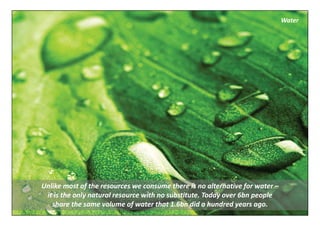
Water


Unlike most of the resources we consume there is no alternative for water –
 it is the only natural resource with no substitute. Today over 6bn people 
   share the same volume of water that 1.6bn did a hundred years ago.
Work


As income increases in India, China, Brazil, and elsewhere, 
      growth in demand for skilled services will occur 
     disproportionately in these emerging economies.
Getting Involved
          Getting Involved
  Sixteen parallel discussions are now all underway: 
        Global experts are adding their views.

   The more who join in the better the debate and
   everyone who participates can use the insights.

 So, go on, give it a go… take a look, see what others 
are saying ‐ add your comments and share your views.

               www.futureagenda.org

Future Agenda Introduction And Initial Thoughts