

Reflecting on results from the Acacia research projects Dakar, 6 October 2009
Purpose of the next hour or so To consider how the identification of outcomes can help research projects learn about the results they are achieving that are beyond outputs but on the way to impact.
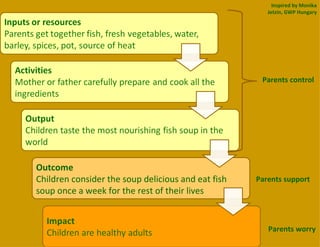
The fish soup development story
Inspired by Monika Jetzin, GWP Hungary Parents support Parents worry Outcome Children consider the soup delicious and eat fish soup once a week for the rest of their lives Parents control
What do these three types of results look like in Acacia research projects? Outcomes
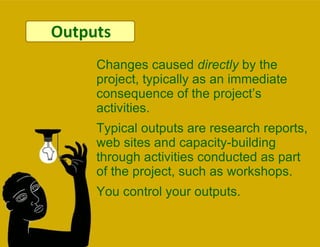
Outputs Changes caused  directly  by the project, typically as an immediate consequence of the project’s activities.  Typical outputs are research reports, web sites and capacity-building through activities conducted as part of the project, such as workshops.  You control your outputs.
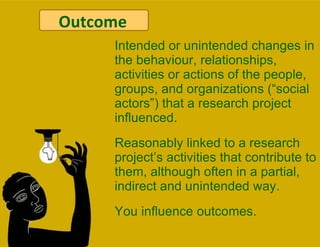
Outcomes Intended or unintended changes in the behaviour, relationships, activities or actions of the people, groups, and organizations (“social actors”) that a research project influenced.  Reasonably linked to a research project’s activities that contribute to them, although often in a partial, indirect and unintended way.  You influence outcomes. Outcome
Impact African citizens build and benefit from a world of broader opportunities because they have the skills and resources to exploit ICTs as a catalyst for their own human, social, and economic development. You contribute indirectly to impact.
Getting from outputs to impact is just like cooking fish soup…right? Wrong!  If only social change were so easy.
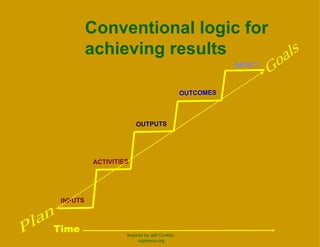
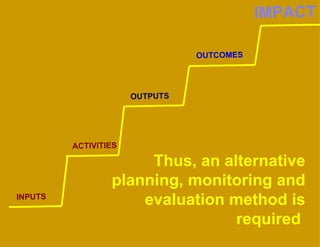
Conventional logic for achieving results Inspired by Jeff Conklin, cognexus.org ACTIVITIES OUTPUTS OUTCOMES IMPACT INPUTS Plan Goals Time
If only the Acacia world were so simple!
Why does conventional logic not work with Acacia?  Acacia’s objectives are social change and innovation: 1. Influence sustained policy dialogue 2. Catalyze thriving research networks 3. Increase research capacity in ICT4D  4. Stimulate social and technical innovation in ICTs 5. Contribute to a formal body of knowledge in ICT4D 6. Incorporate meaningful gender analysis
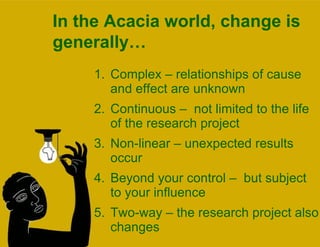
In the Acacia world, change is generally… Complex – relationships of cause and effect are unknown Continuous –  not limited to the life of the research project Non-linear – unexpected results occur Beyond your control –  but subject to your influence Two-way – the research project also changes
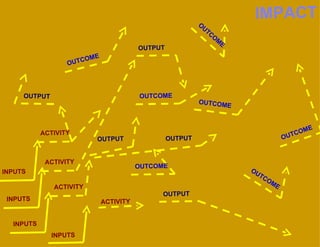
Thus, an alternative planning, monitoring and evaluation method is required  ACTIVITIES OUTPUTS OUTCOMES IMPACT INPUTS
IMPACT OUTPUT OUTCOME INPUTS ACTIVITY INPUTS ACTIVITY INPUTS ACTIVITY INPUTS OUTPUT OUTPUT ACTIVITY OUTPUT OUTPUT OUTCOME OUTCOME OUTCOME OUTCOME OUTCOME OUTCOME
Results in summary
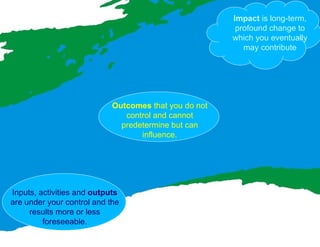
Inputs, activities and  outputs  are under your control and the results more or less foreseeable. Outcomes  that you do not control and cannot predetermine but can influence. Impact  is long-term, profound change to which you eventually may contribute
Sample Acacia outcomes In 2006-2008, the districts of Rakai and Mbale in Uganda implemented Health Management Information System (HMIS) data gathering and reporting as a cost-effective alternative compared to paper-and-pen-based approaches.  Who  changed  what ,  when  and  where ?
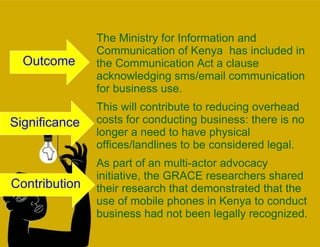
The Ministry for Information and Communication of Kenya  has included in the Communication Act a clause acknowledging sms/email communication for business use.  This will contribute to reducing overhead costs for conducting business: there is no longer a need to have physical offices/landlines to be considered legal. As part of an multi-actor advocacy initiative, the GRACE researchers shared their research that demonstrated that the use of mobile phones in Kenya to conduct business had not been legally recognized.  Outcome Significance Contribution
Exercise with outcomes Purpose :  Have an outcome experience Process:  Individually, take 2-3 minutes to think about an outcome you consider your research project has influenced. Try and formulate it in one sentence.
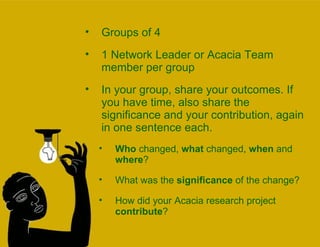
Groups of 4  1 Network Leader or Acacia Team member per group In your group, share your outcomes. If you have time, also share the significance and your contribution, again in one sentence each. Who  changed,  what  changed,  when  and  where ?  What was the  significance  of the change? How did your Acacia research project  contribute ?
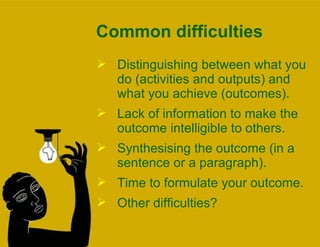
Common difficulties Distinguishing between what you do (activities and outputs) and what you achieve (outcomes). Lack of information to make the outcome intelligible to others. Synthesising the outcome (in a sentence or a paragraph). Time to formulate your outcome. Other difficulties?
In summary This is what a fully formulated outcome looks like
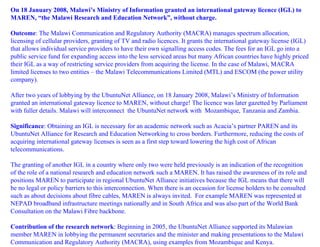
On 18 January 2008, Malawi’s Ministry of Information granted an international gateway licence (IGL) to MAREN, “the Malawi Research and Education Network”, without charge.  Outcome : The Malawi Communication and Regulatory Authority (MACRA) manages spectrum allocation, licensing of cellular providers, granting of TV and radio licences. It grants the international gateway license (IGL) that allows individual service providers to have their own signalling access codes. The fees for an IGL go into a public service fund for expanding access into the less serviced areas but many African countries have highly priced their IGL as a way of restricting service providers from acquiring the license. In the case of Malawi, MACRA limited licenses to two entities – the Malawi Telecommunications Limited (MTL) and ESCOM (the power utility company). After two years of lobbying by the UbuntuNet Alliance, on 18 January 2008, Malawi’s Ministry of Information granted an international gateway licence to MAREN, without charge! The licence was later gazetted by Parliament with fuller details. Malawi will interconnect  the UbuntuNet network with  Mozambique, Tanzania and Zambia. Significance : Obtaining an IGL is necessary for an academic network such as Acacia’s partner PAREN and its  UbuntuNet Alliance for Research and Education Networking  to cross borders. Furthermore, reducing the costs of acquiring international gateway licenses is seen as a first step toward lowering the high cost of African telecommunications. The granting of another IGL in a country where only two were held previously is an indication of the recognition of the role of a national research and education network such a MAREN. It has raised the awareness of its role and positions MAREN to participate in regional UbuntuNet Alliance initiatives because the IGL means that there will be no legal or policy barriers to this interconnection. When there is an occasion for license holders to be consulted such as about decisions about fibre cables, MAREN is always invited.  For example MAREN was represented at NEPAD broadband infrastructure meetings nationally and in South Africa and was also part of the World Bank Consultation on the Malawi Fibre backbone. Contribution of the research network : Beginning in 2005, the UbuntuNet Alliance  supported its Malawian member  MAREN in lobbying the permanent secretaries and the minister and making presentations to the Malawi Communication and Regulatory Authority (MACRA), using examples from Mozambique and Kenya.
And this is the potential of mapping your outcomes
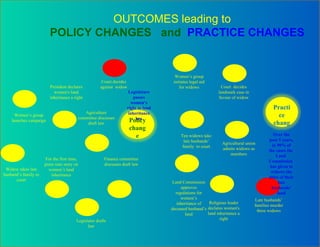
OUTCOMES leading to  POLICY CHANGES  and  PRACTICE CHANGES President declares women's land inheritance a right Ten widows take late husbands’ family  to court Court  decides landmark case in favour of widow Agricultural union admits widows as members Religious leader declares women's land inheritance a right Policy change Legislature passes women’s right to land inheritance law Agriculture committee discusses draft law Women’s group launches campaign Legislator drafts law Widow takes late husband’s family to court For the first time, press runs story on women’s land inheritance Finance committee discusses draft law Court decides against  widow Late husbands’ families murder three widows Women’s group initiates legal aid for widows Over the past 5 years, in 90% of the cases the  Land  Commission  has given to widows the titles of their late husbands’ land Practice change Land Commission approves regulations for women’s inheritance of deceased husband’s land
Questions or comments?
[email_address] Many thanks!

Reflecting On Research Outcomes - Ricardo's Presentation

  • 1.
    Reflecting on resultsfrom the Acacia research projects Dakar, 6 October 2009
  • 2.
    Purpose of thenext hour or so To consider how the identification of outcomes can help research projects learn about the results they are achieving that are beyond outputs but on the way to impact.
  • 3.
    The fish soupdevelopment story
  • 4.
    Inspired by MonikaJetzin, GWP Hungary Parents support Parents worry Outcome Children consider the soup delicious and eat fish soup once a week for the rest of their lives Parents control
  • 5.
    What do thesethree types of results look like in Acacia research projects? Outcomes
  • 6.
    Outputs Changes caused directly by the project, typically as an immediate consequence of the project’s activities. Typical outputs are research reports, web sites and capacity-building through activities conducted as part of the project, such as workshops. You control your outputs.
  • 7.
    Outcomes Intended orunintended changes in the behaviour, relationships, activities or actions of the people, groups, and organizations (“social actors”) that a research project influenced. Reasonably linked to a research project’s activities that contribute to them, although often in a partial, indirect and unintended way. You influence outcomes. Outcome
  • 8.
    Impact African citizensbuild and benefit from a world of broader opportunities because they have the skills and resources to exploit ICTs as a catalyst for their own human, social, and economic development. You contribute indirectly to impact.
  • 9.
    Getting from outputsto impact is just like cooking fish soup…right? Wrong! If only social change were so easy.
  • 10.
    Conventional logic forachieving results Inspired by Jeff Conklin, cognexus.org ACTIVITIES OUTPUTS OUTCOMES IMPACT INPUTS Plan Goals Time
  • 11.
    If only theAcacia world were so simple!
  • 12.
    Why does conventionallogic not work with Acacia? Acacia’s objectives are social change and innovation: 1. Influence sustained policy dialogue 2. Catalyze thriving research networks 3. Increase research capacity in ICT4D 4. Stimulate social and technical innovation in ICTs 5. Contribute to a formal body of knowledge in ICT4D 6. Incorporate meaningful gender analysis
  • 13.
    In the Acaciaworld, change is generally… Complex – relationships of cause and effect are unknown Continuous – not limited to the life of the research project Non-linear – unexpected results occur Beyond your control – but subject to your influence Two-way – the research project also changes
  • 14.
    Thus, an alternativeplanning, monitoring and evaluation method is required ACTIVITIES OUTPUTS OUTCOMES IMPACT INPUTS
  • 15.
    IMPACT OUTPUT OUTCOMEINPUTS ACTIVITY INPUTS ACTIVITY INPUTS ACTIVITY INPUTS OUTPUT OUTPUT ACTIVITY OUTPUT OUTPUT OUTCOME OUTCOME OUTCOME OUTCOME OUTCOME OUTCOME
  • 16.
  • 17.
    Inputs, activities and outputs are under your control and the results more or less foreseeable. Outcomes that you do not control and cannot predetermine but can influence. Impact is long-term, profound change to which you eventually may contribute
  • 18.
    Sample Acacia outcomesIn 2006-2008, the districts of Rakai and Mbale in Uganda implemented Health Management Information System (HMIS) data gathering and reporting as a cost-effective alternative compared to paper-and-pen-based approaches. Who changed what , when and where ?
  • 19.
    The Ministry forInformation and Communication of Kenya has included in the Communication Act a clause acknowledging sms/email communication for business use. This will contribute to reducing overhead costs for conducting business: there is no longer a need to have physical offices/landlines to be considered legal. As part of an multi-actor advocacy initiative, the GRACE researchers shared their research that demonstrated that the use of mobile phones in Kenya to conduct business had not been legally recognized. Outcome Significance Contribution
  • 20.
    Exercise with outcomesPurpose : Have an outcome experience Process: Individually, take 2-3 minutes to think about an outcome you consider your research project has influenced. Try and formulate it in one sentence.
  • 21.
    Groups of 4 1 Network Leader or Acacia Team member per group In your group, share your outcomes. If you have time, also share the significance and your contribution, again in one sentence each. Who changed, what changed, when and where ? What was the significance of the change? How did your Acacia research project contribute ?
  • 22.
    Common difficulties Distinguishingbetween what you do (activities and outputs) and what you achieve (outcomes). Lack of information to make the outcome intelligible to others. Synthesising the outcome (in a sentence or a paragraph). Time to formulate your outcome. Other difficulties?
  • 23.
    In summary Thisis what a fully formulated outcome looks like
  • 24.
    On 18 January2008, Malawi’s Ministry of Information granted an international gateway licence (IGL) to MAREN, “the Malawi Research and Education Network”, without charge. Outcome : The Malawi Communication and Regulatory Authority (MACRA) manages spectrum allocation, licensing of cellular providers, granting of TV and radio licences. It grants the international gateway license (IGL) that allows individual service providers to have their own signalling access codes. The fees for an IGL go into a public service fund for expanding access into the less serviced areas but many African countries have highly priced their IGL as a way of restricting service providers from acquiring the license. In the case of Malawi, MACRA limited licenses to two entities – the Malawi Telecommunications Limited (MTL) and ESCOM (the power utility company). After two years of lobbying by the UbuntuNet Alliance, on 18 January 2008, Malawi’s Ministry of Information granted an international gateway licence to MAREN, without charge! The licence was later gazetted by Parliament with fuller details. Malawi will interconnect the UbuntuNet network with Mozambique, Tanzania and Zambia. Significance : Obtaining an IGL is necessary for an academic network such as Acacia’s partner PAREN and its UbuntuNet Alliance for Research and Education Networking to cross borders. Furthermore, reducing the costs of acquiring international gateway licenses is seen as a first step toward lowering the high cost of African telecommunications. The granting of another IGL in a country where only two were held previously is an indication of the recognition of the role of a national research and education network such a MAREN. It has raised the awareness of its role and positions MAREN to participate in regional UbuntuNet Alliance initiatives because the IGL means that there will be no legal or policy barriers to this interconnection. When there is an occasion for license holders to be consulted such as about decisions about fibre cables, MAREN is always invited. For example MAREN was represented at NEPAD broadband infrastructure meetings nationally and in South Africa and was also part of the World Bank Consultation on the Malawi Fibre backbone. Contribution of the research network : Beginning in 2005, the UbuntuNet Alliance supported its Malawian member MAREN in lobbying the permanent secretaries and the minister and making presentations to the Malawi Communication and Regulatory Authority (MACRA), using examples from Mozambique and Kenya.
  • 25.
    And this isthe potential of mapping your outcomes
  • 26.
    OUTCOMES leading to POLICY CHANGES and PRACTICE CHANGES President declares women's land inheritance a right Ten widows take late husbands’ family to court Court decides landmark case in favour of widow Agricultural union admits widows as members Religious leader declares women's land inheritance a right Policy change Legislature passes women’s right to land inheritance law Agriculture committee discusses draft law Women’s group launches campaign Legislator drafts law Widow takes late husband’s family to court For the first time, press runs story on women’s land inheritance Finance committee discusses draft law Court decides against widow Late husbands’ families murder three widows Women’s group initiates legal aid for widows Over the past 5 years, in 90% of the cases the Land Commission has given to widows the titles of their late husbands’ land Practice change Land Commission approves regulations for women’s inheritance of deceased husband’s land
  • 27.
  • 28.