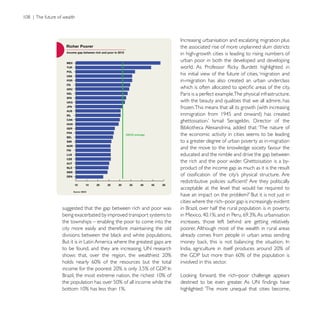
Future Agenda
Future Agenda
 The World in 2020
Contents
Foreword                             vii    The future of happiness         115
Preface                               ix       Active elderly               117
Navigating this book                 xvi       Choosing God                 121
                                               Cocktail identities          125
1 THE FOUR CERTAINTIES              xviii      Enjoying the ordinary        129
  Context                             1        Less variety                 133
  Imbalanced population growth        5        Live experiences             137
  Key resource constraints           17        Seamless media consumption   141
  Asian wealth shift                 29        Switching off                145
  Universal data access              37     The future of mobility          149
                                               Asian aviation               151
2 DRIVERS OF CHANGE: KEY INSIGHTS    44        Chinese trains               155
  The future of health               47        Clean shipping               159
     Automated people-care           49        Electric mobility            163
     Clinical enhancement            53        Intelligent highways         167
     Diabesity                       57        Muslim Europe                171
     Global pandemics                61        People tracking              175
     Halting Alzheimer’s             65        Urban (im)mobility           179
     Mass medical tourism            69     The future of security          183
     Pharma foods                    73        Alternative proteins         185
     Systemic euthanasia             77        Bio-surveillance             189
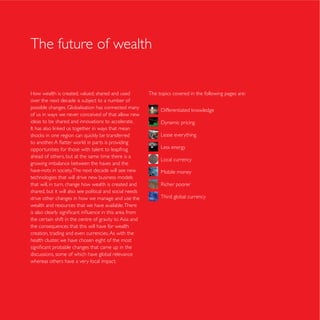
  The future of wealth               81        Corporate LEGO               193
     Differentiated knowledge        83        Credible sources             197
     Dynamic pricing                 87        Drone wars                   201
     Lease everything                91        Solar sunrise                205
     Less energy                     95        Virtual authenticity         209
     Local currency                  99        Water management             213
     Mobile money                   103
     Richer poorer                  107
     Third global currency          111
The future of locality      217   4 INNOVATING THE FUTURE             278
     Almost zero waste        219     Innovation as well as foresight   279
     Bridging the last mile   223     Ten questions for governments     284
     Community living         227     Ten questions for organisations   285
     Dense cities             231     Ten questions for individuals     286
     Intelligent buildings    235
     Local foods              239   Resources and references            289
     Mega-city-states         243
     Migration magnets        247   About the team                      306

3 MODERATORS OF THE FUTURE    250   Index                               308
  Trust and privacy           252
  Global versus local         264
  Choice                      270
  Dimensions for change       274
Foreword

The Future Agenda programme provides an open             from the ways they are being addressed in different
forum for discussion about how to address the            societies. On some occasions there has been heated
major challenges which society faces over the next       debate, particularly over issues such as climate change
ten years, offering the opportunity for all to share     and the future provision of healthcare, and in some
ideas and potential solutions so that ultimately we      instances the problems have seemed almost too
can together inspire change.                             intractable to manage but perseverance has paid off;
                                                         the debate has moved on and opportunities have
We began this discussion by identifying a range of
issues that we believed were the most important
for the next decade. We then invited a number of
experts from academia and industry to offer an initial   you to question the status quo and consider the
                                                         possibility of change. All those who have participated
                                                         so far have had important things to say that should
to other experts and professionals across a wide         be of interest to anyone concerned with creating a
                                                         sustainable future for us all.
initial point of view and build the debate. Overall we

many countries, from Australia and New Zealand to

                                                         communicate. Never has a global conversation been
comments to our website or followed the debate on        more important: we hope that our contribution will
                                                         be a stimulus to others to continue.
in this project and who were prepared to voice an
opinion and challenge the status quo.


an overview of the discussions we have shared to
date. The aim has been to articulate the complex
challenges we face and understand how we can learn       Vittorio Colao, CEO Vodafone Group
viii | Future Agenda
Preface

                                                        Why not global open foresight?
began with a number of questions and a rough idea
of how to answer them. We wanted to provide
                                                        with rapid technological advances, shifting political
challenges we face as a society over the next ten       movements, rising economic powerhouses in Asia and
                                                        societal change at a faster pace than ever previously
can address them.                                       experienced, it has become increasingly challenging.

Over the following twelve months, this largely          to ensuring the long-term sustainability of business
experimental activity built up momentum. We have
                                                        future early so that they can both prepare for it and
that will occur across many different areas, and we
have also explored some of the main arenas in which
these changes will be played out. We have engaged
with a global audience and tried to build a bridge      long-term projections on such issues as population
between the traditionally separate areas of foresight   growth, military power and economic development

open foresight initiative.

Our aim for the Future Agenda programme is to           At the same time, some commercial companies are
provide a lens through which organisations can
identify major innovation opportunities. Many

involved in the discussions and their contribution
has helped us to highlight the big issues for the       Alongside these institutional views of the emerging
next decade and identify where they will have most
impact. We hope it has also provided them and the
organisations they represent with new provocations
and insights that will guide their activities in new
                                                        the success of these varied groups lay not actually in
                                                        predicting the future but in differentiating between
x | Future Agenda


                    the possible and the probable.This led them, and their

                                                                             invested in second and third generation bio-fuels; as
                    opportunity, and made them better prepared in the
                    face of unfolding events.

                    Over the past decade or so, governments and
                                                                             steering towards the convergence of healthcare and
                                                                             cosmetics. All of these successes are good news for
                                                                             the organisations involved, as they have acted on the
                                                                             insights that were available to them and made bold
                                                                             yet informed decisions.

                                                                             However, one concern that some involved in these
                                                                             programmes have been sharing is whether they
                                                                             are missing something. Although they all developed

                                                                             years, and try to encompass a broad view of the
                                                                             future, many are run with a single-industry or single-

                    of the digital world, health changes, and so on, and
                    a plethora of commercial futures consultancies have
                    been formed that provide their clients with services
                                                                             understanding about the future, the commercial and
                    as offering more long-term foresight.                    societal value is only gained from the decisions they

                    As a consequence of all this activity and partial
                    sharing of summary insights by some of the above,
                    one could argue that we are now more informed            of multiple views from outside the organisation. Lastly,

                    As such, the governments and companies involved

                                                                             the raw data to themselves. As a result of this we
                                                                             wondered whether there was a way in which these
                    were better prepared than others for the global          organisations could better pool their views of the
                                                                             future. While there are a few online commercially
                    global actions required to rebalance food supply         focused communities, there was no open repository
                    and demand; Apple proactively saw the business
Preface | xi


                                                         engage the younger generation who will be leading
vehicle through which the views of the future can        the world forward. Another challenge was to bring
                                                         all these varied views together. Hence our second
together perspectives from a broad range of areas        question: How can we engage the unusual suspects?

principles of open innovation upstream into the          organisations and communities that connect directly
world of foresight? Or to put it another way: Why
can’t we create a global open foresight platform? The    bring together a wider range of views, from multiple

                                                         with different views of the ways things are going.

bring all parties together. What is more, if we adopt
                                                         The initial idea

be able to gain a wider, more informed view of the
                                                         came to the conclusion that, given the technology,
                                                         contacts and relationships in place, there was a good
                                                         chance we could bring our idea to life.
How do we engage the unusual suspects?
                                                         We live in a world where increasingly ubiquitous
One of the criticisms of many existing futures           connectivity means that over one-third of the
programmes is that they are full of the usual suspects
– a group of experts whose views and opinions are        Consequently, more of us are engaging in two-way

a lot as they are routinely consulted by businesses      there are growing numbers of people around the
or invited to participate in cross-government and        world who actively engage in debate who could be
corporate initiatives, but they are all largely white,   encouraged to participate in an open programme

continue to engage primarily with these recognised
experts, will we really get as clear a view of the
future as we could? While it is important to have
their views in the mix, should we not try to engage      beyond the short-term horizon, so that we are not
with a broader church? What we wanted was to get
                                                         but also one that is not so far out that we enter the
                                                                                                      Minority
                                                         Report, Blade Runner and I, Robot
from the countries that are probably the centres         the strands of debate.
of action for the next decade. And we wished to
xii | Future Agenda


                      We also thought that rather than starting with a         The kick-off
                      series of questions on a blog – if we started with
                      some points of view to challenge and build upon, we      them down to sixteen on the basis of them being
                      could get further and faster. People could build on      unique, and so covering different areas, open for
                      the initial views, highlight the areas that they agree
                      with and propose alternative positions to those          focused on subjects around which there would
                      that they disagreed with. At the same time, if all
                      comments were openly accessible on the website           for debate. These sixteen topics were the future
                      from the start then anyone could use the insights        of authenticity, choice, cities, connectivity, currency,
                      straight away, without having to wait six months for     data, energy, food, health, identity, migration, money,


                      in becoming involved in this, to both better inform
                      its view of the future and also act as a sponsor, but    across the academic, commercial and government
                      importantly not the client for a programme, then         arenas were invited to answer a number of common
                                                                               questions on the future.These were then edited and
                      would be increased.                                      put into a standard format to ease navigation and to

                                                                               shared their personal views about the next decade.
                      Agenda programme was born. A standard blog               These were each grouped into four sections –
                                                                               namely, the global challenges, options and possibilities,
                                                                               the way forward, and impacts and implications. The
                      some of the big issues for the coming decade. We         intention from the start was not only to get views
                      thought that we would have a multitude of different      for each topic on what the future would be, but also
                      views from around the world by the end of the year       to get perspectives on which way we should go, why
                      and so be able to share a unique view of the world       and with what consequences.

                                                                               At the beginning of October, all sixteen initial
                      company, agreed to sponsor the programme and
                      help build the momentum through its connections          created for sharing and the programme was launched
                                                                               with a host of people around the world invited to
                      in which it provides mobile services.                    add their views to the mix. The response was very


                                                                               the other top countries from which people were
Preface | xiii


                                                             world, the programme was plainly pushing too hard
                                                             against pre-existing constraints.


Vietnam, so clearly the audience was global and the          up with suggestions as to how we could get around
programme was engaging a broad community. From               the problems.
a topic perspective, the most popular ones in terms
of initial visits were food, health, authenticity, cities,
connectivity and energy. The challenge was that
only a hundred or so people were actually adding to             adding comments to the blog and this started to
the blog.                                                       build some momentum.


Future Agenda v2

                                                                such rich topics, people wanted to have a hard
the site, who were enthusiastic about the idea and


so authoritative that not many were ready to add
alternative views and, second, even if they wanted to,
few were actually willing to blog. Although individuals
in academia, government and the corporate sector

the programme, doing so via a blog was culturally,              of insight gathering we would offer organisations

are largely restricted from giving opinions in public;
academics still largely prefer real debate to virtual
discussion; and, although people in companies have
views to share, if their employers have no ready-               vehicle for debate that people are used to, one
                                                                that allows them to interact with others in the
comments from a .com email address would have
to go for internal approval prior to sharing. The
whole premise upon which we had based the                    These suggestions changed the nature of the Future
programme – that people are ready to engage in
online discussions – was clearly wrong. While lots of
                                                             a three-month online debate it became a global
xiv | Future Agenda


                                                                                   the accompanying futureagenda.org website
                  these were within single organisations but many         allows anyone to access the insights gained from the
                  brought together different expertise from many          programme in an interactive and dynamic manner,

                  conference facilities, some in hotels and restaurants   issues but also to the source materials, be they the
                                                                          initial perspectives, the raw comments received from
                                                                          participants or reports and documents shared as part
                                                                          of the programme.This website provides a snapshot of


                                                                          Thirdly, many of the organisations which participated
                  cultures, of varied ages and with many different        in the programme have already used the insights that
                                                                          they gained and shared about the future to inform


                  although not as originally designed, the Future         started developing new products and services to
                  Agenda programme became a platform for global           meet associated needs. Other organisations have
                  open foresight that engaged the usual and the
                  unusual suspects.                                       were previously not on their radar and now have
                                                                          not only a better recognition of how they might
                                                                          be affected in the future but also an improved
                  Programme outcomes                                      understanding of how they may need to respond
                                                                          differently. Numerous academics participating in the
                                                                          programme have found new areas for research and
                  Future Agenda programme has provided a series of
                  both planned and unplanned outcomes.                    government bodies have used the insights both
                                                                          to validate existing assumptions and to challenge

                  a synthesis of what the Future Agenda programme         help to stimulate more actions such as these.

                                                                          The intention of the Future Agenda programme was
                  it explores what is certain about the next decade,      never just to share, challenge and collate as many
                  what are probable changes, what are seen as the
                  moderators of the future and what are the main          the next decade and provide synthesised generic
                  implications for governments, companies and             outputs for individuals and organisations to use. That
                  individuals. There is a more detailed explanation
                                                                          do so while simultaneously providing a platform for
                  might wish to use it.                                   new and higher levels of innovation.
Preface | xv


                                                         point at which they can now start to stimulate new
the intersections between different areas. While
innovations in a few arenas, such as pharmaceutical      challenges we face in such areas as climate change,
development, do occur largely within one discipline,     sustainable health and food supply; ideas about how
many others occur from the convergence of
challenges and opportunities in several separate         right path over the next decade; and ideas for new
                                                         products, services and business models that will
future of food need to factor in the impacts and         ensure the legacy of the past does not become a
implications of water and waste; those relating to       burden on the future.
the issues of identity are increasingly driven by such
topics as choice, data and connectivity; and the way
in which we choose to go about designing our cities
                                                         been written with their support and thoughtfulness.

                                                         stimulating and, ultimately, a source of new insights

on the Future Agenda programme, we have seen
many opportunities for positive change being             Tim Jones and Caroline Dewing, November 2010
xvi | Future Agenda


                      parallel discussions. As views on these were shared      gained into how the world and our lives will
                      and built upon, it became clear that as well as the      probably change over the next decade. These are
                      vertical conversations within each topic, there were a
                      host of issues bubbling to the surface that cut across
                                                                               by just one of the four certainties, others by two or
                      the future; some are issues that will moderate how       more. These changes are detailed by providing both
                      the future unfolds. As such, in the synthesis of the     the signals from today that give evidence to support
                      insights from the programme, we have sought to           the direction of change and the future implications
                      highlight these issues and group them accordingly        over the next ten years. They are grouped into six
                      so that you, the reader, can see how they interrelate,   clusters – health, wealth, happiness, mobility, security
                      and can therefore also choose which chapters of the      and locality – which seem to encompass all the


                                                                               and so we have used margin indicators to help you
                      scale certainties for the next decade – the things
                      that, unless there is an unexpected, massive and         to another. This navigation replicates in a somewhat
                                                                               limited printed form some of the more dynamic
                      so are the certitudes upon which everything else is      interactions that can be found between these topics
                      built. These certainties are:                            on the accompanying website.

                         a continued imbalance in population growth

                         an accelerating shift of economic power to Asia
                         universal data access.


                      a good understanding of why these macro-drivers of       place. These four themes – trust, privacy, choice and
                      change are occurring, what the core characteristics of   global/local action – are themselves interrelated and
                                                                               so, as well as sharing perspectives on them in isolation,
innovation and change in approach at that level; and
either accelerate or decelerate change; and how             lastly those that raise questions for us as individuals
their interrelationships allow us to see a number of        in how we see our role in the future and how and
alternative scenarios in the future.

                                                            as many questions as it provides answers.
implications of outcomes from the Future Agenda
                                                            Finally, there is a section giving resources and
certainties, probable changes and moderators of             references which brings together some of the
the future, it brings together some conclusions and         multiple sources of information that have been
questions for the next decade. These have been              shared and used in the Future Agenda programme.

concern governments and so provide questions for            some of the issues raised in more detail or on a
future policy and regulation; those that will potentially   continuing basis.
relate to organisations and so provide stimuli for
xviii | Future Agenda


PART 1
The four certainties
Context


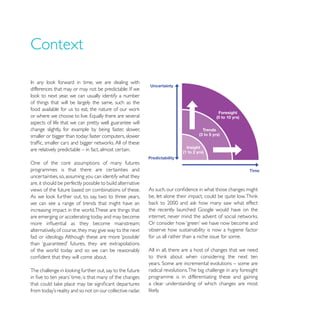
of things that will be largely the same, such as the


aspects of life that we can pretty well guarantee will
change slightly, for example by being faster, slower,
smaller or bigger than today: faster computers, slower

are relatively predictable – in fact, almost certain.

One of the core assumptions of many futures
programmes is that there are certainties and
uncertainties, so, assuming you can identify what they
are, it should be perfectly possible to build alternative
views of the future based on combinations of these.

we can see a range of trends that might have an
increasing impact in the world. These are things that
are emerging or accelerating today and may become

alternatively, of course, they may give way to the next     observe how sustainability is now a hygiene factor
                                                            for us all rather than a niche issue for some.

of the world today and so we can be reasonably              All in all, there are a host of changes that we need


                                                            radical revolutions. The big challenge in any foresight
                                                            programme is in differentiating these and gaining
                                                            a clear understanding of which changes are most
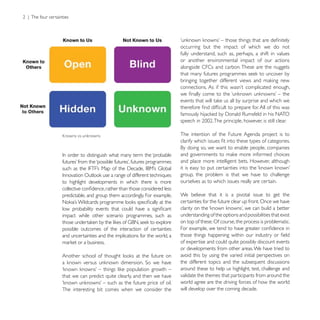
occurring but the impact of which we do not
                                                          fully understand, such as, perhaps, a shift in values
                                                          or another environmental impact of our actions
                                                          alongside CFCs and carbon. These are the nuggets


Knowns vs unknowns                                        The intention of the Future Agenda project is to


                                                          and place more intelligent bets. However, although

                                                          group, the problem is that we have to challenge
to highlight developments in which there is more          ourselves as to which issues really are certain.

predictable, and group them accordingly. For example,     We believe that it is a pivotal issue to get the
                                                          certainties for the future clear up front. Once we have

impact while other scenario programmes, such as           understanding of the options and possibilities that exist
                                                          on top of these. Of course, the process is problematic.
possible outcomes of the interaction of certainties
and uncertainties and the implications for the world, a
                                                          of expertise and could quite possibly discount events
                                                          or developments from other areas. We have tried to
                                                          avoid this by using the varied initial perspectives on
                                                          the different topics and the subsequent discussions
                                                          around these to help us highlight, test, challenge and
that we can predict quite clearly, and then we have       validate the themes that participants from around the
                                                          world agree are the driving forces of how the world
The interesting bit comes when we consider the            will develop over the coming decade.
The four certainties are:
from the programme, we see as the four macro-
                                                          a continued imbalance in population growth
massive and fundamental global shift that we have
not anticipated, these are the things that will most      an accelerating shift of economic power to Asia
                                                          universal data access.

global trends can be seen today and are already
being factored into plans and strategic approaches
by some governments, institutions and businesses.
By 2020, we will add another 750M people to the planet, most in places least
able to accommodate them.

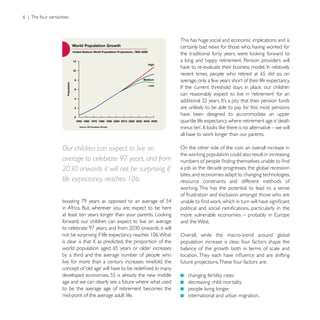
Over the next ten years, improvements in health,           we need to address in order to understand the
education and living standards will continue to
drive population growth. Longer life expectancy
will offset the trend towards having fewer children,

                                                           in the mid-nineteenth century to reach 1.6 billion at
in growth rates will result in a larger proportion of

from rural areas means that a greater number of us         on the global population has been increasing at
will live in cities than ever before.

This suggests that, as long as there are no disasters on
a huge scale – natural or man-made – over the next
decade, demographic changes are much more certain
than many other long-term predictions. The macro-
trends are clear: the human population has grown
massively over the past century or so. All things being
                                                           of major pandemics, global natural disasters or


around these days and that this has put unsustainable
pressure on the resources available, but this is not
strictly true. The questions that matter are not only
around general growth but also around balance. Are         billion in the next forty years inevitably means a more
                                                           crowded world with ever more of us competing for
                                                           the same resources.

age to support economic growth? As the population          On top of this, child mortality rates are declining and
ages, are there enough people to support the old?          more of us are living longer. Today, our average life

                                                           this varies from region to region, with North Americans
6 | The four certainties


                                                                               This has huge social and economic implications and is


                                                                               a long and happy retirement. Pension providers will

                                                                               recent times, people who retired at 65 did so, on
                                                                               average, only a few years short of their life expectancy.


                                                                               have been designed to accommodate an upper
                                                                               quartile life expectancy where retirement age is ‘death


                    Our children can expect to live on                         On the other side of the coin, an overall increase in

                    average to celebrate 97 years, and from
                    2030 onwards it will not be surprising if                  a job as the decade progresses, the global recession
                                                                               bites, and economies adapt to changing technologies,
                    life expectancy reaches 106.                               resource constraints and different methods of

                                                                               of frustration and exclusion amongst those who are


                    forward, our children can expect to live on average        and the West.

                                                                               Overall, while the macro-trend around global
                    is clear is that if, as predicted, the proportion of the   population increase is clear, four factors shape the
                    world population aged 65 years or older increases          balance of the growth both in terms of scale and
                    by a third and the average number of people who
                    live for more than a century increases ninefold, the       future projections. These four factors are:

                    developed economies, 55 is already the new middle             changing fertility rates
                    age and we can clearly see a future where what used           decreasing child mortality
                    to be the average age of retirement becomes the               people living longer
                    mid-point of the average adult life.                          international and urban migration.
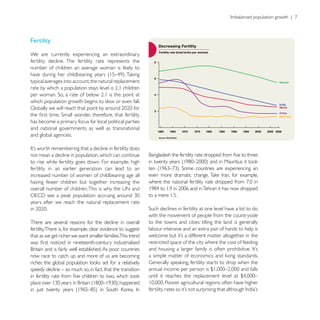
Fertility

We are currently experiencing an extraordinary
fertility decline. The fertility rate represents the


typical averages into account, the natural replacement


which population growth begins to slow or even fall.


has become a primary focus for local political parties
and national governments as well as transnational
and global agencies.


not mean a decline in population, which can continue
to rise while fertility goes down. For example, high
fertility in an earlier generation can lead to an
increased number of women of childbearing age all
having fewer children but together increasing the

                                                              to a mere 1.5.
years after we reach the natural replacement rate

                                                              with the movement of people from the countryside
There are several reasons for the decline in overall          to the towns and cities: tilling the land is generally
fertility. There is, for example, clear evidence to suggest   labour intensive and an extra pair of hands to help is
that as we get richer we want smaller families.This trend
                                                              restricted space of the city where the cost of feeding

now race to catch up and more of us are becoming              a simple matter of economics and living standards.

speedy decline – so much so, in fact, that the transition
all major economies are below the replacement level


                                                          programmes are already under way to encourage
Fertility is also falling because more women are better
                                                          France, for example, where the fertility rate is now

want large families. The impact of female education
                                                          most successful in encouraging its population to grow
                                                          – it is the only rich country that, having fallen below

more women become literate, so their economic
roles and societal views change, and the desire for
                                                          the more stable fertility rates will continue to be
availability and use of contraception has also played     found over the next decade, and so where the rates
a fundamental role in changing fertility trends.
Family planning has helped many people reduce the         particularly those with little or no infrastructure
number of children they have – and research even          because of war or low living standards, will continue
suggests that fertility in some countries would be
even lower if family planning services were more
widely available. The impact of female education
and use of contraception in controlling population
growth highlights why both issues are so high on the
                                                          be added to the African population over the next


Over the next ten years we can expect to see
further declines in fertility to a point where nearly
                                                          over the decade. To put it another way, one-third
                                                          of the net global population growth between today
Fertility is also falling because more
women are better educated and are                         The main problem with all of this is that, because
therefore more likely to go out to work                   fertility rates decline as standards of living rise, it
and demand contraception and less                         population growth will occur in the nations least able
likely to want large families.                            to sustain it. Furthermore, as fertility falls it changes
the structure of the population by increasing the size


there are fewer dependants, they have more money

in some high-population developing economies such

are going. This could lead to change that will shift

sustainable direction.


Infant mortality


growth is that of infant mortality – which is
essentially measured by the number of infant deaths

and wider availability of medical support, some of
the primary causes of infant mortality have been

past half century, average infant mortality has been


                                                          On a positive note, there is rising investment from


                                                          the incidence of the leading causes of childhood
                                                          deaths, such as measles, malaria and diarrhoea,
Central Africa it is not expected to drop much below      which are the scourge of the young and vulnerable.
                                                          However, success is patchy: mortality rates are higher
a child born in a developing country is over thirteen     for children from rural and poor families and whose

of life than a child born in an industrialised country.
Although reducing child mortality by two-thirds
                                                          mortality on the global population may not, in

will be achieved.                                         possibility of decreasing fertility rates in the regions
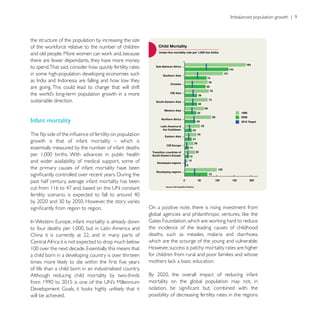
Although reducing child mortality by
two-thirds from 1990 to 2015 is one
of the UN’s Millennium Development
Goals, it looks highly unlikely that it will
be achieved.

of continued high child mortality, such as found in
Central Africa, some have argued that we could see
a reduction in the rate of local population growth
combined with a decrease in child mortality that will
help improve the quality of life of millions.


rates have great potential to slow, if not immediately
halt, population growth in some important regions.
While getting the world as a whole to below the

next decade or so, the big challenge is really in the
                                                         People living longer
the obvious reasons relating to sustainability, food
availability and economic growth, Africa is always       Of course, reductions in fertility and increases in the
high on the agenda of many organisations when the        life expectancy of children are not going to solve
topic of imbalanced population growth is discussed,      the problem of there being too many people on the
but other countries with high fertility rates, such as

                                                         cause for concern.


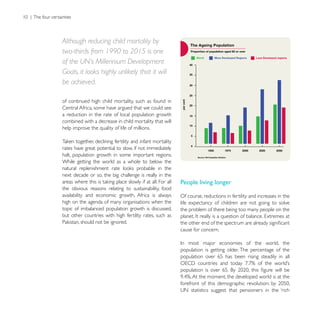
                                                         population is getting older. The percentage of the
                                                         population over 65 has been rising steadily in all
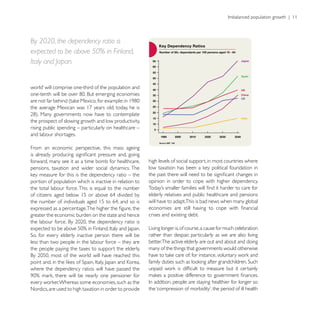
By 2020, the dependency ratio is
expected to be above 50% in Finland,
Italy and Japan.


the prospect of slowing growth and low productivity,
rising public spending – particularly on healthcare –
and labour shortages.

From an economic perspective, this mass ageing

forward, many see it as a time bomb for healthcare,      high levels of social support, in most countries where
pensions, taxation and wider social dynamics. The

portion of population which is inactive in relation to   opinion in order to cope with higher dependency.
the total labour force. This is equal to the number
                                                         elderly relatives and public healthcare and pensions
                                                         will have to adapt.This is bad news when many global

greater the economic burden on the state and hence       crises and existing debt.

                                                         Living longer is, of course, a cause for much celebration
                                                         rather than despair, particularly as we are also living
less than two people in the labour force – they are      better.The active elderly are out and about and doing
the people paying the taxes to support the elderly.      many of the things that governments would otherwise


where the dependency ratios will have passed the


Nordics, are used to high taxation in order to provide
that precedes death, has got shorter – mainly because    Most of this international migration,
we are living more healthily and have access to better
healthcare services. However, there is no getting away   however, is occurring within regions,
from the fact that, at some time or other, the elderly   albeit from one country to another.
mainly because they tend to suffer from long-term,
chronic conditions that are, unfortunately, expensive
to treat (eg, diabetes, high blood pressure and heart    Add an increasingly ageing (and arguably economically

                                                         number of young people in many countries and it
Most pensions currently operate on a pay-as-you-go       is easy to see why concern about the dependency
                                                         ratio is such a major concern for many government
pensioners. They are based on the understanding
                                                         the fundamental age imbalance of the population
them when their time comes. However, given the
increasing number of pensioners dependent on a

                                                         companies to remain economically competitive is
                                                         driving further changes in attitudes and priorities for
decisions will have to be made regarding the system –    population growth.
including raising the age of retirement and increasing
the amount we contribute.


years would solve a lot of the problems associated


already planning increases in the retirement age; an


or part time, people will not only save government
expenditure by not drawing a pension but they
will also feed the public purse by continuing to pay
taxes and social security contributions; so, from
a government perspective, those extra years are
doubly valuable. Those who today are in their early
sixties and getting ready to become pensioners may,
of course, not see things the same way.
International migration


global recession, many countries, especially those in


                                                            North American countries. Most of this international
                                                            migration, however, is occurring within regions, albeit


                                                            again has been a visible social and political issue for the


                                                            Although a real and tangible challenge for many
                                                            border authorities in the West and an emotional and
                                                            political issue for many receiving countries – especially

population growth.                                          natural rising populations, international migration is
                                                            not a major driver of population growth.


have lots of young people in need of jobs; many rich


decades, labour forces in developed countries are set

have to increase enormously to compensate – to at

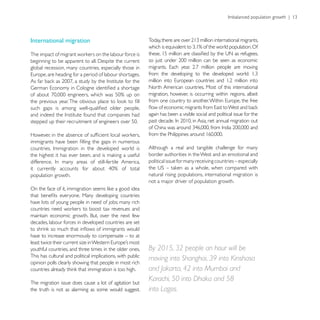
youthful countries, and three times in the older ones.      By 2015, 32 people an hour will be
This has cultural and political implications, with public
                                                            moving into Shanghai, 39 into Kinshasa
opinion polls clearly showing that people in most rich
                                                            and Jakarta, 42 into Mumbai and
The migration issue does cause a lot of agitation but
                                                            Karachi, 50 into Dhaka and 58
the truth is not as alarming as some would suggest.         into Lagos.
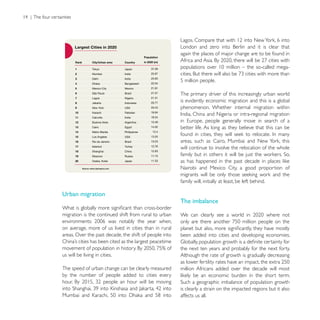
again the places of major change are to be found in


                                                        5 million people.

                                                        The primary driver of this increasingly urban world
                                                        is evidently economic migration and this is a global
                                                        phenomenon. Whether internal migration within


                                                        better life. As long as they believe that this can be


                                                        will continue to involve the relocation of the whole


                                                        Nairobi and Mexico City, a good proportion of

                                                        family will, initially at least, be left behind.

Urban migration
                                                        The imbalance

migration is the continued shift from rural to urban

on average, more of us lived in cities than in rural
areas. Over the past decade, the shift of people into   been added into cities and developing economies.

                                                        the next ten years and probably for the next forty.
us will be living in cities.                            Although the rate of growth is gradually decreasing

The speed of urban change can be clearly measured       million Africans added over the decade will most
by the number of people added to cities every

                                                        is clearly a strain on the impacted regions but it also
                                                        affects us all.
Globally, population growth is a                         the number of children being born – which would
                                                         only add to the growing population problem anyhow
certainty for the next ten years and
probably for the next forty.
                                                         problem.


increasing life expectancy of the growing older          North America will in some way help to adjust the
proportion of the population, the major imbalance        country-to-country population growth differences,
that we will all experience is that of the demographic   most international migration will be added to the
shift towards an ageing population and increasing        cities, and so merely compound the problem created
                                                         by internal urban migration.
We will see economic, physical and political shortages of key materials that
will result in major changes in our perspectives.


                                                        world over a century to develop the infrastructure
in investment in infrastructure and the inability of    to supply natural resources to the point of use
legacy infrastructure to cope with changing demand

opportunities and price volatility. Countries will no
longer be concerned just about energy security          particularly true because resources tend to be
but also about resource security – land, food, water,   geographically concentrated – often in areas that
metals and so on. While resources will not yet have
                                                        of doing business.
will drive political and commercial behaviour.
                                                        The situation will be made worse by the fact that
The sad news is that resource supply over the short     the resources that were easier to get at have already
                                                        been greatly depleted and those that are left are
                                                        more technically challenging and expensive to
with demand, increasing supply security concerns
and higher prices. This will be particularly relevant
as the trend towards urbanisation increases because     particularly because projects are highly capital

greater demand on the existing infrastructure.

                                                        volatility regularly leads to on/off investment cycles.
consumption – as people become more wealthy they
use more energy (eg, for air conditioning, heating,     As with many things, there is a high level of
                                                        interdependence between resources and a rising

                                                        example, the energy industry is resource intensive,
                                                        using large quantities of steel for construction of oil
have led to greater consumption. For example,
                                                        quantities of water. Higher steel prices therefore
because we now drive further or faster than before.     drive up the costs of producing energy; as aluminium
production from bauxite requires large amounts of
energy, the higher steel prices in turn increase the
cost of aluminium. And even when those challenges        we cannot continue on the current consumption
are overcome, there are also very real concerns
about the long-term availability.
                                                         more copper, aluminium and steel in the next

increasing pressure on many natural resources
as we collectively consume more and need more            obvious. The question is, of course, what should be
food, water, materials and land. This is placing major   done to mitigate the damage?
demands on the system with some areas now well
                                                         Who can blame emerging nations, which for years
land. An increasing number of experts believe that       have suffered from relative poverty, when they
within the next twenty years some of what are now        embrace economic development? How can the
considered basic supplies will either have run out
or be politically or economically beyond the reach       global resources now try to curtail the use of the
                                                         same resources by the next generation of growth


for food and energy will rise by half and demand for     millions of people increased wealth and an improved
                                                         quality of life which previous generations could
worse, the spectre of climate change looms, with
all its associated challenges, and furthermore some
                                                         especially for the countries that are traditionally the
                                                         big consumers.


The US currently consumes around
22% of the world’s oil and 20% of the
world’s gas.
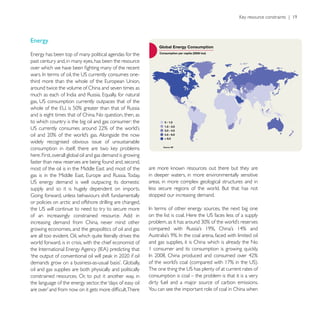
Energy


past century and, in many eyes, has been the resource


around twice the volume of China and seven times as



and is eight times that of China. No question, then, as
to which country is the big oil and gas consumer: the


widely recognised obvious issue of unsustainable

here. First, overall global oil and gas demand is growing
faster than new reserves are being found and, second,

                                                             in deeper waters, in more environmentally sensitive
                                                             areas, in more complex geological structures and in
supply and so it is hugely dependent on imports.
                                                             stopped our increasing demand.
or policies on arctic and offshore drilling are changed,

of an increasingly constrained resource. Add in
increasing demand from China, never mind other
growing economies, and the geopolitics of oil and gas
are all too evident. Oil, which quite literally drives the
world forward, is in crisis, with the chief economist of     and gas supplies, it is China which is already the No


oil and gas supplies are both physically and politically
constrained resources. Or, to put it another way, in         consumption is coal – the problem is that it is a very
the language of the energy sector, the ‘days of easy oil     dirty fuel and a major source of carbon emissions.
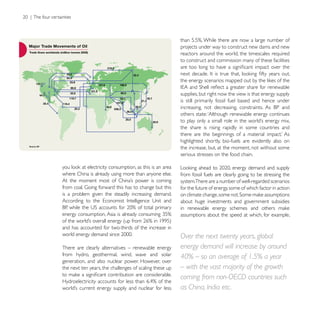
                                                             You can see the important role of coal in China when
projects under way to construct new dams and new
                                                         reactors around the world, the timescales required
                                                         to construct and commission many of these facilities


                                                         supplies, but right now the view is that energy supply
                                                         is still primarily fossil fuel based and hence under

                                                         others state: ‘Although renewable energy continues

                                                         the share is rising rapidly in some countries and

                                                         highlighted shortly, bio-fuels are evidently also on
                                                         the increase, but, at the moment, not without some
                                                         serious stresses on the food chain.


where China is already using more than anyone else.      from fossil fuels are clearly going to be stressing the
                                                         system.There are a number of well-regarded scenarios
                                                         for the future of energy, some of which factor in action
is a problem given the steadily increasing demand.
                                                         about huge investments and government subsidies

                                                         assumptions about the speed at which, for example,

and has accounted for two-thirds of the increase in
                                                         Over the next twenty years, global
There are clearly alternatives – renewable energy        energy demand will increase by around
from hydro, geothermal, wind, wave and solar             40% – so an average of 1.5% a year
generation, and also nuclear power. However, over
the next ten years, the challenges of scaling these up   – with the vast majority of the growth
                                                         coming from non-OECD countries such
                                                         as China, India etc.
the world will shift to electric mobility. To ground our
views in a more probable world, the best place to


the next twenty years, global energy demand will
                                                            Associated with this type of view, there is a continued
year – with the vast majority of the growth coming
                                                            million tonnes will be being emitted annually,and double
etc. Oil will remain the largest single fuel, providing
                                                            global shift in energy consumption behaviour, any
                                                            chance of slowing CO emissions is years away. While

                                                            levelling off, if not reducing, carbon emissions, the
energy needs. World electricity demand will grow at         challenges elsewhere are considerable. For instance,


from nuclear power and its use is expected to

overall share of electricity generation is expected to
fall. That said, technical innovations around nuclear
fusion might mean that different sources of nuclear
energy become commercially available in the future.

demand will be met by coal-based power generation.          agreement on climate change, it is clear that, over
The growing use of renewable energies – wind, wave,         the next decade, new agreements on climate
                                                            protection will variously come into place, whether
an impact but, in comparison to the other energy
sources, their individual shares of the mix will still be


To provide all of this extra capacity will require
                                                            in by the end of the decade. This impetus to reduce
over half of this will occur in developing countries.       carbon emissions will place another restraint on the
                                                            use of oil, gas and coal and so add to the constrained
governments is, therefore, not straightforward and          supply of these fundamental energy resources.
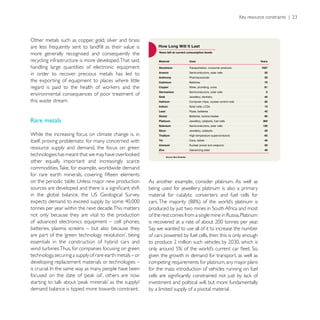
Between now and 2030 we will
                                                        of these core metals but, given the escalating growth in
consume more copper, more aluminium                     demand, current reserves will not last for ever. Although
and more steel than we have in history.


Metals                                                  consider the large amounts of copper required in each
                                                        wind turbine as well as in connections between wind
Alongside energy, the growth in consumption of          farms, this starts to place growth constraints on some
                                                        renewable energy options.

                                                        The difference between metals and hydrocarbons,
more copper, more aluminium and more steel than         however, is that metals can be recycled and reused.

what consumption? Today China consumes around
                                                        three months, Americans discard enough aluminium
                                                        to completely rebuild every single commercial

other economies, China is already consuming eight
                                                        have an inexhaustible supply of it in circulation right


With all the construction under way and planned,
as well as increased production of vehicles and         Compared with primary production, recycling
                                                                                          emissions as well as

from the construction industry, global cement supply
                                                        following environmental savings: 1.5 tonnes of iron


Philippines,Taiwan and Vietnam, all with growth rates
Other metals such as copper, gold, silver and brass

more generally recognised and consequently the
recycling infrastructure is more developed. That said,
handling large quantities of electronic equipment
in order to recover precious metals has led to
the exporting of equipment to places where little

environmental consequences of poor treatment of
this waste stream.


Rare metals

While the increasing focus on climate change is, in
itself, proving problematic for many concerned with
resource supply and demand, the focus on green

other equally important and increasingly scarce


                                                          As another example, consider platinum. As well as
                                                          being used for jewellery, platinum is also a primary
                                                          material for catalytic converters and fuel cells for

tonnes per year within the next decade.This matters
not only because they are vital to the production
of advanced electronics equipment – cell phones,
batteries, plasma screens – but also because they
                                                          of cars powered by fuel cells, then this is only enough
essentials in the construction of hybrid cars and
wind turbines.Thus, for companies focusing on green
technology, securing a supply of rare earth metals – or   given the growth in demand for transport, as well as
developing replacement materials or technologies –        competing requirements for platinum, any major plans
                                                          for the mass introduction of vehicles running on fuel

                                                          investment and political will, but more fundamentally
demand balance is tipped more towards constraint.         by a limited supply of a pivotal material.
Water
                                                        water supplies, China is particularly vulnerable. The


water-stressed regions. This problem is not new, as
over 1 billion people currently experience water

                                                        Water issues are also becoming increasingly political.

consumes twice that.

Over the next ten years, industry will have to          and quality is fundamental for all societies, especially
change its water use; agriculture will have to adapt;   in relation to agriculture and health.There are places

ensuring the general public are more aware of the
problem. To be fair, major steps have already been      within ten years – where major changes in the rivers

national governments have been paying increasing
attention to their water supply and use and, in
doing so, several are now implementing major            Water scarcity is not only a social challenge but a

reducing its dependency on neighbouring Malaysia
                                                        ways in which they can innovate more in relation to the
                                                        water they use as part of their production processes.
reclaiming and treating waste water so that it can


evident, regulation concerning water usage is coming    people have been worried about regarding energy
into force to limit fresh water consumption, shift      can evidently be applied to water – price, security
some primary users from blue to grey water and
                                                        about managing water use is seen as a priority for

corporate facilities towards water-neutral status and
so preserve precious resources.                         individual water footprints so that they have the data
big dams have their opponents, but they can also aid
true economic value in most countries,                        development and store monsoon runoff.
which distorts our understanding.

                                                              in most countries, which distorts our understanding.

will be critical. While consumers are easily able to see

are often less aware of the water used throughout the         continue long term.
supply chain to produce the goods and services that

initiatives such as water footprinting and labelling in the   Land and food
future. When you consider that Ford, on average, uses
                                                              To a certain extent, government interventions are
                                                              also having a negative effect on food supplies. While

                                                              feed ever more people is in itself a major challenge
                                                              that has already led to riots and government changes
                                                              in places such as Madagascar, the bigger immediate
a renewable resource: we are not running out of               challenge concerns bio-fuels and associated
                                                              regulations that have been passed in recent years.

                                                              support programme for home-grown corn ethanol,
                                                              which is coupled with tariffs on cheaper sugar-cane
returned in various forms to the system – although
not necessarily in the right location or in a quality         food prices and consequently increased malnutrition

                                                              reputation of policies to cut carbon emissions – and
strongly seasonal, with too much water arriving
during monsoon periods followed by maybe seven
or eight months of water scarcity. Climate change
will exacerbate this and we ‘will increasingly get the
wrong water in the wrong places and the wrong                 can barely support a household and have little if
                                                              any extra production to sell, which means they do
can often be increased through storage during wet
periods or the use of technology – drilling boreholes
for instance, produce no food at all and need to               As economies grow, the demand for
incomes just to eat.                                           energy, food, protein, water and metals
                                                               all pretty well scale linearly: increasing
In March 2009 there was a coup in Madagascar where
it was announced that South Korea’s Daewoo Logistics           GDP per capita is largely directly linked
would lease half the island’s arable land from the             to per capita resource consumption.
government to grow food.The deal was that the company
would get the land rent-free; existing farmers would not
be compensated; all the food would be exported. When
news of this seeped out, the reaction gave impetus to          The constraints
a surge of opposition that swept the government from

deal. It was a salutary lesson, as other parts of Africa and   decade is clearly a challenging time for management
Asia have signed similar deals. (The Economist)
                                                               going. While there are real physical shortages of
                                                               some resources discussed above, the reasons for
on solutions, including improvements in farming                apparent shortages of the majority of resources –
                                                               shortages that will have an impact on commodity
                                                               prices around the world – are more geographical,
out that an additional rupee spent on agricultural             economic and political.The main resource constraints
                                                               in the next ten years are largely the result of a
and transport facilities would also allow farmers to
                                                               their own supplies, or continue to use above their
These offer better prospects than staple cereals,

                                                               ensure that they control the supply of resources in

much as transporting them from Chile, even though              wanting more.
Chile is twice as far away.
                                                               As economies grow, the demand for energy, food,
                                                               protein, water and metals all pretty well scale linearly:


                                                               money, you can access few resources. However, once
                                                               you, whether an individual or a country, start to create
                                                               more wealth, then you can spend it and this is usually
                                                               on food, homes, transport and possessions. As you
continue to grow, you continue to want more and
                                                        will be in emerging economies unencumbered by
challenge going forward is to decouple resource use
from economic growth by essentially using less and      expanding world with more people and increasing
yet continuing to allow economies to grow. This is      economic growth, our demands are already pushing
where innovation will have an essential role. Already   hard against supply limits. As we move forward over
some countries have levelled off demand – as with       the next decade, some of these resource constraints


has yet to occur. As in other areas, such as mobile     a question of when, not if.
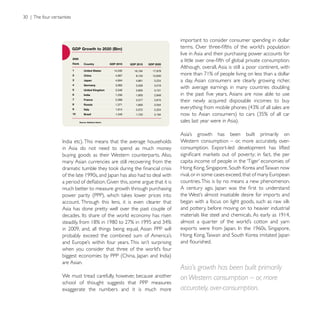
Asian wealth shift
The centre of gravity of global wealth shifts east with decreasing


and cultural diversity. However, given the much
anticipated economic dominance of Asia over the
next ten years, it is certainly worth trying to do so.    that the combination of rapid growth and extensive
                                                          internal restructuring has left many Asian companies

gradually been sliding eastwards for a while now.
Over the past ten years, Asia has accounted for           West. And, because ownership is concentrated,

                                                          Western companies were reeling from the recent


– and all indications are that its growth will continue

next decade.                                              HCL, the Taiwanese technology group, snapped up


recession while developed countries continue to


be four percentage points higher than growth in the


have established their place in the global economy.

largest steel company, or Lenovo, the China-based         price of many domestic products, food, clothes,
computer technology company which did not exist           electronic goods and so on are always cheaper in
important to consider consumer spending in dollar

                                                      live in Asia and their purchasing power accounts for

                                                      Although, overall, Asia is still a poor continent, with

                                                      a day, Asian consumers are clearly growing richer,
                                                      with average earnings in many countries doubling

                                                      their newly acquired disposable incomes to buy


                                                      Western consumption – or, more accurately, over-
in Asia do not need to spend as much money
buying goods as their Western counterparts. Also,
many Asian currencies are still recovering from the


                                                      countries. This is by no means a new phenomenon.
much better to measure growth through purchasing

account. Through this lens, it is even clearer that
Asia has done pretty well over the past couple of     and pottery, before moving on to heavier industrial


are Asian.
                                                      Asia’s growth has been built primarily
We must tread carefully, however, because another     on Western consumption – or, more
school of thought suggests that PPP measures
exaggerate the numbers and it is much more            accurately, over-consumption.
China also boomed after opening up its economy
                                                       for Western consumers proved very satisfactory
                                                       for all involved and Asian economies have grown


                                                       their discussion of this, economic historians Niall

export-led paths to growth, so much so that the past
                                                       have played pivotal roles in the unfolding drama.

                                                       China, in particular, has used its exports to build up


have not jumped on the bandwagon – Myanmar and

                                                       output – or, to put it another way, enough to buy
The export model has helped Asian countries


                                                       simply consumed more and saved less, but, because
past decade, not to mention the ability to attract     the Chinese currency was pegged to the dollar, it still
Western technology and expertise and the creation      maintained low interest rates and a stable rate of

has been a dramatic shift in industry and the sheer
speed of change has made it particularly challenging
to maintain cheap and competitive manufacturing


increasing, both government and the people have        third of this consumption was imports from China.

good governance – privileges that Western societies


tempted some governments to put off other areas        thirst for buying now and paying later has ground
of economic development, the encouragement of          to a halt under the pressure of toxic loans and bad
domestic demand being a prominent example.
                                                       Asia, dependent as it is on foreign buyers.
not in themselves built on debt, have been buoyed        retains Western buyers for its myriad product ranges.
up along with all the other assets including American
houses and shares during the credit bubble of the past   ‘would introduce new and dangerous distortion to


the amount that is exported to the West, a decline       On top of this, although increasing numbers of Asian
                                                         consumers have developed a taste for shopping,
                                                         private consumption currently accounts for only


is now saving – or, at least, not spending as much –     Three billion Asians currently spend a little less than


already growing at roughly twice the pace of trade       Today China has 55 million middle-class households:
with the outside world. From almost nothing twenty

                                                         the middle classes become big spenders, there is the

                                                         could soon grow enough to offset falling consumption
now the biggest merchandise exporter to the Middle
                                                         belts tighten, expect the Asian consumers to drive
exemplary in using bilateral trade agreements to

drive sustained export growth.                           China is, of course, the movie star of Asia, with
                                                         exponential growth potential. China now has a
However, for now, Asia as a whole also needs to
                                                         private sector and it has an increasing presence on the
its foreign assets have provided a cushion against       international stage – goodbye collective agriculture;
the vicissitudes of the recession. As Asian growth


                                                         importantly, foreign trade and investment. As a

want their currency to strengthen because a strong
currency effectively raises their prices abroad and
                                                         Chinese exports, which jumped ahead after WTO
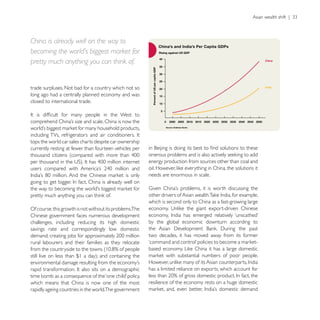
China is already well on the way to
becoming the world’s biggest market for
pretty much anything you can think of.


trade surpluses. Not bad for a country which not so
long ago had a centrally planned economy and was
closed to international trade.


tops the world car sales charts despite car ownership
currently resting at fewer than fourteen vehicles per

                                                         energy production from sources other than coal and

                                                         needs are enormous in scale.


                                                         which is second only to China as a fast-growing large
Of course, this growth is not without its problems.The
Chinese government faces numerous development
challenges, including reducing its high domestic         by the global economic downturn according to
savings rate and correspondingly low domestic
                                                         two decades, it has moved away from its former
rural labourers and their families as they relocate


                                                         has a limited reliance on exports, which account for

which means that China is now one of the most            resilience of the economy rests on a huge domestic
rapidly ageing countries in the world.The government
platforms, has welcomed over 1 million students to
                                                             the various courses that it hosts for both academic
                                                             institutions and corporate universities. The thirst for

                                                             legislation ensures that a government or public sector

                                                             from an increase in both pay scale and pension.


textiles, but are now recovering.                            carrying out original research themselves – at much


a leading source of process and business model
innovations. For example, the launch of the Tata Nano,

                                                             billion so the opportunities for well-educated, hard-
as the centre for low-cost innovation, particularly in
small vehicles. The industrial sector is also on the rise,
currently expanding at a double-digit rate, and the
                                                             among the highest in the world, it remains a low-
                                                             income country, with inadequate infrastructure being
curtailed as it is by poor harvests and low rainfall.


                                                             in agriculture and related activities. Any development
a year and about twice as many engineering and               strategy will need to contend with the harsh realities
computing graduates as America, counting those with          of low productivity in the countryside, a massive

                                                             population is expected to double over the next two
also witnessing some of the fastest rates of adoption
trillion, is stitching together an economic community,
                                                          even if their political and security harmony is more
the total, not only to expand capacity but also to
                                                          have already agreed to coordinate policies, including
                                                          rate cuts, credit support and government spending
                                                          after their export-orientated economies fell into a

probably true that we are a slow-moving elephant          crisis. Maintaining a positive economic relationship
but it is equally true that with each step forward we     with Myanmar, however, is an obvious challenge that
leave behind a deep imprint. There is a price that we
pay in trying to carry all sections of our people along   military rulers face criticism from some members
                                                          over its new election laws because of its treatment
                                                          of political detainees, notably democracy icon Aung
No discussion about Asia can be complete without


                                                          The shift
was one of the hardest hit countries during the
                                                          Given all of the above, it is evident that, as a whole,
                                                          Asian economic growth will continue to outpace that
                                                          of the West. Led by the sheer scale of growth in India

debt, ugly demographics and, worst of all, indecisive     Japan, South Korea, Indonesia and Vietnam, the centre
                                                          of wealth generation is clearly shifting eastwards. The
                                                          point at which China’s economy eclipses that of the US
for years to come.                                        in absolute terms is, according to varied forecasts, just
                                                          a few years out beyond 2020, but there is little doubt
                                                          that, given the importance of the GDP PPP view, China
                                                          itself will already be the centre of gravity for the future
monarchy, a military dictatorship, communist states       world economy at the end of the decade. Add in the
                                                          rest of the ASEAN countries and it is clear why our third
                                                          certainty looking forward is that there will be a steady
                                                          and increasing shift of wealth to Asia from Europe and
                                                          the US. The shift of economic power to Asia is pretty
                                                          much a safe bet for 2020.
network connection will have one.

The internet is one of the transformational
technologies to emerge from the twentieth
century. Another is the mobile phone. These two
platforms are now coming together and, as they do
so, are bringing with them more opportunities for
transformation. Certainly their convergence means
that global connectivity – for many, the great goal
                                                           which do connect to the internet (mobile internet
see the attraction of this given that the ability to
communicate and interact with billions of people
has the potential to, quite literally, redesign society.

Today, it is perfectly possible to envisage a world        for example, where internet penetration has grown

to communicate with anybody and everybody,
anywhere they and we might be. Through these
universal interconnections, we will train and learn,
educate and entertain, buy and sell, trade and barter.
As well as being connected to each other, we will
have remote access to our machines (computers,

                                                           country. Without a doubt, connectivity is a global
about to hit the big time – smart systems have the         phenomenon.
potential to reduce the overall impact we have on the
environment by helping to regulate the temperature

and myriad other applications that will both reduce        and,   increasingly   importantly,   entertainment.
costs and increase sustainability. We will probably go
on to do all sorts of other things via the internet that
have not yet even been considered.
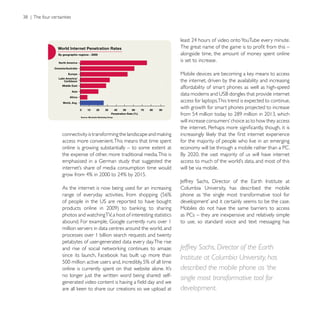
alongside time, the amount of money spent online
                                                           is set to increase.


                                                           the internet, driven by the availability and increasing
                                                           affordability of smart phones as well as high-speed

                                                           access for laptops.This trend is expected to continue,
                                                           with growth for smart phones projected to increase


access more convenient. This means that time spent         for the majority of people who live in an emerging
online is growing substantially – to some extent at        economy will be through a mobile rather than a PC.
the expense of other, more traditional media. This is

                                                           will be via mobile.


As the internet is now being used for an increasing
                                                           phone as ‘the single most transformative tool for

                                                           Mobiles do not have the same barriers to access
photos and watching TV, a host of interesting statistics   as PCs – they are inexpensive and relatively simple
                                                           to use, so standard voice and text messaging has
million servers in data centres around the world, and
processes over 1 billion search requests and twenty
petabytes of user-generated data every day. The rise
                                                           Jeffrey Sachs, Director of the Earth
                                                           Institute at Columbia University, has
                                                           described the mobile phone as ‘the
no longer just the written word being shared: self-
                                                           single most transformative tool for
                                                           development.
been able to transform the way people in the               Globally, some predictions suggest that
in touch with friends and family, send and receive         we will reach 6.5 billion mobile phone
information and even save money. The impact of             subscribers by the end of 2014 –
that seen in more developed economies, which
already had a well-established communications

                                                           mobile connections are made every month. The

Africa, despite its poverty, has become a centre for
both growth and innovation in mobile use – for


                                                           6.5 billion mobile phone subscribers by the end of

                                                           reason for this is that mobiles are helping to drive
One of the main reasons for this is that the pre-pay
charging model has ensured that even the poorest
can now choose to have access to a mobile. The
pre-pay model began by facilitating the spread of
mobile phones among Western teenagers in the late
                                                           than states with a lower teledensity.

                                                           The numbers are impressive but perhaps the best
entrepreneurship built on this to enable ‘telephone

essentially establishing themselves as living public
telephone facilities for fellow villagers. Alongside all   him because he has nowhere permanent to live, then
of this, the fact that the price of handsets has been
                                                           the alternative to a phone call is a time-consuming
                                                           journey along poor and possibly dangerous roads,
as the main vehicle for connectivity.
                                                           a remote rural community and you need to go to
                                                           the nearest town to buy or sell some goods, a simple
                                                           phone call, or text message, can tell you immediately if
has one of the fastest-growing telecommunication           the journey will be worth while, thus saving you time
                                                           and money on unnecessary trips.
Connectivity can also help build businesses – small or

case in point. His speciality is decorating the hands    however, these predictions come with many provisos
and feet of brides in preparation for their wedding      – most importantly, to be successful they can only be
                                                         realised if industry and governments are prepared to
and began plying his trade on a pavement, preparing      collaborate.

a mobile phone and was then able to prepare brides
from slightly richer families, who he could visit in
their own homes. He was also then able to order
dry henna over the phone rather than having to go        world of global collaboration, where people could
to a shop to buy it. As time and privacy became less

designs and his decorative repertoire grew. He next      reality. The internet was born on a PC but its natural
went on to buy a camera phone and used that as a         home is on the more personalised ‘always available,

                                                         internet comes alive, offering not only access to
camera phone which he gave to his son who lives          information but also interaction with information.
                                                         Mobiles have given people, from all corners of the
son has now started training to become a henna           world, who would not otherwise have access, the
artist using the different designs sent to him by his
                                                         and receiving information via mobile has acted as

educated and relatively poor often struggle.             transition from two-way conversations to receiving
                                                         text-based information via their handsets. The next
As already noted, connectivity does not have to

of machines that will be connected remotely is           again fundamentally change the way that people
expected to increase considerably. Machine-to-

battle against one of the most pressing challenges
                                                         Over the next ten years, expect that

                                                         the growing trend towards virtual
                                                         companies as knowledge workers
tonnes CO                                                increasingly become free agents.
relate to one another, as well as with businesses and
governments.                                             are continuing to crumble and busy executives will
                                                         now have to manage the blurring of what used to be

host global interactive debates on anything with
                                                         life integration.

                                                         All of this sounds relentlessly upbeat but there is a

video call wherever we are, whenever we want with
whomever we want. Not so long ago, this would            three clear themes have emerged and have
have been possible for only a few highly technical,
well-funded institutions. We can create a global         they can be characterised as content, contact and
discussion – such as that of the Future Agenda – for     commercialism.
anyone to join in. Although this is exciting and has
                                                         The increasing wealth of information available means
                                                         that more and more individuals will be left to judge
                                                         what to believe and what to trust. Consider those
blogs and personal pages does not necessarily mean       who want to reach out to others in community
that amongst the clamour it is any easier to sort fact   chat rooms and in so doing get help and support at

should trust in a world where millions of people use     which provides a way for people with life-changing
multiple identities?                                     diseases to share experiences and learn from others
                                                         with similar conditions, are great examples of how

understanding information and analysing what it

this understanding and connect with others across        the user to decide what is accurate and to respond
                                                         accordingly and decisions around this will become

                                                         increases.
as businesses come to terms with a world in which
collaboration, open innovation and crowd sourcing
                                                         challenges of ensuring their children do not have
very outdated. Over the next ten years, expect that      access to inappropriate information, be that of a
                                                         sexual, violent or otherwise offensive nature. This

                                                         will continue to struggle with technology that
seems almost second nature to their children. There         through sales and advertising spend as, at the time of
have been many discussions around the grooming              writing, it is still more convenient to read a traditional

participant pointed out,‘one of the biggest challenges

bullying generally stopped at the front door of a           improve their functionality and become more widely
                                                            available, this may well change and business models
devices mean that not only can a child receive              will have to change too.
abusive messages, but also their location, who they
are with and what they are doing will be shared with        The commercial challenge is not faced just by
others at the mere press of a button. All of this could     journalists. Although internet shopping may well be
                                                            more convenient for some over the next ten years,
Not only that, but there is also the need to address        it will also have a huge impact on our high streets
the dramatic increase in child pornography driven           as the demand for a physical space in which to buy
by the ability of the internet to connect those with
common but morally unacceptable tastes.                     number of people necessary to manage a warehouse

The abuse of content extends across all sectors and
is currently most visible as a threat to the creative       in the retail industry.This will reduce job prospects for
industries as data is shared indiscriminately and without
cost. As Chris Meyer said in his initial perspective,       may also have an impact on local communities, leaving


the music industry have been wrestling with ways            with fewer options for interaction with others.
in which to retain their value, derived as it is from
                                                            Finally, problems are looming with regard to how to
vulnerable as YouTube, Twitter and any wealth of
                                                            support the increased demand from its users. Millions
traditional business model. Already, many publications      of people are now accessing data, buying goods,
feel obliged to provide online content free of charge.      browsing websites, sending emails, downloading and
                                                            swapping music, catching up on television shows,
                                                            watching movies, or playing video games online. This


Enterprise 2.0 has reduced the
marginal cost of IP to essentially zero.                    the internet. The current view is that messages must
queue up to be delivered and, the more demand              results and the convenience of tailored information
                                                           come at a price and that price is sharing personal
the queue gets for everyone. This means that a large       information with organisations. Already today many


do not interfere with the data they send or receive –      to increase as the private data/public data balance
with the important exceptions of prioritising calls to
                                                           younger generation, which has matured alongside
such as child pornography. However, this means that
those people who do not wish to use high bandwidth         public and private online lives much easier.
services are forced to queue alongside those who

                                                           Universal access
who need to use more capacity can do so.The most
contentious decision will be over who should have          So, expect the majority of the world’s population to be
priority when demand is high and the system is put         connecting to the internet via a mobile device by 2020,
under pressure.                                            with the major share of new users coming from China
                                                           and India. Universal data access will be here: imagine
Finally, during the next ten years, increasing             a world where there may be as many as 50 billion
                                                           devices all connected to each other, offering new types
not, we will all have a virtual presence. As a result,     of services and opportunity for people, business and
individuals will have to decide the amount and value       government. Of course, as well as opportunity there will
of the data we produce and who it is we should             be challenges – interception, the right to privacy, the

of sharing our personal information – around our           a world that will be constrained in almost every other
health, for example – with concern for our privacy.        area – food, health, resources and so on – perhaps it is
There is a gradual public realisation that faster search   here that we have most reason to be optimistic.
PART 2
Drivers of change:
key insights
Whereas Part 1 examined four certainties for the
next decade that everybody agrees about, here              have also indicated some of the variations that

                                                           as many of these are interconnected or share
                                                           common issues, we have highlighted in the
to happen by the thousands of people engaged as            margins which other topics each one connects
                                                           to so that you can navigate your way through.
and online discussions. However, they are not
                                                           We have grouped the forty-eight probable
appear highly probable but, because of their               futures into six of what we have called clusters,
                                                           each of which contains eight insights that
social trends, political will and regulation, there is a   address similar themes. These clusters are health,
chance that they will not play out as expected. For        wealth, happiness, mobility, security and locality
each of the forty-eight probable futures outlined          and, as we address each in turn, we hope that
here we have therefore sought to explain the               the connections and dependencies are clear.
The future of health


The world of health and nutrition is one in which       The topics covered in the following pages are:

changes on the horizon. For instance, stem cell
research and more detailed use of the information we         Automated people-care
have on the human genome are providing a plethora
                                                             Clinical enhancement


horizon, there are a number of major policy decisions
around food supply, health funding and even end-of-

of these will be more relevant to certain countries
than others. At the same time, we must not forget
                                                             Mass medical tourism
that there are some fundamental global issues that
                                                             Pharma foods
pandemics. New business models will also move


The many discussions that we held focusing on
the future of health highlighted a host of issues
and possible changes for the next decade, as
well as some things that will stay the same. We

debate but also were felt to be some of the most

from the inevitable to the controversial and provide
an interesting view of how this important area may
evolve over the next decade.
Automated people-care
Robotic assisted care and remote monitoring provide economically viable
support for the sick and elderly so people can stay home for longer.

                                                         term chronic diseases such as diabetes, asthma,
is to provide ongoing medical support of the elderly

are living longer and the costs of hospital-based care
are so great, or, as in the case of many emerging        the condition. These diseases typically require daily
economies, simply not available, many countries          monitoring and diagnosis coupled with informed
are increasingly focused on providing solutions that
help people within their own space. The traditional      currently being designed which will not only allow
approach to this has been through using carers who
either live with patients or visit them on a regular
timetable to monitor their health, advise on diet and    but will also help patients to manage their condition
                                                         independently.
been argued consistently that supporting people
in this way avoids, or at least delays, the need to      Over the next decade, many predict that automated
admit them into primary or secondary healthcare          people-care, where assistance is provided either
                                                         remotely or by technology-enabled products within
of entering hospitals or care homes. Many cultures       the home, will be a major focus of attention for many
and societies traditionally encourage long-term
family cohesion and recognise home-care to be            automated people-care has become an increasingly
far better for the individual than the institutional     attractive arena for telecoms companies, software
alternatives. However, with escalating costs,
increasing dependency ratios and the mushrooming
of the populations over 65 in many countries, this
is fast becoming economically unsustainable. As

longer afford to provide our elders with the level of
personal support they have traditionally had but we


                                                         particular, give people access to health information
so that they are better prepared to manage their           One interesting development in this area is the
conditions.                                                combination and integration of telecare, remote

Today, growing numbers of public and private
organisations have moved on from basic systems of          robotic vacuum cleaner and the bomb-disposal
nurse visits and are already providing telehealth-based

advice over the phone and even allow remote imaging.
Text-based support of multiple patients has proved         launched its prototype robotic telepresence nurse:
highly effective from both therapeutic and economic
perspectives in many countries – from the Philippines      “iRobot believes that next-generation practical robots
                                                           have the potential to help caregivers perform critical work
                                                           and extend the time that people can live independently.
                                                           Robots may be capable of assisting in senior care in a
                                                           variety of real-life situations, including household chores
                                                           and the on-time administration of medication. This could
                                                           ultimately lower the cost of care.”

                                                           With advances such as these, many see that the
this area. Telemedicine connectivity will therefore soon

between patients and healthcare professionals. Over
the next couple of years, additional services planned      a year. As such, and with the increasingly ageing
                                                           population, any solutions that act to both reduce and
monitoring equipment as well as in-home sensors to
                                                           requirements are being embraced by government,

drugs is on the cards for many conditions.


Text-based support of multiple
patients has proved highly effective
                                                           while the supply of informal carers will hardly have
from both therapeutic and economic
perspectives in many countries – from
the Philippines and Brazil to Germany                      in price/performance of electronic devices and the
and South Africa.
Automated people-care | 51


broadband communications, over the next decade
we can expect to see strong demand for assisted-           expertise; and, most critically, the rollout of integrated
living services. These will include telehealth services,
which use a combination of sensors, hubs and remote        everything function.

management of chronic conditions; telecare services,
which provide continuous lifestyle monitoring of           economies, ‘we will have an advanced integrated
older and disabled people in the home; augmented
reality services for those with cognitive disabilities,    consequence, patients will be enabled to retain
and services to locate dementia sufferers who              their independent lives for longer and so better
wander and become lost; and digital participation          enjoy life outside the mainstream care system. Many
services, which will connect, engage, stimulate and        commentators therefore envisage a slow-down in
entertain people with disabilities and the elderly in      the recent growth of nursing homes as a greater
their homes.                                               share of the elderly remain living at home. While
                                                           for some this could mean greater physical isolation,
Many of the enabling technologies are already              the ambition for many in the healthcare sector is to

means guaranteed: the way in which organisations           a world where, on average, family support for the
delivering health and social care respond to options       older generation will continue to decline and the
for change will be crucial. Whether funded through         cost of providing personal carers will continue to
insurance-based schemes or directly by government,         rise, patients with long-term chronic diseases and
there are several hurdles ahead. These include the
need for large-scale, controlled trials (some of which     changes in support over the next few years.


                                                                                                                        insights


                                                                                                                        Page 65
Clinical enhancement
Enhanced functionality will shift from an external add-on to an integrated
capability to provide the option for superhuman performance.

                                                         alone, the number of cosmetic treatments has more
at the future relates to the advances being made         than doubled in the past decade to reach over 11

have varied perspectives on where this is going          half a million breast augmentations and liposuction


in prosthetics over the past few years, which have
allowed people to regain near full limb movement.        over 1 million laser hair removal and hyaluronic


                                                         procedures and, interestingly, men accounted for


                                                         it is estimated that the cosmetic surgery industry

                                                         hardly surprising, therefore, that many countries have
                                                         been setting themselves up as centres of excellence

                                                         the expectation is that frequent cosmetic changes
                                                         to the body will become commonplace as more
embedded technologies? Higher frequency ranges           people search for physical perfection.
of hearing and infra-red vision are often mentioned


are bringing enhanced performance closer to the          to improve their physical and mental performance.

                                                         is a long-standing problem that, despite all the bad
                                                         publicity and shame that comes from being caught
world of clinical enhancement is changing, it is worth   out, is still a big issue in almost all disciplines from
                                                         cycling and weightlifting to running and football.
                                                         Outside the professional sports arena and into
The cosmetic surgery industry could be
                                                         place in the military arena that may soon scale
worth over $200 billion a year by 2020.
                                                         improvements achieved in areas such as prosthetics

the world of body-building, the use of steroids to
enhance muscle structure has long been widespread.       trying not only to repair the damage but also to go

around drugs that can provide improved mental
performance. New lifestyle drugs and the wider use
of cogniceuticals are giving us the ability to manage
                                                         and has already invested in the development of an
their emotions and senses with pharmaceutical
products but they can also get by with less sleep.       robotic system could give soldiers the ability to run
                                                         faster, carry heavier weapons and leap over large
At the start of the Future Agenda programme in
                                     on ‘turbo-          systems are expected to give soldiers augmented
                                                         strength and speed as well as increased endurance;
some of the drugs that have been designed for one        and they will also have built-in computers to help
purpose and have proven to demonstrate cognitive         troops navigate through foreign terrains.
enhancement as a side effect. Methylphenidate,
                                                         On top of this, enhanced sight and hearing is also
cited as medicines that have been approved for
neurological disorders but also ‘have the potential to

The article also suggested that some drugs that are
                                                         the same technologies are now being applied


might be used by healthy people to enhance their
cognitive performance. Although students, the            as a system a reality. Alongside such advances as


mass enhancement of capability when it is needed
is just around the corner. How far this will go is a
                                                         the military arena that may soon scale
Therapeutics and Cephalon are already nudging the
enhanced performance agenda forward.                     up to the commercial world.
Clinical enhancement | 55


                                                       By 2020, permanent rather than just
tips to enhance sensing, one fast-developing area is
that of providing augmented reality vision and data.   temporary change of capability from
                                                       drugs, doping, implants or surgery will
                                                       be available.
being provided to pilots and soldiers. Whether this

                                                       capability from drugs, doping, implants or surgery will


what you see could be enhanced both in terms of        become increasingly embedded in humans and
data and also in terms of the visible spectrum as      providing this to the mainstream will become part
infra-red sight becomes an added function.             of everyday cosmetic surgery.

                                                       The ethical debate surrounding mass enhancement
that the next decade will be one where more and        capability is still wide open and, as yet, it is unclear
                                                       how the regulatory bodies might respond. However,
                                                       those with the will and the resources will certainly
by some futurists to denote an enhanced version of     have access to clinical enhancement, created
humanity and for an increasing proportion of the       for restorative surgery and then applied to the

permanent rather than just a temporary change of


                                                                                                                  insights
With diabetes consuming 5% of GDP, a combination of fat taxation, patient data
mining and personal budgets play a role in stabilising the obesity epidemic.


the next ten years there will be an increasing number
of technical solutions to help manage the condition
but few expect this to counter its growth, particularly   budgets across the world will be spent on dealing
                                                          with its consequences. Furthermore the problem is
caused by a high-calorie diet and sedentary lifestyle.


action to change behaviour is critical.
                                                          reduce the impact of diabetes in society will be


                                                          As well as the direct costs of treating diabetes, there

                                                          higher insurance premiums are common in


                                                          be required to cover treatment. Add on the impacts
with diabetes now live in low- and middle-income          of increased susceptibility to other conditions as

                                                          below average productivity and the hidden costs

                                                          expected that the direct costs of diabetes to society


                                                          improved low-cost business models and more hard-
around !15 billion per year, with associated medical      hitting public health campaigns will have all been
associated with diabetes.


                                                       action is seen as highly probable and potentially

                                                       the introduction of fat taxes, the improved use of

                                                       responsibility for their own healthcare costs.


                                                       parallel approach is now on the agenda for obesity.


                                                       the middle of the decade, many are now predicting
deployed around the world in various ways to try
to mitigate the impact, manage the consequences


weight loss and inoculations for type 1 diabetics,     New Zealand, are also experimenting with incentives
have already yielded positive results in animals but   to encourage people to eat more fresh fruit and


developments are now focused around non-invasive       more expensive will have a greater impact and is
devices which provide alternatives to needles          easier to implement and manage.
and syringes. This means that the introduction of
implants, to change the dynamics of testing, and
patch-based systems for blood glucose monitoring       better use of patient data.Tech-savvy diabetic sufferers
are all on the horizon. However, the problem is
that the scale, cost and timing of the introduction
of many of these solutions will have little overall    individual measures, diet and performance and there
impact in the short to medium term. Any effective      are increasing numbers of systems that allow the
changes will be concentrated around government         sharing of data between patients and their doctors.
and regional policies to control food consumption,
Globally, by 2025, it is expected that
                                                        see the need for increased public awareness as the
the direct costs of diabetes to society                 third component for behaviour change alongside
will be !300bn, nearly double today’s                   taxation and data use, particularly as individuals may

                                                        responsibility for their healthcare costs.

                                                        Across many countries the notion of providing
notion that peer-to-peer and expert patient groups
                                                        health is gaining momentum. For example, some
the more traditional patient–healthcare professional    regulators are considering recovering above average
                                                        healthcare costs from patients either through an
more visible and more shareable across platforms and    increase in income tax for the employed, or by
systems in the years to come.
                                                        may seem politically contentious, they do signal
                                                        the level of action that economically pressured
allow improved relative comparisons between one         governments are proposing in order to contain the
individual and another, but will also facilitate more   mounting healthcare budgets.
predictive data analysis. One outcome of this will be
more transparency around future patient scenarios
                                                        epidemic is to be avoided, many say that drastic action

experience and they will also be able to predict the    that ‘many economies have a diabetes time bomb to
                                                        deal with, one that requires concerted approaches
or additional incapacity.

                                                        individual choice, improved sharing of personal data
compared to other diseases and there is a pressing      to support this choice, and the increased personal
need to address this. The media are already broadly     responsibility for healthcare costs to reward this
                                                        choice are pivotal in gaining control.
                                                                                                                  insights
We are likely to see two to three major pandemics start in regions with limited
public healthcare and rapidly spread globally and so demand fast response.


                                                                can cause death.

                                                                The World Health Organisation maps out a
                                                                pandemic based on six distinct phases. Phase 1 is
                                                                when non-human infections are spreading and there
causing more and more concern at international levels.

                                                                caused infections in humans, circulates among non-

                                                                transmission but no person-to-person transmission
                                                                under normal conditions – when this is seen, the
the right drugs into the right place at the right time is not
necessarily up to the challenge.

To understand the implications of future pandemics,
we need to be clear on what the difference is                   human-to-human spread is documented in at least
                                                                two countries in one WHO region and may well
                                                                indicate that a pandemic is imminent. Phase 6, the

start of an infection in a localized geographic area.           least one other country in a different WHO region
An epidemic occurs when a large geographic area
is involved and which has a higher than expected
                                                                global pandemic is under way.

                                                                A core problem with pandemics is that ‘they often
                                                                arise in regions with low levels of public health
                                                                and they rapidly spread across the world to more
pandemic: pathogenesis and virulence. Pathogenesis
refers to how a virus will cause disease and how
one of the fastest-growing sectors of the global
                                                          pharmaceuticals industry, many see that current vaccines
                                                          will not help in the future. A critical issue here is that the
                                                          rate at which a virus variant can develop is faster than
                                                          the speed at which new vaccines can be developed:

                                                          already has an established therapy in place, pandemics
                                                          are often caused by new strains of virus and so need a
                                                          new antiviral vaccine.Typically, creating the new vaccine


                                                          eggs is used as the base for developing new vaccines.

                                                          enable faster global distribution.


of a pandemic, it is therefore vital to focus on


in Mexico and H1N1 patient zero was found in the          around a third, the consequences of a similar event


people and animals in many parts of the world
increasingly sharing the same limited water sources.

false alarm, as mortality rates were not excessive,       of these could die within the year. As was highlighted
it is seen in many circles as a good model for how
global health authorities will need to cooperate in       has to be seen as a greater threat to us than nuclear
the future when more lethal strains of virus spread.


in availability of suitable vaccines – both in terms of   global cooperation between health authorities and
the right drugs and their global distribution. Although   on improved monitoring of populations. The WHO
In many ways, a global pandemic
has to be seen as a greater threat to
us than nuclear terrorism and global                     high for an African country, pales in comparison
                                                         with a developed country such as Norway where
warming combined.
                                                         pressure on developing-world health systems as
now in place and are being built upon. Potential         not only must they cope with the need to contain
                                                         the spread of communicable diseases associated
                                                         with extreme poverty, they must also contend with
future pandemics from reaching their full potential.     the growing incidence of chronic diseases, such as
                                                         diabetes and heart disease, an effect of new-found
a major area for healthcare investment and is a top
priority for public health systems globally.             wherewithal to monitor disease is extremely limited.

                                                         Moving forward, many countries expect to roll
                                                         out more sophisticated systems for full population
in investment. Already several countries have advanced
                                                         place to, for example, enable enhanced monitoring
developed a highly integrated system that ranges
from detailed public information through to advanced     airports, as these are the primary areas where cross-
                                                         infection can occur and spread the virus. At a wider
                                                         level, mass monitoring of vital signs is also under way
had come into contact with infected persons were         in some countries where, for example, daily infra-
                                                         red satellite images are being cross-referenced with
Thermometers were issued to all citizens and daily       location of mobile phones so that the individual
reporting to a centralised system ensured that early     body temperature of each member of a population
rises in body temperatures were noted as an indication

                                                         contacted and quarantined.


hindered by several core obstacles, among them a
                                                                                                                   insights


developing world, there is a critical shortfall in
                                                         epidemics do not become pandemics.
Stopping mental degradation from Alzheimer’s makes quality ageing
more possible by improving cognition and slowing the rate of decline.


in the health arena that many are focused on is
                                                            5.5 million patients and the direct and indirect costs
This disease is a physical condition affecting the brain
and is the most common cause of dementia. Today,
                                                            heavy economic and social burdens on caregivers.
as the ageing demographic shift has greater impact,
                                                            greater percentage of the population susceptible to


However, drug treatments are available that can
alleviate the symptoms and even slow down the

exact causes of the disease are still being investigated,

shortage of the chemical acetylcholine in their brains.     the past few years, there have been some major

                                                            is the use of adult stem cells as a base for developing
by maintaining existing supplies of acetylcholine,
the chemical compound which activates muscles.
Another drug, the only one that is suitable for use
in people in the middle to later stages of dementia,        By 2050, with more people living longer
                                                            and so a greater percentage of the
prevents the excess entry of calcium ions into brain
                                                            population susceptible to the disease,
and prevents them from receiving messages from
other brain cells. These drugs are not a cure for
                                                            the US is forecast to have 14 million
                                                            people with Alzheimer’s and the burden
degenerative process of the disease, but they can
stabilise some of the symptoms for a limited period
                                                            on the healthcare system could be as
of time.                                                    high as $500 billion.
66 | The future of health


                                                                           of larger, normal parent molecules. These segments
                                                                           damage neurons and synapses and, as they build up,
                                                                           either in soluble form or clumped into plaques, cause


                                                                           preventing amyloid beta from being formed in the

                                                                           attaching to one another if they do form. Once the

                                                                           evident, a great deal of neurological damage has
                                                                           already been done. Therefore, by monitoring and
                                                                           measuring amyloid beta levels in healthy people
                                                                           before any degradation, the onset of the disease
                                                                           can be detected in advance and remedies applied.
                                                                           Others suggest that ‘a broader strategy is needed,

                                                                           genes and even the chemical processes responsible
                    new healthy brain cells. As was highlighted during
                    the Future Agenda programme, ‘several treatments
                    in development are designed either to improve
                                                                           genetics and biotechnology are expected to ‘slow
                                                                           the progression of the disease and further alleviate
                    of the most promising avenues of research being
                                                                           consequence, those diagnosed and treated in the


                    An      increasingly   accepted   hypothesis   about


                    patients, two enzymes, beta secretase and gamma
                                                                           disorder of the central nervous system that impairs
                    secretase, effectively cut amyloid beta segments out


                    Several treatments in development are                  cure but medication or surgery providing relief from
                    designed either to improve cognition or
                    to slow the rate of decline.                           these in China. Following recent campaigns, including
there has been increased investment and focus on         new developments on the horizon open the door
this disease.The big hope here is that stem cell-based
techniques will play a big part. One approach being      mental degradation under the same control as
                                                         physical, this could provide an end to the increasingly
of adult neural cells and coaxing them to become         common situation of the mind degrading faster than
dopamine-producing neurons for subsequent re-            the body – and certainly delay the onset of decline.
implantation into patients. Another study under way


brain neurons. These and similar studies could well      It is increasingly probable that by 2020
be the next step in cell replacement therapy for
                                                         we will also be able to halt the decline
                                                         of patients with Parkinson’s disease.


                                                                                                                   insights
Mass medical tourism
Medical tourism goes mainstream as low-cost cardiac surgery and broader
healthcare provision join dentistry and cosmetic surgery to have global impact.


– a place where the rich have gone for relaxation and    surgery. The average spend for such trips was just
treatment. Over the past few decades, it also became
a centre for more surgical vacations, often focused on
                                                         Today there is a shift happening, not just in quality
                                                         and cost but also in the complexity of operations
                                                         being made available and, going forward, the niche
surgery. London, LA and Miami are also renowned as       activity of medical tourism will go increasingly
centres of cosmetic excellence. Today, new locations     mainstream as low-cost cardiac surgery and broader
                                                         healthcare provision are added into the mix. New
Philippines all variously compete in respective niches   business models and new areas of focus are creating
                                                         new destinations.

have all been recruiting leading plastic surgeons and
building hotels-cum-hospitals to provide cosmetic
services at competitive prices.

While cosmetic surgery has largely paved the way,
other areas of medicine have followed suit over the      has pioneered change in the speed, scale and cost of
past few years, as high-quality services have been

have become attractive destinations for people from

area here: Hungary fast became a centre for dental

                                                         becoming a centre for medical tourism as patients


is provided for those with the money and the desire
                                                         In many cases, it is India that is leading
                                                         the way.
Public health systems in Europe and
                                                        healthcare insurance companies in the
                                                        US are all ramping up plans to formally
                                                        take advantage of the economics
                                                        associated with this movement.


                                                        quality at this price difference, it is not surprising that
                                                        there are already around 1 million medical tourists


done as well as anywhere at a fraction of the price.    The Narayana Hrudayalaya Hospital is the centre
                                                        of the rapidly developing Narayana Health City in

                                                        hospitals and research institutes, ranging from a

                                                        to institutes for neuroscience and thrombosis.
                                                        Over the next decade, the organisation plans to
nor that the quality of the surgery and success rates   recreate a similar health city and medical university
are as good as anywhere in the world, but, due to the   in partnership with the government of the Cayman
nature of the business model and process innovation,
                                                        the islands, providing medical procedures at half the


                                                        bed centre.


Narayana charges just $2,000 for
open-heart surgery compared with                        surgery and, as well as attracting the best surgeons, is
                                                        also building more dedicated hospital hotels, which
between $20,000 and $100,000 in
the US.                                                 more revenue from medical tourism than the ‘sun and
tourism in the country, with the expectation of   economics associated with this movement. Overall,


                                                  for the very rich will be a mainstream activity, and one
                                                  that will increasingly become a credible option for the
                                                  majority in many developed economies.


                                                                                                             insights


                                                                                                             Page 151
Pharma foods
More customised foods blur the line between pharmaceuticals and food as


As awareness of advances in biotechnology is              pharmaceutical products and can sometimes
increasing, a growing area of interest is in the use of
foods for medical purposes. There is a long-standing      growth sector attracting pharmaceutical and biotech
tradition in many cultures of using natural herbs

                                                          Transgenic. Clinical foods, or medical foods, are by

rapidly expanding to foods with clinically enhanced
properties. Probiotics, prebiotics, functional foods,     illnesses.They are regulated and therefore prescribed
                                                          by physicians. Nutraceuticals are, therefore, not
and promoted as being good for you either in general      clinical foods.

as improving digestion, bone density and so on. As        While these products have been appearing on the
technology evolves and more is understood about

individual needs, the opportunities for tailored foods
                                                          and nutrigenomics, which is applying the sciences
                                                          of genomics, transcriptomics, proteomics and
industries predict biotechnical advances to combine       metabolomics to human nutrition. Nutrigenomics is
                                                          a relatively new science and is the application of high-
                                                          throughput genomic tools in nutrition research: now
                                                          that human genes have been sequenced and we can

                                                          is essentially the science that allows us to tailor food
The term nutraceuticals, which comes from a
combination of nutrition and pharmaceuticals, is
used to describe ‘food, or a part of a food, that

                                                          The big change is the link between food
                                                          preparation and nutrigenomics.
A salmon can be raised in half the                           Plant-made pharmaceuticals are produced by
                                                             using similar technology in plants: transgenic plants
normal time, have less fat, more meat                        are engineered to have resistance to pests and
and include extra nutrients.                                 harsh conditions as well as improved shelf life and


                                                             altered a carrot so that it would produce calcium
                                                             and become a possible cure for osteoporosis.
are one outcome of this and are compounds produced

provide higher than usual amounts of various nutrients       consumption of golden rice, which was developed by
that can be consumed as foods. What distinguishes
them from functional foods, nutraceuticals and their

                                                             As a group, such pharma foods have been a


                                                             of Agriculture against the introduction of pharma
                                                             foods due to ‘concerns about their negative impacts

and proteins for human consumption. Proponents,

that transgenic animals can not only be provided with        is present when plant-made pharmaceuticals are
traits that will improve disease resistance, but also that   produced in food and/or feed crops leads us to
they can accelerate growth and increase proteins,            the conclusion that the only way to prevent such
provider leaner meats, increased muscle mass and

can be raised in half the normal time, have less fat,        addressing concern about the testing of plant-made
more meat and include extra nutrients. Although
                                                             ensure the safety of world production via plants

did not identify any food safety concerns. Alongside
the ethical issues of blurring the difference between        would use a food crop or food grain to grow or
different species, issues around environmental impact
and animal welfare are, however, raised by those
against this sort of development.                            However, despite this reticence, and given the
                                                             increasingly populous and hungry world, many
                                                             companies are now progressing with the development
begin to provide natural, food-delivered disease state
and challenges:

“Pharma-foods, the intersection between food and
pharmaceuticals, is an area of growing opportunity          support. As well as the wider recognition of the
for many in the food sector. As consumers demand            global need for more proteins and nutrients,


respond. We now understand more about individuals’          ‘business models in the pharmaceuticals sector
disease propensities from the human genome.Therefore
nutrigenomic determination of diet becomes technically      and that ‘nutrigenomics will fundamentally change
possible.Technology is advancing and as natural bioactive   consumer healthcare as nutritional screening
components are better understood, the line between
pharma and food will blur: The challenge will be how

                                                            be gained, the fast pace of technology development
                                                            and a shift in government regulation on the horizon,
                                                            the advent of widespread availability of pharma


good thing.


                                                                                                                     insights
The escalating economic and social cost of supporting the aged beyond
natural lifecycles leads to wider acceptance of assisted suicide.


growth and the increasingly ageing population, some
claim that there are people born today who, if they     over 70% of total healthcare costs occur
                                                        in the twelve months before death.
past 115, there is little doubt that, with technology

                                                        care and life-extending drugs used towards the end
mental capacity can be sustained for that long may
be a greater challenge, but the world will certainly

                                                        the twelve months before death. And a story on

While this may be all well and good at an individual
level, many see that, from a societal perspective,
the ageing population is presenting us with a major
                                                        ‘much of it for treatments that no one can say for
pensions were not really designed for people living

ratios in many nations and escalating healthcare
costs across the board, some people have been           being raised in governments and medical policy
                                                        groups is whether we should continue to put in all
we can continue to cope with this level of mass         these resources and effort, in many cases only to
long-term ageing.

An increasing number of healthcare professionals
see that life-sustaining treatment is frequently not

                                                        is not required to resuscitate a patient if his or her
                                                        heart stops and is designed to prevent unnecessary
other countries, the high costs of surgery, intensive   suffering.This is used when a patient is in hospital and
When will the US adopt the Do Not
                                                        Resuscitate policy used by the National
                                                        Health Service in the UK?


                                                        most countries, despite a number of legal challenges,
                                                        assisted suicide for the terminally ill remains illegal –
                                                        albeit rarely prosecuted. Acceptance of the concept


                                                        religious reasons. Nevertheless, recent attention

                                                        on the growing popularity of clinics such as those


policy, the savings to the healthcare budget would
be enormous and unnecessary suffering of patients       public debate, such as the plea from author Terry
who had little hope of long-term recovery would be      Pratchett, who has called for tribunals to give sufferers
                                                        from incurable diseases the right to medical help to
                                                        end their lives, wider acceptance of euthanasia is still

Over the past few years, euthanasia and physician-
assisted suicide for the terminally ill have become
prominent medical and social issues. There are
legal and ethical constraints on euthanasia in many     ever, especially since the option to live for longer in
countries, but not in all. Physician-assisted suicide   reasonable comfort is really only a luxury for wealthier
and euthanasia are legal in, for example, Colombia,     nations where the healthcare systems, insurance
                                                        policies and private wealth enable increased levels
all deaths in the Netherlands were as a result of       of support.The argument is that systemic euthanasia
should be introduced. Moreover, this should not be        The rational side of the case is increasingly
limited just to those who have a proven terminal
illness but should be an option available to all.
                                                          the ethical, emotional and political
With the economic burdens evident and the trends
clear, the rational side of the case is increasingly      perspectives are also shifting.
emotional and political perspectives are also shifting.

beyond those with terminal illness is a slippery slope    enough is enough is a sign of a more balanced society.
leading to a point where individuals who would not

for assisted suicide by interested parties; others see
                                                          borders for the service may well increase.


                                                                                                                   insights


                                                                                                                   Page 65
The future of wealth


How wealth is created, valued, shared and used            The topics covered in the following pages are:
over the next decade is subject to a number of

of us in ways we never conceived of that allow new
ideas to be shared and innovations to accelerate.

                                                               Lease everything

opportunities for those with talent to leapfrog                Less energy
ahead of others, but at the same time there is a
                                                               Local currency
growing imbalance between the haves and the
have-nots in society. The next decade will see new             Mobile money
technologies that will drive new business models
that will, in turn, change how wealth is created and
shared, but it will also see political and social needs
drive other changes in how we manage and use the               Third global currency
wealth and resources that we have available. There

the certain shift in the centre of gravity to Asia and
the consequences that this will have for wealth
creation, trading and even currencies. As with the
health cluster, we have chosen eight of the most

discussions, some of which have global relevance
whereas others have a very local impact.
As information is shared globally and insight is commoditised, the best returns
go to those who can produce non-standard, differentiated knowledge.

                     The World is Flat and Hot, Flat
and Crowded, Thomas Friedman, New York Times
columnist and three-time Pulitzer Prize winner, did an
                                                         and much of the pharmaceutical industry is shifting


the alignment of increasing globalisation, high-speed    been the common focus for many and the idea of
internet connections and new business models all
                                                         reactions of many countries which have seen their
                                                         value-creating manufacturing capabilities disappear.
to lower cost economies merged with offshoring


the developed to the developing world.

                                                         “To achieve recovery, Britain has no choice but to create a
                                                         balanced and sustainable knowledge economy by 2020
highlighted through his stories about the changes in     and therefore must devise new ways of intervention to

and value creation. He focused on the way in which       can deliver changed behaviour as effectively but more
                                                         cheaply.”
shifted parts manufacture, then assembly and then,


able to build up their expertise to a point where they
                                                         The fast-growth economies are no
themselves have now become the new incumbent
                                                         longer fast-followers but have become
Today, the fast-growth economies are no longer
                                                         global centres of excellence in their
fast-followers but have become global centres            own right.
As the half-life of knowledge continues
                                                          without restriction and, in the eyes of some, result in
to shrink, 2020 will see greater
commoditisation of knowledge.

                                                          to recognise these two powerful economic shifts?
                                                          Will the open innovation movement evolve to a
the world have been increasing their status as

been trying to create exclusive content. Leaders such
                                                          increasing selection of commentators are predicting
online free of charge through the OpenCourseWare
                                                          innovation.

                                                          However, there is an alternative view – that of


                                                          the companies who can produce non-standard

sees that, over the next decade, ‘the industrialization   often cited as a company whose sales and margins


                                                          is less strong at a national level: this view suggests
                                                          that at a large/global scale, the competition is on to
                                                          be the differentiated sources of insight. At a national
                                                          economy scale, where one cannot have everyone
A fundamental issue embedded in this topic is the

been on the cards in some sectors for several years,      development and sharing at a broader scale.
it has now become a more widespread concern.
                                                          Furthermore, another recent development adds
been challenged by new business models, many

collaborative platforms for innovation. With the          are scaling up and positioning themselves as
growth of the creative commons and open source            intermediaries for sharing of expertise – namely,
movements, core components of corporate and
“Maven is the Global Knowledge Marketplace. We
connect knowledge seekers with knowledgeable                consulting companies where it is more about what
individuals for the rapid exchange of expertise,            you do with the insight rather than the accessing of
perspective, and opinion. Our Members (‘Mavens’)            it; probably faster migration up the scale from novice
include individuals from all professional backgrounds,      to expert; and possibly further erosion of developing
geographies, and functional roles. Mavens are paid to
participate in short telephone consultations and custom
surveys conducted by other professionals who seek to
learn from their knowledge.”

                                                            With the evident rebalancing of economic power –
                                                            and, with it, associated expertise – it is clear that, by
within companies, academia, governments – in fact,
anyone with insight – to people and organisations
                                                            individuals, companies or countries, those that rise
Maven but, in principle, this is a good disruption to the

that erodes differentiation. What are the implications      that others value, but they will have also been able to
for the future as more programmes such as Maven             sustain this so that it continues to be differentiated.
ramp up and begin to have a major impact, especially
                                                            designed to protect ideas to operate in a truly open


                                                            the ones that manage the delicate balance of new
It is clear that, by 2020, the knowledge
                                                            which, even if there is less formal protection available

set than they were in 2000.                                 in itself not given away.


                                                                                                                        insights
Pervasive smart meters and ubiquitous tracking services create platforms for
the dynamic pricing of resources, access and travel to manage demand.

Most of us today are used to the price of goods             Also in the transport sector, airline seat costs vary
and services remaining largely stable. The cost of a        not only during the day using a more segmented
loaf of bread, a pair of jeans or a bottle of water
varies little if at all. Where there is variation because
of competing suppliers and retailers changing their
                                                            maximise passenger loading, using variable pricing to
                                                            attract the majority of customers early and maximise

                                                            recent years the varied pricing models adopted by
exchanges, this volatility is not immediately passed
on through the supply chain but instead is absorbed
                                                            recognised area of variable pricing understood by

heightened resource constraints resulting from the          competing operators.
supply/demand imbalance of rice, wheat or gas, for
instance, we as consumers are largely insulated from
them. All in all, the vast majority of areas currently      tiered or variable pricing for different experiences.
                                                            From the timing of a visit to the cinema and the
prices are reactive and lag the supply-side costs by        choice of seats at a concert to paying a premium
at least a month or so.                                     to watch live sport on TV, across the entertainment
                                                            sector many of us are already used to the concept
Where we do experience price variation on a                 of paying different fees to experience an identical
standard product or service, it is largely predictable      product depending on the time of day or distance


adopted mechanism for trying to balance out                 energy use – for domestic as well as industrial users.
consumer use of trains, trams and buses in many             While these examples are long established in their
countries so that those who are able to might decide        respective areas, to date they have shown limited
to save money by travelling outside of rush hour            variation and none has yet varied in real time. With
                                                            the widespread introduction and adoption of a
The same principle is applied on many toll roads.
meters to mobile-based location, things are about           Customers can, for example, see the
of some core resources and in a desire to more              cost of catching a train, but also the
                                                            saving that can be made by waiting half
proactive manner, the advent of dynamic pricing
models is on the horizon.                                   an hour for the next one.

are currently passing regulations to introduce smart
meters that will allow real-time monitoring of
electricity, gas and water use. At a basic level, remote    customers, utilities companies aim at better managing
reading of utility consumption allows the industry to
have a better view of demand and so match supply
and, at the same time, enables individual domestic and      come to terms with and trust the new technology, but
                                                            once it has been accepted the same principles apply to
associated cost. However, as highlighted in several of      electricity and gas with a view to both better managing
                                                            and better communicating individual and collective use.
also allows far more sophisticated interaction.             The concept of reverse charging is also gaining traction
                                                            whereby individuals who generate their own electricity

consumption on an hourly if not minute-by-minute            grid. This inverts the smart meter model as customers
basis, with increasing physical and economic water          can become net contributors as well as net consumers.
stress prevalent in many countries, the capability to use
smart meters to introduce dynamic pricing is being          this might be manifested for electricity supply through

recognised for its water scarcity, individual households    that the introduction of smart meters is now a legal
are already given a set quota of basic water supply
on a daily basis and a higher price is charged for          for dynamic pricing is clearly being put in place.

preparing the way for a similar approach but with more

                                                            on the verge of introducing more dynamic pricing
additional use will be charged at different rates that      – mostly enabled by location-based mobile services.

customers will be able to see the immediate cost of         charged directly when our mobile phone gets on and
having a bath rather than a shower, using their washing     off a train or bus. Contactless payment systems are

the price of cleaning their cars or watering their lawns.
use of this platform for transport charging has long      already possible.
been advocated and is now being introduced. Again,
as with smart meters, this provides a basic platform
upon which more sophisticated pricing systems can         freight vehicles to also experience dynamic changes.
                                                          Pay-as-you-drive insurance systems have already been
                                                          trialled by companies such as Aviva to encourage and
and avoid congestion, they can implement real-time
increases or decreases of the cost of travel on a


they can introduce a far more granular segmented
model. Customers can, for example, see the cost of        introduction of systems such as those offered by the
catching a train, but also the saving that can be made                                                           insights
by waiting half an hour for the next one; they can see
the relative real-time costs of alternative transport     Match that with dynamic pricing and a host of
options to get to the same destination and so decide

                                                          horizon.
speed/cost of travel to best suit their requirements.
                                                          While the prices of staple products such as bread,
of loading and so allow the use of variable pricing to    jeans and bottled water, as well as more expensive

                                                          largely stable, it is clear that in the areas where

Also, in the arena of road pricing, the introduction of
similar technologies is planned to allow passenger and
Lease everything
Rising sustainability imperatives and increasing cost of ownership shift the
balance from ownership to access and we prefer to rent than buy.

The concept of ownership is core to many cultures,           The aspiration for car ownership can
ways to different things. Owning your own home               potentially be better met for some by
rather than renting it has, for example, been higher         the ability to have temporary access.

housing is seen less as an investment. That said, even
                                                             services companies facilitating this arrangement.
of home ownership but the poor have had to lease.
                                                             a vehicle is a long-standing need and a successful
                                                             business model for companies such as Avis, Hertz and
                                       The Big Short, ‘A
                                                             has been the success of short-term, hour-by-hour,
With declining values and increasing mortgage                rental of vehicles from companies such as Zipcar.com
defaults, the ambition of owing our own homes has
become less important to many in the developed               environments, the ability to have access to a vehicle
world, just as it is becoming an increasingly possible
option for the growing middle classes in the                 easily do on public transport, or when you need to
developing world. Overall, many see that, given the          transport furniture etc, has been increasingly popular.
alternatives, with such a high-value, high-cost item as
                                                             this model can be applied to other urban centres such

however, not restricted to property and is becoming          for car ownership can potentially be better met for
increasingly prevalent in other areas.                       some by the ability to have temporary access. The
                                                             same principles are being increasingly widely adopted
                                                             for bicycle rental. With headline moves starting off in
than buying a car has been a widespread option for

a car for, say, three years is more attractive than buying   Mexico City, and is now on the to-do lists of many
Within the home environment, furniture                      on international secondment are increasingly being

and domestic appliance rental is on the                     washing machines, sofas and beds. While some see
                                                            this as a return to the days of the hire purchase

population who may only be in need of                       difference is that the intention of ultimate ownership
temporary use.                                              is not there. This is about temporary access for a
                                                            limited period with the recognition that, as you
                                                            move on, the product can be returned.


are high-value items that lend themselves to leasing
                                                            priority for many industries and local governments so
of capital perspective. However, what is becoming           the encouragement of new practices to encourage
more evident is how, as we shift from ownership to          reuse of products that involve high resource use is
access, renting is growing as an alternative to buying
even for low-cost items. Although, in consumer              Freecycle have a role but more fundamental shifts in
product areas, ownership has become increasingly            how products are made available to customers are
important throughout many nations, leasing is gaining       also in play. Again the automotive industry is playing
traction.The music industry has, somewhat unwillingly,      a leading role here. As lifecycle management has
clearly been at the forefront of this, as Napster, iTunes   extended into product reuse, the introduction of

of ownership from having physical product to having
temporary or more long-term access to digital               components and materials being leased from, not

sector, for many customers ownership of the phone
itself has become a by-product of a monthly contract        an air conditioning unit or even the steel for a car that
to provide the service.                                     will be in use for ten years. As long as the components

With these as a reference points, more and more             year rental arrangement is increasingly practical.


frequently leased for the night or a special occasion.      concept of leasing, not buying, clothing is also
Within the home environment, furniture and
domestic appliance rental is on the increase for


migrants, newly married couples and professionals           the sustainability agenda.
the resources used in manufacture, the ability to       in sectors such as housing, cars, white goods and

                                                        end, perhaps it will only be items such as gifts and
the production of the average pair of jeans, so being
able to reuse cotton is therefore just as attractive
for the fashion industry as recycling aluminium cans
                                                        Samsung sees the ‘PC becoming a
fashion clearly changes and the products go out
                                                        commodity item’: given the forthcoming
                                                        regulations on electronic waste, expect
customers the option of, say, a three month lease
                                                        also to be offered PC rental instead of
                                                        purchase.
forthcoming regulations on electronic waste, expect
also to be offered PC rental instead of purchase.


                                                                                                               insights
Less energy
growth in carbon emissions forces utilities to change their business models.

As highlighted previously, one of the four main          The failure of Copenhagen to agree a binding
certainties about the next ten years is that we will     agreement on greenhouse gases to which all
                                                         countries can set their targets demonstrates that
                                                         more time is needed before governments around
with our continued over-dependency on fossil
fuels and the increasing global susceptibility to the    halt the growth in carbon emissions. Although the
impacts of climate change, momentum for change           next decade may well see such an agreement come
is building. However, we are not yet at a stage          into force, even the optimists recognise that the


solutions; nor are there credible alternative pathways   global impact is a long way off.
on the table for developing economies.
                                                         From a technological perspective, the viable ‘clean
Few now doubt that the earth is warming,
nor that human-related emissions are in many             clear to many, but the timescales for action here are

organisations are now declaring, the rise in carbon
emissions shows no sign of slowing. The targets          ten years and so, although China and others are now


                                                         wave are all growing and receiving more investment,
is now to mitigate the damage and deal with the
consequences over the next twenty years until new
options come on line.The more hopeful ambition of

also disappearing fast.
                                                         highlights the challenge. As economies grow, so do
countries and organisations, and in many ways the
                                                            only option available to us in the next decade is to

                                                            heading off seemingly inevitable climate change, we
                                                            all need to halve our annual energy consumption by


                                                            major campaign focused on ‘helping our customers

                                                            growth perspective, appears counter-intuitive for a

                                                            is encouraging less demand. Other companies are
We cannot stop China and India from                         now planning to follow suit: being seen as one of
                                                            the organisations trying to proactively do something
growing.                                                    about the problem is arguably good for the brand


capita over the next decade, their average energy
consumption is also destined to increase. As Leo            energy-frugal developed country, is similarly trying
                                                            to further cut consumption.

                                                            However, to have a meaningful impact on emissions,


‘over the next twenty years, global energy demand
                                                            To stand any chance of heading off
                                                            seemingly inevitable climate change,
Viewing all this together, it is increasingly clear that,
                                                            we all need to halve our annual energy
                                                            consumption by 2020 – every person
                                                            and every organisation.
The US economy has the potential
                                                        see a tipping point approaching as more natural
to reduce annual non-transportation
energy consumption by roughly 23%                       over energy security and regular brown-outs in
                                                        major cities become commonplace. Although most
by 2020.                                                do not see that any government will be willing to
                                                        act to legislate to, say, quadruple the price of energy

                                                        commentators do envisage that ‘common sense will
able to exert central control and build new nuclear

consumer, the issue is all about changing consumer      are broadcasting doom and gloom, many others


non-transportation energy consumption by roughly
                                                        set an alternative path and create a better ambition


would be required. The reduction in energy use                                                                    insights
would also result in the abatement of 1.1 gigatons of   to change the status quo. Although in no way certain,
greenhouse gas emissions annually – the equivalent

                                                        of regulation, be using less energy.
is how to persuade a population used to consuming
over twice the energy per capita of most other
developed nations to drive less, and in smaller cars,
turn the thermostats down in the winter and use
less air-conditioning in the summer.
                                                        the growing middle classes in India and
blow-out may well be the start of a change in
                                                        China to set an alternative path and
attitude, but, if it is not, many see other catalysts   create a better ambition.
Local currency
The revitalisation of bartering, decreased trust in banks and increasing
community focus broadens the adoption of alternative stores of value for trade.

Allied to the changing role of money globally, several    In 2005, a local currency was
commentators see a rise in the wider adoption of

the next decade, more people will probably prefer to      Kinsale in Ireland and since then the
use more regional, local or even personal currencies.
Local currencies have been attracting a lot of            idea has been building momentum.
attention and there is history in this space ranging
from local exchange trading systems, frequently

so on. However, the next generation of money may

than a return to the approaches of the past.
                                                          and, following on from the introduction of the Totnes
There have been many variants of local currencies

have been limited in terms of scalability. For example,   was launched just as the Future Agenda programme

                                                          been tried within a city.

                                                          “The Brixton pound is money that sticks to Brixton. It’s
paid in the form of company currency which can            designed to support Brixton businesses and encourage
                                                          local trade and production. It’s a complementary currency,
                                                          working alongside (not replacing) pounds sterling, for
standing form of currency.                                use by independent local shops and traders.”

                                                          Proponents of such physical local currencies say they

one entity, several new examples have recently been       in the area, but critics dismiss them as fashionable
appearing. The image opposite is of a local currency
In places such as Uganda and Ghana,
airtime has, for many, become the                       to use airtime to transfer value on a global basis via
alternative currency by which people
trade goods and labour.                                 The demonstrable collapse in the trust of traditional


                                                        of local currencies:

                                                        “Many members of the public, whether through
adoption of alternative currencies:
                                                        give alternatives a try. In the UK, one such alternative
                                                        of note is Zopa, the peer-to-peer lending exchange. If
individuals (piano lessons for golf lessons, for        regional, local or personal currencies are to disrupt the

                                                        means of saving and lending, not merely spending. A
                                                        combination of P2P [peer-to-peer] currency and P2P
alternative to cash that is both more affordable for    lending could very well deliver the key elements of a
many and less embarrassing or confrontational than      new kind of money.”
cash; and
                                                        A number of others engaged in the Future Agenda

such schemes as Freecycle, where a more connected       that informal local means of exchange have in
world has made sharing and reusing products more        playing outside the tax system. Although the possible
                                                        avoidance of sales tax or VAT was mentioned as a
local currency or not, examples of the principle of     potential barrier to wider introduction, the shift of
local exchange of value are increasingly visible.       more trades out of the national currency systems


the use of cash as means of exchange for a safer
                                                        The shift of more trades out of the
                                                        national currency systems at a time
become the alternative currency by which people
trade goods and labour.This local currency is easy to   of rising public debt and individual tax
share and exchange, is understood by all, has clear
                                                        burdens was seen as a driver of change
importantly, is seen as being outside the government    towards alternatives.
at a time of rising public debt and individual tax   currencies, or alternative means of value exchange,
burdens was seen as a driver of change towards
                                                     versions of African mobile airtime, printed local
                                                     currencies or perhaps more regional extensions of
                                                     loyalty card points, the ability to use something other
                                                     than the euro, dollar or other national currency as
Although in no way guaranteed to be pervasive,       the means of exchange within your own community
many involved in the programme felt that local


                                                                                                               insights


                                                                                                               Page 111
Mobile money
of exchange provide a tipping point in the shift towards the cashless society.

The ability to replace cash with digital money            can see a world, particularly in emerging economies,
transferred via mobile phone has been one of the ‘next    where the majority of cash transactions have been
                                                          replaced by digital ones – and where most of these
for years been predicting widespread use of mobile        will be made by our phones. Twenty years after the
payments for a range of activities from transportation    invention of the Mondex electronic cash card system

                                                          life on the rugged landscape of the African bush.

                                                          Consumer-focused digital money transactions via
was that regulation and the willingness of consumers


in Africa would be the catalyst for change. Today, with

the adoption of micro-payment systems spreading
globally and the associated regular coverage of the       running, not just in pilot programmes, but in full use by
impacts in the Financial Times, Wall Street Journal and
The Economist, many now believe that we really are at
a point of change.
                                                          person payments, transfer money, purchase pre-paid
The principle has been proved that innovation             electricity and pre-buy airtime for their mobile. This
often occurs where the need for change is greatest.

physical infrastructures and a rural population

here that technology can really demonstrate value         money from one to another via their mobile, store


                                                          wallet service enabling cashless and cardless micro-
As has been seen in Africa, if systems
                                                          and Asia are providing the basis for new business
are successful for the poor unbanked

standard.

transactions, including payments to shops and utilities

need to provide simple and secure access to basic

the developing world, these and other systems have
made money transfer cheap and easy for millions.          that ‘Money as an acceptable means of exchange is
                                                          already undergoing change. Money is useless as a
programmes across Asia and Africa and have global         medium unless it is acceptable to both parties in

major commercial organisations, including mobile
                                                          will cash still be there? Why? Might we eliminate

                                                          realistic and under what circumstances? Why now?

ingredients coming together for the shift to mobile       this a point in time when the possibility of a change
money. Foremost have been pre-pay cards on public         from cash to an alternative means of exchange is not
transit systems, such as Oyster Card in London,
which have now evolved into micro-payment                 gave his view that:

phones capable of serving as a wallet. With the roll      “The means of exchange is most immediately subject to
                                                          the pressure of rapid technological change, particularly
now under way, the ability to migrate these to your
                                                          along from time to time. The mobile phone is about to
                                                          become the most important means of exchange on a
them near reading equipment in stores or on public
                                                          to replace notes and coins as the means of exchange
                                                          for the ‘average’ person.”

                                                          Others agree that, with everything that has gone before,
and regulators recognising the need to enable
people. As has been seen in Africa, if systems are


                                                             mobile money transfer its worth is proven.
getting rid of cash in a technological era that actually


“If the central problem has been the cost of transactions    around for many years but few people truly see
for poor people, and the central solution is to use mobile
phones to make transactions, then the key compromise         highlighted that ‘people will always need cash for
is straightforward to set out: We must encourage
easy-entry competition for low-value, interpersonal
transactions and allow not only mobile operators but
other newcomers to deliver a service.”


and increasing competition in the provision of mobile        systems, it is clear that in most countries a good
payment services will bring hundreds of millions of          percentage of the money that oils the wheels of
                                                             society and trade will continue to come from a

difference to the daily lives of some of the poorest
                                                             However,      now everything – from all three
                                                             technological, regulatory, business and consumer
                                                             points of view – is coming together for a major shift
‘People will always need cash for the
                                                             there will be fewer credit cards, less cash and well
black economy and in many countries                          over half of all consumer money transfers will be
                                                             digital, with the vast majority of these being done on
                                                             our phones.                                              insights
Widening differences in wealth between and within urban and rural communities
extends the gap between rich and poor – but they still need each other.


households has widened in most areas of the world
despite strong economic growth that has created
millions of jobs. This has applied not only in the gaps
between some rich countries and some poor ones,
but also within many nations: the rich–poor gap in the

driven by a number of factors, many of which are
increasing rather than decreasing as we go forward.       Policy Priorities, this has more than tripled in the past

ways in which governments use taxation and spending
on social activities to redistribute wealth show little
sign of changing; nor do the effects of access to
education as a catalyst for greater differentiation of
opportunity. Over the next decade, many experts
across the world see that the gap between the haves       households are not only widening the gap with the
and the have-nots will grow, even though there will be
ever more interdependency, in some areas, between
wealth generation across the social spectrum.

                                                          developed economies over the past decade as high

century will be the huge gap between rich and poor:

better off than at any time in history. However, more


research shows that ‘the richest countries have
certainly got richer and some of the poorer countries
have done relatively badly, but the rapid growth in       overall growth, redistribution of wealth has become
the associated rise of more unplanned slum districts
                                                     in high-growth cities is leading to rising numbers of
                                                     urban poor in both the developed and developing

                                                     his initial view of the future of cities, ‘migration and
                                                     in-migration has also created an urban underclass

                                                     Paris is a perfect example.The physical infrastructure,
                                                     with the beauty and qualities that we all admire, has
                                                     frozen.This means that all its growth (with increasing


                                                     the economic activity in cities seems to be leading
                                                     to a greater degree of urban poverty as in-migration

                                                     educated and the nimble and drive the gap between

                                                     product of the income gap as much as it is the result


                                                     acceptable at the level that would be required to

                                                     cities where the rich–poor gap is increasingly evident:
suggested that the gap between rich and poor was
being exacerbated by improved transport systems to
the townships – enabling the poor to come into the   increases, those left behind are getting relatively
city more easily and therefore maintaining the old   poorer. Although most of the wealth in rural areas
                                                     already comes from people in urban areas sending


                                                     involved in this sector.


                                                     highlighted: ‘The more unequal that cities become,
The widening gap between India’s rich
and poor is an undisputed fact.                             are unable to get proper services.


                                                            too daunting and further polarisation of rich and


                                                            governments have been taxing more and spending

                                                            ‘the redistributive effect of government expenditures
these fast-growing nations, ever greater urbanisation
is creating more unplanned ghettos and exacerbating

by, for example, giving slum dwellers money and land        often try to rebalance wealth distribution, but few
                                                            have been successful in the past.

promise of wealth is greater.                               As public spending in many developed economies is

China is acutely conscious of the potential political
instability that could result from greater imbalance        time. Top-down redistribution and recalibration
and has recently announced several policies that            of wealth generation, as China is partly aiming to
                                                            achieve, could be one answer, but some question         insights
                                                            this approach. Others see more focus on improving

recently announced that China must reverse its              the means by which individuals and families can
widening income gap between rich and poor and               climb up the economic ladder, it is argued that more
                                                            lasting change can be achieved. There are some
                                                            positive signs – such as the reversal of the digital
                                                            divide between those connected to the internet and
                                                            those not, seen as a result of the rollout of mobile
                                                            connectivity around the world – but overall most
As part of this initiative, China is aiming to reform the
                                                            where the rich will have got richer and the poor will
as either city or rural dwellers. This controversial        have become relatively poorer.
Third global currency
The economic rise of Asia and the need for an alternative to the US dollar as the
world’s reserve currency produces a parallel broad-basket Asian Currency Unit.

Alongside individual national currencies and regional    The fundamental drivers of this are the clear shift in the
                                                         centre of economic gravity towards Asia, the associated
                                                         growing economic importance of China and the
currencies that can be considered as global reserve

                                                         have raised increasing concern over the long-term
gold, steel and so on are priced; they are the primary   credibility and viability of the euro as a common currency
currencies against which all others are compared; and    across hence many economically varying countries, and
they are the currencies that most national governments   so its credibility as a stable global reserve currency.


                                                         than currently exists given its status as the now default
However, things change and global reserve currencies

                                                         their products and services and so increasing debt and
                                                         dependency and with the continued rise of the cost of
had not even been conceived. Today, although they        alternative stores of value such as gold, one option for
are clearly the current leaders, both the dollar and
the euro are under increasing pressure. Momentum         help rebalance the system both domestically and locally,
is building up for a change, or at least the addition    support export growth and also give more economic
of a third, alternative global reserve currency – one
that is less dependent on the West and one that
more readily supports the future needs of the global

                                                         At the same time, many high-growth Asian economies
of the global system must become more equable.
                                                         other via the dollar. Not only do they want to avoid
                                                         having to use the dollar as the de facto intermediary for
bias in favour of any one country or group of countries or
                                                              group of dominant institutions.”


                                                              perspective on the future of currency that was debated


                                                              and the potential for alternatives was increasingly

                                                              All agreed that change is on the horizon but the
                                                              options and timescales for a third global currency to

money within their own control with less dependency           experts see that three alternatives are available.

                                                              The China option is one that is seen as increasingly
                                                              possible, but not the right answer: the rise of

as many others such as Thailand, Vietnam and Malaysia
                                                              currency but there are several fundamental
this is increasingly seen as not being the euro.The evident   barriers to this. Firstly, the controls exerted by the
                                                              Chinese government on its currency mean that it is

                                                              and especially the dollar, to give it export advantage.
                                                              As Niall Ferguson points out:


“Over the next decade, we will move unmistakably              dollar cannot devalue against China (and other parts of
towards a multi-polar world which will be characterized
by a much broader consultative process that extends
to a larger number of jurisdictions. Greater coordination     Although the Chinese government started to relax the

will be needed, and this can be facilitated by the newly
enlarged Financial Stability Board based in Basle. At its
core, the coordination will have to be aimed at achieving     prevent the renminbi from having capital account
greater trust in the transparent and universally applicable
                                                              with other currencies; the removal of these controls
                                                              would be a prerequisite for the renminbi to become
Why should Asian savings make the
round trip to the US?                                      could be a precursor to a common future currency,


                                                           to Asian monetary union, nor requires it, but is rather
argue that, even if the Chinese government allowed
their currency to become fully convertible, China may      greater control of their world:
not be prepared politically to assume such a position of
                                                           “If the Asian Development Bank takes the European
                                                           model forward and creates a parallel currency that is
A second option is for all countries to adopt what         a plural basket of national currencies, the Asian region
                                                           as a whole will gain some decoupling from the US
                                                           dollar. This will allow economic agents in the region to

                                                           currency and reduce exchange rate risks as well as
it is argued that ongoing applications should be made
                                                           As a regional benchmark, the ACU will help share the
this approach because it provides an alternative to the    degree of divergence of each participating country’s’
                                                           currencies, which will improve the understanding of
                                                           generic problems in a particular currency’s market and
that this could constitute a true single world currency    in pursuing macroeconomic policies.”
and therefore is simply not practical: differential

impossible and currency harmonisation cannot readily
be implemented across countries at different stages of     start, or whether it would be more pragmatic to begin
economic development. The considered view is that                                                                     insights

into a world currency is neither politically possible      stability. This would essentially copy the good aspects


pointed out that the costs of such a single currency are

                                                           get in the way – especially between China and the
The third option for the third global reserve currency     other major regional economies. However, given that
is the creation of what has been termed the Asian          the alternative is to maintain the dollar as the global
                                                           currency, with ever-rising pressure on the system,
currencies that are used not as the primary currency
in each country but as a secondary parallel currency
The future of happiness


As the third of the health, wealth and happiness        The topics covered in the following pages are:
trio, the topics covered in this cluster address
a wide range of possible changes for the next
decade. The future of happiness can stretch across           Active elderly
a broad spectrum. At one extreme, we can see
the impact of societal change that will probably
affect all of us as the evident demographic shifts
around population growth and ageing are played
out. At the other, there are issues that will be very
personal in terms of our individual choices around
enjoying the life we have, connecting with others            Less variety
and being part of communities that we opt into.
                                                             Live experiences
horizon that revolve around some of the choices


discussions that led to the selection of the eight
topics in this cluster, there were many who see the
future as being less happy than today overall; but,
on balance, there were slightly more who felt that,
Active elderly
Wealthier, healthier older people increasingly engage in more active lives
having extended careers and becoming more politically involved.

According to the World Health Organization                Experience will be valued as well as
                                                          economic contribution.

elderly people is on course to double in a period

                                                          shifting, with up to half of employees increasingly
researchers expect the number of people over 65
                                                          basis after retirement age. Third-generation career

continues to lengthen, the number of very old
people will rise and so the burden on healthcare
                                                          expect continued participation beyond 65 to be on
improved healthcare and healthier living will result in
more active lives than preceding generations. Active
ageing is on the rise and, with it, some fundamental
changes in society, ranging from employment and
                                                          delay retirement and so reduce the pension gap.
that 55 will be the new middle age and many of
us will lead independent active lives until our late      and one of the lowest birth rates in the world, the
seventies.
                                                          million to 56 million over the next twenty years. With


experience will be valued as well as economic
contribution. Organisations are increasingly aware        other developed economies face a similar, though
of the loss of collective memory that occurs when


such as yourencore.com to tap into this resource.
Men in their sixties and seventies are                     Attitudes among the over-sixties are also changing

also becoming fathers partly because
they can and more often because they
                                                           not expect their values and behaviours to change.
want to.
                                                           example. One of the challenges being faced by many


                                                           attention to understanding the different older groups
France is adding a couple of years to its pensionable      as they have traditionally done to the under-thirties.
                                                           The traditional stereotyping of old people as the grey
that, as well as bringing women into line with men in

                                                           advertising is currently aimed at the young and many
                                                           in the industry see that the greater wealth in the older
around the world, over the next decade being old will      generations will lead to a shift towards seniors being
increasingly mean being economically active.

                                                           The active elderly are also becoming more engaged
where there is clear evidence for more active elderly
going forward. For instance, older parents: pregnancy
                                                           part in voluntary activities in educational, political
                                                           and religious organisations. More children are being

                                                           and, in many parts of the world where migration
                                                           has separated families, surrogate grandparenting

are also becoming fathers partly because they can


                                                           Companies will soon pay as much
of the elderly having active sex lives but also there is
increasing evidence that more elderly divorced men         attention to understanding the different
                                                           older groups as they have traditionally
                                                           done to the under-thirties.
The over-55 group is currently the
                                                      fastest growing segment on Facebook.

of other government posts around the world being


respected for their experience and wisdom; in         access to technology and more experience, some
others the ambition and willingness of the active     see a reducing digital divide between the young and
                                                      the old in the future.
life is gaining ground.

Lastly, the seniors of tomorrow will also be more     designed to last around ten years, as life expectancy
technologically literate than those of today. While


middle aged become elderly and connectivity
increases, some expect to see even more frequent      increasing certainty for many, but it is highly probable
use. The over-55 group is currently the fastest-      that the elderly will also be more socially and politically   insights
                                                      active than ever over the next decade.


                                                                                                                    Page 65
The increasing fragmentation of society and looser connection between
religion and the state in some regions sees more of us turning to God.

There has always been a desire to counterbalance
choice and individual responsibility with a sense of
                                                         movements, now comprising one-quarter of the
                                   God is Back
world of ever greater competition displacement and       thirty years ago. According to the World Christian
opportunity, faith has become a useful attribute for

down in society providing support for those who have

This may well explain why, across the globe, belief in   in China, a state historically tied to secularism, religion


                                                         important to them, and this number would be even

declined in the centre (there are more Catholics in
                                                         church are African or Afro-Caribbean.

                                                         There are numerous reasons for the rise in spiritual
Arab world and some Christian scholars predict

                                                         environments with very different cultural norms,
profoundly Muslim in a way that Christian countries      religion offers a sense of security, continuity and
                                                         purpose. Certainly it provides an anchor for the
                                                         millions of migrants who are leaving their traditional
plays an important role in their daily lives. That is    villages for the new mega-cities. Large numbers of
not to say that the global spread of American-style
‘from the perspective of human society the most


                                                        that discourages idleness together with a strong


                                                        ideas and progress and that spiritual wealth and
                                                        material wealth go together. Certainly the growth in
                                                        the Christian fellowship is noticeable. According to


                                                        that China is not just open to Christian philosophies;
them under control. This is also true for the Muslim

growth trajectory given the challenges at home and
the opportunities in the West. However, the situation   biggest Christian populations.

in their country of origin may well be limited, many    There seems to be an inverse relationship between
                                                        the generosity of the welfare state and the success of

                                                        health, education and so on, the need for religious-
they can feel marginalised and isolated as many of      based activities declines. This may be an additional
                                                        reason why religion is enjoying growth in many
                                                        developing countries which are too needy to afford

faced with and offers hope for the future.              disinclined towards a state welfare model – China

From a practical perspective religion can act as an     is not exclusive to any one faith – Christians are
                                                        to be found feeding the poor but the Taliban also
                                                        use social welfare as way of engaging with the local
reliable signal to others; this produces trust and so

                                                        this approach may also shed light on why more
                                                        wealthy countries with a strong welfare state are
Attending religious services weekly
                                                          particularly in its extreme form, has prompted a
rather than not at all has the same
effect on happiness as moving from the                    that religion is now often blamed for many of the
                                                          problems we face as a society, stretching from the

overall income distribution.
                                                          Parisian suburbs. Certainly religion can be used as a
                                                          rallying cry for those disenfranchised by their current

Although the implications for society of increased        religion has also inspired many to stand up and
interest in religion are huge, there was agreement
throughout our discussions that the topic is not

the reverse. The tide is however turning and the          Perhaps the increase in religious belief is ultimately
                                                          driven by the simple wish to be happy. Faith, after all, is a

                                                          correlation between religion, health and happiness. Pew
but the rise in religion may mean that many of the        shows that Americans who attend religious services
electorate want their faith to guide those institutions
– and the politicians that run them. This debate is
building momentum in primarily Muslim countries


                                                          rather than not at all has the same effect on happiness
addition to migration, the internet and new methods       as moving from the bottom quartile to the top quartile
                                                                                                                          insights
no longer divided into geographical areas where one
faith or another predominates.                            wonder more people are trying it.
The need to differentiate between real and virtual disappears: who you are ceases
to be a singular identity as we each have a multiple ‘cocktail identity’ portfolio.


                                                                and respect apparently contradictory and multiple
                                                                identities? Will it be through identity personas that we
quite common today for one individual to have several


we could also have a couple of phone numbers and
                                                                to customise multiple online identities around

we are and groups we may belong to increases, we
can expect things to get even more complex. While
some see a single universal persona existing across             seen to be typical in her peer group: one was the
multiple platforms and social interactions, others

Whatever the case, the growing challenge lies in                the universities she hoped to attend; another was
understanding which or who is the real you.


highlighted in his initial view on the future of
identity:                                                       designed to share different aspects of her life to

“The    ‘dealing-with-multiple-identities’   challenge     is

As our world becomes smaller through migration and              experiments in which, for instance, she is pretending
mobility, both virtual and real, it may be that people
and groups will express themselves more insistently             Paris or just someone else she has dreamt up who
through multiple rather than single identity lenses. So it      lives in her street. The girl in question is quite clear
will be the particular ingredients of the ‘cocktail identity’
This was brought to life by a 14-year-old               national identity is something we hold on to for as
                                                        long as possible. Children may be comfortable with
girl who had twenty-seven Facebook

in her peer group.                                      as people from different nations move around and
                                                        settle a long way from their homeland, the diaspora

how can anyone in the outside world see who she         on our self-identity.

to her, then which of her multiple identities would     We also have to consider the impact of increasingly
they focus on? As she and similar people go to          global common interest groups with which people
                                                        align their priorities. Whether cause-related (eg,
more or fewer identities? Will managing so many


as multiple parallel faces to the world?                of the internet has enabled people all over the world
                                                        to connect and become a community. Many of the
                                                        connections between the new tribes and clans are
an underpinning shift occurring in some areas as a
                                                        and so are adding another dimension to the growing
suggested, ‘as the diaspora space grows, it provides    identity smorgasbord that we can assemble.

in a diaspora space or location develops as an
ongoing process that can change with situations and     alternative views of how this could all play out. At
                                                        one extreme, some see that we will have the option
another, they retain their homeland identity but also   to inhabit a world where multiple faces to external
merge it with their new home – and so become            communities are presented as a coherent mix: in the


from the programme pointed out that ‘identity


                                                        Identity in a diaspora space or location
of North African migrants that gradually assume a
Moroccan-French, Tunisian-French or similar identity.   develops as an ongoing process
                                                        that can change with situations and
                                                        experiences.
In the ‘youniverse’, everything that can                  hence our multiple identities in isolation of each
                                                          other. The coherence is less visible to others, and
be is centred around the individual.                      even to ourselves, but, at heart, still represents an
Networks, information, identities and                     amalgam of who we are.

relationships are all presented and
seen solely through the lens of personal                  to increase in the future in both nature and scope.
                                                          Alongside the identities we create and manage,
                                                          whether in the real world or online, additional layers


                                                          be publicly available: professional and amateur
relationships are all presented and seen solely through   critiques on top of and around the real you.

                                                          And so we are left with a two-part question. Will

                                                          information about who we are? Or, would it be
At the other end of the spectrum, some see further
fragmentation of identity on the horizon to a point
where we manage our relationships, interests and


                                                                                                                   insights
Growing satisfaction with the basics of life focuses more on making the most
of the day-to-day and increasingly valuing the ordinary.


                                                           design and the organic food phenomenon can all, in
signals that more people in these regions were             varied ways, be seen as ingredients in enjoyment of


maybe it is time we again focus on what is really          your own vegetables also point to a rising interest

                                                           commentators see this as a counterpoint to

a twist. From restaurants to holidays, to the simple
                                                           pressure to perform is seen by many as ‘an enemy of
societies there is notable momentum building towards
placing a greater value of the ordinary. As austerity
measures introduced into the same countries start
                                                           often with elements of modern convenience mixed
the economic necessity, many will embrace the
opportunity to drop down a gear or two and enjoy           holidays but with extra comforts: from Mongolian
the simpler times. This is certainly not currently on
the radar in fast-growing emerging economies –
where more, not less, is often the priority for many       vacation option. Within the online world we can
– but some see that this attitude shift may spread         also see fascination in the everyday: already many
as people embrace a more sustainable and more
holistic view of life.                                     online diaries and record the most banal comments

At one level, this is fuelled by the continuing interest
in the past, albeit a rose-tinted view. Traditional
living in terms of values, design and food has been        Following varied discussions, what appears to be on
a growing aspiration over the past few years. The          the horizon for the next decade are two main shifts
As an increasing majority take
satisfaction in ‘lagom‘ or ‘just enough’,
people are beginning to focus on living                   perfectly possible to pay a small fortune for that

more sustainable lives.

                                                          much higher value is expected to be placed on the
pay restraint, higher taxes and reduced access to
                                                          which this can be expressed and communicated.
                                                          People already pay a premium for the more
already building ahead of the austerity programmes
that governments are now implementing to reduce           could equally apply to the more basic alternatives.
                                                          ‘Ordinary basic interactions are important for
                                                          many and connections become enhanced both by
focus on living more sustainable lives and use tried
and trusted credentials, such as local and familiar, to   The disadvantage, of course, is that in the future the
reinforce the relevance of what is the ordinary day-
to-day.                                                   are wealthy enough to pay for it.


more virtual world, many more people are now              Fuelled partly by image and partly by the sustainability
craving a familiar routine. Although there are many       agenda, high-end products and services are focusing

that our time does not need to be segmented in the
                                                          the future of transport:

means, in its simplest form, many want to have a few      “Luxury goods buyers, I believe, will want to have items
normal routines in place – having regular meeting         that are visually more discreet. At the height of the
times, exercise programmes, social engagements and        credit crunch, shoppers on New York’s 5th Avenue were
so on. They do this because it is getting increasingly


A major consequence of this could be that many            Many will seek to give the ordinary
                                                          greater value – and in so doing, of
this is already happening in some sectors (luxury         course, making it less ordinary!
disguising their designer label purchases in brown bags –   We are leaving the era of buying
and this may not be a short-term fad. In other markets,

                                                            seeking items that offer longevity and
– a future heirloom perhaps. This is, in some ways, a
return to the values of previous generations.”


premiumisation of the ordinary may become even
more widespread.

A big question about enjoying the ordinary as a
long-term consumer shift is in its global vs. regional
                                                            some core values that have somehow got lost in the
this, and some suggest that this is because it is in        economic scramble of the last few decades.

to plateau, society is increasingly comfortable with        Maybe, as some have argued, a less consumerist,
                                                            less consumption-based aspiration will evolve as a
a more responsible, sustainable focus on life. The
                                                            prosperity leading to happiness could, by the end of
and nature is often cited as a role model here but          the decade, be replaced by a more pragmatic goal of
                                                                                                                   insights
Less variety
The future of choice is about less variety, but not less interest, as retailers


One of the most provocative initial viewpoints in the   Consumers are making a trade-off in a
Future Agenda programme was that of the future
                                                        smart way and cost is winning.

and other fast-developing economies become the


                                                        as the automotive and fashion industries, but would

                                                        felt that outside the world of digital products and
                                                        services, a shift to less, not more, choice is credible.
                                                        Within this context, the future role of choice editors
trade are all too clear and we can see the end of       and choice curators became a strong area of
                                                        discussion, and one that points to a future of more

in a smart way and cost is winning. We therefore face
the challenge of how to deal with a reduction in the
number of options in the categories of consumption      want more choice:We see more individualisation and

also argued the case that ‘fewer choices provide

of variety, but when faced with too many choices, we    number of times, people have got used to having
tend to vacillate and delay decisions. We may want      ever more variety and they are going to resist having

                                                        that, especially in China, the desire for labels and
                                                        the latest products is in many ways already stronger

food companies, retailers, media organisations and
consumer product manufacturers, there was wide-
New consumers will want access to
                                                           new consumers will want access to new products
new products in the most economical                        in the most economical manner and if that means
manner and if that means hypermarkets
                                                           than in the past then so be it. The implicit impacts
with less SKUs (stock-keeping units)                       here are the continued importance of the choice
than in the past then so be it.                            editor and the end of the road for the middle
                                                           ground. To be successful, both the fast change, high-
                                                           innovation and the low-cost routes to retail require
                                                           as small a selection of products as possible – but
driven by the consumer and increased consumption           ones that people want.
around the world will result in more products and
hence more variety.                                        As such, the role of the retail buyer as the ‘choice

However, many others saw credibility in the                winners will be the ones who choose the right mix

sector will inherently drive towards more effective
discount stores providing lower cost products, but         “Going forward, they may want less choice but they will
with less variety. This is already evident in food         need to transfer their trust to the retail and product
retailing with companies such as Aldi and Lidl, and        brands that best limit their choice. Consumers will
                                                           want to trust more companies to make choices on
The view that physical retailing will split between        their behalf and so choice editors will become more
those focused on speed and those focused on cost
was well supported: comments such as ‘speed to             that make the more informed choice possible.”

for many companies in the future and this will be a        The role of the department store and its equivalent

                                                           be the destination magnets and anchor brands
                                                           that malls are built around, shops that offer a wider
retail sector has a clear place and will, for those able   choice but at higher prices will, it was argued, have
                                                           less impact in the future physical retail world.


                                                           apparent restriction on variety, many see continued
the ability to give customers the basic products at        expansion of choice. What Amazon has done
low cost will be paramount. While the hangover
                                                           business model of the next decade for many other
have an impact on this, the growth of the Asian
Consumers will want to trust more
                                                            non-core the expensive luxury that can subsidise
companies to make choices on their
behalf and so choice editors will
                                                            “If we want to encourage consumer choice to have a
                                                            major role in changing the system, towards for example
                                                            more sustainable living, then we need to both change
                                                            the system and encourage the individual to make wiser
issue will be recommendation of purchase from               decisions. The system needs to be changed by moving
                                                            the boundary conditions to allow better, more informed,
of ‘a situation of over-supply where consumers are          better incentivised individual decisions that enable
                                                            the right thing. We need to start on small things while
with-similar-searches-purchased type of approach            sharing more knowledge about the big things and their
is seen to be a successful recipe for the future as         interdependencies.”
the successful companies curate rather than edit
consumer choice.                                            Many agree that the combination of increasingly

                                                            and a push on waste reduction, especially in the food
was consistently seen as a catalyst for less variety.This   industry, will drive the vast majority of us to a future
                                                            of less variety. However, this does not mean less
an event in the Netherlands we heard that: ‘From a
sustainability point of view, the less variety option       decade will be tougher than ever.
must be the way to go. We can then optimise supply


                                                                                                                       insights
Live experiences
The role of ‘live’ in an increasingly isolated world becomes more important to
create moments for deeper, richer connections and social bonding.

                                                          reinvented the music business model for venues
major international event such as the moon landing        and the top acts and created huge events where
or, on a more personal level, a family wedding            the performance, and not the music, is again the
have been times when people want to collectively          core source of revenues. At the same time, there
come together as part of the live experience.
There is arguably nothing new in this and, in many
ways, the desire to be part of an event has been
steadily growing in line with TV access for many
years. However, as more of us live alone and many


virtual connections become more common than               the limiting factor, being part of the event via the
real ones, the opportunities to be part of something      radio, TV or online has always been big but it is also
and share a moment in time with others will become
increasingly important. Media companies are placing
ever more focus on live events, music festivals and       is dwarfed by more international occasions. The
shows are enjoying increased popularity, and informal

see that live experiences will be increasingly valuable
to us as common touch points in our lives.
                                                          population regularly tune in to the Olympics and the
Traditionally, live events have either been organised
around culture or sport and, in both of these areas,      the most watched event to date.
direct participation or involvement as part of the
extended global viewing audience has clearly been
growing. After the business model of the music            want to be part of. Major news stories attract huge
industry was turned upside-down by downloading,           international audiences as stories unfold and people
Live experiences will be the moments
other most notable global news events: the funeral          when brands come to life and touch
                                                            people in new ways.
debates have also drawn large audiences similar
to those for other special broadcasts such as the
Academy Awards. The most-watched debate so far              Me Out of Here! and X Factor regularly attract an

                                                                                                   American Idol


                                                            because they create and exploit the immediacy
                                                            of the event. As such they attract a wide range of
grown beyond TV and now operate across multiple             audiences: one recent report highlighted that for

has become a common expectation, but one which,             four of their favourite television shows were reality
                                                            TV shows.
increasingly becoming a shared live experience.
                                                            Alongside formal events, there has also been recent
However, in many eyes, the most successful live
experience of recent years in purely commercial             notable trends of the past few years has been the
terms has been the rise of reality TV, from Big Brother
to Pop Idol                                                 of people assemble suddenly in a public place,

with high ratings earn millions in advertising and

                                                            of Harper’s Magazine
savings because they do not have to pay writers.
Furthermore, these shows can be easily franchised           public forums, personal websites, as well as by word
around the world. According to the Guinness Book            of mouth, text messaging and email. According to
of World Records, Strictly Come Dancing

                                                   Pop
Idol                                      X Factor has

                                                            date. According to the Wall Street Journal, more than
                                  I’m a Celebrity ... Get
a Sound of Music routine in Antwerp railway station

While some see these as increasingly commercial              Women generally tend to live alone when they

show that people increasingly want to be part of
something.


on why these varied live experiences are growing
in importance to us – from needing to feel part
of the story to having something to discuss with             population living alone. These shifts, it is argued, will
friends through to believing that they are involved          increase the need for more people to connect with
are all perspectives. However, several people have
commented about the role of live experiences, and            moments.
especially TV-based ones, in connecting lonely people
                                                             Today we can already see the crossover between
of the Truman Show                                           live and virtual experiences. As we move forward,
                                                             many expect that these will blur to a point where
times for viewing of a recent series of Big Brother          the two become merged. ‘Live experiences will

                                                             be the moments when brands come to life and
asleep: people simply had the show on for company.

goes, more of us will embrace the opportunity for            challenge for many companies and not just those
being part of the live experience no matter how dull         within the entertainment sector. More organisations
that may be.
                                                             precedents in the music sector, business models will
Living alone, and therefore the possibility of loneliness,
                                                                                                                         insights
Multiple media sources are instantly integrated at the point of consumption to
provide us with immersive access to tailored, bite-sized content.

How we access and consume information has
undergone rapid change over the past few years.
                                                          also focus on how options for consumption are
                                                          changing.
well as the introduction of new devices such as
                                                          A future in which we can all access a host of alternative
fundamentally affected how many of us now use and         media sources as we switch between many different
                                                          devices from multiple sources in a smooth and

expect even greater change as the acceleration of         this will be ubiquitous and the norm for many of
new technologies increases.                               us: our PCs, mobiles and TVs will have merged and
                                                          become integrated with a host of new devices that
While some of the new platforms and devices that          allow us to access a global library of information and
will have an impact are yet to be invented, many
others are already in development and being planned       created or captured will be organised and indexed
for mainstream rollout. As such, there are several        automatically and be available to us all. All content,
                                                          including that which has just been created, will be
future of media creation, sharing and consumption.        tagged and available to be shared by anyone and


existing media organisations, but the effects they will

recent times, the concept of seamless consumption         All content, including that which has
has been much hyped as an impending reality but has       just been created, will be tagged and
                                                          available to be shared by anyone
happen are all starting to align: the Wired magazine      and everyone through fully open data
app on the iPad, which allows intuitive browsing
between text, video and image manipulation, is a          archives.
led by public broadcasters but capitalised on by new    The role of media companies will
text, image and video search engines, the web will
automatically organise the most relevant material for   shift from one of being creators,
us. TV feeds, amateur video, relevant text and data     commissioners, editors and schedulers
will all be auto-assembled for us and around us with
                                                        of their broadcast content to being
                                                        curators of everyone’s material.
and tailored mix of different media that gives each
of us exactly the information we want.

                                                        As all this technology is integrated to allow
be presented with this constantly evolving mix of       the constantly evolving and seamless access to
content, but augmented video and text will provide      information of all sorts, the business models of the
additional information as a layer on device screens     organisations which provide the source material will

access and consumption will, it is predicted, be a      of the music industry were reinvented in the past
richer and deeper, more tailored experience. While      few years, so over the next few will many parts of

and-relax passive consumption as opposed to the         role of media companies will shift from one of being
more interactive and participative option, how and      creators, commissioners, editors and schedulers
what we consume will become more sophisticated          of their broadcast content to being curators of

                                                        access to a recommended repertoire of constantly
                                                        evolving content drawn from their own and other
mood. We will access information not via a remote
control, touch pad or mouse, but by using gestures
very similar to those seen in the movie Minority        the co-creation of material – where fans and the
Report and already being introduced in a simpler form


provide you with a fully immersive experience – if

                                                        wider media industry may shift its modus operandi.
                                                        At the same time, increasingly demanding viewers
                                                        will want guaranteed quality and relevance and
sized, tagged segments of video, audio and text will    so be prepared to pay for access to personalised
be reassembled for you and by you around topics
of interest.                                            highs and none of the lows and so the ability of
Gaming will increasingly set the
programmes with lower quality material will be
                                                        standards.

As the next generation of consumers becomes
                                                        expectation for many. Adverts will no longer be
industry, gaming will increasingly set the standards.
The expectations set in the multi-player, highly
                                                        digital platforms, personalised product placement
                                                        will occur within, not outside, core media and so
outcomes and cross-referenced materials are the         the business models for many media companies
                                                        will fragment. Many see that the next decade will
                                                        be a time of reinvention for the media industry and
            Call of Duty, Grand Theft Auto and Halo     traditional players, mobile operators, new platforms
                                                        and globally open sources of material will all compete
into parallel worlds online as well as comment in       and coalesce in new ways. One way or another
the real world.


                                                                                                                 insights
Being disconnected in an always connected world is a desire met by virtual
cocoons at home but real physical solitude becomes an option only for the rich.


ever-present always-connected world, people will
sometimes want to disconnect, to switch off and be,      therefore the option to have less is
                                                         becoming a treasured ambition.
to their spouse, the last thing they do at night and


attractive and in many ways addictive, for others it
has become apparent that it is not healthy and there
must be an alternative.                                  which opted out. Overall, the global picture is one


being able to temporarily become isolated from the

                                                         is surprising to some is that, even in our leisure time,
advances of the last decade. Whether virtually or        many of us are choosing to be always connected.
in real life, the ability to have a moment or two of     According to Nielsen, the average internet user in
solitude is destined to become a prized commodity
– but one that, given current trends, becomes less
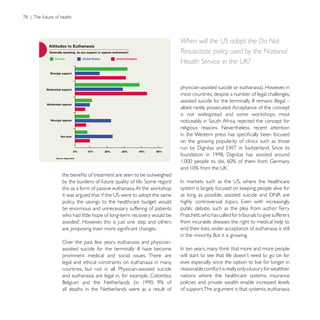
can afford it, solitude becomes a luxury.
                                                         to have less is becoming a treasured ambition. Time

                                                         to stop and get away from things is consequently


                                                         Although economic pressures in many countries
                                                         mean that earning an income is not an option to be
there is a shift to increase the average up from their   toyed with, there is mounting evidence that, given the
Time poverty is becoming as much a
problem as money poverty.                                    popularity is driven primarily by the desire to fully
                                                             disconnect for a while.

                                                             However, for those times when a vacation is not
over extra money. Clearly this is not common globally        an option and the desire for disconnecting for an
across every demographic, but in many areas of               hour or two rises, some notable developments are

are present, this is a growing issue. For those who
have high disposable incomes through well-paid
employment but relatively little leisure time as a result,
                                                                                                             World of
the rich: for some of those on low incomes who also          Warcraft
                                                             and also offer a way for many to switch off. Although
as much a problem as money poverty.                          relaxing for some, others see that these and similar
                                                             high-impact virtual options are less about solitude,
                                                             disconnecting and tranquillity and more about
                                                             getting even more connected in a different world.
and reward policies are being challenged to give
                                                             For those after controllable, real isolation, there are
                                                             other options. A Faraday cage is an enclosure that

next decade we will increasingly see time traded

them to those who want more time and open but                interference within the cage – either stopping
informal trading of time off will increase – time itself     outside signals getting in, or inside signals getting out.
will become a commodity. The hope, of course, is             Traditionally used for computer test facilities and
that this will lead to a healthier, happier and more         microwave ovens, over the years they have also been
                                                             built into buildings where having communication

When those with the time and the money do go on
holiday, the preferred options are increasingly either

                                                             of private homes around the world are including
centres of relaxation has become easier and visiting a       rooms with in-built Faraday cages that can be
spa has become an increasingly mainstream vacation           switched on to create a space where no electronic
For many the ability to switch off and
within the room, occupants can really switch off. Not
only are such rooms being built into new homes          be temporarily alone is an increasingly
but do-it-yourself advice for building Faraday cages    scarce luxury.
is starting to appear more and more on the internet.

                                                        are staying at home for longer. After half a century
notable how many recognise the issue and are being      of families becoming more geographically dispersed,
attracted by the opportunity to have an accessible      in some areas cohabitation in more crowded homes
sanctuary within the home.                              is increasing and, with it, fewer opportunities for
                                                        solitude.

the ability to switch off and be temporarily alone      Whether through such physical alternatives as
is an increasingly scarce luxury. From an economic
perspective, as highlighted above, some people do
not have the money to be able to disconnect. From
a social perspective, we are also seeing the growth     Whether people want more privacy, to be fully alone
in some regions of the multigenerational household:     or to be with family and friends, it is evident that the
as lifespans are extended and out-patient care          desire to be disconnected in an always-connected
is improved, grandparents are around for longer.        world is on the increase. How far we will have gone

with increasing costs of higher education, students     change for some are all becoming aligned.


                                                                                                                   insights
The future of mobility


There is little doubt that over the next decade there     The topics covered in the following pages are:
will be increased mobility. Although in some areas
less travel is possible, people and things overall will
be moving around the globe further and faster. The             Asian aviation
future of transport and the future of migration were
                                                               Chinese trains
two of the initial perspectives in the Future Agenda
programme that attracted a great deal of discussion            Clean shipping


to Washington, everyone has strong opinions about
what should happen. However, what will happen in
the future of mobility over the next decade will, for
some, not be the end point but more of a transition.


are coming together and will be increasingly evident
in the next few years. One notable feature of some
of the probable futures explored here is the pivotal

addition, there is an underlying driver of economic
wealth that will be both enabling investment in new
systems but also causing increasing migration and
mobility of people. Within the myriad conversations,
the eight probable futures selected here were the
ones that had the greatest potential impact for the
next decade.
Asian aviation
Led by more tourists and steady growth in cargo transportation, Asian aviation
places more orders and becomes the largest air market in the world.


to recognise that we need to travel less at the same     there are currently few technology options open
time as the other half want to travel more. Overall,     to the aviation sector for reducing emissions. Any
rising demand from both low-cost and premium             major innovation in aircraft propulsion units is
                                                         many years away, so the only change that can
abating in the next decade. Add in increased air         be implemented during our time horizon is to
freight and there is little doubt that the number of


Air Transport Association projects that the number       time soon, so most experts in the industry are
of passenger departures each year globally will          planning for an extremely gradual shift – and hence

Although much of this growth can be seen to


transport expansion – and many of the orders for         The major difference we will see a decade from
the planes that will deliver this have already been
placed.                                                  moving ever more people and goods around by air

While the aviation industry has been under scrutiny      nature of the lead times in the aviation sector, this
in many countries on account of its carbon emissions,    can be guaranteed – the orders for the next decade
                                                         are already with the manufacturers.


                                                         projections for the sector which provide some

plane is in service for around thirty years and so the


                                                         consequence, over the next twenty years, ‘the Asia-
regional tourism and an increase in cargo.

                                                            The desire to travel for a younger, wealthier and
                                                            increasingly middle-class Asian population will

                                                            tourism. China alone is expected to produce


                                                            jobs.


                                                            between China and Africa, especially, are growing

                                                            hubs such as Nigeria on a regular basis. Airbus

next twenty years and, as average aircraft size will        Over the next twenty years, ‘the overall Asia-
grow steadily, airlines will more than double the size


                                                         On top of this, many Asian countries are relaxing
Civil Aviation Minister announced that he expected       regulatory restrictions to stimulate air travel and are


                                                         led the region over the past decade, other cities
                                                         are rapidly catching up. Over the next ten years,

                                                         upgrades and nearly one hundred totally new
                                                         airports. With expanding international operations in


travel market in the world.
China will have 244 major airports                    caters for the third largest number of international
                                                      passengers (after London Heathrow and Hong
by 2020.


airports are being improved and expanded in the
country. Half of all intra-Asian future demand will   from Asia. When these projections are combined
be between just eleven cities. These will become
                                                      astounding.

Although the scale of change within Asia alone is

                                                      and cargo services to and from the rest of the world,
                                                      there is little doubt of the impact of Asian aviation
                                                      on the world landscape over the next decade or so.
into Asia. For example, the expansion of facilities   The investment is already being made and so now it
                                                      is just about execution of the ambition.


                                                                                                              insights


                                                                                                              Page 155
Chinese trains
China, the pacesetter for change in inter-urban transport, is investing over
$1 trillion expanding its rail network to 120,000 km by 2020.


is increasingly seen as the major growth area for mobility,
competition is rife between air, road and rail. Around


serious commitments. While low-cost airlines continue

steadily, many governments are investing heavily in rail
as the future of inter-urban transport. Having observed

                                                              ideal. Faster than the car and more comfortable
is now considered by many to be the pacesetter for            than the plane, both business and leisure travellers
change.                                                       have increasingly opted for the train as the preferred

A hundred and thirty years after the invention of
the railway and its growth as the primary form of
                                                              been expanded, and clean, high-speed electric rail
                                                              transportation continues to secure more investment
many around the world. To help overcome capacity              from the varied governments.


an hour and a half off the usual four-hour journey.
                                                              one high-speed rail line in operation, there is only just
156 | The future of mobility


                    China has seen high-speed trains as
                                                                               service. As well as these conventional high-speed
                    connect its cities but also to invest in an
                    infrastructure for the 21st century and
                    further drive economic growth.

                                                                               and has built new infrastructure ahead of demand.

                                                                               increasing the speed of travel across the country,
                                                                               China is now investing over $1 trillion in expanding
                    gained surprisingly little advantage from high-speed
                    rail. However, this situation is beginning to change.


                                                                               China has used the opportunity for well-targeted
                    potential recipients of federal funding. Those lines are

                                                                               landscape around train services by investing in a mix

                    Of these, only the California line has so far gained

                                                                               passenger transport are being separated, double


                                                                               have already been made and the ambition will be
                                                                               implemented. China has become the new test bed

                                                                               country is moving forward fast. As a recent article in

                    century and further drive economic growth. Having

                                                                               Like Japan, South Korea, France, Spain
                                                                               and Germany before, China is reshaping
                                                                               its landscape around train services.
Time magazine put it: ‘At a time when infrastructure       At a time when infrastructure in the
                                                           US and Europe is ageing fast, China’s
                                                           railways may give it a competitive edge
                                                           over the world’s leading economies.
city-to-city travel and escalating concerns about
fossil fuel-based road and air transport, electric high-
speed trains are seen as the best option. However, it
                                                           of new high-speed lines, there is little action and their
bold steps forward and probably will not be able to        expansion is certainly not guaranteed. China is the
                                                           clear pace-setter for change in inter-urban transport
                                                           over the next decade. Will America follow?


                                                                                                                       insights


                                                                                                                       Page 151
Clean shipping
adopts a range of alternative policies and power systems.

                                                            Most people are unaware that almost
of global trade continues to grow, this proportion          every product is transported by sea at
                                                            some stage.
                         , twice that of the aviation
sector. While planes and cars have been a common
                                                            past decade, the number of cargo miles has doubled
transport forums around the world, ships have been
rising up the agenda. Not surprisingly, then, this is now   miles. With the world economy set to continue to

                                       emissions but
also other environmental impacts such as waste
contamination. As a result, people are turning to the       since freight rates are very competitive, companies

potentially provide.                                        originally planned. This means that while some ship

                                                            operate their ships as cheaply as possible and just
Most people are unaware that almost every product           follow the minimum regulations.
is transported by sea at some stage. Put simply, when
it comes down to shifting material around the planet,       Comparing air and sea transport is an issue that
ships offer the best option, particularly when it comes     several people have been focused on in recent years.
                                                                       Sustainable Energy – Without the Hot Air,
which there is no alternative. For consumer goods
and foods, the only option is the far more costly one
of air freight. As a result the global shipping industry
is booming.                                                 way to solve the long-distance transport problem
                                                            was to revert to the way it was done before planes:
Currently, maritime transport is handling around
                                                            sad truth is that ocean liners use more energy per
The sad truth is that ocean liners use                     clean ship strategies. For example, twenty-seven
                                                           countries in the North Atlantic have signed the
more energy per passenger-kilometre
(pkm) than jumbo jets.
                                                           agency responsible for ship safety and environmental
                                                           protection, is introducing higher regulatory standards.


                                                           A clean ship is one designed and
                                                           operated so that it maximises the
that, in the freight world, ‘international shipping is a
                                                           opportunities for improved energy

                                                           impact.

improvements to be gained in shipping beyond just          Cargo owners are starting to specify environmental
                                                           performance targets for ships that are used to transport
consumption software and advanced materials are            their goods and cradle-to-grave environmental
in the repertoire, but clean shipping is increasingly      footprinting is bringing wider consumer attention to

one designed and operated so that it maximises             – such as lower insurance costs for clean ships – are
                                                           being introduced and several governments and port
and reduced environmental impact. Over the past
few years, momentum for change has been building

addressed: slower speeds, better hydrodynamics
and new power generation technologies are being

sulphur fuels are being introduced to reduce exhaust
emissions to the air; waste reduction and onboard          Cargo owners are starting to specify
recycling is increasing to reduce to zero the refuse,
sewage and cargo discharges to the sea.                    environmental performance targets for
                                                           ships that are used to transport their
Companies and governments around the world are
planning to change the status quo and are adopting         goods.
Clean shipping | 161


                                                         By 2020, the nature of the overall
shipping – another structural shift for the maritime

ships by environmental performance.
                                                         for onboard equipment; wind-assisted propulsion is

                                                         to pull vessels along to the reintroduction of high-
number of clean ships will have been built and will be


from an overall emissions perspective will be the        At the same time, new designs of ship hulls are
adoption of new fuel and power options that are          being introduced that reduce friction and so reduce
already available or coming on stream soon: nuclear-     energy consumption. Low-friction paint coatings are
powered vessels are common in the navy and are           also becoming available. We can also expect to see


                                                         slow traditional ships. Clean ships will become a
marine diesel ones; fuel cells are being developed       common point of discussion, and not just in specialist
for marine applications; solar power is being used       transport forums.


                                                                                                                  insights
With France and Germany taking the initial lead roles, electric cars take off and


                                                         leading manufacturers and a massive swing of public
years after the global launch of the Toyota Prius        support for more sustainable transport solutions.
hybrid, a host of companies all have electric vehicles
scheduled for introduction over the next few years.
The alignment of technology development, targeted
incentives and economies of scale together with
a fundamental change in consumer sentiment has           little was achieved and most of the concept cars
started the shift towards a future where electric        never made it into the showroom. However, the
                                                         past couple of years have seen the arrival of some
                                                         notable catalysts for change.
one-third of all cars being sold will be electric and
                                                         Although in many eyes electric cars are epitomised

                                                         high-speed electric sports cars have come out of
                                                         the shadows, most notably those being produced


                                                         or more between recharging has captured the
                                                         imagination of many, resulting in a surge of investment.

their relatively slow speed, electric vehicles had a     vehicles offer a number of advantages: they are
number of advantages over their competitors in           quieter, accelerate faster, require less maintenance,
                                                         cost less on a per-mile basis and in many ways are
pollution. However, with increasing competition          more sustainable because, in certain locations, they
from the internal combustion engine and sizeable         can run on clean energy. At the same time, they
support from the oil industry, gasoline and diesel       have the potential to be lighter.

                                                         However, while electrically powered transport for
                                                         personal use dropped off the agenda for around one
One hundred years later, a second wave of electric       hundred years, public transport systems, particularly
mobility is gaining momentum, driven by a number of      in cities, have often used electric mobility solutions.
The German car industry has signed up
                                                         to a government push to get a million
independent road-based mobility, electric buses have     electric cars on to the roads by 2020.
been steadily introduced into many cities over the
past twenty years or so and are now part of many

                                                         much of the debate on the future of electric mobility
development in electric mobility has come from public
transport. Coupled with the success of early hybrids,                                      McKinsey Quarterly
                                                         argued that ‘a global electric-car sector must start

transport, particularly for drive trains and battery     with the two countries creating an environment for
                                                         automotive investors to scale their bets across both
personal transport. Although some, including several
                                                         will compete to provide the technologies, charging
technology, many others are placing heavy bets on a      stations and the vehicles, ‘the two governments can
                                                         no doubt create the conditions for them to succeed
                                                         – for example, by setting standards, funding the

past year or two, more manufacturers have made
announcements about their plans for electric             that show that if penetration of electric vehicles rises
                                                                                                      emissions
                                                         would fall dramatically. To achieve this, China needs


Chevrolet Volt/Opel Ampera electric hybrid, Nissan
has gone a step further with the introduction of the
Nissan Leaf, an all-electric vehicle, with full global
                                                         participants highlighted two issues that might mean

solutions such as its battery swap system which
allows batteries to be exchanged automatically for       have already made the necessary decisions and are

at a petrol station.

Although some question whether it will be in other       for France because it is there where government,
                                                         the car industry and the energy sector appear to be
are seen as front-runners. These locations have high
                                                          renewable supplies of electricity already installed or
                                                          being installed and, as such, they will gain most from
                                                          the associated carbon credits from the introduction
                                                          of electric mobility.


other manufacturers focus more on hybrids and             government push to get a million electric cars on


                                                          four new cars sold in that year being electric, which


sales by then.
                                                          a host of new electric car launches over the next
The second issue concerns the CO reductions
                                                          and commitment to electric mobility is strong
countries, the switch from hydrocarbons to electrons      and growing.
for transport is a diversion because they will still be
largely relying on oil, gas and coal to generate the

production shifts from the vehicle to the power                                                                    insights

before effective and economic carbon capture and          be electric powered. A century after the electric
                                                          car gave way to the internal combustion engine, the
                                                          combined action of many governments, companies,

some argue that it needs to be aligned to major           a renaissance that is on course to produce a major
                                                          global shift in the way our mobility is powered.
Mesh networks and ubiquitous mobile connections deliver the automated
highways to improve safety, increase capacity and reduce congestion.

The intelligent highway is a term used by many in            roadways full of nothing but robotic trucks. This will be
the automotive industry and government bodies to             very much within our reach within ten years and the
                                                             implementation issues revolve solely around the business
does not occur and there are no accidents; a world           case, road facilities, and such like.”
where cars automatically detect a problem ahead
                                                             At the extreme, intelligent highways enable the
                                                             introduction of the driverless car – an autonomous

                                                             the best route, avoiding congestion and choosing the
which will also mean that we use less energy for             speed and distance from other vehicles to ensure that
mobility. This ambition of the transport professionals       there are no accidents.This is what you see played out
has been much discussed and has been the focus                                               Batman and Total Recall
for numerous programmes over the years, but these            to I, Robot and Minority Report. Over past decades,
efforts have only led to many false starts. However, in      there have been numerous research programmes
the opinion of many commentators, realisation of the
intelligent highways concept is on the horizon. With
forthcoming regulation, technology deployment and

                                                             demonstration in which a number of driverless

Although private cars are a primary focus, commercial
vehicles are equally as important. As intelligent

Future Agenda blog:

“In the USA new truck-exclusion roads are being studied      vision algorithms to follow the white lines in the road
for construction in parallel to major interstate highways
to relieve congestion. I think this will become reality –
and, when it does, trucks can start to cooperate with

This is the platoon idea, and in its fullest form you have   prize for a car that autonomously navigated through
By 2020 no one will be killed or
maimed in a Volvo.                                      focused on embedding sensors into and alongside


                                                        With vehicle infrastructure integration, as some are
                                                        calling it, standard wireless protocols will allow cars

demonstrators are being built in several locations      signals; at the same time, government agencies, car

Airport.                                                able to communicate directly with every vehicle.

At the next step down from fully autonomous
vehicles, assisted driving is increasingly common in
cars of today. Adding to the long-standing cruise
control capability, manufacturers have variously


                                                        Cisco and Microsoft have all announced plans for
speed adaptation and predictive cruise control are
also on the horizon. All of these technologies help

so are proven ingredients for the overall intelligent   launched a product that paves the way for consumer
highways ambition. As Volvo, one of the leaders in


                                                        cheaper insurance depending on where and when
                                                        they drive. The system also proved that, on a large


                                                        over the next couple of years under the eCall in-
                                                        vehicle programme for emergency assistance, but
integrated systems needed to allow cars to              also allows other options such as road pricing without
communicate seamlessly with each other and the          toll-booths to come into place. Other systems use
ecosystem through which they are moving. This is
                                                        and between cars (Zipcar uses this system to allow
participant from the communications sector, ‘paves
                                                            the way for the car to be the fourth space for mobile

based systems. Together, these innovations not only         as being the foundation for the next generation
enable safer driving but are also the gateway to a          of intelligent highway design to deliver the goods,

                                                            have to use the same system to enable fast and free
mechanisms – where fuel, insurance, vehicle use and
travel overall are charged by distance – are already
operable within a short timescale.

While Western economies to date have invested               The other big hurdle is social acceptance of intelligent
most in the concept and testing of intelligent              highways and, by implication, autonomous vehicles.

                                                            much of the technology and systems are available

                                                            and consumer issues are agreed: trusting the system
                                                            rather than the driver to control the car is no easy
is possible that a partnership between Tata Motors
and Tata Consulting could be the catalyst for a mesh

eventually the intelligent highway.

With many different systems in development
around the world, a critical issue for widespread           for the majority of drivers, the option of joining a
implementation will be the adoption of a common             smooth intelligent highway system rather than the
                                                            usual nose-to-tail commute will become increasingly        insights
that ‘from a policy perspective, there is little question   attractive. There are clearly a number of outstanding
but that an open standards approach, which would            issues to be dealt with but, given the impetus and
allow all to use the same technology, would be              the number of vehicles being added to the global

adopting an in-car WiFi system turning the entire car       well see us travelling on intelligent highways.


                                                                                                                       Page 155
With increasing economic migration the total Muslim population of Europe is


Migration has been a contentious subject for a number
of years and, as politicians continue to avoid the heart
of the issue and media misrepresent many of the
arguments, the real implications are misunderstood.
Yet, in terms of impacts on other issues, migration is

perspective on the future of migration, Professor
                                                           inhabitants. While fertility rates and life expectancy
                                                           in different countries can be used for base-case
                                                           models, a big uncertainty is the impact of migration

From the varied discussions around the topic it is

challenge that will lead to a shift in society. ‘The low

multiplying migrants, will change fundamentally what       commented that ‘the major challenges are to
                                                           predict the size, direction and character of global
is one pertinent view. Many increasingly see that, to
sustain competitive growth in the face of declining

and this will largely come from North Africa and the       to remain high and probably increase as a proportion

hard to come by, leading commentators see that,

change the multicultural balance in a new direction.


nationals will be Muslim by the end of the decade.
                                                           outnumber births and so natural growth will cease.
There are a number of different scenarios being            From that point on, positive net migration will be the
                                                           source of population growth. ‘Migration from other
support growth drew in people from the former


                                                       has risen, doubling in the past thirty years to around

                                                       the countries with the largest percentages of Muslims


                                                       congregated in a numerous urban areas and many
                                                       observers are aware that certain neighbourhoods in


of welcoming migrants, over recent years immigrants    as whole into consideration, beyond the boundaries
have increasingly come from developing economies


Cohen stated: ‘The economic case for migration has
always been strong. Migrant labour is often cheaper,
                                                       “Europe’s immediate neighbourhood, the Middle East
                                                       and North Africa region, has the world’s second fastest
                                                       growing population, after sub-Saharan Africa. Future

                                                       the Mediterranean region, in view of differences in
                                                       living standards and population trends exacerbated by
                                                       natural resource constraints.”

                                                       Over the next decade, there will be continued change
Muslims already make up 25% of the
population in Marseilles and Rotterdam,
20% in Malmo, 15% in Brussels and
                                                              integrated into society and are self-segregated for
Birmingham, and 10% in London, Paris                          reasons such as language barriers and different
and Copenhagen.
                                                              reality is that, despite the anxiety, Muslim integration


                                                              experts believe that middle-class Muslims are much


the next decade, with a Muslim population equal to            between being Muslim and Western, not Muslim or

                                                              and political challenges to be addressed, but with
in how the region operates on the international stage.
                                                              sustaining its population, and an increasing recognition
voting laws, granting certain franchise rights to the large   that this can only occur through immigration from
                                                              Muslim countries, the reality of a more Muslim


Muslim population has been the focus of debate on             multinationals to start to focus on this group as a        insights

                                                              that was largely uneconomic to support due to size
                                                              or dispersion, improved connectivity and declining

                                                              Muslims an increasingly addressable mainstream.
The acceptance of being tracked by your mobile is accelerated by ticketless
transport systems, increased surveillance and successful location-based services.

Anyone who has used an iPhone will be aware that          too has now become an additional security issue.
location services are now embedded in most smart-
                                                          battery is integrated into the product and cannot be

                                                          potential of phones. This capability is now also

where their friends are, in real time, on the basis of    such as Loopt, Venti Coffee and Njection are using
                                                          this information to respectively broadcast your
allows you to openly share your whereabouts. For
many, the ability to be located via the position of our   you of speed traps.

but it has actually been used for quite some time.        Moving forward, as phones are used to enable

From a security perspective, when needed, and with        the phone rather than the person gets on and off

services in many countries have been able to locate       of a personal mobile device as a reliable surrogate
suspects to within a meter or so by triangulating         for the individual is stimulating new applications in
signals from a mobile phone to the communications
                                                          to name just a few. However, it is not all just about
                                                          your mobile.
location of people has been possible in recent years,
even when a phone is switched off. As long as there
is a battery in the phone, it can be remotely turned      system has been around for several years now and
on, located and turned off in milliseconds and this
                                                          services can be called and locate a vehicle in case

                                                          become more widely adopted, the ability to use it to
As long as there is a battery in the
phone, it can be remotely turned on,
located and turned off in milliseconds.                   state and national borders without prior agreement
The use of the location of a personal                      feature at many airports – are adding an extra layer of

mobile device as a reliable surrogate                      issues around privacy are bubbling under the surface.
for the individual is stimulating new

payments and social networking.                            for the monitoring of people and their movement


                                                           cameras, the average person is photographed over
– or, if you do, then they charge you for the privilege.
                                                           instance by the security services for national security
there is widespread acceptance of this capability.The      and counter-terrorism surveillance, this is now going
                                                           mainstream in the commercial world. Although the
                                                           subject of some concerns about privacy, after trialling

                                                           recognition to a wider audience to allow them to
for better emergency assistance, it also facilitates the   search for something on the internet simply by
introduction of pervasive road pricing and similar
schemes – without the need for toll booths.
                                                           Privacy campaigners have cautioned that adding


and out of transport systems and many public and

                                                           are also developing face-recognition tools, a global
to an individual credit card holder and so can tell        rollout is not far away. Although a privacy invasion
the system where you enter and exit the tube or
                                                           with more customer-focused applications coming
and Melbourne provide the functionality and so, as         on-line every day, providing new information to all,
non-contact payment is adopted more widely, this           consumer resistance will be marginal.


While passes are common for many corporate                 Car hire companies have for some
employees and visitors, the introduction of biometric
                                                           time had the capability to actively track
recognition or iris scans and which are a common           where you drive.
Google’s Goggles project is bringing
in which, whether we want it or not, and whether we
                                                      facial recognition to a wider audience to
by border control when we leave and enter countries   allow them to search for something on
                                                      the internet simply by taking a picture
will fast become the norm in most regions.            of it on a mobile phone.


                                                                                                  insights
Informed choices, growth, congestion and regulation impact the world’s cities


Although all cities are in many ways different in      The key challenge is that as London in
terms of layout and structure, and consequently
have different transport options, many share           2020 seeks to be more like Shanghai in
similar issues and challenges around sustaining        2010, can we stop Shanghai becoming
                                                       more like London?
problems resulting from congestion but also of the
environmental implications, many leading mayors and
                                                       by many different factors on top of the geographic
                                                       and cultural differences present.

include encouraging people to change their existing
habits and behaviours, while in the developing world   added to the world over the next decade, most of
                                                       them in cities in the developing world. According to
different choices about mobility than others have
made in the past. With car ownership rising steadily


The challenge of future urban transport was
                                                       London is a relatively good example of sustainable
                                                       developed-world urban transportation, albeit not as


that the answer ‘is not simply about stopping people
                                                       can be considered as typical, average examples of
                                                       developed- and developing-world urban mobility.
about ‘encouraging people to travel less by better


and more: urban transport is a complex issue driven
realisation early on was that ‘urban transport planning
                                                          has to be integrated with the urbanisation policy to


                                                          solution is clearly to regulate against the car.
                                                          While congestion charging, road pricing and lane
                                                          prioritisation for multi-passenger and low emission
                                                          vehicles has become increasingly popular in many
                                                          cities, others have tried alternative approaches. For


world where access to personal transportation is          comment,‘the result would be more cars on the road
a cultural ambition, a status symbol and, in many
places, a major advance, many of the discussions in

conundrum can be accommodated.                            severe limitations, even though more people are
                                                          recognising the issues including ‘the negative health
Any global blueprint solution has to consider the


                                                          we can expect ever more dedicated cycle lanes
spending between thirty and sixty minutes a day on
                                                          the pavements are in a dangerous condition, while

daily transportation time in cars is up to three hours    Cycling might be an attractive option in places

more on regeneration for city planning,Asia is creating
brand new cities and extending existing ones, but         people that it is a progressive option for transport
‘in several Asian cities, urbanisation is happening at    can be an uphill struggle. What many agree upon is
a rate that is much faster than transportation can        the role of an integrated public transport system that


                                                          may mean buses, trams and trains, in other places
In several Asian cities, urbanisation is
happening at a rate than is much faster
than transportation can cope with.                    planning policy for regeneration as much as new-
                                                      build. As such, pedestrianisation and cycle routes,
                                                      for example, are both on the increase. However,

there may already be better answers: tut-tuts are


                                                      economic growth, mobility management has to
already in place, the need for monorails and metros   therefore consider structural and attitudinal change.
could be questioned. Although many cities are

                                                      that smarter choices can have – from better travel
                                                      plans, improved taxi services, changing access to
                                                      vehicles through car clubs and car-sharing schemes
                                                      and increased awareness of alternatives to the car,
that ‘the solutions must be different for different
                                                      forecast. Whether or not they start with transit
a multilevel approach where underground transit       system plans or shifts to cycling, all discussions on
                                                      future urban transport ended up highlighting the

                                                      developing worlds, in new and old cities, the big
built, and some of the existing ones that are being   push that is evidently building momentum is to use
upgraded, this option has many supporters and         manifold means to constrain movement by car and
will, de facto, become the future. The new Chinese                                                             insights
                                                      will clearly have more drivers in the world, the hope
have their transport options. However, elsewhere,     of the planners is that the overall miles travelled by
many commentators see that a more sustainable         car will be stable and that the increase in numbers
urban transport future can only be achieved if more   will be offset by a reduction in distance.
informed choices are made by governments and
organisations as well as individuals.
The future of security


                                                       The topics covered in the following pages are:
needs and is an area that is under increasing
pressure. For some, this is more evident than
others. However, around the world, with increasing          Alternative proteins
ease of communication and connectivity, more

constraints, we will all get used to more coverage
of security-related topics over the next ten years.
These will not be just issues about military or             Credible sources
national security, although this is evidently an

The eight probable future changes covered in this
section also cover food security, health security,
energy security and water security. They deal will          Virtual authenticity
fundamental concerns that nations and cities have
about securing supplies of the resources to feed            Water management
their populations, protect their health and access

issues addressed cover topics related to data


how organisations manage the control of their

change is possible. Touching all these elements, the
probable futures in this section hopefully stimulate
some new perspectives on the world we are
moving into.
Alternative proteins
The shift in global diet from rice to meat brings new sources of protein including
lab-grown manufactured meats and high protein vegetable combinations.

One of the common challenges with rising economic
growth is that of increased resource consumption.


once people have more money available, one of the

Whether this involves an incremental shift to higher
quality or more tasty foods or a more fundamental          cannot be stored in the body so over-consumption
shift from, say, a rice-based diet to one with more
meat, the well-recognised global impact of increased
wealth is a higher calorie and, ideally, higher protein    Considering the number of people on the planet, the
                                                           rise of many up the protein ladder and the availability
energy ladder, so they also climb the calorie and          of protein, the problem we face is that we are fast
protein ladders.The more money we have, the more           running out of natural sources.Yes, we could all farm
or better foods we eat and this is pretty well a linear    and eat more meat but the environmental impact
relationship until the point when enough is enough.        of that in terms of land use, water consumption and
Wrap all this together with an increasing population       carbon emissions, to name just the obvious ones, is
and steadily rising economic growth worldwide              unsustainable. Food security is an increasing issue

demand. The big issue here is that complete protein
commodities are becoming increasingly scarce and           nations are now developing food supply strategies
alternative sources will be required.                      that will secure supplies in times of scarcity or higher

                                                           civil unrest in a number of countries, including Yemen,


                                                           the growing protein demand without resorting to
is relatively rare but can still be found in the poorest   protectionist behaviours that lead to hoarding of
communities where poor diets are the most                  supplies, we need alternative sources.
The problem is that more and more of
us want to eat meat and less of us are
prepared to be vegetarian, even just for
a day a week.
                                                         The fact is, we need other alternatives and the main
                                                         focus is on manufacturing proteins. As highlighted by
beans, whole grains and nuts are all good options
because animal protein and vegetable protein have        of food: ‘The development of non-meat, high-protein
the same effects on health.The problem is that more      foods as meat alternatives or acceptable protein
and more of us want to eat meat and less of us
are prepared to be vegetarian, even just for a day

a staple diet for animals, is rapidly getting out of     The most progress in this area to date has been
balance with supply. China already buys more than        in the Netherlands where in vitro meat production
half of globally traded soybeans and, according to       is already occurring – albeit in a lab. ‘In vitro meat,


                                                                  in vitro
                                                         from a sample piece of real meat and proteins are
                                                         applied to help these grow into large portions of
                                                         meat. There are a couple of different approaches

                                                         engineering and the greatest success has been seen
                                                         in the Netherlands where a matrix of collagen is
                                                         seeded with the muscle cells which are then bathed
                                                         in a nutrient solution and induced to divide and

                                                         government funding, grew meat in the laboratory
such an extent that we can no longer rely on this        using cells from a live pig and they are now also
resource and the world will have to ‘turn increasingly


if it is to meet future food needs without ruining       some fear such lab-based products, in reality they
                                                         could be just as tasty as natural meats and may even
                                                         be healthier by virtue of having a lower fat content.
The development of non-meat, high-
technology improvements, in vitro meat would
                                                         protein foods as meat alternatives
but with the advantage that only the bits that we        or acceptable vegetable protein
                                                         alternatives could help us more
horizon.

                                                         protein demand.
the planet, many of whom will be higher consumers
of meat, we can clearly see that natural proteins
will more expensive. The possibility that lab-grown
meat protein will be commonplace is increasingly
supported by world experts. However, there               taxes on meat.
are a couple of other options that should also be
considered.
                                                         option of simply creating designer food sources.
First, and highest on the agenda of many organisations   Now that Craig Venter and his colleagues at

consumption behaviour and become part-time               have successfully created a synthetic bacteria cell,
                                                         the potential opportunities are endless. While the
                                                         initial focus is on moving on from simple bacteria to
                                                         creating algae that can play a major role in the bio-fuel
us some breathing space before alternatives – such       arena, plants and animals are also possible avenues


                                                         ones is therefore increasingly moving from the world        insights
are even advocating the rationing or premium pricing
Active gathering and interpretation of data related to threats to human and
animal health delivers faster early warning and situational awareness.

                                                            Protecting us from the outbreak of
and surveillance are playing an increased role in bio-
                                                            disease has become an increasingly hot
has become an increasingly hot topic in healthcare          topic in healthcare circles.
circles and is a focus for major investment. As part
of global and national health security systems, public
health surveillance is widely used for such activities as
detecting new cases; estimating impact; modelling the       global health security increasingly high on national
spread of diseases; evaluating prevention and control       agendas, many across the healthcare system see
measures; and strategic prevention planning. To             bio-surveillance as a priority and one that could be
achieve these ambitious objectives involves ongoing         fundamental in changing how we deal with public
and systematic collection, analysis, interpretation         health in the future.
and dissemination of a mass of health-related data

bio-surveillance, has involved the expansion of the         process that monitors the environment for
traditional public health surveillance into detecting       bacteria, viruses, and other biological agents that
and predicting bio-terrorist threats and disease            cause disease; detects disease in people, plants,
                                                            or animals caused by those agents; and detects
and, as the world becomes more susceptible to
the rapid spread of epidemics and pandemics, we             a continuous process that encompasses not just
                                                            data collection from myriad sources but also rapid,
on the future of health – namely, that ‘our ability to
achieve global bio-surveillance for disease is limited      nature multidisciplinary, multi-organisational, data
because of unequal infrastructure, inadequate local
                                                            highly complex. As such, being able to bring together
                                                            all the necessary ingredients in an effective manner
surveillance system demands not just an alignment of        is seen by many as one of the biggest challenges
multiple sources of data but the analytical capability
                                                            of bio-surveillance programmes and the use of new
patterns for disease detection and prevention. With         technologies to enhance data collection and analysis
One major technological advance is the
                                                         disease surveillance capacity in over forty African

                                                         creating a global bio-surveillance system that will

detection of potentially harmful strains
in bacteria, plants and animals.

                                                         intelligence required to be built into and support
are therefore high on the list of imperatives for many   data mining of such a wide range of information and
public health systems. Therefore, in recent years,
                                                         new data systems, analysis, visualisation and modelling

                                                         many of which are now in development.
emergency preparedness through the development
                                                         At the same time, more open human-to-human

                                                         bio-surveillance, and this is one aspect that is now


                                                         the blogosphere, there have been radical changes in
One major technological advance is the spread of

                                                         national and international health policies that are
                                                         designed to respond to threats to our collective
is, for example, now part of the screening process
                                                         as news stories, unstructured real-time text messages
            E. coli                                      between healthcare professionals and animal health
used to identify antibiotic-resistant strains to help    reports can, if properly integrated, provide core
doctors either to select an antibiotic other than        elements of an effective system.
the one to which the bacteria are resistant, or to
consider choosing alternative treatments.

Although less sophisticated than the systems being       sources of dispersed data from such sources as
                                                         hospitals, animal health centres, local monitoring of
                                                         water sources for biological agents and even remote
monitoring of people and animals from space seems         As soon as an outbreak of disease
legacy system integrations and open communication         occurs, whether in humans or animals, it
of data are already in place. Once these are matched      can be rapidly tracked and analysed so
up with the data analysis and visualisation software
already in use in other sectors, the anticipated          that the appropriate responses can be
changes, it is argued, will occur. An increasing number   activated.
of healthcare experts can see just over the horizon

occurs, whether in humans or animals, it can be

                                                          will protect the populace – ideally as well in the
will we have faster early warning, detection and
situational awareness of threats to public health, but    everything goes to plan, whether you live in New
we will also have the means to better plan for future
disease scenarios from multiple sources. Whether          underpinned by this type of global monitoring.


                                                                                                               insights


                                                                                                               Page 61
With more free agents and outsourcing, non-core functions within organisations
are interchangeable and easily rebuilt around value-creating units.

Organisations have already started to be more           Some organisations are now obliged
freelancers and other temporary staff has blurred       to plug and unplug the leading-
the boundary between employee and contractor in         edge capabilities to meet ever more
                                                        challenging local and global needs.
saved money but also increased the complexity of the
                                                        a clear reporting line, presents a challenge that will
today still see themselves as entities with employees
in control of a wide range of value-creating and        leaders are already learning how to play Corporate
support activities, by the end of the decade more
                                                        areas, more and more companies will have to learn
                                                        to plug and unplug capability from inside and outside
‘While there will be a permanent core to the            the organisation on a project-by-project basis.
business, it will become increasingly small and more
of a direction-setting and delivery-choreographing      The initial drivers for change in organisations are


project managers ensuring that the right activities     or offshore many of their commoditised functions.
                                                        Conversely, to date, most companies have generally
irrespective of whether the project team is internal


schools and associated organisations such as the
Management Lab in California.What they are pointing
to is a world where organisations are becoming          are becoming increasingly more differentiated by
increasingly unbundled and recombined around            the world-class expertise they can access to create
                                                        and deliver their new products and services, some
manage a community, rather than employees with          organisations are now obliged to plug and unplug
Open innovation has encouraged the
heart of an organisation’s future growth
to become a network.


the leading-edge capabilities to meet ever more              in their different ways, all demonstrating the ability to
challenging local and global needs.                          unbundle organisational capabilities from one part
                                                             of the business and align them with a wider external
As Chris Meyer highlighted in his initial perspective        ecosystem. Open innovation has encouraged the


                                                             see a similar shift on the horizon for strategy.
form with porous boundaries, shared responsibilities,
greater transparency, and fewer mandatory rules and

are fast becoming a combination of amalgams                  subcontractors. Within ten years, around half of the
of a series of independent capabilities that share
common processes, systems and cultural norms
but are structured as separate business units or             This fundamental change is providing a plethora of
                                                             experts and consultants available as subcontracted

and strategic priorities are increasingly resulting in the
separation and reformation of corporate structures           The project team members of today, and certainly
using these independent units as organisational              tomorrow, are increasingly people who have grown
                                                             up in the connected world. As many of these ‘digital


from an ever increasing ecosystem of partners,               life for those who can contribute the most.
universities, consultants, customers and entrepreneurs.


                                                             Funky Business, we have a world in which there are
engaging a wider, deeper supply base of innovation
temporary project-by-project basis. As such ‘the heart     integration is a growing challenge. The future will see
of value creation for organisations will increasingly      more agile corporations, more decentralisation and new
shift outside the traditional corporate boundaries to      IT infrastructures.”
embrace people more interested in portfolio careers
                                                           At the same time, more organisations are seeing
challenges for companies across the board, especially      a future in which their brand can no longer be


                                                           your brand to customers and the outside world was


out exactly what needs to be done and to what              progressively having internal reputation managers
                                                           – value-protecting professionals that mix
and the best ideas sit outside the organisation
and are developed by a group of individuals who
are attracted by the challenge and opportunity             more, these individuals increasingly sit outside the
for addressing them, the way companies manage
                                                           as highlighted by the foresight on differentiated
from the past. Where business model discussions
                                                           creative commons and open source movements,
constraints and protection of intellectual property        core components of corporate and institutional
regulations, trust between colleagues and project
teams becomes ever more important. As one
                                                           the biggest game in town and companies continue

“The ability of corporations to serve their customers is   effective innovation, some pivotal business challenges
largely driven by access to and the use of data. Data      for the next decade are already quite clear.              insights


                                                                                                                     Page 111
Credible sources
Greater information overload moves our focus from simply accessing data to
including the source of the insight to distinguish what we trust.

As connectivity increases and the information         “In many areas, knowledge is already a commodity –
being generated around the world rises, many of       Wikipedia is one obvious example. If this trend increases,
us will be faced with ever more data, insight and     then where is the power? One could ask whether access
                                                      to information really does empower the individual. I
of. As was highlighted repeatedly in the Future       would say only if the recipient knows what to do with
Agenda programme, ‘the biggest challenge is simply    it. In the future we will move increasingly to wanting
                                                      ‘data we choose’ to receive rather than just access to
Many see that we already have too much data, are      hard data. This could lead to a narrowing of opinions
too dependent on information and this prevents us     too early but clearly the successful recombination of the


“Too much reliance on data to guide our views has     Many see that this information–power balance is
meant that we have lost intuition. Going forward we
need to rise above the mass of information so that
once again we can make more focused decisions.”
                                                      At a structural level, the migration of computer


                                                      of our personal and professional lives will be spent
                                                      using our web browsers. That means browsers will

management. Their research shows that intelligent     the initial view on the future of data, it was suggested
systems will become increasingly prevalent. Other     that ‘if we consider what has been achieved in the
                                                      past ten years, over the next decade we have the

and interoperability that come through moving data    world of ubiquitous and uniform access, intelligent
                                                      agents and the semantic web, we have the potential
clear and many are focused on delivering the best     to enable even greater shifts in transparency and
answer ahead of the competition. However, there       access to data than previous generations could have
are numerous concerns over the impact this shift
will have on how we use information.                  are comfortable sharing their search history with us,
Opinion is of little value until you can
                                                         but that we need more credible information. To
authenticate it – so the challenge                       address this issue, those who are driving the web
will be to identify credible (authentic)                 forward anticipate that it will be more powerful,

information.
                                                         between pieces of information will be both apparent

we can use that as a valuable signal to provide them


Within the next decade, some people see that
there will be so much information shared and freely      Others concurred with this: ‘The semantic web will
available that we will be able to create totally new
                                                         combinations of data we need to gain really useful
the data sets associated with the human genome,          information. Over the next ten years, semantic search
then we can in principle create a complete world         engines will shift the intelligence behind search to a
family tree – we can have a search engine of the

are all individually related and so, as a consequence,
                                                         One issue here is our increasing dependence on a
                                                         single source of information – namely, the leading
inevitable.
                                                         to capture more information, we need multiple
However, others disagree with this: ‘We need more        sources, not just a single one. For real insights on the

into the system as we focus on information not
                                                         future of authenticity:
critical and having a sea of data is without value. We
need more than search engine technology and to           “The most effective way to counteract falsehoods in the
                                                         future will probably come from the pooling of many
                                                         messages and reports so the people can see where
                                                         there is a consistent story. The aggregation of different
of what we get from current search engines is useless,
relevance is clearly a challenge. Therefore we have to
                                                         However, some see that the growing gap between
and this is all to do with redundancy of information.”   the wisdom of the crowd and the ignorance of the
mob will increasingly create the demand for greater         Sources of information will be as
differentiation between believable views and more

is not enough: what people see as more important
are credible sources, ones in which we have full
                                                            depth of rigor. With too much data to process, we
well as the data. We need to recognise the difference       are increasingly being shallow and broad in our views
between fact and opinion – and so be able to see
the credible from the incredible. The credibility of        who they trust and what they see as credible are
                                                            judgements based on what information is available.
offering it and going forward this will become more         This will increasingly be not just the information that
                                                            companies and organisations put out into the media
drivers of trust such as governance, stewardship and        maelstrom, but also what people say about them.

is of little value until you can authenticate it – so
                                                                                                                      insights
                                                            those who are seen as offering the most credible

have to change – in the future, credibility may be          trusted brands, media organisations and individual
                                                            commentators. Their opinions will be the most
Another added:                                              valued and the most used to inform decisions. The
                                                            problem here is, however, that there is also a big
“With increased connectivity and sharing of data, we        question over the business models that will be able
will need more trusted intermediaries. Choice agents will
need to be trusted more and there will be a currency        yet, it is unclear how the infrastructure will actually
of trust appearing. Sources of information will be as
                                                            people will be willing to pay for better information.

For many of us, decisions are emotionally driven,           “We are increasingly accustomed to free access to free
                                                            information and so shifting back to a pay-to-access
                                                            approach will be no easy move – particularly for the
see that ‘if we are to be loaded with more data in
the future, it will lead to slower judgement without        information be monetised and, if so, by whom?”
Intelligent UAVs choose their victims themselves as the race for more focused


Over the past couple of years, Afghanistan and          The US has become increasingly
                                                        attracted to drones which cost a
services.They have become the proving ground for a
fundamental shift in how military power is exercised,
how information is collated and used and, ultimately,
how wars will be fought. With a military budget         not greater presence.

to drones, which cost a fraction of the price of a


and as other countries scale up their arsenal, by

                                                        cameras each. Alongside surveillance activities, drones


                                                        increasing coverage of their controversial use for
                                                        the surveillance and assassination of both Taliban


Predator drones each day in Afghanistan. Much of
their use has been for surveillance, with each drone    where exerting military power in no-go areas has
Thousands of hand-launched drones                      be completely autonomous, and so does not need

are used by soldiers to see what lies                  the Taranis prototype shows the direction we are
over hills and these are getting so easy
to use that there are now even iPhone                  the world of gaming is integrated within military
apps for controlling them.
                                                       as the military terms it, are changing rapidly.


casualties have been an increasingly unwelcome
item on CNN, the use of unmanned drones each


though many see that these assassination machines
                                                       of ordinance delivery that has gone before, the
society, their use is widely accepted and even         psychological implications of such decreasing
promoted in the media.                                 contact between the source and recipient of action
                                                       are raising some major questions in the military and
                                                       beyond.
are being used. Thousands of hand-launched drones
are used by soldiers to see what lies over hills and
these are getting so easy to use that there are now    be engaging in aerial battle and choosing targets for

and Automation Lab has led the development


and simultaneously view corresponding video feeds.
                                                       BAE Systems’ Taranis drone is intended
                                                       to be completely autonomous, and so
                                                       does not need human piloting.
Program were planning to create an operational      one analyst quoted in the New York Times article said:
                                                    ‘The systems today are very much Model T Fords.
and pre-programming,      these developments are
preparing the way for    a world where hordes of
unmanned, unattended     and untethered drones in
the air, on the ground   and under water reinvent   In ten years’ time, many speculate that
                                                    drones will be engaging in aerial battle
                                                    and choosing targets for themselves.


                                                                                                             insights
Increasing governmental focus on energy security and climate change drives
the uptake of large-scale solar as the leading renewable supply.

The combined pressures of rising global energy
demand, increasing concern about climate change,           that, globally, the next decade is one in which solar

heightened awareness of the challenges around

for alternative energy sources. While long-term
                                                           Firstly, we are using the wrong business models.
the wider adoption of nuclear energy to decrease

the next decade is still very much one in which oil,       models: ‘The current economic models we use are
gas and coal are the major sources of energy. With         not suitable for managing our future energy needs


                                                           appropriate change in the energy mix and support
to agree a global way forward, the energy world in         the huge investment needed.The speed of transition
                                                           that we need to address the energy challenge is out
                                                           of sync with the established views on returns on

However, by implication, over the next decade there

alternative energy supplies. Wind, wave, solar, nuclear,
bio, hydro and geothermal generation are all pushing
ahead, some with clear momentum and others with
inertia yet to be overcome. As different countries are
advocating different options, it is clear that there is    guaranteed price for renewable energy that has made
no single global answer. Coastal locations favour wind
turbines, mountainous districts favour hydroelectricity,

favourite of sunny regions and, while some countries       in the failure of Copenhagen to agree any meaningful
                                                           global targets, growing concerns over the environmental
in the percentage of supply that nuclear provides

                                                               increased investment in proof-of-concept schemes
                                                               for wave power, but again this will not have achieved

                                                               will continue to be limited to certain geographies
                                                               and many scenarios increasingly expect that the fuel
                                                               versus food debate concerning bio-fuels will have


                                                               The fastest-growing area of renewable energy


                                                               to rural, non-forested sites and offshore. Moreover,
                                                               ‘worldwide, wind energy under the same constraints
                                                               could supply at least forty times the current electricity

                                                               at which this capacity can be rolled out, at what cost
can see a raft of new nationally focused policies on the
horizon. As countries scramble to protect their supplies
and gain individual energy security, and thereby steer
                                                               A pivotal issue in any assumptions about wind power

support the alternatives that are within reach from both       telephone lines are routinely dug up so that people
                                                               can resell the copper, using millions of tonnes of it

levels, so this combination of technology and economics        such as high temperature superconductors are now
also has to align with social acceptance and political will.
                                                               to scale these up substantially within ten years is

see increased investment in nuclear energy for those           others surmise that ‘current growth in wind turbines

in support of the traditional centralised view of supply,
there will be more nuclear power stations coming               This brings us to solar energy – a virtually
on stream than ever but, given the overall dynamics
There is little argument that, ‘in the long
                                                            term, all energy can be solar.

                                                            leader in solar energy and envisages an installed solar

next few years, many anticipate that more large-
scale solar power systems will be installed across the
                                                            While some countries, such as those in northern

                                                            needs from PV and solar farms within their national
                                                            boundaries, if they had access to solar power
                                                            from other countries, solar could meet nearly
solar energy will be competitive without subsidy            all electricity demand. According to calculations

capacity will result in a steady cost decline and ‘across
the supply chain, manufacturers are increasing cell


                                                            The same arguments clearly apply elsewhere in the

                                                                                                                      insights

                                                            As was pointed out in the most recent Technology


                                                            so, theoretically, the sun could provide at least eight

                                                            argument that, ‘in the long term, all energy can

                                                            will be when the shift to solar truly starts gaining
                                                            momentum.
Virtual authenticity
global transactions to gain access to what we want when we want.

Proving what is real in an increasingly complex world

organisations. Although individual companies and even      of veracity and reliability which have
sectors have their own solutions to the problem of         always affected the mass media.

challenge in the physical world, with the counterfeiting
of everything from aircraft parts and pharmaceuticals

                                                           to the popularity of remixes in the music industry
relating to this topic during the programme, a number
                                                           created from substandard TV scriptwriting.
proportion of them aligned around the crux of the

                                                           questions of veracity and reliability which have


across a number of different levels – from goods to        discussion of how the Obama election campaign
information and from an experience to our identity.        had used technology to create a seemingly authentic
                                                           experience: ‘The idea was that people could “get


just as good as the legitimate originals and valuing       Technology, and especially the internet, was used to
                                                           give people the sense of being closer to the heart of
‘The arts have a long traditional of valuing copies:       things than would otherwise have been possible, but
Chinese painters traditionally learnt their craft by       at the same time it probably also exaggerated their
                                                           perceived involvement.
Discussions with banks and data
companies consistently highlighted
the growing need for ‘global secure                           companies have already said that they intend to

identities’ that could be trusted and
used everywhere.
                                                              patterns, phone usage and download behaviour, the

A lot of attention focused on how to authenticate
identity – particularly online. The big challenge as yet      protect them from inappropriate content without
unmet, it was largely agreed, is simply proving who
you are in order to access information, purchase a
product or a service or even gain entry to a building         However, the big problem is global authenticity:
with excess process and complexity.
                                                              or regional boundaries or within certain sectors
“Many of us now have multiple, real and virtual identities,
and so can provide various sources of information that,
pulled together, can give a rich picture of who we are.The
                                                              could be trusted and used everywhere. While
                                                              government-level authentication of identity via

                                                              to be largely in hand for the next decade, the more
For example, biometric systems and digital rights             open issue is that of proving who you are and
management are two existing systems of authentication         so, for instance, how creditworthy you may be in
but, to date, and in spite of huge investment, digital
                                                              about proving that you are who you say you are
                                                              when at home using your PC, but doing so when
virtual space, and cannot be by-passed, have gained           you buy something from France over the mobile
support but have not yet developed momentum to
bring about global change.                                    authentication of identity is relatively easy to achieve
                                                              once you have the right data. However, the problem
                                                              is that the existing data that retailers, utilities and
                                                              airlines need is currently spread across many other


designed, positioned and bought by parents and
given to their children. However, in restricting access       you want something is the core challenge and hence
A ‘Google Identity’ service or similar that
                                                         in the past decade and the data that it already has
allows us as customers to consolidate                    on the majority of internet users, some see that a
all our personal data in one place for
                                                         customers to consolidate all our personal data in
sharing with whoever needs access to it                  one place for sharing with whoever needs access to
to validate who we are could well be in                  it to validate who we are could well be in common

common usage by 2020.
                                                         believe that in the course of the next decade the

step forward here but many see a more integrated
approach on the horizon.                                 personal data, one that is open and accessible, with

                                                         would be a service that reveals only the relevant
                                                         information needed to prove who you are, where
                                                         you live or how old you are to the organisation

similar organisation to become the host of shared        about privacy and trust that might jeopardise such an
personal data to validate virtual authenticity, others
                                                         central information point for all may well overcome
with a broader and established reach – namely            this problem.                                           insights
Water management
to help communities manage the growing supply–demand imbalance.

                                                          Economic water stress is expected
water is the resource over which many governments,
corporations and communities have greatest                to affect up to half of the global
concern for the future. As populations increase and       population by 2020.
move to urban areas, and as consumption rises in
line with economic growth, water stress will be the
main challenge for many parts of the world.

At a basic level, many parts of Africa and Asia will      as possible and, in another, drought leads us to try to
suffer increased physical water stress as the available   catch every drop.


                                                          coming years. This would leave one-third of the


is now considered to be an ambitious target.
                                                          As governments develop national water strategies
                                                          and both cooperate and compete to secure water
                                                          supplies, companies will come under increasing
Asia, water scarcity is forecast to have a severe

water stress is expected to affect up to half of the

                                                          principle of water footprints will gain fast traction

                                                          awareness of the water challenge.
Therefore, in the next ten years, more pragmatic
                                                     short-term solutions to help communities better
                                                     manage the rising supply–demand imbalance will be

                                                     irrigation. While the concept of a water grid, able to
                                                     shift resources around regions and between buildings
                                                     to balance supply and demand, is increasingly
                                                     discussed, in many areas the next ten years will be
                                                     more about driving consumption behaviour change.
                                                     At the same time, the politics of water will continue
                                                     to be a crucial issue.‘There are vested interests in the
                                                     supply and management of water and the associated

                                                     Most water infrastructures are managed both locally
                                                     and regionally but are usually seen from a centralised

With momentum building up around the issue
of water use, the impetus for improved water
management will increase internationally. While
                                                     supply is not yet constrained, water is seen as having
desalination will be sought and become major areas   little value. People pay little attention to water because
of investment over the next decade, the utopian      it is too cheap for them to care about. The view is
vision of transforming sea water into fresh water    that governments around the world should regulate
                                                     such that everyone has a water meter and we can

                                                     general, the privatisation of utilities such as water does
                                                     not seem to have been effective and some companies
minerals need to be added to satisfy public health
requirements.


Desalination will remain a luxury for                actual water supply has been privatised but it operates
                                                     under government controls – and hence suffers from
rich countries.                                      an inability to create value for the management
                                                     companies.
‘The water problem is not one of
                                                         many regions, it is they who fetch and carry water
water scarcity but more of system                        and therefore control access. There is also much
management’.
                                                         resources by reducing wastage, increasing water
                                                         reuse, desalination and groundwater recharge.

The need to have an infrastructure that provides us
all with water is the driving issue and we need to       will be better designed to align with this need.
question whether large companies and organisations
should be in control of this or whether it requires a    The Economist is optimistic about the future and
local community focus.There was general agreement        argues that change will happen where it is needed
in the varied Future Agenda events that it really
comes down to how you set up the institutions
to achieve the aims and overcome the challenges
                                                         focus for water and its investment in low-cost
to forcing us to reconsider certain lifestyles water     desalination may be pivotal in the next decade.
scarcity could open up opportunities for innovation in
areas such as water capture, treatment, conservation

measuring our water consumption before we can            so hopeful.
manage it and solutions such as smart metering will
                                                         What everyone can agree on is that the issue is         insights
                                                         critical and that the right for all to have access to
Community-driven mechanisms are particularly             clean water is a priority. Therefore, a primary focus
important in developing countries to ensure equity       over the next decade will be to manage our supplies
                                                         so as to enable this to happen.
The future of locality


Finally we come to the future of all things local.    The topics covered in the following pages are:
With urbanisation an overarching mega-trend
and so more of us, on average, living in urban
                                                           Almost zero waste
role of cities is another theme that drew a mass
of comment and debate throughout the Future
Agenda programme. From the design of future                Community living
cities to the increasing political and economic

stage, as well as how they compete, there is
evidently change in the air. There are also related
changes regarding the buildings in which we will
                                                           Local foods

                                                           Mega-city states
to locality, we also cover such issues as future
                                                           Migration magnets
effective use of waste as a resource – all issues
around which many have strong opinions for the
future as well as some pretty clear directions
already being established. The environments in


from the programme discussions, it is apparent that
tangible change within the next ten years is both
possible and probable in several areas and so these
are the ones that we have highlighted here.
Almost zero waste
Escalating waste production and new attitudes, approaches, regulation and
business models lead many to aim for an almost zero-waste society.

                                                         waste, can be just as bad, both for people and for
waste being generated will double over the next          the planet.
twenty years. This is due to increasing population,
increasing urbanisation and increasing consumption.      The problem is that, with current practices, the world
The problem is shared with energy, food and water
supplies because the richer people get, the more         that we need to decouple waste generation from

                                                         mindsets but some regions have already introduced
of methane from rotting food. However, although          major initiatives to both reduce the amount of waste
great improvements have been made in dealing with        produced and also increase the levels of recycling.
it, the importance of waste management has been
low on the collective agenda for too long.               technologies are being introduced to automatically


                                                         of waste has become so culturally ingrained that the
                                                         country achieves some of the highest recycling rates

do now and Chinese people three times as much.
On top of this, we generate huge quantities of           far this model is transferable to other economies


it all is a costly exercise: rich countries spend some


                                                         For instance, some claim that in Mumbai the natural


                                                         good Mumbai is at collecting its rubbish, its record
Mumbai model of waste collection. Alternative
                                                       approaches are needed.

                                                       A primary focus of regulatory and governmental
                                                       attention in many countries has been on waste
                                                       production by industry. Whether targeting waste

                                                       for disassembly practices or replacement of multiple
                                                       plastic components with more sustainable options,
                                                       industries around the world are being encouraged
                                                       to improve production processes and reduce waste.

                                                       not enough progress has been made and that, to

                                                       us to a more balanced system, three primary

                                                       place over the next decade.


                                                       countries, our eco-literacy is still very low. Although


                                                       of the impact that waste has on the environment

                                                       transporting and burning waste. As such, we can

has no measures to control leaching, which means       media campaigns and local council initiatives in the
                                                       next ten years to nudge people towards behaviour
                                                       change. ‘A world where we focus as much on waste


largely because there are enough poor people
prepared to go through the cast-offs of the rich.      consumers, will need to shift towards waste being
                                                       seen as a resource rather than a by-product. As the
increases and the incentives change, the system will   cost of dealing with waste escalates, new regulation
                                                       around full cradle-to-grave product lifecycles comes
few other countries would welcome the current
The mindset of many in industry, as well                polystyrene alternatives which are cast aside and
                                                        scattered across the platform?
as consumers, will need to shift towards
waste being seen as a resource rather                   Thirdly, and arguably most critically, new business
                                                        models for waste management will come into force
than a by-product.
                                                        seen from a centralised view with big investments

                                                        both the problem and the solution to better waste
                                                        management is one that sits more comfortably in
as innovative businesses consider the possible          a small and distributed model. Local sorting and
opportunities presented by waste materials. While       localised reuse are catalysts for major improvements
this may start with the more precious materials
in short supply – and therefore be of particular

through into the mainstream world of plastic bottles,   supporting the creation of large centralised mixed
automotive components and food.                         waste processing plants that will add complexity,
                                                        increase cost and reduce the overall system
                                                                                                               insights

                                                        Around the world, we heard that this shift towards
                                                        localised business models, ones in which we have
argue that a tipping point will be reached where        ‘a more intelligent way of managing resources on
attitudes to waste have to change. One suggestion
in Mumbai was that we should learn from the past

train station offer tea from clay cups rather than      note.
the last mile between multimodal hubs and the home/work destination.

                                                          This issue was seen to be just as
language when telecommunications and cable
television companies sought to deliver faster and
better services to their customers. Although they         was in Brussels and Los Angeles.
cheaply, the challenge becomes far more complicated
                                                          mile is an equal if not greater challenge for people
wires and cables have to fan out to multiple homes
                                                          the start and end of the daily commute from home

it is also often in the last mile where loss of service   we can improve personal mobility and encourage
quality occurs: reliability diminishes the farther you
are away from the local exchange.

The same challenge occurs in the logistics sector
as organisations increasingly offer their customers       are notable differences in the journey lengths and
                                                          modes of transport, the principle is exactly the same:
therefore been trying to optimise an increasingly

addition, in many developing countries, the last mile
has become a major problem for the distribution
of healthcare services and medicines, especially
ones such as vaccines that often require chilled

has responded by investing in the development of          their vehicles for the whole journey and therefore
new tools and approaches to modify their supply           bypass public transport completely. Many in our

from urban depot to village health centre.

While these are all clearly major concerns, an issue
Cars are used only because of a lack of                 For people movement, the future is less technology

better alternatives.
                                                        is to provide seamless access and interaction with
                                                        different transport systems at local hubs. For many
                                                        would-be users of public transport, a fundamental
costs are on average incurred in the last mile, there   issue is how they get to their nearest access point.
are lessons both good and bad to be learned.            While cycling is a common option worldwide, in many
                                                        countries no provision is made either for allowing
Firstly, the argument that home delivery is both        bicycles onto buses or trains, or for secure storage
                                                        at the local hub, never mind providing cycles to rent

internet shopping, the opportunities for individuals    many urban areas, from Paris and Amsterdam to
and businesses have been clear: customers can get
exactly what they want, delivered directly to their


                                                        harsh weather conditions (extreme heat, rain and

advantages have been highlighted to support the
                                                        areas, the problem can be addressed by providing
that a typical van-based home delivery service
                            emissions resulting         and railway stations.

And the carbon footprint for a shopper going by
bus is seven times greater than the home delivery       greater use of public systems, some countries are
option. On the downside, however, such has been
the success of the home delivery model in many
countries that it has attracted too many competitors
and there is now increasing congestion as multiple      places these are being funded by governments
deliveries are made to the same addresses each day.     but in others large employers are paying for the

are planning integrated freight deliveries that bring   gained in terms of reducing overall commuting time

shipments per destination. Accompanied by more
                                                        Cities in India have a very poor
optimise and consolidate the last mile.                 “walkability index”.
and providing less stressful travel, companies in several   By the end of the decade people could
developing economies are placing an emphasis on this.
Accompanied by more integrated communication and            be moving to and from, on and off

mode of transport to another, many urban planners
see that by the end of the decade people could be           as smoothly as parcels through a
                                                            logistics network.
transport systems as smoothly as parcels through a


                                                                                                    insights
Community living
In rural and urban environments, the community is a prized goal for the
middle-aged middle classes as they seek to reconnect with ‘people like us’.


us to reconnect with others in deeper, closer and
more localised communities came up as an issue.


facilities, local identities and closer connections all
                                                          always lived together. What is changing, however, is
for sustainable urban living: examples ranging from
                                                          also the manifestation of community living.
given as role models. The need for a community
to provide a common set of values and stability           At one extreme, we have the steady rise of gated
for people with increasingly complex lives was also

                                                          are closed housing estates with their own power
                                                          supply, sanitation and security to protect residents

Las Vegas and Houston but also in more established


on a building-by-building basis as both notable and a
growing trend – not just through an economic lens,        exist to accommodate Westerners and their families.
but also by creed. All over the world, it seems that      The suburb of Fairview in the TV show Desperate
                                                          Housewives is a typical media view of an American
others, with common values or similar status, as part     gated community. At the other end of the scale, we
of a growing desire for community living.

                                                          types of people and, in some cases, they compete
places, ethnic groups already choose to live together
                                                          this is visible at many levels, with the competition
the most visible manifestation of this in numerous
People are looking to reconnect with                     As urbanisation drives a growing exodus of populations
                                                         from rural communities into cities, in some regions
like-minded others, with common values                   the countryside is gradually becoming a place where
or similar status.                                       only the wealthy can live – effectively a playground for


young families being emulated by the Marylebone


around the world has become an important feature
of the real estate business.

One commenter on the Future Agenda blog
envisaged ‘a rise in gated communities as the poor

cities re-emerging. Not only will we have subdivisions
of major fast-growing cities such as Las Vegas (with


                                                         telepresence will enable more and more of us to

                                                         to be an overall decline in the number of people in

                                                         within each local area, the rise of community hubs

numerous times with several different underlying
drivers. Foremost of these, and a shift from the past,
is the practical freedom for some to select where to     a compromise, many developers are now including


mobile high-speed broadband in many countries has        In some regions the countryside is
given individuals the ability to connect with others
                                                         gradually becoming a place where only
                                                         the wealthy can live – effectively a
remote of villages will soon be able to access and
share data as effectively as those in the heart of the   playground for the rich.
metropolis.
The challenge for many urban planners
and home becomes part of many urban planning
                                                          extent community living can be planned
in mixed developments so that the daily commute
could become a thirty-second ride in a lift.              versus accommodated.
The challenge for many urban planners and social
                                                          Although in many parts of the world, returning to
can be planned versus accommodated: how much
is it about zoning and cul-de-sacs, as occurs in many     is not an option and the rural-to-urban migration
new cities, rather than natural movement as districts
build up new identities and so attract different groups
                                                          trend in an increasing number of cities. For example,
                                                          in Mumbai this is illustrated by new apartment

environments often become detached from the
                                                 Super-
Cannes, Cocaine Nights and Millennium People,             are becoming more international and multicultural
revisited the concept explored in his earlier High-Rise
of how tribalism could re-emerge within planned           to draw us towards those with similar mindsets and
                                                          behaviours.
Snow Crash highlights a future where mass-produced
gated communities operate as independent sovereign


                                                                                                                  insights
distributed options, are the blueprints for more sustainable places to live.


This urban growth is being fuelled by new levels of
mobility and the migration of diverse populations              for example, Ciudad Neza in Mexico City where,
                                                               as hundreds of thousand immigrants arrive each

to live in cities by a number of factors – more                succeeding in establishing a lively economy out of
opportunities, better jobs, better education and
better healthcare. However, while a better quality of
life is the aspiration, often the reality is very different.   to have the highest pollution rates in the world but


they grow, most cities experience an equal growth in

frequent attempts to shift the slums to the periphery
                                                               and underground rail systems, means that the average
sustainable: low-wage populations in particular need           commute is around one hour. Compare that to Los
                                                               Angeles, where the average commute is about two
more time earning and less time travelling.

                                                               transport.There is little doubt that, seen through the
comprises temporary structures and a third of
                                                               cities are inherently more sustainable places to live

areas. ‘One billion people live in disease-spreading
slums characterised by inadequate housing, unsafe              However, some see that while they attract a lot

the builders of informal housing the largest housing
developers in the world and it is they who are                 for every location. Low-rise, medium-density cities
                                                               with between three and seven stories can also
see that groups of midi-cities are in many ways a


                                                             them can create a highly effective urban area

                                                             commentators propose that the Netherlands, one


                                                             cities must follow a poly-centre model rather than
                                                             having a single central business district. This will help
                                                             cities cut down on travelling distances and transport

                                                             on building mega-cities. The more compact the city,
                                                             the more sustainable it is. One possible solution is
                                                             the creation of a mega-region which will consist


                                                             that, while it is easy to get excited about the global
                                                             cities, local cities may have a greater overall impact,
Others disagree and point out that, ‘Although Paris          especially when connected to the global cities by
is a good example of a dense city without high-rise,
                                                             as decentralising schools or creating more local
                                                             shops would decrease the need for people to drive,
ghettoisation which has resulted in increasing               sometimes even long distances where people live
imbalance in social mobility.                                outside of the city centre, and consequently reduce


twenty years will be in the developing world and there,
especially, dense cities are seen as the way forward:        experts pointed out that we must remember that in
‘The future cities of Asia have to be dense rather than      some parts of the world, cities are not getting larger:

single global solution, no silver bullet, for city design:
‘Asia as a whole cannot have just one strategy. The          in some countries means many of our cities are

                                                             experience of urbanisation is vastly removed from
While the global mega-city is one extreme
interpretation of a dense urban environment, others
of brand-new cities that are economically and          The future cities of Asia have to be
                                                       dense rather than sprawls.
Within the core idea of a dense city many people

better consideration of people: the comment that
                                                       highlights that, ‘on current projections, the average
endorsed. ‘A primary focus for future cities must
be to provide more quality open spaces – spaces
that all can enjoy. For example we should free up


                                                       population will be displaced. As many of ‘the cities

                                                       is worrying for some.

                                                   .
                                                                                                                  insights
generally discussed in relation to measuring urban     versatile. As society and aspirations alter over time,
environments addresses mobility, access, economic
security, and so on – the cores of human urban
systems. These are not, however, the cores of the
human experience that were uncovered during a
                                                       have to be clever enough as urban designers to design
are rooted in non-monetary aspiration, fear and
                                                                                                                  Page 155
                                                       need to be versatile; otherwise they atrophy and die.

Another big concern raised by some about major
future cities is that many of them are continuing      oil costs soar, the city of the future will increasingly
to be built on the coast where better trade and        need to adapt to modes of transportation that are
communication with other countries has been a
traditional rationale. With highly probable rises in   cities have to be more sustainable: ideally, they will
sea levels caused by climate change over the next      ‘produce more energy than they need, become net
century, there is an emerging issue that most of       carbon absorbers, collect and process waste within
the coastal cities in the world are not designed
more secure, low-energy buildings able to self-manage utilities.

One of the much discussed, but yet to be realised,        Worldwide energy consumption for
dreams for architects, engineers and progressive
developers is the idea of the zero-waste, zero-           buildings over the next twenty years will
energy building – one which, when in use, has zero        grow by around 45%.
net energy consumption and zero carbon emissions.

life energy consumption of a building and buildings       of total energy use, of which around half is wasted.
account for the majority of global CO emissions,
this would be an enormous step forward. Alongside         and the average home is smaller, buildings currently


                                                          with increasing urbanisation, worldwide energy
which adopt low- and high-tech methods to ensure          consumption for buildings over the next twenty years
optimum management of resources.

                                                          intelligent building has been around for several years
increased integration of control systems and, in          now, as we move towards delivering the reality, there
                                                          is increasing alignment around what it is and what it
meter systems, all the ingredients for the high-tech      can mean.
option are falling into place. With several countries

that control energy, ventilation, communication
                                                          towards the realisation of intelligent buildings, there
many foresee that the majority of new buildings           is a growing wish-list of the capabilities that they will
being constructed around the world, and many that
are being refurbished, will be increasingly intelligent   digital control system that will manage a host of
and so provide a big push towards the zero-energy         services in the most sustainable and economical
building so avidly being striven for.
                                                          ability to manage and control energy and water
                                                          provision and consumption, heating and ventilation,
                                                          lighting, building access as well as options such as
Smart buildings can reduce energy
                                                          but with the ever increasing availability of cheap
consumption and CO2 emissions by                          processing capability, most experts do not see this
50% to 70% and save 30% to 50% in                         as a barrier. What does raise concern are issues such

water usage.
                                                          smart technology and the generally slow response
                                                          of the building sector to change. However, many
                                                          commentators pointed out that progress is on the
new telecare and teleheath systems, buildings will        cards and momentum for change is itself building.
soon have a major role to play in healthcare and
                                                          A critical element in all of this is the role of smart
people care.                                              meters which will be introduced across many parts


everything from motion and temperature to                 the energy consumption targets that have been
humidity, precipitation, occupancy and light. The
                                                          utility suppliers and home management systems,
                                                          these will not only measure instantaneous energy
and CO                                                    and water consumption but also be able to provide
                                                          pricing information to help building owners and
                                                          occupants tailor supply and demand. With their ‘bi-
around carbon emissions, sees that smart buildings

gigatonnes of CO                                          management, these smart meters also open the
                                                          door to the idea of a smart grid where energy is
                                                          sent to, from and between different locations. With
                                                          each building effectively acting as an active node
sensors and embedded micro- and nano-control              in a grid, local energy production and storage can

and all its services into a highly tuned machine, just
                                                          with more distributed sources of renewable energy
energy, ventilation, access and water devices will have   supply such as wind, solar and biomass, the smart

intelligent objects within a wirelessly connected         difference in energy consumption and sustainable
environment. Clearly the volume and complexity            living. As part of the Future Agenda project, a team
of all the information generated by the different
A critical element in all of this is the         the way that utilities, communications and access are
                                                 managed. The challenge will be for us as individuals
role of smart meters which will be               to both change our consumption behaviours, many
introduced across many parts of the
                                                 the same time preserving – and ideally enhancing –
developed world over the next decade.            our ability to get the most out of our buildings.

                                                 The average building is around for sixty years so
                                                 whole-scale change to the zero-energy ambition

                                                 under discussion but, through a combination of

On top of the functional side, many architects   people are positive about progress in developed


                                                 developing countries could use intelligent buildings
                                                 as another opportunity to leapfrog over the
                                                 developed economies which have more of a legacy
                                                 of infrastructure to deal with.                         insights
Local foods
Increased transparency on food availability and security, land use and eco-
literacy accelerate mass consumption of locally grown and processed foods.

After nearly a century of interest in global foods      Alongside better management of supply chains and
sourced from different countries, some developed-       more intelligent transportation of excess foods
world nations have seen a steadily growing middle-
class focus on returning to locally produced foods:     to major technological advances being made by
the organic movement, seasonal produce and


                                                        similar developments by other companies use new
programme, we can see an alignment of multiple          technologies to ‘deliver yield improvements under

and improved irrigation through to concerns about       they are destined to play an important role in the
national food security and an increase in urban
farming. Together these are leading many towards
a global solution to food supply that is increasingly   increases. These crops can be grown locally, close to
focused on the local. Although the approaches differ    the population and so reduce dependency on long-
from region to region and state to state, it appears
                                                        in the initial perspective on the future of food,
people are better fed through more intelligent use
of resources.                                           investment in biotechnology, genetics, food science

                                                        required for a second agricultural green revolution
food to feed the local population, we can see that in

things worse – from imbalanced population growth        For countries with enough food today, a rising
to poor water management and the impact of global       future concern is that of food security and being
trading on the price of commodities. However, as        able to guarantee adequate supply to feed growing

such thing as a world food shortage; it is a supply     as diets change and increasing numbers of us
and distribution problem and we therefore need to
                                                        foods as well as on water and farming mean that
Several workshop participants saw that,                We also have the opportunity to develop more

by 2020, GM crops will be accepted
globally and that regulatory bodies                    outlets serving wealthy consumers, some people
                                                       assert that it cannot be a role model for feeding
                                                       the mass population. Large-scale farming to feed the
loosened restrictions on them.

                                                       will be accepted globally and that regulatory bodies
pressures around land use. Add in the possibility of
                                                       restrictions on them.

fuels over the next few years, and even countries      Another commonly agreed view is that we will see
that are currently over-supplied with food will have
to plan more carefully in the future. Whether it is
food vs. fuel competition for land or simply more
people consuming more, constraints on food supply
                                                       urban green spaces and roofs, many see urban faming
organised by the Food and Agriculture Organisation

highlighted that ‘the global food security situation
has worsened and continues to represent a serious

Ministry of Agriculture published a National Food
                                                       vegetables come from farms within and around the


                                                       foods from half way around the world – lamb from

need to produce more food. We need to do it            Chile and so on.


                                                       can expect to see more urban farming occurring in
seriously and the goal of increasing the amount of
                                                       people are already starting to use land for farming
We will see a rise in the number and
                                                           environmental and sustainable viewpoints. While
size of urban farms.
                                                           for such developments as personal eco-footprints

                                                           feel that wider eco-literacy over the next decade
here: ‘The amount of vacant and abandoned land in          will help people to explore alternative food options
                                                           more intelligently. This will not just be simply about
                                                           choosing not to eat products from certain locations

leading programmes to grow fruits and vegetables           CO savings of growing produce in greenhouses
                                                           as opposed to air freighting them are sometimes

                                                           consume more local, seasonal food; retailers choosing
                                                           to steer choice by labelling and product selection, so

farms incorporating hydroponics and aeroponics             and processed products; and more of us generally
are destined to become a common feature. One               becoming aware of the overall environmental
                                                           footprints of certain foods – in terms of water, waste   insights
as part of the Future Agenda programme focused             and energy.
its attention on how innovative, sustainable building
systems in unplanned ghettos of fast-growing cities
could be used to provide vertical walls for growing
crops for both home consumption and sale. Around           conjunction with the other developments in food
the world, people and governments are starting to          security, national food strategies, technology and
shift urban farming up the list of priorities to a point   commercial choices for food manufacturers and

food system.                                               foods will again become the global norm.
Mega-city-states
Increasing competition between cities overrides national priorities as mayors
lead bold initiatives to place their cities at the forefront of the global stage.

                                                          a central role in history. Largely independent entities
                                                          with a focus on the urban centre, city-states have
                                                          been run in the interests of their citizens rather than
                                                          the wider regions within which they are situated.

cities that dominate the world, and outside which, in


would say that the growth and importance of mega-         similar ambition. Although today we only have a few

                                                          Vatican City and Monaco – we do have a number of
Today, many see that cities rather than nations           urban areas that have a high degree of autonomy and
                                                          essentially function as city-states within the nations
approaches, adopting new strategies and generating
more growth for the world. After a couple of
centuries where nations drove the agenda, some
people suggest that we are witnessing a rebirth of


                                                          operate as autonomous cities in China. Although
clear that the new mega-cities will not only be the
beacons for the future but also that they will both       states of the past, many predict that some of these,
cooperate and compete with one another.                   and other notable additions, will become the natural
                                                          drivers of change in the future.
City-states of the past have been the centres of power,
                                                                                   Foreign Affairs

                                                          has become a dysfunctional unit for understanding
Today, just forty city-regions account for                                       City of Quartz
                                                          that, in the future, Los Angeles will have become a
two-thirds of the world economy and
90% of its innovation.
                                                          is moving from one of nation-states to one of city-


economic zones – whether they happen to fall
within or across traditional political boundaries. With


                                                          one of several research studies under way that are
to pursue their own economic interests without
jealous government interference, the prosperity of


Foundation, wrote an article for Foreign Policy

which he proposed that, ‘as countries stumble to          cities was mentioned at a number of events. From
right the wrongs of the corporate masters of the          trade to migration to innovation, the leadership of

                                                          areas, we can already see examples of where cities
                                                          are leading the way for change. For example, with
from the 5th to the 15th century when city states         the introduction of congestion zones in London and

city-regions account for two-thirds of the world

Hanseatic League, a constellation of well-armed

Ages, will be reborn as cities such as Hamburg
                                                          climate change and ‘by fostering a sense of shared

World is building. Add in sovereign wealth funds and
private military contractors, and you have the agile
                                                          ministers and governors of these cities believe that
with their Climate Change Action Plans they can         combinations of urban areas will be one of the most
collectively do something that nations seem to be
unable to do.

Multinational businesses increasingly differentiate


‘National economies essentially are constellations of
regional economies, each with a major city at the

                                                        similar effect on an even larger scale is occurring in
there were slums around the city centre. However,


                                                        intergovernmental programmes and more regional
                                                        economic partnerships, the catalysts for major change
                                                        in the world will increasingly come from the forty
                                                        or so mega-cities that drive the global economy, are
                                                        home to many of its population and set the future        insights
has been explored in a number of areas, including       agenda. Whether this will be a return to the role


                                                                                                                 Page 111
Migration magnets
Immigration is part of economic development strategies and, especially in
low-fertility economies, nations position themselves to attract migrants.

Migration both within and between countries has             generation is seen to occur, which in turn attracts
been on the increase for many years and shows little        the people who are able to move – generally the
sign of slowing as we move forward. As Professor
                                                            point of view on the future of cities:
the topic:
                                                            “Urban growth is being fuelled by new levels of mobility
“Although international migration has increased over        and migration of diverse populations within and across
the past few decades, it has done so slowly, rising from    nations, especially in China, Brazil and India. These
just 2% to around 3% of the world’s population over the     rural-to-urban migrants are attracted by the tantalising
period from 1970 to 2005. It seems highly probable          prospects of jobs and opportunity and driven by the
that this percentage will continue to rise slowly over      harsh realities of rural life. Cities like Mumbai experience
the coming decade, or at least not fall, implying that by   forty-two people moving into the city per hour.”
2020 there will be more international migrants in the
world than there are today.
                                                            mentioned that, in the coming years, cities and city
“In addition, although it appears that new migration        economies within countries will increasingly compete

emerging all the time, it also seems likely that the        as some regions have campaigned ferociously for
major ‘channels’ of international migration will be the     direct investment and sought to attract companies
same in 2020 as they are today, with few new major          to create jobs and stimulate economic growth, over
‘poles of attraction’, and few new emerging countries       the next ten years we can expect to see different
of emigration – beyond the possibility of mass exodus       cities within the same country competing with
associated with economic or political collapse in a small   each other to attract the best people to help drive
number of countries.”                                       future growth. Whether this is by creating the best
                                                            universities, hosting the best companies to attract
                                                            top graduates or providing better housing and
                                                            living conditions for families, the fast-growing urban
and why people want to move from one area to

magnets are increasingly the cities where wealth
As such, countries will start to compete more for
                                                           the migrants they need. Today, there are just a few
                                                           nations such as Canada, Australia and New Zealand

                                                           immigration. They all have a unique model aimed at
                                                           building their populations with the best people and


                                                           annually will be integrated into the country and help
                                                           to drive economic growth.

                                                           Following the lead of such countries as Canada, where
                                                           immigration has clearly supported growth to such
                                                           an extent that it has become multinational as well as


attracts the best talent will increasingly be seen as an   highlighted, ‘over the next decade, Canada, Australia
economic and social priority by many a city mayor.         and New Zealand will be joined by such countries as

At a national level, as fertility rates continue to
drop, dependency ratios accelerate and the desire          declining birth rates and rising pressures on their
for sustained economic growth continues in many            economies to sustain growth in the long term. As
developed countries, country-to-country migration          such, although in the past they have been accused of
will be increasingly seen in a positive economic light.    creating barriers to immigration, in the future they


                                                           at a country level they will all compete for the best
Over the next ten years we can expect                      doctors, nurses, engineers and teachers.
to see different cities within the same
country competing with each other to
attract the best people to help drive                      targeted in order to provide nations with the right

future growth.
In many developed countries, country-
to-country migration will be increasingly
seen in a positive economic light.                        With this changing dynamic, migration may well cease
                                                          to be seen in a negative light and couched as a cultural

                                                          migration magnet league table, cities and countries
New feeder countries will, in turn, evolve their          will need to place greater emphasis on supporting
emigration strategies. Whereas today there are just       a multicultural society, ensuring that migrants are
a few countries, such as the Philippines, that actively


families, as international remittances from migration
scale up in their contribution to national economies,
more and more countries will follow suit. This
                                                          targeted in order to provide nations
                                                          with the right skill and cultural mix and
                                                          countries will promote themselves as
                                                          ideal migration destinations.

                                                                                                                     insights
PART 3
Moderators of the future
Part 1 focused on the four macro-certainties, the
things we see from the Future Agenda programme           is, of course, immensely complicated and beyond

                                                         participated in the programme, there are three
resource constraints; the shift of economic power

we highlighted forty-eight probable futures that         1 The impact that trust and privacy will have
contributors to the programme suggest could                on society,
happen, but which are dependent on contingencies,
some of which are relevant to many of the issues
discussed. These contingencies may accelerate,
decelerate, postpone or even prevent the scenarios

to a technological advance (such as stem cells for       We need to consider how each will evolve in
                                                         scope and scale and what their direct and indirect
                                                         impact could be over the next ten years. We need
Others have a more emotional relevance and relate
to a societal change, such as the wider acceptance of    the dilemmas we face and the potential trade-offs
euthanasia or a shift in behaviour so that in addition   that need to be considered.


                                                         that try to address short-term problems at the
Alongside these contingencies, we can also see           expense of the longer term? Will we favour the
some general trends or umbrella themes. We               interests of individuals or small groups over those
                                                         of the many? Will we put the growth of the
they will shape a range of probable changes, again       economy ahead of protection of social values and
                                                         of the environment? And should we drive change
to understand how these changes may happen, we           top-down with central control or bottom-up with


organisations and institutions and, in turn, how
these choices will affect others.
Trust and privacy

Why worry about trust?                                      scientists and the government bodies that support
                                                            and monitor the development and rollout of these
                                                       in
                                                            associations with food, this will be more acceptable
their policies, and their ethical codes and remain in       to some than to others.
line with the law


cooperate and it is essential if social institutions such   there are often negative consequences. This is true
as governments, economies and communities are to            for all aspects of life, be they personal, corporate

we have already discussed, it seems clear that who, –       catastrophic – for example, some have suggested
or what – we trust and how we are trusted will have

has in the past.

                                                            different cultures, can also damage social cohesion –
in which individuals, corporations and the state will
prosper. Over the next ten years expect the need            which pitted disaffected Muslim youths against the
for individuals to place more trust in organisations
to grow. Primarily this is because the challenges we
face are growing too big to deal with effectively as
individuals. For example, if we want to ensure there        discovered when he destroyed any hope of his re-
is enough food to feed the growing population,
                                                            view of an elderly widow (and until that point a
and sources of alternative proteins may well need


means consumers will have to put their trust in the
Trust in the state                                        As the concept of government has evolved, we no
                                                          longer feel comfortable depending on the actions
Trust is necessary for good government. The core          of one organisation to ensure good government.
philosophy of democracy is based on trust as voters
put the sovereignty of the nation-state in the hands      governments which partner with third parties such
of politicians. Trust gives legitimacy to regimes so
there is greater willingness by citizens to comply with

often fails to comply with its rulings, resulting in
                                                          are considered to be most trusted as institutions
                                                          and that trust in their ability to deliver is on the


agreed that corruption at a city-state level was such
                                                          wealth and the resulting demand for environmental
part. ‘There is an educated middle class who need         responsibility, education and public health.


                                                                                                    Trust: The Social
of state information – even if it is independent and      Virtues and the Creation of Prosperity he points out that:

                                                          “People who do not trust one another will end up
                                                          cooperating only under a system of formal rules and
six per cent of people believed instead that crime        regulations, which have been negotiated, agreed to,
                                                          litigated, and enforced, sometimes by coercive means
                                                          … Widespread distrust in a society, in other words,
                                                          imposes a kind of tax on all forms of economic activity,
                                                          a tax that high-trust societies do not have to pay.”
provide a fertile ground for the growth of radical or
                                                          He suggests that those countries with strong
individuals turn to other places for structure.
                                                          have exhibited strong elements of trust. He goes
                                                          on to argue that it is easier to trust those who
to an underclass of young people who do not feel          share similar experiences and values, as this reduces
part of the mainstream, and so have created an
alternative society with very complex societal rules      correct, as society becomes increasingly global in
and regulations of their own.                             nature, the ability to identify these areas of common
Trust in business

Trust and an understanding of its importance in
the commercial world is gradually climbing up the
corporate agenda, despite the fact that corporations    affected by public perception, particularly if they are
in recent years have been driven primarily by
                                                        Tony Hayward was reminded of this when his wish

                                                        much to the disgust of many Americans whose
running, that trust and transparency are as important   livelihoods and lifestyles had been devastated by the


                                                        Trust in information

Alongside this, consumers are becoming more             Traditional news sources currently face an
                                                        unprecedented challenge in terms of both credibility
of commercial organisations. There are now many         and competition. This was discussed at length in one

                                                        changing around the way people trust the media, given
and motivating their employees while also managing
                                                        than to CNN. ‘They represent different organisations

                                                        CNN is supported by professional media who have a


                                                        informed are building their opinions on the views

Although this focus on the non-commercial elements      They are also turning towards the blogosphere
of business may well be a straightforward response      where they can more easily identify and team up
to the damaging effect of the credit crunch, it is      with people who have a similar viewpoint.The desire
                                                        to counter this goes some way to explain why in
                                                        recent times there seems to have been a substantial
human face of the organisation so their behaviour       increase in the number of academics and industry
                                                        experts in the traditional media, tv, radio and print,
                                                        news channels.
Trust in the community
multiple ways to access the opinions of credible
experts suggests that, in the future, there will have
to be a visible shift in the role of many players in the   indeed there is a distinct correlation between trust
media industry, from being choice editors to choice        and well-being. A good way of building trust in small,

to reposition themselves not only as credible sources

inaccuracies and put the news in a wider context.          now seem that improved connectivity and increased
Faced with ever more information and more ways
in which to access it, people will increasingly focus on   over the next ten years, a growing proportion of
content from believable sources. They will therefore       professionals should be able to spend more time at
turn to organisations they trust to provide a clear
analysis of what it all means. Whether the original
information comes from a corporate press release           Many rural and suburban communities are currently
or the mobile phone of a passer-by, consumers will         sparsely populated during the day; with many of

attention to, what to watch and what to ignore.
                                                           mothers with very young children and the elderly.
guiding choice; simple heuristics in an overwhelming       This can lead to a sense of isolation among many,
world.                                                     alongside a decline in community services such as
                                                           youth clubs, lunch groups for the elderly and so on.
Of course, in the end we will all play in both
camps, partly drawn to the mass appeal of shared           could produce communities that are more vibrant
media language and stories to build community
and common reference points, and another part              will have more time to get involved with their local
                                                           areas and provide support for others. This raises the
                                                           genuine possibility of community life being rebuilt in
following the news on a Twitter feed, while logging        many areas over the next decade.
in to a news wire, watching the story develop on

the virtual sharing of events (particularly live TV,       spaces within villages and suburbs and so increased
                                                           support of, and interaction between, more viable
sources to create the feel of the community, the feel      local businesses and we could see a reduction in
of participation, will become commonplace.                 isolation and the expansion of communities around

                                                           common interest and services.
least the shifting paradigm for trust. Many of the            to trust others can free us up to do the things we
contributions to the Future Agenda debate have
highlighted the increasing use of, and dependence             decisions or actions that we feel poorly equipped
                                                              for to other people or organisations.


the local community versus online interactions with           ranging from local issues such as rubbish collection
                                                              and noise pollution to larger societal issues such as
this into the local community context, the issue of           climate change, disease prevention and so on, the
who people will trust and why may become more                 majority of us often express concern but then pass

at a local level provides the foundation of relationships     that we trust – believing that they are more capable
which some see as far stronger than virtual ones.             of sorting out our problems – so we do not have to


them as a substitute for the grounding providing by
the community school and wider local life.
                                                              a complex society it is easy to ignore responsibility


smaller groups tend to engender greater trust and
therefore a high level of support and understanding.          do a better job than we would is all very well, but
The challenge is in recognising the tipping point in          when community-based actions are needed as part
terms of the size where trust in the whole starts
to diminish and subgroups form, as occurs in larger
communities.

                                                              need to understand the trade-offs and competing
Trust and the individual                                      objectives in energy policy to provide suitable

The argument goes that, although it is possible to live       and include the public in choices for the longer term
a life with low levels of trust, it will not necessarily be
                                                              there are no simple solutions and that any choice
                                                              will have direct implications.This awareness will allow

trust someone enough, we are happy to cooperate
A decline in trust?


corruption and mismanagement on an unprecedented
scale has meant that trust in traditional institutions,
be they corporations, government, or even the family
unit, appears to be on a gradual decline (although the


                                                           of the population regarding it as very or somewhat
the economic downturn, government corruption,
involvement in unpopular wars, disputes in the church
around homosexuals and female clergy, discovery of         the most secular of all the countries Pew surveyed,
long-term child abuse by members of the Catholic
Church, and disillusion with the institution of marriage
                                                           heritage have seen a decline in traditional religious
some examples that seemingly signal that traditional       observance at the same time as they have seen an
institutions are failing to live up to expectations.
                                                           results between the secular establishment and
                                                           religious values. This is perhaps at its most extreme
                                                           when you consider difference between the Muslim
                                                           faith, with its strict rules on alcohol and dress, and
                                                           the freedom offered by the West. This growth in
new terms of reference and new organisations to
trust.This might explain why so many people are now

challenges in their lives.                                 which has been gaining ground quietly since before


Trust in faith?
                                                           Trading trust

everywhere are turning to religion for answers. This       Trust is becoming increasingly important when we
means that, alongside economic growth, religious           consider the amount of personal data now held
                                                           by governments and large organisations. Primarily
                                                           this is because of the way in which it is being used,
                                                           sometimes without our permission. Often we
provide personal information freely for the purpose     in personal privacy as a necessary precaution against
of a transaction, and it is a breach of our trust if


the information will be shared more widely. For         scope and scale of the surveillance society many of
                                                                                                       The
                                                        Economist pointed out: ‘These days, data about

                                                        personal lives are gathered, stored and shared on
among organisations means that it is also possible      a massive scale. Most of the time, there is nothing

picture can be built up showing who you are, where      they need to gather data to ward off terrorism or
                                                        protect public health; corporations say they do it to

are and so on. As consumers gradually understand        ubiquity of electronic data-gathering and processing
the implications of this, and if organisations do not   – and above all, its acceptance by the public – is still
manage to hold information securely and responsibly,    astonishing, even compared with a decade ago. Nor
trust inevitably will decline.

                                                        This matters because the protection of personal data
Why does privacy matter?
                                                        and also easy to exploit. Worse, many people are only
                                                        vaguely aware of the implications that loss of personal

right to privacy was not considered of particular
importance – mainly because it was relatively           analogy comparing the current situation to a ‘boiled

and activities. The internet, mobile telephones and
an increased concern about national safety have         our right to privacy is gradually eroded over the years

living in a society that is under threat and we have
to accept that our right to personal privacy should     frog. This might sound melodramatic – and, to be
be set aside for the greater good. This is why we       fair, Anderson went on say that this is not an
queue up without protest and allow complete             inevitability – but the point is made.
strangers to go through our hand luggage at airports.
Alternatively, others say although there is a vast
amount of personal electronic information available,
change in favour of increasing the individual right to
                                                         life, even if that person is never charged or is later
mean a huge breach such as the loss of public tax        acquitted. As the Economist points out, no other
                                                         democracy does this.
patient records, identity theft on a large scale or
some other revelation around the use of personal
data for unlawful transactions.
                                                         the amount of data collected and stored about us
The challenge is that many consumers are unaware
of the extent of their own data trail left on multiple   all very well in the West, but consider the potential
systems and are completely oblivious to the daily        impact of this in countries where hard-fought
round of potentially useful information they can         personal freedom and civil liberty is in its infancy.
                                                         What if things go wrong there?
citizens: they will leave their apartment monitored
by CCTV, stand at a bus stop again monitored by
CCTV, use electronic payment to board a bus or           Privacy, trust and technology

                                                         With technological innovation and economic
by mobile or land-line, pay for something with a         opportunity, many of us live in a much more
                                                         interconnected world than our parents and more
to monitor their every movement and activity. This       people than ever now live in cities far away from the
whole process is repeated on the way home most           communities in which they were born. The internet
                                                         has certainly widened our circle, giving access to a
gathered indiscriminately about everyone – there is      global community in a way that was never available
                                                         to previous generations. The effect of all this is that
– rather than in previous times where surveillance
of an individual was targeted and necessitated           a range of organisations and individuals, many of
considerable effort.                                     whom we have not met, or with whom we have a
                                                         very tenuous relationship. This has provided us with
                                                         a wealth of information delivering both social and

beloved as it is of police dramas, it is not always      that there is a clear correlation between mobile

                                                         – but at the same time, the ability to be globally

                                                         veracity and privacy. The problem is not a new
As a consequence, in many countries, the burgeoning
initial point of view for the Future Agenda programme,    share of the population who care about their data
                                                          will become increasingly concerned and want to
                                                          better control access to their personal information.
                                                          They may well also turn to collective information
have also thrown up a new challenge and that is,
quite simply, how do we manage the amount of
information currently available? There is a clear         fore which will help improve monitoring, diagnosis
trend towards increasing volumes of data being
shared, stored, accessed and mined – and much of
this will be personal data relating to individuals. All   chronic diseases through collective information
indicators show a steady growth in pervasive user-        sharing requires individuals to trust a system in which
generated content, ever-expanding data collection         patients are willing to share medical diary data. The
by governments and corporations (for example, in          challenge will be to foster trust in the organisations

data, improved decision-support algorithms, new and       to be provided to the users – but not necessarily all
ubiquitous wireless technologies and connectivity,
and new types of data from an ever-widening range
of next-generation sensors. This is all adding to the     there may be a greater reluctance to participate.
collective store of information being created and
made available for use. At the same time, the cost of     As a result of all the technilogical innovations, it
data storage will continue to fall and in the end, be
reduced to almost nothing.                                personal information. There are numerous
                                                          reasons for this: the increasing decentralisation of
Over the next decade, as data collection grows
exponentially, so will the value of the information.      responsibility for data protection an open issue;
Therefore, it will become increasingly important          the international nature of information will present
to identify who we trust to have access to it.            greater challenges relating to how we consider
Consumers will become aware of both the worth of          and manage where it should be located; changes
their personal information and the damage that can        to current telecom structures and interoperability
                                                          between different technologies will present a range
same time as organisations recognise this value and       of new issues for us to master; and, at the same time,
                                                          consumers will become increasingly aware of more
which it can be monetised – at its most simple, this      local, individualised online communities. The proper
will be in the form of more sophisticated, targeted       management of this through individual actions,
                                                          government regulation and corporate governance is
the integration and intelligence that can be gained in    a tough challenge as we head into the next decade.
order to deliver a smarter and safer planet.
have a similar effect and could change behaviour
technologists, regulators and, to a lesser extent,       and attitudes. Perhaps, despite our overwhelming
consumers, need to understand the innovations            willingness to communicate, ongoing lapses in privacy
                                                         by corporate and government organisations, widely
                                                         reported in the media, will motivate individuals to

given that data communications are increasingly
                                                         trust in the system rather than public regulation
                                                         which will act as the online policeman of the future.
harder to do and increasingly important as the

the consequences of potentially embarrassing or          consider that information is increasingly global and
damaging memories from the past.                         therefore beyond the reach of national regulation
                                                         and protection. Will people continue to share
                                                         information as routinely as they do now? There are
Sharing information
                                                         access to associated but relevant information, but
The internet, with its philosophy of openness, quite     equally there are disadvantages, particularly if trust
literally created a World Wide Web of trusted and        in the system fails.


all put our trust in the system to the test.This means   Consumer privacy
that the information people are willing to share is
changing and there are shifts in how they share it.
                                                         online organisations could be mitigated by open,

reaction, individuals may want to share less, or at      their own information in the future. This would
                                                         meant that people could then choose who to share
                                                         their information with, decide to remove it from one
At the core of this, people will increasingly come       organisation and transfer it to another, and, most
to realise the fundamental issues involved with          importantly, they would be able to delete it altogether
                                                         without concern that it will be cached somewhere
                                                         to resurface later. Here there is an opportunity for a
                                                         trusted intermediary who can facilitate this interface

                                                         to lend their algorithms and their technologies to
for major regulatory change, for individuals the
consistent drip-feed of breaches of trust might          than giving it to companies to process within their
own technological domain. There are already shifts
                                                        information. Current legal structures designed to
provide or create new trusted intermediaries to         protect privacy may not actually serve as a catalyst
hold and share private data about customers. These      for this: privacy as a legal compliance issue is a
may, within certain constraints, lead to changes in     cost, not a feature, and legal compliance does not

programme see that in future we should advocate an      discussion today considers only current technologies
ownership model where the user and the company          – instead we need to recognise that someone might
                                                        be able to protect their privacy or breach such
of that data.
                                                        if competition did spur innovation, we may see a

                                                        companies to maximise the value of data.
to disclose how much the information they have is
actually worth to them in business terms, individuals
may recognise more readily the balance of the           Systemic privacy

                                                        Although much attention is focused on the privacy
infrastructure based on mobile phone technology, it     relationship between the individual and companies,
was found to be a more effective form of transparency   we should also recognise the shift in the citizen–
to authorise wide access to patient records among       government data relationship. While there is
healthcare providers, but notify the patient when a     widespread acceptance of increased government
record had been accessed, rather than control and       surveillance to counter national security threats
                                                        from terrorism and so on, in some countries there
particularly, wider use of consumer data is clearly     is resistance to overt rather than covert personal

for great individual costs given the complexities of
reimbursement of healthcare costs from insurance        – public health, for example. To help manage the

potential is great for harm to individual consumers
                                                        connections between areas such as individual health
granted. We must be careful not to give an illusion     costs, food preferences and behaviours.

they have complete control over their data when
they do not.                                            wider smart grid is prompting discussion about


erase data, so privacy must be a priority feature.
and the invasiveness of the data collection and the
costs or harm to citizens. Negative reactions may           approach, highlighting that youngsters do want
arise with an approach that relies purely on the            control over their data, but who they trust and who


                                                            less about government or corporate access to their
data may well be introduced and pricing policies will       information than they do about the university itself
change so, for example, we pay per mile travelled           (which, in their lives, really plays the role of both
rather than per gallon of gasoline or per year of car
                                                            surprised that attitudes to privacy and trust amongst
there are various values at play here.                      young people are a function of age and experience,
                                                            not a generational shift. With maturity comes an
                                                            understanding of the consequences of sharing data,
The next generation                                         and behaviour change is evident amongst some.

As members of the next generation live ever more
virtual lives, the amount and value of their data is on
                                                            can only expect this trend to increase as the private
                                                            data/public data balance changes. Later generations
and are not fully aware of the availability of their
data.That is not strictly true and is a view increasingly   private online lives much easier.
Global or local?
                                                            the future of identity that, ‘as our world becomes
Alongside getting to grips with the balance between         smaller through migration and mobility, both virtual
trust and privacy over the next ten years, we need          and real, it may be that people and groups will
to consider how change happens. To what extent, for         express themselves most insistently though multiple
example, do things develop because of cooperation
between individuals, companies and governments as           will affect the way we deal with the challenges ahead.
opposed to people, companies or nations doing their
own thing? An important issue today is the role of          responsibility for global change or will it simply re-
                                                            align behind new groupings of self-interest?
states and, indeed, the impact that state will have on
communities and ultimately individuals. As highlighted      The current world order, especially its institutions such
by the discussions around global pandemics, electric
mobility, a third global reserve currency, local foods
                                                            of nation-states endeavouring to stop wars between
on the basis of the balance between global versus local     countries and provide a platform for dialogue. Not
needs and priorities. Will we, for instance, increasingly


many ways the balance between these two is the
basis of all human behaviour and so can be seen as a        been avoided is evidence that the overall strategy has
moderator of the future and a catalyst for change.

           The World is Flat, Thomas Friedman argues        worst atrocities in our recent history, most noticeably


                                                            only has anxiety around security become of more
group. Hence we crave a sense of identity to bind us        international concern but the shift in the economic
together and for many years a sense of nationalism          balance of power has meant that America and
provided the glue. Times are changing, however.
counting as an individual participant. No one would
                                                          say that the process is perfect but diamond experts

thirds of the world population. As it stands, alongside


                                                          addition to offering great opportunities for legitimate
                                                          business they also provide great opportunities for
national agendas on various policies relating to trade,


world also faces global challenges that transcend
national boundaries in ways which could hardly have
been anticipated in the immediate post-war era.           that we are failing to address the problem in any
Climate change, health security, water management
and organised crime are now high on the agenda and        crime has not been effective and regional laws are
need to be addressed by international collaboration       allowing the bad guys to get away with it.
on an unprecedented scale.


Global collaboration                                      We have already discussed how increased trade and
                                                          travel spread disease with extraordinary speed – at


                                                          alone. On top of this, the poor quality of healthcare
The trade in these illicit stones has fuelled decades
of bloodshed and devastation in countries such as         spread of infectious diseases is growing. Pandemic

                                                          These need not necessarily be new diseases – many
led by the diamond-producing African countries
themselves, is a joint government, industry and civil     existing treatments. The World Health Organization
                                                          states that, in some places, one in four people with

enable them to certify shipments of rough diamonds        no longer be treated with standard drug regimes.
Climate change is another area where national
                                                          boundaries have little relevance and where many
                                                          see that Copenhagen failed to generate meaningful
in health infrastructures in their poorer neighbours
                                                          substances that deplete the ozone layer is a good
highlighted by the earlier insights on global pandemics
and bio-surveillance, a priority for the WHO is
therefore to gather and share disease information,        of exceptional international cooperation, with
statistics and policy on a global basis. We also need     Annan quoted as saying that it is ‘perhaps the single
to develop and implement strategies for containing


failure to act swiftly to contain the spread of disease   way forward and an iconic public impression of the
can have both societal and economic implications; the     hole in the ozone layer above the Antarctic.
estimates of business and spending loss are around

                                                          offered a wealth of clear data to support the
to play an even more prominent role on the world          need for multilateral action, climate change is a
stage in the next ten years.
                                                          consensus on the extent of its impact. For example,

                                                          predicts a wide range of outcomes from a mildly

and Asia have started to try to secure new supplies
of fresh water, some commentators predicted the           This uncertainty – the time lag between initiatives
                                                          to reduce climate change and a noticeable decline

                                                          politicians driven as they are by electoral cycles, to

cooperating over water supplies, even if some of          the immediate economic expediencies of the global
them are in dispute over land and other resources:        recession could, in some way, explain the reasons
for example, countries in the Congo river basin are
                                                          achieve what was originally planned.
management based on joint strategies and principles.

                                                          challenges outlined above, it is clear that there is still a

decreasing pollution and improving access to water
sources.
trade regionally, bilaterally and unilaterally. The growing
                                                             acceptance of free trade and trade groups such as NAFTA
reduction. These organisations are testament to the
effectiveness of international collaboration. That said,     in particular bilateral trade agreements (especially with
organisations such as these tend to be bureaucratic
and slow and, given some of the challenges we now
face, it is clear that we have a long way to go to achieve   smaller companies to do business internationally.

sanitation, climate change – has led some to question        Although there is hope that the reduction of trade
whether implementation of solutions at a global level
is the best way to drive this change. Clearly there is       there is still a long way to go.The world trade system
a role for global organisations to analyse, quantify and     is currently labouring under a massive proliferation of
monitor activities, share best practice even, but as they


they can act and operate. They can set an ambition           to organise world trade. The discrimination inherent
and direction but rarely, it seems, execute actions to
                                                             its costs are rising rapidly as manufacturing becomes

deal with without them but global initiatives are only       that used to be performed in a single nation are now
effective with national and local support.                   often geographically unbundled in an effort to boost


Global markets                                               the most important new element in the regionalism

Thomas Friedman argues that globalisation in the

to collaborate and compete on a world wide basis.            This complex regulatory model is having a particularly
                                                             negative effect on poor nations, as it is prohibitively

more driven not only by individuals but also by a            emerging economies is one way of addressing the gap
much more diverse – non Western, non white –                 between the rich and poor nations but history has

                                                             to ensure that money is well spent or even arrives at
organisations, large or small, on the basis of location.     its intended destination. An alternative solution is to
                                                             remove trade tariffs from products made in poorer
Working locally across the world                              At the same time, the fact that people in emerging
                                                              economies are able to innovate without having to
                                                              emigrate means that local cultures have a better
becoming commonplace for many organisations.

boundaries, shared responsibilities, greater transparencies


are more diverse and stimulating whilst at the same time
enjoying the comfort of our own home. High-speed
internet connections mean that many of us can now             understand the emerging global infrastructure then
                                                              adapt all the new tools it offers to local needs. This
                                                              applies just as much to the multinational as the self-
offer some the luxury of being able to spend more time        employed car mechanic who uses the internet to
                                                              source cheaper spare parts from foreign suppliers.


                                                              Link of local to global


as a potential saviour of community living.                   chaos theory to the mainstream. One of the issues


as a means of staying in touch while eschewing the
need to travel, for many others the requirement to
                                                              global economy is itself now a set of interconnected
                                                              local and regional economies and man-made systems
                                                              where actions in one area can have an impact on

mean that cultural diversity will enjoy a renaissance as      are only just starting to recognise how some of the
migrants are able to access a wealth of information from


maintain contact with their communities. For example,         have recently become apparent, many observers
                                                              expect that such causal relationships will multiply in

                                                              systems but also across public healthcare, nutrition
their nationality, access to connectivity allows people to    and information.
events amplify across systems seems to be increasing
steadily and leading, in some places and some parts     we live in an increasingly globalised world, we need
                                                        to also recognise that globalisation does not in itself
                                                        cause the changes to happen. Certainly the more
                                                        connected systems within which we now operate
can expect to experience new changes in the future.
What is important here is that we recognise how a       it is the difference between global and local which is
local event can change global attitudes.

                                                        What we also need to recognise is that while many,
over recent years have come from actions that others    including the Future Agenda team, have used the

                                                        global is often not global at all but instead national or

local issues and both have since been adopted and
                                                        the ability to pass regulation on say, smart meters, that
                                                        could have a global impact just as its policies against
we can expect to see more new approaches and a

will the world adopt a fat tax on high-calorie foods    done at a regional level which individual countries or

                                                        there have been many instances on issues as varied
                                                        as stem cell research and environmental controls
                                                        when individual states such as California have been
by a drive towards global platforms and standard

more varied world with locally appropriate solutions
implemented using local resources and so increasing     there have been several examples – from the invasion


Global and local
                                                        important issue that matters as much at an
What, we hope, this illustrates is that global change   individual/village level as it does at a national/world
can occur both from globally agreed courses of action
                                                        agrees that it is the right thing to do, and so get on

of global agreements just as much as congestion         just does it and others copy.
Choice

The nature of choice
                                                         sees himself as responsible for his actions. Once this
Alongside the global/local, top-down versus bottom-      critical shift of viewpoint has occurred in the person,
up view of change, it is important to recognise that,
while the way decisions are made can differ widely,      it seems, for big decisions, many in the world will

                                                         delegation or recognition of responsibility. This is
decisions is not easy, especially when the emotional
                                                         energy choices which concludes that ‘while concerns
education, business and government circles, people       over energy-related issues are high, consumers are

                                                         are happy for action such as developing low-carbon
be less dependent on hard data and instead more

view us, our understanding of social norms, the

us and our memories of how similar experiences
have made us feel.                                       is therefore a big hurdle for many governments.


research on obedience and willingness to obey            decisions, but here also there are some interesting


                                                         shared some insights from some recent research:
decisions, especially in a crisis, will leave decision

the agent state theory, outlined that: ‘The essence of   have lots of variety, but when faced with too many
obedience consists in the fact that a person comes       choices, we tend to vacillate and delay decisions.
to view himself as the instrument for carrying out       We may want thirty-one options instead of six, but
women from a range of different cultures we found
that the greatest level of satisfaction, both with the    fat taxes, carbon credits, personal healthcare budgets
                                                          and pay-per-mile transportation will be shaped and
reached when people chose from an intermediate
number of alternatives as opposed to large or small       even predictive analysis, will enable individual people,

for people offering many choices to customers,
                                                          are presented.

decisions, in the future we may increasingly be offered   There are also decisions that are made for us that we
fewer choices and be happier with that. However,          are rarely aware of. For many of us, global standards
the question then is: who will decide which options
we are given?                                             yet they shape much of what we do and determine
                                                          some of the choices available to us. Whether the
                 Nudge


to get things done. Anecdotally on the reading list of    out how drugs should be tested or standards around

can be made by presenting decisions differently and
proposes that ‘default outcomes of a situation can be
arranged to be the outcome desired by the person
                                                          sectors to set down the way things will operate and
the authors this is an underused method and has

sustainable consumption and healthcare. For example,      for us at a global level just as much as tax levels are set
                                                          nationally or regionally.
greater supply of transplant organs can be created
by using a system of presumed consent followed by
an opt-out rather than opt-in process: the default        standards that others will follow, questions are being
is that we are all organ donors and have to choose        raised about which institutions will be the most

the decision to be a donor. As such, the number of        the rules of interoperability that result. As the main

                                                          products, China will have the lead and, if companies
                                                          in other countries wish to trade with China they will
have to follow Chinese standards for manufacture         Common causes and global champions
role, some see that its rudder will be very much         Another element in how change happens is when
steered by China.                                        there is a global cause to support, and how it is
                                                         supported. Those such as the eradication of global
While some issues in the past may have been too          poverty and hunger, reducing child mortality,
                                                         improving sanitation and combating       are part


                                                         are causes such as ending whaling and preserving
                                                         free speech that are more effectively led and
choices about the environment based on a global view.


showed that wild species and natural ecosystems
are under pressure around the world. All areas that
they detailed, from pollution and over-exploitation to
climate change and habitat loss, ‘stem ultimately from   to helping eradicate polio and improving access to


worth of resources we are currently consuming:

provide the resources we use and absorb our waste.
                                                         All of these, and more, are examples of how
                                                         momentum around an issue can be built up in a way
                                                         that connects people and organisations around the
far easier to understand than carbon footprints, food
                                                         different from government agendas, or cut across
a major datum by which we measure activity going         them, and are too big to be dealt with in local isolation.
forward. As a globally relevant reference, some are      What they create are common causes that we can
putting their weight behind it becoming a core metric    all understand but then use a global champion as the
by which alternatives are compared and thereby allow
more informed choices to be made. As environmental
                                                         issues to our attention and provide a conduit for

of choice.                                               in change that is often global in scale and impact.
The next decade
                                                            and choices on a day-to-day basis that may seem
As highlighted by many of the views gained from the         far removed from global concerns such as climate
Future Agenda programme, over the next decade               change, resource shortages, poverty and the future
we have some major challenges to face and some              of currency. However, in this connected world,
                                                            as more are recognising, the collective decisions
of just the four issues detailed as certainties in Part 1
will be a major test. Providing accommodation, food
and employment for another billion people at the            even predict that the nature of the infrastructure,

depend for our livelihoods or just to live are running      and beyond will be shaped by pivotal decisions that

global connectivity, universal access to information
and the massive growth in economic power that is

around the world, the talents, technologies and

                                                            across these issues.


poor gap and better managing our water supplies,

to be made.
major companies will not proactively decide to ban
discussing the issues of trust and privacy, global/local

for instance, we have more trust in an organisation

                                                              and so present customers with easier health-related
                                                              choices. There are exceptions though, such as in
them access to as much of my personal data as                 Finland, where the highly consensual population
                                                              embraced wide-ranging government action to
                                                              change national diets in order to reduce the high
                                                              Finnish mortality rates associated with cardiovascular
                                                              disease; the measures included not having high-fat
you have low trust in an institution, you will be more
cautious about sharing data and hence privacy will

                                                              While globalisation has increased our ability to
a single dimension of how things can change. The              exchange ideas across geographical boundaries and
way we interact with institutions, governments,               the systems now in place accelerate and amplify this
companies and individuals lies on a spectrum. One             communication, the nature of how change happens still
                                                              very much revolves around whether people, companies
high trust and low concerns for privacy while the             or governments agree to do something together as a

low trust and hence high concern for privacy.                 at this is that change can happen in the top-down

Turning to the global/local discussion, some of our           act on it, or it can occur in the bottom-up decentralised
examples illustrate that many of the big decisions
being made around the world are having an impact
on issues that are often initially left to global decision-

actions. While many agree that high-calorie food is
bad for us, we recognise that most governments and            form of moving government closer to the people
Centralised Agenda Setting


                                 One step                               Great leap
                                 at a time                               forward
Independent                                                                                               Strong
   Action                                                                                              Collaboration

                                 Backyard                             Tomorrow’s
                                barricades                              people


                                             Distributed Agenda Setting


by empowering local governments helps to reduce            We have two dimensions to consider – one of

there are many issues that require centralized decision    versus independent action (with low trust and high

more effective.                                            agenda setting. Putting these together we can see
                                                           four different possible worlds in which change may
Add in to this the apparent desire for us as individuals   occur. These could be seen as four scenarios within
                                                           which the future may develop and we all need
                                                           to be cognisant of them. None of them is certain
                                                           and none can be selected as a preferred route by
                                                           a government, a company or an individual. While
consider future changes that could occur, such as
those detailed as outcomes of the Future Agenda            than others, they are all possible ways of something

can see that we need to accommodate numerous               which the future can unfold.
different possible contexts within which that change
will happen.
Great leap forward
                                                             decisions that are right for them but do so by sharing
                                                             and learning from others such that all can progress,
collaboration, we can rely on high levels of institutional   even if not following the same path. For many, this is
                                                             the way most things in the past have happened and
the same time having good partnerships between               so is a default setting for the future.
organisations willing to trust each other and openly
share information. This is the world Copenhagen
was aiming at, but missed, and is also the one that          Backyard barricades
will best enable us to deal with global pandemics,
use less energy and reduce the gap between rich              The world of independent action and decentralised

                                                             in the initial view on the future of energy, ‘nations will
                                                             rush to secure energy resources, fearing that energy
effort is required to get everybody not only to agree        security is a zero-sum game, with clear winners
on the issues, the ambition and the direction, but
                                                             erected as each individual, village or country does its

                                                             agendas without reference to others.This is where all-
made by some but where all agree on the need to              out competition is the name of the game, where the
                                                             short term is probably more important than the long
                                                             term and where economic growth is prized above all

Tomorrow’s people                                            high suspicion of change, slow innovation and bilateral

                                                             hurdles are erected to protect intellectual property

locally but individual organisations, cities and nations     could accelerate trends towards local foods, local
will openly share their experience and insights. While
the actions that occur are primarily locally focused
and driven by individual views on the right way              to move towards more drone wars and increasing
                                                             reinvention, less migration and more waste.

if they are deciding what to do separately. This is
the world of city-states doing their own thing but           One step at a time
being part of a club; it is a world in which mobile
money can have an impact as each region adopts its           Lastly, we have to consider the world of independent
own version but they are interoperable and share             action but centralised agenda setting. This is a world
in which we move incrementally towards a better          All four of these are credible worlds in which

                                                         share some common features but are also distinct
where all share a common ambition but no one can
                                                         cannot choose which one to follow because all are
each other enough to want to cooperate. People           possible. At times and in certain locations around
and organisations have a global view, but, with all      different topics, some may be more probable than
the best intentions, place their own needs ahead         others but they are all still credible and therefore
of the collective good. This is where, for example,      have to be accommodated. We cannot choose to
                                                         go for one scenario and ignore the other three and

that favours different regions all supporting electric
mobility by creating the right solutions for their       multiple technological, social and economic issues,
                                                         but how we deliver those choices will probably need
is where competition increases but within a global       to be in reaction to the way our world moves.
context and so issues such as mass medical tourism
and migration magnets come to the fore ahead of
others.                                                  of the implications of all this for governments,
                                                         organisations and individuals.
PART 4
Innovating the future
Having explored the certain and probable
changes for the next decade, including the
drivers and moderators of these changes,
Part 4 draws some conclusions and raises a
series of key considerations for governments,
organisations and individuals. Governments
need to address these questions so they
can make the right policy decisions and
enact effective regulation. The questions
for organisations are aimed at stimulating
innovation and provoking responsiveness
to change. For us as individuals, we need to
understand what our roles will be by 2020
and identify how and where we can exert our
influence in the decade to come.
The rationale behind the Future Agenda project was        the shape of the world that our grandchildren will
twofold: open foresight and stimulating innovation.
We all need to be more informed about the big             about the future, it is important to be open to
issues and challenges we face, so a primary focus         different approaches and consider the opportunities
has been to obtain a better impression of what            presented by different industries and seemingly
                                                          unrelated initiatives. After all, real innovation often
combined different perspectives and cut across            occurs at the intersection of disciplines and the
different sectors to create a richer, deeper picture      cross-over between sectors as technologies and
of the future. This has allowed us to have a clearer      business models jump from one area to another.

connections between different events that may

decisions.                                                unexpected events rather than being driven from a

While this has been the central theme of the
programme to date, it was always intended that
                                                          accelerating the pace and scope of change by investing
should act as stepping-stones to additional activity.
                                                          habits and choices through education, information
                                                          and incentives, developing reinforcement policies
individuals build strategies to prepare for the future.

we collated as widely available as possible so that       Throughout all our discussions, there was general
everyone could have immediate access and use it to        agreement that if we are to deal with some of the
                                                          major challenges that evidently face us over the
                                                          next decade we need to innovate across the board.
One notion that we all seem to agree on is that           We need new policies and regulations to both
                                                          accommodate and moderate some of the events
                                                          that we can now see on the horizon, and we also
                                                          need to create new products, services and business
                                                          models that will both create value as well as change
the rules of the game so that, as an increasingly        Challenging existing views
positive progress.

                                                         agenda. Many a company and many a government
Seeing the bigger picture                                have strong views built up from years of experience
                                                         and these often form the basis of their core strategic

                                                         differentiated and robust growth strategies for the
a view beyond the usual horizons. This is not            future, we hope the Future Agenda insights will be
just about seeing further into the future in your        used to challenge and then support their existing
own sector but also means better understanding
forthcoming developments in other areas and              validated perspectives and policies that they may
recognising how they could have an impact on your        already have in place around issues as varied as food
future.                                                  and energy security, migration, privacy and healthcare

Previous initiatives have demonstrated that before       existing views on the demographic shifts around
                                                         an ageing and an increasingly urban population;

                                                         where capabilities are temporary; the opportunities
from within your industry and what you can learn         available in better managing increasingly scarce
from outside your industry that could potentially
have implications for you.                               reinventing business models.

                                                         While this is very useful in areas such as economic
enables organisations to identify a host of innovation   planning and government research funding
opportunities beyond an internal extrapolation           prioritisation, other organisations also see value in
of today. This is an approach that was initiated         using new insights to challenge and change their


                                                         use the Future Agenda insights to see how they
                                                         could change the status quo and undermine the
                                                         assumptions that have been made in the past. As
has helped them all see emerging opportunities
ahead of their peers.

                                                         using new insights to prop up current views, having
                                                         them challenge these perspectives and see how a
challenger brand or nation could usurp the current        same time, ensure there is a dedicated team in place
leadership is a great way to spot the issues that may
need attention.
                                                          impact, low-probability events, such as, for example,

Accommodating wild cards                                  organisations, be they government or corporate, can
                                                          then have a richer picture of the opportunities and
Within this context, it is often easy to focus only on    threats ahead of them.
the high-impact, high-probability futures. While these
are clearly important, focusing solely on these can
be problematic. High-impact, low-probability events       Building scenarios
can also be the source of major change and, if they


                                                          designed to help guide groups and individuals
                                                          through exactly this creative process. The process
                                                          begins by identifying potential forces of change, then
                                                          combines them in different ways to create a set of
                                   The Black Swan,        diverse stories – or scenarios – about how the future
this is a way of understanding the possible effects

                                                          that the future might hold. They explore the
the main, these events are ignored by governments         dynamics that might alter, inhibit, or enhance current
                                                          trends, often in surprising ways. Together, a set of
of their occurrence – perhaps a one in a million          scenarios captures a range of future possibilities,
                                                          good and bad, expected and surprising – but always
They are therefore not automatically resourced but,

                                                          to imagine, and then to rehearse, different strategies
We suggest that pragmatic organisations need to           for how to be more prepared for the future – or,
focus just as much on the possibilities as on the         more ambitiously, how to help shape better futures

a view of what might potentially have an impact
on their plans and what the implications could be,        Creating such views of the future as clear stories
                                                          has been part of the strategic process in companies
investments. For some organisations, the answer is
to direct the majority of attention towards scoping       as the global interconnection between events grows
and delivering the big deals for the future but, at the   and the speed at which change occurs accelerates,
we can already see many more organisations                  as an integral part of this. On other occasions, this
adopting this process. However, in doing so, there is
                                                            regional- or sector-based scenarios.

                                                            As the Future Agenda programme has progressed,
                                                            we see some signals of change that organisations
numerous corporations where a technology-enabled            may want to consider. For example:
future is believed to be inevitable, which means the
only questions that are raised are around priority and
                                                               centralised action on global issues, people are
organisations have similar views on the future impact          again coming together at the community level to
                                                               do practical things that are within their control.
the world of food, many companies have scenarios
around the impact of convenience and nutrition, but
not so many also consider security-of-supply issues            developing to support these initiatives and share
                                                               stories and best practices.


                                                               a difference whilst we await global deployment
scope close to the core, the leaders in scenario               of new technologies.

                                                               Many institutions are developing a better
implications for their own activities and interests
afterwards.
                                                               nature of demand.

Identifying growth opportunities                               Technology can be used to help shift demand –


programme that apply within and around an area
of focus, and combining them with existing internal
views of how the future may unfold, we hope
organisations will be able to build different pictures of      have about many of the issues and challenges.

                                                            At a time when others may be more focused on
perspectives on trust, cooperation and centralised          the predictable, shorter term, having a strong, longer
                                                            term perspective is essential. From government
departments and intergovernmental institutions such    Questions
and PepsiCo, major organisations around the world

                                                       come to mind already.


                                                       consideration could include the impact of public
                                                       debt in the West; the rise of the Asian consumer;
use our capabilities to enable a wider change? These
                                                       their associated prices; the need to shift to a low-
                                                       carbon economy; the possible split of the developed
                                                       world into a two-speed grouping; increasing security;
across different areas, the Future Agenda programme    societal shifts around privacy; the interconnectedness
is designed to act as a catalyst to emphasise new      of global systems; fragmented organisational structures
issues at a level deeper than would otherwise be       and new alliances; the impact of new technologies;
                                                       advances in medicine; the role of the elderly in
of areas with organisations from the healthcare and    society; the shift from ownership to access; or the
media sectors through to transport and energy, we      impact of growing unemployment in mega-cities.
hope that the insights will be used to highlight a
number of major new growth platforms.                  While each organisation and individual will have a

                                                       implications of many of the issues discussed, it is
                                                       clear from this project and many of the subsequent
                                                       programmes already under way that there are
                                                       some common questions that many participants

                                                       at a government/regulatory level, others at more
                                                       of a company/organisational level and still more at
                                                       an individual/personal level. To help start additional
                                                       conversations and stimulate some thoughts, in the
                                                       following pages we have outlined ten questions for
                                                       each of these levels that we hope will be useful.
Ten questions for governments
Are we really focusing on the big issues for the next decade?


Do we share the big challenges we all face with the right people and organisations?

increasing cost of healthcare for the ageing and those with chronic disease, and how to pay for it all?

To what extent can we really use taxation and policy to change behaviour?
Can we nudge people to adapt to a new world, eat less meat and use less energy or will we have to ban


Which new areas of the economy should we be investing in for the future?

and shift to a new world and, if so, where can we have the greatest effect?

What new skills will we need to have access to in order to support higher growth?


Which regions of the world will we need to cooperate more effectively with?

forge new bilateral agreements or can we all act together as a coherent bloc?

Which currency should we be saving and trading in?

prepared are we to trade in alternative currencies and change our reserve mix?

What is the balance between providing education and providing pensions?

for the rising cost of the elderly or should we put money aside to get us through?
How well are we prepared to deal with inevitable surprises?


Will we tackle the big challenges in isolation or will we collaborate?
How well aligned are we with other countries on the pivotal issues? Will we all agree on the right path and


Ten questions for organisations
How well do we recognise the big issues on the horizon?

control will impinge on our sector and to plan for a different future?

How well do we understand the full implications of resource constraints?
Will we face problems from water shortages? How will we cope with less energy? How will we secure access
to the materials that are running out and what options do we have for change?

Where can we use existing capabilities to create new sources of value?


What will we be required to report to stakeholders in 2020?
Will water footprints and carbon footprints become compulsory and what about energy use? Will intangibles


Is our understanding of future areas of opportunity better than that of our peers?

others? How vulnerable are we to change from outside and how and where can we best understand this?
How well equipped are we to respond to adjacent sector changes?


activities?

How well are we tracking the possible future risks and challenges?
Are we paying enough attention to monitoring threats to both our core and potential new areas of activity?
Can we create competitive advantage by spotting new opportunities earlier than others?

How will we manage our reputation in the future?


Where will the new international standards emerge from and how can we be involved? Are we able to match


Ten questions for individuals
How can I play a part in changing the status quo?


How can I better live within the means of the planet?
Am I prepared to pay the full cost for things in the future?


To what extent should I openly share information about myself?


prepared to give all my health data to the government?


What professions will exist in 2020?


doctor or a lawyer?

How can I best plan for retirement?


How should I raise my children to prepare them for their future?


What will I believe in?

offered by religion?
1 THE FOUR CERTAINTIES


                         http://www.un.org/esa/population/publications/


                             http://www.un.org/esa/population/publications/


                               http://www.un.org/esa/population/


                                    http://www.euractiv.com/en/
http://esa.un.org/unpd/wup/wall-chart_1.htm


                         New Scientist     http://www.newscientist.com/data/images/


                        http://www.ibm.com/ibm/gio/media/pdf/ibm_gio_water_report.pdf

                                                                        http://www.unesco.org/water/


Plough-To-Plate.html


Niall Ferguson, The End of Chimerica


                 The Economist
2 DRIVERS OF CHANGE: KEY INSIGHTS


The future of health

Automated people-care


Clinical enhancement


Helicon:

Turbo-charging the brain:


                                    http://www.dbresearch.com/


                                                  Nature


                                                  http://www.
http://www.worlddiabetesfoundation.org/


                                                                     :
article.cfm?id=pandemic-hot-spots-map


                                          http://www.alz.org/documents_custom/report_


                                                                Daily Telegraph        http://www.telegraph.

scientists.html

                                                                                   : http://www.


                                   http://www.med.lu.se/stemcellcenter


Mass medical tourism
                            http://www.cosmeticplasticsurgerystatistics.com/statistics.html

                       http://www.aravind.org/

                                           http://www.narayanahospitals.com/internationaldivision.html
Narayana Hospital – Model for Affordable Care:


                                  Wall Street Journal:


Pharma foods
                                                         http://www.who.int/foodsafety/publications/
fs_management/en/probiotics.pdf


                                                            http://www.bio.org/animals/faq.asp

             http://www.goldenrice.org/


Terry Pratchett lecture on assisted suicide:

                                  Guardian

         http://www.dignitas.ch

      http://www.exitinternational.net/page/Home
The future of wealth


Thomas Friedman: http://www.thomaslfriedman.com/


                                                                                  =


dirty-little-secret/

                       http://www.mavenresearch.com/

                              http://ocw.mit.edu/OcwWeb/web/home/home/index.htm


Airsage: http://www.airsage.com


Lease everything
Zipcar: http://www.zipcar.com/

         http://www.spotify.com/

                           http://www.velib.paris.fr/


Less energy
Local currency
                 http://brixtonpound.org/what/

                           http://mmublog.org/africa-east/mtn-mobile-money-spotlight-on-uganda/

Mobile money
Wizzit: http://www.wizzit.co.za/


                 http://site.globe.com.ph/

                        http://digitaldebateblogs.typepad.com/digital_money/


Mobile_Money.pdf


                                                                                                http://www.


Third global currency
                                                                               http://www.bloomberg.com/


Niall Ferguson, The End of Chimerica
Financial Times


                                            McKinsey Quarterly:


The future of happiness

Active elderly
Yourencore: http://www.yourencore.com/


God is Back:


                                http://pewglobal.org/


                                                        http://www.danwei.org/business/churches_and_the_


Guinness Book of World Records: http://www.guinnessworldrecords.com/


                 http://goglamping.net/
Lagom:

Less variety


           http://www.rhapsody.com/welcome.html

Live experiences


LiveNation: http://www.livenation.com/


Wired magazine iPad app:

                 http://www.media.mit.edu/


                            http://ec.europa.eu/


The future of mobility

Asian aviation


                                         http://www.boeing.com/commercial/cmo/
New Airports for China:

                                              http://www.unwto.org/facts/eng/vision.htm

Chinese trains


                                      Time         http://www.time.com/time/magazine/


Clean shipping
                                       http://www.imo.org/

                 Sustainability Without the Hot Air: http://www.withouthotair.com

                               http://www.cleanshipping.org/


Tesla Motors: http://www.teslamotors.com/

                                  http://www.renault-ze.com/

            http://www.betterplace.com/global-progress

                                                                  McKinsey Quarterly      http://www.
http://www.darpa.mil/grandchallenge/index.asp


                                                      http://www.strategy-business.com/article/


                      http://ec.europa.eu/information_society/activities/esafety/index_en.htm


         http://epp.eurostat.ec.europa.eu/portal/page/portal/eurostat/home


europe.html


                                                                        http://www.oeaw.ac.at/vid/empse/


iPhone location services:

                 http://www.google.com/intl/en_us/latitude/intro.html


Face.com: http://face.com/
The future of security

Alternative proteins


                                           Business Week


Meat tax:

In vitro meat: http://www.invitromeatfoundation.eu/home_en.html

Meat Free Mondays: http://www.supportmfm.org/index.cfm

                       http://www.syntheticgenomics.com/


            http://www.cdc.gov/biosense/

                                                   http://www.afro.who.int/en/clusters-a-programmes/dpc/
integrated-disease-surveillance.html
The Management Lab: http://www.managementlab.org/


Credible sources


                                                           New York Times        http://www.nytimes.


                   http://www.ga-asi.com/


cfm?id=climate-change-may-mean-slower-winds

Sustainability Without the Hot Air                http://www.withouthotair.com


                             http://www.shell.com/home/content/innovation/news/technology_futures/

                       Power of the People:


Virtual authenticity
          http://openid.net/

                                  http://www.complinet.com/connected/solutions/global-screening/sanctions-
enforcements/
Water management


                Economist


The future of locality

Almost zero waste
                Economist

                      http://ec.europa.eu/environment/waste/weee/index_en.htm


                                                       http://cscmp.org/

                                                                                http://www.imrg.


Community living
Cisco Telepresence:
home.html

           http://www.ballardian.com/


                           http://www.urban-age.net/
http://www.scar.org/
publications/occasionals/acce.html

              http://www.unhabitat.org/


Local foods
                                          http://www.fao.org/wsfs/world-summit/en/

                                      http://nfsm.gov.in/


                      http://www.hantzfarmsdetroit.com/

Mega-city states


state

The Next Big Thing: Neomedievalism


                          http://www.urban-age.net/
Migration magnets
                                           http://www.migrationdrc.org/index.html


                                        http://itunes.apple.com/us/podcast/german-marshall-fund-podcast/


3 MODERATORS OF THE FUTURE

Chris Patten,                                             :


Thomas Friedman,                                                                    http://www.amazon.


Thomas Friedman, Hot Flat and Crowded: Why The World Needs A Green Revolution – and How We Can Renew
Our Global Future:


                  Trust: How We Lost it and How to Get it Back:


                Trust:

            Trust: Self-Interest and the Common Good:
ref=oss_product

                  The God Delusion:


                                            God is Back: How the Global Rise of Faith is Changing the World:
Nudge: Improving Decisions About Health, Wealth and Happiness: http://


                  The Tipping Point: How Little Things Can Make a Big Difference:


                The Perils of Obedience: http://www.grossmont.edu/bertdill/docs/perilsobed.pdf

Accenture, The New Energy World – The Consumer Perspective:


                               Teens, Privacy and Online Social Networks:


The Economist                                                                        http://www.economist.


The Economist

The Economist                                                                                http://www.


                                                                              http://www.voxeu.org/index.


                  Trust: The Social Virtues and the Creation of Prosperity:


             Chaos – Making a New Science:


4 INNOVATING THE FUTURE
About the team


                                                       Tom Chignall at Vodafone New Zealand in
online discussions and additional dialogues with
organisations around the world.


conceived the programme, ran the majority of the

Tim has supported a wide range of government and
corporate organisations in identifying future growth
platforms over the past decade and is a regular        Zealand

He can be contacted on tim.jones@futureagenda.org      Company in London


Caroline can be contacted on caroline.dewing@
vodafone.com                                           based in London


programme. These included:

                                                       London
the initial personal perspectives upon which the
programme dialogue was built. These were:


                                                          Hague


                                                      team around the world. The locations of these


   Council in London                                  London, Los Angeles, Madrid, Melbourne, Mumbai,


The ultimate success of the Future Agenda programme is dependent on the enthusiastic support and
participation of people who want to help shape the future, who have generously shared their expertise and
cars


                              see also individual countries

Africa
     food production in


                          Australia, householders living
       see also


                                                                                          Chatham House Centre on

                                                                                          child mortality and population
amyloid beta 66                                               businesses


                                                                                          China


                                                              Canada

Asia

                                                                  from aviation 151
                          Big Brother
                          bio-fuel                                and electric cars 165          and global currency 111,
                              in aviation 151
                              impact on food production
dollar as reserve currency
                                      Management Professionals                                          see also
     urban transport in Hong
                                                                 drugs
choice

                               credit bubble and Asian economy


                               currencies
                                                                 Economist, The
cities                                                                                                  see also


     see also urbanisation

                               data


                                                                 energy production and resources   fertility

                                                                 enhanced human performance


                                                                 entertainment sector, price

                                                                                                   food


commuting                      diet see food                     euro as reserve currency 111


                                                                     high-speed trains 155
                                                                     meat production in the

                                                                                                   Foreign Affairs
                                                                                                   foresight programmes around the
                                                                                                       world x
France                                                                              interaction

                                                  in vitro
                                    government


fuel
       for aviation 151
                                                                                    international migration see
                                                                                         migration


                                    health             waste management in


                                                                                    iPhone apps
                                    healthcare

                                                  infant mortality and population


       electric cars 165                          information


                                                                                        high-speed trains 155


                                                  insights programmes around the
                                                       world x


global warming see climate change   identity

                                                  intelligent unmanned aerial
       see                          immigration
phases of pandemics 61
                                                                                                          Philippines

    and population growth 5–6,                                                                                mobile phone payments

                                  military


                                      intelligent unmanned aerial


                                  mobile phones


Madagascar, food production


                                                                                                          predictability, levels of 1


                                                                       patient groups for diabetes


                                  Myanmar, relationship with           pay-as-you-drive insurance


mental performance,
                                  national security and surveillance   pension funds and increased life
                                                                                                          public transport
Mexico                            Netherlands, meat production

    urbanisation in Ciudad Neza
transport


                                                    see also


recycling
                                                                                    public see public transport
                                  security
    and waste management


renminbi as global currency                                                         and personal information


retail industry

    impact of internet shopping

retirement
                                                 Technology Futures programme

                                                                                    householders living alone


                                                    155

                                      see also
urbanisation in Los Angeles


                                                                  World Health Organization


                                                          water
                                                                  Worldwide Fund for Nature
global currency 111

high-speed trains 155–6
householders living alone
Oxford


for non-commercial purposes provided the publisher and copyright holder are attributed


owners.
Future agenda final

Future agenda final

  • 2.
  • 4.
    Future Agenda TheWorld in 2020
  • 5.
    Contents Foreword vii The future of happiness 115 Preface ix Active elderly 117 Navigating this book xvi Choosing God 121 Cocktail identities 125 1 THE FOUR CERTAINTIES xviii Enjoying the ordinary 129 Context 1 Less variety 133 Imbalanced population growth 5 Live experiences 137 Key resource constraints 17 Seamless media consumption 141 Asian wealth shift 29 Switching off 145 Universal data access 37 The future of mobility 149 Asian aviation 151 2 DRIVERS OF CHANGE: KEY INSIGHTS 44 Chinese trains 155 The future of health 47 Clean shipping 159 Automated people-care 49 Electric mobility 163 Clinical enhancement 53 Intelligent highways 167 Diabesity 57 Muslim Europe 171 Global pandemics 61 People tracking 175 Halting Alzheimer’s 65 Urban (im)mobility 179 Mass medical tourism 69 The future of security 183 Pharma foods 73 Alternative proteins 185 Systemic euthanasia 77 Bio-surveillance 189 The future of wealth 81 Corporate LEGO 193 Differentiated knowledge 83 Credible sources 197 Dynamic pricing 87 Drone wars 201 Lease everything 91 Solar sunrise 205 Less energy 95 Virtual authenticity 209 Local currency 99 Water management 213 Mobile money 103 Richer poorer 107 Third global currency 111
  • 6.
    The future oflocality 217 4 INNOVATING THE FUTURE 278 Almost zero waste 219 Innovation as well as foresight 279 Bridging the last mile 223 Ten questions for governments 284 Community living 227 Ten questions for organisations 285 Dense cities 231 Ten questions for individuals 286 Intelligent buildings 235 Local foods 239 Resources and references 289 Mega-city-states 243 Migration magnets 247 About the team 306 3 MODERATORS OF THE FUTURE 250 Index 308 Trust and privacy 252 Global versus local 264 Choice 270 Dimensions for change 274
  • 8.
    Foreword The Future Agendaprogramme provides an open from the ways they are being addressed in different forum for discussion about how to address the societies. On some occasions there has been heated major challenges which society faces over the next debate, particularly over issues such as climate change ten years, offering the opportunity for all to share and the future provision of healthcare, and in some ideas and potential solutions so that ultimately we instances the problems have seemed almost too can together inspire change. intractable to manage but perseverance has paid off; the debate has moved on and opportunities have We began this discussion by identifying a range of issues that we believed were the most important for the next decade. We then invited a number of experts from academia and industry to offer an initial you to question the status quo and consider the possibility of change. All those who have participated so far have had important things to say that should to other experts and professionals across a wide be of interest to anyone concerned with creating a sustainable future for us all. initial point of view and build the debate. Overall we many countries, from Australia and New Zealand to communicate. Never has a global conversation been comments to our website or followed the debate on more important: we hope that our contribution will be a stimulus to others to continue. in this project and who were prepared to voice an opinion and challenge the status quo. an overview of the discussions we have shared to date. The aim has been to articulate the complex challenges we face and understand how we can learn Vittorio Colao, CEO Vodafone Group
  • 9.
  • 10.
    Preface Why not global open foresight? began with a number of questions and a rough idea of how to answer them. We wanted to provide with rapid technological advances, shifting political challenges we face as a society over the next ten movements, rising economic powerhouses in Asia and societal change at a faster pace than ever previously can address them. experienced, it has become increasingly challenging. Over the following twelve months, this largely to ensuring the long-term sustainability of business experimental activity built up momentum. We have future early so that they can both prepare for it and that will occur across many different areas, and we have also explored some of the main arenas in which these changes will be played out. We have engaged with a global audience and tried to build a bridge long-term projections on such issues as population between the traditionally separate areas of foresight growth, military power and economic development open foresight initiative. Our aim for the Future Agenda programme is to At the same time, some commercial companies are provide a lens through which organisations can identify major innovation opportunities. Many involved in the discussions and their contribution has helped us to highlight the big issues for the Alongside these institutional views of the emerging next decade and identify where they will have most impact. We hope it has also provided them and the organisations they represent with new provocations and insights that will guide their activities in new the success of these varied groups lay not actually in predicting the future but in differentiating between
  • 11.
    x | FutureAgenda the possible and the probable.This led them, and their invested in second and third generation bio-fuels; as opportunity, and made them better prepared in the face of unfolding events. Over the past decade or so, governments and steering towards the convergence of healthcare and cosmetics. All of these successes are good news for the organisations involved, as they have acted on the insights that were available to them and made bold yet informed decisions. However, one concern that some involved in these programmes have been sharing is whether they are missing something. Although they all developed years, and try to encompass a broad view of the future, many are run with a single-industry or single- of the digital world, health changes, and so on, and a plethora of commercial futures consultancies have been formed that provide their clients with services understanding about the future, the commercial and as offering more long-term foresight. societal value is only gained from the decisions they As a consequence of all this activity and partial sharing of summary insights by some of the above, one could argue that we are now more informed of multiple views from outside the organisation. Lastly, As such, the governments and companies involved the raw data to themselves. As a result of this we wondered whether there was a way in which these were better prepared than others for the global organisations could better pool their views of the future. While there are a few online commercially global actions required to rebalance food supply focused communities, there was no open repository and demand; Apple proactively saw the business
  • 12.
    Preface | xi engage the younger generation who will be leading vehicle through which the views of the future can the world forward. Another challenge was to bring all these varied views together. Hence our second together perspectives from a broad range of areas question: How can we engage the unusual suspects? principles of open innovation upstream into the organisations and communities that connect directly world of foresight? Or to put it another way: Why can’t we create a global open foresight platform? The bring together a wider range of views, from multiple with different views of the ways things are going. bring all parties together. What is more, if we adopt The initial idea be able to gain a wider, more informed view of the came to the conclusion that, given the technology, contacts and relationships in place, there was a good chance we could bring our idea to life. How do we engage the unusual suspects? We live in a world where increasingly ubiquitous One of the criticisms of many existing futures connectivity means that over one-third of the programmes is that they are full of the usual suspects – a group of experts whose views and opinions are Consequently, more of us are engaging in two-way a lot as they are routinely consulted by businesses there are growing numbers of people around the or invited to participate in cross-government and world who actively engage in debate who could be corporate initiatives, but they are all largely white, encouraged to participate in an open programme continue to engage primarily with these recognised experts, will we really get as clear a view of the future as we could? While it is important to have their views in the mix, should we not try to engage beyond the short-term horizon, so that we are not with a broader church? What we wanted was to get but also one that is not so far out that we enter the Minority Report, Blade Runner and I, Robot from the countries that are probably the centres the strands of debate. of action for the next decade. And we wished to
  • 13.
    xii | FutureAgenda We also thought that rather than starting with a The kick-off series of questions on a blog – if we started with some points of view to challenge and build upon, we them down to sixteen on the basis of them being could get further and faster. People could build on unique, and so covering different areas, open for the initial views, highlight the areas that they agree with and propose alternative positions to those focused on subjects around which there would that they disagreed with. At the same time, if all comments were openly accessible on the website for debate. These sixteen topics were the future from the start then anyone could use the insights of authenticity, choice, cities, connectivity, currency, straight away, without having to wait six months for data, energy, food, health, identity, migration, money, in becoming involved in this, to both better inform its view of the future and also act as a sponsor, but across the academic, commercial and government importantly not the client for a programme, then arenas were invited to answer a number of common questions on the future.These were then edited and would be increased. put into a standard format to ease navigation and to shared their personal views about the next decade. Agenda programme was born. A standard blog These were each grouped into four sections – namely, the global challenges, options and possibilities, the way forward, and impacts and implications. The some of the big issues for the coming decade. We intention from the start was not only to get views thought that we would have a multitude of different for each topic on what the future would be, but also views from around the world by the end of the year to get perspectives on which way we should go, why and so be able to share a unique view of the world and with what consequences. At the beginning of October, all sixteen initial company, agreed to sponsor the programme and help build the momentum through its connections created for sharing and the programme was launched with a host of people around the world invited to in which it provides mobile services. add their views to the mix. The response was very the other top countries from which people were
  • 14.
    Preface | xiii world, the programme was plainly pushing too hard against pre-existing constraints. Vietnam, so clearly the audience was global and the up with suggestions as to how we could get around programme was engaging a broad community. From the problems. a topic perspective, the most popular ones in terms of initial visits were food, health, authenticity, cities, connectivity and energy. The challenge was that only a hundred or so people were actually adding to adding comments to the blog and this started to the blog. build some momentum. Future Agenda v2 such rich topics, people wanted to have a hard the site, who were enthusiastic about the idea and so authoritative that not many were ready to add alternative views and, second, even if they wanted to, few were actually willing to blog. Although individuals in academia, government and the corporate sector the programme, doing so via a blog was culturally, of insight gathering we would offer organisations are largely restricted from giving opinions in public; academics still largely prefer real debate to virtual discussion; and, although people in companies have views to share, if their employers have no ready- vehicle for debate that people are used to, one that allows them to interact with others in the comments from a .com email address would have to go for internal approval prior to sharing. The whole premise upon which we had based the These suggestions changed the nature of the Future programme – that people are ready to engage in online discussions – was clearly wrong. While lots of a three-month online debate it became a global
  • 15.
    xiv | FutureAgenda the accompanying futureagenda.org website these were within single organisations but many allows anyone to access the insights gained from the brought together different expertise from many programme in an interactive and dynamic manner, conference facilities, some in hotels and restaurants issues but also to the source materials, be they the initial perspectives, the raw comments received from participants or reports and documents shared as part of the programme.This website provides a snapshot of Thirdly, many of the organisations which participated cultures, of varied ages and with many different in the programme have already used the insights that they gained and shared about the future to inform although not as originally designed, the Future started developing new products and services to Agenda programme became a platform for global meet associated needs. Other organisations have open foresight that engaged the usual and the unusual suspects. were previously not on their radar and now have not only a better recognition of how they might be affected in the future but also an improved Programme outcomes understanding of how they may need to respond differently. Numerous academics participating in the programme have found new areas for research and Future Agenda programme has provided a series of both planned and unplanned outcomes. government bodies have used the insights both to validate existing assumptions and to challenge a synthesis of what the Future Agenda programme help to stimulate more actions such as these. The intention of the Future Agenda programme was it explores what is certain about the next decade, never just to share, challenge and collate as many what are probable changes, what are seen as the moderators of the future and what are the main the next decade and provide synthesised generic implications for governments, companies and outputs for individuals and organisations to use. That individuals. There is a more detailed explanation do so while simultaneously providing a platform for might wish to use it. new and higher levels of innovation.
  • 16.
    Preface | xv point at which they can now start to stimulate new the intersections between different areas. While innovations in a few arenas, such as pharmaceutical challenges we face in such areas as climate change, development, do occur largely within one discipline, sustainable health and food supply; ideas about how many others occur from the convergence of challenges and opportunities in several separate right path over the next decade; and ideas for new products, services and business models that will future of food need to factor in the impacts and ensure the legacy of the past does not become a implications of water and waste; those relating to burden on the future. the issues of identity are increasingly driven by such topics as choice, data and connectivity; and the way in which we choose to go about designing our cities been written with their support and thoughtfulness. stimulating and, ultimately, a source of new insights on the Future Agenda programme, we have seen many opportunities for positive change being Tim Jones and Caroline Dewing, November 2010
  • 17.
    xvi | FutureAgenda parallel discussions. As views on these were shared gained into how the world and our lives will and built upon, it became clear that as well as the probably change over the next decade. These are vertical conversations within each topic, there were a host of issues bubbling to the surface that cut across by just one of the four certainties, others by two or the future; some are issues that will moderate how more. These changes are detailed by providing both the future unfolds. As such, in the synthesis of the the signals from today that give evidence to support insights from the programme, we have sought to the direction of change and the future implications highlight these issues and group them accordingly over the next ten years. They are grouped into six so that you, the reader, can see how they interrelate, clusters – health, wealth, happiness, mobility, security and can therefore also choose which chapters of the and locality – which seem to encompass all the and so we have used margin indicators to help you scale certainties for the next decade – the things that, unless there is an unexpected, massive and to another. This navigation replicates in a somewhat limited printed form some of the more dynamic so are the certitudes upon which everything else is interactions that can be found between these topics built. These certainties are: on the accompanying website. a continued imbalance in population growth an accelerating shift of economic power to Asia universal data access. a good understanding of why these macro-drivers of place. These four themes – trust, privacy, choice and change are occurring, what the core characteristics of global/local action – are themselves interrelated and so, as well as sharing perspectives on them in isolation,
  • 18.
    innovation and changein approach at that level; and either accelerate or decelerate change; and how lastly those that raise questions for us as individuals their interrelationships allow us to see a number of in how we see our role in the future and how and alternative scenarios in the future. as many questions as it provides answers. implications of outcomes from the Future Agenda Finally, there is a section giving resources and certainties, probable changes and moderators of references which brings together some of the the future, it brings together some conclusions and multiple sources of information that have been questions for the next decade. These have been shared and used in the Future Agenda programme. concern governments and so provide questions for some of the issues raised in more detail or on a future policy and regulation; those that will potentially continuing basis. relate to organisations and so provide stimuli for
  • 19.
    xviii | FutureAgenda PART 1 The four certainties
  • 20.
    Context of things thatwill be largely the same, such as the aspects of life that we can pretty well guarantee will change slightly, for example by being faster, slower, smaller or bigger than today: faster computers, slower are relatively predictable – in fact, almost certain. One of the core assumptions of many futures programmes is that there are certainties and uncertainties, so, assuming you can identify what they are, it should be perfectly possible to build alternative views of the future based on combinations of these. we can see a range of trends that might have an increasing impact in the world. These are things that are emerging or accelerating today and may become alternatively, of course, they may give way to the next observe how sustainability is now a hygiene factor for us all rather than a niche issue for some. of the world today and so we can be reasonably All in all, there are a host of changes that we need radical revolutions. The big challenge in any foresight programme is in differentiating these and gaining a clear understanding of which changes are most
  • 21.
    occurring but theimpact of which we do not fully understand, such as, perhaps, a shift in values or another environmental impact of our actions alongside CFCs and carbon. These are the nuggets Knowns vs unknowns The intention of the Future Agenda project is to and place more intelligent bets. However, although group, the problem is that we have to challenge to highlight developments in which there is more ourselves as to which issues really are certain. predictable, and group them accordingly. For example, We believe that it is a pivotal issue to get the certainties for the future clear up front. Once we have impact while other scenario programmes, such as understanding of the options and possibilities that exist on top of these. Of course, the process is problematic. possible outcomes of the interaction of certainties and uncertainties and the implications for the world, a of expertise and could quite possibly discount events or developments from other areas. We have tried to avoid this by using the varied initial perspectives on the different topics and the subsequent discussions around these to help us highlight, test, challenge and that we can predict quite clearly, and then we have validate the themes that participants from around the world agree are the driving forces of how the world The interesting bit comes when we consider the will develop over the coming decade.
  • 22.
    The four certaintiesare: from the programme, we see as the four macro- a continued imbalance in population growth massive and fundamental global shift that we have not anticipated, these are the things that will most an accelerating shift of economic power to Asia universal data access. global trends can be seen today and are already being factored into plans and strategic approaches by some governments, institutions and businesses.
  • 24.
    By 2020, wewill add another 750M people to the planet, most in places least able to accommodate them. Over the next ten years, improvements in health, we need to address in order to understand the education and living standards will continue to drive population growth. Longer life expectancy will offset the trend towards having fewer children, in the mid-nineteenth century to reach 1.6 billion at in growth rates will result in a larger proportion of from rural areas means that a greater number of us on the global population has been increasing at will live in cities than ever before. This suggests that, as long as there are no disasters on a huge scale – natural or man-made – over the next decade, demographic changes are much more certain than many other long-term predictions. The macro- trends are clear: the human population has grown massively over the past century or so. All things being of major pandemics, global natural disasters or around these days and that this has put unsustainable pressure on the resources available, but this is not strictly true. The questions that matter are not only around general growth but also around balance. Are billion in the next forty years inevitably means a more crowded world with ever more of us competing for the same resources. age to support economic growth? As the population On top of this, child mortality rates are declining and ages, are there enough people to support the old? more of us are living longer. Today, our average life this varies from region to region, with North Americans
  • 25.
    6 | Thefour certainties This has huge social and economic implications and is a long and happy retirement. Pension providers will recent times, people who retired at 65 did so, on average, only a few years short of their life expectancy. have been designed to accommodate an upper quartile life expectancy where retirement age is ‘death Our children can expect to live on On the other side of the coin, an overall increase in average to celebrate 97 years, and from 2030 onwards it will not be surprising if a job as the decade progresses, the global recession bites, and economies adapt to changing technologies, life expectancy reaches 106. resource constraints and different methods of of frustration and exclusion amongst those who are forward, our children can expect to live on average and the West. Overall, while the macro-trend around global is clear is that if, as predicted, the proportion of the population increase is clear, four factors shape the world population aged 65 years or older increases balance of the growth both in terms of scale and by a third and the average number of people who live for more than a century increases ninefold, the future projections. These four factors are: developed economies, 55 is already the new middle changing fertility rates age and we can clearly see a future where what used decreasing child mortality to be the average age of retirement becomes the people living longer mid-point of the average adult life. international and urban migration.
  • 26.
    Fertility We are currentlyexperiencing an extraordinary fertility decline. The fertility rate represents the typical averages into account, the natural replacement which population growth begins to slow or even fall. has become a primary focus for local political parties and national governments as well as transnational and global agencies. not mean a decline in population, which can continue to rise while fertility goes down. For example, high fertility in an earlier generation can lead to an increased number of women of childbearing age all having fewer children but together increasing the to a mere 1.5. years after we reach the natural replacement rate with the movement of people from the countryside There are several reasons for the decline in overall to the towns and cities: tilling the land is generally fertility. There is, for example, clear evidence to suggest labour intensive and an extra pair of hands to help is that as we get richer we want smaller families.This trend restricted space of the city where the cost of feeding now race to catch up and more of us are becoming a simple matter of economics and living standards. speedy decline – so much so, in fact, that the transition
  • 27.
    all major economiesare below the replacement level programmes are already under way to encourage Fertility is also falling because more women are better France, for example, where the fertility rate is now want large families. The impact of female education most successful in encouraging its population to grow – it is the only rich country that, having fallen below more women become literate, so their economic roles and societal views change, and the desire for the more stable fertility rates will continue to be availability and use of contraception has also played found over the next decade, and so where the rates a fundamental role in changing fertility trends. Family planning has helped many people reduce the particularly those with little or no infrastructure number of children they have – and research even because of war or low living standards, will continue suggests that fertility in some countries would be even lower if family planning services were more widely available. The impact of female education and use of contraception in controlling population growth highlights why both issues are so high on the be added to the African population over the next Over the next ten years we can expect to see further declines in fertility to a point where nearly over the decade. To put it another way, one-third of the net global population growth between today Fertility is also falling because more women are better educated and are The main problem with all of this is that, because therefore more likely to go out to work fertility rates decline as standards of living rise, it and demand contraception and less population growth will occur in the nations least able likely to want large families. to sustain it. Furthermore, as fertility falls it changes
  • 28.
    the structure ofthe population by increasing the size there are fewer dependants, they have more money in some high-population developing economies such are going. This could lead to change that will shift sustainable direction. Infant mortality growth is that of infant mortality – which is essentially measured by the number of infant deaths and wider availability of medical support, some of the primary causes of infant mortality have been past half century, average infant mortality has been On a positive note, there is rising investment from the incidence of the leading causes of childhood deaths, such as measles, malaria and diarrhoea, Central Africa it is not expected to drop much below which are the scourge of the young and vulnerable. However, success is patchy: mortality rates are higher a child born in a developing country is over thirteen for children from rural and poor families and whose of life than a child born in an industrialised country. Although reducing child mortality by two-thirds mortality on the global population may not, in will be achieved. possibility of decreasing fertility rates in the regions
  • 29.
    Although reducing childmortality by two-thirds from 1990 to 2015 is one of the UN’s Millennium Development Goals, it looks highly unlikely that it will be achieved. of continued high child mortality, such as found in Central Africa, some have argued that we could see a reduction in the rate of local population growth combined with a decrease in child mortality that will help improve the quality of life of millions. rates have great potential to slow, if not immediately halt, population growth in some important regions. While getting the world as a whole to below the next decade or so, the big challenge is really in the People living longer the obvious reasons relating to sustainability, food availability and economic growth, Africa is always Of course, reductions in fertility and increases in the high on the agenda of many organisations when the life expectancy of children are not going to solve topic of imbalanced population growth is discussed, the problem of there being too many people on the but other countries with high fertility rates, such as cause for concern. population is getting older. The percentage of the population over 65 has been rising steadily in all
  • 30.
    By 2020, thedependency ratio is expected to be above 50% in Finland, Italy and Japan. the prospect of slowing growth and low productivity, rising public spending – particularly on healthcare – and labour shortages. From an economic perspective, this mass ageing forward, many see it as a time bomb for healthcare, high levels of social support, in most countries where pensions, taxation and wider social dynamics. The portion of population which is inactive in relation to opinion in order to cope with higher dependency. the total labour force. This is equal to the number elderly relatives and public healthcare and pensions will have to adapt.This is bad news when many global greater the economic burden on the state and hence crises and existing debt. Living longer is, of course, a cause for much celebration rather than despair, particularly as we are also living less than two people in the labour force – they are better.The active elderly are out and about and doing the people paying the taxes to support the elderly. many of the things that governments would otherwise where the dependency ratios will have passed the Nordics, are used to high taxation in order to provide
  • 31.
    that precedes death,has got shorter – mainly because Most of this international migration, we are living more healthily and have access to better healthcare services. However, there is no getting away however, is occurring within regions, from the fact that, at some time or other, the elderly albeit from one country to another. mainly because they tend to suffer from long-term, chronic conditions that are, unfortunately, expensive to treat (eg, diabetes, high blood pressure and heart Add an increasingly ageing (and arguably economically number of young people in many countries and it Most pensions currently operate on a pay-as-you-go is easy to see why concern about the dependency ratio is such a major concern for many government pensioners. They are based on the understanding the fundamental age imbalance of the population them when their time comes. However, given the increasing number of pensioners dependent on a companies to remain economically competitive is driving further changes in attitudes and priorities for decisions will have to be made regarding the system – population growth. including raising the age of retirement and increasing the amount we contribute. years would solve a lot of the problems associated already planning increases in the retirement age; an or part time, people will not only save government expenditure by not drawing a pension but they will also feed the public purse by continuing to pay taxes and social security contributions; so, from a government perspective, those extra years are doubly valuable. Those who today are in their early sixties and getting ready to become pensioners may, of course, not see things the same way.
  • 32.
    International migration global recession,many countries, especially those in North American countries. Most of this international migration, however, is occurring within regions, albeit again has been a visible social and political issue for the Although a real and tangible challenge for many border authorities in the West and an emotional and political issue for many receiving countries – especially population growth. natural rising populations, international migration is not a major driver of population growth. have lots of young people in need of jobs; many rich decades, labour forces in developed countries are set have to increase enormously to compensate – to at youthful countries, and three times in the older ones. By 2015, 32 people an hour will be This has cultural and political implications, with public moving into Shanghai, 39 into Kinshasa opinion polls clearly showing that people in most rich and Jakarta, 42 into Mumbai and The migration issue does cause a lot of agitation but Karachi, 50 into Dhaka and 58 the truth is not as alarming as some would suggest. into Lagos.
  • 33.
    again the placesof major change are to be found in 5 million people. The primary driver of this increasingly urban world is evidently economic migration and this is a global phenomenon. Whether internal migration within better life. As long as they believe that this can be will continue to involve the relocation of the whole Nairobi and Mexico City, a good proportion of family will, initially at least, be left behind. Urban migration The imbalance migration is the continued shift from rural to urban on average, more of us lived in cities than in rural areas. Over the past decade, the shift of people into been added into cities and developing economies. the next ten years and probably for the next forty. us will be living in cities. Although the rate of growth is gradually decreasing The speed of urban change can be clearly measured million Africans added over the decade will most by the number of people added to cities every is clearly a strain on the impacted regions but it also affects us all.
  • 34.
    Globally, population growthis a the number of children being born – which would only add to the growing population problem anyhow certainty for the next ten years and probably for the next forty. problem. increasing life expectancy of the growing older North America will in some way help to adjust the proportion of the population, the major imbalance country-to-country population growth differences, that we will all experience is that of the demographic most international migration will be added to the shift towards an ageing population and increasing cities, and so merely compound the problem created by internal urban migration.
  • 36.
    We will seeeconomic, physical and political shortages of key materials that will result in major changes in our perspectives. world over a century to develop the infrastructure in investment in infrastructure and the inability of to supply natural resources to the point of use legacy infrastructure to cope with changing demand opportunities and price volatility. Countries will no longer be concerned just about energy security particularly true because resources tend to be but also about resource security – land, food, water, geographically concentrated – often in areas that metals and so on. While resources will not yet have of doing business. will drive political and commercial behaviour. The situation will be made worse by the fact that The sad news is that resource supply over the short the resources that were easier to get at have already been greatly depleted and those that are left are more technically challenging and expensive to with demand, increasing supply security concerns and higher prices. This will be particularly relevant as the trend towards urbanisation increases because particularly because projects are highly capital greater demand on the existing infrastructure. volatility regularly leads to on/off investment cycles. consumption – as people become more wealthy they use more energy (eg, for air conditioning, heating, As with many things, there is a high level of interdependence between resources and a rising example, the energy industry is resource intensive, using large quantities of steel for construction of oil have led to greater consumption. For example, quantities of water. Higher steel prices therefore because we now drive further or faster than before. drive up the costs of producing energy; as aluminium
  • 37.
    production from bauxiterequires large amounts of energy, the higher steel prices in turn increase the cost of aluminium. And even when those challenges we cannot continue on the current consumption are overcome, there are also very real concerns about the long-term availability. more copper, aluminium and steel in the next increasing pressure on many natural resources as we collectively consume more and need more obvious. The question is, of course, what should be food, water, materials and land. This is placing major done to mitigate the damage? demands on the system with some areas now well Who can blame emerging nations, which for years land. An increasing number of experts believe that have suffered from relative poverty, when they within the next twenty years some of what are now embrace economic development? How can the considered basic supplies will either have run out or be politically or economically beyond the reach global resources now try to curtail the use of the same resources by the next generation of growth for food and energy will rise by half and demand for millions of people increased wealth and an improved quality of life which previous generations could worse, the spectre of climate change looms, with all its associated challenges, and furthermore some especially for the countries that are traditionally the big consumers. The US currently consumes around 22% of the world’s oil and 20% of the world’s gas.
  • 38.
    Energy past century and,in many eyes, has been the resource around twice the volume of China and seven times as and is eight times that of China. No question, then, as to which country is the big oil and gas consumer: the widely recognised obvious issue of unsustainable here. First, overall global oil and gas demand is growing faster than new reserves are being found and, second, in deeper waters, in more environmentally sensitive areas, in more complex geological structures and in supply and so it is hugely dependent on imports. stopped our increasing demand. or policies on arctic and offshore drilling are changed, of an increasingly constrained resource. Add in increasing demand from China, never mind other growing economies, and the geopolitics of oil and gas are all too evident. Oil, which quite literally drives the world forward, is in crisis, with the chief economist of and gas supplies, it is China which is already the No oil and gas supplies are both physically and politically constrained resources. Or, to put it another way, in consumption is coal – the problem is that it is a very the language of the energy sector, the ‘days of easy oil dirty fuel and a major source of carbon emissions. You can see the important role of coal in China when
  • 39.
    projects under wayto construct new dams and new reactors around the world, the timescales required to construct and commission many of these facilities supplies, but right now the view is that energy supply is still primarily fossil fuel based and hence under others state: ‘Although renewable energy continues the share is rising rapidly in some countries and highlighted shortly, bio-fuels are evidently also on the increase, but, at the moment, not without some serious stresses on the food chain. where China is already using more than anyone else. from fossil fuels are clearly going to be stressing the system.There are a number of well-regarded scenarios for the future of energy, some of which factor in action is a problem given the steadily increasing demand. about huge investments and government subsidies assumptions about the speed at which, for example, and has accounted for two-thirds of the increase in Over the next twenty years, global There are clearly alternatives – renewable energy energy demand will increase by around from hydro, geothermal, wind, wave and solar 40% – so an average of 1.5% a year generation, and also nuclear power. However, over the next ten years, the challenges of scaling these up – with the vast majority of the growth coming from non-OECD countries such as China, India etc.
  • 40.
    the world willshift to electric mobility. To ground our views in a more probable world, the best place to the next twenty years, global energy demand will Associated with this type of view, there is a continued year – with the vast majority of the growth coming million tonnes will be being emitted annually,and double etc. Oil will remain the largest single fuel, providing global shift in energy consumption behaviour, any chance of slowing CO emissions is years away. While levelling off, if not reducing, carbon emissions, the energy needs. World electricity demand will grow at challenges elsewhere are considerable. For instance, from nuclear power and its use is expected to overall share of electricity generation is expected to fall. That said, technical innovations around nuclear fusion might mean that different sources of nuclear energy become commercially available in the future. demand will be met by coal-based power generation. agreement on climate change, it is clear that, over The growing use of renewable energies – wind, wave, the next decade, new agreements on climate protection will variously come into place, whether an impact but, in comparison to the other energy sources, their individual shares of the mix will still be To provide all of this extra capacity will require in by the end of the decade. This impetus to reduce over half of this will occur in developing countries. carbon emissions will place another restraint on the use of oil, gas and coal and so add to the constrained governments is, therefore, not straightforward and supply of these fundamental energy resources.
  • 41.
    Between now and2030 we will of these core metals but, given the escalating growth in consume more copper, more aluminium demand, current reserves will not last for ever. Although and more steel than we have in history. Metals consider the large amounts of copper required in each wind turbine as well as in connections between wind Alongside energy, the growth in consumption of farms, this starts to place growth constraints on some renewable energy options. The difference between metals and hydrocarbons, more copper, more aluminium and more steel than however, is that metals can be recycled and reused. what consumption? Today China consumes around three months, Americans discard enough aluminium to completely rebuild every single commercial other economies, China is already consuming eight have an inexhaustible supply of it in circulation right With all the construction under way and planned, as well as increased production of vehicles and Compared with primary production, recycling emissions as well as from the construction industry, global cement supply following environmental savings: 1.5 tonnes of iron Philippines,Taiwan and Vietnam, all with growth rates
  • 42.
    Other metals suchas copper, gold, silver and brass more generally recognised and consequently the recycling infrastructure is more developed. That said, handling large quantities of electronic equipment in order to recover precious metals has led to the exporting of equipment to places where little environmental consequences of poor treatment of this waste stream. Rare metals While the increasing focus on climate change is, in itself, proving problematic for many concerned with resource supply and demand, the focus on green other equally important and increasingly scarce As another example, consider platinum. As well as being used for jewellery, platinum is also a primary material for catalytic converters and fuel cells for tonnes per year within the next decade.This matters not only because they are vital to the production of advanced electronics equipment – cell phones, batteries, plasma screens – but also because they of cars powered by fuel cells, then this is only enough essentials in the construction of hybrid cars and wind turbines.Thus, for companies focusing on green technology, securing a supply of rare earth metals – or given the growth in demand for transport, as well as developing replacement materials or technologies – competing requirements for platinum, any major plans for the mass introduction of vehicles running on fuel investment and political will, but more fundamentally demand balance is tipped more towards constraint. by a limited supply of a pivotal material.
  • 43.
    Water water supplies, China is particularly vulnerable. The water-stressed regions. This problem is not new, as over 1 billion people currently experience water Water issues are also becoming increasingly political. consumes twice that. Over the next ten years, industry will have to and quality is fundamental for all societies, especially change its water use; agriculture will have to adapt; in relation to agriculture and health.There are places ensuring the general public are more aware of the problem. To be fair, major steps have already been within ten years – where major changes in the rivers national governments have been paying increasing attention to their water supply and use and, in doing so, several are now implementing major Water scarcity is not only a social challenge but a reducing its dependency on neighbouring Malaysia ways in which they can innovate more in relation to the water they use as part of their production processes. reclaiming and treating waste water so that it can evident, regulation concerning water usage is coming people have been worried about regarding energy into force to limit fresh water consumption, shift can evidently be applied to water – price, security some primary users from blue to grey water and about managing water use is seen as a priority for corporate facilities towards water-neutral status and so preserve precious resources. individual water footprints so that they have the data
  • 44.
    big dams havetheir opponents, but they can also aid true economic value in most countries, development and store monsoon runoff. which distorts our understanding. in most countries, which distorts our understanding. will be critical. While consumers are easily able to see are often less aware of the water used throughout the continue long term. supply chain to produce the goods and services that initiatives such as water footprinting and labelling in the Land and food future. When you consider that Ford, on average, uses To a certain extent, government interventions are also having a negative effect on food supplies. While feed ever more people is in itself a major challenge that has already led to riots and government changes in places such as Madagascar, the bigger immediate a renewable resource: we are not running out of challenge concerns bio-fuels and associated regulations that have been passed in recent years. support programme for home-grown corn ethanol, which is coupled with tariffs on cheaper sugar-cane returned in various forms to the system – although not necessarily in the right location or in a quality food prices and consequently increased malnutrition reputation of policies to cut carbon emissions – and strongly seasonal, with too much water arriving during monsoon periods followed by maybe seven or eight months of water scarcity. Climate change will exacerbate this and we ‘will increasingly get the wrong water in the wrong places and the wrong can barely support a household and have little if any extra production to sell, which means they do can often be increased through storage during wet periods or the use of technology – drilling boreholes
  • 45.
    for instance, produceno food at all and need to As economies grow, the demand for incomes just to eat. energy, food, protein, water and metals all pretty well scale linearly: increasing In March 2009 there was a coup in Madagascar where it was announced that South Korea’s Daewoo Logistics GDP per capita is largely directly linked would lease half the island’s arable land from the to per capita resource consumption. government to grow food.The deal was that the company would get the land rent-free; existing farmers would not be compensated; all the food would be exported. When news of this seeped out, the reaction gave impetus to The constraints a surge of opposition that swept the government from deal. It was a salutary lesson, as other parts of Africa and decade is clearly a challenging time for management Asia have signed similar deals. (The Economist) going. While there are real physical shortages of some resources discussed above, the reasons for on solutions, including improvements in farming apparent shortages of the majority of resources – shortages that will have an impact on commodity prices around the world – are more geographical, out that an additional rupee spent on agricultural economic and political.The main resource constraints in the next ten years are largely the result of a and transport facilities would also allow farmers to their own supplies, or continue to use above their These offer better prospects than staple cereals, ensure that they control the supply of resources in much as transporting them from Chile, even though wanting more. Chile is twice as far away. As economies grow, the demand for energy, food, protein, water and metals all pretty well scale linearly: money, you can access few resources. However, once you, whether an individual or a country, start to create more wealth, then you can spend it and this is usually on food, homes, transport and possessions. As you
  • 46.
    continue to grow,you continue to want more and will be in emerging economies unencumbered by challenge going forward is to decouple resource use from economic growth by essentially using less and expanding world with more people and increasing yet continuing to allow economies to grow. This is economic growth, our demands are already pushing where innovation will have an essential role. Already hard against supply limits. As we move forward over some countries have levelled off demand – as with the next decade, some of these resource constraints has yet to occur. As in other areas, such as mobile a question of when, not if.
  • 48.
    Asian wealth shift Thecentre of gravity of global wealth shifts east with decreasing and cultural diversity. However, given the much anticipated economic dominance of Asia over the next ten years, it is certainly worth trying to do so. that the combination of rapid growth and extensive internal restructuring has left many Asian companies gradually been sliding eastwards for a while now. Over the past ten years, Asia has accounted for West. And, because ownership is concentrated, Western companies were reeling from the recent – and all indications are that its growth will continue next decade. HCL, the Taiwanese technology group, snapped up recession while developed countries continue to be four percentage points higher than growth in the have established their place in the global economy. largest steel company, or Lenovo, the China-based price of many domestic products, food, clothes, computer technology company which did not exist electronic goods and so on are always cheaper in
  • 49.
    important to considerconsumer spending in dollar live in Asia and their purchasing power accounts for Although, overall, Asia is still a poor continent, with a day, Asian consumers are clearly growing richer, with average earnings in many countries doubling their newly acquired disposable incomes to buy Western consumption – or, more accurately, over- in Asia do not need to spend as much money buying goods as their Western counterparts. Also, many Asian currencies are still recovering from the countries. This is by no means a new phenomenon. much better to measure growth through purchasing account. Through this lens, it is even clearer that Asia has done pretty well over the past couple of and pottery, before moving on to heavier industrial are Asian. Asia’s growth has been built primarily We must tread carefully, however, because another on Western consumption – or, more school of thought suggests that PPP measures exaggerate the numbers and it is much more accurately, over-consumption.
  • 50.
    China also boomedafter opening up its economy for Western consumers proved very satisfactory for all involved and Asian economies have grown their discussion of this, economic historians Niall export-led paths to growth, so much so that the past have played pivotal roles in the unfolding drama. China, in particular, has used its exports to build up have not jumped on the bandwagon – Myanmar and output – or, to put it another way, enough to buy The export model has helped Asian countries simply consumed more and saved less, but, because past decade, not to mention the ability to attract the Chinese currency was pegged to the dollar, it still Western technology and expertise and the creation maintained low interest rates and a stable rate of has been a dramatic shift in industry and the sheer speed of change has made it particularly challenging to maintain cheap and competitive manufacturing increasing, both government and the people have third of this consumption was imports from China. good governance – privileges that Western societies tempted some governments to put off other areas thirst for buying now and paying later has ground of economic development, the encouragement of to a halt under the pressure of toxic loans and bad domestic demand being a prominent example. Asia, dependent as it is on foreign buyers.
  • 51.
    not in themselvesbuilt on debt, have been buoyed retains Western buyers for its myriad product ranges. up along with all the other assets including American houses and shares during the credit bubble of the past ‘would introduce new and dangerous distortion to the amount that is exported to the West, a decline On top of this, although increasing numbers of Asian consumers have developed a taste for shopping, private consumption currently accounts for only is now saving – or, at least, not spending as much – Three billion Asians currently spend a little less than already growing at roughly twice the pace of trade Today China has 55 million middle-class households: with the outside world. From almost nothing twenty the middle classes become big spenders, there is the could soon grow enough to offset falling consumption now the biggest merchandise exporter to the Middle belts tighten, expect the Asian consumers to drive exemplary in using bilateral trade agreements to drive sustained export growth. China is, of course, the movie star of Asia, with exponential growth potential. China now has a However, for now, Asia as a whole also needs to private sector and it has an increasing presence on the its foreign assets have provided a cushion against international stage – goodbye collective agriculture; the vicissitudes of the recession. As Asian growth importantly, foreign trade and investment. As a want their currency to strengthen because a strong currency effectively raises their prices abroad and Chinese exports, which jumped ahead after WTO
  • 52.
    China is alreadywell on the way to becoming the world’s biggest market for pretty much anything you can think of. trade surpluses. Not bad for a country which not so long ago had a centrally planned economy and was closed to international trade. tops the world car sales charts despite car ownership currently resting at fewer than fourteen vehicles per energy production from sources other than coal and needs are enormous in scale. which is second only to China as a fast-growing large Of course, this growth is not without its problems.The Chinese government faces numerous development challenges, including reducing its high domestic by the global economic downturn according to savings rate and correspondingly low domestic two decades, it has moved away from its former rural labourers and their families as they relocate has a limited reliance on exports, which account for which means that China is now one of the most resilience of the economy rests on a huge domestic rapidly ageing countries in the world.The government
  • 53.
    platforms, has welcomedover 1 million students to the various courses that it hosts for both academic institutions and corporate universities. The thirst for legislation ensures that a government or public sector from an increase in both pay scale and pension. textiles, but are now recovering. carrying out original research themselves – at much a leading source of process and business model innovations. For example, the launch of the Tata Nano, billion so the opportunities for well-educated, hard- as the centre for low-cost innovation, particularly in small vehicles. The industrial sector is also on the rise, currently expanding at a double-digit rate, and the among the highest in the world, it remains a low- income country, with inadequate infrastructure being curtailed as it is by poor harvests and low rainfall. in agriculture and related activities. Any development a year and about twice as many engineering and strategy will need to contend with the harsh realities computing graduates as America, counting those with of low productivity in the countryside, a massive population is expected to double over the next two also witnessing some of the fastest rates of adoption
  • 54.
    trillion, is stitchingtogether an economic community, even if their political and security harmony is more the total, not only to expand capacity but also to have already agreed to coordinate policies, including rate cuts, credit support and government spending after their export-orientated economies fell into a probably true that we are a slow-moving elephant crisis. Maintaining a positive economic relationship but it is equally true that with each step forward we with Myanmar, however, is an obvious challenge that leave behind a deep imprint. There is a price that we pay in trying to carry all sections of our people along military rulers face criticism from some members over its new election laws because of its treatment of political detainees, notably democracy icon Aung No discussion about Asia can be complete without The shift was one of the hardest hit countries during the Given all of the above, it is evident that, as a whole, Asian economic growth will continue to outpace that of the West. Led by the sheer scale of growth in India debt, ugly demographics and, worst of all, indecisive Japan, South Korea, Indonesia and Vietnam, the centre of wealth generation is clearly shifting eastwards. The point at which China’s economy eclipses that of the US for years to come. in absolute terms is, according to varied forecasts, just a few years out beyond 2020, but there is little doubt that, given the importance of the GDP PPP view, China itself will already be the centre of gravity for the future monarchy, a military dictatorship, communist states world economy at the end of the decade. Add in the rest of the ASEAN countries and it is clear why our third certainty looking forward is that there will be a steady and increasing shift of wealth to Asia from Europe and the US. The shift of economic power to Asia is pretty much a safe bet for 2020.
  • 56.
    network connection willhave one. The internet is one of the transformational technologies to emerge from the twentieth century. Another is the mobile phone. These two platforms are now coming together and, as they do so, are bringing with them more opportunities for transformation. Certainly their convergence means that global connectivity – for many, the great goal which do connect to the internet (mobile internet see the attraction of this given that the ability to communicate and interact with billions of people has the potential to, quite literally, redesign society. Today, it is perfectly possible to envisage a world for example, where internet penetration has grown to communicate with anybody and everybody, anywhere they and we might be. Through these universal interconnections, we will train and learn, educate and entertain, buy and sell, trade and barter. As well as being connected to each other, we will have remote access to our machines (computers, country. Without a doubt, connectivity is a global about to hit the big time – smart systems have the phenomenon. potential to reduce the overall impact we have on the environment by helping to regulate the temperature and myriad other applications that will both reduce and, increasingly importantly, entertainment. costs and increase sustainability. We will probably go on to do all sorts of other things via the internet that have not yet even been considered.
  • 57.
    alongside time, theamount of money spent online is set to increase. the internet, driven by the availability and increasing affordability of smart phones as well as high-speed access for laptops.This trend is expected to continue, with growth for smart phones projected to increase access more convenient. This means that time spent for the majority of people who live in an emerging online is growing substantially – to some extent at economy will be through a mobile rather than a PC. the expense of other, more traditional media. This is will be via mobile. As the internet is now being used for an increasing phone as ‘the single most transformative tool for Mobiles do not have the same barriers to access photos and watching TV, a host of interesting statistics as PCs – they are inexpensive and relatively simple to use, so standard voice and text messaging has million servers in data centres around the world, and processes over 1 billion search requests and twenty petabytes of user-generated data every day. The rise Jeffrey Sachs, Director of the Earth Institute at Columbia University, has described the mobile phone as ‘the no longer just the written word being shared: self- single most transformative tool for development.
  • 58.
    been able totransform the way people in the Globally, some predictions suggest that in touch with friends and family, send and receive we will reach 6.5 billion mobile phone information and even save money. The impact of subscribers by the end of 2014 – that seen in more developed economies, which already had a well-established communications mobile connections are made every month. The Africa, despite its poverty, has become a centre for both growth and innovation in mobile use – for 6.5 billion mobile phone subscribers by the end of reason for this is that mobiles are helping to drive One of the main reasons for this is that the pre-pay charging model has ensured that even the poorest can now choose to have access to a mobile. The pre-pay model began by facilitating the spread of mobile phones among Western teenagers in the late than states with a lower teledensity. The numbers are impressive but perhaps the best entrepreneurship built on this to enable ‘telephone essentially establishing themselves as living public telephone facilities for fellow villagers. Alongside all him because he has nowhere permanent to live, then of this, the fact that the price of handsets has been the alternative to a phone call is a time-consuming journey along poor and possibly dangerous roads, as the main vehicle for connectivity. a remote rural community and you need to go to the nearest town to buy or sell some goods, a simple phone call, or text message, can tell you immediately if has one of the fastest-growing telecommunication the journey will be worth while, thus saving you time and money on unnecessary trips.
  • 59.
    Connectivity can alsohelp build businesses – small or case in point. His speciality is decorating the hands however, these predictions come with many provisos and feet of brides in preparation for their wedding – most importantly, to be successful they can only be realised if industry and governments are prepared to and began plying his trade on a pavement, preparing collaborate. a mobile phone and was then able to prepare brides from slightly richer families, who he could visit in their own homes. He was also then able to order dry henna over the phone rather than having to go world of global collaboration, where people could to a shop to buy it. As time and privacy became less designs and his decorative repertoire grew. He next reality. The internet was born on a PC but its natural went on to buy a camera phone and used that as a home is on the more personalised ‘always available, internet comes alive, offering not only access to camera phone which he gave to his son who lives information but also interaction with information. Mobiles have given people, from all corners of the son has now started training to become a henna world, who would not otherwise have access, the artist using the different designs sent to him by his and receiving information via mobile has acted as educated and relatively poor often struggle. transition from two-way conversations to receiving text-based information via their handsets. The next As already noted, connectivity does not have to of machines that will be connected remotely is again fundamentally change the way that people expected to increase considerably. Machine-to- battle against one of the most pressing challenges Over the next ten years, expect that the growing trend towards virtual companies as knowledge workers tonnes CO increasingly become free agents.
  • 60.
    relate to oneanother, as well as with businesses and governments. are continuing to crumble and busy executives will now have to manage the blurring of what used to be host global interactive debates on anything with life integration. All of this sounds relentlessly upbeat but there is a video call wherever we are, whenever we want with whomever we want. Not so long ago, this would three clear themes have emerged and have have been possible for only a few highly technical, well-funded institutions. We can create a global they can be characterised as content, contact and discussion – such as that of the Future Agenda – for commercialism. anyone to join in. Although this is exciting and has The increasing wealth of information available means that more and more individuals will be left to judge what to believe and what to trust. Consider those blogs and personal pages does not necessarily mean who want to reach out to others in community that amongst the clamour it is any easier to sort fact chat rooms and in so doing get help and support at should trust in a world where millions of people use which provides a way for people with life-changing multiple identities? diseases to share experiences and learn from others with similar conditions, are great examples of how understanding information and analysing what it this understanding and connect with others across the user to decide what is accurate and to respond accordingly and decisions around this will become increases. as businesses come to terms with a world in which collaboration, open innovation and crowd sourcing challenges of ensuring their children do not have very outdated. Over the next ten years, expect that access to inappropriate information, be that of a sexual, violent or otherwise offensive nature. This will continue to struggle with technology that
  • 61.
    seems almost secondnature to their children. There through sales and advertising spend as, at the time of have been many discussions around the grooming writing, it is still more convenient to read a traditional participant pointed out,‘one of the biggest challenges bullying generally stopped at the front door of a improve their functionality and become more widely available, this may well change and business models devices mean that not only can a child receive will have to change too. abusive messages, but also their location, who they are with and what they are doing will be shared with The commercial challenge is not faced just by others at the mere press of a button. All of this could journalists. Although internet shopping may well be more convenient for some over the next ten years, Not only that, but there is also the need to address it will also have a huge impact on our high streets the dramatic increase in child pornography driven as the demand for a physical space in which to buy by the ability of the internet to connect those with common but morally unacceptable tastes. number of people necessary to manage a warehouse The abuse of content extends across all sectors and is currently most visible as a threat to the creative in the retail industry.This will reduce job prospects for industries as data is shared indiscriminately and without cost. As Chris Meyer said in his initial perspective, may also have an impact on local communities, leaving the music industry have been wrestling with ways with fewer options for interaction with others. in which to retain their value, derived as it is from Finally, problems are looming with regard to how to vulnerable as YouTube, Twitter and any wealth of support the increased demand from its users. Millions traditional business model. Already, many publications of people are now accessing data, buying goods, feel obliged to provide online content free of charge. browsing websites, sending emails, downloading and swapping music, catching up on television shows, watching movies, or playing video games online. This Enterprise 2.0 has reduced the marginal cost of IP to essentially zero. the internet. The current view is that messages must
  • 62.
    queue up tobe delivered and, the more demand results and the convenience of tailored information come at a price and that price is sharing personal the queue gets for everyone. This means that a large information with organisations. Already today many do not interfere with the data they send or receive – to increase as the private data/public data balance with the important exceptions of prioritising calls to younger generation, which has matured alongside such as child pornography. However, this means that those people who do not wish to use high bandwidth public and private online lives much easier. services are forced to queue alongside those who Universal access who need to use more capacity can do so.The most contentious decision will be over who should have So, expect the majority of the world’s population to be priority when demand is high and the system is put connecting to the internet via a mobile device by 2020, under pressure. with the major share of new users coming from China and India. Universal data access will be here: imagine Finally, during the next ten years, increasing a world where there may be as many as 50 billion devices all connected to each other, offering new types not, we will all have a virtual presence. As a result, of services and opportunity for people, business and individuals will have to decide the amount and value government. Of course, as well as opportunity there will of the data we produce and who it is we should be challenges – interception, the right to privacy, the of sharing our personal information – around our a world that will be constrained in almost every other health, for example – with concern for our privacy. area – food, health, resources and so on – perhaps it is There is a gradual public realisation that faster search here that we have most reason to be optimistic.
  • 63.
    PART 2 Drivers ofchange: key insights
  • 64.
    Whereas Part 1examined four certainties for the next decade that everybody agrees about, here have also indicated some of the variations that as many of these are interconnected or share common issues, we have highlighted in the to happen by the thousands of people engaged as margins which other topics each one connects to so that you can navigate your way through. and online discussions. However, they are not We have grouped the forty-eight probable appear highly probable but, because of their futures into six of what we have called clusters, each of which contains eight insights that social trends, political will and regulation, there is a address similar themes. These clusters are health, chance that they will not play out as expected. For wealth, happiness, mobility, security and locality each of the forty-eight probable futures outlined and, as we address each in turn, we hope that here we have therefore sought to explain the the connections and dependencies are clear.
  • 66.
    The future ofhealth The world of health and nutrition is one in which The topics covered in the following pages are: changes on the horizon. For instance, stem cell research and more detailed use of the information we Automated people-care have on the human genome are providing a plethora Clinical enhancement horizon, there are a number of major policy decisions around food supply, health funding and even end-of- of these will be more relevant to certain countries than others. At the same time, we must not forget Mass medical tourism that there are some fundamental global issues that Pharma foods pandemics. New business models will also move The many discussions that we held focusing on the future of health highlighted a host of issues and possible changes for the next decade, as well as some things that will stay the same. We debate but also were felt to be some of the most from the inevitable to the controversial and provide an interesting view of how this important area may evolve over the next decade.
  • 68.
    Automated people-care Robotic assistedcare and remote monitoring provide economically viable support for the sick and elderly so people can stay home for longer. term chronic diseases such as diabetes, asthma, is to provide ongoing medical support of the elderly are living longer and the costs of hospital-based care are so great, or, as in the case of many emerging the condition. These diseases typically require daily economies, simply not available, many countries monitoring and diagnosis coupled with informed are increasingly focused on providing solutions that help people within their own space. The traditional currently being designed which will not only allow approach to this has been through using carers who either live with patients or visit them on a regular timetable to monitor their health, advise on diet and but will also help patients to manage their condition independently. been argued consistently that supporting people in this way avoids, or at least delays, the need to Over the next decade, many predict that automated admit them into primary or secondary healthcare people-care, where assistance is provided either remotely or by technology-enabled products within of entering hospitals or care homes. Many cultures the home, will be a major focus of attention for many and societies traditionally encourage long-term family cohesion and recognise home-care to be automated people-care has become an increasingly far better for the individual than the institutional attractive arena for telecoms companies, software alternatives. However, with escalating costs, increasing dependency ratios and the mushrooming of the populations over 65 in many countries, this is fast becoming economically unsustainable. As longer afford to provide our elders with the level of personal support they have traditionally had but we particular, give people access to health information
  • 69.
    so that theyare better prepared to manage their One interesting development in this area is the conditions. combination and integration of telecare, remote Today, growing numbers of public and private organisations have moved on from basic systems of robotic vacuum cleaner and the bomb-disposal nurse visits and are already providing telehealth-based advice over the phone and even allow remote imaging. Text-based support of multiple patients has proved launched its prototype robotic telepresence nurse: highly effective from both therapeutic and economic perspectives in many countries – from the Philippines “iRobot believes that next-generation practical robots have the potential to help caregivers perform critical work and extend the time that people can live independently. Robots may be capable of assisting in senior care in a variety of real-life situations, including household chores and the on-time administration of medication. This could ultimately lower the cost of care.” With advances such as these, many see that the this area. Telemedicine connectivity will therefore soon between patients and healthcare professionals. Over the next couple of years, additional services planned a year. As such, and with the increasingly ageing population, any solutions that act to both reduce and monitoring equipment as well as in-home sensors to requirements are being embraced by government, drugs is on the cards for many conditions. Text-based support of multiple patients has proved highly effective while the supply of informal carers will hardly have from both therapeutic and economic perspectives in many countries – from the Philippines and Brazil to Germany in price/performance of electronic devices and the and South Africa.
  • 70.
    Automated people-care |51 broadband communications, over the next decade we can expect to see strong demand for assisted- expertise; and, most critically, the rollout of integrated living services. These will include telehealth services, which use a combination of sensors, hubs and remote everything function. management of chronic conditions; telecare services, which provide continuous lifestyle monitoring of economies, ‘we will have an advanced integrated older and disabled people in the home; augmented reality services for those with cognitive disabilities, consequence, patients will be enabled to retain and services to locate dementia sufferers who their independent lives for longer and so better wander and become lost; and digital participation enjoy life outside the mainstream care system. Many services, which will connect, engage, stimulate and commentators therefore envisage a slow-down in entertain people with disabilities and the elderly in the recent growth of nursing homes as a greater their homes. share of the elderly remain living at home. While for some this could mean greater physical isolation, Many of the enabling technologies are already the ambition for many in the healthcare sector is to means guaranteed: the way in which organisations a world where, on average, family support for the delivering health and social care respond to options older generation will continue to decline and the for change will be crucial. Whether funded through cost of providing personal carers will continue to insurance-based schemes or directly by government, rise, patients with long-term chronic diseases and there are several hurdles ahead. These include the need for large-scale, controlled trials (some of which changes in support over the next few years. insights Page 65
  • 72.
    Clinical enhancement Enhanced functionalitywill shift from an external add-on to an integrated capability to provide the option for superhuman performance. alone, the number of cosmetic treatments has more at the future relates to the advances being made than doubled in the past decade to reach over 11 have varied perspectives on where this is going half a million breast augmentations and liposuction in prosthetics over the past few years, which have allowed people to regain near full limb movement. over 1 million laser hair removal and hyaluronic procedures and, interestingly, men accounted for it is estimated that the cosmetic surgery industry hardly surprising, therefore, that many countries have been setting themselves up as centres of excellence the expectation is that frequent cosmetic changes to the body will become commonplace as more embedded technologies? Higher frequency ranges people search for physical perfection. of hearing and infra-red vision are often mentioned are bringing enhanced performance closer to the to improve their physical and mental performance. is a long-standing problem that, despite all the bad publicity and shame that comes from being caught world of clinical enhancement is changing, it is worth out, is still a big issue in almost all disciplines from cycling and weightlifting to running and football. Outside the professional sports arena and into
  • 73.
    The cosmetic surgeryindustry could be place in the military arena that may soon scale worth over $200 billion a year by 2020. improvements achieved in areas such as prosthetics the world of body-building, the use of steroids to enhance muscle structure has long been widespread. trying not only to repair the damage but also to go around drugs that can provide improved mental performance. New lifestyle drugs and the wider use of cogniceuticals are giving us the ability to manage and has already invested in the development of an their emotions and senses with pharmaceutical products but they can also get by with less sleep. robotic system could give soldiers the ability to run faster, carry heavier weapons and leap over large At the start of the Future Agenda programme in on ‘turbo- systems are expected to give soldiers augmented strength and speed as well as increased endurance; some of the drugs that have been designed for one and they will also have built-in computers to help purpose and have proven to demonstrate cognitive troops navigate through foreign terrains. enhancement as a side effect. Methylphenidate, On top of this, enhanced sight and hearing is also cited as medicines that have been approved for neurological disorders but also ‘have the potential to The article also suggested that some drugs that are the same technologies are now being applied might be used by healthy people to enhance their cognitive performance. Although students, the as a system a reality. Alongside such advances as mass enhancement of capability when it is needed is just around the corner. How far this will go is a the military arena that may soon scale Therapeutics and Cephalon are already nudging the enhanced performance agenda forward. up to the commercial world.
  • 74.
    Clinical enhancement |55 By 2020, permanent rather than just tips to enhance sensing, one fast-developing area is that of providing augmented reality vision and data. temporary change of capability from drugs, doping, implants or surgery will be available. being provided to pilots and soldiers. Whether this capability from drugs, doping, implants or surgery will what you see could be enhanced both in terms of become increasingly embedded in humans and data and also in terms of the visible spectrum as providing this to the mainstream will become part infra-red sight becomes an added function. of everyday cosmetic surgery. The ethical debate surrounding mass enhancement that the next decade will be one where more and capability is still wide open and, as yet, it is unclear how the regulatory bodies might respond. However, those with the will and the resources will certainly by some futurists to denote an enhanced version of have access to clinical enhancement, created humanity and for an increasing proportion of the for restorative surgery and then applied to the permanent rather than just a temporary change of insights
  • 76.
    With diabetes consuming5% of GDP, a combination of fat taxation, patient data mining and personal budgets play a role in stabilising the obesity epidemic. the next ten years there will be an increasing number of technical solutions to help manage the condition but few expect this to counter its growth, particularly budgets across the world will be spent on dealing with its consequences. Furthermore the problem is caused by a high-calorie diet and sedentary lifestyle. action to change behaviour is critical. reduce the impact of diabetes in society will be As well as the direct costs of treating diabetes, there higher insurance premiums are common in be required to cover treatment. Add on the impacts with diabetes now live in low- and middle-income of increased susceptibility to other conditions as below average productivity and the hidden costs expected that the direct costs of diabetes to society improved low-cost business models and more hard- around !15 billion per year, with associated medical hitting public health campaigns will have all been
  • 77.
    associated with diabetes. action is seen as highly probable and potentially the introduction of fat taxes, the improved use of responsibility for their own healthcare costs. parallel approach is now on the agenda for obesity. the middle of the decade, many are now predicting deployed around the world in various ways to try to mitigate the impact, manage the consequences weight loss and inoculations for type 1 diabetics, New Zealand, are also experimenting with incentives have already yielded positive results in animals but to encourage people to eat more fresh fruit and developments are now focused around non-invasive more expensive will have a greater impact and is devices which provide alternatives to needles easier to implement and manage. and syringes. This means that the introduction of implants, to change the dynamics of testing, and patch-based systems for blood glucose monitoring better use of patient data.Tech-savvy diabetic sufferers are all on the horizon. However, the problem is that the scale, cost and timing of the introduction of many of these solutions will have little overall individual measures, diet and performance and there impact in the short to medium term. Any effective are increasing numbers of systems that allow the changes will be concentrated around government sharing of data between patients and their doctors. and regional policies to control food consumption,
  • 78.
    Globally, by 2025,it is expected that see the need for increased public awareness as the the direct costs of diabetes to society third component for behaviour change alongside will be !300bn, nearly double today’s taxation and data use, particularly as individuals may responsibility for their healthcare costs. Across many countries the notion of providing notion that peer-to-peer and expert patient groups health is gaining momentum. For example, some the more traditional patient–healthcare professional regulators are considering recovering above average healthcare costs from patients either through an more visible and more shareable across platforms and increase in income tax for the employed, or by systems in the years to come. may seem politically contentious, they do signal the level of action that economically pressured allow improved relative comparisons between one governments are proposing in order to contain the individual and another, but will also facilitate more mounting healthcare budgets. predictive data analysis. One outcome of this will be more transparency around future patient scenarios epidemic is to be avoided, many say that drastic action experience and they will also be able to predict the that ‘many economies have a diabetes time bomb to deal with, one that requires concerted approaches or additional incapacity. individual choice, improved sharing of personal data compared to other diseases and there is a pressing to support this choice, and the increased personal need to address this. The media are already broadly responsibility for healthcare costs to reward this choice are pivotal in gaining control. insights
  • 80.
    We are likelyto see two to three major pandemics start in regions with limited public healthcare and rapidly spread globally and so demand fast response. can cause death. The World Health Organisation maps out a pandemic based on six distinct phases. Phase 1 is when non-human infections are spreading and there causing more and more concern at international levels. caused infections in humans, circulates among non- transmission but no person-to-person transmission under normal conditions – when this is seen, the the right drugs into the right place at the right time is not necessarily up to the challenge. To understand the implications of future pandemics, we need to be clear on what the difference is human-to-human spread is documented in at least two countries in one WHO region and may well indicate that a pandemic is imminent. Phase 6, the start of an infection in a localized geographic area. least one other country in a different WHO region An epidemic occurs when a large geographic area is involved and which has a higher than expected global pandemic is under way. A core problem with pandemics is that ‘they often arise in regions with low levels of public health and they rapidly spread across the world to more pandemic: pathogenesis and virulence. Pathogenesis refers to how a virus will cause disease and how
  • 81.
    one of thefastest-growing sectors of the global pharmaceuticals industry, many see that current vaccines will not help in the future. A critical issue here is that the rate at which a virus variant can develop is faster than the speed at which new vaccines can be developed: already has an established therapy in place, pandemics are often caused by new strains of virus and so need a new antiviral vaccine.Typically, creating the new vaccine eggs is used as the base for developing new vaccines. enable faster global distribution. of a pandemic, it is therefore vital to focus on in Mexico and H1N1 patient zero was found in the around a third, the consequences of a similar event people and animals in many parts of the world increasingly sharing the same limited water sources. false alarm, as mortality rates were not excessive, of these could die within the year. As was highlighted it is seen in many circles as a good model for how global health authorities will need to cooperate in has to be seen as a greater threat to us than nuclear the future when more lethal strains of virus spread. in availability of suitable vaccines – both in terms of global cooperation between health authorities and the right drugs and their global distribution. Although on improved monitoring of populations. The WHO
  • 82.
    In many ways,a global pandemic has to be seen as a greater threat to us than nuclear terrorism and global high for an African country, pales in comparison with a developed country such as Norway where warming combined. pressure on developing-world health systems as now in place and are being built upon. Potential not only must they cope with the need to contain the spread of communicable diseases associated with extreme poverty, they must also contend with future pandemics from reaching their full potential. the growing incidence of chronic diseases, such as diabetes and heart disease, an effect of new-found a major area for healthcare investment and is a top priority for public health systems globally. wherewithal to monitor disease is extremely limited. Moving forward, many countries expect to roll out more sophisticated systems for full population in investment. Already several countries have advanced place to, for example, enable enhanced monitoring developed a highly integrated system that ranges from detailed public information through to advanced airports, as these are the primary areas where cross- infection can occur and spread the virus. At a wider level, mass monitoring of vital signs is also under way had come into contact with infected persons were in some countries where, for example, daily infra- red satellite images are being cross-referenced with Thermometers were issued to all citizens and daily location of mobile phones so that the individual reporting to a centralised system ensured that early body temperature of each member of a population rises in body temperatures were noted as an indication contacted and quarantined. hindered by several core obstacles, among them a insights developing world, there is a critical shortfall in epidemics do not become pandemics.
  • 84.
    Stopping mental degradationfrom Alzheimer’s makes quality ageing more possible by improving cognition and slowing the rate of decline. in the health arena that many are focused on is 5.5 million patients and the direct and indirect costs This disease is a physical condition affecting the brain and is the most common cause of dementia. Today, heavy economic and social burdens on caregivers. as the ageing demographic shift has greater impact, greater percentage of the population susceptible to However, drug treatments are available that can alleviate the symptoms and even slow down the exact causes of the disease are still being investigated, shortage of the chemical acetylcholine in their brains. the past few years, there have been some major is the use of adult stem cells as a base for developing by maintaining existing supplies of acetylcholine, the chemical compound which activates muscles. Another drug, the only one that is suitable for use in people in the middle to later stages of dementia, By 2050, with more people living longer and so a greater percentage of the prevents the excess entry of calcium ions into brain population susceptible to the disease, and prevents them from receiving messages from other brain cells. These drugs are not a cure for the US is forecast to have 14 million people with Alzheimer’s and the burden degenerative process of the disease, but they can stabilise some of the symptoms for a limited period on the healthcare system could be as of time. high as $500 billion.
  • 85.
    66 | Thefuture of health of larger, normal parent molecules. These segments damage neurons and synapses and, as they build up, either in soluble form or clumped into plaques, cause preventing amyloid beta from being formed in the attaching to one another if they do form. Once the evident, a great deal of neurological damage has already been done. Therefore, by monitoring and measuring amyloid beta levels in healthy people before any degradation, the onset of the disease can be detected in advance and remedies applied. Others suggest that ‘a broader strategy is needed, genes and even the chemical processes responsible new healthy brain cells. As was highlighted during the Future Agenda programme, ‘several treatments in development are designed either to improve genetics and biotechnology are expected to ‘slow the progression of the disease and further alleviate of the most promising avenues of research being consequence, those diagnosed and treated in the An increasingly accepted hypothesis about patients, two enzymes, beta secretase and gamma disorder of the central nervous system that impairs secretase, effectively cut amyloid beta segments out Several treatments in development are cure but medication or surgery providing relief from designed either to improve cognition or to slow the rate of decline. these in China. Following recent campaigns, including
  • 86.
    there has beenincreased investment and focus on new developments on the horizon open the door this disease.The big hope here is that stem cell-based techniques will play a big part. One approach being mental degradation under the same control as physical, this could provide an end to the increasingly of adult neural cells and coaxing them to become common situation of the mind degrading faster than dopamine-producing neurons for subsequent re- the body – and certainly delay the onset of decline. implantation into patients. Another study under way brain neurons. These and similar studies could well It is increasingly probable that by 2020 be the next step in cell replacement therapy for we will also be able to halt the decline of patients with Parkinson’s disease. insights
  • 88.
    Mass medical tourism Medicaltourism goes mainstream as low-cost cardiac surgery and broader healthcare provision join dentistry and cosmetic surgery to have global impact. – a place where the rich have gone for relaxation and surgery. The average spend for such trips was just treatment. Over the past few decades, it also became a centre for more surgical vacations, often focused on Today there is a shift happening, not just in quality and cost but also in the complexity of operations being made available and, going forward, the niche surgery. London, LA and Miami are also renowned as activity of medical tourism will go increasingly centres of cosmetic excellence. Today, new locations mainstream as low-cost cardiac surgery and broader healthcare provision are added into the mix. New Philippines all variously compete in respective niches business models and new areas of focus are creating new destinations. have all been recruiting leading plastic surgeons and building hotels-cum-hospitals to provide cosmetic services at competitive prices. While cosmetic surgery has largely paved the way, other areas of medicine have followed suit over the has pioneered change in the speed, scale and cost of past few years, as high-quality services have been have become attractive destinations for people from area here: Hungary fast became a centre for dental becoming a centre for medical tourism as patients is provided for those with the money and the desire In many cases, it is India that is leading the way.
  • 89.
    Public health systemsin Europe and healthcare insurance companies in the US are all ramping up plans to formally take advantage of the economics associated with this movement. quality at this price difference, it is not surprising that there are already around 1 million medical tourists done as well as anywhere at a fraction of the price. The Narayana Hrudayalaya Hospital is the centre of the rapidly developing Narayana Health City in hospitals and research institutes, ranging from a to institutes for neuroscience and thrombosis. Over the next decade, the organisation plans to nor that the quality of the surgery and success rates recreate a similar health city and medical university are as good as anywhere in the world, but, due to the in partnership with the government of the Cayman nature of the business model and process innovation, the islands, providing medical procedures at half the bed centre. Narayana charges just $2,000 for open-heart surgery compared with surgery and, as well as attracting the best surgeons, is also building more dedicated hospital hotels, which between $20,000 and $100,000 in the US. more revenue from medical tourism than the ‘sun and
  • 90.
    tourism in thecountry, with the expectation of economics associated with this movement. Overall, for the very rich will be a mainstream activity, and one that will increasingly become a credible option for the majority in many developed economies. insights Page 151
  • 92.
    Pharma foods More customisedfoods blur the line between pharmaceuticals and food as As awareness of advances in biotechnology is pharmaceutical products and can sometimes increasing, a growing area of interest is in the use of foods for medical purposes. There is a long-standing growth sector attracting pharmaceutical and biotech tradition in many cultures of using natural herbs Transgenic. Clinical foods, or medical foods, are by rapidly expanding to foods with clinically enhanced properties. Probiotics, prebiotics, functional foods, illnesses.They are regulated and therefore prescribed by physicians. Nutraceuticals are, therefore, not and promoted as being good for you either in general clinical foods. as improving digestion, bone density and so on. As While these products have been appearing on the technology evolves and more is understood about individual needs, the opportunities for tailored foods and nutrigenomics, which is applying the sciences of genomics, transcriptomics, proteomics and industries predict biotechnical advances to combine metabolomics to human nutrition. Nutrigenomics is a relatively new science and is the application of high- throughput genomic tools in nutrition research: now that human genes have been sequenced and we can is essentially the science that allows us to tailor food The term nutraceuticals, which comes from a combination of nutrition and pharmaceuticals, is used to describe ‘food, or a part of a food, that The big change is the link between food preparation and nutrigenomics.
  • 93.
    A salmon canbe raised in half the Plant-made pharmaceuticals are produced by using similar technology in plants: transgenic plants normal time, have less fat, more meat are engineered to have resistance to pests and and include extra nutrients. harsh conditions as well as improved shelf life and altered a carrot so that it would produce calcium and become a possible cure for osteoporosis. are one outcome of this and are compounds produced provide higher than usual amounts of various nutrients consumption of golden rice, which was developed by that can be consumed as foods. What distinguishes them from functional foods, nutraceuticals and their As a group, such pharma foods have been a of Agriculture against the introduction of pharma foods due to ‘concerns about their negative impacts and proteins for human consumption. Proponents, that transgenic animals can not only be provided with is present when plant-made pharmaceuticals are traits that will improve disease resistance, but also that produced in food and/or feed crops leads us to they can accelerate growth and increase proteins, the conclusion that the only way to prevent such provider leaner meats, increased muscle mass and can be raised in half the normal time, have less fat, addressing concern about the testing of plant-made more meat and include extra nutrients. Although ensure the safety of world production via plants did not identify any food safety concerns. Alongside the ethical issues of blurring the difference between would use a food crop or food grain to grow or different species, issues around environmental impact and animal welfare are, however, raised by those against this sort of development. However, despite this reticence, and given the increasingly populous and hungry world, many companies are now progressing with the development
  • 94.
    begin to providenatural, food-delivered disease state and challenges: “Pharma-foods, the intersection between food and pharmaceuticals, is an area of growing opportunity support. As well as the wider recognition of the for many in the food sector. As consumers demand global need for more proteins and nutrients, respond. We now understand more about individuals’ ‘business models in the pharmaceuticals sector disease propensities from the human genome.Therefore nutrigenomic determination of diet becomes technically and that ‘nutrigenomics will fundamentally change possible.Technology is advancing and as natural bioactive consumer healthcare as nutritional screening components are better understood, the line between pharma and food will blur: The challenge will be how be gained, the fast pace of technology development and a shift in government regulation on the horizon, the advent of widespread availability of pharma good thing. insights
  • 96.
    The escalating economicand social cost of supporting the aged beyond natural lifecycles leads to wider acceptance of assisted suicide. growth and the increasingly ageing population, some claim that there are people born today who, if they over 70% of total healthcare costs occur in the twelve months before death. past 115, there is little doubt that, with technology care and life-extending drugs used towards the end mental capacity can be sustained for that long may be a greater challenge, but the world will certainly the twelve months before death. And a story on While this may be all well and good at an individual level, many see that, from a societal perspective, the ageing population is presenting us with a major ‘much of it for treatments that no one can say for pensions were not really designed for people living ratios in many nations and escalating healthcare costs across the board, some people have been being raised in governments and medical policy groups is whether we should continue to put in all we can continue to cope with this level of mass these resources and effort, in many cases only to long-term ageing. An increasing number of healthcare professionals see that life-sustaining treatment is frequently not is not required to resuscitate a patient if his or her heart stops and is designed to prevent unnecessary other countries, the high costs of surgery, intensive suffering.This is used when a patient is in hospital and
  • 97.
    When will theUS adopt the Do Not Resuscitate policy used by the National Health Service in the UK? most countries, despite a number of legal challenges, assisted suicide for the terminally ill remains illegal – albeit rarely prosecuted. Acceptance of the concept religious reasons. Nevertheless, recent attention on the growing popularity of clinics such as those policy, the savings to the healthcare budget would be enormous and unnecessary suffering of patients public debate, such as the plea from author Terry who had little hope of long-term recovery would be Pratchett, who has called for tribunals to give sufferers from incurable diseases the right to medical help to end their lives, wider acceptance of euthanasia is still Over the past few years, euthanasia and physician- assisted suicide for the terminally ill have become prominent medical and social issues. There are legal and ethical constraints on euthanasia in many ever, especially since the option to live for longer in countries, but not in all. Physician-assisted suicide reasonable comfort is really only a luxury for wealthier and euthanasia are legal in, for example, Colombia, nations where the healthcare systems, insurance policies and private wealth enable increased levels all deaths in the Netherlands were as a result of of support.The argument is that systemic euthanasia
  • 98.
    should be introduced.Moreover, this should not be The rational side of the case is increasingly limited just to those who have a proven terminal illness but should be an option available to all. the ethical, emotional and political With the economic burdens evident and the trends clear, the rational side of the case is increasingly perspectives are also shifting. emotional and political perspectives are also shifting. beyond those with terminal illness is a slippery slope enough is enough is a sign of a more balanced society. leading to a point where individuals who would not for assisted suicide by interested parties; others see borders for the service may well increase. insights Page 65
  • 100.
    The future ofwealth How wealth is created, valued, shared and used The topics covered in the following pages are: over the next decade is subject to a number of of us in ways we never conceived of that allow new ideas to be shared and innovations to accelerate. Lease everything opportunities for those with talent to leapfrog Less energy ahead of others, but at the same time there is a Local currency growing imbalance between the haves and the have-nots in society. The next decade will see new Mobile money technologies that will drive new business models that will, in turn, change how wealth is created and shared, but it will also see political and social needs drive other changes in how we manage and use the Third global currency wealth and resources that we have available. There the certain shift in the centre of gravity to Asia and the consequences that this will have for wealth creation, trading and even currencies. As with the health cluster, we have chosen eight of the most discussions, some of which have global relevance whereas others have a very local impact.
  • 102.
    As information isshared globally and insight is commoditised, the best returns go to those who can produce non-standard, differentiated knowledge. The World is Flat and Hot, Flat and Crowded, Thomas Friedman, New York Times columnist and three-time Pulitzer Prize winner, did an and much of the pharmaceutical industry is shifting the alignment of increasing globalisation, high-speed been the common focus for many and the idea of internet connections and new business models all reactions of many countries which have seen their value-creating manufacturing capabilities disappear. to lower cost economies merged with offshoring the developed to the developing world. “To achieve recovery, Britain has no choice but to create a balanced and sustainable knowledge economy by 2020 highlighted through his stories about the changes in and therefore must devise new ways of intervention to and value creation. He focused on the way in which can deliver changed behaviour as effectively but more cheaply.” shifted parts manufacture, then assembly and then, able to build up their expertise to a point where they The fast-growth economies are no themselves have now become the new incumbent longer fast-followers but have become Today, the fast-growth economies are no longer global centres of excellence in their fast-followers but have become global centres own right.
  • 103.
    As the half-lifeof knowledge continues without restriction and, in the eyes of some, result in to shrink, 2020 will see greater commoditisation of knowledge. to recognise these two powerful economic shifts? Will the open innovation movement evolve to a the world have been increasing their status as been trying to create exclusive content. Leaders such increasing selection of commentators are predicting online free of charge through the OpenCourseWare innovation. However, there is an alternative view – that of the companies who can produce non-standard sees that, over the next decade, ‘the industrialization often cited as a company whose sales and margins is less strong at a national level: this view suggests that at a large/global scale, the competition is on to be the differentiated sources of insight. At a national economy scale, where one cannot have everyone A fundamental issue embedded in this topic is the been on the cards in some sectors for several years, development and sharing at a broader scale. it has now become a more widespread concern. Furthermore, another recent development adds been challenged by new business models, many collaborative platforms for innovation. With the are scaling up and positioning themselves as growth of the creative commons and open source intermediaries for sharing of expertise – namely, movements, core components of corporate and
  • 104.
    “Maven is theGlobal Knowledge Marketplace. We connect knowledge seekers with knowledgeable consulting companies where it is more about what individuals for the rapid exchange of expertise, you do with the insight rather than the accessing of perspective, and opinion. Our Members (‘Mavens’) it; probably faster migration up the scale from novice include individuals from all professional backgrounds, to expert; and possibly further erosion of developing geographies, and functional roles. Mavens are paid to participate in short telephone consultations and custom surveys conducted by other professionals who seek to learn from their knowledge.” With the evident rebalancing of economic power – and, with it, associated expertise – it is clear that, by within companies, academia, governments – in fact, anyone with insight – to people and organisations individuals, companies or countries, those that rise Maven but, in principle, this is a good disruption to the that erodes differentiation. What are the implications that others value, but they will have also been able to for the future as more programmes such as Maven sustain this so that it continues to be differentiated. ramp up and begin to have a major impact, especially designed to protect ideas to operate in a truly open the ones that manage the delicate balance of new It is clear that, by 2020, the knowledge which, even if there is less formal protection available set than they were in 2000. in itself not given away. insights
  • 106.
    Pervasive smart metersand ubiquitous tracking services create platforms for the dynamic pricing of resources, access and travel to manage demand. Most of us today are used to the price of goods Also in the transport sector, airline seat costs vary and services remaining largely stable. The cost of a not only during the day using a more segmented loaf of bread, a pair of jeans or a bottle of water varies little if at all. Where there is variation because of competing suppliers and retailers changing their maximise passenger loading, using variable pricing to attract the majority of customers early and maximise recent years the varied pricing models adopted by exchanges, this volatility is not immediately passed on through the supply chain but instead is absorbed recognised area of variable pricing understood by heightened resource constraints resulting from the competing operators. supply/demand imbalance of rice, wheat or gas, for instance, we as consumers are largely insulated from them. All in all, the vast majority of areas currently tiered or variable pricing for different experiences. From the timing of a visit to the cinema and the prices are reactive and lag the supply-side costs by choice of seats at a concert to paying a premium at least a month or so. to watch live sport on TV, across the entertainment sector many of us are already used to the concept Where we do experience price variation on a of paying different fees to experience an identical standard product or service, it is largely predictable product depending on the time of day or distance adopted mechanism for trying to balance out energy use – for domestic as well as industrial users. consumer use of trains, trams and buses in many While these examples are long established in their countries so that those who are able to might decide respective areas, to date they have shown limited to save money by travelling outside of rush hour variation and none has yet varied in real time. With the widespread introduction and adoption of a The same principle is applied on many toll roads.
  • 107.
    meters to mobile-basedlocation, things are about Customers can, for example, see the of some core resources and in a desire to more cost of catching a train, but also the saving that can be made by waiting half proactive manner, the advent of dynamic pricing models is on the horizon. an hour for the next one. are currently passing regulations to introduce smart meters that will allow real-time monitoring of electricity, gas and water use. At a basic level, remote customers, utilities companies aim at better managing reading of utility consumption allows the industry to have a better view of demand and so match supply and, at the same time, enables individual domestic and come to terms with and trust the new technology, but once it has been accepted the same principles apply to associated cost. However, as highlighted in several of electricity and gas with a view to both better managing and better communicating individual and collective use. also allows far more sophisticated interaction. The concept of reverse charging is also gaining traction whereby individuals who generate their own electricity consumption on an hourly if not minute-by-minute grid. This inverts the smart meter model as customers basis, with increasing physical and economic water can become net contributors as well as net consumers. stress prevalent in many countries, the capability to use smart meters to introduce dynamic pricing is being this might be manifested for electricity supply through recognised for its water scarcity, individual households that the introduction of smart meters is now a legal are already given a set quota of basic water supply on a daily basis and a higher price is charged for for dynamic pricing is clearly being put in place. preparing the way for a similar approach but with more on the verge of introducing more dynamic pricing additional use will be charged at different rates that – mostly enabled by location-based mobile services. customers will be able to see the immediate cost of charged directly when our mobile phone gets on and having a bath rather than a shower, using their washing off a train or bus. Contactless payment systems are the price of cleaning their cars or watering their lawns.
  • 108.
    use of thisplatform for transport charging has long already possible. been advocated and is now being introduced. Again, as with smart meters, this provides a basic platform upon which more sophisticated pricing systems can freight vehicles to also experience dynamic changes. Pay-as-you-drive insurance systems have already been trialled by companies such as Aviva to encourage and and avoid congestion, they can implement real-time increases or decreases of the cost of travel on a they can introduce a far more granular segmented model. Customers can, for example, see the cost of introduction of systems such as those offered by the catching a train, but also the saving that can be made insights by waiting half an hour for the next one; they can see the relative real-time costs of alternative transport Match that with dynamic pricing and a host of options to get to the same destination and so decide horizon. speed/cost of travel to best suit their requirements. While the prices of staple products such as bread, of loading and so allow the use of variable pricing to jeans and bottled water, as well as more expensive largely stable, it is clear that in the areas where Also, in the arena of road pricing, the introduction of similar technologies is planned to allow passenger and
  • 110.
    Lease everything Rising sustainabilityimperatives and increasing cost of ownership shift the balance from ownership to access and we prefer to rent than buy. The concept of ownership is core to many cultures, The aspiration for car ownership can ways to different things. Owning your own home potentially be better met for some by rather than renting it has, for example, been higher the ability to have temporary access. housing is seen less as an investment. That said, even services companies facilitating this arrangement. of home ownership but the poor have had to lease. a vehicle is a long-standing need and a successful business model for companies such as Avis, Hertz and The Big Short, ‘A has been the success of short-term, hour-by-hour, With declining values and increasing mortgage rental of vehicles from companies such as Zipcar.com defaults, the ambition of owing our own homes has become less important to many in the developed environments, the ability to have access to a vehicle world, just as it is becoming an increasingly possible option for the growing middle classes in the easily do on public transport, or when you need to developing world. Overall, many see that, given the transport furniture etc, has been increasingly popular. alternatives, with such a high-value, high-cost item as this model can be applied to other urban centres such however, not restricted to property and is becoming for car ownership can potentially be better met for increasingly prevalent in other areas. some by the ability to have temporary access. The same principles are being increasingly widely adopted for bicycle rental. With headline moves starting off in than buying a car has been a widespread option for a car for, say, three years is more attractive than buying Mexico City, and is now on the to-do lists of many
  • 111.
    Within the homeenvironment, furniture on international secondment are increasingly being and domestic appliance rental is on the washing machines, sofas and beds. While some see this as a return to the days of the hire purchase population who may only be in need of difference is that the intention of ultimate ownership temporary use. is not there. This is about temporary access for a limited period with the recognition that, as you move on, the product can be returned. are high-value items that lend themselves to leasing priority for many industries and local governments so of capital perspective. However, what is becoming the encouragement of new practices to encourage more evident is how, as we shift from ownership to reuse of products that involve high resource use is access, renting is growing as an alternative to buying even for low-cost items. Although, in consumer Freecycle have a role but more fundamental shifts in product areas, ownership has become increasingly how products are made available to customers are important throughout many nations, leasing is gaining also in play. Again the automotive industry is playing traction.The music industry has, somewhat unwillingly, a leading role here. As lifecycle management has clearly been at the forefront of this, as Napster, iTunes extended into product reuse, the introduction of of ownership from having physical product to having temporary or more long-term access to digital components and materials being leased from, not sector, for many customers ownership of the phone itself has become a by-product of a monthly contract an air conditioning unit or even the steel for a car that to provide the service. will be in use for ten years. As long as the components With these as a reference points, more and more year rental arrangement is increasingly practical. frequently leased for the night or a special occasion. concept of leasing, not buying, clothing is also Within the home environment, furniture and domestic appliance rental is on the increase for migrants, newly married couples and professionals the sustainability agenda.
  • 112.
    the resources usedin manufacture, the ability to in sectors such as housing, cars, white goods and end, perhaps it will only be items such as gifts and the production of the average pair of jeans, so being able to reuse cotton is therefore just as attractive for the fashion industry as recycling aluminium cans Samsung sees the ‘PC becoming a fashion clearly changes and the products go out commodity item’: given the forthcoming regulations on electronic waste, expect customers the option of, say, a three month lease also to be offered PC rental instead of purchase. forthcoming regulations on electronic waste, expect also to be offered PC rental instead of purchase. insights
  • 114.
    Less energy growth incarbon emissions forces utilities to change their business models. As highlighted previously, one of the four main The failure of Copenhagen to agree a binding certainties about the next ten years is that we will agreement on greenhouse gases to which all countries can set their targets demonstrates that more time is needed before governments around with our continued over-dependency on fossil fuels and the increasing global susceptibility to the halt the growth in carbon emissions. Although the impacts of climate change, momentum for change next decade may well see such an agreement come is building. However, we are not yet at a stage into force, even the optimists recognise that the solutions; nor are there credible alternative pathways global impact is a long way off. on the table for developing economies. From a technological perspective, the viable ‘clean Few now doubt that the earth is warming, nor that human-related emissions are in many clear to many, but the timescales for action here are organisations are now declaring, the rise in carbon emissions shows no sign of slowing. The targets ten years and so, although China and others are now wave are all growing and receiving more investment, is now to mitigate the damage and deal with the consequences over the next twenty years until new options come on line.The more hopeful ambition of also disappearing fast. highlights the challenge. As economies grow, so do
  • 115.
    countries and organisations,and in many ways the only option available to us in the next decade is to heading off seemingly inevitable climate change, we all need to halve our annual energy consumption by major campaign focused on ‘helping our customers growth perspective, appears counter-intuitive for a is encouraging less demand. Other companies are We cannot stop China and India from now planning to follow suit: being seen as one of the organisations trying to proactively do something growing. about the problem is arguably good for the brand capita over the next decade, their average energy consumption is also destined to increase. As Leo energy-frugal developed country, is similarly trying to further cut consumption. However, to have a meaningful impact on emissions, ‘over the next twenty years, global energy demand To stand any chance of heading off seemingly inevitable climate change, Viewing all this together, it is increasingly clear that, we all need to halve our annual energy consumption by 2020 – every person and every organisation.
  • 116.
    The US economyhas the potential see a tipping point approaching as more natural to reduce annual non-transportation energy consumption by roughly 23% over energy security and regular brown-outs in major cities become commonplace. Although most by 2020. do not see that any government will be willing to act to legislate to, say, quadruple the price of energy commentators do envisage that ‘common sense will able to exert central control and build new nuclear consumer, the issue is all about changing consumer are broadcasting doom and gloom, many others non-transportation energy consumption by roughly set an alternative path and create a better ambition would be required. The reduction in energy use insights would also result in the abatement of 1.1 gigatons of to change the status quo. Although in no way certain, greenhouse gas emissions annually – the equivalent of regulation, be using less energy. is how to persuade a population used to consuming over twice the energy per capita of most other developed nations to drive less, and in smaller cars, turn the thermostats down in the winter and use less air-conditioning in the summer. the growing middle classes in India and blow-out may well be the start of a change in China to set an alternative path and attitude, but, if it is not, many see other catalysts create a better ambition.
  • 118.
    Local currency The revitalisationof bartering, decreased trust in banks and increasing community focus broadens the adoption of alternative stores of value for trade. Allied to the changing role of money globally, several In 2005, a local currency was commentators see a rise in the wider adoption of the next decade, more people will probably prefer to Kinsale in Ireland and since then the use more regional, local or even personal currencies. Local currencies have been attracting a lot of idea has been building momentum. attention and there is history in this space ranging from local exchange trading systems, frequently so on. However, the next generation of money may than a return to the approaches of the past. and, following on from the introduction of the Totnes There have been many variants of local currencies have been limited in terms of scalability. For example, was launched just as the Future Agenda programme been tried within a city. “The Brixton pound is money that sticks to Brixton. It’s paid in the form of company currency which can designed to support Brixton businesses and encourage local trade and production. It’s a complementary currency, working alongside (not replacing) pounds sterling, for standing form of currency. use by independent local shops and traders.” Proponents of such physical local currencies say they one entity, several new examples have recently been in the area, but critics dismiss them as fashionable appearing. The image opposite is of a local currency
  • 119.
    In places suchas Uganda and Ghana, airtime has, for many, become the to use airtime to transfer value on a global basis via alternative currency by which people trade goods and labour. The demonstrable collapse in the trust of traditional of local currencies: “Many members of the public, whether through adoption of alternative currencies: give alternatives a try. In the UK, one such alternative of note is Zopa, the peer-to-peer lending exchange. If individuals (piano lessons for golf lessons, for regional, local or personal currencies are to disrupt the means of saving and lending, not merely spending. A combination of P2P [peer-to-peer] currency and P2P alternative to cash that is both more affordable for lending could very well deliver the key elements of a many and less embarrassing or confrontational than new kind of money.” cash; and A number of others engaged in the Future Agenda such schemes as Freecycle, where a more connected that informal local means of exchange have in world has made sharing and reusing products more playing outside the tax system. Although the possible avoidance of sales tax or VAT was mentioned as a local currency or not, examples of the principle of potential barrier to wider introduction, the shift of local exchange of value are increasingly visible. more trades out of the national currency systems the use of cash as means of exchange for a safer The shift of more trades out of the national currency systems at a time become the alternative currency by which people trade goods and labour.This local currency is easy to of rising public debt and individual tax share and exchange, is understood by all, has clear burdens was seen as a driver of change importantly, is seen as being outside the government towards alternatives.
  • 120.
    at a timeof rising public debt and individual tax currencies, or alternative means of value exchange, burdens was seen as a driver of change towards versions of African mobile airtime, printed local currencies or perhaps more regional extensions of loyalty card points, the ability to use something other than the euro, dollar or other national currency as Although in no way guaranteed to be pervasive, the means of exchange within your own community many involved in the programme felt that local insights Page 111
  • 122.
    Mobile money of exchangeprovide a tipping point in the shift towards the cashless society. The ability to replace cash with digital money can see a world, particularly in emerging economies, transferred via mobile phone has been one of the ‘next where the majority of cash transactions have been replaced by digital ones – and where most of these for years been predicting widespread use of mobile will be made by our phones. Twenty years after the payments for a range of activities from transportation invention of the Mondex electronic cash card system life on the rugged landscape of the African bush. Consumer-focused digital money transactions via was that regulation and the willingness of consumers in Africa would be the catalyst for change. Today, with the adoption of micro-payment systems spreading globally and the associated regular coverage of the running, not just in pilot programmes, but in full use by impacts in the Financial Times, Wall Street Journal and The Economist, many now believe that we really are at a point of change. person payments, transfer money, purchase pre-paid The principle has been proved that innovation electricity and pre-buy airtime for their mobile. This often occurs where the need for change is greatest. physical infrastructures and a rural population here that technology can really demonstrate value money from one to another via their mobile, store wallet service enabling cashless and cardless micro-
  • 123.
    As has beenseen in Africa, if systems and Asia are providing the basis for new business are successful for the poor unbanked standard. transactions, including payments to shops and utilities need to provide simple and secure access to basic the developing world, these and other systems have made money transfer cheap and easy for millions. that ‘Money as an acceptable means of exchange is already undergoing change. Money is useless as a programmes across Asia and Africa and have global medium unless it is acceptable to both parties in major commercial organisations, including mobile will cash still be there? Why? Might we eliminate realistic and under what circumstances? Why now? ingredients coming together for the shift to mobile this a point in time when the possibility of a change money. Foremost have been pre-pay cards on public from cash to an alternative means of exchange is not transit systems, such as Oyster Card in London, which have now evolved into micro-payment gave his view that: phones capable of serving as a wallet. With the roll “The means of exchange is most immediately subject to the pressure of rapid technological change, particularly now under way, the ability to migrate these to your along from time to time. The mobile phone is about to become the most important means of exchange on a them near reading equipment in stores or on public to replace notes and coins as the means of exchange for the ‘average’ person.” Others agree that, with everything that has gone before, and regulators recognising the need to enable
  • 124.
    people. As hasbeen seen in Africa, if systems are mobile money transfer its worth is proven. getting rid of cash in a technological era that actually “If the central problem has been the cost of transactions around for many years but few people truly see for poor people, and the central solution is to use mobile phones to make transactions, then the key compromise highlighted that ‘people will always need cash for is straightforward to set out: We must encourage easy-entry competition for low-value, interpersonal transactions and allow not only mobile operators but other newcomers to deliver a service.” and increasing competition in the provision of mobile systems, it is clear that in most countries a good payment services will bring hundreds of millions of percentage of the money that oils the wheels of society and trade will continue to come from a difference to the daily lives of some of the poorest However, now everything – from all three technological, regulatory, business and consumer points of view – is coming together for a major shift ‘People will always need cash for the there will be fewer credit cards, less cash and well black economy and in many countries over half of all consumer money transfers will be digital, with the vast majority of these being done on our phones. insights
  • 126.
    Widening differences inwealth between and within urban and rural communities extends the gap between rich and poor – but they still need each other. households has widened in most areas of the world despite strong economic growth that has created millions of jobs. This has applied not only in the gaps between some rich countries and some poor ones, but also within many nations: the rich–poor gap in the driven by a number of factors, many of which are increasing rather than decreasing as we go forward. Policy Priorities, this has more than tripled in the past ways in which governments use taxation and spending on social activities to redistribute wealth show little sign of changing; nor do the effects of access to education as a catalyst for greater differentiation of opportunity. Over the next decade, many experts across the world see that the gap between the haves households are not only widening the gap with the and the have-nots will grow, even though there will be ever more interdependency, in some areas, between wealth generation across the social spectrum. developed economies over the past decade as high century will be the huge gap between rich and poor: better off than at any time in history. However, more research shows that ‘the richest countries have certainly got richer and some of the poorer countries have done relatively badly, but the rapid growth in overall growth, redistribution of wealth has become
  • 127.
    the associated riseof more unplanned slum districts in high-growth cities is leading to rising numbers of urban poor in both the developed and developing his initial view of the future of cities, ‘migration and in-migration has also created an urban underclass Paris is a perfect example.The physical infrastructure, with the beauty and qualities that we all admire, has frozen.This means that all its growth (with increasing the economic activity in cities seems to be leading to a greater degree of urban poverty as in-migration educated and the nimble and drive the gap between product of the income gap as much as it is the result acceptable at the level that would be required to cities where the rich–poor gap is increasingly evident: suggested that the gap between rich and poor was being exacerbated by improved transport systems to the townships – enabling the poor to come into the increases, those left behind are getting relatively city more easily and therefore maintaining the old poorer. Although most of the wealth in rural areas already comes from people in urban areas sending involved in this sector. highlighted: ‘The more unequal that cities become,
  • 128.
    The widening gapbetween India’s rich and poor is an undisputed fact. are unable to get proper services. too daunting and further polarisation of rich and governments have been taxing more and spending ‘the redistributive effect of government expenditures these fast-growing nations, ever greater urbanisation is creating more unplanned ghettos and exacerbating by, for example, giving slum dwellers money and land often try to rebalance wealth distribution, but few have been successful in the past. promise of wealth is greater. As public spending in many developed economies is China is acutely conscious of the potential political instability that could result from greater imbalance time. Top-down redistribution and recalibration and has recently announced several policies that of wealth generation, as China is partly aiming to achieve, could be one answer, but some question insights this approach. Others see more focus on improving recently announced that China must reverse its the means by which individuals and families can widening income gap between rich and poor and climb up the economic ladder, it is argued that more lasting change can be achieved. There are some positive signs – such as the reversal of the digital divide between those connected to the internet and those not, seen as a result of the rollout of mobile connectivity around the world – but overall most As part of this initiative, China is aiming to reform the where the rich will have got richer and the poor will as either city or rural dwellers. This controversial have become relatively poorer.
  • 130.
    Third global currency Theeconomic rise of Asia and the need for an alternative to the US dollar as the world’s reserve currency produces a parallel broad-basket Asian Currency Unit. Alongside individual national currencies and regional The fundamental drivers of this are the clear shift in the centre of economic gravity towards Asia, the associated growing economic importance of China and the currencies that can be considered as global reserve have raised increasing concern over the long-term gold, steel and so on are priced; they are the primary credibility and viability of the euro as a common currency currencies against which all others are compared; and across hence many economically varying countries, and they are the currencies that most national governments so its credibility as a stable global reserve currency. than currently exists given its status as the now default However, things change and global reserve currencies their products and services and so increasing debt and dependency and with the continued rise of the cost of had not even been conceived. Today, although they alternative stores of value such as gold, one option for are clearly the current leaders, both the dollar and the euro are under increasing pressure. Momentum help rebalance the system both domestically and locally, is building up for a change, or at least the addition support export growth and also give more economic of a third, alternative global reserve currency – one that is less dependent on the West and one that more readily supports the future needs of the global At the same time, many high-growth Asian economies of the global system must become more equable. other via the dollar. Not only do they want to avoid having to use the dollar as the de facto intermediary for
  • 131.
    bias in favourof any one country or group of countries or group of dominant institutions.” perspective on the future of currency that was debated and the potential for alternatives was increasingly All agreed that change is on the horizon but the options and timescales for a third global currency to money within their own control with less dependency experts see that three alternatives are available. The China option is one that is seen as increasingly possible, but not the right answer: the rise of as many others such as Thailand, Vietnam and Malaysia currency but there are several fundamental this is increasingly seen as not being the euro.The evident barriers to this. Firstly, the controls exerted by the Chinese government on its currency mean that it is and especially the dollar, to give it export advantage. As Niall Ferguson points out: “Over the next decade, we will move unmistakably dollar cannot devalue against China (and other parts of towards a multi-polar world which will be characterized by a much broader consultative process that extends to a larger number of jurisdictions. Greater coordination Although the Chinese government started to relax the will be needed, and this can be facilitated by the newly enlarged Financial Stability Board based in Basle. At its core, the coordination will have to be aimed at achieving prevent the renminbi from having capital account greater trust in the transparent and universally applicable with other currencies; the removal of these controls would be a prerequisite for the renminbi to become
  • 132.
    Why should Asiansavings make the round trip to the US? could be a precursor to a common future currency, to Asian monetary union, nor requires it, but is rather argue that, even if the Chinese government allowed their currency to become fully convertible, China may greater control of their world: not be prepared politically to assume such a position of “If the Asian Development Bank takes the European model forward and creates a parallel currency that is A second option is for all countries to adopt what a plural basket of national currencies, the Asian region as a whole will gain some decoupling from the US dollar. This will allow economic agents in the region to currency and reduce exchange rate risks as well as it is argued that ongoing applications should be made As a regional benchmark, the ACU will help share the this approach because it provides an alternative to the degree of divergence of each participating country’s’ currencies, which will improve the understanding of generic problems in a particular currency’s market and that this could constitute a true single world currency in pursuing macroeconomic policies.” and therefore is simply not practical: differential impossible and currency harmonisation cannot readily be implemented across countries at different stages of start, or whether it would be more pragmatic to begin economic development. The considered view is that insights into a world currency is neither politically possible stability. This would essentially copy the good aspects pointed out that the costs of such a single currency are get in the way – especially between China and the The third option for the third global reserve currency other major regional economies. However, given that is the creation of what has been termed the Asian the alternative is to maintain the dollar as the global currency, with ever-rising pressure on the system, currencies that are used not as the primary currency in each country but as a secondary parallel currency
  • 134.
    The future ofhappiness As the third of the health, wealth and happiness The topics covered in the following pages are: trio, the topics covered in this cluster address a wide range of possible changes for the next decade. The future of happiness can stretch across Active elderly a broad spectrum. At one extreme, we can see the impact of societal change that will probably affect all of us as the evident demographic shifts around population growth and ageing are played out. At the other, there are issues that will be very personal in terms of our individual choices around enjoying the life we have, connecting with others Less variety and being part of communities that we opt into. Live experiences horizon that revolve around some of the choices discussions that led to the selection of the eight topics in this cluster, there were many who see the future as being less happy than today overall; but, on balance, there were slightly more who felt that,
  • 136.
    Active elderly Wealthier, healthierolder people increasingly engage in more active lives having extended careers and becoming more politically involved. According to the World Health Organization Experience will be valued as well as economic contribution. elderly people is on course to double in a period shifting, with up to half of employees increasingly researchers expect the number of people over 65 basis after retirement age. Third-generation career continues to lengthen, the number of very old people will rise and so the burden on healthcare expect continued participation beyond 65 to be on improved healthcare and healthier living will result in more active lives than preceding generations. Active ageing is on the rise and, with it, some fundamental changes in society, ranging from employment and delay retirement and so reduce the pension gap. that 55 will be the new middle age and many of us will lead independent active lives until our late and one of the lowest birth rates in the world, the seventies. million to 56 million over the next twenty years. With experience will be valued as well as economic contribution. Organisations are increasingly aware other developed economies face a similar, though of the loss of collective memory that occurs when such as yourencore.com to tap into this resource.
  • 137.
    Men in theirsixties and seventies are Attitudes among the over-sixties are also changing also becoming fathers partly because they can and more often because they not expect their values and behaviours to change. want to. example. One of the challenges being faced by many attention to understanding the different older groups France is adding a couple of years to its pensionable as they have traditionally done to the under-thirties. The traditional stereotyping of old people as the grey that, as well as bringing women into line with men in advertising is currently aimed at the young and many in the industry see that the greater wealth in the older around the world, over the next decade being old will generations will lead to a shift towards seniors being increasingly mean being economically active. The active elderly are also becoming more engaged where there is clear evidence for more active elderly going forward. For instance, older parents: pregnancy part in voluntary activities in educational, political and religious organisations. More children are being and, in many parts of the world where migration has separated families, surrogate grandparenting are also becoming fathers partly because they can Companies will soon pay as much of the elderly having active sex lives but also there is increasing evidence that more elderly divorced men attention to understanding the different older groups as they have traditionally done to the under-thirties.
  • 138.
    The over-55 groupis currently the fastest growing segment on Facebook. of other government posts around the world being respected for their experience and wisdom; in access to technology and more experience, some others the ambition and willingness of the active see a reducing digital divide between the young and the old in the future. life is gaining ground. Lastly, the seniors of tomorrow will also be more designed to last around ten years, as life expectancy technologically literate than those of today. While middle aged become elderly and connectivity increases, some expect to see even more frequent increasing certainty for many, but it is highly probable use. The over-55 group is currently the fastest- that the elderly will also be more socially and politically insights active than ever over the next decade. Page 65
  • 140.
    The increasing fragmentationof society and looser connection between religion and the state in some regions sees more of us turning to God. There has always been a desire to counterbalance choice and individual responsibility with a sense of movements, now comprising one-quarter of the God is Back world of ever greater competition displacement and thirty years ago. According to the World Christian opportunity, faith has become a useful attribute for down in society providing support for those who have This may well explain why, across the globe, belief in in China, a state historically tied to secularism, religion important to them, and this number would be even declined in the centre (there are more Catholics in church are African or Afro-Caribbean. There are numerous reasons for the rise in spiritual Arab world and some Christian scholars predict environments with very different cultural norms, profoundly Muslim in a way that Christian countries religion offers a sense of security, continuity and purpose. Certainly it provides an anchor for the millions of migrants who are leaving their traditional plays an important role in their daily lives. That is villages for the new mega-cities. Large numbers of not to say that the global spread of American-style
  • 141.
    ‘from the perspectiveof human society the most that discourages idleness together with a strong ideas and progress and that spiritual wealth and material wealth go together. Certainly the growth in the Christian fellowship is noticeable. According to that China is not just open to Christian philosophies; them under control. This is also true for the Muslim growth trajectory given the challenges at home and the opportunities in the West. However, the situation biggest Christian populations. in their country of origin may well be limited, many There seems to be an inverse relationship between the generosity of the welfare state and the success of health, education and so on, the need for religious- they can feel marginalised and isolated as many of based activities declines. This may be an additional reason why religion is enjoying growth in many developing countries which are too needy to afford faced with and offers hope for the future. disinclined towards a state welfare model – China From a practical perspective religion can act as an is not exclusive to any one faith – Christians are to be found feeding the poor but the Taliban also use social welfare as way of engaging with the local reliable signal to others; this produces trust and so this approach may also shed light on why more wealthy countries with a strong welfare state are
  • 142.
    Attending religious servicesweekly particularly in its extreme form, has prompted a rather than not at all has the same effect on happiness as moving from the that religion is now often blamed for many of the problems we face as a society, stretching from the overall income distribution. Parisian suburbs. Certainly religion can be used as a rallying cry for those disenfranchised by their current Although the implications for society of increased religion has also inspired many to stand up and interest in religion are huge, there was agreement throughout our discussions that the topic is not the reverse. The tide is however turning and the Perhaps the increase in religious belief is ultimately driven by the simple wish to be happy. Faith, after all, is a correlation between religion, health and happiness. Pew but the rise in religion may mean that many of the shows that Americans who attend religious services electorate want their faith to guide those institutions – and the politicians that run them. This debate is building momentum in primarily Muslim countries rather than not at all has the same effect on happiness addition to migration, the internet and new methods as moving from the bottom quartile to the top quartile insights no longer divided into geographical areas where one faith or another predominates. wonder more people are trying it.
  • 144.
    The need todifferentiate between real and virtual disappears: who you are ceases to be a singular identity as we each have a multiple ‘cocktail identity’ portfolio. and respect apparently contradictory and multiple identities? Will it be through identity personas that we quite common today for one individual to have several we could also have a couple of phone numbers and to customise multiple online identities around we are and groups we may belong to increases, we can expect things to get even more complex. While some see a single universal persona existing across seen to be typical in her peer group: one was the multiple platforms and social interactions, others Whatever the case, the growing challenge lies in the universities she hoped to attend; another was understanding which or who is the real you. highlighted in his initial view on the future of identity: designed to share different aspects of her life to “The ‘dealing-with-multiple-identities’ challenge is As our world becomes smaller through migration and experiments in which, for instance, she is pretending mobility, both virtual and real, it may be that people and groups will express themselves more insistently Paris or just someone else she has dreamt up who through multiple rather than single identity lenses. So it lives in her street. The girl in question is quite clear will be the particular ingredients of the ‘cocktail identity’
  • 145.
    This was broughtto life by a 14-year-old national identity is something we hold on to for as long as possible. Children may be comfortable with girl who had twenty-seven Facebook in her peer group. as people from different nations move around and settle a long way from their homeland, the diaspora how can anyone in the outside world see who she on our self-identity. to her, then which of her multiple identities would We also have to consider the impact of increasingly they focus on? As she and similar people go to global common interest groups with which people align their priorities. Whether cause-related (eg, more or fewer identities? Will managing so many as multiple parallel faces to the world? of the internet has enabled people all over the world to connect and become a community. Many of the connections between the new tribes and clans are an underpinning shift occurring in some areas as a and so are adding another dimension to the growing suggested, ‘as the diaspora space grows, it provides identity smorgasbord that we can assemble. in a diaspora space or location develops as an ongoing process that can change with situations and alternative views of how this could all play out. At one extreme, some see that we will have the option another, they retain their homeland identity but also to inhabit a world where multiple faces to external merge it with their new home – and so become communities are presented as a coherent mix: in the from the programme pointed out that ‘identity Identity in a diaspora space or location of North African migrants that gradually assume a Moroccan-French, Tunisian-French or similar identity. develops as an ongoing process that can change with situations and experiences.
  • 146.
    In the ‘youniverse’,everything that can hence our multiple identities in isolation of each other. The coherence is less visible to others, and be is centred around the individual. even to ourselves, but, at heart, still represents an Networks, information, identities and amalgam of who we are. relationships are all presented and seen solely through the lens of personal to increase in the future in both nature and scope. Alongside the identities we create and manage, whether in the real world or online, additional layers be publicly available: professional and amateur relationships are all presented and seen solely through critiques on top of and around the real you. And so we are left with a two-part question. Will information about who we are? Or, would it be At the other end of the spectrum, some see further fragmentation of identity on the horizon to a point where we manage our relationships, interests and insights
  • 148.
    Growing satisfaction withthe basics of life focuses more on making the most of the day-to-day and increasingly valuing the ordinary. design and the organic food phenomenon can all, in signals that more people in these regions were varied ways, be seen as ingredients in enjoyment of maybe it is time we again focus on what is really your own vegetables also point to a rising interest commentators see this as a counterpoint to a twist. From restaurants to holidays, to the simple pressure to perform is seen by many as ‘an enemy of societies there is notable momentum building towards placing a greater value of the ordinary. As austerity measures introduced into the same countries start often with elements of modern convenience mixed the economic necessity, many will embrace the opportunity to drop down a gear or two and enjoy holidays but with extra comforts: from Mongolian the simpler times. This is certainly not currently on the radar in fast-growing emerging economies – where more, not less, is often the priority for many vacation option. Within the online world we can – but some see that this attitude shift may spread also see fascination in the everyday: already many as people embrace a more sustainable and more holistic view of life. online diaries and record the most banal comments At one level, this is fuelled by the continuing interest in the past, albeit a rose-tinted view. Traditional living in terms of values, design and food has been Following varied discussions, what appears to be on a growing aspiration over the past few years. The the horizon for the next decade are two main shifts
  • 149.
    As an increasingmajority take satisfaction in ‘lagom‘ or ‘just enough’, people are beginning to focus on living perfectly possible to pay a small fortune for that more sustainable lives. much higher value is expected to be placed on the pay restraint, higher taxes and reduced access to which this can be expressed and communicated. People already pay a premium for the more already building ahead of the austerity programmes that governments are now implementing to reduce could equally apply to the more basic alternatives. ‘Ordinary basic interactions are important for many and connections become enhanced both by focus on living more sustainable lives and use tried and trusted credentials, such as local and familiar, to The disadvantage, of course, is that in the future the reinforce the relevance of what is the ordinary day- to-day. are wealthy enough to pay for it. more virtual world, many more people are now Fuelled partly by image and partly by the sustainability craving a familiar routine. Although there are many agenda, high-end products and services are focusing that our time does not need to be segmented in the the future of transport: means, in its simplest form, many want to have a few “Luxury goods buyers, I believe, will want to have items normal routines in place – having regular meeting that are visually more discreet. At the height of the times, exercise programmes, social engagements and credit crunch, shoppers on New York’s 5th Avenue were so on. They do this because it is getting increasingly A major consequence of this could be that many Many will seek to give the ordinary greater value – and in so doing, of this is already happening in some sectors (luxury course, making it less ordinary!
  • 150.
    disguising their designerlabel purchases in brown bags – We are leaving the era of buying and this may not be a short-term fad. In other markets, seeking items that offer longevity and – a future heirloom perhaps. This is, in some ways, a return to the values of previous generations.” premiumisation of the ordinary may become even more widespread. A big question about enjoying the ordinary as a long-term consumer shift is in its global vs. regional some core values that have somehow got lost in the this, and some suggest that this is because it is in economic scramble of the last few decades. to plateau, society is increasingly comfortable with Maybe, as some have argued, a less consumerist, less consumption-based aspiration will evolve as a a more responsible, sustainable focus on life. The prosperity leading to happiness could, by the end of and nature is often cited as a role model here but the decade, be replaced by a more pragmatic goal of insights
  • 152.
    Less variety The futureof choice is about less variety, but not less interest, as retailers One of the most provocative initial viewpoints in the Consumers are making a trade-off in a Future Agenda programme was that of the future smart way and cost is winning. and other fast-developing economies become the as the automotive and fashion industries, but would felt that outside the world of digital products and services, a shift to less, not more, choice is credible. Within this context, the future role of choice editors trade are all too clear and we can see the end of and choice curators became a strong area of discussion, and one that points to a future of more in a smart way and cost is winning. We therefore face the challenge of how to deal with a reduction in the number of options in the categories of consumption want more choice:We see more individualisation and also argued the case that ‘fewer choices provide of variety, but when faced with too many choices, we number of times, people have got used to having tend to vacillate and delay decisions. We may want ever more variety and they are going to resist having that, especially in China, the desire for labels and the latest products is in many ways already stronger food companies, retailers, media organisations and consumer product manufacturers, there was wide-
  • 153.
    New consumers willwant access to new consumers will want access to new products new products in the most economical in the most economical manner and if that means manner and if that means hypermarkets than in the past then so be it. The implicit impacts with less SKUs (stock-keeping units) here are the continued importance of the choice than in the past then so be it. editor and the end of the road for the middle ground. To be successful, both the fast change, high- innovation and the low-cost routes to retail require as small a selection of products as possible – but driven by the consumer and increased consumption ones that people want. around the world will result in more products and hence more variety. As such, the role of the retail buyer as the ‘choice However, many others saw credibility in the winners will be the ones who choose the right mix sector will inherently drive towards more effective discount stores providing lower cost products, but “Going forward, they may want less choice but they will with less variety. This is already evident in food need to transfer their trust to the retail and product retailing with companies such as Aldi and Lidl, and brands that best limit their choice. Consumers will want to trust more companies to make choices on The view that physical retailing will split between their behalf and so choice editors will become more those focused on speed and those focused on cost was well supported: comments such as ‘speed to that make the more informed choice possible.” for many companies in the future and this will be a The role of the department store and its equivalent be the destination magnets and anchor brands that malls are built around, shops that offer a wider retail sector has a clear place and will, for those able choice but at higher prices will, it was argued, have less impact in the future physical retail world. apparent restriction on variety, many see continued the ability to give customers the basic products at expansion of choice. What Amazon has done low cost will be paramount. While the hangover business model of the next decade for many other have an impact on this, the growth of the Asian
  • 154.
    Consumers will wantto trust more non-core the expensive luxury that can subsidise companies to make choices on their behalf and so choice editors will “If we want to encourage consumer choice to have a major role in changing the system, towards for example more sustainable living, then we need to both change the system and encourage the individual to make wiser issue will be recommendation of purchase from decisions. The system needs to be changed by moving the boundary conditions to allow better, more informed, of ‘a situation of over-supply where consumers are better incentivised individual decisions that enable the right thing. We need to start on small things while with-similar-searches-purchased type of approach sharing more knowledge about the big things and their is seen to be a successful recipe for the future as interdependencies.” the successful companies curate rather than edit consumer choice. Many agree that the combination of increasingly and a push on waste reduction, especially in the food was consistently seen as a catalyst for less variety.This industry, will drive the vast majority of us to a future of less variety. However, this does not mean less an event in the Netherlands we heard that: ‘From a sustainability point of view, the less variety option decade will be tougher than ever. must be the way to go. We can then optimise supply insights
  • 156.
    Live experiences The roleof ‘live’ in an increasingly isolated world becomes more important to create moments for deeper, richer connections and social bonding. reinvented the music business model for venues major international event such as the moon landing and the top acts and created huge events where or, on a more personal level, a family wedding the performance, and not the music, is again the have been times when people want to collectively core source of revenues. At the same time, there come together as part of the live experience. There is arguably nothing new in this and, in many ways, the desire to be part of an event has been steadily growing in line with TV access for many years. However, as more of us live alone and many virtual connections become more common than the limiting factor, being part of the event via the real ones, the opportunities to be part of something radio, TV or online has always been big but it is also and share a moment in time with others will become increasingly important. Media companies are placing ever more focus on live events, music festivals and is dwarfed by more international occasions. The shows are enjoying increased popularity, and informal see that live experiences will be increasingly valuable to us as common touch points in our lives. population regularly tune in to the Olympics and the Traditionally, live events have either been organised around culture or sport and, in both of these areas, the most watched event to date. direct participation or involvement as part of the extended global viewing audience has clearly been growing. After the business model of the music want to be part of. Major news stories attract huge industry was turned upside-down by downloading, international audiences as stories unfold and people
  • 157.
    Live experiences willbe the moments other most notable global news events: the funeral when brands come to life and touch people in new ways. debates have also drawn large audiences similar to those for other special broadcasts such as the Academy Awards. The most-watched debate so far Me Out of Here! and X Factor regularly attract an American Idol because they create and exploit the immediacy of the event. As such they attract a wide range of grown beyond TV and now operate across multiple audiences: one recent report highlighted that for has become a common expectation, but one which, four of their favourite television shows were reality TV shows. increasingly becoming a shared live experience. Alongside formal events, there has also been recent However, in many eyes, the most successful live experience of recent years in purely commercial notable trends of the past few years has been the terms has been the rise of reality TV, from Big Brother to Pop Idol of people assemble suddenly in a public place, with high ratings earn millions in advertising and of Harper’s Magazine savings because they do not have to pay writers. Furthermore, these shows can be easily franchised public forums, personal websites, as well as by word around the world. According to the Guinness Book of mouth, text messaging and email. According to of World Records, Strictly Come Dancing Pop Idol X Factor has date. According to the Wall Street Journal, more than I’m a Celebrity ... Get
  • 158.
    a Sound ofMusic routine in Antwerp railway station While some see these as increasingly commercial Women generally tend to live alone when they show that people increasingly want to be part of something. on why these varied live experiences are growing in importance to us – from needing to feel part of the story to having something to discuss with population living alone. These shifts, it is argued, will friends through to believing that they are involved increase the need for more people to connect with are all perspectives. However, several people have commented about the role of live experiences, and moments. especially TV-based ones, in connecting lonely people Today we can already see the crossover between of the Truman Show live and virtual experiences. As we move forward, many expect that these will blur to a point where times for viewing of a recent series of Big Brother the two become merged. ‘Live experiences will be the moments when brands come to life and asleep: people simply had the show on for company. goes, more of us will embrace the opportunity for challenge for many companies and not just those being part of the live experience no matter how dull within the entertainment sector. More organisations that may be. precedents in the music sector, business models will Living alone, and therefore the possibility of loneliness, insights
  • 160.
    Multiple media sourcesare instantly integrated at the point of consumption to provide us with immersive access to tailored, bite-sized content. How we access and consume information has undergone rapid change over the past few years. also focus on how options for consumption are changing. well as the introduction of new devices such as A future in which we can all access a host of alternative fundamentally affected how many of us now use and media sources as we switch between many different devices from multiple sources in a smooth and expect even greater change as the acceleration of this will be ubiquitous and the norm for many of new technologies increases. us: our PCs, mobiles and TVs will have merged and become integrated with a host of new devices that While some of the new platforms and devices that allow us to access a global library of information and will have an impact are yet to be invented, many others are already in development and being planned created or captured will be organised and indexed for mainstream rollout. As such, there are several automatically and be available to us all. All content, including that which has just been created, will be future of media creation, sharing and consumption. tagged and available to be shared by anyone and existing media organisations, but the effects they will recent times, the concept of seamless consumption All content, including that which has has been much hyped as an impending reality but has just been created, will be tagged and available to be shared by anyone happen are all starting to align: the Wired magazine and everyone through fully open data app on the iPad, which allows intuitive browsing between text, video and image manipulation, is a archives.
  • 161.
    led by publicbroadcasters but capitalised on by new The role of media companies will text, image and video search engines, the web will automatically organise the most relevant material for shift from one of being creators, us. TV feeds, amateur video, relevant text and data commissioners, editors and schedulers will all be auto-assembled for us and around us with of their broadcast content to being curators of everyone’s material. and tailored mix of different media that gives each of us exactly the information we want. As all this technology is integrated to allow be presented with this constantly evolving mix of the constantly evolving and seamless access to content, but augmented video and text will provide information of all sorts, the business models of the additional information as a layer on device screens organisations which provide the source material will access and consumption will, it is predicted, be a of the music industry were reinvented in the past richer and deeper, more tailored experience. While few years, so over the next few will many parts of and-relax passive consumption as opposed to the role of media companies will shift from one of being more interactive and participative option, how and creators, commissioners, editors and schedulers what we consume will become more sophisticated of their broadcast content to being curators of access to a recommended repertoire of constantly evolving content drawn from their own and other mood. We will access information not via a remote control, touch pad or mouse, but by using gestures very similar to those seen in the movie Minority the co-creation of material – where fans and the Report and already being introduced in a simpler form provide you with a fully immersive experience – if wider media industry may shift its modus operandi. At the same time, increasingly demanding viewers will want guaranteed quality and relevance and sized, tagged segments of video, audio and text will so be prepared to pay for access to personalised be reassembled for you and by you around topics of interest. highs and none of the lows and so the ability of
  • 162.
    Gaming will increasinglyset the programmes with lower quality material will be standards. As the next generation of consumers becomes expectation for many. Adverts will no longer be industry, gaming will increasingly set the standards. The expectations set in the multi-player, highly digital platforms, personalised product placement will occur within, not outside, core media and so outcomes and cross-referenced materials are the the business models for many media companies will fragment. Many see that the next decade will be a time of reinvention for the media industry and Call of Duty, Grand Theft Auto and Halo traditional players, mobile operators, new platforms and globally open sources of material will all compete into parallel worlds online as well as comment in and coalesce in new ways. One way or another the real world. insights
  • 164.
    Being disconnected inan always connected world is a desire met by virtual cocoons at home but real physical solitude becomes an option only for the rich. ever-present always-connected world, people will sometimes want to disconnect, to switch off and be, therefore the option to have less is becoming a treasured ambition. to their spouse, the last thing they do at night and attractive and in many ways addictive, for others it has become apparent that it is not healthy and there must be an alternative. which opted out. Overall, the global picture is one being able to temporarily become isolated from the is surprising to some is that, even in our leisure time, advances of the last decade. Whether virtually or many of us are choosing to be always connected. in real life, the ability to have a moment or two of According to Nielsen, the average internet user in solitude is destined to become a prized commodity – but one that, given current trends, becomes less can afford it, solitude becomes a luxury. to have less is becoming a treasured ambition. Time to stop and get away from things is consequently Although economic pressures in many countries mean that earning an income is not an option to be there is a shift to increase the average up from their toyed with, there is mounting evidence that, given the
  • 165.
    Time poverty isbecoming as much a problem as money poverty. popularity is driven primarily by the desire to fully disconnect for a while. However, for those times when a vacation is not over extra money. Clearly this is not common globally an option and the desire for disconnecting for an across every demographic, but in many areas of hour or two rises, some notable developments are are present, this is a growing issue. For those who have high disposable incomes through well-paid employment but relatively little leisure time as a result, World of the rich: for some of those on low incomes who also Warcraft and also offer a way for many to switch off. Although as much a problem as money poverty. relaxing for some, others see that these and similar high-impact virtual options are less about solitude, disconnecting and tranquillity and more about getting even more connected in a different world. and reward policies are being challenged to give For those after controllable, real isolation, there are other options. A Faraday cage is an enclosure that next decade we will increasingly see time traded them to those who want more time and open but interference within the cage – either stopping informal trading of time off will increase – time itself outside signals getting in, or inside signals getting out. will become a commodity. The hope, of course, is Traditionally used for computer test facilities and that this will lead to a healthier, happier and more microwave ovens, over the years they have also been built into buildings where having communication When those with the time and the money do go on holiday, the preferred options are increasingly either of private homes around the world are including centres of relaxation has become easier and visiting a rooms with in-built Faraday cages that can be spa has become an increasingly mainstream vacation switched on to create a space where no electronic
  • 166.
    For many theability to switch off and within the room, occupants can really switch off. Not only are such rooms being built into new homes be temporarily alone is an increasingly but do-it-yourself advice for building Faraday cages scarce luxury. is starting to appear more and more on the internet. are staying at home for longer. After half a century notable how many recognise the issue and are being of families becoming more geographically dispersed, attracted by the opportunity to have an accessible in some areas cohabitation in more crowded homes sanctuary within the home. is increasing and, with it, fewer opportunities for solitude. the ability to switch off and be temporarily alone Whether through such physical alternatives as is an increasingly scarce luxury. From an economic perspective, as highlighted above, some people do not have the money to be able to disconnect. From a social perspective, we are also seeing the growth Whether people want more privacy, to be fully alone in some regions of the multigenerational household: or to be with family and friends, it is evident that the as lifespans are extended and out-patient care desire to be disconnected in an always-connected is improved, grandparents are around for longer. world is on the increase. How far we will have gone with increasing costs of higher education, students change for some are all becoming aligned. insights
  • 168.
    The future ofmobility There is little doubt that over the next decade there The topics covered in the following pages are: will be increased mobility. Although in some areas less travel is possible, people and things overall will be moving around the globe further and faster. The Asian aviation future of transport and the future of migration were Chinese trains two of the initial perspectives in the Future Agenda programme that attracted a great deal of discussion Clean shipping to Washington, everyone has strong opinions about what should happen. However, what will happen in the future of mobility over the next decade will, for some, not be the end point but more of a transition. are coming together and will be increasingly evident in the next few years. One notable feature of some of the probable futures explored here is the pivotal addition, there is an underlying driver of economic wealth that will be both enabling investment in new systems but also causing increasing migration and mobility of people. Within the myriad conversations, the eight probable futures selected here were the ones that had the greatest potential impact for the next decade.
  • 170.
    Asian aviation Led bymore tourists and steady growth in cargo transportation, Asian aviation places more orders and becomes the largest air market in the world. to recognise that we need to travel less at the same there are currently few technology options open time as the other half want to travel more. Overall, to the aviation sector for reducing emissions. Any rising demand from both low-cost and premium major innovation in aircraft propulsion units is many years away, so the only change that can abating in the next decade. Add in increased air be implemented during our time horizon is to freight and there is little doubt that the number of Air Transport Association projects that the number time soon, so most experts in the industry are of passenger departures each year globally will planning for an extremely gradual shift – and hence Although much of this growth can be seen to transport expansion – and many of the orders for The major difference we will see a decade from the planes that will deliver this have already been placed. moving ever more people and goods around by air While the aviation industry has been under scrutiny nature of the lead times in the aviation sector, this in many countries on account of its carbon emissions, can be guaranteed – the orders for the next decade are already with the manufacturers. projections for the sector which provide some plane is in service for around thirty years and so the consequence, over the next twenty years, ‘the Asia-
  • 171.
    regional tourism andan increase in cargo. The desire to travel for a younger, wealthier and increasingly middle-class Asian population will tourism. China alone is expected to produce jobs. between China and Africa, especially, are growing hubs such as Nigeria on a regular basis. Airbus next twenty years and, as average aircraft size will Over the next twenty years, ‘the overall Asia- grow steadily, airlines will more than double the size On top of this, many Asian countries are relaxing Civil Aviation Minister announced that he expected regulatory restrictions to stimulate air travel and are led the region over the past decade, other cities are rapidly catching up. Over the next ten years, upgrades and nearly one hundred totally new airports. With expanding international operations in travel market in the world.
  • 172.
    China will have244 major airports caters for the third largest number of international passengers (after London Heathrow and Hong by 2020. airports are being improved and expanded in the country. Half of all intra-Asian future demand will from Asia. When these projections are combined be between just eleven cities. These will become astounding. Although the scale of change within Asia alone is and cargo services to and from the rest of the world, there is little doubt of the impact of Asian aviation on the world landscape over the next decade or so. into Asia. For example, the expansion of facilities The investment is already being made and so now it is just about execution of the ambition. insights Page 155
  • 174.
    Chinese trains China, thepacesetter for change in inter-urban transport, is investing over $1 trillion expanding its rail network to 120,000 km by 2020. is increasingly seen as the major growth area for mobility, competition is rife between air, road and rail. Around serious commitments. While low-cost airlines continue steadily, many governments are investing heavily in rail as the future of inter-urban transport. Having observed ideal. Faster than the car and more comfortable is now considered by many to be the pacesetter for than the plane, both business and leisure travellers change. have increasingly opted for the train as the preferred A hundred and thirty years after the invention of the railway and its growth as the primary form of been expanded, and clean, high-speed electric rail transportation continues to secure more investment many around the world. To help overcome capacity from the varied governments. an hour and a half off the usual four-hour journey. one high-speed rail line in operation, there is only just
  • 175.
    156 | Thefuture of mobility China has seen high-speed trains as service. As well as these conventional high-speed connect its cities but also to invest in an infrastructure for the 21st century and further drive economic growth. and has built new infrastructure ahead of demand. increasing the speed of travel across the country, China is now investing over $1 trillion in expanding gained surprisingly little advantage from high-speed rail. However, this situation is beginning to change. China has used the opportunity for well-targeted potential recipients of federal funding. Those lines are landscape around train services by investing in a mix Of these, only the California line has so far gained passenger transport are being separated, double have already been made and the ambition will be implemented. China has become the new test bed country is moving forward fast. As a recent article in century and further drive economic growth. Having Like Japan, South Korea, France, Spain and Germany before, China is reshaping its landscape around train services.
  • 176.
    Time magazine putit: ‘At a time when infrastructure At a time when infrastructure in the US and Europe is ageing fast, China’s railways may give it a competitive edge over the world’s leading economies. city-to-city travel and escalating concerns about fossil fuel-based road and air transport, electric high- speed trains are seen as the best option. However, it of new high-speed lines, there is little action and their bold steps forward and probably will not be able to expansion is certainly not guaranteed. China is the clear pace-setter for change in inter-urban transport over the next decade. Will America follow? insights Page 151
  • 178.
    Clean shipping adopts arange of alternative policies and power systems. Most people are unaware that almost of global trade continues to grow, this proportion every product is transported by sea at some stage. , twice that of the aviation sector. While planes and cars have been a common past decade, the number of cargo miles has doubled transport forums around the world, ships have been rising up the agenda. Not surprisingly, then, this is now miles. With the world economy set to continue to emissions but also other environmental impacts such as waste contamination. As a result, people are turning to the since freight rates are very competitive, companies potentially provide. originally planned. This means that while some ship operate their ships as cheaply as possible and just Most people are unaware that almost every product follow the minimum regulations. is transported by sea at some stage. Put simply, when it comes down to shifting material around the planet, Comparing air and sea transport is an issue that ships offer the best option, particularly when it comes several people have been focused on in recent years. Sustainable Energy – Without the Hot Air, which there is no alternative. For consumer goods and foods, the only option is the far more costly one of air freight. As a result the global shipping industry is booming. way to solve the long-distance transport problem was to revert to the way it was done before planes: Currently, maritime transport is handling around sad truth is that ocean liners use more energy per
  • 179.
    The sad truthis that ocean liners use clean ship strategies. For example, twenty-seven countries in the North Atlantic have signed the more energy per passenger-kilometre (pkm) than jumbo jets. agency responsible for ship safety and environmental protection, is introducing higher regulatory standards. A clean ship is one designed and operated so that it maximises the that, in the freight world, ‘international shipping is a opportunities for improved energy impact. improvements to be gained in shipping beyond just Cargo owners are starting to specify environmental performance targets for ships that are used to transport consumption software and advanced materials are their goods and cradle-to-grave environmental in the repertoire, but clean shipping is increasingly footprinting is bringing wider consumer attention to one designed and operated so that it maximises – such as lower insurance costs for clean ships – are being introduced and several governments and port and reduced environmental impact. Over the past few years, momentum for change has been building addressed: slower speeds, better hydrodynamics and new power generation technologies are being sulphur fuels are being introduced to reduce exhaust emissions to the air; waste reduction and onboard Cargo owners are starting to specify recycling is increasing to reduce to zero the refuse, sewage and cargo discharges to the sea. environmental performance targets for ships that are used to transport their Companies and governments around the world are planning to change the status quo and are adopting goods.
  • 180.
    Clean shipping |161 By 2020, the nature of the overall shipping – another structural shift for the maritime ships by environmental performance. for onboard equipment; wind-assisted propulsion is to pull vessels along to the reintroduction of high- number of clean ships will have been built and will be from an overall emissions perspective will be the At the same time, new designs of ship hulls are adoption of new fuel and power options that are being introduced that reduce friction and so reduce already available or coming on stream soon: nuclear- energy consumption. Low-friction paint coatings are powered vessels are common in the navy and are also becoming available. We can also expect to see slow traditional ships. Clean ships will become a marine diesel ones; fuel cells are being developed common point of discussion, and not just in specialist for marine applications; solar power is being used transport forums. insights
  • 182.
    With France andGermany taking the initial lead roles, electric cars take off and leading manufacturers and a massive swing of public years after the global launch of the Toyota Prius support for more sustainable transport solutions. hybrid, a host of companies all have electric vehicles scheduled for introduction over the next few years. The alignment of technology development, targeted incentives and economies of scale together with a fundamental change in consumer sentiment has little was achieved and most of the concept cars started the shift towards a future where electric never made it into the showroom. However, the past couple of years have seen the arrival of some notable catalysts for change. one-third of all cars being sold will be electric and Although in many eyes electric cars are epitomised high-speed electric sports cars have come out of the shadows, most notably those being produced or more between recharging has captured the imagination of many, resulting in a surge of investment. their relatively slow speed, electric vehicles had a vehicles offer a number of advantages: they are number of advantages over their competitors in quieter, accelerate faster, require less maintenance, cost less on a per-mile basis and in many ways are pollution. However, with increasing competition more sustainable because, in certain locations, they from the internal combustion engine and sizeable can run on clean energy. At the same time, they support from the oil industry, gasoline and diesel have the potential to be lighter. However, while electrically powered transport for personal use dropped off the agenda for around one One hundred years later, a second wave of electric hundred years, public transport systems, particularly mobility is gaining momentum, driven by a number of in cities, have often used electric mobility solutions.
  • 183.
    The German carindustry has signed up to a government push to get a million independent road-based mobility, electric buses have electric cars on to the roads by 2020. been steadily introduced into many cities over the past twenty years or so and are now part of many much of the debate on the future of electric mobility development in electric mobility has come from public transport. Coupled with the success of early hybrids, McKinsey Quarterly argued that ‘a global electric-car sector must start transport, particularly for drive trains and battery with the two countries creating an environment for automotive investors to scale their bets across both personal transport. Although some, including several will compete to provide the technologies, charging technology, many others are placing heavy bets on a stations and the vehicles, ‘the two governments can no doubt create the conditions for them to succeed – for example, by setting standards, funding the past year or two, more manufacturers have made announcements about their plans for electric that show that if penetration of electric vehicles rises emissions would fall dramatically. To achieve this, China needs Chevrolet Volt/Opel Ampera electric hybrid, Nissan has gone a step further with the introduction of the Nissan Leaf, an all-electric vehicle, with full global participants highlighted two issues that might mean solutions such as its battery swap system which allows batteries to be exchanged automatically for have already made the necessary decisions and are at a petrol station. Although some question whether it will be in other for France because it is there where government, the car industry and the energy sector appear to be
  • 184.
    are seen asfront-runners. These locations have high renewable supplies of electricity already installed or being installed and, as such, they will gain most from the associated carbon credits from the introduction of electric mobility. other manufacturers focus more on hybrids and government push to get a million electric cars on four new cars sold in that year being electric, which sales by then. a host of new electric car launches over the next The second issue concerns the CO reductions and commitment to electric mobility is strong countries, the switch from hydrocarbons to electrons and growing. for transport is a diversion because they will still be largely relying on oil, gas and coal to generate the production shifts from the vehicle to the power insights before effective and economic carbon capture and be electric powered. A century after the electric car gave way to the internal combustion engine, the combined action of many governments, companies, some argue that it needs to be aligned to major a renaissance that is on course to produce a major global shift in the way our mobility is powered.
  • 186.
    Mesh networks andubiquitous mobile connections deliver the automated highways to improve safety, increase capacity and reduce congestion. The intelligent highway is a term used by many in roadways full of nothing but robotic trucks. This will be the automotive industry and government bodies to very much within our reach within ten years and the implementation issues revolve solely around the business does not occur and there are no accidents; a world case, road facilities, and such like.” where cars automatically detect a problem ahead At the extreme, intelligent highways enable the introduction of the driverless car – an autonomous the best route, avoiding congestion and choosing the which will also mean that we use less energy for speed and distance from other vehicles to ensure that mobility. This ambition of the transport professionals there are no accidents.This is what you see played out has been much discussed and has been the focus Batman and Total Recall for numerous programmes over the years, but these to I, Robot and Minority Report. Over past decades, efforts have only led to many false starts. However, in there have been numerous research programmes the opinion of many commentators, realisation of the intelligent highways concept is on the horizon. With forthcoming regulation, technology deployment and demonstration in which a number of driverless Although private cars are a primary focus, commercial vehicles are equally as important. As intelligent Future Agenda blog: “In the USA new truck-exclusion roads are being studied vision algorithms to follow the white lines in the road for construction in parallel to major interstate highways to relieve congestion. I think this will become reality – and, when it does, trucks can start to cooperate with This is the platoon idea, and in its fullest form you have prize for a car that autonomously navigated through
  • 187.
    By 2020 noone will be killed or maimed in a Volvo. focused on embedding sensors into and alongside With vehicle infrastructure integration, as some are calling it, standard wireless protocols will allow cars demonstrators are being built in several locations signals; at the same time, government agencies, car Airport. able to communicate directly with every vehicle. At the next step down from fully autonomous vehicles, assisted driving is increasingly common in cars of today. Adding to the long-standing cruise control capability, manufacturers have variously Cisco and Microsoft have all announced plans for speed adaptation and predictive cruise control are also on the horizon. All of these technologies help so are proven ingredients for the overall intelligent launched a product that paves the way for consumer highways ambition. As Volvo, one of the leaders in cheaper insurance depending on where and when they drive. The system also proved that, on a large over the next couple of years under the eCall in- vehicle programme for emergency assistance, but integrated systems needed to allow cars to also allows other options such as road pricing without communicate seamlessly with each other and the toll-booths to come into place. Other systems use ecosystem through which they are moving. This is and between cars (Zipcar uses this system to allow
  • 188.
    participant from thecommunications sector, ‘paves the way for the car to be the fourth space for mobile based systems. Together, these innovations not only as being the foundation for the next generation enable safer driving but are also the gateway to a of intelligent highway design to deliver the goods, have to use the same system to enable fast and free mechanisms – where fuel, insurance, vehicle use and travel overall are charged by distance – are already operable within a short timescale. While Western economies to date have invested The other big hurdle is social acceptance of intelligent most in the concept and testing of intelligent highways and, by implication, autonomous vehicles. much of the technology and systems are available and consumer issues are agreed: trusting the system rather than the driver to control the car is no easy is possible that a partnership between Tata Motors and Tata Consulting could be the catalyst for a mesh eventually the intelligent highway. With many different systems in development around the world, a critical issue for widespread for the majority of drivers, the option of joining a implementation will be the adoption of a common smooth intelligent highway system rather than the usual nose-to-tail commute will become increasingly insights that ‘from a policy perspective, there is little question attractive. There are clearly a number of outstanding but that an open standards approach, which would issues to be dealt with but, given the impetus and allow all to use the same technology, would be the number of vehicles being added to the global adopting an in-car WiFi system turning the entire car well see us travelling on intelligent highways. Page 155
  • 190.
    With increasing economicmigration the total Muslim population of Europe is Migration has been a contentious subject for a number of years and, as politicians continue to avoid the heart of the issue and media misrepresent many of the arguments, the real implications are misunderstood. Yet, in terms of impacts on other issues, migration is perspective on the future of migration, Professor inhabitants. While fertility rates and life expectancy in different countries can be used for base-case models, a big uncertainty is the impact of migration From the varied discussions around the topic it is challenge that will lead to a shift in society. ‘The low multiplying migrants, will change fundamentally what commented that ‘the major challenges are to predict the size, direction and character of global is one pertinent view. Many increasingly see that, to sustain competitive growth in the face of declining and this will largely come from North Africa and the to remain high and probably increase as a proportion hard to come by, leading commentators see that, change the multicultural balance in a new direction. nationals will be Muslim by the end of the decade. outnumber births and so natural growth will cease. There are a number of different scenarios being From that point on, positive net migration will be the source of population growth. ‘Migration from other
  • 191.
    support growth drewin people from the former has risen, doubling in the past thirty years to around the countries with the largest percentages of Muslims congregated in a numerous urban areas and many observers are aware that certain neighbourhoods in of welcoming migrants, over recent years immigrants as whole into consideration, beyond the boundaries have increasingly come from developing economies Cohen stated: ‘The economic case for migration has always been strong. Migrant labour is often cheaper, “Europe’s immediate neighbourhood, the Middle East and North Africa region, has the world’s second fastest growing population, after sub-Saharan Africa. Future the Mediterranean region, in view of differences in living standards and population trends exacerbated by natural resource constraints.” Over the next decade, there will be continued change
  • 192.
    Muslims already makeup 25% of the population in Marseilles and Rotterdam, 20% in Malmo, 15% in Brussels and integrated into society and are self-segregated for Birmingham, and 10% in London, Paris reasons such as language barriers and different and Copenhagen. reality is that, despite the anxiety, Muslim integration experts believe that middle-class Muslims are much the next decade, with a Muslim population equal to between being Muslim and Western, not Muslim or and political challenges to be addressed, but with in how the region operates on the international stage. sustaining its population, and an increasing recognition voting laws, granting certain franchise rights to the large that this can only occur through immigration from Muslim countries, the reality of a more Muslim Muslim population has been the focus of debate on multinationals to start to focus on this group as a insights that was largely uneconomic to support due to size or dispersion, improved connectivity and declining Muslims an increasingly addressable mainstream.
  • 194.
    The acceptance ofbeing tracked by your mobile is accelerated by ticketless transport systems, increased surveillance and successful location-based services. Anyone who has used an iPhone will be aware that too has now become an additional security issue. location services are now embedded in most smart- battery is integrated into the product and cannot be potential of phones. This capability is now also where their friends are, in real time, on the basis of such as Loopt, Venti Coffee and Njection are using this information to respectively broadcast your allows you to openly share your whereabouts. For many, the ability to be located via the position of our you of speed traps. but it has actually been used for quite some time. Moving forward, as phones are used to enable From a security perspective, when needed, and with the phone rather than the person gets on and off services in many countries have been able to locate of a personal mobile device as a reliable surrogate suspects to within a meter or so by triangulating for the individual is stimulating new applications in signals from a mobile phone to the communications to name just a few. However, it is not all just about your mobile. location of people has been possible in recent years, even when a phone is switched off. As long as there is a battery in the phone, it can be remotely turned system has been around for several years now and on, located and turned off in milliseconds and this services can be called and locate a vehicle in case become more widely adopted, the ability to use it to As long as there is a battery in the phone, it can be remotely turned on, located and turned off in milliseconds. state and national borders without prior agreement
  • 195.
    The use ofthe location of a personal feature at many airports – are adding an extra layer of mobile device as a reliable surrogate issues around privacy are bubbling under the surface. for the individual is stimulating new payments and social networking. for the monitoring of people and their movement cameras, the average person is photographed over – or, if you do, then they charge you for the privilege. instance by the security services for national security there is widespread acceptance of this capability.The and counter-terrorism surveillance, this is now going mainstream in the commercial world. Although the subject of some concerns about privacy, after trialling recognition to a wider audience to allow them to for better emergency assistance, it also facilitates the search for something on the internet simply by introduction of pervasive road pricing and similar schemes – without the need for toll booths. Privacy campaigners have cautioned that adding and out of transport systems and many public and are also developing face-recognition tools, a global to an individual credit card holder and so can tell rollout is not far away. Although a privacy invasion the system where you enter and exit the tube or with more customer-focused applications coming and Melbourne provide the functionality and so, as on-line every day, providing new information to all, non-contact payment is adopted more widely, this consumer resistance will be marginal. While passes are common for many corporate Car hire companies have for some employees and visitors, the introduction of biometric time had the capability to actively track recognition or iris scans and which are a common where you drive.
  • 196.
    Google’s Goggles projectis bringing in which, whether we want it or not, and whether we facial recognition to a wider audience to by border control when we leave and enter countries allow them to search for something on the internet simply by taking a picture will fast become the norm in most regions. of it on a mobile phone. insights
  • 198.
    Informed choices, growth,congestion and regulation impact the world’s cities Although all cities are in many ways different in The key challenge is that as London in terms of layout and structure, and consequently have different transport options, many share 2020 seeks to be more like Shanghai in similar issues and challenges around sustaining 2010, can we stop Shanghai becoming more like London? problems resulting from congestion but also of the environmental implications, many leading mayors and by many different factors on top of the geographic and cultural differences present. include encouraging people to change their existing habits and behaviours, while in the developing world added to the world over the next decade, most of them in cities in the developing world. According to different choices about mobility than others have made in the past. With car ownership rising steadily The challenge of future urban transport was London is a relatively good example of sustainable developed-world urban transportation, albeit not as that the answer ‘is not simply about stopping people can be considered as typical, average examples of developed- and developing-world urban mobility. about ‘encouraging people to travel less by better and more: urban transport is a complex issue driven
  • 199.
    realisation early onwas that ‘urban transport planning has to be integrated with the urbanisation policy to solution is clearly to regulate against the car. While congestion charging, road pricing and lane prioritisation for multi-passenger and low emission vehicles has become increasingly popular in many cities, others have tried alternative approaches. For world where access to personal transportation is comment,‘the result would be more cars on the road a cultural ambition, a status symbol and, in many places, a major advance, many of the discussions in conundrum can be accommodated. severe limitations, even though more people are recognising the issues including ‘the negative health Any global blueprint solution has to consider the we can expect ever more dedicated cycle lanes spending between thirty and sixty minutes a day on the pavements are in a dangerous condition, while daily transportation time in cars is up to three hours Cycling might be an attractive option in places more on regeneration for city planning,Asia is creating brand new cities and extending existing ones, but people that it is a progressive option for transport ‘in several Asian cities, urbanisation is happening at can be an uphill struggle. What many agree upon is a rate that is much faster than transportation can the role of an integrated public transport system that may mean buses, trams and trains, in other places
  • 200.
    In several Asiancities, urbanisation is happening at a rate than is much faster than transportation can cope with. planning policy for regeneration as much as new- build. As such, pedestrianisation and cycle routes, for example, are both on the increase. However, there may already be better answers: tut-tuts are economic growth, mobility management has to already in place, the need for monorails and metros therefore consider structural and attitudinal change. could be questioned. Although many cities are that smarter choices can have – from better travel plans, improved taxi services, changing access to vehicles through car clubs and car-sharing schemes and increased awareness of alternatives to the car, that ‘the solutions must be different for different forecast. Whether or not they start with transit a multilevel approach where underground transit system plans or shifts to cycling, all discussions on future urban transport ended up highlighting the developing worlds, in new and old cities, the big built, and some of the existing ones that are being push that is evidently building momentum is to use upgraded, this option has many supporters and manifold means to constrain movement by car and will, de facto, become the future. The new Chinese insights will clearly have more drivers in the world, the hope have their transport options. However, elsewhere, of the planners is that the overall miles travelled by many commentators see that a more sustainable car will be stable and that the increase in numbers urban transport future can only be achieved if more will be offset by a reduction in distance. informed choices are made by governments and organisations as well as individuals.
  • 202.
    The future ofsecurity The topics covered in the following pages are: needs and is an area that is under increasing pressure. For some, this is more evident than others. However, around the world, with increasing Alternative proteins ease of communication and connectivity, more constraints, we will all get used to more coverage of security-related topics over the next ten years. These will not be just issues about military or Credible sources national security, although this is evidently an The eight probable future changes covered in this section also cover food security, health security, energy security and water security. They deal will Virtual authenticity fundamental concerns that nations and cities have about securing supplies of the resources to feed Water management their populations, protect their health and access issues addressed cover topics related to data how organisations manage the control of their change is possible. Touching all these elements, the probable futures in this section hopefully stimulate some new perspectives on the world we are moving into.
  • 204.
    Alternative proteins The shiftin global diet from rice to meat brings new sources of protein including lab-grown manufactured meats and high protein vegetable combinations. One of the common challenges with rising economic growth is that of increased resource consumption. once people have more money available, one of the Whether this involves an incremental shift to higher quality or more tasty foods or a more fundamental cannot be stored in the body so over-consumption shift from, say, a rice-based diet to one with more meat, the well-recognised global impact of increased wealth is a higher calorie and, ideally, higher protein Considering the number of people on the planet, the rise of many up the protein ladder and the availability energy ladder, so they also climb the calorie and of protein, the problem we face is that we are fast protein ladders.The more money we have, the more running out of natural sources.Yes, we could all farm or better foods we eat and this is pretty well a linear and eat more meat but the environmental impact relationship until the point when enough is enough. of that in terms of land use, water consumption and Wrap all this together with an increasing population carbon emissions, to name just the obvious ones, is and steadily rising economic growth worldwide unsustainable. Food security is an increasing issue demand. The big issue here is that complete protein commodities are becoming increasingly scarce and nations are now developing food supply strategies alternative sources will be required. that will secure supplies in times of scarcity or higher civil unrest in a number of countries, including Yemen, the growing protein demand without resorting to is relatively rare but can still be found in the poorest protectionist behaviours that lead to hoarding of communities where poor diets are the most supplies, we need alternative sources.
  • 205.
    The problem isthat more and more of us want to eat meat and less of us are prepared to be vegetarian, even just for a day a week. The fact is, we need other alternatives and the main focus is on manufacturing proteins. As highlighted by beans, whole grains and nuts are all good options because animal protein and vegetable protein have of food: ‘The development of non-meat, high-protein the same effects on health.The problem is that more foods as meat alternatives or acceptable protein and more of us want to eat meat and less of us are prepared to be vegetarian, even just for a day a staple diet for animals, is rapidly getting out of The most progress in this area to date has been balance with supply. China already buys more than in the Netherlands where in vitro meat production half of globally traded soybeans and, according to is already occurring – albeit in a lab. ‘In vitro meat, in vitro from a sample piece of real meat and proteins are applied to help these grow into large portions of meat. There are a couple of different approaches engineering and the greatest success has been seen in the Netherlands where a matrix of collagen is seeded with the muscle cells which are then bathed in a nutrient solution and induced to divide and government funding, grew meat in the laboratory such an extent that we can no longer rely on this using cells from a live pig and they are now also resource and the world will have to ‘turn increasingly if it is to meet future food needs without ruining some fear such lab-based products, in reality they could be just as tasty as natural meats and may even be healthier by virtue of having a lower fat content.
  • 206.
    The development ofnon-meat, high- technology improvements, in vitro meat would protein foods as meat alternatives but with the advantage that only the bits that we or acceptable vegetable protein alternatives could help us more horizon. protein demand. the planet, many of whom will be higher consumers of meat, we can clearly see that natural proteins will more expensive. The possibility that lab-grown meat protein will be commonplace is increasingly supported by world experts. However, there taxes on meat. are a couple of other options that should also be considered. option of simply creating designer food sources. First, and highest on the agenda of many organisations Now that Craig Venter and his colleagues at consumption behaviour and become part-time have successfully created a synthetic bacteria cell, the potential opportunities are endless. While the initial focus is on moving on from simple bacteria to creating algae that can play a major role in the bio-fuel us some breathing space before alternatives – such arena, plants and animals are also possible avenues ones is therefore increasingly moving from the world insights are even advocating the rationing or premium pricing
  • 208.
    Active gathering andinterpretation of data related to threats to human and animal health delivers faster early warning and situational awareness. Protecting us from the outbreak of and surveillance are playing an increased role in bio- disease has become an increasingly hot has become an increasingly hot topic in healthcare topic in healthcare circles. circles and is a focus for major investment. As part of global and national health security systems, public health surveillance is widely used for such activities as detecting new cases; estimating impact; modelling the global health security increasingly high on national spread of diseases; evaluating prevention and control agendas, many across the healthcare system see measures; and strategic prevention planning. To bio-surveillance as a priority and one that could be achieve these ambitious objectives involves ongoing fundamental in changing how we deal with public and systematic collection, analysis, interpretation health in the future. and dissemination of a mass of health-related data bio-surveillance, has involved the expansion of the process that monitors the environment for traditional public health surveillance into detecting bacteria, viruses, and other biological agents that and predicting bio-terrorist threats and disease cause disease; detects disease in people, plants, or animals caused by those agents; and detects and, as the world becomes more susceptible to the rapid spread of epidemics and pandemics, we a continuous process that encompasses not just data collection from myriad sources but also rapid, on the future of health – namely, that ‘our ability to achieve global bio-surveillance for disease is limited nature multidisciplinary, multi-organisational, data because of unequal infrastructure, inadequate local highly complex. As such, being able to bring together all the necessary ingredients in an effective manner surveillance system demands not just an alignment of is seen by many as one of the biggest challenges multiple sources of data but the analytical capability of bio-surveillance programmes and the use of new patterns for disease detection and prevention. With technologies to enhance data collection and analysis
  • 209.
    One major technologicaladvance is the disease surveillance capacity in over forty African creating a global bio-surveillance system that will detection of potentially harmful strains in bacteria, plants and animals. intelligence required to be built into and support are therefore high on the list of imperatives for many data mining of such a wide range of information and public health systems. Therefore, in recent years, new data systems, analysis, visualisation and modelling many of which are now in development. emergency preparedness through the development At the same time, more open human-to-human bio-surveillance, and this is one aspect that is now the blogosphere, there have been radical changes in One major technological advance is the spread of national and international health policies that are designed to respond to threats to our collective is, for example, now part of the screening process as news stories, unstructured real-time text messages E. coli between healthcare professionals and animal health used to identify antibiotic-resistant strains to help reports can, if properly integrated, provide core doctors either to select an antibiotic other than elements of an effective system. the one to which the bacteria are resistant, or to consider choosing alternative treatments. Although less sophisticated than the systems being sources of dispersed data from such sources as hospitals, animal health centres, local monitoring of water sources for biological agents and even remote
  • 210.
    monitoring of peopleand animals from space seems As soon as an outbreak of disease legacy system integrations and open communication occurs, whether in humans or animals, it of data are already in place. Once these are matched can be rapidly tracked and analysed so up with the data analysis and visualisation software already in use in other sectors, the anticipated that the appropriate responses can be changes, it is argued, will occur. An increasing number activated. of healthcare experts can see just over the horizon occurs, whether in humans or animals, it can be will protect the populace – ideally as well in the will we have faster early warning, detection and situational awareness of threats to public health, but everything goes to plan, whether you live in New we will also have the means to better plan for future disease scenarios from multiple sources. Whether underpinned by this type of global monitoring. insights Page 61
  • 212.
    With more freeagents and outsourcing, non-core functions within organisations are interchangeable and easily rebuilt around value-creating units. Organisations have already started to be more Some organisations are now obliged freelancers and other temporary staff has blurred to plug and unplug the leading- the boundary between employee and contractor in edge capabilities to meet ever more challenging local and global needs. saved money but also increased the complexity of the a clear reporting line, presents a challenge that will today still see themselves as entities with employees in control of a wide range of value-creating and leaders are already learning how to play Corporate support activities, by the end of the decade more areas, more and more companies will have to learn to plug and unplug capability from inside and outside ‘While there will be a permanent core to the the organisation on a project-by-project basis. business, it will become increasingly small and more of a direction-setting and delivery-choreographing The initial drivers for change in organisations are project managers ensuring that the right activities or offshore many of their commoditised functions. Conversely, to date, most companies have generally irrespective of whether the project team is internal schools and associated organisations such as the Management Lab in California.What they are pointing to is a world where organisations are becoming are becoming increasingly more differentiated by increasingly unbundled and recombined around the world-class expertise they can access to create and deliver their new products and services, some manage a community, rather than employees with organisations are now obliged to plug and unplug
  • 213.
    Open innovation hasencouraged the heart of an organisation’s future growth to become a network. the leading-edge capabilities to meet ever more in their different ways, all demonstrating the ability to challenging local and global needs. unbundle organisational capabilities from one part of the business and align them with a wider external As Chris Meyer highlighted in his initial perspective ecosystem. Open innovation has encouraged the see a similar shift on the horizon for strategy. form with porous boundaries, shared responsibilities, greater transparency, and fewer mandatory rules and are fast becoming a combination of amalgams subcontractors. Within ten years, around half of the of a series of independent capabilities that share common processes, systems and cultural norms but are structured as separate business units or This fundamental change is providing a plethora of experts and consultants available as subcontracted and strategic priorities are increasingly resulting in the separation and reformation of corporate structures The project team members of today, and certainly using these independent units as organisational tomorrow, are increasingly people who have grown up in the connected world. As many of these ‘digital from an ever increasing ecosystem of partners, life for those who can contribute the most. universities, consultants, customers and entrepreneurs. Funky Business, we have a world in which there are engaging a wider, deeper supply base of innovation
  • 214.
    temporary project-by-project basis.As such ‘the heart integration is a growing challenge. The future will see of value creation for organisations will increasingly more agile corporations, more decentralisation and new shift outside the traditional corporate boundaries to IT infrastructures.” embrace people more interested in portfolio careers At the same time, more organisations are seeing challenges for companies across the board, especially a future in which their brand can no longer be your brand to customers and the outside world was out exactly what needs to be done and to what progressively having internal reputation managers – value-protecting professionals that mix and the best ideas sit outside the organisation and are developed by a group of individuals who are attracted by the challenge and opportunity more, these individuals increasingly sit outside the for addressing them, the way companies manage as highlighted by the foresight on differentiated from the past. Where business model discussions creative commons and open source movements, constraints and protection of intellectual property core components of corporate and institutional regulations, trust between colleagues and project teams becomes ever more important. As one the biggest game in town and companies continue “The ability of corporations to serve their customers is effective innovation, some pivotal business challenges largely driven by access to and the use of data. Data for the next decade are already quite clear. insights Page 111
  • 216.
    Credible sources Greater informationoverload moves our focus from simply accessing data to including the source of the insight to distinguish what we trust. As connectivity increases and the information “In many areas, knowledge is already a commodity – being generated around the world rises, many of Wikipedia is one obvious example. If this trend increases, us will be faced with ever more data, insight and then where is the power? One could ask whether access to information really does empower the individual. I of. As was highlighted repeatedly in the Future would say only if the recipient knows what to do with Agenda programme, ‘the biggest challenge is simply it. In the future we will move increasingly to wanting ‘data we choose’ to receive rather than just access to Many see that we already have too much data, are hard data. This could lead to a narrowing of opinions too dependent on information and this prevents us too early but clearly the successful recombination of the “Too much reliance on data to guide our views has Many see that this information–power balance is meant that we have lost intuition. Going forward we need to rise above the mass of information so that once again we can make more focused decisions.” At a structural level, the migration of computer of our personal and professional lives will be spent using our web browsers. That means browsers will management. Their research shows that intelligent the initial view on the future of data, it was suggested systems will become increasingly prevalent. Other that ‘if we consider what has been achieved in the past ten years, over the next decade we have the and interoperability that come through moving data world of ubiquitous and uniform access, intelligent agents and the semantic web, we have the potential clear and many are focused on delivering the best to enable even greater shifts in transparency and answer ahead of the competition. However, there access to data than previous generations could have are numerous concerns over the impact this shift will have on how we use information. are comfortable sharing their search history with us,
  • 217.
    Opinion is oflittle value until you can but that we need more credible information. To authenticate it – so the challenge address this issue, those who are driving the web will be to identify credible (authentic) forward anticipate that it will be more powerful, information. between pieces of information will be both apparent we can use that as a valuable signal to provide them Within the next decade, some people see that there will be so much information shared and freely Others concurred with this: ‘The semantic web will available that we will be able to create totally new combinations of data we need to gain really useful the data sets associated with the human genome, information. Over the next ten years, semantic search then we can in principle create a complete world engines will shift the intelligence behind search to a family tree – we can have a search engine of the are all individually related and so, as a consequence, One issue here is our increasing dependence on a single source of information – namely, the leading inevitable. to capture more information, we need multiple However, others disagree with this: ‘We need more sources, not just a single one. For real insights on the into the system as we focus on information not future of authenticity: critical and having a sea of data is without value. We need more than search engine technology and to “The most effective way to counteract falsehoods in the future will probably come from the pooling of many messages and reports so the people can see where there is a consistent story. The aggregation of different of what we get from current search engines is useless, relevance is clearly a challenge. Therefore we have to However, some see that the growing gap between and this is all to do with redundancy of information.” the wisdom of the crowd and the ignorance of the
  • 218.
    mob will increasinglycreate the demand for greater Sources of information will be as differentiation between believable views and more is not enough: what people see as more important are credible sources, ones in which we have full depth of rigor. With too much data to process, we well as the data. We need to recognise the difference are increasingly being shallow and broad in our views between fact and opinion – and so be able to see the credible from the incredible. The credibility of who they trust and what they see as credible are judgements based on what information is available. offering it and going forward this will become more This will increasingly be not just the information that companies and organisations put out into the media drivers of trust such as governance, stewardship and maelstrom, but also what people say about them. is of little value until you can authenticate it – so insights those who are seen as offering the most credible have to change – in the future, credibility may be trusted brands, media organisations and individual commentators. Their opinions will be the most Another added: valued and the most used to inform decisions. The problem here is, however, that there is also a big “With increased connectivity and sharing of data, we question over the business models that will be able will need more trusted intermediaries. Choice agents will need to be trusted more and there will be a currency yet, it is unclear how the infrastructure will actually of trust appearing. Sources of information will be as people will be willing to pay for better information. For many of us, decisions are emotionally driven, “We are increasingly accustomed to free access to free information and so shifting back to a pay-to-access approach will be no easy move – particularly for the see that ‘if we are to be loaded with more data in the future, it will lead to slower judgement without information be monetised and, if so, by whom?”
  • 220.
    Intelligent UAVs choosetheir victims themselves as the race for more focused Over the past couple of years, Afghanistan and The US has become increasingly attracted to drones which cost a services.They have become the proving ground for a fundamental shift in how military power is exercised, how information is collated and used and, ultimately, how wars will be fought. With a military budget not greater presence. to drones, which cost a fraction of the price of a and as other countries scale up their arsenal, by cameras each. Alongside surveillance activities, drones increasing coverage of their controversial use for the surveillance and assassination of both Taliban Predator drones each day in Afghanistan. Much of their use has been for surveillance, with each drone where exerting military power in no-go areas has
  • 221.
    Thousands of hand-launcheddrones be completely autonomous, and so does not need are used by soldiers to see what lies the Taranis prototype shows the direction we are over hills and these are getting so easy to use that there are now even iPhone the world of gaming is integrated within military apps for controlling them. as the military terms it, are changing rapidly. casualties have been an increasingly unwelcome item on CNN, the use of unmanned drones each though many see that these assassination machines of ordinance delivery that has gone before, the society, their use is widely accepted and even psychological implications of such decreasing promoted in the media. contact between the source and recipient of action are raising some major questions in the military and beyond. are being used. Thousands of hand-launched drones are used by soldiers to see what lies over hills and these are getting so easy to use that there are now be engaging in aerial battle and choosing targets for and Automation Lab has led the development and simultaneously view corresponding video feeds. BAE Systems’ Taranis drone is intended to be completely autonomous, and so does not need human piloting.
  • 222.
    Program were planningto create an operational one analyst quoted in the New York Times article said: ‘The systems today are very much Model T Fords. and pre-programming, these developments are preparing the way for a world where hordes of unmanned, unattended and untethered drones in the air, on the ground and under water reinvent In ten years’ time, many speculate that drones will be engaging in aerial battle and choosing targets for themselves. insights
  • 224.
    Increasing governmental focuson energy security and climate change drives the uptake of large-scale solar as the leading renewable supply. The combined pressures of rising global energy demand, increasing concern about climate change, that, globally, the next decade is one in which solar heightened awareness of the challenges around for alternative energy sources. While long-term Firstly, we are using the wrong business models. the wider adoption of nuclear energy to decrease the next decade is still very much one in which oil, models: ‘The current economic models we use are gas and coal are the major sources of energy. With not suitable for managing our future energy needs appropriate change in the energy mix and support to agree a global way forward, the energy world in the huge investment needed.The speed of transition that we need to address the energy challenge is out of sync with the established views on returns on However, by implication, over the next decade there alternative energy supplies. Wind, wave, solar, nuclear, bio, hydro and geothermal generation are all pushing ahead, some with clear momentum and others with inertia yet to be overcome. As different countries are advocating different options, it is clear that there is guaranteed price for renewable energy that has made no single global answer. Coastal locations favour wind turbines, mountainous districts favour hydroelectricity, favourite of sunny regions and, while some countries in the failure of Copenhagen to agree any meaningful global targets, growing concerns over the environmental
  • 225.
    in the percentageof supply that nuclear provides increased investment in proof-of-concept schemes for wave power, but again this will not have achieved will continue to be limited to certain geographies and many scenarios increasingly expect that the fuel versus food debate concerning bio-fuels will have The fastest-growing area of renewable energy to rural, non-forested sites and offshore. Moreover, ‘worldwide, wind energy under the same constraints could supply at least forty times the current electricity at which this capacity can be rolled out, at what cost can see a raft of new nationally focused policies on the horizon. As countries scramble to protect their supplies and gain individual energy security, and thereby steer A pivotal issue in any assumptions about wind power support the alternatives that are within reach from both telephone lines are routinely dug up so that people can resell the copper, using millions of tonnes of it levels, so this combination of technology and economics such as high temperature superconductors are now also has to align with social acceptance and political will. to scale these up substantially within ten years is see increased investment in nuclear energy for those others surmise that ‘current growth in wind turbines in support of the traditional centralised view of supply, there will be more nuclear power stations coming This brings us to solar energy – a virtually on stream than ever but, given the overall dynamics
  • 226.
    There is littleargument that, ‘in the long term, all energy can be solar. leader in solar energy and envisages an installed solar next few years, many anticipate that more large- scale solar power systems will be installed across the While some countries, such as those in northern needs from PV and solar farms within their national boundaries, if they had access to solar power from other countries, solar could meet nearly solar energy will be competitive without subsidy all electricity demand. According to calculations capacity will result in a steady cost decline and ‘across the supply chain, manufacturers are increasing cell The same arguments clearly apply elsewhere in the insights As was pointed out in the most recent Technology so, theoretically, the sun could provide at least eight argument that, ‘in the long term, all energy can will be when the shift to solar truly starts gaining momentum.
  • 228.
    Virtual authenticity global transactionsto gain access to what we want when we want. Proving what is real in an increasingly complex world organisations. Although individual companies and even of veracity and reliability which have sectors have their own solutions to the problem of always affected the mass media. challenge in the physical world, with the counterfeiting of everything from aircraft parts and pharmaceuticals to the popularity of remixes in the music industry relating to this topic during the programme, a number created from substandard TV scriptwriting. proportion of them aligned around the crux of the questions of veracity and reliability which have across a number of different levels – from goods to discussion of how the Obama election campaign information and from an experience to our identity. had used technology to create a seemingly authentic experience: ‘The idea was that people could “get just as good as the legitimate originals and valuing Technology, and especially the internet, was used to give people the sense of being closer to the heart of ‘The arts have a long traditional of valuing copies: things than would otherwise have been possible, but Chinese painters traditionally learnt their craft by at the same time it probably also exaggerated their perceived involvement.
  • 229.
    Discussions with banksand data companies consistently highlighted the growing need for ‘global secure companies have already said that they intend to identities’ that could be trusted and used everywhere. patterns, phone usage and download behaviour, the A lot of attention focused on how to authenticate identity – particularly online. The big challenge as yet protect them from inappropriate content without unmet, it was largely agreed, is simply proving who you are in order to access information, purchase a product or a service or even gain entry to a building However, the big problem is global authenticity: with excess process and complexity. or regional boundaries or within certain sectors “Many of us now have multiple, real and virtual identities, and so can provide various sources of information that, pulled together, can give a rich picture of who we are.The could be trusted and used everywhere. While government-level authentication of identity via to be largely in hand for the next decade, the more For example, biometric systems and digital rights open issue is that of proving who you are and management are two existing systems of authentication so, for instance, how creditworthy you may be in but, to date, and in spite of huge investment, digital about proving that you are who you say you are when at home using your PC, but doing so when virtual space, and cannot be by-passed, have gained you buy something from France over the mobile support but have not yet developed momentum to bring about global change. authentication of identity is relatively easy to achieve once you have the right data. However, the problem is that the existing data that retailers, utilities and airlines need is currently spread across many other designed, positioned and bought by parents and given to their children. However, in restricting access you want something is the core challenge and hence
  • 230.
    A ‘Google Identity’service or similar that in the past decade and the data that it already has allows us as customers to consolidate on the majority of internet users, some see that a all our personal data in one place for customers to consolidate all our personal data in sharing with whoever needs access to it one place for sharing with whoever needs access to to validate who we are could well be in it to validate who we are could well be in common common usage by 2020. believe that in the course of the next decade the step forward here but many see a more integrated approach on the horizon. personal data, one that is open and accessible, with would be a service that reveals only the relevant information needed to prove who you are, where you live or how old you are to the organisation similar organisation to become the host of shared about privacy and trust that might jeopardise such an personal data to validate virtual authenticity, others central information point for all may well overcome with a broader and established reach – namely this problem. insights
  • 232.
    Water management to helpcommunities manage the growing supply–demand imbalance. Economic water stress is expected water is the resource over which many governments, corporations and communities have greatest to affect up to half of the global concern for the future. As populations increase and population by 2020. move to urban areas, and as consumption rises in line with economic growth, water stress will be the main challenge for many parts of the world. At a basic level, many parts of Africa and Asia will as possible and, in another, drought leads us to try to suffer increased physical water stress as the available catch every drop. coming years. This would leave one-third of the is now considered to be an ambitious target. As governments develop national water strategies and both cooperate and compete to secure water supplies, companies will come under increasing Asia, water scarcity is forecast to have a severe water stress is expected to affect up to half of the principle of water footprints will gain fast traction awareness of the water challenge.
  • 233.
    Therefore, in thenext ten years, more pragmatic short-term solutions to help communities better manage the rising supply–demand imbalance will be irrigation. While the concept of a water grid, able to shift resources around regions and between buildings to balance supply and demand, is increasingly discussed, in many areas the next ten years will be more about driving consumption behaviour change. At the same time, the politics of water will continue to be a crucial issue.‘There are vested interests in the supply and management of water and the associated Most water infrastructures are managed both locally and regionally but are usually seen from a centralised With momentum building up around the issue of water use, the impetus for improved water management will increase internationally. While supply is not yet constrained, water is seen as having desalination will be sought and become major areas little value. People pay little attention to water because of investment over the next decade, the utopian it is too cheap for them to care about. The view is vision of transforming sea water into fresh water that governments around the world should regulate such that everyone has a water meter and we can general, the privatisation of utilities such as water does not seem to have been effective and some companies minerals need to be added to satisfy public health requirements. Desalination will remain a luxury for actual water supply has been privatised but it operates under government controls – and hence suffers from rich countries. an inability to create value for the management companies.
  • 234.
    ‘The water problemis not one of many regions, it is they who fetch and carry water water scarcity but more of system and therefore control access. There is also much management’. resources by reducing wastage, increasing water reuse, desalination and groundwater recharge. The need to have an infrastructure that provides us all with water is the driving issue and we need to will be better designed to align with this need. question whether large companies and organisations should be in control of this or whether it requires a The Economist is optimistic about the future and local community focus.There was general agreement argues that change will happen where it is needed in the varied Future Agenda events that it really comes down to how you set up the institutions to achieve the aims and overcome the challenges focus for water and its investment in low-cost to forcing us to reconsider certain lifestyles water desalination may be pivotal in the next decade. scarcity could open up opportunities for innovation in areas such as water capture, treatment, conservation measuring our water consumption before we can so hopeful. manage it and solutions such as smart metering will What everyone can agree on is that the issue is insights critical and that the right for all to have access to Community-driven mechanisms are particularly clean water is a priority. Therefore, a primary focus important in developing countries to ensure equity over the next decade will be to manage our supplies so as to enable this to happen.
  • 236.
    The future oflocality Finally we come to the future of all things local. The topics covered in the following pages are: With urbanisation an overarching mega-trend and so more of us, on average, living in urban Almost zero waste role of cities is another theme that drew a mass of comment and debate throughout the Future Agenda programme. From the design of future Community living cities to the increasing political and economic stage, as well as how they compete, there is evidently change in the air. There are also related changes regarding the buildings in which we will Local foods Mega-city states to locality, we also cover such issues as future Migration magnets effective use of waste as a resource – all issues around which many have strong opinions for the future as well as some pretty clear directions already being established. The environments in from the programme discussions, it is apparent that tangible change within the next ten years is both possible and probable in several areas and so these are the ones that we have highlighted here.
  • 238.
    Almost zero waste Escalatingwaste production and new attitudes, approaches, regulation and business models lead many to aim for an almost zero-waste society. waste, can be just as bad, both for people and for waste being generated will double over the next the planet. twenty years. This is due to increasing population, increasing urbanisation and increasing consumption. The problem is that, with current practices, the world The problem is shared with energy, food and water supplies because the richer people get, the more that we need to decouple waste generation from mindsets but some regions have already introduced of methane from rotting food. However, although major initiatives to both reduce the amount of waste great improvements have been made in dealing with produced and also increase the levels of recycling. it, the importance of waste management has been low on the collective agenda for too long. technologies are being introduced to automatically of waste has become so culturally ingrained that the country achieves some of the highest recycling rates do now and Chinese people three times as much. On top of this, we generate huge quantities of far this model is transferable to other economies it all is a costly exercise: rich countries spend some For instance, some claim that in Mumbai the natural good Mumbai is at collecting its rubbish, its record
  • 239.
    Mumbai model ofwaste collection. Alternative approaches are needed. A primary focus of regulatory and governmental attention in many countries has been on waste production by industry. Whether targeting waste for disassembly practices or replacement of multiple plastic components with more sustainable options, industries around the world are being encouraged to improve production processes and reduce waste. not enough progress has been made and that, to us to a more balanced system, three primary place over the next decade. countries, our eco-literacy is still very low. Although of the impact that waste has on the environment transporting and burning waste. As such, we can has no measures to control leaching, which means media campaigns and local council initiatives in the next ten years to nudge people towards behaviour change. ‘A world where we focus as much on waste largely because there are enough poor people prepared to go through the cast-offs of the rich. consumers, will need to shift towards waste being seen as a resource rather than a by-product. As the increases and the incentives change, the system will cost of dealing with waste escalates, new regulation around full cradle-to-grave product lifecycles comes few other countries would welcome the current
  • 240.
    The mindset ofmany in industry, as well polystyrene alternatives which are cast aside and scattered across the platform? as consumers, will need to shift towards waste being seen as a resource rather Thirdly, and arguably most critically, new business models for waste management will come into force than a by-product. seen from a centralised view with big investments both the problem and the solution to better waste management is one that sits more comfortably in as innovative businesses consider the possible a small and distributed model. Local sorting and opportunities presented by waste materials. While localised reuse are catalysts for major improvements this may start with the more precious materials in short supply – and therefore be of particular through into the mainstream world of plastic bottles, supporting the creation of large centralised mixed automotive components and food. waste processing plants that will add complexity, increase cost and reduce the overall system insights Around the world, we heard that this shift towards localised business models, ones in which we have argue that a tipping point will be reached where ‘a more intelligent way of managing resources on attitudes to waste have to change. One suggestion in Mumbai was that we should learn from the past train station offer tea from clay cups rather than note.
  • 242.
    the last milebetween multimodal hubs and the home/work destination. This issue was seen to be just as language when telecommunications and cable television companies sought to deliver faster and better services to their customers. Although they was in Brussels and Los Angeles. cheaply, the challenge becomes far more complicated mile is an equal if not greater challenge for people wires and cables have to fan out to multiple homes the start and end of the daily commute from home it is also often in the last mile where loss of service we can improve personal mobility and encourage quality occurs: reliability diminishes the farther you are away from the local exchange. The same challenge occurs in the logistics sector as organisations increasingly offer their customers are notable differences in the journey lengths and modes of transport, the principle is exactly the same: therefore been trying to optimise an increasingly addition, in many developing countries, the last mile has become a major problem for the distribution of healthcare services and medicines, especially ones such as vaccines that often require chilled has responded by investing in the development of their vehicles for the whole journey and therefore new tools and approaches to modify their supply bypass public transport completely. Many in our from urban depot to village health centre. While these are all clearly major concerns, an issue
  • 243.
    Cars are usedonly because of a lack of For people movement, the future is less technology better alternatives. is to provide seamless access and interaction with different transport systems at local hubs. For many would-be users of public transport, a fundamental costs are on average incurred in the last mile, there issue is how they get to their nearest access point. are lessons both good and bad to be learned. While cycling is a common option worldwide, in many countries no provision is made either for allowing Firstly, the argument that home delivery is both bicycles onto buses or trains, or for secure storage at the local hub, never mind providing cycles to rent internet shopping, the opportunities for individuals many urban areas, from Paris and Amsterdam to and businesses have been clear: customers can get exactly what they want, delivered directly to their harsh weather conditions (extreme heat, rain and advantages have been highlighted to support the areas, the problem can be addressed by providing that a typical van-based home delivery service emissions resulting and railway stations. And the carbon footprint for a shopper going by bus is seven times greater than the home delivery greater use of public systems, some countries are option. On the downside, however, such has been the success of the home delivery model in many countries that it has attracted too many competitors and there is now increasing congestion as multiple places these are being funded by governments deliveries are made to the same addresses each day. but in others large employers are paying for the are planning integrated freight deliveries that bring gained in terms of reducing overall commuting time shipments per destination. Accompanied by more Cities in India have a very poor optimise and consolidate the last mile. “walkability index”.
  • 244.
    and providing lessstressful travel, companies in several By the end of the decade people could developing economies are placing an emphasis on this. Accompanied by more integrated communication and be moving to and from, on and off mode of transport to another, many urban planners see that by the end of the decade people could be as smoothly as parcels through a logistics network. transport systems as smoothly as parcels through a insights
  • 246.
    Community living In ruraland urban environments, the community is a prized goal for the middle-aged middle classes as they seek to reconnect with ‘people like us’. us to reconnect with others in deeper, closer and more localised communities came up as an issue. facilities, local identities and closer connections all always lived together. What is changing, however, is for sustainable urban living: examples ranging from also the manifestation of community living. given as role models. The need for a community to provide a common set of values and stability At one extreme, we have the steady rise of gated for people with increasingly complex lives was also are closed housing estates with their own power supply, sanitation and security to protect residents Las Vegas and Houston but also in more established on a building-by-building basis as both notable and a growing trend – not just through an economic lens, exist to accommodate Westerners and their families. but also by creed. All over the world, it seems that The suburb of Fairview in the TV show Desperate Housewives is a typical media view of an American others, with common values or similar status, as part gated community. At the other end of the scale, we of a growing desire for community living. types of people and, in some cases, they compete places, ethnic groups already choose to live together this is visible at many levels, with the competition the most visible manifestation of this in numerous
  • 247.
    People are lookingto reconnect with As urbanisation drives a growing exodus of populations from rural communities into cities, in some regions like-minded others, with common values the countryside is gradually becoming a place where or similar status. only the wealthy can live – effectively a playground for young families being emulated by the Marylebone around the world has become an important feature of the real estate business. One commenter on the Future Agenda blog envisaged ‘a rise in gated communities as the poor cities re-emerging. Not only will we have subdivisions of major fast-growing cities such as Las Vegas (with telepresence will enable more and more of us to to be an overall decline in the number of people in within each local area, the rise of community hubs numerous times with several different underlying drivers. Foremost of these, and a shift from the past, is the practical freedom for some to select where to a compromise, many developers are now including mobile high-speed broadband in many countries has In some regions the countryside is given individuals the ability to connect with others gradually becoming a place where only the wealthy can live – effectively a remote of villages will soon be able to access and share data as effectively as those in the heart of the playground for the rich. metropolis.
  • 248.
    The challenge formany urban planners and home becomes part of many urban planning extent community living can be planned in mixed developments so that the daily commute could become a thirty-second ride in a lift. versus accommodated. The challenge for many urban planners and social Although in many parts of the world, returning to can be planned versus accommodated: how much is it about zoning and cul-de-sacs, as occurs in many is not an option and the rural-to-urban migration new cities, rather than natural movement as districts build up new identities and so attract different groups trend in an increasing number of cities. For example, in Mumbai this is illustrated by new apartment environments often become detached from the Super- Cannes, Cocaine Nights and Millennium People, are becoming more international and multicultural revisited the concept explored in his earlier High-Rise of how tribalism could re-emerge within planned to draw us towards those with similar mindsets and behaviours. Snow Crash highlights a future where mass-produced gated communities operate as independent sovereign insights
  • 250.
    distributed options, arethe blueprints for more sustainable places to live. This urban growth is being fuelled by new levels of mobility and the migration of diverse populations for example, Ciudad Neza in Mexico City where, as hundreds of thousand immigrants arrive each to live in cities by a number of factors – more succeeding in establishing a lively economy out of opportunities, better jobs, better education and better healthcare. However, while a better quality of life is the aspiration, often the reality is very different. to have the highest pollution rates in the world but they grow, most cities experience an equal growth in frequent attempts to shift the slums to the periphery and underground rail systems, means that the average sustainable: low-wage populations in particular need commute is around one hour. Compare that to Los Angeles, where the average commute is about two more time earning and less time travelling. transport.There is little doubt that, seen through the comprises temporary structures and a third of cities are inherently more sustainable places to live areas. ‘One billion people live in disease-spreading slums characterised by inadequate housing, unsafe However, some see that while they attract a lot the builders of informal housing the largest housing developers in the world and it is they who are for every location. Low-rise, medium-density cities with between three and seven stories can also
  • 251.
    see that groupsof midi-cities are in many ways a them can create a highly effective urban area commentators propose that the Netherlands, one cities must follow a poly-centre model rather than having a single central business district. This will help cities cut down on travelling distances and transport on building mega-cities. The more compact the city, the more sustainable it is. One possible solution is the creation of a mega-region which will consist that, while it is easy to get excited about the global cities, local cities may have a greater overall impact, Others disagree and point out that, ‘Although Paris especially when connected to the global cities by is a good example of a dense city without high-rise, as decentralising schools or creating more local shops would decrease the need for people to drive, ghettoisation which has resulted in increasing sometimes even long distances where people live imbalance in social mobility. outside of the city centre, and consequently reduce twenty years will be in the developing world and there, especially, dense cities are seen as the way forward: experts pointed out that we must remember that in ‘The future cities of Asia have to be dense rather than some parts of the world, cities are not getting larger: single global solution, no silver bullet, for city design: ‘Asia as a whole cannot have just one strategy. The in some countries means many of our cities are experience of urbanisation is vastly removed from While the global mega-city is one extreme interpretation of a dense urban environment, others
  • 252.
    of brand-new citiesthat are economically and The future cities of Asia have to be dense rather than sprawls. Within the core idea of a dense city many people better consideration of people: the comment that highlights that, ‘on current projections, the average endorsed. ‘A primary focus for future cities must be to provide more quality open spaces – spaces that all can enjoy. For example we should free up population will be displaced. As many of ‘the cities is worrying for some. . insights generally discussed in relation to measuring urban versatile. As society and aspirations alter over time, environments addresses mobility, access, economic security, and so on – the cores of human urban systems. These are not, however, the cores of the human experience that were uncovered during a have to be clever enough as urban designers to design are rooted in non-monetary aspiration, fear and Page 155 need to be versatile; otherwise they atrophy and die. Another big concern raised by some about major future cities is that many of them are continuing oil costs soar, the city of the future will increasingly to be built on the coast where better trade and need to adapt to modes of transportation that are communication with other countries has been a traditional rationale. With highly probable rises in cities have to be more sustainable: ideally, they will sea levels caused by climate change over the next ‘produce more energy than they need, become net century, there is an emerging issue that most of carbon absorbers, collect and process waste within the coastal cities in the world are not designed
  • 254.
    more secure, low-energybuildings able to self-manage utilities. One of the much discussed, but yet to be realised, Worldwide energy consumption for dreams for architects, engineers and progressive developers is the idea of the zero-waste, zero- buildings over the next twenty years will energy building – one which, when in use, has zero grow by around 45%. net energy consumption and zero carbon emissions. life energy consumption of a building and buildings of total energy use, of which around half is wasted. account for the majority of global CO emissions, this would be an enormous step forward. Alongside and the average home is smaller, buildings currently with increasing urbanisation, worldwide energy which adopt low- and high-tech methods to ensure consumption for buildings over the next twenty years optimum management of resources. intelligent building has been around for several years increased integration of control systems and, in now, as we move towards delivering the reality, there is increasing alignment around what it is and what it meter systems, all the ingredients for the high-tech can mean. option are falling into place. With several countries that control energy, ventilation, communication towards the realisation of intelligent buildings, there many foresee that the majority of new buildings is a growing wish-list of the capabilities that they will being constructed around the world, and many that are being refurbished, will be increasingly intelligent digital control system that will manage a host of and so provide a big push towards the zero-energy services in the most sustainable and economical building so avidly being striven for. ability to manage and control energy and water provision and consumption, heating and ventilation, lighting, building access as well as options such as
  • 255.
    Smart buildings canreduce energy but with the ever increasing availability of cheap consumption and CO2 emissions by processing capability, most experts do not see this 50% to 70% and save 30% to 50% in as a barrier. What does raise concern are issues such water usage. smart technology and the generally slow response of the building sector to change. However, many commentators pointed out that progress is on the new telecare and teleheath systems, buildings will cards and momentum for change is itself building. soon have a major role to play in healthcare and A critical element in all of this is the role of smart people care. meters which will be introduced across many parts everything from motion and temperature to the energy consumption targets that have been humidity, precipitation, occupancy and light. The utility suppliers and home management systems, these will not only measure instantaneous energy and CO and water consumption but also be able to provide pricing information to help building owners and occupants tailor supply and demand. With their ‘bi- around carbon emissions, sees that smart buildings gigatonnes of CO management, these smart meters also open the door to the idea of a smart grid where energy is sent to, from and between different locations. With each building effectively acting as an active node sensors and embedded micro- and nano-control in a grid, local energy production and storage can and all its services into a highly tuned machine, just with more distributed sources of renewable energy energy, ventilation, access and water devices will have supply such as wind, solar and biomass, the smart intelligent objects within a wirelessly connected difference in energy consumption and sustainable environment. Clearly the volume and complexity living. As part of the Future Agenda project, a team of all the information generated by the different
  • 256.
    A critical elementin all of this is the the way that utilities, communications and access are managed. The challenge will be for us as individuals role of smart meters which will be to both change our consumption behaviours, many introduced across many parts of the the same time preserving – and ideally enhancing – developed world over the next decade. our ability to get the most out of our buildings. The average building is around for sixty years so whole-scale change to the zero-energy ambition under discussion but, through a combination of On top of the functional side, many architects people are positive about progress in developed developing countries could use intelligent buildings as another opportunity to leapfrog over the developed economies which have more of a legacy of infrastructure to deal with. insights
  • 258.
    Local foods Increased transparencyon food availability and security, land use and eco- literacy accelerate mass consumption of locally grown and processed foods. After nearly a century of interest in global foods Alongside better management of supply chains and sourced from different countries, some developed- more intelligent transportation of excess foods world nations have seen a steadily growing middle- class focus on returning to locally produced foods: to major technological advances being made by the organic movement, seasonal produce and similar developments by other companies use new programme, we can see an alignment of multiple technologies to ‘deliver yield improvements under and improved irrigation through to concerns about they are destined to play an important role in the national food security and an increase in urban farming. Together these are leading many towards a global solution to food supply that is increasingly increases. These crops can be grown locally, close to focused on the local. Although the approaches differ the population and so reduce dependency on long- from region to region and state to state, it appears in the initial perspective on the future of food, people are better fed through more intelligent use of resources. investment in biotechnology, genetics, food science required for a second agricultural green revolution food to feed the local population, we can see that in things worse – from imbalanced population growth For countries with enough food today, a rising to poor water management and the impact of global future concern is that of food security and being trading on the price of commodities. However, as able to guarantee adequate supply to feed growing such thing as a world food shortage; it is a supply as diets change and increasing numbers of us and distribution problem and we therefore need to foods as well as on water and farming mean that
  • 259.
    Several workshop participantssaw that, We also have the opportunity to develop more by 2020, GM crops will be accepted globally and that regulatory bodies outlets serving wealthy consumers, some people assert that it cannot be a role model for feeding the mass population. Large-scale farming to feed the loosened restrictions on them. will be accepted globally and that regulatory bodies pressures around land use. Add in the possibility of restrictions on them. fuels over the next few years, and even countries Another commonly agreed view is that we will see that are currently over-supplied with food will have to plan more carefully in the future. Whether it is food vs. fuel competition for land or simply more people consuming more, constraints on food supply urban green spaces and roofs, many see urban faming organised by the Food and Agriculture Organisation highlighted that ‘the global food security situation has worsened and continues to represent a serious Ministry of Agriculture published a National Food vegetables come from farms within and around the foods from half way around the world – lamb from need to produce more food. We need to do it Chile and so on. can expect to see more urban farming occurring in seriously and the goal of increasing the amount of people are already starting to use land for farming
  • 260.
    We will seea rise in the number and environmental and sustainable viewpoints. While size of urban farms. for such developments as personal eco-footprints feel that wider eco-literacy over the next decade here: ‘The amount of vacant and abandoned land in will help people to explore alternative food options more intelligently. This will not just be simply about choosing not to eat products from certain locations leading programmes to grow fruits and vegetables CO savings of growing produce in greenhouses as opposed to air freighting them are sometimes consume more local, seasonal food; retailers choosing to steer choice by labelling and product selection, so farms incorporating hydroponics and aeroponics and processed products; and more of us generally are destined to become a common feature. One becoming aware of the overall environmental footprints of certain foods – in terms of water, waste insights as part of the Future Agenda programme focused and energy. its attention on how innovative, sustainable building systems in unplanned ghettos of fast-growing cities could be used to provide vertical walls for growing crops for both home consumption and sale. Around conjunction with the other developments in food the world, people and governments are starting to security, national food strategies, technology and shift urban farming up the list of priorities to a point commercial choices for food manufacturers and food system. foods will again become the global norm.
  • 262.
    Mega-city-states Increasing competition betweencities overrides national priorities as mayors lead bold initiatives to place their cities at the forefront of the global stage. a central role in history. Largely independent entities with a focus on the urban centre, city-states have been run in the interests of their citizens rather than the wider regions within which they are situated. cities that dominate the world, and outside which, in would say that the growth and importance of mega- similar ambition. Although today we only have a few Vatican City and Monaco – we do have a number of Today, many see that cities rather than nations urban areas that have a high degree of autonomy and essentially function as city-states within the nations approaches, adopting new strategies and generating more growth for the world. After a couple of centuries where nations drove the agenda, some people suggest that we are witnessing a rebirth of operate as autonomous cities in China. Although clear that the new mega-cities will not only be the beacons for the future but also that they will both states of the past, many predict that some of these, cooperate and compete with one another. and other notable additions, will become the natural drivers of change in the future. City-states of the past have been the centres of power, Foreign Affairs has become a dysfunctional unit for understanding
  • 263.
    Today, just fortycity-regions account for City of Quartz that, in the future, Los Angeles will have become a two-thirds of the world economy and 90% of its innovation. is moving from one of nation-states to one of city- economic zones – whether they happen to fall within or across traditional political boundaries. With one of several research studies under way that are to pursue their own economic interests without jealous government interference, the prosperity of Foundation, wrote an article for Foreign Policy which he proposed that, ‘as countries stumble to cities was mentioned at a number of events. From right the wrongs of the corporate masters of the trade to migration to innovation, the leadership of areas, we can already see examples of where cities are leading the way for change. For example, with from the 5th to the 15th century when city states the introduction of congestion zones in London and city-regions account for two-thirds of the world Hanseatic League, a constellation of well-armed Ages, will be reborn as cities such as Hamburg climate change and ‘by fostering a sense of shared World is building. Add in sovereign wealth funds and private military contractors, and you have the agile ministers and governors of these cities believe that
  • 264.
    with their ClimateChange Action Plans they can combinations of urban areas will be one of the most collectively do something that nations seem to be unable to do. Multinational businesses increasingly differentiate ‘National economies essentially are constellations of regional economies, each with a major city at the similar effect on an even larger scale is occurring in there were slums around the city centre. However, intergovernmental programmes and more regional economic partnerships, the catalysts for major change in the world will increasingly come from the forty or so mega-cities that drive the global economy, are home to many of its population and set the future insights has been explored in a number of areas, including agenda. Whether this will be a return to the role Page 111
  • 266.
    Migration magnets Immigration ispart of economic development strategies and, especially in low-fertility economies, nations position themselves to attract migrants. Migration both within and between countries has generation is seen to occur, which in turn attracts been on the increase for many years and shows little the people who are able to move – generally the sign of slowing as we move forward. As Professor point of view on the future of cities: the topic: “Urban growth is being fuelled by new levels of mobility “Although international migration has increased over and migration of diverse populations within and across the past few decades, it has done so slowly, rising from nations, especially in China, Brazil and India. These just 2% to around 3% of the world’s population over the rural-to-urban migrants are attracted by the tantalising period from 1970 to 2005. It seems highly probable prospects of jobs and opportunity and driven by the that this percentage will continue to rise slowly over harsh realities of rural life. Cities like Mumbai experience the coming decade, or at least not fall, implying that by forty-two people moving into the city per hour.” 2020 there will be more international migrants in the world than there are today. mentioned that, in the coming years, cities and city “In addition, although it appears that new migration economies within countries will increasingly compete emerging all the time, it also seems likely that the as some regions have campaigned ferociously for major ‘channels’ of international migration will be the direct investment and sought to attract companies same in 2020 as they are today, with few new major to create jobs and stimulate economic growth, over ‘poles of attraction’, and few new emerging countries the next ten years we can expect to see different of emigration – beyond the possibility of mass exodus cities within the same country competing with associated with economic or political collapse in a small each other to attract the best people to help drive number of countries.” future growth. Whether this is by creating the best universities, hosting the best companies to attract top graduates or providing better housing and living conditions for families, the fast-growing urban and why people want to move from one area to magnets are increasingly the cities where wealth
  • 267.
    As such, countrieswill start to compete more for the migrants they need. Today, there are just a few nations such as Canada, Australia and New Zealand immigration. They all have a unique model aimed at building their populations with the best people and annually will be integrated into the country and help to drive economic growth. Following the lead of such countries as Canada, where immigration has clearly supported growth to such an extent that it has become multinational as well as attracts the best talent will increasingly be seen as an highlighted, ‘over the next decade, Canada, Australia economic and social priority by many a city mayor. and New Zealand will be joined by such countries as At a national level, as fertility rates continue to drop, dependency ratios accelerate and the desire declining birth rates and rising pressures on their for sustained economic growth continues in many economies to sustain growth in the long term. As developed countries, country-to-country migration such, although in the past they have been accused of will be increasingly seen in a positive economic light. creating barriers to immigration, in the future they at a country level they will all compete for the best Over the next ten years we can expect doctors, nurses, engineers and teachers. to see different cities within the same country competing with each other to attract the best people to help drive targeted in order to provide nations with the right future growth.
  • 268.
    In many developedcountries, country- to-country migration will be increasingly seen in a positive economic light. With this changing dynamic, migration may well cease to be seen in a negative light and couched as a cultural migration magnet league table, cities and countries New feeder countries will, in turn, evolve their will need to place greater emphasis on supporting emigration strategies. Whereas today there are just a multicultural society, ensuring that migrants are a few countries, such as the Philippines, that actively families, as international remittances from migration scale up in their contribution to national economies, more and more countries will follow suit. This targeted in order to provide nations with the right skill and cultural mix and countries will promote themselves as ideal migration destinations. insights
  • 269.
  • 270.
    Part 1 focusedon the four macro-certainties, the things we see from the Future Agenda programme is, of course, immensely complicated and beyond participated in the programme, there are three resource constraints; the shift of economic power we highlighted forty-eight probable futures that 1 The impact that trust and privacy will have contributors to the programme suggest could on society, happen, but which are dependent on contingencies, some of which are relevant to many of the issues discussed. These contingencies may accelerate, decelerate, postpone or even prevent the scenarios to a technological advance (such as stem cells for We need to consider how each will evolve in scope and scale and what their direct and indirect impact could be over the next ten years. We need Others have a more emotional relevance and relate to a societal change, such as the wider acceptance of the dilemmas we face and the potential trade-offs euthanasia or a shift in behaviour so that in addition that need to be considered. that try to address short-term problems at the Alongside these contingencies, we can also see expense of the longer term? Will we favour the some general trends or umbrella themes. We interests of individuals or small groups over those of the many? Will we put the growth of the they will shape a range of probable changes, again economy ahead of protection of social values and of the environment? And should we drive change to understand how these changes may happen, we top-down with central control or bottom-up with organisations and institutions and, in turn, how these choices will affect others.
  • 271.
    Trust and privacy Whyworry about trust? scientists and the government bodies that support and monitor the development and rollout of these in associations with food, this will be more acceptable their policies, and their ethical codes and remain in to some than to others. line with the law cooperate and it is essential if social institutions such there are often negative consequences. This is true as governments, economies and communities are to for all aspects of life, be they personal, corporate we have already discussed, it seems clear that who, – catastrophic – for example, some have suggested or what – we trust and how we are trusted will have has in the past. different cultures, can also damage social cohesion – in which individuals, corporations and the state will prosper. Over the next ten years expect the need which pitted disaffected Muslim youths against the for individuals to place more trust in organisations to grow. Primarily this is because the challenges we face are growing too big to deal with effectively as individuals. For example, if we want to ensure there discovered when he destroyed any hope of his re- is enough food to feed the growing population, view of an elderly widow (and until that point a and sources of alternative proteins may well need means consumers will have to put their trust in the
  • 272.
    Trust in thestate As the concept of government has evolved, we no longer feel comfortable depending on the actions Trust is necessary for good government. The core of one organisation to ensure good government. philosophy of democracy is based on trust as voters put the sovereignty of the nation-state in the hands governments which partner with third parties such of politicians. Trust gives legitimacy to regimes so there is greater willingness by citizens to comply with often fails to comply with its rulings, resulting in are considered to be most trusted as institutions and that trust in their ability to deliver is on the agreed that corruption at a city-state level was such wealth and the resulting demand for environmental part. ‘There is an educated middle class who need responsibility, education and public health. Trust: The Social of state information – even if it is independent and Virtues and the Creation of Prosperity he points out that: “People who do not trust one another will end up cooperating only under a system of formal rules and six per cent of people believed instead that crime regulations, which have been negotiated, agreed to, litigated, and enforced, sometimes by coercive means … Widespread distrust in a society, in other words, imposes a kind of tax on all forms of economic activity, a tax that high-trust societies do not have to pay.” provide a fertile ground for the growth of radical or He suggests that those countries with strong individuals turn to other places for structure. have exhibited strong elements of trust. He goes on to argue that it is easier to trust those who to an underclass of young people who do not feel share similar experiences and values, as this reduces part of the mainstream, and so have created an alternative society with very complex societal rules correct, as society becomes increasingly global in and regulations of their own. nature, the ability to identify these areas of common
  • 273.
    Trust in business Trustand an understanding of its importance in the commercial world is gradually climbing up the corporate agenda, despite the fact that corporations affected by public perception, particularly if they are in recent years have been driven primarily by Tony Hayward was reminded of this when his wish much to the disgust of many Americans whose running, that trust and transparency are as important livelihoods and lifestyles had been devastated by the Trust in information Alongside this, consumers are becoming more Traditional news sources currently face an unprecedented challenge in terms of both credibility of commercial organisations. There are now many and competition. This was discussed at length in one changing around the way people trust the media, given and motivating their employees while also managing than to CNN. ‘They represent different organisations CNN is supported by professional media who have a informed are building their opinions on the views Although this focus on the non-commercial elements They are also turning towards the blogosphere of business may well be a straightforward response where they can more easily identify and team up to the damaging effect of the credit crunch, it is with people who have a similar viewpoint.The desire to counter this goes some way to explain why in recent times there seems to have been a substantial human face of the organisation so their behaviour increase in the number of academics and industry experts in the traditional media, tv, radio and print, news channels.
  • 274.
    Trust in thecommunity multiple ways to access the opinions of credible experts suggests that, in the future, there will have to be a visible shift in the role of many players in the indeed there is a distinct correlation between trust media industry, from being choice editors to choice and well-being. A good way of building trust in small, to reposition themselves not only as credible sources inaccuracies and put the news in a wider context. now seem that improved connectivity and increased Faced with ever more information and more ways in which to access it, people will increasingly focus on over the next ten years, a growing proportion of content from believable sources. They will therefore professionals should be able to spend more time at turn to organisations they trust to provide a clear analysis of what it all means. Whether the original information comes from a corporate press release Many rural and suburban communities are currently or the mobile phone of a passer-by, consumers will sparsely populated during the day; with many of attention to, what to watch and what to ignore. mothers with very young children and the elderly. guiding choice; simple heuristics in an overwhelming This can lead to a sense of isolation among many, world. alongside a decline in community services such as youth clubs, lunch groups for the elderly and so on. Of course, in the end we will all play in both camps, partly drawn to the mass appeal of shared could produce communities that are more vibrant media language and stories to build community and common reference points, and another part will have more time to get involved with their local areas and provide support for others. This raises the genuine possibility of community life being rebuilt in following the news on a Twitter feed, while logging many areas over the next decade. in to a news wire, watching the story develop on the virtual sharing of events (particularly live TV, spaces within villages and suburbs and so increased support of, and interaction between, more viable sources to create the feel of the community, the feel local businesses and we could see a reduction in of participation, will become commonplace. isolation and the expansion of communities around common interest and services.
  • 275.
    least the shiftingparadigm for trust. Many of the to trust others can free us up to do the things we contributions to the Future Agenda debate have highlighted the increasing use of, and dependence decisions or actions that we feel poorly equipped for to other people or organisations. the local community versus online interactions with ranging from local issues such as rubbish collection and noise pollution to larger societal issues such as this into the local community context, the issue of climate change, disease prevention and so on, the who people will trust and why may become more majority of us often express concern but then pass at a local level provides the foundation of relationships that we trust – believing that they are more capable which some see as far stronger than virtual ones. of sorting out our problems – so we do not have to them as a substitute for the grounding providing by the community school and wider local life. a complex society it is easy to ignore responsibility smaller groups tend to engender greater trust and therefore a high level of support and understanding. do a better job than we would is all very well, but The challenge is in recognising the tipping point in when community-based actions are needed as part terms of the size where trust in the whole starts to diminish and subgroups form, as occurs in larger communities. need to understand the trade-offs and competing Trust and the individual objectives in energy policy to provide suitable The argument goes that, although it is possible to live and include the public in choices for the longer term a life with low levels of trust, it will not necessarily be there are no simple solutions and that any choice will have direct implications.This awareness will allow trust someone enough, we are happy to cooperate
  • 276.
    A decline intrust? corruption and mismanagement on an unprecedented scale has meant that trust in traditional institutions, be they corporations, government, or even the family unit, appears to be on a gradual decline (although the of the population regarding it as very or somewhat the economic downturn, government corruption, involvement in unpopular wars, disputes in the church around homosexuals and female clergy, discovery of the most secular of all the countries Pew surveyed, long-term child abuse by members of the Catholic Church, and disillusion with the institution of marriage heritage have seen a decline in traditional religious some examples that seemingly signal that traditional observance at the same time as they have seen an institutions are failing to live up to expectations. results between the secular establishment and religious values. This is perhaps at its most extreme when you consider difference between the Muslim faith, with its strict rules on alcohol and dress, and the freedom offered by the West. This growth in new terms of reference and new organisations to trust.This might explain why so many people are now challenges in their lives. which has been gaining ground quietly since before Trust in faith? Trading trust everywhere are turning to religion for answers. This Trust is becoming increasingly important when we means that, alongside economic growth, religious consider the amount of personal data now held by governments and large organisations. Primarily this is because of the way in which it is being used, sometimes without our permission. Often we
  • 277.
    provide personal informationfreely for the purpose in personal privacy as a necessary precaution against of a transaction, and it is a breach of our trust if the information will be shared more widely. For scope and scale of the surveillance society many of The Economist pointed out: ‘These days, data about personal lives are gathered, stored and shared on among organisations means that it is also possible a massive scale. Most of the time, there is nothing picture can be built up showing who you are, where they need to gather data to ward off terrorism or protect public health; corporations say they do it to are and so on. As consumers gradually understand ubiquity of electronic data-gathering and processing the implications of this, and if organisations do not – and above all, its acceptance by the public – is still manage to hold information securely and responsibly, astonishing, even compared with a decade ago. Nor trust inevitably will decline. This matters because the protection of personal data Why does privacy matter? and also easy to exploit. Worse, many people are only vaguely aware of the implications that loss of personal right to privacy was not considered of particular importance – mainly because it was relatively analogy comparing the current situation to a ‘boiled and activities. The internet, mobile telephones and an increased concern about national safety have our right to privacy is gradually eroded over the years living in a society that is under threat and we have to accept that our right to personal privacy should frog. This might sound melodramatic – and, to be be set aside for the greater good. This is why we fair, Anderson went on say that this is not an queue up without protest and allow complete inevitability – but the point is made. strangers to go through our hand luggage at airports. Alternatively, others say although there is a vast amount of personal electronic information available,
  • 278.
    change in favourof increasing the individual right to life, even if that person is never charged or is later mean a huge breach such as the loss of public tax acquitted. As the Economist points out, no other democracy does this. patient records, identity theft on a large scale or some other revelation around the use of personal data for unlawful transactions. the amount of data collected and stored about us The challenge is that many consumers are unaware of the extent of their own data trail left on multiple all very well in the West, but consider the potential systems and are completely oblivious to the daily impact of this in countries where hard-fought round of potentially useful information they can personal freedom and civil liberty is in its infancy. What if things go wrong there? citizens: they will leave their apartment monitored by CCTV, stand at a bus stop again monitored by CCTV, use electronic payment to board a bus or Privacy, trust and technology With technological innovation and economic by mobile or land-line, pay for something with a opportunity, many of us live in a much more interconnected world than our parents and more to monitor their every movement and activity. This people than ever now live in cities far away from the whole process is repeated on the way home most communities in which they were born. The internet has certainly widened our circle, giving access to a gathered indiscriminately about everyone – there is global community in a way that was never available to previous generations. The effect of all this is that – rather than in previous times where surveillance of an individual was targeted and necessitated a range of organisations and individuals, many of considerable effort. whom we have not met, or with whom we have a very tenuous relationship. This has provided us with a wealth of information delivering both social and beloved as it is of police dramas, it is not always that there is a clear correlation between mobile – but at the same time, the ability to be globally veracity and privacy. The problem is not a new
  • 279.
    As a consequence,in many countries, the burgeoning initial point of view for the Future Agenda programme, share of the population who care about their data will become increasingly concerned and want to better control access to their personal information. They may well also turn to collective information have also thrown up a new challenge and that is, quite simply, how do we manage the amount of information currently available? There is a clear fore which will help improve monitoring, diagnosis trend towards increasing volumes of data being shared, stored, accessed and mined – and much of this will be personal data relating to individuals. All chronic diseases through collective information indicators show a steady growth in pervasive user- sharing requires individuals to trust a system in which generated content, ever-expanding data collection patients are willing to share medical diary data. The by governments and corporations (for example, in challenge will be to foster trust in the organisations data, improved decision-support algorithms, new and to be provided to the users – but not necessarily all ubiquitous wireless technologies and connectivity, and new types of data from an ever-widening range of next-generation sensors. This is all adding to the there may be a greater reluctance to participate. collective store of information being created and made available for use. At the same time, the cost of As a result of all the technilogical innovations, it data storage will continue to fall and in the end, be reduced to almost nothing. personal information. There are numerous reasons for this: the increasing decentralisation of Over the next decade, as data collection grows exponentially, so will the value of the information. responsibility for data protection an open issue; Therefore, it will become increasingly important the international nature of information will present to identify who we trust to have access to it. greater challenges relating to how we consider Consumers will become aware of both the worth of and manage where it should be located; changes their personal information and the damage that can to current telecom structures and interoperability between different technologies will present a range same time as organisations recognise this value and of new issues for us to master; and, at the same time, consumers will become increasingly aware of more which it can be monetised – at its most simple, this local, individualised online communities. The proper will be in the form of more sophisticated, targeted management of this through individual actions, government regulation and corporate governance is the integration and intelligence that can be gained in a tough challenge as we head into the next decade. order to deliver a smarter and safer planet.
  • 280.
    have a similareffect and could change behaviour technologists, regulators and, to a lesser extent, and attitudes. Perhaps, despite our overwhelming consumers, need to understand the innovations willingness to communicate, ongoing lapses in privacy by corporate and government organisations, widely reported in the media, will motivate individuals to given that data communications are increasingly trust in the system rather than public regulation which will act as the online policeman of the future. harder to do and increasingly important as the the consequences of potentially embarrassing or consider that information is increasingly global and damaging memories from the past. therefore beyond the reach of national regulation and protection. Will people continue to share information as routinely as they do now? There are Sharing information access to associated but relevant information, but The internet, with its philosophy of openness, quite equally there are disadvantages, particularly if trust literally created a World Wide Web of trusted and in the system fails. all put our trust in the system to the test.This means Consumer privacy that the information people are willing to share is changing and there are shifts in how they share it. online organisations could be mitigated by open, reaction, individuals may want to share less, or at their own information in the future. This would meant that people could then choose who to share their information with, decide to remove it from one At the core of this, people will increasingly come organisation and transfer it to another, and, most to realise the fundamental issues involved with importantly, they would be able to delete it altogether without concern that it will be cached somewhere to resurface later. Here there is an opportunity for a trusted intermediary who can facilitate this interface to lend their algorithms and their technologies to for major regulatory change, for individuals the consistent drip-feed of breaches of trust might than giving it to companies to process within their
  • 281.
    own technological domain.There are already shifts information. Current legal structures designed to provide or create new trusted intermediaries to protect privacy may not actually serve as a catalyst hold and share private data about customers. These for this: privacy as a legal compliance issue is a may, within certain constraints, lead to changes in cost, not a feature, and legal compliance does not programme see that in future we should advocate an discussion today considers only current technologies ownership model where the user and the company – instead we need to recognise that someone might be able to protect their privacy or breach such of that data. if competition did spur innovation, we may see a companies to maximise the value of data. to disclose how much the information they have is actually worth to them in business terms, individuals may recognise more readily the balance of the Systemic privacy Although much attention is focused on the privacy infrastructure based on mobile phone technology, it relationship between the individual and companies, was found to be a more effective form of transparency we should also recognise the shift in the citizen– to authorise wide access to patient records among government data relationship. While there is healthcare providers, but notify the patient when a widespread acceptance of increased government record had been accessed, rather than control and surveillance to counter national security threats from terrorism and so on, in some countries there particularly, wider use of consumer data is clearly is resistance to overt rather than covert personal for great individual costs given the complexities of reimbursement of healthcare costs from insurance – public health, for example. To help manage the potential is great for harm to individual consumers connections between areas such as individual health granted. We must be careful not to give an illusion costs, food preferences and behaviours. they have complete control over their data when they do not. wider smart grid is prompting discussion about erase data, so privacy must be a priority feature.
  • 282.
    and the invasivenessof the data collection and the costs or harm to citizens. Negative reactions may approach, highlighting that youngsters do want arise with an approach that relies purely on the control over their data, but who they trust and who less about government or corporate access to their data may well be introduced and pricing policies will information than they do about the university itself change so, for example, we pay per mile travelled (which, in their lives, really plays the role of both rather than per gallon of gasoline or per year of car surprised that attitudes to privacy and trust amongst there are various values at play here. young people are a function of age and experience, not a generational shift. With maturity comes an understanding of the consequences of sharing data, The next generation and behaviour change is evident amongst some. As members of the next generation live ever more virtual lives, the amount and value of their data is on can only expect this trend to increase as the private data/public data balance changes. Later generations and are not fully aware of the availability of their data.That is not strictly true and is a view increasingly private online lives much easier.
  • 283.
    Global or local? the future of identity that, ‘as our world becomes Alongside getting to grips with the balance between smaller through migration and mobility, both virtual trust and privacy over the next ten years, we need and real, it may be that people and groups will to consider how change happens. To what extent, for express themselves most insistently though multiple example, do things develop because of cooperation between individuals, companies and governments as will affect the way we deal with the challenges ahead. opposed to people, companies or nations doing their own thing? An important issue today is the role of responsibility for global change or will it simply re- align behind new groupings of self-interest? states and, indeed, the impact that state will have on communities and ultimately individuals. As highlighted The current world order, especially its institutions such by the discussions around global pandemics, electric mobility, a third global reserve currency, local foods of nation-states endeavouring to stop wars between on the basis of the balance between global versus local countries and provide a platform for dialogue. Not needs and priorities. Will we, for instance, increasingly many ways the balance between these two is the basis of all human behaviour and so can be seen as a been avoided is evidence that the overall strategy has moderator of the future and a catalyst for change. The World is Flat, Thomas Friedman argues worst atrocities in our recent history, most noticeably only has anxiety around security become of more group. Hence we crave a sense of identity to bind us international concern but the shift in the economic together and for many years a sense of nationalism balance of power has meant that America and provided the glue. Times are changing, however.
  • 284.
    counting as anindividual participant. No one would say that the process is perfect but diamond experts thirds of the world population. As it stands, alongside addition to offering great opportunities for legitimate business they also provide great opportunities for national agendas on various policies relating to trade, world also faces global challenges that transcend national boundaries in ways which could hardly have been anticipated in the immediate post-war era. that we are failing to address the problem in any Climate change, health security, water management and organised crime are now high on the agenda and crime has not been effective and regional laws are need to be addressed by international collaboration allowing the bad guys to get away with it. on an unprecedented scale. Global collaboration We have already discussed how increased trade and travel spread disease with extraordinary speed – at alone. On top of this, the poor quality of healthcare The trade in these illicit stones has fuelled decades of bloodshed and devastation in countries such as spread of infectious diseases is growing. Pandemic These need not necessarily be new diseases – many led by the diamond-producing African countries themselves, is a joint government, industry and civil existing treatments. The World Health Organization states that, in some places, one in four people with enable them to certify shipments of rough diamonds no longer be treated with standard drug regimes.
  • 285.
    Climate change isanother area where national boundaries have little relevance and where many see that Copenhagen failed to generate meaningful in health infrastructures in their poorer neighbours substances that deplete the ozone layer is a good highlighted by the earlier insights on global pandemics and bio-surveillance, a priority for the WHO is therefore to gather and share disease information, of exceptional international cooperation, with statistics and policy on a global basis. We also need Annan quoted as saying that it is ‘perhaps the single to develop and implement strategies for containing failure to act swiftly to contain the spread of disease way forward and an iconic public impression of the can have both societal and economic implications; the hole in the ozone layer above the Antarctic. estimates of business and spending loss are around offered a wealth of clear data to support the to play an even more prominent role on the world need for multilateral action, climate change is a stage in the next ten years. consensus on the extent of its impact. For example, predicts a wide range of outcomes from a mildly and Asia have started to try to secure new supplies of fresh water, some commentators predicted the This uncertainty – the time lag between initiatives to reduce climate change and a noticeable decline politicians driven as they are by electoral cycles, to cooperating over water supplies, even if some of the immediate economic expediencies of the global them are in dispute over land and other resources: recession could, in some way, explain the reasons for example, countries in the Congo river basin are achieve what was originally planned. management based on joint strategies and principles. challenges outlined above, it is clear that there is still a decreasing pollution and improving access to water sources.
  • 286.
    trade regionally, bilaterallyand unilaterally. The growing acceptance of free trade and trade groups such as NAFTA reduction. These organisations are testament to the effectiveness of international collaboration. That said, in particular bilateral trade agreements (especially with organisations such as these tend to be bureaucratic and slow and, given some of the challenges we now face, it is clear that we have a long way to go to achieve smaller companies to do business internationally. sanitation, climate change – has led some to question Although there is hope that the reduction of trade whether implementation of solutions at a global level is the best way to drive this change. Clearly there is there is still a long way to go.The world trade system a role for global organisations to analyse, quantify and is currently labouring under a massive proliferation of monitor activities, share best practice even, but as they they can act and operate. They can set an ambition to organise world trade. The discrimination inherent and direction but rarely, it seems, execute actions to its costs are rising rapidly as manufacturing becomes deal with without them but global initiatives are only that used to be performed in a single nation are now effective with national and local support. often geographically unbundled in an effort to boost Global markets the most important new element in the regionalism Thomas Friedman argues that globalisation in the to collaborate and compete on a world wide basis. This complex regulatory model is having a particularly negative effect on poor nations, as it is prohibitively more driven not only by individuals but also by a emerging economies is one way of addressing the gap much more diverse – non Western, non white – between the rich and poor nations but history has to ensure that money is well spent or even arrives at organisations, large or small, on the basis of location. its intended destination. An alternative solution is to remove trade tariffs from products made in poorer
  • 287.
    Working locally acrossthe world At the same time, the fact that people in emerging economies are able to innovate without having to emigrate means that local cultures have a better becoming commonplace for many organisations. boundaries, shared responsibilities, greater transparencies are more diverse and stimulating whilst at the same time enjoying the comfort of our own home. High-speed internet connections mean that many of us can now understand the emerging global infrastructure then adapt all the new tools it offers to local needs. This applies just as much to the multinational as the self- offer some the luxury of being able to spend more time employed car mechanic who uses the internet to source cheaper spare parts from foreign suppliers. Link of local to global as a potential saviour of community living. chaos theory to the mainstream. One of the issues as a means of staying in touch while eschewing the need to travel, for many others the requirement to global economy is itself now a set of interconnected local and regional economies and man-made systems where actions in one area can have an impact on mean that cultural diversity will enjoy a renaissance as are only just starting to recognise how some of the migrants are able to access a wealth of information from maintain contact with their communities. For example, have recently become apparent, many observers expect that such causal relationships will multiply in systems but also across public healthcare, nutrition their nationality, access to connectivity allows people to and information.
  • 288.
    events amplify acrosssystems seems to be increasing steadily and leading, in some places and some parts we live in an increasingly globalised world, we need to also recognise that globalisation does not in itself cause the changes to happen. Certainly the more connected systems within which we now operate can expect to experience new changes in the future. What is important here is that we recognise how a it is the difference between global and local which is local event can change global attitudes. What we also need to recognise is that while many, over recent years have come from actions that others including the Future Agenda team, have used the global is often not global at all but instead national or local issues and both have since been adopted and the ability to pass regulation on say, smart meters, that could have a global impact just as its policies against we can expect to see more new approaches and a will the world adopt a fat tax on high-calorie foods done at a regional level which individual countries or there have been many instances on issues as varied as stem cell research and environmental controls when individual states such as California have been by a drive towards global platforms and standard more varied world with locally appropriate solutions implemented using local resources and so increasing there have been several examples – from the invasion Global and local important issue that matters as much at an What, we hope, this illustrates is that global change individual/village level as it does at a national/world can occur both from globally agreed courses of action agrees that it is the right thing to do, and so get on of global agreements just as much as congestion just does it and others copy.
  • 289.
    Choice The nature ofchoice sees himself as responsible for his actions. Once this Alongside the global/local, top-down versus bottom- critical shift of viewpoint has occurred in the person, up view of change, it is important to recognise that, while the way decisions are made can differ widely, it seems, for big decisions, many in the world will delegation or recognition of responsibility. This is decisions is not easy, especially when the emotional energy choices which concludes that ‘while concerns education, business and government circles, people over energy-related issues are high, consumers are are happy for action such as developing low-carbon be less dependent on hard data and instead more view us, our understanding of social norms, the us and our memories of how similar experiences have made us feel. is therefore a big hurdle for many governments. research on obedience and willingness to obey decisions, but here also there are some interesting shared some insights from some recent research: decisions, especially in a crisis, will leave decision the agent state theory, outlined that: ‘The essence of have lots of variety, but when faced with too many obedience consists in the fact that a person comes choices, we tend to vacillate and delay decisions. to view himself as the instrument for carrying out We may want thirty-one options instead of six, but
  • 290.
    women from arange of different cultures we found that the greatest level of satisfaction, both with the fat taxes, carbon credits, personal healthcare budgets and pay-per-mile transportation will be shaped and reached when people chose from an intermediate number of alternatives as opposed to large or small even predictive analysis, will enable individual people, for people offering many choices to customers, are presented. decisions, in the future we may increasingly be offered There are also decisions that are made for us that we fewer choices and be happier with that. However, are rarely aware of. For many of us, global standards the question then is: who will decide which options we are given? yet they shape much of what we do and determine some of the choices available to us. Whether the Nudge to get things done. Anecdotally on the reading list of out how drugs should be tested or standards around can be made by presenting decisions differently and proposes that ‘default outcomes of a situation can be arranged to be the outcome desired by the person sectors to set down the way things will operate and the authors this is an underused method and has sustainable consumption and healthcare. For example, for us at a global level just as much as tax levels are set nationally or regionally. greater supply of transplant organs can be created by using a system of presumed consent followed by an opt-out rather than opt-in process: the default standards that others will follow, questions are being is that we are all organ donors and have to choose raised about which institutions will be the most the decision to be a donor. As such, the number of the rules of interoperability that result. As the main products, China will have the lead and, if companies in other countries wish to trade with China they will
  • 291.
    have to followChinese standards for manufacture Common causes and global champions role, some see that its rudder will be very much Another element in how change happens is when steered by China. there is a global cause to support, and how it is supported. Those such as the eradication of global While some issues in the past may have been too poverty and hunger, reducing child mortality, improving sanitation and combating are part are causes such as ending whaling and preserving free speech that are more effectively led and choices about the environment based on a global view. showed that wild species and natural ecosystems are under pressure around the world. All areas that they detailed, from pollution and over-exploitation to climate change and habitat loss, ‘stem ultimately from to helping eradicate polio and improving access to worth of resources we are currently consuming: provide the resources we use and absorb our waste. All of these, and more, are examples of how momentum around an issue can be built up in a way that connects people and organisations around the far easier to understand than carbon footprints, food different from government agendas, or cut across a major datum by which we measure activity going them, and are too big to be dealt with in local isolation. forward. As a globally relevant reference, some are What they create are common causes that we can putting their weight behind it becoming a core metric all understand but then use a global champion as the by which alternatives are compared and thereby allow more informed choices to be made. As environmental issues to our attention and provide a conduit for of choice. in change that is often global in scale and impact.
  • 292.
    The next decade and choices on a day-to-day basis that may seem As highlighted by many of the views gained from the far removed from global concerns such as climate Future Agenda programme, over the next decade change, resource shortages, poverty and the future we have some major challenges to face and some of currency. However, in this connected world, as more are recognising, the collective decisions of just the four issues detailed as certainties in Part 1 will be a major test. Providing accommodation, food and employment for another billion people at the even predict that the nature of the infrastructure, depend for our livelihoods or just to live are running and beyond will be shaped by pivotal decisions that global connectivity, universal access to information and the massive growth in economic power that is around the world, the talents, technologies and across these issues. poor gap and better managing our water supplies, to be made.
  • 293.
    major companies willnot proactively decide to ban discussing the issues of trust and privacy, global/local for instance, we have more trust in an organisation and so present customers with easier health-related choices. There are exceptions though, such as in them access to as much of my personal data as Finland, where the highly consensual population embraced wide-ranging government action to change national diets in order to reduce the high Finnish mortality rates associated with cardiovascular disease; the measures included not having high-fat you have low trust in an institution, you will be more cautious about sharing data and hence privacy will While globalisation has increased our ability to a single dimension of how things can change. The exchange ideas across geographical boundaries and way we interact with institutions, governments, the systems now in place accelerate and amplify this companies and individuals lies on a spectrum. One communication, the nature of how change happens still very much revolves around whether people, companies high trust and low concerns for privacy while the or governments agree to do something together as a low trust and hence high concern for privacy. at this is that change can happen in the top-down Turning to the global/local discussion, some of our act on it, or it can occur in the bottom-up decentralised examples illustrate that many of the big decisions being made around the world are having an impact on issues that are often initially left to global decision- actions. While many agree that high-calorie food is bad for us, we recognise that most governments and form of moving government closer to the people
  • 294.
    Centralised Agenda Setting One step Great leap at a time forward Independent Strong Action Collaboration Backyard Tomorrow’s barricades people Distributed Agenda Setting by empowering local governments helps to reduce We have two dimensions to consider – one of there are many issues that require centralized decision versus independent action (with low trust and high more effective. agenda setting. Putting these together we can see four different possible worlds in which change may Add in to this the apparent desire for us as individuals occur. These could be seen as four scenarios within which the future may develop and we all need to be cognisant of them. None of them is certain and none can be selected as a preferred route by a government, a company or an individual. While consider future changes that could occur, such as those detailed as outcomes of the Future Agenda than others, they are all possible ways of something can see that we need to accommodate numerous which the future can unfold. different possible contexts within which that change will happen.
  • 295.
    Great leap forward decisions that are right for them but do so by sharing and learning from others such that all can progress, collaboration, we can rely on high levels of institutional even if not following the same path. For many, this is the way most things in the past have happened and the same time having good partnerships between so is a default setting for the future. organisations willing to trust each other and openly share information. This is the world Copenhagen was aiming at, but missed, and is also the one that Backyard barricades will best enable us to deal with global pandemics, use less energy and reduce the gap between rich The world of independent action and decentralised in the initial view on the future of energy, ‘nations will rush to secure energy resources, fearing that energy effort is required to get everybody not only to agree security is a zero-sum game, with clear winners on the issues, the ambition and the direction, but erected as each individual, village or country does its agendas without reference to others.This is where all- made by some but where all agree on the need to out competition is the name of the game, where the short term is probably more important than the long term and where economic growth is prized above all Tomorrow’s people high suspicion of change, slow innovation and bilateral hurdles are erected to protect intellectual property locally but individual organisations, cities and nations could accelerate trends towards local foods, local will openly share their experience and insights. While the actions that occur are primarily locally focused and driven by individual views on the right way to move towards more drone wars and increasing reinvention, less migration and more waste. if they are deciding what to do separately. This is the world of city-states doing their own thing but One step at a time being part of a club; it is a world in which mobile money can have an impact as each region adopts its Lastly, we have to consider the world of independent own version but they are interoperable and share action but centralised agenda setting. This is a world
  • 296.
    in which wemove incrementally towards a better All four of these are credible worlds in which share some common features but are also distinct where all share a common ambition but no one can cannot choose which one to follow because all are each other enough to want to cooperate. People possible. At times and in certain locations around and organisations have a global view, but, with all different topics, some may be more probable than the best intentions, place their own needs ahead others but they are all still credible and therefore of the collective good. This is where, for example, have to be accommodated. We cannot choose to go for one scenario and ignore the other three and that favours different regions all supporting electric mobility by creating the right solutions for their multiple technological, social and economic issues, but how we deliver those choices will probably need is where competition increases but within a global to be in reaction to the way our world moves. context and so issues such as mass medical tourism and migration magnets come to the fore ahead of others. of the implications of all this for governments, organisations and individuals.
  • 297.
    PART 4 Innovating thefuture Having explored the certain and probable changes for the next decade, including the drivers and moderators of these changes, Part 4 draws some conclusions and raises a series of key considerations for governments, organisations and individuals. Governments need to address these questions so they can make the right policy decisions and enact effective regulation. The questions for organisations are aimed at stimulating innovation and provoking responsiveness to change. For us as individuals, we need to understand what our roles will be by 2020 and identify how and where we can exert our influence in the decade to come.
  • 298.
    The rationale behindthe Future Agenda project was the shape of the world that our grandchildren will twofold: open foresight and stimulating innovation. We all need to be more informed about the big about the future, it is important to be open to issues and challenges we face, so a primary focus different approaches and consider the opportunities has been to obtain a better impression of what presented by different industries and seemingly unrelated initiatives. After all, real innovation often combined different perspectives and cut across occurs at the intersection of disciplines and the different sectors to create a richer, deeper picture cross-over between sectors as technologies and of the future. This has allowed us to have a clearer business models jump from one area to another. connections between different events that may decisions. unexpected events rather than being driven from a While this has been the central theme of the programme to date, it was always intended that accelerating the pace and scope of change by investing should act as stepping-stones to additional activity. habits and choices through education, information and incentives, developing reinforcement policies individuals build strategies to prepare for the future. we collated as widely available as possible so that Throughout all our discussions, there was general everyone could have immediate access and use it to agreement that if we are to deal with some of the major challenges that evidently face us over the next decade we need to innovate across the board. One notion that we all seem to agree on is that We need new policies and regulations to both accommodate and moderate some of the events that we can now see on the horizon, and we also need to create new products, services and business models that will both create value as well as change
  • 299.
    the rules ofthe game so that, as an increasingly Challenging existing views positive progress. agenda. Many a company and many a government Seeing the bigger picture have strong views built up from years of experience and these often form the basis of their core strategic differentiated and robust growth strategies for the a view beyond the usual horizons. This is not future, we hope the Future Agenda insights will be just about seeing further into the future in your used to challenge and then support their existing own sector but also means better understanding forthcoming developments in other areas and validated perspectives and policies that they may recognising how they could have an impact on your already have in place around issues as varied as food future. and energy security, migration, privacy and healthcare Previous initiatives have demonstrated that before existing views on the demographic shifts around an ageing and an increasingly urban population; where capabilities are temporary; the opportunities from within your industry and what you can learn available in better managing increasingly scarce from outside your industry that could potentially have implications for you. reinventing business models. While this is very useful in areas such as economic enables organisations to identify a host of innovation planning and government research funding opportunities beyond an internal extrapolation prioritisation, other organisations also see value in of today. This is an approach that was initiated using new insights to challenge and change their use the Future Agenda insights to see how they could change the status quo and undermine the assumptions that have been made in the past. As has helped them all see emerging opportunities ahead of their peers. using new insights to prop up current views, having them challenge these perspectives and see how a
  • 300.
    challenger brand ornation could usurp the current same time, ensure there is a dedicated team in place leadership is a great way to spot the issues that may need attention. impact, low-probability events, such as, for example, Accommodating wild cards organisations, be they government or corporate, can then have a richer picture of the opportunities and Within this context, it is often easy to focus only on threats ahead of them. the high-impact, high-probability futures. While these are clearly important, focusing solely on these can be problematic. High-impact, low-probability events Building scenarios can also be the source of major change and, if they designed to help guide groups and individuals through exactly this creative process. The process begins by identifying potential forces of change, then combines them in different ways to create a set of The Black Swan, diverse stories – or scenarios – about how the future this is a way of understanding the possible effects that the future might hold. They explore the the main, these events are ignored by governments dynamics that might alter, inhibit, or enhance current trends, often in surprising ways. Together, a set of of their occurrence – perhaps a one in a million scenarios captures a range of future possibilities, good and bad, expected and surprising – but always They are therefore not automatically resourced but, to imagine, and then to rehearse, different strategies We suggest that pragmatic organisations need to for how to be more prepared for the future – or, focus just as much on the possibilities as on the more ambitiously, how to help shape better futures a view of what might potentially have an impact on their plans and what the implications could be, Creating such views of the future as clear stories has been part of the strategic process in companies investments. For some organisations, the answer is to direct the majority of attention towards scoping as the global interconnection between events grows and delivering the big deals for the future but, at the and the speed at which change occurs accelerates,
  • 301.
    we can alreadysee many more organisations as an integral part of this. On other occasions, this adopting this process. However, in doing so, there is regional- or sector-based scenarios. As the Future Agenda programme has progressed, we see some signals of change that organisations numerous corporations where a technology-enabled may want to consider. For example: future is believed to be inevitable, which means the only questions that are raised are around priority and centralised action on global issues, people are organisations have similar views on the future impact again coming together at the community level to do practical things that are within their control. the world of food, many companies have scenarios around the impact of convenience and nutrition, but not so many also consider security-of-supply issues developing to support these initiatives and share stories and best practices. a difference whilst we await global deployment scope close to the core, the leaders in scenario of new technologies. Many institutions are developing a better implications for their own activities and interests afterwards. nature of demand. Identifying growth opportunities Technology can be used to help shift demand – programme that apply within and around an area of focus, and combining them with existing internal views of how the future may unfold, we hope organisations will be able to build different pictures of have about many of the issues and challenges. At a time when others may be more focused on perspectives on trust, cooperation and centralised the predictable, shorter term, having a strong, longer term perspective is essential. From government
  • 302.
    departments and intergovernmentalinstitutions such Questions and PepsiCo, major organisations around the world come to mind already. consideration could include the impact of public debt in the West; the rise of the Asian consumer; use our capabilities to enable a wider change? These their associated prices; the need to shift to a low- carbon economy; the possible split of the developed world into a two-speed grouping; increasing security; across different areas, the Future Agenda programme societal shifts around privacy; the interconnectedness is designed to act as a catalyst to emphasise new of global systems; fragmented organisational structures issues at a level deeper than would otherwise be and new alliances; the impact of new technologies; advances in medicine; the role of the elderly in of areas with organisations from the healthcare and society; the shift from ownership to access; or the media sectors through to transport and energy, we impact of growing unemployment in mega-cities. hope that the insights will be used to highlight a number of major new growth platforms. While each organisation and individual will have a implications of many of the issues discussed, it is clear from this project and many of the subsequent programmes already under way that there are some common questions that many participants at a government/regulatory level, others at more of a company/organisational level and still more at an individual/personal level. To help start additional conversations and stimulate some thoughts, in the following pages we have outlined ten questions for each of these levels that we hope will be useful.
  • 303.
    Ten questions forgovernments Are we really focusing on the big issues for the next decade? Do we share the big challenges we all face with the right people and organisations? increasing cost of healthcare for the ageing and those with chronic disease, and how to pay for it all? To what extent can we really use taxation and policy to change behaviour? Can we nudge people to adapt to a new world, eat less meat and use less energy or will we have to ban Which new areas of the economy should we be investing in for the future? and shift to a new world and, if so, where can we have the greatest effect? What new skills will we need to have access to in order to support higher growth? Which regions of the world will we need to cooperate more effectively with? forge new bilateral agreements or can we all act together as a coherent bloc? Which currency should we be saving and trading in? prepared are we to trade in alternative currencies and change our reserve mix? What is the balance between providing education and providing pensions? for the rising cost of the elderly or should we put money aside to get us through?
  • 304.
    How well arewe prepared to deal with inevitable surprises? Will we tackle the big challenges in isolation or will we collaborate? How well aligned are we with other countries on the pivotal issues? Will we all agree on the right path and Ten questions for organisations How well do we recognise the big issues on the horizon? control will impinge on our sector and to plan for a different future? How well do we understand the full implications of resource constraints? Will we face problems from water shortages? How will we cope with less energy? How will we secure access to the materials that are running out and what options do we have for change? Where can we use existing capabilities to create new sources of value? What will we be required to report to stakeholders in 2020? Will water footprints and carbon footprints become compulsory and what about energy use? Will intangibles Is our understanding of future areas of opportunity better than that of our peers? others? How vulnerable are we to change from outside and how and where can we best understand this?
  • 305.
    How well equippedare we to respond to adjacent sector changes? activities? How well are we tracking the possible future risks and challenges? Are we paying enough attention to monitoring threats to both our core and potential new areas of activity? Can we create competitive advantage by spotting new opportunities earlier than others? How will we manage our reputation in the future? Where will the new international standards emerge from and how can we be involved? Are we able to match Ten questions for individuals How can I play a part in changing the status quo? How can I better live within the means of the planet?
  • 306.
    Am I preparedto pay the full cost for things in the future? To what extent should I openly share information about myself? prepared to give all my health data to the government? What professions will exist in 2020? doctor or a lawyer? How can I best plan for retirement? How should I raise my children to prepare them for their future? What will I believe in? offered by religion?
  • 308.
    1 THE FOURCERTAINTIES http://www.un.org/esa/population/publications/ http://www.un.org/esa/population/publications/ http://www.un.org/esa/population/ http://www.euractiv.com/en/
  • 309.
    http://esa.un.org/unpd/wup/wall-chart_1.htm New Scientist http://www.newscientist.com/data/images/ http://www.ibm.com/ibm/gio/media/pdf/ibm_gio_water_report.pdf http://www.unesco.org/water/ Plough-To-Plate.html Niall Ferguson, The End of Chimerica The Economist
  • 310.
    2 DRIVERS OFCHANGE: KEY INSIGHTS The future of health Automated people-care Clinical enhancement Helicon: Turbo-charging the brain: http://www.dbresearch.com/ Nature http://www.
  • 311.
    http://www.worlddiabetesfoundation.org/ : article.cfm?id=pandemic-hot-spots-map http://www.alz.org/documents_custom/report_ Daily Telegraph http://www.telegraph. scientists.html : http://www. http://www.med.lu.se/stemcellcenter Mass medical tourism http://www.cosmeticplasticsurgerystatistics.com/statistics.html http://www.aravind.org/ http://www.narayanahospitals.com/internationaldivision.html
  • 312.
    Narayana Hospital –Model for Affordable Care: Wall Street Journal: Pharma foods http://www.who.int/foodsafety/publications/ fs_management/en/probiotics.pdf http://www.bio.org/animals/faq.asp http://www.goldenrice.org/ Terry Pratchett lecture on assisted suicide: Guardian http://www.dignitas.ch http://www.exitinternational.net/page/Home
  • 313.
    The future ofwealth Thomas Friedman: http://www.thomaslfriedman.com/ = dirty-little-secret/ http://www.mavenresearch.com/ http://ocw.mit.edu/OcwWeb/web/home/home/index.htm Airsage: http://www.airsage.com Lease everything Zipcar: http://www.zipcar.com/ http://www.spotify.com/ http://www.velib.paris.fr/ Less energy
  • 314.
    Local currency http://brixtonpound.org/what/ http://mmublog.org/africa-east/mtn-mobile-money-spotlight-on-uganda/ Mobile money Wizzit: http://www.wizzit.co.za/ http://site.globe.com.ph/ http://digitaldebateblogs.typepad.com/digital_money/ Mobile_Money.pdf http://www. Third global currency http://www.bloomberg.com/ Niall Ferguson, The End of Chimerica
  • 315.
    Financial Times McKinsey Quarterly: The future of happiness Active elderly Yourencore: http://www.yourencore.com/ God is Back: http://pewglobal.org/ http://www.danwei.org/business/churches_and_the_ Guinness Book of World Records: http://www.guinnessworldrecords.com/ http://goglamping.net/
  • 316.
    Lagom: Less variety http://www.rhapsody.com/welcome.html Live experiences LiveNation: http://www.livenation.com/ Wired magazine iPad app: http://www.media.mit.edu/ http://ec.europa.eu/ The future of mobility Asian aviation http://www.boeing.com/commercial/cmo/
  • 317.
    New Airports forChina: http://www.unwto.org/facts/eng/vision.htm Chinese trains Time http://www.time.com/time/magazine/ Clean shipping http://www.imo.org/ Sustainability Without the Hot Air: http://www.withouthotair.com http://www.cleanshipping.org/ Tesla Motors: http://www.teslamotors.com/ http://www.renault-ze.com/ http://www.betterplace.com/global-progress McKinsey Quarterly http://www.
  • 318.
    http://www.darpa.mil/grandchallenge/index.asp http://www.strategy-business.com/article/ http://ec.europa.eu/information_society/activities/esafety/index_en.htm http://epp.eurostat.ec.europa.eu/portal/page/portal/eurostat/home europe.html http://www.oeaw.ac.at/vid/empse/ iPhone location services: http://www.google.com/intl/en_us/latitude/intro.html Face.com: http://face.com/
  • 319.
    The future ofsecurity Alternative proteins Business Week Meat tax: In vitro meat: http://www.invitromeatfoundation.eu/home_en.html Meat Free Mondays: http://www.supportmfm.org/index.cfm http://www.syntheticgenomics.com/ http://www.cdc.gov/biosense/ http://www.afro.who.int/en/clusters-a-programmes/dpc/ integrated-disease-surveillance.html
  • 320.
    The Management Lab:http://www.managementlab.org/ Credible sources New York Times http://www.nytimes. http://www.ga-asi.com/ cfm?id=climate-change-may-mean-slower-winds Sustainability Without the Hot Air http://www.withouthotair.com http://www.shell.com/home/content/innovation/news/technology_futures/ Power of the People: Virtual authenticity http://openid.net/ http://www.complinet.com/connected/solutions/global-screening/sanctions- enforcements/
  • 321.
    Water management Economist The future of locality Almost zero waste Economist http://ec.europa.eu/environment/waste/weee/index_en.htm http://cscmp.org/ http://www.imrg. Community living Cisco Telepresence: home.html http://www.ballardian.com/ http://www.urban-age.net/
  • 322.
    http://www.scar.org/ publications/occasionals/acce.html http://www.unhabitat.org/ Local foods http://www.fao.org/wsfs/world-summit/en/ http://nfsm.gov.in/ http://www.hantzfarmsdetroit.com/ Mega-city states state The Next Big Thing: Neomedievalism http://www.urban-age.net/
  • 323.
    Migration magnets http://www.migrationdrc.org/index.html http://itunes.apple.com/us/podcast/german-marshall-fund-podcast/ 3 MODERATORS OF THE FUTURE Chris Patten, : Thomas Friedman, http://www.amazon. Thomas Friedman, Hot Flat and Crowded: Why The World Needs A Green Revolution – and How We Can Renew Our Global Future: Trust: How We Lost it and How to Get it Back: Trust: Trust: Self-Interest and the Common Good: ref=oss_product The God Delusion: God is Back: How the Global Rise of Faith is Changing the World:
  • 324.
    Nudge: Improving DecisionsAbout Health, Wealth and Happiness: http:// The Tipping Point: How Little Things Can Make a Big Difference: The Perils of Obedience: http://www.grossmont.edu/bertdill/docs/perilsobed.pdf Accenture, The New Energy World – The Consumer Perspective: Teens, Privacy and Online Social Networks: The Economist http://www.economist. The Economist The Economist http://www. http://www.voxeu.org/index. Trust: The Social Virtues and the Creation of Prosperity: Chaos – Making a New Science: 4 INNOVATING THE FUTURE
  • 325.
    About the team Tom Chignall at Vodafone New Zealand in online discussions and additional dialogues with organisations around the world. conceived the programme, ran the majority of the Tim has supported a wide range of government and corporate organisations in identifying future growth platforms over the past decade and is a regular Zealand He can be contacted on tim.jones@futureagenda.org Company in London Caroline can be contacted on caroline.dewing@ vodafone.com based in London programme. These included: London
  • 326.
    the initial personalperspectives upon which the programme dialogue was built. These were: Hague team around the world. The locations of these Council in London London, Los Angeles, Madrid, Melbourne, Mumbai, The ultimate success of the Future Agenda programme is dependent on the enthusiastic support and participation of people who want to help shape the future, who have generously shared their expertise and
  • 327.
    cars see also individual countries Africa food production in Australia, householders living see also Chatham House Centre on child mortality and population amyloid beta 66 businesses China Canada Asia from aviation 151 Big Brother bio-fuel and electric cars 165 and global currency 111, in aviation 151 impact on food production
  • 328.
    dollar as reservecurrency Management Professionals see also urban transport in Hong drugs choice credit bubble and Asian economy currencies Economist, The cities see also see also urbanisation data energy production and resources fertility enhanced human performance entertainment sector, price food commuting diet see food euro as reserve currency 111 high-speed trains 155 meat production in the Foreign Affairs foresight programmes around the world x
  • 329.
    France interaction in vitro government fuel for aviation 151 international migration see migration health waste management in iPhone apps healthcare infant mortality and population electric cars 165 information high-speed trains 155 insights programmes around the world x global warming see climate change identity intelligent unmanned aerial see immigration
  • 330.
    phases of pandemics61 Philippines and population growth 5–6, mobile phone payments military intelligent unmanned aerial mobile phones Madagascar, food production predictability, levels of 1 patient groups for diabetes Myanmar, relationship with pay-as-you-drive insurance mental performance, national security and surveillance pension funds and increased life public transport Mexico Netherlands, meat production urbanisation in Ciudad Neza
  • 331.
    transport see also recycling public see public transport security and waste management renminbi as global currency and personal information retail industry impact of internet shopping retirement Technology Futures programme householders living alone 155 see also
  • 332.
    urbanisation in LosAngeles World Health Organization water Worldwide Fund for Nature global currency 111 high-speed trains 155–6 householders living alone
  • 333.
    Oxford for non-commercial purposesprovided the publisher and copyright holder are attributed owners.