FUNGAL KERATITIS
MODERATOR: DR SWATI JAIN MA’AM
PRESENTED BY: DR VAIBHAV VISHAL
FUNGAL KERATITIS
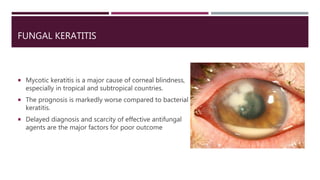
 Mycotic keratitis is a major cause of corneal blindness,
especially in tropical and subtropical countries.
 The prognosis is markedly worse compared to bacterial
keratitis.
 Delayed diagnosis and scarcity of effective antifungal
agents are the major factors for poor outcome
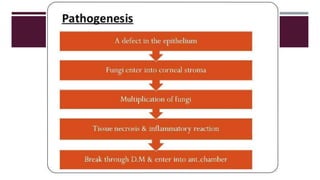
PATHOGENESIS
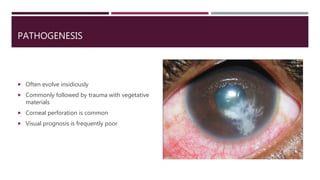
 Often evolve insidiously
 Commonly followed by trauma with vegetative
materials
 Corneal perforation is common
 Visual prognosis is frequently poor
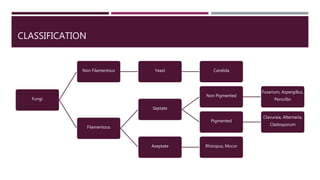
CLASSIFICATION
Fungi
Non Filamentous Yeast Candida
Filamentous
Septate
Non Pigmented
Fusarium, Aspergillus,
Penicillin
Pigmented
Clavuraia, Alternaria,
Cladosporum
Aseptate Rhizopus, Mucor
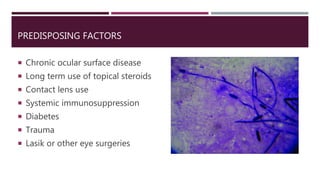
PREDISPOSING FACTORS
 Chronic ocular surface disease
 Long term use of topical steroids
 Contact lens use
 Systemic immunosuppression
 Diabetes
 Trauma
 Lasik or other eye surgeries
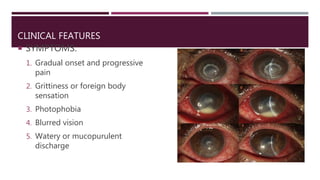
CLINICAL FEATURES
 SYMPTOMS:
1. Gradual onset and progressive
pain
2. Grittiness or foreign body
sensation
3. Photophobia
4. Blurred vision
5. Watery or mucopurulent
discharge
CLINICAL FEATURES
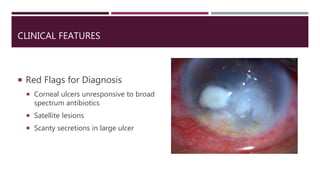
 Red Flags for Diagnosis
 Corneal ulcers unresponsive to broad
spectrum antibiotics
 Satellite lesions
 Scanty secretions in large ulcer
CLINICAL FEATURES
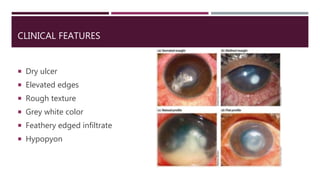
 Dry ulcer
 Elevated edges
 Rough texture
 Grey white color
 Feathery edged infiltrate
 Hypopyon
CLINICAL FEATURES
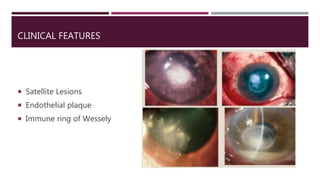
 Satellite Lesions
 Endothelial plaque
 Immune ring of Wessely
CLINICAL FEATURES
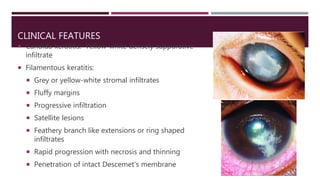
 Candida keratitis: Yellow-white densely suppurative
infiltrate
 Filamentous keratitis:
 Grey or yellow-white stromal infiltrates
 Fluffy margins
 Progressive infiltration
 Satellite lesions
 Feathery branch like extensions or ring shaped
infiltrates
 Rapid progression with necrosis and thinning
 Penetration of intact Descemet’s membrane
CLINICAL FEATURES
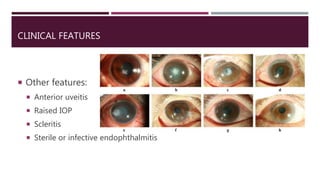
 Other features:
 Anterior uveitis
 Raised IOP
 Scleritis
 Sterile or infective endophthalmitis
INVESTIGATIONS
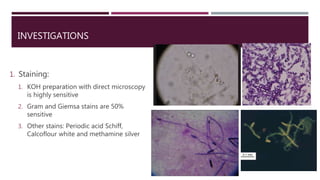
1. Staining:
1. KOH preparation with direct microscopy
is highly sensitive
2. Gram and Giemsa stains are 50%
sensitive
3. Other stains: Periodic acid Schiff,
Calcoflour white and methamine silver
INVESTIGATIONS
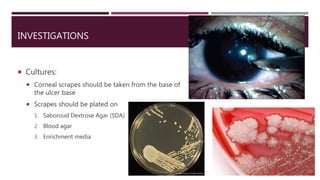
 Cultures:
 Corneal scrapes should be taken from the base of
the ulcer base
 Scrapes should be plated on
1. Saboroud Dextrose Agar (SDA)
2. Blood agar
3. Enrichment media
INVESTIGATIONS
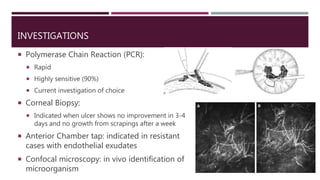
 Polymerase Chain Reaction (PCR):
 Rapid
 Highly sensitive (90%)
 Current investigation of choice
 Corneal Biopsy:
 Indicated when ulcer shows no improvement in 3-4
days and no growth from scrapings after a week
 Anterior Chamber tap: indicated in resistant
cases with endothelial exudates
 Confocal microscopy: in vivo identification of
microorganism
TREATMENT
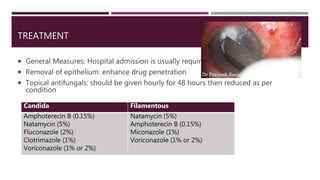
 General Measures: Hospital admission is usually required
 Removal of epithelium: enhance drug penetration
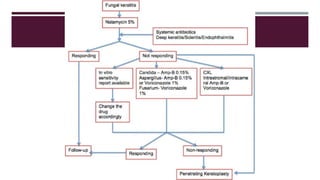
 Topical antifungals: should be given hourly for 48 hours then reduced as per
condition
Candida Filamentous
Amphoterecin B (0.15%)
Natamycin (5%)
Fluconazole (2%)
Clotrimazole (1%)
Voriconazole (1% or 2%)
Natamycin (5%)
Amphoterecin B (0.15%)
Miconazole (1%)
Voriconazole (1% or 2%)
TREATMENT
 Broad spectrum antibiotic: to prevent or address bacterial coinfection
 Cycloplegic
 Subconjunctival fluconazole 2% upto 1ml for 5 days can be administered for
severe cases
 Systemic antifungals: when lesion is near the limbus or endophthalmitis is
suspected
Drugs
Voriconazole 400mg BD D1 then 200mg
OD
Itraconazole 200mg OD
Fluconazole 200mg BD
Doxycycline 100mg BD (anticollagenase)
TREATMENT
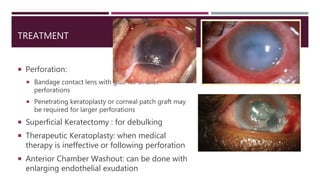
 Perforation:
 Bandage contact lens with glue for smaller
perforations
 Penetrating keratoplasty or corneal patch graft may
be required for larger perforations
 Superficial Keratectomy : for debulking
 Therapeutic Keratoplasty: when medical
therapy is ineffective or following perforation
 Anterior Chamber Washout: can be done with
enlarging endothelial exudation
RECENT ADVANCES
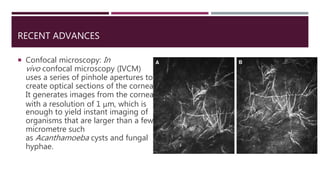
 Confocal microscopy: In
vivo confocal microscopy (IVCM)
uses a series of pinhole apertures to
create optical sections of the cornea.
It generates images from the cornea
with a resolution of 1 μm, which is
enough to yield instant imaging of
organisms that are larger than a few
micrometre such
as Acanthamoeba cysts and fungal
hyphae.
RECENT ADVANCES
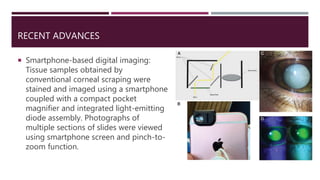
 Smartphone-based digital imaging:
Tissue samples obtained by
conventional corneal scraping were
stained and imaged using a smartphone
coupled with a compact pocket
magnifier and integrated light-emitting
diode assembly. Photographs of
multiple sections of slides were viewed
using smartphone screen and pinch-to-
zoom function.
ADVANCES IN MEDICAL MANAGEMENT
 Posaconazole: It is a new triazole, a synthetic structural analogue of itraconazole. The
mechanism of action involves blocking of the fungal cell wall ergosterol synthesis.In vitro and in
vivo studies have shown that it has broad-spectrum activity against
most Candida species, Cryptococcus neoformans, Aspergillus species, and zygomycetes.
 Echinocandins: It is a group of newer antifungals, which act by inhibiting the synthesis of 1,3-β-
d-glucan, leading to cell lysis due to increased permeability of the cell wall. Currently available
echinocandins comprise caspofungin, micafungin and anidulafungin.
 Nano particles for sustained antifungal drug delivery: Cell-penetrating peptides (CPPs) are short
peptide sequences that are able to transport molecules across the cell membrane. They are
employed to enhance extracellular and intracellular internalization of various biomolecules. This
led to an enhanced solubility of the drug in aqueous medium and increased cellular
penetrability of NTM.
ADVANCES IN SURGICAL MANAGEMENT
 Intrastromal voriconazole: Such a method of drug delivery overcomes a major limitation of
topical antifungal therapy, which is poor bioavailability of drugs in cases of deep-seated
fungal corneal ulcer. It provides a depot of drug, close to the ulcerated area, at a dose of 50
μg/0.1 ml in 5 divided doses, from where the drug is slowly released into the infected tissue.
Various studies in the literature have found targeted therapy with VCZ as an effective
approach for deep-seated recalcitrant fungal corneal infections, not responding to
conventional treatment modalities
 Intracameral amphotericin B: It is another approach that is being utilized for targeted drug
delivery. It is indicated when medical treatment with topical and systemic antifungal has
failed, especially in cases with deep mycosis, endothelial plaque and presence of hypopyon
and/or inflammation of the anterior chamber. The concentration injected, as described in
literature, ranges between 5 and 10 μg/0.1 ml.
ADVANCES IN SURGICAL MANAGEMENT
 Corneal collagen cross-linking (riboflavin with ultraviolet-A irradiation): CXL
may act in cases of mycotic keratitis by a direct antifungal effect and by
halting the ongoing melting, thus helping to avoid emergency keratoplasty.
 Rose Bengal photodynamic therapy: PDT involves the activation of
photosensitizers using light of varying wavelengths. The photosensitizer is
excited by the light and reacts with oxygen-generating ROS, which, in turn,
react with various intracellular components to cause cell death. Recently, in an
experimental study, Arboleda et al. have demonstrated RB PDT to be
successful in infectious keratitis. However, there are no clinical studies to date
to justify PDT with RB for treatment of fungal keratitis.
THANK YOU

Fungal keratitis

  • 1.
    FUNGAL KERATITIS MODERATOR: DRSWATI JAIN MA’AM PRESENTED BY: DR VAIBHAV VISHAL
  • 2.
    FUNGAL KERATITIS  Mycotickeratitis is a major cause of corneal blindness, especially in tropical and subtropical countries.  The prognosis is markedly worse compared to bacterial keratitis.  Delayed diagnosis and scarcity of effective antifungal agents are the major factors for poor outcome
  • 3.
    PATHOGENESIS  Often evolveinsidiously  Commonly followed by trauma with vegetative materials  Corneal perforation is common  Visual prognosis is frequently poor
  • 5.
    CLASSIFICATION Fungi Non Filamentous YeastCandida Filamentous Septate Non Pigmented Fusarium, Aspergillus, Penicillin Pigmented Clavuraia, Alternaria, Cladosporum Aseptate Rhizopus, Mucor
  • 6.
    PREDISPOSING FACTORS  Chronicocular surface disease  Long term use of topical steroids  Contact lens use  Systemic immunosuppression  Diabetes  Trauma  Lasik or other eye surgeries
  • 7.
    CLINICAL FEATURES  SYMPTOMS: 1.Gradual onset and progressive pain 2. Grittiness or foreign body sensation 3. Photophobia 4. Blurred vision 5. Watery or mucopurulent discharge
  • 8.
    CLINICAL FEATURES  RedFlags for Diagnosis  Corneal ulcers unresponsive to broad spectrum antibiotics  Satellite lesions  Scanty secretions in large ulcer
  • 9.
    CLINICAL FEATURES  Dryulcer  Elevated edges  Rough texture  Grey white color  Feathery edged infiltrate  Hypopyon
  • 10.
    CLINICAL FEATURES  SatelliteLesions  Endothelial plaque  Immune ring of Wessely
  • 11.
    CLINICAL FEATURES  Candidakeratitis: Yellow-white densely suppurative infiltrate  Filamentous keratitis:  Grey or yellow-white stromal infiltrates  Fluffy margins  Progressive infiltration  Satellite lesions  Feathery branch like extensions or ring shaped infiltrates  Rapid progression with necrosis and thinning  Penetration of intact Descemet’s membrane
  • 12.
    CLINICAL FEATURES  Otherfeatures:  Anterior uveitis  Raised IOP  Scleritis  Sterile or infective endophthalmitis
  • 13.
    INVESTIGATIONS 1. Staining: 1. KOHpreparation with direct microscopy is highly sensitive 2. Gram and Giemsa stains are 50% sensitive 3. Other stains: Periodic acid Schiff, Calcoflour white and methamine silver
  • 14.
    INVESTIGATIONS  Cultures:  Cornealscrapes should be taken from the base of the ulcer base  Scrapes should be plated on 1. Saboroud Dextrose Agar (SDA) 2. Blood agar 3. Enrichment media
  • 15.
    INVESTIGATIONS  Polymerase ChainReaction (PCR):  Rapid  Highly sensitive (90%)  Current investigation of choice  Corneal Biopsy:  Indicated when ulcer shows no improvement in 3-4 days and no growth from scrapings after a week  Anterior Chamber tap: indicated in resistant cases with endothelial exudates  Confocal microscopy: in vivo identification of microorganism
  • 16.
    TREATMENT  General Measures:Hospital admission is usually required  Removal of epithelium: enhance drug penetration  Topical antifungals: should be given hourly for 48 hours then reduced as per condition Candida Filamentous Amphoterecin B (0.15%) Natamycin (5%) Fluconazole (2%) Clotrimazole (1%) Voriconazole (1% or 2%) Natamycin (5%) Amphoterecin B (0.15%) Miconazole (1%) Voriconazole (1% or 2%)
  • 17.
    TREATMENT  Broad spectrumantibiotic: to prevent or address bacterial coinfection  Cycloplegic  Subconjunctival fluconazole 2% upto 1ml for 5 days can be administered for severe cases  Systemic antifungals: when lesion is near the limbus or endophthalmitis is suspected Drugs Voriconazole 400mg BD D1 then 200mg OD Itraconazole 200mg OD Fluconazole 200mg BD Doxycycline 100mg BD (anticollagenase)
  • 18.
    TREATMENT  Perforation:  Bandagecontact lens with glue for smaller perforations  Penetrating keratoplasty or corneal patch graft may be required for larger perforations  Superficial Keratectomy : for debulking  Therapeutic Keratoplasty: when medical therapy is ineffective or following perforation  Anterior Chamber Washout: can be done with enlarging endothelial exudation
  • 19.
    RECENT ADVANCES  Confocalmicroscopy: In vivo confocal microscopy (IVCM) uses a series of pinhole apertures to create optical sections of the cornea. It generates images from the cornea with a resolution of 1 μm, which is enough to yield instant imaging of organisms that are larger than a few micrometre such as Acanthamoeba cysts and fungal hyphae.
  • 20.
    RECENT ADVANCES  Smartphone-baseddigital imaging: Tissue samples obtained by conventional corneal scraping were stained and imaged using a smartphone coupled with a compact pocket magnifier and integrated light-emitting diode assembly. Photographs of multiple sections of slides were viewed using smartphone screen and pinch-to- zoom function.
  • 21.
    ADVANCES IN MEDICALMANAGEMENT  Posaconazole: It is a new triazole, a synthetic structural analogue of itraconazole. The mechanism of action involves blocking of the fungal cell wall ergosterol synthesis.In vitro and in vivo studies have shown that it has broad-spectrum activity against most Candida species, Cryptococcus neoformans, Aspergillus species, and zygomycetes.  Echinocandins: It is a group of newer antifungals, which act by inhibiting the synthesis of 1,3-β- d-glucan, leading to cell lysis due to increased permeability of the cell wall. Currently available echinocandins comprise caspofungin, micafungin and anidulafungin.  Nano particles for sustained antifungal drug delivery: Cell-penetrating peptides (CPPs) are short peptide sequences that are able to transport molecules across the cell membrane. They are employed to enhance extracellular and intracellular internalization of various biomolecules. This led to an enhanced solubility of the drug in aqueous medium and increased cellular penetrability of NTM.
  • 22.
    ADVANCES IN SURGICALMANAGEMENT  Intrastromal voriconazole: Such a method of drug delivery overcomes a major limitation of topical antifungal therapy, which is poor bioavailability of drugs in cases of deep-seated fungal corneal ulcer. It provides a depot of drug, close to the ulcerated area, at a dose of 50 μg/0.1 ml in 5 divided doses, from where the drug is slowly released into the infected tissue. Various studies in the literature have found targeted therapy with VCZ as an effective approach for deep-seated recalcitrant fungal corneal infections, not responding to conventional treatment modalities  Intracameral amphotericin B: It is another approach that is being utilized for targeted drug delivery. It is indicated when medical treatment with topical and systemic antifungal has failed, especially in cases with deep mycosis, endothelial plaque and presence of hypopyon and/or inflammation of the anterior chamber. The concentration injected, as described in literature, ranges between 5 and 10 μg/0.1 ml.
  • 23.
    ADVANCES IN SURGICALMANAGEMENT  Corneal collagen cross-linking (riboflavin with ultraviolet-A irradiation): CXL may act in cases of mycotic keratitis by a direct antifungal effect and by halting the ongoing melting, thus helping to avoid emergency keratoplasty.  Rose Bengal photodynamic therapy: PDT involves the activation of photosensitizers using light of varying wavelengths. The photosensitizer is excited by the light and reacts with oxygen-generating ROS, which, in turn, react with various intracellular components to cause cell death. Recently, in an experimental study, Arboleda et al. have demonstrated RB PDT to be successful in infectious keratitis. However, there are no clinical studies to date to justify PDT with RB for treatment of fungal keratitis.
  • 25.