THE MEANING AND
SCOPE OF SCHOOL
ADMINISTRATION
AND SUPERVISION
Administration and
Supervision Defined
The word administration ordinarily connotes the
machinery of an organization and its functions.
It refers in general to the plan of organization
and how such organization is controlled and
operated. It involves direction, control, and
operation of the organizational activities to
accomplish the desired aims and objectives.
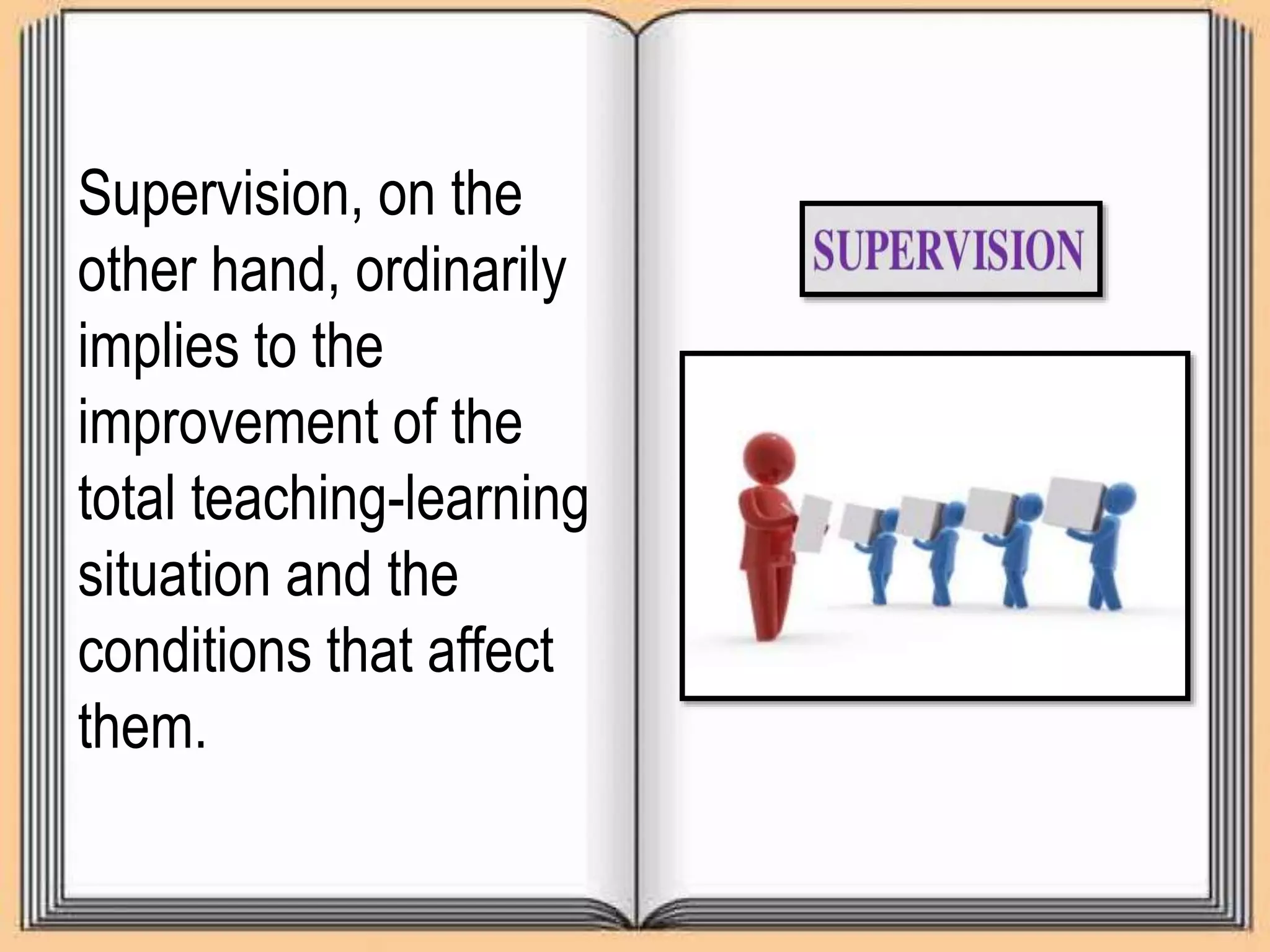
Supervision, on the
other hand, ordinarily
implies to the
improvement of the
total teaching-learning
situation and the
conditions that affect
them.
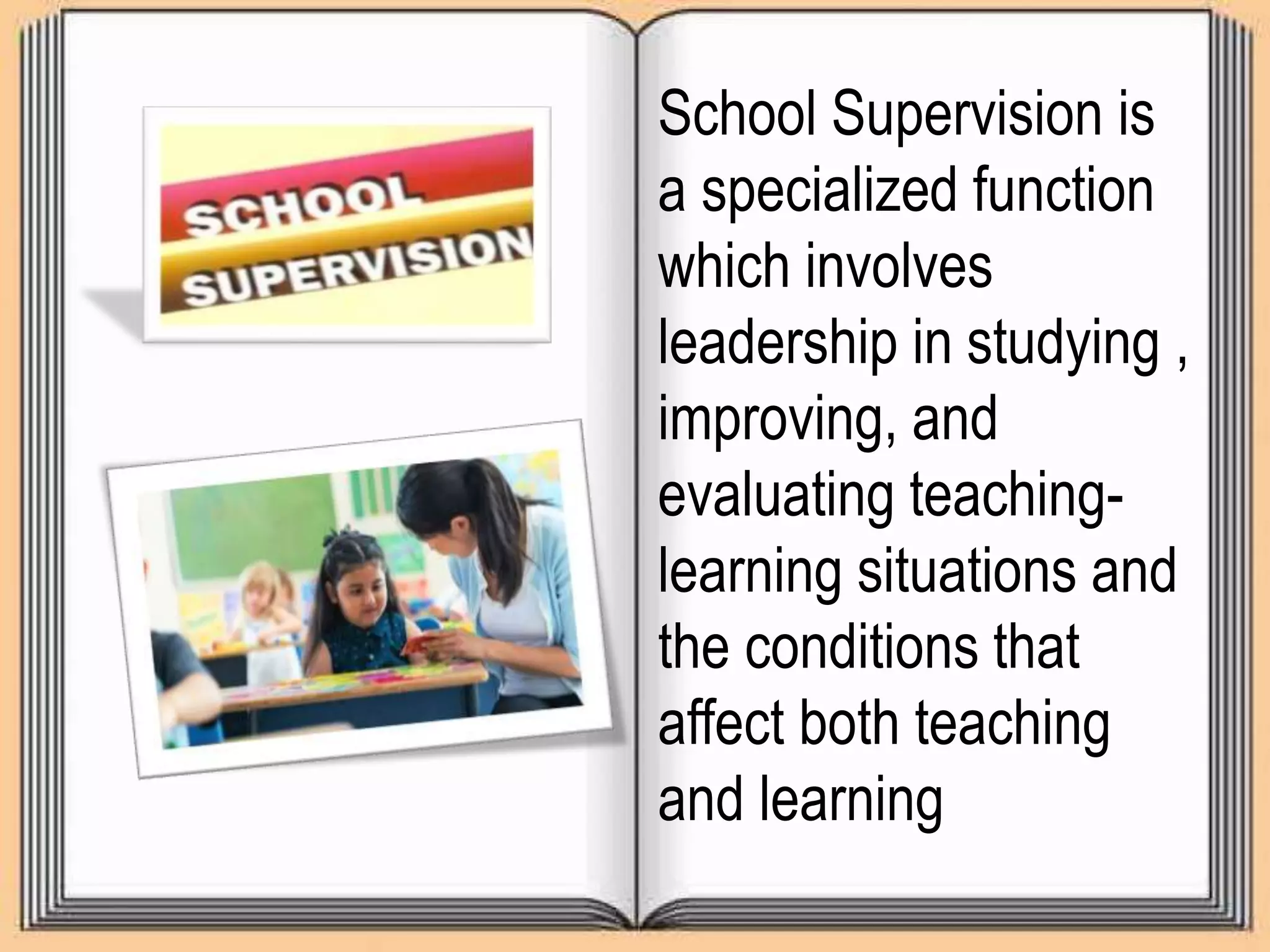
School Supervision is
a specialized function
which involves
leadership in studying ,
improving, and
evaluating teaching-
learning situations and
the conditions that
affect both teaching
and learning
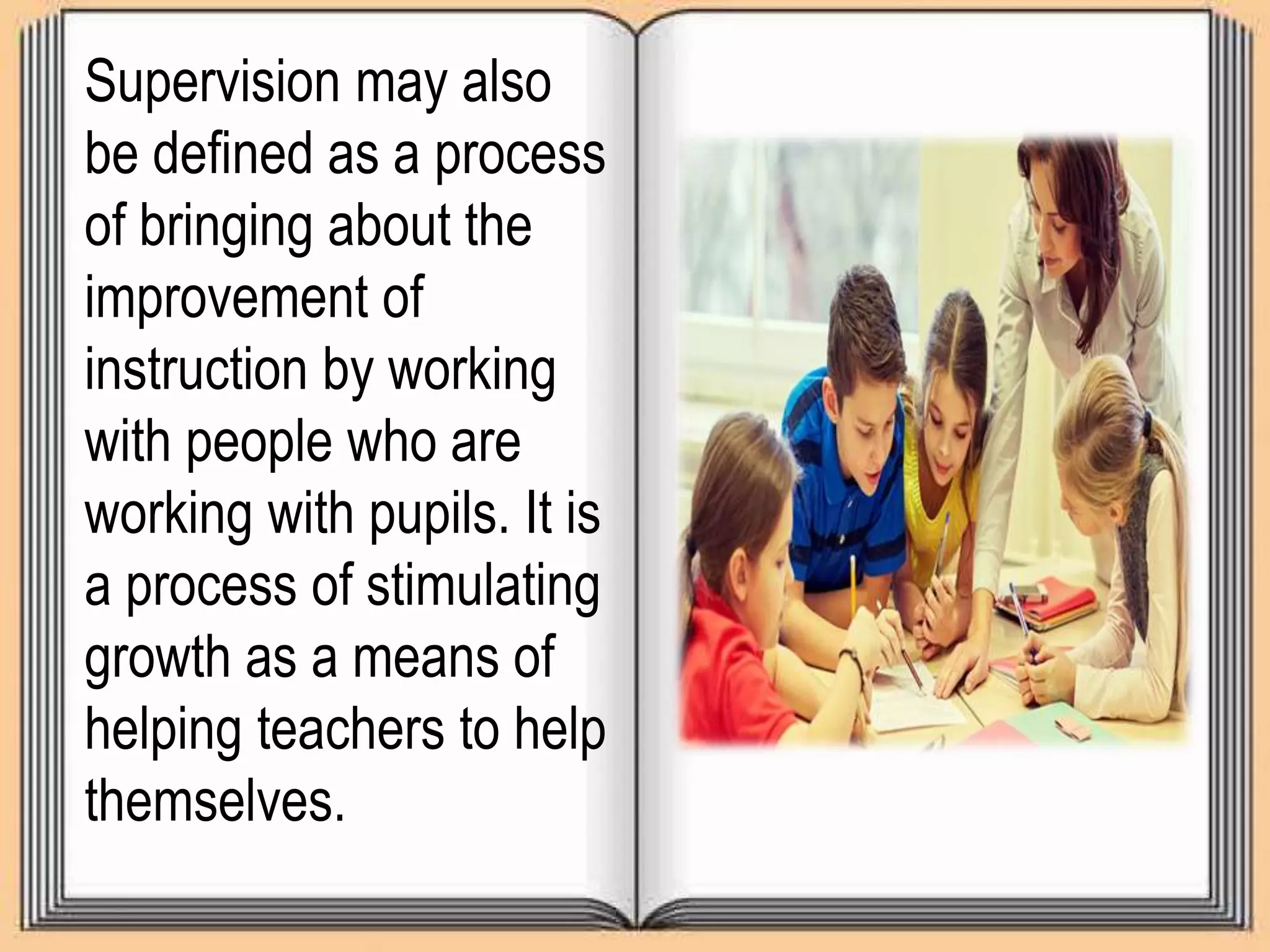
Supervision may also
be defined as a process
of bringing about the
improvement of
instruction by working
with people who are
working with pupils. It is
a process of stimulating
growth as a means of
helping teachers to help
themselves.
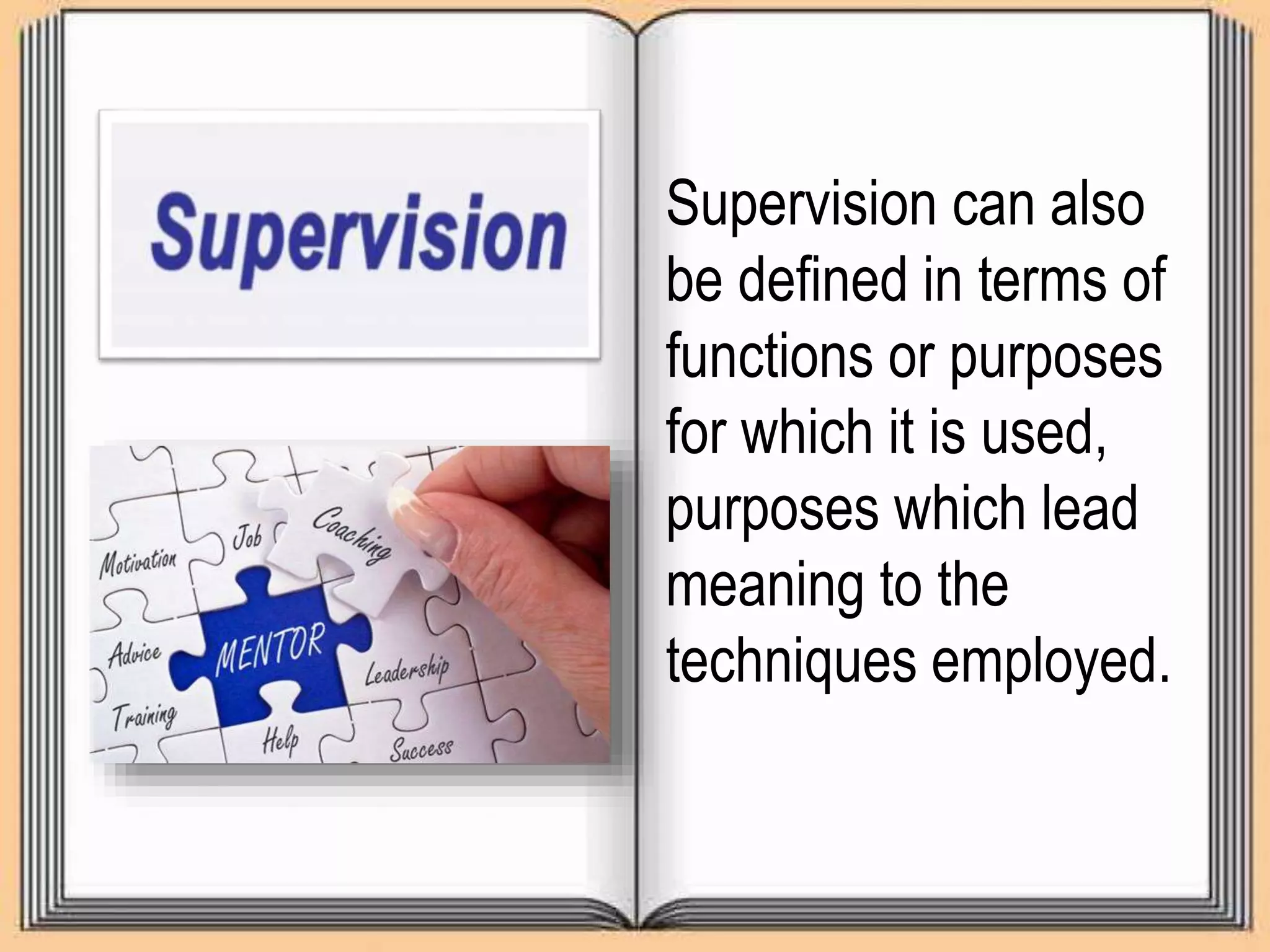
Supervision can also
be defined in terms of
functions or purposes
for which it is used,
purposes which lead
meaning to the
techniques employed.
From the major
divisions of his
textbook, Wiles
discusses supervision
as: (1) skill in
leadership, (2) skill in
human relation, (3)
skills in group process,
(4) skill in personnel
administration, and (5)
skill in evaluation.
FUNCTIONS OF
SCHOOL
ADMINISTRATION
AND SUPERVISION
Meaning of Function
• The term function as used in
education may mean the purpose
or activity to be accomplished by
creative educative process. The
term applies to education as a
whole, to a unit of a school system,
or to some activities carried on by
the school.
• Function are fulfilled by providing
some ends or goals. The school can
achieve the administrative and
supervisory functions. The functions
of the school are oftentimes
determined by its organization and
classroom practices.
The Functions of
School Administration
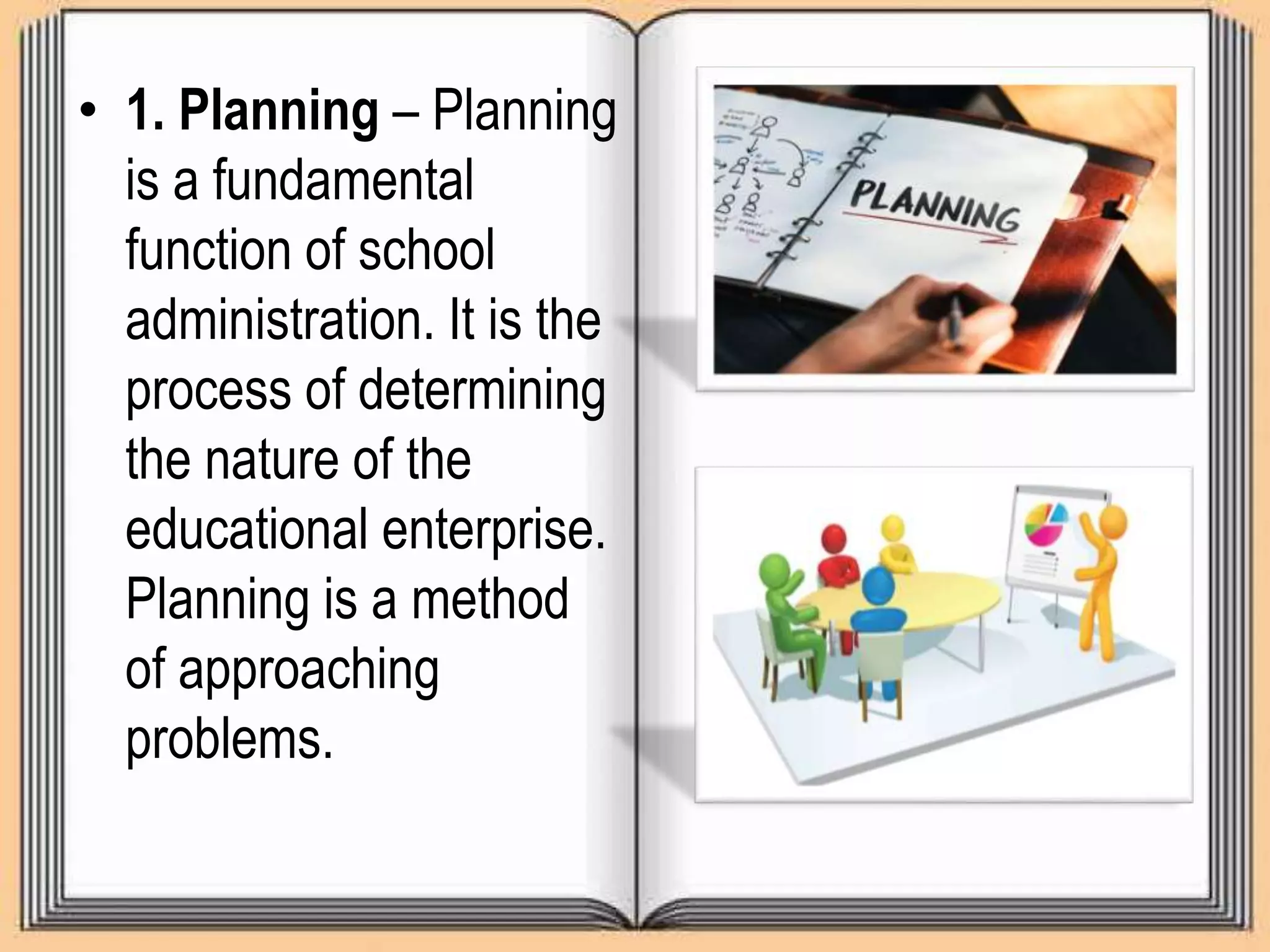
• 1. Planning – Planning
is a fundamental
function of school
administration. It is the
process of determining
the nature of the
educational enterprise.
Planning is a method
of approaching
problems.
• It is examining
problems to be done,
gathering information
on them, determining
alternate courses of
action, and making
decisions about how
the problems should
be solved.
• Planning as a function
of school
administration may be
defined as the activity
of devising and
selecting courses of
action directed toward
the achievement of
educational goals and
objectives.
• 2. Organizing – The
function of
organizing can be
thought of in several
ways. It may be
thought of as
structuring. As such,
it primarily involves
placing job materials,
and ideas in a
structure.
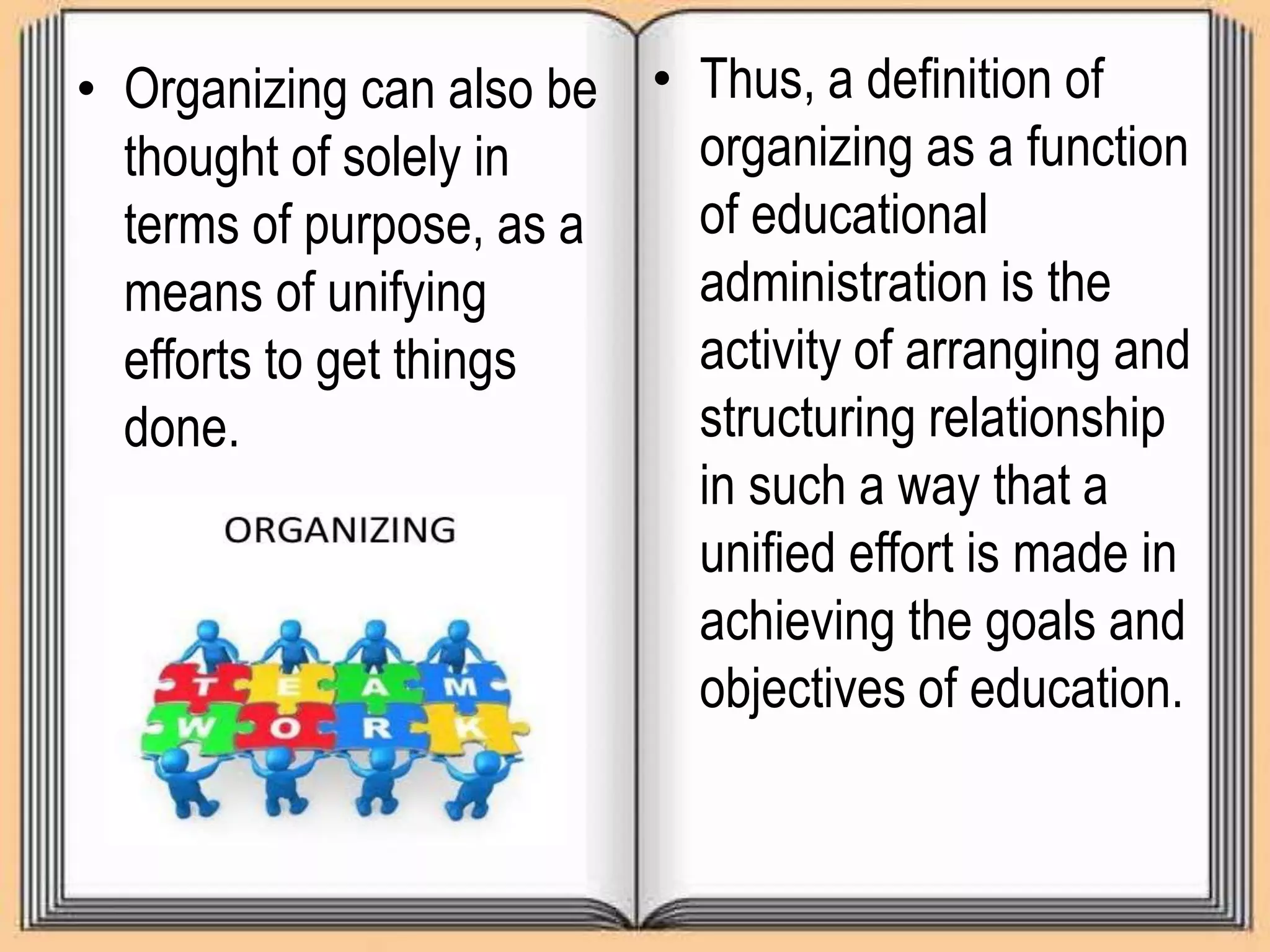
• Organizing can also be
thought of solely in
terms of purpose, as a
means of unifying
efforts to get things
done.
• Thus, a definition of
organizing as a function
of educational
administration is the
activity of arranging and
structuring relationship
in such a way that a
unified effort is made in
achieving the goals and
objectives of education.
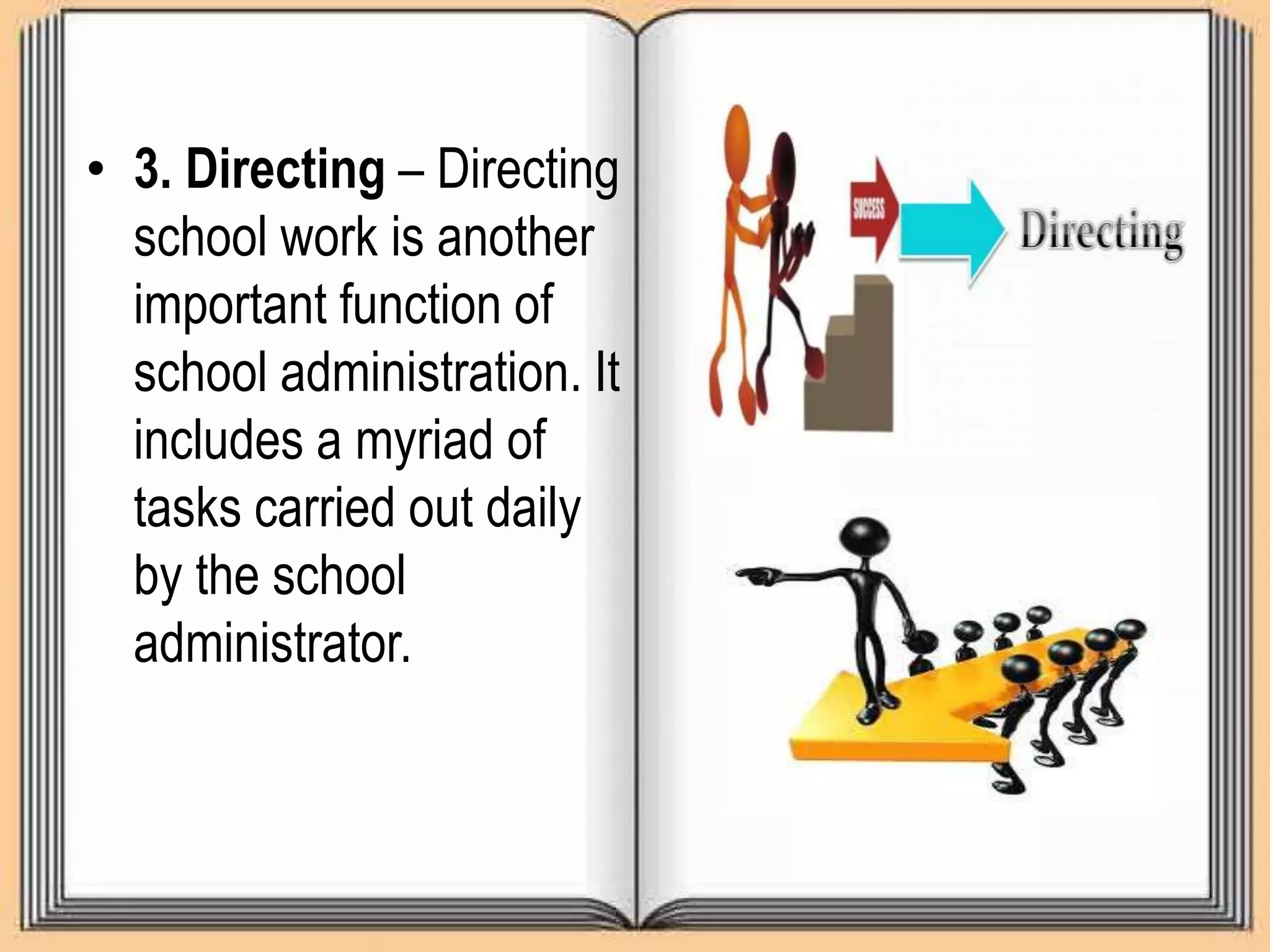
• 3. Directing – Directing
school work is another
important function of
school administration. It
includes a myriad of
tasks carried out daily
by the school
administrator.
• It involves decisions as
to who shall carry out
plans; determination of
the subjects to be
included in each
courses; provision for
physical equipment
necessary to carry out
the work and many
similar acts involved in
carrying out all aspects
of the educational
program.
• It may necessitate
issuing orders, holding
conferences, and
supervising activities.
Direction is a major
aspect of execution,
and is particularly the
province of school
administration.
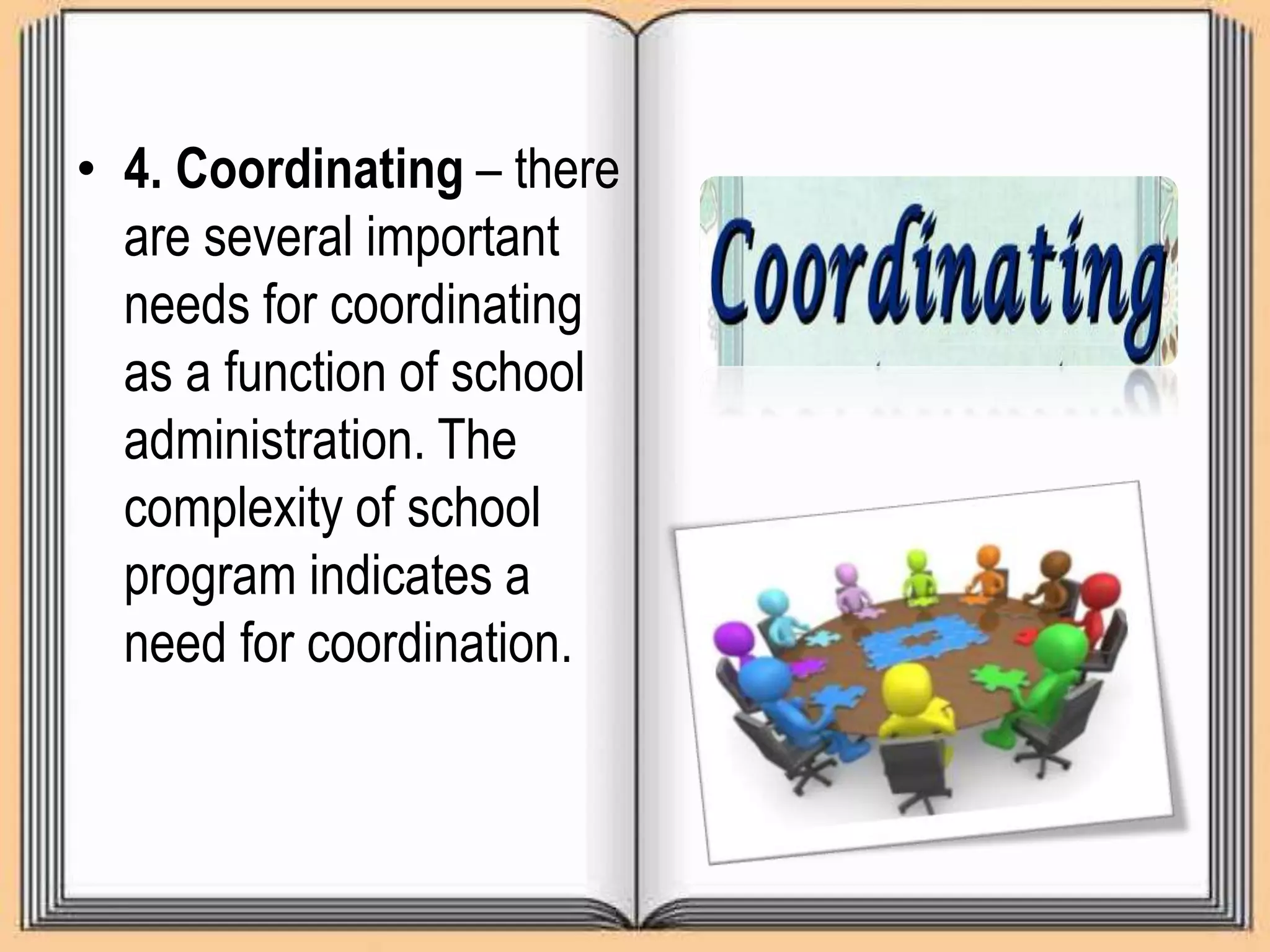
• 4. Coordinating – there
are several important
needs for coordinating
as a function of school
administration. The
complexity of school
program indicates a
need for coordination.
• Coordination is needed
to overcome the
limitations of planning
and organizing as well
as the inherent
limitation of personnel.
• The function of
coordinating may be
defined as the activity
of bringing people,
materials, ideas, and
techniques, and
purposes productive
relationship.
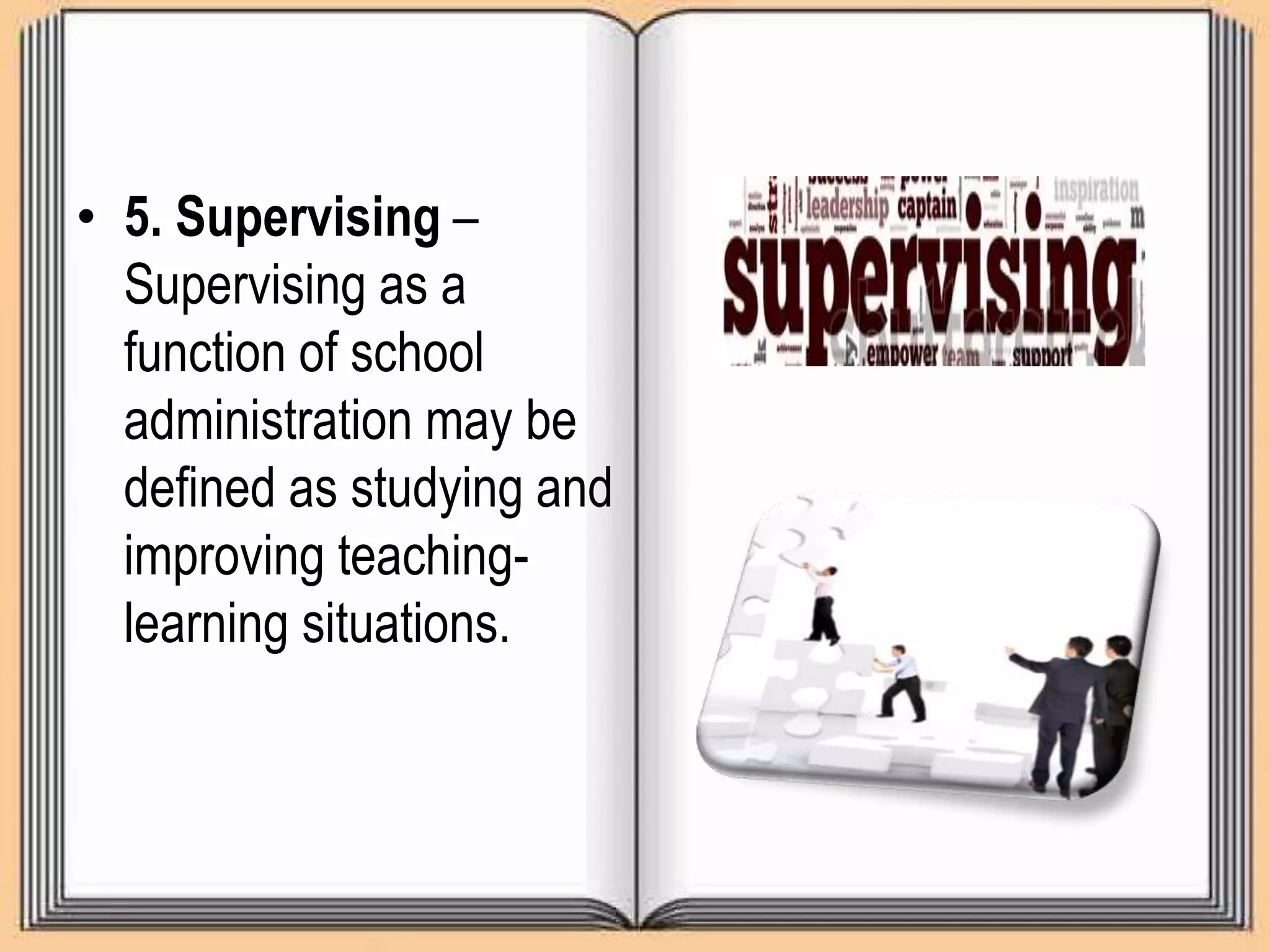
• 5. Supervising –
Supervising as a
function of school
administration may be
defined as studying and
improving teaching-
learning situations.
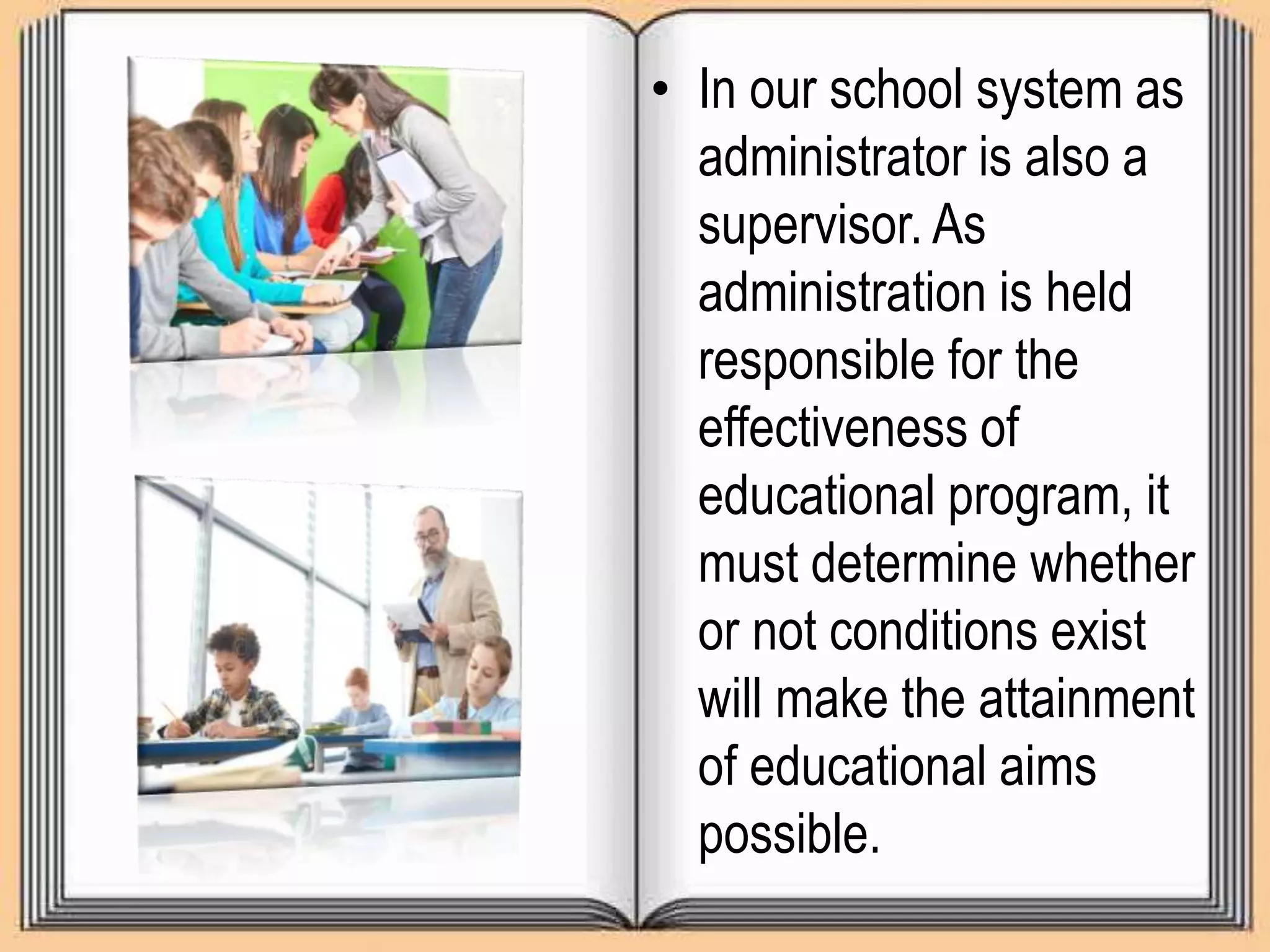
• In our school system as
administrator is also a
supervisor. As
administration is held
responsible for the
effectiveness of
educational program, it
must determine whether
or not conditions exist
will make the attainment
of educational aims
possible.
• 6. Evaluating –
Educational
administration in action
must include evaluation.
Administration is
concerned with the
efficiency with the
enterprise attempts to
achieve its purposes.
• Evaluating as a function
of school
administration, is simply
determining how well
educational purposes
have been achieved.
• 7. Providing
Leadership – In the
operation of the school
system, the
administrator or the
chief executive of any
school should be the
professional leader of
the teaching staff,
working scientifically,
conscientiously, and
democratically.
• An efficient
administrator exercises
the necessary authority
and definite
responsibility to insure
educational leadership.
On him depends the
success of the school
organization clothed
with the necessary
authority and definite
responsibility.
• 8. Recording and
Reporting – Recording
and reporting are
administrative functions
to insure results with a
maximum delegation of
authority. School
records should be kept
for comparison and
evaluation purposes.
• No content should go
into records for which
no real use is likely to
arise. Registering the
I.Q of the pupils, for
example, is wasteful
unless some use is
made of the results.
• A well-devised set of
records requires the
setting up of
administrative
objectives and provides
the gathering of
information which
enables the
administrator to
determine the extent to
which these objectives
are being achieved.
• 9. Promoting Close
School-Community
Relationship –
Promoting closer
relationship between
the school and the
community is an
important function of
school administration
and supervision.
• Education to be
effective, must be
administered and
supervised in an
atmosphere of
sympathy and
understanding between
the school personnel
and the public.
• School administrators
and supervisors are
gradually awakening to
the fact that the school
program itself is the
biggest factor in
building good school-
community relations.
• If the people are
satisfied that children
are getting an excellent
education, their
enthusiasm will be
great. It cannot be
denied that the best
school publicity stems
from a strong school
program.
The Major
Functions of
Supervision
• 1. Inspection – The term
refers to the study of
existing school
conditions. The first task
of a supervisor is to
survey the school system
in order to discover
problems or defects of
the pupils, teachers,
equipment, school
curriculum, objectives
and methods of
instruction, together with
the conditions that
surround them.
• Problems or defects
may be discovered
through actual
observations,
educational tests,
conferences,
questionnaires, and
check lists. Once
discovered they should
be classified into major
and minor problems.
• The major defects
should be formulated
into supervisory
objectives to be
attained for the
semester or for the year
of course or years.
Inspection as a function
must be based on
actual facts.
• 2. Research – Pure
research has its place
in supervision as well
as in science. The
fundamental aim of this
function is formulate a
plan to remedy the
weakness or to solve
the problem discovered.
• The supervisor should
conduct research to
discover means,
methods, and procedures
fundamental to the
success of supervision.
The solutions discovered
through research should
be passes on to the
teachers and other
personnel connected with
the school system.
• Teachers in the field
should also be
encouraged to conduct
their own research for
self-improvement.
Research, as a function
should be practical and
applicable to existing
procedures and
conditions.
• 3. Training –
Acquainting the
teachers with the
solutions discovered or
formulated through
research is within the
training function of
supervision.
• Training may take the
form of demonstration
teaching, workshop,
seminars, directed
observation, individual
or group conference,
intervisitation,
professional classes, or
the use of bulletins and
circulars.
• Writing suggestions in
B.P.S Form 178 is
another device used in
the field to train
teachers in service.
Training function must
be based on the
democratic principle of
supervision – respect
for rights and opinions
of others.
• Supervision must
endeavor to keep up
with the best prevailing
standard of improving
the total teaching
learning situation.
• 4. Guidance – The
concept of guidance
has found expression in
the field of school
supervision. Guidance
involves personal help
given by someone.
• It is the function of
supervision to stimulate,
direct, guide, and
encourage the teachers
to apply instructional
procedures, techniques,
principles, and devices.
• Assisting the teacher to
accomplish his purpose
and to solve the
problems that arise in
his teaching are within
the scope and guidance
function. Guidance, like
training, should be
given in the spirit of
democratic leadership.
• Guidance, like training,
should be given in the
spirit of democratic
leadership.
• 5. Evaluation – This
can be considered the
ultimate major function
of supervision. The
purpose of evaluation is
to appraise the
outcomes and the
factors conditioning the
outcomes of instruction,
and to improve the
products and processes
of instruction.
• This function is calls for
the use of educational
tests and measurement.
• It is the duty of the
supervisor to help
develop an adequate
instrument with which to
measure the teaching-
learning process and
set up standards of
attainment as are
necessary for the
appraisal of the
teacher’s progress in
teaching, and the pupil
in his learning.
THE-MEANING-AND-SCOPE-OF-SCHOOL-ADMINISTRATION-AND-SUPERVISION-2.pptx

THE-MEANING-AND-SCOPE-OF-SCHOOL-ADMINISTRATION-AND-SUPERVISION-2.pptx

  • 1.
    THE MEANING AND SCOPEOF SCHOOL ADMINISTRATION AND SUPERVISION
  • 2.
    Administration and Supervision Defined Theword administration ordinarily connotes the machinery of an organization and its functions. It refers in general to the plan of organization and how such organization is controlled and operated. It involves direction, control, and operation of the organizational activities to accomplish the desired aims and objectives.
  • 3.
    Supervision, on the otherhand, ordinarily implies to the improvement of the total teaching-learning situation and the conditions that affect them.
  • 4.
    School Supervision is aspecialized function which involves leadership in studying , improving, and evaluating teaching- learning situations and the conditions that affect both teaching and learning
  • 5.
    Supervision may also bedefined as a process of bringing about the improvement of instruction by working with people who are working with pupils. It is a process of stimulating growth as a means of helping teachers to help themselves.
  • 6.
    Supervision can also bedefined in terms of functions or purposes for which it is used, purposes which lead meaning to the techniques employed.
  • 7.
    From the major divisionsof his textbook, Wiles discusses supervision as: (1) skill in leadership, (2) skill in human relation, (3) skills in group process, (4) skill in personnel administration, and (5) skill in evaluation.
  • 8.
  • 9.
    Meaning of Function •The term function as used in education may mean the purpose or activity to be accomplished by creative educative process. The term applies to education as a whole, to a unit of a school system, or to some activities carried on by the school.
  • 10.
    • Function arefulfilled by providing some ends or goals. The school can achieve the administrative and supervisory functions. The functions of the school are oftentimes determined by its organization and classroom practices.
  • 11.
  • 12.
    • 1. Planning– Planning is a fundamental function of school administration. It is the process of determining the nature of the educational enterprise. Planning is a method of approaching problems.
  • 13.
    • It isexamining problems to be done, gathering information on them, determining alternate courses of action, and making decisions about how the problems should be solved.
  • 14.
    • Planning asa function of school administration may be defined as the activity of devising and selecting courses of action directed toward the achievement of educational goals and objectives.
  • 15.
    • 2. Organizing– The function of organizing can be thought of in several ways. It may be thought of as structuring. As such, it primarily involves placing job materials, and ideas in a structure.
  • 16.
    • Organizing canalso be thought of solely in terms of purpose, as a means of unifying efforts to get things done. • Thus, a definition of organizing as a function of educational administration is the activity of arranging and structuring relationship in such a way that a unified effort is made in achieving the goals and objectives of education.
  • 17.
    • 3. Directing– Directing school work is another important function of school administration. It includes a myriad of tasks carried out daily by the school administrator.
  • 18.
    • It involvesdecisions as to who shall carry out plans; determination of the subjects to be included in each courses; provision for physical equipment necessary to carry out the work and many similar acts involved in carrying out all aspects of the educational program. • It may necessitate issuing orders, holding conferences, and supervising activities. Direction is a major aspect of execution, and is particularly the province of school administration.
  • 19.
    • 4. Coordinating– there are several important needs for coordinating as a function of school administration. The complexity of school program indicates a need for coordination.
  • 20.
    • Coordination isneeded to overcome the limitations of planning and organizing as well as the inherent limitation of personnel. • The function of coordinating may be defined as the activity of bringing people, materials, ideas, and techniques, and purposes productive relationship.
  • 21.
    • 5. Supervising– Supervising as a function of school administration may be defined as studying and improving teaching- learning situations.
  • 22.
    • In ourschool system as administrator is also a supervisor. As administration is held responsible for the effectiveness of educational program, it must determine whether or not conditions exist will make the attainment of educational aims possible.
  • 23.
    • 6. Evaluating– Educational administration in action must include evaluation. Administration is concerned with the efficiency with the enterprise attempts to achieve its purposes. • Evaluating as a function of school administration, is simply determining how well educational purposes have been achieved.
  • 24.
    • 7. Providing Leadership– In the operation of the school system, the administrator or the chief executive of any school should be the professional leader of the teaching staff, working scientifically, conscientiously, and democratically.
  • 25.
    • An efficient administratorexercises the necessary authority and definite responsibility to insure educational leadership. On him depends the success of the school organization clothed with the necessary authority and definite responsibility.
  • 26.
    • 8. Recordingand Reporting – Recording and reporting are administrative functions to insure results with a maximum delegation of authority. School records should be kept for comparison and evaluation purposes.
  • 27.
    • No contentshould go into records for which no real use is likely to arise. Registering the I.Q of the pupils, for example, is wasteful unless some use is made of the results. • A well-devised set of records requires the setting up of administrative objectives and provides the gathering of information which enables the administrator to determine the extent to which these objectives are being achieved.
  • 28.
    • 9. PromotingClose School-Community Relationship – Promoting closer relationship between the school and the community is an important function of school administration and supervision.
  • 29.
    • Education tobe effective, must be administered and supervised in an atmosphere of sympathy and understanding between the school personnel and the public. • School administrators and supervisors are gradually awakening to the fact that the school program itself is the biggest factor in building good school- community relations.
  • 30.
    • If thepeople are satisfied that children are getting an excellent education, their enthusiasm will be great. It cannot be denied that the best school publicity stems from a strong school program.
  • 31.
  • 32.
    • 1. Inspection– The term refers to the study of existing school conditions. The first task of a supervisor is to survey the school system in order to discover problems or defects of the pupils, teachers, equipment, school curriculum, objectives and methods of instruction, together with the conditions that surround them.
  • 33.
    • Problems ordefects may be discovered through actual observations, educational tests, conferences, questionnaires, and check lists. Once discovered they should be classified into major and minor problems. • The major defects should be formulated into supervisory objectives to be attained for the semester or for the year of course or years. Inspection as a function must be based on actual facts.
  • 34.
    • 2. Research– Pure research has its place in supervision as well as in science. The fundamental aim of this function is formulate a plan to remedy the weakness or to solve the problem discovered.
  • 35.
    • The supervisorshould conduct research to discover means, methods, and procedures fundamental to the success of supervision. The solutions discovered through research should be passes on to the teachers and other personnel connected with the school system. • Teachers in the field should also be encouraged to conduct their own research for self-improvement. Research, as a function should be practical and applicable to existing procedures and conditions.
  • 36.
    • 3. Training– Acquainting the teachers with the solutions discovered or formulated through research is within the training function of supervision.
  • 37.
    • Training maytake the form of demonstration teaching, workshop, seminars, directed observation, individual or group conference, intervisitation, professional classes, or the use of bulletins and circulars.
  • 38.
    • Writing suggestionsin B.P.S Form 178 is another device used in the field to train teachers in service. Training function must be based on the democratic principle of supervision – respect for rights and opinions of others. • Supervision must endeavor to keep up with the best prevailing standard of improving the total teaching learning situation.
  • 39.
    • 4. Guidance– The concept of guidance has found expression in the field of school supervision. Guidance involves personal help given by someone.
  • 40.
    • It isthe function of supervision to stimulate, direct, guide, and encourage the teachers to apply instructional procedures, techniques, principles, and devices.
  • 41.
    • Assisting theteacher to accomplish his purpose and to solve the problems that arise in his teaching are within the scope and guidance function. Guidance, like training, should be given in the spirit of democratic leadership. • Guidance, like training, should be given in the spirit of democratic leadership.
  • 42.
    • 5. Evaluation– This can be considered the ultimate major function of supervision. The purpose of evaluation is to appraise the outcomes and the factors conditioning the outcomes of instruction, and to improve the products and processes of instruction.
  • 43.
    • This functionis calls for the use of educational tests and measurement. • It is the duty of the supervisor to help develop an adequate instrument with which to measure the teaching- learning process and set up standards of attainment as are necessary for the appraisal of the teacher’s progress in teaching, and the pupil in his learning.