MOTOR RELEARNING
PROGRAMME
Dr.I Mohamed Shafiulla M.P.T.,(Ph.D)
School of Physiotherapy,SBV,Puducherry
INTRODUCTION
 A motor relearning program is a rehabilitation training focusing on motor
function recovery post central nervous system injury due to damage to
higher centers leads to loss of dynamic and incapable of reorganization and
adaptation following injury to the brain or spinal cord.
 Retraining of motor control basing on understanding of normal movement
and analysis of motor dysfunction
 Emphasis of MRP is on practice of specific activities the training of cognitive
control over muscles and movement .Components of activities and
conscious elimination of unnecessary motor activities.
 Training the specific muscle control and functional training is emphasized.
 No facilitation or inhibition of tone.
 It is a Task oriented approach.
MRP is based on three major factors
 1.Elimination of unnecessary muscle activity
 2.Feedback
 3.Practice
For effective use of MRP therapist should have the
following problem solving skill i.e recognition
 Analysis
 Decision making
 Action taking
 Re evaluation
Effectiveness of MRP
 Recognition and analysis the problem
 Select patient most essential missing components
 Explain clearly to the patient by speech and
demonstration
 Monitor the patients performance and give verbal
feedback
 Reevaluate throughout each session
 Positive feedback
 Provide an enriched environment in which patient
will be motivated towards recovery of mental and
physical abilities
Sections of MRP
 Sections represent in the essential functions of
everyday life
 Upper limb function
 Orofacial function
 Sitting up from supine
 Sitting
 Standing up and sitting down
 Standing
 walking
STEPS IN MRP
 STEP 1: Analysis of function
*Observation
*Comparison
*Analysis
 STEP 2: Practice of missing component
*Explanation and Instructions
*Practice (Verbal feedback and Manual guidance)
 STEP 3: Practice of Activity
*Progression in step 2 : Increase complexity, Add
variety ,decrease feedback and guidance
 STEP 4: Transference of learning
*Opportunity to practice
*Consistency of practice
*Positive reinforcement
*Stimulating environment
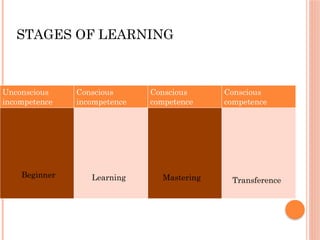
STAGES OF LEARNING
Unconscious
incompetence
Conscious
incompetence
Conscious
competence
Conscious
competence
Beginner Learning Mastering Transference
IMPORTANT POINTS TO BE CONSIDERED
 Activities or motor tasks are either practiced
entirely or they are broken down into
components, practice of each component being
followed immediately by practice of the entire
activity.
 Techniques comprises of VERBAL and VISUAL
feedback and INSTRUCTION and MANUAL
GUIDANCE.
 Method of progression- should not waste time in
practicing what he/she can do.
UPPER LIMB FUNCTION
 Most daily activities includes complex movements of
Upper limb.
 Some pre – requisites for effective use of upper limb
*The ability to look at what one is doing
*Ability to make the postural adjustments which
occur with arm movement and which free the hands
for manipulation
*Sensory discrimination(Combined cortical
sensations)
ESSENTIAL COMPONENTS OF ARM
 Shoulder abduction
 Shoulder forward flexion
 Elbow flexion and extension
ESSENTIAL COMPONENTS OF HAND
Major function of hand is to GRASP, RELEASE
AND Manipulate objects.
The essential components :
 Radial deviation with wrist extension
 Wrist extension while holding an object
 Palmar abduction and rotation at the
carpometacarpal joint of thumb
 Flexion of fingers towards the thumb
 Extension of MCP joints
 Supination of forearm while holding an object
STEP 1 - ANALYSIS
ARM:
 Poor scapular movement
 Poor muscular control of GH joint
 Excessive elbow flexion ,IR of shoulder and Pronation
of forearm.
HAND :
 Difficulty grasping
 Difficulty extending the MCP joints
 Inability to release an object
 Tendency to pronate the forearm
 Excessive ulnar deviation
 Difficulty cupping hand
STEP 2 & 3 – PRACTICE OF TASK
Two important factors to consider in the stimulation of
Upper limb function :
 Leverage
 Pull of gravity
 Motor activity can be initiated early with the patient in
SUPINE with his arm in ELEVATION.
 Muscles must not be allowed to contract incorrectly.
 The patient should not be allowed to encourage to
practice movements which are part of abnormal synergy.
 The main objective initially is to stimulate muscle
activity and not to strengthen .
 Bilateral movements should be avoided until the patient
regains control over the affected limb.
TRAINING
 To elicit muscular activity and train muscular control
around the shoulder
 To maintain length of wrist and finger flexors
 To elicit muscular activity and train muscular control of
the hand
 To stimulate wrist extension and radial deviation
 To stimulate supination
 To stimulate palmar abduction and rotation of the thumb
 To stimulate opposition of radial and ulnar sides of hand
 To train control over manipulation of objects with
 Knife
 Cutlery
 Fork
STEP 4 – TRANSFERENCE OF
LEARNING
POINTS TO BE CONSIDERED :
 Patient must not suffer secondary soft tissue
injury
 Must not be allowed to develop “ learned non -
use “of the affected arm
 Patient must not be given a ball to squeeze as
this encourage over-activity of flexor muscles
ORO- FACIAL FUNCTION
It comprises of :
 Swallowing
 Facial expression
 Ventilation
 Speech
Pre – requisites :
 Balanced sitting
 Ability to move head independently of body
 Normal threshold to sensation
 Control of breathing in relaxation to swallowing
 Normal reflex activity
ESSENTIAL COMPONENTS
 Jaw closure
 Lip closure
 Elevation of posterior third of tongue to close off
posterior oral cavity
 Elevation of lateral borders of tongue
STEP 1 – ANALYSIS
 Observation of sitting position
 Observation of movements of lips, jaw, cheeks
 Intra-oral digital examination of tongue and cheeks
 Observation of eating and drinking
Lack of control over oro- facial musculature results in :
 Open jaw
 Poor lip seal
 Drooling
 Immobile hypotonic tongue
 Tongue too far forward and asymmetrically placed
 Food collecting between gums and cheek
STEP 2 – PRACTICE OF MISSING
COMPONENT
 The most efficient position for swallowing i.e
eating is SITTING.
 Should sit with hips well back in the chair and
with the trunk and head erect
 The use of spatula is not recommended
 Ice can stimulate oral function
TRAINING
 To train swallowing :
 Train jaw closure
 Train lip closure
 To train tongue movement
 To elevate posterior third of the tongue
 To elevate lateral margins of tongue
 To normalize threshold to oral stimulation
 To encourage facial movements
 To improve breathing control
STEP 3 AND 4 – PRACTICE AND
TRANSFERENCE
 Food given to them should be palatable, consists
of variety of textures and initially should be of
the consistency of mashed potatoes.
 If the patient has difficulty in chewing food ,
therapist holds his jaw lightly closed.
 During all the sections of the programme,
therapist should monitor patient’s facial posture
SITTING UP FROM SUPINE
ESSENTIAL COMPONENTS:
1) Rolling on to the side :
 Rotation and flexion of neck
 Hip and knee flexion
 Flexion of shoulder and protraction of shoulder
girdle
 Rotation within the trunk
2) Sitting up over side of the bed :
 Lateral flexion of neck
 Lateral flexion of trunk
 Leg lowered over side of bed
STEP 1 – ANALYSIS
 In rolling, patient may have difficulty in
 Flexion of hip and knee on affected side
 Flexion of shoulder and protraction of shoulder
girdle
 In sitting up over the side of the bed,
 Patient rotates neck and flexes it forward instead
of flexing it laterally
 Patient pulls with intact hand instead of laterally
flexing neck and trunk
 Patient hooks intact leg under affected leg in
order to get legs over side of bed
STEP 2 – PRACTICE OF MISSING
COMPONENTS
 To stimulate protraction of shoulder girdle for
rolling over
 To stimulate extension of hip for rolling onto the
side
 To stimulate lateral flexion of neck
STEP 3- PRACTICE OF SITTING UP
FROM SIDE LYING
 Patient lifts his head laterally, where the
therapist assists the remaining movement
 It is followed by the next step – STEP 4 :
PRACTICE OF LYING DOWN
STEP 5 – TRANSFERENCE OF
LEARNING
 The patient should not spend anymore time in
lying
 The lying position reinforces drowsiness,
confusion and feelings of helplessness and
provokes the symptoms of deprivation.
 The patient should not have a monkey ring
suspended above his bed.
STANDING UP & SITTING DOWN
STANDING UP
 Standing up one or both feet are moved
backwards.
 This gives a base under the centre of gravity as it
moves forward
SITTING DOWN
 Sitting Down , normally checks the chair by
turning to look, feeling for the hand or feeling it
against the back of the leg.
 The feet are positioned, the hip flex, inclining the
trunk forward, so that, as the knee flex, the
centre of gravity can be shifted.
ESSENTIAL COMPONENTS
STANDING UP
 Foot placement.
 Inclination of trunk forward by flexion at hip
with extended neck and spine.
 Extension of hip for final standing alignment.
SITTING DOWN
 Inclination of trunk forward by flexion at hip
with extended neck and spine.
 Flexion of knee.
ANALYSIS OF STANDING UP AND
SITTING DOWN
 The therapist observes the patient’s body
alignment throughout the movement.
 Weight is borne principally through the intact side
 Inability to shift centre of gravity sufficiently
forward
 Patients tries to shift weight forward by flexion
trunk and head instead of hips by wriggling
forward to the edges of the chair.
 Failure to place the affected foot ensure that the
patient, who already has tendency, will stand up
& sit down with all weight taken through the
intact side.
PRACTICE OF STANDING UP &
SITTING DOWN
STANDING UP
 Practicing of standing up facilitated by the use of
a higher stool which elimnates some of the
difficulty involved in initiating the activity.
SITTIING DOWN
 The therapist need to the patient flex his knee and
move it forward at the beginning of the movement.
 Do not stand too close to the patient
 Make sure weight is evenly distributed on both
feet.
TRANSFERENCE OF LEARNING
INTO DAILY LIFE
 When move transferring from bed to chair, from
one chair to another chair.
 Encourage non – use of the affected side &
prevent him from learning to standing up
correctly.
 Consistency of patient practice one way in
therapy & another way brief training session for
close relatives, staff nursing.
BALANCED STANDING
The ability to be active in standing requires appropriate
body alignment & that the correct adjustment can be
made to the changes in body alignment which occur
with shifts in centre of gravity EX during movement.
Essential Components of balance reactions
 Lateral flexion of neck
 Lateral flexion of trunk, elevation of pelvis,
depressing of shoulder
 Forward inclination of trunk at hips.
 Dorsiflexion of feet.
ANALYSIS OF BALANCED
STANDING
 Observation of the patient’s alignment in standing
 Testing of his ability to adjust to voluntary
movement of limbs, trunk & head Ex: to look
behind him to reach forward , sideway and
backward, to stand on one leg , to pick up an object
from the floor, to look up at the ceiling.
 Testing of his response to displacement of weight
sideways and backward EX: balance, equilibrium
reactions. Weight should be displaced at the waist
so as not to interfere with the normal response.
 Wide base of support EX : feet too far apart.
PRACTICE OF BALANCE STANDING
 From the start, the patient must understand what is
going wrong and how to correct it.
 Important that the patient stands within the first
few days & with weight on the affected side.
 Increase the awareness of symmetry & bilaterality
& enable him to commence training in balancing &
walking skills.
 To stimulate correct standing alignment.
 To stimulate hip extension
 To maintain extension of the knee
 To stimulate adjustment to shift in centre of gravity.
 To stimulate protective support to the arm.
TRANSFERENCE OF LEARNING
INTO DAILY LIFE
 As soon as possible, the patient should spend
short period during the day standing at a bench .
The load monitor can be used to ensure that he
support some of his weight on the affected leg .
 The bench should be of an appropriate height to
encourage hip extension.
WALKING
 The normal walking involves a movement of the
centre of gravity through space.
 Adults walking approximately 100 steps per minute
 Walking is the complex function and have been
many biomechanical functions.
STANCE PHASE
 The phase begin with heel strike, is characterised
by plantarflexion then dorsiflexion of the ankle.
 Flexion of knee which followed by extension
 Flexion occurring at the end phase
 The centre of gravity to translated forward
extension of the hip at the end of the stance phase
SWING PHASE
 Early flexion knee beginning of swing phase
decrease moment of inertia of the lower limb
decrease the amount of hip flexor activity
required
 The combine of knee flexion, hip flexion shorten
the leg and allow the swing foot to clear the
ground toe off.
 The swing phase is completion of knee flexion
and dorsiflexion of the ankle the final period
consist of knee extension prior to heel strike, and
ankle dorsiflexion.
ESSENTIAL COMPONENTS OF
WALKING
STANCE PHASE
 Extension of the hip throughout
 Lateral horizontal shift of the pelvis and trunk
 Flexion of the knee initiated on heel strike
followed by extension prior to toe off
SWING PHASE
Flexion of the knee.
Flexion of hip
Extension of the knee plus dorsiflexion of the ankle
immediately prior to heel strike.
ANALYSIS OF WALKING
 Lack of extension of hip
 Lack of control knee flexion and knee extensor
activity
 Excessive lateral horizontal shift of pelvis
 Excessive downward pelvic tilt on the intact side
associated with excessive lateral pelvic shift to
the affected side.
 Lack of extension of hip
 Lack of controlled knee flexion.
PRACTICE OF MISSING
COMPONENTS
 To stimulate hip extensor
 To train knee control
 To train lateral horizontal pelvic shift
 To train flexion of knee at start of swing phase
 To stimulate knee extension and foot dorsiflexion
at heel strike
 Walking facilitation
TRANSFERENCE OF LEARNING
INTO DAILY LIFE
 At the end of the day therapy session, the
therapist allows some time for the patient to
walk at least part of the way
 Next appointment by walking facilitation is
necessary
 The therapist must ensure that staff do not
interfere with the training process by giving the
patient a four-point stick, by helping him from
his intact side or by walking arm in arm.
THINGS TO BE CONSIDERED
 Low bed of convenient height for practice of
standing up and sitting down
 Several small steps
 Common objects for retraining hand function
 Walking sticks
FACTORS IMPROVED QUALITY OF
REHABILITATION
 Early start
 Rehabilitation plan
 Consistency of goal
 Motivation
 Mental Stimulation
 Educational Programme
 Planning for discharge

Motor Relearning Program-Physiotherapy Approach.pptx

  • 1.
    MOTOR RELEARNING PROGRAMME Dr.I MohamedShafiulla M.P.T.,(Ph.D) School of Physiotherapy,SBV,Puducherry
  • 2.
    INTRODUCTION  A motorrelearning program is a rehabilitation training focusing on motor function recovery post central nervous system injury due to damage to higher centers leads to loss of dynamic and incapable of reorganization and adaptation following injury to the brain or spinal cord.  Retraining of motor control basing on understanding of normal movement and analysis of motor dysfunction  Emphasis of MRP is on practice of specific activities the training of cognitive control over muscles and movement .Components of activities and conscious elimination of unnecessary motor activities.  Training the specific muscle control and functional training is emphasized.  No facilitation or inhibition of tone.  It is a Task oriented approach.
  • 3.
    MRP is basedon three major factors  1.Elimination of unnecessary muscle activity  2.Feedback  3.Practice For effective use of MRP therapist should have the following problem solving skill i.e recognition  Analysis  Decision making  Action taking  Re evaluation
  • 4.
    Effectiveness of MRP Recognition and analysis the problem  Select patient most essential missing components  Explain clearly to the patient by speech and demonstration  Monitor the patients performance and give verbal feedback  Reevaluate throughout each session  Positive feedback  Provide an enriched environment in which patient will be motivated towards recovery of mental and physical abilities
  • 5.
    Sections of MRP Sections represent in the essential functions of everyday life  Upper limb function  Orofacial function  Sitting up from supine  Sitting  Standing up and sitting down  Standing  walking
  • 6.
    STEPS IN MRP STEP 1: Analysis of function *Observation *Comparison *Analysis  STEP 2: Practice of missing component *Explanation and Instructions *Practice (Verbal feedback and Manual guidance)  STEP 3: Practice of Activity *Progression in step 2 : Increase complexity, Add variety ,decrease feedback and guidance  STEP 4: Transference of learning *Opportunity to practice *Consistency of practice *Positive reinforcement *Stimulating environment
  • 7.
  • 8.
    IMPORTANT POINTS TOBE CONSIDERED  Activities or motor tasks are either practiced entirely or they are broken down into components, practice of each component being followed immediately by practice of the entire activity.  Techniques comprises of VERBAL and VISUAL feedback and INSTRUCTION and MANUAL GUIDANCE.  Method of progression- should not waste time in practicing what he/she can do.
  • 9.
    UPPER LIMB FUNCTION Most daily activities includes complex movements of Upper limb.  Some pre – requisites for effective use of upper limb *The ability to look at what one is doing *Ability to make the postural adjustments which occur with arm movement and which free the hands for manipulation *Sensory discrimination(Combined cortical sensations)
  • 10.
    ESSENTIAL COMPONENTS OFARM  Shoulder abduction  Shoulder forward flexion  Elbow flexion and extension
  • 11.
    ESSENTIAL COMPONENTS OFHAND Major function of hand is to GRASP, RELEASE AND Manipulate objects. The essential components :  Radial deviation with wrist extension  Wrist extension while holding an object  Palmar abduction and rotation at the carpometacarpal joint of thumb  Flexion of fingers towards the thumb  Extension of MCP joints  Supination of forearm while holding an object
  • 12.
    STEP 1 -ANALYSIS ARM:  Poor scapular movement  Poor muscular control of GH joint  Excessive elbow flexion ,IR of shoulder and Pronation of forearm. HAND :  Difficulty grasping  Difficulty extending the MCP joints  Inability to release an object  Tendency to pronate the forearm  Excessive ulnar deviation  Difficulty cupping hand
  • 13.
    STEP 2 &3 – PRACTICE OF TASK Two important factors to consider in the stimulation of Upper limb function :  Leverage  Pull of gravity  Motor activity can be initiated early with the patient in SUPINE with his arm in ELEVATION.  Muscles must not be allowed to contract incorrectly.  The patient should not be allowed to encourage to practice movements which are part of abnormal synergy.  The main objective initially is to stimulate muscle activity and not to strengthen .  Bilateral movements should be avoided until the patient regains control over the affected limb.
  • 14.
    TRAINING  To elicitmuscular activity and train muscular control around the shoulder  To maintain length of wrist and finger flexors  To elicit muscular activity and train muscular control of the hand  To stimulate wrist extension and radial deviation  To stimulate supination  To stimulate palmar abduction and rotation of the thumb  To stimulate opposition of radial and ulnar sides of hand  To train control over manipulation of objects with  Knife  Cutlery  Fork
  • 15.
    STEP 4 –TRANSFERENCE OF LEARNING POINTS TO BE CONSIDERED :  Patient must not suffer secondary soft tissue injury  Must not be allowed to develop “ learned non - use “of the affected arm  Patient must not be given a ball to squeeze as this encourage over-activity of flexor muscles
  • 16.
    ORO- FACIAL FUNCTION Itcomprises of :  Swallowing  Facial expression  Ventilation  Speech Pre – requisites :  Balanced sitting  Ability to move head independently of body  Normal threshold to sensation  Control of breathing in relaxation to swallowing  Normal reflex activity
  • 17.
    ESSENTIAL COMPONENTS  Jawclosure  Lip closure  Elevation of posterior third of tongue to close off posterior oral cavity  Elevation of lateral borders of tongue
  • 18.
    STEP 1 –ANALYSIS  Observation of sitting position  Observation of movements of lips, jaw, cheeks  Intra-oral digital examination of tongue and cheeks  Observation of eating and drinking Lack of control over oro- facial musculature results in :  Open jaw  Poor lip seal  Drooling  Immobile hypotonic tongue  Tongue too far forward and asymmetrically placed  Food collecting between gums and cheek
  • 19.
    STEP 2 –PRACTICE OF MISSING COMPONENT  The most efficient position for swallowing i.e eating is SITTING.  Should sit with hips well back in the chair and with the trunk and head erect  The use of spatula is not recommended  Ice can stimulate oral function
  • 20.
    TRAINING  To trainswallowing :  Train jaw closure  Train lip closure  To train tongue movement  To elevate posterior third of the tongue  To elevate lateral margins of tongue  To normalize threshold to oral stimulation  To encourage facial movements  To improve breathing control
  • 21.
    STEP 3 AND4 – PRACTICE AND TRANSFERENCE  Food given to them should be palatable, consists of variety of textures and initially should be of the consistency of mashed potatoes.  If the patient has difficulty in chewing food , therapist holds his jaw lightly closed.  During all the sections of the programme, therapist should monitor patient’s facial posture
  • 22.
    SITTING UP FROMSUPINE ESSENTIAL COMPONENTS: 1) Rolling on to the side :  Rotation and flexion of neck  Hip and knee flexion  Flexion of shoulder and protraction of shoulder girdle  Rotation within the trunk 2) Sitting up over side of the bed :  Lateral flexion of neck  Lateral flexion of trunk  Leg lowered over side of bed
  • 23.
    STEP 1 –ANALYSIS  In rolling, patient may have difficulty in  Flexion of hip and knee on affected side  Flexion of shoulder and protraction of shoulder girdle  In sitting up over the side of the bed,  Patient rotates neck and flexes it forward instead of flexing it laterally  Patient pulls with intact hand instead of laterally flexing neck and trunk  Patient hooks intact leg under affected leg in order to get legs over side of bed
  • 24.
    STEP 2 –PRACTICE OF MISSING COMPONENTS  To stimulate protraction of shoulder girdle for rolling over  To stimulate extension of hip for rolling onto the side  To stimulate lateral flexion of neck
  • 25.
    STEP 3- PRACTICEOF SITTING UP FROM SIDE LYING  Patient lifts his head laterally, where the therapist assists the remaining movement  It is followed by the next step – STEP 4 : PRACTICE OF LYING DOWN
  • 26.
    STEP 5 –TRANSFERENCE OF LEARNING  The patient should not spend anymore time in lying  The lying position reinforces drowsiness, confusion and feelings of helplessness and provokes the symptoms of deprivation.  The patient should not have a monkey ring suspended above his bed.
  • 27.
    STANDING UP &SITTING DOWN STANDING UP  Standing up one or both feet are moved backwards.  This gives a base under the centre of gravity as it moves forward SITTING DOWN  Sitting Down , normally checks the chair by turning to look, feeling for the hand or feeling it against the back of the leg.  The feet are positioned, the hip flex, inclining the trunk forward, so that, as the knee flex, the centre of gravity can be shifted.
  • 28.
    ESSENTIAL COMPONENTS STANDING UP Foot placement.  Inclination of trunk forward by flexion at hip with extended neck and spine.  Extension of hip for final standing alignment. SITTING DOWN  Inclination of trunk forward by flexion at hip with extended neck and spine.  Flexion of knee.
  • 29.
    ANALYSIS OF STANDINGUP AND SITTING DOWN  The therapist observes the patient’s body alignment throughout the movement.  Weight is borne principally through the intact side  Inability to shift centre of gravity sufficiently forward  Patients tries to shift weight forward by flexion trunk and head instead of hips by wriggling forward to the edges of the chair.  Failure to place the affected foot ensure that the patient, who already has tendency, will stand up & sit down with all weight taken through the intact side.
  • 30.
    PRACTICE OF STANDINGUP & SITTING DOWN STANDING UP  Practicing of standing up facilitated by the use of a higher stool which elimnates some of the difficulty involved in initiating the activity. SITTIING DOWN  The therapist need to the patient flex his knee and move it forward at the beginning of the movement.  Do not stand too close to the patient  Make sure weight is evenly distributed on both feet.
  • 31.
    TRANSFERENCE OF LEARNING INTODAILY LIFE  When move transferring from bed to chair, from one chair to another chair.  Encourage non – use of the affected side & prevent him from learning to standing up correctly.  Consistency of patient practice one way in therapy & another way brief training session for close relatives, staff nursing.
  • 32.
    BALANCED STANDING The abilityto be active in standing requires appropriate body alignment & that the correct adjustment can be made to the changes in body alignment which occur with shifts in centre of gravity EX during movement. Essential Components of balance reactions  Lateral flexion of neck  Lateral flexion of trunk, elevation of pelvis, depressing of shoulder  Forward inclination of trunk at hips.  Dorsiflexion of feet.
  • 33.
    ANALYSIS OF BALANCED STANDING Observation of the patient’s alignment in standing  Testing of his ability to adjust to voluntary movement of limbs, trunk & head Ex: to look behind him to reach forward , sideway and backward, to stand on one leg , to pick up an object from the floor, to look up at the ceiling.  Testing of his response to displacement of weight sideways and backward EX: balance, equilibrium reactions. Weight should be displaced at the waist so as not to interfere with the normal response.  Wide base of support EX : feet too far apart.
  • 34.
    PRACTICE OF BALANCESTANDING  From the start, the patient must understand what is going wrong and how to correct it.  Important that the patient stands within the first few days & with weight on the affected side.  Increase the awareness of symmetry & bilaterality & enable him to commence training in balancing & walking skills.  To stimulate correct standing alignment.  To stimulate hip extension  To maintain extension of the knee  To stimulate adjustment to shift in centre of gravity.  To stimulate protective support to the arm.
  • 35.
    TRANSFERENCE OF LEARNING INTODAILY LIFE  As soon as possible, the patient should spend short period during the day standing at a bench . The load monitor can be used to ensure that he support some of his weight on the affected leg .  The bench should be of an appropriate height to encourage hip extension.
  • 36.
    WALKING  The normalwalking involves a movement of the centre of gravity through space.  Adults walking approximately 100 steps per minute  Walking is the complex function and have been many biomechanical functions. STANCE PHASE  The phase begin with heel strike, is characterised by plantarflexion then dorsiflexion of the ankle.  Flexion of knee which followed by extension  Flexion occurring at the end phase  The centre of gravity to translated forward extension of the hip at the end of the stance phase
  • 37.
    SWING PHASE  Earlyflexion knee beginning of swing phase decrease moment of inertia of the lower limb decrease the amount of hip flexor activity required  The combine of knee flexion, hip flexion shorten the leg and allow the swing foot to clear the ground toe off.  The swing phase is completion of knee flexion and dorsiflexion of the ankle the final period consist of knee extension prior to heel strike, and ankle dorsiflexion.
  • 38.
    ESSENTIAL COMPONENTS OF WALKING STANCEPHASE  Extension of the hip throughout  Lateral horizontal shift of the pelvis and trunk  Flexion of the knee initiated on heel strike followed by extension prior to toe off SWING PHASE Flexion of the knee. Flexion of hip Extension of the knee plus dorsiflexion of the ankle immediately prior to heel strike.
  • 39.
    ANALYSIS OF WALKING Lack of extension of hip  Lack of control knee flexion and knee extensor activity  Excessive lateral horizontal shift of pelvis  Excessive downward pelvic tilt on the intact side associated with excessive lateral pelvic shift to the affected side.  Lack of extension of hip  Lack of controlled knee flexion.
  • 40.
    PRACTICE OF MISSING COMPONENTS To stimulate hip extensor  To train knee control  To train lateral horizontal pelvic shift  To train flexion of knee at start of swing phase  To stimulate knee extension and foot dorsiflexion at heel strike  Walking facilitation
  • 41.
    TRANSFERENCE OF LEARNING INTODAILY LIFE  At the end of the day therapy session, the therapist allows some time for the patient to walk at least part of the way  Next appointment by walking facilitation is necessary  The therapist must ensure that staff do not interfere with the training process by giving the patient a four-point stick, by helping him from his intact side or by walking arm in arm.
  • 42.
    THINGS TO BECONSIDERED  Low bed of convenient height for practice of standing up and sitting down  Several small steps  Common objects for retraining hand function  Walking sticks
  • 43.
    FACTORS IMPROVED QUALITYOF REHABILITATION  Early start  Rehabilitation plan  Consistency of goal  Motivation  Mental Stimulation  Educational Programme  Planning for discharge