PRESENTATION ON Assisting client with ambulation.docx .
1.
INTRODUCTION:
"Think of themost fundamental human ability: to move. From our first wobbly steps as toddlers to the
effortless strides of a seasoned athlete, walking, or 'ambulation,' is the bedrock of our physical
independence. But what happens when that foundation is compromised? Today, we'll explore the critical
role of ambulation in healthcare, and how we can help people regain or maintain this essential ability."
DEFINITION:
Ambulation is the ability to walk or move from one place to another. It encompasses the act of walking
itself.
CONCEPT: In a medical or healthcare context, ambulation is a crucial aspect of patient care. It's often
emphasized after surgeries, injuries, or illnesses to:
1. Prevent complications associated with immobility (e.g., blood clots, muscle atrophy,
pressure ulcers).
2. Promote healing and recovery.
3. Restore independence and mobility.
Ambulation can range from independent walking to walking with the assistance of devices
(e.g., canes, walkers, and crutches) or caregivers.
The concept includes:
1. Assessing a person's ability to walk.
2. Providing appropriate support and assistance.
3. Ensuring a safe environment for walking.
4. Monitoring progress and adapting the approach as needed.
It is a key component of regaining or maintaining physical function.
In everyday language, it simply means to walk.
ASSISTING CLIENTS WITH AMBULATION:
Assisting clients with ambulation is a critical part of caregiving, and it requires careful attention to
safety and technique.
INDICATIONS FOR ASSISTING PATIENTS WITH AMBULATION
Assisting a patient with ambulation is indicated in various clinical situations to promote mobility,
recovery, and overall well-being. Key indications include:
1. Postoperative Recovery
To prevent complications such as deep vein thrombosis (DVT), pulmonary embolism
(PE), or pneumonia.
Encourages circulation and enhances lung expansion.
2. Musculoskeletal Conditions
For patients with fractures, joint replacements, or muscular weakness requiring support to
regain mobility.
Ensures proper weight-bearing as per medical advice.
3. Neurological Conditions
1
2.
For patientsrecovering from stroke, spinal cord injuries, or Parkinson's disease who may
have impaired balance, coordination, or muscle control.
4. Cardiopulmonary Conditions
For patients with heart failure, chronic obstructive pulmonary disease (COPD), or post-
cardiac surgery to improve endurance and respiratory function.
5. Orthopaedic Surgeries
After hip replacement, knee replacement, or spinal surgery to support mobility and reduce
stiffness.
6. General Weakness or Debilitation
Common in elderly patients, prolonged bed rest, or critical illness recovery to regain
strength and prevent muscle atrophy.
7. Pain Management
Encourages movement to reduce stiffness and alleviate discomfort.
8. Psychological Benefits
Ambulation promotes independence, improves mood, and enhances overall mental well-
being.
9. Fall Prevention and Safety
For patients with impaired balance, dizziness, or visual disturbances requiring guided
movement to prevent falls.
10. Rehabilitation and Physical Therapy
During structured rehab programs to improve gait patterns, coordination, and strength.
General Principles to be followed while assisting a client with ambulation:
Assessment:
o Before assisting, assess the client's mobility, strength, balance, and any pain they may
be experiencing.
o Check their medical history for any conditions that may affect ambulation.
o Consult with healthcare professionals (like physical therapists) for specific
instructions.
Safety First:
o Ensure the environment is safe: clear pathways, remove obstacles, and ensure
adequate lighting.
o Use proper footwear: non-slip shoes are essential.
o Use assistive devices as needed: canes, walkers, crutches, or gait belts.
o Be aware of fall risks.
2
3.
Communication:
o Explainthe process to the client and ensure they understand.
o Communicate clearly throughout the ambulation process.
o Encourage the client and provide positive reinforcement.
Proper Body Mechanics:
o Maintain a wide base of support.
o Bend your knees, not your back.
o Keep the client close to your body.
o Avoid twisting.
Steps for Assisting with Ambulation:
Preparation:
o Ensure the client is wearing proper footwear.
o Gather any necessary assistive devices.
o If using a gait belt, apply it securely around the client's waist.
Assisting from a Sitting Position:
o Help the client to the edge of the bed or chair.
o Ensure their feet are flat on the floor.
o Provide support as they stand, using the gait belt or by supporting their arms.
o Check for dizziness or light headedness.
Walking:
o Walk alongside or slightly behind the client, providing support as needed.
o Match their pace.
o If using an assistive device, ensure the client is using it correctly.
o Be prepared to assist if the client loses balance.
Returning to a Sitting Position:
o Guide the client to the chair or bed.
o Ensure they are positioned correctly before they sit.
o Provide support as they sit down.
Important Considerations:
Assistive Devices:
o Ensure assistive devices are properly fitted and in good working condition.
o Provide instruction on how to use assistive devices correctly.
Fall Prevention:
o Be vigilant for signs of dizziness or weakness.
o If a fall occurs, do not attempt to stop it. Instead, guide the client to the floor to
minimize injury.
o Report any falls to the appropriate healthcare professional.
Individualized Care:
o Each client's needs are unique.
o Adapt your approach based on the client's abilities and limitations.
Assisting a Client with Ambulation Using Different Assistive Devices
Choosing the right assistive device and using proper techniques ensures patient safety, comfort, and
independence. Here's how to assist clients with various mobility aids:
3
4.
1. Cane
Indications: Forclients with slight balance issues, mild weakness, or joint pain.
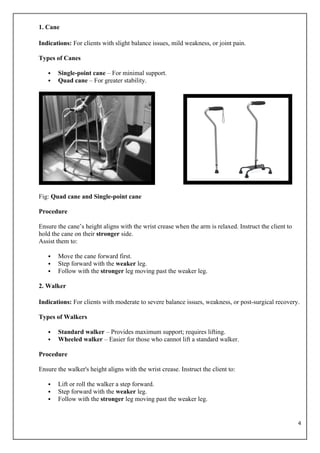
Types of Canes
Single-point cane – For minimal support.
Quad cane – For greater stability.
Fig: Quad cane and Single-point cane
Procedure
Ensure the cane’s height aligns with the wrist crease when the arm is relaxed. Instruct the client to
hold the cane on their stronger side.
Assist them to:
Move the cane forward first.
Step forward with the weaker leg.
Follow with the stronger leg moving past the weaker leg.
2. Walker
Indications: For clients with moderate to severe balance issues, weakness, or post-surgical recovery.
Types of Walkers
Standard walker – Provides maximum support; requires lifting.
Wheeled walker – Easier for those who cannot lift a standard walker.
Procedure
Ensure the walker's height aligns with the wrist crease. Instruct the client to:
Lift or roll the walker a step forward.
Step forward with the weaker leg.
Follow with the stronger leg moving past the weaker leg.
4
5.
3. Crutches
Indications: Forclients with non-weight-bearing or partial-weight-bearing restrictions.
Types of Crutches
Axillary crutches – For short-term use.
Forearm crutches – For long-term use or improved control.
Procedure
Ensure the crutches are adjusted with 2-3 finger widths between the axilla and crutch pad.
Instruct the client to:
Place crutches 6 inches in front and slightly to the side.
Step forward with the weaker leg first (if partial weight-bearing).
Follow with the stronger leg.
For non-weight-bearing, use the "swing-through" gait.
5
6.
4. Gait Belt
Indications:For clients needing extra support during ambulation.
Procedure
Secure the gait belt snugly around the client’s waist.
Stand slightly behind and on the weaker side.
Hold the gait belt firmly with an underhand grip for stability.
5. Wheelchair Assistance
Indications: For clients with limited mobility who need brief standing or transfers.
Procedure
Lock the wheels before assisting the client.
Ensure footrests are out of the way.
Guide the client in standing, pivoting, and sitting.
6
7.
Care of patientswith immobility using nursing process approach
Nursing
assessment
Nursing Diagnosis Goals/Outcomes Nursing Interventions Evaluation
Subjective Data:
- Patient reports, "I
feel too weak to
move."
- Patient states
difficulty turning in
bed.
Objective Data:
- Decreased muscle
strength (rated 2/5
on muscle strength
scale).
- Limited ROM in
upper and lower
extremities.
- Requires
assistance with
repositioning.
Impaired Physical
Mobility related to
muscle weakness and
immobility as
evidenced by limited
ROM, muscle
weakness, and
dependence on
caregivers for mobility.
The patient will
demonstrate improved
mobility with
assistance within one
week. 2. The patient
will actively
participate in range of
motion (ROM)
exercises daily.
- Assess the patient's current mobility status and
limitations
.- Reposition the patient every 2 hours to prevent
pressure injuries.
- Perform passive ROM exercises 2–3 times daily
to maintain joint flexibility.
- Encourage the use of assistive devices (e.g.,
walker, cane) if applicable.
- Educate the patient on proper body mechanics and
movement techniques.
Provide adequate nutritious foods to improve the
muscle strength.
Goal Met: Patient actively
participates in ROM exercises and
requires minimal assistance for
repositioning.
7
8.
Nursing
assessment
Nursing Diagnosis Goals/OutcomesNursing Interventions Evaluation
Subjective Data
Reports of pain,
numbness, tingling,
or itching in
pressure areas.
Complaints of
fatigue, weakness,
or difficulty
repositioning.
Objective Data
Redness, blisters,
or open wounds on
bony prominences.
Changes in skin
texture (dry, moist,
or flaky) and
temperature.
Limited mobility
and dependence on
positioning aids.
Risk for impaired
skin integrity related
to immobility, prolong
bed ridden condition
and impaired
circulation.
The patient's skin will
remain intact and free
from pressure injuries
throughout
hospitalization. 2. The
patient will report
improved comfort with
repositioning.
Assess skin condition, focusing on bony
prominences by Braden Scale.
Reposition the patient every 2 hours using pillows
or foam devices.
Position clock to be maintained.
Keep the skin clean and dry; apply moisturizers
and barrier creams.
Use an air mattress if available.
Encourage adequate fluid intake and a high-protein
diet to promote tissue repair.
Provide back care & massage in each shift.
Maintain adequate hydration
ROM exercises to be performed.
Goal Met: The patient’s skin
remains intact with no signs of
redness or breakdown.
Subjective Data Risk for Ineffective The patient will Assess lung sounds, respiratory rate, and oxygen Goal Met: The patient’s lung
8
9.
Nursing
assessment
Nursing Diagnosis Goals/OutcomesNursing Interventions Evaluation
Reports of chest
discomfort,
difficulty in cough
or breathing, or
feeling of mucus
build-up.
Complaints of
fatigue or weakness
limiting effective
coughing.
Objective Data
Abnormal breath
sounds (e.g.,
crackles, wheezes),
lung congestion.
Decreased SpO2
levels and
ineffective
coughing.
Airway Clearance
related to decreased
mobility and shallow
breathing as evidenced
by lung congestion,
decreased SPO2, in
effective coughing &
deep breathing.
demonstrate effective
coughing and deep
breathing within 48
hours. 2. The patient’s
oxygen saturation will
remain ≥ 95%.
saturation regularly.
SOS oxygen inhalation & nebulization.
Encourage deep breathing and coughing exercises
every 2 hours.
Provide Chest Physiotherapy
Instruct the patient to use an incentive spirometer
to promote lung expansion.
Elevate the head of the bed to at least 30-45 degrees
to facilitate breathing.
Encourage in early ambulation & mobilization.
sounds are clear, and oxygen
saturation is stable at 96%.
9
10.
Nursing
assessment
Nursing Diagnosis Goals/OutcomesNursing Interventions Evaluation
Subjective Data
Reports of
abdominal
discomfort,
bloating, or
incomplete bowel
movements.
Complaints of
reduced appetite or
straining during
defecation.
Objective Data
Decreased bowel
sounds, hard stools,
or infrequent bowel
movements.
Abdominal
distension or
tenderness
Risk for Constipation
related to reduced
mobility and altered
bowel habits
The patient will
maintain regular bowel
movements within 3
days. 2. The patient
will verbalize comfort
and absence of
abdominal discomfort.
Assess the patient’s bowel pattern and monitor for
signs of constipation.
Encourage a high-fiber diet and adequate fluid
intake.
Assist with toileting routines to promote regular
elimination.
Administer prescribed stool softeners or laxatives if
indicated.
Ambulate the patient.
Adequate Water intake.
Goal Met: The patient reports
regular, comfortable bowel
movements.
10
11.
Nursing
assessment
Nursing Diagnosis Goals/OutcomesNursing Interventions Evaluation
Subjective Data
Reports of fatigue,
weakness, or
dizziness with
minimal exertion.
Complaints of
breathlessness or
increased heart rate
during activities.
Objective Data
Inability to perform
ADLs (e.g.,
bathing, dressing).
Vital sign changes
(e.g., increased
heart rate,
respiratory distress)
with activity.
Activity intolerance
related to prolong
immobile condition as
evidenced by unable to
perform ADL, fatigue.
The patient will
demonstrate improved
tolerance to activity by
performing ADLs with
minimal assistance
within 2days.
Gradually increase activity levels using ROM
exercises and mobility aids.
Encourage energy conservation techniques and rest
periods.
Monitor vital signs before, during, and after
activity.
Provide emotional support to reduce anxiety during
exertion.
The patient successfully performs
ADLs with reduced fatigue and
stable vital signs within 2days
11
12.
Nursing
assessment
Nursing Diagnosis Goals/OutcomesNursing Interventions Evaluation
Subjective Data
Reports of fatigue,
weakness, or
inability to perform
self-care tasks.
Expresses
frustration or
dependence on
others for hygiene
needs.
Objective Data
Unkempt
appearance, body
odour, or poor oral
hygiene.
Observable
difficulty in
performing hygiene
tasks like bathing
or grooming.
Self-care deficit
related to immobility
as evidenced by
inability to maintain
personal hygiene.
The patient will
demonstrate improved
ability to perform
personal hygiene with
minimal assistance
gradually
Assist with hygiene tasks while encouraging patient
participation.
Provide adaptive equipment (e.g., long-handled
brushes) to promote independence.
Establish a routine for hygiene care to improve
consistency.
Encourage in self care.
The patient maintains
personal hygiene with
reduced assistance and
improved comfort.
Subjective Data Anxiety related to The patient will Provide emotional support and encourage The patient reports feeling calmer,
12
13.
Nursing
assessment
Nursing Diagnosis Goals/OutcomesNursing Interventions Evaluation
Reports of feeling
worried, fearful, or
overwhelmed.
Expresses concerns
about health status
or recovery.
Objective Data
Restlessness,
crying, irritability,
or frequent
questioning.
Tense facial
expressions and
difficulty focusing.
change in health status,
prolong bed ridden
condition as evidenced
by facial expression,
asking frequent
questions, crying, and
irritability.
demonstrate reduced
anxiety improved
coping strategies
verbalization of feelings.
Offer clear information about the patient's condition
and care plan.
Teach relaxation techniques such as deep breathing
or guided imagery.
Recreational activities to be performed.
shows improved emotional
control, and participates actively in
care
.
13
14.
CARE OF APATIENT WITH CAST
Definition of a Cast
A cast is a rigid, supportive device applied externally to immobilize a fractured bone, support healing,
and prevent movement in the affected area. It is typically made of plaster of Paris (POP) or fiberglass.
Types of Casts
Casts can be categorized based on their design and purpose:
1. Plaster of Paris (POP) Cast
o Made from a quick-setting material that hardens when wet.
o Heavier but moulds well around body contours.
o Ideal for stable fractures or post-surgical immobilization.
2. Fiberglass Cast
o Lightweight, durable, and water-resistant.
o Allows better air circulation.
o Commonly used for long-term casting.
1. Short Arm Cast
o Extends from below the elbow to the hand.
o Used for wrist or forearm fractures.
2. Long Arm Cast
o Extends from the upper arm to the hand.
o Used for fractures involving the elbow or upper arm.
3. Short Leg Cast
o Extends from below the knee to the toes.
o Used for ankle or foot fractures.
4. Long Leg Cast
o Extends from the thigh to the toes.
o Used for knee or femur fractures.
5. Spica Cast
o Covers part of the trunk and one or both legs.
o Commonly used for hip or pelvic fractures.
6. Body Cast
o Encloses the torso to stabilize the spine or back injuries.
Caring for a patient with a cast requires careful attention to prevent complications and promote
healing. Here's a comprehensive guide:
Key Care Points:
Monitoring Circulation and Nerve Function:
o Regularly assess for signs of impaired circulation:
Coldness or pallor (paleness) of fingers or toes.
Numbness or tingling.
14
15.
Increased pain.
Excessive swelling.
o Check the patient's ability to move their fingers or toes.
o Report any changes immediately to a healthcare professional.
Managing Swelling:
o Elevation: Keep the casted limb elevated above the heart level, especially during the
first few days.
o Icing: Apply ice packs wrapped in a thin cloth to the cast for 15-20 minutes at a time,
several times a day.
Skin Care:
o Inspect the skin around the cast edges for redness, irritation, or sores.
o Do not insert objects inside the cast to scratch itching skin. This can cause severe skin
damage or infection.
o If itching is a problem, use a cool hairdryer on a low setting to blow air inside the cast.
o keep the area around the cast clean and dry.
Keeping the Cast Dry:
o Protect the cast from moisture to prevent softening or breakdown.
o Use waterproof cast covers or plastic bags secured with tape when bathing or
showering.
o If the cast gets wet, carefully dry it with a cool hairdryer.
o Plaster casts are very vulnerable to water damage. Fiberglass casts are more water
resistant, but should still be dried thoroughly.
Pain Management:
o Follow the healthcare provider's instructions for pain medication.
o Resting the casted limb can also help reduce pain.
Cast Integrity:
o Do not attempt to modify or remove the cast.
o Check the cast regularly for cracks, breaks, or soft spots.
o If the cast feels too tight or too loose, contact the healthcare provider.
Movement:
o Follow the healthcare provider's instructions regarding movement and weight-bearing.
o Move unaffected joints regularly to prevent stiffness.
o When the doctor says it is ok, follow their instructions on how to start moving the
injured limb.
Preventing Complications:
Be aware of the signs of compartment syndrome, which is a dangerous increase in pressure within the
casted limb. Signs include severe pain, swelling, and numbness. If those symptoms are present, seek
medical attention immediately.
When to Seek Medical Attention:
Increased pain or swelling that is not relieved by elevation or pain medication.
Numbness, tingling, or loss of sensation in the fingers or toes.
Changes in skin colour (pale, blue, or cold).
Signs of infection (fever, redness, warmth, swelling, drainage).
A crack or break in the cast.
A cast that feels too tight or too loose.
Any foul odour coming from the cast.
15
16.
Important Considerations:
Childrenwith casts require extra supervision to prevent them from inserting objects inside the
cast.
Follow all instructions provided by the healthcare provider
CARE OF A PATIENT WITH SPLINT
Caring for a patient with a splint involves several key considerations to ensure proper healing and
prevent complications.
Monitoring Circulation and Nerve Function:
o Regularly check for signs of impaired circulation, such as:
Coldness or pallor (paleness) of the fingers or toes.
Numbness or tingling.
Increased pain.
Swelling.
o Assess the patient's ability to move their fingers or toes.
o Any changes should be reported to a healthcare professional immediately.
Managing Swelling:
o Elevation: Keep the splinted limb elevated above the level of the heart as much as
possible, especially during the first few days. This helps to reduce swelling.
o Icing: Apply ice packs to the splinted area for 15-20 minutes at a time, several times a
day. Always place a thin cloth between the ice and the splint to prevent skin irritation.
Skin Care:
o Check the skin around the edges of the splint for redness, irritation, or sores.
o Do not insert any objects inside the splint to scratch itching skin. This can cause skin
damage.
o If itching is a problem, a healthcare provider may suggest using a cool air source, like a
fan or cool setting on a hair dryer.
16
17.
Keeping theSplint Dry:
o It's crucial to keep the splint dry, as moisture can lead to skin irritation and breakdown.
o When bathing or showering, cover the splint with a waterproof covering, such as a
plastic bag secured with tape or rubber bands.
o If the splint gets wet, carefully dry it with a cool setting on a hair dryer.
Pain Management:
o Follow the healthcare provider's instructions for pain medication.
o Resting the injured limb can also help to reduce pain.
Splint Integrity:
o Do not attempt to adjust or remove the splint unless instructed to do so by a healthcare
professional.
o Check the splint regularly for any signs of damage, such as cracks or breaks.
o If the splint feels too tight or too loose, contact the healthcare provider.
Movement:
o Follow the doctors instructions about moving any uninjured joints. Moving uninjured
joints can help to prevent stiffness.
c
Conclusion
In conclusion, proper ambulation techniques, patient support, and understanding the principles of
mobility are essential in nursing care. Assisting patients effectively not only promotes physical
recovery but also enhances their emotional well-being and independence. Nurses play a crucial role in
ensuring patient safety, preventing complications like falls, and encouraging optimal rehabilitation
outcomes. By integrating evidence-based practices, clear communication, and empathetic care, nurses
can significantly improve the quality of life for patients requiring mobility support.
Bibliography
1. Lewis, S. M., Dirksen, S. R., Heitkemper, M. M., Bucher, L., & Harding, M. M. (2017).
Medical-Surgical Nursing: Assessment and Management of Clinical Problems. 10th Edition.
Elsevier.
17
18.
2. Ignatavicius, D.D., & Workman, M. L. (2020). Medical-Surgical Nursing: Concepts for
Interprofessional Collaborative Care. 9th Edition. Elsevier.
3. Brunner, L. S., & Suddarth, D. S. (2018). Textbook of Medical-Surgical Nursing. 14th
Edition. Wolters Kluwer
18
19.
PRACTICE TEACHING
ON
[Assisting clientswith ambulation: care
of patients with immobility using
nursing process approach,
Care of patients with cast & splint]
Submitted to, Submitted by,
MADAM SRIPARNA GIRI ARPITA MUKHERJEE
ANS CUM ASSISTANT PROFESSOR M.Sc. NURSING 1ST
YEAR
TATA MEDICAL CENTER STUDENT
TATA MEDICAL CENTER
19




![PRACTICE TEACHING
ON
[Assisting clients with ambulation: care
of patients with immobility using
nursing process approach,
Care of patients with cast & splint]
Submitted to, Submitted by,
MADAM SRIPARNA GIRI ARPITA MUKHERJEE
ANS CUM ASSISTANT PROFESSOR M.Sc. NURSING 1ST
YEAR
TATA MEDICAL CENTER STUDENT
TATA MEDICAL CENTER
19](https://image.slidesharecdn.com/assistingclientwithambulation-251120154400-1a85e220/85/PRESENTATION-ON-Assisting-client-with-ambulation-docx-19-320.jpg)


![Mobility and excercise 10 unit [Auto-saved].pptx](https://cdn.slidesharecdn.com/ss_thumbnails/eramammobilityandexcercise10unitauto-saved-250706141151-75177cef-thumbnail.jpg?width=640&height=640&fit=bounds)


