Database Systeming Sunita M. Dol
Page 1
HANDOUT#16
Aim:
Given a set of functional dependencies, find canonical cover and closure of functional
dependencies.
Theory:
Functional Dependency
Functional dependencies play a key role in differentiating good database designs from bad
database. Functional dependencies are constraints on the set of legal relations. They allow us to
express facts about the enterprise that we are modeling with our database designs.
Let R be a relation schema. A subset K of R is a superkey of R if, in any legal relation r(R), for
all pairs t1 and t2 of tuples in r such that t1 _= t2, then t1[K] _= t2[K]. That is, no two tuples in
any legal relation r(R) may have the same value on attribute set K. The notion of functional
dependency generalizes the notion of superkey. Consider a relation schema R, and let α ⊆R and
β ⊆R. The functional dependency
α →β
holds on schema R if, in any legal relation r(R), for all pairs of tuples t1 and t2 in r such that
t1[α] = t2[α], it is also the case that t1[β] = t2[β]. Using the functional-dependency notation, we
say that K is a superkey of R if K → R. That is, K is a superkey if, whenever t1[K] = t2[K], it is
also the case that t1[R] = t2[R] (that is, t1 = t2).
Functional dependencies allow us to express constraints that we cannot express with superkeys.
Consider the schema
Loan-info-schema = (loan-number, branch-name, customer-name, amount)
The set of functional dependencies that we expect to hold on this relation schema is
loan-number →amount
loan-number →branch-name
We would not, however, expect the functional dependency
loan-number →customer-name
to hold, since, in general, a given loan can be made to more than one customer
Closure of a Set of Functional Dependencies
Let F be a set of functional dependencies. The closure of F, denoted by F+, is the set of all
functional dependencies logically implied by F. Given F, we can compute F+ directly from the
formal definition of functional dependency. If F were large, this process would be lengthy and
difficult. Such a computation of F+ requires arguments of the type just used to show that A → H
is in the closure of our example set of dependencies.
Database Systeming Sunita M. Dol
Page 2
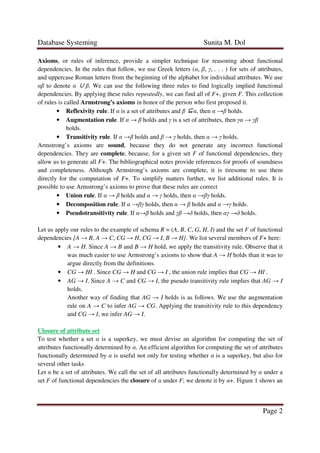
Axioms, or rules of inference, provide a simpler technique for reasoning about functional
dependencies. In the rules that follow, we use Greek letters (α, β, γ, . . . ) for sets of attributes,
and uppercase Roman letters from the beginning of the alphabet for individual attributes. We use
αβ to denote α ∪β. We can use the following three rules to find logically implied functional
dependencies. By applying these rules repeatedly, we can find all of F+, given F. This collection
of rules is called Armstrong’s axioms in honor of the person who first proposed it.
• Reflexivity rule. If α is a set of attributes and β ⊆α, then α →β holds.
• Augmentation rule. If α → β holds and γ is a set of attributes, then γα → γβ
holds.
• Transitivity rule. If α →β holds and β → γ holds, then α → γ holds.
Armstrong’s axioms are sound, because they do not generate any incorrect functional
dependencies. They are complete, because, for a given set F of functional dependencies, they
allow us to generate all F+. The bibliographical notes provide references for proofs of soundness
and completeness. Although Armstrong’s axioms are complete, it is tiresome to use them
directly for the computation of F+. To simplify matters further, we list additional rules. It is
possible to use Armstrong’s axioms to prove that these rules are correct
• Union rule. If α → β holds and α → γ holds, then α →βγ holds.
• Decomposition rule. If α →βγ holds, then α → β holds and α →γ holds.
• Pseudotransitivity rule. If α→β holds and γβ →δ holds, then αγ →δ holds.
Let us apply our rules to the example of schema R = (A, B, C, G, H, I) and the set F of functional
dependencies {A → B, A → C, CG → H, CG → I, B → H}. We list several members of F+ here:
• A → H. Since A → B and B → H hold, we apply the transitivity rule. Observe that it
was much easier to use Armstrong’s axioms to show that A → H holds than it was to
argue directly from the definitions.
• CG → HI . Since CG → H and CG → I , the union rule implies that CG → HI .
• AG → I. Since A → C and CG → I, the pseudo transitivity rule implies that AG → I
holds.
Another way of finding that AG → I holds is as follows. We use the augmentation
rule on A → C to infer AG → CG. Applying the transitivity rule to this dependency
and CG → I, we infer AG → I.
Closure of attribute set
To test whether a set α is a superkey, we must devise an algorithm for computing the set of
attributes functionally determined by α. An efficient algorithm for computing the set of attributes
functionally determined by α is useful not only for testing whether α is a superkey, but also for
several other tasks
Let α be a set of attributes. We call the set of all attributes functionally determined by α under a
set F of functional dependencies the closure of α under F; we denote it by α+. Figure 1 shows an
Database Systeming Sunita M. Dol
Page 3
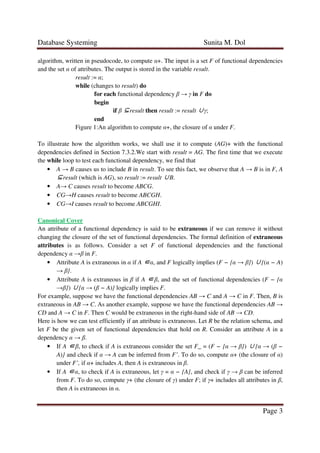
algorithm, written in pseudocode, to compute α+. The input is a set F of functional dependencies
and the set α of attributes. The output is stored in the variable result.
result := α;
while (changes to result) do
for each functional dependency β → γ in F do
begin
if β ⊆result then result := result ∪γ;
end
Figure 1:An algorithm to compute α+, the closure of α under F.
To illustrate how the algorithm works, we shall use it to compute (AG)+ with the functional
dependencies defined in Section 7.3.2.We start with result = AG. The first time that we execute
the while loop to test each functional dependency, we find that
• A → B causes us to include B in result. To see this fact, we observe that A → B is in F, A
⊆result (which is AG), so result := result ∪B.
• A→ C causes result to become ABCG.
• CG→H causes result to become ABCGH.
• CG→I causes result to become ABCGHI.
Canonical Cover
An attribute of a functional dependency is said to be extraneous if we can remove it without
changing the closure of the set of functional dependencies. The formal definition of extraneous
attributes is as follows. Consider a set F of functional dependencies and the functional
dependency α →β in F.
• Attribute A is extraneous in α if A ∈α, and F logically implies (F − {α → β}) ∪{(α − A)
→ β}.
• Attribute A is extraneous in β if A ∈β, and the set of functional dependencies (F − {α
→β}) ∪{α → (β − A)} logically implies F.
For example, suppose we have the functional dependencies AB → C and A → C in F. Then, B is
extraneous in AB → C. As another example, suppose we have the functional dependencies AB →
CD and A → C in F. Then C would be extraneous in the right-hand side of AB → CD.
Here is how we can test efficiently if an attribute is extraneous. Let R be the relation schema, and
let F be the given set of functional dependencies that hold on R. Consider an attribute A in a
dependency α → β.
• If A ∈β, to check if A is extraneous consider the set F_ = (F − {α → β}) ∪{α → (β −
A)} and check if α → A can be inferred from F’. To do so, compute α+ (the closure of α)
under F’, if α+ includes A, then A is extraneous in β.
• If A ∈α, to check if A is extraneous, let γ = α − {A}, and check if γ → β can be inferred
from F. To do so, compute γ+ (the closure of γ) under F; if γ+ includes all attributes in β,
then A is extraneous in α.
Database Systeming Sunita M. Dol
Page 4
For example, suppose F contains AB → CD, A → E, and E → C. To check if C is extraneous in
AB → CD, we compute the attribute closure of AB under F_ = {AB → D, A → E, and E → C}.
The closure is ABCDE, which includes CD, so we infer that C is extraneous.
A canonical cover Fc for F is a set of dependencies such that F logically implies all
dependencies in Fc, and Fc logically implies all dependencies in F. Furthermore, Fc must have
the following properties:
• No functional dependency in Fc contains an extraneous attribute.
• Each left side of a functional dependency in Fc is unique. That is, there are no two
dependencies α1 → β1 and α2 → β2 in Fc such that α1 = α2.
A canonical cover for a set of functional dependencies F can be computed as depicted in Figure
2.
Fc = F
repeat
Use the union rule to replace any dependencies in Fc of the form α1 → β1
and α1 → β2 with α1 → β1 β2.
Find a functional dependency α → β in Fc with an extraneous attribute
either in α or in β.
/* Note: the test for extraneous attributes is done using Fc, not F */
If an extraneous attribute is found, delete it from α → β.
until Fc does not change.
Figure 2: Computing canonical cover
Consider the following set F of functional dependencies on schema (A,B,C):
A →BC
B → C
A →B
AB → C
Let us compute the canonical cover for F.
• There are two functional dependencies with the same set of attributes on the left side of
the arrow:
A →BC
A →B
We combine these functional dependencies into A→ BC.
• A is extraneous in AB → C because F logically implies (F − {AB → C}) ∪{B → C}.
This assertion is true because B → C is already in our set of functional dependencies.
• C is extraneous in A → BC, since A → BC is logically implied by A → B and B →C.
Thus, our canonical cover is
A →B
B → C
Database Systeming Sunita M. Dol
Page 5
Conclusion:
Given a set of functional dependencies, we have found
• Canonical cover Fc for F is a set of dependencies such that F logically implies all
dependencies in Fc, and Fc logically implies all dependencies in F
• Closure of attributes
• Closure of functional dependencies denoted by F+, is the set of all functional
dependencies logically implied by F.
References:
• Database system concepts by Abraham Silberschatz, Henry F. Korth, S. Sudarshan
(McGraw Hill International Edition) sixth edition.
• Database system concepts by Abraham Silberschatz, Henry F. Korth, S. Sudarshan
(McGraw Hill International Edition) fifth edition.
• http://codex.cs.yale.edu/avi/db-book/db4/slide-dir/
• http://codex.cs.yale.edu/avi/db-book/db5/slide-dir/
• http://codex.cs.yale.edu/avi/db-book/db6/slide-dir/

Assignment#16

  • 1.
    Database Systeming SunitaM. Dol Page 1 HANDOUT#16 Aim: Given a set of functional dependencies, find canonical cover and closure of functional dependencies. Theory: Functional Dependency Functional dependencies play a key role in differentiating good database designs from bad database. Functional dependencies are constraints on the set of legal relations. They allow us to express facts about the enterprise that we are modeling with our database designs. Let R be a relation schema. A subset K of R is a superkey of R if, in any legal relation r(R), for all pairs t1 and t2 of tuples in r such that t1 _= t2, then t1[K] _= t2[K]. That is, no two tuples in any legal relation r(R) may have the same value on attribute set K. The notion of functional dependency generalizes the notion of superkey. Consider a relation schema R, and let α ⊆R and β ⊆R. The functional dependency α →β holds on schema R if, in any legal relation r(R), for all pairs of tuples t1 and t2 in r such that t1[α] = t2[α], it is also the case that t1[β] = t2[β]. Using the functional-dependency notation, we say that K is a superkey of R if K → R. That is, K is a superkey if, whenever t1[K] = t2[K], it is also the case that t1[R] = t2[R] (that is, t1 = t2). Functional dependencies allow us to express constraints that we cannot express with superkeys. Consider the schema Loan-info-schema = (loan-number, branch-name, customer-name, amount) The set of functional dependencies that we expect to hold on this relation schema is loan-number →amount loan-number →branch-name We would not, however, expect the functional dependency loan-number →customer-name to hold, since, in general, a given loan can be made to more than one customer Closure of a Set of Functional Dependencies Let F be a set of functional dependencies. The closure of F, denoted by F+, is the set of all functional dependencies logically implied by F. Given F, we can compute F+ directly from the formal definition of functional dependency. If F were large, this process would be lengthy and difficult. Such a computation of F+ requires arguments of the type just used to show that A → H is in the closure of our example set of dependencies.
  • 2.
    Database Systeming SunitaM. Dol Page 2 Axioms, or rules of inference, provide a simpler technique for reasoning about functional dependencies. In the rules that follow, we use Greek letters (α, β, γ, . . . ) for sets of attributes, and uppercase Roman letters from the beginning of the alphabet for individual attributes. We use αβ to denote α ∪β. We can use the following three rules to find logically implied functional dependencies. By applying these rules repeatedly, we can find all of F+, given F. This collection of rules is called Armstrong’s axioms in honor of the person who first proposed it. • Reflexivity rule. If α is a set of attributes and β ⊆α, then α →β holds. • Augmentation rule. If α → β holds and γ is a set of attributes, then γα → γβ holds. • Transitivity rule. If α →β holds and β → γ holds, then α → γ holds. Armstrong’s axioms are sound, because they do not generate any incorrect functional dependencies. They are complete, because, for a given set F of functional dependencies, they allow us to generate all F+. The bibliographical notes provide references for proofs of soundness and completeness. Although Armstrong’s axioms are complete, it is tiresome to use them directly for the computation of F+. To simplify matters further, we list additional rules. It is possible to use Armstrong’s axioms to prove that these rules are correct • Union rule. If α → β holds and α → γ holds, then α →βγ holds. • Decomposition rule. If α →βγ holds, then α → β holds and α →γ holds. • Pseudotransitivity rule. If α→β holds and γβ →δ holds, then αγ →δ holds. Let us apply our rules to the example of schema R = (A, B, C, G, H, I) and the set F of functional dependencies {A → B, A → C, CG → H, CG → I, B → H}. We list several members of F+ here: • A → H. Since A → B and B → H hold, we apply the transitivity rule. Observe that it was much easier to use Armstrong’s axioms to show that A → H holds than it was to argue directly from the definitions. • CG → HI . Since CG → H and CG → I , the union rule implies that CG → HI . • AG → I. Since A → C and CG → I, the pseudo transitivity rule implies that AG → I holds. Another way of finding that AG → I holds is as follows. We use the augmentation rule on A → C to infer AG → CG. Applying the transitivity rule to this dependency and CG → I, we infer AG → I. Closure of attribute set To test whether a set α is a superkey, we must devise an algorithm for computing the set of attributes functionally determined by α. An efficient algorithm for computing the set of attributes functionally determined by α is useful not only for testing whether α is a superkey, but also for several other tasks Let α be a set of attributes. We call the set of all attributes functionally determined by α under a set F of functional dependencies the closure of α under F; we denote it by α+. Figure 1 shows an
  • 3.
    Database Systeming SunitaM. Dol Page 3 algorithm, written in pseudocode, to compute α+. The input is a set F of functional dependencies and the set α of attributes. The output is stored in the variable result. result := α; while (changes to result) do for each functional dependency β → γ in F do begin if β ⊆result then result := result ∪γ; end Figure 1:An algorithm to compute α+, the closure of α under F. To illustrate how the algorithm works, we shall use it to compute (AG)+ with the functional dependencies defined in Section 7.3.2.We start with result = AG. The first time that we execute the while loop to test each functional dependency, we find that • A → B causes us to include B in result. To see this fact, we observe that A → B is in F, A ⊆result (which is AG), so result := result ∪B. • A→ C causes result to become ABCG. • CG→H causes result to become ABCGH. • CG→I causes result to become ABCGHI. Canonical Cover An attribute of a functional dependency is said to be extraneous if we can remove it without changing the closure of the set of functional dependencies. The formal definition of extraneous attributes is as follows. Consider a set F of functional dependencies and the functional dependency α →β in F. • Attribute A is extraneous in α if A ∈α, and F logically implies (F − {α → β}) ∪{(α − A) → β}. • Attribute A is extraneous in β if A ∈β, and the set of functional dependencies (F − {α →β}) ∪{α → (β − A)} logically implies F. For example, suppose we have the functional dependencies AB → C and A → C in F. Then, B is extraneous in AB → C. As another example, suppose we have the functional dependencies AB → CD and A → C in F. Then C would be extraneous in the right-hand side of AB → CD. Here is how we can test efficiently if an attribute is extraneous. Let R be the relation schema, and let F be the given set of functional dependencies that hold on R. Consider an attribute A in a dependency α → β. • If A ∈β, to check if A is extraneous consider the set F_ = (F − {α → β}) ∪{α → (β − A)} and check if α → A can be inferred from F’. To do so, compute α+ (the closure of α) under F’, if α+ includes A, then A is extraneous in β. • If A ∈α, to check if A is extraneous, let γ = α − {A}, and check if γ → β can be inferred from F. To do so, compute γ+ (the closure of γ) under F; if γ+ includes all attributes in β, then A is extraneous in α.
  • 4.
    Database Systeming SunitaM. Dol Page 4 For example, suppose F contains AB → CD, A → E, and E → C. To check if C is extraneous in AB → CD, we compute the attribute closure of AB under F_ = {AB → D, A → E, and E → C}. The closure is ABCDE, which includes CD, so we infer that C is extraneous. A canonical cover Fc for F is a set of dependencies such that F logically implies all dependencies in Fc, and Fc logically implies all dependencies in F. Furthermore, Fc must have the following properties: • No functional dependency in Fc contains an extraneous attribute. • Each left side of a functional dependency in Fc is unique. That is, there are no two dependencies α1 → β1 and α2 → β2 in Fc such that α1 = α2. A canonical cover for a set of functional dependencies F can be computed as depicted in Figure 2. Fc = F repeat Use the union rule to replace any dependencies in Fc of the form α1 → β1 and α1 → β2 with α1 → β1 β2. Find a functional dependency α → β in Fc with an extraneous attribute either in α or in β. /* Note: the test for extraneous attributes is done using Fc, not F */ If an extraneous attribute is found, delete it from α → β. until Fc does not change. Figure 2: Computing canonical cover Consider the following set F of functional dependencies on schema (A,B,C): A →BC B → C A →B AB → C Let us compute the canonical cover for F. • There are two functional dependencies with the same set of attributes on the left side of the arrow: A →BC A →B We combine these functional dependencies into A→ BC. • A is extraneous in AB → C because F logically implies (F − {AB → C}) ∪{B → C}. This assertion is true because B → C is already in our set of functional dependencies. • C is extraneous in A → BC, since A → BC is logically implied by A → B and B →C. Thus, our canonical cover is A →B B → C
  • 5.
    Database Systeming SunitaM. Dol Page 5 Conclusion: Given a set of functional dependencies, we have found • Canonical cover Fc for F is a set of dependencies such that F logically implies all dependencies in Fc, and Fc logically implies all dependencies in F • Closure of attributes • Closure of functional dependencies denoted by F+, is the set of all functional dependencies logically implied by F. References: • Database system concepts by Abraham Silberschatz, Henry F. Korth, S. Sudarshan (McGraw Hill International Edition) sixth edition. • Database system concepts by Abraham Silberschatz, Henry F. Korth, S. Sudarshan (McGraw Hill International Edition) fifth edition. • http://codex.cs.yale.edu/avi/db-book/db4/slide-dir/ • http://codex.cs.yale.edu/avi/db-book/db5/slide-dir/ • http://codex.cs.yale.edu/avi/db-book/db6/slide-dir/