Unit-3
Relational Database
Design
Computer Engineering Department
Database Management Systems (DBMS)
 Looping
Outline
• Functional Dependency
• Definition and types of FD
• Armstrong's axioms (inference rules)
• Closure of FD set
• Closure of attribute set
• Canonical cover
• Decomposition and its types
• Anomaly in database design and its types
• Normalization and normal forms
• 1NF
• 2NF
• 3NF
• BCNF
• 4NF
• 5NF
Section – 1.1
What is Functional Dependency (FD)?
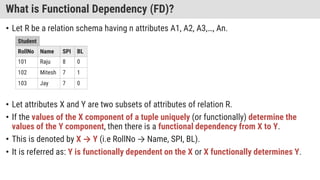
• Let R be a relation schema having n attributes A1, A2, A3,…, An.
• Let attributes X and Y are two subsets of attributes of relation R.
• If the values of the X component of a tuple uniquely (or functionally) determine the
values of the Y component, then there is a functional dependency from X to Y.
• This is denoted by X → Y (i.e RollNo → Name, SPI, BL).
• It is referred as: Y is functionally dependent on the X or X functionally determines Y.
RollNo Name SPI BL
101 Raju 8 0
102 Mitesh 7 1
103 Jay 7 0
Student
Diagrammatic representation of Functional Dependency (FD)
• Example
• Consider the relation Account(account_no, balance, branch).
• account_no can determine balance and branch.
• So, there is a functional dependency from account_no to balance and branch.
• This can be denoted by account_no → {balance, branch}.
X Y X1 X2 Y X Y1 Y2
X → Y {X1, X2} → Y X → {Y1, Y2}
account_no balance branch
Types of Functional Dependency (FD)
• Full Functional Dependency
• In a relation, the attribute B is fully functional dependent on A if B is functionally dependent
on A, but not on any proper subset of A.
• Eg. {Roll_No, Semester, Department_Name} → SPI
• We need all three {Roll_No, Semester, Department_Name} to find SPI.
• Partial Functional Dependency
• In a relation, the attribute B is partial functional dependent on A if B is functionally
dependent on A as well as on any proper subset of A.
• If there is some attribute that can be removed from A and the still dependency holds then it
is partial functional dependancy.
• Eg. {Enrollment_No, Department_Name} → SPI
• Enrollment_No is sufficient to find SPI, Department_Name is not required to find SPI.
Types of Functional Dependency (FD)
• Transitive Functional Dependency
• In a relation, if attribute(s) A → B and B → C, then A → C (means C is transitively depends
on A via B).
• Eg. Subject → Faculty & Faculty → Age then Subject → Age
• Therefore as per the rule of transitive dependency: Subject → Age should hold, that makes
sense because if we know the subject name we can know the faculty’s age.
Subject Faculty Age
DS Shah 35
DBMS Patel 32
DF Shah 35
Sub_Fac
Types of Functional Dependency (FD)
• Trivial Functional Dependency
• X → Y is trivial FD if Y is a subset of X
• Eg. {Roll_No, Department_Name, Semester} → Roll_No
• Nontrivial Functional Dependency
• X → Y is nontrivial FD if Y is not a subset of X
• Eg. {Roll_No, Department_Name, Semester} → Student_Name
Section – 1.2
Armstrong's axioms OR Inference rules
• Armstrong's axioms are a set of rules used to infer (derive) all the functional
dependencies on a relational database.
 If B is a subset of A
 then A → B
Reflexivity
 If A → B
 then AC → BC
Augmentation
 If A → B and B → C
 then A → C
Transitivity
 If A → B and BD → C
 then AD → C
Pseudo Transitivity
 If A → A
Self-determination
 If A → BC
 then A → B and A →
C
Decomposition
 If A → B and A → C
 then A → BC
Union
 If A → B and C → D
 then AC → BD
Composition
Section – 2
What is closure of a set of FDs?
• Given a set F set of functional dependencies, there are certain other functional
dependencies that are logically implied by F.
• E.g.: F = {A → B and B → C}, then we can infer that A → C (by transitivity rule)
• The set of functional dependencies (FDs) that is logically implied by F is called
the closure of F.
• It is denoted by F+.
Closure of a set of FDs [Example]
 Suppose we are given a relation schema R(A,B,C,G,H,I) and the set of functional dependencies
are:
 F = (A → B, A → C, CG → H, CG → I, B → H)
 The functional dependency A → H is logical implied.
A → B
B → H
We have
Transitivity rule A → H
Closure of a set of FDs [Example]
 Suppose we are given a relation schema R(A,B,C,G,H,I) and the set of functional dependencies
are:
 F = (A → B, A → C, CG → H, CG → I, B → H)
 The functional dependency CG → HI is logical implied.
CG → H
CG → I
We have
Union rule CG → HI
Closure of a set of FDs [Example]
 Suppose we are given a relation schema R(A,B,C,G,H,I) and the set of functional dependencies
are:
 F = (A → B, A → C, CG → H, CG → I, B → H)
 The functional dependency AG → I is logical implied.
A → C
CG → I
We have
Pseudo-
transitivity rule
AG → I
Closure of a set of FDs [Example]
 Suppose we are given a relation schema R(A,B,C,G,H,I) and the set of functional dependencies
are:
 F = (A → B, A → C, CG → H, CG → I, B → H)
 The functional dependency AG → I is logical implied.
A → C
We have
Augmentation rule AG → CG
AG → CG
CG → I
Transitivity rule AG → I
Closure of a set of FDs [Example]
F+ = (A → H, CG → HI, AG → I)
Several members of F+ are
 Suppose we are given a relation schema R(A,B,C,G,H,I) and the set of functional dependencies
are:
 F = (A → B, A → C, CG → H, CG → I, B → H)
 Find out the closure of F.
Closure of a set of FDs [Example]
 Compute the closure of the following set F of functional dependencies FDs for relational
schema R = (A,B,C,D,E,F):
 F = (A → B, A → C, CD → E, CD → F, B → E)
 Find out the closure of F.
F+ = (A → BC, CD → EF, A → E, AD → E, AD → F)
A → B & A → C Union Rule A → BC
CD → E & CD → F Union Rule CD → EF
A → B & B → E Transitivity Rule A → E
A → C & CD → E Pseudo-transitivity Rule AD → E
A → C & CD → F Pseudo-transitivity Rule AD → F
Closure of a set of FDs [Example]
 Compute the closure of the following set F of functional dependencies FDs for relational
schema R = (A,B,C,D,E):
 F = (AB → C, D → AC, D → E )
 Find out the closure of F.
F+ = (D → A, D → C, D → ACE)
D → AC Decomposition Rule D → A & D → C
D → AC & D → E Union Rule D → ACE
Section – 3
What is a closure of attribute sets?
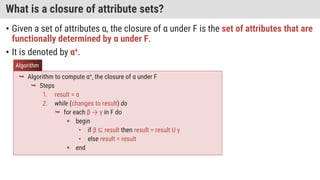
• Given a set of attributes α, the closure of α under F is the set of attributes that are
functionally determined by α under F.
• It is denoted by α+.
What is a closure of attribute sets?
• Given a set of attributes α, the closure of α under F is the set of attributes that are
functionally determined by α under F.
• It is denoted by α+.
 Algorithm to compute α+, the closure of α under F
 Steps
1. result = α
2. while (changes to result) do
 for each β → γ in F do
 begin
• if β ⊆ result then result = result U γ
• else result = result
 end
Algorithm
Closure of attribute sets [Example]
• Consider the relation schema R = (A, B, C, G, H, I).
• For this relation, a set of functional dependencies F can be given as
F = {A → B, A → C, CG → H, CG → I, B → H}
• Find out the closure of (AG)+.
 Algorithm to compute α+, the closure of α under F
 Steps
1. result = α
2. while (changes to result) do
 for each β → γ in F do
 begin
• if β ⊆ result then result = result U γ
• else result = result
 end
Algorithm
 Step 1.
result = α => result = AG
A → B A ⊆ AG result = ABG
A → C A ⊆ ABG result = ABCG
CG → H CG ⊆ ABCG result = ABCGH
CG → I CG ⊆ ABCGH result = ABCGHI
B → H B ⊆ ABCGHI result = ABCGHI
AG+ = ABCGHI
Closure of attribute sets [Exercise]
• Given functional dependencies (FDs) for relational schema R = (A,B,C,D,E):
• F = {A → BC, CD → E, B → D, E → A}
• Find Closure for A
• Find Closure for CD
• Find Closure for B
• Find Closure for BC
• Find Closure for E
A+ = ABCDE
CD+ = ABCDE
B+ = BD
BC+ = ABCDE
E+ = ABCDE
Answer
Section – 4
What is extraneous attributes?
• Let us consider a relation R with schema R = (A, B, C) and set of functional
dependencies FDs F = { AB → C, A → C }.
• In AB → C, B is extraneous attribute. The reason is, there is another FD A → C,
which means when A alone can determine C, the use of B is unnecessary (extra).
• An attribute of a functional dependency is said to be extraneous if we can remove
it without changing the closure of the set of functional dependencies.
What is canonical cover?
• A canonical cover of F is a minimal set of functional dependencies equivalent to
F, having no redundant dependencies or redundant parts of dependencies.
• It is denoted by Fc
• A canonical cover for F is a set of dependencies Fc such that
• F logically implies all dependencies in Fc and
• Fc logically implies all dependencies in F and
• No functional dependency in Fc contains an extraneous attribute and
• Each left side of functional dependency in Fc is unique.
F = {A → B, A → C}
Fc = {A → BC}
Union Rule
Decomposition Rule
Algorithm to find canonical cover
• Repeat
• Use the union rule to replace any dependencies in F α1 → β1 and α1 → β2 with α1 → β1β2
• Find a functional dependency α → β with an extraneous attribute either in α or in β
/* Note: test for extraneous attributes done using Fc, not F */
• If an extraneous attribute is found, delete it from α → β
• until F does not change
/* Note: Union rule may become applicable after some extraneous attributes
have been deleted, so it has to be re-applied */
Canonical cover [Example]
• Combine A → BC and A → B into A → BC (Union Rule)
• Set is {A → BC, B → C, AB → C}
• A is extraneous in AB → C
• Check if the result of deleting A from AB → C is implied by the other dependencies
• Yes: in fact, B → C is already present
• Set is {A → BC, B → C}
• C is extraneous in A → BC
• Check if A → C is logically implied by A → B and the other dependencies
• Yes: using transitivity on A → B and B → C.
• The canonical cover is: A → B, B → C
 Consider the relation schema R = (A, B, C) with FDs
F = {A → BC, B → C, A → B, AB → C}
 Find canonical cover.
Canonical cover [Example]
• The left side of each FD in F is unique.
• Also none of the attributes in the left side or right side of any of the FDs is
extraneous.
• Therefore the canonical cover Fc is equal to F.
• Fc = {A → BC, CD → E, B → D, E → A}
 Consider the relation schema R = (A, B, C, D, E, F) with FDs
F = {A → BC, CD → E, B → D, E → A}
 Find canonical cover.
Section – 5
What is decomposition?
• Decomposition is the process of breaking down given relation into two or more
relations.
• Relation R is replaced by two or more relations in such a way that:
• Each new relation contains a subset of the attributes of R
• Together, they all include all tuples and attributes of R
• Types of decomposition
• Lossy decomposition
• Lossless decomposition (non-loss decomposition)
Lossy decomposition
• The decomposition of relation R into R1
and R2 is lossy when the join of R1 and R2
does not yield the same relation as in R.
• This is also referred as lossy-join
decomposition.
• The disadvantage of such kind of
decomposition is that some information is
lost during retrieval of original relation.
• From practical point of view,
decomposition should not be lossy
decomposition.
Ano Balance Bname
A01 5000 Delhi
A02 5000 Noida
Customer
Ano Balance Bname
A01 5000 Delhi
A01 5000 Noida
A02 5000 Delhi
A02 5000 Noida
Customer
Balance Bname
5000 Delhi
5000 Noida
Table-2
Ano Balance
A01 5000
A02 5000
Table-1
Not Same
Lossless decomposition
• The decomposition of relation R into R1
and R2 is lossless when the join of R1 and
R2 produces the same relation as in R.
• This is also referred as a non-additive
(non-loss) decomposition.
• All decompositions must be lossless.
Ano Balance Bname
A01 5000 Delhi
A02 5000 Noida
Customer
Ano Balance Bname
A01 5000 Delhi
A02 5000 Noida
Customer
Ano Bname
A01 Delhi
A02 Noida
Table-2
Ano Balance
A01 5000
A02 5000
Table-1
Same
Section – 6
What is an anomaly in database design?
• Anomalies are problems that can occur in poorly planned, un-normalized
database where all the data are stored in one table.
• There are three types of anomalies that can arise in the database because of
redundancy are
• Insert anomaly
• Delete anomaly
• Update / Modification anomaly
Insert anomaly
• Consider a relation Emp_Dept(EID, Ename, City, DID, Dname, Manager) EID as a primary
key
• Suppose a new department (IT) has been started by the organization but initially there
is no employee appointed for that department.
• We want to insert that department detail in Emp_Dept table.
• But the tuple for this department cannot be inserted into this table as the EID will have
NULL value, which is not allowed because EID is primary key.
• This kind of problem in the relation where some tuple cannot be inserted is known as
insert anomaly.
EID Ename City DID Dname Manager
1 Raj Delhi 1 CE Shah
2 Meet Noida 1 CE Shah
Emp_Dept
An insert anomaly occurs when certain attributes
cannot be inserted into the database without the
presence of another attribute.
NULL NULL NULL 2 IT NULL Want to insert new department detail (IT)
Delete anomaly
• Consider a relation Emp_Dept(EID, Ename, City, DID, Dname, Manager) EID as a
primary key
• Now consider there is only one employee in some department (IT) and that
employee leaves the organization.
• So we need to delete tuple of that employee (Jay).
• But in addition to that information about the department also deleted.
• This kind of problem in the relation where deletion of some tuples can lead to loss
of some other data not intended to be removed is known as delete anomaly.
EID Ename City DID Dname Manager
1 Raj Delhi 1 CE Shah
2 Meet Noida 1 CE Shah
Emp_Dept
A delete anomaly exists when certain attributes are
lost because of the deletion of another attribute.
3 Jay Gurgaon 2 IT Dave
Want to delete (Jay)
employee's detail
Update anomaly
• Consider a relation Emp_Dept(EID, Ename, City, Dname, Manager) EID as a primary key
• Suppose the manager of a (CE) department has changed, this requires that the Manager
in all the tuples corresponding to that department must be changed to reflect the new
status.
• If we fail to update all the tuples of given department, then two different records of
employee working in the same department might show different Manager lead to
inconsistency in the database.
EID Ename City Dname Manager
1 Raj Delhi CE Sah
2 Meet Noida C.E Shah
3 Jay Gurgaon Computer Shaah
4 Hari Delhi IT Dave
Emp_Dept
An update anomaly exists when one or more
records (instance) of duplicated data is updated,
but not all.
Want to update manager
of CE department
How to deal with insert, delete and update anomaly
EID Ename City DID Dname Manager
1 Raj Delhi 1 CE Shah
2 Meet Noida 1 C.E Shah
Emp_Dept
NULL NULL NULL 3 EC NULL
EID Ename City DID
1 Raj Delhi 1
2 Meet Noida 1
Emp
DID Dname Manager
1 CE Shah
Dept
3 EC NULL
3 Jay Gurgaon 2 IT Dave
2 IT Dave
3 Jay Gurgao
n
2
Such type of anomalies in the database design can be solved by using normalization.
Section – 7
What is normalization?
• Normalization is the process of removing redundant data from tables to improve
data integrity, scalability and storage efficiency.
• data integrity (completeness, accuracy and consistency of data)
• scalability (ability of a system to continue to function well in a growing amount of work)
• storage efficiency (ability to store and manage data that consumes the least amount of
space)
• What we do in normalization?
• Normalization generally involves splitting an existing table into multiple (more than one)
tables, which can be re-joined or linked each time a query is issued (executed).
How many normal forms are there?
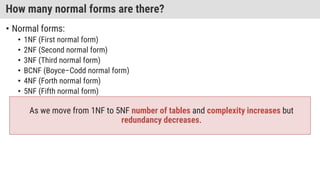
• Normal forms:
• 1NF (First normal form)
• 2NF (Second normal form)
• 3NF (Third normal form)
• BCNF (Boyce–Codd normal form)
• 4NF (Forth normal form)
• 5NF (Fifth normal form)
As we move from 1NF to 5NF number of tables and complexity increases but
redundancy decreases.
1NF (First Normal Form)
Section – 7.1
1NF (First Normal Form)
• Conditions for 1NF
• A relation R is in first normal form (1NF) if and only if it does not contain any
composite attribute or multi-valued attributes or their combinations.
OR
• A relation R is in first normal form (1NF) if and only if all underlying domains
contain atomic values only.
Each cells of a table should contain a single value.
1NF (First Normal Form) [Example - Composite attribute]
• Problem: It is difficult to retrieve the list of customers living in ’Mathura’ city from
customer table.
• The reason is that address attribute is composite attribute which contains road name
as well as city name in single cell.
• It is possible that city name word is also there in road name.
• In our example, ’Mathura’ word occurs in both records, in first record it is a part of road
name and in second one it is the name of city.
CID Name Address
C01 Raju Mathura Road, Delhi
C02 Mitesh Nehru Road, Mathura
C03 Jay C.G Road, Faridabad
Customer
• In customer relation address is composite attribute which
is further divided into sub-attributes as “Road” and “City”.
• So customer relation is not in 1NF.
1NF (First Normal Form) [Example - Composite attribute]
• Solution: Divide composite attributes into number of sub-attributes and insert
value in proper sub-attribute.
CID Name Address
C01 Raju Mathura Road, Delhi
C02 Mitesh Nehru Road, Mathura
C03 Jay C.G Road, Faridabad
Customer
CID Name Road City
C01 Raju Mathura Road Delhi
C02 Mitesh Nehru Road Mathura
C03 Jay C.G Road Faridabad
Customer
Exercise Convert below relation into 1NF (First Normal Form)
PID Full_Name City
P01 Raju Maheshbhai Patel Delhi
Person
1NF (First Normal Form) [Example - Multivalued attribute]
• Problem: It is difficult to retrieve the list of students failed in ’DBMS’ as well as
’DS’ but not in other subjects from student table.
• The reason is that FailedinSubjects attribute is multi-valued attribute so it
contains more than one value.
Rno Name FailedinSubjects
101 Raju DS, DBMs
102 Mitesh DBMS, DS
103 Jay DS, DBMS, DE
104 Jeet DBMS, DE, DS
105 Harsh DE, DBMS, DS
106 Neel DE, DBMS
Student
• In student relation FailedinSubjects attribute is a multi-
valued attribute which can store more than one values.
• So above relation is not in 1NF.
1NF (First Normal Form) [Example - Multivalued attribute]
• Solution: Split the table into two tables in such as way that
• the first table contains all attributes except multi-valued attribute with same primary key
and
• second table contains multi-valued attribute and place a primary key in it.
• insert the primary key of first table in the second table as a foreign key.
Rno Name FailedinSubjects
101 Raju DS, DBMs
102 Mitesh DBMS, DS
103 Jay DS, DBMS, DE
104 Jeet DBMS, DE, DS
105 Harsh DE, DBMS, DS
106 Neel DE, DBMS
Student
Rno Name
101 Raju
102 Mitesh
103 Jay
104 Jeet
105 Harsh
106 Neel
Student
RID Rno Subject
1 101 DS
2 101 DBMS
3 102 DBMS
4 102 DS
5 103 DS
… … …
Result
2NF (Second Normal Form)
Section – 7.2
2NF (Second Normal Form)
• Conditions for 2NF
• A relation R is in second normal form (2NF)
• if and only if it is in 1NF and
• every non-primary key attribute is fully dependent on the primary key
OR
• A relation R is in second normal form (2NF)
• if and only if it is in 1NF and
• no any non-primary key attribute is partially dependent on the primary key
It is in 1NF and each table should contain a single primary key.
2NF (Second Normal Form) [Example]
• FD1: {CID, ANO} → {AccesssDate, Balance, BranchName}
• FD2: ANO → {Balance, BranchName}
• Balance and BranchName are partial dependent on primary key (CID + ANO). So
customer relation is not in 2NF.
CID ANO AccessDate Balance BranchName
C01 A01 01-01-2017 50000 Delhi
C02 A01 01-03-2017 50000 Delhi
C01 A02 01-05-2017 25000 Noida
C03 A02 01-07-2017 25000 Noida
Customer
ANO AccesssDate Balance BranchName
CID
FD1
FD2
2NF (Second Normal Form) [Example]
• Problem: For example, in case of a joint account multiple (more than one)
customers have common (one) accounts.
• If an account ’A01’ is operated jointly by two customers says ’C01’ and ’C02’ then
data values for attributes Balance and BranchName will be duplicated in two
different tuples of customers ’C01’ and ’C02’.
CID ANO AccessDate Balance BranchName
C01 A01 01-01-2017 50000 Delhi
C02 A01 01-03-2017 50000 Delhi
C01 A02 01-05-2017 25000 Noida
C03 A02 01-07-2017 25000 Noida
Customer
ANO AccesssDate Balance BranchName
CID
FD1
FD2
2NF (Second Normal Form) [Example]
• Solution: Decompose relation in such a way that resultant relations do not have any
partial FD.
• Remove partial dependent attributes from the relation that violets 2NF.
• Place them in separate relation along with the prime attribute on which they are fully dependent.
• The primary key of new relation will be the attribute on which it is fully dependent.
• Keep other attributes same as in that table with the same primary key.
CID ANO AccessDate Balance BranchName
C01 A01 01-01-2017 50000 Delhi
C02 A01 01-03-2017 50000 Delhi
C01 A02 01-05-2017 25000 Noida
C03 A02 01-07-2017 25000 Noida
Customer
ANO Balance BranchName
A01 50000 Delhi
A02 25000 Noida
Table-1
CID ANO AccessDate
C01 A01 01-01-2017
C02 A01 01-03-2017
C01 A02 01-05-2017
C03 A02 01-07-2017
Table-2
3NF (Third Normal Form)
Section – 7.3
3NF (Third Normal Form)
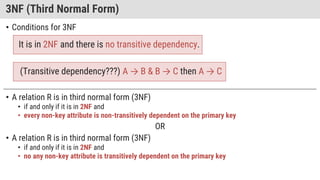
• Conditions for 3NF
• A relation R is in third normal form (3NF)
• if and only if it is in 2NF and
• every non-key attribute is non-transitively dependent on the primary key
OR
• A relation R is in third normal form (3NF)
• if and only if it is in 2NF and
• no any non-key attribute is transitively dependent on the primary key
It is in 2NF and there is no transitive dependency.
(Transitive dependency???) A → B & B → C then A → C
3NF (Third Normal Form) [Example]
• FD1: ANO → {Balance, BranchName, BranchAddress}
• FD2: BranchName → BranchAddress
• So ANO → BranchAddress (Using Transitivity rule)
• BranchAddress is transitive depend on primary key (ANO). So customer relation
is not in 3NF.
ANO Balance BranchName BranchAddress
A01 50000 Delhi Kalawad road
A02 40000 Delhi Kalawad Road
A03 35000 Noida C.G Road
A04 25000 Noida C.G Road
Customer
ANO Balance BranchName BranchAddres
s
FD1
FD2
3NF (Third Normal Form) [Example]
• Problem: In this relation, branch address will be stored repeatedly for each
account of the same branch which occupies more space.
ANO Balance BranchName BranchAddress
A01 50000 Delhi Kalawad road
A02 40000 Delhi Kalawad Road
A03 35000 Noida C.G Road
A04 25000 Noida C.G Road
Customer
ANO Balance BranchName BranchAddres
s
FD1
FD2
3NF (Third Normal Form) [Example]
• Solution: Decompose relation in such a way that resultant relations do not have any
transitive FD.
• Remove transitive dependent attributes from the relation that violets 3NF.
• Place them in a new relation along with the non-prime attributes due to which transitive
dependency occurred.
• The primary key of the new relation will be non-prime attributes due to which transitive
dependency occurred.
• Keep other attributes same as in the table with same primary key and add prime attributes of other
relation into it as a foreign key.
ANO Balance BranchName BranchAddress
A01 50000 Delhi Kalawad road
A02 40000 Delhi Kalawad Road
A03 35000 Noida C.G Road
A04 25000 Noida C.G Road
Customer
BranchName BranchAddress
Delhi Kalawad road
Noida C.G Road
Table-1
ANO Balance BranchName
A01 50000 Delhi
A02 40000 Delhi
A03 35000 Noida
A04 25000 Noida
Table-2
BCNF (Boyce-Codd Normal Form)
Section – 7.4
BCNF (Boyce-Codd Normal Form)
• Conditions for BCNF
• A relation R is in Boyce-Codd normal form (BCNF)
• if and only if it is in 3NF and
• for every functional dependency X → Y, X should be the primary key of the table. OR
• A relation R is in Boyce-Codd normal form (BCNF)
• if and only if it is in 3NF and
• every prime key attribute is non-transitively dependent on the primary key OR
• A relation R is in Boyce-Codd normal form (BCNF)
• if and only if it is in 3NF and
• no any prime key attribute is transitively dependent on the primary key
BCNF is based on the concept of a determinant.
It is in 3NF and every determinant should be primary key.
AccountNO → {Balance, Branch}
Determinant Dependent
Primary Key
BCNF (Boyce-Codd Normal Form) [Example]
RNO Subject Faculty
101 DS Patel
102 DBMS Shah
103 DS Jadeja
104 DBMS Dave
105 DBMS Shah
102 DS Patel
101 DBMS Dave
105 DS Jadeja
Student
RNO Subject Faculty
FD2
FD1
• FD1: RNO, Subject → Faculty
• FD2: Faculty → Subject
• So {RNO, Subject} → Subject (Transitivity rule)
• Here, one faculty teaches only one subject, but a subject may be taught
by more than one faculty.
• A student can learn a subject from only one faculty.
In FD2, determinant is Faculty which is not a primary key. So student table is not in
BCNF.
Problem: In this relation one student can learn more than one subject with different
faculty then records will be stored repeatedly for each student, language and faculty
combination which occupies more space.
BCNF (Boyce-Codd Normal Form) [Example]
RNO Subject Faculty
101 DS Patel
102 DBMS Shah
103 DS Jadeja
104 DBMS Dave
105 DBMS Shah
102 DS Patel
101 DBMS Dave
105 DS Jadeja
Student • Solution: Decompose relation in
such a way that resultant relations
do not have any transitive FD.
• Remove transitive dependent prime
attribute from relation that violets
BCNF.
• Place them in separate new relation
along with the non-prime attribute due
to which transitive dependency
occurred.
• The primary key of new relation will be
this non-prime attribute due to which
transitive dependency occurred.
• Keep other attributes same as in that
table with same primary key and add a
prime attribute of other relation into it
as a foreign key.
Faculty Subject
Patel DS
Shah DBMS
Jadeja DS
Dave DBMS
Table-1
RNO Faculty
101 Patel
102 Shah
103 Jadeja
104 Dave
105 Shah
102 Patel
101 Dave
105 Jadeja
Table-2
Multivalued dependency (MVD)
• For a dependency X → Y, if for a single value of X, multiple values of Y exists,
then the table may have multi-valued dependency.
• Multivalued dependency (MVD) is denoted by →→
• Multivalued dependency (MVD) is represented as X →→ Y
RNO Subject Faculty
101 DS Patel
101 DBMS Patel
101 DS Shah
101 DBMS Shah
Student
4NF (Forth Normal Form)
Section – 7.5
4NF (Forth Normal Form)
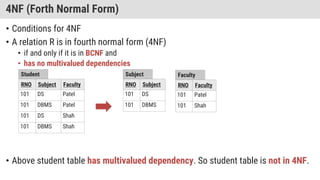
• Conditions for 4NF
• A relation R is in fourth normal form (4NF)
• if and only if it is in BCNF and
• has no multivalued dependencies
• Above student table has multivalued dependency. So student table is not in 4NF.
RNO Subject Faculty
101 DS Patel
101 DBMS Patel
101 DS Shah
101 DBMS Shah
Student
RNO Subject
101 DS
101 DBMS
Subject
RNO Faculty
101 Patel
101 Shah
Faculty
Functional dependency & Multivalued dependency
• A table can have both functional dependency as well as multi-valued dependency
together.
• RNO → Address
• RNO →→ Subject
• RNO →→ Faculty
RNO Address Subject Faculty
101 C. G. Road, Delhi DS Patel
101 C. G. Road, Delhi DBMS Patel
101 C. G. Road, Delhi DS Shah
101 C. G. Road, Delhi DBMS Shah
Student
RNO Subject
101 DS
101 DBMS
Subject
RNO Faculty
101 Patel
101 Shah
Faculty
RNO Address
101 C. G. Road, Delhi
Address
5NF (Fifth Normal Form)
Section – 7.6
5NF (Fifth Normal Form)
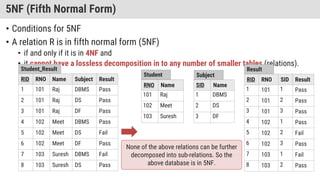
• Conditions for 5NF
• A relation R is in fifth normal form (5NF)
• if and only if it is in 4NF and
• it cannot have a lossless decomposition in to any number of smaller tables (relations).
RID RNO Name Subject Result
1 101 Raj DBMS Pass
2 101 Raj DS Pass
3 101 Raj DF Pass
4 102 Meet DBMS Pass
5 102 Meet DS Fail
6 102 Meet DF Pass
7 103 Suresh DBMS Fail
8 103 Suresh DS Pass
Student_Result
Student_Result relation is further decomposed into sub-
relations. So the above relation is not in 5NF.
5NF (Fifth Normal Form)
• Conditions for 5NF
• A relation R is in fifth normal form (5NF)
• if and only if it is in 4NF and
• it cannot have a lossless decomposition in to any number of smaller tables (relations).
RID RNO Name Subject Result
1 101 Raj DBMS Pass
2 101 Raj DS Pass
3 101 Raj DF Pass
4 102 Meet DBMS Pass
5 102 Meet DS Fail
6 102 Meet DF Pass
7 103 Suresh DBMS Fail
8 103 Suresh DS Pass
Student_Result
RNO Name
101 Raj
102 Meet
103 Suresh
Student
SID Name
1 DBMS
2 DS
3 DF
Subject
RID RNO SID Result
1 101 1 Pass
2 101 2 Pass
3 101 3 Pass
4 102 1 Pass
5 102 2 Fail
6 102 3 Pass
7 103 1 Fail
8 103 2 Pass
Result
None of the above relations can be further
decomposed into sub-relations. So the
above database is in 5NF.
How to find key?
• Conditions to find key
• The attribute is a part of key, if it does not occur on any side of FD
• The attribute is a part of key, if it occurs on the left-hand side of an FD, but never occurs on
the right-hand side
• The attribute is not a part of key, if it occurs on the right-hand side of an FD, but never
occurs on the left-hand side
• The attribute may be a part of key or not, if it occurs on the both side of an FD
How to find key? [Example]
• Let a relation R with attributes ABCD with FDs C → A, B → C. Find keys for relation
R.
• attribute not occur on any side of FDs (D) √
• attribute occurs on only left-hand side of an FDs (B) √
• attribute occurs on only right-hand side of an FDs (A) X
• attribute occurs on both the sides of an FDs (C) ?
• The core is BD.
• B determines C and C determines A, So using transitivity rule B determines A
also.
• So BD is a key.
How to find key? [Exercise]
• Let a relation R with attributes ABCD with FDs C → D, C → A and B → C. Find keys
for relation R.
• The core is B. B determines C which determines A and D, so B is a key. Therefore B is the
key.
• Let a relation R with attributes ABCD with FDs B → C, D → A. Find keys for relation
R.
• The core is BD. B determines C and D determines A, so BD is a key. Therefore BD is the key.
• Let a relation R with attributes ABCD with FDs A → B, BC → D and A → C. Find
keys for relation R.
• The core is A. A determines B and C which determine D, so A is a key. Therefore A is the
key.
Find (candidate) key & check for normal forms [Example]
Candidate Key is BD
 Suppose you are given a relation R with four attributes ABCD. For each of the following sets of
FDs, do the following: F = (B → C, D → A)
 Identify the candidate key(s) for R.
 Identify the best normal form that R satisfies (1NF, 2NF, 3NF or BCNF).
Relation R is in 1NF but not 2NF. In above FDs, there is a partial dependency
(As per FD B → C, C depends only on B but Key is BD so C is partial depends on key (BD))
(As per FD D → A, A depends only on D but Key is BD so A is partial depends on key (BD))
Find (candidate) key & check for normal forms [Example]
Candidate Key is B
 Suppose you are given a relation R with four attributes ABCD. For each of the following sets of
FDs, do the following: F = (C → D, C → A, B → C)
 Identify the candidate key(s) for R.
 Identify the best normal form that R satisfies (1NF, 2NF, 3NF or BCNF).
Relation R is in 2NF but not 3NF. In above FDs, there is a transitive dependency
(As per FDs B → C & C → D then B → D so D is transitive depends on key (B))
(As per FDs B → C & C → A then B → A so A is transitive depends on key (B))
Find (candidate) key & check for normal forms [Example]
Candidate Key is A
 Suppose you are given a relation R with four attributes ABCD. For each of the following sets of
FDs, do the following: F = (A → B, BC → D, A → C)
 Identify the candidate key(s) for R.
 Identify the best normal form that R satisfies (1NF, 2NF, 3NF or BCNF).
Relation R is in 2NF but not 3NF. In above FDs, there is a transitive dependency
(As per FDs A → B & A → C then A → BC using union rule) and
(As per FDs A → BC & BC → D then A → D so D is transitive depends on key (A))
Find (candidate) key & check for normal forms [Example]
Candidate Key are ABC & BCD
 Suppose you are given a relation R with four attributes ABCD. For each of the following sets of
FDs, do the following: F = (ABC → D, D → A)
 Identify the candidate key(s) for R.
 Identify the best normal form that R satisfies (1NF, 2NF, 3NF or BCNF).
Relation R is in 3NF but not BCNF.
In the above FDs, both FDs have prime attribute (D and A) in dependent (right)
side.
How to normalize database?
• A software contract and consultancy firm maintains details of all the various
projects in which its employees are currently involved. These details comprise:
Employee Number, Employee Name, Date of Birth, Department Code, Department
Name, Project Code, Project Description, Project Supervisor.
• Assume the following:
• Each employee number is unique.
• Each department has a single department code.
• Each project has a single code and supervisor.
• Each employee may work on one or more projects.
• Employee names need not necessarily be unique.
• Project Code, Project Description and Project Supervisor are repeating fields.
• Normalize this data to Third Normal Form.
How to normalize database?
• A software contract and consultancy firm maintains details of all the various
projects in which its employees are currently involved. These details comprise:
Employee Number, Employee Name, Date of Birth, Department Code, Department
Name, Project Code, Project Description, Project Supervisor.
Employee
Number
Employee
Name
Date of
Birth
Department
Code
Department
Name
Project
Code
Project
Description
Project
Supervisor
1 Raj 1-1-85 1 CE 1 IOT Patel
2 Meet 4-4-86 2 EC 2 PHP Shah
3 Suresh 2-2-85 1 CE 1 IOT Patel
1 Raj 1-1-85 1 CE 2 PHP Shah
UNF
How to normalize database?
Employee
Number
Employee
Name
Date of
Birth
Department
Code
Department
Name
Project
Code
Project
Description
Project
Supervisor
1 Raj 1-1-85 1 CE 1 IOT Patel
2 Meet 4-4-86 2 EC 2 PHP Shah
3 Suresh 2-2-85 1 CE 1 IOT Patel
1 Raj 1-1-85 1 CE 2 PHP Shah
UNF
Employee
Number
Employee
Name
Date of
Birth
Department
Code
Department
Name
1 Raj 1-1-85 1 CE
2 Meet 4-4-86 2 EC
3 Suresh 2-2-85 1 CE
1NF
Employee
Number
Project
Code
Project
Description
Project
Supervisor
1 1 IOT Patel
2 2 PHP Shah
3 1 IOT Patel
1 2 PHP Shah
How to normalize database?
Employee
Number
Employee
Name
Date of
Birth
Department
Code
Department
Name
1 Raj 1-1-85 1 CE
2 Meet 4-4-86 2 EC
3 Suresh 2-2-85 1 CE
1NF
Employee
Number
Project
Code
Project
Description
Project
Supervisor
1 1 IOT Patel
2 2 PHP Shah
3 1 IOT Patel
1 2 PHP Shah
Employee
Number
Employee
Name
Date of
Birth
Department
Code
Department
Name
1 Raj 1-1-85 1 CE
2 Meet 4-4-86 2 EC
3 Suresh 2-2-85 1 CE
2NF
Project
Code
Project
Description
Project
Supervisor
1 IOT Patel
2 PHP Shah
Employee
Number
Project
Code
1 1
2 2
3 1
1 2
How to normalize database?
3NF
Employee
Number
Employee
Name
Date of
Birth
Department
Code
1 Raj 1-1-85 1
2 Meet 4-4-86 2
3 Suresh 2-2-85 1
Project
Code
Project
Description
Project
Supervisor
1 IOT Patel
2 PHP Shah
Employee
Number
Project
Code
1 1
2 2
3 1
1 2
Department
Code
Department
Name
1 CE
2 EC
Questions asked in AKTU
1. What is meant by normalization? Write its need. List and discuss various
normalization forms.
2. Consider schema EMPLOYEE(E-ID,E-NAME,E-CITY,E-STATE) and
FD = {E-ID → E-NAME, E-ID → E-CITY, E-ID → E-STATE, E-CITY → E-STATE}
 Find attribute closure for: (E-ID)+
3. Compute the closure of the following set F of functional dependencies for
relation schema R(A, B, C, D, E).
F = { A → BC, CD → E, B → D, E → A}
 List the candidate keys for R.
4. Consider schema R = (A, B, C, G, H, I) and the set F of functional dependencies
{A → B, A → C, CG → H, CG → I, B → H}. ( Use F+ )
 Prove that AG → I Holds.
Questions asked in AKTU
5. In the BCNF decomposition algorithm, suppose you use a functional dependency
α → β to decompose a relation schema r (α, β, γ) into r1 (α, β) and r2 (α, γ).
 What primary and foreign-key constraint do you expect to hold on the decomposed
relations?
 Give an example of an inconsistency that can arise due to an erroneous update, if the
foreign-key constraint were not enforced on the decomposed relations above.
 When a relation is decomposed into 3NF, what primary and foreign key dependencies
would you expect will hold on the decomposed schema?
6. A college maintains details of its lecturers' subject area skills. These details
comprise: Lecturer Number, Lecturer Name, Lecturer Grade, Department Code,
Department Name, Subject Code, Subject Name, Subject Level. Assume that
each lecturer may teach many subjects but may not belong to more than one
department. Subject Code, Subject Name and Subject Level are repeating fields.
Normalize this data to Third Normal Form.
Database Management Systems (DBMS)
Computer Science & Engineering

DBMS FDs and Normalization.pptx

  • 1.
    Unit-3 Relational Database Design Computer EngineeringDepartment Database Management Systems (DBMS)
  • 2.
     Looping Outline • FunctionalDependency • Definition and types of FD • Armstrong's axioms (inference rules) • Closure of FD set • Closure of attribute set • Canonical cover • Decomposition and its types • Anomaly in database design and its types • Normalization and normal forms • 1NF • 2NF • 3NF • BCNF • 4NF • 5NF
  • 3.
  • 4.
    What is FunctionalDependency (FD)? • Let R be a relation schema having n attributes A1, A2, A3,…, An. • Let attributes X and Y are two subsets of attributes of relation R. • If the values of the X component of a tuple uniquely (or functionally) determine the values of the Y component, then there is a functional dependency from X to Y. • This is denoted by X → Y (i.e RollNo → Name, SPI, BL). • It is referred as: Y is functionally dependent on the X or X functionally determines Y. RollNo Name SPI BL 101 Raju 8 0 102 Mitesh 7 1 103 Jay 7 0 Student
  • 5.
    Diagrammatic representation ofFunctional Dependency (FD) • Example • Consider the relation Account(account_no, balance, branch). • account_no can determine balance and branch. • So, there is a functional dependency from account_no to balance and branch. • This can be denoted by account_no → {balance, branch}. X Y X1 X2 Y X Y1 Y2 X → Y {X1, X2} → Y X → {Y1, Y2} account_no balance branch
  • 6.
    Types of FunctionalDependency (FD) • Full Functional Dependency • In a relation, the attribute B is fully functional dependent on A if B is functionally dependent on A, but not on any proper subset of A. • Eg. {Roll_No, Semester, Department_Name} → SPI • We need all three {Roll_No, Semester, Department_Name} to find SPI. • Partial Functional Dependency • In a relation, the attribute B is partial functional dependent on A if B is functionally dependent on A as well as on any proper subset of A. • If there is some attribute that can be removed from A and the still dependency holds then it is partial functional dependancy. • Eg. {Enrollment_No, Department_Name} → SPI • Enrollment_No is sufficient to find SPI, Department_Name is not required to find SPI.
  • 7.
    Types of FunctionalDependency (FD) • Transitive Functional Dependency • In a relation, if attribute(s) A → B and B → C, then A → C (means C is transitively depends on A via B). • Eg. Subject → Faculty & Faculty → Age then Subject → Age • Therefore as per the rule of transitive dependency: Subject → Age should hold, that makes sense because if we know the subject name we can know the faculty’s age. Subject Faculty Age DS Shah 35 DBMS Patel 32 DF Shah 35 Sub_Fac
  • 8.
    Types of FunctionalDependency (FD) • Trivial Functional Dependency • X → Y is trivial FD if Y is a subset of X • Eg. {Roll_No, Department_Name, Semester} → Roll_No • Nontrivial Functional Dependency • X → Y is nontrivial FD if Y is not a subset of X • Eg. {Roll_No, Department_Name, Semester} → Student_Name
  • 9.
  • 10.
    Armstrong's axioms ORInference rules • Armstrong's axioms are a set of rules used to infer (derive) all the functional dependencies on a relational database.  If B is a subset of A  then A → B Reflexivity  If A → B  then AC → BC Augmentation  If A → B and B → C  then A → C Transitivity  If A → B and BD → C  then AD → C Pseudo Transitivity  If A → A Self-determination  If A → BC  then A → B and A → C Decomposition  If A → B and A → C  then A → BC Union  If A → B and C → D  then AC → BD Composition
  • 11.
  • 12.
    What is closureof a set of FDs? • Given a set F set of functional dependencies, there are certain other functional dependencies that are logically implied by F. • E.g.: F = {A → B and B → C}, then we can infer that A → C (by transitivity rule) • The set of functional dependencies (FDs) that is logically implied by F is called the closure of F. • It is denoted by F+.
  • 13.
    Closure of aset of FDs [Example]  Suppose we are given a relation schema R(A,B,C,G,H,I) and the set of functional dependencies are:  F = (A → B, A → C, CG → H, CG → I, B → H)  The functional dependency A → H is logical implied. A → B B → H We have Transitivity rule A → H
  • 14.
    Closure of aset of FDs [Example]  Suppose we are given a relation schema R(A,B,C,G,H,I) and the set of functional dependencies are:  F = (A → B, A → C, CG → H, CG → I, B → H)  The functional dependency CG → HI is logical implied. CG → H CG → I We have Union rule CG → HI
  • 15.
    Closure of aset of FDs [Example]  Suppose we are given a relation schema R(A,B,C,G,H,I) and the set of functional dependencies are:  F = (A → B, A → C, CG → H, CG → I, B → H)  The functional dependency AG → I is logical implied. A → C CG → I We have Pseudo- transitivity rule AG → I
  • 16.
    Closure of aset of FDs [Example]  Suppose we are given a relation schema R(A,B,C,G,H,I) and the set of functional dependencies are:  F = (A → B, A → C, CG → H, CG → I, B → H)  The functional dependency AG → I is logical implied. A → C We have Augmentation rule AG → CG AG → CG CG → I Transitivity rule AG → I
  • 17.
    Closure of aset of FDs [Example] F+ = (A → H, CG → HI, AG → I) Several members of F+ are  Suppose we are given a relation schema R(A,B,C,G,H,I) and the set of functional dependencies are:  F = (A → B, A → C, CG → H, CG → I, B → H)  Find out the closure of F.
  • 18.
    Closure of aset of FDs [Example]  Compute the closure of the following set F of functional dependencies FDs for relational schema R = (A,B,C,D,E,F):  F = (A → B, A → C, CD → E, CD → F, B → E)  Find out the closure of F. F+ = (A → BC, CD → EF, A → E, AD → E, AD → F) A → B & A → C Union Rule A → BC CD → E & CD → F Union Rule CD → EF A → B & B → E Transitivity Rule A → E A → C & CD → E Pseudo-transitivity Rule AD → E A → C & CD → F Pseudo-transitivity Rule AD → F
  • 19.
    Closure of aset of FDs [Example]  Compute the closure of the following set F of functional dependencies FDs for relational schema R = (A,B,C,D,E):  F = (AB → C, D → AC, D → E )  Find out the closure of F. F+ = (D → A, D → C, D → ACE) D → AC Decomposition Rule D → A & D → C D → AC & D → E Union Rule D → ACE
  • 20.
  • 21.
    What is aclosure of attribute sets? • Given a set of attributes α, the closure of α under F is the set of attributes that are functionally determined by α under F. • It is denoted by α+.
  • 22.
    What is aclosure of attribute sets? • Given a set of attributes α, the closure of α under F is the set of attributes that are functionally determined by α under F. • It is denoted by α+.  Algorithm to compute α+, the closure of α under F  Steps 1. result = α 2. while (changes to result) do  for each β → γ in F do  begin • if β ⊆ result then result = result U γ • else result = result  end Algorithm
  • 23.
    Closure of attributesets [Example] • Consider the relation schema R = (A, B, C, G, H, I). • For this relation, a set of functional dependencies F can be given as F = {A → B, A → C, CG → H, CG → I, B → H} • Find out the closure of (AG)+.  Algorithm to compute α+, the closure of α under F  Steps 1. result = α 2. while (changes to result) do  for each β → γ in F do  begin • if β ⊆ result then result = result U γ • else result = result  end Algorithm  Step 1. result = α => result = AG A → B A ⊆ AG result = ABG A → C A ⊆ ABG result = ABCG CG → H CG ⊆ ABCG result = ABCGH CG → I CG ⊆ ABCGH result = ABCGHI B → H B ⊆ ABCGHI result = ABCGHI AG+ = ABCGHI
  • 24.
    Closure of attributesets [Exercise] • Given functional dependencies (FDs) for relational schema R = (A,B,C,D,E): • F = {A → BC, CD → E, B → D, E → A} • Find Closure for A • Find Closure for CD • Find Closure for B • Find Closure for BC • Find Closure for E A+ = ABCDE CD+ = ABCDE B+ = BD BC+ = ABCDE E+ = ABCDE Answer
  • 25.
  • 26.
    What is extraneousattributes? • Let us consider a relation R with schema R = (A, B, C) and set of functional dependencies FDs F = { AB → C, A → C }. • In AB → C, B is extraneous attribute. The reason is, there is another FD A → C, which means when A alone can determine C, the use of B is unnecessary (extra). • An attribute of a functional dependency is said to be extraneous if we can remove it without changing the closure of the set of functional dependencies.
  • 27.
    What is canonicalcover? • A canonical cover of F is a minimal set of functional dependencies equivalent to F, having no redundant dependencies or redundant parts of dependencies. • It is denoted by Fc • A canonical cover for F is a set of dependencies Fc such that • F logically implies all dependencies in Fc and • Fc logically implies all dependencies in F and • No functional dependency in Fc contains an extraneous attribute and • Each left side of functional dependency in Fc is unique. F = {A → B, A → C} Fc = {A → BC} Union Rule Decomposition Rule
  • 28.
    Algorithm to findcanonical cover • Repeat • Use the union rule to replace any dependencies in F α1 → β1 and α1 → β2 with α1 → β1β2 • Find a functional dependency α → β with an extraneous attribute either in α or in β /* Note: test for extraneous attributes done using Fc, not F */ • If an extraneous attribute is found, delete it from α → β • until F does not change /* Note: Union rule may become applicable after some extraneous attributes have been deleted, so it has to be re-applied */
  • 29.
    Canonical cover [Example] •Combine A → BC and A → B into A → BC (Union Rule) • Set is {A → BC, B → C, AB → C} • A is extraneous in AB → C • Check if the result of deleting A from AB → C is implied by the other dependencies • Yes: in fact, B → C is already present • Set is {A → BC, B → C} • C is extraneous in A → BC • Check if A → C is logically implied by A → B and the other dependencies • Yes: using transitivity on A → B and B → C. • The canonical cover is: A → B, B → C  Consider the relation schema R = (A, B, C) with FDs F = {A → BC, B → C, A → B, AB → C}  Find canonical cover.
  • 30.
    Canonical cover [Example] •The left side of each FD in F is unique. • Also none of the attributes in the left side or right side of any of the FDs is extraneous. • Therefore the canonical cover Fc is equal to F. • Fc = {A → BC, CD → E, B → D, E → A}  Consider the relation schema R = (A, B, C, D, E, F) with FDs F = {A → BC, CD → E, B → D, E → A}  Find canonical cover.
  • 31.
  • 32.
    What is decomposition? •Decomposition is the process of breaking down given relation into two or more relations. • Relation R is replaced by two or more relations in such a way that: • Each new relation contains a subset of the attributes of R • Together, they all include all tuples and attributes of R • Types of decomposition • Lossy decomposition • Lossless decomposition (non-loss decomposition)
  • 33.
    Lossy decomposition • Thedecomposition of relation R into R1 and R2 is lossy when the join of R1 and R2 does not yield the same relation as in R. • This is also referred as lossy-join decomposition. • The disadvantage of such kind of decomposition is that some information is lost during retrieval of original relation. • From practical point of view, decomposition should not be lossy decomposition. Ano Balance Bname A01 5000 Delhi A02 5000 Noida Customer Ano Balance Bname A01 5000 Delhi A01 5000 Noida A02 5000 Delhi A02 5000 Noida Customer Balance Bname 5000 Delhi 5000 Noida Table-2 Ano Balance A01 5000 A02 5000 Table-1 Not Same
  • 34.
    Lossless decomposition • Thedecomposition of relation R into R1 and R2 is lossless when the join of R1 and R2 produces the same relation as in R. • This is also referred as a non-additive (non-loss) decomposition. • All decompositions must be lossless. Ano Balance Bname A01 5000 Delhi A02 5000 Noida Customer Ano Balance Bname A01 5000 Delhi A02 5000 Noida Customer Ano Bname A01 Delhi A02 Noida Table-2 Ano Balance A01 5000 A02 5000 Table-1 Same
  • 35.
  • 36.
    What is ananomaly in database design? • Anomalies are problems that can occur in poorly planned, un-normalized database where all the data are stored in one table. • There are three types of anomalies that can arise in the database because of redundancy are • Insert anomaly • Delete anomaly • Update / Modification anomaly
  • 37.
    Insert anomaly • Considera relation Emp_Dept(EID, Ename, City, DID, Dname, Manager) EID as a primary key • Suppose a new department (IT) has been started by the organization but initially there is no employee appointed for that department. • We want to insert that department detail in Emp_Dept table. • But the tuple for this department cannot be inserted into this table as the EID will have NULL value, which is not allowed because EID is primary key. • This kind of problem in the relation where some tuple cannot be inserted is known as insert anomaly. EID Ename City DID Dname Manager 1 Raj Delhi 1 CE Shah 2 Meet Noida 1 CE Shah Emp_Dept An insert anomaly occurs when certain attributes cannot be inserted into the database without the presence of another attribute. NULL NULL NULL 2 IT NULL Want to insert new department detail (IT)
  • 38.
    Delete anomaly • Considera relation Emp_Dept(EID, Ename, City, DID, Dname, Manager) EID as a primary key • Now consider there is only one employee in some department (IT) and that employee leaves the organization. • So we need to delete tuple of that employee (Jay). • But in addition to that information about the department also deleted. • This kind of problem in the relation where deletion of some tuples can lead to loss of some other data not intended to be removed is known as delete anomaly. EID Ename City DID Dname Manager 1 Raj Delhi 1 CE Shah 2 Meet Noida 1 CE Shah Emp_Dept A delete anomaly exists when certain attributes are lost because of the deletion of another attribute. 3 Jay Gurgaon 2 IT Dave Want to delete (Jay) employee's detail
  • 39.
    Update anomaly • Considera relation Emp_Dept(EID, Ename, City, Dname, Manager) EID as a primary key • Suppose the manager of a (CE) department has changed, this requires that the Manager in all the tuples corresponding to that department must be changed to reflect the new status. • If we fail to update all the tuples of given department, then two different records of employee working in the same department might show different Manager lead to inconsistency in the database. EID Ename City Dname Manager 1 Raj Delhi CE Sah 2 Meet Noida C.E Shah 3 Jay Gurgaon Computer Shaah 4 Hari Delhi IT Dave Emp_Dept An update anomaly exists when one or more records (instance) of duplicated data is updated, but not all. Want to update manager of CE department
  • 40.
    How to dealwith insert, delete and update anomaly EID Ename City DID Dname Manager 1 Raj Delhi 1 CE Shah 2 Meet Noida 1 C.E Shah Emp_Dept NULL NULL NULL 3 EC NULL EID Ename City DID 1 Raj Delhi 1 2 Meet Noida 1 Emp DID Dname Manager 1 CE Shah Dept 3 EC NULL 3 Jay Gurgaon 2 IT Dave 2 IT Dave 3 Jay Gurgao n 2 Such type of anomalies in the database design can be solved by using normalization.
  • 41.
  • 42.
    What is normalization? •Normalization is the process of removing redundant data from tables to improve data integrity, scalability and storage efficiency. • data integrity (completeness, accuracy and consistency of data) • scalability (ability of a system to continue to function well in a growing amount of work) • storage efficiency (ability to store and manage data that consumes the least amount of space) • What we do in normalization? • Normalization generally involves splitting an existing table into multiple (more than one) tables, which can be re-joined or linked each time a query is issued (executed).
  • 43.
    How many normalforms are there? • Normal forms: • 1NF (First normal form) • 2NF (Second normal form) • 3NF (Third normal form) • BCNF (Boyce–Codd normal form) • 4NF (Forth normal form) • 5NF (Fifth normal form) As we move from 1NF to 5NF number of tables and complexity increases but redundancy decreases.
  • 44.
    1NF (First NormalForm) Section – 7.1
  • 45.
    1NF (First NormalForm) • Conditions for 1NF • A relation R is in first normal form (1NF) if and only if it does not contain any composite attribute or multi-valued attributes or their combinations. OR • A relation R is in first normal form (1NF) if and only if all underlying domains contain atomic values only. Each cells of a table should contain a single value.
  • 46.
    1NF (First NormalForm) [Example - Composite attribute] • Problem: It is difficult to retrieve the list of customers living in ’Mathura’ city from customer table. • The reason is that address attribute is composite attribute which contains road name as well as city name in single cell. • It is possible that city name word is also there in road name. • In our example, ’Mathura’ word occurs in both records, in first record it is a part of road name and in second one it is the name of city. CID Name Address C01 Raju Mathura Road, Delhi C02 Mitesh Nehru Road, Mathura C03 Jay C.G Road, Faridabad Customer • In customer relation address is composite attribute which is further divided into sub-attributes as “Road” and “City”. • So customer relation is not in 1NF.
  • 47.
    1NF (First NormalForm) [Example - Composite attribute] • Solution: Divide composite attributes into number of sub-attributes and insert value in proper sub-attribute. CID Name Address C01 Raju Mathura Road, Delhi C02 Mitesh Nehru Road, Mathura C03 Jay C.G Road, Faridabad Customer CID Name Road City C01 Raju Mathura Road Delhi C02 Mitesh Nehru Road Mathura C03 Jay C.G Road Faridabad Customer Exercise Convert below relation into 1NF (First Normal Form) PID Full_Name City P01 Raju Maheshbhai Patel Delhi Person
  • 48.
    1NF (First NormalForm) [Example - Multivalued attribute] • Problem: It is difficult to retrieve the list of students failed in ’DBMS’ as well as ’DS’ but not in other subjects from student table. • The reason is that FailedinSubjects attribute is multi-valued attribute so it contains more than one value. Rno Name FailedinSubjects 101 Raju DS, DBMs 102 Mitesh DBMS, DS 103 Jay DS, DBMS, DE 104 Jeet DBMS, DE, DS 105 Harsh DE, DBMS, DS 106 Neel DE, DBMS Student • In student relation FailedinSubjects attribute is a multi- valued attribute which can store more than one values. • So above relation is not in 1NF.
  • 49.
    1NF (First NormalForm) [Example - Multivalued attribute] • Solution: Split the table into two tables in such as way that • the first table contains all attributes except multi-valued attribute with same primary key and • second table contains multi-valued attribute and place a primary key in it. • insert the primary key of first table in the second table as a foreign key. Rno Name FailedinSubjects 101 Raju DS, DBMs 102 Mitesh DBMS, DS 103 Jay DS, DBMS, DE 104 Jeet DBMS, DE, DS 105 Harsh DE, DBMS, DS 106 Neel DE, DBMS Student Rno Name 101 Raju 102 Mitesh 103 Jay 104 Jeet 105 Harsh 106 Neel Student RID Rno Subject 1 101 DS 2 101 DBMS 3 102 DBMS 4 102 DS 5 103 DS … … … Result
  • 50.
    2NF (Second NormalForm) Section – 7.2
  • 51.
    2NF (Second NormalForm) • Conditions for 2NF • A relation R is in second normal form (2NF) • if and only if it is in 1NF and • every non-primary key attribute is fully dependent on the primary key OR • A relation R is in second normal form (2NF) • if and only if it is in 1NF and • no any non-primary key attribute is partially dependent on the primary key It is in 1NF and each table should contain a single primary key.
  • 52.
    2NF (Second NormalForm) [Example] • FD1: {CID, ANO} → {AccesssDate, Balance, BranchName} • FD2: ANO → {Balance, BranchName} • Balance and BranchName are partial dependent on primary key (CID + ANO). So customer relation is not in 2NF. CID ANO AccessDate Balance BranchName C01 A01 01-01-2017 50000 Delhi C02 A01 01-03-2017 50000 Delhi C01 A02 01-05-2017 25000 Noida C03 A02 01-07-2017 25000 Noida Customer ANO AccesssDate Balance BranchName CID FD1 FD2
  • 53.
    2NF (Second NormalForm) [Example] • Problem: For example, in case of a joint account multiple (more than one) customers have common (one) accounts. • If an account ’A01’ is operated jointly by two customers says ’C01’ and ’C02’ then data values for attributes Balance and BranchName will be duplicated in two different tuples of customers ’C01’ and ’C02’. CID ANO AccessDate Balance BranchName C01 A01 01-01-2017 50000 Delhi C02 A01 01-03-2017 50000 Delhi C01 A02 01-05-2017 25000 Noida C03 A02 01-07-2017 25000 Noida Customer ANO AccesssDate Balance BranchName CID FD1 FD2
  • 54.
    2NF (Second NormalForm) [Example] • Solution: Decompose relation in such a way that resultant relations do not have any partial FD. • Remove partial dependent attributes from the relation that violets 2NF. • Place them in separate relation along with the prime attribute on which they are fully dependent. • The primary key of new relation will be the attribute on which it is fully dependent. • Keep other attributes same as in that table with the same primary key. CID ANO AccessDate Balance BranchName C01 A01 01-01-2017 50000 Delhi C02 A01 01-03-2017 50000 Delhi C01 A02 01-05-2017 25000 Noida C03 A02 01-07-2017 25000 Noida Customer ANO Balance BranchName A01 50000 Delhi A02 25000 Noida Table-1 CID ANO AccessDate C01 A01 01-01-2017 C02 A01 01-03-2017 C01 A02 01-05-2017 C03 A02 01-07-2017 Table-2
  • 55.
    3NF (Third NormalForm) Section – 7.3
  • 56.
    3NF (Third NormalForm) • Conditions for 3NF • A relation R is in third normal form (3NF) • if and only if it is in 2NF and • every non-key attribute is non-transitively dependent on the primary key OR • A relation R is in third normal form (3NF) • if and only if it is in 2NF and • no any non-key attribute is transitively dependent on the primary key It is in 2NF and there is no transitive dependency. (Transitive dependency???) A → B & B → C then A → C
  • 57.
    3NF (Third NormalForm) [Example] • FD1: ANO → {Balance, BranchName, BranchAddress} • FD2: BranchName → BranchAddress • So ANO → BranchAddress (Using Transitivity rule) • BranchAddress is transitive depend on primary key (ANO). So customer relation is not in 3NF. ANO Balance BranchName BranchAddress A01 50000 Delhi Kalawad road A02 40000 Delhi Kalawad Road A03 35000 Noida C.G Road A04 25000 Noida C.G Road Customer ANO Balance BranchName BranchAddres s FD1 FD2
  • 58.
    3NF (Third NormalForm) [Example] • Problem: In this relation, branch address will be stored repeatedly for each account of the same branch which occupies more space. ANO Balance BranchName BranchAddress A01 50000 Delhi Kalawad road A02 40000 Delhi Kalawad Road A03 35000 Noida C.G Road A04 25000 Noida C.G Road Customer ANO Balance BranchName BranchAddres s FD1 FD2
  • 59.
    3NF (Third NormalForm) [Example] • Solution: Decompose relation in such a way that resultant relations do not have any transitive FD. • Remove transitive dependent attributes from the relation that violets 3NF. • Place them in a new relation along with the non-prime attributes due to which transitive dependency occurred. • The primary key of the new relation will be non-prime attributes due to which transitive dependency occurred. • Keep other attributes same as in the table with same primary key and add prime attributes of other relation into it as a foreign key. ANO Balance BranchName BranchAddress A01 50000 Delhi Kalawad road A02 40000 Delhi Kalawad Road A03 35000 Noida C.G Road A04 25000 Noida C.G Road Customer BranchName BranchAddress Delhi Kalawad road Noida C.G Road Table-1 ANO Balance BranchName A01 50000 Delhi A02 40000 Delhi A03 35000 Noida A04 25000 Noida Table-2
  • 60.
    BCNF (Boyce-Codd NormalForm) Section – 7.4
  • 61.
    BCNF (Boyce-Codd NormalForm) • Conditions for BCNF • A relation R is in Boyce-Codd normal form (BCNF) • if and only if it is in 3NF and • for every functional dependency X → Y, X should be the primary key of the table. OR • A relation R is in Boyce-Codd normal form (BCNF) • if and only if it is in 3NF and • every prime key attribute is non-transitively dependent on the primary key OR • A relation R is in Boyce-Codd normal form (BCNF) • if and only if it is in 3NF and • no any prime key attribute is transitively dependent on the primary key BCNF is based on the concept of a determinant. It is in 3NF and every determinant should be primary key. AccountNO → {Balance, Branch} Determinant Dependent Primary Key
  • 62.
    BCNF (Boyce-Codd NormalForm) [Example] RNO Subject Faculty 101 DS Patel 102 DBMS Shah 103 DS Jadeja 104 DBMS Dave 105 DBMS Shah 102 DS Patel 101 DBMS Dave 105 DS Jadeja Student RNO Subject Faculty FD2 FD1 • FD1: RNO, Subject → Faculty • FD2: Faculty → Subject • So {RNO, Subject} → Subject (Transitivity rule) • Here, one faculty teaches only one subject, but a subject may be taught by more than one faculty. • A student can learn a subject from only one faculty. In FD2, determinant is Faculty which is not a primary key. So student table is not in BCNF. Problem: In this relation one student can learn more than one subject with different faculty then records will be stored repeatedly for each student, language and faculty combination which occupies more space.
  • 63.
    BCNF (Boyce-Codd NormalForm) [Example] RNO Subject Faculty 101 DS Patel 102 DBMS Shah 103 DS Jadeja 104 DBMS Dave 105 DBMS Shah 102 DS Patel 101 DBMS Dave 105 DS Jadeja Student • Solution: Decompose relation in such a way that resultant relations do not have any transitive FD. • Remove transitive dependent prime attribute from relation that violets BCNF. • Place them in separate new relation along with the non-prime attribute due to which transitive dependency occurred. • The primary key of new relation will be this non-prime attribute due to which transitive dependency occurred. • Keep other attributes same as in that table with same primary key and add a prime attribute of other relation into it as a foreign key. Faculty Subject Patel DS Shah DBMS Jadeja DS Dave DBMS Table-1 RNO Faculty 101 Patel 102 Shah 103 Jadeja 104 Dave 105 Shah 102 Patel 101 Dave 105 Jadeja Table-2
  • 64.
    Multivalued dependency (MVD) •For a dependency X → Y, if for a single value of X, multiple values of Y exists, then the table may have multi-valued dependency. • Multivalued dependency (MVD) is denoted by →→ • Multivalued dependency (MVD) is represented as X →→ Y RNO Subject Faculty 101 DS Patel 101 DBMS Patel 101 DS Shah 101 DBMS Shah Student
  • 65.
    4NF (Forth NormalForm) Section – 7.5
  • 66.
    4NF (Forth NormalForm) • Conditions for 4NF • A relation R is in fourth normal form (4NF) • if and only if it is in BCNF and • has no multivalued dependencies • Above student table has multivalued dependency. So student table is not in 4NF. RNO Subject Faculty 101 DS Patel 101 DBMS Patel 101 DS Shah 101 DBMS Shah Student RNO Subject 101 DS 101 DBMS Subject RNO Faculty 101 Patel 101 Shah Faculty
  • 67.
    Functional dependency &Multivalued dependency • A table can have both functional dependency as well as multi-valued dependency together. • RNO → Address • RNO →→ Subject • RNO →→ Faculty RNO Address Subject Faculty 101 C. G. Road, Delhi DS Patel 101 C. G. Road, Delhi DBMS Patel 101 C. G. Road, Delhi DS Shah 101 C. G. Road, Delhi DBMS Shah Student RNO Subject 101 DS 101 DBMS Subject RNO Faculty 101 Patel 101 Shah Faculty RNO Address 101 C. G. Road, Delhi Address
  • 68.
    5NF (Fifth NormalForm) Section – 7.6
  • 69.
    5NF (Fifth NormalForm) • Conditions for 5NF • A relation R is in fifth normal form (5NF) • if and only if it is in 4NF and • it cannot have a lossless decomposition in to any number of smaller tables (relations). RID RNO Name Subject Result 1 101 Raj DBMS Pass 2 101 Raj DS Pass 3 101 Raj DF Pass 4 102 Meet DBMS Pass 5 102 Meet DS Fail 6 102 Meet DF Pass 7 103 Suresh DBMS Fail 8 103 Suresh DS Pass Student_Result Student_Result relation is further decomposed into sub- relations. So the above relation is not in 5NF.
  • 70.
    5NF (Fifth NormalForm) • Conditions for 5NF • A relation R is in fifth normal form (5NF) • if and only if it is in 4NF and • it cannot have a lossless decomposition in to any number of smaller tables (relations). RID RNO Name Subject Result 1 101 Raj DBMS Pass 2 101 Raj DS Pass 3 101 Raj DF Pass 4 102 Meet DBMS Pass 5 102 Meet DS Fail 6 102 Meet DF Pass 7 103 Suresh DBMS Fail 8 103 Suresh DS Pass Student_Result RNO Name 101 Raj 102 Meet 103 Suresh Student SID Name 1 DBMS 2 DS 3 DF Subject RID RNO SID Result 1 101 1 Pass 2 101 2 Pass 3 101 3 Pass 4 102 1 Pass 5 102 2 Fail 6 102 3 Pass 7 103 1 Fail 8 103 2 Pass Result None of the above relations can be further decomposed into sub-relations. So the above database is in 5NF.
  • 71.
    How to findkey? • Conditions to find key • The attribute is a part of key, if it does not occur on any side of FD • The attribute is a part of key, if it occurs on the left-hand side of an FD, but never occurs on the right-hand side • The attribute is not a part of key, if it occurs on the right-hand side of an FD, but never occurs on the left-hand side • The attribute may be a part of key or not, if it occurs on the both side of an FD
  • 72.
    How to findkey? [Example] • Let a relation R with attributes ABCD with FDs C → A, B → C. Find keys for relation R. • attribute not occur on any side of FDs (D) √ • attribute occurs on only left-hand side of an FDs (B) √ • attribute occurs on only right-hand side of an FDs (A) X • attribute occurs on both the sides of an FDs (C) ? • The core is BD. • B determines C and C determines A, So using transitivity rule B determines A also. • So BD is a key.
  • 73.
    How to findkey? [Exercise] • Let a relation R with attributes ABCD with FDs C → D, C → A and B → C. Find keys for relation R. • The core is B. B determines C which determines A and D, so B is a key. Therefore B is the key. • Let a relation R with attributes ABCD with FDs B → C, D → A. Find keys for relation R. • The core is BD. B determines C and D determines A, so BD is a key. Therefore BD is the key. • Let a relation R with attributes ABCD with FDs A → B, BC → D and A → C. Find keys for relation R. • The core is A. A determines B and C which determine D, so A is a key. Therefore A is the key.
  • 74.
    Find (candidate) key& check for normal forms [Example] Candidate Key is BD  Suppose you are given a relation R with four attributes ABCD. For each of the following sets of FDs, do the following: F = (B → C, D → A)  Identify the candidate key(s) for R.  Identify the best normal form that R satisfies (1NF, 2NF, 3NF or BCNF). Relation R is in 1NF but not 2NF. In above FDs, there is a partial dependency (As per FD B → C, C depends only on B but Key is BD so C is partial depends on key (BD)) (As per FD D → A, A depends only on D but Key is BD so A is partial depends on key (BD))
  • 75.
    Find (candidate) key& check for normal forms [Example] Candidate Key is B  Suppose you are given a relation R with four attributes ABCD. For each of the following sets of FDs, do the following: F = (C → D, C → A, B → C)  Identify the candidate key(s) for R.  Identify the best normal form that R satisfies (1NF, 2NF, 3NF or BCNF). Relation R is in 2NF but not 3NF. In above FDs, there is a transitive dependency (As per FDs B → C & C → D then B → D so D is transitive depends on key (B)) (As per FDs B → C & C → A then B → A so A is transitive depends on key (B))
  • 76.
    Find (candidate) key& check for normal forms [Example] Candidate Key is A  Suppose you are given a relation R with four attributes ABCD. For each of the following sets of FDs, do the following: F = (A → B, BC → D, A → C)  Identify the candidate key(s) for R.  Identify the best normal form that R satisfies (1NF, 2NF, 3NF or BCNF). Relation R is in 2NF but not 3NF. In above FDs, there is a transitive dependency (As per FDs A → B & A → C then A → BC using union rule) and (As per FDs A → BC & BC → D then A → D so D is transitive depends on key (A))
  • 77.
    Find (candidate) key& check for normal forms [Example] Candidate Key are ABC & BCD  Suppose you are given a relation R with four attributes ABCD. For each of the following sets of FDs, do the following: F = (ABC → D, D → A)  Identify the candidate key(s) for R.  Identify the best normal form that R satisfies (1NF, 2NF, 3NF or BCNF). Relation R is in 3NF but not BCNF. In the above FDs, both FDs have prime attribute (D and A) in dependent (right) side.
  • 78.
    How to normalizedatabase? • A software contract and consultancy firm maintains details of all the various projects in which its employees are currently involved. These details comprise: Employee Number, Employee Name, Date of Birth, Department Code, Department Name, Project Code, Project Description, Project Supervisor. • Assume the following: • Each employee number is unique. • Each department has a single department code. • Each project has a single code and supervisor. • Each employee may work on one or more projects. • Employee names need not necessarily be unique. • Project Code, Project Description and Project Supervisor are repeating fields. • Normalize this data to Third Normal Form.
  • 79.
    How to normalizedatabase? • A software contract and consultancy firm maintains details of all the various projects in which its employees are currently involved. These details comprise: Employee Number, Employee Name, Date of Birth, Department Code, Department Name, Project Code, Project Description, Project Supervisor. Employee Number Employee Name Date of Birth Department Code Department Name Project Code Project Description Project Supervisor 1 Raj 1-1-85 1 CE 1 IOT Patel 2 Meet 4-4-86 2 EC 2 PHP Shah 3 Suresh 2-2-85 1 CE 1 IOT Patel 1 Raj 1-1-85 1 CE 2 PHP Shah UNF
  • 80.
    How to normalizedatabase? Employee Number Employee Name Date of Birth Department Code Department Name Project Code Project Description Project Supervisor 1 Raj 1-1-85 1 CE 1 IOT Patel 2 Meet 4-4-86 2 EC 2 PHP Shah 3 Suresh 2-2-85 1 CE 1 IOT Patel 1 Raj 1-1-85 1 CE 2 PHP Shah UNF Employee Number Employee Name Date of Birth Department Code Department Name 1 Raj 1-1-85 1 CE 2 Meet 4-4-86 2 EC 3 Suresh 2-2-85 1 CE 1NF Employee Number Project Code Project Description Project Supervisor 1 1 IOT Patel 2 2 PHP Shah 3 1 IOT Patel 1 2 PHP Shah
  • 81.
    How to normalizedatabase? Employee Number Employee Name Date of Birth Department Code Department Name 1 Raj 1-1-85 1 CE 2 Meet 4-4-86 2 EC 3 Suresh 2-2-85 1 CE 1NF Employee Number Project Code Project Description Project Supervisor 1 1 IOT Patel 2 2 PHP Shah 3 1 IOT Patel 1 2 PHP Shah Employee Number Employee Name Date of Birth Department Code Department Name 1 Raj 1-1-85 1 CE 2 Meet 4-4-86 2 EC 3 Suresh 2-2-85 1 CE 2NF Project Code Project Description Project Supervisor 1 IOT Patel 2 PHP Shah Employee Number Project Code 1 1 2 2 3 1 1 2
  • 82.
    How to normalizedatabase? 3NF Employee Number Employee Name Date of Birth Department Code 1 Raj 1-1-85 1 2 Meet 4-4-86 2 3 Suresh 2-2-85 1 Project Code Project Description Project Supervisor 1 IOT Patel 2 PHP Shah Employee Number Project Code 1 1 2 2 3 1 1 2 Department Code Department Name 1 CE 2 EC
  • 83.
    Questions asked inAKTU 1. What is meant by normalization? Write its need. List and discuss various normalization forms. 2. Consider schema EMPLOYEE(E-ID,E-NAME,E-CITY,E-STATE) and FD = {E-ID → E-NAME, E-ID → E-CITY, E-ID → E-STATE, E-CITY → E-STATE}  Find attribute closure for: (E-ID)+ 3. Compute the closure of the following set F of functional dependencies for relation schema R(A, B, C, D, E). F = { A → BC, CD → E, B → D, E → A}  List the candidate keys for R. 4. Consider schema R = (A, B, C, G, H, I) and the set F of functional dependencies {A → B, A → C, CG → H, CG → I, B → H}. ( Use F+ )  Prove that AG → I Holds.
  • 84.
    Questions asked inAKTU 5. In the BCNF decomposition algorithm, suppose you use a functional dependency α → β to decompose a relation schema r (α, β, γ) into r1 (α, β) and r2 (α, γ).  What primary and foreign-key constraint do you expect to hold on the decomposed relations?  Give an example of an inconsistency that can arise due to an erroneous update, if the foreign-key constraint were not enforced on the decomposed relations above.  When a relation is decomposed into 3NF, what primary and foreign key dependencies would you expect will hold on the decomposed schema? 6. A college maintains details of its lecturers' subject area skills. These details comprise: Lecturer Number, Lecturer Name, Lecturer Grade, Department Code, Department Name, Subject Code, Subject Name, Subject Level. Assume that each lecturer may teach many subjects but may not belong to more than one department. Subject Code, Subject Name and Subject Level are repeating fields. Normalize this data to Third Normal Form.
  • 85.
    Database Management Systems(DBMS) Computer Science & Engineering