JOINS AND SUBQUERIES IN
BIG DATAANALYSIS
N.SURATHAVANI MSc(IT)
Nadar Saraswathi College of Arts and Science,
Theni.
SQL JOIN:
A JOIN clause is used to combine rows from two or
more tables, based on a related column between them.
An SQL JOIN clause combines rows from two or
more tables. It creates a set of rows in a temporary
table.
Different Types of SQL JOINs:
JOIN (INNER)
LEFT (OUTER) JOIN
RIGHT (OUTER) JOIN
FULL (OUTER) JOIN
SQL INNER JOIN:
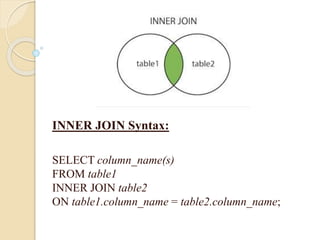
The INNER JOIN keyword selects records that have
matching values in both tables.
The INNER JOIN keyword selects all rows from
both tables as long as there is a match between the
columns.
INNER JOIN Syntax:
SELECT column_name(s)
FROM table1
INNER JOIN table2
ON table1.column_name = table2.column_name;
SQL LEFT JOIN:
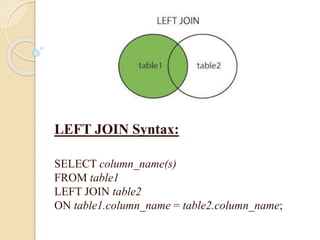
The LEFT JOIN keyword returns all records from
the left table (table1), and the matched records from
the right table (table2).
The result is NULL from the right side, if there is no
match.
The LEFT JOIN keyword returns all records from
the left table (Customers), even if there are no
matches in the right table (Orders).
LEFT JOIN Syntax:
SELECT column_name(s)
FROM table1
LEFT JOIN table2
ON table1.column_name = table2.column_name;
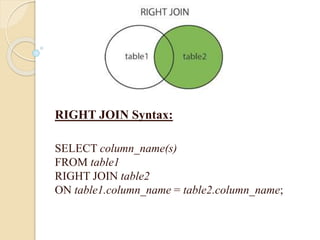
SQL RIGHT JOIN:
The RIGHT JOIN keyword returns all records from
the right table (table2), and the matched records from
the left table (table1).
The result is NULL from the left side, when there is
no match.
The RIGHT JOIN keyword returns all records from
the right table (Employees), even if there are no
matches in the left table (Orders).
RIGHT JOIN Syntax:
SELECT column_name(s)
FROM table1
RIGHT JOIN table2
ON table1.column_name = table2.column_name;
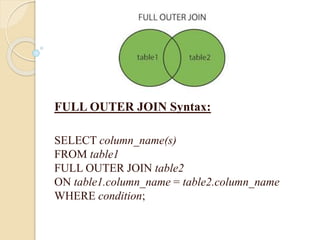
SQL FULL OUTER JOIN:
The FULL OUTER JOIN keyword return all records
when there is a match in either left (table1) or right
(table2) table records.
FULL OUTER JOIN can potentially return very
large result-sets.
FULL OUTER JOIN and FULL JOIN are the same.
FULL OUTER JOIN Syntax:
SELECT column_name(s)
FROM table1
FULL OUTER JOIN table2
ON table1.column_name = table2.column_name
WHERE condition;
Subquery in SQL:
The subquery can be nested inside a SELECT,
INSERT, UPDATE, or DELETE statement or inside
another subquery.
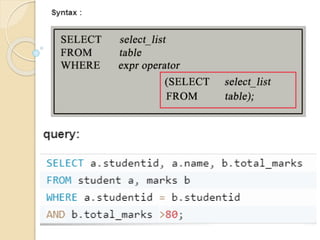
A subquery is usually added within the WHERE
Clause of another SQL SELECT statement.
You can use the comparison operators, such as >, <,
or =. The comparison operator can also be a multiple-
row operator, such as IN, ANY, or ALL.
A subquery is also called an inner query or inner
select, while the statement containing a subquery is
also called an outer query or outer select.
A subquery must be enclosed in parentheses.
A subquery must be placed on the right side of the
comparison operator.
A subquery may occur in :
A SELECT clause
A FROM clause
A WHERE clause
Subqueries:
A subquery must be enclosed in parentheses.
A subquery must be placed on the right side of
the comparison operator.
Subqueries cannot manipulate their results
internally, therefore ORDER BY clause cannot
be added into a subquery.
Use single-row operators with single-row
subqueries

joins and subqueries in big data analysis

  • 1.
    JOINS AND SUBQUERIESIN BIG DATAANALYSIS N.SURATHAVANI MSc(IT) Nadar Saraswathi College of Arts and Science, Theni.
  • 2.
    SQL JOIN: A JOINclause is used to combine rows from two or more tables, based on a related column between them. An SQL JOIN clause combines rows from two or more tables. It creates a set of rows in a temporary table.
  • 3.
    Different Types ofSQL JOINs: JOIN (INNER) LEFT (OUTER) JOIN RIGHT (OUTER) JOIN FULL (OUTER) JOIN
  • 4.
    SQL INNER JOIN: TheINNER JOIN keyword selects records that have matching values in both tables. The INNER JOIN keyword selects all rows from both tables as long as there is a match between the columns.
  • 5.
    INNER JOIN Syntax: SELECTcolumn_name(s) FROM table1 INNER JOIN table2 ON table1.column_name = table2.column_name;
  • 6.
    SQL LEFT JOIN: TheLEFT JOIN keyword returns all records from the left table (table1), and the matched records from the right table (table2). The result is NULL from the right side, if there is no match. The LEFT JOIN keyword returns all records from the left table (Customers), even if there are no matches in the right table (Orders).
  • 7.
    LEFT JOIN Syntax: SELECTcolumn_name(s) FROM table1 LEFT JOIN table2 ON table1.column_name = table2.column_name;
  • 8.
    SQL RIGHT JOIN: TheRIGHT JOIN keyword returns all records from the right table (table2), and the matched records from the left table (table1). The result is NULL from the left side, when there is no match. The RIGHT JOIN keyword returns all records from the right table (Employees), even if there are no matches in the left table (Orders).
  • 9.
    RIGHT JOIN Syntax: SELECTcolumn_name(s) FROM table1 RIGHT JOIN table2 ON table1.column_name = table2.column_name;
  • 10.
    SQL FULL OUTERJOIN: The FULL OUTER JOIN keyword return all records when there is a match in either left (table1) or right (table2) table records. FULL OUTER JOIN can potentially return very large result-sets. FULL OUTER JOIN and FULL JOIN are the same.
  • 11.
    FULL OUTER JOINSyntax: SELECT column_name(s) FROM table1 FULL OUTER JOIN table2 ON table1.column_name = table2.column_name WHERE condition;
  • 12.
    Subquery in SQL: Thesubquery can be nested inside a SELECT, INSERT, UPDATE, or DELETE statement or inside another subquery. A subquery is usually added within the WHERE Clause of another SQL SELECT statement. You can use the comparison operators, such as >, <, or =. The comparison operator can also be a multiple- row operator, such as IN, ANY, or ALL.
  • 13.
    A subquery isalso called an inner query or inner select, while the statement containing a subquery is also called an outer query or outer select. A subquery must be enclosed in parentheses. A subquery must be placed on the right side of the comparison operator.
  • 14.
    A subquery mayoccur in : A SELECT clause A FROM clause A WHERE clause
  • 16.
    Subqueries: A subquery mustbe enclosed in parentheses. A subquery must be placed on the right side of the comparison operator. Subqueries cannot manipulate their results internally, therefore ORDER BY clause cannot be added into a subquery. Use single-row operators with single-row subqueries