FUNCTIONS AND GRAPHS
Precalculus
Chapter 1
• This Slideshow was developed to accompany the textbook
• Precalculus
• By Richard Wright
• https://www.andrews.edu/~rwright/Precalculus-RLW/Text/TOC.ht
ml
• Some examples and diagrams are taken from the textbook.
Slides created by
Richard Wright, Andrews Academy
rwright@andrews.edu
1-01 THE CARTESIAN PLANE
In this section, you will:
• Plot points in the cartesian coordinate system.
• Find the distance between two points.
• Find the midpoint between two points.
1-01 THE CARTESIAN PLANE
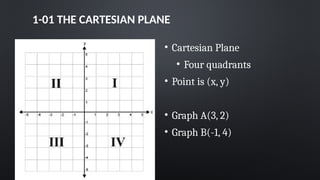
• Cartesian Plane
• Four quadrants
• Point is (x, y)
• Graph A(3, 2)
• Graph B(-1, 4)
1-01 THE CARTESIAN PLANE
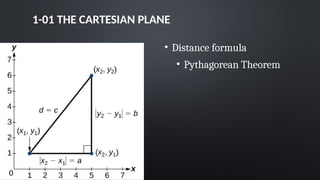
• Distance formula
• Pythagorean Theorem
1-01 THE CARTESIAN PLANE
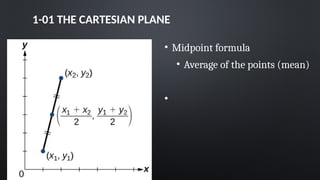
• Midpoint formula
• Average of the points (mean)
•
1-01 THE CARTESIAN PLANE
• Find the (a) distance and (b)
midpoint between (-1, 3) and (2, -5)
1-02 GRAPHS
In this section, you will:
• Graph equations by plotting points.
• Graph equations with a graphing utility.
• Find the x- and y-intercepts.
• Graph circles.
1-02 GRAPHS
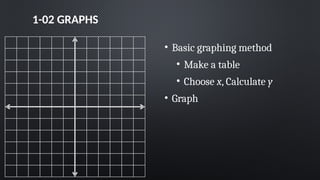
• Basic graphing method
• Make a table
• Choose x, Calculate y
• Graph
1-02 GRAPHS
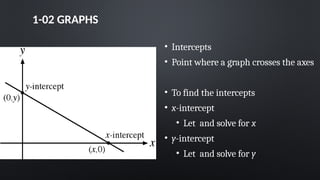
• Intercepts
• Point where a graph crosses the axes
• To find the intercepts
• x-intercept
• Let and solve for x
• y-intercept
• Let and solve for y
1-02 GRAPHS
• Find the intercepts of
1-02 GRAPHS
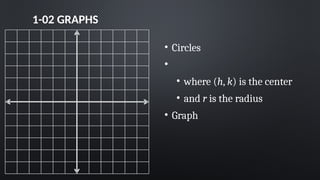
• Circles
•
• where (h, k) is the center
• and r is the radius
• Graph
1-03 LINEAR EQUATIONS IN TWO
VARIABLES
In this section, you will:
• Calculate and interpret slope.
• Write linear equations.
• Graph linear functions.
1-03 LINEAR EQUATIONS IN TWO VARIABLES
• Slope-intercept form
• m = slope (rate of change)
• (0, b) = y-intercept
•  horizontal line
•  vertical line
• To graph a line (shortcut)
1. Plot y-intercept
2. Follow the slope to get a couple
more points
3. Draw a line through the points
1-03 LINEAR EQUATIONS IN TWO VARIABLES
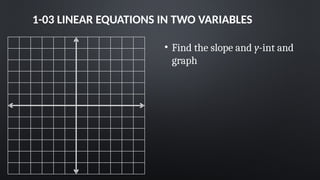
• Find the slope and y-int and
graph
1-03 LINEAR EQUATIONS IN TWO VARIABLES
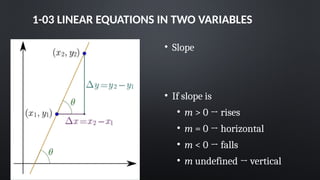
• Slope
• If slope is
• m > 0 → rises
• m = 0 → horizontal
• m < 0 → falls
• m undefined → vertical
1-03 LINEAR EQUATIONS IN TWO VARIABLES
• Find the slope of the line passing through (-3, -2) and (1, 6)
1-03 LINEAR EQUATIONS IN TWO VARIABLES
• Write Linear Equations
1. Find slope (m)
2. Find a point on the line
3. Use point-slope form
• Find slope-intercept form of the
line passing through (0, -2) with
m = 3.
1-03 LINEAR EQUATIONS IN TWO VARIABLES
• Parallel and Penpendicular
• Parallel → same slope
• Perpendicular → slopes are
negative reciprocals
•
• Find the equation of the line
passing through (2, 1) and
perpendicular to .
1-04 FUNCTIONS AND FUNCTIONAL
NOTATION
In this section, you will:
• Determine whether a relation represents a function.
• Find input and output values of a function.
• Find the domain of a function.
• Evaluate piecewise functions.
1-04 FUNCTIONS AND FUNCTIONAL NOTATION
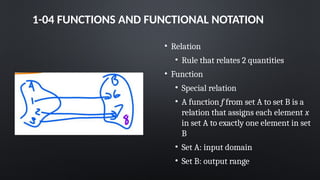
• Relation
• Rule that relates 2 quantities
• Function
• Special relation
• A function f from set A to set B is a
relation that assigns each element x
in set A to exactly one element in set
B
• Set A: input domain
• Set B: output range
1-04 FUNCTIONS AND FUNCTIONAL NOTATION
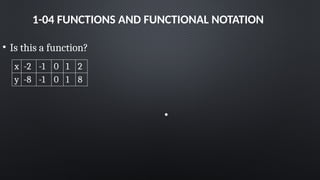
• Is this a function?
•
x -2 -1 0 1 2
y -8 -1 0 1 8
1-04 FUNCTIONS AND FUNCTIONAL NOTATION
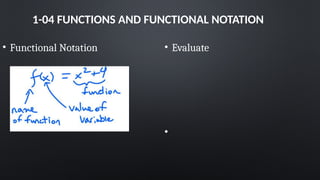
• Functional Notation • Evaluate
•
1-04 FUNCTIONS AND FUNCTIONAL NOTATION
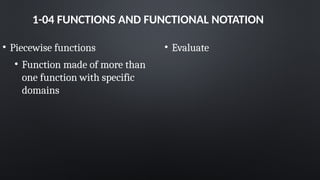
• Piecewise functions
• Function made of more than
one function with specific
domains
• Evaluate
1-04 FUNCTIONS AND FUNCTIONAL NOTATION
• Domain of a function
• Implied domain - all real
numbers for which the
expression is defined
• Interval notation
• [ ] means =
• ( ) means ≠
• (2, 7] means 2 < x ≤ 7
• What is the domain?
•
1-04 FUNCTIONS AND FUNCTIONAL NOTATION
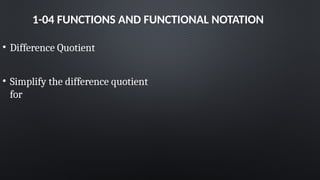
• Difference Quotient
• Simplify the difference quotient
for
1-05 GRAPHS OF FUNCTIONS
In this section, you will:
• Find domain and range from graphs.
• Determine whether graphs represent functions.
• Find zeros of functions.
• Find the average rate of change of a function.
• Analyze graphs to determine when the graph is increasing, decreasing, or constant.
1-05 GRAPHS OF FUNCTIONS
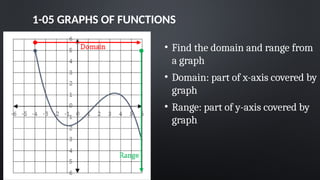
• Find the domain and range from
a graph
• Domain: part of x-axis covered by
graph
• Range: part of y-axis covered by
graph
1-05 GRAPHS OF FUNCTIONS
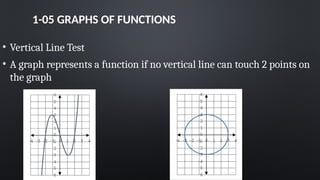
• Vertical Line Test
• A graph represents a function if no vertical line can touch 2 points on
the graph
1-05 GRAPHS OF FUNCTIONS
• Zeros of a function
• x-value such that
• x-intercepts
• To find, make and solve for x
• Find the zeros of
1-05 GRAPHS OF FUNCTIONS
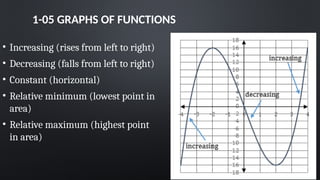
• Increasing (rises from left to right)
• Decreasing (falls from left to right)
• Constant (horizontal)
• Relative minimum (lowest point in
area)
• Relative maximum (highest point
in area)
1-05 GRAPHS OF FUNCTIONS
• Rate of Change
• Average rate of change = slope between 2 points
1-06 GRAPHS OF PARENT FUNCTIONS
In this section, you will:
• Identify the graphs of parent functions.
• Graph piecewise functions.
1-06 GRAPHS OF PARENT FUNCTIONS
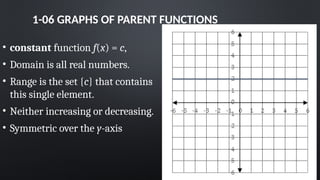
• constant function f(x) = c,
• Domain is all real numbers.
• Range is the set {c} that contains
this single element.
• Neither increasing or decreasing.
• Symmetric over the y-axis
1-06 GRAPHS OF PARENT FUNCTIONS
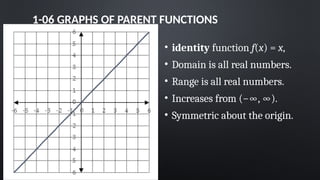
• identity function f(x) = x,
• Domain is all real numbers.
• Range is all real numbers.
• Increases from (−∞, ∞).
• Symmetric about the origin.
1-06 GRAPHS OF PARENT FUNCTIONS
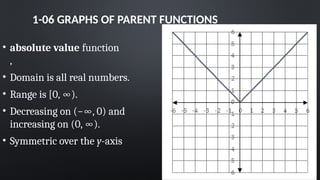
• absolute value function
,
• Domain is all real numbers.
• Range is [0, ∞).
• Decreasing on (−∞, 0) and
increasing on (0, ∞).
• Symmetric over the y-axis
1-06 GRAPHS OF PARENT FUNCTIONS
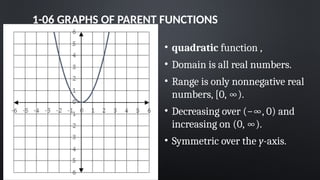
• quadratic function ,
• Domain is all real numbers.
• Range is only nonnegative real
numbers, [0, ∞).
• Decreasing over (−∞, 0) and
increasing on (0, ∞).
• Symmetric over the y-axis.
1-06 GRAPHS OF PARENT FUNCTIONS
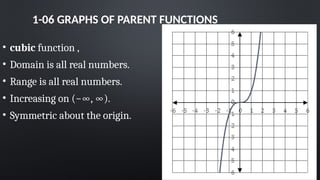
• cubic function ,
• Domain is all real numbers.
• Range is all real numbers.
• Increasing on (−∞, ∞).
• Symmetric about the origin.
1-06 GRAPHS OF PARENT FUNCTIONS
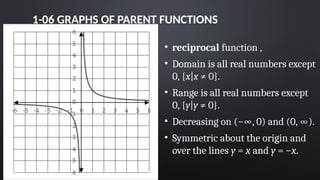
• reciprocal function ,
• Domain is all real numbers except
0, {x|x ≠ 0}.
• Range is all real numbers except
0, {y|y ≠ 0}.
• Decreasing on (−∞, 0) and (0, ∞).
• Symmetric about the origin and
over the lines y = x and y = −x.
1-06 GRAPHS OF PARENT FUNCTIONS
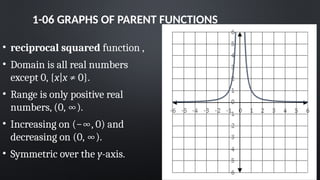
• reciprocal squared function ,
• Domain is all real numbers
except 0, {x|x ≠ 0}.
• Range is only positive real
numbers, (0, ∞).
• Increasing on (−∞, 0) and
decreasing on (0, ∞).
• Symmetric over the y-axis.
1-06 GRAPHS OF PARENT FUNCTIONS
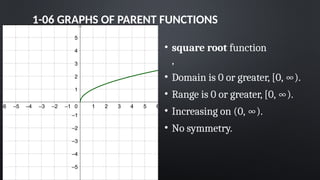
• square root function
,
• Domain is 0 or greater, [0, ∞).
• Range is 0 or greater, [0, ∞).
• Increasing on (0, ∞).
• No symmetry.
1-06 GRAPHS OF PARENT FUNCTIONS
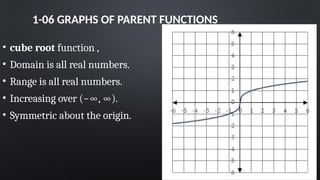
• cube root function ,
• Domain is all real numbers.
• Range is all real numbers.
• Increasing over (−∞, ∞).
• Symmetric about the origin.
1-06 GRAPHS OF PARENT FUNCTIONS
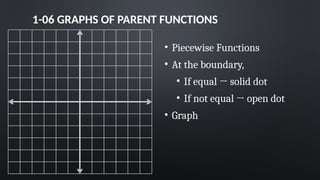
• Piecewise Functions
• At the boundary,
• If equal → solid dot
• If not equal → open dot
• Graph
1-07 TRANSFORMATIONS OF
FUNCTIONS
In this section, you will:
• Graph functions with translations.
• Graph functions with reflections.
• Graph functions with stretches and shrinks.
• Perform a sequences of transformations.
1-07 TRANSFORMATIONS OF FUNCTIONS
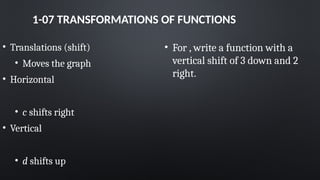
• Translations (shift)
• Moves the graph
• Horizontal
• c shifts right
• Vertical
• d shifts up
• For , write a function with a
vertical shift of 3 down and 2
right.
1-07 TRANSFORMATIONS OF FUNCTIONS
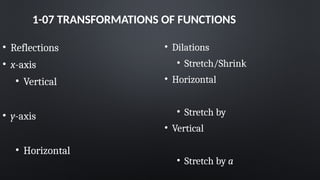
• Reflections
• x-axis
• Vertical
• y-axis
• Horizontal
• Dilations
• Stretch/Shrink
• Horizontal
• Stretch by
• Vertical
• Stretch by a
1-07 TRANSFORMATIONS OF FUNCTIONS
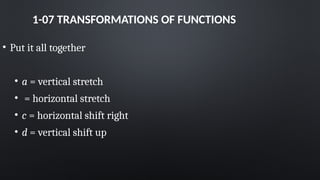
• Put it all together
• a = vertical stretch
• = horizontal stretch
• c = horizontal shift right
• d = vertical shift up
1-07 TRANSFORMATIONS OF FUNCTIONS
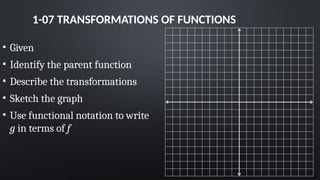
• Given
• Identify the parent function
• Describe the transformations
• Sketch the graph
• Use functional notation to write
g in terms of f
1-07 TRANSFORMATIONS OF FUNCTIONS
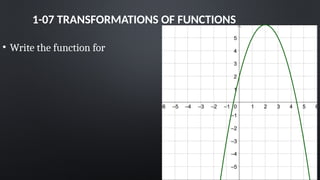
• Write the function for
1-08 COMBINATIONS OF FUNCTIONS
In this section, you will:
• Combine functions using algebraic operations.
• Create a composition of functions.
1-08 COMBINATIONS OF FUNCTIONS
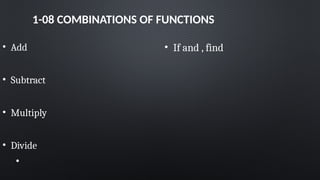
• Add
• Subtract
• Multiply
• Divide
•
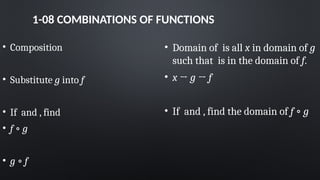
• If and , find
1-08 COMBINATIONS OF FUNCTIONS
• Composition
• Substitute g into f
• If and , find
• f ∘ g
• g ∘ f
• Domain of is all x in domain of g
such that is in the domain of f.
• x → g → f
• If and , find the domain of f ∘ g
1-08 COMBINATIONS OF FUNCTIONS
• Decompose
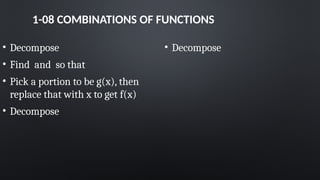
• Find and so that
• Pick a portion to be g(x), then
replace that with x to get f(x)
• Decompose
• Decompose
1-09 INVERSE FUNCTIONS
In this section, you will:
• Verify that two functions are inverse functions.
• Find the domain and range on inverse functions.
• Find the inverse of a function.
1-09 INVERSE FUNCTIONS
• Inverse functions
• Switch x and y
• Switch inputs and outputs
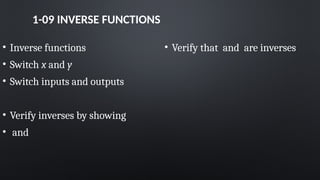
• Verify inverses by showing
• and
• Verify that and are inverses
1-09 INVERSE FUNCTIONS
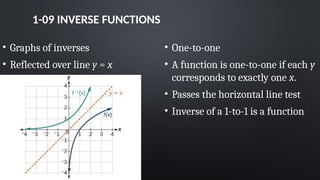
• Graphs of inverses
• Reflected over line y = x
• One-to-one
• A function is one-to-one if each y
corresponds to exactly one x.
• Passes the horizontal line test
• Inverse of a 1-to-1 is a function
1-09 INVERSE FUNCTIONS
• Finding inverses
1. Replace f(x) with y
2. Switch x and y
3. Solve for y
4. If you did step 1, replace y with
• Find the inverse of
1-09 INVERSE FUNCTIONS
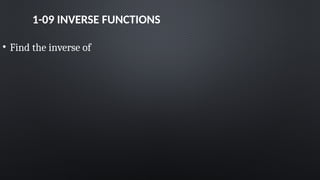
• Find the inverse of
1-10 MATHEMATICAL MODELING
In this section, you will:
• Draw and interpret scatter plots.
• Find the best-fitting line using a graphing utility.
• Calculate variations.
1-10 MATHEMATICAL MODELING
• Mathematical modeling
• Find a function to fit data points
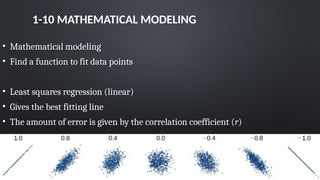
• Least squares regression (linear)
• Gives the best fitting line
• The amount of error is given by the correlation coefficient (r)
1-10 MATHEMATICAL MODELING
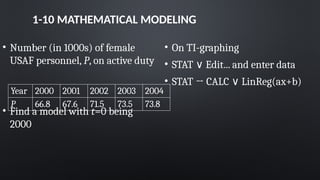
• Number (in 1000s) of female
USAF personnel, P, on active duty
• Find a model with t=0 being
2000
• On TI-graphing
• STAT Edit... and enter data
∨
• STAT → CALC LinReg(ax+b)
∨
Year 2000 2001 2002 2003 2004
P 66.8 67.6 71.5 73.5 73.8
1-10 MATHEMATICAL MODELING
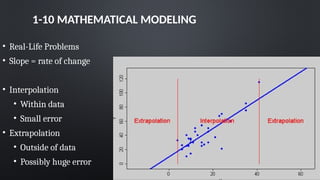
• Real-Life Problems
• Slope = rate of change
• Interpolation
• Within data
• Small error
• Extrapolation
• Outside of data
• Possibly huge error
1-10 MATHEMATICAL MODELING
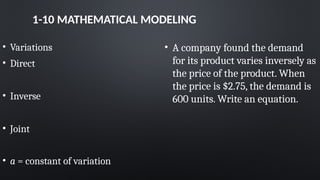
• Variations
• Direct
• Inverse
• Joint
• a = constant of variation
• A company found the demand
for its product varies inversely as
the price of the product. When
the price is $2.75, the demand is
600 units. Write an equation.
Precalculus 01 Functions and Graphs.pptx

  • 1.
  • 2.
    • This Slideshowwas developed to accompany the textbook • Precalculus • By Richard Wright • https://www.andrews.edu/~rwright/Precalculus-RLW/Text/TOC.ht ml • Some examples and diagrams are taken from the textbook. Slides created by Richard Wright, Andrews Academy rwright@andrews.edu
  • 3.
    1-01 THE CARTESIANPLANE In this section, you will: • Plot points in the cartesian coordinate system. • Find the distance between two points. • Find the midpoint between two points.
  • 4.
    1-01 THE CARTESIANPLANE • Cartesian Plane • Four quadrants • Point is (x, y) • Graph A(3, 2) • Graph B(-1, 4)
  • 5.
    1-01 THE CARTESIANPLANE • Distance formula • Pythagorean Theorem
  • 6.
    1-01 THE CARTESIANPLANE • Midpoint formula • Average of the points (mean) •
  • 7.
    1-01 THE CARTESIANPLANE • Find the (a) distance and (b) midpoint between (-1, 3) and (2, -5)
  • 8.
    1-02 GRAPHS In thissection, you will: • Graph equations by plotting points. • Graph equations with a graphing utility. • Find the x- and y-intercepts. • Graph circles.
  • 9.
    1-02 GRAPHS • Basicgraphing method • Make a table • Choose x, Calculate y • Graph
  • 10.
    1-02 GRAPHS • Intercepts •Point where a graph crosses the axes • To find the intercepts • x-intercept • Let and solve for x • y-intercept • Let and solve for y
  • 11.
    1-02 GRAPHS • Findthe intercepts of
  • 12.
    1-02 GRAPHS • Circles • •where (h, k) is the center • and r is the radius • Graph
  • 13.
    1-03 LINEAR EQUATIONSIN TWO VARIABLES In this section, you will: • Calculate and interpret slope. • Write linear equations. • Graph linear functions.
  • 14.
    1-03 LINEAR EQUATIONSIN TWO VARIABLES • Slope-intercept form • m = slope (rate of change) • (0, b) = y-intercept •  horizontal line •  vertical line • To graph a line (shortcut) 1. Plot y-intercept 2. Follow the slope to get a couple more points 3. Draw a line through the points
  • 15.
    1-03 LINEAR EQUATIONSIN TWO VARIABLES • Find the slope and y-int and graph
  • 16.
    1-03 LINEAR EQUATIONSIN TWO VARIABLES • Slope • If slope is • m > 0 → rises • m = 0 → horizontal • m < 0 → falls • m undefined → vertical
  • 17.
    1-03 LINEAR EQUATIONSIN TWO VARIABLES • Find the slope of the line passing through (-3, -2) and (1, 6)
  • 18.
    1-03 LINEAR EQUATIONSIN TWO VARIABLES • Write Linear Equations 1. Find slope (m) 2. Find a point on the line 3. Use point-slope form • Find slope-intercept form of the line passing through (0, -2) with m = 3.
  • 19.
    1-03 LINEAR EQUATIONSIN TWO VARIABLES • Parallel and Penpendicular • Parallel → same slope • Perpendicular → slopes are negative reciprocals • • Find the equation of the line passing through (2, 1) and perpendicular to .
  • 20.
    1-04 FUNCTIONS ANDFUNCTIONAL NOTATION In this section, you will: • Determine whether a relation represents a function. • Find input and output values of a function. • Find the domain of a function. • Evaluate piecewise functions.
  • 21.
    1-04 FUNCTIONS ANDFUNCTIONAL NOTATION • Relation • Rule that relates 2 quantities • Function • Special relation • A function f from set A to set B is a relation that assigns each element x in set A to exactly one element in set B • Set A: input domain • Set B: output range
  • 22.
    1-04 FUNCTIONS ANDFUNCTIONAL NOTATION • Is this a function? • x -2 -1 0 1 2 y -8 -1 0 1 8
  • 23.
    1-04 FUNCTIONS ANDFUNCTIONAL NOTATION • Functional Notation • Evaluate •
  • 24.
    1-04 FUNCTIONS ANDFUNCTIONAL NOTATION • Piecewise functions • Function made of more than one function with specific domains • Evaluate
  • 25.
    1-04 FUNCTIONS ANDFUNCTIONAL NOTATION • Domain of a function • Implied domain - all real numbers for which the expression is defined • Interval notation • [ ] means = • ( ) means ≠ • (2, 7] means 2 < x ≤ 7 • What is the domain? •
  • 26.
    1-04 FUNCTIONS ANDFUNCTIONAL NOTATION • Difference Quotient • Simplify the difference quotient for
  • 27.
    1-05 GRAPHS OFFUNCTIONS In this section, you will: • Find domain and range from graphs. • Determine whether graphs represent functions. • Find zeros of functions. • Find the average rate of change of a function. • Analyze graphs to determine when the graph is increasing, decreasing, or constant.
  • 28.
    1-05 GRAPHS OFFUNCTIONS • Find the domain and range from a graph • Domain: part of x-axis covered by graph • Range: part of y-axis covered by graph
  • 29.
    1-05 GRAPHS OFFUNCTIONS • Vertical Line Test • A graph represents a function if no vertical line can touch 2 points on the graph
  • 30.
    1-05 GRAPHS OFFUNCTIONS • Zeros of a function • x-value such that • x-intercepts • To find, make and solve for x • Find the zeros of
  • 31.
    1-05 GRAPHS OFFUNCTIONS • Increasing (rises from left to right) • Decreasing (falls from left to right) • Constant (horizontal) • Relative minimum (lowest point in area) • Relative maximum (highest point in area)
  • 32.
    1-05 GRAPHS OFFUNCTIONS • Rate of Change • Average rate of change = slope between 2 points
  • 33.
    1-06 GRAPHS OFPARENT FUNCTIONS In this section, you will: • Identify the graphs of parent functions. • Graph piecewise functions.
  • 34.
    1-06 GRAPHS OFPARENT FUNCTIONS • constant function f(x) = c, • Domain is all real numbers. • Range is the set {c} that contains this single element. • Neither increasing or decreasing. • Symmetric over the y-axis
  • 35.
    1-06 GRAPHS OFPARENT FUNCTIONS • identity function f(x) = x, • Domain is all real numbers. • Range is all real numbers. • Increases from (−∞, ∞). • Symmetric about the origin.
  • 36.
    1-06 GRAPHS OFPARENT FUNCTIONS • absolute value function , • Domain is all real numbers. • Range is [0, ∞). • Decreasing on (−∞, 0) and increasing on (0, ∞). • Symmetric over the y-axis
  • 37.
    1-06 GRAPHS OFPARENT FUNCTIONS • quadratic function , • Domain is all real numbers. • Range is only nonnegative real numbers, [0, ∞). • Decreasing over (−∞, 0) and increasing on (0, ∞). • Symmetric over the y-axis.
  • 38.
    1-06 GRAPHS OFPARENT FUNCTIONS • cubic function , • Domain is all real numbers. • Range is all real numbers. • Increasing on (−∞, ∞). • Symmetric about the origin.
  • 39.
    1-06 GRAPHS OFPARENT FUNCTIONS • reciprocal function , • Domain is all real numbers except 0, {x|x ≠ 0}. • Range is all real numbers except 0, {y|y ≠ 0}. • Decreasing on (−∞, 0) and (0, ∞). • Symmetric about the origin and over the lines y = x and y = −x.
  • 40.
    1-06 GRAPHS OFPARENT FUNCTIONS • reciprocal squared function , • Domain is all real numbers except 0, {x|x ≠ 0}. • Range is only positive real numbers, (0, ∞). • Increasing on (−∞, 0) and decreasing on (0, ∞). • Symmetric over the y-axis.
  • 41.
    1-06 GRAPHS OFPARENT FUNCTIONS • square root function , • Domain is 0 or greater, [0, ∞). • Range is 0 or greater, [0, ∞). • Increasing on (0, ∞). • No symmetry.
  • 42.
    1-06 GRAPHS OFPARENT FUNCTIONS • cube root function , • Domain is all real numbers. • Range is all real numbers. • Increasing over (−∞, ∞). • Symmetric about the origin.
  • 43.
    1-06 GRAPHS OFPARENT FUNCTIONS • Piecewise Functions • At the boundary, • If equal → solid dot • If not equal → open dot • Graph
  • 44.
    1-07 TRANSFORMATIONS OF FUNCTIONS Inthis section, you will: • Graph functions with translations. • Graph functions with reflections. • Graph functions with stretches and shrinks. • Perform a sequences of transformations.
  • 45.
    1-07 TRANSFORMATIONS OFFUNCTIONS • Translations (shift) • Moves the graph • Horizontal • c shifts right • Vertical • d shifts up • For , write a function with a vertical shift of 3 down and 2 right.
  • 46.
    1-07 TRANSFORMATIONS OFFUNCTIONS • Reflections • x-axis • Vertical • y-axis • Horizontal • Dilations • Stretch/Shrink • Horizontal • Stretch by • Vertical • Stretch by a
  • 47.
    1-07 TRANSFORMATIONS OFFUNCTIONS • Put it all together • a = vertical stretch • = horizontal stretch • c = horizontal shift right • d = vertical shift up
  • 48.
    1-07 TRANSFORMATIONS OFFUNCTIONS • Given • Identify the parent function • Describe the transformations • Sketch the graph • Use functional notation to write g in terms of f
  • 49.
    1-07 TRANSFORMATIONS OFFUNCTIONS • Write the function for
  • 50.
    1-08 COMBINATIONS OFFUNCTIONS In this section, you will: • Combine functions using algebraic operations. • Create a composition of functions.
  • 51.
    1-08 COMBINATIONS OFFUNCTIONS • Add • Subtract • Multiply • Divide • • If and , find
  • 52.
    1-08 COMBINATIONS OFFUNCTIONS • Composition • Substitute g into f • If and , find • f ∘ g • g ∘ f • Domain of is all x in domain of g such that is in the domain of f. • x → g → f • If and , find the domain of f ∘ g
  • 53.
    1-08 COMBINATIONS OFFUNCTIONS • Decompose • Find and so that • Pick a portion to be g(x), then replace that with x to get f(x) • Decompose • Decompose
  • 54.
    1-09 INVERSE FUNCTIONS Inthis section, you will: • Verify that two functions are inverse functions. • Find the domain and range on inverse functions. • Find the inverse of a function.
  • 55.
    1-09 INVERSE FUNCTIONS •Inverse functions • Switch x and y • Switch inputs and outputs • Verify inverses by showing • and • Verify that and are inverses
  • 56.
    1-09 INVERSE FUNCTIONS •Graphs of inverses • Reflected over line y = x • One-to-one • A function is one-to-one if each y corresponds to exactly one x. • Passes the horizontal line test • Inverse of a 1-to-1 is a function
  • 57.
    1-09 INVERSE FUNCTIONS •Finding inverses 1. Replace f(x) with y 2. Switch x and y 3. Solve for y 4. If you did step 1, replace y with • Find the inverse of
  • 58.
    1-09 INVERSE FUNCTIONS •Find the inverse of
  • 59.
    1-10 MATHEMATICAL MODELING Inthis section, you will: • Draw and interpret scatter plots. • Find the best-fitting line using a graphing utility. • Calculate variations.
  • 60.
    1-10 MATHEMATICAL MODELING •Mathematical modeling • Find a function to fit data points • Least squares regression (linear) • Gives the best fitting line • The amount of error is given by the correlation coefficient (r)
  • 61.
    1-10 MATHEMATICAL MODELING •Number (in 1000s) of female USAF personnel, P, on active duty • Find a model with t=0 being 2000 • On TI-graphing • STAT Edit... and enter data ∨ • STAT → CALC LinReg(ax+b) ∨ Year 2000 2001 2002 2003 2004 P 66.8 67.6 71.5 73.5 73.8
  • 62.
    1-10 MATHEMATICAL MODELING •Real-Life Problems • Slope = rate of change • Interpolation • Within data • Small error • Extrapolation • Outside of data • Possibly huge error
  • 63.
    1-10 MATHEMATICAL MODELING •Variations • Direct • Inverse • Joint • a = constant of variation • A company found the demand for its product varies inversely as the price of the product. When the price is $2.75, the demand is 600 units. Write an equation.

Editor's Notes

  • #9 (x, y) (-2, 4) (-1, 3.5) (0, 3) (1, 2.5) (2, 2)
  • #11 No real x-int y-int: (0, 2)
  • #15 m=3 b=-4
  • #18 y=3x-2
  • #22 Yes, each x is matched to exactly one y Yes, each x gives exactly one y-value No, some x give two y-values
  • #24 f(-1)=-1 f(2)=6
  • #25 t≠0, (-∞,0) ∪ (0,∞) x≥8/5, [8/5, ∞)
  • #26 2
  • #29 Function Not function
  • #30 -5/2, 6
  • #31 Increasing (-∞,-2) ∪ (2, ∞) Decreasing (-2, 2) Minimum (2, -16) Maximum (-2 16)
  • #48 Quadratic Reflection over x-axis, shift 5 left, shift 2 up Graph
  • #49 Parent function is f(x)=x² Shift right 2: c=2 Shift up 6: d=6 Reflect over x-axis: -f(x) g(x)=-(x-2)²+6
  • #51 2x 4 x²-4 (x+2)/(x-2)
  • #52 x²-2x+1 x²-1 Domain of g: x≠0 Domain of f: x≥0 Let g=domain of f (or excluded domain) and solve for x 1/x≥0 → true when x>0 Answer: x>0
  • #53 g(x)=x+3; f(x)=2|x| g(x)=(8-x)/5; f(x)=³√(x)
  • #57 f⁻¹(x)=x³-10
  • #58 f⁻¹(x)=-√(x+2)
  • #61 P=1.99t+66.7
  • #63 Inverse variation d=1650/p