

From
Wordy to
Web-ready
Creating a consumable
web article from your
academic work
Web reading is a goal-
driven activity.
Therefore, your content should speak directly to a goal that your
audience has. It’s helpful to define not just who your audience
is, but also what they want.
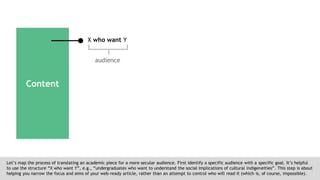
Content
X who want Y
audience
Let’s map the process of translating an academic piece for a more secular audience. First identify a specific audience with a specific goal. It’s helpful
to use the structure “X who want Y”, e.g., “undergraduates who want to understand the social implications of cultural indigeneities”. This step is about
helping you narrow the focus and aims of your web-ready article, rather than an attempt to control who will read it (which is, of course, impossible).
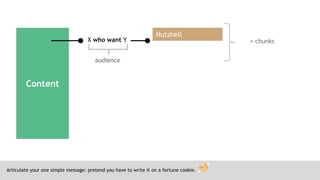
Content
Nutshell
X who want Y
audience
+ chunks
Articulate your one simple message: pretend you have to write it on a fortune cookie.
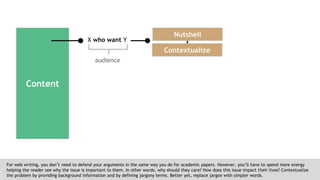
Content
Nutshell
X who want Y
audience
For web writing, you don’t need to defend your arguments in the same way you do for academic papers. However, you’ll have to spend more energy
helping the reader see why the issue is important to them. In other words, why should they care? How does this issue impact their lives? Contextualize
the problem by providing background information and by defining jargony terms. Better yet, replace jargon with simpler words.
Contextualize
Content
Nutshell
X who want Y
audience
chunk it
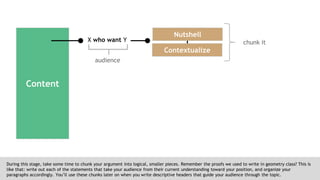
During this stage, take some time to chunk your argument into logical, smaller pieces. Remember the proofs we used to write in geometry class? This is
like that: write out each of the statements that take your audience from their current understanding toward your position, and organize your
paragraphs accordingly. You’ll use these chunks later on when you write descriptive headers that guide your audience through the topic.
Contextualize
Content
Nutshell
X who want Y
audience
chunk it
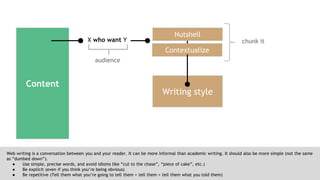
Web writing is a conversation between you and your reader. It can be more informal than academic writing. It should also be more simple (not the same
as “dumbed down”).
● Use simple, precise words, and avoid idioms like “cut to the chase”, “piece of cake”, etc.)
● Be explicit (even if you think you’re being obvious)
● Be repetitive (Tell them what you’re going to tell them > tell them > tell them what you told them)
Contextualize
Writing style
Content
Nutshell
X who want Y
audience
chunk it
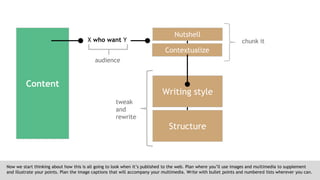
Now we start thinking about how this is all going to look when it’s published to the web. Plan where you’ll use images and multimedia to supplement
and illustrate your points. Plan the image captions that will accompany your multimedia. Write with bullet points and numbered lists wherever you can.
Contextualize
Writing style
Structure
tweak
and
rewrite
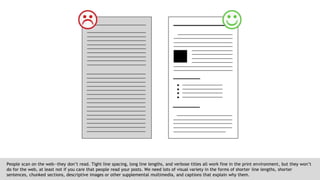
People scan on the web--they don’t read. Tight line spacing, long line lengths, and verbose titles all work fine in the print environment, but they won’t
do for the web, at least not if you care that people read your posts. We need lots of visual variety in the forms of shorter line lengths, shorter
sentences, chunked sections, descriptive images or other supplemental multimedia, and captions that explain why them.
Section headers
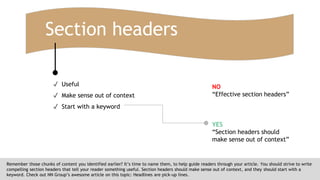
Remember those chunks of content you identified earlier? It’s time to name them, to help guide readers through your article. You should strive to write
compelling section headers that tell your reader something useful. Section headers should make sense out of context, and they should start with a
keyword. Check out NN Group’s awesome article on this topic: Headlines are pick-up lines.
✓ Useful
✓ Make sense out of context
✓ Start with a keyword
NO
“Effective section headers”
YES
“Section headers should
make sense out of context”
Content
Nutshell
X who want Y
audience
chunk it
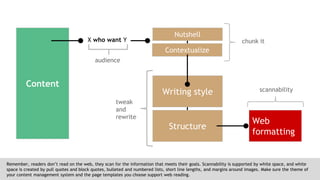
Remember, readers don’t read on the web, they scan for the information that meets their goals. Scannability is supported by white space, and white
space is created by pull quotes and block quotes, bulleted and numbered lists, short line lengths, and margins around images. Make sure the theme of
your content management system and the page templates you choose support web reading.
Contextualize
Writing style
Structure
tweak
and
rewrite
Web
formatting
scannability
Title
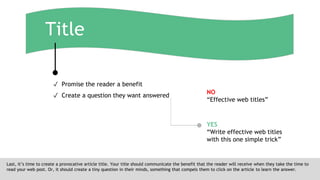
Last, it’s time to create a provocative article title. Your title should communicate the benefit that the reader will receive when they take the time to
read your web post. Or, it should create a tiny question in their minds, something that compels them to click on the article to learn the answer.
✓ Promise the reader a benefit
✓ Create a question they want answered
NO
“Effective web titles”
YES
“Write effective web titles
with this one simple trick”
Dig deeper
Writing clearly and simply (webaim.org - definitive on web accessibility)
Web writing for scientists (IEEE)
Writing for the web(nngroup.com - definitive on web usability)
Like this resource? It’s called a sliderding!
Learn more at z.umn.edu/sliderding

From Wordy to Web-ready

  • 1.
    From Wordy to Web-ready Creating aconsumable web article from your academic work
  • 2.
    Web reading isa goal- driven activity. Therefore, your content should speak directly to a goal that your audience has. It’s helpful to define not just who your audience is, but also what they want.
  • 3.
    Content X who wantY audience Let’s map the process of translating an academic piece for a more secular audience. First identify a specific audience with a specific goal. It’s helpful to use the structure “X who want Y”, e.g., “undergraduates who want to understand the social implications of cultural indigeneities”. This step is about helping you narrow the focus and aims of your web-ready article, rather than an attempt to control who will read it (which is, of course, impossible).
  • 4.
    Content Nutshell X who wantY audience + chunks Articulate your one simple message: pretend you have to write it on a fortune cookie.
  • 5.
    Content Nutshell X who wantY audience For web writing, you don’t need to defend your arguments in the same way you do for academic papers. However, you’ll have to spend more energy helping the reader see why the issue is important to them. In other words, why should they care? How does this issue impact their lives? Contextualize the problem by providing background information and by defining jargony terms. Better yet, replace jargon with simpler words. Contextualize
  • 6.
    Content Nutshell X who wantY audience chunk it During this stage, take some time to chunk your argument into logical, smaller pieces. Remember the proofs we used to write in geometry class? This is like that: write out each of the statements that take your audience from their current understanding toward your position, and organize your paragraphs accordingly. You’ll use these chunks later on when you write descriptive headers that guide your audience through the topic. Contextualize
  • 7.
    Content Nutshell X who wantY audience chunk it Web writing is a conversation between you and your reader. It can be more informal than academic writing. It should also be more simple (not the same as “dumbed down”). ● Use simple, precise words, and avoid idioms like “cut to the chase”, “piece of cake”, etc.) ● Be explicit (even if you think you’re being obvious) ● Be repetitive (Tell them what you’re going to tell them > tell them > tell them what you told them) Contextualize Writing style
  • 8.
    Content Nutshell X who wantY audience chunk it Now we start thinking about how this is all going to look when it’s published to the web. Plan where you’ll use images and multimedia to supplement and illustrate your points. Plan the image captions that will accompany your multimedia. Write with bullet points and numbered lists wherever you can. Contextualize Writing style Structure tweak and rewrite
  • 9.
    People scan onthe web--they don’t read. Tight line spacing, long line lengths, and verbose titles all work fine in the print environment, but they won’t do for the web, at least not if you care that people read your posts. We need lots of visual variety in the forms of shorter line lengths, shorter sentences, chunked sections, descriptive images or other supplemental multimedia, and captions that explain why them.
  • 10.
    Section headers Remember thosechunks of content you identified earlier? It’s time to name them, to help guide readers through your article. You should strive to write compelling section headers that tell your reader something useful. Section headers should make sense out of context, and they should start with a keyword. Check out NN Group’s awesome article on this topic: Headlines are pick-up lines. ✓ Useful ✓ Make sense out of context ✓ Start with a keyword NO “Effective section headers” YES “Section headers should make sense out of context”
  • 11.
    Content Nutshell X who wantY audience chunk it Remember, readers don’t read on the web, they scan for the information that meets their goals. Scannability is supported by white space, and white space is created by pull quotes and block quotes, bulleted and numbered lists, short line lengths, and margins around images. Make sure the theme of your content management system and the page templates you choose support web reading. Contextualize Writing style Structure tweak and rewrite Web formatting scannability
  • 12.
    Title Last, it’s timeto create a provocative article title. Your title should communicate the benefit that the reader will receive when they take the time to read your web post. Or, it should create a tiny question in their minds, something that compels them to click on the article to learn the answer. ✓ Promise the reader a benefit ✓ Create a question they want answered NO “Effective web titles” YES “Write effective web titles with this one simple trick”
  • 13.
    Dig deeper Writing clearlyand simply (webaim.org - definitive on web accessibility) Web writing for scientists (IEEE) Writing for the web(nngroup.com - definitive on web usability)
  • 14.
    Like this resource?It’s called a sliderding! Learn more at z.umn.edu/sliderding