WRITING A
   FRIE NDLY LE TTE R
In a friendly letter, write
  about the things that
  interes t you and the
pers on to whom you are
         writing.
B E FORE WRITING
Jot down your ideas.
Are you replying to a
 letter?
What questions or
 comments do you need to
 reply to?
What new information
 about yourself or others
 do you want to include?
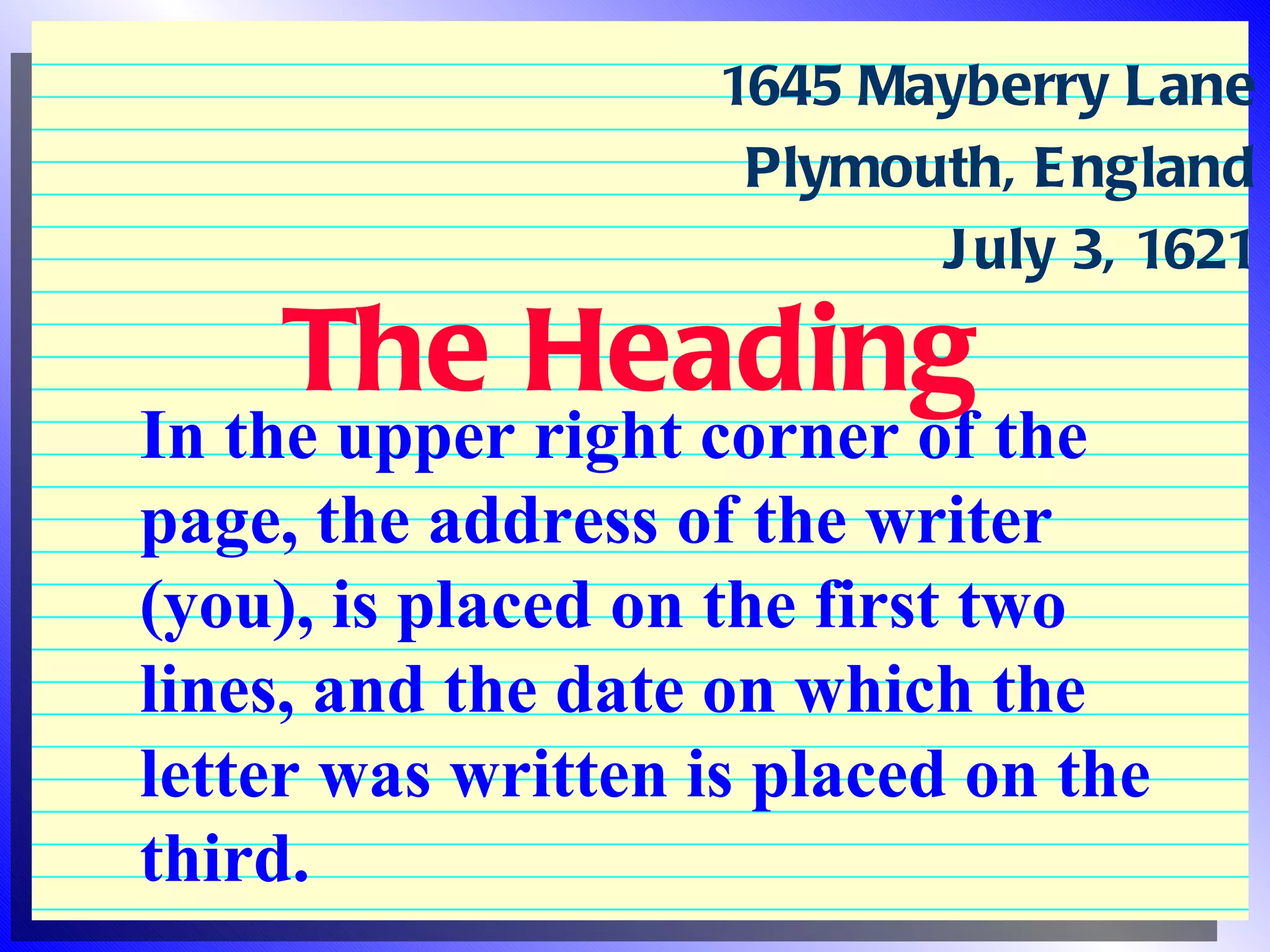
1645 Mayberry Lane
                     Plymouth, E ngland
                           J uly 3, 1621

     The Heading
In the upper right corner of the
page, the address of the writer
(you), is placed on the first two
lines, and the date on which the
letter was written is placed on the
third.
The S alutation
The s alutation begins at the
left-hand margin and is
placed a s hort dis tance
below the heading. In a
friendly letter, it is followed
by a comma.
THE BODY
The body of a friendly letter
is the mes s age, what you
have to s ay. It may begin
directly below the
s alutation. Remember to
indent the firs t line of each
paragraph.
The C los ing
The clos ing for a friendly letter may
be Your friend, S incerely, S incerely
yours , or any s imilar phras e you like,
except Yours truly, or Very truly yours
which are us ed only in bus ines s
letters . It is placed jus t below the final
line of the body, beginning a little to
the right of the middle of the page,
and followed by a comma.
The S ignature
The s ignature of a friendly
letter need only be your firs t
name. C enter it under the
clos ing. A lways write the
s ignature by hand, even if
you have typed the res t of
the letter.
Are there any
 questions?

Friendly letter

  • 1.
    WRITING A FRIE NDLY LE TTE R In a friendly letter, write about the things that interes t you and the pers on to whom you are writing.
  • 2.
    B E FOREWRITING Jot down your ideas. Are you replying to a letter? What questions or comments do you need to reply to? What new information about yourself or others do you want to include?
  • 3.
    1645 Mayberry Lane Plymouth, E ngland J uly 3, 1621 The Heading In the upper right corner of the page, the address of the writer (you), is placed on the first two lines, and the date on which the letter was written is placed on the third.
  • 4.
    The S alutation Thes alutation begins at the left-hand margin and is placed a s hort dis tance below the heading. In a friendly letter, it is followed by a comma.
  • 5.
    THE BODY The bodyof a friendly letter is the mes s age, what you have to s ay. It may begin directly below the s alutation. Remember to indent the firs t line of each paragraph.
  • 6.
    The C losing The clos ing for a friendly letter may be Your friend, S incerely, S incerely yours , or any s imilar phras e you like, except Yours truly, or Very truly yours which are us ed only in bus ines s letters . It is placed jus t below the final line of the body, beginning a little to the right of the middle of the page, and followed by a comma.
  • 7.
    The S ignature Thes ignature of a friendly letter need only be your firs t name. C enter it under the clos ing. A lways write the s ignature by hand, even if you have typed the res t of the letter.
  • 8.
    Are there any questions?

Editor's Notes

  • #2 Instruct students what to write down and what to make a mental note of. First slide, copy heading only.
  • #3 Pre-writing, have students copy bullets.
  • #4 Remind students to put a comma between the city and state and the date of the month and the year. Have students copy this slide and use this heading on their letter.
  • #5 If students ask how many lines a short distance is, remind them that most letters are written on stationary that does not contain lines. Salutation usually begins with Dear…, point out letter in text. Jimmy writes “Dear Old Pal:”. Tell students that they can use a name, nickname, or a pet-name, ie: Old Pal. If students question colon used in text, tell them that a comma is more appropriate for a friendly letter.
  • #6 Remind students that even though it is a friendly letter, proper punctuation, spelling, and grammar are expected!
  • #7 Point out to students that only the first word of the closing begins with a capital letter. If students question the position of the closing in the text, explain that this is just a result of the layout of the book. Show students other text and how it is done correctly in that one.
  • #8 Answer questions and then have students begin brainstorming and writing their rough drafts. Final draft due tomorrow. Give students plain white paper for their final draft, which may be either typed or hand written. Tomorrow we will go over addressing the envelope.