●●●●●●RReeaaddTThheeoorryy..OOrrgg ©© 22001100 Name________________
EEnngglliisshhFFoorrEEvveerryyoonnee..OOrrgg ©© 22000088 Date________________
““AA MMyysstteerryy””
RReeaaddiinngg CCoommpprreehheennssiioonn –– SShhoorrtt SSttoorriieess
Directions: Read the story. Then answer the questions below.
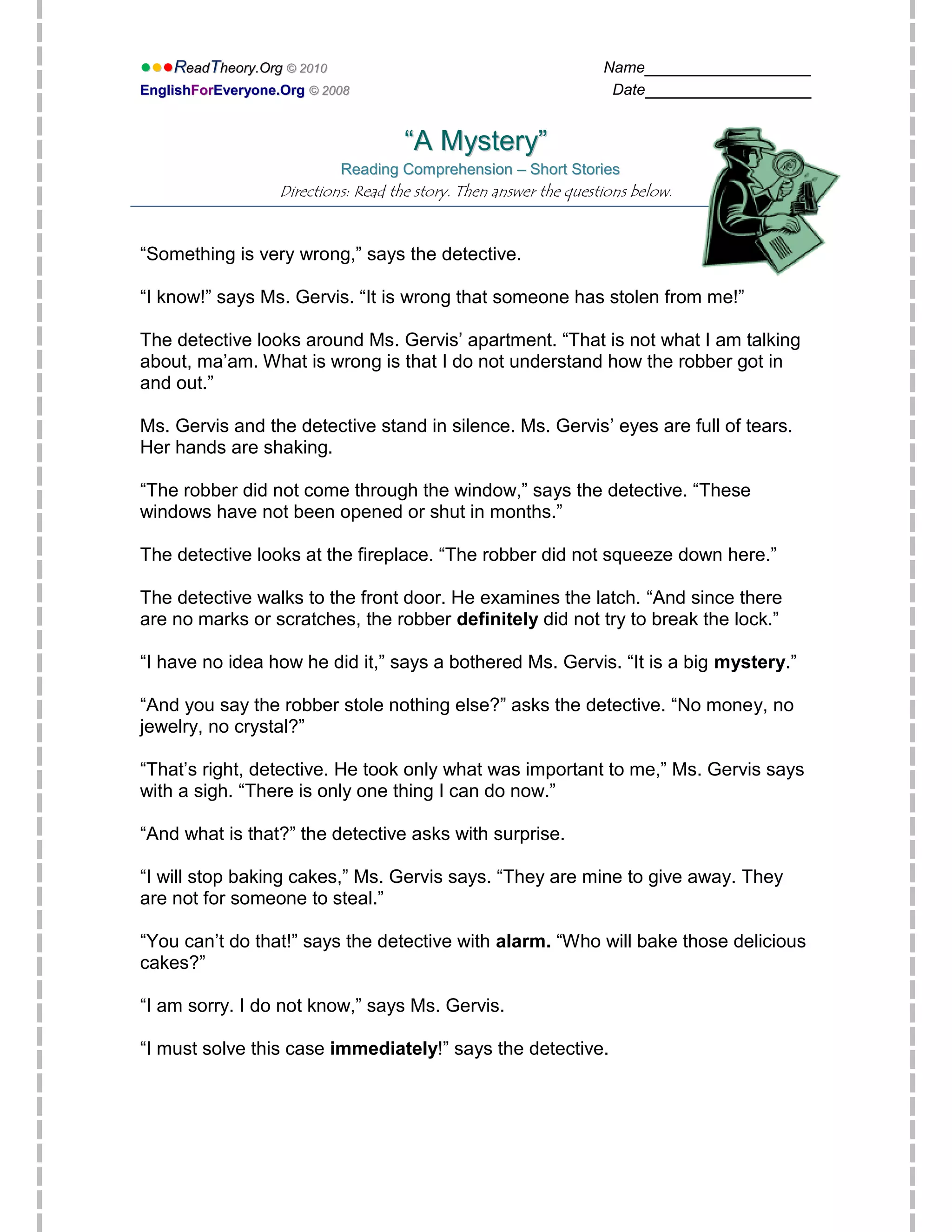
“Something is very wrong,” says the detective.
“I know!” says Ms. Gervis. “It is wrong that someone has stolen from me!”
The detective looks around Ms. Gervis’ apartment. “That is not what I am talking
about, ma’am. What is wrong is that I do not understand how the robber got in
and out.”
Ms. Gervis and the detective stand in silence. Ms. Gervis’ eyes are full of tears.
Her hands are shaking.
“The robber did not come through the window,” says the detective. “These
windows have not been opened or shut in months.”
The detective looks at the fireplace. “The robber did not squeeze down here.”
The detective walks to the front door. He examines the latch. “And since there
are no marks or scratches, the robber definitely did not try to break the lock.”
“I have no idea how he did it,” says a bothered Ms. Gervis. “It is a big mystery.”
“And you say the robber stole nothing else?” asks the detective. “No money, no
jewelry, no crystal?”
“That’s right, detective. He took only what was important to me,” Ms. Gervis says
with a sigh. “There is only one thing I can do now.”
“And what is that?” the detective asks with surprise.
“I will stop baking cakes,” Ms. Gervis says. “They are mine to give away. They
are not for someone to steal.”
“You can’t do that!” says the detective with alarm. “Who will bake those delicious
cakes?”
“I am sorry. I do not know,” says Ms. Gervis.
“I must solve this case immediately!” says the detective.
Questions:
11)) Where does this story take place?
A. in a bakery
B. at the police station
C. in Ms. Gervis' house
D. in Ms. Gervis' apartment
22)) Near the beginning of the story,
“Ms. Gervis’ eyes are full of tears.
Her hands are shaking.” How does
Ms. Gervis probably feel?
A. She is upset.
B. She is tired.
C. She is hungry.
D. She is confused.
33)) What makes the detective sure that
the robber did not come through the
windows?
A. The windows are locked.
B. The windows face the police
station.
C. The windows have not been
used in months.
D. The windows are too small for a
person to fit through.
44)) "And the robber definitely did not
use the front door." Which is the
best way to rewrite this sentence?
A. "And the robber may not have
used the front door."
B. "And the robber probably did not
use the front door."
C. "And the robber was not able to
use the front door."
D. "And the robber certainly did not
use the front door."
55)) What else could the detective have
asked Ms. Gervis in order to solve
the mystery?
I. Which types of cakes does Ms.
Gervis know how to bake?
II. Does someone else have a key
to the apartment?
III. Does Ms. Gervis ever leave the
door unlocked?
A. I only
B. I and II
C. II and III
D. I, II, and III
66)) What does Ms. Gervis do with her
cakes?
A. She eats them.
B. She sells them.
C. She hides them.
D. She gives them away.
Questions (continued):
77)) What does the detective seem to
think will happen if he solves the
mystery?
A. Ms. Gervis will start baking
cakes again
B. Ms. Gervis will bake him extra
cakes
C. Ms. Gervis will give him her
secret recipe
D. Ms. Gervis will give him money
and jewels
88)) What is a mystery?
A. something that is wrong
B. something that happens at night
C. something a robber leaves
behind
D. something that cannot be
explained
99)) What else was stolen from the
apartment?
A. crystal
B. jewelry
C. money
D. nothing
1100)) If something is said with alarm,
how is it said?
A. with fear and panic
B. with bells and whistles
C. with smiles and laughter
D. with sadness and tears
Do you like mysteries? What is your favorite kind of story? Explain.
________________________________________________________________________
________________________________________________________________________
________________________________________________________________________
________________________________________________________________________
________________________________________________________________________
________________________________________________________________________
________________________________________________________________________
________________________________________________________________________
________________________________________________________________________
________________________________________________________________________
Answers and Explanations
1) D
Near the beginning of the story, “the detective looks around Ms. Gervis’
apartment.” We can understand from this that the story takes place in Ms.
Gervis’ apartment. Therefore (D) is correct.
Ms. Gervis’ cake was stolen, but it was stolen from her apartment, not a
bakery. Therefore (A) is incorrect. Detectives work at the police station, but
the detective was investigating at Ms. Gervis’ apartment. Therefore (B) is
incorrect. Ms. Gervis has an apartment, not a house. Therefore (C) is
incorrect.
2) A
The detective is at Ms. Gervis’ apartment because Ms. Gervis has been
robbed. In fact, the robber took “only what was important” to Ms. Gervis.
Since Ms. Gervis’ apartment has been robbed and the robber took something
important to her, we can understand that Ms. Gervis is upset. Therefore (A) is
correct.
The story does not provide information to support answer choices (B) and
(C). Therefore they are incorrect. Ms. Gervis does not know how someone
got into her apartment, but she is shaking and crying because she has been
robbed, not because she is confused. Therefore (D) is incorrect.
3) C
In the middle of the story, the detective says, “The robber did not come
through the windows.” Then the detective says, “These windows have not
been opened or shut in months.” We can understand from these statements
that the detective believes that the robber didn’t come through the windows
because the windows had not been used in months. Therefore (C) is correct.
The story does not provide information to support answer choices (A), (B),
and (D). Therefore they are incorrect.
4) D
definitely (adjective): certainly; without doubt.
In the middle of the story, the detective examines the latch on the door. The
detective says, “Since there are no marks or scratches, the robber definitely
did not try to break the lock.” The reader can understand from this that since
there is no evidence that someone tried to break the lock, someone certainly
did not try to break the lock. Certainly is another way to say definitely.
Therefore (D) is correct.
Definitely means certainly, but something that may not happen is uncertain.
Therefore (A) is incorrect. Since probably means that something could
happen but might not, it is not certain. Therefore (B) is incorrect. When
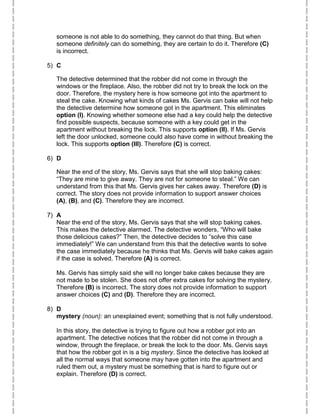
someone is not able to do something, they cannot do that thing. But when
someone definitely can do something, they are certain to do it. Therefore (C)
is incorrect.
5) C
The detective determined that the robber did not come in through the
windows or the fireplace. Also, the robber did not try to break the lock on the
door. Therefore, the mystery here is how someone got into the apartment to
steal the cake. Knowing what kinds of cakes Ms. Gervis can bake will not help
the detective determine how someone got in the apartment. This eliminates
option (I). Knowing whether someone else had a key could help the detective
find possible suspects, because someone with a key could get in the
apartment without breaking the lock. This supports option (II). If Ms. Gervis
left the door unlocked, someone could also have come in without breaking the
lock. This supports option (III). Therefore (C) is correct.
6) D
Near the end of the story, Ms. Gervis says that she will stop baking cakes:
“They are mine to give away. They are not for someone to steal.” We can
understand from this that Ms. Gervis gives her cakes away. Therefore (D) is
correct. The story does not provide information to support answer choices
(A), (B), and (C). Therefore they are incorrect.
7) A
Near the end of the story, Ms. Gervis says that she will stop baking cakes.
This makes the detective alarmed. The detective wonders, “Who will bake
those delicious cakes?” Then, the detective decides to “solve this case
immediately!” We can understand from this that the detective wants to solve
the case immediately because he thinks that Ms. Gervis will bake cakes again
if the case is solved. Therefore (A) is correct.
Ms. Gervis has simply said she will no longer bake cakes because they are
not made to be stolen. She does not offer extra cakes for solving the mystery.
Therefore (B) is incorrect. The story does not provide information to support
answer choices (C) and (D). Therefore they are incorrect.
8) D
mystery (noun): an unexplained event; something that is not fully understood.
In this story, the detective is trying to figure out how a robber got into an
apartment. The detective notices that the robber did not come in through a
window, through the fireplace, or break the lock to the door. Ms. Gervis says
that how the robber got in is a big mystery. Since the detective has looked at
all the normal ways that someone may have gotten into the apartment and
ruled them out, a mystery must be something that is hard to figure out or
explain. Therefore (D) is correct.
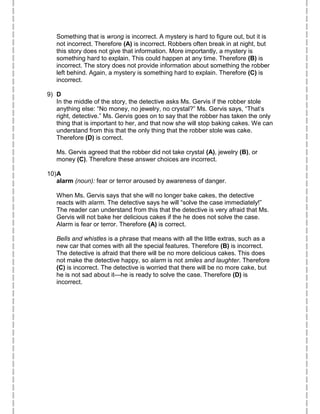
Something that is wrong is incorrect. A mystery is hard to figure out, but it is
not incorrect. Therefore (A) is incorrect. Robbers often break in at night, but
this story does not give that information. More importantly, a mystery is
something hard to explain. This could happen at any time. Therefore (B) is
incorrect. The story does not provide information about something the robber
left behind. Again, a mystery is something hard to explain. Therefore (C) is
incorrect.
9) D
In the middle of the story, the detective asks Ms. Gervis if the robber stole
anything else: “No money, no jewelry, no crystal?” Ms. Gervis says, “That’s
right, detective.” Ms. Gervis goes on to say that the robber has taken the only
thing that is important to her, and that now she will stop baking cakes. We can
understand from this that the only thing that the robber stole was cake.
Therefore (D) is correct.
Ms. Gervis agreed that the robber did not take crystal (A), jewelry (B), or
money (C). Therefore these answer choices are incorrect.
10)A
alarm (noun): fear or terror aroused by awareness of danger.
When Ms. Gervis says that she will no longer bake cakes, the detective
reacts with alarm. The detective says he will “solve the case immediately!”
The reader can understand from this that the detective is very afraid that Ms.
Gervis will not bake her delicious cakes if the he does not solve the case.
Alarm is fear or terror. Therefore (A) is correct.
Bells and whistles is a phrase that means with all the little extras, such as a
new car that comes with all the special features. Therefore (B) is incorrect.
The detective is afraid that there will be no more delicious cakes. This does
not make the detective happy, so alarm is not smiles and laughter. Therefore
(C) is incorrect. The detective is worried that there will be no more cake, but
he is not sad about it—he is ready to solve the case. Therefore (D) is
incorrect.

A mystery

  • 1.
    ●●●●●●RReeaaddTThheeoorryy..OOrrgg ©© 22001100Name________________ EEnngglliisshhFFoorrEEvveerryyoonnee..OOrrgg ©© 22000088 Date________________ ““AA MMyysstteerryy”” RReeaaddiinngg CCoommpprreehheennssiioonn –– SShhoorrtt SSttoorriieess Directions: Read the story. Then answer the questions below. “Something is very wrong,” says the detective. “I know!” says Ms. Gervis. “It is wrong that someone has stolen from me!” The detective looks around Ms. Gervis’ apartment. “That is not what I am talking about, ma’am. What is wrong is that I do not understand how the robber got in and out.” Ms. Gervis and the detective stand in silence. Ms. Gervis’ eyes are full of tears. Her hands are shaking. “The robber did not come through the window,” says the detective. “These windows have not been opened or shut in months.” The detective looks at the fireplace. “The robber did not squeeze down here.” The detective walks to the front door. He examines the latch. “And since there are no marks or scratches, the robber definitely did not try to break the lock.” “I have no idea how he did it,” says a bothered Ms. Gervis. “It is a big mystery.” “And you say the robber stole nothing else?” asks the detective. “No money, no jewelry, no crystal?” “That’s right, detective. He took only what was important to me,” Ms. Gervis says with a sigh. “There is only one thing I can do now.” “And what is that?” the detective asks with surprise. “I will stop baking cakes,” Ms. Gervis says. “They are mine to give away. They are not for someone to steal.” “You can’t do that!” says the detective with alarm. “Who will bake those delicious cakes?” “I am sorry. I do not know,” says Ms. Gervis. “I must solve this case immediately!” says the detective.
  • 2.
    Questions: 11)) Where doesthis story take place? A. in a bakery B. at the police station C. in Ms. Gervis' house D. in Ms. Gervis' apartment 22)) Near the beginning of the story, “Ms. Gervis’ eyes are full of tears. Her hands are shaking.” How does Ms. Gervis probably feel? A. She is upset. B. She is tired. C. She is hungry. D. She is confused. 33)) What makes the detective sure that the robber did not come through the windows? A. The windows are locked. B. The windows face the police station. C. The windows have not been used in months. D. The windows are too small for a person to fit through. 44)) "And the robber definitely did not use the front door." Which is the best way to rewrite this sentence? A. "And the robber may not have used the front door." B. "And the robber probably did not use the front door." C. "And the robber was not able to use the front door." D. "And the robber certainly did not use the front door." 55)) What else could the detective have asked Ms. Gervis in order to solve the mystery? I. Which types of cakes does Ms. Gervis know how to bake? II. Does someone else have a key to the apartment? III. Does Ms. Gervis ever leave the door unlocked? A. I only B. I and II C. II and III D. I, II, and III 66)) What does Ms. Gervis do with her cakes? A. She eats them. B. She sells them. C. She hides them. D. She gives them away.
  • 3.
    Questions (continued): 77)) Whatdoes the detective seem to think will happen if he solves the mystery? A. Ms. Gervis will start baking cakes again B. Ms. Gervis will bake him extra cakes C. Ms. Gervis will give him her secret recipe D. Ms. Gervis will give him money and jewels 88)) What is a mystery? A. something that is wrong B. something that happens at night C. something a robber leaves behind D. something that cannot be explained 99)) What else was stolen from the apartment? A. crystal B. jewelry C. money D. nothing 1100)) If something is said with alarm, how is it said? A. with fear and panic B. with bells and whistles C. with smiles and laughter D. with sadness and tears Do you like mysteries? What is your favorite kind of story? Explain. ________________________________________________________________________ ________________________________________________________________________ ________________________________________________________________________ ________________________________________________________________________ ________________________________________________________________________ ________________________________________________________________________ ________________________________________________________________________ ________________________________________________________________________ ________________________________________________________________________ ________________________________________________________________________
  • 4.
    Answers and Explanations 1)D Near the beginning of the story, “the detective looks around Ms. Gervis’ apartment.” We can understand from this that the story takes place in Ms. Gervis’ apartment. Therefore (D) is correct. Ms. Gervis’ cake was stolen, but it was stolen from her apartment, not a bakery. Therefore (A) is incorrect. Detectives work at the police station, but the detective was investigating at Ms. Gervis’ apartment. Therefore (B) is incorrect. Ms. Gervis has an apartment, not a house. Therefore (C) is incorrect. 2) A The detective is at Ms. Gervis’ apartment because Ms. Gervis has been robbed. In fact, the robber took “only what was important” to Ms. Gervis. Since Ms. Gervis’ apartment has been robbed and the robber took something important to her, we can understand that Ms. Gervis is upset. Therefore (A) is correct. The story does not provide information to support answer choices (B) and (C). Therefore they are incorrect. Ms. Gervis does not know how someone got into her apartment, but she is shaking and crying because she has been robbed, not because she is confused. Therefore (D) is incorrect. 3) C In the middle of the story, the detective says, “The robber did not come through the windows.” Then the detective says, “These windows have not been opened or shut in months.” We can understand from these statements that the detective believes that the robber didn’t come through the windows because the windows had not been used in months. Therefore (C) is correct. The story does not provide information to support answer choices (A), (B), and (D). Therefore they are incorrect. 4) D definitely (adjective): certainly; without doubt. In the middle of the story, the detective examines the latch on the door. The detective says, “Since there are no marks or scratches, the robber definitely did not try to break the lock.” The reader can understand from this that since there is no evidence that someone tried to break the lock, someone certainly did not try to break the lock. Certainly is another way to say definitely. Therefore (D) is correct. Definitely means certainly, but something that may not happen is uncertain. Therefore (A) is incorrect. Since probably means that something could happen but might not, it is not certain. Therefore (B) is incorrect. When
  • 5.
    someone is notable to do something, they cannot do that thing. But when someone definitely can do something, they are certain to do it. Therefore (C) is incorrect. 5) C The detective determined that the robber did not come in through the windows or the fireplace. Also, the robber did not try to break the lock on the door. Therefore, the mystery here is how someone got into the apartment to steal the cake. Knowing what kinds of cakes Ms. Gervis can bake will not help the detective determine how someone got in the apartment. This eliminates option (I). Knowing whether someone else had a key could help the detective find possible suspects, because someone with a key could get in the apartment without breaking the lock. This supports option (II). If Ms. Gervis left the door unlocked, someone could also have come in without breaking the lock. This supports option (III). Therefore (C) is correct. 6) D Near the end of the story, Ms. Gervis says that she will stop baking cakes: “They are mine to give away. They are not for someone to steal.” We can understand from this that Ms. Gervis gives her cakes away. Therefore (D) is correct. The story does not provide information to support answer choices (A), (B), and (C). Therefore they are incorrect. 7) A Near the end of the story, Ms. Gervis says that she will stop baking cakes. This makes the detective alarmed. The detective wonders, “Who will bake those delicious cakes?” Then, the detective decides to “solve this case immediately!” We can understand from this that the detective wants to solve the case immediately because he thinks that Ms. Gervis will bake cakes again if the case is solved. Therefore (A) is correct. Ms. Gervis has simply said she will no longer bake cakes because they are not made to be stolen. She does not offer extra cakes for solving the mystery. Therefore (B) is incorrect. The story does not provide information to support answer choices (C) and (D). Therefore they are incorrect. 8) D mystery (noun): an unexplained event; something that is not fully understood. In this story, the detective is trying to figure out how a robber got into an apartment. The detective notices that the robber did not come in through a window, through the fireplace, or break the lock to the door. Ms. Gervis says that how the robber got in is a big mystery. Since the detective has looked at all the normal ways that someone may have gotten into the apartment and ruled them out, a mystery must be something that is hard to figure out or explain. Therefore (D) is correct.
  • 6.
    Something that iswrong is incorrect. A mystery is hard to figure out, but it is not incorrect. Therefore (A) is incorrect. Robbers often break in at night, but this story does not give that information. More importantly, a mystery is something hard to explain. This could happen at any time. Therefore (B) is incorrect. The story does not provide information about something the robber left behind. Again, a mystery is something hard to explain. Therefore (C) is incorrect. 9) D In the middle of the story, the detective asks Ms. Gervis if the robber stole anything else: “No money, no jewelry, no crystal?” Ms. Gervis says, “That’s right, detective.” Ms. Gervis goes on to say that the robber has taken the only thing that is important to her, and that now she will stop baking cakes. We can understand from this that the only thing that the robber stole was cake. Therefore (D) is correct. Ms. Gervis agreed that the robber did not take crystal (A), jewelry (B), or money (C). Therefore these answer choices are incorrect. 10)A alarm (noun): fear or terror aroused by awareness of danger. When Ms. Gervis says that she will no longer bake cakes, the detective reacts with alarm. The detective says he will “solve the case immediately!” The reader can understand from this that the detective is very afraid that Ms. Gervis will not bake her delicious cakes if the he does not solve the case. Alarm is fear or terror. Therefore (A) is correct. Bells and whistles is a phrase that means with all the little extras, such as a new car that comes with all the special features. Therefore (B) is incorrect. The detective is afraid that there will be no more delicious cakes. This does not make the detective happy, so alarm is not smiles and laughter. Therefore (C) is incorrect. The detective is worried that there will be no more cake, but he is not sad about it—he is ready to solve the case. Therefore (D) is incorrect.