Argument Writing
An Introductory Guide for Middle School Students
An argument in writing
• IS DIFFERENT THAN
ARGUING WITH A
PARENT OR FRIEND
Characteristics of Argument
Writing
• Convinces reader claim is true
• Uses evidence—facts and data
• Acknowledges counterclaims—
the other side of the argument
An Effective Claim
• Takes a clear position
• Has two sides
• Is narrow enough to be supported
within essay
• Can be supported by facts or citations
from a text
Types of Claims
• Cause and effect—a person, thing, or
event caused something else to happen
• Example: Rikki Tikki Tavi’s victory
over the snakes was the result of his
natural abilities as a mongoose, rather
than his desire to protect the people in
the cottage.
Types of Claims
• Claims of definition or fact—argue
what a definition is or if something is
really a fact
• Example: In the story, “Gift of the
Magi,” by O. Henry, the two characters
provide an outstanding illustration of
what foolish is.
Types of Claims
• Claims about values—argue the worth
of something and if it is valued.
• While Perrault’s “Cinderella” is an
interesting story, it is a second-rate
story when compared to Grimm’s
Cinderella version.
Types of Claims
• Claims about solutions or policies—
argue for or against certain approaches
to problems.
• Example: The Capulets have their
daughter’s well-being in mind when
they follow tradition and make
arrangements for her to marry Paris.
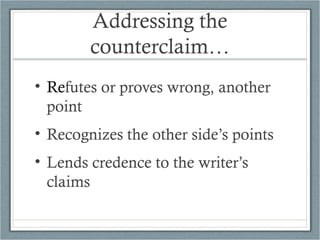
Addressing the
counterclaim…
• Refutes or proves wrong, another
point
• Recognizes the other side’s points
• Lends credence to the writer’s
claims
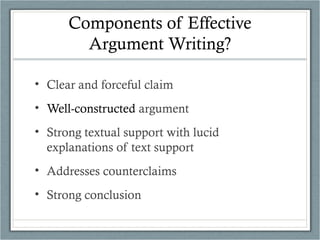
Components of Effective
Argument Writing?
• Clear and forceful claim
• Well-constructed argument
• Strong textual support with lucid
explanations of text support
• Addresses counterclaims
• Strong conclusion

Arguwritingz 2 (1)

  • 1.
    Argument Writing An IntroductoryGuide for Middle School Students
  • 2.
    An argument inwriting • IS DIFFERENT THAN ARGUING WITH A PARENT OR FRIEND
  • 3.
    Characteristics of Argument Writing •Convinces reader claim is true • Uses evidence—facts and data • Acknowledges counterclaims— the other side of the argument
  • 4.
    An Effective Claim •Takes a clear position • Has two sides • Is narrow enough to be supported within essay • Can be supported by facts or citations from a text
  • 5.
    Types of Claims •Cause and effect—a person, thing, or event caused something else to happen • Example: Rikki Tikki Tavi’s victory over the snakes was the result of his natural abilities as a mongoose, rather than his desire to protect the people in the cottage.
  • 6.
    Types of Claims •Claims of definition or fact—argue what a definition is or if something is really a fact • Example: In the story, “Gift of the Magi,” by O. Henry, the two characters provide an outstanding illustration of what foolish is.
  • 7.
    Types of Claims •Claims about values—argue the worth of something and if it is valued. • While Perrault’s “Cinderella” is an interesting story, it is a second-rate story when compared to Grimm’s Cinderella version.
  • 8.
    Types of Claims •Claims about solutions or policies— argue for or against certain approaches to problems. • Example: The Capulets have their daughter’s well-being in mind when they follow tradition and make arrangements for her to marry Paris.
  • 9.
    Addressing the counterclaim… • Refutesor proves wrong, another point • Recognizes the other side’s points • Lends credence to the writer’s claims
  • 10.
    Components of Effective ArgumentWriting? • Clear and forceful claim • Well-constructed argument • Strong textual support with lucid explanations of text support • Addresses counterclaims • Strong conclusion