BSMATHEMATICS
GROUP 2
 ANEESAARIF 14
 HAMEEZASAEED 24
 UMME HANI 26
 AREEBAFATEHALI 12
SHORTSTORY
DEFINITION OF A SHORT STORY
 Tells about a single event or experience
 Fictional(not true)
 500 to 15000 words in length
 It has a beginning ,middle , and end
 Creates an impression on the reader
TYPES OF SHORT
STORY
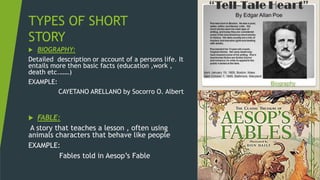
 BIOGRAPHY:
Detailed description or account of a persons life. It
entails more then basic facts (education ,work ,
death etc.……)
EXAMPLE:
CAYETANO ARELLANO by Socorro O. Albert
 FABLE:
A story that teaches a lesson , often using
animals characters that behave like people
EXAMPLE:
Fables told in Aesop’s Fable
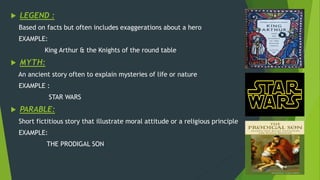
 LEGEND :
Based on facts but often includes exaggerations about a hero
EXAMPLE:
King Arthur & the Knights of the round table
 MYTH:
An ancient story often to explain mysteries of life or nature
EXAMPLE :
STAR WARS
 PARABLE:
Short fictitious story that illustrate moral attitude or a religious principle
EXAMPLE:
THE PRODIGAL SON
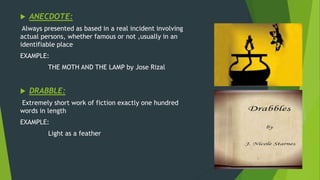
 ANECDOTE:
Always presented as based in a real incident involving
actual persons, whether famous or not ,usually in an
identifiable place
EXAMPLE:
THE MOTH AND THE LAMP by Jose Rizal
 DRABBLE:
Extremely short work of fiction exactly one hundred
words in length
EXAMPLE:
Light as a feather
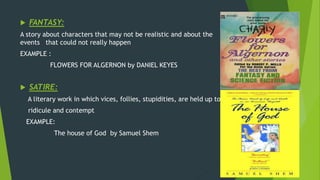
 FANTASY:
A story about characters that may not be realistic and about the
events that could not really happen
EXAMPLE :
FLOWERS FOR ALGERNON by DANIEL KEYES
 SATIRE:
A literary work in which vices, follies, stupidities, are held up to
ridicule and contempt
EXAMPLE:
The house of God by Samuel Shem
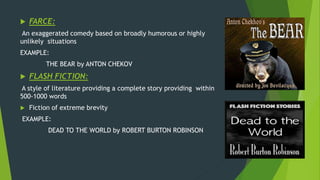
 FARCE:
An exaggerated comedy based on broadly humorous or highly
unlikely situations
EXAMPLE:
THE BEAR by ANTON CHEKOV
 FLASH FICTION:
A style of literature providing a complete story providing within
500-1000 words
 Fiction of extreme brevity
EXAMPLE:
DEAD TO THE WORLD by ROBERT BURTON ROBINSON
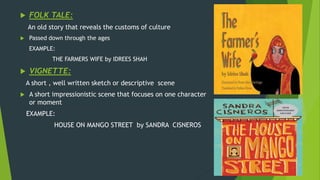
 FOLK TALE:
An old story that reveals the customs of culture
 Passed down through the ages
EXAMPLE:
THE FARMERS WIFE by IDREES SHAH
 VIGNETTE:
A short , well written sketch or descriptive scene
 A short impressionistic scene that focuses on one character
or moment
EXAMPLE:
HOUSE ON MANGO STREET by SANDRA CISNEROS
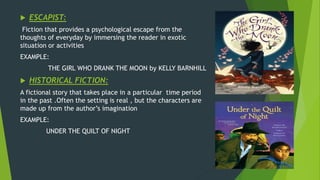
 ESCAPIST:
Fiction that provides a psychological escape from the
thoughts of everyday by immersing the reader in exotic
situation or activities
EXAMPLE:
THE GIRL WHO DRANK THE MOON by KELLY BARNHILL
 HISTORICAL FICTION:
A fictional story that takes place in a particular time period
in the past .Often the setting is real , but the characters are
made up from the author’s imagination
EXAMPLE:
UNDER THE QUILT OF NIGHT
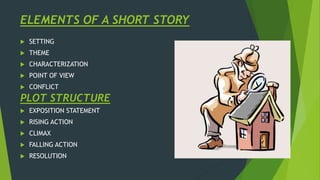
ELEMENTS OF A SHORT STORY
 SETTING
 THEME
 CHARACTERIZATION
 POINT OF VIEW
 CONFLICT
PLOT STRUCTURE
 EXPOSITION STATEMENT
 RISING ACTION
 CLIMAX
 FALLING ACTION
 RESOLUTION
SETTING
 Tells the reader where and when the
story takes place
 It’s a character's
environment including the
season, weather, time of
day , year, exact location,
geographical features and
everything else that is
possibly in their
surroundings
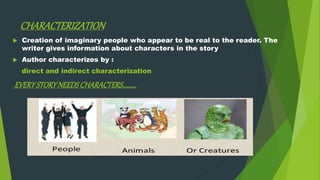
CHARACTERIZATION
 Creation of imaginary people who appear to be real to the reader. The
writer gives information about characters in the story
 Author characterizes by :
direct and indirect characterization
EVERYSTORYNEEDSCHARACTERS……….
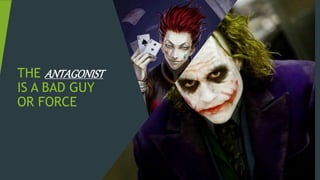
THE PROTAGONIST IS A GOOD GUY
THE ANTAGONIST
IS A BAD GUY
OR FORCE
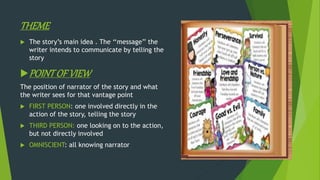
THEME
 The story’s main idea . The ‘‘message’’ the
writer intends to communicate by telling the
story
POINTOF VIEW
The position of narrator of the story and what
the writer sees for that vantage point
 FIRST PERSON: one involved directly in the
action of the story, telling the story
 THIRD PERSON: one looking on to the action,
but not directly involved
 OMNISCIENT: all knowing narrator
CONFLICT:
 Conflict is a problem in the story that needs to be resolved
 TYPESOF CONFLICT:
MANVSMAN MANVSHIMSELF MANVSNATURE MANVSSOCIETY
STRUCTUREOF STORY
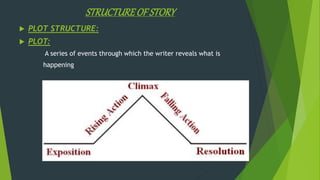
 PLOT STRUCTURE:
 PLOT:
A series of events through which the writer reveals what is
happening
EXPOSITION:
 Beginning of the story where the characters and setting is revealed
RISINGACTION:
 Where the events in the story become complicated and the conflict in the story is
revealed(events between the introduction and climax)
CLIMAX:
 The highest point of interest, the most intense moment; the character makes a decision
that cannot be reversed
FALLINGACTION:
 Events and complications begin to resolve themselves
RESOLUTION:
 The story’s action after the climax until the end of the story. Where all the loose ends are
tied up. The falling action leads to the ‘’conclusion’’ of the story
HOWTOWRITEA SHORTSTORY?
Keep the amazing, the unusual, the strange the irrational stories
you hear and use them for your own purposes
 The first sentence of your
narrative should catch yours
readers attention with the
unusual, the unexpected an
action or conflict.
CREATE CONFLICT
AND TENSION
FIND A
RESOLUTION
A CHILDHOODSAVED
It had been two hours waiting for the train. Haiqa was getting restless(SETTING). Suddenly she noticed a
child begging at the platform. He appeared to be little sweet boy who had a small bag on his shoulder.
She noticed a book in his bag. Haiqa was eager to know where the child lived. There was still more than
an hour left for the train to arrive. So she got up and started following him(SUSPENCE). The boy moved
out of the station and entered a slum nearby. He got into a house which appeared to be a dirty and
unhygienic place. There were other child beggars in the house who were in the age group of 5 to 10
years. They were thin and week. They had money but nothing to eat. Just than a man entered the house
the children became quiet. He asked them the money they had collected by begging. The poor children
handed all money they had to him. Haiqa understood that it was a racket of child beggars. She felt pity
for those small children. She decided to inform the police(CLIMAX). The police and NGO reached the
place. The man was arrested and the children were sent under the protection of NGO from where they
would be sent to their homes. Haiqa felt relieved and was appreciated by everyone. She was later
rewarded by government for her effort in rescuing the children.(ENDING WITH SAVING LIFE OF
CHILDREN).
POINT OF VIEW:THIRD PERSON
SOCIAL ISSUE:CHILD BEGGING
THEME : VIOLENCE AGAINST POOR CHILDREN
Short story

Short story

  • 1.
    BSMATHEMATICS GROUP 2  ANEESAARIF14  HAMEEZASAEED 24  UMME HANI 26  AREEBAFATEHALI 12
  • 3.
  • 4.
    DEFINITION OF ASHORT STORY  Tells about a single event or experience  Fictional(not true)  500 to 15000 words in length  It has a beginning ,middle , and end  Creates an impression on the reader
  • 5.
    TYPES OF SHORT STORY BIOGRAPHY: Detailed description or account of a persons life. It entails more then basic facts (education ,work , death etc.……) EXAMPLE: CAYETANO ARELLANO by Socorro O. Albert  FABLE: A story that teaches a lesson , often using animals characters that behave like people EXAMPLE: Fables told in Aesop’s Fable
  • 6.
     LEGEND : Basedon facts but often includes exaggerations about a hero EXAMPLE: King Arthur & the Knights of the round table  MYTH: An ancient story often to explain mysteries of life or nature EXAMPLE : STAR WARS  PARABLE: Short fictitious story that illustrate moral attitude or a religious principle EXAMPLE: THE PRODIGAL SON
  • 7.
     ANECDOTE: Always presentedas based in a real incident involving actual persons, whether famous or not ,usually in an identifiable place EXAMPLE: THE MOTH AND THE LAMP by Jose Rizal  DRABBLE: Extremely short work of fiction exactly one hundred words in length EXAMPLE: Light as a feather
  • 8.
     FANTASY: A storyabout characters that may not be realistic and about the events that could not really happen EXAMPLE : FLOWERS FOR ALGERNON by DANIEL KEYES  SATIRE: A literary work in which vices, follies, stupidities, are held up to ridicule and contempt EXAMPLE: The house of God by Samuel Shem
  • 9.
     FARCE: An exaggeratedcomedy based on broadly humorous or highly unlikely situations EXAMPLE: THE BEAR by ANTON CHEKOV  FLASH FICTION: A style of literature providing a complete story providing within 500-1000 words  Fiction of extreme brevity EXAMPLE: DEAD TO THE WORLD by ROBERT BURTON ROBINSON
  • 10.
     FOLK TALE: Anold story that reveals the customs of culture  Passed down through the ages EXAMPLE: THE FARMERS WIFE by IDREES SHAH  VIGNETTE: A short , well written sketch or descriptive scene  A short impressionistic scene that focuses on one character or moment EXAMPLE: HOUSE ON MANGO STREET by SANDRA CISNEROS
  • 11.
     ESCAPIST: Fiction thatprovides a psychological escape from the thoughts of everyday by immersing the reader in exotic situation or activities EXAMPLE: THE GIRL WHO DRANK THE MOON by KELLY BARNHILL  HISTORICAL FICTION: A fictional story that takes place in a particular time period in the past .Often the setting is real , but the characters are made up from the author’s imagination EXAMPLE: UNDER THE QUILT OF NIGHT
  • 12.
    ELEMENTS OF ASHORT STORY  SETTING  THEME  CHARACTERIZATION  POINT OF VIEW  CONFLICT PLOT STRUCTURE  EXPOSITION STATEMENT  RISING ACTION  CLIMAX  FALLING ACTION  RESOLUTION
  • 13.
    SETTING  Tells thereader where and when the story takes place  It’s a character's environment including the season, weather, time of day , year, exact location, geographical features and everything else that is possibly in their surroundings
  • 14.
    CHARACTERIZATION  Creation ofimaginary people who appear to be real to the reader. The writer gives information about characters in the story  Author characterizes by : direct and indirect characterization EVERYSTORYNEEDSCHARACTERS……….
  • 15.
  • 16.
    THE ANTAGONIST IS ABAD GUY OR FORCE
  • 17.
    THEME  The story’smain idea . The ‘‘message’’ the writer intends to communicate by telling the story POINTOF VIEW The position of narrator of the story and what the writer sees for that vantage point  FIRST PERSON: one involved directly in the action of the story, telling the story  THIRD PERSON: one looking on to the action, but not directly involved  OMNISCIENT: all knowing narrator
  • 18.
    CONFLICT:  Conflict isa problem in the story that needs to be resolved  TYPESOF CONFLICT: MANVSMAN MANVSHIMSELF MANVSNATURE MANVSSOCIETY
  • 19.
    STRUCTUREOF STORY  PLOTSTRUCTURE:  PLOT: A series of events through which the writer reveals what is happening
  • 20.
    EXPOSITION:  Beginning ofthe story where the characters and setting is revealed RISINGACTION:  Where the events in the story become complicated and the conflict in the story is revealed(events between the introduction and climax) CLIMAX:  The highest point of interest, the most intense moment; the character makes a decision that cannot be reversed FALLINGACTION:  Events and complications begin to resolve themselves RESOLUTION:  The story’s action after the climax until the end of the story. Where all the loose ends are tied up. The falling action leads to the ‘’conclusion’’ of the story
  • 21.
  • 23.
    Keep the amazing,the unusual, the strange the irrational stories you hear and use them for your own purposes
  • 24.
     The firstsentence of your narrative should catch yours readers attention with the unusual, the unexpected an action or conflict.
  • 29.
  • 30.
  • 31.
    A CHILDHOODSAVED It hadbeen two hours waiting for the train. Haiqa was getting restless(SETTING). Suddenly she noticed a child begging at the platform. He appeared to be little sweet boy who had a small bag on his shoulder. She noticed a book in his bag. Haiqa was eager to know where the child lived. There was still more than an hour left for the train to arrive. So she got up and started following him(SUSPENCE). The boy moved out of the station and entered a slum nearby. He got into a house which appeared to be a dirty and unhygienic place. There were other child beggars in the house who were in the age group of 5 to 10 years. They were thin and week. They had money but nothing to eat. Just than a man entered the house the children became quiet. He asked them the money they had collected by begging. The poor children handed all money they had to him. Haiqa understood that it was a racket of child beggars. She felt pity for those small children. She decided to inform the police(CLIMAX). The police and NGO reached the place. The man was arrested and the children were sent under the protection of NGO from where they would be sent to their homes. Haiqa felt relieved and was appreciated by everyone. She was later rewarded by government for her effort in rescuing the children.(ENDING WITH SAVING LIFE OF CHILDREN). POINT OF VIEW:THIRD PERSON SOCIAL ISSUE:CHILD BEGGING THEME : VIOLENCE AGAINST POOR CHILDREN