Integrating Climate Adaptation and Disaster Resiliency Peter Cusolito, CEM  Vanasse Hangen Brustlin, Inc Wayne Barnes, CFM  City of East Providence  Michelle Burnett, CFM Rhode Island Emergency Management Agency Marie-Annette (Nan) Johnson Federal Emergency Management Agency
Session Objectives Through this session participants will : Develop a clearer understanding the importance of hazard mitigation in developing and maintaining sustainable communities; Detail of the main components of each phase of the hazard mitigation planning process and the importance of building a comprehensive team of stakeholders, to include the public; Identify hazard mitigation measures that are applicable to state, regional and municipal hazard risk problems; Identify resources and projects that reduce the impact hazards or reduce or eliminate vulnerability.
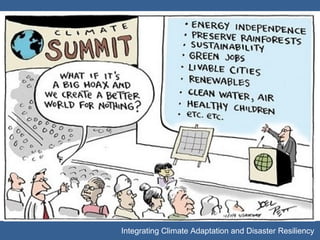
Climate Impacts Coupled with the continued threats from routine natural and technological hazards and the impact of a shifting climate has increased the challenge of appropriate and cost-effective mitigation practices Current projections indicate a 4 to 6 foot rise in sea level in the Northeast by 2100, with increases in temperature by 3 to 6 degrees F, increases in precipitation by 2 to 11 percent by 2050, and more frequent and more intense storms.
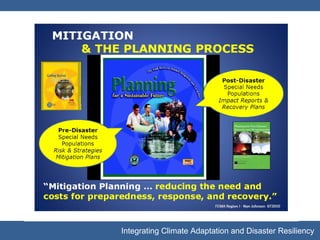
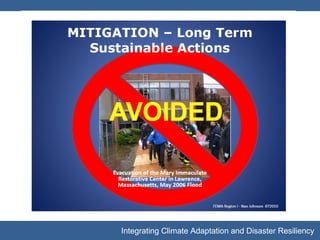
Mitigation Mitigation is a sustained action taken to reduce or eliminate risk to people and property from hazards and their effects.  Unlike other traditional emergency management program disciplines which focus on the immediate response to a hazard or the short term recovery from an event, mitigation looks at long-term solutions to reduce risk.
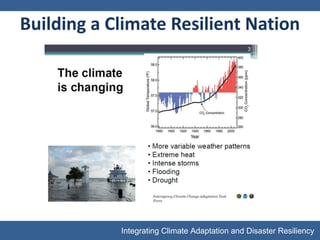
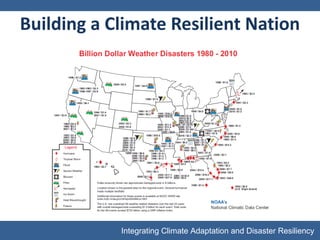
Building a Climate Resilient Nation
Building a Climate Resilient Nation & Sustainable Communities What does it mean to adapt to climate change? What do decision-makers need? How is the Federal government responding?  States?  Locals?  Tribes?
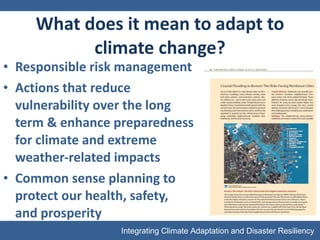
What does it mean to adapt to climate change? Responsible risk management Actions that reduce vulnerability over the long term & enhance preparedness for climate and extreme weather-related impacts Common sense planning to protect our health, safety,  and prosperity
What do decision-makers need?
What is the Federal role in adapting to climate change? Provide climate science & services to help communities make better decisions that reduce risks to people & property Strengthen planning capabilities to help communities develop and implement strategies Incorporate & integrate into existing planning Support partnerships that foster coordination, communication, and collaboration
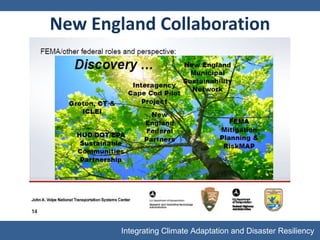
New England Collaboration
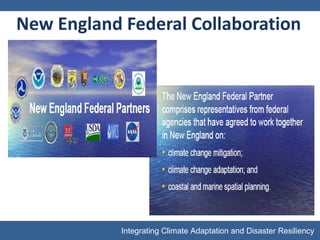
New England Federal Collaboration
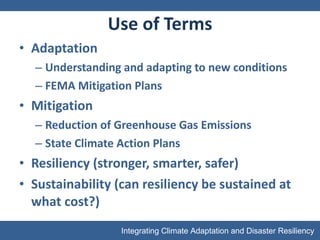
Use of Terms Adaptation  Understanding and adapting to new conditions FEMA Mitigation Plans Mitigation Reduction of Greenhouse Gas Emissions State Climate Action Plans Resiliency (stronger, smarter, safer) Sustainability (can resiliency be sustained at what cost?)
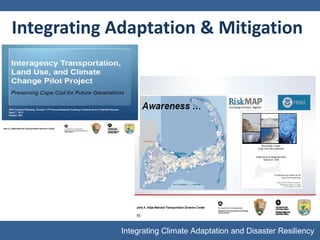
Integrating Adaptation & Mitigation


Tools for Mitigation Hazard identification and mapping Design and construction applications Land-use planning Financial incentives Insurance Structural controls
Insurance Insurance is a risk transfer measure The NFIP is an example of how, if properly designed, insurance can be a tool for mitigation NFIP considered one of the most successful mitigation programs ever created NFIP Community Rating System Today more than 20,000 communities in the NFIP have mitigation programs in place
NFIP in Rhode Island All 39 communities and the Narragansett Indian Tribe participate 16,016 policies in force covering over $3.8 billion in property Roughly 3.3% of the 449,582 households in RI Significantly under-prescribed to Participation allows for certain FEMA grant opportunities
Impediments to Mitigation Denial of the risk Lack of political will Costs and lack of funding State or local match  The taking issue Changes: Potential liability issues  Media attention  Incentives / penalties
Federal Mitigation Programs Hazard Mitigation Assistance National Earthquake Hazard Reduction Program National Hurricane Program National Dam Safety Program Fire Prevention and Assistance Act Assistance to Firefighters Grant
Intent of Hazard Mitigation Assistance  (HMA)  Grant Programs Opportunity to protect individuals and property from natural hazards while also reducing reliance on Federal disaster funds… HMA programs provide pre-disaster mitigation grant funds annually (except post-disaster HMGP)… Statutory origins of programs differ, but share common goal of reducing loss of life and property due to natural hazards…
Hazard Mitigation Assistance Grant Programs Hazard Mitigation Grant Program (HMGP) Pre-Disaster Mitigation (PDM) Program Flood Mitigation Assistance (FMA) Program Repetitive Flood Claims (RFC) Program Severe Repetitive Loss (SRL) Program
Hazard Mitigation Assistance Eligible Projects Acquisition & demolition or relocation of structures Elevation of existing structures Retrofitting Construction of Safe Rooms Vegetation management Storm water management projects Localized flood reduction projects Protective measures for utilities and infrastructure
Hazard Mitigation Assistance Ineligible Projects Maintenance and/or repair projects Completed projects or projects that are in-progress Major flood control projects such as construction or repair of dams, dikes, levees, seawalls, etc. Design, feasibility, and/or drainage studies not integral to project Warning or alert notification systems Phased or partial projects Flood studies or flood mapping Response or communication equipment Generators or related equipment (not integral to the project)
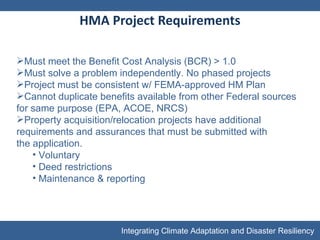
HMA Project Requirements Must meet the Benefit Cost Analysis (BCR) > 1.0 Must solve a problem independently. No phased projects Project must be consistent w/ FEMA-approved HM Plan Cannot duplicate benefits available from other Federal sources for same purpose (EPA, ACOE, NRCS) Property acquisition/relocation projects have additional requirements and assurances that must be submitted with the application. Voluntary Deed restrictions Maintenance & reporting
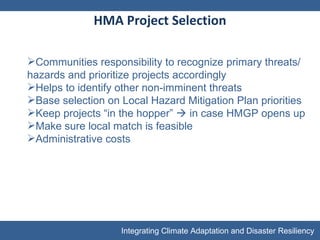
HMA Project Selection Communities responsibility to recognize primary threats/hazards and prioritize projects accordingly Helps to identify other non-imminent threats Base selection on Local Hazard Mitigation Plan priorities Keep projects “in the hopper”    in case HMGP opens up Make sure local match is feasible Administrative costs
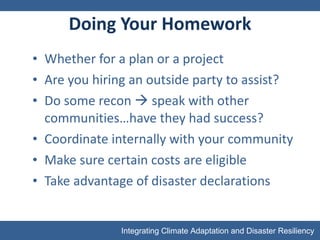
Doing Your Homework Whether for a plan or a project Are you hiring an outside party to assist? Do some recon    speak with other communities…have they had success? Coordinate internally with your community Make sure certain costs are eligible  Take advantage of disaster declarations
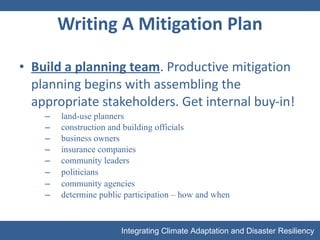
Writing A Mitigation Plan Build a planning team . Productive mitigation planning begins with assembling the appropriate stakeholders. Get internal buy-in! land-use planners construction and building officials business owners insurance companies community leaders politicians   community agencies determine public participation  –  how and when
Identify Available Tools Risk assessment Historical records GIS information Hazard mapping Insurance information (including NFIP) Personnel Funding References Best practices
Develop Goals & Objectives Goals – Broad visions Objectives – Define strategies or steps for achieving goals Based on community values, identity, and culture Local goals should be consistent with State goals Local goals should not contradict with other goals for the community/organization (Comp plans, operational plans etc.) Local goals should not conflict with the goals of abutter jurisdictions
Develop Goals and Objectives Review and analyze hazard profiles and loss estimates Review the findings of the Risk Assessment What are the hazards? Need all stat ID’s hazards and can add to these as appropriate Characteristics of each hazard Which critical assets are located in hazard area and what characteristics make them vulnerable? Where would the most potential losses occur Develop a list of problem statements based on the Risk Assessment review
Develop Goals and Objectives Goal Statements Reflect desire to protect people and structures Reduce response and recovery costs Minimize disruption Eliminate (realistically, limit) vulnerability Review goal statements for conflicts with existing policies and plans
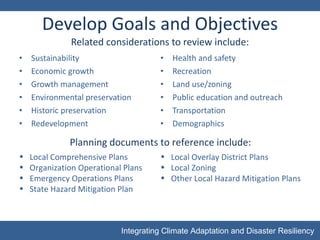
Develop Goals and Objectives Related considerations to review include: Sustainability Economic growth Growth management Environmental preservation Historic preservation Redevelopment Health and safety Recreation Land use/zoning Public education and outreach Transportation Demographics Local Comprehensive Plans Organization Operational Plans Emergency Operations Plans State Hazard Mitigation Plan Planning documents to reference include: Local Overlay District Plans  Local Zoning Other Local Hazard Mitigation Plans
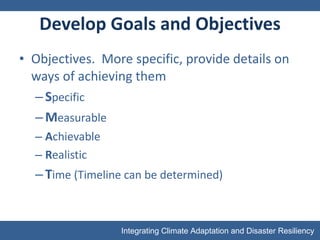
Develop Goals and Objectives Objectives.  More specific, provide details on ways of achieving them S pecific M easurable A chievable R ealistic T ime (Timeline can be determined)
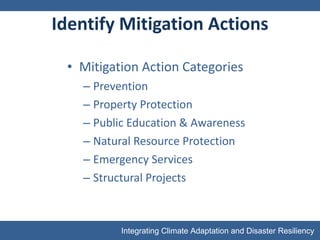
Identify Mitigation Actions Mitigation Action Categories Prevention Property Protection Public Education & Awareness Natural Resource Protection Emergency Services Structural Projects
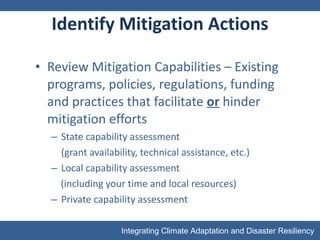
Identify Mitigation Actions Review Mitigation Capabilities – Existing programs, policies, regulations, funding and practices that facilitate  or  hinder mitigation efforts State capability assessment (grant availability, technical assistance, etc.) Local capability assessment (including your time and local resources) Private capability assessment
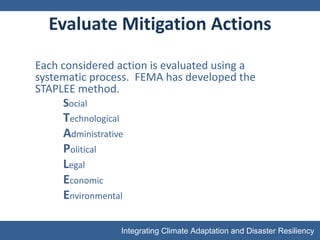
Evaluate Mitigation Actions Each considered action is evaluated using a systematic process.  FEMA has developed the STAPLEE method. S ocial T echnological A dministrative P olitical L egal E conomic E nvironmental
Prioritize Mitigation Actions Everything can’t be a Top priority! Some considerations: Identified immediate needs Ease of implementation Multi-objective actions Time to implement Post-disaster mitigation
Implementation Strategy How will mitigation actions be implemented? Responsible party Teams and partners Required resources Timeline Document the strategy
Write the Plan Assemble the products described previously Follow the FEMA guidelines for plan format and content Describe the planning process Include the risk assessment Mitigation strategy Document public input opportunity Process for maintaining the plan
Plan Approval Enable draft review/comment/approval by planning team Completed plan is released for public review and comment Completed plan is forwarded to abutter jurisdictions for review and comment Comments are reviewed for inclusion Forward plan along for State/Federal Review Local plans go to the State for intermediate review before forwarding to FEMA State and Tribal plans are forwarded to the FEMA regional office
Plan Approval FEMA uses the appropriate (state, tribal, or local) crosswalk to assess the plan for completeness and compliance.  Deficiencies are noted and a formal corrective notice is sent to the jurisdiction When all deficiencies are corrected, the plan is returned for FEMA review If plan passes FEMA review, a Letter of Conditional Approval is issued to the jurisdiction The jurisdiction governing body votes to formally adopt the approved hazard mitigation plan Completed and adopted plan is forwarded to FEMA
Contact Peter Cusolito, CEM  Vanasse Hangen Brustlin, Inc [email_address] Wayne Barnes, CFM  City of East Providence  [email_address] Michelle Burnett, CFM Rhode Island Emergency Management Agency [email_address] Marie-Annette (Nan) Johnson Federal Emergency Management Agency [email_address]
 

Integrating Climate Adaptation and Disaster Resiliency

  • 1.
    Integrating Climate Adaptationand Disaster Resiliency Peter Cusolito, CEM Vanasse Hangen Brustlin, Inc Wayne Barnes, CFM City of East Providence Michelle Burnett, CFM Rhode Island Emergency Management Agency Marie-Annette (Nan) Johnson Federal Emergency Management Agency
  • 2.
    Session Objectives Throughthis session participants will : Develop a clearer understanding the importance of hazard mitigation in developing and maintaining sustainable communities; Detail of the main components of each phase of the hazard mitigation planning process and the importance of building a comprehensive team of stakeholders, to include the public; Identify hazard mitigation measures that are applicable to state, regional and municipal hazard risk problems; Identify resources and projects that reduce the impact hazards or reduce or eliminate vulnerability.
  • 3.
    Climate Impacts Coupledwith the continued threats from routine natural and technological hazards and the impact of a shifting climate has increased the challenge of appropriate and cost-effective mitigation practices Current projections indicate a 4 to 6 foot rise in sea level in the Northeast by 2100, with increases in temperature by 3 to 6 degrees F, increases in precipitation by 2 to 11 percent by 2050, and more frequent and more intense storms.
  • 4.
    Mitigation Mitigation isa sustained action taken to reduce or eliminate risk to people and property from hazards and their effects. Unlike other traditional emergency management program disciplines which focus on the immediate response to a hazard or the short term recovery from an event, mitigation looks at long-term solutions to reduce risk.
  • 5.
    Building a ClimateResilient Nation
  • 6.
    Building a ClimateResilient Nation
  • 7.
    Building a ClimateResilient Nation & Sustainable Communities What does it mean to adapt to climate change? What do decision-makers need? How is the Federal government responding? States? Locals? Tribes?
  • 8.
    What does itmean to adapt to climate change? Responsible risk management Actions that reduce vulnerability over the long term & enhance preparedness for climate and extreme weather-related impacts Common sense planning to protect our health, safety, and prosperity
  • 9.
  • 10.
    What is theFederal role in adapting to climate change? Provide climate science & services to help communities make better decisions that reduce risks to people & property Strengthen planning capabilities to help communities develop and implement strategies Incorporate & integrate into existing planning Support partnerships that foster coordination, communication, and collaboration
  • 11.
  • 12.
    New England FederalCollaboration
  • 13.
    Use of TermsAdaptation Understanding and adapting to new conditions FEMA Mitigation Plans Mitigation Reduction of Greenhouse Gas Emissions State Climate Action Plans Resiliency (stronger, smarter, safer) Sustainability (can resiliency be sustained at what cost?)
  • 14.
  • 15.
  • 16.
  • 17.
  • 18.
    Tools for MitigationHazard identification and mapping Design and construction applications Land-use planning Financial incentives Insurance Structural controls
  • 19.
    Insurance Insurance isa risk transfer measure The NFIP is an example of how, if properly designed, insurance can be a tool for mitigation NFIP considered one of the most successful mitigation programs ever created NFIP Community Rating System Today more than 20,000 communities in the NFIP have mitigation programs in place
  • 20.
    NFIP in RhodeIsland All 39 communities and the Narragansett Indian Tribe participate 16,016 policies in force covering over $3.8 billion in property Roughly 3.3% of the 449,582 households in RI Significantly under-prescribed to Participation allows for certain FEMA grant opportunities
  • 21.
    Impediments to MitigationDenial of the risk Lack of political will Costs and lack of funding State or local match The taking issue Changes: Potential liability issues Media attention Incentives / penalties
  • 22.
    Federal Mitigation ProgramsHazard Mitigation Assistance National Earthquake Hazard Reduction Program National Hurricane Program National Dam Safety Program Fire Prevention and Assistance Act Assistance to Firefighters Grant
  • 23.
    Intent of HazardMitigation Assistance (HMA) Grant Programs Opportunity to protect individuals and property from natural hazards while also reducing reliance on Federal disaster funds… HMA programs provide pre-disaster mitigation grant funds annually (except post-disaster HMGP)… Statutory origins of programs differ, but share common goal of reducing loss of life and property due to natural hazards…
  • 24.
    Hazard Mitigation AssistanceGrant Programs Hazard Mitigation Grant Program (HMGP) Pre-Disaster Mitigation (PDM) Program Flood Mitigation Assistance (FMA) Program Repetitive Flood Claims (RFC) Program Severe Repetitive Loss (SRL) Program
  • 25.
    Hazard Mitigation AssistanceEligible Projects Acquisition & demolition or relocation of structures Elevation of existing structures Retrofitting Construction of Safe Rooms Vegetation management Storm water management projects Localized flood reduction projects Protective measures for utilities and infrastructure
  • 26.
    Hazard Mitigation AssistanceIneligible Projects Maintenance and/or repair projects Completed projects or projects that are in-progress Major flood control projects such as construction or repair of dams, dikes, levees, seawalls, etc. Design, feasibility, and/or drainage studies not integral to project Warning or alert notification systems Phased or partial projects Flood studies or flood mapping Response or communication equipment Generators or related equipment (not integral to the project)
  • 27.
    HMA Project RequirementsMust meet the Benefit Cost Analysis (BCR) > 1.0 Must solve a problem independently. No phased projects Project must be consistent w/ FEMA-approved HM Plan Cannot duplicate benefits available from other Federal sources for same purpose (EPA, ACOE, NRCS) Property acquisition/relocation projects have additional requirements and assurances that must be submitted with the application. Voluntary Deed restrictions Maintenance & reporting
  • 28.
    HMA Project SelectionCommunities responsibility to recognize primary threats/hazards and prioritize projects accordingly Helps to identify other non-imminent threats Base selection on Local Hazard Mitigation Plan priorities Keep projects “in the hopper”  in case HMGP opens up Make sure local match is feasible Administrative costs
  • 29.
    Doing Your HomeworkWhether for a plan or a project Are you hiring an outside party to assist? Do some recon  speak with other communities…have they had success? Coordinate internally with your community Make sure certain costs are eligible Take advantage of disaster declarations
  • 30.
    Writing A MitigationPlan Build a planning team . Productive mitigation planning begins with assembling the appropriate stakeholders. Get internal buy-in! land-use planners construction and building officials business owners insurance companies community leaders politicians community agencies determine public participation – how and when
  • 31.
    Identify Available ToolsRisk assessment Historical records GIS information Hazard mapping Insurance information (including NFIP) Personnel Funding References Best practices
  • 32.
    Develop Goals &Objectives Goals – Broad visions Objectives – Define strategies or steps for achieving goals Based on community values, identity, and culture Local goals should be consistent with State goals Local goals should not contradict with other goals for the community/organization (Comp plans, operational plans etc.) Local goals should not conflict with the goals of abutter jurisdictions
  • 33.
    Develop Goals andObjectives Review and analyze hazard profiles and loss estimates Review the findings of the Risk Assessment What are the hazards? Need all stat ID’s hazards and can add to these as appropriate Characteristics of each hazard Which critical assets are located in hazard area and what characteristics make them vulnerable? Where would the most potential losses occur Develop a list of problem statements based on the Risk Assessment review
  • 34.
    Develop Goals andObjectives Goal Statements Reflect desire to protect people and structures Reduce response and recovery costs Minimize disruption Eliminate (realistically, limit) vulnerability Review goal statements for conflicts with existing policies and plans
  • 35.
    Develop Goals andObjectives Related considerations to review include: Sustainability Economic growth Growth management Environmental preservation Historic preservation Redevelopment Health and safety Recreation Land use/zoning Public education and outreach Transportation Demographics Local Comprehensive Plans Organization Operational Plans Emergency Operations Plans State Hazard Mitigation Plan Planning documents to reference include: Local Overlay District Plans Local Zoning Other Local Hazard Mitigation Plans
  • 36.
    Develop Goals andObjectives Objectives. More specific, provide details on ways of achieving them S pecific M easurable A chievable R ealistic T ime (Timeline can be determined)
  • 37.
    Identify Mitigation ActionsMitigation Action Categories Prevention Property Protection Public Education & Awareness Natural Resource Protection Emergency Services Structural Projects
  • 38.
    Identify Mitigation ActionsReview Mitigation Capabilities – Existing programs, policies, regulations, funding and practices that facilitate or hinder mitigation efforts State capability assessment (grant availability, technical assistance, etc.) Local capability assessment (including your time and local resources) Private capability assessment
  • 39.
    Evaluate Mitigation ActionsEach considered action is evaluated using a systematic process. FEMA has developed the STAPLEE method. S ocial T echnological A dministrative P olitical L egal E conomic E nvironmental
  • 40.
    Prioritize Mitigation ActionsEverything can’t be a Top priority! Some considerations: Identified immediate needs Ease of implementation Multi-objective actions Time to implement Post-disaster mitigation
  • 41.
    Implementation Strategy Howwill mitigation actions be implemented? Responsible party Teams and partners Required resources Timeline Document the strategy
  • 42.
    Write the PlanAssemble the products described previously Follow the FEMA guidelines for plan format and content Describe the planning process Include the risk assessment Mitigation strategy Document public input opportunity Process for maintaining the plan
  • 43.
    Plan Approval Enabledraft review/comment/approval by planning team Completed plan is released for public review and comment Completed plan is forwarded to abutter jurisdictions for review and comment Comments are reviewed for inclusion Forward plan along for State/Federal Review Local plans go to the State for intermediate review before forwarding to FEMA State and Tribal plans are forwarded to the FEMA regional office
  • 44.
    Plan Approval FEMAuses the appropriate (state, tribal, or local) crosswalk to assess the plan for completeness and compliance. Deficiencies are noted and a formal corrective notice is sent to the jurisdiction When all deficiencies are corrected, the plan is returned for FEMA review If plan passes FEMA review, a Letter of Conditional Approval is issued to the jurisdiction The jurisdiction governing body votes to formally adopt the approved hazard mitigation plan Completed and adopted plan is forwarded to FEMA
  • 45.
    Contact Peter Cusolito,CEM Vanasse Hangen Brustlin, Inc [email_address] Wayne Barnes, CFM City of East Providence [email_address] Michelle Burnett, CFM Rhode Island Emergency Management Agency [email_address] Marie-Annette (Nan) Johnson Federal Emergency Management Agency [email_address]
  • 46.