
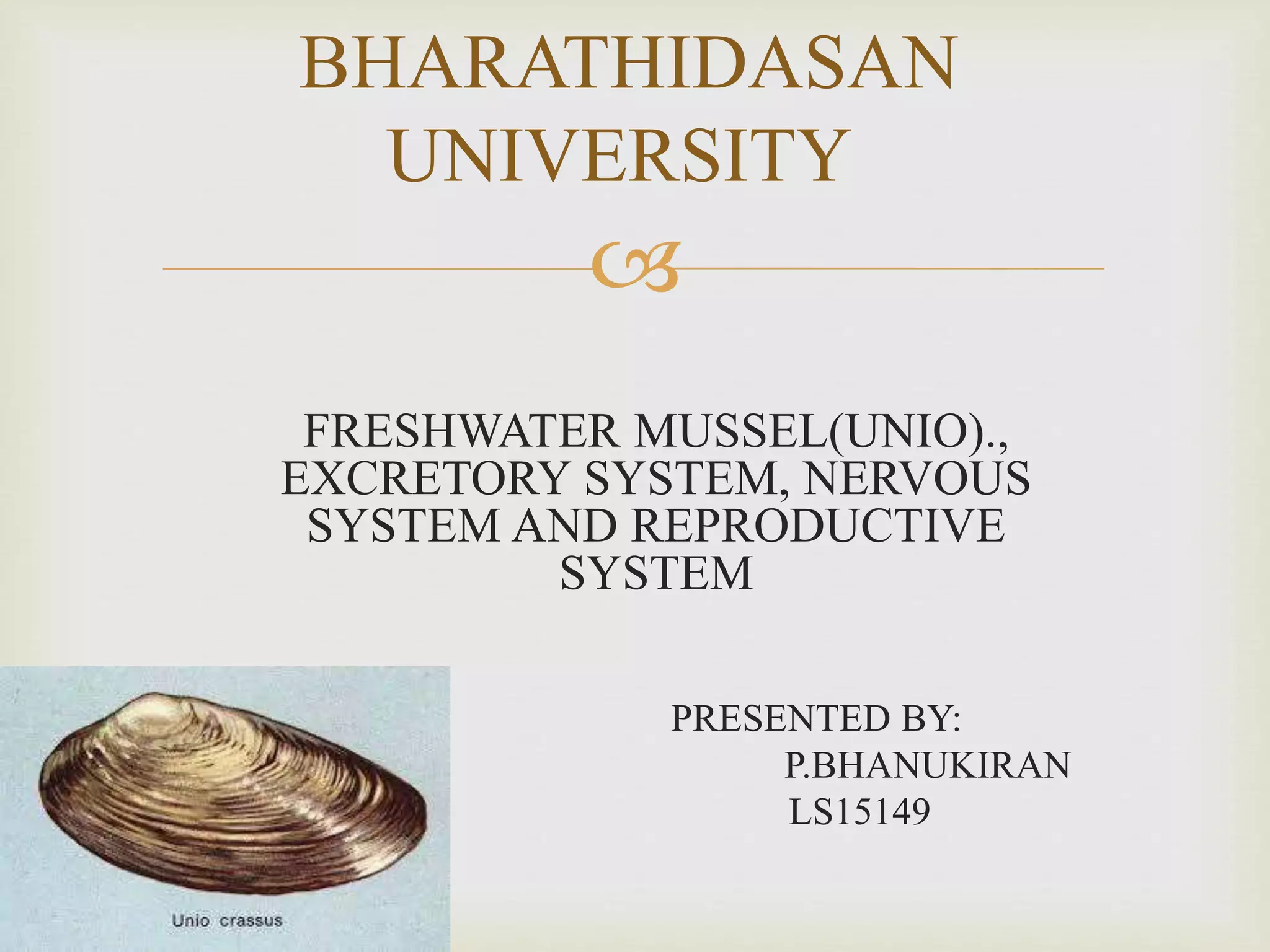
FRESHWATER MUSSEL(UNIO).,
EXCRETORY SYSTEM, NERVOUS
SYSTEM AND REPRODUCTIVE
SYSTEM
PRESENTED BY:
P.BHANUKIRAN
LS15149
BHARATHIDASAN
UNIVERSITY
 Excretory System
Physiology of Excretion
CONTENT

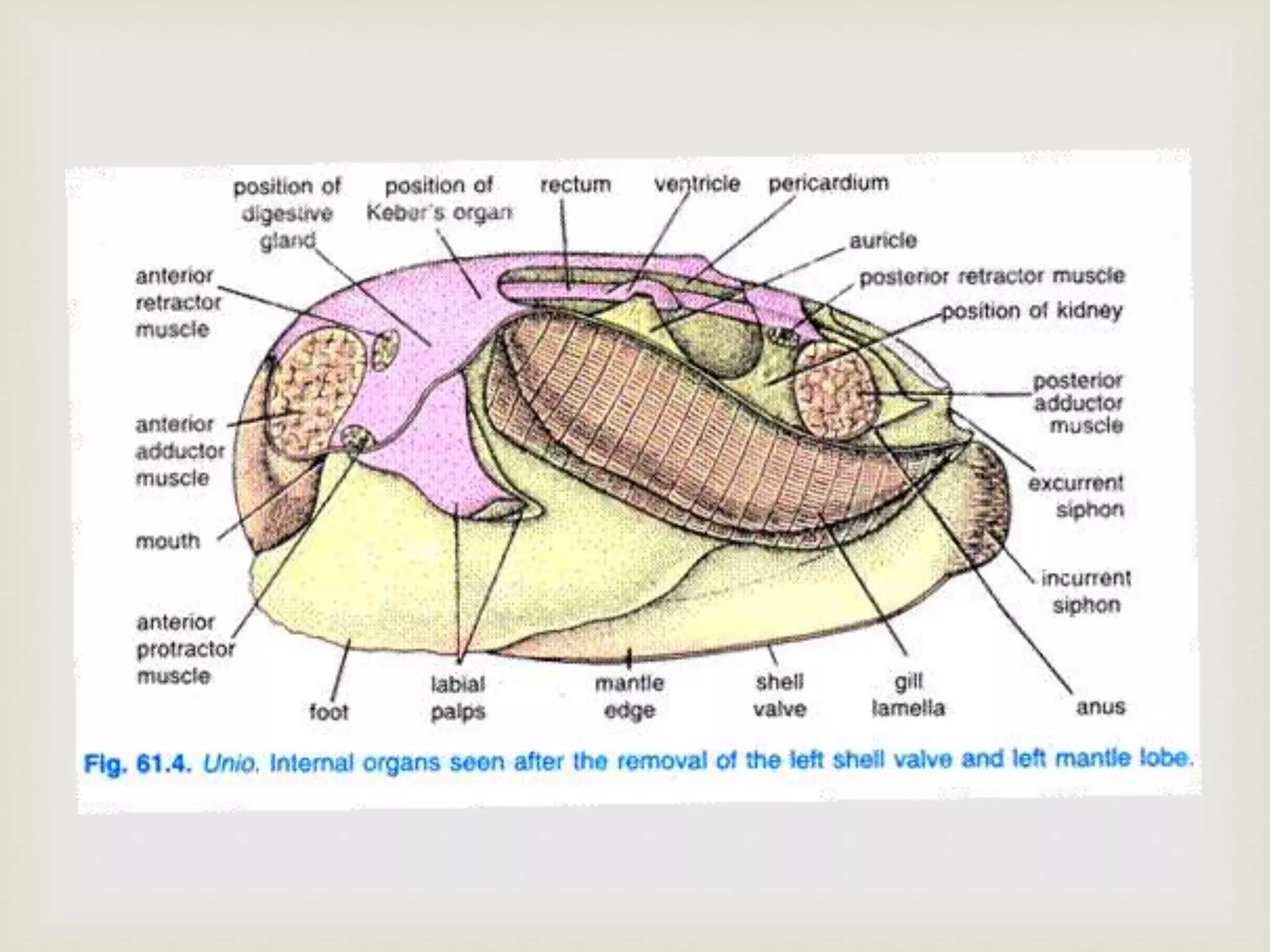
 The excretory system of Unio consists of Organs of
Bojanus and the Keber’s organ.
 Organs of Bojanus: Nephridia which are often
referred as organs of Bojanus are the chief excretory
organs of Unio.
 These are situated below the Pericardium one on
each side of the body
EXCRETORY SYSTEM


 The kidney consists of a tube bent upon itself, where the
lower limb is a glandular part and the upper limb is a
urinary bladder.
 Each kidney opens at one end into the pericardium by a
minute reno-pericardial aperture, at the other end into
renal pore into the suprabranchial chamber.
PHYSIOLOGY OF EXCRETION
 The glandular part of kidney removes nitrogenous waste
from the pericardial fluid and blood supplied to them .
 The ciliated cells of urinary bladder create outward
current carrying the excretory fluid.

 Kidneys also remove large amount of water to
maintain their blood concentration.
 Keber’s Organ: Infront of pericardium is another
excretory organ called pericardial gland or keber’s
organ.
 It is formed from epithelium of pericardium.
 It helps discharge waste into pericardium which
chiefly consists mainly of ammonia and amino
compounds and some traces of urea and uric acid.
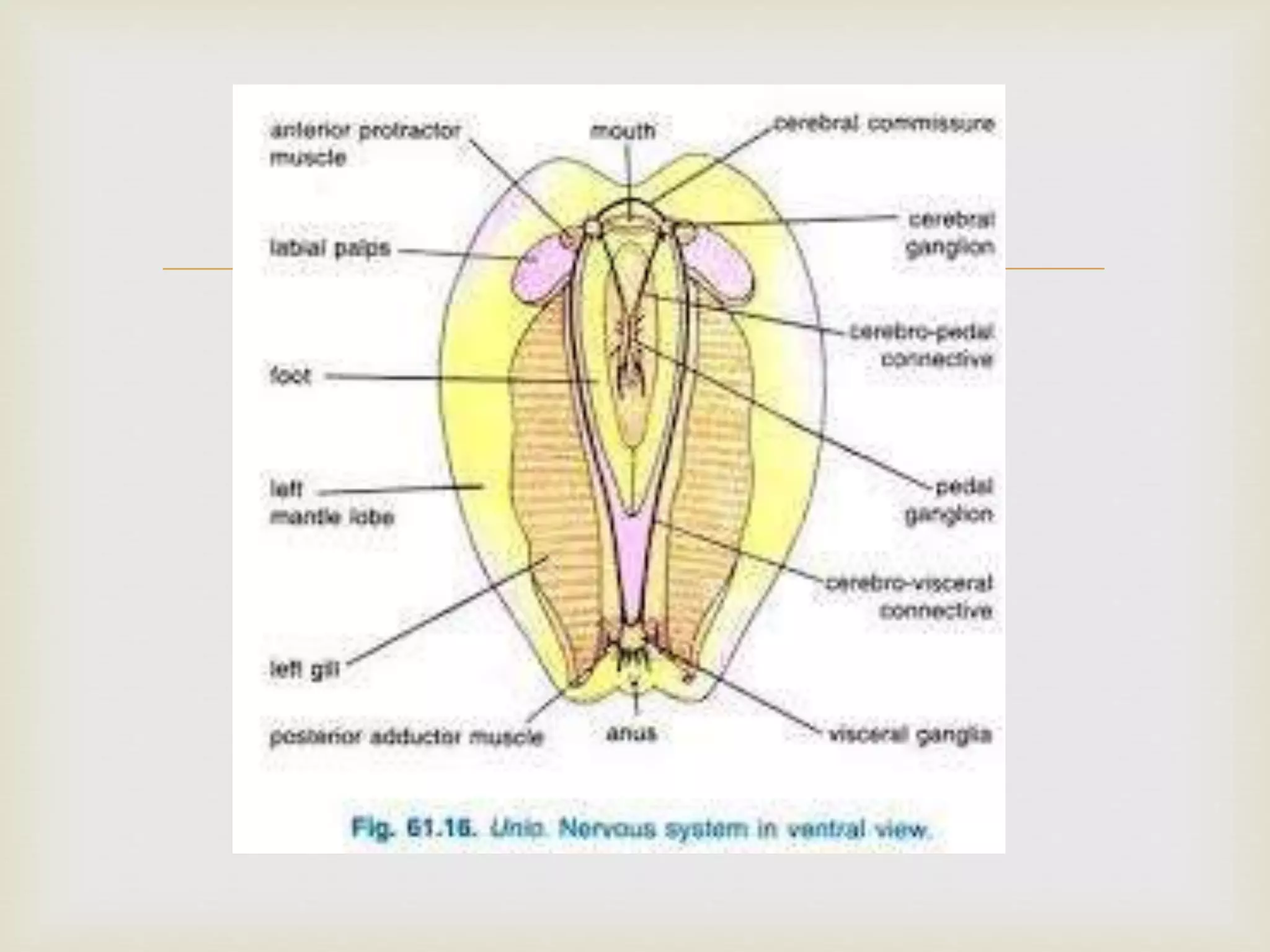
 The nervous system of unio consists of only paired
ganglia, commissures(nerves connecting two similar
ganglia), connectives(nerves connection two
dissimilar ganglia) and nerves.
 There are two types of ganglia which are as follows:
1.) Cerebro-pleural ganglia
2.) Pedal ganglia
3.) Visceral ganglia
NERVOUS SYSTEM


 Cerebro-pleural ganglia: These are paired,
triangular and are of a pin head size which are
placed one on either side a little behind mouth and at
the base of labial palps.
 Each ganglion gives out an anterior adductor nerve
to the adductor muscle, a labial nerve to labial pulp
and an anterior pallial nerve to the anterior part of
mantle.
 Pedal ganglia: These lie at the junction of visceral
mass and are paired.
 Both pedal ganglia re joined into a bilobed mass and
these supply to the foot, its muscles and statocyst.

 Visceral ganglia: Paired, and are fused together to form a
flattened X-shaped mass lying mid-ventrally below the
posterior adductor muscle.
 Gives out the pallial nerve to the mantle, renal nerve to
the kidneys, ctenidial nerve to the gills and the adductor
nerve to the posterior adductor muscles.
 Commissures: The cerebro-pleural ganglia of both the
sides are connected together by a thin transverse, loop
like nerve passing over the oesophagus, this nerve is
called cerebral commissure.
 Connectives: All the three ganglia are connected with
some stuot nerves representing the connectives.
There is no connective between the pedal and visceral
ganglia.

 Unio is dioecious
 The gonads are testes and ovaries in female.
 The lining of the gonads proliferate to give rise to
spermatozoa in male and eggs in female.
 There are no Accessory reproductive structures
found in bivalves.
 The sperms and eggs fuse in the female inhalant
siphon amd reach ctenidia.
 Fertilisation and early development occur there.
REPRODUCTIVE
SYSTEM

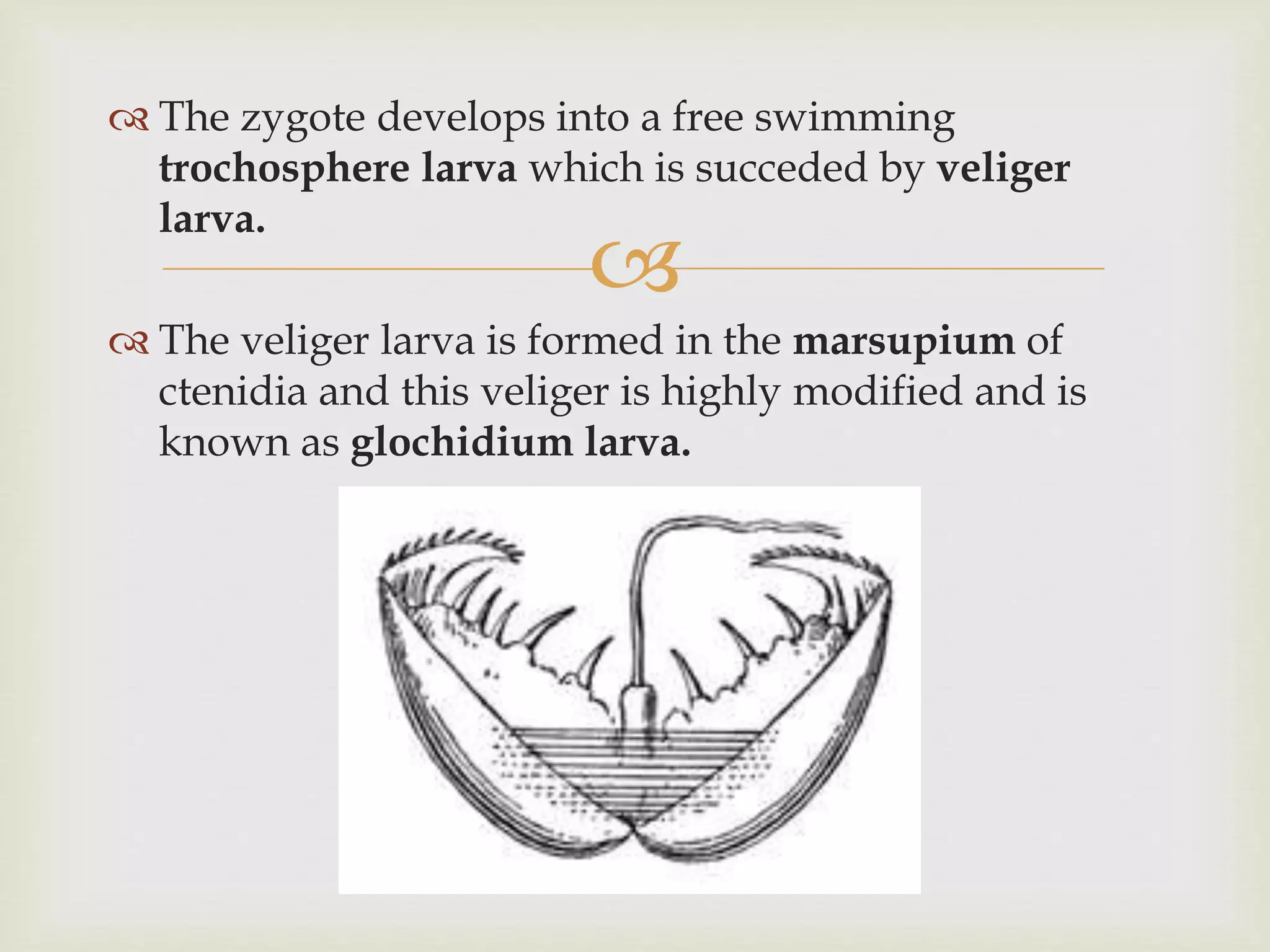
 The zygote develops into a free swimming
trochosphere larva which is succeded by veliger
larva.
 The veliger larva is formed in the marsupium of
ctenidia and this veliger is highly modified and is
known as glochidium larva.

LIFE CYCLE

Freshwater mussel enr..

  • 1.
     FRESHWATER MUSSEL(UNIO)., EXCRETORY SYSTEM,NERVOUS SYSTEM AND REPRODUCTIVE SYSTEM PRESENTED BY: P.BHANUKIRAN LS15149 BHARATHIDASAN UNIVERSITY
  • 2.
  • 3.
      The excretorysystem of Unio consists of Organs of Bojanus and the Keber’s organ.  Organs of Bojanus: Nephridia which are often referred as organs of Bojanus are the chief excretory organs of Unio.  These are situated below the Pericardium one on each side of the body EXCRETORY SYSTEM
  • 4.
  • 5.
      The kidneyconsists of a tube bent upon itself, where the lower limb is a glandular part and the upper limb is a urinary bladder.  Each kidney opens at one end into the pericardium by a minute reno-pericardial aperture, at the other end into renal pore into the suprabranchial chamber. PHYSIOLOGY OF EXCRETION  The glandular part of kidney removes nitrogenous waste from the pericardial fluid and blood supplied to them .  The ciliated cells of urinary bladder create outward current carrying the excretory fluid.
  • 6.
      Kidneys alsoremove large amount of water to maintain their blood concentration.  Keber’s Organ: Infront of pericardium is another excretory organ called pericardial gland or keber’s organ.  It is formed from epithelium of pericardium.  It helps discharge waste into pericardium which chiefly consists mainly of ammonia and amino compounds and some traces of urea and uric acid.
  • 7.
     The nervoussystem of unio consists of only paired ganglia, commissures(nerves connecting two similar ganglia), connectives(nerves connection two dissimilar ganglia) and nerves.  There are two types of ganglia which are as follows: 1.) Cerebro-pleural ganglia 2.) Pedal ganglia 3.) Visceral ganglia NERVOUS SYSTEM
  • 8.
  • 9.
      Cerebro-pleural ganglia:These are paired, triangular and are of a pin head size which are placed one on either side a little behind mouth and at the base of labial palps.  Each ganglion gives out an anterior adductor nerve to the adductor muscle, a labial nerve to labial pulp and an anterior pallial nerve to the anterior part of mantle.  Pedal ganglia: These lie at the junction of visceral mass and are paired.  Both pedal ganglia re joined into a bilobed mass and these supply to the foot, its muscles and statocyst.
  • 10.
      Visceral ganglia:Paired, and are fused together to form a flattened X-shaped mass lying mid-ventrally below the posterior adductor muscle.  Gives out the pallial nerve to the mantle, renal nerve to the kidneys, ctenidial nerve to the gills and the adductor nerve to the posterior adductor muscles.  Commissures: The cerebro-pleural ganglia of both the sides are connected together by a thin transverse, loop like nerve passing over the oesophagus, this nerve is called cerebral commissure.  Connectives: All the three ganglia are connected with some stuot nerves representing the connectives. There is no connective between the pedal and visceral ganglia.
  • 11.
      Unio isdioecious  The gonads are testes and ovaries in female.  The lining of the gonads proliferate to give rise to spermatozoa in male and eggs in female.  There are no Accessory reproductive structures found in bivalves.  The sperms and eggs fuse in the female inhalant siphon amd reach ctenidia.  Fertilisation and early development occur there. REPRODUCTIVE SYSTEM
  • 12.
      The zygotedevelops into a free swimming trochosphere larva which is succeded by veliger larva.  The veliger larva is formed in the marsupium of ctenidia and this veliger is highly modified and is known as glochidium larva.
  • 13.