Prof. J.F. Huang, Fiber-Optic Communication Lab.
National Cheng Kung University, Taiwan
Amplitude Shift Keying (ASK)
 ASK is implemented by changing the amplitude of a
carrier signal to reflect amplitude levels in the digital
signal.
 For example: a digital “1” could not affect the signal,
whereas a digital “0” would, by making it zero.
 The line encoding will determine the values of the
analog waveform to reflect the digital data being
carried.
1
Prof. J.F. Huang, Fiber-Optic Communication Lab.
National Cheng Kung University, Taiwan
Amplitude Shift Keying (ASK)
 Mathematically, ASK is
vask(t) = [1 vm(t)][A/2 cos(c t)]
 For logic 1 , vm(t)=+1V
vask(t) = [1  1][A/2 cos(c t)] = Acos(c t)
 For logic 0 , vm(t)=-1V
vask(t) = [1 - 1][A/2 cos(c t)] = 0
2
Prof. J.F. Huang, Fiber-Optic Communication Lab.
National Cheng Kung University, Taiwan
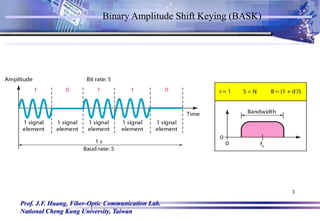
Binary Amplitude Shift Keying (BASK)
3
Prof. J.F. Huang, Fiber-Optic Communication Lab.
National Cheng Kung University, Taiwan
Bandwidth of ASK
 The bandwidth B of ASK is equal to the signal rate fb .
B = fb
 Baud = fb
4
Prof. J.F. Huang, Fiber-Optic Communication Lab.
National Cheng Kung University, Taiwan
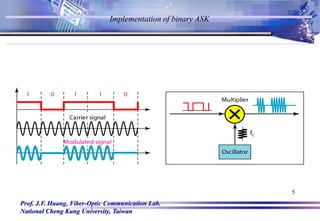
Implementation of binary ASK
5
Prof. J.F. Huang, Fiber-Optic Communication Lab.
National Cheng Kung University, Taiwan
6
 The general expression for a binary FSK signal is
v(t) = Vccos{2π[fc vm(t)Df)]t} (13-3)
 where
v(t)= binary FSK waveform
Vc = peak unmodulated carrier amplitude
fc = carrier frequency
vm(t) = binary input modulating signal (volts)
Df = difference in output frequency
Frequency Shift Keying
Prof. J.F. Huang, Fiber-Optic Communication Lab.
National Cheng Kung University, Taiwan
7
Frequency Shift Keying
 From Equ. (13-3) it is seen that with binary FSK the
carrier amplitude Vc remains constant with modulation.
However, the output carrier frequency (fc) shifts by an
amount equal to +Df.
 The frequency shift Df is proportional to the amplitude
and polarity of the binary input signal. For example, a
binary ‘1’ could be +1 volt and a binary ‘0’ could be –1
volt producing frequency shifts of + Df and - Df,
respectively.
Prof. J.F. Huang, Fiber-Optic Communication Lab.
National Cheng Kung University, Taiwan
8
FSK Transmitter
 With binary FSK, the center carrier frequency is shifted
(deviated) by the binary input data. As the binary input
signal changes from a logic ‘0’ to a logic ‘1’, and vice versa,
the FSK output shifts between mark (or logic ‘1’)
frequency and space (or logic ‘0’) frequency.
 The rate of change at the modulator input is called the bit
rate and has the units of bits per second (bps). The rate of
change at the modulator output is called the baud rate
and is equal to the reciprocal of the time of one output
signaling element.
 In binary FSK, the input and output rates of change are
equal; therefore, the bit rate and baud rate are equal. A
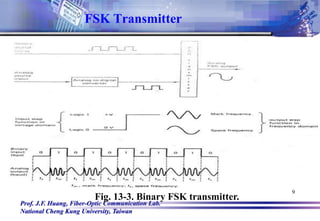
simple binary FSK transmitter is shown in Figure 13-3.
Prof. J.F. Huang, Fiber-Optic Communication Lab.
National Cheng Kung University, Taiwan
9
Fig. 13-3. Binary FSK transmitter.
FSK Transmitter
Prof. J.F. Huang, Fiber-Optic Communication Lab.
National Cheng Kung University, Taiwan
10
Bandwidth Considerations of FSK
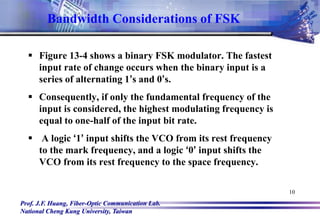
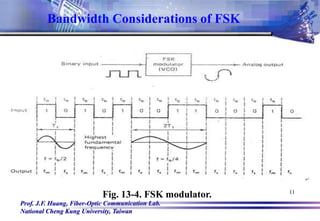
 Figure 13-4 shows a binary FSK modulator. The fastest
input rate of change occurs when the binary input is a
series of alternating 1’s and 0’s.
 Consequently, if only the fundamental frequency of the
input is considered, the highest modulating frequency is
equal to one-half of the input bit rate.
 A logic ‘1’ input shifts the VCO from its rest frequency
to the mark frequency, and a logic ‘0’ input shifts the
VCO from its rest frequency to the space frequency.
Prof. J.F. Huang, Fiber-Optic Communication Lab.
National Cheng Kung University, Taiwan
11
Fig. 13-4. FSK modulator.
Bandwidth Considerations of FSK
Prof. J.F. Huang, Fiber-Optic Communication Lab.
National Cheng Kung University, Taiwan
12
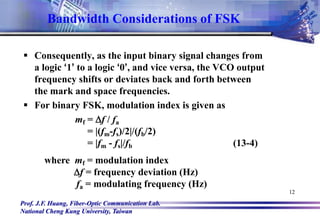
 Consequently, as the input binary signal changes from
a logic ‘1’ to a logic ‘0’, and vice versa, the VCO output
frequency shifts or deviates back and forth between
the mark and space frequencies.
 For binary FSK, modulation index is given as
mf = Df / fa
= |(fm-fs)/2|/(fb/2)
= |fm - fs|/fb (13-4)
where mf = modulation index
Df = frequency deviation (Hz)
fa = modulating frequency (Hz)
Bandwidth Considerations of FSK
Prof. J.F. Huang, Fiber-Optic Communication Lab.
National Cheng Kung University, Taiwan
13
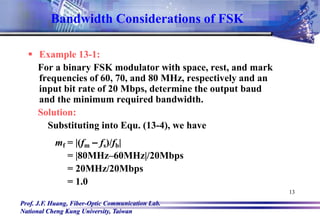
 Example 13-1:
For a binary FSK modulator with space, rest, and mark
frequencies of 60, 70, and 80 MHz, respectively and an
input bit rate of 20 Mbps, determine the output baud
and the minimum required bandwidth.
Solution:
Substituting into Equ. (13-4), we have
mf = |(fm – fs)/fb|
= |80MHz–60MHz|/20Mbps
= 20MHz/20Mbps
= 1.0
Bandwidth Considerations of FSK
Prof. J.F. Huang, Fiber-Optic Communication Lab.
National Cheng Kung University, Taiwan
14
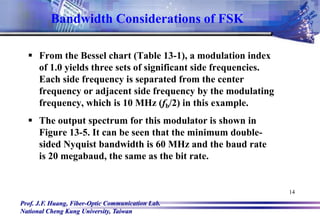
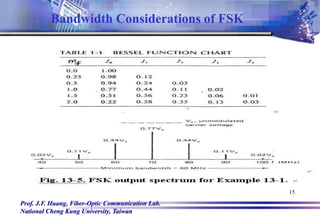
 From the Bessel chart (Table 13-1), a modulation index
of 1.0 yields three sets of significant side frequencies.
Each side frequency is separated from the center
frequency or adjacent side frequency by the modulating
frequency, which is 10 MHz (fb/2) in this example.
 The output spectrum for this modulator is shown in
Figure 13-5. It can be seen that the minimum double-
sided Nyquist bandwidth is 60 MHz and the baud rate
is 20 megabaud, the same as the bit rate.
Bandwidth Considerations of FSK
Prof. J.F. Huang, Fiber-Optic Communication Lab.
National Cheng Kung University, Taiwan
15
Bandwidth Considerations of FSK
Prof. J.F. Huang, Fiber-Optic Communication Lab.
National Cheng Kung University, Taiwan
16
FSK Receiver
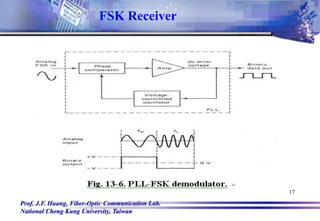
 The most common circuit used for demodulating binary
FSK signals is the phase-locked loop (PLL), which is
shown in block diagram form in Figure 13-6.
 As the input to the PLL shifts between the mark and
space frequencies, the dc error voltage at the output of
the phase comparator follows the frequency shift.
 The natural frequency of the PLL is generally made
equal to the center frequency of the FSK modulator.
The changes in the dc error voltage will then follow
the changes in the analog input frequency and are
symmetrical around 0 Vdc.
Prof. J.F. Huang, Fiber-Optic Communication Lab.
National Cheng Kung University, Taiwan
17
FSK Receiver
Prof. J.F. Huang, Fiber-Optic Communication Lab.
National Cheng Kung University, Taiwan
18
 Binary FSK has a poorer error performance than PSK
or QAM and, consequently, is seldom used for high-
performance digital radio systems.
 Its use is restricted to low-performance, low-cost,
asynchronous data modems that are used for data
communications over analog, voice band telephone lines.
FSK Receiver
Prof. J.F. Huang, Fiber-Optic Communication Lab.
National Cheng Kung University, Taiwan
19
Minimum Shift-Keying
 Minimum shift-keying (MSK) is a form of continuous-
phase FSK (CPFSK). Essentially, MSK is a binary
FSK except that the mark and space frequencies are
synchronized with the input binary bit rate.
 With MSK, the mark and space frequencies are selected
such that they are separated from the center frequency
by an exact odd multiple of one-half of the bit rate.
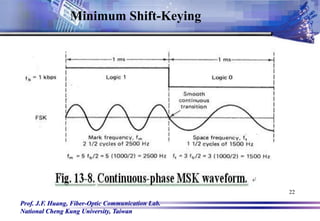
 This ensures that there is a smooth phase transition in
the analog output signal when it changes from a mark
to a space frequency, or vice versa.
Prof. J.F. Huang, Fiber-Optic Communication Lab.
National Cheng Kung University, Taiwan
20
Minimum Shift-Keying
Prof. J.F. Huang, Fiber-Optic Communication Lab.
National Cheng Kung University, Taiwan
21
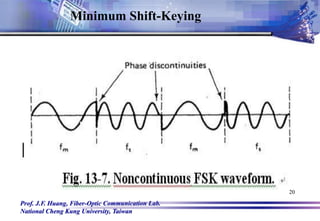
 Figure 13-7 shows a noncontinuous FSK waveform. When
the input changes from a logic ‘1’ to a logic ‘0’, and vice
versa, there is an abrupt phase discontinuity in the analog
output signal.
 When this occurs, the demodulator has trouble following
the frequency shift; consequently, an error may occur.
Figure 13-8 shows a continuous phase MSK waveform.
 MSK has a better bit-error performance than conventional
binary FSK for a given SNR. The disadvantage of MSK is
that it requires synchronizing circuits and it therefore
more expensive to implement.
Minimum Shift-Keying
Prof. J.F. Huang, Fiber-Optic Communication Lab.
National Cheng Kung University, Taiwan
22
Minimum Shift-Keying
Prof. J.F. Huang, Fiber-Optic Communication Lab.
National Cheng Kung University, Taiwan
23
Binary Phase Shift Keying
 With binary phase shift keying (BPSK), two output phases are
possible for a single carrier frequency.
One output phase represents a logic ‘1’ and the other
a logic ‘0’.
 As the input digital signal changes state, the phase of the
output carrier shifts between two angles that are 180° out of
phase. BPSK is a form of suppressed carrier, square-wave
modulation of a continuous wave (CW) signal.
Prof. J.F. Huang, Fiber-Optic Communication Lab.
National Cheng Kung University, Taiwan
24
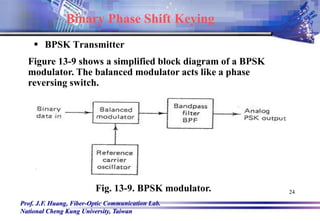
 BPSK Transmitter
Fig. 13-9. BPSK modulator.
Binary Phase Shift Keying
Figure 13-9 shows a simplified block diagram of a BPSK
modulator. The balanced modulator acts like a phase
reversing switch.
Prof. J.F. Huang, Fiber-Optic Communication Lab.
National Cheng Kung University, Taiwan
25
 In BPSK, depending on the logic condition of the digital
input, the carrier is transferred to the output either in
phase or 180° out of phase with the reference carrier
oscillator.
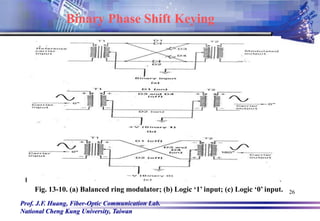
 Figure 13-10a shows the schematic diagram of a
balanced ring modulator.
 If the binary input is a logic ‘1’ (positive voltage), diodes
D1 and D2 are forward biased and “on”, while diodes
D3 and D4 are reverse biased and “off” (Figure 13-10b).
 The carrier voltage developed across transformer T2
is in phase with the carrier voltage across T1.
Consequently, the output signal is in phase with the
reference oscillator.
Binary Phase Shift Keying
Prof. J.F. Huang, Fiber-Optic Communication Lab.
National Cheng Kung University, Taiwan
26
Fig. 13-10. (a) Balanced ring modulator; (b) Logic ‘1’ input; (c) Logic ‘0’ input.
Binary Phase Shift Keying
Prof. J.F. Huang, Fiber-Optic Communication Lab.
National Cheng Kung University, Taiwan
27
 If the binary input is a logic ‘0’ (negative voltage), diodes
D1 and D2 are reverse biased and “off,” while diodes D3
and D4 are forward biased and “on” (Figure 13-10c).
 The carrier voltage developed across transformer T2
is 180°out of phase with the carrier voltage across T1.
Consequently, the output signal is 180° out of phase with
the reference oscillator.
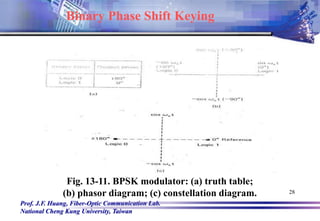
 Figure 13-11 shows the truth table, phasor diagram, and
constellation diagram for a BPSK modulator.
 A constellation diagram, or signal state-space diagram, is
similar to a phasor diagram except that the entire phasor
is not drawn. In a constellation diagram, only the relative
positions of the peaks of the phasors are shown.
Binary Phase Shift Keying
Prof. J.F. Huang, Fiber-Optic Communication Lab.
National Cheng Kung University, Taiwan
28
Fig. 13-11. BPSK modulator: (a) truth table;
(b) phasor diagram; (c) constellation diagram.
Binary Phase Shift Keying
Prof. J.F. Huang, Fiber-Optic Communication Lab.
National Cheng Kung University, Taiwan
29
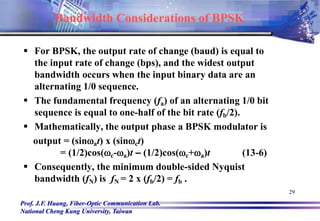
 For BPSK, the output rate of change (baud) is equal to
the input rate of change (bps), and the widest output
bandwidth occurs when the input binary data are an
alternating 1/0 sequence.
 The fundamental frequency (fa) of an alternating 1/0 bit
sequence is equal to one-half of the bit rate (fb/2).
 Mathematically, the output phase a BPSK modulator is
output = (sinat) x (sinct)
= (1/2)cos(c-a)t – (1/2)cos(c+a)t (13-6)
 Consequently, the minimum double-sided Nyquist
bandwidth (fN) is fN = 2 x (fb/2) = fb .
Bandwidth Considerations of BPSK
Prof. J.F. Huang, Fiber-Optic Communication Lab.
National Cheng Kung University, Taiwan
30
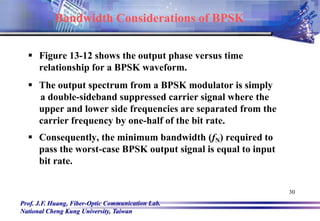
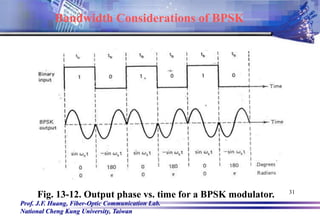
 Figure 13-12 shows the output phase versus time
relationship for a BPSK waveform.
 The output spectrum from a BPSK modulator is simply
a double-sideband suppressed carrier signal where the
upper and lower side frequencies are separated from the
carrier frequency by one-half of the bit rate.
 Consequently, the minimum bandwidth (fN) required to
pass the worst-case BPSK output signal is equal to input
bit rate.
Bandwidth Considerations of BPSK
Prof. J.F. Huang, Fiber-Optic Communication Lab.
National Cheng Kung University, Taiwan
31
Fig. 13-12. Output phase vs. time for a BPSK modulator.
Bandwidth Considerations of BPSK
Prof. J.F. Huang, Fiber-Optic Communication Lab.
National Cheng Kung University, Taiwan
32
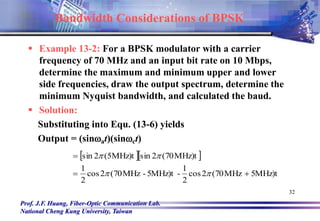
 Example 13-2: For a BPSK modulator with a carrier
frequency of 70 MHz and an input bit rate on 10 Mbps,
determine the maximum and minimum upper and lower
side frequencies, draw the output spectrum, determine the
minimum Nyquist bandwidth, and calculated the baud.
 Solution:
Substituting into Equ. (13-6) yields
Output = (sinat)(sinct)
  
5MHz)t
MHz
70
(
2
cos
2
1
-
5MHz)t
-
MHz
70
(
2
cos
2
1
MHz)t
70
(
2
sin
MHz)t
5
(
2
sin







Bandwidth Considerations of BPSK
Prof. J.F. Huang, Fiber-Optic Communication Lab.
National Cheng Kung University, Taiwan
33
Bandwidth Considerations of BPSK
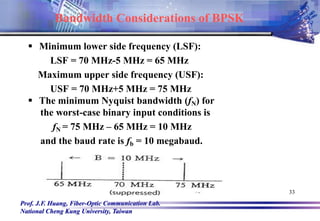
 Minimum lower side frequency (LSF):
LSF = 70 MHz-5 MHz = 65 MHz
Maximum upper side frequency (USF):
USF = 70 MHz+5 MHz = 75 MHz
 The minimum Nyquist bandwidth (fN) for
the worst-case binary input conditions is
fN = 75 MHz – 65 MHz = 10 MHz
and the baud rate is fb = 10 megabaud.
Prof. J.F. Huang, Fiber-Optic Communication Lab.
National Cheng Kung University, Taiwan
34
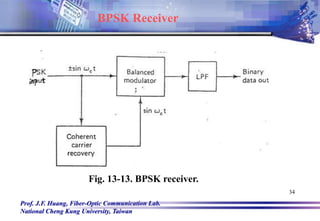
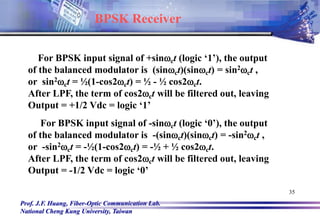
BPSK Receiver
Fig. 13-13. BPSK receiver.
Prof. J.F. Huang, Fiber-Optic Communication Lab.
National Cheng Kung University, Taiwan
35
For BPSK input signal of +sinct (logic ‘1’), the output
of the balanced modulator is (sinct)(sinct) = sin2ct ,
or sin2ct = ½(1-cos2ct) = ½ - ½ cos2ct.
After LPF, the term of cos2ct will be filtered out, leaving
Output = +1/2 Vdc = logic ‘1’
For BPSK input signal of -sinct (logic ‘0’), the output
of the balanced modulator is -(sinct)(sinct) = -sin2ct ,
or -sin2ct = -½(1-cos2ct) = -½ + ½ cos2ct.
After LPF, the term of cos2ct will be filtered out, leaving
Output = -1/2 Vdc = logic ‘0’
BPSK Receiver
Prof. J.F. Huang, Fiber-Optic Communication Lab.
National Cheng Kung University, Taiwan
36
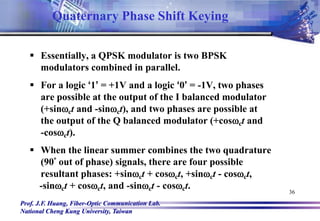
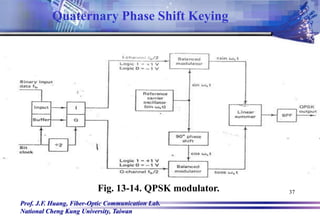
 Essentially, a QPSK modulator is two BPSK
modulators combined in parallel.
 For a logic ‘1’ = +1V and a logic ‘0’ = -1V, two phases
are possible at the output of the I balanced modulator
(+sinct and -sinct), and two phases are possible at
the output of the Q balanced modulator (+cosct and
-cosct).
 When the linear summer combines the two quadrature
(90° out of phase) signals, there are four possible
resultant phases: +sinct + cosct, +sinct - cosct,
-sinct + cosct, and -sinct - cosct.
Quaternary Phase Shift Keying
Prof. J.F. Huang, Fiber-Optic Communication Lab.
National Cheng Kung University, Taiwan
37
Fig. 13-14. QPSK modulator.
Quaternary Phase Shift Keying
Prof. J.F. Huang, Fiber-Optic Communication Lab.
National Cheng Kung University, Taiwan
38
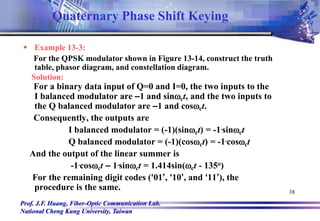
 Example 13-3:
For the QPSK modulator shown in Figure 13-14, construct the truth
table, phasor diagram, and constellation diagram.
Solution:
For a binary data input of Q=0 and I=0, the two inputs to the
I balanced modulator are –1 and sinct, and the two inputs to
the Q balanced modulator are –1 and cosct.
Consequently, the outputs are
I balanced modulator = (-1)(sinct) = -1.sinct
Q balanced modulator = (-1)(cosct) = -1.cosct
And the output of the linear summer is
-1.cosct – 1.sinct = 1.414sin(ct - 135o)
For the remaining digit codes (‘01’, ‘10’, and ‘11’), the
procedure is the same.
Quaternary Phase Shift Keying
Prof. J.F. Huang, Fiber-Optic Communication Lab.
National Cheng Kung University, Taiwan
39
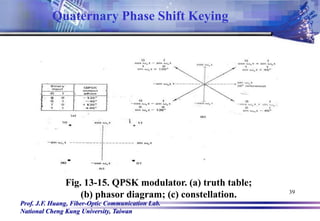
Fig. 13-15. QPSK modulator. (a) truth table;
(b) phasor diagram; (c) constellation.
Quaternary Phase Shift Keying
Prof. J.F. Huang, Fiber-Optic Communication Lab.
National Cheng Kung University, Taiwan
40
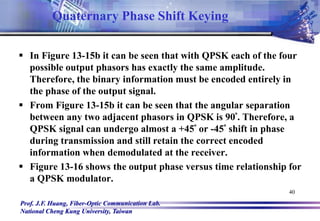
 In Figure 13-15b it can be seen that with QPSK each of the four
possible output phasors has exactly the same amplitude.
Therefore, the binary information must be encoded entirely in
the phase of the output signal.
 From Figure 13-15b it can be seen that the angular separation
between any two adjacent phasors in QPSK is 90°. Therefore, a
QPSK signal can undergo almost a +45° or -45° shift in phase
during transmission and still retain the correct encoded
information when demodulated at the receiver.
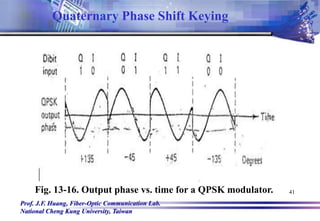
 Figure 13-16 shows the output phase versus time relationship for
a QPSK modulator.
Quaternary Phase Shift Keying
Prof. J.F. Huang, Fiber-Optic Communication Lab.
National Cheng Kung University, Taiwan
41
Fig. 13-16. Output phase vs. time for a QPSK modulator.
Quaternary Phase Shift Keying
Prof. J.F. Huang, Fiber-Optic Communication Lab.
National Cheng Kung University, Taiwan
42
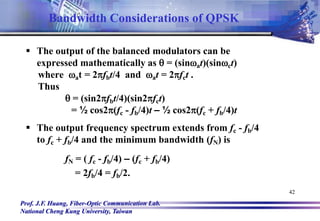
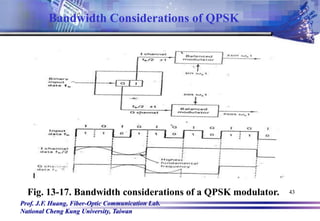
 The output of the balanced modulators can be
expressed mathematically as q = (sinat)(sinct)
where at = 2fbt/4 and at = 2fct .
Thus
q = (sin2fbt/4)(sin2fct)
= ½ cos2(fc - fb/4)t – ½ cos2(fc + fb/4)t
 The output frequency spectrum extends from fc - fb/4
to fc + fb/4 and the minimum bandwidth (fN) is
fN = ( fc - fb/4) – (fc + fb/4)
= 2fb/4 = fb/2.
Bandwidth Considerations of QPSK
Prof. J.F. Huang, Fiber-Optic Communication Lab.
National Cheng Kung University, Taiwan
43
Fig. 13-17. Bandwidth considerations of a QPSK modulator.
Bandwidth Considerations of QPSK
Prof. J.F. Huang, Fiber-Optic Communication Lab.
National Cheng Kung University, Taiwan
44
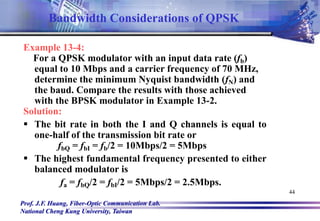
Example 13-4:
For a QPSK modulator with an input data rate (fb)
equal to 10 Mbps and a carrier frequency of 70 MHz,
determine the minimum Nyquist bandwidth (fN) and
the baud. Compare the results with those achieved
with the BPSK modulator in Example 13-2.
Solution:
 The bit rate in both the I and Q channels is equal to
one-half of the transmission bit rate or
fbQ = fbI = fb/2 = 10Mbps/2 = 5Mbps
 The highest fundamental frequency presented to either
balanced modulator is
fa = fbQ/2 = fbI/2 = 5Mbps/2 = 2.5Mbps.
Bandwidth Considerations of QPSK
Prof. J.F. Huang, Fiber-Optic Communication Lab.
National Cheng Kung University, Taiwan
45
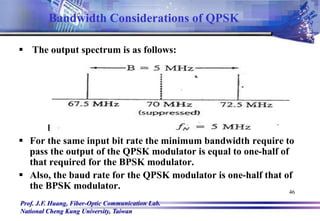
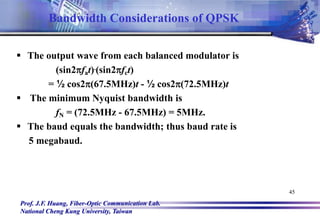
 The output wave from each balanced modulator is
(sin2fat).(sin2fct)
= ½ cos2(67.5MHz)t - ½ cos2(72.5MHz)t
 The minimum Nyquist bandwidth is
fN = (72.5MHz - 67.5MHz) = 5MHz.
 The baud equals the bandwidth; thus baud rate is
5 megabaud.
Bandwidth Considerations of QPSK
Prof. J.F. Huang, Fiber-Optic Communication Lab.
National Cheng Kung University, Taiwan
46
 The output spectrum is as follows:
 For the same input bit rate the minimum bandwidth require to
pass the output of the QPSK modulator is equal to one-half of
that required for the BPSK modulator.
 Also, the baud rate for the QPSK modulator is one-half that of
the BPSK modulator.
Bandwidth Considerations of QPSK
Prof. J.F. Huang, Fiber-Optic Communication Lab.
National Cheng Kung University, Taiwan
47
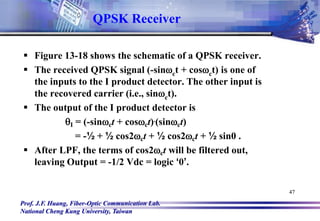
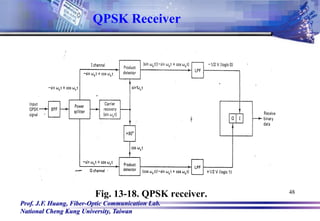
 Figure 13-18 shows the schematic of a QPSK receiver.
 The received QPSK signal (-sinct + cosct) is one of
the inputs to the I product detector. The other input is
the recovered carrier (i.e., sinct).
 The output of the I product detector is
qI = (-sinct + cosct).(sinct)
= -½ + ½ cos2ct + ½ cos2ct + ½ sin0 .
 After LPF, the terms of cos2ct will be filtered out,
leaving Output = -1/2 Vdc = logic ‘0’.
QPSK Receiver
Prof. J.F. Huang, Fiber-Optic Communication Lab.
National Cheng Kung University, Taiwan
48
QPSK Receiver
Fig. 13-18. QPSK receiver.
Prof. J.F. Huang, Fiber-Optic Communication Lab.
National Cheng Kung University, Taiwan
49
 Again, the received QPSK signal (-sinct + cosct) is one
of inputs to the Q product detector. The other input is
the recovered carrier shifted 90° in phase (i.e., cosct).
 The output of the Q product detector is
qQ = (-sinct + cosct).(cosct)
= ½ + ½ cos2ct - ½ cos2ct - ½ sin0 .
 After LPF, the terms of cos2ct will be filtered out,
leaving Output = 1/2 Vdc = logic ‘1’.
 The demodulated I and Q bits (‘1’ and ‘0’, respectively)
correspond to the constellation diagram and truth table
for the QPSK modulator shown in Figure 13-15.
QPSK Receiver
Prof. J.F. Huang, Fiber-Optic Communication Lab.
National Cheng Kung University, Taiwan
50
Offset QPSK (OQPSK)
 OQPSK is a modified form of QPSK where the bit
waveforms or the I and Q channels are offset or shifted
in phase from each other by one-half of a bit time.
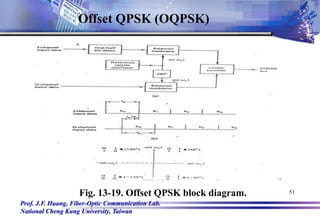
 Figure 13-19 shows a simplified block diagram, the bit
sequence alignment and the constellation diagram for
an OQPSK modulator.
 Because changes in the I channel occur at the
midpoints of the Q-channel bits, and vice versa, there
is never more than a single bit change in the dibit code,
and therefore there is never more than a 90° shift in the
output phase.
Prof. J.F. Huang, Fiber-Optic Communication Lab.
National Cheng Kung University, Taiwan
51
Fig. 13-19. Offset QPSK block diagram.
Offset QPSK (OQPSK)
Prof. J.F. Huang, Fiber-Optic Communication Lab.
National Cheng Kung University, Taiwan
52
 In conventional QPSK, change in the input dibit
from ’00’ to ’11’ or ’01’ to ’10’ causes a corresponding
180° shift in the output phase.
 An advantage of OQPSK is the limited phase shift that
must be imparted during modulation. A disadvantage
of OQPSK is that changes in the output phase occur at
twice the data rate in either the I or Q channels.
 Consequently, with OQPSK the baud and minimum
bandwidth are twice that of conventional QPSK for a
given transmission bit rate.
Offset QPSK (OQPSK)
Prof. J.F. Huang, Fiber-Optic Communication Lab.
National Cheng Kung University, Taiwan
53
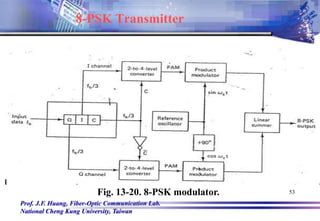
8-PSK Transmitter
Fig. 13-20. 8-PSK modulator.
Prof. J.F. Huang, Fiber-Optic Communication Lab.
National Cheng Kung University, Taiwan
54
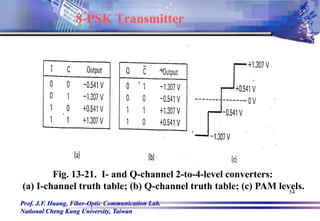
Fig. 13-21. I- and Q-channel 2-to-4-level converters:
(a) I-channel truth table; (b) Q-channel truth table; (c) PAM levels.
8-PSK Transmitter
Prof. J.F. Huang, Fiber-Optic Communication Lab.
National Cheng Kung University, Taiwan
55
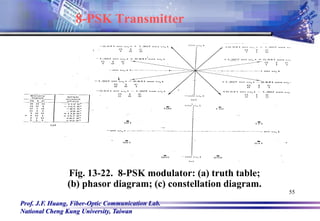
Fig. 13-22. 8-PSK modulator: (a) truth table;
(b) phasor diagram; (c) constellation diagram.
8-PSK Transmitter
Prof. J.F. Huang, Fiber-Optic Communication Lab.
National Cheng Kung University, Taiwan
56
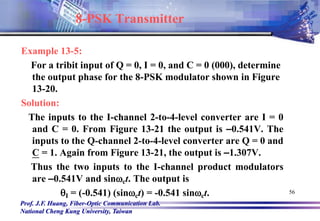
Example 13-5:
For a tribit input of Q = 0, I = 0, and C = 0 (000), determine
the output phase for the 8-PSK modulator shown in Figure
13-20.
Solution:
The inputs to the I-channel 2-to-4-level converter are I = 0
and C = 0. From Figure 13-21 the output is –0.541V. The
inputs to the Q-channel 2-to-4-level converter are Q = 0 and
C = 1. Again from Figure 13-21, the output is –1.307V.
Thus the two inputs to the I-channel product modulators
are –0.541V and sinct. The output is
qI = (-0.541) (sinct) = -0.541 sinct.
8-PSK Transmitter
Prof. J.F. Huang, Fiber-Optic Communication Lab.
National Cheng Kung University, Taiwan
57
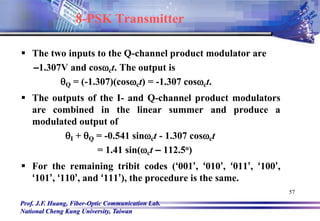
 The two inputs to the Q-channel product modulator are
–1.307V and cosct. The output is
qQ = (-1.307)(cosct) = -1.307 cosct.
 The outputs of the I- and Q-channel product modulators
are combined in the linear summer and produce a
modulated output of
qI + qQ = -0.541 sinct - 1.307 cosct
= 1.41 sin(ct – 112.5o)
 For the remaining tribit codes (‘001’, ‘010’, ‘011’, ‘100’,
‘101’, ‘110’, and ‘111’), the procedure is the same.
8-PSK Transmitter
Prof. J.F. Huang, Fiber-Optic Communication Lab.
National Cheng Kung University, Taiwan
58
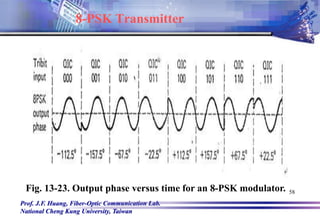
Fig. 13-23. Output phase versus time for an 8-PSK modulator.
8-PSK Transmitter
Prof. J.F. Huang, Fiber-Optic Communication Lab.
National Cheng Kung University, Taiwan
59
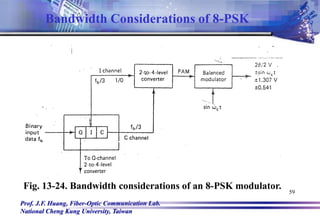
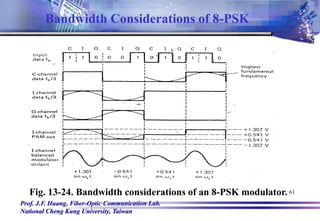
Fig. 13-24. Bandwidth considerations of an 8-PSK modulator.
Bandwidth Considerations of 8-PSK
Prof. J.F. Huang, Fiber-Optic Communication Lab.
National Cheng Kung University, Taiwan
60
Bandwidth Considerations of 8-PSK
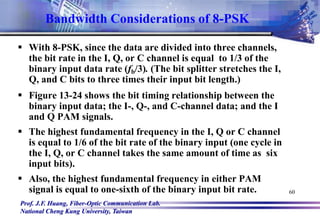
 With 8-PSK, since the data are divided into three channels,
the bit rate in the I, Q, or C channel is equal to 1/3 of the
binary input data rate (fb/3). (The bit splitter stretches the I,
Q, and C bits to three times their input bit length.)
 Figure 13-24 shows the bit timing relationship between the
binary input data; the I-, Q-, and C-channel data; and the I
and Q PAM signals.
 The highest fundamental frequency in the I, Q or C channel
is equal to 1/6 of the bit rate of the binary input (one cycle in
the I, Q, or C channel takes the same amount of time as six
input bits).
 Also, the highest fundamental frequency in either PAM
signal is equal to one-sixth of the binary input bit rate.
Prof. J.F. Huang, Fiber-Optic Communication Lab.
National Cheng Kung University, Taiwan
61
Fig. 13-24. Bandwidth considerations of an 8-PSK modulator.
Bandwidth Considerations of 8-PSK
Prof. J.F. Huang, Fiber-Optic Communication Lab.
National Cheng Kung University, Taiwan
62
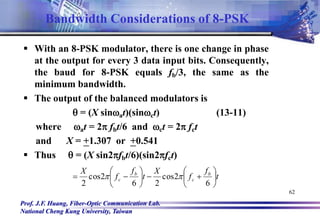
 With an 8-PSK modulator, there is one change in phase
at the output for every 3 data input bits. Consequently,
the baud for 8-PSK equals fb/3, the same as the
minimum bandwidth.
 The output of the balanced modulators is
q = (X sinat)(sinct) (13-11)
where at = 2 fbt/6 and ct = 2 fct
and X = +1.307 or +0.541
 Thus q = (X sin2fbt/6)(sin2fct)
t
f
f
X
t
f
f
X b
c
b
c 















6
2
cos
2
6
2
cos
2


Bandwidth Considerations of 8-PSK
Prof. J.F. Huang, Fiber-Optic Communication Lab.
National Cheng Kung University, Taiwan
63
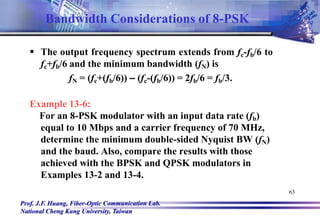
 The output frequency spectrum extends from fc-fb/6 to
fc+fb/6 and the minimum bandwidth (fN) is
fN = (fc+(fb/6)) – (fc-(fb/6)) = 2fb/6 = fb/3.
Example 13-6:
For an 8-PSK modulator with an input data rate (fb)
equal to 10 Mbps and a carrier frequency of 70 MHz,
determine the minimum double-sided Nyquist BW (fN)
and the baud. Also, compare the results with those
achieved with the BPSK and QPSK modulators in
Examples 13-2 and 13-4.
Bandwidth Considerations of 8-PSK
Prof. J.F. Huang, Fiber-Optic Communication Lab.
National Cheng Kung University, Taiwan
64
Solution:
The bit rate in the I, Q, and C channels is equal to
one-third of the input bit rate, or
fbC=fbQ=fbI = 10Mbps/3 =3.33Mbps.
The faster rate of change and highest fundamental
frequency presented to either balanced modulator is
fa = fbC/2 = fbQ/2 = fbI/2
= 3.33Mbps/2 = 1.667Mbps
The output wave from the balance modulator is
(sin2fat)(sin2fct)
= ½[cos2(68.333MHz)t – cos2(71.667MHz)t]
Bandwidth Considerations of 8-PSK
Prof. J.F. Huang, Fiber-Optic Communication Lab.
National Cheng Kung University, Taiwan
65
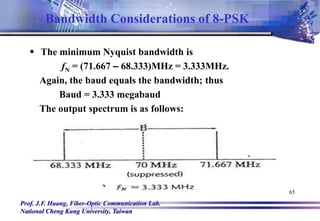
 The minimum Nyquist bandwidth is
fN = (71.667 – 68.333)MHz = 3.333MHz.
Again, the baud equals the bandwidth; thus
Baud = 3.333 megabaud
The output spectrum is as follows:
Bandwidth Considerations of 8-PSK
Prof. J.F. Huang, Fiber-Optic Communication Lab.
National Cheng Kung University, Taiwan
66
 For the same input bit rate the minimum bandwidth
required to pass the output of an 8-PSK modulator
is equal to one-third that of the BPSK modulator in
Example 13-2 and 50% less than that required for
the QPSK modulator in Example 13-4.
 Also, in each case the baud has been reduced by the
same proportions.
Bandwidth Considerations of 8-PSK
Prof. J.F. Huang, Fiber-Optic Communication Lab.
National Cheng Kung University, Taiwan
67
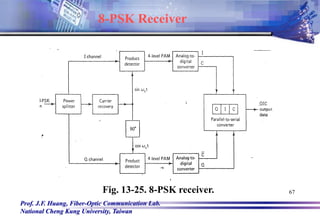
8-PSK Receiver
Fig. 13-25. 8-PSK receiver.
Prof. J.F. Huang, Fiber-Optic Communication Lab.
National Cheng Kung University, Taiwan
68
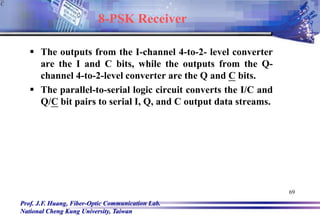
 Figure 13-25 shows a block diagram of an 8-PSK
receiver. The power splitter directs the input 8-PSK
signal to the I and Q product detectors and the carrier
recovery circuit.
 The carrier recovery circuit reproduces the original
reference oscillator signal.
 The incoming 8-PSK signal is mixed with the
recovered carrier in the I product detector and with a
quadrature carrier in the Q product detector.
 The outputs of the product detectors are 4-level PAM
signals that are fed to the 4-to-2- level analog-to-digital
converters (ADCs).
8-PSK Receiver
Prof. J.F. Huang, Fiber-Optic Communication Lab.
National Cheng Kung University, Taiwan
69
 The outputs from the I-channel 4-to-2- level converter
are the I and C bits, while the outputs from the Q-
channel 4-to-2-level converter are the Q and C bits.
 The parallel-to-serial logic circuit converts the I/C and
Q/C bit pairs to serial I, Q, and C output data streams.
C
8-PSK Receiver
Prof. J.F. Huang, Fiber-Optic Communication Lab.
National Cheng Kung University, Taiwan
70
8-QAM Transmitter
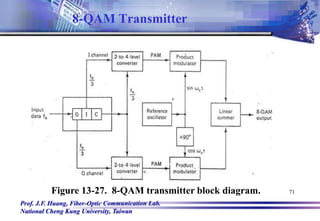
 The difference between the 8-QAM (Figure 13-27) and
the 8-PSK (Figure 13-19) is the omission of the inverter
between the C channel and the Q product modulator.
 As with 8-PSK, the incoming data are divided into
groups of three (tribits): the I, Q, and C channels, each
with a bit rate equal to one-third of the incoming data
rate.
 Again, the I and Q bits determine the polarity of the
PAM signal at the output of the 2-to-4-level converters,
and the C channel determines the magnitude.
Prof. J.F. Huang, Fiber-Optic Communication Lab.
National Cheng Kung University, Taiwan
71
Figure 13-27. 8-QAM transmitter block diagram.
8-QAM Transmitter
Prof. J.F. Huang, Fiber-Optic Communication Lab.
National Cheng Kung University, Taiwan
72
 Because the C bit is fed uninverted to both the I- and
Q-channel 2-to-4-level converters, the magnitudes of I
and Q PAM signals are always equal.
 Their polarities depend on the logic condition of the I
and Q bits and therefore may be different.
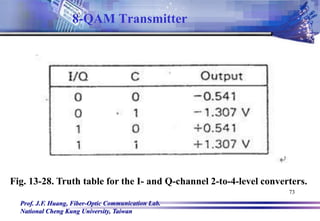
 Figure 13-28 shows the truth table for the I and Q-
channel 2-to-4-level converters; they are the same.
8-QAM Transmitter
Prof. J.F. Huang, Fiber-Optic Communication Lab.
National Cheng Kung University, Taiwan
73
Fig. 13-28. Truth table for the I- and Q-channel 2-to-4-level converters.
8-QAM Transmitter
Prof. J.F. Huang, Fiber-Optic Communication Lab.
National Cheng Kung University, Taiwan
74
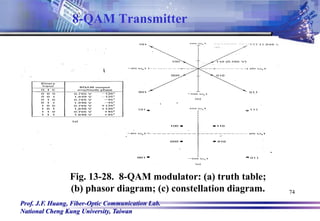
Fig. 13-28. 8-QAM modulator: (a) truth table;
(b) phasor diagram; (c) constellation diagram.
8-QAM Transmitter
Prof. J.F. Huang, Fiber-Optic Communication Lab.
National Cheng Kung University, Taiwan
75
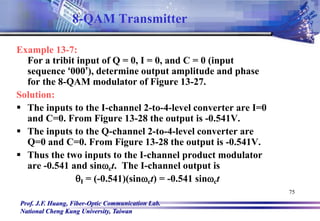
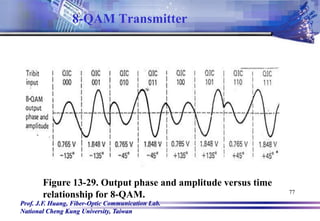
Example 13-7:
For a tribit input of Q = 0, I = 0, and C = 0 (input
sequence ‘000’), determine output amplitude and phase
for the 8-QAM modulator of Figure 13-27.
Solution:
 The inputs to the I-channel 2-to-4-level converter are I=0
and C=0. From Figure 13-28 the output is -0.541V.
 The inputs to the Q-channel 2-to-4-level converter are
Q=0 and C=0. From Figure 13-28 the output is -0.541V.
 Thus the two inputs to the I-channel product modulator
are -0.541 and sinct. The I-channel output is
qI = (-0.541)(sinct) = -0.541 sinct
8-QAM Transmitter
Prof. J.F. Huang, Fiber-Optic Communication Lab.
National Cheng Kung University, Taiwan
76
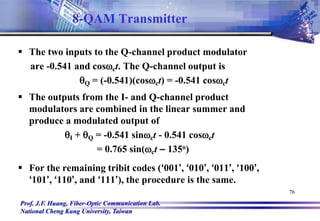
 The two inputs to the Q-channel product modulator
are -0.541 and cosct. The Q-channel output is
qQ = (-0.541)(cosct) = -0.541 cosct
 The outputs from the I- and Q-channel product
modulators are combined in the linear summer and
produce a modulated output of
qI + qQ = -0.541 sinct - 0.541 cosct
= 0.765 sin(ct – 135o)
 For the remaining tribit codes (‘001’, ‘010’, ‘011’, ‘100’,
‘101’, ‘110’, and ‘111’), the procedure is the same.
8-QAM Transmitter
Prof. J.F. Huang, Fiber-Optic Communication Lab.
National Cheng Kung University, Taiwan
77
Figure 13-29. Output phase and amplitude versus time
relationship for 8-QAM.
8-QAM Transmitter
Prof. J.F. Huang, Fiber-Optic Communication Lab.
National Cheng Kung University, Taiwan
78
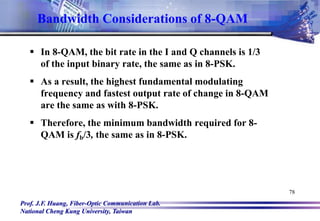
Bandwidth Considerations of 8-QAM
 In 8-QAM, the bit rate in the I and Q channels is 1/3
of the input binary rate, the same as in 8-PSK.
 As a result, the highest fundamental modulating
frequency and fastest output rate of change in 8-QAM
are the same as with 8-PSK.
 Therefore, the minimum bandwidth required for 8-
QAM is fb/3, the same as in 8-PSK.
Prof. J.F. Huang, Fiber-Optic Communication Lab.
National Cheng Kung University, Taiwan
79
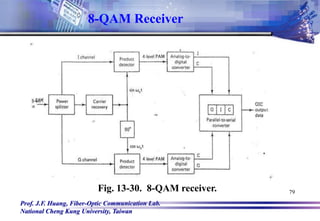
Fig. 13-30. 8-QAM receiver.
8-QAM Receiver
Prof. J.F. Huang, Fiber-Optic Communication Lab.
National Cheng Kung University, Taiwan
80
8-QAM Receiver
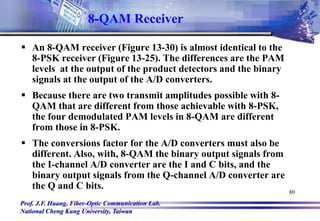
 An 8-QAM receiver (Figure 13-30) is almost identical to the
8-PSK receiver (Figure 13-25). The differences are the PAM
levels at the output of the product detectors and the binary
signals at the output of the A/D converters.
 Because there are two transmit amplitudes possible with 8-
QAM that are different from those achievable with 8-PSK,
the four demodulated PAM levels in 8-QAM are different
from those in 8-PSK.
 The conversions factor for the A/D converters must also be
different. Also, with, 8-QAM the binary output signals from
the I-channel A/D converter are the I and C bits, and the
binary output signals from the Q-channel A/D converter are
the Q and C bits.
Prof. J.F. Huang, Fiber-Optic Communication Lab.
National Cheng Kung University, Taiwan
81
16-QAM Transmitter
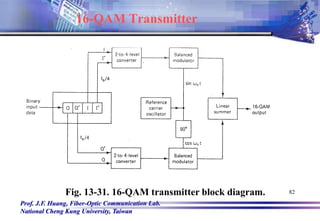
 The block diagram for 16-QAM transmitter is shown
in Figure 13-31. The input binary data are divided into
four channels: The I, I’, Q, and Q’.
 The bit rate in each channel is equal to 1/4 of the input
bit rate (fb/4). Four bits are serially clocked into the bit
splitter; then they are outputted simultaneously and in
parallel with the I, I’, Q, and Q’ bits determine the
magnitude (a logic ‘1’ = 0.821V and a logic ‘0’ = 0.22V).
 The 2-to-4-level converters generate a 4-level PAM
signal. Two polarities and two magnitudes are possible
at the output of each 2-to-4-level converter. They are
+0.22V and +0.821V.
Prof. J.F. Huang, Fiber-Optic Communication Lab.
National Cheng Kung University, Taiwan
82
Fig. 13-31. 16-QAM transmitter block diagram.
16-QAM Transmitter
Prof. J.F. Huang, Fiber-Optic Communication Lab.
National Cheng Kung University, Taiwan
83
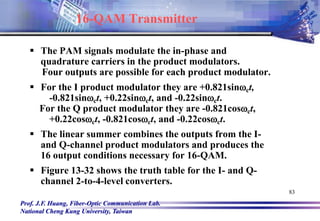
 The PAM signals modulate the in-phase and
quadrature carriers in the product modulators.
Four outputs are possible for each product modulator.
 For the I product modulator they are +0.821sinct,
-0.821sinct, +0.22sinct, and -0.22sinct.
For the Q product modulator they are -0.821cosct,
+0.22cosct, -0.821cosct, and -0.22cosct.
 The linear summer combines the outputs from the I-
and Q-channel product modulators and produces the
16 output conditions necessary for 16-QAM.
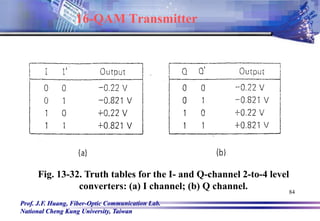
 Figure 13-32 shows the truth table for the I- and Q-
channel 2-to-4-level converters.
16-QAM Transmitter
Prof. J.F. Huang, Fiber-Optic Communication Lab.
National Cheng Kung University, Taiwan
84
Fig. 13-32. Truth tables for the I- and Q-channel 2-to-4 level
converters: (a) I channel; (b) Q channel.
16-QAM Transmitter
Prof. J.F. Huang, Fiber-Optic Communication Lab.
National Cheng Kung University, Taiwan
85
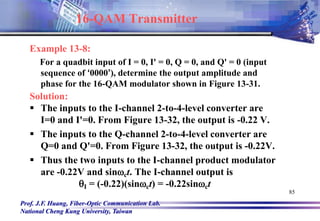
Example 13-8:
For a quadbit input of I = 0, I' = 0, Q = 0, and Q' = 0 (input
sequence of ‘0000’), determine the output amplitude and
phase for the 16-QAM modulator shown in Figure 13-31.
Solution:
 The inputs to the I-channel 2-to-4-level converter are
I=0 and I'=0. From Figure 13-32, the output is -0.22 V.
 The inputs to the Q-channel 2-to-4-level converter are
Q=0 and Q'=0. From Figure 13-32, the output is -0.22V.
 Thus the two inputs to the I-channel product modulator
are -0.22V and sinct. The I-channel output is
qI = (-0.22)(sinct) = -0.22sinct
16-QAM Transmitter
Prof. J.F. Huang, Fiber-Optic Communication Lab.
National Cheng Kung University, Taiwan
86
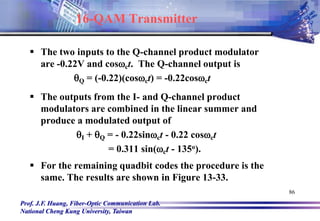
 The two inputs to the Q-channel product modulator
are -0.22V and cosct. The Q-channel output is
qQ = (-0.22)(cosct) = -0.22cosct
 The outputs from the I- and Q-channel product
modulators are combined in the linear summer and
produce a modulated output of
qI + qQ = - 0.22sinct - 0.22 cosct
= 0.311 sin(ct - 135o).
 For the remaining quadbit codes the procedure is the
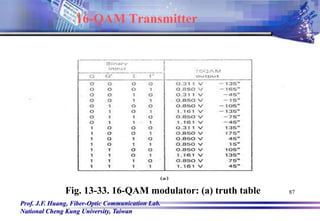
same. The results are shown in Figure 13-33.
16-QAM Transmitter
Prof. J.F. Huang, Fiber-Optic Communication Lab.
National Cheng Kung University, Taiwan
87
Fig. 13-33. 16-QAM modulator: (a) truth table
16-QAM Transmitter
Prof. J.F. Huang, Fiber-Optic Communication Lab.
National Cheng Kung University, Taiwan
88
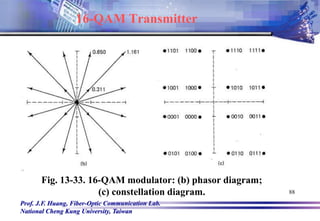
Fig. 13-33. 16-QAM modulator: (b) phasor diagram;
(c) constellation diagram.
16-QAM Transmitter
Prof. J.F. Huang, Fiber-Optic Communication Lab.
National Cheng Kung University, Taiwan
89
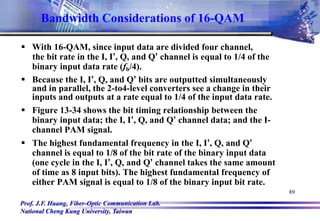
Bandwidth Considerations of 16-QAM
 With 16-QAM, since input data are divided four channel,
the bit rate in the I, I’, Q, and Q’ channel is equal to 1/4 of the
binary input data rate (fb/4).
 Because the I, I’, Q, and Q’ bits are outputted simultaneously
and in parallel, the 2-to4-level converters see a change in their
inputs and outputs at a rate equal to 1/4 of the input data rate.
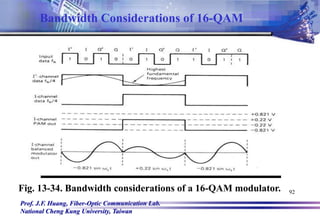
 Figure 13-34 shows the bit timing relationship between the
binary input data; the I, I’, Q, and Q’ channel data; and the I-
channel PAM signal.
 The highest fundamental frequency in the I, I’, Q, and Q’
channel is equal to 1/8 of the bit rate of the binary input data
(one cycle in the I, I’, Q, and Q’ channel takes the same amount
of time as 8 input bits). The highest fundamental frequency of
either PAM signal is equal to 1/8 of the binary input bit rate.
Prof. J.F. Huang, Fiber-Optic Communication Lab.
National Cheng Kung University, Taiwan
90
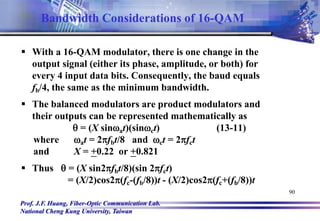
 With a 16-QAM modulator, there is one change in the
output signal (either its phase, amplitude, or both) for
every 4 input data bits. Consequently, the baud equals
fb/4, the same as the minimum bandwidth.
 The balanced modulators are product modulators and
their outputs can be represented mathematically as
q = (X sinat)(sinct) (13-11)
where at = 2fbt/8 and ct = 2fct
and X = +0.22 or +0.821
 Thus q = (X sin2fbt/8)(sin 2fct)
= (X/2)cos2(fc-(fb/8))t - (X/2)cos2(fc+(fb/8))t
Bandwidth Considerations of 16-QAM
Prof. J.F. Huang, Fiber-Optic Communication Lab.
National Cheng Kung University, Taiwan
91
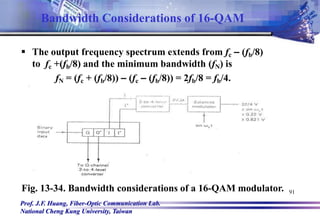
 The output frequency spectrum extends from fc – (fb/8)
to fc +(fb/8) and the minimum bandwidth (fN) is
fN = (fc + (fb/8)) – (fc – (fb/8)) = 2fb/8 = fb/4.
Fig. 13-34. Bandwidth considerations of a 16-QAM modulator.
Bandwidth Considerations of 16-QAM
Prof. J.F. Huang, Fiber-Optic Communication Lab.
National Cheng Kung University, Taiwan
92
Fig. 13-34. Bandwidth considerations of a 16-QAM modulator.
Bandwidth Considerations of 16-QAM
Prof. J.F. Huang, Fiber-Optic Communication Lab.
National Cheng Kung University, Taiwan
93
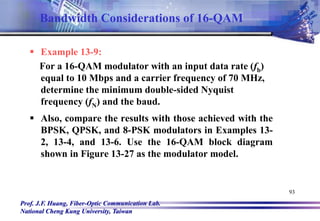
 Example 13-9:
For a 16-QAM modulator with an input data rate (fb)
equal to 10 Mbps and a carrier frequency of 70 MHz,
determine the minimum double-sided Nyquist
frequency (fN) and the baud.
 Also, compare the results with those achieved with the
BPSK, QPSK, and 8-PSK modulators in Examples 13-
2, 13-4, and 13-6. Use the 16-QAM block diagram
shown in Figure 13-27 as the modulator model.
Bandwidth Considerations of 16-QAM
Prof. J.F. Huang, Fiber-Optic Communication Lab.
National Cheng Kung University, Taiwan
94
 Solution:
The bit rate in the I, I’, Q, and Q’ channels is equal to
1/4 of the input bit rate or
fbI = fbI’ = fbQ = fbQ’ = fb/4 = 10Mbps/4 = 2.5 Mbps
 Therefore, the faster rate of change and highest
fundamental frequency presented to either balanced
modulator is
fa = fbI/2 = fbI’/2 = fbQ/2 = fbQ’/2
= 2.5 Mbps/2 = 1.25 Mbps
 The output wave from the balanced modulator is
(sin2fat)(sin2fct)
= ½ cos[2(68.75MHz)t] - ½ cos[2(71.25MHz)t]
Bandwidth Considerations of 16-QAM
Prof. J.F. Huang, Fiber-Optic Communication Lab.
National Cheng Kung University, Taiwan
95
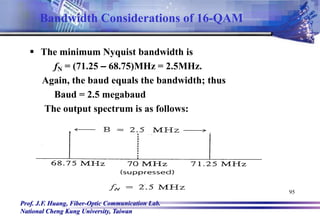
 The minimum Nyquist bandwidth is
fN = (71.25 – 68.75)MHz = 2.5MHz.
Again, the baud equals the bandwidth; thus
Baud = 2.5 megabaud
The output spectrum is as follows:
Bandwidth Considerations of 16-QAM
Prof. J.F. Huang, Fiber-Optic Communication Lab.
National Cheng Kung University, Taiwan
96
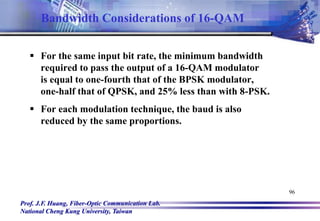
 For the same input bit rate, the minimum bandwidth
required to pass the output of a 16-QAM modulator
is equal to one-fourth that of the BPSK modulator,
one-half that of QPSK, and 25% less than with 8-PSK.
 For each modulation technique, the baud is also
reduced by the same proportions.
Bandwidth Considerations of 16-QAM
Prof. J.F. Huang, Fiber-Optic Communication Lab.
National Cheng Kung University, Taiwan
97
Bandwidth Efficiency
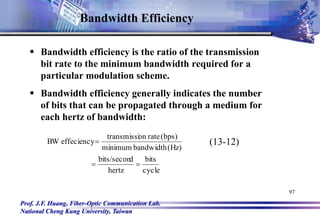
 Bandwidth efficiency is the ratio of the transmission
bit rate to the minimum bandwidth required for a
particular modulation scheme.
 Bandwidth efficiency generally indicates the number
of bits that can be propagated through a medium for
each hertz of bandwidth:
cycle
bits
hertz
d
bits/secon
(Hz)
bandwidth
minimum
(bps)
rate
on
transmissi
effeciency
BW


 (13-12)
Prof. J.F. Huang, Fiber-Optic Communication Lab.
National Cheng Kung University, Taiwan
98
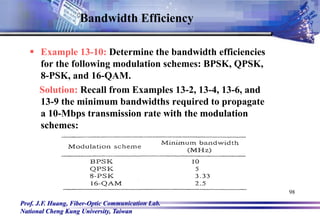
 Example 13-10: Determine the bandwidth efficiencies
for the following modulation schemes: BPSK, QPSK,
8-PSK, and 16-QAM.
Solution: Recall from Examples 13-2, 13-4, 13-6, and
13-9 the minimum bandwidths required to propagate
a 10-Mbps transmission rate with the modulation
schemes:
Bandwidth Efficiency
Prof. J.F. Huang, Fiber-Optic Communication Lab.
National Cheng Kung University, Taiwan
99
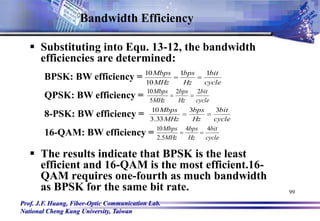
 Substituting into Equ. 13-12, the bandwidth
efficiencies are determined:
 The results indicate that BPSK is the least
efficient and 16-QAM is the most efficient.16-
QAM requires one-fourth as much bandwidth
as BPSK for the same bit rate.
BPSK: BW efficiency =
QPSK: BW efficiency =
8-PSK: BW efficiency =
16-QAM: BW efficiency =
cycle
bit
Hz
bps
MHz
Mbps 1
1
10
10


cycle
bit
Hz
bps
MHz
Mbps 2
2
5
10


cycle
bit
Hz
bps
MHz
Mbps 3
3
33
.
3
10


cycle
bit
Hz
bps
MHz
Mbps 4
4
5
.
2
10


Bandwidth Efficiency
Prof. J.F. Huang, Fiber-Optic Communication Lab.
National Cheng Kung University, Taiwan
100
Probability of Error and Bit Error Rate
 Probability of error P(e) and bit error rate (BER) are often
used interchangeably, although in practice they do have
slightly different meanings.
 P(e) is a theoretical (mathematical) expectation of the bit
error rate for a given system. BER is an empirical
(historical) record of a system’s actual bit error
performance.
 Probability of error is a function of the carrier-to-noise
power ratio (or more specifically, the average energy-per-bit
to noise-power-density ratio) and the number of possible
encoding conditions used (M-ary).
 Carrier-to-noise power ratio is the ratio of the average
carrier power (the combined power of the career and its
associated sidebands) to the thermal noise power.
Prof. J.F. Huang, Fiber-Optic Communication Lab.
National Cheng Kung University, Taiwan
101
 Carrier power can be stated in watts or dBm, where
C(dBm) = 10log[C(watts)/0.001] (13-13)
 Thermal noise power is expressed mathematically as
N = kTB (watts) (13-14a)
or N(dBm) = 10log(kTB/0.001) (13-14b)
 Mathematically, the carrier-to-noise power ratio is
C/N = C/kTB (13-15a)
where
C = Carrier power (W)
N = thermal noise power (W)
k = Boltzmann's constant (1.38×10⁻²³ J/oK)
T = temperature (0oK = -273 oC, Room temp. = 290oK)
B = bandwidth (Hz).
Probability of Error and Bit Error Rate
Prof. J.F. Huang, Fiber-Optic Communication Lab.
National Cheng Kung University, Taiwan
102
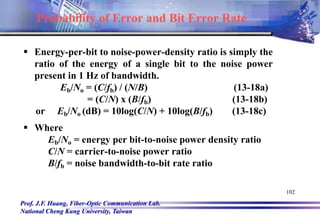
 Energy-per-bit to noise-power-density ratio is simply the
ratio of the energy of a single bit to the noise power
present in 1 Hz of bandwidth.
Eb/No = (C/fb) / (N/B) (13-18a)
= (C/N) x (B/fb) (13-18b)
or Eb/No (dB) = 10log(C/N) + 10log(B/fb) (13-18c)
 Where
Eb/No = energy per bit-to-noise power density ratio
C/N = carrier-to-noise power ratio
B/fb = noise bandwidth-to-bit rate ratio
Probability of Error and Bit Error Rate
Prof. J.F. Huang, Fiber-Optic Communication Lab.
National Cheng Kung University, Taiwan
103
 From Equ. (13-18b) it can be seen that the Eb/No ratio
is simply the product of the carrier-to-noise power
ratio and the noise-bandwidth-to-bit-rate ratio.
 From Equ. (13-18b), it can be seen that when the
bandwidth equals the bit rate, Eb/No = C/N.
 In general, the minimum carrier-to-noise power ratio
required for QAM system is less than that required
for comparable PSK system.
 Also, the higher the level of encoding used (the higher
the value of M), the higher the minimum carrier-to-
noise power-ratio.
Probability of Error and Bit Error Rate
Prof. J.F. Huang, Fiber-Optic Communication Lab.
National Cheng Kung University, Taiwan
104
PSK Error Performance
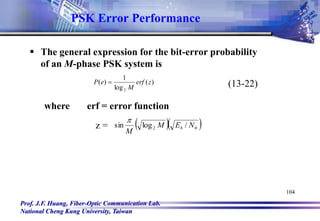
 The general expression for the bit-error probability
of an M-phase PSK system is
)
(
log
1
)
(
2
z
erf
M
e
P  (13-22)
where erf = error function
z =   
0
2 /
log
sin N
E
M
M
b

Prof. J.F. Huang, Fiber-Optic Communication Lab.
National Cheng Kung University, Taiwan
105
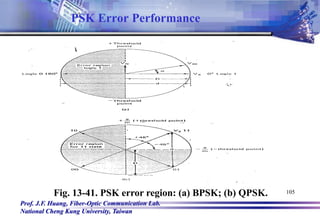
Fig. 13-41. PSK error region: (a) BPSK; (b) QPSK.
PSK Error Performance
Prof. J.F. Huang, Fiber-Optic Communication Lab.
National Cheng Kung University, Taiwan
106
 It can be shown that QPSK provides the same error
performance as BPSK. This is because the 3-dB
reduction in error distance for QPSK is offset by the
3-dB decrease in its bandwidth (in addition to the
error distance, the relative widths of the noise
bandwidths must also be considered).
 Thus both systems provide optimum performance.
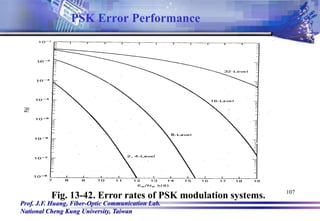
Figure 13-42 shows the error performance for 2-, 4-,
8-, 16-, and 32-PSK systems as a function of Eb/No.
PSK Error Performance
Prof. J.F. Huang, Fiber-Optic Communication Lab.
National Cheng Kung University, Taiwan
107
Fig. 13-42. Error rates of PSK modulation systems.
PSK Error Performance
Prof. J.F. Huang, Fiber-Optic Communication Lab.
National Cheng Kung University, Taiwan
108
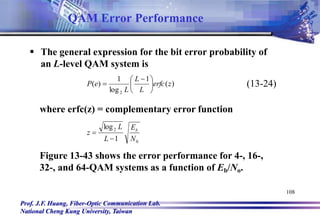
 The general expression for the bit error probability of
an L-level QAM system is
)
(
1
log
1
)
(
2
z
erfc
L
L
L
e
P 




 
 (13-24)
where erfc(z) = complementary error function
0
2
1
log
N
E
L
L
z b


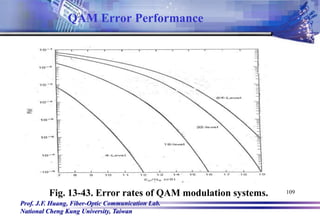
Figure 13-43 shows the error performance for 4-, 16-,
32-, and 64-QAM systems as a function of Eb/No.
QAM Error Performance
Prof. J.F. Huang, Fiber-Optic Communication Lab.
National Cheng Kung University, Taiwan
109
Fig. 13-43. Error rates of QAM modulation systems.
QAM Error Performance

Chap13--Digital Modulation Techniques.ppt

  • 1.
    Prof. J.F. Huang,Fiber-Optic Communication Lab. National Cheng Kung University, Taiwan Amplitude Shift Keying (ASK)  ASK is implemented by changing the amplitude of a carrier signal to reflect amplitude levels in the digital signal.  For example: a digital “1” could not affect the signal, whereas a digital “0” would, by making it zero.  The line encoding will determine the values of the analog waveform to reflect the digital data being carried. 1
  • 2.
    Prof. J.F. Huang,Fiber-Optic Communication Lab. National Cheng Kung University, Taiwan Amplitude Shift Keying (ASK)  Mathematically, ASK is vask(t) = [1 vm(t)][A/2 cos(c t)]  For logic 1 , vm(t)=+1V vask(t) = [1  1][A/2 cos(c t)] = Acos(c t)  For logic 0 , vm(t)=-1V vask(t) = [1 - 1][A/2 cos(c t)] = 0 2
  • 3.
    Prof. J.F. Huang,Fiber-Optic Communication Lab. National Cheng Kung University, Taiwan Binary Amplitude Shift Keying (BASK) 3
  • 4.
    Prof. J.F. Huang,Fiber-Optic Communication Lab. National Cheng Kung University, Taiwan Bandwidth of ASK  The bandwidth B of ASK is equal to the signal rate fb . B = fb  Baud = fb 4
  • 5.
    Prof. J.F. Huang,Fiber-Optic Communication Lab. National Cheng Kung University, Taiwan Implementation of binary ASK 5
  • 6.
    Prof. J.F. Huang,Fiber-Optic Communication Lab. National Cheng Kung University, Taiwan 6  The general expression for a binary FSK signal is v(t) = Vccos{2π[fc vm(t)Df)]t} (13-3)  where v(t)= binary FSK waveform Vc = peak unmodulated carrier amplitude fc = carrier frequency vm(t) = binary input modulating signal (volts) Df = difference in output frequency Frequency Shift Keying
  • 7.
    Prof. J.F. Huang,Fiber-Optic Communication Lab. National Cheng Kung University, Taiwan 7 Frequency Shift Keying  From Equ. (13-3) it is seen that with binary FSK the carrier amplitude Vc remains constant with modulation. However, the output carrier frequency (fc) shifts by an amount equal to +Df.  The frequency shift Df is proportional to the amplitude and polarity of the binary input signal. For example, a binary ‘1’ could be +1 volt and a binary ‘0’ could be –1 volt producing frequency shifts of + Df and - Df, respectively.
  • 8.
    Prof. J.F. Huang,Fiber-Optic Communication Lab. National Cheng Kung University, Taiwan 8 FSK Transmitter  With binary FSK, the center carrier frequency is shifted (deviated) by the binary input data. As the binary input signal changes from a logic ‘0’ to a logic ‘1’, and vice versa, the FSK output shifts between mark (or logic ‘1’) frequency and space (or logic ‘0’) frequency.  The rate of change at the modulator input is called the bit rate and has the units of bits per second (bps). The rate of change at the modulator output is called the baud rate and is equal to the reciprocal of the time of one output signaling element.  In binary FSK, the input and output rates of change are equal; therefore, the bit rate and baud rate are equal. A simple binary FSK transmitter is shown in Figure 13-3.
  • 9.
    Prof. J.F. Huang,Fiber-Optic Communication Lab. National Cheng Kung University, Taiwan 9 Fig. 13-3. Binary FSK transmitter. FSK Transmitter
  • 10.
    Prof. J.F. Huang,Fiber-Optic Communication Lab. National Cheng Kung University, Taiwan 10 Bandwidth Considerations of FSK  Figure 13-4 shows a binary FSK modulator. The fastest input rate of change occurs when the binary input is a series of alternating 1’s and 0’s.  Consequently, if only the fundamental frequency of the input is considered, the highest modulating frequency is equal to one-half of the input bit rate.  A logic ‘1’ input shifts the VCO from its rest frequency to the mark frequency, and a logic ‘0’ input shifts the VCO from its rest frequency to the space frequency.
  • 11.
    Prof. J.F. Huang,Fiber-Optic Communication Lab. National Cheng Kung University, Taiwan 11 Fig. 13-4. FSK modulator. Bandwidth Considerations of FSK
  • 12.
    Prof. J.F. Huang,Fiber-Optic Communication Lab. National Cheng Kung University, Taiwan 12  Consequently, as the input binary signal changes from a logic ‘1’ to a logic ‘0’, and vice versa, the VCO output frequency shifts or deviates back and forth between the mark and space frequencies.  For binary FSK, modulation index is given as mf = Df / fa = |(fm-fs)/2|/(fb/2) = |fm - fs|/fb (13-4) where mf = modulation index Df = frequency deviation (Hz) fa = modulating frequency (Hz) Bandwidth Considerations of FSK
  • 13.
    Prof. J.F. Huang,Fiber-Optic Communication Lab. National Cheng Kung University, Taiwan 13  Example 13-1: For a binary FSK modulator with space, rest, and mark frequencies of 60, 70, and 80 MHz, respectively and an input bit rate of 20 Mbps, determine the output baud and the minimum required bandwidth. Solution: Substituting into Equ. (13-4), we have mf = |(fm – fs)/fb| = |80MHz–60MHz|/20Mbps = 20MHz/20Mbps = 1.0 Bandwidth Considerations of FSK
  • 14.
    Prof. J.F. Huang,Fiber-Optic Communication Lab. National Cheng Kung University, Taiwan 14  From the Bessel chart (Table 13-1), a modulation index of 1.0 yields three sets of significant side frequencies. Each side frequency is separated from the center frequency or adjacent side frequency by the modulating frequency, which is 10 MHz (fb/2) in this example.  The output spectrum for this modulator is shown in Figure 13-5. It can be seen that the minimum double- sided Nyquist bandwidth is 60 MHz and the baud rate is 20 megabaud, the same as the bit rate. Bandwidth Considerations of FSK
  • 15.
    Prof. J.F. Huang,Fiber-Optic Communication Lab. National Cheng Kung University, Taiwan 15 Bandwidth Considerations of FSK
  • 16.
    Prof. J.F. Huang,Fiber-Optic Communication Lab. National Cheng Kung University, Taiwan 16 FSK Receiver  The most common circuit used for demodulating binary FSK signals is the phase-locked loop (PLL), which is shown in block diagram form in Figure 13-6.  As the input to the PLL shifts between the mark and space frequencies, the dc error voltage at the output of the phase comparator follows the frequency shift.  The natural frequency of the PLL is generally made equal to the center frequency of the FSK modulator. The changes in the dc error voltage will then follow the changes in the analog input frequency and are symmetrical around 0 Vdc.
  • 17.
    Prof. J.F. Huang,Fiber-Optic Communication Lab. National Cheng Kung University, Taiwan 17 FSK Receiver
  • 18.
    Prof. J.F. Huang,Fiber-Optic Communication Lab. National Cheng Kung University, Taiwan 18  Binary FSK has a poorer error performance than PSK or QAM and, consequently, is seldom used for high- performance digital radio systems.  Its use is restricted to low-performance, low-cost, asynchronous data modems that are used for data communications over analog, voice band telephone lines. FSK Receiver
  • 19.
    Prof. J.F. Huang,Fiber-Optic Communication Lab. National Cheng Kung University, Taiwan 19 Minimum Shift-Keying  Minimum shift-keying (MSK) is a form of continuous- phase FSK (CPFSK). Essentially, MSK is a binary FSK except that the mark and space frequencies are synchronized with the input binary bit rate.  With MSK, the mark and space frequencies are selected such that they are separated from the center frequency by an exact odd multiple of one-half of the bit rate.  This ensures that there is a smooth phase transition in the analog output signal when it changes from a mark to a space frequency, or vice versa.
  • 20.
    Prof. J.F. Huang,Fiber-Optic Communication Lab. National Cheng Kung University, Taiwan 20 Minimum Shift-Keying
  • 21.
    Prof. J.F. Huang,Fiber-Optic Communication Lab. National Cheng Kung University, Taiwan 21  Figure 13-7 shows a noncontinuous FSK waveform. When the input changes from a logic ‘1’ to a logic ‘0’, and vice versa, there is an abrupt phase discontinuity in the analog output signal.  When this occurs, the demodulator has trouble following the frequency shift; consequently, an error may occur. Figure 13-8 shows a continuous phase MSK waveform.  MSK has a better bit-error performance than conventional binary FSK for a given SNR. The disadvantage of MSK is that it requires synchronizing circuits and it therefore more expensive to implement. Minimum Shift-Keying
  • 22.
    Prof. J.F. Huang,Fiber-Optic Communication Lab. National Cheng Kung University, Taiwan 22 Minimum Shift-Keying
  • 23.
    Prof. J.F. Huang,Fiber-Optic Communication Lab. National Cheng Kung University, Taiwan 23 Binary Phase Shift Keying  With binary phase shift keying (BPSK), two output phases are possible for a single carrier frequency. One output phase represents a logic ‘1’ and the other a logic ‘0’.  As the input digital signal changes state, the phase of the output carrier shifts between two angles that are 180° out of phase. BPSK is a form of suppressed carrier, square-wave modulation of a continuous wave (CW) signal.
  • 24.
    Prof. J.F. Huang,Fiber-Optic Communication Lab. National Cheng Kung University, Taiwan 24  BPSK Transmitter Fig. 13-9. BPSK modulator. Binary Phase Shift Keying Figure 13-9 shows a simplified block diagram of a BPSK modulator. The balanced modulator acts like a phase reversing switch.
  • 25.
    Prof. J.F. Huang,Fiber-Optic Communication Lab. National Cheng Kung University, Taiwan 25  In BPSK, depending on the logic condition of the digital input, the carrier is transferred to the output either in phase or 180° out of phase with the reference carrier oscillator.  Figure 13-10a shows the schematic diagram of a balanced ring modulator.  If the binary input is a logic ‘1’ (positive voltage), diodes D1 and D2 are forward biased and “on”, while diodes D3 and D4 are reverse biased and “off” (Figure 13-10b).  The carrier voltage developed across transformer T2 is in phase with the carrier voltage across T1. Consequently, the output signal is in phase with the reference oscillator. Binary Phase Shift Keying
  • 26.
    Prof. J.F. Huang,Fiber-Optic Communication Lab. National Cheng Kung University, Taiwan 26 Fig. 13-10. (a) Balanced ring modulator; (b) Logic ‘1’ input; (c) Logic ‘0’ input. Binary Phase Shift Keying
  • 27.
    Prof. J.F. Huang,Fiber-Optic Communication Lab. National Cheng Kung University, Taiwan 27  If the binary input is a logic ‘0’ (negative voltage), diodes D1 and D2 are reverse biased and “off,” while diodes D3 and D4 are forward biased and “on” (Figure 13-10c).  The carrier voltage developed across transformer T2 is 180°out of phase with the carrier voltage across T1. Consequently, the output signal is 180° out of phase with the reference oscillator.  Figure 13-11 shows the truth table, phasor diagram, and constellation diagram for a BPSK modulator.  A constellation diagram, or signal state-space diagram, is similar to a phasor diagram except that the entire phasor is not drawn. In a constellation diagram, only the relative positions of the peaks of the phasors are shown. Binary Phase Shift Keying
  • 28.
    Prof. J.F. Huang,Fiber-Optic Communication Lab. National Cheng Kung University, Taiwan 28 Fig. 13-11. BPSK modulator: (a) truth table; (b) phasor diagram; (c) constellation diagram. Binary Phase Shift Keying
  • 29.
    Prof. J.F. Huang,Fiber-Optic Communication Lab. National Cheng Kung University, Taiwan 29  For BPSK, the output rate of change (baud) is equal to the input rate of change (bps), and the widest output bandwidth occurs when the input binary data are an alternating 1/0 sequence.  The fundamental frequency (fa) of an alternating 1/0 bit sequence is equal to one-half of the bit rate (fb/2).  Mathematically, the output phase a BPSK modulator is output = (sinat) x (sinct) = (1/2)cos(c-a)t – (1/2)cos(c+a)t (13-6)  Consequently, the minimum double-sided Nyquist bandwidth (fN) is fN = 2 x (fb/2) = fb . Bandwidth Considerations of BPSK
  • 30.
    Prof. J.F. Huang,Fiber-Optic Communication Lab. National Cheng Kung University, Taiwan 30  Figure 13-12 shows the output phase versus time relationship for a BPSK waveform.  The output spectrum from a BPSK modulator is simply a double-sideband suppressed carrier signal where the upper and lower side frequencies are separated from the carrier frequency by one-half of the bit rate.  Consequently, the minimum bandwidth (fN) required to pass the worst-case BPSK output signal is equal to input bit rate. Bandwidth Considerations of BPSK
  • 31.
    Prof. J.F. Huang,Fiber-Optic Communication Lab. National Cheng Kung University, Taiwan 31 Fig. 13-12. Output phase vs. time for a BPSK modulator. Bandwidth Considerations of BPSK
  • 32.
    Prof. J.F. Huang,Fiber-Optic Communication Lab. National Cheng Kung University, Taiwan 32  Example 13-2: For a BPSK modulator with a carrier frequency of 70 MHz and an input bit rate on 10 Mbps, determine the maximum and minimum upper and lower side frequencies, draw the output spectrum, determine the minimum Nyquist bandwidth, and calculated the baud.  Solution: Substituting into Equ. (13-6) yields Output = (sinat)(sinct)    5MHz)t MHz 70 ( 2 cos 2 1 - 5MHz)t - MHz 70 ( 2 cos 2 1 MHz)t 70 ( 2 sin MHz)t 5 ( 2 sin        Bandwidth Considerations of BPSK
  • 33.
    Prof. J.F. Huang,Fiber-Optic Communication Lab. National Cheng Kung University, Taiwan 33 Bandwidth Considerations of BPSK  Minimum lower side frequency (LSF): LSF = 70 MHz-5 MHz = 65 MHz Maximum upper side frequency (USF): USF = 70 MHz+5 MHz = 75 MHz  The minimum Nyquist bandwidth (fN) for the worst-case binary input conditions is fN = 75 MHz – 65 MHz = 10 MHz and the baud rate is fb = 10 megabaud.
  • 34.
    Prof. J.F. Huang,Fiber-Optic Communication Lab. National Cheng Kung University, Taiwan 34 BPSK Receiver Fig. 13-13. BPSK receiver.
  • 35.
    Prof. J.F. Huang,Fiber-Optic Communication Lab. National Cheng Kung University, Taiwan 35 For BPSK input signal of +sinct (logic ‘1’), the output of the balanced modulator is (sinct)(sinct) = sin2ct , or sin2ct = ½(1-cos2ct) = ½ - ½ cos2ct. After LPF, the term of cos2ct will be filtered out, leaving Output = +1/2 Vdc = logic ‘1’ For BPSK input signal of -sinct (logic ‘0’), the output of the balanced modulator is -(sinct)(sinct) = -sin2ct , or -sin2ct = -½(1-cos2ct) = -½ + ½ cos2ct. After LPF, the term of cos2ct will be filtered out, leaving Output = -1/2 Vdc = logic ‘0’ BPSK Receiver
  • 36.
    Prof. J.F. Huang,Fiber-Optic Communication Lab. National Cheng Kung University, Taiwan 36  Essentially, a QPSK modulator is two BPSK modulators combined in parallel.  For a logic ‘1’ = +1V and a logic ‘0’ = -1V, two phases are possible at the output of the I balanced modulator (+sinct and -sinct), and two phases are possible at the output of the Q balanced modulator (+cosct and -cosct).  When the linear summer combines the two quadrature (90° out of phase) signals, there are four possible resultant phases: +sinct + cosct, +sinct - cosct, -sinct + cosct, and -sinct - cosct. Quaternary Phase Shift Keying
  • 37.
    Prof. J.F. Huang,Fiber-Optic Communication Lab. National Cheng Kung University, Taiwan 37 Fig. 13-14. QPSK modulator. Quaternary Phase Shift Keying
  • 38.
    Prof. J.F. Huang,Fiber-Optic Communication Lab. National Cheng Kung University, Taiwan 38  Example 13-3: For the QPSK modulator shown in Figure 13-14, construct the truth table, phasor diagram, and constellation diagram. Solution: For a binary data input of Q=0 and I=0, the two inputs to the I balanced modulator are –1 and sinct, and the two inputs to the Q balanced modulator are –1 and cosct. Consequently, the outputs are I balanced modulator = (-1)(sinct) = -1.sinct Q balanced modulator = (-1)(cosct) = -1.cosct And the output of the linear summer is -1.cosct – 1.sinct = 1.414sin(ct - 135o) For the remaining digit codes (‘01’, ‘10’, and ‘11’), the procedure is the same. Quaternary Phase Shift Keying
  • 39.
    Prof. J.F. Huang,Fiber-Optic Communication Lab. National Cheng Kung University, Taiwan 39 Fig. 13-15. QPSK modulator. (a) truth table; (b) phasor diagram; (c) constellation. Quaternary Phase Shift Keying
  • 40.
    Prof. J.F. Huang,Fiber-Optic Communication Lab. National Cheng Kung University, Taiwan 40  In Figure 13-15b it can be seen that with QPSK each of the four possible output phasors has exactly the same amplitude. Therefore, the binary information must be encoded entirely in the phase of the output signal.  From Figure 13-15b it can be seen that the angular separation between any two adjacent phasors in QPSK is 90°. Therefore, a QPSK signal can undergo almost a +45° or -45° shift in phase during transmission and still retain the correct encoded information when demodulated at the receiver.  Figure 13-16 shows the output phase versus time relationship for a QPSK modulator. Quaternary Phase Shift Keying
  • 41.
    Prof. J.F. Huang,Fiber-Optic Communication Lab. National Cheng Kung University, Taiwan 41 Fig. 13-16. Output phase vs. time for a QPSK modulator. Quaternary Phase Shift Keying
  • 42.
    Prof. J.F. Huang,Fiber-Optic Communication Lab. National Cheng Kung University, Taiwan 42  The output of the balanced modulators can be expressed mathematically as q = (sinat)(sinct) where at = 2fbt/4 and at = 2fct . Thus q = (sin2fbt/4)(sin2fct) = ½ cos2(fc - fb/4)t – ½ cos2(fc + fb/4)t  The output frequency spectrum extends from fc - fb/4 to fc + fb/4 and the minimum bandwidth (fN) is fN = ( fc - fb/4) – (fc + fb/4) = 2fb/4 = fb/2. Bandwidth Considerations of QPSK
  • 43.
    Prof. J.F. Huang,Fiber-Optic Communication Lab. National Cheng Kung University, Taiwan 43 Fig. 13-17. Bandwidth considerations of a QPSK modulator. Bandwidth Considerations of QPSK
  • 44.
    Prof. J.F. Huang,Fiber-Optic Communication Lab. National Cheng Kung University, Taiwan 44 Example 13-4: For a QPSK modulator with an input data rate (fb) equal to 10 Mbps and a carrier frequency of 70 MHz, determine the minimum Nyquist bandwidth (fN) and the baud. Compare the results with those achieved with the BPSK modulator in Example 13-2. Solution:  The bit rate in both the I and Q channels is equal to one-half of the transmission bit rate or fbQ = fbI = fb/2 = 10Mbps/2 = 5Mbps  The highest fundamental frequency presented to either balanced modulator is fa = fbQ/2 = fbI/2 = 5Mbps/2 = 2.5Mbps. Bandwidth Considerations of QPSK
  • 45.
    Prof. J.F. Huang,Fiber-Optic Communication Lab. National Cheng Kung University, Taiwan 45  The output wave from each balanced modulator is (sin2fat).(sin2fct) = ½ cos2(67.5MHz)t - ½ cos2(72.5MHz)t  The minimum Nyquist bandwidth is fN = (72.5MHz - 67.5MHz) = 5MHz.  The baud equals the bandwidth; thus baud rate is 5 megabaud. Bandwidth Considerations of QPSK
  • 46.
    Prof. J.F. Huang,Fiber-Optic Communication Lab. National Cheng Kung University, Taiwan 46  The output spectrum is as follows:  For the same input bit rate the minimum bandwidth require to pass the output of the QPSK modulator is equal to one-half of that required for the BPSK modulator.  Also, the baud rate for the QPSK modulator is one-half that of the BPSK modulator. Bandwidth Considerations of QPSK
  • 47.
    Prof. J.F. Huang,Fiber-Optic Communication Lab. National Cheng Kung University, Taiwan 47  Figure 13-18 shows the schematic of a QPSK receiver.  The received QPSK signal (-sinct + cosct) is one of the inputs to the I product detector. The other input is the recovered carrier (i.e., sinct).  The output of the I product detector is qI = (-sinct + cosct).(sinct) = -½ + ½ cos2ct + ½ cos2ct + ½ sin0 .  After LPF, the terms of cos2ct will be filtered out, leaving Output = -1/2 Vdc = logic ‘0’. QPSK Receiver
  • 48.
    Prof. J.F. Huang,Fiber-Optic Communication Lab. National Cheng Kung University, Taiwan 48 QPSK Receiver Fig. 13-18. QPSK receiver.
  • 49.
    Prof. J.F. Huang,Fiber-Optic Communication Lab. National Cheng Kung University, Taiwan 49  Again, the received QPSK signal (-sinct + cosct) is one of inputs to the Q product detector. The other input is the recovered carrier shifted 90° in phase (i.e., cosct).  The output of the Q product detector is qQ = (-sinct + cosct).(cosct) = ½ + ½ cos2ct - ½ cos2ct - ½ sin0 .  After LPF, the terms of cos2ct will be filtered out, leaving Output = 1/2 Vdc = logic ‘1’.  The demodulated I and Q bits (‘1’ and ‘0’, respectively) correspond to the constellation diagram and truth table for the QPSK modulator shown in Figure 13-15. QPSK Receiver
  • 50.
    Prof. J.F. Huang,Fiber-Optic Communication Lab. National Cheng Kung University, Taiwan 50 Offset QPSK (OQPSK)  OQPSK is a modified form of QPSK where the bit waveforms or the I and Q channels are offset or shifted in phase from each other by one-half of a bit time.  Figure 13-19 shows a simplified block diagram, the bit sequence alignment and the constellation diagram for an OQPSK modulator.  Because changes in the I channel occur at the midpoints of the Q-channel bits, and vice versa, there is never more than a single bit change in the dibit code, and therefore there is never more than a 90° shift in the output phase.
  • 51.
    Prof. J.F. Huang,Fiber-Optic Communication Lab. National Cheng Kung University, Taiwan 51 Fig. 13-19. Offset QPSK block diagram. Offset QPSK (OQPSK)
  • 52.
    Prof. J.F. Huang,Fiber-Optic Communication Lab. National Cheng Kung University, Taiwan 52  In conventional QPSK, change in the input dibit from ’00’ to ’11’ or ’01’ to ’10’ causes a corresponding 180° shift in the output phase.  An advantage of OQPSK is the limited phase shift that must be imparted during modulation. A disadvantage of OQPSK is that changes in the output phase occur at twice the data rate in either the I or Q channels.  Consequently, with OQPSK the baud and minimum bandwidth are twice that of conventional QPSK for a given transmission bit rate. Offset QPSK (OQPSK)
  • 53.
    Prof. J.F. Huang,Fiber-Optic Communication Lab. National Cheng Kung University, Taiwan 53 8-PSK Transmitter Fig. 13-20. 8-PSK modulator.
  • 54.
    Prof. J.F. Huang,Fiber-Optic Communication Lab. National Cheng Kung University, Taiwan 54 Fig. 13-21. I- and Q-channel 2-to-4-level converters: (a) I-channel truth table; (b) Q-channel truth table; (c) PAM levels. 8-PSK Transmitter
  • 55.
    Prof. J.F. Huang,Fiber-Optic Communication Lab. National Cheng Kung University, Taiwan 55 Fig. 13-22. 8-PSK modulator: (a) truth table; (b) phasor diagram; (c) constellation diagram. 8-PSK Transmitter
  • 56.
    Prof. J.F. Huang,Fiber-Optic Communication Lab. National Cheng Kung University, Taiwan 56 Example 13-5: For a tribit input of Q = 0, I = 0, and C = 0 (000), determine the output phase for the 8-PSK modulator shown in Figure 13-20. Solution: The inputs to the I-channel 2-to-4-level converter are I = 0 and C = 0. From Figure 13-21 the output is –0.541V. The inputs to the Q-channel 2-to-4-level converter are Q = 0 and C = 1. Again from Figure 13-21, the output is –1.307V. Thus the two inputs to the I-channel product modulators are –0.541V and sinct. The output is qI = (-0.541) (sinct) = -0.541 sinct. 8-PSK Transmitter
  • 57.
    Prof. J.F. Huang,Fiber-Optic Communication Lab. National Cheng Kung University, Taiwan 57  The two inputs to the Q-channel product modulator are –1.307V and cosct. The output is qQ = (-1.307)(cosct) = -1.307 cosct.  The outputs of the I- and Q-channel product modulators are combined in the linear summer and produce a modulated output of qI + qQ = -0.541 sinct - 1.307 cosct = 1.41 sin(ct – 112.5o)  For the remaining tribit codes (‘001’, ‘010’, ‘011’, ‘100’, ‘101’, ‘110’, and ‘111’), the procedure is the same. 8-PSK Transmitter
  • 58.
    Prof. J.F. Huang,Fiber-Optic Communication Lab. National Cheng Kung University, Taiwan 58 Fig. 13-23. Output phase versus time for an 8-PSK modulator. 8-PSK Transmitter
  • 59.
    Prof. J.F. Huang,Fiber-Optic Communication Lab. National Cheng Kung University, Taiwan 59 Fig. 13-24. Bandwidth considerations of an 8-PSK modulator. Bandwidth Considerations of 8-PSK
  • 60.
    Prof. J.F. Huang,Fiber-Optic Communication Lab. National Cheng Kung University, Taiwan 60 Bandwidth Considerations of 8-PSK  With 8-PSK, since the data are divided into three channels, the bit rate in the I, Q, or C channel is equal to 1/3 of the binary input data rate (fb/3). (The bit splitter stretches the I, Q, and C bits to three times their input bit length.)  Figure 13-24 shows the bit timing relationship between the binary input data; the I-, Q-, and C-channel data; and the I and Q PAM signals.  The highest fundamental frequency in the I, Q or C channel is equal to 1/6 of the bit rate of the binary input (one cycle in the I, Q, or C channel takes the same amount of time as six input bits).  Also, the highest fundamental frequency in either PAM signal is equal to one-sixth of the binary input bit rate.
  • 61.
    Prof. J.F. Huang,Fiber-Optic Communication Lab. National Cheng Kung University, Taiwan 61 Fig. 13-24. Bandwidth considerations of an 8-PSK modulator. Bandwidth Considerations of 8-PSK
  • 62.
    Prof. J.F. Huang,Fiber-Optic Communication Lab. National Cheng Kung University, Taiwan 62  With an 8-PSK modulator, there is one change in phase at the output for every 3 data input bits. Consequently, the baud for 8-PSK equals fb/3, the same as the minimum bandwidth.  The output of the balanced modulators is q = (X sinat)(sinct) (13-11) where at = 2 fbt/6 and ct = 2 fct and X = +1.307 or +0.541  Thus q = (X sin2fbt/6)(sin2fct) t f f X t f f X b c b c                 6 2 cos 2 6 2 cos 2   Bandwidth Considerations of 8-PSK
  • 63.
    Prof. J.F. Huang,Fiber-Optic Communication Lab. National Cheng Kung University, Taiwan 63  The output frequency spectrum extends from fc-fb/6 to fc+fb/6 and the minimum bandwidth (fN) is fN = (fc+(fb/6)) – (fc-(fb/6)) = 2fb/6 = fb/3. Example 13-6: For an 8-PSK modulator with an input data rate (fb) equal to 10 Mbps and a carrier frequency of 70 MHz, determine the minimum double-sided Nyquist BW (fN) and the baud. Also, compare the results with those achieved with the BPSK and QPSK modulators in Examples 13-2 and 13-4. Bandwidth Considerations of 8-PSK
  • 64.
    Prof. J.F. Huang,Fiber-Optic Communication Lab. National Cheng Kung University, Taiwan 64 Solution: The bit rate in the I, Q, and C channels is equal to one-third of the input bit rate, or fbC=fbQ=fbI = 10Mbps/3 =3.33Mbps. The faster rate of change and highest fundamental frequency presented to either balanced modulator is fa = fbC/2 = fbQ/2 = fbI/2 = 3.33Mbps/2 = 1.667Mbps The output wave from the balance modulator is (sin2fat)(sin2fct) = ½[cos2(68.333MHz)t – cos2(71.667MHz)t] Bandwidth Considerations of 8-PSK
  • 65.
    Prof. J.F. Huang,Fiber-Optic Communication Lab. National Cheng Kung University, Taiwan 65  The minimum Nyquist bandwidth is fN = (71.667 – 68.333)MHz = 3.333MHz. Again, the baud equals the bandwidth; thus Baud = 3.333 megabaud The output spectrum is as follows: Bandwidth Considerations of 8-PSK
  • 66.
    Prof. J.F. Huang,Fiber-Optic Communication Lab. National Cheng Kung University, Taiwan 66  For the same input bit rate the minimum bandwidth required to pass the output of an 8-PSK modulator is equal to one-third that of the BPSK modulator in Example 13-2 and 50% less than that required for the QPSK modulator in Example 13-4.  Also, in each case the baud has been reduced by the same proportions. Bandwidth Considerations of 8-PSK
  • 67.
    Prof. J.F. Huang,Fiber-Optic Communication Lab. National Cheng Kung University, Taiwan 67 8-PSK Receiver Fig. 13-25. 8-PSK receiver.
  • 68.
    Prof. J.F. Huang,Fiber-Optic Communication Lab. National Cheng Kung University, Taiwan 68  Figure 13-25 shows a block diagram of an 8-PSK receiver. The power splitter directs the input 8-PSK signal to the I and Q product detectors and the carrier recovery circuit.  The carrier recovery circuit reproduces the original reference oscillator signal.  The incoming 8-PSK signal is mixed with the recovered carrier in the I product detector and with a quadrature carrier in the Q product detector.  The outputs of the product detectors are 4-level PAM signals that are fed to the 4-to-2- level analog-to-digital converters (ADCs). 8-PSK Receiver
  • 69.
    Prof. J.F. Huang,Fiber-Optic Communication Lab. National Cheng Kung University, Taiwan 69  The outputs from the I-channel 4-to-2- level converter are the I and C bits, while the outputs from the Q- channel 4-to-2-level converter are the Q and C bits.  The parallel-to-serial logic circuit converts the I/C and Q/C bit pairs to serial I, Q, and C output data streams. C 8-PSK Receiver
  • 70.
    Prof. J.F. Huang,Fiber-Optic Communication Lab. National Cheng Kung University, Taiwan 70 8-QAM Transmitter  The difference between the 8-QAM (Figure 13-27) and the 8-PSK (Figure 13-19) is the omission of the inverter between the C channel and the Q product modulator.  As with 8-PSK, the incoming data are divided into groups of three (tribits): the I, Q, and C channels, each with a bit rate equal to one-third of the incoming data rate.  Again, the I and Q bits determine the polarity of the PAM signal at the output of the 2-to-4-level converters, and the C channel determines the magnitude.
  • 71.
    Prof. J.F. Huang,Fiber-Optic Communication Lab. National Cheng Kung University, Taiwan 71 Figure 13-27. 8-QAM transmitter block diagram. 8-QAM Transmitter
  • 72.
    Prof. J.F. Huang,Fiber-Optic Communication Lab. National Cheng Kung University, Taiwan 72  Because the C bit is fed uninverted to both the I- and Q-channel 2-to-4-level converters, the magnitudes of I and Q PAM signals are always equal.  Their polarities depend on the logic condition of the I and Q bits and therefore may be different.  Figure 13-28 shows the truth table for the I and Q- channel 2-to-4-level converters; they are the same. 8-QAM Transmitter
  • 73.
    Prof. J.F. Huang,Fiber-Optic Communication Lab. National Cheng Kung University, Taiwan 73 Fig. 13-28. Truth table for the I- and Q-channel 2-to-4-level converters. 8-QAM Transmitter
  • 74.
    Prof. J.F. Huang,Fiber-Optic Communication Lab. National Cheng Kung University, Taiwan 74 Fig. 13-28. 8-QAM modulator: (a) truth table; (b) phasor diagram; (c) constellation diagram. 8-QAM Transmitter
  • 75.
    Prof. J.F. Huang,Fiber-Optic Communication Lab. National Cheng Kung University, Taiwan 75 Example 13-7: For a tribit input of Q = 0, I = 0, and C = 0 (input sequence ‘000’), determine output amplitude and phase for the 8-QAM modulator of Figure 13-27. Solution:  The inputs to the I-channel 2-to-4-level converter are I=0 and C=0. From Figure 13-28 the output is -0.541V.  The inputs to the Q-channel 2-to-4-level converter are Q=0 and C=0. From Figure 13-28 the output is -0.541V.  Thus the two inputs to the I-channel product modulator are -0.541 and sinct. The I-channel output is qI = (-0.541)(sinct) = -0.541 sinct 8-QAM Transmitter
  • 76.
    Prof. J.F. Huang,Fiber-Optic Communication Lab. National Cheng Kung University, Taiwan 76  The two inputs to the Q-channel product modulator are -0.541 and cosct. The Q-channel output is qQ = (-0.541)(cosct) = -0.541 cosct  The outputs from the I- and Q-channel product modulators are combined in the linear summer and produce a modulated output of qI + qQ = -0.541 sinct - 0.541 cosct = 0.765 sin(ct – 135o)  For the remaining tribit codes (‘001’, ‘010’, ‘011’, ‘100’, ‘101’, ‘110’, and ‘111’), the procedure is the same. 8-QAM Transmitter
  • 77.
    Prof. J.F. Huang,Fiber-Optic Communication Lab. National Cheng Kung University, Taiwan 77 Figure 13-29. Output phase and amplitude versus time relationship for 8-QAM. 8-QAM Transmitter
  • 78.
    Prof. J.F. Huang,Fiber-Optic Communication Lab. National Cheng Kung University, Taiwan 78 Bandwidth Considerations of 8-QAM  In 8-QAM, the bit rate in the I and Q channels is 1/3 of the input binary rate, the same as in 8-PSK.  As a result, the highest fundamental modulating frequency and fastest output rate of change in 8-QAM are the same as with 8-PSK.  Therefore, the minimum bandwidth required for 8- QAM is fb/3, the same as in 8-PSK.
  • 79.
    Prof. J.F. Huang,Fiber-Optic Communication Lab. National Cheng Kung University, Taiwan 79 Fig. 13-30. 8-QAM receiver. 8-QAM Receiver
  • 80.
    Prof. J.F. Huang,Fiber-Optic Communication Lab. National Cheng Kung University, Taiwan 80 8-QAM Receiver  An 8-QAM receiver (Figure 13-30) is almost identical to the 8-PSK receiver (Figure 13-25). The differences are the PAM levels at the output of the product detectors and the binary signals at the output of the A/D converters.  Because there are two transmit amplitudes possible with 8- QAM that are different from those achievable with 8-PSK, the four demodulated PAM levels in 8-QAM are different from those in 8-PSK.  The conversions factor for the A/D converters must also be different. Also, with, 8-QAM the binary output signals from the I-channel A/D converter are the I and C bits, and the binary output signals from the Q-channel A/D converter are the Q and C bits.
  • 81.
    Prof. J.F. Huang,Fiber-Optic Communication Lab. National Cheng Kung University, Taiwan 81 16-QAM Transmitter  The block diagram for 16-QAM transmitter is shown in Figure 13-31. The input binary data are divided into four channels: The I, I’, Q, and Q’.  The bit rate in each channel is equal to 1/4 of the input bit rate (fb/4). Four bits are serially clocked into the bit splitter; then they are outputted simultaneously and in parallel with the I, I’, Q, and Q’ bits determine the magnitude (a logic ‘1’ = 0.821V and a logic ‘0’ = 0.22V).  The 2-to-4-level converters generate a 4-level PAM signal. Two polarities and two magnitudes are possible at the output of each 2-to-4-level converter. They are +0.22V and +0.821V.
  • 82.
    Prof. J.F. Huang,Fiber-Optic Communication Lab. National Cheng Kung University, Taiwan 82 Fig. 13-31. 16-QAM transmitter block diagram. 16-QAM Transmitter
  • 83.
    Prof. J.F. Huang,Fiber-Optic Communication Lab. National Cheng Kung University, Taiwan 83  The PAM signals modulate the in-phase and quadrature carriers in the product modulators. Four outputs are possible for each product modulator.  For the I product modulator they are +0.821sinct, -0.821sinct, +0.22sinct, and -0.22sinct. For the Q product modulator they are -0.821cosct, +0.22cosct, -0.821cosct, and -0.22cosct.  The linear summer combines the outputs from the I- and Q-channel product modulators and produces the 16 output conditions necessary for 16-QAM.  Figure 13-32 shows the truth table for the I- and Q- channel 2-to-4-level converters. 16-QAM Transmitter
  • 84.
    Prof. J.F. Huang,Fiber-Optic Communication Lab. National Cheng Kung University, Taiwan 84 Fig. 13-32. Truth tables for the I- and Q-channel 2-to-4 level converters: (a) I channel; (b) Q channel. 16-QAM Transmitter
  • 85.
    Prof. J.F. Huang,Fiber-Optic Communication Lab. National Cheng Kung University, Taiwan 85 Example 13-8: For a quadbit input of I = 0, I' = 0, Q = 0, and Q' = 0 (input sequence of ‘0000’), determine the output amplitude and phase for the 16-QAM modulator shown in Figure 13-31. Solution:  The inputs to the I-channel 2-to-4-level converter are I=0 and I'=0. From Figure 13-32, the output is -0.22 V.  The inputs to the Q-channel 2-to-4-level converter are Q=0 and Q'=0. From Figure 13-32, the output is -0.22V.  Thus the two inputs to the I-channel product modulator are -0.22V and sinct. The I-channel output is qI = (-0.22)(sinct) = -0.22sinct 16-QAM Transmitter
  • 86.
    Prof. J.F. Huang,Fiber-Optic Communication Lab. National Cheng Kung University, Taiwan 86  The two inputs to the Q-channel product modulator are -0.22V and cosct. The Q-channel output is qQ = (-0.22)(cosct) = -0.22cosct  The outputs from the I- and Q-channel product modulators are combined in the linear summer and produce a modulated output of qI + qQ = - 0.22sinct - 0.22 cosct = 0.311 sin(ct - 135o).  For the remaining quadbit codes the procedure is the same. The results are shown in Figure 13-33. 16-QAM Transmitter
  • 87.
    Prof. J.F. Huang,Fiber-Optic Communication Lab. National Cheng Kung University, Taiwan 87 Fig. 13-33. 16-QAM modulator: (a) truth table 16-QAM Transmitter
  • 88.
    Prof. J.F. Huang,Fiber-Optic Communication Lab. National Cheng Kung University, Taiwan 88 Fig. 13-33. 16-QAM modulator: (b) phasor diagram; (c) constellation diagram. 16-QAM Transmitter
  • 89.
    Prof. J.F. Huang,Fiber-Optic Communication Lab. National Cheng Kung University, Taiwan 89 Bandwidth Considerations of 16-QAM  With 16-QAM, since input data are divided four channel, the bit rate in the I, I’, Q, and Q’ channel is equal to 1/4 of the binary input data rate (fb/4).  Because the I, I’, Q, and Q’ bits are outputted simultaneously and in parallel, the 2-to4-level converters see a change in their inputs and outputs at a rate equal to 1/4 of the input data rate.  Figure 13-34 shows the bit timing relationship between the binary input data; the I, I’, Q, and Q’ channel data; and the I- channel PAM signal.  The highest fundamental frequency in the I, I’, Q, and Q’ channel is equal to 1/8 of the bit rate of the binary input data (one cycle in the I, I’, Q, and Q’ channel takes the same amount of time as 8 input bits). The highest fundamental frequency of either PAM signal is equal to 1/8 of the binary input bit rate.
  • 90.
    Prof. J.F. Huang,Fiber-Optic Communication Lab. National Cheng Kung University, Taiwan 90  With a 16-QAM modulator, there is one change in the output signal (either its phase, amplitude, or both) for every 4 input data bits. Consequently, the baud equals fb/4, the same as the minimum bandwidth.  The balanced modulators are product modulators and their outputs can be represented mathematically as q = (X sinat)(sinct) (13-11) where at = 2fbt/8 and ct = 2fct and X = +0.22 or +0.821  Thus q = (X sin2fbt/8)(sin 2fct) = (X/2)cos2(fc-(fb/8))t - (X/2)cos2(fc+(fb/8))t Bandwidth Considerations of 16-QAM
  • 91.
    Prof. J.F. Huang,Fiber-Optic Communication Lab. National Cheng Kung University, Taiwan 91  The output frequency spectrum extends from fc – (fb/8) to fc +(fb/8) and the minimum bandwidth (fN) is fN = (fc + (fb/8)) – (fc – (fb/8)) = 2fb/8 = fb/4. Fig. 13-34. Bandwidth considerations of a 16-QAM modulator. Bandwidth Considerations of 16-QAM
  • 92.
    Prof. J.F. Huang,Fiber-Optic Communication Lab. National Cheng Kung University, Taiwan 92 Fig. 13-34. Bandwidth considerations of a 16-QAM modulator. Bandwidth Considerations of 16-QAM
  • 93.
    Prof. J.F. Huang,Fiber-Optic Communication Lab. National Cheng Kung University, Taiwan 93  Example 13-9: For a 16-QAM modulator with an input data rate (fb) equal to 10 Mbps and a carrier frequency of 70 MHz, determine the minimum double-sided Nyquist frequency (fN) and the baud.  Also, compare the results with those achieved with the BPSK, QPSK, and 8-PSK modulators in Examples 13- 2, 13-4, and 13-6. Use the 16-QAM block diagram shown in Figure 13-27 as the modulator model. Bandwidth Considerations of 16-QAM
  • 94.
    Prof. J.F. Huang,Fiber-Optic Communication Lab. National Cheng Kung University, Taiwan 94  Solution: The bit rate in the I, I’, Q, and Q’ channels is equal to 1/4 of the input bit rate or fbI = fbI’ = fbQ = fbQ’ = fb/4 = 10Mbps/4 = 2.5 Mbps  Therefore, the faster rate of change and highest fundamental frequency presented to either balanced modulator is fa = fbI/2 = fbI’/2 = fbQ/2 = fbQ’/2 = 2.5 Mbps/2 = 1.25 Mbps  The output wave from the balanced modulator is (sin2fat)(sin2fct) = ½ cos[2(68.75MHz)t] - ½ cos[2(71.25MHz)t] Bandwidth Considerations of 16-QAM
  • 95.
    Prof. J.F. Huang,Fiber-Optic Communication Lab. National Cheng Kung University, Taiwan 95  The minimum Nyquist bandwidth is fN = (71.25 – 68.75)MHz = 2.5MHz. Again, the baud equals the bandwidth; thus Baud = 2.5 megabaud The output spectrum is as follows: Bandwidth Considerations of 16-QAM
  • 96.
    Prof. J.F. Huang,Fiber-Optic Communication Lab. National Cheng Kung University, Taiwan 96  For the same input bit rate, the minimum bandwidth required to pass the output of a 16-QAM modulator is equal to one-fourth that of the BPSK modulator, one-half that of QPSK, and 25% less than with 8-PSK.  For each modulation technique, the baud is also reduced by the same proportions. Bandwidth Considerations of 16-QAM
  • 97.
    Prof. J.F. Huang,Fiber-Optic Communication Lab. National Cheng Kung University, Taiwan 97 Bandwidth Efficiency  Bandwidth efficiency is the ratio of the transmission bit rate to the minimum bandwidth required for a particular modulation scheme.  Bandwidth efficiency generally indicates the number of bits that can be propagated through a medium for each hertz of bandwidth: cycle bits hertz d bits/secon (Hz) bandwidth minimum (bps) rate on transmissi effeciency BW    (13-12)
  • 98.
    Prof. J.F. Huang,Fiber-Optic Communication Lab. National Cheng Kung University, Taiwan 98  Example 13-10: Determine the bandwidth efficiencies for the following modulation schemes: BPSK, QPSK, 8-PSK, and 16-QAM. Solution: Recall from Examples 13-2, 13-4, 13-6, and 13-9 the minimum bandwidths required to propagate a 10-Mbps transmission rate with the modulation schemes: Bandwidth Efficiency
  • 99.
    Prof. J.F. Huang,Fiber-Optic Communication Lab. National Cheng Kung University, Taiwan 99  Substituting into Equ. 13-12, the bandwidth efficiencies are determined:  The results indicate that BPSK is the least efficient and 16-QAM is the most efficient.16- QAM requires one-fourth as much bandwidth as BPSK for the same bit rate. BPSK: BW efficiency = QPSK: BW efficiency = 8-PSK: BW efficiency = 16-QAM: BW efficiency = cycle bit Hz bps MHz Mbps 1 1 10 10   cycle bit Hz bps MHz Mbps 2 2 5 10   cycle bit Hz bps MHz Mbps 3 3 33 . 3 10   cycle bit Hz bps MHz Mbps 4 4 5 . 2 10   Bandwidth Efficiency
  • 100.
    Prof. J.F. Huang,Fiber-Optic Communication Lab. National Cheng Kung University, Taiwan 100 Probability of Error and Bit Error Rate  Probability of error P(e) and bit error rate (BER) are often used interchangeably, although in practice they do have slightly different meanings.  P(e) is a theoretical (mathematical) expectation of the bit error rate for a given system. BER is an empirical (historical) record of a system’s actual bit error performance.  Probability of error is a function of the carrier-to-noise power ratio (or more specifically, the average energy-per-bit to noise-power-density ratio) and the number of possible encoding conditions used (M-ary).  Carrier-to-noise power ratio is the ratio of the average carrier power (the combined power of the career and its associated sidebands) to the thermal noise power.
  • 101.
    Prof. J.F. Huang,Fiber-Optic Communication Lab. National Cheng Kung University, Taiwan 101  Carrier power can be stated in watts or dBm, where C(dBm) = 10log[C(watts)/0.001] (13-13)  Thermal noise power is expressed mathematically as N = kTB (watts) (13-14a) or N(dBm) = 10log(kTB/0.001) (13-14b)  Mathematically, the carrier-to-noise power ratio is C/N = C/kTB (13-15a) where C = Carrier power (W) N = thermal noise power (W) k = Boltzmann's constant (1.38×10⁻²³ J/oK) T = temperature (0oK = -273 oC, Room temp. = 290oK) B = bandwidth (Hz). Probability of Error and Bit Error Rate
  • 102.
    Prof. J.F. Huang,Fiber-Optic Communication Lab. National Cheng Kung University, Taiwan 102  Energy-per-bit to noise-power-density ratio is simply the ratio of the energy of a single bit to the noise power present in 1 Hz of bandwidth. Eb/No = (C/fb) / (N/B) (13-18a) = (C/N) x (B/fb) (13-18b) or Eb/No (dB) = 10log(C/N) + 10log(B/fb) (13-18c)  Where Eb/No = energy per bit-to-noise power density ratio C/N = carrier-to-noise power ratio B/fb = noise bandwidth-to-bit rate ratio Probability of Error and Bit Error Rate
  • 103.
    Prof. J.F. Huang,Fiber-Optic Communication Lab. National Cheng Kung University, Taiwan 103  From Equ. (13-18b) it can be seen that the Eb/No ratio is simply the product of the carrier-to-noise power ratio and the noise-bandwidth-to-bit-rate ratio.  From Equ. (13-18b), it can be seen that when the bandwidth equals the bit rate, Eb/No = C/N.  In general, the minimum carrier-to-noise power ratio required for QAM system is less than that required for comparable PSK system.  Also, the higher the level of encoding used (the higher the value of M), the higher the minimum carrier-to- noise power-ratio. Probability of Error and Bit Error Rate
  • 104.
    Prof. J.F. Huang,Fiber-Optic Communication Lab. National Cheng Kung University, Taiwan 104 PSK Error Performance  The general expression for the bit-error probability of an M-phase PSK system is ) ( log 1 ) ( 2 z erf M e P  (13-22) where erf = error function z =    0 2 / log sin N E M M b 
  • 105.
    Prof. J.F. Huang,Fiber-Optic Communication Lab. National Cheng Kung University, Taiwan 105 Fig. 13-41. PSK error region: (a) BPSK; (b) QPSK. PSK Error Performance
  • 106.
    Prof. J.F. Huang,Fiber-Optic Communication Lab. National Cheng Kung University, Taiwan 106  It can be shown that QPSK provides the same error performance as BPSK. This is because the 3-dB reduction in error distance for QPSK is offset by the 3-dB decrease in its bandwidth (in addition to the error distance, the relative widths of the noise bandwidths must also be considered).  Thus both systems provide optimum performance. Figure 13-42 shows the error performance for 2-, 4-, 8-, 16-, and 32-PSK systems as a function of Eb/No. PSK Error Performance
  • 107.
    Prof. J.F. Huang,Fiber-Optic Communication Lab. National Cheng Kung University, Taiwan 107 Fig. 13-42. Error rates of PSK modulation systems. PSK Error Performance
  • 108.
    Prof. J.F. Huang,Fiber-Optic Communication Lab. National Cheng Kung University, Taiwan 108  The general expression for the bit error probability of an L-level QAM system is ) ( 1 log 1 ) ( 2 z erfc L L L e P         (13-24) where erfc(z) = complementary error function 0 2 1 log N E L L z b   Figure 13-43 shows the error performance for 4-, 16-, 32-, and 64-QAM systems as a function of Eb/No. QAM Error Performance
  • 109.
    Prof. J.F. Huang,Fiber-Optic Communication Lab. National Cheng Kung University, Taiwan 109 Fig. 13-43. Error rates of QAM modulation systems. QAM Error Performance