dehydration process which is use to
preserve a material or make the material
more convenient to transport
•A slow batch process
•Main 2 techniques
freeze
evaporation
•Use a vacuum system
•Main 4 stages
1. Pretreatment
2. Freezing
3. Primary drying
4. Secondary drying
Any method of treating the product before
freezing
•Concentrating the product.
•Addition of components to,
- improve stability
- improve processing
• Freeze concentration
• Solution phase concentration
• Formulation to preserve product
appearance
• Formulation to stabilize reactive
products
• Formulation to increase surface area
• Decreasing high vapor pressure solvents
Can be done in 2 ways;
1. Small scale(in a lab),
-place the material in a freeze drying flask
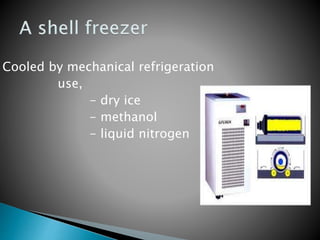
- rotate the flask in a bath (shell freezer)
Cooled by mechanical refrigeration
use,
- dry ice
- methanol
- liquid nitrogen
2.Large scale
-use freeze drying machine
* It is important to cool the material below
triple point in both ways
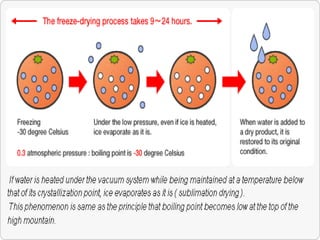
•Pressure is lowered
•Enough heat is supplied to the material
(water to sublime)
•95% of water in the material is sublimated
•Process is slow
(much heat could alter the materials structure)
•Pressure is controlled through a application of
partial vacuum.
(speeds up the sublimation)
Aim;
-to remove unfrozen water molecules
•Temperature is increased greater than in
primary drying stage
•Vacuum is break with an inert gas (Nitrogen)
before material is sealed
 Less damages to their physical structures
 No need to refrigerate
 No need to use chemicals for preservation
 Easy to transport
 Can reconstitute quickly and easily
 Can increase the shelf life
 No risk of contamination
 Expensive
 Long process time
 Can cause structural deformation
 Storage problems
 Effective for selected items
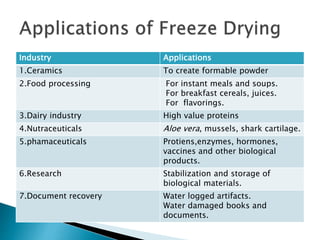
Industry Applications
1.Ceramics To create formable powder
2.Food processing For instant meals and soups.
For breakfast cereals, juices.
For flavorings.
3.Dairy industry High value proteins
4.Nutraceuticals Aloe vera, mussels, shark cartilage.
5.phamaceuticals Protiens,enzymes, hormones,
vaccines and other biological
products.
6.Research Stabilization and storage of
biological materials.
7.Document recovery Water logged artifacts.
Water damaged books and
documents.
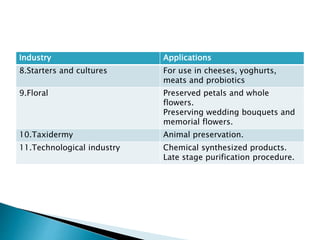
Industry Applications
8.Starters and cultures For use in cheeses, yoghurts,
meats and probiotics
9.Floral Preserved petals and whole
flowers.
Preserving wedding bouquets and
memorial flowers.
10.Taxidermy Animal preservation.
11.Technological industry Chemical synthesized products.
Late stage purification procedure.
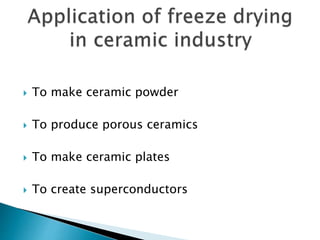
 To make ceramic powder
 To produce porous ceramics
 To make ceramic plates
 To create superconductors
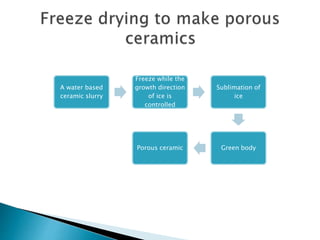
A water based
ceramic slurry
Freeze while the
growth direction
of ice is
controlled
Sublimation of
ice
Green bodyPorous ceramic
 From a sprayed slurry mist.
 Creates softer particles with a more
homogeneous chemical composition.
 More expensive
 S/08/924-A.M.P.L. Adikari
 S/08/927- I.N.K. Darandakumbura
Thank you!

Freeze drying

  • 1.
    dehydration process whichis use to preserve a material or make the material more convenient to transport
  • 2.
    •A slow batchprocess •Main 2 techniques freeze evaporation •Use a vacuum system •Main 4 stages
  • 4.
    1. Pretreatment 2. Freezing 3.Primary drying 4. Secondary drying
  • 5.
    Any method oftreating the product before freezing
  • 6.
    •Concentrating the product. •Additionof components to, - improve stability - improve processing
  • 7.
    • Freeze concentration •Solution phase concentration • Formulation to preserve product appearance • Formulation to stabilize reactive products • Formulation to increase surface area • Decreasing high vapor pressure solvents
  • 8.
    Can be donein 2 ways; 1. Small scale(in a lab), -place the material in a freeze drying flask - rotate the flask in a bath (shell freezer)
  • 9.
    Cooled by mechanicalrefrigeration use, - dry ice - methanol - liquid nitrogen
  • 10.
  • 11.
    * It isimportant to cool the material below triple point in both ways
  • 12.
    •Pressure is lowered •Enoughheat is supplied to the material (water to sublime) •95% of water in the material is sublimated •Process is slow (much heat could alter the materials structure) •Pressure is controlled through a application of partial vacuum. (speeds up the sublimation)
  • 13.
    Aim; -to remove unfrozenwater molecules •Temperature is increased greater than in primary drying stage
  • 14.
    •Vacuum is breakwith an inert gas (Nitrogen) before material is sealed
  • 15.
     Less damagesto their physical structures  No need to refrigerate  No need to use chemicals for preservation  Easy to transport  Can reconstitute quickly and easily  Can increase the shelf life  No risk of contamination
  • 16.
     Expensive  Longprocess time  Can cause structural deformation  Storage problems  Effective for selected items
  • 17.
    Industry Applications 1.Ceramics Tocreate formable powder 2.Food processing For instant meals and soups. For breakfast cereals, juices. For flavorings. 3.Dairy industry High value proteins 4.Nutraceuticals Aloe vera, mussels, shark cartilage. 5.phamaceuticals Protiens,enzymes, hormones, vaccines and other biological products. 6.Research Stabilization and storage of biological materials. 7.Document recovery Water logged artifacts. Water damaged books and documents.
  • 18.
    Industry Applications 8.Starters andcultures For use in cheeses, yoghurts, meats and probiotics 9.Floral Preserved petals and whole flowers. Preserving wedding bouquets and memorial flowers. 10.Taxidermy Animal preservation. 11.Technological industry Chemical synthesized products. Late stage purification procedure.
  • 19.
     To makeceramic powder  To produce porous ceramics  To make ceramic plates  To create superconductors
  • 20.
    A water based ceramicslurry Freeze while the growth direction of ice is controlled Sublimation of ice Green bodyPorous ceramic
  • 21.
     From asprayed slurry mist.  Creates softer particles with a more homogeneous chemical composition.  More expensive
  • 22.
     S/08/924-A.M.P.L. Adikari S/08/927- I.N.K. Darandakumbura
  • 23.

Editor's Notes

  • #12 Triple point-lowest temp at which the solid & liquid phase of the material coexist, bcz it ensures the sublimation