The Depression Continues
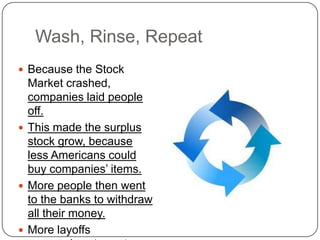
Wash, Rinse, Repeat
 Because the Stock
Market crashed,
companies laid people
off.
 This made the surplus
stock grow, because
less Americans could
buy companies’ items.
 More people then went
to the banks to withdraw
all their money.
 More layoffs
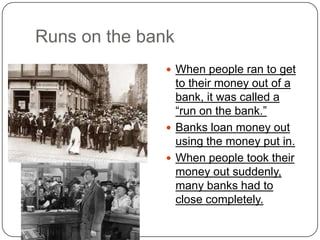
Runs on the bank
 When people ran to get
to their money out of a
bank, it was called a
“run on the bank.”
 Banks loan money out
using the money put in.
 When people took their
money out suddenly,
many banks had to
close completely.
Calling in the loan
 At the same time, in an attempt to recoup
the money they were losing, banks
required people to pay ALL the money
they were loaned or they would lose their
house/car/etc.
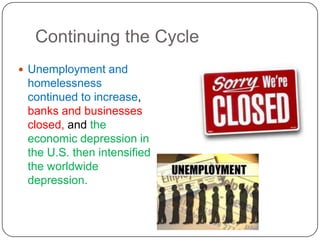
Continuing the Cycle
 Unemployment and
homelessness
continued to increase,
banks and businesses
closed, and the
economic depression in
the U.S. then intensified
the worldwide
depression.
A Change of Direction
 Remember the Depression began in Europe.
 Remember Europe owed America a great deal of
money for loans during and after World War I.
 Germany borrowed more money from the United
States to pay back reperations.
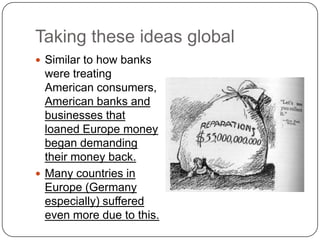
Taking these ideas global
 Similar to how banks
were treating
American consumers,
American banks and
businesses that
loaned Europe money
began demanding
their money back.
 Many countries in
Europe (Germany
especially) suffered
even more due to this.
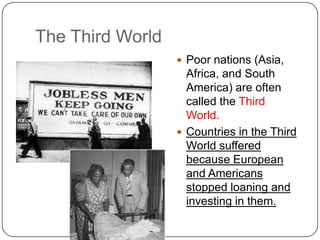
The Third World
 Poor nations (Asia,
Africa, and South
America) are often
called the Third
World.
 Countries in the Third
World suffered
because European
and Americans
stopped loaning and
investing in them.
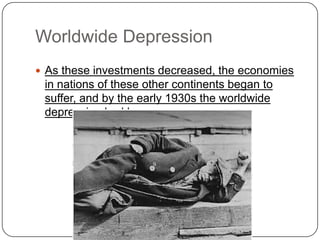
Worldwide Depression
 As these investments decreased, the economies
in nations of these other continents began to
suffer, and by the early 1930s the worldwide
depression had begun.

The depression continues

  • 1.
  • 2.
    Wash, Rinse, Repeat Because the Stock Market crashed, companies laid people off.  This made the surplus stock grow, because less Americans could buy companies’ items.  More people then went to the banks to withdraw all their money.  More layoffs
  • 3.
    Runs on thebank  When people ran to get to their money out of a bank, it was called a “run on the bank.”  Banks loan money out using the money put in.  When people took their money out suddenly, many banks had to close completely.
  • 4.
    Calling in theloan  At the same time, in an attempt to recoup the money they were losing, banks required people to pay ALL the money they were loaned or they would lose their house/car/etc.
  • 5.
    Continuing the Cycle Unemployment and homelessness continued to increase, banks and businesses closed, and the economic depression in the U.S. then intensified the worldwide depression.
  • 6.
    A Change ofDirection  Remember the Depression began in Europe.  Remember Europe owed America a great deal of money for loans during and after World War I.  Germany borrowed more money from the United States to pay back reperations.
  • 7.
    Taking these ideasglobal  Similar to how banks were treating American consumers, American banks and businesses that loaned Europe money began demanding their money back.  Many countries in Europe (Germany especially) suffered even more due to this.
  • 8.
    The Third World Poor nations (Asia, Africa, and South America) are often called the Third World.  Countries in the Third World suffered because European and Americans stopped loaning and investing in them.
  • 9.
    Worldwide Depression  Asthese investments decreased, the economies in nations of these other continents began to suffer, and by the early 1930s the worldwide depression had begun.