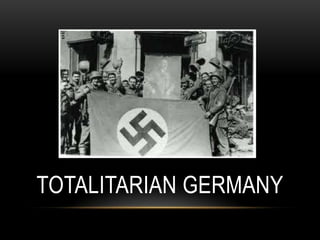
TOTALITARIAN GERMANY
BACKGROUND INFORMATION
• Germany was devastated by World War I.
• Reparations further destroyed the German economy.
• The land Germany lost, both in the Treaty of Versailles and
afterwards that France took as payment for reparations,
was the most productive parts of Germany.
• The Depression therefore hit Germany worse than
anywhere else.
• It was the perfect opportunity for a dictator to rise to power.
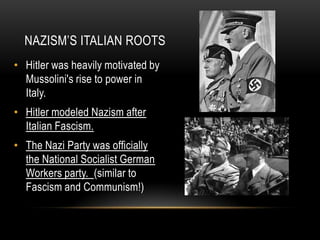
• Hitler was heavily motivated by
Mussolini's rise to power in
Italy.
• Hitler modeled Nazism after
Italian Fascism.
• The Nazi Party was officially
the National Socialist German
Workers party. (similar to
Fascism and Communism!)
NAZISM’S ITALIAN ROOTS
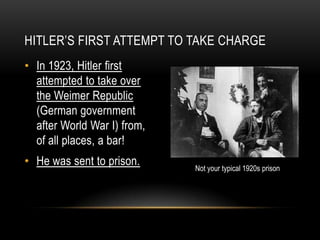
• In 1923, Hitler first
attempted to take over
the Weimer Republic
(German government
after World War I) from,
of all places, a bar!
• He was sent to prison.
HITLER’S FIRST ATTEMPT TO TAKE CHARGE
Not your typical 1920s prison
• Blamed other countries for
Germany’s hardships.
• Discussed his hatred
especially for the Jewish
people.
• Spoke of his desire to unite
all German speaking people.
• While in prison, Hitler wrote
Mein Kampf (My Struggle),
his autobiography.
• He discussed his desires to
create a new powerful
Germany.
• Claimed Germans were
Aryans (a master race).
MEIN KAMPF
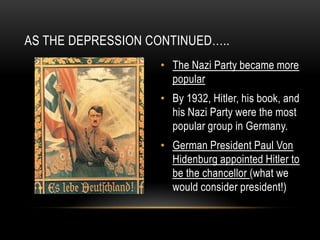
• The Nazi Party became more
popular
• By 1932, Hitler, his book, and
his Nazi Party were the most
popular group in Germany.
• German President Paul Von
Hidenburg appointed Hitler to
be the chancellor (what we
would consider president!)
AS THE DEPRESSION CONTINUED…..
TO INCREASE HIS POWERS
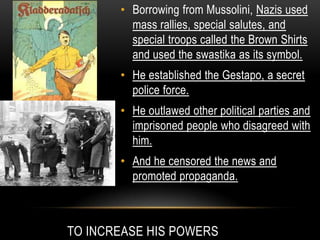
• Borrowing from Mussolini, Nazis used
mass rallies, special salutes, and
special troops called the Brown Shirts
and used the swastika as its symbol.
• He established the Gestapo, a secret
police force.
• He outlawed other political parties and
imprisoned people who disagreed with
him.
• And he censored the news and
promoted propaganda.
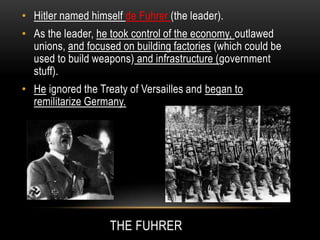
THE FUHRER
• Hitler named himself de Fuhrer (the leader).
• As the leader, he took control of the economy, outlawed
unions, and focused on building factories (which could be
used to build weapons) and infrastructure (government
stuff).
• He ignored the Treaty of Versailles and began to
remilitarize Germany.
PUTTING THE TROOPS TO WORK
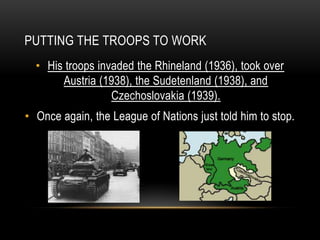
• His troops invaded the Rhineland (1936), took over
Austria (1938), the Sudetenland (1938), and
Czechoslovakia (1939).
• Once again, the League of Nations just told him to stop.

Totalitarian germany

  • 1.
  • 2.
    BACKGROUND INFORMATION • Germanywas devastated by World War I. • Reparations further destroyed the German economy. • The land Germany lost, both in the Treaty of Versailles and afterwards that France took as payment for reparations, was the most productive parts of Germany. • The Depression therefore hit Germany worse than anywhere else. • It was the perfect opportunity for a dictator to rise to power.
  • 3.
    • Hitler washeavily motivated by Mussolini's rise to power in Italy. • Hitler modeled Nazism after Italian Fascism. • The Nazi Party was officially the National Socialist German Workers party. (similar to Fascism and Communism!) NAZISM’S ITALIAN ROOTS
  • 4.
    • In 1923,Hitler first attempted to take over the Weimer Republic (German government after World War I) from, of all places, a bar! • He was sent to prison. HITLER’S FIRST ATTEMPT TO TAKE CHARGE Not your typical 1920s prison
  • 5.
    • Blamed othercountries for Germany’s hardships. • Discussed his hatred especially for the Jewish people. • Spoke of his desire to unite all German speaking people. • While in prison, Hitler wrote Mein Kampf (My Struggle), his autobiography. • He discussed his desires to create a new powerful Germany. • Claimed Germans were Aryans (a master race). MEIN KAMPF
  • 6.
    • The NaziParty became more popular • By 1932, Hitler, his book, and his Nazi Party were the most popular group in Germany. • German President Paul Von Hidenburg appointed Hitler to be the chancellor (what we would consider president!) AS THE DEPRESSION CONTINUED…..
  • 7.
    TO INCREASE HISPOWERS • Borrowing from Mussolini, Nazis used mass rallies, special salutes, and special troops called the Brown Shirts and used the swastika as its symbol. • He established the Gestapo, a secret police force. • He outlawed other political parties and imprisoned people who disagreed with him. • And he censored the news and promoted propaganda.
  • 8.
    THE FUHRER • Hitlernamed himself de Fuhrer (the leader). • As the leader, he took control of the economy, outlawed unions, and focused on building factories (which could be used to build weapons) and infrastructure (government stuff). • He ignored the Treaty of Versailles and began to remilitarize Germany.
  • 9.
    PUTTING THE TROOPSTO WORK • His troops invaded the Rhineland (1936), took over Austria (1938), the Sudetenland (1938), and Czechoslovakia (1939). • Once again, the League of Nations just told him to stop.